
A English
Crystal packing Questions in English
Class 12 Chemistry · Solid State · Crystal packing
281+
Questions
English
Language
100%
With Solutions
Showing 49 of 281 questions in English
101
MediumMCQ
If a compound (oxide) has an $hcp$ arrangement and the cations $M$ occupy two-thirds of the octahedral voids,the formula of the compound is:
A
$M_3O$
B
$M_3O_2$
C
$M_2O_3$
D
$M_3O_4$
Solution
(C) In an $hcp$ arrangement,the number of atoms per unit cell is $6$.
The number of octahedral voids is equal to the number of atoms in the lattice,which is $6$.
The cations $M$ occupy two-thirds of the octahedral voids,so the number of $M$ cations per unit cell is $\frac{2}{3} \times 6 = 4$.
The number of oxide ions $(O)$ per unit cell is $6$.
Therefore,the ratio of $M:O$ is $4:6$,which simplifies to $2:3$.
Thus,the formula of the compound is $M_2O_3$.
The number of octahedral voids is equal to the number of atoms in the lattice,which is $6$.
The cations $M$ occupy two-thirds of the octahedral voids,so the number of $M$ cations per unit cell is $\frac{2}{3} \times 6 = 4$.
The number of oxide ions $(O)$ per unit cell is $6$.
Therefore,the ratio of $M:O$ is $4:6$,which simplifies to $2:3$.
Thus,the formula of the compound is $M_2O_3$.
0 likes
View Solution102
DifficultMCQ
In the closest packing of atoms,there are
A
One tetrahedral void and two octahedral voids per atom
B
Two tetrahedral voids and one octahedral void per atom
C
Two of each tetrahedral and octahedral voids per atom
D
One of each tetrahedral and octahedral voids per atom
Solution
(B) In a closest packing of atoms (e.g.,$fcc$ or $ccp$),the number of atoms per unit cell is $n = 4$.
The number of tetrahedral voids $(TV)$ is $2n = 2 \times 4 = 8$.
The number of octahedral voids $(OV)$ is $n = 4$.
Therefore,the number of $TV$s per atom is $\frac{8}{4} = 2$.
The number of $OV$s per atom is $\frac{4}{4} = 1$.
Thus,there are $2$ tetrahedral voids and $1$ octahedral void per atom.
The number of tetrahedral voids $(TV)$ is $2n = 2 \times 4 = 8$.
The number of octahedral voids $(OV)$ is $n = 4$.
Therefore,the number of $TV$s per atom is $\frac{8}{4} = 2$.
The number of $OV$s per atom is $\frac{4}{4} = 1$.
Thus,there are $2$ tetrahedral voids and $1$ octahedral void per atom.
0 likes
View Solution103
EasyMCQ
The stacking pattern in a body-centered cubic $(bcc)$ lattice is of the type............
A
$A-A-A-A$
B
$A-B-A-B$
C
$A-B-C-A-B-C$
D
$A-A-B-A-A-B$
Solution
(B) In a body-centered cubic $(bcc)$ lattice,the spheres are arranged such that the second layer is placed in the depressions of the first layer,but the third layer is placed directly above the first layer. This creates an $A-B-A-B$ type of stacking pattern.
0 likes
View Solution104
EasyMCQ
Which of the following metals crystallizes in a hexagonal close-packed $(hcp)$ structure?
A
$Na$
B
$Cu$
C
$Mg$
D
$Ag$
Solution
(C) The crystal structure of metals depends on the arrangement of atoms.
$Na$ (Sodium) crystallizes in a body-centered cubic $(bcc)$ structure.
$Cu$ (Copper) and $Ag$ (Silver) crystallize in a face-centered cubic $(fcc)$ or cubic close-packed $(ccp)$ structure.
$Mg$ (Magnesium) crystallizes in a hexagonal close-packed $(hcp)$ structure.
Therefore,the correct option is $C$.
$Na$ (Sodium) crystallizes in a body-centered cubic $(bcc)$ structure.
$Cu$ (Copper) and $Ag$ (Silver) crystallize in a face-centered cubic $(fcc)$ or cubic close-packed $(ccp)$ structure.
$Mg$ (Magnesium) crystallizes in a hexagonal close-packed $(hcp)$ structure.
Therefore,the correct option is $C$.
0 likes
View Solution105
DifficultMCQ
Which of the following metals crystallizes in a cubic closest packing $(CCP)$ structure?
A
$Na$
B
$Zn$
C
$Mg$
D
$Ag$
Solution
(D) The crystal structures of the given metals are as follows:
$1$. $Na$ (Sodium) crystallizes in a Body-Centered Cubic $(BCC)$ structure.
$2$. $Zn$ (Zinc) crystallizes in a Hexagonal Close-Packed $(HCP)$ structure.
$3$. $Mg$ (Magnesium) crystallizes in a Hexagonal Close-Packed $(HCP)$ structure.
$4$. $Ag$ (Silver) crystallizes in a Cubic Closest Packing $(CCP)$ or Face-Centered Cubic $(FCC)$ structure.
Therefore,the correct option is $D$.
$1$. $Na$ (Sodium) crystallizes in a Body-Centered Cubic $(BCC)$ structure.
$2$. $Zn$ (Zinc) crystallizes in a Hexagonal Close-Packed $(HCP)$ structure.
$3$. $Mg$ (Magnesium) crystallizes in a Hexagonal Close-Packed $(HCP)$ structure.
$4$. $Ag$ (Silver) crystallizes in a Cubic Closest Packing $(CCP)$ or Face-Centered Cubic $(FCC)$ structure.
Therefore,the correct option is $D$.
0 likes
View Solution106
EasyMCQ
In a face-centered cubic $(FCC)$ close-packed structure,the third layer covers the ..... voids created between the first and second layers.
A
Tetrahedral
B
Octahedral
C
Both
D
None of these
Solution
(B) In a face-centered cubic $(FCC)$ or cubic close-packed $(CCP)$ structure,the arrangement follows an $ABCABC...$ pattern.
In the $ABC$ arrangement,the first layer is $A$,the second layer is $B$,and the third layer is $C$.
The second layer $(B)$ covers the tetrahedral voids of the first layer $(A)$.
The third layer $(C)$ covers the octahedral voids created between the first and second layers.
In the $ABC$ arrangement,the first layer is $A$,the second layer is $B$,and the third layer is $C$.
The second layer $(B)$ covers the tetrahedral voids of the first layer $(A)$.
The third layer $(C)$ covers the octahedral voids created between the first and second layers.
0 likes
View Solution107
EasyMCQ
In a hexagonal close-packed $(HCP)$ structure,the third layer covers the ........ holes created between the first and second layers.
A
Tetrahedral
B
Octahedral
C
Both
D
None of these
Solution
(A) In a hexagonal close-packed $(HCP)$ structure,the arrangement of layers follows an $ABAB...$ pattern.
When the second layer is placed over the first layer,tetrahedral holes are formed.
The third layer is placed directly above the first layer,which means it covers the tetrahedral holes created by the first and second layers.
When the second layer is placed over the first layer,tetrahedral holes are formed.
The third layer is placed directly above the first layer,which means it covers the tetrahedral holes created by the first and second layers.
0 likes
View Solution108
DifficultMCQ
In a face-centered cubic $(FCC)$ structure,the fraction of the total volume occupied by atoms is .... ($a =$ edge length)
A
$\pi / 6$
B
$\pi / 3\sqrt{2}$
C
$\pi / 4\sqrt{2}$
D
$\pi / 2\sqrt{2}$
Solution
(B) In an $FCC$ unit cell,the number of atoms per unit cell $(Z)$ is $4$.
The relationship between edge length $(a)$ and atomic radius $(r)$ is $a = 2\sqrt{2}r$.
The volume of $4$ atoms is $4 \times (\frac{4}{3} \pi r^3) = \frac{16}{3} \pi r^3$.
The volume of the unit cell is $a^3 = (2\sqrt{2}r)^3 = 16\sqrt{2}r^3$.
Packing fraction = $\frac{\text{Volume of atoms}}{\text{Volume of unit cell}} = \frac{\frac{16}{3} \pi r^3}{16\sqrt{2}r^3} = \frac{\pi}{3\sqrt{2}}$.
The relationship between edge length $(a)$ and atomic radius $(r)$ is $a = 2\sqrt{2}r$.
The volume of $4$ atoms is $4 \times (\frac{4}{3} \pi r^3) = \frac{16}{3} \pi r^3$.
The volume of the unit cell is $a^3 = (2\sqrt{2}r)^3 = 16\sqrt{2}r^3$.
Packing fraction = $\frac{\text{Volume of atoms}}{\text{Volume of unit cell}} = \frac{\frac{16}{3} \pi r^3}{16\sqrt{2}r^3} = \frac{\pi}{3\sqrt{2}}$.
0 likes
View Solution109
EasyMCQ
The void space in an $fcc$ structure is ..........
A
$1 - \pi /6$
B
$1 - \sqrt{2}\pi /3$
C
$1 - \sqrt{2}\pi /6$
D
$1 - \sqrt{3}\pi /4$
Solution
(C) In an $fcc$ structure,the packing efficiency is $\frac{\pi}{3\sqrt{2}}$.
The void space is calculated as $1 - \text{packing efficiency}$.
$\text{Void space} = 1 - \frac{\pi}{3\sqrt{2}}$.
To simplify,multiply the numerator and denominator by $\sqrt{2}$:
$\text{Void space} = 1 - \frac{\pi \times \sqrt{2}}{3\sqrt{2} \times \sqrt{2}} = 1 - \frac{\sqrt{2}\pi}{6}$.
The void space is calculated as $1 - \text{packing efficiency}$.
$\text{Void space} = 1 - \frac{\pi}{3\sqrt{2}}$.
To simplify,multiply the numerator and denominator by $\sqrt{2}$:
$\text{Void space} = 1 - \frac{\pi \times \sqrt{2}}{3\sqrt{2} \times \sqrt{2}} = 1 - \frac{\sqrt{2}\pi}{6}$.
0 likes
View Solution110
DifficultMCQ
When sodium is heated above $1000 \ K$,its crystal structure changes from $bcc$ to $fcc$. Assuming the metallic radius of the atom remains unchanged,the ratio of the fraction of volume occupied by atoms in $bcc$ and $fcc$ structures will be .......
A
$1.53$
B
$0.91$
C
$3.18$
D
$2.52$
Solution
(B) The packing fraction $(PF)$ of a crystal structure is defined as the fraction of the total volume occupied by the atoms.
For $bcc$,$Z_1 = 2$ and $4r = \sqrt{3}a_1$,so $PF_{bcc} = \frac{2 \times \frac{4}{3} \pi r^3}{a_1^3} = \frac{2 \times \frac{4}{3} \pi r^3}{(4r/\sqrt{3})^3} = \frac{\sqrt{3}\pi}{8} \approx 0.68$.
For $fcc$,$Z_2 = 4$ and $4r = \sqrt{2}a_2$,so $PF_{fcc} = \frac{4 \times \frac{4}{3} \pi r^3}{a_2^3} = \frac{4 \times \frac{4}{3} \pi r^3}{(4r/\sqrt{2})^3} = \frac{\pi}{3\sqrt{2}} \approx 0.74$.
The ratio of the fraction of volume occupied is $\frac{PF_{bcc}}{PF_{fcc}} = \frac{\sqrt{3}\pi / 8}{\pi / (3\sqrt{2})} = \frac{3\sqrt{6}}{8} = \frac{3 \times 2.449}{8} = \frac{7.347}{8} \approx 0.918 \approx 0.91$.
For $bcc$,$Z_1 = 2$ and $4r = \sqrt{3}a_1$,so $PF_{bcc} = \frac{2 \times \frac{4}{3} \pi r^3}{a_1^3} = \frac{2 \times \frac{4}{3} \pi r^3}{(4r/\sqrt{3})^3} = \frac{\sqrt{3}\pi}{8} \approx 0.68$.
For $fcc$,$Z_2 = 4$ and $4r = \sqrt{2}a_2$,so $PF_{fcc} = \frac{4 \times \frac{4}{3} \pi r^3}{a_2^3} = \frac{4 \times \frac{4}{3} \pi r^3}{(4r/\sqrt{2})^3} = \frac{\pi}{3\sqrt{2}} \approx 0.74$.
The ratio of the fraction of volume occupied is $\frac{PF_{bcc}}{PF_{fcc}} = \frac{\sqrt{3}\pi / 8}{\pi / (3\sqrt{2})} = \frac{3\sqrt{6}}{8} = \frac{3 \times 2.449}{8} = \frac{7.347}{8} \approx 0.918 \approx 0.91$.
0 likes
View Solution111
EasyMCQ
In a simple cubic lattice,what percentage of the space is left unoccupied by the spheres?
A
$52.36$
B
$68$
C
$47.64$
D
$32$
Solution
(C) The packing efficiency of a simple cubic lattice is $52.36\%$.
This means that $52.36\%$ of the total volume is occupied by the spheres.
The percentage of the space left unoccupied (void space) is calculated as:
$\text{Void space} = 100\% - \text{Packing efficiency}$
$\text{Void space} = 100\% - 52.36\% = 47.64\%$.
Therefore,the correct option is $C$.
This means that $52.36\%$ of the total volume is occupied by the spheres.
The percentage of the space left unoccupied (void space) is calculated as:
$\text{Void space} = 100\% - \text{Packing efficiency}$
$\text{Void space} = 100\% - 52.36\% = 47.64\%$.
Therefore,the correct option is $C$.
0 likes
View Solution112
EasyMCQ
In a crystal lattice,the number of octahedral voids compared to tetrahedral voids is ...............
A
Equal
B
Double
C
Half
D
Four times
Solution
(C) In a close-packed structure,if the number of atoms is $N$,then the number of octahedral voids is $N$ and the number of tetrahedral voids is $2N$.
Therefore,the number of octahedral voids is half the number of tetrahedral voids.
Therefore,the number of octahedral voids is half the number of tetrahedral voids.
0 likes
View Solution113
EasyMCQ
If the number of tetrahedral voids in a crystal lattice is $N$,then the number of close-packed spheres will be ..........
A
$N$
B
$2N$
C
$N/2$
D
$4N$
Solution
(C) In a close-packed structure,if the number of spheres is $n$,then the number of tetrahedral voids is $2n$.
Given that the number of tetrahedral voids is $N$,we have $2n = N$.
Therefore,the number of spheres $n = N/2$.
Given that the number of tetrahedral voids is $N$,we have $2n = N$.
Therefore,the number of spheres $n = N/2$.
0 likes
View Solution114
MediumMCQ
If the distance between the corner and the center of a cube is $x$,then the tetrahedral void will be at a distance of .... from the corner of the cube.
A
$x$
B
$2x$
C
$x/2$
D
$4x$
Solution
(C) In a cube of side length $a$,the distance from the corner to the center of the cube is half of the body diagonal.
Body diagonal = $\sqrt{3}a$.
Distance from corner to center $(x)$ = $\frac{\sqrt{3}a}{2}$.
Tetrahedral voids are located at a distance of $\frac{\sqrt{3}a}{4}$ from the corners.
Comparing the two,the distance of the tetrahedral void from the corner is $\frac{1}{2} \times (\frac{\sqrt{3}a}{2}) = \frac{x}{2}$.
Body diagonal = $\sqrt{3}a$.
Distance from corner to center $(x)$ = $\frac{\sqrt{3}a}{2}$.
Tetrahedral voids are located at a distance of $\frac{\sqrt{3}a}{4}$ from the corners.
Comparing the two,the distance of the tetrahedral void from the corner is $\frac{1}{2} \times (\frac{\sqrt{3}a}{2}) = \frac{x}{2}$.
0 likes
View Solution115
MediumMCQ
In a compound $XY$,the atoms of element $Y$ form a $ccp$ structure,while the atoms of element $X$ occupy $2/3$ of the tetrahedral voids. The molecular formula of the compound will be ..........
A
$X_2Y_3$
B
$X_4Y_3$
C
$X_3Y_4$
D
$X_3Y_2$
Solution
(B) Let the number of atoms of element $Y$ in the $ccp$ structure be $n = 4$.
The number of tetrahedral voids $(T.V.)$ is $2n = 2 \times 4 = 8$.
Given that element $X$ occupies $2/3$ of the tetrahedral voids,the number of $X$ atoms = $8 \times \frac{2}{3} = \frac{16}{3}$.
The ratio of $X:Y$ is $\frac{16}{3} : 4$,which simplifies to $16:12$ or $4:3$.
Therefore,the molecular formula is $X_4Y_3$.
The number of tetrahedral voids $(T.V.)$ is $2n = 2 \times 4 = 8$.
Given that element $X$ occupies $2/3$ of the tetrahedral voids,the number of $X$ atoms = $8 \times \frac{2}{3} = \frac{16}{3}$.
The ratio of $X:Y$ is $\frac{16}{3} : 4$,which simplifies to $16:12$ or $4:3$.
Therefore,the molecular formula is $X_4Y_3$.
0 likes
View Solution116
MediumMCQ
In a compound $XY$,the atoms of element $Y$ form an $fcc$ structure,while the atoms of element $X$ occupy $25\%$ of the tetrahedral voids. The molecular formula of the compound will be .......
A
$X_2Y_3$
B
$XY$
C
$XY_2$
D
$X_2Y$
Solution
(C) In an $fcc$ structure,the number of atoms of element $Y$ per unit cell is $4$.
The number of tetrahedral voids $(T.V.)$ is equal to $2 \times (\text{number of atoms}) = 2 \times 4 = 8$.
Element $X$ occupies $25\%$ of the tetrahedral voids,so the number of $X$ atoms $= 8 \times \frac{25}{100} = 8 \times \frac{1}{4} = 2$.
The ratio of $X:Y$ is $2:4$,which simplifies to $1:2$.
Therefore,the molecular formula of the compound is $XY_2$.
The number of tetrahedral voids $(T.V.)$ is equal to $2 \times (\text{number of atoms}) = 2 \times 4 = 8$.
Element $X$ occupies $25\%$ of the tetrahedral voids,so the number of $X$ atoms $= 8 \times \frac{25}{100} = 8 \times \frac{1}{4} = 2$.
The ratio of $X:Y$ is $2:4$,which simplifies to $1:2$.
Therefore,the molecular formula of the compound is $XY_2$.
0 likes
View Solution117
EasyMCQ
In an ionic solid compound,$A$ ions are at the corners of the cube and $B$ ions are at the center of each face. The molecular formula of the compound will be ..............
A
$AB$
B
$A_2B$
C
$AB_3$
D
$A_3B$
Solution
(C) Number of $A$ ions at the corners = $8 \times \frac{1}{8} = 1$
Number of $B$ ions at the face centers = $6 \times \frac{1}{2} = 3$
Therefore,the ratio of $A:B$ is $1:3$.
The molecular formula of the compound is $AB_3$.
Number of $B$ ions at the face centers = $6 \times \frac{1}{2} = 3$
Therefore,the ratio of $A:B$ is $1:3$.
The molecular formula of the compound is $AB_3$.
0 likes
View Solution118
DifficultMCQ
In a solid compound,the atoms of $A$ form a face-centered cubic $(fcc)$ lattice,while atoms of $B$ occupy all octahedral voids and half of the tetrahedral voids. The molecular formula of the solid will be ........
A
$AB_2$
B
$A_2B$
C
$A_4B_3$
D
$A_3B_4$
Solution
(A) In an $fcc$ lattice,the number of atoms of $A$ per unit cell is $4$.
The number of octahedral voids is equal to the number of atoms in the lattice,which is $4$.
The number of tetrahedral voids is twice the number of atoms in the lattice,which is $2 \times 4 = 8$.
Given that $B$ occupies all octahedral voids $(4)$ and half of the tetrahedral voids $(8 \times \frac{1}{2} = 4)$,the total number of $B$ atoms is $4 + 4 = 8$.
Thus,the ratio of $A:B$ is $4:8$,which simplifies to $1:2$.
Therefore,the molecular formula is $AB_2$.
The number of octahedral voids is equal to the number of atoms in the lattice,which is $4$.
The number of tetrahedral voids is twice the number of atoms in the lattice,which is $2 \times 4 = 8$.
Given that $B$ occupies all octahedral voids $(4)$ and half of the tetrahedral voids $(8 \times \frac{1}{2} = 4)$,the total number of $B$ atoms is $4 + 4 = 8$.
Thus,the ratio of $A:B$ is $4:8$,which simplifies to $1:2$.
Therefore,the molecular formula is $AB_2$.
0 likes
View Solution119
MediumMCQ
In a $ccp$ structure of a mixed oxide,$1/8$ of the tetrahedral voids are occupied by divalent $X^{+2}$ ions and $50\%$ of the octahedral voids are occupied by trivalent $Y^{+3}$ ions. The formula of the oxide is:
A
$X{Y_2}{O_4}$
B
$X_2{Y_3}{O_4}$
C
$X_4{Y_5}{O_{10}}$
D
$X{Y_4}{O_4}$
Solution
(A) Let the number of oxide ions $(O^{2-})$ in the $ccp$ lattice be $N = 4$.
Number of octahedral voids $(OV)$ = $N = 4$.
Number of tetrahedral voids $(TV)$ = $2N = 8$.
Given that $1/8$ of the $TV$ are occupied by $X^{+2}$ ions:
Number of $X^{+2}$ ions = $\frac{1}{8} \times 8 = 1$.
Given that $50\%$ of the $OV$ are occupied by $Y^{+3}$ ions:
Number of $Y^{+3}$ ions = $\frac{50}{100} \times 4 = 2$.
Thus,the ratio of $X : Y : O$ is $1 : 2 : 4$.
The formula of the oxide is $X{Y_2}{O_4}$.
Number of octahedral voids $(OV)$ = $N = 4$.
Number of tetrahedral voids $(TV)$ = $2N = 8$.
Given that $1/8$ of the $TV$ are occupied by $X^{+2}$ ions:
Number of $X^{+2}$ ions = $\frac{1}{8} \times 8 = 1$.
Given that $50\%$ of the $OV$ are occupied by $Y^{+3}$ ions:
Number of $Y^{+3}$ ions = $\frac{50}{100} \times 4 = 2$.
Thus,the ratio of $X : Y : O$ is $1 : 2 : 4$.
The formula of the oxide is $X{Y_2}{O_4}$.
0 likes
View Solution120
MediumMCQ
In a compound made of atoms $A$ and $B$,atoms $A$ form an $fcc$ lattice,while atoms $B$ occupy $25\%$ of the tetrahedral voids and $50\%$ of the octahedral voids. If the crystal is cut such that all face-centered atoms along one axis are removed,the molecular formula of the resulting solid will be ...........
A
$A_4B_4$
B
$A_4B_3$
C
$A_3B_4$
D
$A_2B_3$
Solution
(C) $1$. In an $fcc$ unit cell,the number of atoms $A$ at corners is $8 \times (1/8) = 1$ and at face centers is $6 \times (1/2) = 3$. Total $A = 4$.
$2$. Number of tetrahedral voids = $2 \times 4 = 8$. Number of octahedral voids = $4$.
$3$. Atoms $B$ occupy $25\%$ of tetrahedral voids $(8 \times 0.25 = 2)$ and $50\%$ of octahedral voids $(4 \times 0.50 = 2)$. Total $B = 4$.
$4$. If atoms along one axis are removed,two face-centered atoms are removed. New number of $A = 4 - 2 = 2$. The corner atoms remain $1$. Total $A = 3$.
$5$. The number of voids remains unchanged as the lattice framework is intact. Total $B = 4$.
$6$. The resulting formula is $A_3B_4$.
$2$. Number of tetrahedral voids = $2 \times 4 = 8$. Number of octahedral voids = $4$.
$3$. Atoms $B$ occupy $25\%$ of tetrahedral voids $(8 \times 0.25 = 2)$ and $50\%$ of octahedral voids $(4 \times 0.50 = 2)$. Total $B = 4$.
$4$. If atoms along one axis are removed,two face-centered atoms are removed. New number of $A = 4 - 2 = 2$. The corner atoms remain $1$. Total $A = 3$.
$5$. The number of voids remains unchanged as the lattice framework is intact. Total $B = 4$.
$6$. The resulting formula is $A_3B_4$.
0 likes
View Solution121
DifficultMCQ
In a $ccp$ structure of $X$ atoms,$Y$ atoms occupy half of the octahedral voids. If one $X$ atom and one $Y$ atom in each unit cell are replaced by a $Z$ atom,the molecular formula of the solid will be:
A
$X_4Y_2Z_2$
B
$X_3YZ_2$
C
$X_3Y_2Z_2$
D
$X_3Y_3Z$
Solution
(B) In a $ccp$ structure,the number of $X$ atoms per unit cell is $4$.
The number of octahedral voids is equal to the number of atoms,which is $4$.
$Y$ atoms occupy half of the octahedral voids,so the number of $Y$ atoms is $4 \times \frac{1}{2} = 2$.
If one $X$ atom is replaced by $Z$,the remaining $X$ atoms = $4 - 1 = 3$.
If one $Y$ atom is replaced by $Z$,the remaining $Y$ atoms = $2 - 1 = 1$.
The total number of $Z$ atoms introduced is $1 + 1 = 2$.
Thus,the ratio of $X:Y:Z$ is $3:1:2$.
The molecular formula is $X_3YZ_2$.
The number of octahedral voids is equal to the number of atoms,which is $4$.
$Y$ atoms occupy half of the octahedral voids,so the number of $Y$ atoms is $4 \times \frac{1}{2} = 2$.
If one $X$ atom is replaced by $Z$,the remaining $X$ atoms = $4 - 1 = 3$.
If one $Y$ atom is replaced by $Z$,the remaining $Y$ atoms = $2 - 1 = 1$.
The total number of $Z$ atoms introduced is $1 + 1 = 2$.
Thus,the ratio of $X:Y:Z$ is $3:1:2$.
The molecular formula is $X_3YZ_2$.
0 likes
View Solution122
MediumMCQ
In a $ccp$ structure of $X$ atoms,$Y$ atoms occupy the octahedral voids. If two $X$ atoms at the corners are replaced by $Z$ atoms,the molecular formula of the solid will be:
A
$X_{15}Y_{16}Z$
B
$X_7Y_8Z$
C
$X_{7.5}Y_8Z$
D
$X_8Y_8Z_3$
Solution
(A) In a $ccp$ unit cell,the total number of $X$ atoms at corners and face centers is $4$. The number of octahedral voids is equal to the number of atoms,which is $4$.
Number of $X$ atoms remaining after replacing $2$ corner atoms: $X = 4 - (2 \times \frac{1}{8}) = 4 - \frac{1}{4} = \frac{15}{4}$.
Number of $Y$ atoms in octahedral voids: $Y = 4$.
Number of $Z$ atoms replacing corner atoms: $Z = 2 \times \frac{1}{8} = \frac{1}{4}$.
The ratio is $X : Y : Z = \frac{15}{4} : 4 : \frac{1}{4}$.
Multiplying by $4$,we get $X_{15}Y_{16}Z$.
Number of $X$ atoms remaining after replacing $2$ corner atoms: $X = 4 - (2 \times \frac{1}{8}) = 4 - \frac{1}{4} = \frac{15}{4}$.
Number of $Y$ atoms in octahedral voids: $Y = 4$.
Number of $Z$ atoms replacing corner atoms: $Z = 2 \times \frac{1}{8} = \frac{1}{4}$.
The ratio is $X : Y : Z = \frac{15}{4} : 4 : \frac{1}{4}$.
Multiplying by $4$,we get $X_{15}Y_{16}Z$.
0 likes
View Solution123
MediumMCQ
In a compound formed by atoms $A$ and $B$, atoms $A$ form a cubic close-packed $(CCP)$ structure, while atoms $B$ are located at the center of each edge. If the edge length of the cubic unit cell is $115 \ pm$, the distance of atom $A$ from the center of the cube is .......... $pm$.
A
$57.5$
B
$81.3$
C
$40.6$
D
$99.5$
Solution
(B) In a $CCP$ structure, atoms $A$ are at the corners and face centers. The center of the cube is the body center.
Distance of a corner atom from the body center is $\frac{\sqrt{3}a}{2}$.
Distance of a face-centered atom from the body center is $\frac{a}{\sqrt{2}}$.
Since the question asks for the distance of $A$ from the center, and $A$ occupies both corners and face centers, the distance of the corner atom is $\frac{\sqrt{3} \times 115}{2} \approx 99.5 \ pm$ and the distance of the face-centered atom is $\frac{115}{\sqrt{2}} \approx 81.3 \ pm$.
Given the options, $81.3 \ pm$ is the correct distance for the face-centered atom $A$ from the center of the cube.
Distance of a corner atom from the body center is $\frac{\sqrt{3}a}{2}$.
Distance of a face-centered atom from the body center is $\frac{a}{\sqrt{2}}$.
Since the question asks for the distance of $A$ from the center, and $A$ occupies both corners and face centers, the distance of the corner atom is $\frac{\sqrt{3} \times 115}{2} \approx 99.5 \ pm$ and the distance of the face-centered atom is $\frac{115}{\sqrt{2}} \approx 81.3 \ pm$.
Given the options, $81.3 \ pm$ is the correct distance for the face-centered atom $A$ from the center of the cube.
0 likes
View Solution124
DifficultMCQ
The radius ratio of cation to anion for a triangular void is ....
A
$0.414 - 0.732$
B
$0.225 - 0.414$
C
$0.732 - 1.000$
D
$0.155 - 0.225$
Solution
(D) For a triangular void,the coordination number is $3$.
The limiting radius ratio $(r_+ / r_-)$ for a coordination number of $3$ is $0.155$.
Therefore,the range for a triangular void is $0.155 \le r_+ / r_- < 0.225$.
The limiting radius ratio $(r_+ / r_-)$ for a coordination number of $3$ is $0.155$.
Therefore,the range for a triangular void is $0.155 \le r_+ / r_- < 0.225$.
0 likes
View Solution125
EasyMCQ
In which of the following crystals are all the tetrahedral voids occupied?
A
$NaCl$
B
$CsCl$
C
$ZnS$
D
$Na_2O$
Solution
(D) In the $ZnS$ (zinc blende) structure,$S^{2-}$ ions form a $ccp$ (cubic close packing) lattice.
There are $4$ $S^{2-}$ ions per unit cell.
The number of tetrahedral voids is $2 \times (\text{number of atoms}) = 2 \times 4 = 8$.
In $ZnS$,$Zn^{2+}$ ions occupy half of the tetrahedral voids,so $4$ tetrahedral voids are occupied.
In the $Na_2O$ (antifluorite) structure,$O^{2-}$ ions form a $ccp$ lattice.
There are $4$ $O^{2-}$ ions per unit cell.
The number of tetrahedral voids is $8$.
In $Na_2O$,$Na^{+}$ ions occupy all $8$ tetrahedral voids.
Therefore,in $Na_2O$,all tetrahedral voids are occupied.
There are $4$ $S^{2-}$ ions per unit cell.
The number of tetrahedral voids is $2 \times (\text{number of atoms}) = 2 \times 4 = 8$.
In $ZnS$,$Zn^{2+}$ ions occupy half of the tetrahedral voids,so $4$ tetrahedral voids are occupied.
In the $Na_2O$ (antifluorite) structure,$O^{2-}$ ions form a $ccp$ lattice.
There are $4$ $O^{2-}$ ions per unit cell.
The number of tetrahedral voids is $8$.
In $Na_2O$,$Na^{+}$ ions occupy all $8$ tetrahedral voids.
Therefore,in $Na_2O$,all tetrahedral voids are occupied.
0 likes
View Solution126
EasyMCQ
The spinel structure consists of ............
A
Simple cubic structure
B
$bcc$ structure of anions
C
$ccp$ structure of anions
D
$hcp$ structure of anions
Solution
(C) The spinel structure is a type of crystal structure with the general formula $AB_2O_4$. In this structure,the oxide ions $(O^{2-})$ form a cubic close-packed $(ccp)$ or face-centered cubic $(fcc)$ lattice. The metal cations occupy the tetrahedral and octahedral voids within this lattice.
0 likes
View Solution127
MediumMCQ
Which one of the following statements about packing in solids is incorrect?
A
Coordination number in $bcc$ mode of packing is $8$.
B
Coordination number in $hcp$ mode of packing is $12$.
C
Void space in $hcp$ mode of packing is $32\%$.
D
Void space in $ccp$ mode of packing is $26\%$.
Solution
(C) In $hcp$ and $ccp$ arrangements,the packing efficiency is $74\%$.
Therefore,the void space (empty space) is $100\% - 74\% = 26\%$.
Statement $C$ claims the void space in $hcp$ is $32\%$,which is incorrect.
Therefore,the void space (empty space) is $100\% - 74\% = 26\%$.
Statement $C$ claims the void space in $hcp$ is $32\%$,which is incorrect.
0 likes
View Solution128
DifficultMCQ
Assertion : In close packing of spheres,a tetrahedral void is surrounded by four spheres whereas an octahedral void is surrounded by six spheres.
Reason : $A$ tetrahedral void has a tetrahedral shape whereas an octahedral void has an octahedral shape.
Reason : $A$ tetrahedral void has a tetrahedral shape whereas an octahedral void has an octahedral shape.
A
If both Assertion and Reason are correct and the Reason is a correct explanation of the Assertion.
B
If both Assertion and Reason are correct but Reason is not a correct explanation of the Assertion.
C
If the Assertion is correct but Reason is incorrect.
D
If both the Assertion and Reason are incorrect.
Solution
(A) The Assertion is correct because a tetrahedral void is formed by the contact of $4$ spheres,and an octahedral void is formed by the contact of $6$ spheres.
The Reason is also correct because the names 'tetrahedral' and 'octahedral' are derived from the geometric arrangement of the spheres surrounding the void.
Since the number of surrounding spheres directly determines the geometry of the void,the Reason correctly explains the Assertion.
The Reason is also correct because the names 'tetrahedral' and 'octahedral' are derived from the geometric arrangement of the spheres surrounding the void.
Since the number of surrounding spheres directly determines the geometry of the void,the Reason correctly explains the Assertion.
0 likes
View Solution129
AdvancedMCQ
$A$ compound is formed by cation $C$ and anion $A$. The anions form hexagonal close packed $(hcp)$ lattice and the cations occupy $75 \%$ of octahedral voids. The formula of the compound is
A
$C_{2}A_{3}$
B
$C_{3}A_{2}$
C
$C_{3}A_{4}$
D
$C_{4}A_{3}$
Solution
(C) In a hexagonal close packed $(hcp)$ lattice,the number of anions $(A)$ per unit cell is $6$.
The number of octahedral voids in an $hcp$ lattice is equal to the number of atoms,which is $6$.
The cations $(C)$ occupy $75 \%$ of these octahedral voids.
Number of cations $(C) = 6 \times \frac{75}{100} = 6 \times \frac{3}{4} = \frac{18}{4} = 4.5$ or $\frac{9}{2}$.
The ratio of cations $(C)$ to anions $(A)$ is $\frac{9}{2} : 6$.
Multiplying both sides by $2$,we get $9 : 12$.
Simplifying the ratio by dividing by $3$,we get $3 : 4$.
Therefore,the formula of the compound is $C_{3}A_{4}$.
The number of octahedral voids in an $hcp$ lattice is equal to the number of atoms,which is $6$.
The cations $(C)$ occupy $75 \%$ of these octahedral voids.
Number of cations $(C) = 6 \times \frac{75}{100} = 6 \times \frac{3}{4} = \frac{18}{4} = 4.5$ or $\frac{9}{2}$.
The ratio of cations $(C)$ to anions $(A)$ is $\frac{9}{2} : 6$.
Multiplying both sides by $2$,we get $9 : 12$.
Simplifying the ratio by dividing by $3$,we get $3 : 4$.
Therefore,the formula of the compound is $C_{3}A_{4}$.
0 likes
View Solution130
MediumMCQ
$A$ compound is formed by two elements $X$ and $Y$. Atoms of the element $Y$ (as anions) make $ccp$ and those of the element $X$ (as cations) occupy all the octahedral voids. What is the formula of the compound?
A
$XY$
B
$XY_2$
C
$X_2Y$
D
$X_3Y_4$
Solution
(A) The $ccp$ lattice is formed by the element $Y$.
The number of octahedral voids generated is equal to the number of atoms of $Y$ present in the lattice.
Since all the octahedral voids are occupied by the atoms of $X$,the number of atoms of $X$ is equal to the number of atoms of $Y$.
Thus,the ratio of atoms of $X$ to $Y$ is $1:1$.
Therefore,the formula of the compound is $XY$.
The number of octahedral voids generated is equal to the number of atoms of $Y$ present in the lattice.
Since all the octahedral voids are occupied by the atoms of $X$,the number of atoms of $X$ is equal to the number of atoms of $Y$.
Thus,the ratio of atoms of $X$ to $Y$ is $1:1$.
Therefore,the formula of the compound is $XY$.
0 likes
View Solution131
MediumMCQ
Atoms of element $B$ form $hcp$ lattice and those of the element $A$ occupy $2/3$ of tetrahedral voids. What is the formula of the compound formed by the elements $A$ and $B$?
A
$A_4B_3$
B
$A_3B_4$
C
$A_2B_3$
D
$A_3B_2$
Solution
(A) Let the number of atoms of element $B$ in the $hcp$ lattice be $n$.
Number of tetrahedral voids = $2n$.
Number of tetrahedral voids occupied by atoms of element $A$ = $(2/3) \times 2n = 4n/3$.
Ratio of atoms $A : B = (4n/3) : n = 4/3 : 1 = 4 : 3$.
Therefore,the formula of the compound is $A_4B_3$.
Number of tetrahedral voids = $2n$.
Number of tetrahedral voids occupied by atoms of element $A$ = $(2/3) \times 2n = 4n/3$.
Ratio of atoms $A : B = (4n/3) : n = 4/3 : 1 = 4 : 3$.
Therefore,the formula of the compound is $A_4B_3$.
0 likes
View Solution132
Easy
$A$ compound forms a hexagonal close-packed $(HCP)$ structure. What is the total number of voids in $0.5 \ mol$ of it? How many of these are tetrahedral voids?
Solution
Let the number of close-packed particles be $N$.
Given,$N = 0.5 \ mol = 0.5 \times 6.022 \times 10^{23} = 3.011 \times 10^{23}$ particles.
In a close-packed structure:
Number of octahedral voids $= N = 3.011 \times 10^{23}$.
Number of tetrahedral voids $= 2N = 2 \times 3.011 \times 10^{23} = 6.022 \times 10^{23}$.
Total number of voids $= N + 2N = 3N = 3 \times 3.011 \times 10^{23} = 9.033 \times 10^{23}$.
Thus,the total number of voids is $9.033 \times 10^{23}$ and the number of tetrahedral voids is $6.022 \times 10^{23}$.
Given,$N = 0.5 \ mol = 0.5 \times 6.022 \times 10^{23} = 3.011 \times 10^{23}$ particles.
In a close-packed structure:
Number of octahedral voids $= N = 3.011 \times 10^{23}$.
Number of tetrahedral voids $= 2N = 2 \times 3.011 \times 10^{23} = 6.022 \times 10^{23}$.
Total number of voids $= N + 2N = 3N = 3 \times 3.011 \times 10^{23} = 9.033 \times 10^{23}$.
Thus,the total number of voids is $9.033 \times 10^{23}$ and the number of tetrahedral voids is $6.022 \times 10^{23}$.
0 likes
View Solution133
MediumMCQ
$A$ compound is formed by two elements $M$ and $N$. The element $N$ forms $ccp$ lattice and atoms of $M$ occupy $1/3$ of the tetrahedral voids. What is the formula of the compound?
A
$M_3N_2$
B
$M_2N_3$
C
$MN_3$
D
$M_3N$
Solution
(B) The $ccp$ lattice is formed by the atoms of element $N$. Let the number of atoms of $N$ be $x$.
The number of tetrahedral voids is $2x$.
According to the problem,atoms of $M$ occupy $1/3$ of the tetrahedral voids,so the number of atoms of $M$ is $(1/3) \times 2x = 2x/3$.
The ratio of atoms $M:N$ is $(2x/3) : x = 2/3 : 1 = 2:3$.
Therefore,the formula of the compound is $M_2N_3$.
The number of tetrahedral voids is $2x$.
According to the problem,atoms of $M$ occupy $1/3$ of the tetrahedral voids,so the number of atoms of $M$ is $(1/3) \times 2x = 2x/3$.
The ratio of atoms $M:N$ is $(2x/3) : x = 2/3 : 1 = 2:3$.
Therefore,the formula of the compound is $M_2N_3$.
0 likes
View Solution134
MediumMCQ
Which of the following lattices has the highest packing efficiency: $(i)$ simple cubic,$(ii)$ body-centred cubic,and $(iii)$ hexagonal close-packed lattice?
A
$(i)$
B
$(ii)$
C
$(iii)$
D
All have the same efficiency
Solution
(C) The packing efficiency of a crystal lattice is the fraction of space occupied by the constituent particles.
- Simple cubic lattice: $52.4 \%$
- Body-centred cubic $(BCC)$ lattice: $68 \%$
- Hexagonal close-packed $(HCP)$ lattice: $74 \%$
Therefore,the hexagonal close-packed lattice has the highest packing efficiency.
- Simple cubic lattice: $52.4 \%$
- Body-centred cubic $(BCC)$ lattice: $68 \%$
- Hexagonal close-packed $(HCP)$ lattice: $74 \%$
Therefore,the hexagonal close-packed lattice has the highest packing efficiency.
0 likes
View Solution135
Easy
How will you distinguish between the following pairs of terms:
$(i)$ Hexagonal close-packing $(hcp)$ and cubic close-packing $(ccp)$?
$(i)$ Hexagonal close-packing $(hcp)$ and cubic close-packing $(ccp)$?
Solution
(N/A) $(i)$ In $hcp$,the third layer is placed over the second layer such that the spheres of the third layer occupy the tetrahedral voids of the second layer. This results in an $ABAB...$ pattern of layers,where the spheres of the third layer are directly above the spheres of the first layer.
In $ccp$,the third layer is placed over the second layer such that the spheres of the third layer occupy the octahedral voids of the second layer. This results in an $ABCABC...$ pattern of layers,where the spheres of the fourth layer are directly above the spheres of the first layer.
In $ccp$,the third layer is placed over the second layer such that the spheres of the third layer occupy the octahedral voids of the second layer. This results in an $ABCABC...$ pattern of layers,where the spheres of the fourth layer are directly above the spheres of the first layer.
0 likes
View Solution136
Easy
How will you distinguish between the following pairs of terms:
$(iii)$ Tetrahedral void and octahedral void?
$(iii)$ Tetrahedral void and octahedral void?
Solution
(N/A) $(iii)$ $A$ void surrounded by $4$ spheres is called a tetrahedral void,whereas a void surrounded by $6$ spheres is called an octahedral void. $A$ tetrahedral void is formed when $4$ spheres are arranged at the corners of a regular tetrahedron,while an octahedral void is formed when $6$ spheres are arranged at the corners of a regular octahedron.
0 likes
View Solution137
Easy
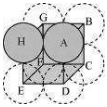
Calculate the packing efficiency in a simple cubic metal crystal.
Solution
(N/A) Simple cubic lattice:
In a simple cubic lattice,the particles are located only at the corners of the cube and touch each other along the edge.
Let the edge length of the cube be $a$ and the radius of each particle be $r$.
So,we can write: $a = 2r$.
Now,volume of the cubic unit cell $= a^3 = (2r)^3 = 8r^3$.
We know that the number of particles per unit cell is $1$.
Therefore,volume of the occupied unit cell $= \frac{4}{3} \pi r^3$.
Hence,packing efficiency $= \frac{\text{Volume of one particle}}{\text{Volume of cubic unit cell}} \times 100 \%$.
Packing efficiency $= \frac{\frac{4}{3} \pi r^3}{8r^3} \times 100 \% = \frac{\pi}{6} \times 100 \%$.
Using $\pi \approx 3.14159$,packing efficiency $\approx \frac{3.14159}{6} \times 100 \% \approx 52.36 \% \approx 52.4 \%$.
In a simple cubic lattice,the particles are located only at the corners of the cube and touch each other along the edge.
Let the edge length of the cube be $a$ and the radius of each particle be $r$.
So,we can write: $a = 2r$.
Now,volume of the cubic unit cell $= a^3 = (2r)^3 = 8r^3$.
We know that the number of particles per unit cell is $1$.
Therefore,volume of the occupied unit cell $= \frac{4}{3} \pi r^3$.
Hence,packing efficiency $= \frac{\text{Volume of one particle}}{\text{Volume of cubic unit cell}} \times 100 \%$.
Packing efficiency $= \frac{\frac{4}{3} \pi r^3}{8r^3} \times 100 \% = \frac{\pi}{6} \times 100 \%$.
Using $\pi \approx 3.14159$,packing efficiency $\approx \frac{3.14159}{6} \times 100 \% \approx 52.36 \% \approx 52.4 \%$.
0 likes
View Solution138
Easy
Calculate the packing efficiency of a metal crystal for a body-centred cubic $(BCC)$ structure.
Solution
(N/A) In a body-centred cubic $(BCC)$ unit cell,the atom at the centre is in contact with the other two atoms diagonally arranged along the body diagonal.
From the geometry of the cube,let the edge length be $a$ and the radius of the atom be $r$.
The face diagonal $b$ is given by:
$b^{2} = a^{2} + a^{2} = 2a^{2}$
$b = \sqrt{2}a$
The body diagonal $c$ is given by:
$c^{2} = a^{2} + b^{2} = a^{2} + 2a^{2} = 3a^{2}$
$c = \sqrt{3}a$
Since the atoms along the body diagonal touch each other,the length of the body diagonal is $c = 4r$.
Therefore,$\sqrt{3}a = 4r$,which gives $a = \frac{4r}{\sqrt{3}}$.
The volume of the unit cell is $a^{3} = \left(\frac{4r}{\sqrt{3}}\right)^{3} = \frac{64r^{3}}{3\sqrt{3}}$.
$A$ $BCC$ unit cell contains $2$ atoms. The volume occupied by these $2$ atoms is:
$V_{occupied} = 2 \times \frac{4}{3} \pi r^{3} = \frac{8}{3} \pi r^{3}$.
Packing efficiency is calculated as:
$\text{Packing Efficiency} = \frac{\text{Volume of } 2 \text{ atoms}}{\text{Total volume of unit cell}} \times 100\%$
$= \frac{\frac{8}{3} \pi r^{3}}{\frac{64r^{3}}{3\sqrt{3}}} \times 100\%$
$= \frac{8\pi}{3} \times \frac{3\sqrt{3}}{64} \times 100\%$
$= \frac{\sqrt{3}\pi}{8} \times 100\% \approx 68\%$.
From the geometry of the cube,let the edge length be $a$ and the radius of the atom be $r$.
The face diagonal $b$ is given by:
$b^{2} = a^{2} + a^{2} = 2a^{2}$
$b = \sqrt{2}a$
The body diagonal $c$ is given by:
$c^{2} = a^{2} + b^{2} = a^{2} + 2a^{2} = 3a^{2}$
$c = \sqrt{3}a$
Since the atoms along the body diagonal touch each other,the length of the body diagonal is $c = 4r$.
Therefore,$\sqrt{3}a = 4r$,which gives $a = \frac{4r}{\sqrt{3}}$.
The volume of the unit cell is $a^{3} = \left(\frac{4r}{\sqrt{3}}\right)^{3} = \frac{64r^{3}}{3\sqrt{3}}$.
$A$ $BCC$ unit cell contains $2$ atoms. The volume occupied by these $2$ atoms is:
$V_{occupied} = 2 \times \frac{4}{3} \pi r^{3} = \frac{8}{3} \pi r^{3}$.
Packing efficiency is calculated as:
$\text{Packing Efficiency} = \frac{\text{Volume of } 2 \text{ atoms}}{\text{Total volume of unit cell}} \times 100\%$
$= \frac{\frac{8}{3} \pi r^{3}}{\frac{64r^{3}}{3\sqrt{3}}} \times 100\%$
$= \frac{8\pi}{3} \times \frac{3\sqrt{3}}{64} \times 100\%$
$= \frac{\sqrt{3}\pi}{8} \times 100\% \approx 68\%$.
0 likes
View Solution139
Easy
Calculate the packing efficiency in a metal crystal for a face-centred cubic $(FCC)$ unit cell (assuming that atoms are touching each other).
Solution
(N/A) For a face-centred cubic $(FCC)$ unit cell:
Let the edge length of the unit cell be $a$ and the length of the face diagonal $AC$ be $b$.
From $\triangle ABC$,we have:
$AC^{2} = BC^{2} + AB^{2}$
$\Rightarrow b^{2} = a^{2} + a^{2}$
$\Rightarrow b^{2} = 2a^{2}$
$\Rightarrow b = \sqrt{2}a$
Let $r$ be the radius of the atom.
From the figure,it can be observed that the face diagonal $b = 4r$.
$\Rightarrow \sqrt{2}a = 4r$
$\Rightarrow a = \frac{4r}{\sqrt{2}} = 2\sqrt{2}r$
Volume of the unit cell = $a^{3} = (2\sqrt{2}r)^{3} = 16\sqrt{2}r^{3}$.
An $FCC$ unit cell contains $4$ atoms.
Volume of $4$ atoms = $4 \times \frac{4}{3}\pi r^{3} = \frac{16}{3}\pi r^{3}$.
Packing efficiency = $\frac{\text{Volume of 4 atoms}}{\text{Total volume of unit cell}} \times 100\%$
$= \frac{\frac{16}{3}\pi r^{3}}{16\sqrt{2}r^{3}} \times 100\%$
$= \frac{\pi}{3\sqrt{2}} \times 100\% \approx 74\%$
Let the edge length of the unit cell be $a$ and the length of the face diagonal $AC$ be $b$.
From $\triangle ABC$,we have:
$AC^{2} = BC^{2} + AB^{2}$
$\Rightarrow b^{2} = a^{2} + a^{2}$
$\Rightarrow b^{2} = 2a^{2}$
$\Rightarrow b = \sqrt{2}a$
Let $r$ be the radius of the atom.
From the figure,it can be observed that the face diagonal $b = 4r$.
$\Rightarrow \sqrt{2}a = 4r$
$\Rightarrow a = \frac{4r}{\sqrt{2}} = 2\sqrt{2}r$
Volume of the unit cell = $a^{3} = (2\sqrt{2}r)^{3} = 16\sqrt{2}r^{3}$.
An $FCC$ unit cell contains $4$ atoms.
Volume of $4$ atoms = $4 \times \frac{4}{3}\pi r^{3} = \frac{16}{3}\pi r^{3}$.
Packing efficiency = $\frac{\text{Volume of 4 atoms}}{\text{Total volume of unit cell}} \times 100\%$
$= \frac{\frac{16}{3}\pi r^{3}}{16\sqrt{2}r^{3}} \times 100\%$
$= \frac{\pi}{3\sqrt{2}} \times 100\% \approx 74\%$
0 likes
View Solution140
Easy
If the radius of the octahedral void is $r$ and the radius of the atoms in close packing is $R$,derive the relation between $r$ and $R$.
Solution
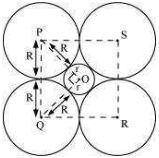
(N/A) Consider a square plane of four atoms in close packing with an octahedral void at the center $O$. Let the centers of two adjacent atoms be $P$ and $Q$.
From the geometry of the octahedral void,we can form a right-angled triangle $\triangle POQ$ where the hypotenuse $PQ = 2R$ and the sides $PO = OQ = R + r$.
Applying the Pythagoras theorem in $\triangle POQ$:
$PQ^{2} = PO^{2} + OQ^{2}$
$(2R)^{2} = (R + r)^{2} + (R + r)^{2}$
$4R^{2} = 2(R + r)^{2}$
$2R^{2} = (R + r)^{2}$
Taking the square root on both sides:
$\sqrt{2}R = R + r$
$r = \sqrt{2}R - R$
$r = (\sqrt{2} - 1)R$
Since $\sqrt{2} \approx 1.414$,we get:
$r = 0.414R$
From the geometry of the octahedral void,we can form a right-angled triangle $\triangle POQ$ where the hypotenuse $PQ = 2R$ and the sides $PO = OQ = R + r$.
Applying the Pythagoras theorem in $\triangle POQ$:
$PQ^{2} = PO^{2} + OQ^{2}$
$(2R)^{2} = (R + r)^{2} + (R + r)^{2}$
$4R^{2} = 2(R + r)^{2}$
$2R^{2} = (R + r)^{2}$
Taking the square root on both sides:
$\sqrt{2}R = R + r$
$r = \sqrt{2}R - R$
$r = (\sqrt{2} - 1)R$
Since $\sqrt{2} \approx 1.414$,we get:
$r = 0.414R$
0 likes
View Solution141
Easy
Ferric oxide crystallises in a hexagonal close-packed array of oxide ions with two out of every three octahedral holes occupied by ferric ions. Derive the formula of the ferric oxide.
Solution
(D) Let the number of oxide $(O^{2-})$ ions be $x$.
Since the oxide ions form a hexagonal close-packed $(HCP)$ array,the number of octahedral voids is equal to the number of oxide ions,which is $x$.
It is given that two out of every three octahedral holes are occupied by ferric ions.
So,the number of ferric $(Fe^{3+})$ ions $= \frac{2}{3}x$.
Therefore,the ratio of the number of $Fe^{3+}$ ions to the number of $O^{2-}$ ions is $Fe^{3+} : O^{2-} = \frac{2}{3}x : x = \frac{2}{3} : 1 = 2 : 3$.
Hence,the formula of the ferric oxide is $Fe_{2}O_{3}$.
Since the oxide ions form a hexagonal close-packed $(HCP)$ array,the number of octahedral voids is equal to the number of oxide ions,which is $x$.
It is given that two out of every three octahedral holes are occupied by ferric ions.
So,the number of ferric $(Fe^{3+})$ ions $= \frac{2}{3}x$.
Therefore,the ratio of the number of $Fe^{3+}$ ions to the number of $O^{2-}$ ions is $Fe^{3+} : O^{2-} = \frac{2}{3}x : x = \frac{2}{3} : 1 = 2 : 3$.
Hence,the formula of the ferric oxide is $Fe_{2}O_{3}$.
0 likes
View Solution142
EasyMCQ
How many unit cells share a corner of a unit cell in a crystal lattice?
A
$4$
B
$6$
C
$8$
D
$12$
Solution
(C) In a simple cubic crystal lattice,each corner of a unit cell is shared by $8$ adjacent unit cells.
This is because each corner point is common to $8$ cubes meeting at that point in three-dimensional space.
This is because each corner point is common to $8$ cubes meeting at that point in three-dimensional space.
0 likes
View Solution143
EasyMCQ
What are open structures in the context of crystal lattices?
A
Structures with high packing efficiency
B
Structures with low packing efficiency where atoms occupy only a small fraction of the available space
C
Structures where atoms are arranged in a close-packed manner
D
Structures that are completely filled with atoms
Solution
(B) In crystal chemistry,an open structure refers to a crystal lattice arrangement where the atoms occupy a relatively small fraction of the total available volume.
This typically occurs in structures with low packing efficiency,such as the simple cubic $(sc)$ lattice,where the packing fraction is only about $52.4\%$.
In such structures,there is a significant amount of empty space (voids) between the constituent particles.
This typically occurs in structures with low packing efficiency,such as the simple cubic $(sc)$ lattice,where the packing fraction is only about $52.4\%$.
In such structures,there is a significant amount of empty space (voids) between the constituent particles.
0 likes
View Solution144
EasyMCQ
What is the full form of $fcc$?
A
Face-centered cubic
B
Face-centered crystal
C
Fast-centered cubic
D
Face-centered cell
Solution
(A) The full form of $fcc$ is $Face-centered \ cubic$ unit cell. In this type of unit cell,the constituent particles are present at all the corners and at the center of each face of the cube.
0 likes
View Solution145
Difficult
Explain close packing in one dimension. Explain close packing in two dimensions.
Solution
(N/A) The spheres in one dimension can be arranged only in one way,that is,to arrange them in a row and touching each other.
Close packing of spheres in one dimension:
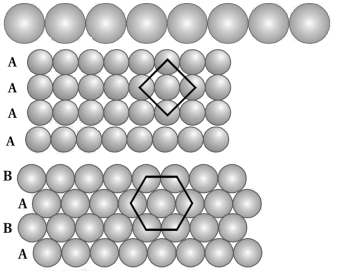
In this arrangement,each sphere is in contact with two of its neighbours. The number of nearest neighbours of a particle is called the coordination number. Thus,in a one-dimensional arrangement,the coordination number is $2$.
The close packing in two dimensions can be done in two ways by stacking the rows of closed-packed spheres: $(i)$ Square Close Packing,$(ii)$ Hexagonal Close Packing $(HCP)$.
$(i)$ Square Close Packing: In square close packing,the spheres of the second row are placed exactly above the spheres of the first row such that the spheres of these two rows are aligned horizontally as well as vertically.
If the first row of spheres is called $A$ type row,the second row being exactly the same as the first one is also of $A$ type and hence by placing more rows,$AAAA...$ type of arrangement is obtained.
In this arrangement,each sphere is in contact with four of its neighbours and hence the coordination number of a sphere is $4$.
If the centres of the four immediate neighbours are joined,a square is formed and hence it is named Square Close Packing.
$(ii)$ Hexagonal Close Packing $(HCP)$:
In hexagonal close packing,the spheres of the second row are fit in the depressions of the spheres of the first row.
If the spheres of the first row are called $A$ type,the ones in the second row may be called $B$ type. The spheres of the third row are placed in the depressions of the spheres of the second row such that the spheres of the first row and third row are in the same alignment horizontally and vertically.
As the third row is exactly the same as that of the first row,it is called $A$ type. Hence,we get $ABABAB...$ type of arrangement.
In this arrangement,each sphere is in contact with six of its neighbours and thus in two dimensions,the coordination number is $6$. The centres of these six spheres are at the corners of a regular hexagon,hence this packing is called two-dimensional hexagonal close packing.
Close packing of spheres in one dimension:
In this arrangement,each sphere is in contact with two of its neighbours. The number of nearest neighbours of a particle is called the coordination number. Thus,in a one-dimensional arrangement,the coordination number is $2$.
The close packing in two dimensions can be done in two ways by stacking the rows of closed-packed spheres: $(i)$ Square Close Packing,$(ii)$ Hexagonal Close Packing $(HCP)$.
$(i)$ Square Close Packing: In square close packing,the spheres of the second row are placed exactly above the spheres of the first row such that the spheres of these two rows are aligned horizontally as well as vertically.
If the first row of spheres is called $A$ type row,the second row being exactly the same as the first one is also of $A$ type and hence by placing more rows,$AAAA...$ type of arrangement is obtained.
In this arrangement,each sphere is in contact with four of its neighbours and hence the coordination number of a sphere is $4$.
If the centres of the four immediate neighbours are joined,a square is formed and hence it is named Square Close Packing.
$(ii)$ Hexagonal Close Packing $(HCP)$:
In hexagonal close packing,the spheres of the second row are fit in the depressions of the spheres of the first row.
If the spheres of the first row are called $A$ type,the ones in the second row may be called $B$ type. The spheres of the third row are placed in the depressions of the spheres of the second row such that the spheres of the first row and third row are in the same alignment horizontally and vertically.
As the third row is exactly the same as that of the first row,it is called $A$ type. Hence,we get $ABABAB...$ type of arrangement.
In this arrangement,each sphere is in contact with six of its neighbours and thus in two dimensions,the coordination number is $6$. The centres of these six spheres are at the corners of a regular hexagon,hence this packing is called two-dimensional hexagonal close packing.
0 likes
View Solution146
Difficult
Explain three-dimensional close packing from two-dimensional square close-packing. How is the primitive cubic unit cell obtained?
Solution
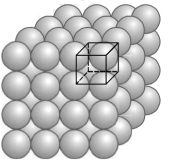
(N/A) Three-dimensional structures are obtained by stacking two-dimensional layers one above the other.
$A$ simple cubic lattice is formed by an $AAA \dots$ arrangement.
In this type of arrangement,the second square close-packed layer is placed exactly above the first square close-packed layer such that the spheres of the first and second layers are in the same alignment horizontally and vertically. In a similar way,more layers can be placed one above the other.
If the arrangement of spheres in the first layer is called $A$ type,then all the layers have the same arrangement. Thus,this lattice has an $AAAAA \dots$ type arrangement,and the lattice generated is a simple cubic unit cell or primitive cubic unit cell. The coordination number of each sphere is $6$.
$A$ simple cubic lattice is formed by an $AAA \dots$ arrangement.
In this type of arrangement,the second square close-packed layer is placed exactly above the first square close-packed layer such that the spheres of the first and second layers are in the same alignment horizontally and vertically. In a similar way,more layers can be placed one above the other.
If the arrangement of spheres in the first layer is called $A$ type,then all the layers have the same arrangement. Thus,this lattice has an $AAAAA \dots$ type arrangement,and the lattice generated is a simple cubic unit cell or primitive cubic unit cell. The coordination number of each sphere is $6$.
0 likes
View Solution147
Difficult
Explain tetrahedral and octahedral voids.
Solution
(N/A) $1$. Tetrahedral voids: When a second layer of spheres is placed over the first layer such that the spheres of the second layer occupy the depressions of the first layer,tetrahedral voids are formed. These voids are surrounded by $4$ spheres,and their centers form a regular tetrahedron.
$2$. Octahedral voids: These are formed when the triangular voids in the second layer lie above the triangular voids of the first layer and the triangular shapes of these voids do not overlap. These voids are surrounded by $6$ spheres,and their centers form a regular octahedron.
$2$. Octahedral voids: These are formed when the triangular voids in the second layer lie above the triangular voids of the first layer and the triangular shapes of these voids do not overlap. These voids are surrounded by $6$ spheres,and their centers form a regular octahedron.
0 likes
View Solution148
DifficultMCQ
Explain the formation of voids during the transition from a two-dimensional hexagonal close-packed layer to a three-dimensional close-packed structure.
A
Formation of tetrahedral voids only
B
Formation of octahedral voids only
C
Formation of both tetrahedral and octahedral voids
D
No voids are formed
Solution
(C) When we place a second layer over the first layer such that the spheres of the second layer are placed in the depressions of the first layer,voids are formed.
- $Tetrahedral$ $voids$ are formed when a sphere of the second layer rests above the triangular void of the first layer.
- $Octahedral$ $voids$ are formed when the triangular voids of the first layer and the second layer align such that they do not overlap,creating a space surrounded by $6$ spheres.
- Thus,both $tetrahedral$ and $octahedral$ voids are formed in a $3D$ close-packed structure.
- $Tetrahedral$ $voids$ are formed when a sphere of the second layer rests above the triangular void of the first layer.
- $Octahedral$ $voids$ are formed when the triangular voids of the first layer and the second layer align such that they do not overlap,creating a space surrounded by $6$ spheres.
- Thus,both $tetrahedral$ and $octahedral$ voids are formed in a $3D$ close-packed structure.
0 likes
View Solution149
Difficult
Explain the Hexagonal Close Packing $(hcp)$ and Cubic Close Packing $(ccp)$ or Face-Centered Cubic $(fcc)$ structures.
Solution
(A) When the third layer is placed over the second layer,there are two possibilities:
- $(i)$ Covering Tetrahedral Voids: When the third layer spheres cover the tetrahedral voids of the second layer,the spheres of the third layer align exactly with those of the first layer. This pattern of spheres repeats alternately and is written as the $ABAB$ pattern. This structure is called the Hexagonal Close Packed $(hcp)$ structure. Example: $Zn$ and $Mg$ metals exhibit this structure.
- $(ii)$ Covering Octahedral Voids: When the third layer spheres cover the octahedral voids of the second layer,the spheres of the third layer do not align with those of the first or second layer. This arrangement is called type $C$.
- When the fourth layer is placed,the spheres align exactly with the first layer. This pattern of layers is written as $ABCABC...$.
- This is called the Cubic Close Packed $(ccp)$ or Face-Centered Cubic $(fcc)$ structure. Example: Metals like $Cu$ and $Ag$ crystallize in this structure.
- Both types of close packing are highly efficient and occupy $74 \%$ of the crystal space. Here,each sphere is in contact with $12$ other spheres. Thus,the coordination number in both structures is $12$.
- $(i)$ Covering Tetrahedral Voids: When the third layer spheres cover the tetrahedral voids of the second layer,the spheres of the third layer align exactly with those of the first layer. This pattern of spheres repeats alternately and is written as the $ABAB$ pattern. This structure is called the Hexagonal Close Packed $(hcp)$ structure. Example: $Zn$ and $Mg$ metals exhibit this structure.
- $(ii)$ Covering Octahedral Voids: When the third layer spheres cover the octahedral voids of the second layer,the spheres of the third layer do not align with those of the first or second layer. This arrangement is called type $C$.
- When the fourth layer is placed,the spheres align exactly with the first layer. This pattern of layers is written as $ABCABC...$.
- This is called the Cubic Close Packed $(ccp)$ or Face-Centered Cubic $(fcc)$ structure. Example: Metals like $Cu$ and $Ag$ crystallize in this structure.
- Both types of close packing are highly efficient and occupy $74 \%$ of the crystal space. Here,each sphere is in contact with $12$ other spheres. Thus,the coordination number in both structures is $12$.
0 likes
View SolutionSolid State — Crystal packing · Frequently Asked Questions
1Are these Solid State questions useful for JEE and NEET?
Yes. All questions in this section are mapped to JEE Main and NEET exam patterns. Previous year questions from JEE Main, NEET, GUJCET and state-level exams are included with full solutions.
2Can I switch to Hindi or Gujarati for these questions?
Yes. Use the language tabs in the hero section or the sidebar to view the same questions and solutions in English, Hindi or Gujarati.
3How do I generate a question paper from this subtopic?
Use the Vedclass Exam Paper Generator — select the chapter and subtopic, set difficulty, and generate Sets A, B, C, D automatically. First 3 chapters of every subject are free.
Vedclass Products
For Students
Vedclass Test Series
Mock tests in real JEE/NEET style with performance analysis. 5-day free trial.
Start Free TrialFor Teachers
Exam Paper Generator
Generate Set A/B/C/D papers from this chapter in 2 minutes. 3 chapters free.
Try FreeFor Institutes
Online Exam Module
Live online exams with unlimited students, 360° analytics & white-label branding.
See DemoFor Teachers & Institutes
Generate a Solid State Exam Paper in 2 Minutes
Select subtopic & difficulty — Sets A, B, C, D auto-generated with No Repeat logic.
First 3 chapters of every subject are free — no payment required.