
A English
Wet Test for Basic Radical Questions in English
Class 12 Chemistry · Principles Related to Practical Chemistry · Wet Test for Basic Radical
236+
Questions
English
Language
100%
With Solutions
Showing 36 of 236 questions in English
201
DifficultMCQ
$A$ solution of a metal ion,when treated with $KI$,gives a red precipitate which dissolves in excess $KI$ to give a colourless solution. Moreover,the solution of the metal ion,on treatment with a solution of cobalt$(II)$ thiocyanate,gives rise to a deep blue crystalline precipitate. The metal ion is:
A
$Pb^{2+}$
B
$Hg^{2+}$
C
$Cu^{2+}$
D
$Co^{2+}$
Solution
(B) The reaction of $Hg^{2+}$ with $KI$ produces a red precipitate of $HgI_2$:
$Hg^{2+} + 2KI \longrightarrow HgI_2 \downarrow \text{(red)} + 2K^+$
In excess $KI$,$HgI_2$ dissolves to form a colourless soluble complex,potassium tetraiodomercurate$(II)$:
$HgI_2 + 2KI \longrightarrow K_2[HgI_4]$
Additionally,$Hg^{2+}$ reacts with cobalt$(II)$ thiocyanate to form a deep blue crystalline precipitate of mercury$(II)$ tetrathiocyanatocobaltate$(II)$,$Hg[Co(SCN)_4]$:
$Hg^{2+} + [Co(SCN)_4]^{2-} \longrightarrow Hg[Co(SCN)_4] \downarrow \text{(deep blue)}$
Thus,the metal ion is $Hg^{2+}$.
$Hg^{2+} + 2KI \longrightarrow HgI_2 \downarrow \text{(red)} + 2K^+$
In excess $KI$,$HgI_2$ dissolves to form a colourless soluble complex,potassium tetraiodomercurate$(II)$:
$HgI_2 + 2KI \longrightarrow K_2[HgI_4]$
Additionally,$Hg^{2+}$ reacts with cobalt$(II)$ thiocyanate to form a deep blue crystalline precipitate of mercury$(II)$ tetrathiocyanatocobaltate$(II)$,$Hg[Co(SCN)_4]$:
$Hg^{2+} + [Co(SCN)_4]^{2-} \longrightarrow Hg[Co(SCN)_4] \downarrow \text{(deep blue)}$
Thus,the metal ion is $Hg^{2+}$.
0 likes
View Solution202
DifficultMCQ
$p$-Amino-$N,N$-dimethylaniline is added to a strongly acidic solution of $X$. The resulting solution is treated with a few drops of aqueous solution of $Y$ to yield blue coloration due to the formation of methylene blue. Treatment of the aqueous solution of $Y$ with the reagent potassium hexacyanoferrate$(II)$ leads to the formation of an intense blue precipitate. The precipitate dissolves on excess addition of the reagent. Similarly,treatment of the solution of $Y$ with the solution of potassium hexacyanoferrate$(III)$ leads to a brown coloration due to the formation of $Z$.
$1.$ The compound $X$ is
$(A)$ $NaNO_3$ $(B)$ $NaCl$ $(C)$ $Na_2SO_4$ $(D)$ $Na_2S$
$2.$ The compound $Y$ is
$(A)$ $MgCl_2$ $(B)$ $FeCl_2$ $(C)$ $FeCl_3$ $(D)$ $ZnCl_2$
$3.$ The compound $Z$ is
$(A)$ $Mg_2[Fe(CN)_6]$ $(B)$ $Fe[Fe(CN)_6]$
$(C)$ $Fe_4[Fe(CN)_6]_3$ $(D)$ $K_2Zn_3[Fe(CN)_6]_2$
Give the answer for questions $1, 2$ and $3$.
$1.$ The compound $X$ is
$(A)$ $NaNO_3$ $(B)$ $NaCl$ $(C)$ $Na_2SO_4$ $(D)$ $Na_2S$
$2.$ The compound $Y$ is
$(A)$ $MgCl_2$ $(B)$ $FeCl_2$ $(C)$ $FeCl_3$ $(D)$ $ZnCl_2$
$3.$ The compound $Z$ is
$(A)$ $Mg_2[Fe(CN)_6]$ $(B)$ $Fe[Fe(CN)_6]$
$(C)$ $Fe_4[Fe(CN)_6]_3$ $(D)$ $K_2Zn_3[Fe(CN)_6]_2$
Give the answer for questions $1, 2$ and $3$.
A
$D, C, B$
B
$D, B, A$
C
$A, C, D$
D
$A, C, C$
Solution
(A) The reaction described is the Lauth's violet or Methylene Blue test for sulfides.
$1.$ $X$ is $Na_2S$ because it provides $S^{2-}$ ions which react with $p$-amino-$N,N$-dimethylaniline in the presence of an oxidizing agent $(Y)$ to form methylene blue.
$2.$ $Y$ is $FeCl_3$ (an oxidizing agent). $FeCl_3$ reacts with potassium hexacyanoferrate$(II)$ $(K_4[Fe(CN)_6])$ to form Prussian blue $(Fe_4[Fe(CN)_6]_3)$,which is an intense blue precipitate. This precipitate dissolves in excess reagent to form a soluble complex.
$3.$ $FeCl_3$ reacts with potassium hexacyanoferrate$(III)$ $(K_3[Fe(CN)_6])$ to form $Fe[Fe(CN)_6]$ (iron$(III)$ hexacyanoferrate$(III)$),which gives a brown coloration.
Therefore,$X = Na_2S$,$Y = FeCl_3$,and $Z = Fe[Fe(CN)_6]$.
The correct option is $(D, C, B)$.
$1.$ $X$ is $Na_2S$ because it provides $S^{2-}$ ions which react with $p$-amino-$N,N$-dimethylaniline in the presence of an oxidizing agent $(Y)$ to form methylene blue.
$2.$ $Y$ is $FeCl_3$ (an oxidizing agent). $FeCl_3$ reacts with potassium hexacyanoferrate$(II)$ $(K_4[Fe(CN)_6])$ to form Prussian blue $(Fe_4[Fe(CN)_6]_3)$,which is an intense blue precipitate. This precipitate dissolves in excess reagent to form a soluble complex.
$3.$ $FeCl_3$ reacts with potassium hexacyanoferrate$(III)$ $(K_3[Fe(CN)_6])$ to form $Fe[Fe(CN)_6]$ (iron$(III)$ hexacyanoferrate$(III)$),which gives a brown coloration.
Therefore,$X = Na_2S$,$Y = FeCl_3$,and $Z = Fe[Fe(CN)_6]$.
The correct option is $(D, C, B)$.
0 likes
View Solution203
DifficultMCQ
Passing $H_2S$ gas into a mixture of $Mn^{2+}$,$Ni^{2+}$,$Cu^{2+}$ and $Hg^{2+}$ ions in an acidified aqueous solution precipitates
A
$CuS$ and $HgS$
B
$MnS$ and $CuS$
C
$MnS$ and $NiS$
D
$NiS$ and $HgS$
Solution
(A) In an acidified aqueous solution,the concentration of $S^{2-}$ ions is very low due to the common ion effect of $H^+$ ions from the acid.
Only the sulphides of Group $II$ cations,such as $Cu^{2+}$ and $Hg^{2+}$,have a sufficiently low solubility product $(K_{sp})$ to precipitate under these conditions.
The sulphides of $Mn^{2+}$ and $Ni^{2+}$ (Group $III$ and $IV$ cations) have higher $K_{sp}$ values and remain in the solution.
Therefore,$CuS$ and $HgS$ are precipitated.
Hence,the correct option is $A$.
Only the sulphides of Group $II$ cations,such as $Cu^{2+}$ and $Hg^{2+}$,have a sufficiently low solubility product $(K_{sp})$ to precipitate under these conditions.
The sulphides of $Mn^{2+}$ and $Ni^{2+}$ (Group $III$ and $IV$ cations) have higher $K_{sp}$ values and remain in the solution.
Therefore,$CuS$ and $HgS$ are precipitated.
Hence,the correct option is $A$.
0 likes
View Solution204
MediumMCQ
The correct option$(s)$ to distinguish nitrate salts of $Mn^{2+}$ and $Cu^{2+}$ taken separately is (are):
$(A)$ $Mn^{2+}$ shows the characteristic green colour in the flame test
$(B)$ Only $Cu^{2+}$ shows the formation of precipitate by passing $H_2S$ in acidic medium
$(C)$ Only $Mn^{2+}$ shows the formation of precipitate by passing $H_2S$ in faintly basic medium
$(D)$ $Cu^{2+}/Cu$ has higher reduction potential than $Mn^{2+}/Mn$ (measured under similar conditions)
$(A)$ $Mn^{2+}$ shows the characteristic green colour in the flame test
$(B)$ Only $Cu^{2+}$ shows the formation of precipitate by passing $H_2S$ in acidic medium
$(C)$ Only $Mn^{2+}$ shows the formation of precipitate by passing $H_2S$ in faintly basic medium
$(D)$ $Cu^{2+}/Cu$ has higher reduction potential than $Mn^{2+}/Mn$ (measured under similar conditions)
A
$A, B$
B
$A, C$
C
$A, D$
D
$B, D$
Solution
(D) $1$. Flame test: Both $Mn^{2+}$ and $Cu^{2+}$ do not show a characteristic green flame color that distinguishes them uniquely in this context (often $Cu^{2+}$ is associated with green,but $Mn^{2+}$ does not show a characteristic green flame). Thus,$(A)$ is incorrect.
$2$. Precipitation with $H_2S$ in acidic medium: $CuS$ has a very low solubility product $(K_{sp})$,so it precipitates in acidic medium. $MnS$ has a higher $K_{sp}$ and does not precipitate in acidic medium. Thus,$(B)$ is correct.
$3$. Precipitation with $H_2S$ in basic medium: Both $CuS$ and $MnS$ precipitate in basic medium. Thus,$(C)$ is incorrect.
$4$. Reduction potential: The standard reduction potential $E^0$ for $Cu^{2+}/Cu$ $(+0.34 \ V)$ is higher than that of $Mn^{2+}/Mn$ $(-1.18 \ V)$. Thus,$(D)$ is correct.
Therefore,the correct options are $(B)$ and $(D)$.
$2$. Precipitation with $H_2S$ in acidic medium: $CuS$ has a very low solubility product $(K_{sp})$,so it precipitates in acidic medium. $MnS$ has a higher $K_{sp}$ and does not precipitate in acidic medium. Thus,$(B)$ is correct.
$3$. Precipitation with $H_2S$ in basic medium: Both $CuS$ and $MnS$ precipitate in basic medium. Thus,$(C)$ is incorrect.
$4$. Reduction potential: The standard reduction potential $E^0$ for $Cu^{2+}/Cu$ $(+0.34 \ V)$ is higher than that of $Mn^{2+}/Mn$ $(-1.18 \ V)$. Thus,$(D)$ is correct.
Therefore,the correct options are $(B)$ and $(D)$.
0 likes
View Solution205
DifficultMCQ
$A$ colorless aqueous solution contains nitrates of two metals,$X$ and $Y$. When it was added to an aqueous solution of $NaCl$,a white precipitate was formed. This precipitate was found to be partly soluble in hot water to give a residue $P$ and a solution $Q$. The residue $P$ was soluble in aqueous $NH_3$ and also in excess sodium thiosulfate. The hot solution $Q$ gave a yellow precipitate with $KI$. The metals $X$ and $Y$,respectively,are
A
$Ag$ and $Pb$
B
$Ag$ and $Cd$
C
$Cd$ and $Pb$
D
$Cd$ and $Zn$
Solution
(A) $1$. The addition of $NaCl$ to the solution containing nitrates of $X$ and $Y$ produces white precipitates of $AgCl$ and $PbCl_2$.
$2$. $PbCl_2$ is soluble in hot water,while $AgCl$ is not. Thus,the residue $P$ is $AgCl$ and the hot filtrate $Q$ contains $PbCl_2$.
$3$. $AgCl$ (residue $P$) is soluble in aqueous $NH_3$ to form $[Ag(NH_3)_2]Cl$ and in excess sodium thiosulfate to form $Na_3[Ag(S_2O_3)_2]$.
$4$. The hot solution $Q$ containing $Pb^{2+}$ ions reacts with $KI$ to form a yellow precipitate of $PbI_2$ $(Pb^{2+} + 2I^- \rightarrow PbI_2 \downarrow)$.
$5$. Therefore,$X$ is $Ag$ and $Y$ is $Pb$.
$2$. $PbCl_2$ is soluble in hot water,while $AgCl$ is not. Thus,the residue $P$ is $AgCl$ and the hot filtrate $Q$ contains $PbCl_2$.
$3$. $AgCl$ (residue $P$) is soluble in aqueous $NH_3$ to form $[Ag(NH_3)_2]Cl$ and in excess sodium thiosulfate to form $Na_3[Ag(S_2O_3)_2]$.
$4$. The hot solution $Q$ containing $Pb^{2+}$ ions reacts with $KI$ to form a yellow precipitate of $PbI_2$ $(Pb^{2+} + 2I^- \rightarrow PbI_2 \downarrow)$.
$5$. Therefore,$X$ is $Ag$ and $Y$ is $Pb$.
0 likes
View Solution206
AdvancedMCQ
$A$ mixture of two salts is used to prepare a solution $S$,which gives the following results:
White precipitate$(s)$ $\xleftarrow{\text{Dilute } NaOH(aq.) \text{ at Room temperature}}$ $S$ (aq. solution of the salts) $\xrightarrow{\text{Dilute } HCl(aq.) \text{ at Room temperature}}$ White precipitate$(s)$ only
The correct option$(s)$ for the salt mixture is(are):
$A$. $Pb(NO_3)_2$ and $Zn(NO_3)_2$
$B$. $Pb(NO_3)_2$ and $Bi(NO_3)_3$
$C$. $AgNO_3$ and $Bi(NO_3)_3$
$D$. $Pb(NO_3)_2$ and $Hg(NO_3)_2$
White precipitate$(s)$ $\xleftarrow{\text{Dilute } NaOH(aq.) \text{ at Room temperature}}$ $S$ (aq. solution of the salts) $\xrightarrow{\text{Dilute } HCl(aq.) \text{ at Room temperature}}$ White precipitate$(s)$ only
The correct option$(s)$ for the salt mixture is(are):
$A$. $Pb(NO_3)_2$ and $Zn(NO_3)_2$
$B$. $Pb(NO_3)_2$ and $Bi(NO_3)_3$
$C$. $AgNO_3$ and $Bi(NO_3)_3$
$D$. $Pb(NO_3)_2$ and $Hg(NO_3)_2$
A
$A, B, C$
B
$A, B, D$
C
$A, B$
D
$A, C$
Solution
(C) To form a white precipitate with both dilute $NaOH$ and dilute $HCl$,the cations must satisfy the following conditions:
$1$. With dilute $HCl$,the cation must form a white precipitate (e.g.,$Pb^{2+}$ or $Ag^+$).
$2$. With dilute $NaOH$,the cation must form a white precipitate (e.g.,$Pb^{2+}$,$Zn^{2+}$,or $Bi^{3+}$).
Analyzing the options:
- $Pb(NO_3)_2$: Forms white $PbCl_2$ with $HCl$ and white $Pb(OH)_2$ with $NaOH$.
- $Zn(NO_3)_2$: Forms soluble $ZnCl_2$ with $HCl$ and white $Zn(OH)_2$ with $NaOH$.
- $Bi(NO_3)_3$: Forms soluble $BiCl_3$ with $HCl$ and white $Bi(OH)_3$ with $NaOH$.
- $AgNO_3$: Forms white $AgCl$ with $HCl$ but forms brown $Ag_2O$ with $NaOH$.
- $Hg(NO_3)_2$: Forms soluble $HgCl_2$ with $HCl$ and yellow $HgO$ with $NaOH$.
For the mixture to give white precipitates only with both reagents:
- Mixture $A$ ($Pb(NO_3)_2$ and $Zn(NO_3)_2$): $Pb^{2+}$ gives white $PbCl_2$ and $Pb(OH)_2$; $Zn^{2+}$ gives white $Zn(OH)_2$. This works.
- Mixture $B$ ($Pb(NO_3)_2$ and $Bi(NO_3)_3$): $Pb^{2+}$ gives white $PbCl_2$ and $Pb(OH)_2$; $Bi^{3+}$ gives white $Bi(OH)_3$. This works.
- Mixture $C$ ($AgNO_3$ and $Bi(NO_3)_3$): $Ag^+$ gives brown $Ag_2O$ with $NaOH$. Incorrect.
- Mixture $D$ ($Pb(NO_3)_2$ and $Hg(NO_3)_2$): $Hg^{2+}$ gives yellow $HgO$ with $NaOH$. Incorrect.
Thus,mixtures $A$ and $B$ are correct.
$1$. With dilute $HCl$,the cation must form a white precipitate (e.g.,$Pb^{2+}$ or $Ag^+$).
$2$. With dilute $NaOH$,the cation must form a white precipitate (e.g.,$Pb^{2+}$,$Zn^{2+}$,or $Bi^{3+}$).
Analyzing the options:
- $Pb(NO_3)_2$: Forms white $PbCl_2$ with $HCl$ and white $Pb(OH)_2$ with $NaOH$.
- $Zn(NO_3)_2$: Forms soluble $ZnCl_2$ with $HCl$ and white $Zn(OH)_2$ with $NaOH$.
- $Bi(NO_3)_3$: Forms soluble $BiCl_3$ with $HCl$ and white $Bi(OH)_3$ with $NaOH$.
- $AgNO_3$: Forms white $AgCl$ with $HCl$ but forms brown $Ag_2O$ with $NaOH$.
- $Hg(NO_3)_2$: Forms soluble $HgCl_2$ with $HCl$ and yellow $HgO$ with $NaOH$.
For the mixture to give white precipitates only with both reagents:
- Mixture $A$ ($Pb(NO_3)_2$ and $Zn(NO_3)_2$): $Pb^{2+}$ gives white $PbCl_2$ and $Pb(OH)_2$; $Zn^{2+}$ gives white $Zn(OH)_2$. This works.
- Mixture $B$ ($Pb(NO_3)_2$ and $Bi(NO_3)_3$): $Pb^{2+}$ gives white $PbCl_2$ and $Pb(OH)_2$; $Bi^{3+}$ gives white $Bi(OH)_3$. This works.
- Mixture $C$ ($AgNO_3$ and $Bi(NO_3)_3$): $Ag^+$ gives brown $Ag_2O$ with $NaOH$. Incorrect.
- Mixture $D$ ($Pb(NO_3)_2$ and $Hg(NO_3)_2$): $Hg^{2+}$ gives yellow $HgO$ with $NaOH$. Incorrect.
Thus,mixtures $A$ and $B$ are correct.
0 likes
View Solution207
AdvancedMCQ
Upon treatment with ammoniacal $H_2S$,the metal ion that precipitates as a sulfide is
A
$Fe(III)$
B
$Al(III)$
C
$Mg(II)$
D
$Zn(II)$
Solution
(D) Ammoniacal $H_2S$ is the group reagent for the fourth group of cationic radicals in qualitative analysis.
$Fe^{3+}$ and $Al^{3+}$ belong to the third group and precipitate as hydroxides,$Fe(OH)_3$ and $Al(OH)_3$,in the presence of $NH_4OH$ and $NH_4Cl$.
$Mg^{2+}$ does not precipitate with $H_2S$ in the presence of $NH_4OH$.
$Zn^{2+}$ belongs to the fourth group and reacts with $H_2S$ in the presence of $NH_4OH$ to form a white precipitate of $ZnS$.
$Fe^{3+}$ and $Al^{3+}$ belong to the third group and precipitate as hydroxides,$Fe(OH)_3$ and $Al(OH)_3$,in the presence of $NH_4OH$ and $NH_4Cl$.
$Mg^{2+}$ does not precipitate with $H_2S$ in the presence of $NH_4OH$.
$Zn^{2+}$ belongs to the fourth group and reacts with $H_2S$ in the presence of $NH_4OH$ to form a white precipitate of $ZnS$.
0 likes
View Solution208
Difficult
An aqueous solution of a mixture of two inorganic salts,when treated with dilute $HCl$,gave a precipitate $(P)$ and a filtrate $(Q)$. The precipitate $P$ was found to dissolve in hot water. The filtrate $(Q)$ remained unchanged when treated with $H_2S$ in a dilute mineral acid medium. However,it gave a precipitate $(R)$ with $H_2S$ in an ammoniacal medium. The precipitate $R$ gave a coloured solution $(S)$ when treated with $H_2O_2$ in an aqueous $NaOH$ medium.
$1.$ The precipitate $P$ contains
$(A)$ $Pb^{2+}$ $(B)$ $Hg_2^{2+}$ $(C)$ $Ag^{+}$ $(D)$ $Hg^{2+}$
$2.$ The coloured solution $S$ contains
$(A)$ $Fe_2(SO_4)_3$ $(B)$ $CuSO_4$ $(C)$ $ZnSO_4$ $(D)$ $Na_2CrO_4$
$1.$ The precipitate $P$ contains
$(A)$ $Pb^{2+}$ $(B)$ $Hg_2^{2+}$ $(C)$ $Ag^{+}$ $(D)$ $Hg^{2+}$
$2.$ The coloured solution $S$ contains
$(A)$ $Fe_2(SO_4)_3$ $(B)$ $CuSO_4$ $(C)$ $ZnSO_4$ $(D)$ $Na_2CrO_4$
Solution
(A, D) $1.$ The precipitate $P$ is $PbCl_2$,which is formed by the reaction of $Pb^{2+}$ with $HCl$. $PbCl_2$ is known to be soluble in hot water. Thus,$P$ contains $Pb^{2+}$.
$2.$ The filtrate $Q$ contains $Cr^{3+}$. When treated with $H_2S$ in an ammoniacal medium,it forms a green precipitate $R$ of $Cr(OH)_3$. When $Cr(OH)_3$ is treated with $H_2O_2$ in an aqueous $NaOH$ medium,it undergoes oxidation to form a yellow solution $S$ containing $Na_2CrO_4$ (sodium chromate).
Reaction: $2Cr(OH)_3 + 4NaOH + 3H_2O_2 \longrightarrow 2Na_2CrO_4 + 8H_2O$.
$2.$ The filtrate $Q$ contains $Cr^{3+}$. When treated with $H_2S$ in an ammoniacal medium,it forms a green precipitate $R$ of $Cr(OH)_3$. When $Cr(OH)_3$ is treated with $H_2O_2$ in an aqueous $NaOH$ medium,it undergoes oxidation to form a yellow solution $S$ containing $Na_2CrO_4$ (sodium chromate).
Reaction: $2Cr(OH)_3 + 4NaOH + 3H_2O_2 \longrightarrow 2Na_2CrO_4 + 8H_2O$.
0 likes
View Solution209
MediumMCQ
Among $PbS$,$CuS$,$HgS$,$MnS$,$Ag_2S$,$NiS$,$CoS$,$Bi_2S_3$,and $SnS_2$,the total number of black coloured sulphides is
A
$5$
B
$6$
C
$7$
D
$8$
Solution
(C) The sulphides $PbS$,$CuS$,$HgS$,$Ag_2S$,$NiS$,$CoS$,and $Bi_2S_3$ are black in colour.
$MnS$ is buff coloured.
$SnS_2$ is yellow coloured.
Therefore,the total number of black coloured sulphides is $7$.
$MnS$ is buff coloured.
$SnS_2$ is yellow coloured.
Therefore,the total number of black coloured sulphides is $7$.
0 likes
View Solution210
AdvancedMCQ
The pair$(s)$ of ions where $BOTH$ the ions are precipitated upon passing $H_2S$ gas in the presence of dilute $HCl$,is(are):
$(A) Ba^{2+}, Zn^{2+}$
$(B) Bi^{3+}, Fe^{3+}$
$(C) Cu^{2+}, Pb^{2+}$
$(D) Hg^{2+}, Bi^{3+}$
$(A) Ba^{2+}, Zn^{2+}$
$(B) Bi^{3+}, Fe^{3+}$
$(C) Cu^{2+}, Pb^{2+}$
$(D) Hg^{2+}, Bi^{3+}$
A
$(A, D)$
B
$(C, D)$
C
$(B, D)$
D
$(B, C)$
Solution
(B) In qualitative analysis,the group-$II$ cations are precipitated as sulfides by passing $H_2S$ gas in the presence of dilute $HCl$.
The group-$II$ cations include $Cu^{2+}, Pb^{2+}, Hg^{2+}, Bi^{3+}, Cd^{2+}, As^{3+}, Sb^{3+},$ and $Sn^{4+}$.
In option $(C)$,both $Cu^{2+}$ and $Pb^{2+}$ belong to group-$II$ and will precipitate as sulfides.
In option $(D)$,both $Hg^{2+}$ and $Bi^{3+}$ belong to group-$II$ and will precipitate as sulfides.
Therefore,both $(C)$ and $(D)$ are correct pairs.
The group-$II$ cations include $Cu^{2+}, Pb^{2+}, Hg^{2+}, Bi^{3+}, Cd^{2+}, As^{3+}, Sb^{3+},$ and $Sn^{4+}$.
In option $(C)$,both $Cu^{2+}$ and $Pb^{2+}$ belong to group-$II$ and will precipitate as sulfides.
In option $(D)$,both $Hg^{2+}$ and $Bi^{3+}$ belong to group-$II$ and will precipitate as sulfides.
Therefore,both $(C)$ and $(D)$ are correct pairs.
0 likes
View Solution211
DifficultMCQ
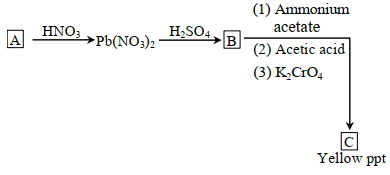
Identify $A$,$B$ and $C$ in the given reaction sequence.
A
$PbCl_2, PbSO_4, PbCrO_4$
B
$PbS, PbSO_4, PbCrO_4$
C
$PbS, PbSO_4, Pb(CH_3COO)_2$
D
$PbCl_2, Pb(SO_4)_2, PbCrO_4$
Solution
(B) The reaction sequence is as follows:
$1$. $PbS$ (Galena) reacts with $HNO_3$ to form lead$(II)$ nitrate: $3PbS + 8HNO_3 \rightarrow 3Pb(NO_3)_2 + 2NO + 3S + 4H_2O$. Thus,$A = PbS$.
$2$. $Pb(NO_3)_2$ reacts with $H_2SO_4$ to form lead$(II)$ sulfate precipitate: $Pb(NO_3)_2 + H_2SO_4 \rightarrow PbSO_4(s) + 2HNO_3$. Thus,$B = PbSO_4$.
$3$. $PbSO_4$ is dissolved in ammonium acetate and acetic acid to form lead$(II)$ acetate,which then reacts with $K_2CrO_4$ to form a yellow precipitate of lead$(II)$ chromate: $PbSO_4 + 2CH_3COONH_4 \rightarrow Pb(CH_3COO)_2 + (NH_4)_2SO_4$ and $Pb(CH_3COO)_2 + K_2CrO_4 \rightarrow PbCrO_4(s) + 2CH_3COOK$. Thus,$C = PbCrO_4$.
Therefore,$A = PbS$,$B = PbSO_4$,and $C = PbCrO_4$.
$1$. $PbS$ (Galena) reacts with $HNO_3$ to form lead$(II)$ nitrate: $3PbS + 8HNO_3 \rightarrow 3Pb(NO_3)_2 + 2NO + 3S + 4H_2O$. Thus,$A = PbS$.
$2$. $Pb(NO_3)_2$ reacts with $H_2SO_4$ to form lead$(II)$ sulfate precipitate: $Pb(NO_3)_2 + H_2SO_4 \rightarrow PbSO_4(s) + 2HNO_3$. Thus,$B = PbSO_4$.
$3$. $PbSO_4$ is dissolved in ammonium acetate and acetic acid to form lead$(II)$ acetate,which then reacts with $K_2CrO_4$ to form a yellow precipitate of lead$(II)$ chromate: $PbSO_4 + 2CH_3COONH_4 \rightarrow Pb(CH_3COO)_2 + (NH_4)_2SO_4$ and $Pb(CH_3COO)_2 + K_2CrO_4 \rightarrow PbCrO_4(s) + 2CH_3COOK$. Thus,$C = PbCrO_4$.
Therefore,$A = PbS$,$B = PbSO_4$,and $C = PbCrO_4$.
0 likes
View Solution212
DifficultMCQ
Among the following cations,the number of cations which will give characteristic precipitate in their identification tests with $K_4[Fe(CN)_6]$ is :
$Cu^{2+}, Fe^{3+}, Ba^{2+}, Ca^{2+}, NH_4^{+}, Mg^{2+}, Zn^{2+}$
$Cu^{2+}, Fe^{3+}, Ba^{2+}, Ca^{2+}, NH_4^{+}, Mg^{2+}, Zn^{2+}$
A
$1$
B
$2$
C
$3$
D
$4$
Solution
(D) The reaction of $K_4[Fe(CN)_6]$ with specific cations produces characteristic precipitates:
$1$. $Cu^{2+} + K_4[Fe(CN)_6] \rightarrow Cu_2[Fe(CN)_6] \downarrow$ (Reddish-brown precipitate)
$2$. $Fe^{3+} + K_4[Fe(CN)_6] \rightarrow Fe_4[Fe(CN)_6]_3 \downarrow$ (Prussian blue precipitate)
$3$. $Zn^{2+} + K_4[Fe(CN)_6] \rightarrow K_2Zn_3[Fe(CN)_6]_2 \downarrow$ (White/Bluish-white precipitate)
$4$. $Ca^{2+} + K_4[Fe(CN)_6] \rightarrow K_2Ca[Fe(CN)_6] \downarrow$ (White precipitate)
$Ba^{2+}, NH_4^{+},$ and $Mg^{2+}$ do not form characteristic precipitates with $K_4[Fe(CN)_6]$.
Thus,there are $4$ such cations.
$1$. $Cu^{2+} + K_4[Fe(CN)_6] \rightarrow Cu_2[Fe(CN)_6] \downarrow$ (Reddish-brown precipitate)
$2$. $Fe^{3+} + K_4[Fe(CN)_6] \rightarrow Fe_4[Fe(CN)_6]_3 \downarrow$ (Prussian blue precipitate)
$3$. $Zn^{2+} + K_4[Fe(CN)_6] \rightarrow K_2Zn_3[Fe(CN)_6]_2 \downarrow$ (White/Bluish-white precipitate)
$4$. $Ca^{2+} + K_4[Fe(CN)_6] \rightarrow K_2Ca[Fe(CN)_6] \downarrow$ (White precipitate)
$Ba^{2+}, NH_4^{+},$ and $Mg^{2+}$ do not form characteristic precipitates with $K_4[Fe(CN)_6]$.
Thus,there are $4$ such cations.
0 likes
View Solution213
MediumMCQ
Find the compound $A$ from the following reaction sequences:
$A$ $\xrightarrow{\text{aqua-regia}} B$ $\xrightarrow[(2) CH_3COOH]{(1) KNO_2 \mid NH_4OH} \text{yellow ppt}$
$A$ $\xrightarrow{\text{aqua-regia}} B$ $\xrightarrow[(2) CH_3COOH]{(1) KNO_2 \mid NH_4OH} \text{yellow ppt}$
A
$ZnS$
B
$CoS$
C
$MnS$
D
$NiS$
Solution
(B) $CoS$ reacts with aqua-regia to form $CoCl_2$ (Compound $B$).
When $CoCl_2$ reacts with $KNO_2$ in the presence of acetic acid $(CH_3COOH)$,it forms a yellow precipitate of potassium cobaltinitrite $(K_3[Co(NO_2)_6])$.
$3CoS + 2HNO_3 + 6HCl \rightarrow 3CoCl_2 + 3S + 2NO + 4H_2O$
$CoCl_2 + 7KNO_2 + 2CH_3COOH \rightarrow K_3[Co(NO_2)_6] \downarrow (\text{yellow}) + 2KCl + 2CH_3COOK + NO + H_2O$
When $CoCl_2$ reacts with $KNO_2$ in the presence of acetic acid $(CH_3COOH)$,it forms a yellow precipitate of potassium cobaltinitrite $(K_3[Co(NO_2)_6])$.
$3CoS + 2HNO_3 + 6HCl \rightarrow 3CoCl_2 + 3S + 2NO + 4H_2O$
$CoCl_2 + 7KNO_2 + 2CH_3COOH \rightarrow K_3[Co(NO_2)_6] \downarrow (\text{yellow}) + 2KCl + 2CH_3COOK + NO + H_2O$
0 likes
View Solution214
DifficultMCQ
Identify the inorganic sulphides that are yellow in colour $ : $
$(A)$ $(NH_4)_2S$
$(B)$ $PbS$
$(C)$ $CuS$
$(D)$ $As_2S_3$
$(E)$ $As_2S_5$
Choose the correct answer from the options given below $ : $
$(A)$ $(NH_4)_2S$
$(B)$ $PbS$
$(C)$ $CuS$
$(D)$ $As_2S_3$
$(E)$ $As_2S_5$
Choose the correct answer from the options given below $ : $
A
$(A)$ and $(C)$ only
B
$(A)$, $(D)$ and $(E)$ only
C
$(A)$ and $(B)$ only
D
$(D)$ and $(E)$ only
Solution
$(D)$ The colours of the given inorganic sulphides are as follows $ : $
$1$. $(NH_4)_2S$ is colourless.
$2$. $PbS$ is black.
$3$. $CuS$ is black.
$4$. $As_2S_3$ is yellow.
$5$. $As_2S_5$ is yellow.
Therefore, $As_2S_3$ and $As_2S_5$ are the yellow coloured sulphides.
$1$. $(NH_4)_2S$ is colourless.
$2$. $PbS$ is black.
$3$. $CuS$ is black.
$4$. $As_2S_3$ is yellow.
$5$. $As_2S_5$ is yellow.
Therefore, $As_2S_3$ and $As_2S_5$ are the yellow coloured sulphides.
0 likes
View Solution215
DifficultMCQ
Choose the correct tests with respective observations.
$(A)$ $CuSO_4$ (acidified with acetic acid) $+$ $K_4[Fe(CN)_6]$ $\rightarrow$ Chocolate brown precipitate.
$(B)$ $FeCl_3 + K_4[Fe(CN)_6]$ $\rightarrow$ Prussian blue precipitate.
$(C)$ $ZnCl_2 + K_4[Fe(CN)_6]$,neutralised with $NH_4OH$ $\rightarrow$ White or bluish white precipitate.
$(D)$ $MgCl_2 + K_4[Fe(CN)_6]$ $\rightarrow$ Blue precipitate.
$(E)$ $BaCl_2 + K_4[Fe(CN)_6]$,neutralised with $NaOH$ $\rightarrow$ White precipitate.
Choose the correct answer from the options given below:
$(A)$ $CuSO_4$ (acidified with acetic acid) $+$ $K_4[Fe(CN)_6]$ $\rightarrow$ Chocolate brown precipitate.
$(B)$ $FeCl_3 + K_4[Fe(CN)_6]$ $\rightarrow$ Prussian blue precipitate.
$(C)$ $ZnCl_2 + K_4[Fe(CN)_6]$,neutralised with $NH_4OH$ $\rightarrow$ White or bluish white precipitate.
$(D)$ $MgCl_2 + K_4[Fe(CN)_6]$ $\rightarrow$ Blue precipitate.
$(E)$ $BaCl_2 + K_4[Fe(CN)_6]$,neutralised with $NaOH$ $\rightarrow$ White precipitate.
Choose the correct answer from the options given below:
A
$A, D$ and $E$ only
B
$B, D$ and $E$ only
C
$A, B$ and $C$ only
D
$C, D$ and $E$ only
Solution
(C) : $2 CuSO_4 + K_4[Fe(CN)_6] \xrightarrow{CH_3COOH} Cu_2[Fe(CN)_6] + 2 K_2SO_4$ (Chocolate brown precipitate). This is correct.
$B$: $4 FeCl_3 + 3 K_4[Fe(CN)_6] \rightarrow Fe_4[Fe(CN)_6]_3 + 12 KCl$ (Prussian blue precipitate). This is correct.
$C$: $3 ZnCl_2 + 2 K_4[Fe(CN)_6] \xrightarrow{NH_4OH} K_2Zn_3[Fe(CN)_6]_2 + 6 KCl$ (White or bluish white precipitate). This is correct.
$D$: $MgCl_2$ does not form a blue precipitate with $K_4[Fe(CN)_6]$. This is incorrect.
$E$: $BaCl_2$ does not form a white precipitate with $K_4[Fe(CN)_6]$. This is incorrect.
Therefore,the correct tests are $A, B$ and $C$.
$B$: $4 FeCl_3 + 3 K_4[Fe(CN)_6] \rightarrow Fe_4[Fe(CN)_6]_3 + 12 KCl$ (Prussian blue precipitate). This is correct.
$C$: $3 ZnCl_2 + 2 K_4[Fe(CN)_6] \xrightarrow{NH_4OH} K_2Zn_3[Fe(CN)_6]_2 + 6 KCl$ (White or bluish white precipitate). This is correct.
$D$: $MgCl_2$ does not form a blue precipitate with $K_4[Fe(CN)_6]$. This is incorrect.
$E$: $BaCl_2$ does not form a white precipitate with $K_4[Fe(CN)_6]$. This is incorrect.
Therefore,the correct tests are $A, B$ and $C$.
0 likes
View Solution216
MediumMCQ
When a salt is treated with sodium hydroxide solution,it gives gas $X$. On passing gas $X$ through reagent $Y$,a brown-coloured precipitate is formed. $X$ and $Y$ respectively,are
A
$X=NH_3$ and $Y=HgO$
B
$X=NH_3$ and $Y=K_2HgI_4+KOH$
C
$X=NH_4Cl$ and $Y=KOH$
D
$X=HCl$ and $Y=NH_4Cl$
Solution
(B) When an ammonium salt is treated with sodium hydroxide $(NaOH)$,it releases ammonia gas $(NH_3)$:
$NH_4^{+} + OH^{-} \longrightarrow NH_3 \uparrow + H_2O$
Ammonia gas $(NH_3)$ reacts with Nessler's reagent $(K_2[HgI_4] + KOH)$ to form a brown-coloured precipitate known as the iodide of Millon's base:
$2[HgI_4]^{2-} + NH_3 + 3OH^{-} \longrightarrow HgO \cdot Hg(NH_2)I + 7I^{-} + 2H_2O$
Thus,$X = NH_3$ and $Y = K_2HgI_4 + KOH$.
$NH_4^{+} + OH^{-} \longrightarrow NH_3 \uparrow + H_2O$
Ammonia gas $(NH_3)$ reacts with Nessler's reagent $(K_2[HgI_4] + KOH)$ to form a brown-coloured precipitate known as the iodide of Millon's base:
$2[HgI_4]^{2-} + NH_3 + 3OH^{-} \longrightarrow HgO \cdot Hg(NH_2)I + 7I^{-} + 2H_2O$
Thus,$X = NH_3$ and $Y = K_2HgI_4 + KOH$.
0 likes
View Solution217
MediumMCQ
Match List-$I$ with List-$II$:
Choose the correct answer from the options given below:
| List-$I$ (Ion) | List-$II$ (Group Number in Cation Analysis) |
| $A. Co^{2+}$ | $I. Group-I$ |
| $B. Mg^{2+}$ | $II. Group-III$ |
| $C. Pb^{2+}$ | $III. Group-IV$ |
| $D. Al^{3+}$ | $IV. Group-VI$ |
Choose the correct answer from the options given below:
A
$A-III, B-IV, C-II, D-I$
B
$A-III, B-II, C-IV, D-I$
C
$A-III, B-IV, C-I, D-II$
D
$A-III, B-II, C-I, D-IV$
Solution
(C) The classification of cations into groups for qualitative analysis is based on their solubility products and the reagents used:
$1$. $Pb^{2+}$ belongs to $Group-I$ (precipitated as $PbCl_2$).
$2$. $Al^{3+}$ belongs to $Group-III$ (precipitated as $Al(OH)_3$ in the presence of $NH_4Cl$ and $NH_4OH$).
$3$. $Co^{2+}$ belongs to $Group-IV$ (precipitated as $CoS$ in the presence of $NH_4Cl$,$NH_4OH$,and $H_2S$).
$4$. $Mg^{2+}$ belongs to $Group-VI$ (remains in solution after other groups are precipitated and is identified as $Mg_2P_2O_7$).
Therefore,the correct matching is:
Thus,the correct option is $C$.
$1$. $Pb^{2+}$ belongs to $Group-I$ (precipitated as $PbCl_2$).
$2$. $Al^{3+}$ belongs to $Group-III$ (precipitated as $Al(OH)_3$ in the presence of $NH_4Cl$ and $NH_4OH$).
$3$. $Co^{2+}$ belongs to $Group-IV$ (precipitated as $CoS$ in the presence of $NH_4Cl$,$NH_4OH$,and $H_2S$).
$4$. $Mg^{2+}$ belongs to $Group-VI$ (remains in solution after other groups are precipitated and is identified as $Mg_2P_2O_7$).
Therefore,the correct matching is:
| $A. Co^{2+}$ | $III. Group-IV$ |
| $B. Mg^{2+}$ | $IV. Group-VI$ |
| $C. Pb^{2+}$ | $I. Group-I$ |
| $D. Al^{3+}$ | $II. Group-III$ |
Thus,the correct option is $C$.
0 likes
View Solution218
MediumMCQ
Which of the following options is incorrect?
A
Group-$I$,Cation-$Pb^{2+}$,Group reagent-dil. $HCl$
B
Group-$II$,Cation-$Cu^{2+}$,Group reagent-$H_2S$ in presence of dil. $HCl$
C
Group-$III$,Cation-$Fe^{3+}, Al^{3+}$,Group reagent-$NH_4OH + NH_4Cl$
D
Group-$IV$,Cation-$Ba^{2+}, Ca^{2+}$,Group reagent-$NaOH + Na_2CO_3$
Solution
(D) In qualitative inorganic analysis,cations are classified into groups based on their reaction with specific group reagents.
Group-$I$ cations $(Pb^{2+}, Ag^+, Hg_2^{2+})$ are precipitated as chlorides using dil. $HCl$.
Group-$II$ cations $(Cu^{2+}, As^{3+}, etc.)$ are precipitated as sulfides using $H_2S$ in the presence of dil. $HCl$.
Group-$III$ cations $(Fe^{3+}, Al^{3+}, Cr^{3+})$ are precipitated as hydroxides using $NH_4OH$ in the presence of $NH_4Cl$.
Group-$IV$ cations $(Zn^{2+}, Mn^{2+}, Ni^{2+}, Co^{2+})$ are precipitated as sulfides using $H_2S$ in the presence of $NH_4OH$.
Group-$V$ cations $(Ba^{2+}, Sr^{2+}, Ca^{2+})$ are precipitated as carbonates using $(NH_4)_2CO_3$ in the presence of $NH_4OH$ and $NH_4Cl$.
Option $D$ is incorrect because $Ba^{2+}$ and $Ca^{2+}$ belong to Group-$V$,not Group-$IV$,and the reagent listed is also incorrect.
Group-$I$ cations $(Pb^{2+}, Ag^+, Hg_2^{2+})$ are precipitated as chlorides using dil. $HCl$.
Group-$II$ cations $(Cu^{2+}, As^{3+}, etc.)$ are precipitated as sulfides using $H_2S$ in the presence of dil. $HCl$.
Group-$III$ cations $(Fe^{3+}, Al^{3+}, Cr^{3+})$ are precipitated as hydroxides using $NH_4OH$ in the presence of $NH_4Cl$.
Group-$IV$ cations $(Zn^{2+}, Mn^{2+}, Ni^{2+}, Co^{2+})$ are precipitated as sulfides using $H_2S$ in the presence of $NH_4OH$.
Group-$V$ cations $(Ba^{2+}, Sr^{2+}, Ca^{2+})$ are precipitated as carbonates using $(NH_4)_2CO_3$ in the presence of $NH_4OH$ and $NH_4Cl$.
Option $D$ is incorrect because $Ba^{2+}$ and $Ca^{2+}$ belong to Group-$V$,not Group-$IV$,and the reagent listed is also incorrect.
0 likes
View Solution219
MediumMCQ
$A \xrightarrow{ K_4[Fe(CN)_6] } \text{Blue-white precipitate}$. Which ion is $A$?
A
$Cu^{2+}$
B
$Fe^{3+}$
C
$Ca^{2+}$
D
$Zn^{2+}$
Solution
(D) The reaction of $Zn^{2+}$ ions with potassium ferrocyanide $(K_4[Fe(CN)_6])$ produces a white or blue-white precipitate of zinc ferrocyanide,$Zn_2[Fe(CN)_6]$.
The chemical equation is: $2Zn^{2+} + K_4[Fe(CN)_6] \rightarrow Zn_2[Fe(CN)_6] + 4K^+$.
Therefore,the ion $A$ is $Zn^{2+}$.
The chemical equation is: $2Zn^{2+} + K_4[Fe(CN)_6] \rightarrow Zn_2[Fe(CN)_6] + 4K^+$.
Therefore,the ion $A$ is $Zn^{2+}$.
0 likes
View Solution220
MediumMCQ
Match List-$I$ with List-$II$:
Choose the correct answer from the options given below:
| List-$I$ ($Test$/$reagent$) | List-$II$ ($Radical$ $identified$) |
|---|---|
| $A$. Lake Test | $I$. $NO_3^{-}$ |
| $B$. Nessler's Reagent | $II$. $Fe^{3+}$ |
| $C$. Potassium thiocyanate | $III$. $Al^{3+}$ |
| $D$. Brown Ring Test | $IV$. $NH_4^{+}$ |
Choose the correct answer from the options given below:
A
$A-IV, B-II, C-III, D-I$
B
$A-II, B-IV, C-III, D-I$
C
$A-II, B-III, C-IV, D-I$
D
$A-III, B-IV, C-II, D-I$
Solution
(D) . Lake Test is used to identify $Al^{3+}$ ions.
$B$. Nessler's Reagent is used to identify $NH_4^{+}$ ions.
$C$. Potassium thiocyanate is used to identify $Fe^{3+}$ ions.
$D$. Brown Ring Test is used to identify $NO_3^{-}$ ions.
Therefore,the correct matching is $A-III, B-IV, C-II, D-I$.
$B$. Nessler's Reagent is used to identify $NH_4^{+}$ ions.
$C$. Potassium thiocyanate is used to identify $Fe^{3+}$ ions.
$D$. Brown Ring Test is used to identify $NO_3^{-}$ ions.
Therefore,the correct matching is $A-III, B-IV, C-II, D-I$.
0 likes
View Solution221
MediumMCQ
Given below are certain cations. Using inorganic qualitative analysis,arrange them in increasing group number from $0$ to $VI$.
$A. Al^{3+}$ $B. Cu^{2+}$
$C. Ba^{2+}$ $D. Co^{2+}$
$E. Mg^{2+}$
Choose the correct answer from the options given below:
$A. Al^{3+}$ $B. Cu^{2+}$
$C. Ba^{2+}$ $D. Co^{2+}$
$E. Mg^{2+}$
Choose the correct answer from the options given below:
A
$B, A, D, C, E$
B
$B, C, A, D, E$
C
$E, C, D, B, A$
D
$E, A, B, C, D$
Solution
(A) In inorganic qualitative analysis,the cations are classified into groups based on their precipitation reactions with specific group reagents:
Arranging them in increasing order of group number gives the sequence: $B, A, D, C, E$.
| $B. Cu^{2+}$ | Group $II$ |
| $A. Al^{3+}$ | Group $III$ |
| $D. Co^{2+}$ | Group $IV$ |
| $C. Ba^{2+}$ | Group $V$ |
| $E. Mg^{2+}$ | Group $VI$ |
Arranging them in increasing order of group number gives the sequence: $B, A, D, C, E$.
0 likes
View Solution222
MediumMCQ
Statement-$1$: Few drops of $HNO_3$ are added before proceeding to $III^{rd}$ group.
Statement-$2$: For the oxidation of $Fe^{+2} \rightarrow Fe^{+3}$.
Statement-$2$: For the oxidation of $Fe^{+2} \rightarrow Fe^{+3}$.
A
Both Statement-$1$ and Statement-$2$ are correct.
B
Statement-$1$ is correct but Statement-$2$ is incorrect.
C
Statement-$1$ is incorrect but Statement-$2$ is correct.
D
Both Statement-$1$ and Statement-$2$ are incorrect.
Solution
(A) In the qualitative analysis of cations,the $III^{rd}$ group consists of $Fe^{+3}$,$Al^{+3}$,and $Cr^{+3}$.
Before adding the group reagent ($NH_4OH$ in the presence of $NH_4Cl$),it is necessary to ensure that all iron is present in the $Fe^{+3}$ state.
If iron is present as $Fe^{+2}$,it will not precipitate as $Fe(OH)_3$ effectively with the $III^{rd}$ group reagent.
Therefore,concentrated $HNO_3$ is added to oxidize $Fe^{+2}$ to $Fe^{+3}$ according to the reaction: $6Fe^{+2} + 2HNO_3 + 6H^+ \rightarrow 6Fe^{+3} + 2NO + 4H_2O$.
Thus,both Statement-$1$ and Statement-$2$ are correct.
Before adding the group reagent ($NH_4OH$ in the presence of $NH_4Cl$),it is necessary to ensure that all iron is present in the $Fe^{+3}$ state.
If iron is present as $Fe^{+2}$,it will not precipitate as $Fe(OH)_3$ effectively with the $III^{rd}$ group reagent.
Therefore,concentrated $HNO_3$ is added to oxidize $Fe^{+2}$ to $Fe^{+3}$ according to the reaction: $6Fe^{+2} + 2HNO_3 + 6H^+ \rightarrow 6Fe^{+3} + 2NO + 4H_2O$.
Thus,both Statement-$1$ and Statement-$2$ are correct.
0 likes
View Solution223
EasyMCQ
$A$ solution contains $Cl^{-}$,$I^{-}$,and $SO_{4}^{2-}$ ions. Which of the following ions is capable of precipitating all of the above when added to this solution?
A
$Pb^{2+}$
B
$Ba^{2+}$
C
$Hg^{2+}$
D
$Cu^{2+}$
Solution
(A) $Pb^{2+}$ ion is capable of precipitating $Cl^{-}$,$I^{-}$,and $SO_{4}^{2-}$ ions as insoluble salts.
$Pb^{2+} + 2Cl^{-} \longrightarrow PbCl_{2} \downarrow$ (White precipitate)
$Pb^{2+} + 2I^{-} \longrightarrow PbI_{2} \downarrow$ (Yellow precipitate)
$Pb^{2+} + SO_{4}^{2-} \longrightarrow PbSO_{4} \downarrow$ (White precipitate)
While $Ba^{2+}$ precipitates $SO_{4}^{2-}$,it does not form insoluble precipitates with $Cl^{-}$ and $I^{-}$ in aqueous solutions.
$Pb^{2+} + 2Cl^{-} \longrightarrow PbCl_{2} \downarrow$ (White precipitate)
$Pb^{2+} + 2I^{-} \longrightarrow PbI_{2} \downarrow$ (Yellow precipitate)
$Pb^{2+} + SO_{4}^{2-} \longrightarrow PbSO_{4} \downarrow$ (White precipitate)
While $Ba^{2+}$ precipitates $SO_{4}^{2-}$,it does not form insoluble precipitates with $Cl^{-}$ and $I^{-}$ in aqueous solutions.
0 likes
View Solution224
DifficultMCQ
The solution of $BiCl_{3}$ in dil. $HCl$ when diluted with water,forms a white precipitate which is:
A
Bismuth oxychloride
B
Bismuth oxide
C
Bismuth hydroxide
D
None of the above
Solution
(A) When $BiCl_{3}$ is diluted with water,it undergoes hydrolysis to form a white precipitate of bismuth oxychloride $(BiOCl)$.
The chemical reaction is: $BiCl_{3} + H_{2}O \rightleftharpoons BiOCl \downarrow + 2HCl$
Here,$BiOCl$ is the white precipitate.
The chemical reaction is: $BiCl_{3} + H_{2}O \rightleftharpoons BiOCl \downarrow + 2HCl$
Here,$BiOCl$ is the white precipitate.
0 likes
View Solution225
MediumMCQ
$A$ mixture of $NaCl$ and $K_{2}Cr_{2}O_{7}$ is heated with conc. $H_{2}SO_{4}$,deep red vapours are formed. Which of the following statements is false?
A
The vapours contain $CrO_{2}Cl_{2}$ and $Cl_{2}$
B
The vapours when passed into lead acetate in acetic acid give a yellow precipitate.
C
The vapours give a yellow solution with $NaOH$.
D
The vapours contain $CrO_{2}Cl_{2}$ only.
Solution
(A) The reaction is the Chromyl Chloride test: $4Cl^{-} + Cr_{2}O_{7}^{2-} + 6H^{+} \rightarrow 2CrO_{2}Cl_{2} + 3H_{2}O$.
The deep red vapours consist of $CrO_{2}Cl_{2}$ (Chromyl chloride).
Statement $A$ is false because the vapours do not contain $Cl_{2}$ gas.
When these vapours are passed into $NaOH$,a yellow solution of sodium chromate is formed: $CrO_{2}Cl_{2} + 4OH^{-} \rightarrow CrO_{4}^{2-} + 2Cl^{-} + 2H_{2}O$.
This solution,when treated with lead acetate,gives a yellow precipitate of lead chromate: $CrO_{4}^{2-} + Pb^{2+} \rightarrow PbCrO_{4} \downarrow$ (yellow).
The deep red vapours consist of $CrO_{2}Cl_{2}$ (Chromyl chloride).
Statement $A$ is false because the vapours do not contain $Cl_{2}$ gas.
When these vapours are passed into $NaOH$,a yellow solution of sodium chromate is formed: $CrO_{2}Cl_{2} + 4OH^{-} \rightarrow CrO_{4}^{2-} + 2Cl^{-} + 2H_{2}O$.
This solution,when treated with lead acetate,gives a yellow precipitate of lead chromate: $CrO_{4}^{2-} + Pb^{2+} \rightarrow PbCrO_{4} \downarrow$ (yellow).
0 likes
View Solution226
MediumMCQ
The yellow precipitate formed during the chromyl chloride test is chemically
A
chromic acid
B
lead chromate
C
lead acetate
D
sodium chromate
Solution
(B) The chromyl chloride test is used to detect the presence of chloride ions.
When a chloride salt is heated with potassium dichromate $(K_2Cr_2O_7)$ and concentrated sulfuric acid $(H_2SO_4)$,red vapors of chromyl chloride $(CrO_2Cl_2)$ are evolved.
When these vapors are passed into a solution of sodium hydroxide $(NaOH)$,a yellow solution of sodium chromate $(Na_2CrO_4)$ is formed.
Upon adding lead acetate $(CH_3COO)_2Pb$ to this yellow solution,a yellow precipitate of lead chromate $(PbCrO_4)$ is obtained.
When a chloride salt is heated with potassium dichromate $(K_2Cr_2O_7)$ and concentrated sulfuric acid $(H_2SO_4)$,red vapors of chromyl chloride $(CrO_2Cl_2)$ are evolved.
When these vapors are passed into a solution of sodium hydroxide $(NaOH)$,a yellow solution of sodium chromate $(Na_2CrO_4)$ is formed.
Upon adding lead acetate $(CH_3COO)_2Pb$ to this yellow solution,a yellow precipitate of lead chromate $(PbCrO_4)$ is obtained.
0 likes
View Solution227
MediumMCQ
Identify the metal $M$ and the precipitate $Z$ in the following reaction sequence:
$MSO_4$ $\xrightarrow{NH_4OH} \downarrow X \text{ (white)}$ $\xrightarrow{NH_4OH \text{ (excess)}} Y$ $\xrightarrow{H_2S} \downarrow Z$
$MSO_4$ $\xrightarrow{NH_4OH} \downarrow X \text{ (white)}$ $\xrightarrow{NH_4OH \text{ (excess)}} Y$ $\xrightarrow{H_2S} \downarrow Z$
A
$Cu, ZnS$
B
$Zn, ZnS$
C
$Fe, FeS$
D
$Al, Al_2S_3$
Solution
(B) The reaction sequence is as follows:
$ZnSO_4$ $\xrightarrow{NH_4OH} Zn(OH)_2 \downarrow \text{ (White ppt., } X)$ $\xrightarrow{NH_4OH \text{ (excess)}} [Zn(NH_3)_4]^{2+} \text{ (Clear solution, } Y)$ $\xrightarrow{H_2S} ZnS \downarrow \text{ (Ppt., } Z)$
Therefore,the metal $M$ is $Zn$ and the precipitate $Z$ is $ZnS$.
$ZnSO_4$ $\xrightarrow{NH_4OH} Zn(OH)_2 \downarrow \text{ (White ppt., } X)$ $\xrightarrow{NH_4OH \text{ (excess)}} [Zn(NH_3)_4]^{2+} \text{ (Clear solution, } Y)$ $\xrightarrow{H_2S} ZnS \downarrow \text{ (Ppt., } Z)$
Therefore,the metal $M$ is $Zn$ and the precipitate $Z$ is $ZnS$.
0 likes
View Solution228
EasyMCQ
The group reagent $NH_4Cl_{(s)}$ and aqueous $NH_3$ will precipitate which of the following ions?
A
$NH_4^{+}$
B
$Al^{3+}$
C
$Ba^{2+}$
D
$Ca^{2+}$
Solution
(B) The group reagent consisting of $NH_4Cl$ and aqueous $NH_3$ $(NH_4OH)$ is used for the precipitation of Group $III$ cations in qualitative inorganic analysis.
These cations are $Al^{3+}$,$Fe^{3+}$,and $Cr^{3+}$.
Among the given options,$Al^{3+}$ belongs to Group $III$ and will be precipitated as $Al(OH)_3$.
These cations are $Al^{3+}$,$Fe^{3+}$,and $Cr^{3+}$.
Among the given options,$Al^{3+}$ belongs to Group $III$ and will be precipitated as $Al(OH)_3$.
0 likes
View Solution229
MediumMCQ
In which of the following is $NH_{3}$ not used?
A
Tollen's reagent
B
Nessler's reagent
C
Group reagent for the analysis of $IV$ group basic radicals
D
Group reagent for the analysis of $III$ group basic radicals
Solution
(C) $NH_{3}$ is used in the preparation of Tollen's reagent $([Ag(NH_{3})_{2}]^{+})$.
$NH_{3}$ is also used as a group reagent for the analysis of $III$ group basic radicals (as $NH_{4}OH$).
$NH_{3}$ is not used as a group reagent for the analysis of $IV$ group basic radicals,where $H_{2}S$ in the presence of $NH_{4}OH$ is used.
Nessler's reagent is $K_{2}[HgI_{4}]$ in $KOH$,which is used to test $NH_{4}^{+}$ ions,but $NH_{3}$ is not a component of the reagent itself.
$NH_{3}$ is also used as a group reagent for the analysis of $III$ group basic radicals (as $NH_{4}OH$).
$NH_{3}$ is not used as a group reagent for the analysis of $IV$ group basic radicals,where $H_{2}S$ in the presence of $NH_{4}OH$ is used.
Nessler's reagent is $K_{2}[HgI_{4}]$ in $KOH$,which is used to test $NH_{4}^{+}$ ions,but $NH_{3}$ is not a component of the reagent itself.
0 likes
View Solution230
EasyMCQ
The colour of $Mg(OH)_2$ precipitate formed when it is precipitated in the presence of magneson reagent is
A
Green
B
Yellow
C
Brown
D
Blue
Solution
(D) Magneson reagent is a dye used in the qualitative analysis of $Mg^{2+}$ ions.
In an alkaline medium,$Mg^{2+}$ ions form a blue-coloured lake (precipitate) with the magneson reagent.
This reaction is used as a confirmatory test for magnesium,where $Mg(OH)_2$ adsorbs the dye to form a deep blue precipitate.
In an alkaline medium,$Mg^{2+}$ ions form a blue-coloured lake (precipitate) with the magneson reagent.
This reaction is used as a confirmatory test for magnesium,where $Mg(OH)_2$ adsorbs the dye to form a deep blue precipitate.
0 likes
View Solution231
EasyMCQ
$A$ solution is prepared by mixing a concentrated solution of $Co(NO_3)_2$ with a concentrated solution of $NaNO_2$ in $50\%$ acetic acid. $A$ solution of a salt containing metal $M$ is added to the mixture,and a yellow precipitate is formed. Metal $M$ is:
A
Magnesium
B
Sodium
C
Potassium
D
Zinc
Solution
(C) When a concentrated solution of $Co(NO_3)_2$ reacts with $NaNO_2$ in $50\%$ acetic acid,the hexanitritocobaltate$(III)$ complex ion,$[Co(NO_2)_6]^{3-}$,is formed.
Upon adding a salt containing the potassium ion $(K^+)$,a yellow precipitate of potassium hexanitritocobaltate$(III)$,$K_3[Co(NO_2)_6]$,is produced.
This reaction is a standard qualitative test for the identification of potassium ions.
Therefore,metal $M$ is potassium $(K)$.
Upon adding a salt containing the potassium ion $(K^+)$,a yellow precipitate of potassium hexanitritocobaltate$(III)$,$K_3[Co(NO_2)_6]$,is produced.
This reaction is a standard qualitative test for the identification of potassium ions.
Therefore,metal $M$ is potassium $(K)$.
0 likes
View Solution232
EasyMCQ
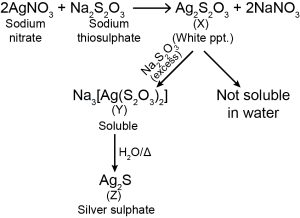
Addition of sodium thiosulphate solution to a solution of silver nitrate gives $X$ as a white precipitate,which is insoluble in water but soluble in excess thiosulphate solution to give $Y$. On boiling in water,$Y$ gives $Z$. $X$,$Y$,and $Z$ respectively are:
A
$Ag_{2}S_{2}O_{3}$,$Na_{3}[Ag(S_{2}O_{3})_{2}]$,$Ag_{2}S$
B
$Ag_{2}SO_{4}$,$Na[Ag(S_{2}O_{3})_{2}]$,$Ag_{2}S_{2}$
C
$Ag_{2}S_{2}O_{3}$,$Na_{5}[Ag(S_{2}O_{3})_{3}]$,$AgS$
D
$Ag_{2}SO_{3}$,$Na_{3}[Ag(S_{2}O_{3})_{2}]$,$Ag_{2}O$
Solution
(A) The sequence of reactions is as follows:
$1$. $2AgNO_{3} + Na_{2}S_{2}O_{3} \rightarrow Ag_{2}S_{2}O_{3} \downarrow (X) + 2NaNO_{3}$
$2$. $Ag_{2}S_{2}O_{3} + 3Na_{2}S_{2}O_{3} \rightarrow 2Na_{3}[Ag(S_{2}O_{3})_{2}] (Y)$
$3$. $2Na_{3}[Ag(S_{2}O_{3})_{2}] + H_{2}O \xrightarrow{\Delta} Ag_{2}S (Z) + Na_{2}SO_{4} + 2Na_{2}S_{2}O_{3} + H_{2}SO_{4}$
Thus,$X = Ag_{2}S_{2}O_{3}$,$Y = Na_{3}[Ag(S_{2}O_{3})_{2}]$,and $Z = Ag_{2}S$.
$1$. $2AgNO_{3} + Na_{2}S_{2}O_{3} \rightarrow Ag_{2}S_{2}O_{3} \downarrow (X) + 2NaNO_{3}$
$2$. $Ag_{2}S_{2}O_{3} + 3Na_{2}S_{2}O_{3} \rightarrow 2Na_{3}[Ag(S_{2}O_{3})_{2}] (Y)$
$3$. $2Na_{3}[Ag(S_{2}O_{3})_{2}] + H_{2}O \xrightarrow{\Delta} Ag_{2}S (Z) + Na_{2}SO_{4} + 2Na_{2}S_{2}O_{3} + H_{2}SO_{4}$
Thus,$X = Ag_{2}S_{2}O_{3}$,$Y = Na_{3}[Ag(S_{2}O_{3})_{2}]$,and $Z = Ag_{2}S$.
0 likes
View Solution233
MediumMCQ
Compound $X$ is tested and the results are shown in the table.
Which ions are present in compound $X$?
| Test | Result |
| Aqueous $NaOH$ is added,then heated gently. | Gas given off which turns damp red litmus paper blue. |
| Dilute $HCl$ is added. | Effervescence,gas given off which turns lime water milky and acidified $K_2Cr_2O_7$ paper green. |
A
Ammonium ions and sulphite ions
B
Ammonium ions and carbonate ions
C
Sodium ions and carbonate ions
D
Ammonium ions and sulphate ions
Solution
(A) Test $1$: The reaction with aqueous $NaOH$ and gentle heating produces $NH_3$ gas (which turns damp red litmus blue),indicating the presence of ammonium ions $(NH_4^+)$.
Test $2$: The reaction with dilute $HCl$ produces $SO_2$ gas (which turns lime water milky and acidified $K_2Cr_2O_7$ paper green),indicating the presence of sulphite ions $(SO_3^{2-})$.
Carbonate ions would turn lime water milky but would not change the color of acidified $K_2Cr_2O_7$.
Therefore,compound $X$ contains ammonium and sulphite ions.
Test $2$: The reaction with dilute $HCl$ produces $SO_2$ gas (which turns lime water milky and acidified $K_2Cr_2O_7$ paper green),indicating the presence of sulphite ions $(SO_3^{2-})$.
Carbonate ions would turn lime water milky but would not change the color of acidified $K_2Cr_2O_7$.
Therefore,compound $X$ contains ammonium and sulphite ions.
0 likes
View Solution234
DifficultMCQ
In the group analysis of cations,$Ba^{2+}$ and $Ca^{2+}$ are precipitated respectively as
A
sulphide and sulphide
B
hydroxide and carbonate
C
carbonate and carbonate
D
chromate and sulphide
Solution
(C) In the qualitative analysis of cations,$Ba^{2+}$ and $Ca^{2+}$ belong to Group $V$.
They are precipitated by the addition of $(NH_{4})_{2}CO_{3}$ in the presence of $NH_{4}Cl$ and $NH_{4}OH$.
Both $Ba^{2+}$ and $Ca^{2+}$ react with the carbonate ion $(CO_{3}^{2-})$ to form their respective insoluble carbonates,$BaCO_{3}$ and $CaCO_{3}$.
They are precipitated by the addition of $(NH_{4})_{2}CO_{3}$ in the presence of $NH_{4}Cl$ and $NH_{4}OH$.
Both $Ba^{2+}$ and $Ca^{2+}$ react with the carbonate ion $(CO_{3}^{2-})$ to form their respective insoluble carbonates,$BaCO_{3}$ and $CaCO_{3}$.
0 likes
View Solution235
DifficultMCQ
$A$ salt with a few drops of conc. $HCl$ gives an apple green colour in a flame test. The group precipitate of the salt is dissolved in acetic acid and treated with $K_{2}CrO_{4}$ to give a yellow precipitate. When the sodium carbonate extract of the salt solution is heated with conc. $HNO_{3}$ and ammonium molybdate,it results in a canary yellow precipitate. The cation and anion present in the salt are respectively,
A
$Ca^{2+}$ and $SO_{4}^{2-}$
B
$Ba^{2+}$ and $PO_{4}^{3-}$
C
$Mn^{2+}$ and $PO_{4}^{3-}$
D
$Ba^{2+}$ and $SO_{4}^{2-}$
Solution
(B) $1$. An apple green flame test is a characteristic feature of $Ba^{2+}$ ions.
$2$. $Ba^{2+}$ ions react with $K_{2}CrO_{4}$ in an acetic acid medium to form a yellow precipitate of barium chromate $(BaCrO_{4})$.
$3$. The formation of a canary yellow precipitate upon heating the sodium carbonate extract with conc. $HNO_{3}$ and ammonium molybdate is a confirmatory test for the presence of phosphate ions $(PO_{4}^{3-})$.
$4$. Therefore,the salt contains $Ba^{2+}$ as the cation and $PO_{4}^{3-}$ as the anion.
$2$. $Ba^{2+}$ ions react with $K_{2}CrO_{4}$ in an acetic acid medium to form a yellow precipitate of barium chromate $(BaCrO_{4})$.
$3$. The formation of a canary yellow precipitate upon heating the sodium carbonate extract with conc. $HNO_{3}$ and ammonium molybdate is a confirmatory test for the presence of phosphate ions $(PO_{4}^{3-})$.
$4$. Therefore,the salt contains $Ba^{2+}$ as the cation and $PO_{4}^{3-}$ as the anion.
0 likes
View Solution236
MediumMCQ
Among $Fe^{3+}$,$Pb^{2+}$,$Cu^{2+}$,and $Mn^{2+}$,identify the one that gets precipitated out while passing $H_2S$ gas in the presence of $NH_4OH$ as a group reagent. The highest possible oxidation state of the corresponding metal is:
A
+$3$
B
+$4$
C
+$2$
D
+$7$
Solution
(D) In qualitative inorganic analysis,metal ions are classified into groups based on their precipitation reactions.
$Pb^{2+}$ and $Cu^{2+}$ belong to Group $II$ and precipitate as sulfides in an acidic medium.
$Fe^{3+}$ belongs to Group $III$ and precipitates as $Fe(OH)_3$ in the presence of $NH_4OH$ and $NH_4Cl$.
$Mn^{2+}$ belongs to Group $IV$ and precipitates as $MnS$ when $H_2S$ is passed through an alkaline solution (in the presence of $NH_4OH$).
Therefore,$Mn^{2+}$ is the ion that precipitates under the given conditions.
The electronic configuration of Manganese $(Mn)$ is $[Ar] 3d^5 4s^2$. It can lose all $7$ valence electrons to achieve its highest oxidation state of $+7$,as seen in compounds like $KMnO_4$.
$Pb^{2+}$ and $Cu^{2+}$ belong to Group $II$ and precipitate as sulfides in an acidic medium.
$Fe^{3+}$ belongs to Group $III$ and precipitates as $Fe(OH)_3$ in the presence of $NH_4OH$ and $NH_4Cl$.
$Mn^{2+}$ belongs to Group $IV$ and precipitates as $MnS$ when $H_2S$ is passed through an alkaline solution (in the presence of $NH_4OH$).
Therefore,$Mn^{2+}$ is the ion that precipitates under the given conditions.
The electronic configuration of Manganese $(Mn)$ is $[Ar] 3d^5 4s^2$. It can lose all $7$ valence electrons to achieve its highest oxidation state of $+7$,as seen in compounds like $KMnO_4$.
0 likes
View SolutionPrinciples Related to Practical Chemistry — Wet Test for Basic Radical · Frequently Asked Questions
1Are these Principles Related to Practical Chemistry questions useful for JEE and NEET?
Yes. All questions in this section are mapped to JEE Main and NEET exam patterns. Previous year questions from JEE Main, NEET, GUJCET and state-level exams are included with full solutions.
2Can I switch to Hindi or Gujarati for these questions?
Yes. Use the language tabs in the hero section or the sidebar to view the same questions and solutions in English, Hindi or Gujarati.
3How do I generate a question paper from this subtopic?
Use the Vedclass Exam Paper Generator — select the chapter and subtopic, set difficulty, and generate Sets A, B, C, D automatically. First 3 chapters of every subject are free.
Vedclass Products
For Students
Vedclass Test Series
Mock tests in real JEE/NEET style with performance analysis. 5-day free trial.
Start Free TrialFor Teachers
Exam Paper Generator
Generate Set A/B/C/D papers from this chapter in 2 minutes. 3 chapters free.
Try FreeFor Institutes
Online Exam Module
Live online exams with unlimited students, 360° analytics & white-label branding.
See DemoFor Teachers & Institutes
Generate a Principles Related to Practical Chemistry Exam Paper in 2 Minutes
Select subtopic & difficulty — Sets A, B, C, D auto-generated with No Repeat logic.
First 3 chapters of every subject are free — no payment required.