
A English
Preliminary Test Questions in English
Class 12 Chemistry · Principles Related to Practical Chemistry · Preliminary Test
38+
Questions
English
Language
100%
With Solutions
Showing 38 of 38 questions in English
1
EasyMCQ
Starch paper is used to test for the presence of
A
Iodine
B
Oxidising agent
C
Iodide ion
D
Reducing agent
Solution
(A) Starch paper is used to detect the presence of $I_{2}$ (iodine).
When an oxidizing agent reacts with an iodide ion $(I^{-})$,it produces iodine $(I_{2})$.
$2I^{-} + \text{oxidant} \rightarrow I_{2} + \text{reduced product}$
The produced $I_{2}$ reacts with starch to form a characteristic blue-black complex.
$I_{2} + \text{starch} \rightarrow \text{blue-black complex}$
When an oxidizing agent reacts with an iodide ion $(I^{-})$,it produces iodine $(I_{2})$.
$2I^{-} + \text{oxidant} \rightarrow I_{2} + \text{reduced product}$
The produced $I_{2}$ reacts with starch to form a characteristic blue-black complex.
$I_{2} + \text{starch} \rightarrow \text{blue-black complex}$
0 likes
View Solution2
MediumMCQ
What is a fusion mixture?
A
$Na_2CO_3 + K_2CO_3$
B
$Na_2CO_3 + NaHCO_3$
C
$Na_2CO_3 + NaOH$
D
$Na_2CO_3 + K_2SO_4$
Solution
(A) fusion mixture is an equimolar mixture of sodium carbonate $(Na_2CO_3)$ and potassium carbonate $(K_2CO_3)$.
It is commonly used in analytical chemistry to fuse insoluble substances like silicates or metal oxides to make them soluble in water or acids.
It is commonly used in analytical chemistry to fuse insoluble substances like silicates or metal oxides to make them soluble in water or acids.
0 likes
View Solution3
MediumMCQ
The microcosmic salt is
A
$Na(NH_4)H_2O$
B
$K(NH_4)HPO_3 \cdot 2H_2O$
C
$Na(NH_4)HPO_4 \cdot 4H_2O$
D
$Na(NH_3)HPO_4 \cdot 4H_2O$
Solution
(C) The chemical formula for microcosmic salt is $Na(NH_4)HPO_4 \cdot 4H_2O$.
It is also known as sodium ammonium hydrogen phosphate tetrahydrate.
It is also known as sodium ammonium hydrogen phosphate tetrahydrate.
0 likes
View Solution4
MediumMCQ
Which ion gives a violet-coloured bead in the borax bead test?
A
$Fe^{2+}$
B
$Ni^{2+}$
C
$Co^{2+}$
D
$Mn^{2+}$
Solution
(D) The correct answer is $(D)$.
In the borax bead test,$Mn^{2+}$ ions form manganese metaborate,$Mn(BO_2)_2$,which exhibits a violet or amethyst colour in the oxidizing flame.
This colour is characteristic of the $Mn^{2+}$ ion.
In the borax bead test,$Mn^{2+}$ ions form manganese metaborate,$Mn(BO_2)_2$,which exhibits a violet or amethyst colour in the oxidizing flame.
This colour is characteristic of the $Mn^{2+}$ ion.
0 likes
View Solution5
MediumMCQ
Which one of the following metals will give blue ash when its salt is heated with $Na_2CO_3$ solid and $Co(NO_3)_2$ on a charcoal piece?
A
$Cu$
B
$Mg$
C
$Al$
D
$Zn$
Solution
(C) The charcoal cavity test with $Co(NO_3)_2$ is used for the identification of certain metals.
When aluminum salts are heated with $Na_2CO_3$ and $Co(NO_3)_2$ on a charcoal piece,they form cobalt aluminate $(CoAl_2O_4)$,which is known as Thenard's blue.
The reaction is: $2Co(NO_3)_2 \rightarrow 2CoO + 4NO_2 + O_2$ and $CoO + Al_2O_3 \rightarrow CoAl_2O_4$ (blue ash).
When aluminum salts are heated with $Na_2CO_3$ and $Co(NO_3)_2$ on a charcoal piece,they form cobalt aluminate $(CoAl_2O_4)$,which is known as Thenard's blue.
The reaction is: $2Co(NO_3)_2 \rightarrow 2CoO + 4NO_2 + O_2$ and $CoO + Al_2O_3 \rightarrow CoAl_2O_4$ (blue ash).
0 likes
View Solution6
MediumMCQ
Which one of the following salts gives a green-coloured flame when the salt is tested by a $Pt$ wire?
A
Barium salt
B
Calcium salt
C
Borate
D
Lead salt
Solution
(A) The flame test is used to identify metal ions based on the characteristic colour they impart to a non-luminous flame.
$A$. Barium $(Ba^{2+})$ salts impart a characteristic apple-green colour to the flame.
$B$. Calcium $(Ca^{2+})$ salts impart a brick-red colour.
$C$. Borates (like borax) can produce a green flame,but the question specifically asks for a salt tested by $Pt$ wire in the context of metal cation identification,where Barium is the standard answer.
$D$. Lead $(Pb^{2+})$ salts typically do not give a characteristic flame colour.
Therefore,the correct option is $A$.
$A$. Barium $(Ba^{2+})$ salts impart a characteristic apple-green colour to the flame.
$B$. Calcium $(Ca^{2+})$ salts impart a brick-red colour.
$C$. Borates (like borax) can produce a green flame,but the question specifically asks for a salt tested by $Pt$ wire in the context of metal cation identification,where Barium is the standard answer.
$D$. Lead $(Pb^{2+})$ salts typically do not give a characteristic flame colour.
Therefore,the correct option is $A$.
0 likes
View Solution7
MediumMCQ
The salt used for performing the 'bead' test in qualitative inorganic analysis is
A
$K_2SO_4 \cdot Al_2(SO_4)_3 \cdot 24H_2O$
B
$FeSO_4 \cdot (NH_4)_2SO_4 \cdot 6H_2O$
C
$Na(NH_4)HPO_4 \cdot 4H_2O$
D
$CaSO_4 \cdot 2H_2O$
Solution
(C) The salt used for the bead test is known as Microcosmic salt,which is $Na(NH_4)HPO_4 \cdot 4H_2O$.
Upon heating,it decomposes to form a transparent bead of sodium metaphosphate:
$Na(NH_4)HPO_4 \cdot 4H_2O \xrightarrow{\Delta} NaPO_3 + NH_3 + 5H_2O$.
This $NaPO_3$ bead reacts with metal oxides to form colored beads,which helps in the identification of metal ions.
Upon heating,it decomposes to form a transparent bead of sodium metaphosphate:
$Na(NH_4)HPO_4 \cdot 4H_2O \xrightarrow{\Delta} NaPO_3 + NH_3 + 5H_2O$.
This $NaPO_3$ bead reacts with metal oxides to form colored beads,which helps in the identification of metal ions.
0 likes
View Solution8
MediumMCQ
On performing a borax-bead test with a given inorganic mixture for qualitative analysis,the colour of the bead was found to be emerald green both in oxidising and reducing flame. It indicates the possibility of the presence of
A
$Co^{2+}$
B
$Ni^{2+}$
C
$Cr^{3+}$
D
$Cu^{2+}$
Solution
(C) The borax-bead test is used to identify transition metal ions.
$Cr^{3+}$ ions produce an emerald green bead in both the oxidising and reducing flames due to the formation of chromium$(III)$ metaborate,$Cr(BO_2)_3$.
Therefore,the correct option is $(C)$.
$Cr^{3+}$ ions produce an emerald green bead in both the oxidising and reducing flames due to the formation of chromium$(III)$ metaborate,$Cr(BO_2)_3$.
Therefore,the correct option is $(C)$.
0 likes
View Solution9
MediumMCQ
$A$ chemistry student trying to detect the metallic ion in a salt,makes a paste on a clean platinum wire loop of the salt with concentrated $HCl$. When he takes a small amount of this paste and keeps it in a non-luminous Bunsen flame,the colour of the flame changes to grassy green. He should,therefore,conclude that the metal is
A
Barium
B
Calcium
C
Potassium
D
Strontium
Solution
(A) The flame test is a qualitative analysis method used to identify the presence of certain metal ions based on the characteristic color they impart to a non-luminous Bunsen flame.
$Ba^{2+}$ ions produce a characteristic grassy green color in the flame.
$Ca^{2+}$ ions produce a brick-red color.
$K^+$ ions produce a lilac color.
$Sr^{2+}$ ions produce a crimson-red color.
Therefore,the correct metal is Barium $(Ba)$.
$Ba^{2+}$ ions produce a characteristic grassy green color in the flame.
$Ca^{2+}$ ions produce a brick-red color.
$K^+$ ions produce a lilac color.
$Sr^{2+}$ ions produce a crimson-red color.
Therefore,the correct metal is Barium $(Ba)$.
0 likes
View Solution10
EasyMCQ
If steel is heated to a temperature well below red heat and is then cooled slowly,the process is called
A
Tempering
B
Hardening
C
Softening
D
Annealing
Solution
(A) The process described is known as $Tempering$.
In this process,steel is heated to a temperature well below red heat and then cooled slowly.
This treatment reduces the brittleness of the steel while retaining its hardness.
In this process,steel is heated to a temperature well below red heat and then cooled slowly.
This treatment reduces the brittleness of the steel while retaining its hardness.
0 likes
View Solution11
MediumMCQ
Which salt is used during the bead test in the qualitative analysis of inorganic substances?
A
$K_2SO_4 \cdot Al_2(SO_4)_3 \cdot 24H_2O$
B
$FeSO_4 \cdot (NH_4)_2SO_4 \cdot 6H_2O$
C
$Na(NH_4)HPO_4 \cdot 4H_2O$
D
$CaSO_4 \cdot 2H_2O$
Solution
(C) The bead test (specifically the microcosmic salt bead test) uses microcosmic salt,which is $Na(NH_4)HPO_4 \cdot 4H_2O$.
Upon heating,it decomposes to form a transparent bead of sodium metaphosphate:
$Na(NH_4)HPO_4 \cdot 4H_2O \xrightarrow{\Delta} NaPO_3 + NH_3 + 5H_2O$.
This sodium metaphosphate bead reacts with metal oxides to form colored beads.
Upon heating,it decomposes to form a transparent bead of sodium metaphosphate:
$Na(NH_4)HPO_4 \cdot 4H_2O \xrightarrow{\Delta} NaPO_3 + NH_3 + 5H_2O$.
This sodium metaphosphate bead reacts with metal oxides to form colored beads.
0 likes
View Solution12
MediumMCQ
Which metal ion gives a violet bead in the borax bead test?
A
$Fe^{2+}$
B
$Ni^{2+}$
C
$Co^{2+}$
D
$Mn^{2+}$
Solution
(D) In the borax bead test,$Mn^{2+}$ ions form manganese metaborate,$Mn(BO_2)_2$,which exhibits a violet color in the oxidizing flame.
0 likes
View Solution13
MediumMCQ
What is microcosmic salt?
A
$Na_2HPO_4 \cdot 2H_2O$
B
$(NH_4)_2HPO_4 \cdot 2H_2O$
C
$Na(NH_4)HPO_4 \cdot 4H_2O$
D
None of these
Solution
(C) $Na(NH_4)HPO_4 \cdot 4H_2O$ is known as microcosmic salt.
It is commonly used in qualitative inorganic analysis,specifically for the bead test.
It is commonly used in qualitative inorganic analysis,specifically for the bead test.
0 likes
View Solution14
MediumMCQ
Which of the following salts is used in the bead test for the qualitative analysis of inorganic substances?
A
$K_2SO_4 \cdot Al_2(SO_4)_3 \cdot 24H_2O$
B
$FeSO_4 \cdot (NH_4)_2SO_4 \cdot 6H_2O$
C
$Na(NH_4)HPO_4 \cdot 4H_2O$
D
$CuSO_4 \cdot 5H_2O$
Solution
(C) The salt used in the bead test is known as microcosmic salt,which has the chemical formula $Na(NH_4)HPO_4 \cdot 4H_2O$.
0 likes
View Solution15
MediumMCQ
What is the formula of microcosmic salt?
A
$Na_2HPO_4$
B
$NaNH_4HPO_4 \cdot 4H_2O$
C
$K_2HPO_4$
D
$Na_2PO_4 \cdot K_2PO_4$
Solution
(B) Microcosmic salt is a chemical compound known as sodium ammonium hydrogen phosphate tetrahydrate.
Its chemical formula is $NaNH_4HPO_4 \cdot 4H_2O$.
It is commonly used in qualitative analysis for the bead test.
Its chemical formula is $NaNH_4HPO_4 \cdot 4H_2O$.
It is commonly used in qualitative analysis for the bead test.
0 likes
View Solution16
EasyMCQ
The salt which finds uses in qualitative inorganic analysis is
A
$CuSO_4 \cdot 5H_2O$ or $ZnSO_4 \cdot 5H_2O$
B
$K_2SO_4 \cdot Al_2(SO_4)_3 \cdot 24H_2O$
C
$Na(NH_4)HPO_4 \cdot 4H_2O$
D
$FeSO_4 \cdot (NH_4)_2SO_4 \cdot 6H_2O$
Solution
(C) $Na(NH_4)HPO_4 \cdot 4H_2O$ (Microcosmic salt) is used for performing the bead test in qualitative inorganic analysis.
Upon heating,it forms a glassy bead of sodium metaphosphate $(NaPO_3)$,which reacts with metal oxides to form colored beads.
So,the correct answer is $C$.
Upon heating,it forms a glassy bead of sodium metaphosphate $(NaPO_3)$,which reacts with metal oxides to form colored beads.
So,the correct answer is $C$.
0 likes
View Solution17
EasyMCQ
Which of the following gives the chromyl chloride test?
A
$KCl$
B
$PbCl_2$
C
$HgCl_2$
D
All
Solution
(A) The chromyl chloride test is a qualitative test used to detect the presence of chloride ions $(Cl^-)$ in a sample.
In this test,a chloride salt is heated with potassium dichromate $(K_2Cr_2O_7)$ and concentrated sulfuric acid $(H_2SO_4)$.
If chloride ions are present,they react to form chromyl chloride $(CrO_2Cl_2)$,which is a deep red vapor.
This test is specifically applicable to ionic chlorides.
$KCl$ is an ionic chloride and readily gives this test.
$PbCl_2$ and $HgCl_2$ are covalent in nature and do not provide the necessary chloride ions in the reaction mixture to form chromyl chloride.
Therefore,only $KCl$ gives the chromyl chloride test.
In this test,a chloride salt is heated with potassium dichromate $(K_2Cr_2O_7)$ and concentrated sulfuric acid $(H_2SO_4)$.
If chloride ions are present,they react to form chromyl chloride $(CrO_2Cl_2)$,which is a deep red vapor.
This test is specifically applicable to ionic chlorides.
$KCl$ is an ionic chloride and readily gives this test.
$PbCl_2$ and $HgCl_2$ are covalent in nature and do not provide the necessary chloride ions in the reaction mixture to form chromyl chloride.
Therefore,only $KCl$ gives the chromyl chloride test.
0 likes
View Solution18
EasyMCQ
Which of the following salts does not give a borax bead test?
A
$Al^{+3}$
B
$Co^{+2}$
C
$Cu^{+2}$
D
$Ni^{+2}$
Solution
(A) The borax bead test is used to identify transition metal ions that form colored metaborates upon heating with borax $(Na_2B_4O_7 \cdot 10H_2O)$.
Transition metals like $Co^{+2}$,$Cu^{+2}$,and $Ni^{+2}$ form colored beads (blue,green/blue,and brown/yellow respectively).
$Al^{+3}$ is a representative element (non-transition metal) and does not form colored metaborates,thus it does not give a positive borax bead test.
Transition metals like $Co^{+2}$,$Cu^{+2}$,and $Ni^{+2}$ form colored beads (blue,green/blue,and brown/yellow respectively).
$Al^{+3}$ is a representative element (non-transition metal) and does not form colored metaborates,thus it does not give a positive borax bead test.
0 likes
View Solution19
MediumMCQ
Which of the following gives the chromyl chloride test?
A
$KCl$
B
$PbCl_2$
C
$HgCl_2$
D
All
Solution
(A) The chromyl chloride test is a characteristic test for the presence of chloride ions $(Cl^-)$ in inorganic compounds.
It is specifically given by ionic chlorides.
Among the given options,$KCl$ is an ionic chloride,whereas $PbCl_2$ and $HgCl_2$ are covalent in nature and do not respond to this test.
It is specifically given by ionic chlorides.
Among the given options,$KCl$ is an ionic chloride,whereas $PbCl_2$ and $HgCl_2$ are covalent in nature and do not respond to this test.
0 likes
View Solution20
MediumMCQ
The compound called microcosmic salt is
A
$Na_2HPO_4 \cdot 2H_2O$
B
$Na(NH_4)HPO_4 \cdot 4H_2O$
C
$Na_2NH_4PO_4 \cdot 2H_2O$
D
$(NH_4)_2HPO_4 \cdot 2H_2O$
Solution
(B) Microcosmic salt is a chemical compound with the formula $Na(NH_4)HPO_4 \cdot 4H_2O$.
It is historically known as sodium ammonium hydrogen phosphate tetrahydrate.
It is obtained from urine and is used in the laboratory for the microcosmic salt bead test to identify metallic radicals based on the characteristic colors they produce in an oxidizing or reducing flame.
It is historically known as sodium ammonium hydrogen phosphate tetrahydrate.
It is obtained from urine and is used in the laboratory for the microcosmic salt bead test to identify metallic radicals based on the characteristic colors they produce in an oxidizing or reducing flame.
0 likes
View Solution21
MediumMCQ
Which of the following solid salt on heating with solid $K_2Cr_2O_7$ and conc. $H_2SO_4$ evolves orange-red vapours that turn an aqueous $NaOH$ solution yellow?
A
$NaBr$
B
$NaCl$
C
$NaNO_3$
D
$NaI$
Solution
(B) The reaction of a chloride salt with solid $K_2Cr_2O_7$ and concentrated $H_2SO_4$ is known as the $Chromyl$ $Chloride$ test.
$4NaCl_{(s)} + K_2Cr_2O_{7(s)} + 6H_2SO_4(conc.) \to 2CrO_2Cl_2(orange-red \ vapours) + 2KHSO_4 + 4NaHSO_4 + 3H_2O$
The orange-red vapours of $CrO_2Cl_2$ (chromyl chloride) dissolve in aqueous $NaOH$ to form a yellow solution of sodium chromate:
$CrO_2Cl_2 + 4NaOH_{(aq)} \to Na_2CrO_4(yellow \ solution) + 2NaCl + 2H_2O$
Thus,the correct salt is $NaCl$.
$4NaCl_{(s)} + K_2Cr_2O_{7(s)} + 6H_2SO_4(conc.) \to 2CrO_2Cl_2(orange-red \ vapours) + 2KHSO_4 + 4NaHSO_4 + 3H_2O$
The orange-red vapours of $CrO_2Cl_2$ (chromyl chloride) dissolve in aqueous $NaOH$ to form a yellow solution of sodium chromate:
$CrO_2Cl_2 + 4NaOH_{(aq)} \to Na_2CrO_4(yellow \ solution) + 2NaCl + 2H_2O$
Thus,the correct salt is $NaCl$.
0 likes
View Solution22
MediumMCQ
When sodium chloride is heated with concentrated $H_2SO_4$ and solid potassium dichromate,which compound containing $Cr$ in the $+6$ oxidation state is formed as a gas?
A
Chromic chloride
B
Chromyl chloride
C
Chromous chloride
D
None of these
Solution
(B) The reaction of sodium chloride with potassium dichromate and concentrated sulfuric acid is known as the chromyl chloride test.
The balanced chemical equation is:
$4NaCl + K_2Cr_2O_7 + 6H_2SO_4 \to 2CrO_2Cl_2 + 4NaHSO_4 + 2KHSO_4 + 3H_2O$
In this reaction,$CrO_2Cl_2$ (Chromyl chloride) is formed as a deep red gas,where the oxidation state of $Cr$ is $+6$.
The balanced chemical equation is:
$4NaCl + K_2Cr_2O_7 + 6H_2SO_4 \to 2CrO_2Cl_2 + 4NaHSO_4 + 2KHSO_4 + 3H_2O$
In this reaction,$CrO_2Cl_2$ (Chromyl chloride) is formed as a deep red gas,where the oxidation state of $Cr$ is $+6$.
0 likes
View Solution23
EasyMCQ
Which of the following cations cannot give a borax bead test?
A
$Cr^{3+}$
B
$Co^{2+}$
C
$Ag^{+}$
D
$Mn^{2+}$
Solution
(C) The borax bead test is used to identify transition metal ions that form colored metaborates.
$Ag^{+}$ ion does not give a characteristic colored bead because the formed silver metaborate,$AgBO_2$,is white or colorless,making it indistinguishable from the borax bead itself.
$Ag^{+}$ ion does not give a characteristic colored bead because the formed silver metaborate,$AgBO_2$,is white or colorless,making it indistinguishable from the borax bead itself.
0 likes
View Solution24
MediumMCQ
Assign $A, B, C, D$ from the given type of reaction.
$MCrO_4 \downarrow (M^{2+} = Ba^{2+}, Pb^{2+}) + AcOH \longrightarrow$ No dissolution
$MCrO_4 \downarrow (M^{2+} = Ba^{2+}, Pb^{2+}) + AcOH \longrightarrow$ No dissolution
A
For precipitate formation reaction
B
For precipitate dissolution reaction
C
For precipitate exchange reaction
D
For no reaction
Solution
(D) The reaction involves the interaction of metal chromate precipitates ($BaCrO_4$ or $PbCrO_4$) with acetic acid $(AcOH)$.
Since $AcOH$ is a weak acid,it is not strong enough to dissolve these specific chromate precipitates.
Therefore,the observation 'No dissolution' indicates that no significant chemical reaction occurs between the precipitate and the acid.
Thus,the correct classification is 'For no reaction'.
Since $AcOH$ is a weak acid,it is not strong enough to dissolve these specific chromate precipitates.
Therefore,the observation 'No dissolution' indicates that no significant chemical reaction occurs between the precipitate and the acid.
Thus,the correct classification is 'For no reaction'.
0 likes
View Solution25
MediumMCQ
Assign $A$,$B$,$C$,$D$ from the given type of reaction.
$2KI + FeCl_2 \longrightarrow$ No reaction
$2KI + FeCl_2 \longrightarrow$ No reaction
A
$A$. for coloured ppt./Black ppt.
B
$B$. for coloured solution.
C
$C$. for clear/colourless solution
D
$D$. for white ppt.
Solution
(C) The reaction $2KI + FeCl_2 \longrightarrow$ No reaction indicates that no chemical change occurs between potassium iodide $(KI)$ and ferrous chloride $(FeCl_2)$.
Since the reactants remain in the solution without forming any precipitate or changing color,the resulting mixture remains a clear/colourless solution.
Therefore,the correct assignment is $C$.
Since the reactants remain in the solution without forming any precipitate or changing color,the resulting mixture remains a clear/colourless solution.
Therefore,the correct assignment is $C$.
0 likes
View Solution26
MediumMCQ
Assign $A, B, C, D$ from the given type of reaction.
$Na_2CO_3 + KNO_3 \longrightarrow$ No reaction
$Na_2CO_3 + KNO_3 \longrightarrow$ No reaction
A
$A$. for coloured ppt./Black ppt.
B
$B$. for coloured solution.
C
$C$. for clear/colourless solution
D
$D$. for white ppt.
Solution
(C) The reaction between $Na_2CO_3$ and $KNO_3$ involves two soluble salts.
According to the solubility rules,all sodium and potassium salts are soluble in water.
Since no insoluble precipitate is formed and no redox reaction occurs to produce a coloured species,there is no observable reaction.
Therefore,the mixture results in a clear/colourless solution.
Thus,the correct assignment is $C$.
According to the solubility rules,all sodium and potassium salts are soluble in water.
Since no insoluble precipitate is formed and no redox reaction occurs to produce a coloured species,there is no observable reaction.
Therefore,the mixture results in a clear/colourless solution.
Thus,the correct assignment is $C$.
0 likes
View Solution27
MediumMCQ
Identify the type of precipitate formed in the following reaction: $(NH_4)_2SO_4 + Ba(OH)_2 \longrightarrow BaSO_4 \downarrow + 2NH_3 \uparrow$
A
for coloured ppt./Black ppt.
B
for coloured solution.
C
for clear/colourless solution
D
for white ppt.
Solution
(D) The reaction is: $(NH_4)_2SO_4 + Ba(OH)_2 \longrightarrow BaSO_4 \downarrow + 2NH_3 \uparrow$.
In this reaction,$BaSO_4$ (Barium sulfate) is formed as a solid precipitate.
$BaSO_4$ is known to be a white coloured precipitate.
In this reaction,$BaSO_4$ (Barium sulfate) is formed as a solid precipitate.
$BaSO_4$ is known to be a white coloured precipitate.
0 likes
View Solution28
EasyMCQ
Given below are two statements:
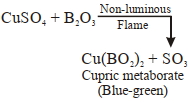
Statement $I$: Colourless cupric metaborate is reduced to cuprous metaborate in a luminous flame.
Statement $II$: Cuprous metaborate is obtained by heating boric anhydride and copper sulphate in a non-luminous flame.
In the light of the above statements,choose the most appropriate answer from the options given below.
Statement $I$: Colourless cupric metaborate is reduced to cuprous metaborate in a luminous flame.
Statement $II$: Cuprous metaborate is obtained by heating boric anhydride and copper sulphate in a non-luminous flame.
In the light of the above statements,choose the most appropriate answer from the options given below.
A
Statement $I$ is true but Statement $II$ is false
B
Both Statement $I$ and Statement $II$ are false
C
Statement $I$ is false but Statement $II$ is true
D
Both Statement $I$ and Statement $II$ are true
Solution
(B) Statement $I$ is false because cupric metaborate $(Cu(BO_2)_2)$ is blue in color,not colourless.
Statement $II$ is false because heating boric anhydride $(B_2O_3)$ and copper sulphate $(CuSO_4)$ in a non-luminous (oxidizing) flame produces cupric metaborate $(Cu(BO_2)_2)$,which is blue. Cuprous metaborate $(CuBO_2)$ is formed in a luminous (reducing) flame.
Statement $II$ is false because heating boric anhydride $(B_2O_3)$ and copper sulphate $(CuSO_4)$ in a non-luminous (oxidizing) flame produces cupric metaborate $(Cu(BO_2)_2)$,which is blue. Cuprous metaborate $(CuBO_2)$ is formed in a luminous (reducing) flame.
0 likes
View Solution29
MediumMCQ
In the flame test of a mixture of salts,a green flame with a blue centre was observed. Which one of the following cations may be present?
A
$Cu^{2+}$
B
$Sr^{2+}$
C
$Ba^{2+}$
D
$Ca^{2+}$
Solution
(A) The flame test is a diagnostic tool used to identify the presence of certain metal ions in a sample based on the characteristic color they impart to a non-luminous flame.
Based on the observation,the presence of a green flame with a blue centre is characteristic of the $Cu^{2+}$ ion.
| Ion | Colour of the flame |
| $A. Cu^{2+}$ | Green flame with blue centre |
| $B. Sr^{2+}$ | Crimson Red |
| $C. Ba^{2+}$ | Apple green |
| $D. Ca^{2+}$ | Brick red |
Based on the observation,the presence of a green flame with a blue centre is characteristic of the $Cu^{2+}$ ion.
0 likes
View Solution30
MediumMCQ
While preparing crystals of Mohr's salt,dil. $H_2SO_4$ is added to a mixture of ferrous sulphate and ammonium sulphate,before dissolving this mixture in water,dil. $H_2SO_4$ is added here to:
A
prevent the hydrolysis of ferrous sulphate
B
prevent the hydrolysis of ammonium sulphate
C
make the medium strongly acidic
D
increase the rate of formation of crystals
Solution
(A) $Fe^{+2}$ ions undergo hydrolysis in water.
To prevent this hydrolysis and to keep the solution clear,dilute $H_2SO_4$ is added to the mixture of ferrous sulphate and ammonium sulphate before dissolving it in water.
To prevent this hydrolysis and to keep the solution clear,dilute $H_2SO_4$ is added to the mixture of ferrous sulphate and ammonium sulphate before dissolving it in water.
0 likes
View Solution31
MediumMCQ
Match List-$I$ with List-$II$ and choose the correct answer from the options given below:
| List-$I$ (Name of the test) | List-$II$ (Reaction sequence involved) [$M$ is metal] |
|---|---|
| $A$. Borax bead test | $I$. $MCO_3$ $\rightarrow MO$ $\xrightarrow[+\Delta]{Co(NO_3)_2} CoO \cdot MO$ |
| $B$. Charcoal cavity test | $II$. $MCO_3$ $\rightarrow MCl_2$ $\rightarrow M^{2+}$ |
| $C$. Cobalt nitrate test | $III$. $MSO_4$ $\xrightarrow[\Delta]{Na_2B_4O_7} M(BO_2)_2$ $\rightarrow MBO_2$ $\rightarrow M$ |
| $D$. Flame test | $IV$. $MSO_4$ $\xrightarrow[\Delta]{Na_2CO_3} MCO_3$ $\rightarrow MO$ $\rightarrow M$ |
A
$A-III, B-IV, C-I, D-II$
B
$A-III, B-II, C-IV, D-I$
C
$A-III, B-I, C-II, D-IV$
D
$A-I, B-IV, C-III, D-II$
Solution
(A) The correct matches are as follows:
$A$. Borax bead test: $MSO_4$ $\xrightarrow[\Delta]{Na_2B_4O_7} M(BO_2)_2$ $\rightarrow MBO_2$ $\rightarrow M$ (Matches $III$)
$B$. Charcoal cavity test: $MSO_4$ $\xrightarrow[\Delta]{Na_2CO_3} MCO_3$ $\rightarrow MO$ $\rightarrow M$ (Matches $IV$)
$C$. Cobalt nitrate test: $MCO_3$ $\rightarrow MO$ $\xrightarrow[+\Delta]{Co(NO_3)_2} CoO \cdot MO$ (Matches $I$)
$D$. Flame test: $MCO_3$ $\rightarrow MCl_2$ $\rightarrow M^{2+}$ (Matches $II$)
Therefore,the correct sequence is $A-III, B-IV, C-I, D-II$.
$A$. Borax bead test: $MSO_4$ $\xrightarrow[\Delta]{Na_2B_4O_7} M(BO_2)_2$ $\rightarrow MBO_2$ $\rightarrow M$ (Matches $III$)
$B$. Charcoal cavity test: $MSO_4$ $\xrightarrow[\Delta]{Na_2CO_3} MCO_3$ $\rightarrow MO$ $\rightarrow M$ (Matches $IV$)
$C$. Cobalt nitrate test: $MCO_3$ $\rightarrow MO$ $\xrightarrow[+\Delta]{Co(NO_3)_2} CoO \cdot MO$ (Matches $I$)
$D$. Flame test: $MCO_3$ $\rightarrow MCl_2$ $\rightarrow M^{2+}$ (Matches $II$)
Therefore,the correct sequence is $A-III, B-IV, C-I, D-II$.
0 likes
View Solution32
MediumMCQ
The colour of Mohr's salt and alum is respectively $:-$
A
Colourless,Colourless
B
Colourless,Light green
C
Light Green,Colourless
D
Light Green,Light Green
Solution
(C) Mohr's salt is $FeSO_4 \cdot (NH_4)_2SO_4 \cdot 6H_2O$. It contains $Fe^{2+}$ ions,which impart a light green colour to the salt.
Alum (specifically Potash Alum) is $K_2SO_4 \cdot Al_2(SO_4)_3 \cdot 24H_2O$. It contains $Al^{3+}$ ions,which are colourless in aqueous solution and solid form.
Therefore,the correct order is Light Green and Colourless.
Alum (specifically Potash Alum) is $K_2SO_4 \cdot Al_2(SO_4)_3 \cdot 24H_2O$. It contains $Al^{3+}$ ions,which are colourless in aqueous solution and solid form.
Therefore,the correct order is Light Green and Colourless.
0 likes
View Solution33
DifficultMCQ
Match List-$I$ with List-$II$:
Choose the correct answer from the options given below:
| List-$I$ Solid salt treated with dil. $H_2SO_4$ | List-$II$ Anion detected |
| $A.$ Effervescence of colourless gas | $I.$ $NO_2^-$ |
| $B.$ Gas with smell of rotten egg | $II.$ $CO_3^{2-}$ |
| $C.$ Yellowish green gas with pungent and suffocating smell | $III.$ $S^{2-}$ |
| $D.$ Brown fumes | $IV.$ $Cl^{-}$ |
Choose the correct answer from the options given below:
A
$A-II, B-III, C-IV, D-I$
B
$A-IV, B-III, C-II, D-I$
C
$A-I, B-II, C-III, D-IV$
D
$A-II, B-III, C-I, D-IV$
Solution
(A) The reaction of solid salts with dilute $H_2SO_4$ is a standard qualitative analysis test for anions:
$1$. $CO_3^{2-}$ reacts with dil. $H_2SO_4$ to release $CO_2$ gas,which causes effervescence $(A-II)$.
$2$. $S^{2-}$ reacts with dil. $H_2SO_4$ to release $H_2S$ gas,which has the smell of rotten eggs $(B-III)$.
$3$. $Cl^{-}$ (in some cases like $NaCl$ with conc. $H_2SO_4$ or specific conditions) can release $Cl_2$ gas (yellowish-green,pungent) if an oxidizing agent is present,but in standard qualitative analysis,$Cl^-$ is identified by the evolution of $HCl$ gas. However,based on the provided options,$C$ matches with $IV$ $(Cl^-)$ and $D$ matches with $I$ $(NO_2^-)$ which releases brown fumes of $NO_2$ gas.
Therefore,the correct matching is $A-II, B-III, C-IV, D-I$.
$1$. $CO_3^{2-}$ reacts with dil. $H_2SO_4$ to release $CO_2$ gas,which causes effervescence $(A-II)$.
$2$. $S^{2-}$ reacts with dil. $H_2SO_4$ to release $H_2S$ gas,which has the smell of rotten eggs $(B-III)$.
$3$. $Cl^{-}$ (in some cases like $NaCl$ with conc. $H_2SO_4$ or specific conditions) can release $Cl_2$ gas (yellowish-green,pungent) if an oxidizing agent is present,but in standard qualitative analysis,$Cl^-$ is identified by the evolution of $HCl$ gas. However,based on the provided options,$C$ matches with $IV$ $(Cl^-)$ and $D$ matches with $I$ $(NO_2^-)$ which releases brown fumes of $NO_2$ gas.
Therefore,the correct matching is $A-II, B-III, C-IV, D-I$.
0 likes
View Solution34
MediumMCQ
Which pair of cations can be identified by the borax bead test?
A
$Cu^{2+}, Co^{2+}$
B
$Cu^{2+}, Zn^{2+}$
C
$Co^{2+}, Ag^{+}$
D
$Ni^{2+}, Pb^{2+}$
Solution
(A) The borax bead test is used to identify transition metal cations that form coloured metaborates when heated with borax $(Na_2B_4O_7 \cdot 10H_2O)$.
Transition metals like $Cu^{2+}$,$Co^{2+}$,$Ni^{2+}$,$Fe^{3+}$,and $Cr^{3+}$ form characteristic coloured beads.
$Zn^{2+}$,$Pb^{2+}$,and $Ag^{+}$ do not form coloured metaborates in the borax bead test.
Therefore,the pair $Cu^{2+}$ and $Co^{2+}$ can both be identified by this test.
Transition metals like $Cu^{2+}$,$Co^{2+}$,$Ni^{2+}$,$Fe^{3+}$,and $Cr^{3+}$ form characteristic coloured beads.
$Zn^{2+}$,$Pb^{2+}$,and $Ag^{+}$ do not form coloured metaborates in the borax bead test.
Therefore,the pair $Cu^{2+}$ and $Co^{2+}$ can both be identified by this test.
0 likes
View Solution35
DifficultMCQ
What type of information is collected using $FTIR$ (Fourier transform infrared) spectroscopy?
A
Morphology of nanomaterial
B
Absorption of functional group
C
Geometry of particles
D
Particle size
Solution
(B) $1$. Morphology of nanomaterial: $FTIR$ does not provide information about the morphology (shape,structure) of nanomaterials. Techniques like $SEM$ or $TEM$ are used for this.
$2$. Absorption of functional group: $FTIR$ identifies functional groups by detecting characteristic absorption bands in the infrared region,such as those for $-OH$,$-CH$,$-NH$,and $-CO$ groups. This is the correct information collected by $FTIR$.
$3$. Geometry of particles: $FTIR$ does not give information about particle geometry (e.g.,spherical or cubic shapes).
$4$. Particle size: $FTIR$ cannot determine particle size. Techniques like $DLS$ (Dynamic Light Scattering) or electron microscopy are used for this.
$2$. Absorption of functional group: $FTIR$ identifies functional groups by detecting characteristic absorption bands in the infrared region,such as those for $-OH$,$-CH$,$-NH$,and $-CO$ groups. This is the correct information collected by $FTIR$.
$3$. Geometry of particles: $FTIR$ does not give information about particle geometry (e.g.,spherical or cubic shapes).
$4$. Particle size: $FTIR$ cannot determine particle size. Techniques like $DLS$ (Dynamic Light Scattering) or electron microscopy are used for this.
0 likes
View Solution36
EasyMCQ
Identify the last step in wet chemical synthesis of nanomaterial.
A
Formation of oxide or alcohol-bridged network
B
Dehydration
C
Aging of the gel
D
Drying of the gel
Solution
(B) The wet chemical synthesis (Sol-Gel process) of nanomaterials typically follows these steps: hydrolysis,condensation,gelation (formation of oxide or alcohol-bridged network),aging,drying,and finally dehydration (or calcination) to remove residual organic groups and water to obtain the final nanomaterial.
0 likes
View Solution37
EasyMCQ
Identify the technique used to know the binding nature of nanomaterials.
A
$SEM$
B
$TEM$
C
$XRD$
D
$FTIR$
Solution
(D) $FTIR$ (Fourier Transform Infrared Spectroscopy) is the technique used to identify the functional groups and the binding nature of nanomaterials by measuring the absorption of infrared radiation.
$SEM$ (Scanning Electron Microscopy) is used for surface morphology.
$TEM$ (Transmission Electron Microscopy) is used for internal structure and size.
$XRD$ ($X$-Ray Diffraction) is used for crystal structure analysis.
$SEM$ (Scanning Electron Microscopy) is used for surface morphology.
$TEM$ (Transmission Electron Microscopy) is used for internal structure and size.
$XRD$ ($X$-Ray Diffraction) is used for crystal structure analysis.
0 likes
View Solution38
MediumMCQ
Which of the following statement$(s)$ is (are) correct when a mixture of $NaCl$ and $K_{2}Cr_{2}O_{7}$ is gently warmed with conc. $H_{2}SO_{4}?$
A
$A$ deep red vapour is evolved
B
The vapour when passed through $NaOH$ solution,gives a yellow solution
C
Chlorine gas is also evolved
D
Chromyl chloride is formed
Solution
(A, B, D) When $NaCl$ and $K_{2}Cr_{2}O_{7}$ are warmed with conc. $H_{2}SO_{4}$,they produce deep red vapours of chromyl chloride $(CrO_{2}Cl_{2})$. Thus,statement $(A)$ and $(D)$ are correct.
When these vapours are passed through $NaOH$ solution,they form sodium chromate $(Na_{2}CrO_{4})$,which is yellow in color. Thus,statement $(B)$ is correct.
Chlorine gas is not evolved in this reaction. Thus,statement $(C)$ is incorrect.
The reactions are as follows:
$(I)$ $K_{2}Cr_{2}O_{7} + 6 H_{2}SO_{4} \longrightarrow 2 KHSO_{4} + 2 CrO_{3} + 3 H_{2}O$
$(II)$ $NaCl + H_{2}SO_{4} \longrightarrow NaHSO_{4} + HCl$
$(III)$ $CrO_{3} + 2 HCl \longrightarrow CrO_{2}Cl_{2} + H_{2}O$
$(IV)$ $CrO_{2}Cl_{2} + 4 NaOH \longrightarrow Na_{2}CrO_{4} + 2 NaCl + 2 H_{2}O$
When these vapours are passed through $NaOH$ solution,they form sodium chromate $(Na_{2}CrO_{4})$,which is yellow in color. Thus,statement $(B)$ is correct.
Chlorine gas is not evolved in this reaction. Thus,statement $(C)$ is incorrect.
The reactions are as follows:
$(I)$ $K_{2}Cr_{2}O_{7} + 6 H_{2}SO_{4} \longrightarrow 2 KHSO_{4} + 2 CrO_{3} + 3 H_{2}O$
$(II)$ $NaCl + H_{2}SO_{4} \longrightarrow NaHSO_{4} + HCl$
$(III)$ $CrO_{3} + 2 HCl \longrightarrow CrO_{2}Cl_{2} + H_{2}O$
$(IV)$ $CrO_{2}Cl_{2} + 4 NaOH \longrightarrow Na_{2}CrO_{4} + 2 NaCl + 2 H_{2}O$
0 likes
View SolutionPrinciples Related to Practical Chemistry — Preliminary Test · Frequently Asked Questions
1Are these Principles Related to Practical Chemistry questions useful for JEE and NEET?
Yes. All questions in this section are mapped to JEE Main and NEET exam patterns. Previous year questions from JEE Main, NEET, GUJCET and state-level exams are included with full solutions.
2Can I switch to Hindi or Gujarati for these questions?
Yes. Use the language tabs in the hero section or the sidebar to view the same questions and solutions in English, Hindi or Gujarati.
3How do I generate a question paper from this subtopic?
Use the Vedclass Exam Paper Generator — select the chapter and subtopic, set difficulty, and generate Sets A, B, C, D automatically. First 3 chapters of every subject are free.
Vedclass Products
For Students
Vedclass Test Series
Mock tests in real JEE/NEET style with performance analysis. 5-day free trial.
Start Free TrialFor Teachers
Exam Paper Generator
Generate Set A/B/C/D papers from this chapter in 2 minutes. 3 chapters free.
Try FreeFor Institutes
Online Exam Module
Live online exams with unlimited students, 360° analytics & white-label branding.
See DemoFor Teachers & Institutes
Generate a Principles Related to Practical Chemistry Exam Paper in 2 Minutes
Select subtopic & difficulty — Sets A, B, C, D auto-generated with No Repeat logic.
First 3 chapters of every subject are free — no payment required.