
A English
General methods of preparation and mechanism of polymerisation Questions in English
Class 12 Chemistry · Polymers · General methods of preparation and mechanism of polymerisation
295+
Questions
English
Language
100%
With Solutions
Showing 50 of 295 questions in English
151
MediumMCQ
The polymer formed by condensation polymerization is .....
A
Polyethylene
B
Teflon
C
Bakelite
D
Natural rubber
Solution
(C) Condensation polymerization involves the repeated loss of small molecules like $H_2O$,$HCl$,or $NH_3$ during the formation of the polymer chain.
Bakelite is a thermosetting polymer formed by the condensation reaction between phenol and formaldehyde.
Polyethylene,Teflon,and natural rubber are formed via addition polymerization.
Bakelite is a thermosetting polymer formed by the condensation reaction between phenol and formaldehyde.
Polyethylene,Teflon,and natural rubber are formed via addition polymerization.
0 likes
View Solution152
MediumMCQ
Which of the following alkenes is most reactive towards cationic polymerization?
A
$CH_2 = CH - CH_3$
B
$CH_2 = CH - Cl$
C
$CH_2 = CH - C_6H_5$
D
$CH_2 = CH - COOCH_3$
Solution
(C) Cationic polymerization is initiated by the formation of a carbocation intermediate.
Therefore,the alkene that forms the most stable carbocation will be the most reactive towards cationic polymerization.
In $CH_2 = CH - C_6H_5$ (styrene),the carbocation formed is $CH_3 - CH^+ - C_6H_5$,which is highly stabilized by resonance with the phenyl group.
In contrast,the other options contain electron-withdrawing groups (like $-Cl$ or $-COOCH_3$) or only weak electron-donating groups (like $-CH_3$),which do not stabilize the carbocation as effectively as the phenyl group.
Therefore,the alkene that forms the most stable carbocation will be the most reactive towards cationic polymerization.
In $CH_2 = CH - C_6H_5$ (styrene),the carbocation formed is $CH_3 - CH^+ - C_6H_5$,which is highly stabilized by resonance with the phenyl group.
In contrast,the other options contain electron-withdrawing groups (like $-Cl$ or $-COOCH_3$) or only weak electron-donating groups (like $-CH_3$),which do not stabilize the carbocation as effectively as the phenyl group.
0 likes
View Solution153
MediumMCQ
Which of the following acts as a chain transfer agent in vinyl polymerization?
A
$t$-butyl peroxide
B
Carbon tetrachloride
C
Diphenylamine
D
Phenol
Solution
(B) In vinyl polymerization,a chain transfer agent is a substance that reacts with the growing polymer chain to terminate it,while simultaneously initiating a new chain. $CCl_4$ (Carbon tetrachloride) is a well-known chain transfer agent because the $C-Cl$ bond is relatively weak,allowing the chlorine atom to be abstracted by the growing radical,thereby terminating the original chain and creating a new $CCl_3$ radical to start a new chain. Therefore,the correct option is $B$.
0 likes
View Solution154
MediumMCQ
Which of the following alkenes is least reactive towards anionic polymerization?
A
$CH_2=CH-CH_3$
B
$CF_2=CF_2$
C
$CH_2=CH-CN$
D
$CH_2=CH-C_6H_5$
Solution
(A) Anionic polymerization is initiated by a nucleophile (anion) attacking the double bond of the monomer.
For this reaction to occur,the monomer must have electron-withdrawing groups $(EWG)$ attached to the double bond to stabilize the resulting carbanion intermediate.
$CH_2=CH-CN$ and $CH_2=CH-C_6H_5$ have strong electron-withdrawing groups ($-CN$ and $-C_6H_5$ respectively) that stabilize the negative charge.
$CF_2=CF_2$ is also susceptible to anionic polymerization due to the strong inductive effect of fluorine atoms.
$CH_2=CH-CH_3$ (propene) contains an electron-donating methyl group $(-CH_3)$,which destabilizes the carbanion intermediate,making it the least reactive towards anionic polymerization.
For this reaction to occur,the monomer must have electron-withdrawing groups $(EWG)$ attached to the double bond to stabilize the resulting carbanion intermediate.
$CH_2=CH-CN$ and $CH_2=CH-C_6H_5$ have strong electron-withdrawing groups ($-CN$ and $-C_6H_5$ respectively) that stabilize the negative charge.
$CF_2=CF_2$ is also susceptible to anionic polymerization due to the strong inductive effect of fluorine atoms.
$CH_2=CH-CH_3$ (propene) contains an electron-donating methyl group $(-CH_3)$,which destabilizes the carbanion intermediate,making it the least reactive towards anionic polymerization.
0 likes
View Solution155
EasyMCQ
The product of addition polymerization is .......
A
$PVC$
B
$Nylon$
C
$Terylene$
D
$Polyamide$
Solution
(A) Addition polymerization involves the repeated addition of monomers containing double or triple bonds without the loss of any small molecules.
$PVC$ (Polyvinyl chloride) is formed by the addition polymerization of vinyl chloride $(CH_2=CHCl)$.
$Nylon$,$Terylene$,and $Polyamide$ are formed through condensation polymerization,which involves the elimination of small molecules like $H_2O$ or $CH_3OH$.
$PVC$ (Polyvinyl chloride) is formed by the addition polymerization of vinyl chloride $(CH_2=CHCl)$.
$Nylon$,$Terylene$,and $Polyamide$ are formed through condensation polymerization,which involves the elimination of small molecules like $H_2O$ or $CH_3OH$.
0 likes
View Solution156
MediumMCQ
Which polymer is formed by anionic addition polymerization mechanism?
A
Polyethylene
B
Butyl rubber
C
Polystyrene
D
Teflon
Solution
(C) Anionic addition polymerization occurs when the monomer contains electron-withdrawing groups that stabilize the carbanion intermediate. $Styrene$ $(C_6H_5CH=CH_2)$ is a classic example of a monomer that undergoes anionic polymerization because the phenyl group stabilizes the negative charge through resonance. Therefore,$Polystyrene$ is formed by this mechanism.
0 likes
View Solution157
MediumMCQ
Which initiator is used for the free radical addition polymerization process?
A
Acid
B
Sulphate salt
C
Base
D
Acetyl peroxide
Solution
(D) Free radical addition polymerization is initiated by the presence of a free radical initiator. $Acetyl \ peroxide$,$benzoyl \ peroxide$,or $tert-butyl \ peroxide$ are commonly used as initiators in this process. These compounds undergo homolytic fission to generate free radicals,which then initiate the polymerization of monomers like ethene or styrene.
0 likes
View Solution158
EasyMCQ
Which of the following is a Ziegler-Natta catalyst?
A
$K[PtCl_3(C_2H_4)]$
B
$[(Ph_3P)_3Rh]Cl$
C
$Al(C_2H_5)_3 + TiCl_4$
D
$Fe(C_5H_5)_2$
Solution
(C) The Ziegler-Natta catalyst is a mixture of an organometallic compound of a Group $1-3$ element (typically an alkyl aluminum compound like $Al(C_2H_5)_3$) and a transition metal compound (typically a titanium compound like $TiCl_4$).
It is widely used in the polymerization of alkenes,such as the production of high-density polyethylene $(HDPE)$.
Therefore,the correct combination is $Al(C_2H_5)_3 + TiCl_4$.
It is widely used in the polymerization of alkenes,such as the production of high-density polyethylene $(HDPE)$.
Therefore,the correct combination is $Al(C_2H_5)_3 + TiCl_4$.
0 likes
View Solution159
EasyMCQ
Polyvinyl alcohol is prepared by:
A
Polymerization of vinyl alcohol
B
Alkaline hydrolysis of polyvinyl acetate
C
Polymerization of acetylene
D
Reaction of acetylene with $H_2SO_4$ in the presence of $HgSO_4$
Solution
(B) Polyvinyl alcohol cannot be prepared directly by the polymerization of vinyl alcohol because vinyl alcohol is unstable and tautomerizes to acetaldehyde.
It is commercially prepared by the alkaline hydrolysis (or alcoholysis) of polyvinyl acetate.
The reaction is: $(CH_2-CH(OCOCH_3))_n + nH_2O \xrightarrow{OH^-} (CH_2-CH(OH))_n + nCH_3COOH$.
It is commercially prepared by the alkaline hydrolysis (or alcoholysis) of polyvinyl acetate.
The reaction is: $(CH_2-CH(OCOCH_3))_n + nH_2O \xrightarrow{OH^-} (CH_2-CH(OH))_n + nCH_3COOH$.
0 likes
View Solution160
EasyMCQ
$PMMA$ is a polymer of ............ .
A
Methyl methacrylate
B
Methacrylate
C
Methyl acrylate
D
Ethyl acrylate
Solution
(A) $PMMA$ stands for Polymethyl methacrylate. It is formed by the polymerization of the monomer methyl methacrylate $(CH_2=C(CH_3)COOCH_3)$.
0 likes
View Solution161
DifficultMCQ
Glyptal is formed by the reaction of ethylene glycol with .............
A
Malonic acid
B
Terephthalic acid
C
Isophthalic acid
D
Phthalic acid
Solution
(D) Glyptal is a polyester resin formed by the condensation polymerization of ethylene glycol $(HO-CH_2-CH_2-OH)$ and phthalic acid $(C_6H_4(COOH)_2)$.
The reaction involves the elimination of water molecules to form the polymer chain.
The reaction involves the elimination of water molecules to form the polymer chain.
0 likes
View Solution162
EasyMCQ
The monomers of $Nylon-66$ are .....
A
Butadiene and acrylonitrile
B
Ethylene glycol and terephthalic acid
C
Hexamethylenediamine and adipic acid
D
Melamine and formaldehyde
Solution
(C) $Nylon-66$ is a polyamide formed by the condensation polymerization of two monomers: $Hexamethylenediamine$ $(H_2N-(CH_2)_6-NH_2)$ and $Adipic \text{ } acid$ $(HOOC-(CH_2)_4-COOH)$.
Therefore,the correct option is $C$.
Therefore,the correct option is $C$.
0 likes
View Solution163
EasyMCQ
Polymerization of caprolactam gives .....
A
Terylene
B
Teflon
C
Glyptal
D
Nylon-$6$
Solution
(D) Caprolactam is heated with water at high temperature $(533-543 \ K)$ to undergo ring-opening polymerization.
This process results in the formation of Nylon-$6$.
This process results in the formation of Nylon-$6$.
0 likes
View Solution164
EasyMCQ
The catalyst used for the polymerization of olefins is .........
A
Ziegler-Natta catalyst
B
Wilkinson catalyst
C
$Pd$ catalyst
D
Zeise's salt
Solution
(A) The polymerization of olefins (like ethylene or propylene) to produce high-density polyethylene or polypropylene is carried out using the $Ziegler-Natta$ catalyst.
This catalyst is typically a mixture of a transition metal compound,such as $TiCl_4$,and an organometallic compound,such as $Al(C_2H_5)_3$ (triethylaluminium).
This catalyst is typically a mixture of a transition metal compound,such as $TiCl_4$,and an organometallic compound,such as $Al(C_2H_5)_3$ (triethylaluminium).
0 likes
View Solution165
EasyMCQ
Bakelite is a polymer formed by the reaction between $....$.
A
Formaldehyde and $NaOH$
B
Formaldehyde and urea
C
Phenol and methanal (formaldehyde)
D
Phenol and trichloromethane
Solution
(C) Bakelite is a thermosetting phenol-formaldehyde resin. It is formed by the condensation polymerization of phenol and formaldehyde (methanal) in the presence of an acid or base catalyst.
0 likes
View Solution166
DifficultMCQ
Glycol is an important component of which of the following?
A
Dacron
B
Acrolein
C
Teflon
D
Viscose system
Solution
(A) Ethylene glycol $(HO-CH_2-CH_2-OH)$ is a monomer used in the synthesis of the polyester polymer known as $Dacron$ (also called $Terylene$).
It reacts with terephthalic acid through a condensation polymerization process to form the polymer.
It reacts with terephthalic acid through a condensation polymerization process to form the polymer.
0 likes
View Solution167
EasyMCQ
Which of the following is the monomer of the polymer Teflon?
A
Difluoroethene
B
Tetrafluoroethene
C
Acrylonitrile
D
Styrene
Solution
(B) Teflon is a synthetic fluoropolymer of tetrafluoroethene. Its chemical formula is $(CF_2=CF_2)_n$. The monomer unit is tetrafluoroethene $(CF_2=CF_2)$.
0 likes
View Solution168
EasyMCQ
Terylene is formed by the polymerization reaction of terephthalic acid with .........
A
Ethylene glycol
B
Phenol
C
Glycerol
D
Urea
Solution
(A) Terylene (also known as Dacron) is a polyester fiber. It is prepared by the condensation polymerization of terephthalic acid $(C_6H_4(COOH)_2)$ and ethylene glycol $(HO-CH_2-CH_2-OH)$.
The reaction is as follows:
$n \ HOOC-C_6H_4-COOH + n \ HO-CH_2-CH_2-OH \rightarrow [-CO-C_6H_4-CO-O-CH_2-CH_2-O-]_n + 2n \ H_2O$
The reaction is as follows:
$n \ HOOC-C_6H_4-COOH + n \ HO-CH_2-CH_2-OH \rightarrow [-CO-C_6H_4-CO-O-CH_2-CH_2-O-]_n + 2n \ H_2O$
0 likes
View Solution169
EasyMCQ
Bakelite is formed by the reaction between phenol and formaldehyde. The initial reaction between these two compounds is an example of ..............
A
Aromatic electrophilic substitution
B
Aromatic nucleophilic substitution
C
Free radical reaction
D
Aldol reaction
Solution
(A) The reaction between phenol and formaldehyde to form Bakelite is a step-growth polymerization process. The initial step involves the electrophilic attack of formaldehyde (in the presence of an acid or base catalyst) on the ortho or para positions of the phenol ring. Since the phenol ring is electron-rich,it undergoes $Aromatic \ electrophilic \ substitution$ to form ortho-hydroxybenzyl alcohol or para-hydroxybenzyl alcohol.
0 likes
View Solution170
EasyMCQ
The monomer of Neoprene is $...$.
A
Chloroprene
B
Butadiene + Styrene
C
$CF_2 = CF_2$
D
None of these
Solution
(A) Neoprene is a synthetic rubber formed by the polymerization of chloroprene ($2$-chloro-$1,3$-butadiene). The chemical formula for chloroprene is $CH_2=C(Cl)-CH=CH_2$.
0 likes
View Solution171
MediumMCQ
Which monomer is used for the preparation of Orlon?
A
$CH_2 = CH_2$
B
$CH_2 = CH-CN$
C
$CH_2 = C(CH_3)_2$
D
$C_6H_5-CH=CH_2$
Solution
(B) Orlon,also known as polyacrylonitrile $(PAN)$,is a synthetic polymer.
It is prepared by the polymerization of acrylonitrile monomer.
The chemical formula for acrylonitrile is $CH_2 = CH-CN$.
It is prepared by the polymerization of acrylonitrile monomer.
The chemical formula for acrylonitrile is $CH_2 = CH-CN$.
0 likes
View Solution172
EasyMCQ
Which catalyst is used in the preparation of Teflon?
A
Base
B
Ziegler-Natta
C
Persulphate
D
Alkyl mercaptan
Solution
(C) Teflon (polytetrafluoroethene) is prepared by the free radical polymerization of tetrafluoroethene $(CF_2=CF_2)$.
This reaction is carried out in the presence of a high pressure and a catalyst such as ammonium persulphate or a peroxide initiator.
Therefore,the correct catalyst used is persulphate.
This reaction is carried out in the presence of a high pressure and a catalyst such as ammonium persulphate or a peroxide initiator.
Therefore,the correct catalyst used is persulphate.
0 likes
View Solution173
MediumMCQ
Which of the following is a chain transfer reagent?
A
$CCl_4$
B
$CH_4$
C
$O_2$
D
$H_2$
Solution
(A) Chain transfer agents are substances that react with the growing polymer chain to terminate its growth,thereby initiating a new chain.
This process limits the average molecular mass of the polymer.
Among the given options,$CCl_4$ acts as a chain transfer agent in radical polymerization because the $C-Cl$ bond is relatively weak and can easily undergo homolytic cleavage to transfer a chlorine atom to the growing radical chain.
This process limits the average molecular mass of the polymer.
Among the given options,$CCl_4$ acts as a chain transfer agent in radical polymerization because the $C-Cl$ bond is relatively weak and can easily undergo homolytic cleavage to transfer a chlorine atom to the growing radical chain.
0 likes
View Solution174
EasyMCQ
Polyvinyl alcohol can be prepared by
A
polymerization of vinyl alcohol
B
alkaline hydrolysis of polyvinyl acetate
C
polymerization of acetylene
D
reaction of acetylene with $H_2SO_4$ in presence of $HgSO_4$
Solution
(B) Vinyl alcohol is unstable and tautomerizes to acetaldehyde. Therefore,it cannot be polymerized directly. Polyvinyl alcohol is prepared by the alkaline hydrolysis (or alcoholysis) of polyvinyl acetate. The reaction is: $-(CH_2-CH(OCOCH_3))_n- + nH_2O \xrightarrow{OH^-} -(CH_2-CH(OH))_n- + nCH_3COOH$.
1 likes
View Solution175
DifficultMCQ
Which compound/set of compounds is used in the manufacture of nylon $-66$ ?
A
$HOOC(CH_2)_4COOH + H_2N(CH_2)_6NH_2$
B
$CH_2 = C(CH_3) - CH = CH_2$
C
$CH_2 = CH_2$
D
Terephthalic acid $+ HOCH_2-CH_2OH$
Solution
(A) Nylon $-66$ is a polyamide formed by the condensation polymerization of adipic acid $(HOOC(CH_2)_4COOH)$ and hexamethylenediamine $(H_2N(CH_2)_6NH_2)$.
Therefore,the correct set of compounds is $HOOC(CH_2)_4COOH + H_2N(CH_2)_6NH_2$.
Therefore,the correct set of compounds is $HOOC(CH_2)_4COOH + H_2N(CH_2)_6NH_2$.
0 likes
View Solution176
MediumMCQ
The preparation of Bakelite proceeds via which of the following reactions?
A
Condensation and elimination
B
Electrophilic addition and dehydration
C
Electrophilic substitution and dehydration
D
Nucleophilic addition and dehydration
Solution
(C) The formation of Bakelite involves the reaction between phenol and formaldehyde.
Initially,formaldehyde undergoes electrophilic substitution on the benzene ring of phenol to form ortho- or para-hydroxybenzyl alcohol.
Subsequently,these intermediate molecules undergo condensation polymerization involving the loss of water molecules (dehydration) to form the cross-linked polymer known as Bakelite.
Initially,formaldehyde undergoes electrophilic substitution on the benzene ring of phenol to form ortho- or para-hydroxybenzyl alcohol.
Subsequently,these intermediate molecules undergo condensation polymerization involving the loss of water molecules (dehydration) to form the cross-linked polymer known as Bakelite.
0 likes
View Solution177
Medium
Define the term polymerisation.
Solution
(N/A) Polymerisation is the process of forming high molecular mass $(10^{3} - 10^{7} \ u)$ macromolecules,which consist of repeating structural units derived from monomers. In a polymer,various monomer units are joined by strong covalent bonds.
0 likes
View Solution178
Medium
Explain the term copolymerisation and give two examples.
Solution
(N/A) The polymerisation reaction in which a mixture of more than one monomeric species is allowed to polymerise and form a copolymer which contains units of both species is called copolymerisation. The process of forming polymer $Buna-S$ from $1,3-butadiene$ and $styrene$ is an example of copolymerisation.
$n CH_2=CH-CH=CH_2 + n C_6H_5CH=CH_2 \xrightarrow{\text{Copolymerisation}} [CH_2-CH=CH-CH_2-CH(C_6H_5)]_n$ $(Buna-S)$
$Nylon-6,6$ is also a copolymer formed by $hexamethylenediamine$ and $adipic acid$.
$n H_2N(CH_2)_6NH_2 + n HOOC(CH_2)_4COOH \to [NH(CH_2)_6NHCO(CH_2)_4CO]_n + 2n H_2O$ $(Nylon-6,6)$
$n CH_2=CH-CH=CH_2 + n C_6H_5CH=CH_2 \xrightarrow{\text{Copolymerisation}} [CH_2-CH=CH-CH_2-CH(C_6H_5)]_n$ $(Buna-S)$
$Nylon-6,6$ is also a copolymer formed by $hexamethylenediamine$ and $adipic acid$.
$n H_2N(CH_2)_6NH_2 + n HOOC(CH_2)_4COOH \to [NH(CH_2)_6NHCO(CH_2)_4CO]_n + 2n H_2O$ $(Nylon-6,6)$
0 likes
View Solution179
Difficult
Write the free radical mechanism for the polymerization of ethene.
Solution
(N/A) The polymerization of ethene to polythene involves a free radical mechanism initiated by benzoyl peroxide. The process occurs in three steps:
$1$. Chain Initiation Step:
Benzoyl peroxide decomposes to form phenyl radicals,which then react with ethene to form a new radical.
$(C_6H_5COO)_2 \to 2C_6H_5COO\cdot \to 2C_6H_5\cdot + 2CO_2$
$C_6H_5\cdot + CH_2=CH_2 \to C_6H_5-CH_2-\dot{C}H_2$
$2$. Chain Propagating Step:
The radical reacts with more ethene molecules to grow the chain.
$C_6H_5-CH_2-\dot{C}H_2 + n(CH_2=CH_2) \to C_6H_5-(CH_2-CH_2)_n-CH_2-\dot{C}H_2$
$3$. Chain Terminating Step:
Two long-chain radicals combine to form the final polymer.
$C_6H_5-(CH_2-CH_2)_n-CH_2-\dot{C}H_2 + \dot{C}H_2-CH_2-(CH_2-CH_2)_n-C_6H_5 \to C_6H_5-(CH_2-CH_2)_n-CH_2-CH_2-CH_2-CH_2-(CH_2-CH_2)_n-C_6H_5$
$1$. Chain Initiation Step:
Benzoyl peroxide decomposes to form phenyl radicals,which then react with ethene to form a new radical.
$(C_6H_5COO)_2 \to 2C_6H_5COO\cdot \to 2C_6H_5\cdot + 2CO_2$
$C_6H_5\cdot + CH_2=CH_2 \to C_6H_5-CH_2-\dot{C}H_2$
$2$. Chain Propagating Step:
The radical reacts with more ethene molecules to grow the chain.
$C_6H_5-CH_2-\dot{C}H_2 + n(CH_2=CH_2) \to C_6H_5-(CH_2-CH_2)_n-CH_2-\dot{C}H_2$
$3$. Chain Terminating Step:
Two long-chain radicals combine to form the final polymer.
$C_6H_5-(CH_2-CH_2)_n-CH_2-\dot{C}H_2 + \dot{C}H_2-CH_2-(CH_2-CH_2)_n-C_6H_5 \to C_6H_5-(CH_2-CH_2)_n-CH_2-CH_2-CH_2-CH_2-(CH_2-CH_2)_n-C_6H_5$
0 likes
View Solution180
Medium
Write the name and structure of one of the common initiators used in free radical addition polymerisation.
Solution
(N/A) One common initiator used in free radical addition polymerization is benzoyl peroxide. Its structure is as follows:
$C_6H_5-CO-O-O-CO-C_6H_5$
$C_6H_5-CO-O-O-CO-C_6H_5$
0 likes
View Solution181
Medium
How is Dacron obtained from ethylene glycol and terephthalic acid?
Solution
(N/A) Dacron (also known as Terylene) is obtained by the condensation polymerisation of ethylene glycol and terephthalic acid at high temperatures in the presence of a catalyst (zinc acetate-antimony trioxide).
The chemical reaction is as follows:
$n \ HOCH_2-CH_2OH + n \ HOOC-C_6H_4-COOH$ $\xrightarrow{\Delta, \text{catalyst}} -[OCH_2-CH_2-O-CO-C_6H_4-CO]_n- + 2n \ H_2O$
The chemical reaction is as follows:
$n \ HOCH_2-CH_2OH + n \ HOOC-C_6H_4-COOH$ $\xrightarrow{\Delta, \text{catalyst}} -[OCH_2-CH_2-O-CO-C_6H_4-CO]_n- + 2n \ H_2O$
0 likes
View Solution182
Advanced
What is Addition Polymerization? Explain the mechanism of Addition Polymerization.
Solution
In this type of polymerization,molecules of the same or different monomers add together on a large scale to form a polymer.
The monomers used are unsaturated compounds,e.g.,alkenes,alkadienes,and their derivatives.
This mode of polymerization leads to an increase in chain length,and chain growth can occur through the formation of free radicals or ionic species.
Free radical mechanism: $A$ variety of alkenes or dienes and their derivatives are polymerized in the presence of a free radical generating initiator (catalyst) like benzoyl peroxide,acetyl peroxide,$tert-butyl$ peroxide,etc.
For example,the polymerization of ethene to polythene consists of heating or exposing to light a mixture of ethene with a small amount of benzoyl peroxide initiator.
$1$. Chain initiation step: The process starts with the addition of a phenyl free radical,formed by the peroxide,to the ethene double bond,generating a new and larger free radical.
$C_6H_5-CO-O-O-CO-C_6H_5$ $\rightarrow 2C_6H_5-CO-O^{\bullet}$ $\rightarrow 2C_6H_5^{\bullet} + 2CO_2$
$C_6H_5^{\bullet} + CH_2=CH_2 \rightarrow C_6H_5-CH_2-\dot{C}H_2$
$2$. Chain propagating step: As this radical reacts with another molecule of ethene,a larger radical is formed. The repetition of this sequence carries the reaction forward.
$C_6H_5-CH_2-\dot{C}H_2 + n(CH_2=CH_2) \rightarrow C_6H_5-(CH_2-CH_2)_n-CH_2-\dot{C}H_2$
$3$. Chain terminating step: At some stage,the product radical reacts with another radical to form the polymerized product.
$C_6H_5-(CH_2-CH_2)_n-CH_2-\dot{C}H_2 + C_6H_5-(CH_2-CH_2)_n-CH_2-\dot{C}H_2$ $\rightarrow C_6H_5-(CH_2-CH_2)_n-CH_2-CH_2-CH_2-CH_2-(CH_2-CH_2)_n-C_6H_5$
The monomers used are unsaturated compounds,e.g.,alkenes,alkadienes,and their derivatives.
This mode of polymerization leads to an increase in chain length,and chain growth can occur through the formation of free radicals or ionic species.
Free radical mechanism: $A$ variety of alkenes or dienes and their derivatives are polymerized in the presence of a free radical generating initiator (catalyst) like benzoyl peroxide,acetyl peroxide,$tert-butyl$ peroxide,etc.
For example,the polymerization of ethene to polythene consists of heating or exposing to light a mixture of ethene with a small amount of benzoyl peroxide initiator.
$1$. Chain initiation step: The process starts with the addition of a phenyl free radical,formed by the peroxide,to the ethene double bond,generating a new and larger free radical.
$C_6H_5-CO-O-O-CO-C_6H_5$ $\rightarrow 2C_6H_5-CO-O^{\bullet}$ $\rightarrow 2C_6H_5^{\bullet} + 2CO_2$
$C_6H_5^{\bullet} + CH_2=CH_2 \rightarrow C_6H_5-CH_2-\dot{C}H_2$
$2$. Chain propagating step: As this radical reacts with another molecule of ethene,a larger radical is formed. The repetition of this sequence carries the reaction forward.
$C_6H_5-CH_2-\dot{C}H_2 + n(CH_2=CH_2) \rightarrow C_6H_5-(CH_2-CH_2)_n-CH_2-\dot{C}H_2$
$3$. Chain terminating step: At some stage,the product radical reacts with another radical to form the polymerized product.
$C_6H_5-(CH_2-CH_2)_n-CH_2-\dot{C}H_2 + C_6H_5-(CH_2-CH_2)_n-CH_2-\dot{C}H_2$ $\rightarrow C_6H_5-(CH_2-CH_2)_n-CH_2-CH_2-CH_2-CH_2-(CH_2-CH_2)_n-C_6H_5$
0 likes
View Solution183
Difficult
What is condensation polymerization? Explain with an example.
Solution
(N/A) Condensation polymerization involves repetitive condensation reactions between two different bi-functional or tri-functional monomeric units.
These polycondensation reactions often result in the elimination of small molecules such as $H_2O$,$ROH$,or $HCl$,leading to the formation of high molecular mass condensation polymers.
In these reactions,the product of each step is again a bi-functional species,and the condensation sequence continues.
Since each step produces a distinct functionalized species and is independent of others,this process is also called step-growth polymerization.
Example: The formation of Terylene (or Dacron) by the interaction of ethylene glycol and terephthalic acid.
$nHO-CH_2-CH_2-OH + nHOOC-C_6H_4-COOH \rightarrow -[O-CH_2-CH_2-O-CO-C_6H_4-CO]_n- + 2nH_2O$
These polycondensation reactions often result in the elimination of small molecules such as $H_2O$,$ROH$,or $HCl$,leading to the formation of high molecular mass condensation polymers.
In these reactions,the product of each step is again a bi-functional species,and the condensation sequence continues.
Since each step produces a distinct functionalized species and is independent of others,this process is also called step-growth polymerization.
Example: The formation of Terylene (or Dacron) by the interaction of ethylene glycol and terephthalic acid.
$nHO-CH_2-CH_2-OH + nHOOC-C_6H_4-COOH \rightarrow -[O-CH_2-CH_2-O-CO-C_6H_4-CO]_n- + 2nH_2O$
0 likes
View Solution184
Difficult
Write a short note on step-growth polymerization.
Solution
(N/A) Step-growth polymerization generally involves a repetitive condensation reaction between two different bi-functional or tri-functional monomeric units.
These polycondensation reactions may result in the loss of simple molecules such as $H_2O$,$ROH$,$HCl$,etc.,and lead to the formation of high molecular mass condensation polymers.
In these reactions,the product of each step is again a bi-functional species,and the sequence of condensation continues.
Since each step produces a distinct functionalized species and is independent of others,this process is called step-growth polymerization.
The formation of Terylene or Dacron by the interaction of ethylene glycol and terephthalic acid is an example of this type of polymerization:
$nHO-CH_2-CH_2-OH + nHOOC-C_6H_4-COOH \rightarrow -[O-CH_2-CH_2-O-CO-C_6H_4-CO]_n- + 2nH_2O$
These polycondensation reactions may result in the loss of simple molecules such as $H_2O$,$ROH$,$HCl$,etc.,and lead to the formation of high molecular mass condensation polymers.
In these reactions,the product of each step is again a bi-functional species,and the sequence of condensation continues.
Since each step produces a distinct functionalized species and is independent of others,this process is called step-growth polymerization.
The formation of Terylene or Dacron by the interaction of ethylene glycol and terephthalic acid is an example of this type of polymerization:
$nHO-CH_2-CH_2-OH + nHOOC-C_6H_4-COOH \rightarrow -[O-CH_2-CH_2-O-CO-C_6H_4-CO]_n- + 2nH_2O$
0 likes
View Solution185
Medium
What is polymerisation? Write the example and uses of that reaction.
Solution
(N/A) Definition: Polymerisation is a process in which a large number of small monomer molecules combine together under high temperature,high pressure,and in the presence of a catalyst to form a large molecule called a polymer.
$(b)$ Examples:
$(i)$ Polymerisation of ethene $(nCH_2=CH_2)$ at $473-673 \ K$ under high pressure and catalyst forms polyethene $(-(CH_2-CH_2)-_n)$.
$(ii)$ Polymerisation of propene $(nCH_3-CH=CH_2)$ under high temperature and pressure yields polypropene $(-(CH(CH_3)-CH_2)-_n)$.
$(c)$ Uses: Polymers are used for the manufacture of plastic bags,squeeze bottles,refrigerator dishes,toys,pipes,radio and $T$.$V$. cabinets,etc. Polypropene is used for the manufacture of milk crates,plastic buckets,and other moulded articles.
Limitations: Though these materials have now become common,excessive use of polythene and polypropylene is a matter of great environmental concern.
$(b)$ Examples:
$(i)$ Polymerisation of ethene $(nCH_2=CH_2)$ at $473-673 \ K$ under high pressure and catalyst forms polyethene $(-(CH_2-CH_2)-_n)$.
$(ii)$ Polymerisation of propene $(nCH_3-CH=CH_2)$ under high temperature and pressure yields polypropene $(-(CH(CH_3)-CH_2)-_n)$.
$(c)$ Uses: Polymers are used for the manufacture of plastic bags,squeeze bottles,refrigerator dishes,toys,pipes,radio and $T$.$V$. cabinets,etc. Polypropene is used for the manufacture of milk crates,plastic buckets,and other moulded articles.
Limitations: Though these materials have now become common,excessive use of polythene and polypropylene is a matter of great environmental concern.
0 likes
View Solution186
Medium
Explain the polymerization of alkenes with examples.
Solution
(N/A) Definition: Polymerization is a process in which a large number of small monomer molecules combine to form a large macromolecule called a polymer under high temperature,high pressure,and in the presence of a catalyst.
$(b)$ Examples:
$(i)$ Polymerization of ethene: $nCH_2=CH_2 \xrightarrow[\text{High pressure, catalyst}]{473-673 \ K, O_2} (-CH_2-CH_2-)_n$ (Polythene)
$(ii)$ Polymerization of propene: $nCH_3-CH=CH_2 \xrightarrow[\text{High pressure, catalyst}]{\text{High temperature}} (-CH(CH_3)-CH_2-)_n$ (Polypropene)
$(c)$ Uses: Polymers are used for the manufacture of plastic bags,squeeze bottles,refrigerator dishes,toys,pipes,radio and $T$.$V$. cabinets,etc. Polypropene is used for the manufacture of milk crates,plastic buckets,and other moulded articles.
Limitations: Though these materials have now become common,excessive use of polythene and polypropylene is a matter of great concern for the environment.
$(b)$ Examples:
$(i)$ Polymerization of ethene: $nCH_2=CH_2 \xrightarrow[\text{High pressure, catalyst}]{473-673 \ K, O_2} (-CH_2-CH_2-)_n$ (Polythene)
$(ii)$ Polymerization of propene: $nCH_3-CH=CH_2 \xrightarrow[\text{High pressure, catalyst}]{\text{High temperature}} (-CH(CH_3)-CH_2-)_n$ (Polypropene)
$(c)$ Uses: Polymers are used for the manufacture of plastic bags,squeeze bottles,refrigerator dishes,toys,pipes,radio and $T$.$V$. cabinets,etc. Polypropene is used for the manufacture of milk crates,plastic buckets,and other moulded articles.
Limitations: Though these materials have now become common,excessive use of polythene and polypropylene is a matter of great concern for the environment.
0 likes
View Solution187
Medium
Explain the preparation of Nylon-$2$-nylon-$6$.
Solution
(N/A) Nylon-$2$-nylon-$6$ is an alternating polyamide copolymer prepared by the condensation polymerization of glycine $(H_{2}N-CH_{2}-COOH)$ and amino caproic acid $(H_{2}N-(CH_{2})_{5}-COOH)$.
The reaction is as follows:
$n H_{2}N-CH_{2}-COOH + n H_{2}N-(CH_{2})_{5}-COOH \rightarrow -[NH-CH_{2}-CO-NH-(CH_{2})_{5}-CO]_{n}- + 2n H_{2}O$
It is a biodegradable polymer.
The reaction is as follows:
$n H_{2}N-CH_{2}-COOH + n H_{2}N-(CH_{2})_{5}-COOH \rightarrow -[NH-CH_{2}-CO-NH-(CH_{2})_{5}-CO]_{n}- + 2n H_{2}O$
It is a biodegradable polymer.
0 likes
View Solution188
Medium
Out of chain growth polymerization and step growth polymerization,in which type will you place the following reaction: $-(A)_m + -(A)_n \to -(A)_{m+n}$?
Solution
(A) The given reaction represents chain growth polymerization. In this process,the polymer chain grows by the addition of monomer units to the active site without the loss of any small molecules like $H_2O$ or $CH_3OH$. The reaction $-(A)_m + -(A)_n \to -(A)_{m+n}$ indicates the simple addition of two chains or units,which is characteristic of chain growth polymerization.
0 likes
View Solution189
Medium
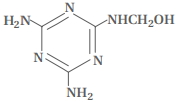
How is the following resin intermediate prepared and which polymer is formed by this monomer unit?
Solution
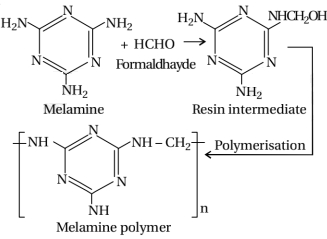
(N/A) The resin intermediate is prepared by the reaction of $Melamine$ with $Formaldehyde$ $(HCHO)$.
This reaction involves the nucleophilic addition of the amino group of $Melamine$ to the carbonyl group of $Formaldehyde$.
The resulting resin intermediate undergoes further polymerization to form the $Melamine-Formaldehyde$ polymer (also known as $Melamine$ resin).
The process is shown below:
$Melamine + HCHO$ $\rightarrow \text{Resin intermediate}$ $\xrightarrow{\text{Polymerization}} \text{Melamine polymer}$
This reaction involves the nucleophilic addition of the amino group of $Melamine$ to the carbonyl group of $Formaldehyde$.
The resulting resin intermediate undergoes further polymerization to form the $Melamine-Formaldehyde$ polymer (also known as $Melamine$ resin).
The process is shown below:
$Melamine + HCHO$ $\rightarrow \text{Resin intermediate}$ $\xrightarrow{\text{Polymerization}} \text{Melamine polymer}$
0 likes
View Solution190
Difficult
What is the role of benzoyl peroxide in addition polymerization of alkenes? Explain its mode of action with the help of an example.
Solution
(N/A) Benzoyl peroxide acts as a free radical initiator in the addition polymerization of alkenes. It undergoes homolytic fission to produce free radicals,which then initiate the polymerization process. The mechanism involves three steps:
$(i)$ Chain initiation step:
$C_6H_5-CO-O-O-CO-C_6H_5$ $\rightarrow 2C_6H_5-CO-O$ $\rightarrow 2C_6H_5^{\bullet} \text{ (Phenyl radical)}$
$(ii)$ Chain propagation step:
$C_6H_5^{\bullet} + CH_2=CH_2$ $\rightarrow C_6H_5-CH_2-CH_2^{\bullet}$ $\rightarrow C_6H_5-(CH_2-CH_2)_n-CH_2-CH_2^{\bullet}$
$(iii)$ Chain termination step:
$2C_6H_5-(CH_2-CH_2)_n-CH_2^{\bullet}$ $\rightarrow C_6H_5-(CH_2-CH_2)_n-CH_2-CH_2-CH_2-CH_2-(CH_2-CH_2)_n-C_6H_5 \text{ (Polythene)}$
$(i)$ Chain initiation step:
$C_6H_5-CO-O-O-CO-C_6H_5$ $\rightarrow 2C_6H_5-CO-O$ $\rightarrow 2C_6H_5^{\bullet} \text{ (Phenyl radical)}$
$(ii)$ Chain propagation step:
$C_6H_5^{\bullet} + CH_2=CH_2$ $\rightarrow C_6H_5-CH_2-CH_2^{\bullet}$ $\rightarrow C_6H_5-(CH_2-CH_2)_n-CH_2-CH_2^{\bullet}$
$(iii)$ Chain termination step:
$2C_6H_5-(CH_2-CH_2)_n-CH_2^{\bullet}$ $\rightarrow C_6H_5-(CH_2-CH_2)_n-CH_2-CH_2-CH_2-CH_2-(CH_2-CH_2)_n-C_6H_5 \text{ (Polythene)}$
0 likes
View Solution191
Medium
Why should the monomer used in addition polymerization through free radical pathway be very pure?
Solution
(N/A) During free radical polymerization,monomers must be very pure because even trace amounts of impurities can act as chain inhibitors. These inhibitors react with the free radicals,terminating the chain growth prematurely,which leads to the formation of polymers with shorter chain lengths and lower molecular weights.
0 likes
View Solution192
MediumMCQ
Match the polymers given in column $-I$ with the preferred mode of polymerisation followed by their monomers in column $-II$.
| Column $-I$ | Column $-II$ |
|---|---|
| $A$. Nylon $-6, 6$ | $i$. Free radical polymerisation |
| $B$. $PVC$ | $ii$. Ziegler-Natta polymerization or coordination polymerization |
| $C$. $HDP$ | $iii$. Anionic polymerisation |
| $iv$. Condensation polymerization |
A
$A-iv, B-i, C-ii$
B
$A-iv, B-ii, C-i$
C
$A-i, B-iv, C-ii$
D
$A-ii, B-i, C-iv$
Solution
(A) . Nylon $-6, 6$ is formed by the condensation polymerization of hexamethylenediamine and adipic acid. Thus,$A-iv$.
$B$. $PVC$ (polyvinyl chloride) is formed by the free radical polymerization of vinyl chloride monomer. Thus,$B-i$.
$C$. $HDP$ (high-density polyethylene) is prepared using Ziegler-Natta catalyst (coordination polymerization). Thus,$C-ii$.
Therefore,the correct match is $A-iv, B-i, C-ii$.
$B$. $PVC$ (polyvinyl chloride) is formed by the free radical polymerization of vinyl chloride monomer. Thus,$B-i$.
$C$. $HDP$ (high-density polyethylene) is prepared using Ziegler-Natta catalyst (coordination polymerization). Thus,$C-ii$.
Therefore,the correct match is $A-iv, B-i, C-ii$.
0 likes
View Solution193
Difficult
Provide the reaction sequences for the following conversions:
$(1)$ $1-$bromopropane from $2-$bromopropane
$(2)$ Polythene from calcium carbide
$(1)$ $1-$bromopropane from $2-$bromopropane
$(2)$ Polythene from calcium carbide
Solution
(N/A) $(1)$ Conversion of $2-$bromopropane to $1-$bromopropane:
$CH_3CHBrCH_3$ $\xrightarrow{KOH(alc.)} CH_3CH=CH_2$ $\xrightarrow{HBr, \text{peroxide}} CH_3CH_2CH_2Br$
$(2)$ Conversion of calcium carbide to polythene:
$CaC_2 + 2H_2O \rightarrow HC \equiv CH + Ca(OH)_2$
$HC \equiv CH + H_2 \xrightarrow{Pd} CH_2=CH_2$
$n(CH_2=CH_2) \xrightarrow{\text{polymerisation}} (-CH_2-CH_2-)_n$
$CH_3CHBrCH_3$ $\xrightarrow{KOH(alc.)} CH_3CH=CH_2$ $\xrightarrow{HBr, \text{peroxide}} CH_3CH_2CH_2Br$
$(2)$ Conversion of calcium carbide to polythene:
$CaC_2 + 2H_2O \rightarrow HC \equiv CH + Ca(OH)_2$
$HC \equiv CH + H_2 \xrightarrow{Pd} CH_2=CH_2$
$n(CH_2=CH_2) \xrightarrow{\text{polymerisation}} (-CH_2-CH_2-)_n$
0 likes
View Solution194
MediumMCQ
Which one of the following polymers is not obtained by condensation polymerisation?
A
Buna-$N$
B
Bakelite
C
Nylon $6$
D
Nylon $6,6$
Solution
(A) Condensation polymers are formed by the repeated condensation reaction between two different bi-functional or tri-functional monomeric units,usually with the elimination of small molecules like $H_2O$,$HCl$,etc.
Bakelite,Nylon $6$,and Nylon $6,6$ are all examples of condensation polymers.
Buna-$N$ is formed by the copolymerization of $1,3$-butadiene and acrylonitrile in the presence of a peroxide catalyst. It is an addition polymer,not a condensation polymer.
Bakelite,Nylon $6$,and Nylon $6,6$ are all examples of condensation polymers.
Buna-$N$ is formed by the copolymerization of $1,3$-butadiene and acrylonitrile in the presence of a peroxide catalyst. It is an addition polymer,not a condensation polymer.
0 likes
View Solution195
MediumMCQ
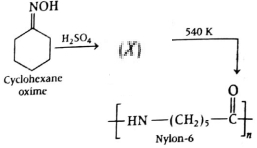
In the above reaction sequence,$X$ is
A
Cyclohexanone
B
Caprolactam
C
Hexamethylene di-isocyanate
D
$HO(CH_2)_6NH_2$
Solution
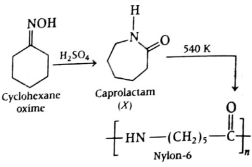
(B) The given reaction sequence represents the synthesis of $Nylon-6$.
Cyclohexanone oxime undergoes a Beckmann rearrangement in the presence of $H_2SO_4$ to form $Caprolactam$ $(X)$.
$Caprolactam$ is then heated at $540 \ K$ to undergo ring-opening polymerization to form $Nylon-6$.
Thus,$X$ is $Caprolactam$.
Cyclohexanone oxime undergoes a Beckmann rearrangement in the presence of $H_2SO_4$ to form $Caprolactam$ $(X)$.
$Caprolactam$ is then heated at $540 \ K$ to undergo ring-opening polymerization to form $Nylon-6$.
Thus,$X$ is $Caprolactam$.
0 likes
View Solution196
MediumMCQ
The monomer of $[-C(CH_3)_2-CH_2-]_n$ is:
A
$2$-methylpropene
B
styrene
C
propylene
D
ethene
Solution
(A) The given polymer is polyisobutylene,which is formed by the polymerization of $2$-methylpropene (isobutylene).
The structure of the monomer is $CH_3-C(CH_3)=CH_2$.
The structure of the monomer is $CH_3-C(CH_3)=CH_2$.
0 likes
View Solution197
DifficultMCQ
The polymer formed on heating Novolac with formaldehyde is:
A
Bakelite
B
Polyester
C
Melamine
D
Nylon $6,6$
Solution
(A) Novolac is a linear polymer of phenol and formaldehyde. On heating with formaldehyde,it undergoes cross-linking to form an infusible solid mass known as Bakelite.
0 likes
View Solution198
MediumMCQ
The monomer of Novolac is:
A
$3-$Hydroxybutanoic acid
B
Phenol and melamine
C
$o-$Hydroxymethylphenol
D
$1,3-$Butadiene and styrene
Solution
(C) Novolac is a linear polymer formed by the condensation polymerization of phenol and formaldehyde.
In the initial step,the reaction between phenol and formaldehyde yields a mixture of $o-$ and $p-$hydroxymethylphenol derivatives.
These derivatives act as the monomers that undergo further condensation to form the linear polymer known as Novolac.
Therefore,$o-$hydroxymethylphenol is the monomeric unit involved in the formation of Novolac.
In the initial step,the reaction between phenol and formaldehyde yields a mixture of $o-$ and $p-$hydroxymethylphenol derivatives.
These derivatives act as the monomers that undergo further condensation to form the linear polymer known as Novolac.
Therefore,$o-$hydroxymethylphenol is the monomeric unit involved in the formation of Novolac.
0 likes
View Solution199
MediumMCQ
Which one of the following polymers is prepared by addition polymerisation?
A
Teflon
B
Nylon-$6,6$
C
Novolac
D
Dacron
Solution
(A) Teflon is an addition polymer formed by the addition polymerisation of tetrafluoroethene $(CF_2=CF_2)$.
The reaction is as follows:
$n \ CF_2=CF_2 \xrightarrow{\text{Polymerisation}} [-CF_2-CF_2-]_n$
Nylon-$6,6$,Novolac,and Dacron are condensation polymers.
The reaction is as follows:
$n \ CF_2=CF_2 \xrightarrow{\text{Polymerisation}} [-CF_2-CF_2-]_n$
Nylon-$6,6$,Novolac,and Dacron are condensation polymers.
0 likes
View Solution200
MediumMCQ
Melamine polymer is formed by the condensation of:
A
Melamine and $HCHO$
B
Melamine and $HCHO$ (with different structure)
C
Benzene derivative and $HCHO$
D
Pyridine derivative and $HCHO$
Solution
(A) Melamine polymer,also known as melamine-formaldehyde resin,is formed by the condensation polymerization of melamine and formaldehyde $(HCHO)$.
The reaction involves the formation of a resinous material through the elimination of water molecules.
The reaction involves the formation of a resinous material through the elimination of water molecules.
0 likes
View SolutionPolymers — General methods of preparation and mechanism of polymerisation · Frequently Asked Questions
1Are these Polymers questions useful for JEE and NEET?
Yes. All questions in this section are mapped to JEE Main and NEET exam patterns. Previous year questions from JEE Main, NEET, GUJCET and state-level exams are included with full solutions.
2Can I switch to Hindi or Gujarati for these questions?
Yes. Use the language tabs in the hero section or the sidebar to view the same questions and solutions in English, Hindi or Gujarati.
3How do I generate a question paper from this subtopic?
Use the Vedclass Exam Paper Generator — select the chapter and subtopic, set difficulty, and generate Sets A, B, C, D automatically. First 3 chapters of every subject are free.
Vedclass Products
For Students
Vedclass Test Series
Mock tests in real JEE/NEET style with performance analysis. 5-day free trial.
Start Free TrialFor Teachers
Exam Paper Generator
Generate Set A/B/C/D papers from this chapter in 2 minutes. 3 chapters free.
Try FreeFor Institutes
Online Exam Module
Live online exams with unlimited students, 360° analytics & white-label branding.
See DemoFor Teachers & Institutes
Generate a Polymers Exam Paper in 2 Minutes
Select subtopic & difficulty — Sets A, B, C, D auto-generated with No Repeat logic.
First 3 chapters of every subject are free — no payment required.