
A English
General methods of preparation and mechanism of polymerisation Questions in English
Class 12 Chemistry · Polymers · General methods of preparation and mechanism of polymerisation
295+
Questions
English
Language
100%
With Solutions
Showing 50 of 295 questions in English
51
MediumMCQ
Which one of the following can be used as a monomer in a polymerization reaction?
A
$CH_3-CH_2-Cl$
B
$CH_3-CH_2-OH$
C
$C_6H_6$
D
$C_3H_6$
Solution
(D) Propene $(C_3H_6)$ contains a double bond $(CH_3-CH=CH_2)$ and can undergo addition polymerization to form polypropylene.
Saturated compounds like ethyl chloride,ethanol,and benzene do not typically act as monomers for addition polymerization.
Saturated compounds like ethyl chloride,ethanol,and benzene do not typically act as monomers for addition polymerization.
0 likes
View Solution52
MediumMCQ
The Ziegler-Natta catalysts are
A
Stereospecific
B
Non-metallic complexes
C
Gaseous catalysts
D
Universal in all polymerisation reactions
Solution
(A) Ziegler-Natta catalyst is a mixture of $TiCl_4$ and $(C_2H_5)_3Al$ used in the synthesis of stereoregular polymers.
0 likes
View Solution53
MediumMCQ
Which of the following is a chain growth polymer?
A
Polystyrene
B
Protein
C
Starch
D
Nucleic acid
Solution
(A) . Polystyrene is a chain growth polymer. Chain growth polymers involve a series of reactions,each of which consumes a reactive particle and produces another similar one. The reactive particles may be free radicals or ions (cation or anion) to which monomers are added by a chain reaction. This is a characteristic reaction of alkenes and conjugated dienes,or indeed of all kinds of compounds that contain a $C=C$ double bond. The provided image illustrates the synthesis of polystyrene from benzene via ethylbenzene and styrene.
0 likes
View Solution54
EasyMCQ
$CF_2 = CF_2$ is the monomer of......
A
Teflon
B
Orlon
C
Polythene
D
Nylon-$6$
Solution
(A) The polymerization of tetrafluoroethene $(CF_2 = CF_2)$ leads to the formation of polytetrafluoroethene,commonly known as Teflon.
The reaction is: $nCF_2 = CF_2 \to -(CF_2 - CF_2)_n-$ (Teflon).
The reaction is: $nCF_2 = CF_2 \to -(CF_2 - CF_2)_n-$ (Teflon).
0 likes
View Solution55
EasyMCQ
Which of the following polymers can be prepared by condensation polymerization?
A
Teflon
B
Rubber
C
Styrene
D
Nylon-$66$
Solution
(D) Condensation polymerization involves the repeated condensation reaction between two different bi-functional or tri-functional monomeric units,usually accompanied by the elimination of small molecules like $H_2O$,$HCl$,or $NH_3$.
Nylon-$66$ is a polyamide formed by the condensation polymerization of hexamethylenediamine $(H_2N(CH_2)_6NH_2)$ and adipic acid $(HOOC(CH_2)_4COOH)$ with the elimination of water molecules.
Teflon,rubber,and styrene are prepared by addition polymerization.
Nylon-$66$ is a polyamide formed by the condensation polymerization of hexamethylenediamine $(H_2N(CH_2)_6NH_2)$ and adipic acid $(HOOC(CH_2)_4COOH)$ with the elimination of water molecules.
Teflon,rubber,and styrene are prepared by addition polymerization.
0 likes
View Solution56
EasyMCQ
The monomers used in the production of $Nylon-66$ are ........
A
$Hexamethylene \ diamine$ and $Ethylene \ glycol$
B
$Adipic \ acid$ and $Ethylene \ glycol$
C
$Adipic \ acid$ and $Hexamethylene \ diamine$
D
$Dimethyl \ terephthalate$ and $Ethylene \ glycol$
Solution
(C) $Nylon-66$ is a polyamide formed by the condensation polymerization of $Adipic \ acid$ $(HOOC-(CH_2)_4-COOH)$ and $Hexamethylene \ diamine$ $(NH_2-(CH_2)_6-NH_2)$.
0 likes
View Solution57
MediumMCQ
Which of the following monomers undergoes polymerization to form Neoprene?
A
$F_2C = CF_2$
B
$Cl_2C = CCl_2$
C
$CH_2 = C(Cl) - CH = CH_2$
D
$CH_2 = CHCl$
Solution
(C) Neoprene is a synthetic rubber obtained by the free-radical polymerization of chloroprene ($2$-chloro$-1,3-$butadiene).
The chemical formula for chloroprene is $CH_2 = C(Cl) - CH = CH_2$.
Therefore,the correct monomer is $CH_2 = C(Cl) - CH = CH_2$.
The chemical formula for chloroprene is $CH_2 = C(Cl) - CH = CH_2$.
Therefore,the correct monomer is $CH_2 = C(Cl) - CH = CH_2$.
0 likes
View Solution58
MediumMCQ
Bakelite is a ....... polymer.
A
Natural
B
Addition
C
Condensation
D
Homo
Solution
(C) Bakelite is formed by the condensation polymerization of phenol and formaldehyde.
During this process,small molecules like water are eliminated,which is characteristic of condensation polymers.
During this process,small molecules like water are eliminated,which is characteristic of condensation polymers.
0 likes
View Solution59
EasyMCQ
Neoprene (synthetic rubber) is a polymer of ........
A
Propene
B
Vinyl chloride
C
Chloroprene
D
Butadiene
Solution
(C) Neoprene is a synthetic rubber formed by the free radical polymerization of chloroprene ($2$-chloro-$1,3$-butadiene).
The chemical reaction is:
$n(CH_2=C(Cl)-CH=CH_2) \xrightarrow{\text{polymerization}} (-CH_2-C(Cl)=CH-CH_2-)_n$
Thus,the monomer of neoprene is chloroprene.
The chemical reaction is:
$n(CH_2=C(Cl)-CH=CH_2) \xrightarrow{\text{polymerization}} (-CH_2-C(Cl)=CH-CH_2-)_n$
Thus,the monomer of neoprene is chloroprene.
0 likes
View Solution60
EasyMCQ
$PMMA$ is a polymer of which of the following?
A
Acrylic acid
B
Methyl acrylate
C
Methyl methacrylate
D
All of the above
Solution
(C) $PMMA$ stands for Polymethyl methacrylate.
It is a synthetic polymer formed by the polymerization of the monomer methyl methacrylate $(CH_2=C(CH_3)COOCH_3)$.
It is a synthetic polymer formed by the polymerization of the monomer methyl methacrylate $(CH_2=C(CH_3)COOCH_3)$.
0 likes
View Solution61
EasyMCQ
Which of the following polymers is of the chain-growth type?
A
Teflon
B
Nylon-$6$
C
Nylon-$6, 6$
D
Bakelite
Solution
(A) Chain-growth polymerization involves the addition of monomers containing double or triple bonds (like alkenes) to form polymers without the loss of any small molecules.
$Teflon$ (polytetrafluoroethylene) is formed by the addition polymerization of tetrafluoroethylene $(CF_2=CF_2)$,which is a chain-growth process.
$Nylon-6$,$Nylon-6, 6$,and $Bakelite$ are condensation polymers formed by the loss of small molecules like $H_2O$ or $HCl$.
$Teflon$ (polytetrafluoroethylene) is formed by the addition polymerization of tetrafluoroethylene $(CF_2=CF_2)$,which is a chain-growth process.
$Nylon-6$,$Nylon-6, 6$,and $Bakelite$ are condensation polymers formed by the loss of small molecules like $H_2O$ or $HCl$.
0 likes
View Solution62
EasyMCQ
Which of the following components react to form $Bakelite$?
A
$Melamine + Formaldehyde$
B
$Formaldehyde + Adipic \ acid$
C
$Phenol + Adipic \ acid$
D
$Phenol + Formaldehyde$
Solution
(D) $Bakelite$ is a thermosetting polymer formed by the condensation polymerization of $Phenol$ and $Formaldehyde$ in the presence of an acid or base catalyst.
The reaction involves the formation of $o-$ and $p-$hydroxymethylphenol derivatives,which further cross-link to form the rigid $Bakelite$ structure.
The reaction involves the formation of $o-$ and $p-$hydroxymethylphenol derivatives,which further cross-link to form the rigid $Bakelite$ structure.
0 likes
View Solution63
EasyMCQ
Which of the following is the correct description of polypropylene?
A
Propylene,condensation polymer
B
Propylene,addition polymer
C
Propylene,anionic polymer
D
Propylene,cationic anionic polymerase
Solution
(B) Polypropylene is formed by the polymerization of propylene $(CH_3-CH=CH_2)$.
Since the monomer contains a double bond and the polymerization process involves the addition of monomer units without the loss of any small molecules,it is classified as an addition polymer.
Therefore,the correct description is $Propylene, \text{addition polymer}$.
Since the monomer contains a double bond and the polymerization process involves the addition of monomer units without the loss of any small molecules,it is classified as an addition polymer.
Therefore,the correct description is $Propylene, \text{addition polymer}$.
0 likes
View Solution64
EasyMCQ
Which of the following is a step-growth polymer?
A
Polyisoprene
B
Polyethylene
C
Nylon
D
Polyacrylonitrile
Solution
(C) Step-growth polymerization involves the reaction of bifunctional or multifunctional monomers,typically involving the loss of small molecules like $H_2O$ or $HCl$. $Nylon$ (e.g.,$Nylon-6,6$) is formed by condensation polymerization,which is a type of step-growth polymerization. $Polyethylene$,$Polyisoprene$,and $Polyacrylonitrile$ are examples of chain-growth polymers.
0 likes
View Solution65
EasyMCQ
Which of the following polymers can be formed by a condensation polymerization reaction?
A
Teflon
B
Rubber
C
Styrene
D
Nylon-$66$
Solution
(D) Condensation polymerization involves the repeated condensation reaction between two different bi-functional or tri-functional monomeric units,often with the elimination of small molecules like $H_2O$,$HCl$,or $NH_3$.
Nylon-$66$ is prepared by the condensation polymerization of hexamethylenediamine $(H_2N(CH_2)_6NH_2)$ and adipic acid $(HOOC(CH_2)_4COOH)$.
Teflon,rubber,and styrene are formed via addition polymerization.
Nylon-$66$ is prepared by the condensation polymerization of hexamethylenediamine $(H_2N(CH_2)_6NH_2)$ and adipic acid $(HOOC(CH_2)_4COOH)$.
Teflon,rubber,and styrene are formed via addition polymerization.
0 likes
View Solution66
EasyMCQ
In the preparation of polyethylene using the Ziegler-Natta process from ethylene,what is the temperature required for proper polymerization?
A
Below $10\,^oC$
B
$10\,^oC$ to $50\,^oC$
C
$50\,^oC$ to $80\,^oC$
D
$80\,^oC$ to $140\,^oC$
Solution
(C) The Ziegler-Natta polymerization of ethylene to produce high-density polyethylene is typically carried out at a temperature range of $50\,^oC$ to $80\,^oC$ under low pressure using a catalyst like $TiCl_4$ and $(C_2H_5)_3Al$.
0 likes
View Solution67
MediumMCQ
Alkyd resins are condensation polymers formed by the reaction of a dibasic acid and . . . . . . .
A
Phenol
B
Glycol
C
Glycerol
D
Formaldehyde
Solution
(C) Alkyd resins are a type of polyester resin formed by the polycondensation of a polybasic acid (such as phthalic acid) and a polyhydric alcohol (such as glycerol or glycol). In the context of standard chemistry curriculum,the reaction between a dibasic acid and a polyhydric alcohol like $Glycerol$ is the classic method for producing alkyd resins.
0 likes
View Solution68
EasyMCQ
What is the name of the condensation product of caprolactam?
A
Nylon-$6$
B
Nylon-$6, 6$
C
Nylon-$6, 10$
D
Nylon-$60$
Solution
(A) Caprolactam is heated with water at high temperature $(533-543 \ K)$ to undergo ring-opening polymerization.
This process leads to the formation of Nylon-$6$.
It is called Nylon-$6$ because the monomer,caprolactam,contains $6$ carbon atoms.
This process leads to the formation of Nylon-$6$.
It is called Nylon-$6$ because the monomer,caprolactam,contains $6$ carbon atoms.
0 likes
View Solution69
EasyMCQ
Which of the following reacts with phenol to produce Bakelite?
A
$HCHO$
B
$(CH_2OH)_2$
C
$CH_3CHO$
D
$CH_3COCH_3$
Solution
(A) Bakelite is a thermosetting polymer formed by the condensation polymerization of phenol and formaldehyde $(HCHO)$.
The reaction involves the formation of ortho- and para-hydroxybenzyl alcohol derivatives,which further cross-link to form the rigid structure of Bakelite.
The reaction involves the formation of ortho- and para-hydroxybenzyl alcohol derivatives,which further cross-link to form the rigid structure of Bakelite.
0 likes
View Solution70
EasyMCQ
What type of reaction occurs between monomer molecules to form a polymer?
A
Condensation reaction between monomer molecules
B
Internal reaction between monomer molecules
C
Hydrolysis of monomer molecules
D
Polymerization reaction (joining of monomer molecules)
Solution
(D) Polymers are formed by the process of polymerization,which involves the repeated joining of monomer molecules to form long-chain macromolecules. This can occur via addition polymerization or condensation polymerization. Therefore,the most accurate description among the given options is the joining of monomer molecules.
0 likes
View Solution71
MediumMCQ
The initiator used in cationic polymerization is........
A
$LiAlH_4$
B
$HNO_3$
C
$AlCl_3$
D
$BuLi$
Solution
(C) $AlCl_3$ is a Lewis acid,which acts as an initiator by generating a carbocation in cationic polymerization.
0 likes
View Solution72
EasyMCQ
Which of the following polymers is formed by condensation polymerization?
A
Styrene
B
Nylon-$66$
C
Teflon
D
Rubber
Solution
(B) Condensation polymerization involves the reaction between two bifunctional monomers with the elimination of small molecules like $H_2O$,$HCl$,or $NH_3$.
Nylon-$66$ is a polyamide formed by the condensation reaction between hexamethylenediamine $(H_2N(CH_2)_6NH_2)$ and adipic acid $(HOOC(CH_2)_4COOH)$.
Styrene,Teflon,and Rubber are formed by addition polymerization.
Nylon-$66$ is a polyamide formed by the condensation reaction between hexamethylenediamine $(H_2N(CH_2)_6NH_2)$ and adipic acid $(HOOC(CH_2)_4COOH)$.
Styrene,Teflon,and Rubber are formed by addition polymerization.
0 likes
View Solution73
MediumMCQ
Which catalyst is used for the polymerization of olefins?
A
Ziegler-Natta catalyst
B
Wilkinson's catalyst
C
$Pd$ catalyst
D
Zeise's salt catalyst
Solution
(A) The $Ziegler-Natta$ catalyst is a mixture of $TiCl_4$ and $Al(C_2H_5)_3$ (triethylaluminium). It is widely used in the industrial polymerization of olefins like ethylene and propylene to produce high-density polyethylene and polypropylene.
0 likes
View Solution74
MediumMCQ
Which of the following polymers is formed by chain-growth polymerization?
A
Polystyrene
B
Protein
C
Starch
D
Nucleic acid
Solution
(A) Chain-growth polymerization involves a series of reactions where each step adds a monomer unit to the growing chain.
This mechanism is characteristic of alkenes and compounds containing $C=C$ double bonds,such as styrene.
Polystyrene is formed via the free-radical polymerization of styrene,which is a type of chain-growth polymerization.
Proteins,starch,and nucleic acids are natural polymers formed via step-growth (condensation) polymerization.
This mechanism is characteristic of alkenes and compounds containing $C=C$ double bonds,such as styrene.
Polystyrene is formed via the free-radical polymerization of styrene,which is a type of chain-growth polymerization.
Proteins,starch,and nucleic acids are natural polymers formed via step-growth (condensation) polymerization.
0 likes
View Solution75
EasyMCQ
Which linear polymer is formed when lactide is heated with zinc chloride?
A
Polystyrene
B
Polyamide
C
Polyester
D
Polyethylene
Solution
(C) Lactide is a cyclic dimer of lactic acid $(CH_3CH(OH)COOH)$.
When lactide is heated in the presence of a catalyst like zinc chloride $(ZnCl_2)$,it undergoes ring-opening polymerization.
This process results in the formation of polylactic acid $(PLA)$,which is a biodegradable linear polyester.
Therefore,the correct option is $C$.
When lactide is heated in the presence of a catalyst like zinc chloride $(ZnCl_2)$,it undergoes ring-opening polymerization.
This process results in the formation of polylactic acid $(PLA)$,which is a biodegradable linear polyester.
Therefore,the correct option is $C$.
0 likes
View Solution76
EasyMCQ
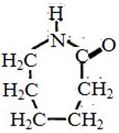
The polymer which can be prepared from the following monomer unit is:
A
Nylon $6, 6$
B
Nylon-$2$-Nylon-$6$
C
Melamine polymer
D
Nylon-$6$
Solution
(D) The given structure is Caprolactam.
Caprolactam undergoes ring-opening polymerization when heated with water at high temperatures to form Nylon-$6$.
Therefore,the correct option is $D$.
Caprolactam undergoes ring-opening polymerization when heated with water at high temperatures to form Nylon-$6$.
Therefore,the correct option is $D$.
0 likes
View Solution77
EasyMCQ
The widely used plastic $PVC$ is obtained by the polymerization of which monomer?
A
$CH_2 = CH_2$
B
$CH_2 = CH-Cl$
C
$CH_2 = CCl_2$
D
$CHCl = CHCl$
Solution
(B) $PVC$ stands for Polyvinyl chloride.
It is formed by the addition polymerization of vinyl chloride monomer,which has the chemical formula $CH_2 = CH-Cl$.
The reaction is: $n(CH_2 = CH-Cl) \rightarrow -[CH_2-CH(Cl)]_n-$.
Therefore,the correct monomer is vinyl chloride.
It is formed by the addition polymerization of vinyl chloride monomer,which has the chemical formula $CH_2 = CH-Cl$.
The reaction is: $n(CH_2 = CH-Cl) \rightarrow -[CH_2-CH(Cl)]_n-$.
Therefore,the correct monomer is vinyl chloride.
0 likes
View Solution78
EasyMCQ
When the process of forming a polymer from monomers begins,what happens?
A
Condensation reaction occurs between monomers.
B
Addition reaction occurs between monomers.
C
Monomer is converted into monomer ion by a proton.
D
Hydrolysis of the monomer occurs.
Solution
(C) The process of forming a polymer from monomers is known as polymerization. In the initiation step of chain-growth polymerization,the monomer is typically activated by an initiator (such as a free radical,cation,or anion). For example,in cationic polymerization,a proton $(H^+)$ or a Lewis acid acts as an initiator to convert the monomer into a reactive monomer ion (carbocation),which then starts the chain propagation. Therefore,the initiation step involves the conversion of the monomer into a reactive species.
0 likes
View Solution79
EasyMCQ
Natural rubber is a polymer of .......
A
$1, 3-$butadiene.
B
Ethylene.
C
$2-$methyl-$1, 3-$butadiene.
D
Styrene.
Solution
(C) Natural rubber is a linear polymer of isoprene ($2-$methyl-$1, 3-$butadiene).
The polymerization reaction is:
$n \ CH_2=C(CH_3)-CH=CH_2 \xrightarrow{\text{polymerization}} [ -CH_2-C(CH_3)=CH-CH_2 -]_n$
Thus,it is a polymer of $2-$methyl-$1, 3-$butadiene.
The polymerization reaction is:
$n \ CH_2=C(CH_3)-CH=CH_2 \xrightarrow{\text{polymerization}} [ -CH_2-C(CH_3)=CH-CH_2 -]_n$
Thus,it is a polymer of $2-$methyl-$1, 3-$butadiene.
0 likes
View Solution80
EasyMCQ
Which synthetic polymer is obtained by the polymerization of chloroprene?
A
Neoprene
B
Chloroprene
C
Glyptal
D
Nylon
Solution
(A) Neoprene is a synthetic rubber obtained by the free radical polymerization of chloroprene ($2$-chloro-$1,3$-butadiene). The reaction is represented as: $n CH_2=C(Cl)-CH=CH_2 \rightarrow [-CH_2-C(Cl)=CH-CH_2-]_n$.
0 likes
View Solution81
EasyMCQ
Which raw material is used in the preparation of $Nylon-6$?
A
Adipic acid
B
Phthalic acid
C
Ethylene glycol
D
Caprolactam
Solution
(D) $Nylon-6$ is prepared by heating caprolactam with water at a high temperature $(533-543 \ K)$.
The reaction involves the ring-opening polymerization of caprolactam.
Therefore,the correct raw material is caprolactam.
The reaction involves the ring-opening polymerization of caprolactam.
Therefore,the correct raw material is caprolactam.
0 likes
View Solution82
EasyMCQ
Which catalyst is used in the Ziegler-Natta process for the preparation of polyethylene?
A
$TiCl_4$ and $(C_2H_5)_3Al$
B
$TiCl_4$ and $(CH_3)_3Al$
C
$TiO_2$
D
$Ti(OC_3H_7)_4$
Solution
(A) The Ziegler-Natta catalyst is a mixture of titanium tetrachloride $(TiCl_4)$ and triethylaluminum $((C_2H_5)_3Al)$.
This catalyst is used for the polymerization of ethylene to produce high-density polyethylene $(HDPE)$ under low pressure conditions.
This catalyst is used for the polymerization of ethylene to produce high-density polyethylene $(HDPE)$ under low pressure conditions.
0 likes
View Solution83
MediumMCQ
Phenol reacts with which of the following to form Bakelite?
A
Chlorobenzene
B
Acetal
C
Acetaldehyde
D
Formaldehyde
Solution
(D) Bakelite is a thermosetting polymer formed by the condensation polymerization of phenol and formaldehyde in the presence of an acid or base catalyst. The reaction involves the formation of ortho and para-hydroxybenzyl alcohol derivatives,which further cross-link to form the rigid structure of Bakelite.
0 likes
View Solution84
EasyMCQ
Which polymer is formed by the condensation polymerization of hexamethylenediamine and adipic acid?
A
Dacron
B
Nylon-$66$
C
Rayon
D
Teflon
Solution
(B) The condensation polymerization of hexamethylenediamine $(H_2N(CH_2)_6NH_2)$ and adipic acid $(HOOC(CH_2)_4COOH)$ results in the formation of Nylon-$66$.
This is a polyamide polymer formed by the elimination of water molecules during the reaction.
This is a polyamide polymer formed by the elimination of water molecules during the reaction.
0 likes
View Solution85
EasyMCQ
In the production of thermosetting polymers,which substance is used along with methanal?
A
Benzene
B
Phenylamine
C
Benzaldehyde
D
Phenol
Solution
(D) When $Phenol$ reacts with $Methanal$ $(HCHO)$,it undergoes condensation polymerization to form $Bakelite$,which is a well-known thermosetting polymer.
0 likes
View Solution86
DifficultMCQ
Which of the following components is the best initiator for cationic polymerization?
A
$BuLi$
B
$LiAlH_4$
C
$HNO_3$
D
$AlCl_3$
Solution
(D) Cationic polymerization is initiated by electrophilic species or Lewis acids.
$AlCl_3$ is a strong Lewis acid that can accept a lone pair of electrons to generate a carbocation,which acts as the initiator for the polymerization process.
$BuLi$ is an initiator for anionic polymerization.
$LiAlH_4$ is a reducing agent.
$HNO_3$ is a strong acid but not typically used as an initiator for cationic polymerization compared to Lewis acids like $AlCl_3$.
$AlCl_3$ is a strong Lewis acid that can accept a lone pair of electrons to generate a carbocation,which acts as the initiator for the polymerization process.
$BuLi$ is an initiator for anionic polymerization.
$LiAlH_4$ is a reducing agent.
$HNO_3$ is a strong acid but not typically used as an initiator for cationic polymerization compared to Lewis acids like $AlCl_3$.
0 likes
View Solution87
EasyMCQ
Which of the following undergoes polymerization to form $PVC$?
A
Ethene
B
$1-$Chloropropene
C
Propene
D
$1-$Chloroethene
Solution
(D) $PVC$ stands for Polyvinyl chloride.
It is formed by the free radical addition polymerization of vinyl chloride $(CH_2=CHCl)$,which is also known as $1-$chloroethene.
The reaction is: $n(CH_2=CHCl) \rightarrow -[CH_2-CHCl]_n-$.
Therefore,the monomer is $1-$chloroethene.
It is formed by the free radical addition polymerization of vinyl chloride $(CH_2=CHCl)$,which is also known as $1-$chloroethene.
The reaction is: $n(CH_2=CHCl) \rightarrow -[CH_2-CHCl]_n-$.
Therefore,the monomer is $1-$chloroethene.
0 likes
View Solution88
EasyMCQ
The thermosetting polymer Bakelite is formed by the reaction of phenol with which of the following?
A
$CH_3CHO$
B
$HCHO$
C
$CHOOH$
D
$CH_3CH_2CHO$
Solution
(B) Bakelite is a thermosetting polymer formed by the condensation polymerization of phenol and formaldehyde $(HCHO)$ in the presence of an acid or base catalyst.
This reaction involves the formation of ortho and para-hydroxybenzyl alcohol derivatives,which further cross-link to form the rigid structure of Bakelite.
This reaction involves the formation of ortho and para-hydroxybenzyl alcohol derivatives,which further cross-link to form the rigid structure of Bakelite.
0 likes
View Solution89
MediumMCQ
What type of polymer is natural rubber?
A
Condensation polymer
B
Addition polymer
C
Coordination polymer
D
None of these
Solution
(B) Natural rubber is obtained by the addition polymerization of isoprene ($2$-methyl-$1,3$-butadiene).
0 likes
View Solution90
EasyMCQ
An example of a chain-growth polymer is .......
A
Nylon-$66$
B
Bakelite
C
Terylene
D
Teflon
Solution
(D) Chain-growth polymers are typically formed by addition polymerization of unsaturated monomers like alkenes or their derivatives.
Among the given options,Teflon (polytetrafluoroethylene) is formed by the addition polymerization of tetrafluoroethene $(CF_2=CF_2)$,which is a classic example of a chain-growth polymer.
Nylon-$66$,Bakelite,and Terylene are examples of step-growth (condensation) polymers.
Among the given options,Teflon (polytetrafluoroethylene) is formed by the addition polymerization of tetrafluoroethene $(CF_2=CF_2)$,which is a classic example of a chain-growth polymer.
Nylon-$66$,Bakelite,and Terylene are examples of step-growth (condensation) polymers.
0 likes
View Solution91
MediumMCQ
The $Ziegler-Natta$ catalyst is used in the preparation of which of the following?
A
Low-density polyethylene
B
High-density polyethylene
C
Dacron
D
Teflon and $PVC$
Solution
(B) The $Ziegler-Natta$ catalyst,which is a mixture of $TiCl_4$ and $(C_2H_5)_3Al$,is specifically used in the polymerization of ethene to produce $High-density \text{ } polyethylene$ $(HDPE)$.
This process occurs at low pressure and temperature,resulting in a linear polymer chain with high density.
This process occurs at low pressure and temperature,resulting in a linear polymer chain with high density.
0 likes
View Solution92
EasyMCQ
Which of the following is a chain-growth polymer?
A
Nucleic acid
B
Polystyrene
C
Protein
D
Starch
Solution
(B) Chain-growth polymerization typically involves the addition of monomers containing double bonds,such as alkenes or their derivatives. $Polystyrene$ is formed by the chain-growth polymerization of $styrene$ $(C_6H_5CH=CH_2)$.
Nucleic acids,proteins,and starch are natural polymers formed through condensation polymerization processes.
Nucleic acids,proteins,and starch are natural polymers formed through condensation polymerization processes.
0 likes
View Solution93
EasyMCQ
Which of the following monomers undergoes polymerization to form the polymer neoprene?
A
$CH_2 = CHCl$
B
$CCl_2 = CCl_2$
C
$CH_2 = C(Cl) - CH = CH_2$
D
$CF_2 = CF_2$
Solution
(C) Neoprene is a synthetic rubber formed by the free-radical polymerization of chloroprene ($2$-chloro$-1,3-$butadiene).
The chemical formula for chloroprene is $CH_2 = C(Cl) - CH = CH_2$.
Therefore,the correct monomer is $CH_2 = C(Cl) - CH = CH_2$.
The chemical formula for chloroprene is $CH_2 = C(Cl) - CH = CH_2$.
Therefore,the correct monomer is $CH_2 = C(Cl) - CH = CH_2$.
0 likes
View Solution94
MediumMCQ
Glyptal polymer is obtained by the reaction of ethylene glycol with which of the following?
A
Malonic acid
B
Phthalic acid
C
Maleic acid
D
Acetic acid
Solution
(B) Glyptal is a polyester resin formed by the condensation polymerization of ethylene glycol $(HO-CH_2-CH_2-OH)$ and phthalic acid $(C_6H_4(COOH)_2)$.
The reaction involves the elimination of water molecules to form the polymer chain.
The reaction involves the elimination of water molecules to form the polymer chain.
0 likes
View Solution95
MediumMCQ
The Ziegler-Natta catalyst is .........
A
Stereospecific
B
Non-metallic
C
Gaseous catalyst
D
Used in all polymerization reactions
Solution
(A) The Ziegler-Natta catalyst is a mixture of $TiCl_4$ and $(C_2H_5)_3Al$.
It is widely known for its stereospecific nature,which allows for the production of polymers with specific spatial arrangements,such as isotactic polypropylene.
It is widely known for its stereospecific nature,which allows for the production of polymers with specific spatial arrangements,such as isotactic polypropylene.
0 likes
View Solution96
EasyMCQ
Which raw material is used in the preparation of $Nylon-6,6$?
A
Ethylene
B
Adipic acid
C
Butadiene
D
Acetylene
Solution
(B) $Nylon-6,6$ is a polyamide formed by the condensation polymerization of two monomers: hexamethylenediamine and adipic acid.
Therefore,adipic acid is one of the essential raw materials used in its synthesis.
Therefore,adipic acid is one of the essential raw materials used in its synthesis.
0 likes
View Solution97
MediumMCQ
The monomer of the polymer $\left[ -CH_2-C(CH_3)_2- \right]_n$ is:
A
$2-methylpropene$
B
$Styrene$
C
$Propylene$
D
$Ethene$
Solution
(A) The given polymer is polyisobutylene,which is formed by the polymerization of isobutylene $(2-methylpropene)$.
The structure of the monomer is $CH_2=C(CH_3)_2$.
The structure of the monomer is $CH_2=C(CH_3)_2$.
0 likes
View Solution98
EasyMCQ
Bakelite is formed by the reaction between which of the following?
A
Phenol and formaldehyde
B
Ethylene glycol and dimethyl terephthalate
C
Urea and formaldehyde
D
Tetramethylene glycol and hexamethylene diamine
Solution
(A) Bakelite is a thermosetting polymer formed by the condensation polymerization of $Phenol$ and $Formaldehyde$ in the presence of an acid or base catalyst. The reaction involves the formation of ortho- and para-hydroxybenzyl alcohol derivatives,which further cross-link to form the rigid structure of Bakelite.
0 likes
View Solution99
EasyMCQ
Monomers are converted into polymers by . . . . . . .
A
Hydrolysis of monomers
B
Polymerization of monomers
C
Protonation of monomers
D
None of the above
Solution
(B) The process by which monomers are converted into polymers is known as $Polymerization$. In this process,small repeating units called monomers combine to form a long-chain macromolecule called a polymer.
0 likes
View Solution100
MediumMCQ
The Ziegler-Natta catalyst is $....$
A
$Pt/PtO$
B
$Al(C_2H_5)_3 + TiCl_4$
C
$K(PtCl_3(\eta^2 - C_2H_4))$
D
$Pt/Rh$
Solution
(B) The Ziegler-Natta catalyst is a mixture of triethylaluminium $(Al(C_2H_5)_3)$ and titanium tetrachloride $(TiCl_4)$.
It is widely used in the polymerization of alkenes.
It is widely used in the polymerization of alkenes.
0 likes
View SolutionPolymers — General methods of preparation and mechanism of polymerisation · Frequently Asked Questions
1Are these Polymers questions useful for JEE and NEET?
Yes. All questions in this section are mapped to JEE Main and NEET exam patterns. Previous year questions from JEE Main, NEET, GUJCET and state-level exams are included with full solutions.
2Can I switch to Hindi or Gujarati for these questions?
Yes. Use the language tabs in the hero section or the sidebar to view the same questions and solutions in English, Hindi or Gujarati.
3How do I generate a question paper from this subtopic?
Use the Vedclass Exam Paper Generator — select the chapter and subtopic, set difficulty, and generate Sets A, B, C, D automatically. First 3 chapters of every subject are free.
Vedclass Products
For Students
Vedclass Test Series
Mock tests in real JEE/NEET style with performance analysis. 5-day free trial.
Start Free TrialFor Teachers
Exam Paper Generator
Generate Set A/B/C/D papers from this chapter in 2 minutes. 3 chapters free.
Try FreeFor Institutes
Online Exam Module
Live online exams with unlimited students, 360° analytics & white-label branding.
See DemoFor Teachers & Institutes
Generate a Polymers Exam Paper in 2 Minutes
Select subtopic & difficulty — Sets A, B, C, D auto-generated with No Repeat logic.
First 3 chapters of every subject are free — no payment required.