
A English
General methods of preparation and mechanism of polymerisation Questions in English
Class 12 Chemistry · Polymers · General methods of preparation and mechanism of polymerisation
295+
Questions
English
Language
100%
With Solutions
Showing 49 of 295 questions in English
101
EasyMCQ
The Ziegler-Natta catalyst is.....
A
$Pt/PtO_2$
B
$Al(C_2H_5)_3 + TiCl_4$
C
$K[PtCl_3(\eta^2 - C_2H_4)]$
D
$Pt/Rh$
Solution
(B) The Ziegler-Natta catalyst is a mixture of triethylaluminium $(Al(C_2H_5)_3)$ and titanium tetrachloride $(TiCl_4)$.
It is widely used in the industrial polymerization of alkenes,such as the production of high-density polyethylene $(HDPE)$.
It is widely used in the industrial polymerization of alkenes,such as the production of high-density polyethylene $(HDPE)$.
0 likes
View Solution102
MediumMCQ
Phenol is reacted with which of the following to obtain Bakelite?
A
Acetaldehyde
B
Formaldehyde
C
Baking soda
D
Formic acid
Solution
(B) Bakelite is a thermosetting polymer formed by the condensation polymerization of phenol and formaldehyde in the presence of an acid or base catalyst. The reaction is as follows: $n C_6H_5OH + n HCHO \rightarrow \text{Bakelite}$.
0 likes
View Solution103
MediumMCQ
Which of the following reagents is required to obtain Bakelite from phenol?
A
$HCHO$
B
$CHCl_3 / NaOH$
C
$CCl_4 / NaOH$
D
$HCHO / H_2O$
Solution
(A) The condensation reaction of phenol with formaldehyde $(HCHO)$ in the presence of an acid or base catalyst leads to the formation of the polymer Bakelite.
0 likes
View Solution104
EasyMCQ
Which of the following reactions produces Bakelite?
A
Urea with $HCHO$
B
Tetramethyl glycol with hexamethylene diisocyanate
C
Phenol and $HCHO$
D
Ethylene glycol and dimethyl terephthalate
Solution
(C) Bakelite is obtained by the polymerization of phenol and formaldehyde $(HCHO)$ in the presence of an acid or base catalyst.
This is a condensation polymerization reaction.
This is a condensation polymerization reaction.
0 likes
View Solution105
EasyMCQ
Nylon $-6$ is made from
A
Butadiene
B
Chloroprene
C
Adipic acid
D
Caprolactum
Solution
(D) Caprolactum is the monomer of nylon $-6$.
When caprolactum is heated with water at high temperature,it undergoes ring-opening polymerization to form nylon $-6$.
When caprolactum is heated with water at high temperature,it undergoes ring-opening polymerization to form nylon $-6$.
0 likes
View Solution106
EasyMCQ
Are small molecules liberated during addition polymerization?
A
Yes
B
No
C
Sometimes
D
Only $H_2O$
Solution
(B) In addition polymerization,the simple addition of monomer units takes place without the loss of any small molecules. This is in contrast to condensation polymerization,where small molecules like $H_2O$,$HCl$,or $NH_3$ are typically eliminated.
0 likes
View Solution107
MediumMCQ
The straight chain polymer is formed by
A
hydrolysis of $CH_3SiCl_3$ followed by condensation polymerisation
B
hydrolysis of $(CH_3)_4Si$ by addition polymerisation
C
hydrolysis of $(CH_3)_2SiCl_2$ followed by condensation polymerisation
D
hydrolysis of $(CH_3)_3SiCl$ followed by condensation polymerisation.
Solution
(C) The hydrolysis of dimethyl dichlorosilane,$(CH_3)_2SiCl_2$,produces a dihydroxy derivative,$(CH_3)_2Si(OH)_2$.
This dihydroxy derivative undergoes condensation polymerisation to form a straight chain silicone polymer,as shown in the reaction:
$n(CH_3)_2SiCl_2 + 2nH_2O \rightarrow n(CH_3)_2Si(OH)_2 + 2nHCl$
$n(CH_3)_2Si(OH)_2 \rightarrow -[O-Si(CH_3)_2-O]_n- + nH_2O$
This dihydroxy derivative undergoes condensation polymerisation to form a straight chain silicone polymer,as shown in the reaction:
$n(CH_3)_2SiCl_2 + 2nH_2O \rightarrow n(CH_3)_2Si(OH)_2 + 2nHCl$
$n(CH_3)_2Si(OH)_2 \rightarrow -[O-Si(CH_3)_2-O]_n- + nH_2O$
0 likes
View Solution108
MediumMCQ
Caprolactam is used for the manufacture of
A
teflon
B
terylene
C
nylon $6, 6$
D
nylon $6$
Solution
(D) Caprolactam is heated with water at high temperature to undergo ring-opening polymerization.
This process yields $6$-aminohexanoic acid,which upon further heating undergoes condensation polymerization to form the polymer known as nylon $6$.
Therefore,caprolactam is the monomer used for the manufacture of nylon $6$.
This process yields $6$-aminohexanoic acid,which upon further heating undergoes condensation polymerization to form the polymer known as nylon $6$.
Therefore,caprolactam is the monomer used for the manufacture of nylon $6$.
0 likes
View Solution109
MediumMCQ
Which of the following is the monomer of neoprene?
A
$CH_2=C(Cl)-CH=CH_2$
B
$CH_2=CH-C \equiv CH$
C
$CH_2=CH-CH=CH_2$
D
$CH_2=C(CH_3)-CH=CH_2$
Solution
(A) Neoprene is a synthetic rubber produced by the polymerization of chloroprene.
The $IUPAC$ name of chloroprene is $2$-chloro-$1,3$-butadiene.
Its chemical structure is $CH_2=C(Cl)-CH=CH_2$.
The $IUPAC$ name of chloroprene is $2$-chloro-$1,3$-butadiene.
Its chemical structure is $CH_2=C(Cl)-CH=CH_2$.
0 likes
View Solution110
DifficultMCQ
Which one of the following polymers is prepared by condensation polymerisation?
A
Teflon
B
Natural rubber
C
Styrene
D
Nylon $6,6$
Solution
(D) Condensation Polymerization: This is a process of polymer formation by the reaction of smaller molecules to form bigger ones,with the elimination of small molecules such as $H_{2}O$ or methanol.
For example: In the formation of $Nylon-6,6$,small molecules of hexamethylenediamine and adipic acid react,resulting in the removal of a water molecule for each condensation step between the two monomers.
For example: In the formation of $Nylon-6,6$,small molecules of hexamethylenediamine and adipic acid react,resulting in the removal of a water molecule for each condensation step between the two monomers.
0 likes
View Solution111
MediumMCQ
Bakelite is obtained from phenol by reacting with
A
$CH_2(OH)_2$
B
$CH_3CHO$
C
$CH_3COCH_3$
D
$HCHO$
Solution
(D) Bakelite is a thermosetting polymer formed by the condensation polymerization of phenol and formaldehyde $(HCHO)$.
In the presence of an acid or base catalyst,phenol reacts with formaldehyde to form $o$- and $p$-hydroxymethylphenol intermediates.
These intermediates undergo further polymerization to form a linear polymer called Novolac.
Upon heating with more formaldehyde,Novolac undergoes cross-linking to form the infusible,hard,and cross-linked polymer known as Bakelite.
In the presence of an acid or base catalyst,phenol reacts with formaldehyde to form $o$- and $p$-hydroxymethylphenol intermediates.
These intermediates undergo further polymerization to form a linear polymer called Novolac.
Upon heating with more formaldehyde,Novolac undergoes cross-linking to form the infusible,hard,and cross-linked polymer known as Bakelite.
0 likes
View Solution112
MediumMCQ
The species which can best serve as an initiator for the cationic polymerization is:
A
$LiAlH_4$
B
$HNO_3$
C
$AlCl_3$
D
$BaLi$
Solution
(C) Cationic polymerization is initiated by electrophiles or Lewis acids.
Electron-deficient species (Lewis acids) such as $AlCl_3$,$BF_3$,and $SnCl_4$ are commonly used as initiators for cationic polymerization because they can generate carbocations from the monomer.
Among the given options,$AlCl_3$ is a well-known Lewis acid.
Electron-deficient species (Lewis acids) such as $AlCl_3$,$BF_3$,and $SnCl_4$ are commonly used as initiators for cationic polymerization because they can generate carbocations from the monomer.
Among the given options,$AlCl_3$ is a well-known Lewis acid.
0 likes
View Solution113
DifficultMCQ
The formation of which of the following polymers involves a hydrolysis reaction?
A
Nylon $6$
B
Bakelite
C
Nylon $6, 6$
D
Terylene
Solution
(A) Nylon-$6$ is prepared by heating $\varepsilon$-caprolactam with water at a high temperature $(533-543 \ K)$.
In this process,the cyclic amide ring of $\varepsilon$-caprolactam undergoes a hydrolysis reaction to form an amino acid,which then undergoes polymerization to form Nylon-$6$.
In this process,the cyclic amide ring of $\varepsilon$-caprolactam undergoes a hydrolysis reaction to form an amino acid,which then undergoes polymerization to form Nylon-$6$.
0 likes
View Solution114
DifficultMCQ
The polymer $(Q)$ produced in the following sequence is:
Cyclohexanone $\xrightarrow[{(ii)\,\,{H_2}SO_4\,,\,\Delta }]{{(i)\,\,NH_2 - OH}}\,P\,$ $\xrightarrow[{533\, - \,543\,\,K}]{{{H_2}O}}Q$
Cyclohexanone $\xrightarrow[{(ii)\,\,{H_2}SO_4\,,\,\Delta }]{{(i)\,\,NH_2 - OH}}\,P\,$ $\xrightarrow[{533\, - \,543\,\,K}]{{{H_2}O}}Q$
A
Nylon $-6,6$
B
Nylon $-4,6$
C
Nylon $-6$
D
Terylene
Solution
(C) $1$. The starting material is cyclohexanone.
$2$. Reaction with hydroxylamine $(NH_2OH)$ followed by acid-catalyzed rearrangement (Beckmann rearrangement) using $H_2SO_4$ and heat converts cyclohexanone into caprolactam (intermediate $P$).
$3$. Caprolactam,when heated with water at $533-543 \ K$,undergoes ring-opening polymerization to form Nylon $-6$ (polymer $Q$).
$4$. Therefore,the correct option is $C$.
$2$. Reaction with hydroxylamine $(NH_2OH)$ followed by acid-catalyzed rearrangement (Beckmann rearrangement) using $H_2SO_4$ and heat converts cyclohexanone into caprolactam (intermediate $P$).
$3$. Caprolactam,when heated with water at $533-543 \ K$,undergoes ring-opening polymerization to form Nylon $-6$ (polymer $Q$).
$4$. Therefore,the correct option is $C$.
0 likes
View Solution115
MediumMCQ
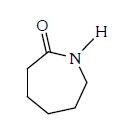
Which of the following polymers can be formed by using the following monomer unit?
A
Nylon-$6, 6$
B
Nylon-$2$-nylon-$6$
C
Melamine polymer
D
Nylon-$6$
Solution
(D) The given monomer unit is caprolactam.
Caprolactam,when heated with water at high temperature,undergoes ring-opening polymerization to form Nylon-$6$.
The reaction is:
Caprolactam $\xrightarrow{H_2O, \Delta}$ Nylon-$6$.
Caprolactam,when heated with water at high temperature,undergoes ring-opening polymerization to form Nylon-$6$.
The reaction is:
Caprolactam $\xrightarrow{H_2O, \Delta}$ Nylon-$6$.
0 likes
View Solution116
MediumMCQ
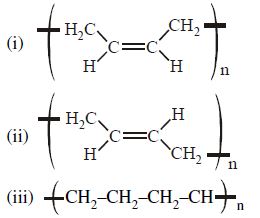
If $1,3$-butadiene is polymerized by a free radical synthesis,the possible product contains which repeating units?
A
$(i) \& (ii)$
B
$(iii)$ only
C
$(i)$ only
D
$(i), (ii) \& (iii)$
Solution
(A) The polymerization of $1,3$-butadiene $(CH_2=CH-CH=CH_2)$ via free radical mechanism involves $1,4$-addition.
This results in the formation of polybutadiene,which can exist in two geometric isomeric forms due to the double bond in the polymer chain:
$1$. $cis$-$1,4$-polybutadiene (represented by structure $(i)$).
$2$. $trans$-$1,4$-polybutadiene (represented by structure $(ii)$).
Structure $(iii)$ represents a saturated chain which is not formed by the $1,4$-polymerization of $1,3$-butadiene.
Therefore,the possible products contain repeating units $(i)$ and $(ii)$.
This results in the formation of polybutadiene,which can exist in two geometric isomeric forms due to the double bond in the polymer chain:
$1$. $cis$-$1,4$-polybutadiene (represented by structure $(i)$).
$2$. $trans$-$1,4$-polybutadiene (represented by structure $(ii)$).
Structure $(iii)$ represents a saturated chain which is not formed by the $1,4$-polymerization of $1,3$-butadiene.
Therefore,the possible products contain repeating units $(i)$ and $(ii)$.
0 likes
View Solution117
MediumMCQ
The widely used plastic $PVC$ is a polymerization product of
A
$CH_2=CH_2$
B
$CH_2=CHCl$
C
$CHCl=CHCl$
D
$CH_2=CCl_2$
Solution
(B) $PVC$ stands for Polyvinyl chloride.
It is formed by the addition polymerization of vinyl chloride monomer,which has the chemical formula $CH_2=CHCl$.
It is formed by the addition polymerization of vinyl chloride monomer,which has the chemical formula $CH_2=CHCl$.
0 likes
View Solution118
MediumMCQ
The Ziegler-Natta catalyst used for polymerisation of ethene and styrene is $TiCl_4 + (C_2H_5)_3Al$. The catalysing species (active species) involved in the polymerisation is
A
$TiCl_4$
B
$TiCl_3$
C
$TiCl_2$
D
$TiCl$
Solution
(B) The Ziegler-Natta catalyst is a mixture of titanium tetrachloride $(TiCl_4)$ and an organoaluminium compound like triethylaluminium $((C_2H_5)_3Al)$.
In the reaction mechanism,$TiCl_4$ is reduced by the organoaluminium compound to form an active species containing $Ti(III)$,which is $TiCl_3$ (or an alkylated derivative thereof).
This $TiCl_3$ species acts as the active site where the monomer coordinates and undergoes insertion into the metal-carbon bond to propagate the polymer chain.
In the reaction mechanism,$TiCl_4$ is reduced by the organoaluminium compound to form an active species containing $Ti(III)$,which is $TiCl_3$ (or an alkylated derivative thereof).
This $TiCl_3$ species acts as the active site where the monomer coordinates and undergoes insertion into the metal-carbon bond to propagate the polymer chain.
0 likes
View Solution119
MediumMCQ
Neoprene rubber is obtained by the polymerization of:
A
$1, 3-$Butadiene
B
$2-$Methyl$-1, 3-$butadiene
C
$2-$Chloro$-1, 3-$butadiene
D
Styrene and butadiene
Solution
(C) Neoprene,also known as polychloroprene,is a synthetic rubber produced by the free-radical polymerization of the monomer $2-$chloro$-1, 3-$butadiene (also known as chloroprene).
The chemical reaction is:
$n \ CH_2=C(Cl)-CH=CH_2 \rightarrow -[CH_2-C(Cl)=CH-CH_2]_n-$
The chemical reaction is:
$n \ CH_2=C(Cl)-CH=CH_2 \rightarrow -[CH_2-C(Cl)=CH-CH_2]_n-$
0 likes
View Solution120
MediumMCQ
$PHBV$ is a polymer of
A
$3-$Hydroxybutanoic acid and $3-$Hydroxypentanoic acid
B
$2-$Hydroxybutanoic acid and $2-$Hydroxypentanoic acid
C
$4-$Hydroxybutanoic acid and $4-$Hydroxypentanoic acid
D
$3-$Hydroxybutanoic acid and $2-$Hydroxypentanoic acid
Solution
(A) $PHBV$ stands for Poly-$\beta$-hydroxybutyrate-co-$\beta$-hydroxyvalerate.
It is a copolymer obtained by the polymerization of $3-$hydroxybutanoic acid and $3-$hydroxypentanoic acid.
Therefore,the correct option is $A$.
It is a copolymer obtained by the polymerization of $3-$hydroxybutanoic acid and $3-$hydroxypentanoic acid.
Therefore,the correct option is $A$.
0 likes
View Solution121
MediumMCQ
The fibre obtained by the condensation of hexamethylene diamine and adipic acid is
A
$Dacron$
B
$Nylon$ $6,6$
C
$Rayon$
D
$Teflon$
Solution
(B) $Nylon$ $6,6$ is a polyamide fibre obtained by the condensation polymerization of hexamethylene diamine $(H_2N(CH_2)_6NH_2)$ and adipic acid $(HOOC(CH_2)_4COOH)$.
0 likes
View Solution122
MediumMCQ
The monomeric units of Bakelite are:
A
$HCHO + C_6H_5OH$
B
$HCHO + \text{Melamine}$
C
$CH_2=CH-CH=CH_2 + C_6H_5CH=CH_2$
D
$HCHO + CF_2=CF_2$
Solution
(A) Bakelite is a thermosetting polymer formed by the condensation polymerization of phenol $(C_6H_5OH)$ and formaldehyde $(HCHO)$.
Therefore,the monomeric units of Bakelite are phenol and formaldehyde.
Therefore,the monomeric units of Bakelite are phenol and formaldehyde.
0 likes
View Solution123
EasyMCQ
Orlon is a polymer of
A
Styrene
B
$CF_2=CF_2$
C
Vinyl cyanide
D
Acrolein
Solution
(C) Orlon,also known as polyacrylonitrile $(PAN)$,is a synthetic polymer formed by the polymerization of acrylonitrile (also known as vinyl cyanide).
The chemical reaction is: $n CH_2=CH(CN) \rightarrow -[CH_2-CH(CN)]_n-$.
Therefore,the monomer of Orlon is vinyl cyanide.
The chemical reaction is: $n CH_2=CH(CN) \rightarrow -[CH_2-CH(CN)]_n-$.
Therefore,the monomer of Orlon is vinyl cyanide.
0 likes
View Solution124
EasyMCQ
During the formation of bakelite,which initial linear product is formed?
A
Melamine
B
$PHBV$
C
Novolac
D
Acrylonitrile
Solution
(C) Bakelite is a thermosetting polymer formed by the condensation reaction of phenol and formaldehyde in the presence of an acid or base catalyst.
In the initial stage,the reaction produces a linear polymer known as $Novolac$.
$Novolac$ is a linear chain of phenol units linked by methylene bridges.
Upon further heating with more formaldehyde,$Novolac$ undergoes cross-linking to form the infusible,hard,and rigid solid known as Bakelite.
In the initial stage,the reaction produces a linear polymer known as $Novolac$.
$Novolac$ is a linear chain of phenol units linked by methylene bridges.
Upon further heating with more formaldehyde,$Novolac$ undergoes cross-linking to form the infusible,hard,and rigid solid known as Bakelite.
0 likes
View Solution125
AdvancedMCQ
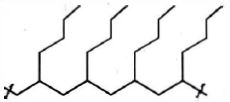
The following structure represents a subunit of a hydrocarbon polymer that may be prepared by a radical polymerization method. Identify the monomer that has been polymerized to make this polymer chain.
A
$1$-Hexene
B
$n$-Hexane
C
$1$-Pentene
D
$2$-Methyl-$1$-pentene
Solution
(A) The given polymer structure is a poly($1$-alkene). By examining the repeating unit,we can identify the monomer. The backbone consists of a $2$-carbon chain with a $4$-carbon side chain (butyl group) attached to every other carbon atom. This corresponds to the polymerization of $1$-hexene $(CH_2=CH-CH_2-CH_2-CH_2-CH_3)$. The radical polymerization of $1$-hexene involves the opening of the double bond to form the polymer chain.
0 likes
View Solution126
DifficultMCQ
The copolymer formed by addition polymerization of styrene and acrylonitrile in the presence of peroxide is
A
$[C(C_6H_5)(CH_3)-CH(CN)-CH_2]_n$
B
$[CH_2-CH(C_6H_5)-CH_2-CH(CN)]_n$
C
$[CH_2-CH(C_6H_5)-CH(CN)-CH_2]_n$
D
$[CH(C_6H_5)-CH_2-CH_2-CH(CN)]_n$
Solution
(B) . Styrene $(CH_2=CH-C_6H_5)$ and acrylonitrile $(CH_2=CH-CN)$ undergo addition polymerization in the presence of peroxide to form a copolymer.
The monomers link in a head-to-tail fashion,resulting in the following structure:
$n CH_2=CH(C_6H_5) + n CH_2=CH(CN) \xrightarrow{\text{Peroxide}} [CH_2-CH(C_6H_5)-CH_2-CH(CN)]_n$
The monomers link in a head-to-tail fashion,resulting in the following structure:
$n CH_2=CH(C_6H_5) + n CH_2=CH(CN) \xrightarrow{\text{Peroxide}} [CH_2-CH(C_6H_5)-CH_2-CH(CN)]_n$
0 likes
View Solution127
MediumMCQ
Which of the following polymers is synthesized using a free radical polymerization technique?
A
Terylene
B
Melamine polymer
C
Nylon $6, 6$
D
Teflon
Solution
(D) Teflon (polytetrafluoroethene) is an addition polymer formed by the free radical polymerization of its monomer,tetrafluoroethene $(CF_2 = CF_2)$.
In contrast,Terylene,Melamine polymer,and Nylon-$6, 6$ are condensation polymers formed by the elimination of small molecules like water or alcohol.
In contrast,Terylene,Melamine polymer,and Nylon-$6, 6$ are condensation polymers formed by the elimination of small molecules like water or alcohol.
0 likes
View Solution128
EasyMCQ
Bakelite is obtained from phenol by reacting with
A
Acetal
B
$CH_3CHO$
C
$HCHO$
D
Chlorobenzene
Solution
(C) Bakelite is a thermosetting polymer formed by the condensation polymerization of phenol and formaldehyde $(HCHO)$ in the presence of an acid or base catalyst.
The reaction involves the formation of ortho- and para-hydroxybenzyl alcohol derivatives,which further undergo cross-linking to form the complex structure of Bakelite.
The reaction involves the formation of ortho- and para-hydroxybenzyl alcohol derivatives,which further undergo cross-linking to form the complex structure of Bakelite.
0 likes
View Solution129
EasyMCQ
Which one of the following is a chain growth polymerisation?
A
Nucleic acid
B
Polystyrene
C
Protein
D
Starch
Solution
(B) Chain growth polymerization involves the addition of monomers to the active site of a growing polymer chain,typically through free radical,cationic,or anionic mechanisms.
$Polystyrene$ is formed by the addition polymerization of styrene monomers,which is a classic example of chain growth polymerization.
$Nucleic$ $acid$,$protein$,and $starch$ are natural polymers formed through step-growth (condensation) polymerization.
$Polystyrene$ is formed by the addition polymerization of styrene monomers,which is a classic example of chain growth polymerization.
$Nucleic$ $acid$,$protein$,and $starch$ are natural polymers formed through step-growth (condensation) polymerization.
0 likes
View Solution130
EasyMCQ
Bakelite is obtained from phenol by reacting it with
A
Acetaldehyde
B
Chlorobenzene
C
Formaldehyde
D
Acetamide
Solution
(C) Bakelite is a thermosetting phenol-formaldehyde resin.
It is obtained by the condensation polymerization of phenol and formaldehyde in the presence of an acid or base catalyst.
It is obtained by the condensation polymerization of phenol and formaldehyde in the presence of an acid or base catalyst.
0 likes
View Solution131
DifficultMCQ
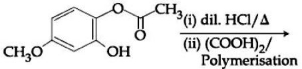
The major product of the following reaction is:
A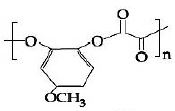
B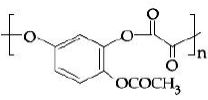
C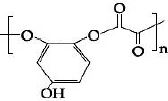
D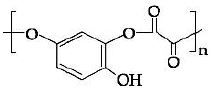
Solution
(A) Step $1$: Hydrolysis of the starting material. The starting material is $4$-methoxyphenyl acetate. Treatment with $dil. \ HCl$ and heat causes hydrolysis of the ester group,yielding $4$-methoxyphenol.
Step $2$: Polymerization. The $4$-methoxyphenol is then reacted with oxalic acid $(COOH)_2$. This is a condensation polymerization reaction where the phenolic $-OH$ groups react with the carboxylic acid groups of oxalic acid to form a polyester linkage. The resulting polymer contains the $4$-methoxyphenyl unit linked via ester bonds.
Step $2$: Polymerization. The $4$-methoxyphenol is then reacted with oxalic acid $(COOH)_2$. This is a condensation polymerization reaction where the phenolic $-OH$ groups react with the carboxylic acid groups of oxalic acid to form a polyester linkage. The resulting polymer contains the $4$-methoxyphenyl unit linked via ester bonds.
0 likes
View Solution132
DifficultMCQ
The polymer obtained from the following reaction is:

A
$[ -C(=O)-(CH_2)_4-NH- ]_n$
B
$[ -NH-C(=O)-(CH_2)_4-C(=O)-NH- ]_n$
C
$[ -O-(CH_2)_5-C(=O)- ]_n$
D
$[ -O-C(=O)-(CH_2)_4-O- ]_n$
Solution
(C) The starting material is $6$-aminohexanoic acid $(H_2N-(CH_2)_5-COOH)$.
$(i)$ Treatment with $NaNO_2/H_3O^+$ converts the amino group to a hydroxyl group,forming $6$-hydroxyhexanoic acid $(HO-(CH_2)_5-COOH)$.
(ii) Polymerization of $6$-hydroxyhexanoic acid via self-esterification results in the polyester polycaprolactone,which has the repeating unit $[ -O-(CH_2)_5-C(=O)- ]_n$.
$(i)$ Treatment with $NaNO_2/H_3O^+$ converts the amino group to a hydroxyl group,forming $6$-hydroxyhexanoic acid $(HO-(CH_2)_5-COOH)$.
(ii) Polymerization of $6$-hydroxyhexanoic acid via self-esterification results in the polyester polycaprolactone,which has the repeating unit $[ -O-(CH_2)_5-C(=O)- ]_n$.
0 likes
View Solution133
DifficultMCQ
The homopolymer formed from $4-$hydroxybutanoic acid is:
A
$-[O-C(=O)-(CH_2)_3-O]_n-$
B
$-[C(=O)-(CH_2)_2-C(=O)]_n-$
C
$-[C(=O)-(CH_2)_2-C(=O)-O]_n-$
D
$-[C(=O)-(CH_2)_3-O]_n-$
Solution
(D) $4-$hydroxybutanoic acid $(HO-CH_2-CH_2-CH_2-COOH)$ undergoes self-condensation polymerization to form a polyester.
During this process,a water molecule is eliminated from each monomer unit.
The resulting repeating unit is $-[C(=O)-(CH_2)_3-O]_n-$.
During this process,a water molecule is eliminated from each monomer unit.
The resulting repeating unit is $-[C(=O)-(CH_2)_3-O]_n-$.
0 likes
View Solution134
MediumMCQ
The two monomers for the synthesis of Nylon $6, 6$ are
A
$HOOC(CH_2)_4COOH$ and $H_2N(CH_2)_6NH_2$
B
$HOOC(CH_2)_6COOH$ and $H_2N(CH_2)_6NH_2$
C
$HOOC(CH_2)_4COOH$ and $H_2N(CH_2)_4NH_2$
D
$HOOC(CH_2)_6COOH$ and $H_2N(CH_2)_4NH_2$
Solution
(A) Nylon $6, 6$ is a polyamide formed by the condensation polymerization of two monomers:
$1$. Adipic acid: $HOOC(CH_2)_4COOH$
$2$. Hexamethylene diamine: $H_2N(CH_2)_6NH_2$
Therefore,the correct option is $A$.
$1$. Adipic acid: $HOOC(CH_2)_4COOH$
$2$. Hexamethylene diamine: $H_2N(CH_2)_6NH_2$
Therefore,the correct option is $A$.
0 likes
View Solution135
DifficultMCQ
The major product of the following reaction is:
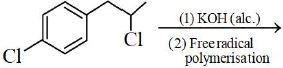
A
$A$ polymer with a phenol group attached to the backbone.
B
$A$ polymer with a chlorine atom on the benzene ring and a methyl group on the backbone.
C
$A$ polymer with a chlorine atom on the benzene ring and no methyl group on the backbone.
D
$A$ polymer with a chlorine atom on the benzene ring and a methyl group on the backbone (different structure).
Solution
(B) Step $1$: Dehydrohalogenation of $1-(4-chlorophenyl)-2-chloropropane$ with alcoholic $KOH$ leads to the formation of $1-(4-chlorophenyl)prop-1-ene$ via an $E2$ elimination mechanism.
Step $2$: The resulting alkene,$1-(4-chlorophenyl)prop-1-ene$,undergoes free radical polymerization to form the corresponding polymer. The structure of the polymer is formed by the addition of the monomer units,resulting in a backbone with a methyl group and a $4-chlorophenyl$ substituent on adjacent carbons.
Step $2$: The resulting alkene,$1-(4-chlorophenyl)prop-1-ene$,undergoes free radical polymerization to form the corresponding polymer. The structure of the polymer is formed by the addition of the monomer units,resulting in a backbone with a methyl group and a $4-chlorophenyl$ substituent on adjacent carbons.
0 likes
View Solution136
MediumMCQ
Which of the following is a condensation polymer?
A
Nylon $6,6$
B
Neoprene
C
Buna $-S$
D
Teflon
Solution
(A) Nylon $-6,6$ is a condensation polymer formed by the reaction between hexamethylene diamine and adipic acid with the elimination of water molecules.
Buna $-S$,Teflon,and Neoprene are examples of addition polymers.
Buna $-S$,Teflon,and Neoprene are examples of addition polymers.
0 likes
View Solution137
EasyMCQ
Glyptal polymer is obtained from phthalic acid by treating it with
A
Malonic acid
B
Ethylene glycol
C
Maleic acid
D
Phenol
Solution
(B) Glyptal is a polyester formed by the condensation polymerization of ethylene glycol $(HO-CH_2-CH_2-OH)$ and phthalic acid $(C_6H_4(COOH)_2)$.
The reaction is as follows:
$n \ HO-CH_2-CH_2-OH + n \ C_6H_4(COOH)_2 \rightarrow \text{Glyptal} + 2n \ H_2O$
Thus,phthalic acid is treated with ethylene glycol to obtain glyptal.
The reaction is as follows:
$n \ HO-CH_2-CH_2-OH + n \ C_6H_4(COOH)_2 \rightarrow \text{Glyptal} + 2n \ H_2O$
Thus,phthalic acid is treated with ethylene glycol to obtain glyptal.
0 likes
View Solution138
EasyMCQ
Which of the following is a step-growth polymer?
A
Polyethylene
B
Polyester
C
Polypropylene
D
Polystyrene
Solution
(B) Step-growth polymerization involves the reaction of bifunctional or multifunctional monomers to form polymers with the elimination of small molecules like $H_2O$ or $CH_3OH$.
Polyesters,such as $Terylene$ (Dacron),are formed by the condensation polymerization of ethylene glycol and terephthalic acid,which is a classic example of step-growth polymerization.
Polyethylene,polypropylene,and polystyrene are addition polymers formed by chain-growth polymerization.
Polyesters,such as $Terylene$ (Dacron),are formed by the condensation polymerization of ethylene glycol and terephthalic acid,which is a classic example of step-growth polymerization.
Polyethylene,polypropylene,and polystyrene are addition polymers formed by chain-growth polymerization.
0 likes
View Solution139
DifficultMCQ
How is a linear chain polymer formed?
A
By hydrolysis followed by condensation polymerization of $CH_3SiCl_3$
B
By hydrolysis of $(CH_3)_4Si$ through addition polymerization
C
By hydrolysis followed by condensation polymerization of $(CH_3)_2SiCl_2$
D
By hydrolysis followed by condensation polymerization of $(CH_3)_3SiCl$
Solution
(C) The hydrolysis of dialkyldichlorosilane $(R_2SiCl_2)$ produces dialkylsilanediol $(R_2Si(OH)_2)$.
These silanediol molecules undergo condensation polymerization to form linear chain silicone polymers.
For $(CH_3)_2SiCl_2$:
$n(CH_3)_2SiCl_2 + 2nH_2O \rightarrow n(CH_3)_2Si(OH)_2 + 2nHCl$
$n(CH_3)_2Si(OH)_2 \rightarrow -[O-Si(CH_3)_2-O]_n- + nH_2O$
Thus,$(CH_3)_2SiCl_2$ is the correct precursor for linear chain polymers.
These silanediol molecules undergo condensation polymerization to form linear chain silicone polymers.
For $(CH_3)_2SiCl_2$:
$n(CH_3)_2SiCl_2 + 2nH_2O \rightarrow n(CH_3)_2Si(OH)_2 + 2nHCl$
$n(CH_3)_2Si(OH)_2 \rightarrow -[O-Si(CH_3)_2-O]_n- + nH_2O$
Thus,$(CH_3)_2SiCl_2$ is the correct precursor for linear chain polymers.
0 likes
View Solution140
MediumMCQ
What is the monomer unit of silicones?
A
$R_2SiCl_2$
B
$R_3SiCl$
C
$RSiCl_3$
D
$R_4Si$
Solution
(A) Silicones are synthetic organosilicon polymers with the general formula $(R_2SiO)_n$.
They are prepared by the hydrolysis of dialkyldichlorosilanes,$R_2SiCl_2$.
The hydrolysis of $R_2SiCl_2$ yields a dihydroxy derivative,$R_2Si(OH)_2$,which undergoes polymerization to form silicones.
Therefore,the monomer unit is $R_2SiCl_2$.
They are prepared by the hydrolysis of dialkyldichlorosilanes,$R_2SiCl_2$.
The hydrolysis of $R_2SiCl_2$ yields a dihydroxy derivative,$R_2Si(OH)_2$,which undergoes polymerization to form silicones.
Therefore,the monomer unit is $R_2SiCl_2$.
0 likes
View Solution141
EasyMCQ
Bakelite is obtained from phenol by reacting with?
A
$CH_2OH-CH_2OH$
B
$CH_3-CHO$
C
$CH_3-CO-CH_3$
D
$HCHO$
Solution
(D) Bakelite is a thermosetting polymer formed by the condensation polymerization of phenol and formaldehyde $(HCHO)$ in the presence of an acid or base catalyst.
0 likes
View Solution142
MediumMCQ
Which of the following products is a monomeric unit of Bakelite,formed in the Lederer-Manasse reaction?
A
o-Cresol
B
o-Hydroxybenzyl alcohol
C
Benzyl alcohol
D
Catechol
Solution
(B) The Lederer-Manasse reaction involves the reaction of phenol with formaldehyde in the presence of an acid or base catalyst.
This reaction leads to the formation of ortho- and para-hydroxybenzyl alcohols.
These hydroxybenzyl alcohols serve as the monomeric units for the polymerization process that produces Bakelite.
Among the given options,the structure corresponding to o-hydroxybenzyl alcohol is the correct monomeric unit.
This reaction leads to the formation of ortho- and para-hydroxybenzyl alcohols.
These hydroxybenzyl alcohols serve as the monomeric units for the polymerization process that produces Bakelite.
Among the given options,the structure corresponding to o-hydroxybenzyl alcohol is the correct monomeric unit.
0 likes
View Solution143
MediumMCQ
$2-$chloro$-1,3-$butadiene is also known as
A
Chloroprene
B
Neoprene
C
Isoprene
D
Buna$-N$
Solution
(A) The chemical structure of $2-$chloro$-1,3-$butadiene is $CH_2=C(Cl)-CH=CH_2$.
This compound is commonly known as Chloroprene.
It is the monomer used for the preparation of the synthetic rubber known as Neoprene.
This compound is commonly known as Chloroprene.
It is the monomer used for the preparation of the synthetic rubber known as Neoprene.
0 likes
View Solution144
EasyMCQ
Teflon is a polymer of
A
Tetrafluoroethene
B
Tetrafluoroethane
C
Acrylonitrile
D
Caprolactam
Solution
(A) Teflon (polytetrafluoroethylene) is a polymer formed by the addition polymerization of tetrafluoroethene $(CF_2=CF_2)$ monomers.
It is an addition polymer.
It is an addition polymer.
0 likes
View Solution145
EasyMCQ
The polymer formed by the condensation polymerization of ethylene glycol and phthalic acid is known as:
A
Glyptal
B
Bakelite
C
$PHBV$
D
$PVC$
Solution
(A) The condensation polymerization of ethylene glycol $(HO-CH_2-CH_2-OH)$ and phthalic acid $(C_6H_4(COOH)_2)$ results in the formation of a polyester known as Glyptal.
This is a cross-linked polymer used in the manufacture of paints and lacquers.
This is a cross-linked polymer used in the manufacture of paints and lacquers.
0 likes
View Solution146
MediumMCQ
Monomers are converted to polymers by
A
Hydrolysis of monomer
B
Condensation between monomers
C
Combustion of monomers
D
Hydration of monomers
Solution
(B) Polymers are classified into two types based on the mode of polymerization: $Addition$ and $Condensation$ polymers.
$Condensation$ polymers are formed through a condensation reaction,where monomers join together and eliminate small molecules as by-products,such as $H_2O$ or $CH_3OH$.
An $Addition$ polymer is formed by the simple linking of monomers without the loss of any small molecules.
Therefore,monomers can be converted to polymers by a condensation reaction between monomers.
$Condensation$ polymers are formed through a condensation reaction,where monomers join together and eliminate small molecules as by-products,such as $H_2O$ or $CH_3OH$.
An $Addition$ polymer is formed by the simple linking of monomers without the loss of any small molecules.
Therefore,monomers can be converted to polymers by a condensation reaction between monomers.
0 likes
View Solution147
EasyMCQ
Ziegler-Natta catalyst is
A
$R_3Al$
B
$TiCl_4$
C
$R_3Al + TiCl_4$
D
$R_3B + TiCl_2$
Solution
(C) The Ziegler-Natta catalyst is a combination of an organometallic compound of a Group $1-3$ element (typically an alkyl aluminum compound like $R_3Al$) and a transition metal compound (typically a titanium compound like $TiCl_4$).
Thus,the correct composition is $R_3Al + TiCl_4$.
Thus,the correct composition is $R_3Al + TiCl_4$.
0 likes
View Solution148
EasyMCQ
Which of the following is a step-growth polymer?
A
Bakelite
B
Polyethylene
C
Teflon
D
$PVC$
Solution
(A) Step-growth polymerization involves the reaction of bifunctional or multifunctional monomers to form polymers with the loss of small molecules like $H_2O$ or $HCl$.
Bakelite is a condensation polymer formed by the reaction of phenol and formaldehyde,which is a classic example of step-growth polymerization.
Polyethylene,Teflon,and $PVC$ are addition polymers formed by chain-growth polymerization.
Bakelite is a condensation polymer formed by the reaction of phenol and formaldehyde,which is a classic example of step-growth polymerization.
Polyethylene,Teflon,and $PVC$ are addition polymers formed by chain-growth polymerization.
0 likes
View Solution149
EasyMCQ
An example of a condensation polymer is .............
A
$PVC$
B
Terylene
C
Polypropylene
D
Polystyrene
Solution
(B) Condensation polymers are formed by the repeated condensation reaction between two different bi-functional or tri-functional monomeric units,usually with the elimination of small molecules like $H_2O$,$HCl$,or $CH_3OH$.
$Terylene$ (also known as $Dacron$) is a condensation polymer formed by the polymerization of ethylene glycol and terephthalic acid.
$PVC$,$Polypropylene$,and $Polystyrene$ are all examples of addition polymers.
$Terylene$ (also known as $Dacron$) is a condensation polymer formed by the polymerization of ethylene glycol and terephthalic acid.
$PVC$,$Polypropylene$,and $Polystyrene$ are all examples of addition polymers.
0 likes
View SolutionPolymers — General methods of preparation and mechanism of polymerisation · Frequently Asked Questions
1Are these Polymers questions useful for JEE and NEET?
Yes. All questions in this section are mapped to JEE Main and NEET exam patterns. Previous year questions from JEE Main, NEET, GUJCET and state-level exams are included with full solutions.
2Can I switch to Hindi or Gujarati for these questions?
Yes. Use the language tabs in the hero section or the sidebar to view the same questions and solutions in English, Hindi or Gujarati.
3How do I generate a question paper from this subtopic?
Use the Vedclass Exam Paper Generator — select the chapter and subtopic, set difficulty, and generate Sets A, B, C, D automatically. First 3 chapters of every subject are free.
Vedclass Products
For Students
Vedclass Test Series
Mock tests in real JEE/NEET style with performance analysis. 5-day free trial.
Start Free TrialFor Teachers
Exam Paper Generator
Generate Set A/B/C/D papers from this chapter in 2 minutes. 3 chapters free.
Try FreeFor Institutes
Online Exam Module
Live online exams with unlimited students, 360° analytics & white-label branding.
See DemoFor Teachers & Institutes
Generate a Polymers Exam Paper in 2 Minutes
Select subtopic & difficulty — Sets A, B, C, D auto-generated with No Repeat logic.
First 3 chapters of every subject are free — no payment required.