
A English
General methods of preparation and mechanism of polymerisation Questions in English
Class 12 Chemistry · Polymers · General methods of preparation and mechanism of polymerisation
295+
Questions
English
Language
100%
With Solutions
Showing 50 of 295 questions in English
201
MediumMCQ
Terylene polymer is obtained by the condensation of:
A
Ethane-$1, 2$-diol and Benzene-$1, 3$-dicarboxylic acid
B
Propane-$1, 2$-diol and Benzene-$1, 4$-dicarboxylic acid
C
Ethane-$1, 2$-diol and Benzene-$1, 4$-dicarboxylic acid
D
Ethane-$1, 2$-diol and Benzene-$1, 2$-dicarboxylic acid
Solution
(C) Terylene,also known as $Dacron$,is a polyester fiber.
It is prepared by the condensation polymerization of Ethane-$1, 2$-diol (ethylene glycol) and Benzene-$1, 4$-dicarboxylic acid (terephthalic acid).
The reaction involves the elimination of water molecules to form an ester linkage between the monomers.
It is prepared by the condensation polymerization of Ethane-$1, 2$-diol (ethylene glycol) and Benzene-$1, 4$-dicarboxylic acid (terephthalic acid).
The reaction involves the elimination of water molecules to form an ester linkage between the monomers.
0 likes
View Solution202
MediumMCQ
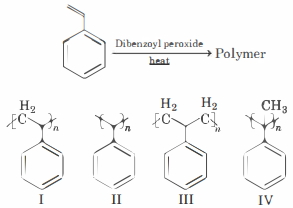
The structure of the polymer obtained by the following reaction is
A
$I$
B
$II$
C
$III$
D
$IV$
Solution
(A) The reaction involves the free radical polymerization of styrene $(C_6H_5CH=CH_2)$ in the presence of dibenzoyl peroxide as an initiator.
During polymerization,the double bond of the vinyl group breaks,and the monomer units link together to form a long chain.
The structure of the repeating unit in polystyrene is $[-CH_2-CH(C_6H_5)-]_n$.
Comparing this with the given options,structure $I$ represents the correct polymer structure.
During polymerization,the double bond of the vinyl group breaks,and the monomer units link together to form a long chain.
The structure of the repeating unit in polystyrene is $[-CH_2-CH(C_6H_5)-]_n$.
Comparing this with the given options,structure $I$ represents the correct polymer structure.
0 likes
View Solution203
DifficultMCQ
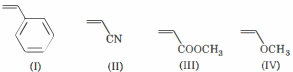
Among $(I)-(IV)$,the compound that does not undergo polymerisation under radical initiation is:
A
$I$
B
$II$
C
$III$
D
$IV$
Solution
(D) The correct answer is $(d)$.
In free radical polymerisation,the monomer must be capable of forming a stable radical intermediate. Compounds $(I)$ (styrene),$(II)$ (acrylonitrile),and $(III)$ (methyl acrylate) contain electron-withdrawing groups attached to the double bond,which stabilize the radical formed during the propagation step through resonance.
Compound $(IV)$,methyl vinyl ether $(CH_2=CH-OCH_3)$,has an electron-donating methoxy group. The oxygen atom donates electron density into the double bond,making it electron-rich. This destabilizes the formation of a radical intermediate in a free radical mechanism,as radical polymerization typically requires electron-deficient alkenes to stabilize the radical center.
In free radical polymerisation,the monomer must be capable of forming a stable radical intermediate. Compounds $(I)$ (styrene),$(II)$ (acrylonitrile),and $(III)$ (methyl acrylate) contain electron-withdrawing groups attached to the double bond,which stabilize the radical formed during the propagation step through resonance.
Compound $(IV)$,methyl vinyl ether $(CH_2=CH-OCH_3)$,has an electron-donating methoxy group. The oxygen atom donates electron density into the double bond,making it electron-rich. This destabilizes the formation of a radical intermediate in a free radical mechanism,as radical polymerization typically requires electron-deficient alkenes to stabilize the radical center.
0 likes
View Solution204
MediumMCQ
The expected reactivity of the monomers shown below towards cationic polymerization follows the order:
$I: CH_2=CH-CO_2CH_3$
$II: CH_2=CH-Cl$
$III: CH_2=CH-CH_3$
$IV: CH_2=CH-Ph$
$I: CH_2=CH-CO_2CH_3$
$II: CH_2=CH-Cl$
$III: CH_2=CH-CH_3$
$IV: CH_2=CH-Ph$
A
$I < II < III < IV$
B
$IV < III < II < I$
C
$III < IV < II < I$
D
$IV < III < I < II$
Solution
(A) Cationic polymerization proceeds via the formation of a carbocation intermediate. The rate of polymerization is directly proportional to the stability of the carbocation formed.
The stability of the resulting carbocations is as follows:
$I: CH_3O_2C-CH_2-CH_2^+$ (destabilized by $-I$ and $-M$ effects of the ester group)
$II: Cl-CH_2-CH_2^+$ (destabilized by $-I$ effect of $Cl$)
$III: CH_3-CH_2-CH_2^+$ (stabilized by $+I$ effect of the methyl group)
$IV: Ph-CH_2-CH_2^+$ (highly stabilized by resonance with the phenyl ring)
Thus,the stability order is $I < II < III < IV$. Consequently,the reactivity order for cationic polymerization is $I < II < III < IV$.
The stability of the resulting carbocations is as follows:
$I: CH_3O_2C-CH_2-CH_2^+$ (destabilized by $-I$ and $-M$ effects of the ester group)
$II: Cl-CH_2-CH_2^+$ (destabilized by $-I$ effect of $Cl$)
$III: CH_3-CH_2-CH_2^+$ (stabilized by $+I$ effect of the methyl group)
$IV: Ph-CH_2-CH_2^+$ (highly stabilized by resonance with the phenyl ring)
Thus,the stability order is $I < II < III < IV$. Consequently,the reactivity order for cationic polymerization is $I < II < III < IV$.
0 likes
View Solution205
MediumMCQ
Caprolactam,when heated at high temperature in the presence of water,gives:
A
Teflon
B
Dacron
C
Nylon $6,6$
D
Nylon $6$
Solution
(D) Caprolactam is heated with water at a high temperature $(533-543 \ K)$ to undergo ring-opening polymerization.
This process results in the formation of the polyamide known as Nylon $6$.
The reaction is represented as:
Caprolactam $\xrightarrow{H_2O, \Delta} [CO-(CH_2)_5-NH]_n$ (Nylon $6$).
This process results in the formation of the polyamide known as Nylon $6$.
The reaction is represented as:
Caprolactam $\xrightarrow{H_2O, \Delta} [CO-(CH_2)_5-NH]_n$ (Nylon $6$).
0 likes
View Solution206
MediumMCQ
The polymer $X$ consists of linear molecules and is closely packed. It is prepared in the presence of triethylaluminium and titanium tetrachloride under low pressure. The polymer $X$ is -
A
Polyacrylonitrile
B
Low density polythene
C
Polytetrafluoroethane
D
High density polythene
Solution
(D) Ethene undergoes addition polymerisation to form high density polythene in the presence of a catalyst such as triethylaluminium $(Al(C_2H_5)_3)$ and titanium tetrachloride $(TiCl_4)$,which is known as the Ziegler-Natta catalyst.
This process occurs at a temperature of $333 \ K$ to $343 \ K$ and under a pressure of $6-7 \ \text{atm}$.
High density polythene consists of linear molecules and is closely packed,which results in high density and high melting point.
This process occurs at a temperature of $333 \ K$ to $343 \ K$ and under a pressure of $6-7 \ \text{atm}$.
High density polythene consists of linear molecules and is closely packed,which results in high density and high melting point.
0 likes
View Solution207
MediumMCQ
Which amongst the following molecules on polymerization produces neoprene?
A
$H_2C=C(Cl)-CH=CH_2$
B
$H_2C=CH-CH=CH_2$
C
$H_3C-CH=CH-CH_3$
D
$H_2C=CH-C\equiv CH$
Solution
(A) Neoprene is a synthetic rubber formed by the free radical polymerization of chloroprene $(2\text{-chloro-}1,3\text{-butadiene})$. The chemical reaction is as follows:
$nCH_2=C(Cl)-CH=CH_2 \xrightarrow{\text{Polymerization}} [CH_2-C(Cl)=CH-CH_2]_n$
Thus,the monomer required for the production of neoprene is chloroprene,which corresponds to option $A$.
$nCH_2=C(Cl)-CH=CH_2 \xrightarrow{\text{Polymerization}} [CH_2-C(Cl)=CH-CH_2]_n$
Thus,the monomer required for the production of neoprene is chloroprene,which corresponds to option $A$.
0 likes
View Solution208
DifficultMCQ
The correct functional group $X$ and the reagent/reaction conditions $Y$ in the following scheme are:
$X-(CH_2)_4-X \xrightarrow{Y} \text{condensation polymer}$
$(i) \text{ with } HOOC-(CH_2)_4-COOH / \text{heat}$
$(A) X = COOCH_3, Y = H_2 / Ni / \text{heat}$
$(B) X = CONH_2, Y = H_2 / Ni / \text{heat}$
$(C) X = CONH_2, Y = Br_2 / NaOH$
$(D) X = CN, Y = H_2 / Ni / \text{heat}$
$X-(CH_2)_4-X \xrightarrow{Y} \text{condensation polymer}$
$(i) \text{ with } HOOC-(CH_2)_4-COOH / \text{heat}$
$(A) X = COOCH_3, Y = H_2 / Ni / \text{heat}$
$(B) X = CONH_2, Y = H_2 / Ni / \text{heat}$
$(C) X = CONH_2, Y = Br_2 / NaOH$
$(D) X = CN, Y = H_2 / Ni / \text{heat}$
A
$(C, D)$
B
$(B, D)$
C
$(A, D)$
D
$(A, B)$
Solution
(A) To form a condensation polymer with adipic acid $(HOOC-(CH_2)_4-COOH)$,we need a diamine $(NH_2-(CH_2)_n-NH_2)$.
$1$. If $X = CONH_2$,the reaction with $Br_2 / NaOH$ (Hofmann bromamide degradation) gives $NH_2-(CH_2)_4-NH_2$. This is a diamine,which reacts with adipic acid to form a polyamide (Nylon-$6$,$4$).
$2$. If $X = CN$,the reaction with $H_2 / Ni / \text{heat}$ (catalytic hydrogenation) gives $NH_2-(CH_2)_6-NH_2$. This is a diamine,which reacts with adipic acid to form a polyamide (Nylon-$6$,$6$).
Both $(C)$ and $(D)$ result in the formation of a diamine,which can undergo condensation polymerization with the given dicarboxylic acid. Thus,the correct pairs are $(C)$ and $(D)$.
$1$. If $X = CONH_2$,the reaction with $Br_2 / NaOH$ (Hofmann bromamide degradation) gives $NH_2-(CH_2)_4-NH_2$. This is a diamine,which reacts with adipic acid to form a polyamide (Nylon-$6$,$4$).
$2$. If $X = CN$,the reaction with $H_2 / Ni / \text{heat}$ (catalytic hydrogenation) gives $NH_2-(CH_2)_6-NH_2$. This is a diamine,which reacts with adipic acid to form a polyamide (Nylon-$6$,$6$).
Both $(C)$ and $(D)$ result in the formation of a diamine,which can undergo condensation polymerization with the given dicarboxylic acid. Thus,the correct pairs are $(C)$ and $(D)$.
0 likes
View Solution209
MediumMCQ
The monomers used in the preparation of Dextron are:
A
Glycine and $\omega-amino$ caproic acid
B
$3-$hydroxy butanoic acid and $3-$hydroxy pentanoic acid
C
Glycine and lactic acid
D
Lactic acid and glycolic acid
Solution
(D) The monomers used in the preparation of Dextron are lactic acid and glycolic acid.
$n CH_3-CH(OH)-COOH + n HO-CH_2-COOH \rightarrow -[O-CH(CH_3)-CO-O-CH_2-CO]_n- + n H_2O$
Thus,Dextron is a copolymer of lactic acid and glycolic acid.
$n CH_3-CH(OH)-COOH + n HO-CH_2-COOH \rightarrow -[O-CH(CH_3)-CO-O-CH_2-CO]_n- + n H_2O$
Thus,Dextron is a copolymer of lactic acid and glycolic acid.
0 likes
View Solution210
DifficultMCQ
Which of the following pairs of monomers is used for the preparation of Dexon?
A
$3-$Hydroxybutanoic acid and $3-$hydroxypentanoic acid
B
Glycine and $\omega-$aminocaproic acid
C
Lactic acid and glycolic acid
D
Isobutylene and Isoprene
Solution
(C) Dexon is a biodegradable polymer prepared from the monomers lactic acid and glycolic acid.
It is a copolymer formed by the condensation polymerization of these two hydroxy acids,resulting in the formation of ester linkages.
The reaction is as follows:
$nCH_3-CH(OH)-COOH + nHO-CH_2-COOH \rightarrow [-O-CH(CH_3)-CO-O-CH_2-CO-]_n + nH_2O$
It is a copolymer formed by the condensation polymerization of these two hydroxy acids,resulting in the formation of ester linkages.
The reaction is as follows:
$nCH_3-CH(OH)-COOH + nHO-CH_2-COOH \rightarrow [-O-CH(CH_3)-CO-O-CH_2-CO-]_n + nH_2O$
0 likes
View Solution211
EasyMCQ
Which of the following polymers is obtained by the addition polymerisation method?
A
Nylon $6$
B
Terylene
C
Nylon $6, 6$
D
Teflon
Solution
(D) Addition polymerisation involves the repeated addition of monomer molecules possessing double or triple bonds to form a polymer without the loss of any small molecules.
$Teflon$ (polytetrafluoroethylene) is formed by the addition polymerisation of tetrafluoroethene $(CF_2=CF_2)$.
$Nylon$ $6$,$Terylene$,and $Nylon$ $6, 6$ are condensation polymers formed by the elimination of small molecules like $H_2O$ or $CH_3OH$.
$Teflon$ (polytetrafluoroethylene) is formed by the addition polymerisation of tetrafluoroethene $(CF_2=CF_2)$.
$Nylon$ $6$,$Terylene$,and $Nylon$ $6, 6$ are condensation polymers formed by the elimination of small molecules like $H_2O$ or $CH_3OH$.
0 likes
View Solution212
EasyMCQ
Which of the following polymers requires a peroxide as an initiator for its preparation?
A
Nylon $6,6$
B
Polyacrylonitrile
C
Terylene
D
Bakelite
Solution
(B) Polyacrylonitrile is prepared by the free radical polymerization of acrylonitrile $(CH_2=CH-CN)$.
Free radical polymerization requires a radical initiator,such as a peroxide (e.g.,benzoyl peroxide),to initiate the chain reaction.
Nylon $6,6$ and Terylene are prepared by condensation polymerization,while Bakelite is prepared by step-growth polymerization involving phenol and formaldehyde.
Free radical polymerization requires a radical initiator,such as a peroxide (e.g.,benzoyl peroxide),to initiate the chain reaction.
Nylon $6,6$ and Terylene are prepared by condensation polymerization,while Bakelite is prepared by step-growth polymerization involving phenol and formaldehyde.
0 likes
View Solution213
EasyMCQ
Which of the following polymers is obtained by the condensation polymerisation method?
A
Polythene
B
Nylon $6, 6$
C
Polyacrylonitrile
D
Teflon
Solution
(B) Condensation polymerization involves the repeated condensation reaction between two different bi-functional or tri-functional monomeric units,usually with the elimination of small molecules like $H_2O$,$HCl$,or $NH_3$.
$Nylon \ 6, 6$ is formed by the condensation of hexamethylenediamine $(H_2N(CH_2)_6NH_2)$ and adipic acid $(HOOC(CH_2)_4COOH)$.
Polythene,Polyacrylonitrile,and Teflon are all examples of addition polymers formed by the polymerization of unsaturated monomers.
$Nylon \ 6, 6$ is formed by the condensation of hexamethylenediamine $(H_2N(CH_2)_6NH_2)$ and adipic acid $(HOOC(CH_2)_4COOH)$.
Polythene,Polyacrylonitrile,and Teflon are all examples of addition polymers formed by the polymerization of unsaturated monomers.
0 likes
View Solution214
EasyMCQ
Identify the monomers used to prepare glyptal.
A
$\beta-Hydroxy$ butyric acid and $\beta-Hydroxy$ valeric acid
B
Ethylene glycol and phenol
C
Ethylene glycol and Terephthalic acid
D
Ethylene glycol and phthalic acid
Solution
(D) Glyptal is a polyester resin formed by the condensation polymerization of ethylene glycol and phthalic acid.
The reaction involves the elimination of water molecules to form a polymer chain.
The monomers are $HO-CH_2-CH_2-OH$ (ethylene glycol) and $C_6H_4(COOH)_2$ (phthalic acid).
The reaction involves the elimination of water molecules to form a polymer chain.
The monomers are $HO-CH_2-CH_2-OH$ (ethylene glycol) and $C_6H_4(COOH)_2$ (phthalic acid).
0 likes
View Solution215
MediumMCQ
Which of the following polymers is obtained by the ring-opening polymerization method?
A
$[CH_2-CH(Cl)]_n$
B
$[NH-(CH_2)_5-CO]_n$
C
$[CH_2-CH_2]_n$
D
$[CO-(CH_2)_4-CO-NH-(CH_2)_6-NH]_n$
Solution
(B) Ring-opening polymerization involves the addition of cyclic monomers to a growing polymer chain without the elimination of small molecules like $H_2O$ or $CH_3OH$.
Nylon-$6$ is a well-known example of a polymer formed by the ring-opening polymerization of $\varepsilon$-caprolactam.
The structure of Nylon-$6$ is $[NH-(CH_2)_5-CO]_n$.
Therefore,the correct option is $B$.
Nylon-$6$ is a well-known example of a polymer formed by the ring-opening polymerization of $\varepsilon$-caprolactam.
The structure of Nylon-$6$ is $[NH-(CH_2)_5-CO]_n$.
Therefore,the correct option is $B$.
0 likes
View Solution216
EasyMCQ
Which of the following monomers is used to prepare thermocol?
A
Bisphenol and acrylamide
B
Acrylamide
C
Butadiene
D
Styrene
Solution
(D) Thermocol is a trade name for expanded polystyrene $(EPS)$.
It is prepared by the polymerization of the monomer $Styrene$ $(C_6H_5CH=CH_2)$.
Therefore,the correct monomer used for the preparation of thermocol is $Styrene$.
It is prepared by the polymerization of the monomer $Styrene$ $(C_6H_5CH=CH_2)$.
Therefore,the correct monomer used for the preparation of thermocol is $Styrene$.
0 likes
View Solution217
EasyMCQ
Which free radical initiator is used for the polymerization of tetrafluoroethylene?
A
Zinc acetate
B
Titanium tetrachloride
C
Ammonium persulphate
D
Acetyl peroxide
Solution
(C) The polymerization of tetrafluoroethylene to produce polytetrafluoroethylene $(PTFE)$ is carried out by heating or exposing tetrafluoroethylene to a free radical initiator such as ammonium persulphate or hydrogen peroxide under high pressure.
0 likes
View Solution218
EasyMCQ
Which of the following compounds does not undergo vinyl polymerization?
A
$\varepsilon$-Caprolactam
B
Vinyl cyanide
C
Tetrafluoroethylene
D
Ethylene
Solution
(A) $\varepsilon$-Caprolactam does not undergo vinyl polymerization.
It undergoes ring-opening polymerization to form Nylon-$6$.
It undergoes ring-opening polymerization to form Nylon-$6$.
0 likes
View Solution219
EasyMCQ
Identify the monomer used in the preparation of polyacrylonitrile.
A
$H_2C=C(CH_3)-CH=CH_2$
B
$F_2C=CF_2$
C
$H_2C=CH-CN$
D
$H_2C=CH-CH=CH_2$
Solution
(C) Polyacrylonitrile $(PAN)$ is a polymer formed by the addition polymerization of acrylonitrile monomer.
The chemical formula for acrylonitrile is $CH_2=CH-CN$.
Therefore,the correct monomer is $H_2C=CH-CN$.
The chemical formula for acrylonitrile is $CH_2=CH-CN$.
Therefore,the correct monomer is $H_2C=CH-CN$.
0 likes
View Solution220
EasyMCQ
From which of the following compounds is thermocol obtained?
A
Bisphenol
B
Vinyl chloride
C
Styrene
D
Butadiene
Solution
(C) Thermocol is a trade name for expanded polystyrene $(EPS)$.
It is produced by the polymerization of the monomer $Styrene$ $(C_6H_5CH=CH_2)$.
Therefore,the correct answer is $Styrene$.
It is produced by the polymerization of the monomer $Styrene$ $(C_6H_5CH=CH_2)$.
Therefore,the correct answer is $Styrene$.
0 likes
View Solution221
EasyMCQ
Identify a monomer used in the preparation of neoprene.
A
$2-$methyl$-1,3-$butadiene
B
$2-$chloro$-1,3-$butadiene
C
Melamine
D
$1,3-$butadiene
Solution
(B) Neoprene is a synthetic rubber formed by the free radical polymerization of chloroprene.
Chloroprene is the common name for $2-$chloro$-1,3-$butadiene.
The chemical structure is $CH_2=C(Cl)-CH=CH_2$.
Therefore,the correct monomer is $2-$chloro$-1,3-$butadiene.
Chloroprene is the common name for $2-$chloro$-1,3-$butadiene.
The chemical structure is $CH_2=C(Cl)-CH=CH_2$.
Therefore,the correct monomer is $2-$chloro$-1,3-$butadiene.
0 likes
View Solution222
EasyMCQ
Identify the monomers used in the preparation of Nylon $2-$ nylon $6$.
A
Glycine and $\epsilon$-amino caproic acid
B
$\beta$-hydroxy butyric acid and $\beta$-hydroxy valeric acid
C
Ethylene glycol and phthalic acid
D
Acrylamide and vinyl chloride
Solution
(A) Nylon $2-$ nylon $6$ is a polyamide copolymer.
It is formed by the condensation polymerization of two monomers:
$1$. Glycine $(H_2N-CH_2-COOH)$
$2$. $\epsilon$-amino caproic acid $(H_2N-(CH_2)_5-COOH)$
Therefore,the correct option is $A$.
It is formed by the condensation polymerization of two monomers:
$1$. Glycine $(H_2N-CH_2-COOH)$
$2$. $\epsilon$-amino caproic acid $(H_2N-(CH_2)_5-COOH)$
Therefore,the correct option is $A$.
0 likes
View Solution223
EasyMCQ
What are the compounds used to obtain nylon salt?
A
Adipic acid and ammonia
B
Terephthalic acid and hexamethylenediamine
C
Adipic acid and hexamethylenediamine
D
$\beta$-hydroxybutyric acid and hexamethylenediamine
Solution
(C) Nylon $6,6$ is prepared by the condensation polymerization of hexamethylenediamine and adipic acid.
In the first step,these two monomers react to form a $1:1$ salt known as nylon salt.
The reaction is: $HOOC(CH_2)_4COOH + H_2N(CH_2)_6NH_2 \rightarrow [^-OOC(CH_2)_4COO^-][^+H_3N(CH_2)_6NH_3^+]$ (Nylon salt).
In the first step,these two monomers react to form a $1:1$ salt known as nylon salt.
The reaction is: $HOOC(CH_2)_4COOH + H_2N(CH_2)_6NH_2 \rightarrow [^-OOC(CH_2)_4COO^-][^+H_3N(CH_2)_6NH_3^+]$ (Nylon salt).
0 likes
View Solution224
EasyMCQ
Identify the monomers used in the preparation of $Dacron$.
A
$C_6H_5OH$ and $CH_2O$
B
$H_2C=CH-CH=CH_2$ and $H_2C=CH-CN$
C
$HO-CH_2-CH_2-OH$ and $HOOC-C_6H_4-COOH$ (Ethylene glycol and terephthalic acid)
D
$H_2C=CH-CN$ and $C_6H_5OH$
Solution
(C) $Dacron$ (also known as $Terylene$) is a polyester fiber. It is prepared by the condensation polymerization of ethylene glycol $(HO-CH_2-CH_2-OH)$ and terephthalic acid ($benzene-1,4-dicarboxylic \ acid$,$HOOC-C_6H_4-COOH$). The reaction involves the elimination of water molecules to form an ester linkage.
0 likes
View Solution225
MediumMCQ
Identify the monomers used for the preparation of Buna-$S$.
A
Phenol and formaldehyde
B
$1,3-$butadiene and styrene
C
Ethylene glycol and styrene
D
$\beta-$hydroxy butyric acid and phenol
Solution
(B) Buna-$S$ is a synthetic rubber formed by the copolymerization of $1,3-$butadiene and styrene in the presence of a sodium catalyst.
The reaction is as follows:
$n(CH_2=CH-CH=CH_2) + n(C_6H_5CH=CH_2) \xrightarrow{Na} -[CH_2-CH=CH-CH_2-CH(C_6H_5)-CH_2]_n-$
The reaction is as follows:
$n(CH_2=CH-CH=CH_2) + n(C_6H_5CH=CH_2) \xrightarrow{Na} -[CH_2-CH=CH-CH_2-CH(C_6H_5)-CH_2]_n-$
0 likes
View Solution226
MediumMCQ
Which among the following polymers is obtained by ring opening polymerization process?
A
Polyacrylonitrile
B
Nylon $6,6$
C
Nylon $6$
D
Terylene
Solution
(C) Nylon $6$ is prepared by heating caprolactam with water at a high temperature $(533-543 \ K)$.
During this process,the amide bond in the cyclic caprolactam ring breaks,leading to ring opening polymerization.
The reaction is as follows:
$\epsilon$-Caprolactam ($n$ molecules) $\xrightarrow{H_2O, 533-543 \ K} [NH-(CH_2)_5-CO]_n$ (Nylon $6$).
During this process,the amide bond in the cyclic caprolactam ring breaks,leading to ring opening polymerization.
The reaction is as follows:
$\epsilon$-Caprolactam ($n$ molecules) $\xrightarrow{H_2O, 533-543 \ K} [NH-(CH_2)_5-CO]_n$ (Nylon $6$).
0 likes
View Solution227
MediumMCQ
Which of the following monomers is used to obtain the polymer represented as $-(CH_2-CH(CONH_2))_n-$?
A
Acrylamide
B
Urea and Formaldehyde
C
Bisphenol
D
Methylmethacrylate
Solution
(A) The given polymer is $-(CH_2-CH(CONH_2))_n-$,which is polyacrylamide.
Polyacrylamide is formed by the addition polymerization of the monomer acrylamide $(CH_2=CH-CONH_2)$.
Therefore,the correct monomer is acrylamide.
Polyacrylamide is formed by the addition polymerization of the monomer acrylamide $(CH_2=CH-CONH_2)$.
Therefore,the correct monomer is acrylamide.
0 likes
View Solution228
MediumMCQ
Which of the following polymers requires a dihydric alcohol and an aromatic dicarboxylic acid for its synthesis?
A
Nylon $6$
B
Dacron
C
Bakelite
D
Polyacrylamide
Solution
(B) Dacron (also known as Terylene) is a polyester formed by the condensation polymerization of ethylene glycol (a dihydric alcohol) and terephthalic acid (an aromatic dicarboxylic acid) in the presence of a zinc acetate-antimony trioxide catalyst at $420-460 \ K$.
0 likes
View Solution229
MediumMCQ
Which of the following polymers needs $HO-CH_2-CH_2-OH$ as one of the monomers for its preparation?
A
Nylon $6,6$
B
Dacron
C
Polyacrylamide
D
Buna-$N$
Solution
(B) The monomer $HO-CH_2-CH_2-OH$ is known as ethylene glycol.
It is used in the preparation of Dacron (also known as Terylene).
Dacron is a polyester formed by the condensation polymerization of ethylene glycol and terephthalic acid in the presence of a zinc acetate-antimony trioxide catalyst at $420-460 \ K$.
The reaction is: $n \ HO-CH_2-CH_2-OH + n \ HOOC-C_6H_4-COOH \rightarrow [-O-CH_2-CH_2-O-CO-C_6H_4-CO-]_n + 2n \ H_2O$.
It is used in the preparation of Dacron (also known as Terylene).
Dacron is a polyester formed by the condensation polymerization of ethylene glycol and terephthalic acid in the presence of a zinc acetate-antimony trioxide catalyst at $420-460 \ K$.
The reaction is: $n \ HO-CH_2-CH_2-OH + n \ HOOC-C_6H_4-COOH \rightarrow [-O-CH_2-CH_2-O-CO-C_6H_4-CO-]_n + 2n \ H_2O$.
0 likes
View Solution230
EasyMCQ
Which of the following polymers is obtained from $C_2F_4$?
A
$PVC$
B
Polyisobutylene
C
Polyacrylonitrile
D
Teflon
Solution
(D) The monomer used in the preparation of Teflon is tetrafluoroethylene,$(CF_2=CF_2)$.
Polymerization of tetrafluoroethylene under high pressure in the presence of a peroxide or persulphate catalyst yields Teflon,which is $(CF_2-CF_2)_n$.
Polymerization of tetrafluoroethylene under high pressure in the presence of a peroxide or persulphate catalyst yields Teflon,which is $(CF_2-CF_2)_n$.
0 likes
View Solution231
EasyMCQ
Identify the monomers used to prepare novolac.
A
Isoprene
B
$1,3-$Butadiene
C
Phenol and formaldehyde
D
Melamine
Solution
(C) Novolac is a linear polymer formed by the condensation polymerization of $Phenol$ and $Formaldehyde$ in the presence of an acid catalyst.
It is a type of phenol-formaldehyde resin.
It is a type of phenol-formaldehyde resin.
0 likes
View Solution232
EasyMCQ
Identify the monomer used to prepare neoprene.
A
$CH_2=C(Cl)-CH=CH_2$
B
$CH_2=CH-CH=CH_2$
C
$CH_2=C(CH_3)-CH=CH_2$
D
$CH_2=CH-CN$
Solution
(A) Neoprene is a synthetic rubber prepared by the free radical polymerization of chloroprene ($2$-chloro$-1,3-$butadiene).
The chemical reaction is:
$n(CH_2=C(Cl)-CH=CH_2) \rightarrow (-CH_2-C(Cl)=CH-CH_2-)_n$
Thus,the monomer is chloroprene,which has the structure $CH_2=C(Cl)-CH=CH_2$.
The chemical reaction is:
$n(CH_2=C(Cl)-CH=CH_2) \rightarrow (-CH_2-C(Cl)=CH-CH_2-)_n$
Thus,the monomer is chloroprene,which has the structure $CH_2=C(Cl)-CH=CH_2$.
0 likes
View Solution233
EasyMCQ
Identify the monomers needed for the synthesis of nylon $6,6$.
A
Adipic acid and hexamethylenediamine
B
Acrylonitrile and $\epsilon$-caprolactam
C
Ethylene glycol and $\epsilon$-caprolactam
D
Ethylene glycol and adipic acid
Solution
(A) Nylon $6,6$ is a polyamide formed by the condensation polymerization of two monomers: hexamethylenediamine $(H_2N-(CH_2)_6-NH_2)$ and adipic acid $(HOOC-(CH_2)_4-COOH)$.
During the reaction,a molecule of water is eliminated for each amide linkage formed,resulting in the polymer chain.
During the reaction,a molecule of water is eliminated for each amide linkage formed,resulting in the polymer chain.
0 likes
View Solution234
MediumMCQ
What is the molecular formula of a monomer used for the preparation of Teflon?
A
$C_2F_4$
B
$C_2H_2$
C
$C_2H_4$
D
$C_2H_3CN$
Solution
(A) Teflon is prepared by the polymerization of tetrafluoroethylene $(CF_2=CF_2)$.
The chemical reaction is:
$nCF_2=CF_2 \xrightarrow[(NH_4)_2S_2O_8]{\text{Heat, pressure}} -(CF_2-CF_2)_n-$
Here,$C_2F_4$ is the monomeric unit.
The chemical reaction is:
$nCF_2=CF_2 \xrightarrow[(NH_4)_2S_2O_8]{\text{Heat, pressure}} -(CF_2-CF_2)_n-$
Here,$C_2F_4$ is the monomeric unit.
0 likes
View Solution235
EasyMCQ
Which among the following polymers does $NOT$ need a peroxide initiator for synthesis?
A
$LDP$
B
Nylon $6, 6$
C
Polyacrylonitrile
D
Teflon
Solution
(B) Nylon $6, 6$ is a condensation polymer formed by the reaction between hexamethylenediamine and adipic acid.
Condensation polymerization does not require a free radical initiator like peroxide,whereas $LDP$,Polyacrylonitrile,and Teflon are addition polymers that typically require a peroxide initiator for free radical polymerization.
Condensation polymerization does not require a free radical initiator like peroxide,whereas $LDP$,Polyacrylonitrile,and Teflon are addition polymers that typically require a peroxide initiator for free radical polymerization.
0 likes
View Solution236
MediumMCQ
Identify the monomer for the synthesis of polyacrylonitrile.
A
$CH_2=CHCl$
B
$C_2H_4$
C
$C_2F_4$
D
$CH_2=CHCN$
Solution
(D) Polyacrylonitrile $(PAN)$,also known as Orlon or Acrilan,is a polymer formed by the addition polymerization of acrylonitrile monomer.
The chemical reaction is as follows:
$nCH_2=CHCN \xrightarrow{\text{peroxide catalyst or } KNH_2/NH_3(l)} -[CH_2-CH(CN)]_n-$
Thus,the monomer is acrylonitrile,which has the formula $CH_2=CHCN$.
The chemical reaction is as follows:
$nCH_2=CHCN \xrightarrow{\text{peroxide catalyst or } KNH_2/NH_3(l)} -[CH_2-CH(CN)]_n-$
Thus,the monomer is acrylonitrile,which has the formula $CH_2=CHCN$.
0 likes
View Solution237
EasyMCQ
Which of the following monomers is used in the preparation of $PAN$?
A
$HO(CH_2)_2OH$
B
$CH_2=CH-CN$
C
$F_2C=CF_2$
D
$CH_2=CH-Cl$
Solution
(B) $PAN$ stands for Polyacrylonitrile. It is a polymer formed by the addition polymerization of acrylonitrile monomer. The chemical formula for acrylonitrile is $CH_2=CH-CN$. Therefore,the correct monomer is $CH_2=CH-CN$.
0 likes
View Solution238
EasyMCQ
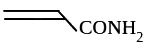
Identify the polymer obtained by using the monomer shown in the image:
A
$PVC$
B
$Buna-S$
C
$Polyacrylamide$
D
$Glyptal$
Solution
(C) The monomer shown in the image is acrylamide,which has the chemical formula $CH_2=CH-CONH_2$.
Upon polymerization,the double bond breaks,and the monomer units link together to form a long chain polymer known as $Polyacrylamide$.
The reaction can be represented as:
$n(CH_2=CH-CONH_2) \rightarrow (-CH_2-CH(CONH_2)-)_n$
Thus,the correct polymer is $Polyacrylamide$.
Upon polymerization,the double bond breaks,and the monomer units link together to form a long chain polymer known as $Polyacrylamide$.
The reaction can be represented as:
$n(CH_2=CH-CONH_2) \rightarrow (-CH_2-CH(CONH_2)-)_n$
Thus,the correct polymer is $Polyacrylamide$.
0 likes
View Solution239
MediumMCQ
Which of the following monomers is used for the preparation of $Nylon-6$?
A
Isobutylene
B
Hexamethylene diammonium adipate
C
Caprolactam
D
Acrylonitrile
Solution
(C) $Nylon-6$ is prepared by heating caprolactam with water at a high temperature.
In this process,the ring of caprolactam opens to form aminocaproic acid,which then undergoes polymerization to form $Nylon-6$.
The reaction is as follows:
$\text{Caprolactam}$ $\xrightarrow{H_2O, \text{Heat}} H_2N-(CH_2)_5-COOH$ $\xrightarrow{\text{Heat}} (-NH-(CH_2)_5-CO-)_n \text{ (Nylon-6)}$
In this process,the ring of caprolactam opens to form aminocaproic acid,which then undergoes polymerization to form $Nylon-6$.
The reaction is as follows:
$\text{Caprolactam}$ $\xrightarrow{H_2O, \text{Heat}} H_2N-(CH_2)_5-COOH$ $\xrightarrow{\text{Heat}} (-NH-(CH_2)_5-CO-)_n \text{ (Nylon-6)}$
0 likes
View Solution240
EasyMCQ
Which among the following monomers is used to prepare $PVC$?
A
$Vinyl$ $chloride$
B
$Methyl$ $methacrylate$
C
$Acrylamide$
D
$Vinyl$ $chloride$ (structure)
Solution
(A) $Polyvinyl$ $chloride$ $(PVC)$ is a polymer formed by the polymerization of $vinyl$ $chloride$ monomer. The chemical formula for $vinyl$ $chloride$ is $CH_2=CHCl$. The polymerization reaction is as follows:
$n(CH_2=CHCl) \xrightarrow{\text{catalyst}} -[CH_2-CHCl]_n-$
$n(CH_2=CHCl) \xrightarrow{\text{catalyst}} -[CH_2-CHCl]_n-$
0 likes
View Solution241
EasyMCQ
Which of the following polymers is obtained from $\varepsilon$-caprolactam?
A
Polyacrylonitrile
B
Neoprene
C
Terylene
D
Nylon-$6$
Solution
(D) The polymer obtained from $\varepsilon$-caprolactam is Nylon-$6$.
When $\varepsilon$-caprolactam is heated with water at high temperature,it undergoes ring-opening polymerization to form Nylon-$6$.
When $\varepsilon$-caprolactam is heated with water at high temperature,it undergoes ring-opening polymerization to form Nylon-$6$.
0 likes
View Solution242
EasyMCQ
Which among the following is an example of a cyclic amide?
A
$PAN$
B
Terylene
C
$\varepsilon$-caprolactam
D
Teflon
Solution
(C) cyclic amide is also known as a lactam.
$\varepsilon$-caprolactam is a seven-membered cyclic amide that is used as a monomer for the preparation of Nylon-$6$.
Therefore,the correct option is $C$.
$\varepsilon$-caprolactam is a seven-membered cyclic amide that is used as a monomer for the preparation of Nylon-$6$.
Therefore,the correct option is $C$.
0 likes
View Solution243
MediumMCQ
Identify the catalyst used in the manufacturing of $HDP$.
A
Ziegler-Natta
B
Peroxides
C
Lindlar's
D
Magnesium oxide
Solution
(A) $HDP$ stands for high-density polyethylene. It is a linear polymer with high density due to close packing.
$HDP$ is obtained by the polymerization of ethene in the presence of a Ziegler-Natta catalyst,which is a combination of triethylaluminium and titanium tetrachloride,at a temperature of $333 \ K$ to $343 \ K$ and a pressure of $6-7 \ atm$.
$HDP$ is obtained by the polymerization of ethene in the presence of a Ziegler-Natta catalyst,which is a combination of triethylaluminium and titanium tetrachloride,at a temperature of $333 \ K$ to $343 \ K$ and a pressure of $6-7 \ atm$.
0 likes
View Solution244
EasyMCQ
Which among the following compounds is used as a monomer in the preparation of Teflon?
A
Tetrabromoethylene
B
Tetrafluoroethylene
C
Tetrachloroethylene
D
Tetraiodoethylene
Solution
(B) Teflon is a polymer formed by the polymerization of tetrafluoroethylene $(CF_2=CF_2)$.
The reaction is carried out by heating tetrafluoroethylene with a free radical or persulphate catalyst at high pressure.
The chemical equation is: $nCF_2=CF_2 \xrightarrow[(NH_4)_2S_2O_8]{\text{Heat, pressure}} -[CF_2-CF_2]_n-$
Thus,the monomer used is tetrafluoroethylene.
The reaction is carried out by heating tetrafluoroethylene with a free radical or persulphate catalyst at high pressure.
The chemical equation is: $nCF_2=CF_2 \xrightarrow[(NH_4)_2S_2O_8]{\text{Heat, pressure}} -[CF_2-CF_2]_n-$
Thus,the monomer used is tetrafluoroethylene.
0 likes
View Solution245
EasyMCQ
Identify the monomers used for the manufacturing of $Terylene$.
A
Propylene glycol and Terephthalic acid
B
Ethylene glycol and Terephthalic acid
C
Propylene glycol and Phthalic acid
D
Ethylene glycol and Phthalic acid
Solution
(B) $Terylene$ (also known as $Dacron$) is a polyester fiber.
It is prepared by the condensation polymerization of $Ethylene \ glycol$ $(HO-CH_2-CH_2-OH)$ and $Terephthalic \ acid$ $(HOOC-C_6H_4-COOH)$.
The reaction is as follows:
$n(HO-CH_2-CH_2-OH) + n(HOOC-C_6H_4-COOH) \rightarrow -[O-CH_2-CH_2-O-CO-C_6H_4-CO]_n- + 2nH_2O$
Therefore,the correct monomers are $Ethylene \ glycol$ and $Terephthalic \ acid$.
It is prepared by the condensation polymerization of $Ethylene \ glycol$ $(HO-CH_2-CH_2-OH)$ and $Terephthalic \ acid$ $(HOOC-C_6H_4-COOH)$.
The reaction is as follows:
$n(HO-CH_2-CH_2-OH) + n(HOOC-C_6H_4-COOH) \rightarrow -[O-CH_2-CH_2-O-CO-C_6H_4-CO]_n- + 2nH_2O$
Therefore,the correct monomers are $Ethylene \ glycol$ and $Terephthalic \ acid$.
0 likes
View Solution246
EasyMCQ
Which of the following monomers is used in the manufacture of Neoprene rubber?
A
$1,3-$Butadiene
B
Styrene
C
$2-$chlorobuta$-1,3-$diene
D
Isobutylene
Solution
(C) Neoprene is a synthetic rubber produced by the free radical polymerization of chloroprene.
The chemical name for chloroprene is $2-$chlorobuta$-1,3-$diene.
The reaction is as follows:
$n \ CH_2=C(Cl)-CH=CH_2 \xrightarrow{\text{polymerization}} [-CH_2-C(Cl)=CH-CH_2-]_n$
The chemical name for chloroprene is $2-$chlorobuta$-1,3-$diene.
The reaction is as follows:
$n \ CH_2=C(Cl)-CH=CH_2 \xrightarrow{\text{polymerization}} [-CH_2-C(Cl)=CH-CH_2-]_n$
0 likes
View Solution247
EasyMCQ
Which of the following polymers is prepared by using phenol?
A
Bakelite
B
Melamine
C
Teflon
D
Neoprene
Solution
(A) Bakelite is a thermosetting polymer prepared by the condensation polymerization of phenol and formaldehyde in the presence of an acid or base catalyst.
Therefore,the correct option is $A$.
Therefore,the correct option is $A$.
0 likes
View Solution248
EasyMCQ
Which among the following monomers is used to prepare Teflon?
A
$CH_2=C(CH_3)_2$
B
$CF_2=CF_2$
C
$CH_2=CHCl$
D
$CH_3-CH=CH_2$
Solution
(B) Teflon is manufactured by heating tetrafluoroethene with a free radical or persulphate catalyst at high pressures.
The chemical reaction is:
$n CF_2=CF_2 \xrightarrow{\text{Catalyst, High Pressure}} -(CF_2-CF_2)-_n$
Thus,the monomer used to prepare Teflon is tetrafluoroethene $(CF_2=CF_2)$.
The chemical reaction is:
$n CF_2=CF_2 \xrightarrow{\text{Catalyst, High Pressure}} -(CF_2-CF_2)-_n$
Thus,the monomer used to prepare Teflon is tetrafluoroethene $(CF_2=CF_2)$.
0 likes
View Solution249
EasyMCQ
Identify the monomers used in the preparation of $PHBV$ polymer.
A
$3-$Hydroxybutanoic acid and $3-$hydroxypentanoic acid
B
Lactic acid and glycolic acid
C
$3-$Hydroxybutanoic acid and $2-$hydroxypentanoic acid
D
Glycine and $\omega$-aminocaproic acid
Solution
(A) $PHBV$ stands for Poly $\beta$-hydroxybutyrate-co-$\beta$-hydroxyvalerate.
It is a copolymer obtained by the polymerization of $3-$hydroxybutanoic acid and $3-$hydroxypentanoic acid.
These monomers undergo condensation polymerization to form the biodegradable polyester $PHBV$.
It is a copolymer obtained by the polymerization of $3-$hydroxybutanoic acid and $3-$hydroxypentanoic acid.
These monomers undergo condensation polymerization to form the biodegradable polyester $PHBV$.
0 likes
View Solution250
EasyMCQ
Identify the catalyst used in the manufacture of high density polythene.
A
$MnO_{2}$
B
$Co-Th$ alloy
C
$TiCl_{4}$ along with $Al(C_{2}H_{5})_{3}$
D
$V_{2}O_{5}$
Solution
(C) High density polythene $(HDPE)$ is manufactured by the addition polymerisation of ethene in the presence of a Ziegler-Natta catalyst.
The Ziegler-Natta catalyst consists of a mixture of triethylaluminium $(Al(C_{2}H_{5})_{3})$ and titanium tetrachloride $(TiCl_{4})$.
The Ziegler-Natta catalyst consists of a mixture of triethylaluminium $(Al(C_{2}H_{5})_{3})$ and titanium tetrachloride $(TiCl_{4})$.
0 likes
View SolutionPolymers — General methods of preparation and mechanism of polymerisation · Frequently Asked Questions
1Are these Polymers questions useful for JEE and NEET?
Yes. All questions in this section are mapped to JEE Main and NEET exam patterns. Previous year questions from JEE Main, NEET, GUJCET and state-level exams are included with full solutions.
2Can I switch to Hindi or Gujarati for these questions?
Yes. Use the language tabs in the hero section or the sidebar to view the same questions and solutions in English, Hindi or Gujarati.
3How do I generate a question paper from this subtopic?
Use the Vedclass Exam Paper Generator — select the chapter and subtopic, set difficulty, and generate Sets A, B, C, D automatically. First 3 chapters of every subject are free.
Vedclass Products
For Students
Vedclass Test Series
Mock tests in real JEE/NEET style with performance analysis. 5-day free trial.
Start Free TrialFor Teachers
Exam Paper Generator
Generate Set A/B/C/D papers from this chapter in 2 minutes. 3 chapters free.
Try FreeFor Institutes
Online Exam Module
Live online exams with unlimited students, 360° analytics & white-label branding.
See DemoFor Teachers & Institutes
Generate a Polymers Exam Paper in 2 Minutes
Select subtopic & difficulty — Sets A, B, C, D auto-generated with No Repeat logic.
First 3 chapters of every subject are free — no payment required.