
A English
Composition, Properties and Uses of Polymer Questions in English
Class 12 Chemistry · Polymers · Composition, Properties and Uses of Polymer
556+
Questions
English
Language
100%
With Solutions
Showing 45 of 556 questions in English
501
EasyMCQ
The polydispersity index of a polymer containing $10$ molecules with molecular mass $1.0 \times 10^4$ and $10$ molecules with molecular mass $1.0 \times 10^5$ is approximately.
A
$1.67$
B
$0.59$
C
$1.55$
D
$0.83$
Solution
(A) The polydispersity index $(PDI)$ is defined as the ratio of weight average molecular mass $(M_w)$ to number average molecular mass $(M_n)$.
$PDI = \frac{M_w}{M_n}$
Given: $N_1 = 10$,$M_1 = 1.0 \times 10^4 = 10,000$; $N_2 = 10$,$M_2 = 1.0 \times 10^5 = 100,000$.
Number average molecular mass $(M_n)$:
$M_n = \frac{\sum N_i M_i}{\sum N_i} = \frac{(10 \times 10,000) + (10 \times 100,000)}{10 + 10} = \frac{100,000 + 1,000,000}{20} = \frac{1,100,000}{20} = 55,000$.
Weight average molecular mass $(M_w)$:
$M_w = \frac{\sum N_i M_i^2}{\sum N_i M_i} = \frac{10 \times (10,000)^2 + 10 \times (100,000)^2}{(10 \times 10,000) + (10 \times 100,000)} = \frac{10^9 + 10^{11}}{1,100,000} = \frac{101,000,000,000}{1,100,000} \approx 91,818$.
$PDI = \frac{91,818}{55,000} \approx 1.67$.
$PDI = \frac{M_w}{M_n}$
Given: $N_1 = 10$,$M_1 = 1.0 \times 10^4 = 10,000$; $N_2 = 10$,$M_2 = 1.0 \times 10^5 = 100,000$.
Number average molecular mass $(M_n)$:
$M_n = \frac{\sum N_i M_i}{\sum N_i} = \frac{(10 \times 10,000) + (10 \times 100,000)}{10 + 10} = \frac{100,000 + 1,000,000}{20} = \frac{1,100,000}{20} = 55,000$.
Weight average molecular mass $(M_w)$:
$M_w = \frac{\sum N_i M_i^2}{\sum N_i M_i} = \frac{10 \times (10,000)^2 + 10 \times (100,000)^2}{(10 \times 10,000) + (10 \times 100,000)} = \frac{10^9 + 10^{11}}{1,100,000} = \frac{101,000,000,000}{1,100,000} \approx 91,818$.
$PDI = \frac{91,818}{55,000} \approx 1.67$.
0 likes
View Solution502
MediumMCQ
Match the following:
Correct answer is:
| List-$I$ (Polymer) | List-$II$ (Used in Making) |
|---|---|
| $A$. Urea-formaldehyde resin | $I$. Safety Helmets |
| $B$. Glyptal | $II$. Gaskets |
| $C$. Bakelite | $III$. Laminated sheets |
| $D$. Nylon-$6,6$ | $IV$. Commercial fibres |
| $E$. Phenol-formaldehyde | $V$. Paints |
Correct answer is:
A
$A-III, B-V, C-I, D-IV$
B
$A-III, B-V, C-I, D-IV$
C
$A-III, B-V, C-I, D-IV$
D
$A-III, B-V, C-I, D-IV$
Solution
(A) The correct matches are as follows:
$A$. Urea-formaldehyde resin is used in making Laminated sheets $(III)$.
$B$. Glyptal is used in making Paints $(V)$.
$C$. Bakelite is used in making Safety Helmets $(I)$.
$D$. Nylon-$6,6$ is used in making Commercial fibres $(IV)$.
$E$. Phenol-formaldehyde is used in making Gaskets $(II)$.
Thus,the correct sequence is $A-III, B-V, C-I, D-IV$.
$A$. Urea-formaldehyde resin is used in making Laminated sheets $(III)$.
$B$. Glyptal is used in making Paints $(V)$.
$C$. Bakelite is used in making Safety Helmets $(I)$.
$D$. Nylon-$6,6$ is used in making Commercial fibres $(IV)$.
$E$. Phenol-formaldehyde is used in making Gaskets $(II)$.
Thus,the correct sequence is $A-III, B-V, C-I, D-IV$.
0 likes
View Solution503
MediumMCQ
Which one of the statements regarding $X$ is not correct?
$3$-Hydroxybutanoic acid + $3$-Hydroxypentanoic acid $\longrightarrow X$
$3$-Hydroxybutanoic acid + $3$-Hydroxypentanoic acid $\longrightarrow X$
A
It is a condensation polymer
B
It is non-biodegradable
C
It is used in orthopaedic devices
D
It is known as $PHBV$
Solution
(B) The reaction between $3$-hydroxybutanoic acid and $3$-hydroxypentanoic acid leads to the formation of the copolymer $PHBV$ (poly-$\beta$-hydroxybutyrate-co-$\beta$-hydroxyvalerate).
$PHBV$ is a well-known biodegradable polymer.
Therefore,the statement that it is non-biodegradable is incorrect.
$PHBV$ is a condensation polymer and is used in orthopaedic devices and controlled drug release.
$PHBV$ is a well-known biodegradable polymer.
Therefore,the statement that it is non-biodegradable is incorrect.
$PHBV$ is a condensation polymer and is used in orthopaedic devices and controlled drug release.
0 likes
View Solution504
MediumMCQ
Which of the following is an example of a fibre?
A
$[-CH_2-CH(Cl)-]_n$
B
$[-CH_2-CH_2-]_n$
C
$[-CH_2-C(Cl)=CH-CH_2-]_n$
D
$[-OC-C_6H_4-CO-O-CH_2-CH_2-O-]_n$
Solution
(D) Fibres are polymers that have strong intermolecular forces between the chains,such as hydrogen bonds or dipole-dipole interactions. These forces lead to close packing,which imparts crystalline character and makes them long,thin,and thread-like,suitable for weaving into fabrics. Examples include nylon-$66$,silk,and terylene (also known as dacron). The structure given in option $D$ represents terylene (dacron),which is a polyester fibre formed by the condensation polymerization of ethylene glycol and terephthalic acid.
0 likes
View Solution505
MediumMCQ
The common monomer for both Terylene and glyptal is
A
$HO-CH_2-CH_2-OH$
B
$HO-CH_2-CH_2-CH_2-OH$
C
$HO-CH_2-CH_2-C_6H_5$
D
$H_2N-CH_2-CH_2-NH_2$
Solution
(A) $Terylene$:
The monomers for $Terylene$ are ethylene glycol and terephthalic acid. $Terylene$ is also known as $Dacron$ or polyester.
$Glyptal$:
The monomers for $Glyptal$ are ethylene glycol and phthalic acid. $Glyptal$ is an alkyd resin and a polyester.
$\therefore$ Ethylene glycol $(HO-CH_2-CH_2-OH)$ is the common monomer for both.
The monomers for $Terylene$ are ethylene glycol and terephthalic acid. $Terylene$ is also known as $Dacron$ or polyester.
$Glyptal$:
The monomers for $Glyptal$ are ethylene glycol and phthalic acid. $Glyptal$ is an alkyd resin and a polyester.
$\therefore$ Ethylene glycol $(HO-CH_2-CH_2-OH)$ is the common monomer for both.
0 likes
View Solution506
EasyMCQ
The $X$ formed in the following reaction sequence and its structural type are respectively:

A
$Novolac$ - linear polymer
B
$Bakelite$ - cross linked polymer
C
$Novolac$ - cross linked polymer
D
$Bakelite$ - linear polymer
Solution
(B) The reaction of phenol with formaldehyde in the presence of a base $(OH^-)$ and heat leads to the formation of $Bakelite$.
$Bakelite$ is a thermosetting polymer formed by the condensation polymerization of phenol and formaldehyde.
It has a highly branched,three-dimensional structure,which is classified as a cross-linked polymer.
Therefore,$X$ is $Bakelite$ and it is a cross-linked polymer.
$Bakelite$ is a thermosetting polymer formed by the condensation polymerization of phenol and formaldehyde.
It has a highly branched,three-dimensional structure,which is classified as a cross-linked polymer.
Therefore,$X$ is $Bakelite$ and it is a cross-linked polymer.
0 likes
View Solution507
MediumMCQ
The monomers of $\text{nylon-}2\text{-nylon-}6$ are:
A
$A$. $\text{Glycine}$ and $\text{amino caproic acid}$
B
$B$. $\text{Hexamethylene diamine}$ and $\text{adipic acid}$
C
$C$. $\text{Glycine}$ and $\text{aminovaleric acid}$
D
$D$. $\text{Hexamethylene diamine}$ and $\text{sebacic acid}$
Solution
(A) $\text{Nylon-}2\text{-nylon-}6$ is a biodegradable polyamide copolymer. It is formed by the copolymerization of $\text{glycine}$ $(H_2N-CH_2-COOH)$ and $\text{aminocaproic acid}$ $(H_2N-(CH_2)_5-COOH)$.
0 likes
View Solution508
DifficultMCQ
The polydispersity index $(PDI)$ of a polymer is $1.25$. If $\overline{M}_{n}$ is $800$,what is its $\overline{M}_{w}$?
A
$800$
B
$900$
C
$950$
D
$1000$
Solution
(D) The polydispersity index $(PDI)$ is defined as the ratio of weight average molecular mass $(\overline{M}_{w})$ to number average molecular mass $(\overline{M}_{n})$.
$PDI = \frac{\overline{M}_{w}}{\overline{M}_{n}}$
Given,$PDI = 1.25$ and $\overline{M}_{n} = 800$.
Substituting the values: $1.25 = \frac{\overline{M}_{w}}{800}$.
Therefore,$\overline{M}_{w} = 800 \times 1.25 = 1000$.
$PDI = \frac{\overline{M}_{w}}{\overline{M}_{n}}$
Given,$PDI = 1.25$ and $\overline{M}_{n} = 800$.
Substituting the values: $1.25 = \frac{\overline{M}_{w}}{800}$.
Therefore,$\overline{M}_{w} = 800 \times 1.25 = 1000$.
0 likes
View Solution509
EasyMCQ
Which of the following polymers is used in the preparation of gaskets?
A
$[CH_2-CH(CN)]_n$
B
$[CH_2-CH(C_6H_5)]_n$
C
$[CH_2-CH(Cl)]_n$
D
$[CF_2-CF_2]_n$
Solution
(D) Polytetrafluoroethene $(PTFE)$,represented by the formula $[CF_2-CF_2]_n$,is a chemically inert polymer with high thermal stability. Due to its excellent resistance to corrosion and heat,it is widely used in making oil seals and gaskets.
0 likes
View Solution510
MediumMCQ
Which of the following polymers is used in the controlled release of drugs?
A
Nylon-$6$
B
Poly-$\beta$-hydroxybutyrate-co-$\beta$-hydroxyvalerate $(PHBV)$
C
Nylon-$6$,$6$
D
Nylon$-2-$nylon-$6$
Solution
(B) $PHBV$ (Poly-$\beta$-hydroxybutyrate-co-$\beta$-hydroxyvalerate) is a biodegradable,aliphatic polyester.
It is used in orthopaedic devices and in controlled release of drugs.
It is used in orthopaedic devices and in controlled release of drugs.
0 likes
View Solution511
DifficultMCQ
Which among the following polymers exhibit hydrogen bonding?
A
Polyvinyl chloride
B
Nylon-$6, 6$
C
Neoprene
D
Teflon
Solution
(B) Polyvinyl chloride,neoprene,and teflon are addition homopolymers. They do not contain polar groups capable of forming strong hydrogen bonds.
Nylon-$6, 6$ is a polyamide. It contains amide linkages $(-CONH-)$ where the $N-H$ group acts as a hydrogen bond donor and the $C=O$ group acts as a hydrogen bond acceptor,leading to strong inter-chain hydrogen bonding.
Nylon-$6, 6$ is a polyamide. It contains amide linkages $(-CONH-)$ where the $N-H$ group acts as a hydrogen bond donor and the $C=O$ group acts as a hydrogen bond acceptor,leading to strong inter-chain hydrogen bonding.
0 likes
View Solution512
EasyMCQ
Intermolecular forces in nylon-$6,6$ are
A
dipole-dipole interactions
B
hydrogen bonding
C
van der Waals' forces
D
ionic bonds
Solution
(B) Nylon-$6,6$ is a polyamide polymer.
It contains amide groups $(-CONH-)$ in its chain.
The presence of these groups allows for strong intermolecular hydrogen bonding between the polymer chains,which gives it the properties of a fibre.
It contains amide groups $(-CONH-)$ in its chain.
The presence of these groups allows for strong intermolecular hydrogen bonding between the polymer chains,which gives it the properties of a fibre.
0 likes
View Solution513
EasyMCQ
Which among the following polymers can be formed by using caprolactam monomer unit?
A
Nylon-$6,6$
B
Nylon-$2$-nylon-$6$
C
Melamine polymer
D
Nylon-$6$
Solution
(D) Caprolactam is an intermediate primarily used in the production of nylon-$6$ fibres and resins.
When caprolactam is heated with water at $533-574 \ K$,it undergoes ring-opening polymerization to form nylon-$6$.
When caprolactam is heated with water at $533-574 \ K$,it undergoes ring-opening polymerization to form nylon-$6$.
0 likes
View Solution514
EasyMCQ
Which of the following polymers is biodegradable?
A
Nylon-$6, 6$
B
Nylon-$2$-nylon-$6$
C
Melamine polymer
D
Nylon-$6$
Solution
(B) Biodegradable polymers are those that can be broken down by microorganisms in the environment.
Nylon-$2$-nylon-$6$ is a polyamide copolymer of glycine and amino caproic acid,which is biodegradable.
Nylon-$6, 6$,Nylon-$6$,and Melamine polymers are synthetic,non-biodegradable polymers.
Therefore,the correct option is $(B)$.
Nylon-$2$-nylon-$6$ is a polyamide copolymer of glycine and amino caproic acid,which is biodegradable.
Nylon-$6, 6$,Nylon-$6$,and Melamine polymers are synthetic,non-biodegradable polymers.
Therefore,the correct option is $(B)$.
0 likes
View Solution515
EasyMCQ
The monomers of nylon$-6, 6$ $(X)$ and terylene $(Y)$ are
A
Nylon$-6, 6$ $(X)$: $H_2N-(CH_2)_5-CH_3$,$HOOC-(CH_2)_4-CH_3$; Terylene $(Y)$: $HO-CH_2-CH_3$,$HO-C_6H_4-COOH$
B
Nylon$-6, 6$ $(X)$: $H_2N-(CH_2)_4-NH_2$,$HOOC-(CH_2)_4-COOH$; Terylene $(Y)$: $HO-CH_2-CH_2-OH$,$C_6H_4(COOH)_2$ (ortho)
C
Nylon$-6, 6$ $(X)$: $H_2N-CH_2-COOH$,$H_2N-(CH_2)_5-COOH$; Terylene $(Y)$: $HO-CH_2-CH_2-OH$,$HO-C_6H_4-COOH$
D
Nylon$-6, 6$ $(X)$: $H_2N-(CH_2)_6-NH_2$,$HOOC-(CH_2)_4-COOH$; Terylene $(Y)$: $HO-CH_2-CH_2-OH$,$HOOC-C_6H_4-COOH$ (terephthalic acid)
Solution
(D) Nylon$-6, 6$ is a polyamide formed by the condensation polymerization of hexamethylenediamine $(H_2N-(CH_2)_6-NH_2)$ and adipic acid $(HOOC-(CH_2)_4-COOH)$.
Terylene (also known as Dacron) is a polyester formed by the condensation polymerization of ethylene glycol $(HO-CH_2-CH_2-OH)$ and terephthalic acid $(HOOC-C_6H_4-COOH)$.
Comparing these with the given options,option $D$ correctly identifies the monomers for both polymers.
Terylene (also known as Dacron) is a polyester formed by the condensation polymerization of ethylene glycol $(HO-CH_2-CH_2-OH)$ and terephthalic acid $(HOOC-C_6H_4-COOH)$.
Comparing these with the given options,option $D$ correctly identifies the monomers for both polymers.
0 likes
View Solution516
EasyMCQ
Which one of the following structures represents the neoprene rubber?
A
$[CH_2-C(Cl)=CH-CH_2]_n$
B
$[CH_2-CH=C(Cl)-CH_2]_n$
C
$[NH-(CH_2)_6-NH-CO-(CH_2)_4-CO]_n$
D
$[OCH_2-CH_2OOC-C_6H_4-CO]_n$
Solution
(A) Neoprene is a synthetic rubber formed by the free radical polymerization of chloroprene ($2$-chloro-$1,3$-butadiene).
The polymerization reaction is:
$n(CH_2=C(Cl)-CH=CH_2) \xrightarrow{hv} [CH_2-C(Cl)=CH-CH_2]_n$
Thus,the correct structure of neoprene is $[CH_2-C(Cl)=CH-CH_2]_n$.
The polymerization reaction is:
$n(CH_2=C(Cl)-CH=CH_2) \xrightarrow{hv} [CH_2-C(Cl)=CH-CH_2]_n$
Thus,the correct structure of neoprene is $[CH_2-C(Cl)=CH-CH_2]_n$.
0 likes
View Solution517
EasyMCQ
Nylon-$6,6$ is a condensation polymer of two monomers $X$ and $Y$. The number of $-CH_2-$ groups in $X$ and $Y$ are respectively
A
$6,4$
B
$6,6$
C
$5,6$
D
$6,2$
Solution
(A) Nylon-$6,6$ is synthesized by the polycondensation of hexamethylenediamine and adipic acid.
$n HOOC-(CH_2)_4-COOH + n H_2N-(CH_2)_6-NH_2 \rightarrow [CO-(CH_2)_4-CO-NH-(CH_2)_6-NH]_n + 2n H_2O$
In hexamethylenediamine $(H_2N-(CH_2)_6-NH_2)$,the number of $-CH_2-$ groups is $6$.
In adipic acid $(HOOC-(CH_2)_4-COOH)$,the number of $-CH_2-$ groups is $4$.
Therefore,the number of $-CH_2-$ groups in $X$ and $Y$ are $6$ and $4$ respectively.
$n HOOC-(CH_2)_4-COOH + n H_2N-(CH_2)_6-NH_2 \rightarrow [CO-(CH_2)_4-CO-NH-(CH_2)_6-NH]_n + 2n H_2O$
In hexamethylenediamine $(H_2N-(CH_2)_6-NH_2)$,the number of $-CH_2-$ groups is $6$.
In adipic acid $(HOOC-(CH_2)_4-COOH)$,the number of $-CH_2-$ groups is $4$.
Therefore,the number of $-CH_2-$ groups in $X$ and $Y$ are $6$ and $4$ respectively.
0 likes
View Solution518
EasyMCQ
Which one of the following structures represents the neoprene rubber?
A
$[CH_2-C(Cl)=CH-CH_2]_n$
B
$[CH_2-CH=CH-CH_2-CH_2-CH(CN)]_n$
C
$[NH-CO-NH-CH_2]_n$
D
$[OCH_2-CH_2OOC-C_6H_4-CO]_n$
Solution
(A) Neoprene is obtained from chloroprene,which is $2-$chlorobuta$-1,3-$diene.
It is an addition homopolymer with rubber-like structure and properties.
The structure of neoprene is $[CH_2-C(Cl)=CH-CH_2]_n$.
Neoprene exhibits good chemical stability and maintains flexibility over a wide temperature range.
It is an addition homopolymer with rubber-like structure and properties.
The structure of neoprene is $[CH_2-C(Cl)=CH-CH_2]_n$.
Neoprene exhibits good chemical stability and maintains flexibility over a wide temperature range.
0 likes
View Solution519
EasyMCQ
Buna-$N$ is a co-polymer of $1,3-$Butadiene and $\underline{X}$. What is $\underline{X}$?
A
$CH_2=CH-CN$
B
$CH_2=CH-Cl$
C
$CH_2=CH-C_6H_5$
D
$CH_2=CH-CH_3$
Solution
(A) Buna-$N$ is a synthetic rubber formed by the co-polymerization of $1,3-$Butadiene and Acrylonitrile $(CH_2=CH-CN)$.
Therefore,$\underline{X}$ is Acrylonitrile,which corresponds to option $A$.
Therefore,$\underline{X}$ is Acrylonitrile,which corresponds to option $A$.
0 likes
View Solution520
EasyMCQ
Ethylene on reaction with Baeyer's reagent gives the compound $A$. In the preparation of co-polymer $X$,compound $A$ is used as a monomer. What is $X$?
A
Nylon $6, 6$
B
Bakelite
C
Glyptal
D
Nylon $2-$Nylon $6$
Solution
(C) Ethylene $(CH_2=CH_2)$ reacts with Baeyer's reagent (cold,dilute alkaline $KMnO_4$ solution) to form ethylene glycol $(HO-CH_2-CH_2-OH)$,which is compound $A$.
Ethylene glycol is used as a monomer in the preparation of the co-polymer Glyptal (polyethylene terephthalate is a polyester,but Glyptal is specifically formed from ethylene glycol and phthalic acid).
Therefore,the correct answer is Glyptal.
Ethylene glycol is used as a monomer in the preparation of the co-polymer Glyptal (polyethylene terephthalate is a polyester,but Glyptal is specifically formed from ethylene glycol and phthalic acid).
Therefore,the correct answer is Glyptal.
0 likes
View Solution521
EasyMCQ
Which of the following statements are correct?
$a$. Natural rubber becomes soft and sticky at high temperature.
$b$. Neoprene is a polymer of $2-$chloro$-1,3-$butadiene.
$c$. Nylon $6,6$ is a polyamide fibre.
$d$. Buna$-S$ is an example of a homopolymer.
$a$. Natural rubber becomes soft and sticky at high temperature.
$b$. Neoprene is a polymer of $2-$chloro$-1,3-$butadiene.
$c$. Nylon $6,6$ is a polyamide fibre.
$d$. Buna$-S$ is an example of a homopolymer.
A
$b, c$
B
$a, c, d$
C
$b, d$
D
$a, c$
Solution
(A) . Natural rubber becomes soft and sticky at high temperature,not hard. So,statement $a$ is incorrect.
$b$. Neoprene is formed by the polymerization of chloroprene ($2-$chloro$-1,3-$butadiene). So,statement $b$ is correct.
$c$. Nylon $6,6$ is formed by the condensation polymerization of hexamethylenediamine and adipic acid,which contains amide linkages. So,statement $c$ is correct.
$d$. Buna$-S$ is a copolymer formed from $1,3-$butadiene and styrene. So,statement $d$ is incorrect.
Therefore,statements $b$ and $c$ are correct.
$b$. Neoprene is formed by the polymerization of chloroprene ($2-$chloro$-1,3-$butadiene). So,statement $b$ is correct.
$c$. Nylon $6,6$ is formed by the condensation polymerization of hexamethylenediamine and adipic acid,which contains amide linkages. So,statement $c$ is correct.
$d$. Buna$-S$ is a copolymer formed from $1,3-$butadiene and styrene. So,statement $d$ is incorrect.
Therefore,statements $b$ and $c$ are correct.
0 likes
View Solution522
EasyMCQ
Observe the following polymers.
$I$. $PHBV$
$II$. Nylon-$2$-nylon-$6$
$III$. Glyptal
$IV$. Bakelite
Which of the above is/are biodegradable polymer$(s)$?
$I$. $PHBV$
$II$. Nylon-$2$-nylon-$6$
$III$. Glyptal
$IV$. Bakelite
Which of the above is/are biodegradable polymer$(s)$?
A
$III$
B
$I$ and $II$
C
$IV$
D
$III$ and $IV$
Solution
(B) Biodegradable polymers are those that can be decomposed by microorganisms.
Among the given polymers:
$I$. $PHBV$ (Poly-$\beta$-hydroxybutyrate-co-$\beta$-hydroxyvalerate) is a well-known biodegradable polymer.
$II$. Nylon-$2$-nylon-$6$ is a polyamide copolymer of glycine and amino caproic acid,which is also biodegradable.
$III$. Glyptal is a condensation polymer of ethylene glycol and phthalic acid,which is non-biodegradable.
$IV$. Bakelite is a thermosetting phenol-formaldehyde resin,which is non-biodegradable.
Therefore,$I$ and $II$ are biodegradable polymers.
Among the given polymers:
$I$. $PHBV$ (Poly-$\beta$-hydroxybutyrate-co-$\beta$-hydroxyvalerate) is a well-known biodegradable polymer.
$II$. Nylon-$2$-nylon-$6$ is a polyamide copolymer of glycine and amino caproic acid,which is also biodegradable.
$III$. Glyptal is a condensation polymer of ethylene glycol and phthalic acid,which is non-biodegradable.
$IV$. Bakelite is a thermosetting phenol-formaldehyde resin,which is non-biodegradable.
Therefore,$I$ and $II$ are biodegradable polymers.
0 likes
View Solution523
MediumMCQ
Which one of the following is a biodegradable polymer?
A
Nylon-$6,6$
B
Nylon-$6$
C
Nylon-$2$-nylon-$6$
D
Bakelite
Solution
(C) Biodegradable polymers are polymers that can be decomposed by microorganisms or enzymes under aerobic or anaerobic conditions.
$A$. Nylon-$6,6$ is a synthetic polyamide and is non-biodegradable.
$B$. Nylon-$6$ is a synthetic polyamide and is non-biodegradable.
$C$. Nylon-$2$-nylon-$6$ is an alternating copolymer of glycine and amino caproic acid,which is a well-known biodegradable polymer.
$D$. Bakelite is a thermosetting phenol-formaldehyde resin and is non-biodegradable.
Therefore,the correct option is $C$.
$A$. Nylon-$6,6$ is a synthetic polyamide and is non-biodegradable.
$B$. Nylon-$6$ is a synthetic polyamide and is non-biodegradable.
$C$. Nylon-$2$-nylon-$6$ is an alternating copolymer of glycine and amino caproic acid,which is a well-known biodegradable polymer.
$D$. Bakelite is a thermosetting phenol-formaldehyde resin and is non-biodegradable.
Therefore,the correct option is $C$.
0 likes
View Solution524
MediumMCQ
Consider the following sequence of reactions.
$2 CH_3Cl + Si$ $\xrightarrow[573 \ K]{Cu} X$ $\xrightarrow{H_2O} Y$ $\xrightarrow{\text{Polymerization}} Z$
The repeating structural unit in $Z$ is
$2 CH_3Cl + Si$ $\xrightarrow[573 \ K]{Cu} X$ $\xrightarrow{H_2O} Y$ $\xrightarrow{\text{Polymerization}} Z$
The repeating structural unit in $Z$ is
A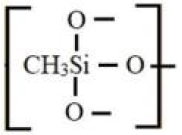
B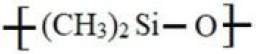
C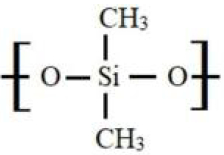
D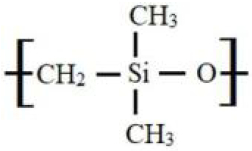
Solution
(C) The reaction sequence is as follows:
$1$. $2 CH_3Cl + Si \xrightarrow[573 \ K]{Cu} (CH_3)_2SiCl_2$ $(X)$
$2$. $(CH_3)_2SiCl_2 + 2 H_2O \rightarrow (CH_3)_2Si(OH)_2 + 2 HCl$ $(Y)$
$3$. The hydrolysis product $(CH_3)_2Si(OH)_2$ undergoes polymerization to form silicone (polydimethylsiloxane).
$4$. The repeating structural unit in the resulting polymer $Z$ is $[-(CH_3)_2Si-O-]_n$.
This corresponds to the structure shown in option $C$.
$1$. $2 CH_3Cl + Si \xrightarrow[573 \ K]{Cu} (CH_3)_2SiCl_2$ $(X)$
$2$. $(CH_3)_2SiCl_2 + 2 H_2O \rightarrow (CH_3)_2Si(OH)_2 + 2 HCl$ $(Y)$
$3$. The hydrolysis product $(CH_3)_2Si(OH)_2$ undergoes polymerization to form silicone (polydimethylsiloxane).
$4$. The repeating structural unit in the resulting polymer $Z$ is $[-(CH_3)_2Si-O-]_n$.
This corresponds to the structure shown in option $C$.
0 likes
View Solution525
EasyMCQ
Which one of the following is used in the preparation of cellulose nitrate?
A
$KNO_3$
B
$HNO_3$
C
$KNO_2$
D
$HNO_2$
Solution
(B) Cellulose is treated with concentrated $HNO_3$ in the presence of concentrated $H_2SO_4$ to produce cellulose nitrate.
Cellulose nitrate is an important substance used in the manufacture of explosives (gun cotton),lacquers,and plastics.
Cellulose nitrate is an important substance used in the manufacture of explosives (gun cotton),lacquers,and plastics.
0 likes
View Solution526
MediumMCQ
The polymer chains are held together by hydrogen bonding in a polymer $X$. Polymer $X$ is formed from monomers $Y$ and $Z$. What are $Y$ and $Z$ ?
| $CH_2=CH-C_6H_5$ | $H_2N(CH_2)_6NH_2$ | $CH_2=CH-CH=CH_2$ | $CH_2=CH-CN$ | $HO_2C(CH_2)_4CO_2H$ |
| $A$ | $B$ | $C$ | $D$ | $E$ |
A
$A, C$
B
$B, E$
C
$C, D$
D
$A, A$
Solution
(B) Polymers held together by strong intermolecular forces like hydrogen bonding are known as fibres.
Nylon-$6,6$ is a common example of a fibre,which is a polyamide.
It is formed by the condensation polymerization of hexamethylenediamine ($H_2N(CH_2)_6NH_2$,labeled as $B$) and adipic acid ($HO_2C(CH_2)_4CO_2H$,labeled as $E$).
Therefore,the monomers $Y$ and $Z$ are $B$ and $E$.
Nylon-$6,6$ is a common example of a fibre,which is a polyamide.
It is formed by the condensation polymerization of hexamethylenediamine ($H_2N(CH_2)_6NH_2$,labeled as $B$) and adipic acid ($HO_2C(CH_2)_4CO_2H$,labeled as $E$).
Therefore,the monomers $Y$ and $Z$ are $B$ and $E$.
0 likes
View Solution527
MediumMCQ
The monomer which is present in both Bakelite and Melamine polymers is
A
Methanal
B
Methanol
C
Phenol
D
Ethane-$1, 2$-diol
Solution
(A) Bakelite is formed by the condensation polymerization of phenol and formaldehyde (methanal).
Melamine is formed by the condensation polymerization of melamine and formaldehyde (methanal).
Therefore,methanal is the common monomer present in both polymers.
Melamine is formed by the condensation polymerization of melamine and formaldehyde (methanal).
Therefore,methanal is the common monomer present in both polymers.
0 likes
View Solution528
EasyMCQ
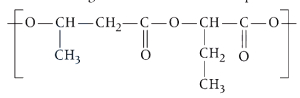
The structure given below is an example of
$I$. $A$ condensation and biodegradable polymer.
$II$. $A$ biodegradable and thermoplastic polymer.
$III$. $A$ biodegradable and thermosetting polymer.
$IV$. $A$ polyester and thermoplastic polymer.
$I$. $A$ condensation and biodegradable polymer.
$II$. $A$ biodegradable and thermoplastic polymer.
$III$. $A$ biodegradable and thermosetting polymer.
$IV$. $A$ polyester and thermoplastic polymer.
A
$I$,$II$ and $III$
B
$I$,$II$ and $IV$
C
$I$,$III$ and $IV$
D
$II$,$III$ and $IV$
Solution
(B) The given structure is $PHBV$,which stands for poly-$\beta$-hydroxybutyrate-co-$\beta$-hydroxyvalerate.
It is a copolymer formed by the condensation polymerization of $3$-hydroxybutanoic acid and $3$-hydroxypentanoic acid.
It is a biodegradable,thermoplastic polyester.
Therefore,statements $I$ (condensation and biodegradable),$II$ (biodegradable and thermoplastic),and $IV$ (polyester and thermoplastic) are correct.
Thus,the correct combination is $I$,$II$ and $IV$.
It is a copolymer formed by the condensation polymerization of $3$-hydroxybutanoic acid and $3$-hydroxypentanoic acid.
It is a biodegradable,thermoplastic polyester.
Therefore,statements $I$ (condensation and biodegradable),$II$ (biodegradable and thermoplastic),and $IV$ (polyester and thermoplastic) are correct.
Thus,the correct combination is $I$,$II$ and $IV$.
0 likes
View Solution529
DifficultMCQ
The polydispersity index $(PDI)$ of a polymer is ($\bar{M}_w = \text{weight average molecular mass}$ and $\bar{M}_n = \text{number average molecular mass}$)
A
the product of $\bar{M}_n$ and $\bar{M}_w$
B
the sum of $\bar{M}_n$ and $\bar{M}_w$
C
the difference between $\bar{M}_w$ and $\bar{M}_n$
D
the ratio between $\bar{M}_w$ and $\bar{M}_n$
Solution
(D) The polydispersity index $(PDI)$ of a polymer is defined as the ratio of the weight average molecular mass $(\bar{M}_w)$ to the number average molecular mass $(\bar{M}_n)$.
$PDI = \frac{\bar{M}_w}{\bar{M}_n}$
It serves as a measure of the breadth or distribution of molecular weights in a polymer sample.
$PDI = \frac{\bar{M}_w}{\bar{M}_n}$
It serves as a measure of the breadth or distribution of molecular weights in a polymer sample.
0 likes
View Solution530
EasyMCQ
Example of a biodegradable polymer pair is
A
nylon-$6,6$ and terylene
B
$PHBV$ and dextron
C
bakelite and $PVC$
D
$PET$ and polyethylene
Solution
(B) The polymers which disintegrate by themselves during a certain period of time by enzymatic hydrolysis and to some extent by oxidation are known as biodegradable polymers.
Examples include:
$1$. Poly-$\beta$-hydroxybutyrate-co-$\beta$-hydroxyvalerate $(PHBV)$,which is used in orthopaedic devices and in controlled drug release.
$2$. Poly(glycolic acid)-poly(lactic acid),commonly known as $Dexon$ (or dextron),which is used for stitching of wounds after surgery.
Examples include:
$1$. Poly-$\beta$-hydroxybutyrate-co-$\beta$-hydroxyvalerate $(PHBV)$,which is used in orthopaedic devices and in controlled drug release.
$2$. Poly(glycolic acid)-poly(lactic acid),commonly known as $Dexon$ (or dextron),which is used for stitching of wounds after surgery.
0 likes
View Solution531
EasyMCQ
Which of the following is a biodegradable polymer?
A
Polythene
B
Bakelite
C
$PHBV$
D
$PVC$
Solution
(C) $PHBV$ (Polyhydroxy butyrate-co-$\beta$-hydroxy valerate) is a biodegradable polymer.
It is obtained by the copolymerization of $3$-hydroxybutanoic acid and $3$-hydroxypentanoic acid.
It is obtained by the copolymerization of $3$-hydroxybutanoic acid and $3$-hydroxypentanoic acid.
0 likes
View Solution532
EasyMCQ
$X$ is a polymer,which is mainly used for making unbreakable cups and laminated sheets. The monomers of $X$ are
A
Urea and formaldehyde
B
Ethylene glycol and phthalic acid
C
Phenol and formaldehyde
D
$1,3-$Butadiene and styrene
Solution
(A) The polymer $X$ used for making unbreakable cups and laminated sheets is known as melamine-formaldehyde resin.
Melamine-formaldehyde resin is formed by the condensation polymerization of melamine and formaldehyde.
However,among the given options,the question refers to the formation of thermosetting plastics.
Specifically,urea-formaldehyde resin is used for making unbreakable cups and laminated sheets.
Therefore,the monomers of $X$ are urea and formaldehyde.
Melamine-formaldehyde resin is formed by the condensation polymerization of melamine and formaldehyde.
However,among the given options,the question refers to the formation of thermosetting plastics.
Specifically,urea-formaldehyde resin is used for making unbreakable cups and laminated sheets.
Therefore,the monomers of $X$ are urea and formaldehyde.
0 likes
View Solution533
MediumMCQ
Ethylene on reaction with cold,dilute alkaline $KMnO_4$ at $273 \ K$ gives a compound '$P$'. This on polymerisation with which of the following gives dacron?
A
Benzoic acid
B
Terephthalic acid
C
Phthalic acid
D
p-Hydroxybenzoic acid
Solution
(B) Ethylene $(CH_2=CH_2)$ reacts with cold,dilute alkaline $KMnO_4$ (Baeyer's reagent) at $273 \ K$ to form ethylene glycol $(HO-CH_2-CH_2-OH)$,which is compound '$P$'.
Dacron (also known as Terylene) is a polyester formed by the condensation polymerisation of ethylene glycol and terephthalic acid $(HOOC-C_6H_4-COOH)$.
Therefore,the correct reactant is terephthalic acid.
Dacron (also known as Terylene) is a polyester formed by the condensation polymerisation of ethylene glycol and terephthalic acid $(HOOC-C_6H_4-COOH)$.
Therefore,the correct reactant is terephthalic acid.
0 likes
View Solution534
EasyMCQ
Neoprene is the polymer of a monomer $X$. The $IUPAC$ name of $X$ is
A
$1,3-$Butadiene
B
$2-$Methyl$-1,3-$butadiene
C
$2-$Iodo$-1,3-$butadiene
D
$2-$Chloro$-1,3-$butadiene
Solution
(D) Neoprene is a synthetic rubber formed by the polymerization of chloroprene.
The chemical name of chloroprene is $2-$chloro$-1,3-$butadiene.
Therefore,the monomer $X$ is $2-$chloro$-1,3-$butadiene.
The chemical name of chloroprene is $2-$chloro$-1,3-$butadiene.
Therefore,the monomer $X$ is $2-$chloro$-1,3-$butadiene.
0 likes
View Solution535
EasyMCQ
Polymer $X$ is an example of polyester and $Y$ is an example of polyamide. $X$ and $Y$ are respectively:
A
Novolac,Terylene
B
Dacron,Nylon $6,6$
C
Nylon $6$,Terylene
D
Teflon,Terylene
Solution
(B) Polyester is a polymer containing the ester functional group in the main chain. $Dacron$ (also known as $Terylene$) is a well-known polyester formed by the condensation polymerization of ethylene glycol and terephthalic acid.
Polyamide is a polymer containing the amide functional group in the main chain. $Nylon$ $6,6$ is a classic example of a polyamide,formed by the condensation polymerization of hexamethylenediamine and adipic acid.
Therefore,$X$ is $Dacron$ and $Y$ is $Nylon$ $6,6$.
Polyamide is a polymer containing the amide functional group in the main chain. $Nylon$ $6,6$ is a classic example of a polyamide,formed by the condensation polymerization of hexamethylenediamine and adipic acid.
Therefore,$X$ is $Dacron$ and $Y$ is $Nylon$ $6,6$.
0 likes
View Solution536
EasyMCQ
Match the following List-$I$ (Monomer/s) with List-$II$ (Name of the polymer) and select the correct answer:
| List-$I$ (Monomer/s) | List-$II$ (Name of the polymer) |
| :--- | :--- |
| $A$. $CF_2=CF_2$ | $I$. Neoprene |
| $B$. $NH_2(CH_2)_6NH_2, HO_2C(CH_2)_4CO_2H$ | $II$. Bakelite |
| $C$. $C_6H_5OH, HCHO$ | $III$. Teflon |
| $D$. $CH_2=CH(Cl)-CH=CH_2$ | $IV$. Nylon $6, 6$ |
| List-$I$ (Monomer/s) | List-$II$ (Name of the polymer) |
| :--- | :--- |
| $A$. $CF_2=CF_2$ | $I$. Neoprene |
| $B$. $NH_2(CH_2)_6NH_2, HO_2C(CH_2)_4CO_2H$ | $II$. Bakelite |
| $C$. $C_6H_5OH, HCHO$ | $III$. Teflon |
| $D$. $CH_2=CH(Cl)-CH=CH_2$ | $IV$. Nylon $6, 6$ |
A
$A-II; B-III; C-I; D-IV$
B
$A-III; B-IV; C-II; D-I$
C
$A-III; B-IV; C-I; D-II$
D
$A-III; B-I; C-IV; D-II$
Solution
(B) The correct matches are:
$A$. $CF_2=CF_2$ is the monomer for Teflon $(III)$.
$B$. $NH_2(CH_2)_6NH_2$ (hexamethylenediamine) and $HO_2C(CH_2)_4CO_2H$ (adipic acid) are monomers for Nylon $6, 6$ $(IV)$.
$C$. $C_6H_5OH$ (phenol) and $HCHO$ (formaldehyde) are monomers for Bakelite $(II)$.
$D$. $CH_2=CH(Cl)-CH=CH_2$ (chloroprene) is the monomer for Neoprene $(I)$.
Thus,the correct matching is $A-III, B-IV, C-II, D-I$.
$A$. $CF_2=CF_2$ is the monomer for Teflon $(III)$.
$B$. $NH_2(CH_2)_6NH_2$ (hexamethylenediamine) and $HO_2C(CH_2)_4CO_2H$ (adipic acid) are monomers for Nylon $6, 6$ $(IV)$.
$C$. $C_6H_5OH$ (phenol) and $HCHO$ (formaldehyde) are monomers for Bakelite $(II)$.
$D$. $CH_2=CH(Cl)-CH=CH_2$ (chloroprene) is the monomer for Neoprene $(I)$.
Thus,the correct matching is $A-III, B-IV, C-II, D-I$.
0 likes
View Solution537
DifficultMCQ
What are '$X$' and '$Y$' respectively in the following reactions?

A
Phthalic acid,Terephthalic acid
B
Terephthalic acid,Phthalic acid
C
Isophthalic acid,Terephthalic acid
D
Terephthalic acid,Isophthalic acid
Solution
(A) The reaction of ethylene glycol $(HO-CH_2-CH_2-OH)$ with phthalic acid produces Glyptal,which is used in the manufacture of paints. Thus,$X$ is phthalic acid.
The reaction of ethylene glycol with terephthalic acid produces Terylene (or Dacron),which is used in making safety helmets and synthetic fibers. Thus,$Y$ is terephthalic acid.
Therefore,$X$ is phthalic acid and $Y$ is terephthalic acid.
The reaction of ethylene glycol with terephthalic acid produces Terylene (or Dacron),which is used in making safety helmets and synthetic fibers. Thus,$Y$ is terephthalic acid.
Therefore,$X$ is phthalic acid and $Y$ is terephthalic acid.
0 likes
View Solution538
EasyMCQ
Match List-$I$ (polymer) with List-$II$ (monomer/s) and select the correct option:
| List-$I$ (polymer) | List-$II$ (monomer/s) |
| :--- | :--- |
| $(A)$ Bakelite | $(I)$ $2$-Methyl-$1,3$-butadiene |
| $(B)$ Natural rubber | $(II)$ Glycine + Aminocaproic acid |
| $(C)$ Glyptal | $(III)$ Phenol + formaldehyde |
| $(D)$ Nylon $2$-Nylon $6$ | $(IV)$ Phthalic acid + ethylene glycol |
| List-$I$ (polymer) | List-$II$ (monomer/s) |
| :--- | :--- |
| $(A)$ Bakelite | $(I)$ $2$-Methyl-$1,3$-butadiene |
| $(B)$ Natural rubber | $(II)$ Glycine + Aminocaproic acid |
| $(C)$ Glyptal | $(III)$ Phenol + formaldehyde |
| $(D)$ Nylon $2$-Nylon $6$ | $(IV)$ Phthalic acid + ethylene glycol |
A
$A-IV, B-I, C-II, D-III$
B
$A-III, B-I, C-IV, D-II$
C
$A-III, B-II, C-IV, D-I$
D
$A-II, B-III, C-I, D-IV$
Solution
(B) Bakelite is a condensation polymer of phenol and formaldehyde. Thus,$A \rightarrow III$.
Natural rubber is an addition polymer of $2$-methyl-$1,3$-butadiene (isoprene). Thus,$B \rightarrow I$.
Glyptal is a condensation polymer of phthalic acid and ethylene glycol. Thus,$C \rightarrow IV$.
Nylon $2$-Nylon $6$ is a condensation polymer of glycine and aminocaproic acid. Thus,$D \rightarrow II$.
Therefore,the correct matching is $A-III, B-I, C-IV, D-II$.
Natural rubber is an addition polymer of $2$-methyl-$1,3$-butadiene (isoprene). Thus,$B \rightarrow I$.
Glyptal is a condensation polymer of phthalic acid and ethylene glycol. Thus,$C \rightarrow IV$.
Nylon $2$-Nylon $6$ is a condensation polymer of glycine and aminocaproic acid. Thus,$D \rightarrow II$.
Therefore,the correct matching is $A-III, B-I, C-IV, D-II$.
0 likes
View Solution539
EasyMCQ
Identify the correct statement from the following:
$(A)$ Glyptal is made from the monomers ethylene glycol and phthalic acid
$(B)$ Bakelite is used in making electrical switches
$(C)$ Nylon-$2$-nylon-$6$ is a biodegradable polymer
$(A)$ Glyptal is made from the monomers ethylene glycol and phthalic acid
$(B)$ Bakelite is used in making electrical switches
$(C)$ Nylon-$2$-nylon-$6$ is a biodegradable polymer
A
$A, B, C$
B
$A$ & $C$ only
C
$A$ & $B$ only
D
$B$ & $C$ only
Solution
(A) Glyptal is a condensation polymer of ethylene glycol and phthalic acid.
Bakelite is a thermosetting polymer that is used in making electrical switches and other electrical appliances.
Nylon-$2$-nylon-$6$ is a biodegradable polymer.
Thus,all the statements are correct.
Bakelite is a thermosetting polymer that is used in making electrical switches and other electrical appliances.
Nylon-$2$-nylon-$6$ is a biodegradable polymer.
Thus,all the statements are correct.
0 likes
View Solution540
DifficultMCQ
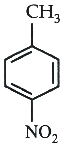
$R$ is one of the monomers for the formation of a polymer called
A
Dacron
B
Nylon $6, 6$
C
Nylon $6$
D
Bakelite
Solution
(A) The reaction sequence shows the conversion of $p$-nitrotoluene to terephthalic acid $(R)$.
$R$ is terephthalic acid $(C_6H_4(COOH)_2)$.
Terephthalic acid and ethylene glycol $(HOCH_2CH_2OH)$ are the monomers used for the synthesis of the polymer Dacron (also known as Terylene or Polyethylene terephthalate).
$R$ is terephthalic acid $(C_6H_4(COOH)_2)$.
Terephthalic acid and ethylene glycol $(HOCH_2CH_2OH)$ are the monomers used for the synthesis of the polymer Dacron (also known as Terylene or Polyethylene terephthalate).
0 likes
View Solution541
MediumMCQ
Match the following:
| List-$I$ | List-$II$ |
| $A$. Natural rubber | $I$. Free radical polymerisation |
| $B$. $PVC$ | $II$. Side chain alternative arrangement |
| $C$. Terylene | $III$. $Cis-polyisoprene$ |
| $D$. Syndiotactic polymer | $IV$. Condensation polymerisation |
A
$A-I, B-II, C-III, D-IV$
B
$A-III, B-II, C-IV, D-I$
C
$A-III, B-I, C-IV, D-II$
D
$A-IV, B-II, C-I, D-III$
Solution
(C) $A-III, B-I, C-IV, D-II$.
$A$. Natural rubber is chemically $cis-1,4-polyisoprene$.
$B$. $PVC$ ($Polyvinyl$ $chloride$) is typically formed via free radical addition polymerisation.
$C$. Terylene $(Dacron)$ is a polyester formed by the condensation polymerisation of ethylene glycol and terephthalic acid.
$D$. Syndiotactic polymers are those in which the side groups (substituents) alternate on opposite sides of the polymer chain.
$A$. Natural rubber is chemically $cis-1,4-polyisoprene$.
$B$. $PVC$ ($Polyvinyl$ $chloride$) is typically formed via free radical addition polymerisation.
$C$. Terylene $(Dacron)$ is a polyester formed by the condensation polymerisation of ethylene glycol and terephthalic acid.
$D$. Syndiotactic polymers are those in which the side groups (substituents) alternate on opposite sides of the polymer chain.
0 likes
View Solution542
EasyMCQ
Which of the following are synthetic rubbers?
$(i)$ Terylene
$(ii)$ Buna$-S$
$(iii)$ Buna$-N$
$(iv)$ Neoprene
$(v)$ Polyacrylonitrile
$(i)$ Terylene
$(ii)$ Buna$-S$
$(iii)$ Buna$-N$
$(iv)$ Neoprene
$(v)$ Polyacrylonitrile
A
$(i)$,$(ii)$ and $(iii)$
B
$(ii)$,$(iv)$ and $(v)$
C
$(ii)$,$(iii)$ and $(iv)$
D
$(i)$,$(ii)$ and $(iv)$
Solution
(C) Synthetic rubbers are polymers that exhibit rubber-like properties and are prepared artificially.
$(i)$ Terylene is a polyester fiber.
$(ii)$ Buna$-S$ is a copolymer of $1,3$-butadiene and styrene,which is a synthetic rubber.
$(iii)$ Buna$-N$ is a copolymer of $1,3$-butadiene and acrylonitrile,which is a synthetic rubber.
$(iv)$ Neoprene is a polymer of chloroprene ($2$-chloro-$1,3$-butadiene),which is a synthetic rubber.
$(v)$ Polyacrylonitrile is a synthetic fiber (Orlon).
Therefore,$(ii)$,$(iii)$,and $(iv)$ are synthetic rubbers.
Hence,the correct option is $(c)$.
$(i)$ Terylene is a polyester fiber.
$(ii)$ Buna$-S$ is a copolymer of $1,3$-butadiene and styrene,which is a synthetic rubber.
$(iii)$ Buna$-N$ is a copolymer of $1,3$-butadiene and acrylonitrile,which is a synthetic rubber.
$(iv)$ Neoprene is a polymer of chloroprene ($2$-chloro-$1,3$-butadiene),which is a synthetic rubber.
$(v)$ Polyacrylonitrile is a synthetic fiber (Orlon).
Therefore,$(ii)$,$(iii)$,and $(iv)$ are synthetic rubbers.
Hence,the correct option is $(c)$.
0 likes
View Solution543
EasyMCQ
The monomer units of nylon-$6, 6$ and nylon-$2$-nylon-$6$ are respectively:
A
$H_2N(CH_2)_6NH_2, HO_2C(CH_2)_4CO_2H$ and $H_2NCH_2CO_2H, H_2N(CH_2)_5CO_2H$
B
$H_2NCH_2CO_2H, HO_2C(CH_2)_4CO_2H$ and $H_2N(CH_2)_6NH_2, H_2N(CH_2)_5CO_2H$
C
$H_2N(CH_2)_6NH_2, HO_2C(CH_2)_4CO_2H$ and $H_2NCH_2CO_2H, H_2N(CH_2)_5CO_2H$
D
$H_2NCH_2CO_2H, H_2N(CH_2)_5CO_2H$ and $H_2N(CH_2)_6NH_2, HO_2C(CH_2)_4CO_2H$
Solution
(C) The monomer units of nylon-$6, 6$ are hexamethylene diamine,$H_2N(CH_2)_6NH_2$ and adipic acid,$HO_2C(CH_2)_4CO_2H$.
The monomer units of nylon-$2$-nylon-$6$ are glycine,$H_2NCH_2COOH$ and aminocaproic acid,$H_2N(CH_2)_5COOH$.
Therefore,the correct option is $C$.
The monomer units of nylon-$2$-nylon-$6$ are glycine,$H_2NCH_2COOH$ and aminocaproic acid,$H_2N(CH_2)_5COOH$.
Therefore,the correct option is $C$.
0 likes
View Solution544
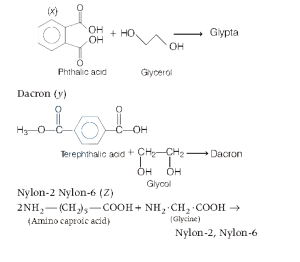
MediumMCQ
Identify the monomers used in the manufacture of glyptal $(X)$,dacron $(Y)$ and nylon $2$-nylon $6$ $(Z)$.
A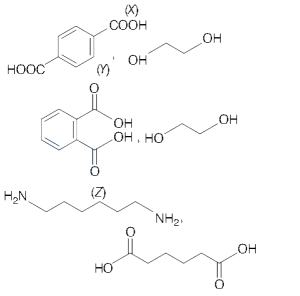
B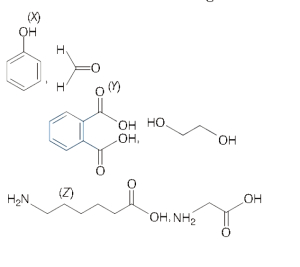
C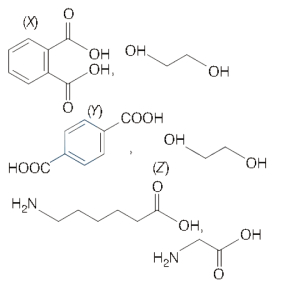
D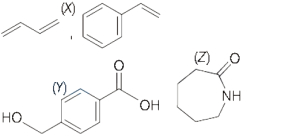
Solution
(C) $Glyptal (X):$ Ethylene glycol and phthalic acid.
$Dacron (Y):$ Ethylene glycol and terephthalic acid.
$Nylon 2-nylon 6 (Z):$ Glycine and aminocaproic acid.
$Dacron (Y):$ Ethylene glycol and terephthalic acid.
$Nylon 2-nylon 6 (Z):$ Glycine and aminocaproic acid.
0 likes
View Solution545
Medium
Match the following items in List-$I$ with their corresponding monomer units in List-$II$.
| List-$I$ | List-$II$ |
|---|---|
| $A$. Natural rubber | $i$. $\beta$-glucose |
| $B$. Cellulose | $ii$. Isoprene |
| $C$. Nylon-$6$ | $iii$. Tetrafluoroethylene |
| $D$. Teflon | $iv$. Caprolactam |
Solution
(A-II, B-I, C-IV, D-III) The correct matches are as follows:
$A$. Natural rubber is a polymer of isoprene ($2$-methyl-$1,3$-butadiene). Thus,$A \rightarrow ii$.
$B$. Cellulose is a polysaccharide consisting of a linear chain of $\beta(1-4)$ linked $\beta$-$D$-glucose units. Thus,$B \rightarrow i$.
$C$. The monomer unit of Nylon-$6$ is caprolactam. Thus,$C \rightarrow iv$.
$D$. Teflon is formed by the polymerization of tetrafluoroethylene monomer units: $n(CF_2=CF_2) \rightarrow -(CF_2-CF_2)_n-$. Thus,$D \rightarrow iii$.
The correct matching is $A-ii, B-i, C-iv, D-iii$.
$A$. Natural rubber is a polymer of isoprene ($2$-methyl-$1,3$-butadiene). Thus,$A \rightarrow ii$.
$B$. Cellulose is a polysaccharide consisting of a linear chain of $\beta(1-4)$ linked $\beta$-$D$-glucose units. Thus,$B \rightarrow i$.
$C$. The monomer unit of Nylon-$6$ is caprolactam. Thus,$C \rightarrow iv$.
$D$. Teflon is formed by the polymerization of tetrafluoroethylene monomer units: $n(CF_2=CF_2) \rightarrow -(CF_2-CF_2)_n-$. Thus,$D \rightarrow iii$.
The correct matching is $A-ii, B-i, C-iv, D-iii$.
0 likes
View SolutionPolymers — Composition, Properties and Uses of Polymer · Frequently Asked Questions
1Are these Polymers questions useful for JEE and NEET?
Yes. All questions in this section are mapped to JEE Main and NEET exam patterns. Previous year questions from JEE Main, NEET, GUJCET and state-level exams are included with full solutions.
2Can I switch to Hindi or Gujarati for these questions?
Yes. Use the language tabs in the hero section or the sidebar to view the same questions and solutions in English, Hindi or Gujarati.
3How do I generate a question paper from this subtopic?
Use the Vedclass Exam Paper Generator — select the chapter and subtopic, set difficulty, and generate Sets A, B, C, D automatically. First 3 chapters of every subject are free.
Vedclass Products
For Students
Vedclass Test Series
Mock tests in real JEE/NEET style with performance analysis. 5-day free trial.
Start Free TrialFor Teachers
Exam Paper Generator
Generate Set A/B/C/D papers from this chapter in 2 minutes. 3 chapters free.
Try FreeFor Institutes
Online Exam Module
Live online exams with unlimited students, 360° analytics & white-label branding.
See DemoFor Teachers & Institutes
Generate a Polymers Exam Paper in 2 Minutes
Select subtopic & difficulty — Sets A, B, C, D auto-generated with No Repeat logic.
First 3 chapters of every subject are free — no payment required.