
A English
Classification of Polymer Questions in English
Class 12 Chemistry · Polymers · Classification of Polymer
219+
Questions
English
Language
100%
With Solutions
Showing 49 of 219 questions in English
101
EasyMCQ
Which of the following is a linear polymer?
A
Starch
B
Nucleic acid
C
Polystyrene
D
Protein
Solution
(C) Linear polymers consist of long and straight chains. $High \ density \ polyethylene \ (HDPE)$,$polyvinyl \ chloride \ (PVC)$,and $polystyrene$ are examples of linear polymers. $Starch$ (amylopectin) and $proteins$ often exhibit branched or complex structures,while $nucleic \ acids$ are complex biopolymers.
0 likes
View Solution102
EasyMCQ
Which of the following cannot act as a monomer for an addition polymer?
A
$CH_2=CHCl$
B
$CH_2=CH-CN$
C
$CH_2=CH-C_6H_5$
D
$CH_3COOH$
Solution
(D) Addition polymerization requires the presence of a multiple bond (usually a carbon-carbon double bond,$C=C$) in the monomer molecule.
$CH_2=CHCl$ (vinyl chloride),$CH_2=CH-CN$ (acrylonitrile),and $CH_2=CH-C_6H_5$ (styrene) all contain a $C=C$ double bond and can undergo addition polymerization.
$CH_3COOH$ (acetic acid) does not contain a carbon-carbon double bond and therefore cannot act as a monomer for addition polymerization.
$CH_2=CHCl$ (vinyl chloride),$CH_2=CH-CN$ (acrylonitrile),and $CH_2=CH-C_6H_5$ (styrene) all contain a $C=C$ double bond and can undergo addition polymerization.
$CH_3COOH$ (acetic acid) does not contain a carbon-carbon double bond and therefore cannot act as a monomer for addition polymerization.
0 likes
View Solution103
DifficultMCQ
Which of the following sets contains only addition polymers?
A
Polyethylene,Polypropylene,Terylene
B
Polyethylene,$PVC$,Acrylonitrile
C
Buna-$S$,Nylon,Polybutadiene
D
Bakelite,$PVC$,Polyethylene
Solution
(B) Addition polymers are formed by the repeated addition of monomer molecules possessing double or triple bonds without the loss of any small molecules.
$1$. Polyethylene is formed from ethene $(CH_2=CH_2)$.
$2$. $PVC$ (Polyvinyl chloride) is formed from vinyl chloride $(CH_2=CHCl)$.
$3$. Acrylonitrile (or Polyacrylonitrile) is formed from acrylonitrile $(CH_2=CH-CN)$.
All these are addition polymers.
In contrast,Terylene,Nylon,and Bakelite are condensation polymers formed with the loss of small molecules like $H_2O$ or $CH_3OH$.
$1$. Polyethylene is formed from ethene $(CH_2=CH_2)$.
$2$. $PVC$ (Polyvinyl chloride) is formed from vinyl chloride $(CH_2=CHCl)$.
$3$. Acrylonitrile (or Polyacrylonitrile) is formed from acrylonitrile $(CH_2=CH-CN)$.
All these are addition polymers.
In contrast,Terylene,Nylon,and Bakelite are condensation polymers formed with the loss of small molecules like $H_2O$ or $CH_3OH$.
0 likes
View Solution104
EasyMCQ
Which of the following is a condensation polymer?
A
Dacron
B
$PVC$
C
Polystyrene
D
Teflon
Solution
(A) Condensation polymers are formed by the repeated condensation reaction between two different bi-functional or tri-functional monomeric units,usually with the elimination of small molecules like $H_2O$,$HCl$,or $NH_3$.
$Dacron$ (also known as $Terylene$) is a polyester formed by the condensation polymerization of ethylene glycol and terephthalic acid.
$PVC$,polystyrene,and Teflon are addition polymers formed by the polymerization of unsaturated monomers.
$Dacron$ (also known as $Terylene$) is a polyester formed by the condensation polymerization of ethylene glycol and terephthalic acid.
$PVC$,polystyrene,and Teflon are addition polymers formed by the polymerization of unsaturated monomers.
0 likes
View Solution105
EasyMCQ
Which of the following is a natural fiber-producing polymer?
A
Starch
B
Cellulose
C
Natural rubber
D
Nylon
Solution
(B) Natural polymers are classified based on their source and usage.
$1$. Starch is a natural polymer but is not a fiber.
$2$. Cellulose is a natural polymer that occurs in plants and is used to produce natural fibers like cotton and linen.
$3$. Natural rubber is a natural polymer but is an elastomer,not a fiber.
$4$. Nylon is a synthetic fiber-producing polymer.
Therefore,cellulose is the correct answer.
$1$. Starch is a natural polymer but is not a fiber.
$2$. Cellulose is a natural polymer that occurs in plants and is used to produce natural fibers like cotton and linen.
$3$. Natural rubber is a natural polymer but is an elastomer,not a fiber.
$4$. Nylon is a synthetic fiber-producing polymer.
Therefore,cellulose is the correct answer.
0 likes
View Solution106
EasyMCQ
Nylon-$66$ is not a .......
A
Condensation polymer
B
Co-polymer
C
Polyamide
D
Homopolymer
Solution
(D) Nylon-$66$ is prepared by the condensation polymerization of hexamethylenediamine $(H_2N(CH_2)_6NH_2)$ and adipic acid $(HOOC(CH_2)_4COOH)$.
Since it is formed from two different monomers,it is a co-polymer.
It contains amide linkages $(-CONH-)$,so it is a polyamide.
It is formed by the loss of small molecules like water,so it is a condensation polymer.
It is not a homopolymer because a homopolymer is formed from only one type of monomer unit.
Since it is formed from two different monomers,it is a co-polymer.
It contains amide linkages $(-CONH-)$,so it is a polyamide.
It is formed by the loss of small molecules like water,so it is a condensation polymer.
It is not a homopolymer because a homopolymer is formed from only one type of monomer unit.
0 likes
View Solution107
EasyMCQ
Which of the following is not a synthetic polymer?
A
Polythene
B
$PVC$
C
Nylon
D
Cellophane
Solution
(D) Synthetic polymers are man-made polymers produced in laboratories or industries. $Polythene$,$PVC$ (Polyvinyl chloride),and $Nylon$ are all synthetic polymers. $Cellophane$ is a thin,transparent sheet made of regenerated cellulose,which is derived from natural sources like wood or cotton pulp. Therefore,$Cellophane$ is considered a natural-based or semi-synthetic polymer,not a purely synthetic one.
0 likes
View Solution108
EasyMCQ
Which of the following is a polymer?
A
Carnauba wax
B
Carbowax
C
Beeswax
D
Paraffin wax
Solution
(B) Carbowax is a trade name for polyethylene glycol $(PEG)$,which is a polymer of ethylene oxide. The general formula is $H-(O-CH_2-CH_2)_n-OH$. Carnauba wax,beeswax,and paraffin wax are mixtures of hydrocarbons,esters,or fatty acids,but they are not considered polymers in the chemical sense of high molecular weight macromolecules formed by repeating units.
0 likes
View Solution109
EasyMCQ
Which of the following is a rayon?
A
Nylon
B
Cellulosic fibers
C
Natural silk
D
Terylene
Solution
(B) Rayon is a semi-synthetic fiber made from regenerated cellulose,which is obtained from wood pulp or cotton linters. Therefore,it is classified as a cellulosic fiber.
0 likes
View Solution110
MediumMCQ
Teflon,styron (polystyrene),and neoprene are all:
A
Copolymers
B
Condensation polymers
C
Homopolymers
D
Monomers
Solution
(C) Teflon is a polymer of tetrafluoroethene $(CF_2=CF_2)$.
Styron (polystyrene) is a polymer of styrene $(C_6H_5CH=CH_2)$.
Neoprene is a polymer of chloroprene $(CH_2=C(Cl)-CH=CH_2)$.
Since all these polymers are formed by the polymerization of a single type of monomer unit,they are classified as homopolymers.
Styron (polystyrene) is a polymer of styrene $(C_6H_5CH=CH_2)$.
Neoprene is a polymer of chloroprene $(CH_2=C(Cl)-CH=CH_2)$.
Since all these polymers are formed by the polymerization of a single type of monomer unit,they are classified as homopolymers.
0 likes
View Solution111
MediumMCQ
Which one of the following is not a condensation polymer?
A
Melamine
B
Glyptal
C
Dacron
D
Neoprene
Solution
(D) Neoprene is an addition polymer formed by the polymerization of chloroprene $(CH_2=C(Cl)-CH=CH_2)$.
Melamine,Glyptal,and Dacron are condensation polymers.
Melamine,Glyptal,and Dacron are condensation polymers.
0 likes
View Solution112
MediumMCQ
Regarding cross-linked or network polymers,which of the following statements is incorrect?
A
They contain covalent bonds between various linear polymer chains.
B
They are formed from bi- and tri-functional monomers.
C
Examples are bakelite and melamine.
D
They contain strong covalent bonds in their polymer chains.
Solution
(D) Cross-linked or network polymers are formed from bi-functional and tri-functional monomers.
They contain strong covalent bonds between various linear polymer chains.
Examples include $Bakelite$ and $Melamine$.
Since all statements $A$,$B$,$C$,and $D$ are technically correct descriptions of cross-linked polymers,there is no incorrect statement provided in the options. However,in the context of standard chemistry curriculum,all these statements are considered true properties of network polymers.
They contain strong covalent bonds between various linear polymer chains.
Examples include $Bakelite$ and $Melamine$.
Since all statements $A$,$B$,$C$,and $D$ are technically correct descriptions of cross-linked polymers,there is no incorrect statement provided in the options. However,in the context of standard chemistry curriculum,all these statements are considered true properties of network polymers.
0 likes
View Solution113
MediumMCQ
Is $-[CH_2-CH(C_6H_5)-]_n$ a homopolymer or a copolymer?
A
Homopolymer
B
Copolymer
C
Both
D
None of these
Solution
(A) The given structure $-[CH_2-CH(C_6H_5)-]_n$ represents polystyrene.
It is a homopolymer because it is formed by the polymerization of a single type of monomer,which is styrene $(C_6H_5CH=CH_2)$.
It is a homopolymer because it is formed by the polymerization of a single type of monomer,which is styrene $(C_6H_5CH=CH_2)$.
0 likes
View Solution114
Easy
What are polymers?
Solution
(N/A) Polymers are high molecular mass macromolecules,which consist of repeating structural units derived from monomers.
Polymers have a high molecular mass $\left(10^{3} - 10^{7} \ u\right)$.
In a polymer,various monomer units are joined by strong covalent bonds.
These polymers can be natural as well as synthetic.
Polythene,rubber,and nylon $6,6$ are examples of polymers.
Polymers have a high molecular mass $\left(10^{3} - 10^{7} \ u\right)$.
In a polymer,various monomer units are joined by strong covalent bonds.
These polymers can be natural as well as synthetic.
Polythene,rubber,and nylon $6,6$ are examples of polymers.
0 likes
View Solution115
Medium
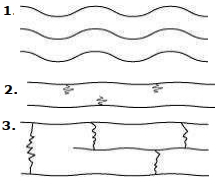
How are polymers classified on the basis of structure?
Solution
Polymers are classified on the basis of structure into the following three types:
$1.$ Linear polymers:
These polymers consist of long and straight chains. They are well-packed and have high densities,tensile strength,and melting points. Examples include high-density polythene $(HDP)$,polyvinyl chloride $(PVC)$,etc.
$2.$ Branched chain polymers:
These polymers consist of linear chains having some branches of different lengths. Due to branching,they do not pack well and thus have lower densities and melting points. Examples include low-density polythene $(LDP)$,amylopectin,etc.
$3.$ Cross-linked or Network polymers:
These polymers are formed from bi-functional and tri-functional monomers and contain strong covalent bonds between various linear polymer chains. This results in a three-dimensional network structure. These are hard,rigid,and brittle. Examples include bakelite,melamine-formaldehyde resin,etc.
$1.$ Linear polymers:
These polymers consist of long and straight chains. They are well-packed and have high densities,tensile strength,and melting points. Examples include high-density polythene $(HDP)$,polyvinyl chloride $(PVC)$,etc.
$2.$ Branched chain polymers:
These polymers consist of linear chains having some branches of different lengths. Due to branching,they do not pack well and thus have lower densities and melting points. Examples include low-density polythene $(LDP)$,amylopectin,etc.
$3.$ Cross-linked or Network polymers:
These polymers are formed from bi-functional and tri-functional monomers and contain strong covalent bonds between various linear polymer chains. This results in a three-dimensional network structure. These are hard,rigid,and brittle. Examples include bakelite,melamine-formaldehyde resin,etc.
0 likes
View Solution116
Medium
Write the names of monomers of the following polymers:
$(i)$ $-(NH-(CH_2)_6-NH-CO-(CH_2)_4-CO)_n-$
$(ii)$ $-(CO-(CH_2)_5-NH)_n-$
$(iii)$ $-(CF_2-CF_2)_n-$
$(i)$ $-(NH-(CH_2)_6-NH-CO-(CH_2)_4-CO)_n-$
$(ii)$ $-(CO-(CH_2)_5-NH)_n-$
$(iii)$ $-(CF_2-CF_2)_n-$
Solution
(N/A) $(i)$ Hexamethylenediamine $[H_2N-(CH_2)_6-NH_2]$ and adipic acid $[HOOC-(CH_2)_4-COOH]$
$(ii)$ Caprolactam
$(iii)$ Tetrafluoroethene $(CF_2=CF_2)$
$(ii)$ Caprolactam
$(iii)$ Tetrafluoroethene $(CF_2=CF_2)$
0 likes
View Solution117
Medium
Classify the following as addition and condensation polymers: Terylene,Bakelite,Polyvinyl chloride,Polythene.
Solution
(N/A) Addition polymers are formed by the repeated addition of monomer molecules possessing double or triple bonds without the loss of any small molecules. Examples: $Polyvinyl \ chloride$,$Polythene$.
Condensation polymers are formed by repeated condensation reactions between two different bi-functional or tri-functional monomeric units,usually with the elimination of small molecules like $H_2O$,$HCl$,or $CH_3OH$. Examples: $Terylene$,$Bakelite$.
Condensation polymers are formed by repeated condensation reactions between two different bi-functional or tri-functional monomeric units,usually with the elimination of small molecules like $H_2O$,$HCl$,or $CH_3OH$. Examples: $Terylene$,$Bakelite$.
0 likes
View Solution118
Medium
Explain the terms polymer and monomer.
Solution
(N/A) Polymers are high molecular mass macromolecules composed of repeating structural units derived from monomers. Polymers have a high molecular mass $(10^{3} - 10^{7} \ u)$. In a polymer,various monomer units are joined by strong covalent bonds. Polymers can be natural as well as synthetic. Polythene,rubber,and nylon $6,6$ are examples of polymers. Monomers are simple,reactive molecules that combine with each other in large numbers through covalent bonds to give rise to polymers. For example,ethene,propene,styrene,and vinyl chloride.
0 likes
View Solution119
Medium
What are natural and synthetic polymers? Give two examples of each type.
Solution
(N/A) Natural polymers are polymers that are found in nature and are formed by plants and animals. Examples include $Protein$ and $Cellulose$.
Synthetic polymers are man-made polymers prepared in laboratories or industries. Examples include $Polythene$ and $Nylon-6,6$.
Synthetic polymers are man-made polymers prepared in laboratories or industries. Examples include $Polythene$ and $Nylon-6,6$.
0 likes
View Solution120
Medium
Distinguish between the terms homopolymer and copolymer and give an example of each.
Solution
(N/A)
| $Homopolymer$ | $Copolymer$ |
| The polymers that are formed by the polymerization of a single monomer are known as homopolymers. In other words,the repeating units of homopolymers are derived only from one monomer. For example,$Polythene$ is a homopolymer of $Ethene$. | The polymers whose repeating units are derived from two types of monomers are known as copolymers. For example,$Buna-S$ is a copolymer of $1,3-butadiene$ and $Styrene$. |
0 likes
View Solution121
Medium
How do you explain the functionality of a monomer?
Solution
(N/A) The functionality of a monomer is defined as the number of binding sites present in that monomer.
For example,the functionality of monomers such as ethene $(CH_2=CH_2)$ and propene $(CH_3-CH=CH_2)$ is $1$,while the functionality of monomers like $1,3-$butadiene $(CH_2=CH-CH=CH_2)$ and adipic acid $(HOOC-(CH_2)_4-COOH)$ is $2$.
For example,the functionality of monomers such as ethene $(CH_2=CH_2)$ and propene $(CH_3-CH=CH_2)$ is $1$,while the functionality of monomers like $1,3-$butadiene $(CH_2=CH-CH=CH_2)$ and adipic acid $(HOOC-(CH_2)_4-COOH)$ is $2$.
0 likes
View Solution122
MediumMCQ
Is $-(NH-CHR-CO)_n-$ a homopolymer or a copolymer?
A
Homopolymer
B
Copolymer
C
Both
D
None
Solution
(A) The structure $-(NH-CHR-CO)_n-$ represents a polypeptide chain.
It is formed by the polymerization of a single type of monomer unit,which is an $\alpha$-amino acid with the general formula $NH_2-CHR-COOH$.
Since it is derived from only one type of monomer,it is classified as a homopolymer.
It is formed by the polymerization of a single type of monomer unit,which is an $\alpha$-amino acid with the general formula $NH_2-CHR-COOH$.
Since it is derived from only one type of monomer,it is classified as a homopolymer.
0 likes
View Solution123
MediumMCQ
In which classes are polymers classified on the basis of molecular forces?
A
Elastomers,Fibres,Thermoplastic polymers,Thermosetting polymers
B
Addition polymers,Condensation polymers
C
Natural,Semi-synthetic,Synthetic
D
Linear,Branched,Cross-linked
Solution
(A) On the basis of the magnitude of intermolecular forces present in polymers,they are classified into the following four groups:
$(i)$ Elastomers: These have weak intermolecular forces.
$(ii)$ Fibres: These have strong intermolecular forces like hydrogen bonding.
$(iii)$ Thermoplastic polymers: These have intermediate intermolecular forces.
$(iv)$ Thermosetting polymers: These have strong cross-links formed during molding.
$(i)$ Elastomers: These have weak intermolecular forces.
$(ii)$ Fibres: These have strong intermolecular forces like hydrogen bonding.
$(iii)$ Thermoplastic polymers: These have intermediate intermolecular forces.
$(iv)$ Thermosetting polymers: These have strong cross-links formed during molding.
0 likes
View Solution124
Medium
How can you differentiate between addition and condensation polymerization?
Solution
(N/A) Addition polymerization is the process of repeated addition of monomers possessing double or triple bonds to form polymers. For example,polythene is formed by the addition polymerization of ethene.
$n CH_2 = CH_2 \to -(CH_2 - CH_2)_n-$
Condensation polymerization is the process of formation of polymers by repeated condensation reactions between two different bi-functional or tri-functional monomers. $A$ small molecule such as water or hydrochloric acid is eliminated in each condensation step. For example,nylon $6,6$ is formed by the condensation polymerization of hexamethylenediamine and adipic acid.
$n H_2N(CH_2)_6NH_2 + n HOOC(CH_2)_4COOH \to [NH(CH_2)_6NHCO(CH_2)_4CO]_n + 2n H_2O$
$n CH_2 = CH_2 \to -(CH_2 - CH_2)_n-$
Condensation polymerization is the process of formation of polymers by repeated condensation reactions between two different bi-functional or tri-functional monomers. $A$ small molecule such as water or hydrochloric acid is eliminated in each condensation step. For example,nylon $6,6$ is formed by the condensation polymerization of hexamethylenediamine and adipic acid.
$n H_2N(CH_2)_6NH_2 + n HOOC(CH_2)_4COOH \to [NH(CH_2)_6NHCO(CH_2)_4CO]_n + 2n H_2O$
0 likes
View Solution125
Medium
Define thermoplastics and thermosetting polymers with two examples of each.
Solution
(N/A) $Thermoplastic$ polymers are linear or slightly branched long-chain polymers that can be repeatedly softened and hardened upon heating. Hence,they can be reshaped multiple times. Examples include $Polythene$ and $Polystyrene$.
$Thermosetting$ polymers are cross-linked or heavily branched polymers that undergo extensive cross-linking during the molding process,becoming permanently hard. These plastics cannot be softened again upon heating. Examples include $Bakelite$ and $Urea-formaldehyde$ resins.
$Thermosetting$ polymers are cross-linked or heavily branched polymers that undergo extensive cross-linking during the molding process,becoming permanently hard. These plastics cannot be softened again upon heating. Examples include $Bakelite$ and $Urea-formaldehyde$ resins.
0 likes
View Solution126
Medium
Write the monomers used for getting the following polymers:
$(i)$ Polyvinyl chloride
$(ii)$ Teflon
$(iii)$ Bakelite
$(i)$ Polyvinyl chloride
$(ii)$ Teflon
$(iii)$ Bakelite
Solution
(N/A) $(i)$ The monomer for Polyvinyl chloride is Vinyl chloride $(CH_2=CHCl)$.
$(ii)$ The monomer for Teflon is Tetrafluoroethylene $(CF_2=CF_2)$.
$(iii)$ The monomers for Bakelite are Formaldehyde $(HCHO)$ and Phenol $(C_6H_5OH)$.
$(ii)$ The monomer for Teflon is Tetrafluoroethylene $(CF_2=CF_2)$.
$(iii)$ The monomers for Bakelite are Formaldehyde $(HCHO)$ and Phenol $(C_6H_5OH)$.
0 likes
View Solution127
Medium
What is a monomer? What is polymerization?
Solution
(N/A) Polymers are formed by the joining of repeating structural units on a large scale.
The repeating structural units are derived from simple and reactive molecules known as monomers.
The process of formation of polymers from their respective monomers is called polymerization.
The repeating structural units are derived from simple and reactive molecules known as monomers.
The process of formation of polymers from their respective monomers is called polymerization.
0 likes
View Solution128
Difficult
Classify polymers based on their source.
Solution
(N/A) Based on their source,polymers are classified into three categories:
$(a)$ Natural polymers: These polymers are found in plants and animals. Examples include proteins,cellulose,starch,some resins,and rubber.
$(b)$ Semi-synthetic polymers: These are derived from naturally occurring polymers by chemical modifications. Examples include cellulose derivatives such as cellulose acetate (rayon) and cellulose nitrate.
$(c)$ Synthetic polymers: These are man-made polymers. Examples include plastics (e.g.,polythene),synthetic fibres (e.g.,nylon-$6,6$),and synthetic rubbers (e.g.,Buna-$S$),which are extensively used in daily life and industry.
$(a)$ Natural polymers: These polymers are found in plants and animals. Examples include proteins,cellulose,starch,some resins,and rubber.
$(b)$ Semi-synthetic polymers: These are derived from naturally occurring polymers by chemical modifications. Examples include cellulose derivatives such as cellulose acetate (rayon) and cellulose nitrate.
$(c)$ Synthetic polymers: These are man-made polymers. Examples include plastics (e.g.,polythene),synthetic fibres (e.g.,nylon-$6,6$),and synthetic rubbers (e.g.,Buna-$S$),which are extensively used in daily life and industry.
0 likes
View Solution129
Medium
Write down the main types of polymerization.
Solution
(N/A) There are two broad types of polymerization reactions:
$(a)$ Addition or chain growth polymerization: In this type,monomers containing double or triple bonds add together to form polymers without the loss of any small molecules.
$(b)$ Condensation or step growth polymerization: In this type,monomers containing bifunctional or polyfunctional groups react with each other,usually with the elimination of small molecules like $H_2O$,$HCl$,or $NH_3$.
$(a)$ Addition or chain growth polymerization: In this type,monomers containing double or triple bonds add together to form polymers without the loss of any small molecules.
$(b)$ Condensation or step growth polymerization: In this type,monomers containing bifunctional or polyfunctional groups react with each other,usually with the elimination of small molecules like $H_2O$,$HCl$,or $NH_3$.
0 likes
View Solution130
Medium
What are copolymers? Explain with an example.
Solution
(N/A) Copolymers are polymers formed by the polymerization of two or more different types of monomeric species.
Example: Buna-$S$ is a copolymer formed by the addition polymerization of $1,3-$butadiene and styrene.
The reaction is as follows:
$nCH_2=CH-CH=CH_2 + nC_6H_5CH=CH_2 \rightarrow -[CH_2-CH=CH-CH_2-CH(C_6H_5)-CH_2]_n-$
Example: Buna-$S$ is a copolymer formed by the addition polymerization of $1,3-$butadiene and styrene.
The reaction is as follows:
$nCH_2=CH-CH=CH_2 + nC_6H_5CH=CH_2 \rightarrow -[CH_2-CH=CH-CH_2-CH(C_6H_5)-CH_2]_n-$
0 likes
View Solution131
Medium
What are synthetic rubbers? Write two examples of them.
Solution
(N/A) Synthetic rubber is any vulcanizable rubber-like polymer that is capable of being stretched to twice its original length. However,it returns to its original shape and size as soon as the external stretching force is released.
Synthetic rubbers are either homo-polymers of $1,3$-butadiene derivatives or copolymers of $1,3$-butadiene or its derivatives with another unsaturated monomer.
Examples: $Neoprene$,$Buna-N$.
Synthetic rubbers are either homo-polymers of $1,3$-butadiene derivatives or copolymers of $1,3$-butadiene or its derivatives with another unsaturated monomer.
Examples: $Neoprene$,$Buna-N$.
0 likes
View Solution132
EasyMCQ
Identify the type of polymer $- A - A - A - A - A - A -$
A
Homopolymer
B
Copolymer
C
Terpolymer
D
Natural polymer
Solution
(A) The given polymer structure $- A - A - A - A - A - A -$ consists of only $1$ type of repeating monomer unit,which is $A$.
Polymers formed from only one type of monomer unit are known as Homopolymers.
Polymers formed from only one type of monomer unit are known as Homopolymers.
0 likes
View Solution133
EasyMCQ
Identify the type of polymer $ - A - B - B - A - A - A - B - A $.
A
Homopolymer
B
Copolymer
C
Condensation polymer
D
Natural polymer
Solution
(B) polymer formed from two or more different types of monomer units is called a copolymer.
Since the given chain $ - A - B - B - A - A - A - B - A $ contains two different monomer units,$A$ and $B$,it is classified as a copolymer.
Since the given chain $ - A - B - B - A - A - A - B - A $ contains two different monomer units,$A$ and $B$,it is classified as a copolymer.
0 likes
View Solution134
Medium
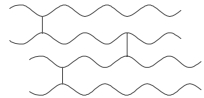
Identify the type of polymer given in the following figure.
Solution
(N/A) The polymer shown in the figure consists of linear chains connected by covalent bonds,which is characteristic of a cross-linked or network polymer. These polymers are typically formed from bi-functional and tri-functional monomers and contain strong covalent bonds linking the polymer chains together.
0 likes
View Solution135
Medium
Can nucleic acid,protein and starch be considered as step growth polymers?
Solution
(A) Yes,nucleic acids,proteins,and starch can be considered as step-growth polymers.
During their polymerization process,the formation of these biopolymers involves the elimination of small molecules like water $(H_2O)$ or other neutral molecules.
Since they are formed by the condensation of monomers with the loss of small molecules,they are also classified as condensation polymers.
During their polymerization process,the formation of these biopolymers involves the elimination of small molecules like water $(H_2O)$ or other neutral molecules.
Since they are formed by the condensation of monomers with the loss of small molecules,they are also classified as condensation polymers.
0 likes
View Solution136
Difficult
Differentiate between rubbers and plastics on the basis of intermolecular forces.
Solution
(N/A) Rubbers are elastomers,which are polymers held together by the weakest intermolecular forces of attraction. These weak forces allow the polymer chains to be stretched,and they return to their original shape upon the release of the stretching force.
Plastics are generally thermoplastic or thermosetting polymers that possess intermediate to strong intermolecular forces of attraction compared to elastomers. These forces are stronger than those in rubbers,which makes plastics more rigid and capable of being moulded into various shapes.
Plastics are generally thermoplastic or thermosetting polymers that possess intermediate to strong intermolecular forces of attraction compared to elastomers. These forces are stronger than those in rubbers,which makes plastics more rigid and capable of being moulded into various shapes.
0 likes
View Solution137
Difficult
Which of the following polymers soften on heating and harden on cooling? What are the polymers with this property collectively called? What are the structural similarities between such polymers?
Solution
(N/A) Polythene,polyvinyls,and polystyrene soften on heating and harden on cooling.
Such polymers are collectively called $ \text{thermoplastic polymers} $.
These polymers consist of linear or slightly branched long-chain molecules.
They possess intermolecular forces whose strength lies between the strength of intermolecular forces of $ \text{elastomers} $ and $ \text{fibres} $.
Such polymers are collectively called $ \text{thermoplastic polymers} $.
These polymers consist of linear or slightly branched long-chain molecules.
They possess intermolecular forces whose strength lies between the strength of intermolecular forces of $ \text{elastomers} $ and $ \text{fibres} $.
0 likes
View Solution138
EasyMCQ
Which of the following is a natural polymer?
A
poly (Butadiene-acrylonitrile)
B
cis$-1,4-$polyisoprene
C
poly (Butadiene-styrene)
D
polybutadiene
Solution
(B) Natural rubber is a natural polymer known as $cis-1,4-polyisoprene$.
It is obtained from the latex of rubber trees.
The other options,such as poly(Butadiene-acrylonitrile) (Buna-$N$),poly(Butadiene-styrene) (Buna-$S$),and polybutadiene,are synthetic polymers.
It is obtained from the latex of rubber trees.
The other options,such as poly(Butadiene-acrylonitrile) (Buna-$N$),poly(Butadiene-styrene) (Buna-$S$),and polybutadiene,are synthetic polymers.
0 likes
View Solution139
MediumMCQ
Which of the following is not an example of a chain growth polymer?
A
Neoprene
B
Buna-$S$
C
$PMMA$
D
Glyptal
Solution
(D) Chain growth polymers are formed by the repeated addition of monomer units containing double or triple bonds (e.g.,Neoprene,Buna-$S$,$PMMA$).
Glyptal is a condensation or step-growth polymer formed by the reaction between ethylene glycol $(HOCH_2CH_2OH)$ and phthalic acid $(C_6H_4(COOH)_2)$ with the elimination of water molecules.
Glyptal is a condensation or step-growth polymer formed by the reaction between ethylene glycol $(HOCH_2CH_2OH)$ and phthalic acid $(C_6H_4(COOH)_2)$ with the elimination of water molecules.
0 likes
View Solution140
MediumMCQ
$[NH(CH_2)_6NHCO(CH_2)_4CO]_n$ is a
A
addition polymer
B
thermosetting polymer
C
homopolymer
D
copolymer
Solution
(D) The given structure represents the repeating unit of $Nylon-6,6$.
It is formed by the condensation polymerization of hexamethylenediamine $(H_2N(CH_2)_6NH_2)$ and adipic acid $(HOOC(CH_2)_4COOH)$.
Since it is formed from two different monomers,it is classified as a copolymer.
It is formed by the condensation polymerization of hexamethylenediamine $(H_2N(CH_2)_6NH_2)$ and adipic acid $(HOOC(CH_2)_4COOH)$.
Since it is formed from two different monomers,it is classified as a copolymer.
0 likes
View Solution141
MediumMCQ
Which among the following is not a polyester?
A
Novolac
B
$PHBV$
C
Dacron
D
Glyptal
Solution
(A) Novolac is a phenol-formaldehyde resin formed by the condensation of phenol and formaldehyde.
It does not contain an ester linkage in its structure.
$PHBV$ (poly-$\beta$-hydroxybutyrate-co-$\beta$-hydroxyvalerate),Dacron (polyethylene terephthalate),and Glyptal are all examples of polyesters.
Therefore,Novolac is not a polyester.
It does not contain an ester linkage in its structure.
$PHBV$ (poly-$\beta$-hydroxybutyrate-co-$\beta$-hydroxyvalerate),Dacron (polyethylene terephthalate),and Glyptal are all examples of polyesters.
Therefore,Novolac is not a polyester.
0 likes
View Solution142
MediumMCQ
Which of the following is not an example of a condensation polymer?
A
Nylon $6,6$
B
Dacron
C
Buna$-N$
D
Silicone
Solution
(C) Buna$-N$ is an addition copolymer formed by the polymerization of $1,3-$butadiene and acrylonitrile.
Condensation polymers are formed by the repeated condensation reaction between two different bi-functional or tri-functional monomeric units,usually with the elimination of small molecules like $H_2O$,$HCl$,or $NH_3$.
Nylon $6,6$,Dacron,and Silicone are examples of condensation polymers.
Buna$-N$ is an addition polymer,not a condensation polymer.
Condensation polymers are formed by the repeated condensation reaction between two different bi-functional or tri-functional monomeric units,usually with the elimination of small molecules like $H_2O$,$HCl$,or $NH_3$.
Nylon $6,6$,Dacron,and Silicone are examples of condensation polymers.
Buna$-N$ is an addition polymer,not a condensation polymer.
0 likes
View Solution143
EasyMCQ
Which one of the following is $NOT$ a copolymer?
A
Buna-$S$
B
Neoprene
C
$PHBV$
D
Butadiene-styrene
Solution
(B) copolymer is a polymer formed from two or more different types of monomer units.
Buna-$S$ is a copolymer of $1,3$-butadiene and styrene.
$PHBV$ (poly-$\beta$-hydroxybutyrate-co-$\beta$-hydroxyvalerate) is a copolymer of $3$-hydroxybutanoic acid and $3$-hydroxypentanoic acid.
Butadiene-styrene is another name for Buna-$S$,which is a copolymer.
Neoprene is a homopolymer of chloroprene ($2$-chloro-$1,3$-butadiene).
Therefore,neoprene is not a copolymer.
Buna-$S$ is a copolymer of $1,3$-butadiene and styrene.
$PHBV$ (poly-$\beta$-hydroxybutyrate-co-$\beta$-hydroxyvalerate) is a copolymer of $3$-hydroxybutanoic acid and $3$-hydroxypentanoic acid.
Butadiene-styrene is another name for Buna-$S$,which is a copolymer.
Neoprene is a homopolymer of chloroprene ($2$-chloro-$1,3$-butadiene).
Therefore,neoprene is not a copolymer.
0 likes
View Solution144
EasyMCQ
Which of the following is $NOT$ a natural polymer?
A
Protein
B
Starch
C
Rubber
D
Rayon
Solution
(D) Natural polymers are those that occur naturally in plants and animals. Examples include $Protein$,$Starch$,and $Rubber$.
$Rayon$ is a regenerated cellulose fiber,which is classified as a semisynthetic polymer because it is derived from natural cellulose through chemical processing.
$Rayon$ is a regenerated cellulose fiber,which is classified as a semisynthetic polymer because it is derived from natural cellulose through chemical processing.
0 likes
View Solution145
MediumMCQ
Natural rubber is a polymer of
A
neoprene
B
chloroprene
C
isoprene
D
styrene
Solution
(C) . Natural rubber is a linear polymer of isoprene ($2$-methyl-$1,3$-butadiene) and is also called $cis$-$1,4$-polyisoprene. The polymerization reaction is as follows:
$CH_2=C(CH_3)-CH=CH_2 \xrightarrow{\text{Polymerisation}} [-CH_2-C(CH_3)=CH-CH_2-]_n$
$CH_2=C(CH_3)-CH=CH_2 \xrightarrow{\text{Polymerisation}} [-CH_2-C(CH_3)=CH-CH_2-]_n$
0 likes
View Solution146
MediumMCQ
Match List-$I$ and List-$II$.
Choose the correct answer from the options given below:
| List-$I$ | List-$II$ |
| $A$. Elastomeric polymer | $I$. Urea formaldehyde resin |
| $B$. Fibre polymer | $II$. Polystyrene |
| $C$. Thermosetting polymer | $III$. Polyester |
| $D$. Thermoplastic polymer | $IV$. Neoprene |
Choose the correct answer from the options given below:
A
$A-II, B-III, C-I, D-IV$
B
$A-II, B-I, C-IV, D-III$
C
$A-IV, B-III, C-I, D-II$
D
$A-IV, B-I, C-III, D-II$
Solution
(C) The classification of polymers based on molecular forces is as follows:
$A$. Elastomeric polymer: $IV$. Neoprene (weak intermolecular forces allow stretching).
$B$. Fibre polymer: $III$. Polyester (strong intermolecular forces like hydrogen bonding).
$C$. Thermosetting polymer: $I$. Urea-formaldehyde resin (cross-linked polymers that harden on heating).
$D$. Thermoplastic polymer: $II$. Polystyrene (soften on heating and harden on cooling).
Therefore,the correct matching is $A-IV, B-III, C-I, D-II$.
$A$. Elastomeric polymer: $IV$. Neoprene (weak intermolecular forces allow stretching).
$B$. Fibre polymer: $III$. Polyester (strong intermolecular forces like hydrogen bonding).
$C$. Thermosetting polymer: $I$. Urea-formaldehyde resin (cross-linked polymers that harden on heating).
$D$. Thermoplastic polymer: $II$. Polystyrene (soften on heating and harden on cooling).
Therefore,the correct matching is $A-IV, B-III, C-I, D-II$.
0 likes
View Solution147
MediumMCQ
Which among the following is a thermoplastic polymer?
A
Bakelite
B
Polythene
C
Urea-formaldehyde resin
D
Melamine polymer
Solution
(B) Thermoplastic polymers are those that soften on heating and harden on cooling,and can be reshaped.
$Polythene$ is a classic example of a thermoplastic polymer.
$Bakelite$,$Urea-formaldehyde$ resin,and $Melamine$ polymer are thermosetting polymers,which undergo permanent chemical change upon heating and cannot be reshaped.
$Polythene$ is a classic example of a thermoplastic polymer.
$Bakelite$,$Urea-formaldehyde$ resin,and $Melamine$ polymer are thermosetting polymers,which undergo permanent chemical change upon heating and cannot be reshaped.
0 likes
View Solution148
EasyMCQ
Which of the following polymers is classified as a fibre?
A
Nylon $6, 6$
B
Urea formaldehyde resin
C
Polystyrene
D
Neoprene
Solution
(A) Polymers are classified based on their intermolecular forces into elastomers,fibres,thermoplastics,and thermosetting polymers.
Fibres are thread-forming solids which possess high tensile strength and high modulus.
These characteristics are due to strong intermolecular forces like hydrogen bonding or dipole-dipole interactions.
Nylon $6, 6$ is a polyamide,which contains strong hydrogen bonding between the chains,making it a fibre.
Urea formaldehyde resin is a thermosetting polymer.
Polystyrene is a thermoplastic polymer.
Neoprene is an elastomer.
Therefore,the correct option is $A$.
Fibres are thread-forming solids which possess high tensile strength and high modulus.
These characteristics are due to strong intermolecular forces like hydrogen bonding or dipole-dipole interactions.
Nylon $6, 6$ is a polyamide,which contains strong hydrogen bonding between the chains,making it a fibre.
Urea formaldehyde resin is a thermosetting polymer.
Polystyrene is a thermoplastic polymer.
Neoprene is an elastomer.
Therefore,the correct option is $A$.
0 likes
View Solution149
EasyMCQ
Identify the thermoplastic polymer from the following.
A
Polyvinyl chloride
B
Bakelite
C
Terylene
D
Neoprene
Solution
(A) Thermoplastic polymers are linear or slightly branched long-chain molecules that can be repeatedly softened on heating and hardened on cooling.
$Polyvinyl \ chloride$ $(PVC)$ is a well-known thermoplastic polymer.
$Bakelite$ is a thermosetting polymer.
$Terylene$ is a polyester fiber (often considered a thermoplastic,but $PVC$ is the classic textbook example of a thermoplastic plastic).
$Neoprene$ is a synthetic rubber (elastomer).
Therefore,the correct answer is $Polyvinyl \ chloride$.
$Polyvinyl \ chloride$ $(PVC)$ is a well-known thermoplastic polymer.
$Bakelite$ is a thermosetting polymer.
$Terylene$ is a polyester fiber (often considered a thermoplastic,but $PVC$ is the classic textbook example of a thermoplastic plastic).
$Neoprene$ is a synthetic rubber (elastomer).
Therefore,the correct answer is $Polyvinyl \ chloride$.
0 likes
View SolutionPolymers — Classification of Polymer · Frequently Asked Questions
1Are these Polymers questions useful for JEE and NEET?
Yes. All questions in this section are mapped to JEE Main and NEET exam patterns. Previous year questions from JEE Main, NEET, GUJCET and state-level exams are included with full solutions.
2Can I switch to Hindi or Gujarati for these questions?
Yes. Use the language tabs in the hero section or the sidebar to view the same questions and solutions in English, Hindi or Gujarati.
3How do I generate a question paper from this subtopic?
Use the Vedclass Exam Paper Generator — select the chapter and subtopic, set difficulty, and generate Sets A, B, C, D automatically. First 3 chapters of every subject are free.
Vedclass Products
For Students
Vedclass Test Series
Mock tests in real JEE/NEET style with performance analysis. 5-day free trial.
Start Free TrialFor Teachers
Exam Paper Generator
Generate Set A/B/C/D papers from this chapter in 2 minutes. 3 chapters free.
Try FreeFor Institutes
Online Exam Module
Live online exams with unlimited students, 360° analytics & white-label branding.
See DemoFor Teachers & Institutes
Generate a Polymers Exam Paper in 2 Minutes
Select subtopic & difficulty — Sets A, B, C, D auto-generated with No Repeat logic.
First 3 chapters of every subject are free — no payment required.