
A English
Classification of Polymer Questions in English
Class 12 Chemistry · Polymers · Classification of Polymer
219+
Questions
English
Language
100%
With Solutions
Showing 50 of 219 questions in English
1
MediumMCQ
On the basis of the mode of their formation,polymers can be classified as:
A
As addition polymers only
B
As condensation polymers only
C
As copolymers
D
Both as addition and condensation polymers
Solution
(D) On the basis of the mode of their formation,polymers are classified into two types: addition polymers and condensation polymers.
Addition polymers are formed by the repeated addition of monomer molecules possessing double or triple bonds without the loss of any small molecules.
Condensation polymers are formed by the repeated condensation reaction between two different bi-functional or tri-functional monomeric units,usually involving the elimination of small molecules like $H_2O$,$CH_3OH$,etc.
Addition polymers are formed by the repeated addition of monomer molecules possessing double or triple bonds without the loss of any small molecules.
Condensation polymers are formed by the repeated condensation reaction between two different bi-functional or tri-functional monomeric units,usually involving the elimination of small molecules like $H_2O$,$CH_3OH$,etc.
0 likes
View Solution2
EasyMCQ
Thermoplastics are
A
Linear polymers
B
Highly cross-linked
C
Both $(a)$ and $(b)$
D
Crystalline
Solution
(A) thermoplastic is a material,usually a plastic polymer,which becomes soft when heated and hard when cooled.
They possess linear or slightly branched molecular chains and lack significant cross-linking between the chains,which allows them to be reshaped upon heating.
They possess linear or slightly branched molecular chains and lack significant cross-linking between the chains,which allows them to be reshaped upon heating.
0 likes
View Solution3
EasyMCQ
‘Shellac’ secreted by lac insects is
A
Natural plastic
B
Natural resin
C
Natural elastic
D
Any of these
Solution
(B) Shellac is a natural resin secreted by the female lac insect $(Laccifer \ lacca)$ on trees. It is a complex mixture of hydroxy fatty acids and is widely used as a natural polymer.
0 likes
View Solution4
EasyMCQ
Which of the following is not a polymer?
A
Gun cotton
B
Perspex
C
Shellac
D
Wax
Solution
(D) Wax is a mixture of long-chain fatty acids and alcohols,which is a molecular solid and not a polymer.
Gun cotton is cellulose nitrate (a natural polymer derivative).
Perspex is polymethyl methacrylate (a synthetic polymer).
Shellac is a natural resinous polymer.
Gun cotton is cellulose nitrate (a natural polymer derivative).
Perspex is polymethyl methacrylate (a synthetic polymer).
Shellac is a natural resinous polymer.
0 likes
View Solution5
EasyMCQ
Which of the following is not a polymer?
A
Wool
B
Cotton
C
Leather
D
Fat
Solution
(D) Wool consists of protein,which is a polymer of amino acids.
Cotton is composed of cellulose,which is a naturally occurring polymer of glucose.
Leather is derived from animal skin,which is primarily composed of the protein collagen,a natural polymer.
Fat molecules are triglycerides,formed by the esterification of glycerol with three fatty acid molecules. They are not polymers because they do not consist of repeating structural units linked by covalent bonds in a long chain.
Cotton is composed of cellulose,which is a naturally occurring polymer of glucose.
Leather is derived from animal skin,which is primarily composed of the protein collagen,a natural polymer.
Fat molecules are triglycerides,formed by the esterification of glycerol with three fatty acid molecules. They are not polymers because they do not consist of repeating structural units linked by covalent bonds in a long chain.
0 likes
View Solution6
EasyMCQ
Melamine ware is a type of:
A
Thermosetting plastic
B
Thermoplastic
C
Both $(a)$ and $(b)$
D
None of these
Solution
(A) Melamine-formaldehyde resin is a synthetic polymer formed by the condensation polymerization of melamine and formaldehyde.
It is a hard,durable,and heat-resistant material that does not soften upon heating.
Therefore,it is classified as a thermosetting plastic.
It is a hard,durable,and heat-resistant material that does not soften upon heating.
Therefore,it is classified as a thermosetting plastic.
0 likes
View Solution7
EasyMCQ
Among the following,a natural polymer is:
A
Cellulose
B
$PVC$
C
Teflon
D
Polyethylene
Solution
(A) $Cellulose$ is a natural polymer found in the cell walls of plants.
$PVC$,$Teflon$,and $Polyethylene$ are synthetic polymers.
$PVC$,$Teflon$,and $Polyethylene$ are synthetic polymers.
0 likes
View Solution8
EasyMCQ
Which of the following is a thermoplastic?
A
Nylon
B
Polyethylene
C
Terylene
D
All of these
Solution
(D) thermoplastic is a polymer that becomes pliable or moldable above a specific temperature and returns to a solid state upon cooling.
$Nylon$ is a thermoplastic material that can be melt-processed into fibers,films,or shapes.
$Polyethylene$ is a lightweight,durable thermoplastic with a variable crystalline structure.
$Terylene$ (also known as $Polyethylene \ terephthalate$) is a common thermoplastic polymer resin of the polyester family used in fibers for clothing and containers.
Since all the given compounds are thermoplastic polymers,the correct answer is $D$.
$Nylon$ is a thermoplastic material that can be melt-processed into fibers,films,or shapes.
$Polyethylene$ is a lightweight,durable thermoplastic with a variable crystalline structure.
$Terylene$ (also known as $Polyethylene \ terephthalate$) is a common thermoplastic polymer resin of the polyester family used in fibers for clothing and containers.
Since all the given compounds are thermoplastic polymers,the correct answer is $D$.
0 likes
View Solution9
EasyMCQ
Which of the following is a natural polymer?
A
Polyester
B
Glyptal
C
Starch
D
Nylon $-6$
Solution
(C) . Starch is a natural polymer,whereas polyester,glyptal,and nylon $-6$ are synthetic polymers.
0 likes
View Solution10
EasyMCQ
Which is a naturally occurring polymer?
A
Polythene
B
$PVC$
C
Acetic acid
D
Protein
Solution
(D) Protein is a natural polymer of $\alpha$-amino acids.
0 likes
View Solution11
EasyMCQ
Which of the following is a branched polymer?
A
Low density polyethylene
B
Polyester
C
High density polyethylene
D
Nylon
Solution
(A) Low density polyethylene $(LDPE)$ has a highly branched structure due to free radical polymerization.
In contrast,high density polyethylene $(HDPE)$,polyester,and nylon are examples of linear polymers.
In contrast,high density polyethylene $(HDPE)$,polyester,and nylon are examples of linear polymers.
0 likes
View Solution12
EasyMCQ
Which of the following is an addition polymer?
A
Glucose
B
Polyethylene
C
Ethylene
D
Terylene
Solution
(B) An addition polymer is a polymer that forms by the simple linking of monomers without the co-generation of other products.
$Glucose$ is the monomer of polysaccharides like starch and cellulose.
$Polyethylene$ $(PE)$ is made by the reaction of multiple ethylene molecules in the presence of a catalyst to break the double bond and connect the carbon atoms into a chain without forming any by-products.
$Ethylene$ is the monomer of $polyethylene$.
$Terylene$ is a synthetic polyester fiber produced by polymerizing $ethylene \text{ } glycol$ and $terephthalic \text{ } acid$,which is obtained from petroleum with the removal of water. Hence,it is a condensation polymer. (Condensation polymers are formed through a condensation reaction,where molecules join together and lose small molecules as by-products such as water or methanol.)
Therefore,$Polyethylene$ is an addition polymer.
$Glucose$ is the monomer of polysaccharides like starch and cellulose.
$Polyethylene$ $(PE)$ is made by the reaction of multiple ethylene molecules in the presence of a catalyst to break the double bond and connect the carbon atoms into a chain without forming any by-products.
$Ethylene$ is the monomer of $polyethylene$.
$Terylene$ is a synthetic polyester fiber produced by polymerizing $ethylene \text{ } glycol$ and $terephthalic \text{ } acid$,which is obtained from petroleum with the removal of water. Hence,it is a condensation polymer. (Condensation polymers are formed through a condensation reaction,where molecules join together and lose small molecules as by-products such as water or methanol.)
Therefore,$Polyethylene$ is an addition polymer.
0 likes
View Solution13
EasyMCQ
Which one of the following is a linear polymer?
A
Amylopectin
B
Glycogen
C
Starch
D
Amylose
Solution
(D) Amylose is a linear polymer of $\alpha-D-Glucose$ units linked by $\alpha-(1 \rightarrow 4)$ glycosidic linkages.
Amylopectin,Glycogen,and Starch (which contains amylopectin) are branched polymers.
Amylopectin,Glycogen,and Starch (which contains amylopectin) are branched polymers.
0 likes
View Solution14
EasyMCQ
Which of the following polymers is an example of a fibre?
A
Silk
B
Dacron
C
Nylon $-6,6$
D
All of these
Solution
(D) The correct answer is $(d)$.
Silk is a natural protein fibre.
Dacron is a synthetic polyester fibre.
Nylon $-6,6$ is a synthetic polyamide fibre.
Therefore,all the given options are examples of fibres.
Silk is a natural protein fibre.
Dacron is a synthetic polyester fibre.
Nylon $-6,6$ is a synthetic polyamide fibre.
Therefore,all the given options are examples of fibres.
0 likes
View Solution15
EasyMCQ
Polyethylene is
A
Random copolymer
B
Homo polymer
C
Alternate copolymer
D
Crosslinked copolymer
Solution
(B) Polyethylene is a homopolymer.
$n CH_2 = CH_2 \to -(CH_2 - CH_2)_n-$
$n CH_2 = CH_2 \to -(CH_2 - CH_2)_n-$
0 likes
View Solution16
MediumMCQ
Which of the following is a biodegradable polymer?
A
Cellulose
B
Polythene
C
Polyvinyl chloride
D
Nylon-$6$
Solution
(A) Cellulose is a natural polymer that is biodegradable.
Polythene,Polyvinyl chloride,and Nylon-$6$ are synthetic polymers,which are generally non-biodegradable.
Polythene,Polyvinyl chloride,and Nylon-$6$ are synthetic polymers,which are generally non-biodegradable.
0 likes
View Solution17
MediumMCQ
Which of the following is an example of condensation polymers?
A
Polythene
B
$PVC$
C
Orlon
D
Terylene
Solution
(D) Condensation polymers are formed through a condensation reaction,where monomers join together and eliminate small molecules like $H_2O$ or $CH_3OH$ as by-products.
$1$. Polythene is formed by the addition polymerization of ethylene $(CH_2=CH_2)$ monomers.
$2$. $PVC$ (Polyvinyl chloride) is produced by the addition polymerization of vinyl chloride $(CH_2=CHCl)$ monomers.
$3$. Orlon (Polyacrylonitrile) is formed by the addition polymerization of acrylonitrile $(CH_2=CHCN)$ monomers.
$4$. Terylene (Dacron) is a condensation polymer formed by the polymerization of ethylene glycol $(HO-CH_2-CH_2-OH)$ and terephthalic acid $(C_6H_4(COOH)_2)$ with the elimination of water molecules.
$1$. Polythene is formed by the addition polymerization of ethylene $(CH_2=CH_2)$ monomers.
$2$. $PVC$ (Polyvinyl chloride) is produced by the addition polymerization of vinyl chloride $(CH_2=CHCl)$ monomers.
$3$. Orlon (Polyacrylonitrile) is formed by the addition polymerization of acrylonitrile $(CH_2=CHCN)$ monomers.
$4$. Terylene (Dacron) is a condensation polymer formed by the polymerization of ethylene glycol $(HO-CH_2-CH_2-OH)$ and terephthalic acid $(C_6H_4(COOH)_2)$ with the elimination of water molecules.
0 likes
View Solution18
EasyMCQ
Nylon is not a
A
Condensation polymer
B
Polyamide
C
Copolymer
D
Homopolymer
Solution
(D) Nylon is a copolymer formed by the condensation of two different monomer units: hexamethylene diamine and adipic acid.
Since it is formed from two different monomers,it is classified as a copolymer,not a homopolymer.
$A$ homopolymer is formed by the polymerization of a single type of monomer unit.
Since it is formed from two different monomers,it is classified as a copolymer,not a homopolymer.
$A$ homopolymer is formed by the polymerization of a single type of monomer unit.
0 likes
View Solution19
EasyMCQ
Which of the following is not an example of an addition polymer?
A
Terylene
B
Polypropylene
C
Polyethylene
D
Polystyrene
Solution
(A) Terylene (or $Dacron$) is not an example of an addition polymer.
It is a condensation polymer formed by the reaction between ethylene glycol and terephthalic acid.
It is classified as a polyester.
It is a condensation polymer formed by the reaction between ethylene glycol and terephthalic acid.
It is classified as a polyester.
0 likes
View Solution20
EasyMCQ
Which of the following is a linear polymer?
A
Nylons
B
Bakelite
C
Low density polythene
D
Melamine - formaldehyde polymer
Solution
(A) The simplest polymer architecture is a linear chain or a single backbone with no branches.
$A$ linear polymer is a long continuous chain of carbon-carbon bonds with the remaining two valence bonds attached primarily to hydrogen or another relatively small hydrocarbon moiety.
Among the given options,$Nylons$ are linear polymers,whereas $Bakelite$ and $Melamine-formaldehyde$ are cross-linked polymers,and $Low \ density \ polythene$ is a branched polymer.
$A$ linear polymer is a long continuous chain of carbon-carbon bonds with the remaining two valence bonds attached primarily to hydrogen or another relatively small hydrocarbon moiety.
Among the given options,$Nylons$ are linear polymers,whereas $Bakelite$ and $Melamine-formaldehyde$ are cross-linked polymers,and $Low \ density \ polythene$ is a branched polymer.
0 likes
View Solution21
MediumMCQ
Natural rubber is a
A
Polyester
B
Polyamide
C
Polyisoprene
D
Polysaccharide
Solution
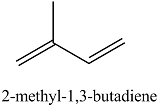
(C) Natural rubber is $cis-1,4-polyisoprene$.
It is a linear polymer of isoprene.
Isoprene is $2-methyl-1,3-butadiene$.
It is a linear polymer of isoprene.
Isoprene is $2-methyl-1,3-butadiene$.
0 likes
View Solution22
EasyMCQ
$A$ condensation polymer among the following polymers is
A
$PVC$
B
$Teflon$
C
$Dacron$
D
$Polystyrene$
Solution
(C) The polymer formed by condensation polymerization is known as a condensation polymer.
$Dacron$ (also known as $Terylene$) is a condensation polymer.
It is formed by the condensation polymerization of $terephthalic \ acid$ and $ethylene \ glycol$ with the elimination of water molecules.
$Dacron$ (also known as $Terylene$) is a condensation polymer.
It is formed by the condensation polymerization of $terephthalic \ acid$ and $ethylene \ glycol$ with the elimination of water molecules.
0 likes
View Solution23
EasyMCQ
Which of the following is not a natural polymer?
A
Cellulose
B
Protein
C
$PVC$
D
Nucleic acid
Solution
(C) $PVC$ (Polyvinyl chloride) is a synthetic polymer prepared by the polymerization of vinyl chloride monomer. Cellulose,proteins,and nucleic acids are naturally occurring polymers found in plants and animals.
0 likes
View Solution24
DifficultMCQ
Which of the following describes a syndiotactic polymer in $-[CH_2-C(YZ)-]_n$?
A
All $Y$ groups lie on one side of the chain and all $Z$ groups on the other side.
B
The $Y$ and $Z$ groups lie alternately on each side of the chain.
C
The $Y$ and $Z$ groups are arranged in a random fashion.
D
$Y$ and $Z$ groups are the same.
Solution
(B) The correct answer is $(b)$. There are $3$ stereochemical arrangements possible for a polymer of the type $-[CH_2-C(YZ)-]_n$:
$(i)$ Isotactic: Here,the groups are arranged on one side of the chain. All $Y$ groups lie on one side and all $Z$ groups lie on the opposite side of the chain.
$(ii)$ Syndiotactic: The $Y$ and $Z$ groups lie alternately on each side of the chain.
$(iii)$ Atactic: The $Y$ and $Z$ groups are arranged in a random fashion.
$(i)$ Isotactic: Here,the groups are arranged on one side of the chain. All $Y$ groups lie on one side and all $Z$ groups lie on the opposite side of the chain.
$(ii)$ Syndiotactic: The $Y$ and $Z$ groups lie alternately on each side of the chain.
$(iii)$ Atactic: The $Y$ and $Z$ groups are arranged in a random fashion.
0 likes
View Solution25
MediumMCQ
Polymers of the type $Z-M_n-Y$,$i.e.$ those which contain a foreign molecule in addition to the recurring unit are known as
A
Semisynthetic polymers
B
Atactic polymers
C
Telomers
D
Plasticiser
Solution
(C) Polymers of the type $Z-M_n-Y$,which contain a foreign molecule in addition to the recurring unit,are known as telomers.
The process of their formation is called telomerisation.
The process of their formation is called telomerisation.
0 likes
View Solution26
MediumMCQ
Which of the following is a synthetic polymer?
A
Rubber
B
Perspex
C
Protein
D
Cellulose
Solution
(B) $Perspex$ (poly(methyl methacrylate)) is a synthetic polymer,whereas rubber,protein,and cellulose are natural polymers.
0 likes
View Solution27
MediumMCQ
The molecular mass of a polymer is
A
Small
B
Very small
C
Negligible
D
Large
Solution
(D) Polymers are macromolecules formed by the combination of a large number of repeating structural units.
Due to the presence of thousands of these repeating units,polymers possess a very high molecular mass,typically ranging from $10^3$ to $10^7 \ u$.
Due to the presence of thousands of these repeating units,polymers possess a very high molecular mass,typically ranging from $10^3$ to $10^7 \ u$.
0 likes
View Solution28
MediumMCQ
Which of the following polymers are hard?
A
Linear
B
Cross-linked
C
Branched chain
D
Thermoplastic
Solution
(B) Cross-linked polymers are formed by the presence of strong covalent bonds between various linear polymer chains. These bonds create a three-dimensional network structure,which makes the polymer hard,rigid,and infusible. Examples include Bakelite and melamine-formaldehyde resins.
0 likes
View Solution29
EasyMCQ
Which of the following has the largest molecular mass?
A
Monomer
B
Dimer
C
Polymer
D
Oligomer
Solution
(C) Molecular mass is a number equal to the sum of the atomic masses of the atoms in a molecule.
$A$ monomer is a molecule that forms the basic unit for polymers.
$A$ dimer is an oligomer consisting of two monomers joined by bonds that can be either strong or weak,covalent,or intermolecular.
$A$ polymer is a chemical compound with molecules bonded together in long,repeating chains.
An oligomer is a molecular complex of chemicals that consists of a few repeating units.
The polymer has the highest number of repeating units and hence,the maximum number of atoms,so it has the largest molecular mass.
$A$ monomer is a molecule that forms the basic unit for polymers.
$A$ dimer is an oligomer consisting of two monomers joined by bonds that can be either strong or weak,covalent,or intermolecular.
$A$ polymer is a chemical compound with molecules bonded together in long,repeating chains.
An oligomer is a molecular complex of chemicals that consists of a few repeating units.
The polymer has the highest number of repeating units and hence,the maximum number of atoms,so it has the largest molecular mass.
0 likes
View Solution30
MediumMCQ
$CH_2=CH_2$ is a
A
Monomer
B
Polymer
C
Isomer
D
Equimer
Solution
(A) $CH_2=CH_2$ (ethylene) is a monomer.
Large number of ethylene monomeric units combine together through polymerization to form a polymer called polyethylene,as shown in the reaction: $n(CH_2=CH_2) \rightarrow -[CH_2-CH_2]_n-$.
Large number of ethylene monomeric units combine together through polymerization to form a polymer called polyethylene,as shown in the reaction: $n(CH_2=CH_2) \rightarrow -[CH_2-CH_2]_n-$.
0 likes
View Solution31
MediumMCQ
Natural rubber contains several thousand units of $X$ linked together in the polymer chain. $X$ is
A
Neoprene
B
Isoprene
C
Chloroprene
D
Styrene
Solution
(B) Natural rubber is a linear polymer of isoprene ($2$-methyl-$1,3$-butadiene).
Its monomer unit $X$ is isoprene,which has the chemical formula $CH_2=C(CH_3)-CH=CH_2$.
Its monomer unit $X$ is isoprene,which has the chemical formula $CH_2=C(CH_3)-CH=CH_2$.
0 likes
View Solution32
MediumMCQ
Natural rubber is basically a polymer of which of the following? Or,what is the monomer of natural rubber?
A
Neoprene
B
Isoprene
C
Chloroprene
D
Butadiene
Solution
(B) Natural rubber is a linear polymer of $2$-methyl-$1,3$-butadiene,which is commonly known as $Isoprene$.
The polymerization reaction is:
$n CH_2 = C(CH_3) - CH = CH_2 \to -(CH_2 - C(CH_3) = CH - CH_2)_n$ (Natural rubber).
The polymerization reaction is:
$n CH_2 = C(CH_3) - CH = CH_2 \to -(CH_2 - C(CH_3) = CH - CH_2)_n$ (Natural rubber).
0 likes
View Solution33
EasyMCQ
Which one is a polymer compound?
A
$SO_2$
B
$CO_2$
C
$CH_4$
D
$PVC$
Solution
(D) $SO_2$,$CO_2$,and $CH_4$ are simple chemical compounds and exist in the gaseous state at room temperature.
$PVC$ (polyvinyl chloride) is a long-chain addition polymer formed from the polymerization of vinyl chloride monomers.
$PVC$ (polyvinyl chloride) is a long-chain addition polymer formed from the polymerization of vinyl chloride monomers.
0 likes
View Solution34
EasyMCQ
The process of heat-softening,moulding and cooling to rigidness can be repeated for which plastics?
A
Thermoplastics
B
Thermosetting plastics
C
Both $(A)$ and $(B)$
D
None of the above
Solution
(A) thermoplastic,or thermosoftening plastic,is a plastic polymer material that becomes pliable or moldable at a certain elevated temperature and solidifies upon cooling.
This process of softening by heating and hardening by cooling can be repeated many times.
Thermosetting plastics,on the other hand,undergo extensive cross-linking during molding and cannot be remoulded or reused.
This process of softening by heating and hardening by cooling can be repeated many times.
Thermosetting plastics,on the other hand,undergo extensive cross-linking during molding and cannot be remoulded or reused.
0 likes
View Solution35
EasyMCQ
Which polymer possesses strong intermolecular forces,such as hydrogen bonding?
A
Natural rubber
B
Teflon
C
$SBR$
D
Polyamide (Nylon-$6$,$6$)
Solution
(D) Polymers are classified based on the magnitude of intermolecular forces present between the polymer chains.
$1$. Elastomers have weak intermolecular forces (e.g.,natural rubber).
$2$. Fibres possess strong intermolecular forces like hydrogen bonding or dipole-dipole interactions,which lead to close packing and crystalline nature (e.g.,polyamides like $Nylon-6,6$).
$3$. Thermoplastics and thermosetting polymers have intermediate to strong forces.
Among the given options,$Nylon-6,6$ (a polyamide) is a fibre that exhibits strong hydrogen bonding.
$1$. Elastomers have weak intermolecular forces (e.g.,natural rubber).
$2$. Fibres possess strong intermolecular forces like hydrogen bonding or dipole-dipole interactions,which lead to close packing and crystalline nature (e.g.,polyamides like $Nylon-6,6$).
$3$. Thermoplastics and thermosetting polymers have intermediate to strong forces.
Among the given options,$Nylon-6,6$ (a polyamide) is a fibre that exhibits strong hydrogen bonding.
0 likes
View Solution36
MediumMCQ
Natural rubber is a polymer of......
A
Neoprene
B
Isoprene
C
Chloroprene
D
Butadiene
Solution
(B) Natural rubber is a linear polymer of $2$-methyl-$1,3$-butadiene,which is commonly known as isoprene. The polymerization reaction is represented as:
$n \, CH_2 = C(CH_3) - CH = CH_2 \to -[CH_2 - C(CH_3) = CH - CH_2]_n-$
$n \, CH_2 = C(CH_3) - CH = CH_2 \to -[CH_2 - C(CH_3) = CH - CH_2]_n-$
0 likes
View Solution37
EasyMCQ
$CH_2 = CH_2$ is a/an ....
A
Monomer
B
Polymer
C
Isomer
D
Equimer
Solution
(A) $CH_2 = CH_2$ (ethene) is the basic repeating unit used in the synthesis of polyethylene. Therefore,it is classified as a monomer.
0 likes
View Solution38
EasyMCQ
Which of the following is not an example of a natural polymer?
A
Wool
B
Silk
C
Leather
D
Nylon
Solution
(D) Natural polymers are those that occur naturally in plants and animals. Examples include proteins (like wool,silk,and leather),cellulose,starch,and natural rubber. $Nylon$ is a synthetic polymer,specifically a polyamide,which is manufactured in laboratories or industries. Therefore,$Nylon$ is not a natural polymer.
0 likes
View Solution39
EasyMCQ
Which of the following is a homopolymer?
A
Bakelite
B
Buna-$S$
C
Dacron
D
Butyl rubber
Solution
(NONE) homopolymer is a polymer formed from only one type of monomer unit.
Bakelite is a copolymer of phenol and formaldehyde.
Buna-$S$ is a copolymer of $1,3$-butadiene and styrene.
Dacron (Terylene) is a copolymer of ethylene glycol and terephthalic acid.
Butyl rubber is a copolymer of isobutylene and a small amount of isoprene.
However,in the context of standard chemistry questions,if we consider common polymers,none of the options provided are strictly homopolymers in their standard industrial forms. If the question implies a single monomer type,none fit perfectly. Re-evaluating: If the question intended to list a homopolymer like Polyethylene or $PVC$,but provided these,there might be an error. Given the options,none are homopolymers. However,if we must choose,often these questions are flawed. Assuming a correction is needed,if the question asked for a copolymer,all are correct. If it asks for a homopolymer,none are correct.
Bakelite is a copolymer of phenol and formaldehyde.
Buna-$S$ is a copolymer of $1,3$-butadiene and styrene.
Dacron (Terylene) is a copolymer of ethylene glycol and terephthalic acid.
Butyl rubber is a copolymer of isobutylene and a small amount of isoprene.
However,in the context of standard chemistry questions,if we consider common polymers,none of the options provided are strictly homopolymers in their standard industrial forms. If the question implies a single monomer type,none fit perfectly. Re-evaluating: If the question intended to list a homopolymer like Polyethylene or $PVC$,but provided these,there might be an error. Given the options,none are homopolymers. However,if we must choose,often these questions are flawed. Assuming a correction is needed,if the question asked for a copolymer,all are correct. If it asks for a homopolymer,none are correct.
0 likes
View Solution40
EasyMCQ
Which of the following polymers is not obtained by addition polymerization?
A
Polystyrene
B
Nylon
C
Polypropene
D
$P.V.C$
Solution
(B) Addition polymerization involves the repeated addition of monomers containing double or triple bonds without the loss of any small molecules.
Polystyrene,Polypropene,and $P.V.C$ (Polyvinyl chloride) are formed by the addition polymerization of styrene,propene,and vinyl chloride,respectively.
Nylon (e.g.,Nylon-$6,6$) is a condensation polymer formed by the reaction between hexamethylenediamine and adipic acid,which involves the elimination of small molecules like $H_2O$.
Polystyrene,Polypropene,and $P.V.C$ (Polyvinyl chloride) are formed by the addition polymerization of styrene,propene,and vinyl chloride,respectively.
Nylon (e.g.,Nylon-$6,6$) is a condensation polymer formed by the reaction between hexamethylenediamine and adipic acid,which involves the elimination of small molecules like $H_2O$.
0 likes
View Solution41
MediumMCQ
Which of the following polymers has a linear structure?
A
Neoprene
B
Buna-$S$
C
$PMMA$
D
Glyptal
Solution
(C) Linear polymers consist of long and straight chains.
$PMMA$ (Polymethyl methacrylate) is a linear polymer.
Neoprene and Buna-$S$ are elastomers with cross-links or branched structures,and Glyptal is a thermosetting polymer with a highly cross-linked structure.
$PMMA$ (Polymethyl methacrylate) is a linear polymer.
Neoprene and Buna-$S$ are elastomers with cross-links or branched structures,and Glyptal is a thermosetting polymer with a highly cross-linked structure.
0 likes
View Solution42
EasyMCQ
Which of the following is not a polymer?
A
Ice
B
Starch
C
Protein
D
Cellulose
Solution
(A) Ice $(H_2O)$ is a molecular solid,not a polymer. Starch,protein,and cellulose are natural polymers.
0 likes
View Solution43
EasyMCQ
Which of the following is not a polymer?
A
Silk
B
$DNA$
C
$DDT$
D
Starch
Solution
(C) $DDT$ (Dichlorodiphenyltrichloroethane) is an organic compound used as an insecticide,but it is not a polymer. Silk,$DNA$,and starch are all naturally occurring polymers.
0 likes
View Solution44
EasyMCQ
Which of the following is not a polymer?
A
Teflon
B
Petroleum
C
Cellulose
D
Natural rubber
Solution
(B) Polymers are large molecules (macromolecules) formed by the repetition of structural units called monomers.
$A$. Teflon is a polymer of tetrafluoroethene.
$B$. Petroleum is a complex mixture of hydrocarbons,but it is not a polymer.
$C$. Cellulose is a natural polymer of glucose.
$D$. Natural rubber is a polymer of isoprene ($2$-methyl$-1,3-$butadiene).
Therefore,petroleum is not a polymer.
$A$. Teflon is a polymer of tetrafluoroethene.
$B$. Petroleum is a complex mixture of hydrocarbons,but it is not a polymer.
$C$. Cellulose is a natural polymer of glucose.
$D$. Natural rubber is a polymer of isoprene ($2$-methyl$-1,3-$butadiene).
Therefore,petroleum is not a polymer.
0 likes
View Solution45
EasyMCQ
Which of the following is a natural polymer?
A
Cellulose
B
$PVC$
C
Teflon
D
Polyethylene
Solution
(A) Natural polymers are polymers that occur naturally in plants and animals. $Cellulose$ is a natural polymer found in plant cell walls. $PVC$,$Teflon$,and $Polyethylene$ are synthetic polymers.
0 likes
View Solution46
EasyMCQ
Which of the following is not an example of a condensation polymer?
A
Melamine
B
Glyptal
C
Dacron
D
Neoprene
Solution
(D) Neoprene is an addition polymer formed from the polymerization of chloroprene ($2$-chloro-$1,3$-butadiene).
Condensation polymers like Melamine,Glyptal,and Dacron are formed by the loss of small molecules like $H_2O$ or $HCl$ during polymerization.
Condensation polymers like Melamine,Glyptal,and Dacron are formed by the loss of small molecules like $H_2O$ or $HCl$ during polymerization.
0 likes
View Solution47
EasyMCQ
Polyethylene is a.......
A
Random copolymer
B
Homopolymer
C
Alternating copolymer
D
Cross-linked copolymer
Solution
(B) Polyethylene is formed by the polymerization of a single type of monomer unit,which is ethene $(CH_2=CH_2)$.
Since it consists of only one type of repeating unit,it is classified as a homopolymer.
Since it consists of only one type of repeating unit,it is classified as a homopolymer.
0 likes
View Solution48
EasyMCQ
Which of the following is an example of a copolymer?
A
Buna-$S$
B
Teflon
C
$PVC$
D
Polypropylene
Solution
(A) copolymer is a polymer formed from two or more different types of monomer units.
Buna-$S$ is a copolymer formed by the polymerization of $1,3$-butadiene and styrene.
Teflon,$PVC$,and Polypropylene are homopolymers,as they are formed from a single type of monomer unit (tetrafluoroethene,vinyl chloride,and propene,respectively).
Therefore,the correct answer is Buna-$S$.
Buna-$S$ is a copolymer formed by the polymerization of $1,3$-butadiene and styrene.
Teflon,$PVC$,and Polypropylene are homopolymers,as they are formed from a single type of monomer unit (tetrafluoroethene,vinyl chloride,and propene,respectively).
Therefore,the correct answer is Buna-$S$.
0 likes
View Solution49
MediumMCQ
Which of the following polymers is an example of a fiber?
A
Silk
B
Dacron
C
Nylon-$66$
D
All of the above
Solution
(D) Silk is a protein-based natural fiber.
Dacron is a polyester fiber.
Nylon-$66$ is a polyamide fiber.
Therefore,all of the given options are examples of fibers.
Dacron is a polyester fiber.
Nylon-$66$ is a polyamide fiber.
Therefore,all of the given options are examples of fibers.
0 likes
View Solution50
EasyMCQ
Based on the mode of polymerization,polymers are classified into .......
A
Addition polymers only
B
Condensation polymers only
C
Copolymers
D
Both addition and condensation polymers
Solution
(D) Polymers are classified based on the mode of polymerization into two main types:
$1$. Addition polymers: Formed by the repeated addition of monomer molecules possessing double or triple bonds.
$2$. Condensation polymers: Formed by repeated condensation reactions between two different bi-functional or tri-functional monomeric units,often involving the loss of small molecules like $H_2O$,$HCl$,or $NH_3$.
Therefore,the correct classification includes both addition and condensation polymers.
$1$. Addition polymers: Formed by the repeated addition of monomer molecules possessing double or triple bonds.
$2$. Condensation polymers: Formed by repeated condensation reactions between two different bi-functional or tri-functional monomeric units,often involving the loss of small molecules like $H_2O$,$HCl$,or $NH_3$.
Therefore,the correct classification includes both addition and condensation polymers.
0 likes
View SolutionPolymers — Classification of Polymer · Frequently Asked Questions
1Are these Polymers questions useful for JEE and NEET?
Yes. All questions in this section are mapped to JEE Main and NEET exam patterns. Previous year questions from JEE Main, NEET, GUJCET and state-level exams are included with full solutions.
2Can I switch to Hindi or Gujarati for these questions?
Yes. Use the language tabs in the hero section or the sidebar to view the same questions and solutions in English, Hindi or Gujarati.
3How do I generate a question paper from this subtopic?
Use the Vedclass Exam Paper Generator — select the chapter and subtopic, set difficulty, and generate Sets A, B, C, D automatically. First 3 chapters of every subject are free.
Vedclass Products
For Students
Vedclass Test Series
Mock tests in real JEE/NEET style with performance analysis. 5-day free trial.
Start Free TrialFor Teachers
Exam Paper Generator
Generate Set A/B/C/D papers from this chapter in 2 minutes. 3 chapters free.
Try FreeFor Institutes
Online Exam Module
Live online exams with unlimited students, 360° analytics & white-label branding.
See DemoFor Teachers & Institutes
Generate a Polymers Exam Paper in 2 Minutes
Select subtopic & difficulty — Sets A, B, C, D auto-generated with No Repeat logic.
First 3 chapters of every subject are free — no payment required.