
A English
Classification of Polymer Questions in English
Class 12 Chemistry · Polymers · Classification of Polymer
219+
Questions
English
Language
100%
With Solutions
Showing 17 of 219 questions in English
201
EasyMCQ
Which of the following is an example of a fibre?
A
Polyester
B
Urea-formaldehyde resin
C
Polyvinyl chloride
D
Neoprene
Solution
(A) Polyamides and polyesters are two groups of synthetic fibres that possess high tensile strength,are not easily stretched,and are widely used in the textile industry.
Polyvinyl chloride is a synthetic plastic polymer,and neoprene is a synthetic rubber.
Therefore,polyester is an example of a fibre.
Hence,option $(A)$ is correct.
Polyvinyl chloride is a synthetic plastic polymer,and neoprene is a synthetic rubber.
Therefore,polyester is an example of a fibre.
Hence,option $(A)$ is correct.
0 likes
View Solution202
EasyMCQ
Teflon is an example of
A
Formaldehyde resin
B
Polyamide
C
Polyester
D
Addition polymer
Solution
(D) Teflon is a polymer of tetrafluoroethene $(CF_2=CF_2)$.
It is formed by the polymerization of tetrafluoroethene monomers without the loss of any small molecules.
Therefore,it is classified as an addition polymer.
It is formed by the polymerization of tetrafluoroethene monomers without the loss of any small molecules.
Therefore,it is classified as an addition polymer.
0 likes
View Solution203
EasyMCQ
Examples of synthetic polymer $(X)$ and semi-synthetic polymer $(Y)$ are:
A
Polythene,Rayon
B
Rayon,Nylon $6, 6$
C
Rubber,Polythene
D
Cellulose nitrate,$PVC$
Solution
(A) Synthetic polymers are human-made polymers,such as polythene,$PVC$,and nylon $6, 6$.
Semi-synthetic polymers are derived from naturally occurring polymers by chemical modification,such as cellulose nitrate and rayon (cellulose acetate).
In the given options,Polythene is a synthetic polymer $(X)$ and Rayon is a semi-synthetic polymer $(Y)$.
Semi-synthetic polymers are derived from naturally occurring polymers by chemical modification,such as cellulose nitrate and rayon (cellulose acetate).
In the given options,Polythene is a synthetic polymer $(X)$ and Rayon is a semi-synthetic polymer $(Y)$.
0 likes
View Solution204
EasyMCQ
Examples of thermoplastic polymer $(X)$ and thermosetting polymer $(Y)$ are:
$X \quad Y$
$X \quad Y$
A
Teflon,Neoprene
B
Neoprene,Glyptal
C
Polystyrene,Bakelite
D
Bakelite,Polythene
Solution
(C) Thermoplastic polymers are those that soften on heating and harden on cooling,such as Polystyrene.
Thermosetting polymers are those that undergo extensive cross-linking during molding and become infusible,such as Bakelite.
Therefore,$X = \text{Polystyrene}$ and $Y = \text{Bakelite}$.
Thermosetting polymers are those that undergo extensive cross-linking during molding and become infusible,such as Bakelite.
Therefore,$X = \text{Polystyrene}$ and $Y = \text{Bakelite}$.
0 likes
View Solution205
EasyMCQ
Identify the set with only addition homopolymers.
A
Polythene,Natural rubber,Cellulose
B
Starch,Nylon,Terylene
C
Teflon,Bakelite,Orlon
D
Polythene,Teflon,Orlon
Solution
(D) Addition polymers are formed by the repeated addition of monomer molecules possessing double or triple bonds. $A$ homopolymer is formed from only one type of monomer unit.
$1$. Polythene is formed from ethene $(CH_2=CH_2)$.
$2$. Teflon (Polytetrafluoroethene) is formed from tetrafluoroethene $(CF_2=CF_2)$.
$3$. Orlon (Polyacrylonitrile) is formed from acrylonitrile $(CH_2=CH-CN)$.
All three are addition homopolymers. Therefore,the correct set is Polythene,Teflon,and Orlon.
$1$. Polythene is formed from ethene $(CH_2=CH_2)$.
$2$. Teflon (Polytetrafluoroethene) is formed from tetrafluoroethene $(CF_2=CF_2)$.
$3$. Orlon (Polyacrylonitrile) is formed from acrylonitrile $(CH_2=CH-CN)$.
All three are addition homopolymers. Therefore,the correct set is Polythene,Teflon,and Orlon.
0 likes
View Solution206
EasyMCQ
Which one of the following is not an example of a condensation polymer?
A
Terylene
B
Nylon $6,6$
C
Bakelite
D
Polystyrene
Solution
(D) Condensation polymers are formed by repeated condensation reactions between two different bi-functional monomeric units,involving the elimination of small molecules such as water,alcohol,or hydrogen chloride.
$A$,$B$,and $C$ (Terylene,Nylon $6,6$,and Bakelite) are examples of condensation polymers.
Polystyrene is an addition polymer formed by the polymerization of styrene $(C_6H_5CH=CH_2)$ monomers without the elimination of any small molecules.
$A$,$B$,and $C$ (Terylene,Nylon $6,6$,and Bakelite) are examples of condensation polymers.
Polystyrene is an addition polymer formed by the polymerization of styrene $(C_6H_5CH=CH_2)$ monomers without the elimination of any small molecules.
0 likes
View Solution207
EasyMCQ
Amongst the following,how many of them come under the category of elastomers?
Natural rubber,polyethene,vulcanized rubber,bakelite,polyvinylchloride,Buna-$N$,Nylon $6$,Neoprene
Natural rubber,polyethene,vulcanized rubber,bakelite,polyvinylchloride,Buna-$N$,Nylon $6$,Neoprene
A
$4$
B
$5$
C
$3$
D
$6$
Solution
(A) Elastomers are polymers that have weak intermolecular forces of attraction,allowing them to be stretched.
These include: Natural rubber,vulcanized rubber,Buna-$N$,and Neoprene.
Therefore,there are $4$ elastomers in the given list.
These include: Natural rubber,vulcanized rubber,Buna-$N$,and Neoprene.
Therefore,there are $4$ elastomers in the given list.
0 likes
View Solution208
EasyMCQ
Match the items in List-$I$ (Polymer Type) with the items in List-$II$ (Example):
| List-$I$ (Polymer Type) | List-$II$ (Example) |
|---|---|
| $(A)$ Fibre | $(I)$ Bakelite |
| $(B)$ Elastomer | $(II)$ Polystyrene |
| $(C)$ Thermosetting polymer | $(III)$ Neoprene |
| $(D)$ Thermoplastic polymer | $(IV)$ Dacron |
A
$A-III, B-IV, C-I, D-II$
B
$A-IV, B-III, C-I, D-II$
C
$A-II, B-I, C-IV, D-III$
D
$A-IV, B-I, C-II, D-III$
Solution
(B) The correct matching is as follows:
$(A)$ Fibre: $(IV)$ Dacron
$(B)$ Elastomer: $(III)$ Neoprene
$(C)$ Thermosetting polymer: $(I)$ Bakelite
$(D)$ Thermoplastic polymer: $(II)$ Polystyrene
Therefore,the correct sequence is $A-IV, B-III, C-I, D-II$.
$(A)$ Fibre: $(IV)$ Dacron
$(B)$ Elastomer: $(III)$ Neoprene
$(C)$ Thermosetting polymer: $(I)$ Bakelite
$(D)$ Thermoplastic polymer: $(II)$ Polystyrene
Therefore,the correct sequence is $A-IV, B-III, C-I, D-II$.
0 likes
View Solution209
EasyMCQ
Which one among the following is a semi-synthetic polymer?
A
Cellulose acetate
B
Starch
C
Rubber
D
Nylon-$6, 6$
Solution
(A) semi-synthetic polymer is derived from a naturally occurring polymer through chemical modification.
Starch and rubber are natural polymers,while nylon-$6, 6$ is a synthetic polymer.
Cellulose acetate is prepared by the acetylation of cellulose,which is a natural polymer.
Therefore,the reaction is: $Cellulose \xrightarrow{\text{Acetylation}} Cellulose \ acetate$ (Natural polymer $\rightarrow$ Semi-synthetic polymer).
Starch and rubber are natural polymers,while nylon-$6, 6$ is a synthetic polymer.
Cellulose acetate is prepared by the acetylation of cellulose,which is a natural polymer.
Therefore,the reaction is: $Cellulose \xrightarrow{\text{Acetylation}} Cellulose \ acetate$ (Natural polymer $\rightarrow$ Semi-synthetic polymer).
0 likes
View Solution210
MediumMCQ
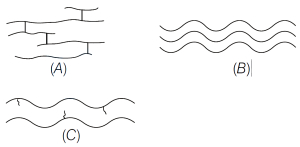
The schematic illustrations of macromolecules given below represent:
A
$A$: $HDPE$,$B$: $LDPE$,$C$: Bakelite
B
$A$: Bakelite,$B$: $HDPE$,$C$: $LDPE$
C
$A$: $HDPE$,$B$: Bakelite,$C$: $LDPE$
D
$A$: $LDPE$,$B$: Bakelite,$C$: $HDPE$
Solution
(B) The schematic illustrations represent the structures of different types of polymers:
$(A)$ shows a cross-linked polymer structure,which is characteristic of thermosetting polymers like Bakelite.
$(B)$ shows linear polymer chains,which is characteristic of high-density polyethylene $(HDPE)$.
$(C)$ shows branched polymer chains,which is characteristic of low-density polyethylene $(LDPE)$.
$(A)$ shows a cross-linked polymer structure,which is characteristic of thermosetting polymers like Bakelite.
$(B)$ shows linear polymer chains,which is characteristic of high-density polyethylene $(HDPE)$.
$(C)$ shows branched polymer chains,which is characteristic of low-density polyethylene $(LDPE)$.
0 likes
View Solution211
EasyMCQ
Examples for natural polymers are
A
cotton,silk,bakelite and wool
B
cellulose,polystyrene and neoprene
C
nylon,terylene and $PVC$
D
silk,cotton and proteins
Solution
(D) Natural polymers are those that occur naturally in plants and animals.
Silk,cotton,and proteins are all examples of natural polymers.
Bakelite,polystyrene,neoprene,nylon,terylene,and $PVC$ are synthetic polymers.
Silk,cotton,and proteins are all examples of natural polymers.
Bakelite,polystyrene,neoprene,nylon,terylene,and $PVC$ are synthetic polymers.
0 likes
View Solution212
MediumMCQ
Identify the copolymer from the following.
A
$[CH_2-CH=CH-CH_2-CH(C_6H_5)-CH_2]_n$
B
$[CF_2-CF_2]_n$
C
$[CH_2-C(Cl)=CH-CH_2]_n$
D
$[CH_2-CH(Cl)]_n$
Solution
(A) copolymer is a polymer formed from two or more different types of monomer units.
Option $A$ represents Buna-$S$ (Styrene-Butadiene Rubber),which is formed by the copolymerization of $1,3$-butadiene $(CH_2=CH-CH=CH_2)$ and styrene $(C_6H_5CH=CH_2)$.
Options $B$,$C$,and $D$ represent homopolymers:
$B$ is Polytetrafluoroethene (Teflon),
$C$ is Polychloroprene (Neoprene),
$D$ is Polyvinyl chloride $(PVC)$.
Therefore,the correct answer is $A$.
Option $A$ represents Buna-$S$ (Styrene-Butadiene Rubber),which is formed by the copolymerization of $1,3$-butadiene $(CH_2=CH-CH=CH_2)$ and styrene $(C_6H_5CH=CH_2)$.
Options $B$,$C$,and $D$ represent homopolymers:
$B$ is Polytetrafluoroethene (Teflon),
$C$ is Polychloroprene (Neoprene),
$D$ is Polyvinyl chloride $(PVC)$.
Therefore,the correct answer is $A$.
0 likes
View Solution213
EasyMCQ
Which one of the following is not a biopolymer?
A
Cellulose
B
Nylon-$6$
C
Insulin
D
$DNA$
Solution
(B) Polymers which control various life processes in plants and animals are called biopolymers.
Cellulose,Insulin,$DNA$,starch,and proteins are examples of biopolymers.
Nylon-$6$ is a synthetic polymer,not a biopolymer.
Cellulose,Insulin,$DNA$,starch,and proteins are examples of biopolymers.
Nylon-$6$ is a synthetic polymer,not a biopolymer.
0 likes
View Solution214
MediumMCQ
Match the following:
| List-$I$ (Type of polymer) | List-$II$ (Structure of the example) |
|---|---|
| $A$. Fibre | $I$. Nylon-$6$,$6$ |
| $B$. Elastomer | $II$. Neoprene |
| $C$. Thermosetting polymer | $III$. Bakelite |
| $D$. Thermoplastic polymer | $IV$. Polyvinyl chloride |
A
$A-II, B-IV, C-I, D-III$
B
$A-II, B-III, C-IV, D-I$
C
$A-III, B-I, C-IV, D-II$
D
$A-I, B-II, C-III, D-IV$
Solution
(D) The classification of polymers based on molecular forces is as follows:
$A$. Fibre: These have strong intermolecular forces like hydrogen bonding. Example: Nylon-$6$,$6$ $(I)$.
$B$. Elastomer: These have weak intermolecular forces allowing stretching. Example: Neoprene $(II)$.
$C$. Thermosetting polymer: These are cross-linked polymers that become hard on heating. Example: Bakelite $(III)$.
$D$. Thermoplastic polymer: These soften on heating and harden on cooling. Example: Polyvinyl chloride $(IV)$.
Therefore,the correct matching is $A-I, B-II, C-III, D-IV$.
$A$. Fibre: These have strong intermolecular forces like hydrogen bonding. Example: Nylon-$6$,$6$ $(I)$.
$B$. Elastomer: These have weak intermolecular forces allowing stretching. Example: Neoprene $(II)$.
$C$. Thermosetting polymer: These are cross-linked polymers that become hard on heating. Example: Bakelite $(III)$.
$D$. Thermoplastic polymer: These soften on heating and harden on cooling. Example: Polyvinyl chloride $(IV)$.
Therefore,the correct matching is $A-I, B-II, C-III, D-IV$.
0 likes
View Solution215
EasyMCQ
$A$ polymer contains $50$ molecules with molecular mass $5,000$,$100$ molecules with molecular mass $10,000$ and $50$ molecules with molecular mass $15,000$. Calculate the number average molecular mass. (in $,000$)
A
$5$
B
$75$
C
$10$
D
$20$
Solution
(C) The number average molecular mass $(M_n)$ is calculated using the formula: $M_n = \frac{\sum N_i M_i}{\sum N_i} = \frac{N_1 M_1 + N_2 M_2 + N_3 M_3}{N_1 + N_2 + N_3}$.
Given: $N_1 = 50, M_1 = 5,000$; $N_2 = 100, M_2 = 10,000$; $N_3 = 50, M_3 = 15,000$.
Substituting the values: $M_n = \frac{(50 \times 5,000) + (100 \times 10,000) + (50 \times 15,000)}{50 + 100 + 50}$.
$M_n = \frac{250,000 + 1,000,000 + 750,000}{200} = \frac{2,000,000}{200} = 10,000$.
Thus,the number average molecular mass is $10,000$.
Given: $N_1 = 50, M_1 = 5,000$; $N_2 = 100, M_2 = 10,000$; $N_3 = 50, M_3 = 15,000$.
Substituting the values: $M_n = \frac{(50 \times 5,000) + (100 \times 10,000) + (50 \times 15,000)}{50 + 100 + 50}$.
$M_n = \frac{250,000 + 1,000,000 + 750,000}{200} = \frac{2,000,000}{200} = 10,000$.
Thus,the number average molecular mass is $10,000$.
0 likes
View Solution216
EasyMCQ
Which one of the following is a condensation polymer?
A
$PVC$
B
$Teflon$
C
$Dacron$
D
$Polystyrene$
Solution
(C) $Dacron$ is a condensation polymer. It is also known as $Terylene$.
It is a polymer obtained by the condensation reaction between $Ethylene \ glycol$ and $Terephthalic \ acid$ at $420-460 \ K$ in the presence of a zinc acetate-antimony trioxide catalyst.
The reaction is as follows:
$nHOCH_2CH_2OH + nHOOC-C_6H_4-COOH \xrightarrow{420-460 \ K} [-O-CH_2CH_2-O-CO-C_6H_4-CO-]_n + 2nH_2O$
It is a polymer obtained by the condensation reaction between $Ethylene \ glycol$ and $Terephthalic \ acid$ at $420-460 \ K$ in the presence of a zinc acetate-antimony trioxide catalyst.
The reaction is as follows:
$nHOCH_2CH_2OH + nHOOC-C_6H_4-COOH \xrightarrow{420-460 \ K} [-O-CH_2CH_2-O-CO-C_6H_4-CO-]_n + 2nH_2O$
0 likes
View Solution217
EasyMCQ
Which one of the following is an example of a co-polymer?
A
$Buna-S$
B
Teflon
C
$PVC$
D
Polypropylene
Solution
(A) co-polymer is a polymer formed from two or more different types of monomer units.
$Buna-S$ is a co-polymer formed by the polymerisation of $1,3-butadiene$ and styrene.
The structure of $Buna-S$ is: $(-CH_2-CH=CH-CH_2-CH(C_6H_5)-CH_2-)_n$.
Teflon,$PVC$,and Polypropylene are homopolymers.
$Buna-S$ is a co-polymer formed by the polymerisation of $1,3-butadiene$ and styrene.
The structure of $Buna-S$ is: $(-CH_2-CH=CH-CH_2-CH(C_6H_5)-CH_2-)_n$.
Teflon,$PVC$,and Polypropylene are homopolymers.
0 likes
View SolutionPolymers — Classification of Polymer · Frequently Asked Questions
1Are these Polymers questions useful for JEE and NEET?
Yes. All questions in this section are mapped to JEE Main and NEET exam patterns. Previous year questions from JEE Main, NEET, GUJCET and state-level exams are included with full solutions.
2Can I switch to Hindi or Gujarati for these questions?
Yes. Use the language tabs in the hero section or the sidebar to view the same questions and solutions in English, Hindi or Gujarati.
3How do I generate a question paper from this subtopic?
Use the Vedclass Exam Paper Generator — select the chapter and subtopic, set difficulty, and generate Sets A, B, C, D automatically. First 3 chapters of every subject are free.
Vedclass Products
For Students
Vedclass Test Series
Mock tests in real JEE/NEET style with performance analysis. 5-day free trial.
Start Free TrialFor Teachers
Exam Paper Generator
Generate Set A/B/C/D papers from this chapter in 2 minutes. 3 chapters free.
Try FreeFor Institutes
Online Exam Module
Live online exams with unlimited students, 360° analytics & white-label branding.
See DemoFor Teachers & Institutes
Generate a Polymers Exam Paper in 2 Minutes
Select subtopic & difficulty — Sets A, B, C, D auto-generated with No Repeat logic.
First 3 chapters of every subject are free — no payment required.