
A English
Oxygen family Questions in English
Class 12 Chemistry · p-Block Elements (Class 12) · Oxygen family
406+
Questions
English
Language
100%
With Solutions
Showing 50 of 406 questions in English
151
MediumMCQ
Which of the following statements is incorrect for sulfur?
A
$S_2$ molecule is paramagnetic.
B
In vapor state at $200\,^{\circ}C$,sulfur exists as $S_8$ rings.
C
At $600\,^{\circ}C$,$S_2$ gas exists in the vapor state.
D
In sulfur compounds,the oxidation state of sulfur is never less than $+4$.
Solution
(D) $1$. $S_2$ molecule is paramagnetic,similar to $O_2$,due to the presence of two unpaired electrons in its antibonding $\pi^*$ molecular orbitals.
$2$. At $200\,^{\circ}C$,sulfur vapor consists mainly of $S_8$ molecules which have a puckered ring structure.
$3$. At high temperatures like $600\,^{\circ}C$,$S_8$ rings break down into $S_2$ molecules,which are paramagnetic.
$4$. Sulfur exhibits a wide range of oxidation states from $-2$ to $+6$ (e.g.,in $H_2S$,the oxidation state of sulfur is $-2$). Therefore,the statement that the oxidation state is never less than $+4$ is incorrect.
$2$. At $200\,^{\circ}C$,sulfur vapor consists mainly of $S_8$ molecules which have a puckered ring structure.
$3$. At high temperatures like $600\,^{\circ}C$,$S_8$ rings break down into $S_2$ molecules,which are paramagnetic.
$4$. Sulfur exhibits a wide range of oxidation states from $-2$ to $+6$ (e.g.,in $H_2S$,the oxidation state of sulfur is $-2$). Therefore,the statement that the oxidation state is never less than $+4$ is incorrect.
0 likes
View Solution152
MediumMCQ
Sulphuric acid reacts with $PCl_5$ to give
A
Thionyl chloride
B
Sulphur monochloride
C
Sulphuryl chloride
D
Sulphur tetrachloride
Solution
(C) The reaction between sulphuric acid and phosphorus pentachloride produces sulphuryl chloride,phosphoryl chloride,and hydrogen chloride gas.
The balanced chemical equation is:
$H_2SO_4 + 2PCl_5 \rightarrow SO_2Cl_2 + 2POCl_3 + 2HCl$
The balanced chemical equation is:
$H_2SO_4 + 2PCl_5 \rightarrow SO_2Cl_2 + 2POCl_3 + 2HCl$
0 likes
View Solution153
EasyMCQ
Which of the elements of group $16$ has the maximum tendency of catenation?
A
Oxygen
B
Sulphur
C
Selenium
D
Tellurium
Solution
(B) The tendency towards catenation depends on the strength of the element-element bond.
As the atomic size increases from $S$ to $Te$,the bond dissociation energy decreases.
Although oxygen is the first element,the $O-O$ bond energy is smaller than that of $S-S$ due to significant inter-electronic repulsions between the lone pairs of the small oxygen atoms.
Therefore,sulphur $(S)$ exhibits the maximum tendency towards catenation among group $16$ elements.
As the atomic size increases from $S$ to $Te$,the bond dissociation energy decreases.
Although oxygen is the first element,the $O-O$ bond energy is smaller than that of $S-S$ due to significant inter-electronic repulsions between the lone pairs of the small oxygen atoms.
Therefore,sulphur $(S)$ exhibits the maximum tendency towards catenation among group $16$ elements.
0 likes
View Solution154
DifficultMCQ
Which of the following compounds undergoes hydrolysis easily?
A
$SF_6$
B
$SCl_6$
C
$SeF_6$
D
$TeF_6$
Solution
(D) The hydrolysis of $SX_6$ type compounds is governed by steric hindrance and the availability of vacant $d$-orbitals.
$SF_6$ is kinetically inert to hydrolysis due to the high steric hindrance provided by six fluorine atoms around the central sulfur atom,which prevents the attack of water molecules.
$SCl_6$ is not a stable compound.
$SeF_6$ and $TeF_6$ also show resistance to hydrolysis due to steric factors,but as the size of the central atom increases from $S$ to $Te$,the steric hindrance decreases,making $TeF_6$ more susceptible to hydrolysis compared to $SF_6$.
However,among the given options,$TeF_6$ is the most susceptible to hydrolysis because the larger size of the $Te$ atom reduces the steric crowding compared to $SF_6$ and $SeF_6$.
$SF_6$ is kinetically inert to hydrolysis due to the high steric hindrance provided by six fluorine atoms around the central sulfur atom,which prevents the attack of water molecules.
$SCl_6$ is not a stable compound.
$SeF_6$ and $TeF_6$ also show resistance to hydrolysis due to steric factors,but as the size of the central atom increases from $S$ to $Te$,the steric hindrance decreases,making $TeF_6$ more susceptible to hydrolysis compared to $SF_6$.
However,among the given options,$TeF_6$ is the most susceptible to hydrolysis because the larger size of the $Te$ atom reduces the steric crowding compared to $SF_6$ and $SeF_6$.
0 likes
View Solution155
EasyMCQ
The molecular formula of pyrosulfuric acid is
A
$H_2S_2O_3$
B
$H_2S_2O_4$
C
$H_2S_2O_6$
D
$H_2S_2O_7$
Solution
(D) Disulfuric acid,also known as pyrosulfuric acid,is an oxoacid of sulfur.
It is a major constituent of fuming sulfuric acid,commonly known as oleum.
The chemical formula of pyrosulfuric acid is $H_2S_2O_7$.
It is a major constituent of fuming sulfuric acid,commonly known as oleum.
The chemical formula of pyrosulfuric acid is $H_2S_2O_7$.
0 likes
View Solution156
MediumMCQ
The catalyst used in the contact process is
A
$Fe_2O_3$
B
$V_2O_5$
C
$SO_3$
D
$Ag_2O$
Solution
(B) The contact process is an industrial method used for the manufacture of sulfuric acid $(H_2SO_4)$.
In this process,sulfur dioxide $(SO_2)$ is oxidized to sulfur trioxide $(SO_3)$ in the presence of vanadium pentoxide $(V_2O_5)$ as a catalyst.
The reaction is: $2SO_2(g) + O_2(g) \xrightarrow{V_2O_5} 2SO_3(g)$.
In this process,sulfur dioxide $(SO_2)$ is oxidized to sulfur trioxide $(SO_3)$ in the presence of vanadium pentoxide $(V_2O_5)$ as a catalyst.
The reaction is: $2SO_2(g) + O_2(g) \xrightarrow{V_2O_5} 2SO_3(g)$.
0 likes
View Solution157
EasyMCQ
Which of the following acids is the strongest?
A
$H_2S$
B
$H_2Se$
C
$H_2Te$
D
$H_2O$
Solution
(C) The acidic strength of hydrides of group $16$ elements increases down the group.
As we move from $O$ to $Te$,the atomic size of the central atom increases.
This leads to an increase in the bond length of the $H-E$ bond (where $E = O, S, Se, Te$).
Consequently,the bond dissociation enthalpy decreases,making it easier to release $H^+$ ions.
Therefore,the order of acidic strength is $H_2O < H_2S < H_2Se < H_2Te$.
Thus,$H_2Te$ is the strongest acid among the given options.
As we move from $O$ to $Te$,the atomic size of the central atom increases.
This leads to an increase in the bond length of the $H-E$ bond (where $E = O, S, Se, Te$).
Consequently,the bond dissociation enthalpy decreases,making it easier to release $H^+$ ions.
Therefore,the order of acidic strength is $H_2O < H_2S < H_2Se < H_2Te$.
Thus,$H_2Te$ is the strongest acid among the given options.
0 likes
View Solution158
EasyMCQ
Caro's acid is
A
$H_2SO_5$
B
$H_2S_2O_5$
C
$H_2S_2O_7$
D
$H_2S_2O_8$
Solution
(A) $H_2SO_5$ is known as Caro's acid,also known as peroxymonosulfuric acid.
0 likes
View Solution159
EasyMCQ
What are the products formed when ferrous sulphate $(FeSO_4 \cdot 7H_2O)$ is heated strongly?
A
$SO_2$ and $SO_3$
B
$SO_2$ only
C
$SO_3$ only
D
$H_2S$ only
Solution
(A) When ferrous sulphate heptahydrate $(FeSO_4 \cdot 7H_2O)$ is heated,it first loses its water of crystallization to form anhydrous ferrous sulphate $(FeSO_4)$.
On further strong heating,anhydrous ferrous sulphate decomposes to form ferric oxide $(Fe_2O_3)$,sulphur dioxide $(SO_2)$,and sulphur trioxide $(SO_3)$.
The chemical equation is: $2FeSO_4(s) \xrightarrow{\Delta} Fe_2O_3(s) + SO_2(g) + SO_3(g)$.
On further strong heating,anhydrous ferrous sulphate decomposes to form ferric oxide $(Fe_2O_3)$,sulphur dioxide $(SO_2)$,and sulphur trioxide $(SO_3)$.
The chemical equation is: $2FeSO_4(s) \xrightarrow{\Delta} Fe_2O_3(s) + SO_2(g) + SO_3(g)$.
0 likes
View Solution160
DifficultMCQ
In the following reaction,identify the nature of the product formed by the complete hydrolysis of the underlined atom at $R.T.$:
$\underline{Te}F_6 + H_2O \longrightarrow H_6TeO_6 + HF$
$\underline{Te}F_6 + H_2O \longrightarrow H_6TeO_6 + HF$
A
If the product is an oxyacid with an $-ic$ suffix.
B
If the product is an oxyacid with an $-ous$ suffix.
C
If the products are two oxyacids,one with an $-ic$ suffix and the other with an $-ous$ suffix.
D
If the product is not an oxyacid,neither with an $-ic$ suffix nor with an $-ous$ suffix.
Solution
(A) The reaction is: $\underline{Te}F_6 + 6H_2O \longrightarrow H_6TeO_6 + 6HF$.
Here,$H_6TeO_6$ is orthotelluric acid,which can be written as $Te(OH)_6$ or $H_2TeO_4 \cdot 2H_2O$.
The oxidation state of $Te$ in $H_6TeO_6$ is $+6$.
Since $Te$ is in its highest oxidation state $(+6)$,the corresponding oxyacid is named telluric acid,which ends with the $-ic$ suffix.
Therefore,the product is an oxyacid with an $-ic$ suffix.
Here,$H_6TeO_6$ is orthotelluric acid,which can be written as $Te(OH)_6$ or $H_2TeO_4 \cdot 2H_2O$.
The oxidation state of $Te$ in $H_6TeO_6$ is $+6$.
Since $Te$ is in its highest oxidation state $(+6)$,the corresponding oxyacid is named telluric acid,which ends with the $-ic$ suffix.
Therefore,the product is an oxyacid with an $-ic$ suffix.
0 likes
View Solution161
DifficultMCQ
In the following reaction,assign the product of complete hydrolysis at $R.T.$ for the underlined atom:
$\underline{S}OF_4 + H_2O \longrightarrow H_2SO_4 + HF$
$\underline{S}OF_4 + H_2O \longrightarrow H_2SO_4 + HF$
A
If product is oxy acid with $-ic$ suffix
B
If product is oxy acid with $-ous$ suffix
C
If product are two oxy acids one with $-ic$ suffix and other one with $-ous$ suffix.
D
If product is not oxy acid,neither with $-ic$ suffix nor with $-ous$ suffix.
Solution
(A) The reaction for the complete hydrolysis of $SOF_4$ is:
$SOF_4 + 3H_2O \longrightarrow H_2SO_4 + 4HF$
In $H_2SO_4$ (sulfuric acid),the oxidation state of sulfur is $+6$.
Since the suffix is $-ic$ for the acid with the higher oxidation state,$H_2SO_4$ is an oxy acid with an $-ic$ suffix.
Therefore,the correct option is $A$.
$SOF_4 + 3H_2O \longrightarrow H_2SO_4 + 4HF$
In $H_2SO_4$ (sulfuric acid),the oxidation state of sulfur is $+6$.
Since the suffix is $-ic$ for the acid with the higher oxidation state,$H_2SO_4$ is an oxy acid with an $-ic$ suffix.
Therefore,the correct option is $A$.
0 likes
View Solution162
MediumMCQ
Which of the following compounds does not liberate oxygen gas on warming with concentrated $H_2SO_4$?
A
$SO_3$
B
$PbO_2$
C
$MnO_2$
D
$CrO_5$
Solution
(A) $1$. $SO_3$ reacts with concentrated $H_2SO_4$ to form oleum $(H_2S_2O_7)$ and does not release oxygen gas.
$2$. $PbO_2$ reacts with concentrated $H_2SO_4$ to release oxygen: $2PbO_2 + 2H_2SO_4 \rightarrow 2PbSO_4 + 2H_2O + O_2 \uparrow$.
$3$. $MnO_2$ reacts with concentrated $H_2SO_4$ to release oxygen: $2MnO_2 + 2H_2SO_4 \rightarrow 2MnSO_4 + 2H_2O + O_2 \uparrow$.
$4$. $CrO_5$ (chromium peroxide) is unstable and decomposes in the presence of acid to release oxygen: $4CrO_5 + 6H_2SO_4 \rightarrow 2Cr_2(SO_4)_3 + 6H_2O + 7O_2 \uparrow$.
$2$. $PbO_2$ reacts with concentrated $H_2SO_4$ to release oxygen: $2PbO_2 + 2H_2SO_4 \rightarrow 2PbSO_4 + 2H_2O + O_2 \uparrow$.
$3$. $MnO_2$ reacts with concentrated $H_2SO_4$ to release oxygen: $2MnO_2 + 2H_2SO_4 \rightarrow 2MnSO_4 + 2H_2O + O_2 \uparrow$.
$4$. $CrO_5$ (chromium peroxide) is unstable and decomposes in the presence of acid to release oxygen: $4CrO_5 + 6H_2SO_4 \rightarrow 2Cr_2(SO_4)_3 + 6H_2O + 7O_2 \uparrow$.
0 likes
View Solution163
MediumMCQ
Which of the following is a colourless gas that exhibits both oxidising and reducing properties?
A
$CO_2$
B
$SO_2$
C
$NO_2$
D
$SO_3$
Solution
(B) $SO_2$ acts as a reducing agent because sulfur can be oxidized from $+4$ to $+6$ (e.g.,forming $SO_4^{2-}$).
It acts as an oxidizing agent because sulfur can be reduced from $+4$ to $0$ (e.g.,forming $S$).
$SO_2$ is a colourless gas,whereas $NO_2$ is a brown gas.
It acts as an oxidizing agent because sulfur can be reduced from $+4$ to $0$ (e.g.,forming $S$).
$SO_2$ is a colourless gas,whereas $NO_2$ is a brown gas.
0 likes
View Solution164
MediumMCQ
In which of the following reactions is $SO_2$ gas not produced?
A
$S_8 + \text{conc. } H_2SO_4 \xrightarrow{\text{warm}}$
B
$S_8 + \text{conc. } HNO_3 \xrightarrow{\text{warm}}$
C
$PbS + O_2 \xrightarrow{\Delta}$
D
$FeS_2 + O_2 \xrightarrow{\Delta}$
Solution
(B) The reaction of $S_8$ with concentrated $H_2SO_4$ is: $\frac{1}{8}S_8 + 2H_2SO_4 \xrightarrow{\text{warm}} 3SO_2 + 2H_2O$. Here $SO_2$ is produced.
The reaction of $S_8$ with concentrated $HNO_3$ is: $\frac{1}{8}S_8 + 6HNO_3 \xrightarrow{\text{warm}} H_2SO_4 + 6NO_2 + 2H_2O$. Here $H_2SO_4$ and $NO_2$ are produced,not $SO_2$.
The roasting of $PbS$ is: $2PbS + 3O_2 \xrightarrow{\Delta} 2PbO + 2SO_2$. Here $SO_2$ is produced.
The roasting of $FeS_2$ is: $4FeS_2 + 11O_2 \xrightarrow{\Delta} 2Fe_2O_3 + 8SO_2$. Here $SO_2$ is produced.
Thus,$SO_2$ is not produced in option $B$.
The reaction of $S_8$ with concentrated $HNO_3$ is: $\frac{1}{8}S_8 + 6HNO_3 \xrightarrow{\text{warm}} H_2SO_4 + 6NO_2 + 2H_2O$. Here $H_2SO_4$ and $NO_2$ are produced,not $SO_2$.
The roasting of $PbS$ is: $2PbS + 3O_2 \xrightarrow{\Delta} 2PbO + 2SO_2$. Here $SO_2$ is produced.
The roasting of $FeS_2$ is: $4FeS_2 + 11O_2 \xrightarrow{\Delta} 2Fe_2O_3 + 8SO_2$. Here $SO_2$ is produced.
Thus,$SO_2$ is not produced in option $B$.
0 likes
View Solution165
MediumMCQ
What is the correct order of the first electron gain enthalpy for $O, S,$ and $Se$?
A
$O > S > Se$
B
$S > Se > O$
C
$Se > O > S$
D
$S > O > Se$
Solution
(B) The electron gain enthalpy becomes less negative as we move down the group from $S$ to $Se$.
However,oxygen $(O)$ has a very small size,which leads to strong inter-electronic repulsions between the incoming electron and the electrons already present in the $2p$ subshell.
Due to this,the energy released during the addition of an electron to $O$ is less than that for $S$.
Therefore,the correct order of electron gain enthalpy (magnitude) is $S > Se > O$.
However,oxygen $(O)$ has a very small size,which leads to strong inter-electronic repulsions between the incoming electron and the electrons already present in the $2p$ subshell.
Due to this,the energy released during the addition of an electron to $O$ is less than that for $S$.
Therefore,the correct order of electron gain enthalpy (magnitude) is $S > Se > O$.
0 likes
View Solution166
EasyMCQ
Which of the following has peroxy linkage?
A
$H_2S_2O_3$
B
$H_2SO_5$
C
$H_2S_2O_7$
D
$H_2S_4O_6$
Solution
(B) The peroxy linkage is defined as an $O-O$ bond where oxygen is in the $-1$ oxidation state.
In $H_2SO_5$ (Caro's acid),the structure is $HO-S(=O)_2-O-OH$.
Here,the $S-O-O-H$ group contains the peroxy linkage $(-O-O-)$.
Other options like $H_2S_2O_3$,$H_2S_2O_7$,and $H_2S_4O_6$ do not contain an $O-O$ bond.
In $H_2SO_5$ (Caro's acid),the structure is $HO-S(=O)_2-O-OH$.
Here,the $S-O-O-H$ group contains the peroxy linkage $(-O-O-)$.
Other options like $H_2S_2O_3$,$H_2S_2O_7$,and $H_2S_4O_6$ do not contain an $O-O$ bond.
0 likes
View Solution167
EasyMCQ
In the preparation of sulphuric acid,$V_2O_5$ is used in the reaction which is:
A
$S + O_2 \to SO_2$
B
$SO_2 + H_2O \to H_2SO_4$
C
$2SO_2 + O_2 \to 2SO_3$
D
None of these
Solution
(C) In the contact process for the industrial preparation of sulphuric acid,$V_2O_5$ (vanadium pentoxide) acts as a catalyst.
The catalytic oxidation of sulphur dioxide to sulphur trioxide is given by the reaction:
$2SO_2(g) + O_2(g) \xrightarrow{V_2O_5} 2SO_3(g)$
Therefore,the correct reaction is $2SO_2 + O_2 \to 2SO_3$.
The catalytic oxidation of sulphur dioxide to sulphur trioxide is given by the reaction:
$2SO_2(g) + O_2(g) \xrightarrow{V_2O_5} 2SO_3(g)$
Therefore,the correct reaction is $2SO_2 + O_2 \to 2SO_3$.
0 likes
View Solution168
DifficultMCQ
What is true about $H_2S_nO_6$ (Polythionic acid)?
A
Total $S-S$ bond $= n-1$
B
Number of $S$ atoms with zero oxidation state $= n-2$
C
Number of $S$ atoms with $+5$ oxidation state $= n-1$
D
Number of $S$ atoms with $+5$ oxidation state $= 2$
Solution
(D) The structure of polythionic acid $H_2S_nO_6$ is $HO_3S-(S)_{n-2}-SO_3H$.
In this structure,the two terminal sulfur atoms are bonded to three oxygen atoms and one sulfur atom,resulting in an oxidation state of $+5$ for each terminal sulfur.
There are $n-2$ sulfur atoms in the central chain,each bonded to two other sulfur atoms,resulting in an oxidation state of $0$ for these atoms.
Total $S-S$ bonds in the chain are $(n-2)$ internal bonds plus $2$ bonds connecting the terminal sulfur atoms,totaling $n-1$ $S-S$ bonds.
Thus,the number of $S$ atoms with $+5$ oxidation state is $2$,and the number of $S$ atoms with $0$ oxidation state is $n-2$.
In this structure,the two terminal sulfur atoms are bonded to three oxygen atoms and one sulfur atom,resulting in an oxidation state of $+5$ for each terminal sulfur.
There are $n-2$ sulfur atoms in the central chain,each bonded to two other sulfur atoms,resulting in an oxidation state of $0$ for these atoms.
Total $S-S$ bonds in the chain are $(n-2)$ internal bonds plus $2$ bonds connecting the terminal sulfur atoms,totaling $n-1$ $S-S$ bonds.
Thus,the number of $S$ atoms with $+5$ oxidation state is $2$,and the number of $S$ atoms with $0$ oxidation state is $n-2$.
0 likes
View Solution169
DifficultMCQ
The quantitative estimation of $O_3$ is based on
A
Its reaction with $PbS$
B
Its reaction with $NO$
C
Its reaction with $KI$ and titration of $I_2$ liberated with sodium thiosulphate
D
Its reaction with $H_2O_2$ in presence of $K_2Cr_2O_7$
Solution
(C) The quantitative estimation of $O_3$ is performed by passing it through a neutral solution of potassium iodide $(KI)$ buffered with a borate buffer $(pH = 9.2)$.
$O_3$ reacts with $KI$ to liberate $I_2$ according to the reaction: $2I^{-} + H_2O + O_3 \to 2OH^{-} + I_2 + O_2$.
The liberated $I_2$ is then titrated against a standard solution of sodium thiosulphate $(Na_2S_2O_3)$ using starch as an indicator: $I_2 + 2Na_2S_2O_3 \to Na_2S_4O_6 + 2NaI$.
$O_3$ reacts with $KI$ to liberate $I_2$ according to the reaction: $2I^{-} + H_2O + O_3 \to 2OH^{-} + I_2 + O_2$.
The liberated $I_2$ is then titrated against a standard solution of sodium thiosulphate $(Na_2S_2O_3)$ using starch as an indicator: $I_2 + 2Na_2S_2O_3 \to Na_2S_4O_6 + 2NaI$.
0 likes
View Solution170
AdvancedMCQ
Which of the following diagrams is correct for the change of sulphur compounds?
A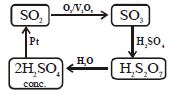
B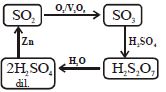
C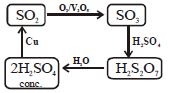
D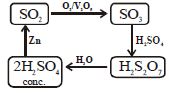
Solution
(C) The industrial production of $H_2SO_4$ (Contact Process) involves the following steps:
$1$. $2SO_2 + O_2 \xrightarrow{V_2O_5} 2SO_3$
$2$. $SO_3 + H_2SO_4 \rightarrow H_2S_2O_7$ (Oleum)
$3$. $H_2S_2O_7 + H_2O \rightarrow 2H_2SO_4$
$4$. Concentrated $H_2SO_4$ acts as an oxidizing agent and reacts with metals like $Cu$ to produce $SO_2$: $Cu + 2H_2SO_4 \text{ (conc.)} \rightarrow CuSO_4 + SO_2 + 2H_2O$.
Thus,the correct diagram is the one showing the reaction of concentrated $H_2SO_4$ with $Cu$ to form $SO_2$.
$1$. $2SO_2 + O_2 \xrightarrow{V_2O_5} 2SO_3$
$2$. $SO_3 + H_2SO_4 \rightarrow H_2S_2O_7$ (Oleum)
$3$. $H_2S_2O_7 + H_2O \rightarrow 2H_2SO_4$
$4$. Concentrated $H_2SO_4$ acts as an oxidizing agent and reacts with metals like $Cu$ to produce $SO_2$: $Cu + 2H_2SO_4 \text{ (conc.)} \rightarrow CuSO_4 + SO_2 + 2H_2O$.
Thus,the correct diagram is the one showing the reaction of concentrated $H_2SO_4$ with $Cu$ to form $SO_2$.
0 likes
View Solution171
DifficultMCQ
The incorrect statement$(s)$ about $O_3$ is (are):
A
$O-O$ bond lengths are equal
B
Thermal decomposition of $O_3$ is endothermic
C
$O_3$ is diamagnetic in nature
D
$O_3$ has a bent structure
Solution
(B) $1$. $O_3$ (ozone) exhibits resonance,resulting in equal $O-O$ bond lengths due to partial double bond character. Thus,statement $A$ is correct.
$2$. The thermal decomposition of $O_3$ into $O_2$ and $O$ is an exothermic process because the formation of the strong $O=O$ double bond releases more energy than is required to break the $O-O$ bonds in ozone. Thus,statement $B$ is incorrect.
$3$. $O_3$ has all electrons paired,making it diamagnetic. Thus,statement $C$ is correct.
$4$. $O_3$ has a bent (angular) molecular geometry due to the presence of a lone pair on the central oxygen atom. Thus,statement $D$ is correct.
Therefore,the incorrect statement is $B$.
$2$. The thermal decomposition of $O_3$ into $O_2$ and $O$ is an exothermic process because the formation of the strong $O=O$ double bond releases more energy than is required to break the $O-O$ bonds in ozone. Thus,statement $B$ is incorrect.
$3$. $O_3$ has all electrons paired,making it diamagnetic. Thus,statement $C$ is correct.
$4$. $O_3$ has a bent (angular) molecular geometry due to the presence of a lone pair on the central oxygen atom. Thus,statement $D$ is correct.
Therefore,the incorrect statement is $B$.
0 likes
View Solution172
EasyMCQ
How many $S-OH$ bonds are present in Caro's acid?
A
$1$
B
$2$
C
$3$
D
$0$
Solution
(A) Caro's acid $(H_2SO_5)$,also known as peroxymonosulfuric acid,has the structure $HO-SO_2-O-OH$.
In this structure,the sulfur atom is bonded to two oxygen atoms via double bonds $(S=O)$,one hydroxyl group $(-OH)$,and one peroxy group $(-O-OH)$.
Therefore,there is only $1$ $S-OH$ bond present in the molecule.
In this structure,the sulfur atom is bonded to two oxygen atoms via double bonds $(S=O)$,one hydroxyl group $(-OH)$,and one peroxy group $(-O-OH)$.
Therefore,there is only $1$ $S-OH$ bond present in the molecule.
0 likes
View Solution173
MediumMCQ
The correct order of $K_a$ in aqueous solution at $298 \ K$ for the hydrides of group $16$ elements is:
A
$H_2O > H_2S > H_2Se > H_2Te$
B
$H_2Te > H_2Se > H_2S > H_2O$
C
$H_2O > H_2Te > H_2Se > H_2S$
D
None of these
Solution
(B) The acidic strength of hydrides of group $16$ elements increases down the group as the bond dissociation enthalpy decreases due to the increase in atomic size of the central atom.
Therefore,the order of acidic strength $(K_a)$ is $H_2Te > H_2Se > H_2S > H_2O$.
Therefore,the order of acidic strength $(K_a)$ is $H_2Te > H_2Se > H_2S > H_2O$.
0 likes
View Solution174
MediumMCQ
Among chalcogens,the correct order of amount of energy released during electron gain (electron gain enthalpy) is
A
$S > O > Se > Te$
B
$O < S < Se < Te$
C
$Te < Se > S > O$
D
$O < Te < Se < S$
Solution
(D) The electron gain enthalpy becomes less negative as we move down the group from $S$ to $Te$ due to an increase in atomic size.
However,oxygen $(O)$ has an exceptionally low electron gain enthalpy due to its small size and strong inter-electronic repulsions.
Therefore,the correct order of electron gain enthalpy (amount of energy released) is $O < Te < Se < S$.
However,oxygen $(O)$ has an exceptionally low electron gain enthalpy due to its small size and strong inter-electronic repulsions.
Therefore,the correct order of electron gain enthalpy (amount of energy released) is $O < Te < Se < S$.
0 likes
View Solution175
MediumMCQ
$SO_2$ is a strong reducing agent; however,it can also act as an oxidising agent. Which of the following shows its oxidising nature?
A
Bleaching action
B
Decolourising of acidified $KMnO_4$ solution
C
Reaction with $H_2S$ to give sulphur
D
Turning acidified dichromate paper green
Solution
(C) In the reaction $2H_2S + SO_2 \rightarrow 2H_2O + 3S$,the oxidation state of sulphur in $SO_2$ is $+4$ and in $H_2S$ is $-2$.
Here,$SO_2$ oxidises $H_2S$ to elemental sulphur $(S^0)$ and itself gets reduced to $S^0$.
Thus,$SO_2$ acts as an oxidising agent in this reaction.
In other options,$SO_2$ acts as a reducing agent.
Here,$SO_2$ oxidises $H_2S$ to elemental sulphur $(S^0)$ and itself gets reduced to $S^0$.
Thus,$SO_2$ acts as an oxidising agent in this reaction.
In other options,$SO_2$ acts as a reducing agent.
0 likes
View Solution176
MediumMCQ
When $H_2SO_4$ reacts with $PCl_5$,the obtained product$(s)$ is/are:
A
$SO_2Cl_2$
B
$POCl_3$
C
$HCl$
D
All of these
Solution
(D) The chemical reaction between sulfuric acid $(H_2SO_4)$ and phosphorus pentachloride $(PCl_5)$ is given by the following balanced equation:
$H_2SO_4 + 2PCl_5 \longrightarrow SO_2Cl_2 + 2POCl_3 + 2HCl$
As shown in the equation,the products formed are sulfuryl chloride $(SO_2Cl_2)$,phosphorus oxychloride $(POCl_3)$,and hydrogen chloride $(HCl)$.
Therefore,all the given options are correct.
$H_2SO_4 + 2PCl_5 \longrightarrow SO_2Cl_2 + 2POCl_3 + 2HCl$
As shown in the equation,the products formed are sulfuryl chloride $(SO_2Cl_2)$,phosphorus oxychloride $(POCl_3)$,and hydrogen chloride $(HCl)$.
Therefore,all the given options are correct.
0 likes
View Solution177
EasyMCQ
The most abundant element in the Earth's crust is .............. .
A
$O$
B
$Si$
C
$H$
D
$C$
Solution
(A) The Earth's crust is composed of various elements. Oxygen $(O)$ is the most abundant element,accounting for approximately $46.6\%$ by weight. Silicon $(Si)$ is the second most abundant element,accounting for approximately $27.7\%$.
0 likes
View Solution178
MediumMCQ
Peroxo acids of sulphur are:
A
$H_2SO_5$,$H_2SO_3$ and $H_2S_2O_8$
B
$H_2SO_4$,$H_2S_2O_8$ and $H_2SO_3$
C
$H_2S_2O_7$,$H_2SO_3$ and $H_2SO_4$
D
$H_2S_2O_8$ and $H_2SO_5$
Solution
(D) Peroxo acids are those that contain a peroxy linkage $(-O-O-)$.
$H_2SO_5$ (peroxomonosulphuric acid or Caro's acid) contains one peroxy linkage.
$H_2S_2O_8$ (peroxodisulphuric acid or Marshall's acid) contains one peroxy linkage.
Therefore,$H_2S_2O_8$ and $H_2SO_5$ are the peroxo acids of sulphur.
$H_2SO_5$ (peroxomonosulphuric acid or Caro's acid) contains one peroxy linkage.
$H_2S_2O_8$ (peroxodisulphuric acid or Marshall's acid) contains one peroxy linkage.
Therefore,$H_2S_2O_8$ and $H_2SO_5$ are the peroxo acids of sulphur.
0 likes
View Solution179
DifficultMCQ
Ozone is not .....
A
an allotrope
B
a strong oxidizing agent
C
paramagnetic
D
a bent molecule
Solution
(C) Ozone $(O_3)$ is an allotrope of oxygen.
It acts as a strong oxidizing agent because it easily releases nascent oxygen $(O_3 \rightarrow O_2 + [O])$.
Ozone is a bent molecule with a bond angle of approximately $117^{\circ}$.
Ozone is diamagnetic because all its electrons are paired. Therefore,it is not paramagnetic.
It acts as a strong oxidizing agent because it easily releases nascent oxygen $(O_3 \rightarrow O_2 + [O])$.
Ozone is a bent molecule with a bond angle of approximately $117^{\circ}$.
Ozone is diamagnetic because all its electrons are paired. Therefore,it is not paramagnetic.
0 likes
View Solution180
EasyMCQ
Which of the following has the maximum tendency to form polyanions?
A
Nitrogen
B
Oxygen
C
Sulfur
D
Boron
Solution
(C) Polyanions are formed by the catenation of atoms of the same element.
Sulfur has a high tendency for catenation due to its ability to form stable $S-S$ bonds.
This property allows sulfur to form various polyanions such as $S_n^{2-}$ (e.g.,$S_6^{2-}, S_8^{2-}$).
Therefore,sulfur exhibits the maximum tendency to form polyanions among the given elements.
Sulfur has a high tendency for catenation due to its ability to form stable $S-S$ bonds.
This property allows sulfur to form various polyanions such as $S_n^{2-}$ (e.g.,$S_6^{2-}, S_8^{2-}$).
Therefore,sulfur exhibits the maximum tendency to form polyanions among the given elements.
0 likes
View Solution181
EasyMCQ
Which of the following bonds has the maximum bond energy?
A
$Se - Se$
B
$Te - Te$
C
$S - S$
D
$O - O$
Solution
(C) The bond energy depends on the size of the atoms involved in the bond. Smaller atoms form shorter and stronger bonds due to better orbital overlap. However,for group $16$ elements,the $O-O$ bond is exceptionally weak due to the high inter-electronic repulsion between the lone pairs of the small oxygen atoms. Among the remaining elements $(S, Se, Te)$,the bond strength decreases as the atomic size increases down the group. Therefore,the $S-S$ bond is the strongest among the given options.
0 likes
View Solution182
EasyMCQ
Which of the following hydrides is the most acidic?
A
$H_2Te$
B
$H_2Se$
C
$H_2O$
D
$H_2S$
Solution
(A) The acidity of hydrides of group $16$ elements increases down the group.
As we move from $O$ to $Te$,the bond dissociation enthalpy of $H-E$ bond decreases due to the increase in the size of the central atom.
Therefore,the order of acidic strength is: $H_2O < H_2S < H_2Se < H_2Te$.
Thus,$H_2Te$ is the most acidic hydride among the given options.
As we move from $O$ to $Te$,the bond dissociation enthalpy of $H-E$ bond decreases due to the increase in the size of the central atom.
Therefore,the order of acidic strength is: $H_2O < H_2S < H_2Se < H_2Te$.
Thus,$H_2Te$ is the most acidic hydride among the given options.
0 likes
View Solution183
EasyMCQ
Which of the following statements is incorrect?
A
$O_2$ is a weaker oxidizing agent than $O_3$.
B
The bond length of $O_2$ is greater than that of $O_3$.
C
Both $O_2$ and $O_3$ are paramagnetic.
D
$O_2$ is linear and $O_3$ is angular.
Solution
(C) $1$. $O_3$ is a stronger oxidizing agent than $O_2$ because it easily releases nascent oxygen $(O_3 \rightarrow O_2 + [O])$.
$2$. The bond order of $O_2$ is $2$,while the bond order of $O_3$ is $1.5$. Since bond length is inversely proportional to bond order,$O_3$ has a longer bond length than $O_2$. Thus,the statement that $O_2$ has a greater bond length is incorrect.
$3$. $O_2$ is paramagnetic due to the presence of two unpaired electrons in its antibonding molecular orbitals,whereas $O_3$ is diamagnetic.
$4$. $O_2$ is a linear molecule,and $O_3$ has a bent (angular) geometry due to $sp^2$ hybridization with one lone pair.
Therefore,statements $B$ and $C$ are incorrect. However,in standard multiple-choice contexts,$C$ is often considered the primary error as $O_3$ is diamagnetic.
$2$. The bond order of $O_2$ is $2$,while the bond order of $O_3$ is $1.5$. Since bond length is inversely proportional to bond order,$O_3$ has a longer bond length than $O_2$. Thus,the statement that $O_2$ has a greater bond length is incorrect.
$3$. $O_2$ is paramagnetic due to the presence of two unpaired electrons in its antibonding molecular orbitals,whereas $O_3$ is diamagnetic.
$4$. $O_2$ is a linear molecule,and $O_3$ has a bent (angular) geometry due to $sp^2$ hybridization with one lone pair.
Therefore,statements $B$ and $C$ are incorrect. However,in standard multiple-choice contexts,$C$ is often considered the primary error as $O_3$ is diamagnetic.
0 likes
View Solution184
EasyMCQ
The photoconductor used in a xerox machine is ....
A
Carbon
B
Black phosphorus
C
Selenium
D
Tellurium
Solution
(C) In a xerox machine,the photoconductor drum is coated with a thin layer of $Selenium$ $(Se)$. $Selenium$ is a semiconductor that becomes conductive when exposed to light,which is the fundamental principle behind the xerographic process.
0 likes
View Solution185
EasyMCQ
Which of the following statements is incorrect for $H_2SO_4$?
A
It is a reducing agent.
B
It is a dehydrating agent.
C
It is highly viscous.
D
It is a sulfonating agent.
Solution
(A) $H_2SO_4$ acts as a strong oxidizing agent and a dehydrating agent. It is not a reducing agent because the sulfur atom in $H_2SO_4$ is in its maximum oxidation state of $+6$,meaning it can only be reduced,not oxidized. Therefore,it cannot act as a reducing agent.
0 likes
View Solution186
EasyMCQ
Identify the incorrect statement regarding ozone $(O_3)$.
A
Ozone is formed in the upper atmosphere by the photochemical reaction of dioxygen $(O_2)$.
B
Ozone is more reactive than oxygen $(O_2)$.
C
Ozone is diamagnetic,whereas oxygen is paramagnetic.
D
Ozone protects living organisms on Earth from gamma radiation.
Solution
(D) $1$. Ozone $(O_3)$ is formed in the upper atmosphere by the action of ultraviolet $(UV)$ radiation on dioxygen $(O_2)$.
$2$. Ozone is a stronger oxidizing agent and more reactive than dioxygen $(O_2)$.
$3$. Ozone is diamagnetic (all electrons are paired),while dioxygen $(O_2)$ is paramagnetic (contains two unpaired electrons in its antibonding molecular orbitals).
$4$. Ozone protects the Earth's surface from harmful ultraviolet $(UV)$ radiation,not gamma radiation. Therefore,the statement claiming it protects against gamma radiation is incorrect.
$2$. Ozone is a stronger oxidizing agent and more reactive than dioxygen $(O_2)$.
$3$. Ozone is diamagnetic (all electrons are paired),while dioxygen $(O_2)$ is paramagnetic (contains two unpaired electrons in its antibonding molecular orbitals).
$4$. Ozone protects the Earth's surface from harmful ultraviolet $(UV)$ radiation,not gamma radiation. Therefore,the statement claiming it protects against gamma radiation is incorrect.
0 likes
View Solution187
EasyMCQ
Which of the following contains an $S - S$ bond?
A
$H_2S_2O_7$
B
$H_2S_2O_8$
C
$H_2S_2O_6$
D
$H_2SO_4$
Solution
(C) The structures of the given oxoacids of sulfur are as follows:
$1$. $H_2S_2O_7$ (Pyrosulfuric acid): Contains an $S-O-S$ linkage.
$2$. $H_2S_2O_8$ (Peroxodisulfuric acid): Contains an $S-O-O-S$ linkage.
$3$. $H_2S_2O_6$ (Dithionic acid): Contains an $S-S$ bond.
$4$. $H_2SO_4$ (Sulfuric acid): Contains no $S-S$ bond.
Therefore,$H_2S_2O_6$ is the correct answer.
$1$. $H_2S_2O_7$ (Pyrosulfuric acid): Contains an $S-O-S$ linkage.
$2$. $H_2S_2O_8$ (Peroxodisulfuric acid): Contains an $S-O-O-S$ linkage.
$3$. $H_2S_2O_6$ (Dithionic acid): Contains an $S-S$ bond.
$4$. $H_2SO_4$ (Sulfuric acid): Contains no $S-S$ bond.
Therefore,$H_2S_2O_6$ is the correct answer.
0 likes
View Solution188
EasyMCQ
Which of the following statements regarding ozone $(O_3)$ is not correct?
A
It oxidizes lead sulfide $(PbS)$.
B
It oxidizes potassium iodide $(KI)$.
C
It oxidizes mercury $(Hg)$.
D
It cannot act as a bleaching agent.
Solution
(D) Ozone $(O_3)$ acts as a powerful oxidizing agent because it readily decomposes to give nascent oxygen $(O_3 \rightarrow O_2 + [O])$.
It oxidizes lead sulfide $(PbS)$ to lead sulfate $(PbSO_4)$: $PbS + 4O_3 \rightarrow PbSO_4 + 4O_2$.
It oxidizes potassium iodide $(KI)$ to iodine $(I_2)$: $2KI + H_2O + O_3 \rightarrow 2KOH + I_2 + O_2$.
It oxidizes mercury $(Hg)$ to mercurous oxide $(Hg_2O)$,which causes the 'tailing of mercury' (sticking to glass): $2Hg + O_3 \rightarrow Hg_2O + O_2$.
Ozone acts as a strong bleaching agent due to the release of nascent oxygen,which oxidizes colored matter to colorless matter. Therefore,the statement that it cannot act as a bleaching agent is incorrect.
It oxidizes lead sulfide $(PbS)$ to lead sulfate $(PbSO_4)$: $PbS + 4O_3 \rightarrow PbSO_4 + 4O_2$.
It oxidizes potassium iodide $(KI)$ to iodine $(I_2)$: $2KI + H_2O + O_3 \rightarrow 2KOH + I_2 + O_2$.
It oxidizes mercury $(Hg)$ to mercurous oxide $(Hg_2O)$,which causes the 'tailing of mercury' (sticking to glass): $2Hg + O_3 \rightarrow Hg_2O + O_2$.
Ozone acts as a strong bleaching agent due to the release of nascent oxygen,which oxidizes colored matter to colorless matter. Therefore,the statement that it cannot act as a bleaching agent is incorrect.
0 likes
View Solution189
EasyMCQ
Which of the following elements exhibits the highest property of catenation?
A
$S$
B
$Se$
C
$Te$
D
$O$
Solution
(A) Catenation is the ability of an element to form bonds with its own atoms to form long chains or rings.
In the $16^{th}$ group (Oxygen family),the tendency for catenation decreases down the group as the bond energy of the $E-E$ bond decreases.
However,among the given options,Sulfur $(S)$ shows the highest tendency for catenation due to its relatively strong $S-S$ bond compared to the others in the group.
Oxygen $(O)$ shows limited catenation (e.g.,in $O_3$ or $H_2O_2$) but it is significantly less than that of Sulfur.
In the $16^{th}$ group (Oxygen family),the tendency for catenation decreases down the group as the bond energy of the $E-E$ bond decreases.
However,among the given options,Sulfur $(S)$ shows the highest tendency for catenation due to its relatively strong $S-S$ bond compared to the others in the group.
Oxygen $(O)$ shows limited catenation (e.g.,in $O_3$ or $H_2O_2$) but it is significantly less than that of Sulfur.
0 likes
View Solution190
MediumMCQ
Peroxymonosulfuric acid is known as ..........
A
Marshall's acid
B
Caro's acid
C
Sulfuric acid
D
None of these
Solution
(B) Peroxymonosulfuric acid,with the chemical formula $H_2SO_5$,is commonly known as Caro's acid.
Marshall's acid refers to peroxydisulfuric acid $(H_2S_2O_8)$.
Marshall's acid refers to peroxydisulfuric acid $(H_2S_2O_8)$.
0 likes
View Solution191
EasyMCQ
Which compound of sulfur is used as a refrigerant?
A
$SO_2$
B
$SO_3$
C
$S_2Cl_2$
D
$H_2SO_4$
Solution
(A) Sulfur dioxide $(SO_2)$ is used as a refrigerant because it can be easily liquefied under pressure and has a high latent heat of vaporization.
0 likes
View Solution192
MediumMCQ
Oxygen does not react directly with which of the following?
A
$P$
B
$Cl$
C
$Na$
D
$S$
Solution
(B) Oxygen is a highly reactive non-metal and acts as a strong oxidizing agent.
It reacts directly with most metals (like $Na$) and non-metals (like $P$ and $S$) to form their respective oxides.
However,oxygen does not react directly with halogens like chlorine $(Cl)$ under normal conditions to form oxides,as the reaction is not thermodynamically favorable or requires specific indirect methods.
It reacts directly with most metals (like $Na$) and non-metals (like $P$ and $S$) to form their respective oxides.
However,oxygen does not react directly with halogens like chlorine $(Cl)$ under normal conditions to form oxides,as the reaction is not thermodynamically favorable or requires specific indirect methods.
0 likes
View Solution193
MediumMCQ
What is obtained by the reaction of concentrated $H_2SO_4$ with $PCl_5$?
A
$SO_2Cl_2$
B
$H_3PO_4$
C
$SO_2$
D
$SOCl_2$
Solution
(A) The reaction between concentrated sulfuric acid $(H_2SO_4)$ and phosphorus pentachloride $(PCl_5)$ proceeds as follows:
$H_2SO_4 + 2PCl_5 \rightarrow SO_2Cl_2 + 2POCl_3 + 2HCl$
As shown in the chemical equation,sulfuryl chloride $(SO_2Cl_2)$ is one of the primary products formed.
$H_2SO_4 + 2PCl_5 \rightarrow SO_2Cl_2 + 2POCl_3 + 2HCl$
As shown in the chemical equation,sulfuryl chloride $(SO_2Cl_2)$ is one of the primary products formed.
0 likes
View Solution194
MediumMCQ
What is formed by the reaction of ozone with mercury?
A
$HgO$
B
$Hg_2O$
C
$Hg_2O_2$
D
$HgO_2$
Solution
(B) When ozone $(O_3)$ reacts with mercury $(Hg)$,it oxidizes mercury to mercurous oxide $(Hg_2O)$.
The chemical reaction is as follows:
$2Hg + O_3 \rightarrow Hg_2O + O_2$
This reaction is used in the tailing of mercury,where mercury loses its meniscus due to the formation of $Hg_2O$.
The chemical reaction is as follows:
$2Hg + O_3 \rightarrow Hg_2O + O_2$
This reaction is used in the tailing of mercury,where mercury loses its meniscus due to the formation of $Hg_2O$.
0 likes
View Solution195
EasyMCQ
What is the atomicity of sulfur in rhombic sulfur?
A
$1$
B
$2$
C
$6$
D
$8$
Solution
(D) Rhombic sulfur,also known as $\alpha$-sulfur,is the most stable allotrope of sulfur at room temperature.
It consists of puckered ring-shaped molecules with the formula $S_8$.
Since each molecule contains $8$ sulfur atoms,the atomicity of sulfur in rhombic sulfur is $8$.
It consists of puckered ring-shaped molecules with the formula $S_8$.
Since each molecule contains $8$ sulfur atoms,the atomicity of sulfur in rhombic sulfur is $8$.
0 likes
View Solution196
MediumMCQ
Which of the following oxides of sulfur contains a sulfur-sulfur $(S-S)$ bond?
A
$H_2S_2O_8$
B
$H_2S_2O_7$
C
$H_2S_2O_3$
D
$H_2S_2O_6$
Solution
(D) The structures of the given oxoacids of sulfur are as follows:
$1$. $H_2S_2O_8$ (Peroxodisulfuric acid): Contains an $S-O-O-S$ linkage.
$2$. $H_2S_2O_7$ (Pyrosulfuric acid): Contains an $S-O-S$ linkage.
$3$. $H_2S_2O_3$ (Thiosulfuric acid): Contains an $S-S$ bond.
$4$. $H_2S_2O_6$ (Dithionic acid): Contains an $S-S$ bond.
However,in the context of standard chemistry curriculum questions regarding sulfur-sulfur bonds in oxoacids,$H_2S_2O_6$ is the classic example of a compound with a direct $S-S$ bond. Note: $H_2S_2O_3$ also contains an $S-S$ bond,but $H_2S_2O_6$ is the most commonly cited answer for this specific question structure.
$1$. $H_2S_2O_8$ (Peroxodisulfuric acid): Contains an $S-O-O-S$ linkage.
$2$. $H_2S_2O_7$ (Pyrosulfuric acid): Contains an $S-O-S$ linkage.
$3$. $H_2S_2O_3$ (Thiosulfuric acid): Contains an $S-S$ bond.
$4$. $H_2S_2O_6$ (Dithionic acid): Contains an $S-S$ bond.
However,in the context of standard chemistry curriculum questions regarding sulfur-sulfur bonds in oxoacids,$H_2S_2O_6$ is the classic example of a compound with a direct $S-S$ bond. Note: $H_2S_2O_3$ also contains an $S-S$ bond,but $H_2S_2O_6$ is the most commonly cited answer for this specific question structure.
0 likes
View Solution197
EasyMCQ
Which of the following exists as a cyclic trimer in its solid state?
A
$SO_3$
B
$O_3$
C
$SO_2$
D
$S_4N_4$
Solution
(A) In the solid state,$SO_3$ exists as a cyclic trimer,which is represented as $(SO_3)_3$ or $S_3O_9$.
This structure consists of a six-membered ring of alternating sulfur and oxygen atoms,where each sulfur atom is also bonded to two terminal oxygen atoms.
This structure consists of a six-membered ring of alternating sulfur and oxygen atoms,where each sulfur atom is also bonded to two terminal oxygen atoms.
0 likes
View Solution198
EasyMCQ
Elements of group $16$,except $Po$,are known as chalcogens because .........
A
These elements,primarily oxygen and sulfur,are found in minerals of many metals as oxides and sulfides.
B
Many acids contain these elements ($O$ and $S$).
C
These elements primarily form anions.
D
These elements exhibit various allotropes.
Solution
(A) The term 'chalcogen' is derived from the Greek word 'chalcos' meaning 'ore' and 'gen' meaning 'producer'.
Since most of the ores of metals are found in the form of oxides and sulfides,the elements of group $16$ (excluding $Po$) are called chalcogens or ore-forming elements.
Since most of the ores of metals are found in the form of oxides and sulfides,the elements of group $16$ (excluding $Po$) are called chalcogens or ore-forming elements.
0 likes
View Solution199
EasyMCQ
Which of the following statements is correct?
A
$SF_6$ does not react with water.
B
$OF_6$ has $d^2sp^3$ hybridization.
C
$S_2O_3^{2-}$ is a linear ion.
D
$SO_4^{2-}$ does not have $\pi$ bonding.
Solution
(A) $SF_6$ is a sterically protected molecule where the sulfur atom is surrounded by six fluorine atoms,making it kinetically inert towards hydrolysis by water.
$OF_6$ does not exist because oxygen cannot expand its octet due to the absence of $d$-orbitals.
$S_2O_3^{2-}$ (thiosulfate) has a tetrahedral geometry around the central sulfur atom,not a linear one.
$SO_4^{2-}$ involves $p\pi-d\pi$ bonding between oxygen and sulfur atoms to stabilize the structure.
$OF_6$ does not exist because oxygen cannot expand its octet due to the absence of $d$-orbitals.
$S_2O_3^{2-}$ (thiosulfate) has a tetrahedral geometry around the central sulfur atom,not a linear one.
$SO_4^{2-}$ involves $p\pi-d\pi$ bonding between oxygen and sulfur atoms to stabilize the structure.
0 likes
View Solution200
EasyMCQ
Which product is obtained by the dehydration of concentrated $H_2SO_4$ in the presence of $P_4O_{10}$?
A
$SO_2$
B
$SO_3$
C
$H_2S_2O_8$
D
$SO_2$ and $SO_3$
Solution
(B) Phosphorus pentoxide $(P_4O_{10})$ is a powerful dehydrating agent. When concentrated sulfuric acid $(H_2SO_4)$ is heated with $P_4O_{10}$,it undergoes dehydration to form sulfur trioxide $(SO_3)$. The reaction is: $H_2SO_4 + P_4O_{10} \rightarrow SO_3 + H_4P_4O_{12}$ (or $4HPO_3$).
0 likes
View Solutionp-Block Elements (Class 12) — Oxygen family · Frequently Asked Questions
1Are these p-Block Elements (Class 12) questions useful for JEE and NEET?
Yes. All questions in this section are mapped to JEE Main and NEET exam patterns. Previous year questions from JEE Main, NEET, GUJCET and state-level exams are included with full solutions.
2Can I switch to Hindi or Gujarati for these questions?
Yes. Use the language tabs in the hero section or the sidebar to view the same questions and solutions in English, Hindi or Gujarati.
3How do I generate a question paper from this subtopic?
Use the Vedclass Exam Paper Generator — select the chapter and subtopic, set difficulty, and generate Sets A, B, C, D automatically. First 3 chapters of every subject are free.
Vedclass Products
For Students
Vedclass Test Series
Mock tests in real JEE/NEET style with performance analysis. 5-day free trial.
Start Free TrialFor Teachers
Exam Paper Generator
Generate Set A/B/C/D papers from this chapter in 2 minutes. 3 chapters free.
Try FreeFor Institutes
Online Exam Module
Live online exams with unlimited students, 360° analytics & white-label branding.
See DemoFor Teachers & Institutes
Generate a p-Block Elements (Class 12) Exam Paper in 2 Minutes
Select subtopic & difficulty — Sets A, B, C, D auto-generated with No Repeat logic.
First 3 chapters of every subject are free — no payment required.