
A English
Oxygen family Questions in English
Class 12 Chemistry · p-Block Elements (Class 12) · Oxygen family
406+
Questions
English
Language
100%
With Solutions
Showing 50 of 406 questions in English
51
MediumMCQ
Ozone,when reacts with potassium iodide solution,liberates a certain product which turns starch paper blue. The liberated substance is......
A
Oxygen
B
Iodine
C
Hydrogen iodide
D
Potassium hydroxide
Solution
(B) Ozone $(O_3)$ reacts with potassium iodide $(KI)$ solution in the presence of water to liberate iodine $(I_2)$:
$2KI + H_2O + O_3 \rightarrow 2KOH + I_2 + O_2$
The liberated iodine $(I_2)$ reacts with starch to form a blue-colored complex,which is a standard test for the presence of ozone.
$2KI + H_2O + O_3 \rightarrow 2KOH + I_2 + O_2$
The liberated iodine $(I_2)$ reacts with starch to form a blue-colored complex,which is a standard test for the presence of ozone.
0 likes
View Solution52
MediumMCQ
For the preparation of sodium thiosulphate by the "Springs reaction",the reactants used are
A
$Na_2S + Na_2SO_3 + Cl_2$
B
$Na_2S + SO_2$
C
$Na_2SO_3 + S$
D
$Na_2S + Na_2SO_3 + I_2$
Solution
(D) The "Springs reaction" is a method for the preparation of sodium thiosulphate $(Na_2S_2O_3)$.
In this reaction,sodium sulphide $(Na_2S)$ and sodium sulphite $(Na_2SO_3)$ react with iodine $(I_2)$ to produce sodium thiosulphate and sodium iodide $(NaI)$.
The balanced chemical equation is: $Na_2S + Na_2SO_3 + I_2 \to Na_2S_2O_3 + 2NaI$.
Therefore,the correct option is $(D)$.
In this reaction,sodium sulphide $(Na_2S)$ and sodium sulphite $(Na_2SO_3)$ react with iodine $(I_2)$ to produce sodium thiosulphate and sodium iodide $(NaI)$.
The balanced chemical equation is: $Na_2S + Na_2SO_3 + I_2 \to Na_2S_2O_3 + 2NaI$.
Therefore,the correct option is $(D)$.
0 likes
View Solution53
MediumMCQ
Rhombic sulphur has the following structure:
A
Open chain
B
Tetrahedral
C
Puckered $6-$ membered ring
D
Puckered $8-$ membered ring
Solution
(D) The structure of rhombic sulphur is molecular in nature.
It consists of $S_8$ molecules,which adopt a puckered $8-$ membered ring structure (crown shape).
The $S-S$ bond distance is $2.12 \ \mathring{A}$.
It consists of $S_8$ molecules,which adopt a puckered $8-$ membered ring structure (crown shape).
The $S-S$ bond distance is $2.12 \ \mathring{A}$.
0 likes
View Solution54
MediumMCQ
The catalyst used in the lead chamber process of sulphuric acid manufacture is
A
Platinum
B
Vanadium compounds
C
Nickel
D
Oxide of nitrogen
Solution
(D) In the lead chamber process for the manufacture of $H_2SO_4$,the oxidation of $SO_2$ to $SO_3$ is catalyzed by oxides of nitrogen ($NO$ and $NO_2$).
The reaction is: $2SO_2 + O_2 \xrightarrow{NO} 2SO_3$.
The reaction is: $2SO_2 + O_2 \xrightarrow{NO} 2SO_3$.
0 likes
View Solution55
MediumMCQ
The catalyst used in the contact process for the manufacturing of sulphuric acid is
A
Copper
B
Iron/aluminium oxide
C
Vanadium pentoxide
D
Platinized asbestos
Solution
(C) The contact process involves the catalytic oxidation of sulphur dioxide to sulphur trioxide.
The catalyst used in this process is $V_2O_5$ (Vanadium pentoxide).
The chemical reaction is: $2SO_{2(g)} + O_{2(g)} \xrightarrow{V_2O_5} 2SO_{3(g)}$.
The catalyst used in this process is $V_2O_5$ (Vanadium pentoxide).
The chemical reaction is: $2SO_{2(g)} + O_{2(g)} \xrightarrow{V_2O_5} 2SO_{3(g)}$.
0 likes
View Solution56
EasyMCQ
The test of ozone $O_3$ can be done by
A
$Ag$
B
$Hg$
C
$Au$
D
$Cu$
Solution
(B) The test for ozone $O_3$ is performed using mercury $(Hg)$.
When ozone reacts with mercury,it forms mercurous oxide $(Hg_2O)$.
The reaction is: $6Hg + O_3 \to 3Hg_2O$.
During this reaction,mercury loses its meniscus and starts sticking to the glass surface,which is a characteristic test for ozone.
When ozone reacts with mercury,it forms mercurous oxide $(Hg_2O)$.
The reaction is: $6Hg + O_3 \to 3Hg_2O$.
During this reaction,mercury loses its meniscus and starts sticking to the glass surface,which is a characteristic test for ozone.
0 likes
View Solution57
EasyMCQ
$V_2O_5$ is useful as a catalyst in:
A
Manufacture of $H_2SO_4$
B
Manufacture of $HNO_3$
C
Manufacture of $Na_2CO_3$
D
It is not a catalyst
Solution
(A) In the contact process for the industrial manufacture of $H_2SO_4$,vanadium pentoxide $(V_2O_5)$ is used as a catalyst for the oxidation of $SO_2$ to $SO_3$.
0 likes
View Solution58
EasyMCQ
Red hot iron absorbs $SO_2$ giving the product
A
$FeS + O_2$
B
$Fe_2O_3 + FeS$
C
$FeO + FeS$
D
$FeO + S$
Solution
(C) When red hot iron reacts with sulfur dioxide,it undergoes a redox reaction to form iron$(II)$ oxide and iron$(II)$ sulfide.
The balanced chemical equation is:
$3Fe + SO_2 \to 2FeO + FeS$
The balanced chemical equation is:
$3Fe + SO_2 \to 2FeO + FeS$
0 likes
View Solution59
EasyMCQ
Photoconductors in xerox machines use which of the following?
A
Mercury
B
Black phosphorus
C
Selenium
D
Tellurium
Solution
(C) In xerox machines,the photoconductor drum is typically coated with a thin layer of $Selenium$ $(Se)$. $Selenium$ is a semiconductor that exhibits photoconductivity,meaning its electrical conductivity increases when exposed to light. This property is essential for the electrostatic imaging process used in xerocopying.
0 likes
View Solution60
MediumMCQ
Identify the incorrect statement regarding ozone $(O_3)$.
A
Ozone is formed in the upper atmosphere by the photochemical action of $O_2$.
B
Ozone is more reactive than dioxygen $(O_2)$.
C
Ozone is diamagnetic while dioxygen is paramagnetic.
D
Ozone protects the Earth's organisms by absorbing gamma radiation.
Solution
(D) $1$. Ozone $(O_3)$ is formed in the upper atmosphere by the action of $UV$ radiation on dioxygen $(O_2)$.
$2$. Ozone is thermodynamically unstable with respect to oxygen,making it more reactive.
$3$. Ozone $(O_3)$ is diamagnetic (all electrons are paired),whereas dioxygen $(O_2)$ is paramagnetic (contains two unpaired electrons in antibonding molecular orbitals).
$4$. Ozone layer absorbs harmful $UV$ radiation,not gamma radiation. Therefore,the statement regarding gamma radiation is incorrect.
$2$. Ozone is thermodynamically unstable with respect to oxygen,making it more reactive.
$3$. Ozone $(O_3)$ is diamagnetic (all electrons are paired),whereas dioxygen $(O_2)$ is paramagnetic (contains two unpaired electrons in antibonding molecular orbitals).
$4$. Ozone layer absorbs harmful $UV$ radiation,not gamma radiation. Therefore,the statement regarding gamma radiation is incorrect.
0 likes
View Solution61
EasyMCQ
Which is the stable crystalline form of sulfur at room temperature?
A
Rhombic sulfur
B
Monoclinic sulfur
C
Plastic sulfur
D
Prismatic sulfur
Solution
(A) Sulfur exhibits allotropy. At room temperature,$Rhombic$ $sulfur$ (also known as $\alpha-sulfur$) is the most stable crystalline form. Monoclinic sulfur $(\beta-sulfur)$ is stable only above $369 \ K$.
0 likes
View Solution62
EasyMCQ
Which of the following oxoacids of sulfur contains a sulfur-sulfur $(S-S)$ bond?
A
$H_2S_2O_8$
B
$H_2S_2O_7$
C
$H_2S_2O_3$
D
$H_2S_2O_6$
Solution
(C) The structures of the given oxoacids are as follows:
$1$. $H_2S_2O_8$ (Peroxodisulfuric acid): Contains an $S-O-O-S$ linkage.
$2$. $H_2S_2O_7$ (Pyrosulfuric acid): Contains an $S-O-S$ linkage.
$3$. $H_2S_2O_3$ (Thiosulfuric acid): Contains an $S-S$ bond.
$4$. $H_2S_2O_6$ (Dithionic acid): Contains an $S-S$ bond.
Note: Both $H_2S_2O_3$ and $H_2S_2O_6$ contain $S-S$ bonds. However,in standard competitive chemistry questions of this type,$H_2S_2O_3$ is the most common example cited for the presence of an $S-S$ bond. Given the options,$H_2S_2O_3$ is the primary answer.
$1$. $H_2S_2O_8$ (Peroxodisulfuric acid): Contains an $S-O-O-S$ linkage.
$2$. $H_2S_2O_7$ (Pyrosulfuric acid): Contains an $S-O-S$ linkage.
$3$. $H_2S_2O_3$ (Thiosulfuric acid): Contains an $S-S$ bond.
$4$. $H_2S_2O_6$ (Dithionic acid): Contains an $S-S$ bond.
Note: Both $H_2S_2O_3$ and $H_2S_2O_6$ contain $S-S$ bonds. However,in standard competitive chemistry questions of this type,$H_2S_2O_3$ is the most common example cited for the presence of an $S-S$ bond. Given the options,$H_2S_2O_3$ is the primary answer.
0 likes
View Solution63
EasyMCQ
Which of the following compounds has the maximum number of oxo groups (terminal $O$ atoms bonded to the central atom by a double bond)?
A
$H_2SO_4$
B
$H_2SO_3$
C
$H_3PO_3$
D
$H_3PO_4$
Solution
(A) To determine the number of oxo groups,we look at the structures of the given acids:
$1$. $H_2SO_4$ (Sulfuric acid): The central $S$ atom is bonded to two $OH$ groups and two terminal $O$ atoms via double bonds. Thus,it has $2$ oxo groups.
$2$. $H_2SO_3$ (Sulfurous acid): The central $S$ atom is bonded to two $OH$ groups and one terminal $O$ atom via a double bond. Thus,it has $1$ oxo group.
$3$. $H_3PO_3$ (Phosphorous acid): The central $P$ atom is bonded to two $OH$ groups,one $H$ atom,and one terminal $O$ atom via a double bond. Thus,it has $1$ oxo group.
$4$. $H_3PO_4$ (Phosphoric acid): The central $P$ atom is bonded to three $OH$ groups and one terminal $O$ atom via a double bond. Thus,it has $1$ oxo group.
Comparing the number of oxo groups,$H_2SO_4$ has the maximum number $(2)$.
$1$. $H_2SO_4$ (Sulfuric acid): The central $S$ atom is bonded to two $OH$ groups and two terminal $O$ atoms via double bonds. Thus,it has $2$ oxo groups.
$2$. $H_2SO_3$ (Sulfurous acid): The central $S$ atom is bonded to two $OH$ groups and one terminal $O$ atom via a double bond. Thus,it has $1$ oxo group.
$3$. $H_3PO_3$ (Phosphorous acid): The central $P$ atom is bonded to two $OH$ groups,one $H$ atom,and one terminal $O$ atom via a double bond. Thus,it has $1$ oxo group.
$4$. $H_3PO_4$ (Phosphoric acid): The central $P$ atom is bonded to three $OH$ groups and one terminal $O$ atom via a double bond. Thus,it has $1$ oxo group.
Comparing the number of oxo groups,$H_2SO_4$ has the maximum number $(2)$.
0 likes
View Solution64
EasyMCQ
What is produced by the hydrolysis of one mole of peroxodisulphuric acid $(H_2S_2O_8)$?
A
Two moles of sulphuric acid
B
Two moles of peroxomonosulphuric acid
C
One mole of sulphuric acid and one mole of peroxomonosulphuric acid
D
One mole each of sulphuric acid,peroxomonosulphuric acid,and hydrogen peroxide
Solution
(C) The hydrolysis of peroxodisulphuric acid $(H_2S_2O_8)$ proceeds in two steps:
$1$. $H_2S_2O_8 + H_2O \rightarrow H_2SO_4 + H_2SO_5$
$2$. $H_2SO_5 + H_2O \rightarrow H_2SO_4 + H_2O_2$
However,for one mole of $H_2S_2O_8$,the initial hydrolysis reaction yields one mole of sulphuric acid $(H_2SO_4)$ and one mole of peroxomonosulphuric acid $(H_2SO_5)$.
$1$. $H_2S_2O_8 + H_2O \rightarrow H_2SO_4 + H_2SO_5$
$2$. $H_2SO_5 + H_2O \rightarrow H_2SO_4 + H_2O_2$
However,for one mole of $H_2S_2O_8$,the initial hydrolysis reaction yields one mole of sulphuric acid $(H_2SO_4)$ and one mole of peroxomonosulphuric acid $(H_2SO_5)$.
0 likes
View Solution65
DifficultMCQ
Assertion: The reaction between $SO_2$ and $H_2S$ in the presence of $Fe_2O_3$ catalyst gives elemental sulfur.
Reason: $SO_2$ is a reducing agent.
Reason: $SO_2$ is a reducing agent.
A
Both Assertion and Reason are true and the Reason is the correct explanation of the Assertion.
B
Both Assertion and Reason are true,but the Reason is not the correct explanation of the Assertion.
C
Assertion is true,but the Reason is false.
D
Both Assertion and Reason are false.
0 likes
View Solution66
EasyMCQ
What is obtained by the reaction of $SO_2$ with an aqueous solution of sodium hydroxide?
A
$NaHSO_3$
B
$Na_2S_2O_3$
C
$NaHSO_4$
D
$Na_2SO_4$
Solution
(A) When $SO_2$ is passed through an aqueous solution of sodium hydroxide $(NaOH)$,it reacts to form sodium bisulphite $(NaHSO_3)$.
The balanced chemical equation is: $NaOH(aq) + SO_2(g) \to NaHSO_3(aq)$.
The balanced chemical equation is: $NaOH(aq) + SO_2(g) \to NaHSO_3(aq)$.
0 likes
View Solution67
EasyMCQ
In the contact process for the production of $H_2SO_4$,which catalyst is required to convert $SO_2$ into $SO_3$?
A
$NO$
B
$V_2O_5$
C
$Fe$
D
$Ni$
Solution
(B) In the contact process,the oxidation of sulfur dioxide $(SO_2)$ to sulfur trioxide $(SO_3)$ is a reversible exothermic reaction:
$2SO_2(g) + O_2(g) \rightleftharpoons 2SO_3(g)$.
This reaction is carried out in the presence of vanadium pentoxide $(V_2O_5)$ as a catalyst to increase the rate of reaction.
$2SO_2(g) + O_2(g) \rightleftharpoons 2SO_3(g)$.
This reaction is carried out in the presence of vanadium pentoxide $(V_2O_5)$ as a catalyst to increase the rate of reaction.
0 likes
View Solution68
EasyMCQ
$SO_2$ can be converted into $SO_3$ with the help of:
A
$O_2$
B
$O_3$
C
$H_2O_2$
D
All of these
Solution
(D) The oxidation of $SO_2$ to $SO_3$ can occur through various oxidizing agents:
$1$. $2SO_2 + O_2 \xrightarrow{\text{catalyst}} 2SO_3$
$2$. $SO_2 + O_3 \rightarrow SO_3 + O_2$
$3$. $SO_2 + H_2O_2 \rightarrow SO_3 + H_2O$
Since all three reagents can facilitate this conversion,the correct option is $D$.
$1$. $2SO_2 + O_2 \xrightarrow{\text{catalyst}} 2SO_3$
$2$. $SO_2 + O_3 \rightarrow SO_3 + O_2$
$3$. $SO_2 + H_2O_2 \rightarrow SO_3 + H_2O$
Since all three reagents can facilitate this conversion,the correct option is $D$.
0 likes
View Solution69
MediumMCQ
Caro's acid is
A
$H_2SO_3$
B
$H_3S_2O_5$
C
$H_2SO_5$
D
$H_2S_2O_8$
Solution
(C) Caro's acid is $H_2SO_5$.
Its chemical structure is $HO-SO_2-O-OH$,which contains a peroxy linkage $(-O-O-)$.
Its chemical structure is $HO-SO_2-O-OH$,which contains a peroxy linkage $(-O-O-)$.
0 likes
View Solution70
MediumMCQ
In which pair of ions do both species contain an $S-S$ bond?
A
$S_4O_6^{2-}, S_2O_3^{2-}$
B
$S_2O_7^{2-}, S_2O_8^{2-}$
C
$S_4O_6^{2-}, S_2O_7^{2-}$
D
$S_2O_7^{2-}, S_2O_3^{2-}$
Solution
(A) The tetrathionate ion $(S_4O_6^{2-})$ has a structure with an $S-S-S-S$ chain,thus it contains $S-S$ bonds.
The thiosulfate ion $(S_2O_3^{2-})$ has a structure where one sulfur atom is bonded to another sulfur atom via a double bond ($S=S$ bond),thus it contains an $S-S$ bond.
The disulfate ion $(S_2O_7^{2-})$ has an $S-O-S$ linkage and no $S-S$ bond.
The peroxodisulfate ion $(S_2O_8^{2-})$ has an $S-O-O-S$ linkage and no $S-S$ bond.
Therefore,both $S_4O_6^{2-}$ and $S_2O_3^{2-}$ contain $S-S$ bonds.
The thiosulfate ion $(S_2O_3^{2-})$ has a structure where one sulfur atom is bonded to another sulfur atom via a double bond ($S=S$ bond),thus it contains an $S-S$ bond.
The disulfate ion $(S_2O_7^{2-})$ has an $S-O-S$ linkage and no $S-S$ bond.
The peroxodisulfate ion $(S_2O_8^{2-})$ has an $S-O-O-S$ linkage and no $S-S$ bond.
Therefore,both $S_4O_6^{2-}$ and $S_2O_3^{2-}$ contain $S-S$ bonds.
0 likes
View Solution71
DifficultMCQ
Which of the statements given below is incorrect?
A
$O_3$ molecule is bent.
B
$ONF$ is isoelectronic with $O_2N^-$.
C
$OF_2$ is an oxide of fluorine.
D
$Cl_2O_7$ is an anhydride of perchloric acid.
Solution
(C) $OF_2$ is a fluoride of oxygen because the electronegativity of fluorine $(3.98)$ is greater than that of oxygen $(3.44)$.
Therefore,$OF_2$ is named oxygen difluoride,not an oxide of fluorine.
$O_3$ is bent,$ONF$ ($8+7+9 = 24$ electrons) is isoelectronic with $O_2N^-$ ($16+7+1 = 24$ electrons),and $Cl_2O_7$ is the anhydride of $HClO_4$ $(2HClO_4 \rightarrow Cl_2O_7 + H_2O)$.
Therefore,$OF_2$ is named oxygen difluoride,not an oxide of fluorine.
$O_3$ is bent,$ONF$ ($8+7+9 = 24$ electrons) is isoelectronic with $O_2N^-$ ($16+7+1 = 24$ electrons),and $Cl_2O_7$ is the anhydride of $HClO_4$ $(2HClO_4 \rightarrow Cl_2O_7 + H_2O)$.
0 likes
View Solution72
EasyMCQ
Nitrogen dioxide $(NO_2)$ and sulphur dioxide $(SO_2)$ have some properties in common. Which property is shown by one of these compounds,but not by the other?
A
Is soluble in water.
B
Is used as a food preservative.
C
Forms 'acid-rain'.
D
Is a reducing agent.
Solution
(B) $SO_2$ is used as a food preservative because it acts as an antioxidant and antimicrobial agent.
$NO_2$ is not used as a food preservative.
Both $NO_2$ and $SO_2$ are soluble in water,form acid rain,and can act as reducing agents.
$NO_2$ is not used as a food preservative.
Both $NO_2$ and $SO_2$ are soluble in water,form acid rain,and can act as reducing agents.
0 likes
View Solution73
DifficultMCQ
Acidity of diprotic acids in aqueous solutions increases in the order:
A
$H_2S < H_2Se < H_2Te$
B
$H_2Se < H_2S < H_2Te$
C
$H_2Te < H_2S < H_2Se$
D
$H_2Se < H_2Te < H_2S$
Solution
(A) The acidic strength of hydrides increases as the size of the central atom increases,which weakens the $M-H$ bond.
Since the atomic size increases from $S$ to $Se$ to $Te$,the bond dissociation enthalpy decreases,leading to an increase in acidic strength.
The order is $H_2S < H_2Se < H_2Te$.
Acidic nature $\propto \frac{1}{\text{Bond dissociation enthalpy}}$.
Since the atomic size increases from $S$ to $Se$ to $Te$,the bond dissociation enthalpy decreases,leading to an increase in acidic strength.
The order is $H_2S < H_2Se < H_2Te$.
Acidic nature $\propto \frac{1}{\text{Bond dissociation enthalpy}}$.
0 likes
View Solution74
MediumMCQ
Sulphur trioxide can be obtained by which of the following reactions?
A
$CaSO_4 + C \xrightarrow{\Delta} CaO + SO_2 + CO$
B
$Fe_2(SO_4)_3 \xrightarrow{\Delta} Fe_2O_3 + 3SO_3$
C
$S + 2H_2SO_4 \xrightarrow{\Delta} 3SO_2 + 2H_2O$
D
$H_2SO_4 + PCl_5 \xrightarrow{\Delta} SO_3HCl + POCl_3 + HCl$
Solution
(B) The thermal decomposition of ferric sulphate is a standard laboratory method for the preparation of sulphur trioxide:
$Fe_2(SO_4)_3 \xrightarrow{\Delta} Fe_2O_3 + 3SO_3$
Analysis of other options:
$(A)$ $CaSO_4 + C \xrightarrow{\Delta} CaO + SO_2 + CO$ (Produces $SO_2$)
$(B)$ $Fe_2(SO_4)_3 \xrightarrow{\Delta} Fe_2O_3 + 3SO_3$ (Produces $SO_3$)
$(C)$ $S + 2H_2SO_4 \xrightarrow{\Delta} 3SO_2 + 2H_2O$ (Produces $SO_2$)
$(D)$ $H_2SO_4 + PCl_5 \xrightarrow{\Delta} SO_3HCl + POCl_3 + HCl$ (Produces chlorosulphonic acid)
Thus,$SO_3$ is obtained by heating $Fe_2(SO_4)_3$.
$Fe_2(SO_4)_3 \xrightarrow{\Delta} Fe_2O_3 + 3SO_3$
Analysis of other options:
$(A)$ $CaSO_4 + C \xrightarrow{\Delta} CaO + SO_2 + CO$ (Produces $SO_2$)
$(B)$ $Fe_2(SO_4)_3 \xrightarrow{\Delta} Fe_2O_3 + 3SO_3$ (Produces $SO_3$)
$(C)$ $S + 2H_2SO_4 \xrightarrow{\Delta} 3SO_2 + 2H_2O$ (Produces $SO_2$)
$(D)$ $H_2SO_4 + PCl_5 \xrightarrow{\Delta} SO_3HCl + POCl_3 + HCl$ (Produces chlorosulphonic acid)
Thus,$SO_3$ is obtained by heating $Fe_2(SO_4)_3$.
0 likes
View Solution75
DifficultMCQ
In which of the following arrangements is the given sequence not strictly according to the property indicated against it?
A
$HF < HCl < HBr < HI$ : increasing acidic strength
B
$H_2O < H_2S < H_2Se < H_2Te$ : increasing $pK_a$ values
C
$NH_3 < PH_3 < AsH_3 < SbH_3$ : increasing acidic character
D
$CO_2 < SiO_2 < SnO_2 < PbO_2$ : increasing oxidising power
Solution
(B) The acidic strength of hydrides of group $16$ elements increases down the group as the bond dissociation energy decreases: $H_2O < H_2S < H_2Se < H_2Te$.
Since $pK_a = -\log(K_a)$,a higher acidic strength corresponds to a lower $pK_a$ value.
Therefore,the correct order for $pK_a$ values should be $H_2O > H_2S > H_2Se > H_2Te$.
Option $B$ shows an increasing order of $pK_a$ values,which is incorrect.
Since $pK_a = -\log(K_a)$,a higher acidic strength corresponds to a lower $pK_a$ value.
Therefore,the correct order for $pK_a$ values should be $H_2O > H_2S > H_2Se > H_2Te$.
Option $B$ shows an increasing order of $pK_a$ values,which is incorrect.
0 likes
View Solution76
MediumMCQ
Name the gas that can readily decolourise acidified $KMnO_4$ solution.
A
$SO_2$
B
$NO_2$
C
$P_2O_5$
D
$CO_2$
Solution
(A) Sulfur dioxide $(SO_2)$ acts as a strong reducing agent.
When $SO_2$ gas is passed through an acidified solution of potassium permanganate $(KMnO_4)$,it reduces the purple-colored $Mn^{7+}$ ion to the colorless $Mn^{2+}$ ion.
The balanced chemical equation is:
$2KMnO_4 + 5SO_2 + 2H_2O \rightarrow K_2SO_4 + 2MnSO_4 + 2H_2SO_4$
Since $MnSO_4$ is a colorless solution,the purple color of $KMnO_4$ disappears.
When $SO_2$ gas is passed through an acidified solution of potassium permanganate $(KMnO_4)$,it reduces the purple-colored $Mn^{7+}$ ion to the colorless $Mn^{2+}$ ion.
The balanced chemical equation is:
$2KMnO_4 + 5SO_2 + 2H_2O \rightarrow K_2SO_4 + 2MnSO_4 + 2H_2SO_4$
Since $MnSO_4$ is a colorless solution,the purple color of $KMnO_4$ disappears.
1 likes
View Solution77
MediumMCQ
Which of the following is the wrong statement?
A
$ONCl$ and $ONO^{-}$ are isoelectronic.
B
$O_3$ molecule is bent.
C
Ozone is violet-black in solid state.
D
Ozone is a diamagnetic gas.
Solution
(A) $ONCl$ has $8 + 7 + 17 = 32$ electrons,while $ONO^{-}$ $(NO_2^-)$ has $7 + 8 + 8 + 1 = 24$ electrons. Therefore,they are not isoelectronic.
$O_3$ has a bent structure due to the presence of a lone pair on the central oxygen atom.
Ozone is indeed violet-black in the solid state.
Ozone is diamagnetic as all electrons are paired.
Thus,the statement in option $A$ is incorrect.
$O_3$ has a bent structure due to the presence of a lone pair on the central oxygen atom.
Ozone is indeed violet-black in the solid state.
Ozone is diamagnetic as all electrons are paired.
Thus,the statement in option $A$ is incorrect.
0 likes
View Solution78
MediumMCQ
Which of the following statements regarding sulphur is incorrect?
A
$S_2$ molecule is paramagnetic.
B
The vapour at $200\, ^oC$ consists mostly of $S_8$ rings.
C
At $600\, ^oC$ the gas mainly consists of $S_2$ molecules.
D
The oxidation state of sulphur is never less than $+4$ in its compounds.
Solution
(D) The oxidation state of sulphur ranges from $-2$ to $+6$ in its various compounds. For example,in $H_2S$,the oxidation state of sulphur is $-2$. Therefore,the statement that the oxidation state of sulphur is never less than $+4$ is incorrect.
0 likes
View Solution79
DifficultMCQ
What is the correct order of acidic nature for the given oxides?
A
$SO_2 < SeO_2 < TeO_2$
B
$SO_2 > SeO_2 > TeO_2$
C
$SO_2 = SeO_2 = TeO_2$
D
$SO_2 < SeO_2 > TeO_2$
Solution
(B) The acidic nature of oxides of non-metals decreases down the group as the metallic character increases.
In group $16$,the order of elements is $S > Se > Te$.
Therefore,the acidic strength of their dioxides follows the order: $SO_2 > SeO_2 > TeO_2$.
In group $16$,the order of elements is $S > Se > Te$.
Therefore,the acidic strength of their dioxides follows the order: $SO_2 > SeO_2 > TeO_2$.
0 likes
View Solution80
DifficultMCQ
Which of the following statements is incorrect?
A
$MnO_2$ acts as a catalyst for the decomposition of $KClO_3$ to $O_2$.
B
The conversion of $SO_2$ to $SO_3$ is an exothermic reaction in the contact process.
C
White phosphorus has a garlic-like odor and is poisonous in nature.
D
$\gamma-SO_3$ has a chain structure.
Solution
(D) $1$. $MnO_2$ acts as a catalyst for the decomposition of $KClO_3$ to $O_2$ is a correct statement.
$2$. The conversion of $SO_2$ to $SO_3$ in the contact process is an exothermic reaction,which is a correct statement.
$3$. White phosphorus is indeed poisonous and has a characteristic garlic-like odor,which is a correct statement.
$4$. $\gamma-SO_3$ exists as a cyclic trimer $(SO_3)_3$ in the solid state,not a chain structure. Therefore,this statement is incorrect.
$2$. The conversion of $SO_2$ to $SO_3$ in the contact process is an exothermic reaction,which is a correct statement.
$3$. White phosphorus is indeed poisonous and has a characteristic garlic-like odor,which is a correct statement.
$4$. $\gamma-SO_3$ exists as a cyclic trimer $(SO_3)_3$ in the solid state,not a chain structure. Therefore,this statement is incorrect.
0 likes
View Solution81
MediumMCQ
Which of the following compounds produces an $oxy$-$acid$ having a basicity of $2$ upon hydrolysis?
A
$NCl_3$
B
$Al_2(CH_3)_6$
C
$SO_2Cl_2$
D
$Mg_3N_2$
Solution
(C) The hydrolysis of $SO_2Cl_2$ (sulfuryl chloride) is given by the reaction: $SO_2Cl_2 + 2H_2O \rightarrow H_2SO_4 + 2HCl$.
The product $H_2SO_4$ (sulfuric acid) is an $oxy$-$acid$ with the structure $(HO)_2SO_2$.
It has two $OH$ groups attached to the central sulfur atom,which can release two $H^+$ ions in aqueous solution,thus its basicity is $2$.
The product $H_2SO_4$ (sulfuric acid) is an $oxy$-$acid$ with the structure $(HO)_2SO_2$.
It has two $OH$ groups attached to the central sulfur atom,which can release two $H^+$ ions in aqueous solution,thus its basicity is $2$.
0 likes
View Solution82
DifficultMCQ
$A$ pale yellow solid molecule $(A)$ having crown shape is heated with conc. $H_2SO_4$. It gives a suffocating smell of gas $(B)$,which when passed through starch iodate paper,turns it blue. The gas $(B)$ is:
A
$H_2S$
B
$SO_2$
C
$I_2$
D
$NO_2$
Solution
(B) The pale yellow solid molecule $(A)$ with a crown shape is sulfur $(S_8)$.
When $S_8$ is heated with concentrated $H_2SO_4$,it undergoes oxidation to produce sulfur dioxide gas $(SO_2)$:
$S_8 + 16H_2SO_4 \rightarrow 8SO_2 + 8SO_2 + 16H_2O$ (simplified as $S + 2H_2SO_4 \rightarrow 3SO_2 + 2H_2O$).
$SO_2$ is a colorless gas with a suffocating smell.
When $SO_2$ is passed through starch iodate paper,it reduces iodate $(IO_3^-)$ to iodine $(I_2)$,which reacts with starch to form a blue-colored complex.
Therefore,the gas $(B)$ is $SO_2$.
When $S_8$ is heated with concentrated $H_2SO_4$,it undergoes oxidation to produce sulfur dioxide gas $(SO_2)$:
$S_8 + 16H_2SO_4 \rightarrow 8SO_2 + 8SO_2 + 16H_2O$ (simplified as $S + 2H_2SO_4 \rightarrow 3SO_2 + 2H_2O$).
$SO_2$ is a colorless gas with a suffocating smell.
When $SO_2$ is passed through starch iodate paper,it reduces iodate $(IO_3^-)$ to iodine $(I_2)$,which reacts with starch to form a blue-colored complex.
Therefore,the gas $(B)$ is $SO_2$.
0 likes
View Solution83
MediumMCQ
The laboratory test 'tailing of mercury' is used to identify:
A
$O_2$
B
$O_3$
C
$H_2O$
D
$H_2O_2$
Solution
(B) Ozone $(O_3)$ reacts with mercury $(Hg)$ to form mercurous oxide $(Hg_2O)$,which dissolves in mercury.
This causes the mercury to lose its meniscus and stick to the glass walls,a phenomenon known as 'tailing of mercury'.
$2Hg + O_3 \rightarrow Hg_2O + O_2$
This causes the mercury to lose its meniscus and stick to the glass walls,a phenomenon known as 'tailing of mercury'.
$2Hg + O_3 \rightarrow Hg_2O + O_2$
0 likes
View Solution84
DifficultMCQ
$A$ sulphate of a metal $(A)$ on heating evolves two gases $(B)$ and $(C)$ and an oxide $(D).$ Gas $(B)$ turns $K_2Cr_2O_7$ paper green while gas $(C)$ forms a trimer in which there is no $S-S$ bond. Compound $(D)$ with $HCl$ reacts to form a compound $(E)$ which exists as a dimer. Compounds $(A)$,$(B)$,$(C)$,$(D)$ and $(E)$ are respectively:
A
$FeSO_4, SO_2, SO_3, Fe_2O_3, FeCl_3$
B
$Al_2(SO_4)_3, SO_2, SO_3, Al_2O_3, FeCl_3$
C
$FeS, SO_2, SO_3, FeSO_4, FeCl_3$
D
$FeS, SO_2, SO_3, Fe_2(PO_4)_3, FeCl_2$
Solution
(A) The thermal decomposition of ferrous sulphate is given by: $2 FeSO_4 \rightarrow SO_2 + SO_3 + Fe_2O_3$.
Here,gas $(B)$ is $SO_2$,gas $(C)$ is $SO_3$,and oxide $(D)$ is $Fe_2O_3$.
Gas $(B)$ $(SO_2)$ is a reducing agent and turns acidified $K_2Cr_2O_7$ paper green due to the formation of $Cr_2(SO_4)_3$.
Gas $(C)$ $(SO_3)$ forms a trimer $(SO_3)_3$ which has a cyclic structure with no $S-S$ bonds.
Compound $(D)$ $(Fe_2O_3)$ reacts with $HCl$ to form $FeCl_3$ $(E)$,which exists as a dimer $(Fe_2Cl_6)$ and acts as a Lewis acid.
Thus,the correct sequence is $FeSO_4, SO_2, SO_3, Fe_2O_3, FeCl_3$.
Here,gas $(B)$ is $SO_2$,gas $(C)$ is $SO_3$,and oxide $(D)$ is $Fe_2O_3$.
Gas $(B)$ $(SO_2)$ is a reducing agent and turns acidified $K_2Cr_2O_7$ paper green due to the formation of $Cr_2(SO_4)_3$.
Gas $(C)$ $(SO_3)$ forms a trimer $(SO_3)_3$ which has a cyclic structure with no $S-S$ bonds.
Compound $(D)$ $(Fe_2O_3)$ reacts with $HCl$ to form $FeCl_3$ $(E)$,which exists as a dimer $(Fe_2Cl_6)$ and acts as a Lewis acid.
Thus,the correct sequence is $FeSO_4, SO_2, SO_3, Fe_2O_3, FeCl_3$.
0 likes
View Solution85
MediumMCQ
$A$ gas which exists in three allotropic forms $\alpha$,$\beta$ and $\gamma$ is
A
$SO_2$
B
$SO_3$
C
$CO_2$
D
$NH_3$
Solution
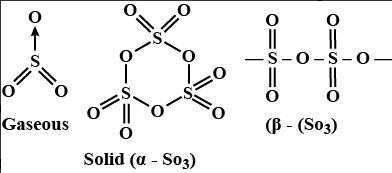
(B) $SO_3$ exists in three allotropic forms:
$a$) $\alpha-SO_3$: It forms long,transparent,ice-like crystals. The melting point of this form is $17^{\circ} C$.
$b$) $\beta-SO_3$: It forms needle-like,silky white crystals. It melts at $32.5^{\circ} C$. Above $50^{\circ} C$,it changes to the $\alpha$-form.
$c$) $\gamma-SO_3$: It is similar to the $\beta$-form and is obtained by completely drying $\beta-SO_3$. It melts at $62.2^{\circ} C$ under $2$ atmospheric pressure.
$a$) $\alpha-SO_3$: It forms long,transparent,ice-like crystals. The melting point of this form is $17^{\circ} C$.
$b$) $\beta-SO_3$: It forms needle-like,silky white crystals. It melts at $32.5^{\circ} C$. Above $50^{\circ} C$,it changes to the $\alpha$-form.
$c$) $\gamma-SO_3$: It is similar to the $\beta$-form and is obtained by completely drying $\beta-SO_3$. It melts at $62.2^{\circ} C$ under $2$ atmospheric pressure.
0 likes
View Solution86
MediumMCQ
When an inorganic compound reacts with $SO_2$ in an aqueous medium,it produces $(A)$. $(A)$ on reaction with $Na_2CO_3$ gives compound $(B)$,which with sulphur,gives a substance $(C)$ used in photography. Compound $(C)$ is:
A
$Na_2S$
B
$Na_2S_2O_7$
C
$Na_2SO_4$
D
$Na_2S_2O_3$
Solution
(D) The reaction sequence is as follows:
$1$. An inorganic compound (like $Ca(OH)_2$) reacts with $SO_2$ to form $(A)$ $(CaSO_3)$.
$2$. $(A)$ $(CaSO_3)$ reacts with $Na_2CO_3$ to give $(B)$ $(Na_2SO_3)$.
$3$. Alternatively,the standard industrial process for preparing sodium thiosulphate involves: $2NaOH + SO_2 \rightarrow Na_2SO_3 + H_2O$.
$4$. Then,$Na_2SO_3 + S \rightarrow Na_2S_2O_3$ (Compound $(C)$).
$5$. $Na_2S_2O_3$ (Sodium thiosulphate) is widely used in photography as a fixing agent (hypo solution).
$1$. An inorganic compound (like $Ca(OH)_2$) reacts with $SO_2$ to form $(A)$ $(CaSO_3)$.
$2$. $(A)$ $(CaSO_3)$ reacts with $Na_2CO_3$ to give $(B)$ $(Na_2SO_3)$.
$3$. Alternatively,the standard industrial process for preparing sodium thiosulphate involves: $2NaOH + SO_2 \rightarrow Na_2SO_3 + H_2O$.
$4$. Then,$Na_2SO_3 + S \rightarrow Na_2S_2O_3$ (Compound $(C)$).
$5$. $Na_2S_2O_3$ (Sodium thiosulphate) is widely used in photography as a fixing agent (hypo solution).
0 likes
View Solution87
MediumMCQ
Choose the $INCORRECT$ statement about $SO_2$.
A
$SO_2$ cannot burn but supports combustion.
B
The maximum permitted atmospheric concentration of $SO_2$ for humans is $5 \ ppm$.
C
$SO_2$ is converted into $SO_3$ in the presence of $V_2O_5$ at low temperature and high pressure.
D
$SO_2$ can act as an oxidizing agent as well as a reducing agent depending on the conditions.
Solution
(A) $1$. $SO_2$ is a non-combustible gas and does not support combustion,so option $A$ is incorrect.
$2$. The maximum permitted atmospheric concentration of $SO_2$ for humans is indeed $5 \ ppm$.
$3$. In the contact process,$SO_2$ is oxidized to $SO_3$ using $V_2O_5$ as a catalyst at high temperature (around $720 \ K$) and low pressure (around $2 \ bar$),not low temperature and high pressure.
$4$. $SO_2$ has sulfur in the $+4$ oxidation state,which can be oxidized to $+6$ or reduced to $0$,thus it acts as both an oxidizing and reducing agent.
$5$. Both $A$ and $C$ are technically incorrect statements based on standard chemical properties and industrial processes.
$2$. The maximum permitted atmospheric concentration of $SO_2$ for humans is indeed $5 \ ppm$.
$3$. In the contact process,$SO_2$ is oxidized to $SO_3$ using $V_2O_5$ as a catalyst at high temperature (around $720 \ K$) and low pressure (around $2 \ bar$),not low temperature and high pressure.
$4$. $SO_2$ has sulfur in the $+4$ oxidation state,which can be oxidized to $+6$ or reduced to $0$,thus it acts as both an oxidizing and reducing agent.
$5$. Both $A$ and $C$ are technically incorrect statements based on standard chemical properties and industrial processes.
0 likes
View Solution88
DifficultMCQ
Choose the $CORRECT$ statement.
A
Arsenic,antimony and bismuth are not found mainly as sulphide minerals.
B
Spontaneous combustion of white phosphorus is technically used in Holme's signals.
C
Polonium is the only element of group $16$,which does not exhibit allotropy.
D
Oxygen shows allotropy.
Solution
(D) $1$. Arsenic,antimony,and bismuth are primarily found as sulphide minerals,so statement $A$ is incorrect.
$2$. Holme's signals use calcium phosphide $(Ca_3P_2)$ and calcium carbide $(CaC_2)$. When thrown into the sea,they produce phosphine $(PH_3)$,which undergoes spontaneous combustion. White phosphorus itself is not used directly in this manner,making statement $B$ incorrect.
$3$. Polonium is a radioactive element and it does exhibit allotropy. Statement $C$ is incorrect.
$4$. Oxygen exists in two allotropic forms: dioxygen $(O_2)$ and ozone $(O_3)$. Thus,statement $D$ is correct.
$2$. Holme's signals use calcium phosphide $(Ca_3P_2)$ and calcium carbide $(CaC_2)$. When thrown into the sea,they produce phosphine $(PH_3)$,which undergoes spontaneous combustion. White phosphorus itself is not used directly in this manner,making statement $B$ incorrect.
$3$. Polonium is a radioactive element and it does exhibit allotropy. Statement $C$ is incorrect.
$4$. Oxygen exists in two allotropic forms: dioxygen $(O_2)$ and ozone $(O_3)$. Thus,statement $D$ is correct.
0 likes
View Solution89
DifficultMCQ
Which of the following options is $incorrect$?
A
Tailing of mercury can be used as a test for $O_3$.
B
Carbon suboxide $(C_3O_2)$ is amphoteric in nature and carbon monoxide $(CO)$ is neutral.
C
Both $Ni_3B$ and $FeB$ have no $B-B$ bond.
D
Both $V_3B_2$ and $NaB_{15}$ have $B-B$ bond.
Solution
(B) Tailing of mercury is the reaction: $2Hg + O_3 \longrightarrow Hg_2O + O_2$. This is a characteristic test for ozone.
$(B)$ Carbon suboxide $(C_3O_2)$ is acidic in nature,not amphoteric. Carbon monoxide $(CO)$ is neutral.
$(C)$ $Ni_3B$ contains isolated boron atoms,and $FeB$ contains zig-zag chains of boron atoms with $B-B$ bonds.
$(D)$ $V_3B_2$ contains pairs of boron atoms ($B-B$ bond) and $NaB_{15}$ contains icosahedral arrangements of boron atoms.
$(B)$ Carbon suboxide $(C_3O_2)$ is acidic in nature,not amphoteric. Carbon monoxide $(CO)$ is neutral.
$(C)$ $Ni_3B$ contains isolated boron atoms,and $FeB$ contains zig-zag chains of boron atoms with $B-B$ bonds.
$(D)$ $V_3B_2$ contains pairs of boron atoms ($B-B$ bond) and $NaB_{15}$ contains icosahedral arrangements of boron atoms.
0 likes
View Solution90
MediumMCQ
$H_2S$ is more acidic than $H_2O$,due to
A
$O$ is more electronegative than $S$
B
$O-H$ bond is stronger than $S-H$ bond
C
$O-H$ bond is weaker than $S-H$ bond
D
None of these
Solution
(B) The acidity of hydrides of group $16$ elements increases from top to bottom in the periodic table.
This is because the bond dissociation enthalpy of the $X-H$ bond decreases as the size of the central atom increases from $O$ to $Te$.
Since the $S-H$ bond is weaker than the $O-H$ bond,$H_2S$ releases $H^+$ ions more easily than $H_2O$,making it more acidic.
Therefore,the correct reason is that the $O-H$ bond is stronger than the $S-H$ bond.
This is because the bond dissociation enthalpy of the $X-H$ bond decreases as the size of the central atom increases from $O$ to $Te$.
Since the $S-H$ bond is weaker than the $O-H$ bond,$H_2S$ releases $H^+$ ions more easily than $H_2O$,making it more acidic.
Therefore,the correct reason is that the $O-H$ bond is stronger than the $S-H$ bond.
0 likes
View Solution91
MediumMCQ
Which of the following statements is $INCORRECT$?
A
In Haber's process,iron oxide,potassium oxide,and aluminium oxide are used as catalysts.
B
$ClO_2$ is used as a bleaching agent.
C
Decomposition of ozone is an endothermic process.
D
Hydrolysis of $XeF_6$ is a non-redox process.
Solution
(C) The decomposition of ozone $(2O_3 \to 3O_2)$ is an exothermic process because the formation of $O_2$ is more stable than $O_3$,releasing energy. Therefore,the statement in option $C$ is $INCORRECT$. The hydrolysis of $XeF_6$ $(XeF_6 + 3H_2O \to XeO_3 + 6HF)$ involves no change in oxidation states,making it a non-redox process.
0 likes
View Solution92
MediumMCQ
What is the product formed when $PCl_5$ reacts with concentrated $H_2SO_4$?
A
$SOCl_2$
B
$SO_2Cl_2$
C
$S_2Cl_2$
D
$SO_2$
Solution
(B) The reaction between phosphorus pentachloride $(PCl_5)$ and concentrated sulfuric acid $(H_2SO_4)$ proceeds as follows:
$PCl_5 + H_2SO_4 \to SO_2Cl_2 + POCl_3 + 2HCl$
Thus,the product formed is sulfuryl chloride $(SO_2Cl_2)$.
$PCl_5 + H_2SO_4 \to SO_2Cl_2 + POCl_3 + 2HCl$
Thus,the product formed is sulfuryl chloride $(SO_2Cl_2)$.
0 likes
View Solution93
MediumMCQ
Select the correct statement regarding sulphur :-
A
At high temperature it is paramagnetic
B
$S-S$ has less bond energy than $O-O$ bond
C
Sulphur exists in $S_8$ form and it has a cage-like structure.
D
Size of sulphur is greater than oxygen so,it (sulphur) has less electron affinity than oxygen.
Solution
(C) $1$. Sulphur exists as $S_8$ molecules in its most stable form,which adopts a puckered ring or cage-like structure. This statement is correct.
$2$. At high temperatures,$S_2$ molecules are formed,which are paramagnetic due to the presence of two unpaired electrons in the antibonding $\pi^*$ orbitals,similar to $O_2$. However,the statement in option $A$ is incomplete/ambiguous compared to $C$.
$3$. The $S-S$ single bond is stronger than the $O-O$ single bond because the lone pairs on oxygen atoms experience significant inter-electronic repulsion due to the small size of the oxygen atom,making the $O-O$ bond weak. Thus,$S-S$ has higher bond energy than $O-O$.
$4$. Sulphur has a higher electron affinity than oxygen because the small size of the oxygen atom leads to strong inter-electronic repulsions,which makes the addition of an electron less favorable compared to sulphur.
$2$. At high temperatures,$S_2$ molecules are formed,which are paramagnetic due to the presence of two unpaired electrons in the antibonding $\pi^*$ orbitals,similar to $O_2$. However,the statement in option $A$ is incomplete/ambiguous compared to $C$.
$3$. The $S-S$ single bond is stronger than the $O-O$ single bond because the lone pairs on oxygen atoms experience significant inter-electronic repulsion due to the small size of the oxygen atom,making the $O-O$ bond weak. Thus,$S-S$ has higher bond energy than $O-O$.
$4$. Sulphur has a higher electron affinity than oxygen because the small size of the oxygen atom leads to strong inter-electronic repulsions,which makes the addition of an electron less favorable compared to sulphur.
0 likes
View Solution94
MediumMCQ
Which of the following compounds of sulphur does not hydrolyze at room temperature?
A
$SF_{4}$
B
$SOCl_{2}$
C
$SF_{6}$
D
$SO_{2}Cl_{2}$
Solution
(C) $SF_{6}$ is an $sp^{3}d^{2}$ hybridized molecule with an octahedral geometry.
It is sterically protected by six fluorine atoms,making it kinetically inert.
Additionally,there are no vacant $d$-orbitals available for the water molecules to attack the sulphur atom.
Therefore,$SF_{6}$ does not undergo hydrolysis at room temperature.
Thus,the correct answer is option $C$.
It is sterically protected by six fluorine atoms,making it kinetically inert.
Additionally,there are no vacant $d$-orbitals available for the water molecules to attack the sulphur atom.
Therefore,$SF_{6}$ does not undergo hydrolysis at room temperature.
Thus,the correct answer is option $C$.
0 likes
View Solution95
MediumMCQ
Select the correct statement.
A
$O_3$ is a dry bleaching agent.
B
Phosgene,tear gas,and mustard gas are all non-poisonous.
C
Sulphuric acid is used in petroleum refining.
D
Both $(A)$ and $(C)$ are correct.
Solution
(D) $O_3$ (ozone) acts as a dry bleaching agent due to its oxidizing property.
Phosgene,tear gas,and mustard gas are highly poisonous substances.
Sulphuric acid $(H_2SO_4)$ is widely used in petroleum refining for the removal of impurities.
Therefore,both statements $(A)$ and $(C)$ are correct.
Phosgene,tear gas,and mustard gas are highly poisonous substances.
Sulphuric acid $(H_2SO_4)$ is widely used in petroleum refining for the removal of impurities.
Therefore,both statements $(A)$ and $(C)$ are correct.
0 likes
View Solution96
DifficultMCQ
How many total statements are correct in the following?
$(i)$ $SO_2$ - antichlor,preservative
$(ii)$ $O_3$ - Disinfectant
$(iii)$ $Cl_2$ - Antiseptic
$(iv)$ $O_2$ - used in oxy-acetylene welding
$(v)$ $PH_3$ - used in smoke screens
$(vi)$ $HNO_3$ - Pickling of stainless steel
$(i)$ $SO_2$ - antichlor,preservative
$(ii)$ $O_3$ - Disinfectant
$(iii)$ $Cl_2$ - Antiseptic
$(iv)$ $O_2$ - used in oxy-acetylene welding
$(v)$ $PH_3$ - used in smoke screens
$(vi)$ $HNO_3$ - Pickling of stainless steel
A
$3$
B
$6$
C
$4$
D
$5$
Solution
(D) $(i)$ $SO_2$ acts as an antichlor and a food preservative. (Correct)
$(ii)$ $O_3$ is used as a disinfectant for water. (Correct)
$(iii)$ $Cl_2$ is used as a disinfectant and for bleaching,but it is not typically classified as an antiseptic. (Incorrect)
$(iv)$ $O_2$ is used in oxy-acetylene welding. (Correct)
$(v)$ $PH_3$ is used in Holme's signals (smoke screens). (Correct)
$(vi)$ $HNO_3$ is used for the pickling of stainless steel. (Correct)
Therefore,statements $(i), (ii), (iv), (v),$ and $(vi)$ are correct. The total number of correct statements is $5$.
$(ii)$ $O_3$ is used as a disinfectant for water. (Correct)
$(iii)$ $Cl_2$ is used as a disinfectant and for bleaching,but it is not typically classified as an antiseptic. (Incorrect)
$(iv)$ $O_2$ is used in oxy-acetylene welding. (Correct)
$(v)$ $PH_3$ is used in Holme's signals (smoke screens). (Correct)
$(vi)$ $HNO_3$ is used for the pickling of stainless steel. (Correct)
Therefore,statements $(i), (ii), (iv), (v),$ and $(vi)$ are correct. The total number of correct statements is $5$.
0 likes
View Solution97
MediumMCQ
When $PbO_2$ reacts with conc. $HNO_3$,the gas evolved is:
A
$NO_2$
B
$O_2$
C
$N_2$
D
$N_2O$
Solution
(B) The reaction between lead$(IV)$ oxide $(PbO_2)$ and concentrated nitric acid $(HNO_3)$ is an oxidation-reduction reaction.
$PbO_2$ acts as an oxidizing agent and oxidizes water to oxygen gas.
The balanced chemical equation is:
$PbO_2 + 2HNO_3 \rightarrow Pb(NO_3)_2 + H_2O + \frac{1}{2} O_2$
Thus,the gas evolved is oxygen $(O_2)$.
$PbO_2$ acts as an oxidizing agent and oxidizes water to oxygen gas.
The balanced chemical equation is:
$PbO_2 + 2HNO_3 \rightarrow Pb(NO_3)_2 + H_2O + \frac{1}{2} O_2$
Thus,the gas evolved is oxygen $(O_2)$.
0 likes
View Solution98
MediumMCQ
When $SO_2$ is passed through a solution of $H_2S$ in water :-
A
Sulphuric acid is formed
B
$A$ clear solution is formed
C
$A$ sulphur is precipitated
D
No change observed
Solution
(C) When $SO_2$ is passed through an aqueous solution of $H_2S$,it acts as an oxidizing agent and oxidizes $H_2S$ to elemental sulphur.
The chemical reaction is as follows:
$2H_2S(aq) + SO_2(aq) \rightarrow 2H_2O(l) + 3S(s)$
Thus,sulphur is precipitated out.
The chemical reaction is as follows:
$2H_2S(aq) + SO_2(aq) \rightarrow 2H_2O(l) + 3S(s)$
Thus,sulphur is precipitated out.
0 likes
View Solution99
MediumMCQ
When Conc. $H_2SO_4$ is added to charcoal :-
A
There is no reaction
B
Water gas is formed
C
$SO_2$ and $CO_2$ are evolved
D
$CO$ and $SO_2$ are evolved
Solution
(C) When concentrated $H_2SO_4$ is added to charcoal (carbon),it acts as an oxidizing agent and oxidizes carbon to carbon dioxide.
The chemical reaction is:
$C(s) + 2H_2SO_4(conc.) \rightarrow CO_2(g) + 2SO_2(g) + 2H_2O(l)$
In this reaction,$H_2SO_4$ is reduced to $SO_2$ and $C$ is oxidized to $CO_2$.
The chemical reaction is:
$C(s) + 2H_2SO_4(conc.) \rightarrow CO_2(g) + 2SO_2(g) + 2H_2O(l)$
In this reaction,$H_2SO_4$ is reduced to $SO_2$ and $C$ is oxidized to $CO_2$.
0 likes
View Solution100
EasyMCQ
In which of the following is there no $S-S$ linkage?
A
$S_2O_3^{2-}$
B
$S_2O_5^{2-}$
C
$S_2O_6^{2-}$
D
$S_2O_7^{2-}$
Solution
(D) In $S_2O_7^{2-}$ (pyrosulfate ion),the two sulfur atoms are linked via an oxygen atom ($S-O-S$ linkage).
In $S_2O_3^{2-}$ (thiosulfate),$S_2O_5^{2-}$ (disulfite),and $S_2O_6^{2-}$ (dithionate),there is a direct $S-S$ bond.
In $S_2O_3^{2-}$ (thiosulfate),$S_2O_5^{2-}$ (disulfite),and $S_2O_6^{2-}$ (dithionate),there is a direct $S-S$ bond.
0 likes
View Solutionp-Block Elements (Class 12) — Oxygen family · Frequently Asked Questions
1Are these p-Block Elements (Class 12) questions useful for JEE and NEET?
Yes. All questions in this section are mapped to JEE Main and NEET exam patterns. Previous year questions from JEE Main, NEET, GUJCET and state-level exams are included with full solutions.
2Can I switch to Hindi or Gujarati for these questions?
Yes. Use the language tabs in the hero section or the sidebar to view the same questions and solutions in English, Hindi or Gujarati.
3How do I generate a question paper from this subtopic?
Use the Vedclass Exam Paper Generator — select the chapter and subtopic, set difficulty, and generate Sets A, B, C, D automatically. First 3 chapters of every subject are free.
Vedclass Products
For Students
Vedclass Test Series
Mock tests in real JEE/NEET style with performance analysis. 5-day free trial.
Start Free TrialFor Teachers
Exam Paper Generator
Generate Set A/B/C/D papers from this chapter in 2 minutes. 3 chapters free.
Try FreeFor Institutes
Online Exam Module
Live online exams with unlimited students, 360° analytics & white-label branding.
See DemoFor Teachers & Institutes
Generate a p-Block Elements (Class 12) Exam Paper in 2 Minutes
Select subtopic & difficulty — Sets A, B, C, D auto-generated with No Repeat logic.
First 3 chapters of every subject are free — no payment required.