
A English
Oxygen family Questions in English
Class 12 Chemistry · p-Block Elements (Class 12) · Oxygen family
406+
Questions
English
Language
100%
With Solutions
Showing 50 of 406 questions in English
251
EasyMCQ
What is the color of ozone $(O_3)$?
A
Pale blue gas
B
Deep blue liquid
C
Violet-black solid
D
All of the above
Solution
(D) Ozone $(O_3)$ exists in different states with distinct colors:
$1$. In the gaseous state,it is a pale blue gas.
$2$. In the liquid state,it is a deep blue liquid.
$3$. In the solid state,it is a violet-black solid.
Therefore,all the given options are correct.
$1$. In the gaseous state,it is a pale blue gas.
$2$. In the liquid state,it is a deep blue liquid.
$3$. In the solid state,it is a violet-black solid.
Therefore,all the given options are correct.
0 likes
View Solution252
Difficult
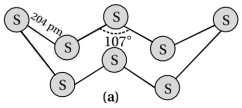
Provide information about the allotropes of sulfur.
Solution
(N/A) The stable form of sulfur at room temperature is rhombic sulfur,which transforms into monoclinic sulfur when heated to $369 \ K$.
Rhombic sulfur ($\alpha$-sulfur):
This allotrope is yellow in color,with a melting point of $385.8 \ K$ and a specific gravity of $2.06$.
It is prepared by evaporating the solution of roll sulfur in $CS_2$.
It is insoluble in water but slightly soluble in benzene,alcohol,and ether.
It is readily soluble in $CS_2$.
Monoclinic sulfur ($\beta$-sulfur):
Its melting point is $393 \ K$ and its specific gravity is $1.98$.
It is soluble in $CS_2$.
This form is prepared by melting rhombic sulfur in a dish and cooling it until a crust is formed. Two holes are made in the crust,and the remaining liquid is poured out.
Upon removing the crust,colorless needle-shaped crystals of $\beta$-sulfur are formed. It is stable above $369 \ K$ and transforms into $\alpha$-sulfur below this temperature.
Conversely,$\alpha$-sulfur is stable below $369 \ K$ and transforms into $\beta$-sulfur above this temperature.
Rhombic sulfur ($\alpha$-sulfur):
This allotrope is yellow in color,with a melting point of $385.8 \ K$ and a specific gravity of $2.06$.
It is prepared by evaporating the solution of roll sulfur in $CS_2$.
It is insoluble in water but slightly soluble in benzene,alcohol,and ether.
It is readily soluble in $CS_2$.
Monoclinic sulfur ($\beta$-sulfur):
Its melting point is $393 \ K$ and its specific gravity is $1.98$.
It is soluble in $CS_2$.
This form is prepared by melting rhombic sulfur in a dish and cooling it until a crust is formed. Two holes are made in the crust,and the remaining liquid is poured out.
Upon removing the crust,colorless needle-shaped crystals of $\beta$-sulfur are formed. It is stable above $369 \ K$ and transforms into $\alpha$-sulfur below this temperature.
Conversely,$\alpha$-sulfur is stable below $369 \ K$ and transforms into $\beta$-sulfur above this temperature.
0 likes
View Solution253
MediumMCQ
What are the other names for monoclinic sulfur and rhombic sulfur?
A
Monoclinic sulfur is $\alpha$-sulfur and rhombic sulfur is $\beta$-sulfur.
B
Monoclinic sulfur is $\beta$-sulfur and rhombic sulfur is $\alpha$-sulfur.
C
Both are known as $\alpha$-sulfur.
D
Both are known as $\beta$-sulfur.
Solution
(B) Sulfur exhibits allotropy. The two most common allotropes are rhombic sulfur and monoclinic sulfur.
Rhombic sulfur is also known as $\alpha$-sulfur.
Monoclinic sulfur is also known as $\beta$-sulfur.
Therefore,the correct identification is that rhombic sulfur is $\alpha$-sulfur and monoclinic sulfur is $\beta$-sulfur.
Rhombic sulfur is also known as $\alpha$-sulfur.
Monoclinic sulfur is also known as $\beta$-sulfur.
Therefore,the correct identification is that rhombic sulfur is $\alpha$-sulfur and monoclinic sulfur is $\beta$-sulfur.
0 likes
View Solution254
EasyMCQ
What is the color of $\alpha$-sulphur?
A
Yellow
B
White
C
Red
D
Black
Solution
(A) $\alpha$-sulphur,also known as rhombic sulphur,is the most stable allotrope of sulphur at room temperature. It is yellow in color.
0 likes
View Solution255
EasyMCQ
What are the specific densities of $\alpha$-sulphur and $\beta$-sulphur?
A
$2.06 \ g/cm^3$ and $1.98 \ g/cm^3$
B
$1.98 \ g/cm^3$ and $2.06 \ g/cm^3$
C
$2.06 \ g/cm^3$ and $2.06 \ g/cm^3$
D
$1.98 \ g/cm^3$ and $1.98 \ g/cm^3$
Solution
(A) The $\alpha$-sulphur (rhombic sulphur) is formed by evaporating the solution of roll sulphur in $CS_2$. Its specific density is $2.06 \ g/cm^3$.
The $\beta$-sulphur (monoclinic sulphur) is prepared by melting rhombic sulphur in a dish and cooling until a crust is formed. Its specific density is $1.98 \ g/cm^3$.
Therefore,the specific densities are $2.06 \ g/cm^3$ and $1.98 \ g/cm^3$ respectively.
The $\beta$-sulphur (monoclinic sulphur) is prepared by melting rhombic sulphur in a dish and cooling until a crust is formed. Its specific density is $1.98 \ g/cm^3$.
Therefore,the specific densities are $2.06 \ g/cm^3$ and $1.98 \ g/cm^3$ respectively.
0 likes
View Solution256
Difficult
Write a note on the preparation of sulphur dioxide. Explain the properties of sulphur dioxide. State its uses.
Solution
(N/A) Preparation:
$1$. Sulphur dioxide is formed together with a little $(6-8 \%)$ sulphur trioxide when sulphur is burnt in air or oxygen: $S_{(s)} + O_{2(g)} \rightarrow SO_{2(g)}$
$2$. In the laboratory,it is readily generated by treating a sulphite with dilute sulphuric acid: $SO_{3(aq)}^{2-} + 2H_{(aq)}^{+} \rightarrow H_{2}O_{(l)} + SO_{2(g)}$
$3$. Industrially,$SO_{2}$ is obtained as a by-product of the roasting of sulphide ores: $4FeS_{2(s)} + 11O_{2(g)} \rightarrow 2Fe_{2}O_{3(s)} + 8SO_{2(g)}$
Properties:
$(i)$ Physical properties: Sulphur dioxide is a colourless gas with a pungent smell and is highly soluble in water. It boils at $263 \ K$ and liquefies at room temperature under a pressure of $2 \ atm$. The shape of $SO_{2}$ is angular. It is a resonance hybrid of two canonical forms.
$(ii)$ Chemical properties:
- $SO_{2}$ when passed through water forms a solution of sulphurous acid: $SO_{2(g)} + H_{2}O_{(l)} \rightleftharpoons H_{2}SO_{3(aq)}$
- It reacts with $NaOH$ solution to form sodium sulphite,which reacts with more $SO_{2}$ to form sodium hydrogen sulphite: $2NaOH + SO_{2} \rightarrow Na_{2}SO_{3} + H_{2}O$; $Na_{2}SO_{3} + H_{2}O + SO_{2} \rightarrow 2NaHSO_{3}$
- $SO_{2}$ reacts with chlorine in the presence of charcoal (catalyst) to give sulphuryl chloride: $SO_{2(g)} + Cl_{2(g)} \rightarrow SO_{2}Cl_{2(l)}$
- In the presence of vanadium$(V)$ oxide,it oxidizes to $SO_{3}$: $SO_{2(g)} + \frac{1}{2}O_{2(g)} \xrightarrow{V_{2}O_{5}} SO_{3(g)}$
- Moist sulphur dioxide acts as a reducing agent: $2Fe^{3+} + SO_{2} + 2H_{2}O \rightarrow 2Fe^{2+} + SO_{4}^{2-} + 4H^{+}$; $5SO_{2} + 2MnO_{4}^{-} + 2H_{2}O \rightarrow 5SO_{4}^{2-} + 4H^{+} + 2Mn^{2+}$
Uses:
- In the refining of petroleum and sugar.
- In the bleaching of wool and silk.
- As an anti-chlor,disinfectant,and preservative.
- Industrial chemicals such as $H_{2}SO_{4}$,$NaHSO_{3}$,and $Ca(HSO_{3})_{2}$ are prepared from $SO_{2}$.
- Liquid $SO_{2}$ is used as a solvent to dissolve a number of inorganic and organic chemicals.
$1$. Sulphur dioxide is formed together with a little $(6-8 \%)$ sulphur trioxide when sulphur is burnt in air or oxygen: $S_{(s)} + O_{2(g)} \rightarrow SO_{2(g)}$
$2$. In the laboratory,it is readily generated by treating a sulphite with dilute sulphuric acid: $SO_{3(aq)}^{2-} + 2H_{(aq)}^{+} \rightarrow H_{2}O_{(l)} + SO_{2(g)}$
$3$. Industrially,$SO_{2}$ is obtained as a by-product of the roasting of sulphide ores: $4FeS_{2(s)} + 11O_{2(g)} \rightarrow 2Fe_{2}O_{3(s)} + 8SO_{2(g)}$
Properties:
$(i)$ Physical properties: Sulphur dioxide is a colourless gas with a pungent smell and is highly soluble in water. It boils at $263 \ K$ and liquefies at room temperature under a pressure of $2 \ atm$. The shape of $SO_{2}$ is angular. It is a resonance hybrid of two canonical forms.
$(ii)$ Chemical properties:
- $SO_{2}$ when passed through water forms a solution of sulphurous acid: $SO_{2(g)} + H_{2}O_{(l)} \rightleftharpoons H_{2}SO_{3(aq)}$
- It reacts with $NaOH$ solution to form sodium sulphite,which reacts with more $SO_{2}$ to form sodium hydrogen sulphite: $2NaOH + SO_{2} \rightarrow Na_{2}SO_{3} + H_{2}O$; $Na_{2}SO_{3} + H_{2}O + SO_{2} \rightarrow 2NaHSO_{3}$
- $SO_{2}$ reacts with chlorine in the presence of charcoal (catalyst) to give sulphuryl chloride: $SO_{2(g)} + Cl_{2(g)} \rightarrow SO_{2}Cl_{2(l)}$
- In the presence of vanadium$(V)$ oxide,it oxidizes to $SO_{3}$: $SO_{2(g)} + \frac{1}{2}O_{2(g)} \xrightarrow{V_{2}O_{5}} SO_{3(g)}$
- Moist sulphur dioxide acts as a reducing agent: $2Fe^{3+} + SO_{2} + 2H_{2}O \rightarrow 2Fe^{2+} + SO_{4}^{2-} + 4H^{+}$; $5SO_{2} + 2MnO_{4}^{-} + 2H_{2}O \rightarrow 5SO_{4}^{2-} + 4H^{+} + 2Mn^{2+}$
Uses:
- In the refining of petroleum and sugar.
- In the bleaching of wool and silk.
- As an anti-chlor,disinfectant,and preservative.
- Industrial chemicals such as $H_{2}SO_{4}$,$NaHSO_{3}$,and $Ca(HSO_{3})_{2}$ are prepared from $SO_{2}$.
- Liquid $SO_{2}$ is used as a solvent to dissolve a number of inorganic and organic chemicals.
0 likes
View Solution257
EasyMCQ
How does $SO_2$ gas behave when it is moist?
A
As an oxidizing agent
B
As a reducing agent
C
As a dehydrating agent
D
As a basic oxide
Solution
(B) When $SO_2$ is moist,it reacts with water to form sulfurous acid $(H_2SO_3)$.
$SO_2 + H_2O \rightarrow H_2SO_3$
In this state,it acts as a strong reducing agent because it can easily be oxidized to sulfuric acid $(H_2SO_4)$ by losing electrons or by reacting with oxygen.
$SO_2 + H_2O \rightarrow H_2SO_3$
In this state,it acts as a strong reducing agent because it can easily be oxidized to sulfuric acid $(H_2SO_4)$ by losing electrons or by reacting with oxygen.
0 likes
View Solution258
Medium
Explain the oxoacids of sulfur.
Solution
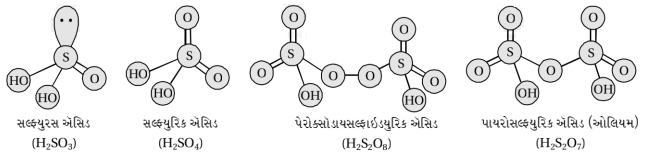
(N/A) Sulfur forms many oxoacids such as $H_{2}SO_{3}$,$H_{2}S_{2}O_{3}$,$H_{2}S_{2}O_{4}$,$H_{2}S_{2}O_{5}$,$H_{2}S_{x}O_{6}$ ($x=2$ to $5$),$H_{2}SO_{4}$,$H_{2}S_{2}O_{7}$,$H_{2}SO_{5}$,and $H_{2}S_{2}O_{8}$.
Some of these acids are unstable and cannot be isolated. They are often identified in aqueous solution or in the form of their salts. The structures of some important oxoacids are shown in the image.
Some of these acids are unstable and cannot be isolated. They are often identified in aqueous solution or in the form of their salts. The structures of some important oxoacids are shown in the image.
0 likes
View Solution259
Advanced
Explain the contact process for the manufacture of sulphuric acid.
Solution
(N/A) The contact process involves the following key steps:
$(i)$ Burning of sulphur or sulphide ores in the presence of air to generate $SO_{2}$.
$(ii)$ Purification of $SO_{2}$ gas by removing dust and impurities like arsenic compounds.
$(iii)$ Catalytic oxidation of $SO_{2}$ to $SO_{3}$ using oxygen in the presence of a $V_{2}O_{5}$ catalyst:
$2 SO_{2(g)} + O_{2(g)} \rightarrow 2 SO_{3(g)}$,$\Delta_{r}H^{\ominus} = -196.6 \ kJ/mol$.
This reaction is exothermic,reversible,and involves a decrease in volume. Thus,low temperature and high pressure are favourable for maximum yield. In practice,the process is carried out at $2 \ bar$ pressure and $720 \ K$ temperature.
$(iv)$ Absorption of $SO_{3}$ in concentrated $H_{2}SO_{4}$ to produce oleum $(H_{2}S_{2}O_{7})$:
$SO_{3} + H_{2}SO_{4} \rightarrow H_{2}S_{2}O_{7}$ (Oleum).
$(v)$ Dilution of oleum with water to obtain sulphuric acid of the desired concentration ($96-98 \%$ pure).
$(i)$ Burning of sulphur or sulphide ores in the presence of air to generate $SO_{2}$.
$(ii)$ Purification of $SO_{2}$ gas by removing dust and impurities like arsenic compounds.
$(iii)$ Catalytic oxidation of $SO_{2}$ to $SO_{3}$ using oxygen in the presence of a $V_{2}O_{5}$ catalyst:
$2 SO_{2(g)} + O_{2(g)} \rightarrow 2 SO_{3(g)}$,$\Delta_{r}H^{\ominus} = -196.6 \ kJ/mol$.
This reaction is exothermic,reversible,and involves a decrease in volume. Thus,low temperature and high pressure are favourable for maximum yield. In practice,the process is carried out at $2 \ bar$ pressure and $720 \ K$ temperature.
$(iv)$ Absorption of $SO_{3}$ in concentrated $H_{2}SO_{4}$ to produce oleum $(H_{2}S_{2}O_{7})$:
$SO_{3} + H_{2}SO_{4} \rightarrow H_{2}S_{2}O_{7}$ (Oleum).
$(v)$ Dilution of oleum with water to obtain sulphuric acid of the desired concentration ($96-98 \%$ pure).
0 likes
View Solution260
Advanced
Explain the industrial manufacturing of sulphuric acid by the contact process.
Solution
(N/A) The contact process for the industrial manufacturing of sulphuric acid involves the following major steps:
$(i)$ Burning of sulphur or sulphide ores in the presence of air to generate $SO_{2}$ gas.
$(ii)$ Purification of $SO_{2}$ gas by removing dust and other impurities such as arsenic compounds.
$(iii)$ Catalytic oxidation of $SO_{2}$ with $O_{2}$ to form $SO_{3}$ in the presence of a vanadium pentoxide $(V_{2}O_{5})$ catalyst:
$2SO_{2(g)} + O_{2(g)} \rightleftharpoons 2SO_{3(g)}, \Delta_{r}H^{\ominus} = -196.6 \ kJ/mol$
This reaction is exothermic,reversible,and involves a decrease in volume. Therefore,low temperature and high pressure are favourable for maximum yield. In practice,the process is carried out at $2 \ bar$ pressure and $720 \ K$ temperature.
$(iv)$ Absorption of $SO_{3}$ in concentrated $H_{2}SO_{4}$ to produce oleum $(H_{2}S_{2}O_{7})$:
$SO_{3} + H_{2}SO_{4} \rightarrow H_{2}S_{2}O_{7}$
$(v)$ Dilution of oleum with water to obtain sulphuric acid of the desired concentration.
The sulphuric acid obtained by the contact process is $96-98 \%$ pure.
$(i)$ Burning of sulphur or sulphide ores in the presence of air to generate $SO_{2}$ gas.
$(ii)$ Purification of $SO_{2}$ gas by removing dust and other impurities such as arsenic compounds.
$(iii)$ Catalytic oxidation of $SO_{2}$ with $O_{2}$ to form $SO_{3}$ in the presence of a vanadium pentoxide $(V_{2}O_{5})$ catalyst:
$2SO_{2(g)} + O_{2(g)} \rightleftharpoons 2SO_{3(g)}, \Delta_{r}H^{\ominus} = -196.6 \ kJ/mol$
This reaction is exothermic,reversible,and involves a decrease in volume. Therefore,low temperature and high pressure are favourable for maximum yield. In practice,the process is carried out at $2 \ bar$ pressure and $720 \ K$ temperature.
$(iv)$ Absorption of $SO_{3}$ in concentrated $H_{2}SO_{4}$ to produce oleum $(H_{2}S_{2}O_{7})$:
$SO_{3} + H_{2}SO_{4} \rightarrow H_{2}S_{2}O_{7}$
$(v)$ Dilution of oleum with water to obtain sulphuric acid of the desired concentration.
The sulphuric acid obtained by the contact process is $96-98 \%$ pure.
0 likes
View Solution261
Difficult
Discuss the physical and chemical properties of sulphuric acid.
Solution
(N/A) $(i)$ Physical properties: Sulphuric acid is a colourless,dense,oily liquid with a specific gravity of $1.84$ at $298 \ K$. The freezing point is $283 \ K$ and the boiling point is $611 \ K$. It dissolves in water with the evolution of a large quantity of heat. Hence,while diluting an acid,the acid must be added to water and not water to an acid with constant stirring.
$(ii)$ Chemical properties: The chemical reactions of sulphuric acid are a result of the following characteristics:
$(a)$ Low volatility
$(b)$ Strong acidic character
$(c)$ Strong affinity for water
$(d)$ Ability to act as an oxidising agent
In aqueous medium,sulphuric acid ionises in two steps:
$H_2SO_{4(aq)} + H_2O_{(l)} \rightarrow H_3O^{+}_{(aq)} + HSO^{-}_{4(aq)} ; Ka_1 = \text{very large } (Ka_1 > 10)$
$HSO^{-}_{4(aq)} + H_2O_{(l)} \rightarrow H_3O^{+}_{(aq)} + SO^{2-}_{4(aq)} ; Ka_2 = 1.2 \times 10^{-2}$
The larger value of $Ka_1$ $(Ka_1 > 10)$ means that $H_2SO_4$ is largely dissociated into $H^{+}$ and $HSO^{-}_4$. Greater the value of the dissociation constant $(K_a)$,the stronger is the acid. The acid forms two series of salts: Normal salts (e.g.,sodium sulphate,copper sulphate) and acid sulphates (e.g.,sodium hydrogen sulphate).
Sulphuric acid,because of its low volatility,can be used to manufacture more volatile acids from their corresponding salts:
$2MX + H_2SO_4 \rightarrow 2HX + M_2SO_4$ (where $X = F, Cl, NO_3$ and $M = \text{Metal}$).
Concentrated sulphuric acid is a strong dehydrating agent. Many wet gases can be dried by passing them through sulphuric acid,provided the gases do not react with the acid. Sulphuric acid removes water from organic compounds; it is evident by its charring action on carbohydrates:
$C_{12}H_{22}O_{11} \xrightarrow{H_2SO_4} 11H_2O + 12C$
Hot concentrated sulphuric acid is a moderately strong oxidising agent. It oxidises both metals and non-metals,being reduced to $SO_2$:
$Cu + 2H_2SO_4 \rightarrow CuSO_4 + SO_2 + 2H_2O$
$S + 2H_2SO_4 \rightarrow 3SO_2 + 2H_2O$
$C + 2H_2SO_4 \rightarrow CO_2 + 2SO_2 + 2H_2O$
Sulphuric acid is an important industrial chemical,often called the "King of chemicals".
$(ii)$ Chemical properties: The chemical reactions of sulphuric acid are a result of the following characteristics:
$(a)$ Low volatility
$(b)$ Strong acidic character
$(c)$ Strong affinity for water
$(d)$ Ability to act as an oxidising agent
In aqueous medium,sulphuric acid ionises in two steps:
$H_2SO_{4(aq)} + H_2O_{(l)} \rightarrow H_3O^{+}_{(aq)} + HSO^{-}_{4(aq)} ; Ka_1 = \text{very large } (Ka_1 > 10)$
$HSO^{-}_{4(aq)} + H_2O_{(l)} \rightarrow H_3O^{+}_{(aq)} + SO^{2-}_{4(aq)} ; Ka_2 = 1.2 \times 10^{-2}$
The larger value of $Ka_1$ $(Ka_1 > 10)$ means that $H_2SO_4$ is largely dissociated into $H^{+}$ and $HSO^{-}_4$. Greater the value of the dissociation constant $(K_a)$,the stronger is the acid. The acid forms two series of salts: Normal salts (e.g.,sodium sulphate,copper sulphate) and acid sulphates (e.g.,sodium hydrogen sulphate).
Sulphuric acid,because of its low volatility,can be used to manufacture more volatile acids from their corresponding salts:
$2MX + H_2SO_4 \rightarrow 2HX + M_2SO_4$ (where $X = F, Cl, NO_3$ and $M = \text{Metal}$).
Concentrated sulphuric acid is a strong dehydrating agent. Many wet gases can be dried by passing them through sulphuric acid,provided the gases do not react with the acid. Sulphuric acid removes water from organic compounds; it is evident by its charring action on carbohydrates:
$C_{12}H_{22}O_{11} \xrightarrow{H_2SO_4} 11H_2O + 12C$
Hot concentrated sulphuric acid is a moderately strong oxidising agent. It oxidises both metals and non-metals,being reduced to $SO_2$:
$Cu + 2H_2SO_4 \rightarrow CuSO_4 + SO_2 + 2H_2O$
$S + 2H_2SO_4 \rightarrow 3SO_2 + 2H_2O$
$C + 2H_2SO_4 \rightarrow CO_2 + 2SO_2 + 2H_2O$
Sulphuric acid is an important industrial chemical,often called the "King of chemicals".
0 likes
View Solution262
EasyMCQ
Which process is used for the manufacture of $H_2SO_4$?
A
Contact process
B
Ostwald process
C
Haber process
D
Solvay process
Solution
(A) The $H_2SO_4$ (sulfuric acid) is manufactured by the $Contact \ process$.
In this process,sulfur dioxide $(SO_2)$ is oxidized to sulfur trioxide $(SO_3)$ in the presence of a catalyst (vanadium pentoxide,$V_2O_5$),which is then absorbed in concentrated $H_2SO_4$ to form oleum $(H_2S_2O_7)$.
Finally,oleum is diluted with water to obtain $H_2SO_4$ of the desired concentration.
In this process,sulfur dioxide $(SO_2)$ is oxidized to sulfur trioxide $(SO_3)$ in the presence of a catalyst (vanadium pentoxide,$V_2O_5$),which is then absorbed in concentrated $H_2SO_4$ to form oleum $(H_2S_2O_7)$.
Finally,oleum is diluted with water to obtain $H_2SO_4$ of the desired concentration.
0 likes
View Solution263
MediumMCQ
How many stages are there in the Contact Process,and what is produced at the end of the Contact Process?
A
$3$ stages,$H_2SO_4$
B
$2$ stages,$SO_3$
C
$4$ stages,$H_2S_2O_7$
D
$3$ stages,$SO_2$
Solution
(A) The Contact Process for the manufacture of sulfuric acid consists of $3$ main stages:
$1$. Burning of sulfur or sulfide ores in air to generate sulfur dioxide $(SO_2)$.
$2$. Conversion of $SO_2$ to sulfur trioxide $(SO_3)$ by the reaction with oxygen in the presence of a catalyst $(V_2O_5)$.
$3$. Absorption of $SO_3$ in $H_2SO_4$ to give oleum $(H_2S_2O_7)$,which is then diluted with water to produce sulfuric acid $(H_2SO_4)$.
Thus,the final product obtained is sulfuric acid $(H_2SO_4)$.
$1$. Burning of sulfur or sulfide ores in air to generate sulfur dioxide $(SO_2)$.
$2$. Conversion of $SO_2$ to sulfur trioxide $(SO_3)$ by the reaction with oxygen in the presence of a catalyst $(V_2O_5)$.
$3$. Absorption of $SO_3$ in $H_2SO_4$ to give oleum $(H_2S_2O_7)$,which is then diluted with water to produce sulfuric acid $(H_2SO_4)$.
Thus,the final product obtained is sulfuric acid $(H_2SO_4)$.
0 likes
View Solution264
MediumMCQ
State the melting point,boiling point,and specific gravity of $H_2SO_4$.
A
$283 \ K, 563 \ K, 1.84 \ g/cm^3$
B
$293 \ K, 611 \ K, 1.84 \ g/cm^3$
C
$273 \ K, 500 \ K, 1.50 \ g/cm^3$
D
$300 \ K, 650 \ K, 1.90 \ g/cm^3$
Solution
(B) The physical properties of concentrated sulfuric acid $(H_2SO_4)$ are as follows:
$1$. Melting point: $283 \ K$
$2$. Boiling point: $611 \ K$
$3$. Specific gravity: $1.84 \ g/cm^3$ at $298 \ K$
Therefore,the correct values correspond to option $B$.
$1$. Melting point: $283 \ K$
$2$. Boiling point: $611 \ K$
$3$. Specific gravity: $1.84 \ g/cm^3$ at $298 \ K$
Therefore,the correct values correspond to option $B$.
0 likes
View Solution265
EasyMCQ
Which oxide is used as a catalyst in the contact process?
A
$V_2O_5$
B
$SO_2$
C
$SO_3$
D
$MnO_2$
Solution
(A) In the contact process,sulfur dioxide $(SO_2)$ is oxidized to sulfur trioxide $(SO_3)$ in the presence of vanadium pentoxide $(V_2O_5)$ as a catalyst.
The reaction is: $2SO_2(g) + O_2(g) \xrightarrow{V_2O_5} 2SO_3(g)$.
The reaction is: $2SO_2(g) + O_2(g) \xrightarrow{V_2O_5} 2SO_3(g)$.
0 likes
View Solution266
MediumMCQ
Determine whether the following statements are True $(T)$ or False $(F)$:
$1.$ $SO_2$ is converted to $SO_3$ in the production of sulfuric acid.
$2.$ Ziegler catalyst is used for the oxidation of $SO_2$ to $SO_3$.
$1.$ $SO_2$ is converted to $SO_3$ in the production of sulfuric acid.
$2.$ Ziegler catalyst is used for the oxidation of $SO_2$ to $SO_3$.
A
$1-T, 2-T$
B
$1-T, 2-F$
C
$1-F, 2-T$
D
$1-F, 2-F$
Solution
(B) $1.$ In the contact process for the manufacture of sulfuric acid,$SO_2$ is oxidized to $SO_3$ using vanadium pentoxide $(V_2O_5)$ as a catalyst. Thus,statement $1$ is True $(T)$.
$2.$ Ziegler catalyst (e.g.,$TiCl_4 + Al(C_2H_5)_3$) is used for the polymerization of ethene,not for the oxidation of $SO_2$. Thus,statement $2$ is False $(F)$.
$2.$ Ziegler catalyst (e.g.,$TiCl_4 + Al(C_2H_5)_3$) is used for the polymerization of ethene,not for the oxidation of $SO_2$. Thus,statement $2$ is False $(F)$.
0 likes
View Solution267
MediumMCQ
Although fluorine is more electronegative than oxygen,the ability of oxygen to stabilize higher oxidation states exceeds that of fluorine. Why?
A
Oxygen can form multiple bonds with metals.
B
Fluorine is too small to accommodate many atoms.
C
Oxygen has a higher ionization energy.
D
Fluorine has a lower electron affinity.
Solution
(A) The ability of oxygen to stabilize higher oxidation states is due to its ability to form multiple bonds with metals ($p\pi-d\pi$ bonding).
Fluorine,being a monovalent atom,can only form single bonds,which limits its ability to stabilize higher oxidation states compared to oxygen,which can form double bonds with metal atoms.
Fluorine,being a monovalent atom,can only form single bonds,which limits its ability to stabilize higher oxidation states compared to oxygen,which can form double bonds with metal atoms.
0 likes
View Solution268
EasyMCQ
Which gas has a pungent and suffocating odor?
A
$SO_2$
B
$CO_2$
C
$N_2$
D
$O_2$
Solution
(A) Sulfur dioxide $(SO_2)$ is a colorless gas with a pungent and suffocating odor,similar to that of a burnt matchstick. It is highly irritating to the respiratory system.
0 likes
View Solution269
Medium
In the preparation of $H_2SO_4$ by the Contact Process,why is $SO_3$ not absorbed directly in water to form $H_2SO_4$?
Solution
(N/A) If $SO_3$ is absorbed directly in water,a large amount of heat is released,which leads to the formation of an acid fog.
This acid fog is extremely difficult to condense,making the process inefficient and hazardous.
This acid fog is extremely difficult to condense,making the process inefficient and hazardous.
0 likes
View Solution270
Medium
Explain why ozone $(O_3)$ is thermodynamically less stable than oxygen $(O_2)$?
Solution
(N/A) The conversion of ozone $(O_3)$ to oxygen $(O_2)$ is an exothermic process,which means it is accompanied by the liberation of heat $(\Delta H < 0)$.
Additionally,the decomposition of $2$ moles of $O_3$ into $3$ moles of $O_2$ leads to an increase in entropy $(\Delta S > 0)$.
According to the Gibbs free energy equation,$\Delta G = \Delta H - T\Delta S$,both a negative $\Delta H$ and a positive $\Delta S$ result in a large negative value for the Gibbs free energy change $(\Delta G)$.
Since a negative $\Delta G$ indicates a spontaneous process,ozone is thermodynamically less stable than oxygen.
Additionally,the decomposition of $2$ moles of $O_3$ into $3$ moles of $O_2$ leads to an increase in entropy $(\Delta S > 0)$.
According to the Gibbs free energy equation,$\Delta G = \Delta H - T\Delta S$,both a negative $\Delta H$ and a positive $\Delta S$ result in a large negative value for the Gibbs free energy change $(\Delta G)$.
Since a negative $\Delta G$ indicates a spontaneous process,ozone is thermodynamically less stable than oxygen.
0 likes
View Solution271
Difficult
An amorphous solid $'A'$ burns in air to form a gas $'B'$ which turns lime water milky. The gas is also produced as a by-product during roasting of sulphide ore. This gas decolourises acidified aqueous $KMnO_4$ solution and reduces $Fe^{3+}$ to $Fe^{2+}$. Identify the solid $'A'$ and the gas $'B'$ and write the reactions involved.
Solution
(A) The solid $'A'$ is sulphur $(S_8)$ and the gas $'B'$ is sulphur dioxide $(SO_2)$.
$1$. Combustion of sulphur in air:
$S_8(s) + 8O_2(g) \rightarrow 8SO_2(g)$
$2$. Reaction with lime water:
$SO_2(g) + Ca(OH)_2(aq) \rightarrow CaSO_3(s) + H_2O(l)$
(Calcium sulphite makes the solution milky)
$3$. Decolourisation of acidified $KMnO_4$:
$5SO_2 + 2MnO_4^{-} + 2H_2O \rightarrow 5SO_4^{2-} + 4H^{+} + 2Mn^{2+}$
$4$. Reduction of $Fe^{3+}$ to $Fe^{2+}$:
$2Fe^{3+} + SO_2 + 2H_2O \rightarrow 2Fe^{2+} + SO_4^{2-} + 4H^{+}$
$1$. Combustion of sulphur in air:
$S_8(s) + 8O_2(g) \rightarrow 8SO_2(g)$
$2$. Reaction with lime water:
$SO_2(g) + Ca(OH)_2(aq) \rightarrow CaSO_3(s) + H_2O(l)$
(Calcium sulphite makes the solution milky)
$3$. Decolourisation of acidified $KMnO_4$:
$5SO_2 + 2MnO_4^{-} + 2H_2O \rightarrow 5SO_4^{2-} + 4H^{+} + 2Mn^{2+}$
$4$. Reduction of $Fe^{3+}$ to $Fe^{2+}$:
$2Fe^{3+} + SO_2 + 2H_2O \rightarrow 2Fe^{2+} + SO_4^{2-} + 4H^{+}$
0 likes
View Solution272
Medium
Explain the occurrence of group-$16$ elements.
Solution
(N/A) $(i)$ Oxygen: Oxygen is the most abundant of all the elements on earth. It forms about $46.6 \%$ by mass of the earth's crust. Dry air contains $20.946 \%$ oxygen by volume.
$(ii)$ Sulphur: The abundance of sulphur in the earth's crust is only $0.03-0.1 \%$. Combined sulphur exists primarily as sulphates such as gypsum $(CaSO_4 \cdot 2H_2O)$,epsom salt $(MgSO_4 \cdot 7H_2O)$,baryte $(BaSO_4)$ and sulphides such as galena $(PbS)$,zinc blende $(ZnS)$,and copper pyrites $(CuFeS_2)$. Traces of sulphur occur as hydrogen sulphide in volcanoes and in organic materials such as eggs,proteins,garlic,onion,mustard,hair,and wool.
$(iii)$ Selenium and tellurium: Selenium and tellurium are found as metal selenides and tellurides in sulphide ores.
$(iv)$ Polonium and livermorium: Polonium occurs in nature as a decay product of thorium and uranium minerals. Livermorium is a synthetic radioactive element. It has been produced only in a very small amount and has a very short half-life (only a small fraction of one second),which limits the study of its properties.
$(ii)$ Sulphur: The abundance of sulphur in the earth's crust is only $0.03-0.1 \%$. Combined sulphur exists primarily as sulphates such as gypsum $(CaSO_4 \cdot 2H_2O)$,epsom salt $(MgSO_4 \cdot 7H_2O)$,baryte $(BaSO_4)$ and sulphides such as galena $(PbS)$,zinc blende $(ZnS)$,and copper pyrites $(CuFeS_2)$. Traces of sulphur occur as hydrogen sulphide in volcanoes and in organic materials such as eggs,proteins,garlic,onion,mustard,hair,and wool.
$(iii)$ Selenium and tellurium: Selenium and tellurium are found as metal selenides and tellurides in sulphide ores.
$(iv)$ Polonium and livermorium: Polonium occurs in nature as a decay product of thorium and uranium minerals. Livermorium is a synthetic radioactive element. It has been produced only in a very small amount and has a very short half-life (only a small fraction of one second),which limits the study of its properties.
0 likes
View Solution273
Medium
State the electronic configurations of group-$16$ elements.
Solution
The elements of group-$16$ have six electrons in their valence shell. Hence,the general valence shell electronic configuration is $ns^{2} np^{4}$.
| Element | Electronic configuration |
| $_{8}O$ | $[He] 2s^{2} 2p^{4}$ |
| $_{16}S$ | $[Ne] 3s^{2} 3p^{4}$ |
| $_{34}Se$ | $[Ar] 3d^{10} 4s^{2} 4p^{4}$ |
| $_{52}Te$ | $[Kr] 4d^{10} 5s^{2} 5p^{4}$ |
| $_{84}Po$ | $[Xe] 4f^{14} 5d^{10} 6s^{2} 6p^{4}$ |
| $_{116}Lv$ | $[Rn] 5f^{14} 6d^{10} 7s^{2} 7p^{4}$ |
0 likes
View Solution274
Medium
Explain variations in atomic radii and ionisation enthalpies in group-$16$.
Solution
(N/A) $(i)$ Atomic radii: The atomic radii of group-$16$ elements are smaller than the corresponding group-$15$ elements. This is due to an increase in effective nuclear charge.
In group-$16$,moving down the group,the atomic radii and ionic radii increase due to the addition of new electron shells at each successive element.
$(ii)$ Ionisation enthalpy: The first ionisation enthalpies of group-$16$ elements are lower than the corresponding group-$15$ elements. This is due to the fact that group-$15$ elements have extra stable half-filled $p$-orbitals.
The ionisation enthalpy of group-$16$ elements is quite high due to their small size and high nuclear charge. However,down the group,the ionisation enthalpy decreases with the increase in atomic size.
In group-$16$,moving down the group,the atomic radii and ionic radii increase due to the addition of new electron shells at each successive element.
$(ii)$ Ionisation enthalpy: The first ionisation enthalpies of group-$16$ elements are lower than the corresponding group-$15$ elements. This is due to the fact that group-$15$ elements have extra stable half-filled $p$-orbitals.
The ionisation enthalpy of group-$16$ elements is quite high due to their small size and high nuclear charge. However,down the group,the ionisation enthalpy decreases with the increase in atomic size.
0 likes
View Solution275
Medium
Explain the variations in electron gain enthalpy and electronegativity of group-$16$ elements.
Solution
(N/A) $(i)$ Electron gain enthalpy: Group-$16$ elements have high negative electron gain enthalpy. Oxygen has a less negative electron gain enthalpy than sulphur due to the compact nature (small size) of the oxygen atom,which leads to inter-electronic repulsions. From sulphur onwards,the electron gain enthalpy becomes less negative down the group up to polonium.
Order of electron gain enthalpy: $O < S > Se > Te > Po$
$(ii)$ Electronegativity: Oxygen is the second most electronegative element after fluorine. Down the group,electronegativity decreases with an increase in atomic number. This implies that metallic character increases from oxygen to polonium.
Order of electron gain enthalpy: $O < S > Se > Te > Po$
$(ii)$ Electronegativity: Oxygen is the second most electronegative element after fluorine. Down the group,electronegativity decreases with an increase in atomic number. This implies that metallic character increases from oxygen to polonium.
0 likes
View Solution276
Medium
Discuss the physical properties of group-$16$ elements.
Solution
(N/A) $(i)$ Atomicity: Oxygen is a diatomic gas,while other elements are polyatomic solids. For example,sulphur,selenium,and tellurium exist as polyatomic molecules such as $S_{8}$,$Se_{8}$,etc. This is due to the tendency of oxygen to form $p\pi-p\pi$ bonds because of its small size and high bond enthalpy of the $(O=O)$ bond.
$(ii)$ Metallic character: Down the group,the metallic character of the elements increases. Oxygen and sulphur are non-metals,selenium and tellurium are metalloids,whereas polonium is a metal. Polonium is radioactive with a half-life period of $13.8 \ days$.
$(iii)$ Melting and boiling points: The melting and boiling points gradually increase down the group. The large difference between the melting and boiling points of oxygen and sulphur is due to their atomicity; oxygen is diatomic,whereas sulphur is polyatomic.
$(iv)$ Allotropy: All elements of group-$16$ exhibit allotropy.
$(ii)$ Metallic character: Down the group,the metallic character of the elements increases. Oxygen and sulphur are non-metals,selenium and tellurium are metalloids,whereas polonium is a metal. Polonium is radioactive with a half-life period of $13.8 \ days$.
$(iii)$ Melting and boiling points: The melting and boiling points gradually increase down the group. The large difference between the melting and boiling points of oxygen and sulphur is due to their atomicity; oxygen is diatomic,whereas sulphur is polyatomic.
$(iv)$ Allotropy: All elements of group-$16$ exhibit allotropy.
0 likes
View Solution277
Medium
Write a note on the oxidation state of group-$16$ elements.
Solution
(N/A) The elements of group-$16$ exhibit a variety of oxidation states. The stability of the $(-2)$ oxidation state decreases down the group. Polonium hardly shows the $(-2)$ oxidation state.
Since the electronegativity of oxygen is very high,it shows only a negative oxidation state of $(-2)$,except in the case of $OF_{2}$,where its oxidation state is $(+2)$.
The elements of group-$16$ other than oxygen also show $(+2), (+4),$ and $(+6)$ oxidation states,but $(+4)$ and $(+6)$ are the most common. Sulfur,selenium,and tellurium usually show the $(+4)$ oxidation state in their compounds with oxygen and the $(+6)$ oxidation state with fluorine (e.g.,$SF_{6}$).
The stability of the $(+6)$ oxidation state decreases down the group,while the stability of the $(+4)$ oxidation state increases due to the inert pair effect. Bonding in the $(+4)$ and $(+6)$ oxidation states is primarily covalent.
Since the electronegativity of oxygen is very high,it shows only a negative oxidation state of $(-2)$,except in the case of $OF_{2}$,where its oxidation state is $(+2)$.
The elements of group-$16$ other than oxygen also show $(+2), (+4),$ and $(+6)$ oxidation states,but $(+4)$ and $(+6)$ are the most common. Sulfur,selenium,and tellurium usually show the $(+4)$ oxidation state in their compounds with oxygen and the $(+6)$ oxidation state with fluorine (e.g.,$SF_{6}$).
The stability of the $(+6)$ oxidation state decreases down the group,while the stability of the $(+4)$ oxidation state increases due to the inert pair effect. Bonding in the $(+4)$ and $(+6)$ oxidation states is primarily covalent.
0 likes
View Solution278
Medium
Write a note on oxides of group-$16$ elements.
Solution
(N/A) The elements of group-$16$ form oxides of type $EO_{2}$ and $EO_{3}$,where $E = S, Se, Te$ or $Po$.
$SO_{2}$ is a gas,while $SeO_{2}$ is a solid. $SO_{2}$ acts as a reducing agent,whereas $TeO_{2}$ acts as an oxidising agent.
The stability of $EO_{2}$ type oxides decreases down the group: $SO_{2} > SeO_{2} > TeO_{2}$.
The acidic character of $EO_{2}$ type oxides also decreases down the group: $SO_{2} > SeO_{2} > TeO_{2}$.
These elements also form oxides of type $EO_{3}$ (e.g.,$SO_{3}, SeO_{3}, TeO_{3}$). The acidic strength of these oxides decreases down the group: $SO_{3} > SeO_{3} > TeO_{3}$.
$SO_{2}$ is a gas,while $SeO_{2}$ is a solid. $SO_{2}$ acts as a reducing agent,whereas $TeO_{2}$ acts as an oxidising agent.
The stability of $EO_{2}$ type oxides decreases down the group: $SO_{2} > SeO_{2} > TeO_{2}$.
The acidic character of $EO_{2}$ type oxides also decreases down the group: $SO_{2} > SeO_{2} > TeO_{2}$.
These elements also form oxides of type $EO_{3}$ (e.g.,$SO_{3}, SeO_{3}, TeO_{3}$). The acidic strength of these oxides decreases down the group: $SO_{3} > SeO_{3} > TeO_{3}$.
0 likes
View Solution279
Medium
Explain the nature of oxides of group-$16$ elements.
Solution
(N/A) The elements of group-$16$ form oxides of type $EO_2$ and $EO_3$,where $E = S, Se, Te$ or $Po$.
$SO_2$ is a gas,while $SeO_2$ is a solid.
$SO_2$ acts as a reducing agent,whereas $TeO_2$ acts as an oxidizing agent.
The stability of these oxides decreases down the group.
Stability order: $SO_2 > SeO_2 > TeO_2$.
Acidic strength order: $SO_2 > SeO_2 > TeO_2$.
These elements also form oxides of type $EO_3$ (e.g.,$SO_3, SeO_3, TeO_3$).
The acidic strength of $EO_3$ type oxides also decreases down the group.
Acidic strength order: $SO_3 > SeO_3 > TeO_3$.
$SO_2$ is a gas,while $SeO_2$ is a solid.
$SO_2$ acts as a reducing agent,whereas $TeO_2$ acts as an oxidizing agent.
The stability of these oxides decreases down the group.
Stability order: $SO_2 > SeO_2 > TeO_2$.
Acidic strength order: $SO_2 > SeO_2 > TeO_2$.
These elements also form oxides of type $EO_3$ (e.g.,$SO_3, SeO_3, TeO_3$).
The acidic strength of $EO_3$ type oxides also decreases down the group.
Acidic strength order: $SO_3 > SeO_3 > TeO_3$.
0 likes
View Solution280
Medium
Write a note on halide compounds of group-$16$ elements.
Solution
(N/A) The elements of group-$16$ form halides of the type $EX_{6}$,$EX_{4}$,and $EX_{2}$,where $E$ is an element of the group and $X$ is a halogen.
The stability of the halides decreases in the order $F^{-} > Cl^{-} > Br^{-} > I^{-}$. Amongst hexahalides,only hexafluorides are stable. All hexafluorides are gaseous in nature and have an octahedral structure. $SF_{6}$ is exceptionally stable.
Amongst tetrafluorides,$SF_{4}$ is a gas,$SeF_{4}$ is a liquid,and $TeF_{4}$ is a solid. These fluorides exhibit $sp^{3}d$ hybridization and have a trigonal bipyramidal structure,where one of the equatorial positions is occupied by a lone pair of electrons. This geometry is also known as a see-saw geometry.
All elements except oxygen form dichlorides and dibromides. These dihalides are formed by $sp^{3}$ hybridization and have a tetrahedral structure. The well-known monohalides are dimeric in nature.
Examples include $S_{2}F_{2}$,$S_{2}Cl_{2}$,$S_{2}Br_{2}$,$Se_{2}Cl_{2}$,and $Se_{2}Br_{2}$. These dimeric halides undergo disproportionation reactions,for example: $2 Se_{2}Cl_{2} \rightarrow 3 Se + SeCl_{4}$.
The stability of the halides decreases in the order $F^{-} > Cl^{-} > Br^{-} > I^{-}$. Amongst hexahalides,only hexafluorides are stable. All hexafluorides are gaseous in nature and have an octahedral structure. $SF_{6}$ is exceptionally stable.
Amongst tetrafluorides,$SF_{4}$ is a gas,$SeF_{4}$ is a liquid,and $TeF_{4}$ is a solid. These fluorides exhibit $sp^{3}d$ hybridization and have a trigonal bipyramidal structure,where one of the equatorial positions is occupied by a lone pair of electrons. This geometry is also known as a see-saw geometry.
All elements except oxygen form dichlorides and dibromides. These dihalides are formed by $sp^{3}$ hybridization and have a tetrahedral structure. The well-known monohalides are dimeric in nature.
Examples include $S_{2}F_{2}$,$S_{2}Cl_{2}$,$S_{2}Br_{2}$,$Se_{2}Cl_{2}$,and $Se_{2}Br_{2}$. These dimeric halides undergo disproportionation reactions,for example: $2 Se_{2}Cl_{2} \rightarrow 3 Se + SeCl_{4}$.
0 likes
View Solution281
Medium
Discuss the anomalous behaviour of oxygen.
Solution
(N/A) Oxygen shows anomalous behaviour compared to other elements of Group $16$ due to its small size,high electronegativity,and the absence of $d$-orbitals in its valence shell.
$1$. Oxygen is a diatomic gas $(O_2)$ at room temperature,whereas other members of the group are polyatomic solids.
$2$. Oxygen exhibits an oxidation state of $-2$ in most compounds,except in $OF_2$ where it shows $+2$. Other members of the group show $+4$ and $+6$ oxidation states in addition to $-2$.
$3$. $H_2O$ is a liquid at room temperature due to intermolecular hydrogen bonding,while the hydrides of other elements do not exhibit such strong hydrogen bonding.
$4$. The covalency of oxygen is limited to a maximum of $2$ due to the absence of $d$-orbitals in its valence shell,whereas other elements in the group can expand their covalency beyond $4$.
$1$. Oxygen is a diatomic gas $(O_2)$ at room temperature,whereas other members of the group are polyatomic solids.
$2$. Oxygen exhibits an oxidation state of $-2$ in most compounds,except in $OF_2$ where it shows $+2$. Other members of the group show $+4$ and $+6$ oxidation states in addition to $-2$.
$3$. $H_2O$ is a liquid at room temperature due to intermolecular hydrogen bonding,while the hydrides of other elements do not exhibit such strong hydrogen bonding.
$4$. The covalency of oxygen is limited to a maximum of $2$ due to the absence of $d$-orbitals in its valence shell,whereas other elements in the group can expand their covalency beyond $4$.
0 likes
View Solution282
Easy
What are the values of electron gain enthalpy in groups $16$ and $17$? How do they change?
Solution
(N/A) The electron gain enthalpy values for these groups are highly negative. Excluding $F$ and $O$,the negative value of electron gain enthalpy decreases gradually as we move down the group.
0 likes
View Solution283
MediumMCQ
Which of the following oxoacids of sulphur has an $-O-O-$ linkage?
A
$H_{2}S_{2}O_{7}$,pyrosulphuric acid
B
$H_{2}SO_{3}$,sulphurous acid
C
$H_{2}SO_{4}$,sulphuric acid
D
$H_{2}S_{2}O_{8}$,peroxodisulphuric acid
Solution
(D) The $-O-O-$ linkage is known as a peroxy linkage.
Among the given options,$H_{2}S_{2}O_{8}$ (peroxodisulphuric acid) contains a peroxy linkage.
The structure of $H_{2}S_{2}O_{8}$ is $HO-SO_{2}-O-O-SO_{2}-OH$,which clearly shows the presence of the $-O-O-$ bond.
Therefore,the correct option is $D$.
Among the given options,$H_{2}S_{2}O_{8}$ (peroxodisulphuric acid) contains a peroxy linkage.
The structure of $H_{2}S_{2}O_{8}$ is $HO-SO_{2}-O-O-SO_{2}-OH$,which clearly shows the presence of the $-O-O-$ bond.
Therefore,the correct option is $D$.
0 likes
View Solution284
MediumMCQ
Which of the following statements is correct for oleum?
A
It is prepared by adsorption of $SO_3$ in conc. $H_2SO_4$
B
It contains $O-O$ groups
C
It has six $OH$ groups
D
None of these
Solution
(A) Oleum $(H_2S_2O_7)$,also known as fuming sulfuric acid,is prepared by the absorption of $SO_3$ in concentrated $H_2SO_4$.
The reaction is: $H_2SO_4 + SO_3 \rightarrow H_2S_2O_7$.
It contains an $S-O-S$ linkage,not an $O-O$ linkage.
It has two $OH$ groups in its structure.
Therefore,the correct statement is that it is prepared by the absorption of $SO_3$ in concentrated $H_2SO_4$.
The reaction is: $H_2SO_4 + SO_3 \rightarrow H_2S_2O_7$.
It contains an $S-O-S$ linkage,not an $O-O$ linkage.
It has two $OH$ groups in its structure.
Therefore,the correct statement is that it is prepared by the absorption of $SO_3$ in concentrated $H_2SO_4$.
0 likes
View Solution285
EasyMCQ
Among the following allotropic forms of sulphur,the number of allotropic forms,which will show paramagnetism is ..... .
$(A)$ $\alpha$-sulphur
$(B)$ $\beta$-sulphur
$(C)$ $S_2$-form
$(A)$ $\alpha$-sulphur
$(B)$ $\beta$-sulphur
$(C)$ $S_2$-form
A
$0$
B
$1$
C
$2$
D
$3$
Solution
(B) Sulphur exists in various allotropic forms like $\alpha$-sulphur (rhombic) and $\beta$-sulphur (monoclinic),which consist of $S_8$ puckered ring structures. These forms are diamagnetic because all electrons are paired in the $S_8$ molecules.
The $S_2$ form of sulphur is analogous to $O_2$ and is paramagnetic in the vapour state at high temperatures due to the presence of two unpaired electrons in its antibonding $\pi^*$ molecular orbitals.
Therefore,only the $S_2$ form shows paramagnetism.
The number of such allotropic forms is $1$.
The $S_2$ form of sulphur is analogous to $O_2$ and is paramagnetic in the vapour state at high temperatures due to the presence of two unpaired electrons in its antibonding $\pi^*$ molecular orbitals.
Therefore,only the $S_2$ form shows paramagnetism.
The number of such allotropic forms is $1$.
0 likes
View Solution286
EasyMCQ
Given below are two statements:
Statement-$I$: $\alpha$ and $\beta$ forms of sulphur can change reversibly between themselves with slow heating or slow cooling.
Statement-$II$: At room temperature the stable crystalline form of sulphur is monoclinic sulphur.
In the light of the above statements,choose the correct answer from the options given below:
Statement-$I$: $\alpha$ and $\beta$ forms of sulphur can change reversibly between themselves with slow heating or slow cooling.
Statement-$II$: At room temperature the stable crystalline form of sulphur is monoclinic sulphur.
In the light of the above statements,choose the correct answer from the options given below:
A
Statement $I$ is false but Statement $II$ is true.
B
Both Statement $I$ and Statement $II$ are true.
C
Statement $I$ is true but Statement $II$ is false.
D
Both Statement $I$ and Statement $II$ are false.
Solution
(C) The transition temperature for sulphur is $369 \ K$. Below $369 \ K$,$\alpha-$sulphur (rhombic) is stable,and above $369 \ K$,$\beta-$sulphur (monoclinic) is stable.
These two forms can change reversibly between themselves with slow heating or slow cooling,making Statement-$I$ true.
At room temperature,$\alpha-$sulphur (rhombic) is the most stable form,not monoclinic sulphur. Therefore,Statement-$II$ is false.
These two forms can change reversibly between themselves with slow heating or slow cooling,making Statement-$I$ true.
At room temperature,$\alpha-$sulphur (rhombic) is the most stable form,not monoclinic sulphur. Therefore,Statement-$II$ is false.
0 likes
View Solution287
MediumMCQ
Chalcogen group elements are:
A
$Se, Tb$ and $Pu$.
B
$Se, Te$ and $Po$.
C
$S, Te$ and $Pm$.
D
$O, Ti$ and $Po$.
Solution
(B) Group $16$ elements are known as chalcogens.
The members of this group are Oxygen $(O)$,Sulfur $(S)$,Selenium $(Se)$,Tellurium $(Te)$,and Polonium $(Po)$.
Therefore,the correct set is $Se, Te$ and $Po$.
The members of this group are Oxygen $(O)$,Sulfur $(S)$,Selenium $(Se)$,Tellurium $(Te)$,and Polonium $(Po)$.
Therefore,the correct set is $Se, Te$ and $Po$.
0 likes
View Solution288
EasyMCQ
The number of $S=O$ bonds present in sulphurous acid,peroxodisulphuric acid and pyrosulphuric acid,respectively are :
A
$2, 3$ and $4$
B
$1, 4$ and $3$
C
$2, 4$ and $3$
D
$1, 4$ and $4$
Solution
(D) $1$. Sulphurous acid $(H_2SO_3)$: The structure contains $1$ $S=O$ bond.
$2$. Peroxodisulphuric acid $(H_2S_2O_8)$: The structure contains $4$ $S=O$ bonds.
$3$. Pyrosulphuric acid $(H_2S_2O_7)$: The structure contains $4$ $S=O$ bonds.
Therefore,the number of $S=O$ bonds are $1, 4$ and $4$ respectively.
$2$. Peroxodisulphuric acid $(H_2S_2O_8)$: The structure contains $4$ $S=O$ bonds.
$3$. Pyrosulphuric acid $(H_2S_2O_7)$: The structure contains $4$ $S=O$ bonds.
Therefore,the number of $S=O$ bonds are $1, 4$ and $4$ respectively.
0 likes
View Solution289
MediumMCQ
Given below are two statements:
Statement $I$: The boiling points of the following hydrides of group $16$ elements increase in the order: $H_2O < H_2S < H_2Se < H_2Te$.
Statement $II$: The boiling points of these hydrides increase with an increase in molar mass.
In the light of the above statements,choose the most appropriate answer from the options given below:
Statement $I$: The boiling points of the following hydrides of group $16$ elements increase in the order: $H_2O < H_2S < H_2Se < H_2Te$.
Statement $II$: The boiling points of these hydrides increase with an increase in molar mass.
In the light of the above statements,choose the most appropriate answer from the options given below:
A
Both Statement $I$ and Statement $II$ are incorrect.
B
Statement $I$ is correct but Statement $II$ is incorrect.
C
Statement $I$ is incorrect but Statement $II$ is correct.
D
Both Statement $I$ and Statement $II$ are correct.
Solution
(A) The boiling points of group $16$ hydrides are influenced by both molecular mass and intermolecular hydrogen bonding.
For $H_2S$,$H_2Se$,and $H_2Te$,the boiling point increases with increasing molar mass due to stronger van der Waals forces.
However,$H_2O$ exhibits strong intermolecular hydrogen bonding,which results in a significantly higher boiling point than the other hydrides in the group.
The correct order of boiling points is $H_2S < H_2Se < H_2Te < H_2O$.
Statement $I$ is incorrect because it places $H_2O$ at the beginning of the sequence.
Statement $II$ is incorrect because it suggests a simple trend based on molar mass,ignoring the dominant effect of hydrogen bonding in $H_2O$.
For $H_2S$,$H_2Se$,and $H_2Te$,the boiling point increases with increasing molar mass due to stronger van der Waals forces.
However,$H_2O$ exhibits strong intermolecular hydrogen bonding,which results in a significantly higher boiling point than the other hydrides in the group.
The correct order of boiling points is $H_2S < H_2Se < H_2Te < H_2O$.
Statement $I$ is incorrect because it places $H_2O$ at the beginning of the sequence.
Statement $II$ is incorrect because it suggests a simple trend based on molar mass,ignoring the dominant effect of hydrogen bonding in $H_2O$.
0 likes
View Solution290
EasyMCQ
The correct order of melting points of hydrides of group $16$ elements is $...$
A
$H_{2}S < H_{2}Se < H_{2}Te < H_{2}O$
B
$H_{2}O < H_{2}S < H_{2}Se < H_{2}Te$
C
$H_{2}S < H_{2}Te < H_{2}Se < H_{2}O$
D
$H_{2}Se < H_{2}S < H_{2}Te < H_{2}O$
Solution
(A) The melting points of group $16$ hydrides $(H_{2}O, H_{2}S, H_{2}Se, H_{2}Te)$ depend on the intermolecular forces of attraction.
$H_{2}O$ has the highest melting point due to strong intermolecular hydrogen bonding.
For the remaining hydrides $(H_{2}S, H_{2}Se, H_{2}Te)$,the melting point increases down the group due to an increase in molecular mass and the resulting increase in van der Waals forces.
Therefore,the correct order is $H_{2}S < H_{2}Se < H_{2}Te < H_{2}O$.
$H_{2}O$ has the highest melting point due to strong intermolecular hydrogen bonding.
For the remaining hydrides $(H_{2}S, H_{2}Se, H_{2}Te)$,the melting point increases down the group due to an increase in molecular mass and the resulting increase in van der Waals forces.
Therefore,the correct order is $H_{2}S < H_{2}Se < H_{2}Te < H_{2}O$.
0 likes
View Solution291
MediumMCQ
Consider the following sulphur-based oxoacids: $H_2SO_3$,$H_2SO_4$,$H_2S_2O_8$,and $H_2S_2O_7$. Among these oxoacids,the number of those with a peroxo $(O-O)$ bond is $..........$
A
$1$
B
$2$
C
$3$
D
$0$
Solution
(A) To determine the number of oxoacids with a peroxo $(O-O)$ bond,we examine their structures:
$1$. $H_2SO_3$ (Sulphurous acid): Contains only $S=O$ and $S-OH$ bonds. No peroxo bond.
$2$. $H_2SO_4$ (Sulphuric acid): Contains $S=O$ and $S-OH$ bonds. No peroxo bond.
$3$. $H_2S_2O_8$ (Peroxodisulphuric acid): Contains a central $O-O$ peroxo linkage between two sulphur atoms.
$4$. $H_2S_2O_7$ (Pyrosulphuric acid): Contains an $S-O-S$ linkage. No peroxo bond.
Thus,only $H_2S_2O_8$ contains a peroxo bond.
The total count is $1$.
$1$. $H_2SO_3$ (Sulphurous acid): Contains only $S=O$ and $S-OH$ bonds. No peroxo bond.
$2$. $H_2SO_4$ (Sulphuric acid): Contains $S=O$ and $S-OH$ bonds. No peroxo bond.
$3$. $H_2S_2O_8$ (Peroxodisulphuric acid): Contains a central $O-O$ peroxo linkage between two sulphur atoms.
$4$. $H_2S_2O_7$ (Pyrosulphuric acid): Contains an $S-O-S$ linkage. No peroxo bond.
Thus,only $H_2S_2O_8$ contains a peroxo bond.
The total count is $1$.
0 likes
View Solution292
MediumMCQ
The thermal stability of the hydrides of group-$16$ elements follows the order:
A
$H_2Te < H_2Se < H_2S < H_2O$
B
$H_2O < H_2Se < H_2S < H_2Te$
C
$H_2Te < H_2Se < H_2O < H_2S$
D
$H_2S < H_2Se < H_2Te < H_2O$
Solution
(A) The thermal stability of hydrides depends on the bond dissociation enthalpy.
As we move down the group-$16$ from $O$ to $Te$,the atomic size of the central atom increases.
This leads to an increase in the bond length of the $E-H$ bond (where $E = O, S, Se, Te$).
As the bond length increases,the bond dissociation enthalpy decreases,making the bond weaker.
Therefore,the thermal stability decreases down the group.
The correct order of thermal stability is $H_2O > H_2S > H_2Se > H_2Te$ or $H_2Te < H_2Se < H_2S < H_2O$.
As we move down the group-$16$ from $O$ to $Te$,the atomic size of the central atom increases.
This leads to an increase in the bond length of the $E-H$ bond (where $E = O, S, Se, Te$).
As the bond length increases,the bond dissociation enthalpy decreases,making the bond weaker.
Therefore,the thermal stability decreases down the group.
The correct order of thermal stability is $H_2O > H_2S > H_2Se > H_2Te$ or $H_2Te < H_2Se < H_2S < H_2O$.
0 likes
View Solution293
DifficultMCQ
$A$ solution of $CrO_5$ in amyl alcohol has a $....$ colour.
A
Green
B
Orange-Red
C
Yellow
D
Blue
Solution
(D) The reaction of acidified potassium dichromate with hydrogen peroxide produces chromium pentoxide $(CrO_5)$.
$CrO_5$ is unstable in water but is stabilized in amyl alcohol,where it exhibits a characteristic deep blue colour.
Therefore,option $(D)$ is correct.
$CrO_5$ is unstable in water but is stabilized in amyl alcohol,where it exhibits a characteristic deep blue colour.
Therefore,option $(D)$ is correct.
0 likes
View Solution294
MediumMCQ
The bond dissociation energy of the $E-H$ bond in the $H_2E$ hydrides of group $16$ elements (where $E = O, S, Se, Te$) follows which order?
A
$H_2O > H_2S > H_2Se > H_2Te$
B
$H_2O > H_2S > H_2Te > H_2Se$
C
$H_2S > H_2O > H_2Se > H_2Te$
D
$H_2Te > H_2Se > H_2S > H_2O$
Solution
(A) As we move down the group $16$ from $O$ to $Te$,the atomic size of the central element $E$ increases.
Due to the increase in atomic size,the bond length of the $E-H$ bond increases.
As the bond length increases,the bond strength decreases,which leads to a decrease in the bond dissociation energy.
Therefore,the order of bond dissociation energy is $H_2O > H_2S > H_2Se > H_2Te$.
Due to the increase in atomic size,the bond length of the $E-H$ bond increases.
As the bond length increases,the bond strength decreases,which leads to a decrease in the bond dissociation energy.
Therefore,the order of bond dissociation energy is $H_2O > H_2S > H_2Se > H_2Te$.
0 likes
View Solution295
MediumMCQ
Match List-$I$ with List-$II$ :
Choose the correct answer from the options given below.
| List-$I$ (Oxoacids of Sulphur) | List-$II$ (Bonds) |
| $A$. Peroxodisulphuric acid | $I$. Two $S-OH$,Four $S=O$,One $S-O-S$ |
| $B$. Sulphuric acid | $II$. Two $S-OH$,One $S=O$ |
| $C$. Pyrosulphuric acid | $III$. Two $S-OH$,Four $S=O$,One $S-O-O-S$ |
| $D$. Sulphurous acid | $IV$. Two $S-OH$,Two $S=O$ |
Choose the correct answer from the options given below.
A
$A-III, B-IV, C-II, D-I$
B
$A-I, B-III, C-II, D-IV$
C
$A-III, B-IV, C-I, D-II$
D
$A-I, B-III, C-IV, D-II$
Solution
(C) The structures of the given oxoacids of sulphur are as follows:
$A$. Peroxodisulphuric acid $(H_2S_2O_8)$: Contains two $S-OH$ groups,four $S=O$ bonds,and one peroxide linkage $(S-O-O-S)$. This matches $III$.
$B$. Sulphuric acid $(H_2SO_4)$: Contains two $S-OH$ groups and two $S=O$ bonds. This matches $IV$.
$C$. Pyrosulphuric acid $(H_2S_2O_7)$: Contains two $S-OH$ groups,four $S=O$ bonds,and one $S-O-S$ linkage. This matches $I$.
$D$. Sulphurous acid $(H_2SO_3)$: Contains two $S-OH$ groups and one $S=O$ bond. This matches $II$.
Therefore,the correct matching is $A-III, B-IV, C-I, D-II$.
$A$. Peroxodisulphuric acid $(H_2S_2O_8)$: Contains two $S-OH$ groups,four $S=O$ bonds,and one peroxide linkage $(S-O-O-S)$. This matches $III$.
$B$. Sulphuric acid $(H_2SO_4)$: Contains two $S-OH$ groups and two $S=O$ bonds. This matches $IV$.
$C$. Pyrosulphuric acid $(H_2S_2O_7)$: Contains two $S-OH$ groups,four $S=O$ bonds,and one $S-O-S$ linkage. This matches $I$.
$D$. Sulphurous acid $(H_2SO_3)$: Contains two $S-OH$ groups and one $S=O$ bond. This matches $II$.
Therefore,the correct matching is $A-III, B-IV, C-I, D-II$.
0 likes
View Solution296
DifficultMCQ
Given below are two statements:
Statement $I$: Oxygen being the first member of group $16$ exhibits only $-2$ oxidation state.
Statement $II$: Down the group $16$ stability of $+4$ oxidation state decreases and $+6$ oxidation state increases.
In the light of the above statements,choose the most appropriate answer from the options given below:
Statement $I$: Oxygen being the first member of group $16$ exhibits only $-2$ oxidation state.
Statement $II$: Down the group $16$ stability of $+4$ oxidation state decreases and $+6$ oxidation state increases.
In the light of the above statements,choose the most appropriate answer from the options given below:
A
Statement $I$ is correct but Statement $II$ is incorrect
B
Both Statement $I$ and Statement $II$ are correct
C
Both Statement $I$ and Statement $II$ are incorrect
D
Statement $I$ is incorrect but Statement $II$ is correct
Solution
(C) Statement-$I$: Oxygen exhibits oxidation states ranging from $-2$ to $+2$ (e.g.,in $OF_2$,it is $+2$). Thus,Statement-$I$ is incorrect.
Statement-$II$: Due to the inert pair effect,as we move down group $16$,the stability of the $+6$ oxidation state decreases,while the stability of the $+4$ oxidation state increases. Thus,Statement-$II$ is incorrect.
Therefore,both statements are incorrect.
Statement-$II$: Due to the inert pair effect,as we move down group $16$,the stability of the $+6$ oxidation state decreases,while the stability of the $+4$ oxidation state increases. Thus,Statement-$II$ is incorrect.
Therefore,both statements are incorrect.
0 likes
View Solution297
DifficultMCQ
Anomalous behaviour of oxygen is due to its
A
Large size and high electronegativity
B
Small size and low electronegativity
C
Small size and high electronegativity
D
Large size and low electronegativity
Solution
(C) The anomalous behaviour of oxygen compared to other members of group $16$ is primarily due to its small atomic size,high electronegativity,and the absence of $d$-orbitals in its valence shell.
0 likes
View Solution298
DifficultMCQ
Below are two statements. One is labeled as Assertion $(A)$ and the other as Reason $(R):$
Assertion $(A):$ $H_2Te$ is more acidic than $H_2S$.
Reason $(R):$ The bond dissociation enthalpy of $H_2Te$ is less than that of $H_2S$.
In the context of the above statements,choose the correct answer from the following options:
Assertion $(A):$ $H_2Te$ is more acidic than $H_2S$.
Reason $(R):$ The bond dissociation enthalpy of $H_2Te$ is less than that of $H_2S$.
In the context of the above statements,choose the correct answer from the following options:
A
Both $(A)$ and $(R)$ are true,but $(R)$ is not the correct explanation of $(A).$
B
Both $(A)$ and $(R)$ are true,and $(R)$ is the correct explanation of $(A).$
C
$(A)$ is false,but $(R)$ is true.
D
$(A)$ is true,but $(R)$ is false.
Solution
(B) The acidity of hydrides of group $16$ elements increases down the group because the bond dissociation enthalpy decreases as the size of the central atom increases.
Since the bond dissociation enthalpy of $H_2Te$ is lower than that of $H_2S$,the $H-Te$ bond is weaker than the $H-S$ bond.
Therefore,$H_2Te$ releases $H^+$ ions more easily than $H_2S$,making it more acidic.
Thus,both $(A)$ and $(R)$ are true,and $(R)$ is the correct explanation of $(A).$
Since the bond dissociation enthalpy of $H_2Te$ is lower than that of $H_2S$,the $H-Te$ bond is weaker than the $H-S$ bond.
Therefore,$H_2Te$ releases $H^+$ ions more easily than $H_2S$,making it more acidic.
Thus,both $(A)$ and $(R)$ are true,and $(R)$ is the correct explanation of $(A).$
0 likes
View Solution299
DifficultMCQ
Choose the correct statements from the following:
$A$. All group $16$ elements form oxides of general formula $EO_2$ and $EO_3$ where $E=S, Se, Te$ and $Po$. Both the types of oxides are acidic in nature.
$B$. $TeO_2$ is an oxidising agent while $SO_2$ is reducing in nature.
$C$. The reducing property decreases from $H_2S$ to $H_2Te$ down the group.
$D$. The ozone molecule contains six lone pairs of electrons.
Choose the correct answer from the options given below:
$A$. All group $16$ elements form oxides of general formula $EO_2$ and $EO_3$ where $E=S, Se, Te$ and $Po$. Both the types of oxides are acidic in nature.
$B$. $TeO_2$ is an oxidising agent while $SO_2$ is reducing in nature.
$C$. The reducing property decreases from $H_2S$ to $H_2Te$ down the group.
$D$. The ozone molecule contains six lone pairs of electrons.
Choose the correct answer from the options given below:
A
$A$ and $D$ only
B
$B$ and $C$ only
C
$C$ and $D$ only
D
$A$ and $B$ only
Solution
(D) Correct: Group $16$ elements form $EO_2$ and $EO_3$ type oxides which are acidic.
$(B)$ Correct: $SO_2$ acts as a reducing agent,whereas $TeO_2$ acts as an oxidising agent.
$(C)$ Incorrect: The reducing property increases from $H_2S$ to $H_2Te$ down the group due to the decrease in bond dissociation enthalpy.
$(D)$ Incorrect: The ozone molecule $(O_3)$ has a bent structure with resonance. The total number of lone pairs is $6$ (terminal oxygen atoms have $2$ and $3$ lone pairs respectively,and the central oxygen has $1$ lone pair).
Therefore,statements $A$ and $B$ are correct.
$(B)$ Correct: $SO_2$ acts as a reducing agent,whereas $TeO_2$ acts as an oxidising agent.
$(C)$ Incorrect: The reducing property increases from $H_2S$ to $H_2Te$ down the group due to the decrease in bond dissociation enthalpy.
$(D)$ Incorrect: The ozone molecule $(O_3)$ has a bent structure with resonance. The total number of lone pairs is $6$ (terminal oxygen atoms have $2$ and $3$ lone pairs respectively,and the central oxygen has $1$ lone pair).
Therefore,statements $A$ and $B$ are correct.
0 likes
View Solution300
MediumMCQ
Given below are two statements: one is labelled as Assertion $(A)$ and the other is labelled as Reason $(R)$.
Assertion $(A)$ : Both rhombic and monoclinic sulphur exist as $S_8$ while oxygen exists as $O_2$.
Reason $(R)$ : Oxygen forms $p \pi-p \pi$ multiple bonds with itself and other elements having small size and high electronegativity like $C, N$,which is not possible for sulphur.
In the light of the above statements,choose the most appropriate answer from the options given below:
Assertion $(A)$ : Both rhombic and monoclinic sulphur exist as $S_8$ while oxygen exists as $O_2$.
Reason $(R)$ : Oxygen forms $p \pi-p \pi$ multiple bonds with itself and other elements having small size and high electronegativity like $C, N$,which is not possible for sulphur.
In the light of the above statements,choose the most appropriate answer from the options given below:
A
Both $(A)$ and $(R)$ are correct and $(R)$ is the correct explanation of $(A)$.
B
Both $(A)$ and $(R)$ are correct but $(R)$ is not the correct explanation of $(A)$.
C
$(A)$ is correct but $(R)$ is not correct.
D
$(A)$ is not correct but $(R)$ is correct.
Solution
(A) Oxygen has a small atomic size and high electronegativity,which allows it to form stable $p \pi-p \pi$ multiple bonds with itself $(O_2)$ and other small atoms like $C$ and $N$.
Sulphur has a larger atomic size,making $p \pi-p \pi$ overlap ineffective; therefore,it prefers to form single bonds and exists as $S_8$ puckered rings.
Thus,Assertion $(A)$ is correct because $S_8$ is the stable form of sulphur.
Reason $(R)$ is also correct as it explains why oxygen exists as a diatomic molecule $(O_2)$ while sulphur exists as a polyatomic molecule $(S_8)$.
Sulphur has a larger atomic size,making $p \pi-p \pi$ overlap ineffective; therefore,it prefers to form single bonds and exists as $S_8$ puckered rings.
Thus,Assertion $(A)$ is correct because $S_8$ is the stable form of sulphur.
Reason $(R)$ is also correct as it explains why oxygen exists as a diatomic molecule $(O_2)$ while sulphur exists as a polyatomic molecule $(S_8)$.
0 likes
View Solutionp-Block Elements (Class 12) — Oxygen family · Frequently Asked Questions
1Are these p-Block Elements (Class 12) questions useful for JEE and NEET?
Yes. All questions in this section are mapped to JEE Main and NEET exam patterns. Previous year questions from JEE Main, NEET, GUJCET and state-level exams are included with full solutions.
2Can I switch to Hindi or Gujarati for these questions?
Yes. Use the language tabs in the hero section or the sidebar to view the same questions and solutions in English, Hindi or Gujarati.
3How do I generate a question paper from this subtopic?
Use the Vedclass Exam Paper Generator — select the chapter and subtopic, set difficulty, and generate Sets A, B, C, D automatically. First 3 chapters of every subject are free.
Vedclass Products
For Students
Vedclass Test Series
Mock tests in real JEE/NEET style with performance analysis. 5-day free trial.
Start Free TrialFor Teachers
Exam Paper Generator
Generate Set A/B/C/D papers from this chapter in 2 minutes. 3 chapters free.
Try FreeFor Institutes
Online Exam Module
Live online exams with unlimited students, 360° analytics & white-label branding.
See DemoFor Teachers & Institutes
Generate a p-Block Elements (Class 12) Exam Paper in 2 Minutes
Select subtopic & difficulty — Sets A, B, C, D auto-generated with No Repeat logic.
First 3 chapters of every subject are free — no payment required.