
A English
Reduction to free Metal Questions in English
Class 12 Chemistry · General Principles and Processes of Isolation of Elements · Reduction to free Metal
597+
Questions
English
Language
100%
With Solutions
Showing 50 of 597 questions in English
251
EasyMCQ
Silica is added to roasted copper ores during extraction in order to remove
A
cuprous sulphide
B
ferrous oxide
C
ferrous sulphide
D
cuprous oxide
Solution
(B) Silica $(SiO_2)$ is added during the smelting process to remove iron oxide $(FeO)$ impurities present in the roasted copper ore.
During roasting,iron sulfides present in the ore react with oxygen to form iron oxides $(FeO)$.
$2FeS + 3O_2 \rightarrow 2FeO + 2SO_2$
Silica acts as an acidic flux and reacts with the basic impurity $FeO$ to form a fusible slag,iron silicate ($FeSiO_3$ or $FeO \cdot SiO_2$).
$FeO + SiO_2 \rightarrow FeSiO_3 \text{ (slag)}$
This slag is less dense than the molten matte and can be easily removed.
During roasting,iron sulfides present in the ore react with oxygen to form iron oxides $(FeO)$.
$2FeS + 3O_2 \rightarrow 2FeO + 2SO_2$
Silica acts as an acidic flux and reacts with the basic impurity $FeO$ to form a fusible slag,iron silicate ($FeSiO_3$ or $FeO \cdot SiO_2$).
$FeO + SiO_2 \rightarrow FeSiO_3 \text{ (slag)}$
This slag is less dense than the molten matte and can be easily removed.
0 likes
View Solution252
MediumMCQ
In the commercial electrochemical process for aluminium extraction,the electrolyte used is:
A
$Al(OH)_3$ in $NaOH$ solution
B
An aqueous solution of $Al_2(SO_4)_3$
C
$A$ molten mixture of $Al_2O_3, Na_3AlF_6$ and $CaF_2$
D
$A$ molten mixture of $AlO(OH)$ and $Al(OH)_3$
Solution
(C) In the Hall-$H$éroult process for the extraction of aluminium,pure alumina $(Al_2O_3)$ has a very high melting point and is a poor conductor of electricity.
To lower the melting point and increase electrical conductivity,it is dissolved in a molten mixture of cryolite $(Na_3AlF_6)$ and fluorspar $(CaF_2)$.
To lower the melting point and increase electrical conductivity,it is dissolved in a molten mixture of cryolite $(Na_3AlF_6)$ and fluorspar $(CaF_2)$.
0 likes
View Solution253
EasyMCQ
$A$ metal has a high concentration in the Earth's crust and its oxides cannot be reduced by carbon. The most suitable method for the extraction of such metal is:
A
Alumino thermite process
B
Electrolysis process
C
Van-Arkel's process
D
Cupellation
Solution
(B) Oxides of strong electropositive metals such as $K$,$Ca$,$Na$,$Al$,and $Mg$ are very stable.
It is difficult to reduce them into their metallic state by carbon reduction because their affinity for oxygen is much higher than that of carbon.
Such metals are extracted by passing electricity (electrolysis process) through their fused chlorides,oxides,or hydroxides.
Hence,the most suitable method for the extraction of a metal which has a high concentration in the Earth's crust and whose oxides cannot be reduced by carbon is the electrolysis process.
It is difficult to reduce them into their metallic state by carbon reduction because their affinity for oxygen is much higher than that of carbon.
Such metals are extracted by passing electricity (electrolysis process) through their fused chlorides,oxides,or hydroxides.
Hence,the most suitable method for the extraction of a metal which has a high concentration in the Earth's crust and whose oxides cannot be reduced by carbon is the electrolysis process.
0 likes
View Solution254
MediumMCQ
The process,which does not use a catalyst is
A
Contact process
B
Thermite process
C
Ostwald's process
D
Haber's process
Solution
(B) catalyst is a substance that lowers the activation energy of a reaction by providing an alternate pathway. Generally,a catalyst increases the speed of a reaction.
In the thermite process,the reaction $2 Al + Fe_2O_3 \rightarrow Al_2O_3 + 2 Fe$ (or similar metal oxide reductions) is highly exothermic and proceeds rapidly without the need for a catalyst.
In contrast,the Contact process uses $V_2O_5$,the Ostwald process uses $Pt/Rh$ gauze,and the Haber process uses $Fe$ with $Mo$ as a promoter.
In the thermite process,the reaction $2 Al + Fe_2O_3 \rightarrow Al_2O_3 + 2 Fe$ (or similar metal oxide reductions) is highly exothermic and proceeds rapidly without the need for a catalyst.
In contrast,the Contact process uses $V_2O_5$,the Ostwald process uses $Pt/Rh$ gauze,and the Haber process uses $Fe$ with $Mo$ as a promoter.
0 likes
View Solution255
DifficultMCQ
Refractory materials are generally used in furnaces because
A
they are chemically inert
B
they can withstand high temperature
C
they do not contain impurities
D
they decrease melting point of ore
Solution
(B) Refractory materials are substances that have a very high melting point and can withstand extremely high temperatures without melting,softening,or undergoing chemical changes. Therefore,they are used to line the interior of furnaces.
0 likes
View Solution256
EasyMCQ
The modern method of steel manufacturing is
A
Open hearth process
B
$L.D.$ process
C
Bessemerisation
D
Cupellation
Solution
(B) The most modern and widely used method for steel production is the $L.D.$ (Linz-Donawitz) process,which involves blowing oxygen into molten pig iron.
0 likes
View Solution257
EasyMCQ
During the electrolytic reduction of alumina,two auxiliary electrolytes $X$ and $Y$ are added to increase the electrical conductance and lower the melting point of the mixture. $X$ and $Y$ are:
A
Cryolite and fluorspar
B
Cryolite and alum
C
Alum and fluorspar
D
Fluorspar and bauxite
Solution
(A) In the Hall-Heroult process for the electrolytic reduction of alumina $(Al_2O_3)$,the melting point of pure alumina is very high $(2323 \ K)$.
To lower the melting point to about $1140 \ K$ and to increase the electrical conductivity of the melt,two auxiliary electrolytes are added: Cryolite $(Na_3AlF_6)$ and Fluorspar $(CaF_2)$.
Thus,$X$ and $Y$ are cryolite and fluorspar.
To lower the melting point to about $1140 \ K$ and to increase the electrical conductivity of the melt,two auxiliary electrolytes are added: Cryolite $(Na_3AlF_6)$ and Fluorspar $(CaF_2)$.
Thus,$X$ and $Y$ are cryolite and fluorspar.
0 likes
View Solution258
EasyMCQ
Which of the following statements is correct regarding the slag formation during the extraction of a metal like copper or iron?
A
The slag is lighter and lower melting than the metal.
B
The slag is heavier and lower melting than the metal.
C
The slag is lighter and higher melting than the metal.
D
The slag is heavier and higher melting than the metal.
Solution
(A) During the extraction of metals like $Cu$ or $Fe$,slag is formed by the reaction of flux with gangue impurities.
Slag is generally lighter than the molten metal and has a lower melting point.
Due to its lower density,it floats on the surface of the molten metal,allowing for easy separation.
Slag is generally lighter than the molten metal and has a lower melting point.
Due to its lower density,it floats on the surface of the molten metal,allowing for easy separation.
0 likes
View Solution259
DifficultMCQ
Among the following groups of oxides,the group containing oxides that cannot be reduced by $C$ to give the respective metal is
A
$CaO$ and $K_2O$
B
$Fe_2O_3$ and $ZnO$
C
$Cu_2O$ and $SnO_2$
D
$PbO$ and $Pb_3O_4$
Solution
(A) The reduction of metal oxides by carbon $(C)$ depends on the thermodynamic stability of the oxide and the affinity of the metal for oxygen compared to carbon.
Highly reactive metals such as alkali metals ($K$,$Na$) and alkaline earth metals ($Ca$,$Mg$) form very stable oxides that cannot be reduced by carbon at standard metallurgical temperatures.
In the given options,$CaO$ and $K_2O$ are oxides of highly reactive metals ($Ca$ and $K$),which have a very high affinity for oxygen.
Therefore,they cannot be reduced by carbon to their respective metals.
Highly reactive metals such as alkali metals ($K$,$Na$) and alkaline earth metals ($Ca$,$Mg$) form very stable oxides that cannot be reduced by carbon at standard metallurgical temperatures.
In the given options,$CaO$ and $K_2O$ are oxides of highly reactive metals ($Ca$ and $K$),which have a very high affinity for oxygen.
Therefore,they cannot be reduced by carbon to their respective metals.
0 likes
View Solution260
DifficultMCQ
In the alumino thermite process,$Al$ acts as
A
An oxidising agent
B
$A$ flux
C
$A$ reducing agent
D
$A$ solder
Solution
(C) In the alumino thermite process,metal oxides like $Fe_2O_3$ are reduced to their respective metals using aluminum powder as the reducing agent. The reaction is highly exothermic: $Fe_2O_3(s) + 2Al(s) \rightarrow 2Fe(l) + Al_2O_3(s) + \text{Heat}$. Here,$Al$ undergoes oxidation (loses electrons) and reduces the metal oxide,hence it acts as a reducing agent.
0 likes
View Solution261
EasyMCQ
In the extraction of copper from its sulphide ore,the metal is formed by the reduction of $Cu_2O$ with:
A
$FeS$
B
$CO$
C
$Cu_2S$
D
$SO_2$
Solution
(C) In the extraction of copper from its sulphide ore,the metal is formed by the self-reduction of $Cu_2O$ with $Cu_2S$.
First,the sulphide ore is roasted in air to convert a portion of it into copper$(I)$ oxide: $2 Cu_2S + 3 O_2 \rightarrow 2 Cu_2O + 2 SO_2$.
Then,the remaining copper$(I)$ sulphide reacts with the copper$(I)$ oxide produced to form metallic copper: $2 Cu_2O + Cu_2S \rightarrow 6 Cu + SO_2$.
This process is known as auto-reduction or self-reduction.
First,the sulphide ore is roasted in air to convert a portion of it into copper$(I)$ oxide: $2 Cu_2S + 3 O_2 \rightarrow 2 Cu_2O + 2 SO_2$.
Then,the remaining copper$(I)$ sulphide reacts with the copper$(I)$ oxide produced to form metallic copper: $2 Cu_2O + Cu_2S \rightarrow 6 Cu + SO_2$.
This process is known as auto-reduction or self-reduction.
0 likes
View Solution262
MediumMCQ
Name the metal $M$ which is extracted on the basis of following reactions:
$4M + 8CN^{-} + 2H_2O + O_2 \rightarrow 4[M(CN)_2]^{-} + 4OH^{-}$
$2[M(CN)_2]^{-} + Zn \rightarrow [Zn(CN)_4]^{2-} + 2M$
$4M + 8CN^{-} + 2H_2O + O_2 \rightarrow 4[M(CN)_2]^{-} + 4OH^{-}$
$2[M(CN)_2]^{-} + Zn \rightarrow [Zn(CN)_4]^{2-} + 2M$
A
Nickel
B
Silver
C
Copper
D
Mercury
Solution
(B) The given reactions represent the MacArthur-Forrest cyanide process used for the extraction of noble metals like silver $(Ag)$ or gold $(Au)$.
The balanced chemical equations for silver are:
$4Ag + 8CN^{-} + 2H_2O + O_2 \rightarrow 4[Ag(CN)_2]^{-} + 4OH^{-}$
$2[Ag(CN)_2]^{-} + Zn \rightarrow [Zn(CN)_4]^{2-} + 2Ag$
Thus,the metal $M$ is silver $(Ag)$.
The balanced chemical equations for silver are:
$4Ag + 8CN^{-} + 2H_2O + O_2 \rightarrow 4[Ag(CN)_2]^{-} + 4OH^{-}$
$2[Ag(CN)_2]^{-} + Zn \rightarrow [Zn(CN)_4]^{2-} + 2Ag$
Thus,the metal $M$ is silver $(Ag)$.
0 likes
View Solution263
DifficultMCQ
In the process of extraction of gold,
Roasted gold ore $+ CN^{-} + H_2O \xrightarrow{O_2} [x] + OH^{-}$;
$[x] + Zn \rightarrow [y] + Au$
$[x]$ and $[y]$ are :
Roasted gold ore $+ CN^{-} + H_2O \xrightarrow{O_2} [x] + OH^{-}$;
$[x] + Zn \rightarrow [y] + Au$
$[x]$ and $[y]$ are :
A
$[x] = [Au(CN)_2]^-, [y] = [Zn(CN)_4]^{2-}$
B
$[x] = [Au(CN)_4]^{3-}, [y] = [Zn(CN)_4]^{2-}$
C
$[x] = [Au(CN)_2]^-, [y] = [Zn(CN)_6]^{4-}$
D
$[x] = [Au(CN)_4]^-, [y] = [Zn(CN)_4]^{2-}$
Solution
(A) The extraction of gold involves the leaching of gold ore with a dilute solution of $CN^-$ in the presence of air (source of $O_2$),which acts as an oxidizing agent.
The chemical reaction is:
$4Au(s) + 8CN^-(aq) + 2H_2O(aq) + O_2(g) \rightarrow 4[Au(CN)_2]^-(aq) + 4OH^-(aq)$
Here,$[x] = [Au(CN)_2]^-$.
Gold is then recovered from the complex by displacement using zinc,which is a more reactive metal:
$2[Au(CN)_2]^-(aq) + Zn(s) \rightarrow [Zn(CN)_4]^{2-}(aq) + 2Au(s)$
Here,$[y] = [Zn(CN)_4]^{2-}$.
The chemical reaction is:
$4Au(s) + 8CN^-(aq) + 2H_2O(aq) + O_2(g) \rightarrow 4[Au(CN)_2]^-(aq) + 4OH^-(aq)$
Here,$[x] = [Au(CN)_2]^-$.
Gold is then recovered from the complex by displacement using zinc,which is a more reactive metal:
$2[Au(CN)_2]^-(aq) + Zn(s) \rightarrow [Zn(CN)_4]^{2-}(aq) + 2Au(s)$
Here,$[y] = [Zn(CN)_4]^{2-}$.
0 likes
View Solution264
MediumMCQ
Formation of metallic copper from the sulphide ore in the commercial thermo-metallurgical process essentially involves which one of the following reactions as the major reaction?
A
$CuS + \frac{3}{2}O_2 \to Cu_2O + SO_2$; $Cu_2O + C \to 2Cu + CO$
B
$Cu_2S + \frac{3}{2}O_2 \to Cu_2O + SO_2$; $2Cu_2O + Cu_2S \to 6Cu + SO_2$
C
$Cu_2S + 2O_2 \to CuSO_4$; $CuSO_4 + Cu_2S \to 3Cu + 2SO_2$
D
$Cu_2S + \frac{3}{2}O_2 \to Cu_2O + SO_2$; $Cu_2O + CO \to 2Cu + CO_2$
Solution
(B) In the commercial extraction of copper from copper glance $(Cu_2S)$,the process is known as self-reduction or auto-reduction.
First,the sulphide ore is partially roasted in air to form copper$(I)$ oxide:
$Cu_2S + \frac{3}{2}O_2 \to Cu_2O + SO_2$
Then,the remaining copper$(I)$ sulphide reacts with the copper$(I)$ oxide formed to produce metallic copper:
$2Cu_2O + Cu_2S \to 6Cu + SO_2$
This is the major reaction in the Bessemer converter.
First,the sulphide ore is partially roasted in air to form copper$(I)$ oxide:
$Cu_2S + \frac{3}{2}O_2 \to Cu_2O + SO_2$
Then,the remaining copper$(I)$ sulphide reacts with the copper$(I)$ oxide formed to produce metallic copper:
$2Cu_2O + Cu_2S \to 6Cu + SO_2$
This is the major reaction in the Bessemer converter.
0 likes
View Solution265
EasyMCQ
To prevent the corrosion of the anode in the Hall-Heroult process,which of the following action is done?
A
Coke powder is added to mix with electrolyte
B
Co-electrolytes like fluorspar is used
C
Coke powder is sprayed at the top of electrolyte melt
D
Anode is replaced by $Pt$ electrode instead of graphite electrode
Solution
(C) In the Hall-Heroult process,the graphite anode is susceptible to oxidation by the oxygen gas liberated at the anode,which leads to its corrosion. To prevent this,$Coke$ powder is sprinkled on the surface of the molten electrolyte. This layer of $Coke$ powder prevents the oxygen from coming into contact with the graphite anode,thereby protecting it from oxidation.
0 likes
View Solution266
EasyMCQ
Which of the following metals is commercially reduced by the carbon reduction method and refined by the distillation method?
A
$Zn$
B
$Pb$
C
$Fe$
D
$Hg$
Solution
(A) The extraction of $Zn$ from its ore (zinc blende,$ZnS$) involves roasting to form $ZnO$.
$ZnO$ is then reduced to $Zn$ metal using carbon (coke) at high temperatures: $ZnO + C \rightarrow Zn + CO$.
Since $Zn$ has a low boiling point $(907 \ ^\circ C)$,it is refined by the distillation method,where the metal is vaporized and then condensed to obtain pure metal.
$ZnO$ is then reduced to $Zn$ metal using carbon (coke) at high temperatures: $ZnO + C \rightarrow Zn + CO$.
Since $Zn$ has a low boiling point $(907 \ ^\circ C)$,it is refined by the distillation method,where the metal is vaporized and then condensed to obtain pure metal.
0 likes
View Solution267
MediumMCQ
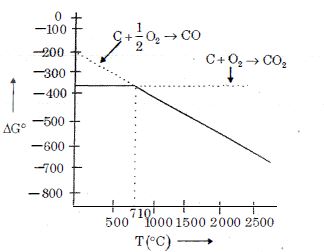
Which of the following is incorrect on the basis of the Ellingham diagram for carbon?
A
Up to $710^{\circ}C$,the reaction of formation of $CO_2$ is energetically more favorable,but above $710^{\circ}C$,the formation of $CO$ is preferred.
B
In principle,carbon can be used to reduce any metal oxide at a sufficiently high temperature.
C
$\Delta S(C_{(s)} + 1/2 O_{2(g)} \to CO_{(g)}) < \Delta S(C_{(s)} + O_{2(g)} \to CO_{2(g)})$
D
Carbon reduces many oxides at elevated temperature because the $\Delta G^{\circ}$ vs temperature line has a negative slope.
Solution
(C) For the reaction $C_{(s)} + 1/2 O_{2(g)} \to CO_{(g)}$,the number of moles of gas increases $(\Delta n_g = +0.5)$,so the entropy change $\Delta S$ is positive.
For the reaction $C_{(s)} + O_{2(g)} \to CO_{2(g)}$,the number of moles of gas remains the same $(\Delta n_g = 0)$,so $\Delta S$ is approximately zero.
Therefore,$\Delta S(C \to CO) > \Delta S(C \to CO_2)$.
Thus,statement $(C)$ is incorrect.
For the reaction $C_{(s)} + O_{2(g)} \to CO_{2(g)}$,the number of moles of gas remains the same $(\Delta n_g = 0)$,so $\Delta S$ is approximately zero.
Therefore,$\Delta S(C \to CO) > \Delta S(C \to CO_2)$.
Thus,statement $(C)$ is incorrect.
0 likes
View Solution268
EasyMCQ
In the extraction of copper from its sulphide ore,the slag is formed by adding which of the following?
A
$SiO_2$
B
$FeO$
C
$P_2O_5$
D
$CaO$
Solution
(A) During the extraction of copper from copper pyrites $(CuFeS_2)$,the ore is roasted to convert iron sulphide $(FeS)$ into iron oxide $(FeO)$.
$2FeS + 3O_2 \rightarrow 2FeO + 2SO_2$
To remove the impurity of $FeO$,silica $(SiO_2)$ is added as a flux.
$FeO + SiO_2 \rightarrow FeSiO_3$ (slag).
Thus,$SiO_2$ is added to form the slag.
$2FeS + 3O_2 \rightarrow 2FeO + 2SO_2$
To remove the impurity of $FeO$,silica $(SiO_2)$ is added as a flux.
$FeO + SiO_2 \rightarrow FeSiO_3$ (slag).
Thus,$SiO_2$ is added to form the slag.
0 likes
View Solution269
EasyMCQ
Self-reduction process is used in the extraction of $-$
A
Iron
B
Zinc
C
Aluminium
D
Lead
Solution
(D) Self-reduction,also known as auto-reduction,is a process where the metal sulfide ore is partially roasted to form its oxide,which then reacts with the remaining sulfide to produce the metal without the need for an external reducing agent.
This process is commonly used for metals like $Cu$,$Pb$,and $Hg$.
For example,in the extraction of lead $(Pb)$ from galena $(PbS)$:
$2PbS + 3O_2 \rightarrow 2PbO + 2SO_2$
$2PbO + PbS \rightarrow 3Pb + SO_2$
Therefore,the correct option is $D$.
This process is commonly used for metals like $Cu$,$Pb$,and $Hg$.
For example,in the extraction of lead $(Pb)$ from galena $(PbS)$:
$2PbS + 3O_2 \rightarrow 2PbO + 2SO_2$
$2PbO + PbS \rightarrow 3Pb + SO_2$
Therefore,the correct option is $D$.
0 likes
View Solution270
EasyMCQ
In the extraction of silver,$Ag_2S$ is dissolved in :
A
$HCl$
B
$HNO_3$
C
$KCN$
D
$H_2SO_4$
Solution
(C) In the Mac-Arthur Forest cyanide process for the extraction of silver,silver sulfide $(Ag_2S)$ ore is treated with a dilute solution of sodium cyanide $(NaCN)$ or potassium cyanide $(KCN)$.
The chemical reaction is as follows:
$Ag_2S + 4KCN \rightarrow 2K[Ag(CN)_2] + K_2S$
This process involves the formation of a soluble complex,$K[Ag(CN)_2]$,which allows the silver to be separated from the ore.
The chemical reaction is as follows:
$Ag_2S + 4KCN \rightarrow 2K[Ag(CN)_2] + K_2S$
This process involves the formation of a soluble complex,$K[Ag(CN)_2]$,which allows the silver to be separated from the ore.
0 likes
View Solution271
MediumMCQ
Consider the following metallurgical processes:
$(i)$ Heating impure metal with $CO$ and distilling the resulting volatile carbonyl (boiling point $43\,^{\circ}C$) and finally decomposing at $150\,^{\circ}C$ to $200\,^{\circ}C$ to get the pure metal.
$(ii)$ Heating the sulphide ore in air until a part is converted to oxide and then further heating in the absence of air to let the oxide react with unchanged sulphide.
$(iii)$ Electrolysing the molten electrolyte containing approximately equal amounts of the metal chloride and $CaCl_2$ to obtain the metal.
The processes used for obtaining sodium,nickel and copper are,respectively,
$(i)$ Heating impure metal with $CO$ and distilling the resulting volatile carbonyl (boiling point $43\,^{\circ}C$) and finally decomposing at $150\,^{\circ}C$ to $200\,^{\circ}C$ to get the pure metal.
$(ii)$ Heating the sulphide ore in air until a part is converted to oxide and then further heating in the absence of air to let the oxide react with unchanged sulphide.
$(iii)$ Electrolysing the molten electrolyte containing approximately equal amounts of the metal chloride and $CaCl_2$ to obtain the metal.
The processes used for obtaining sodium,nickel and copper are,respectively,
A
$(i), (ii)$ and $(iii)$
B
$(ii), (iii)$ and $(i)$
C
$(iii), (i)$ and $(ii)$
D
$(ii), (i)$ and $(iii)$
Solution
(C) The process $(iii)$ is used for obtaining sodium metal via the electrolysis of molten $NaCl$ mixed with $CaCl_2$ (Down's process). The $CaCl_2$ lowers the melting point of $NaCl$.
The process $(i)$ is the Mond process,used for the refining of nickel. Impure nickel reacts with $CO$ to form volatile nickel tetracarbonyl,$Ni(CO)_4$,which is then decomposed at higher temperatures to yield pure nickel.
The process $(ii)$ is self-reduction (or auto-reduction),used for the extraction of copper from copper glance $(Cu_2S)$. The reactions are:
$2Cu_2S + 3O_2 \rightarrow 2Cu_2O + 2SO_2$
$2Cu_2O + Cu_2S \rightarrow 6Cu + SO_2$
Therefore,the processes for sodium,nickel,and copper are $(iii), (i)$ and $(ii)$ respectively.
The process $(i)$ is the Mond process,used for the refining of nickel. Impure nickel reacts with $CO$ to form volatile nickel tetracarbonyl,$Ni(CO)_4$,which is then decomposed at higher temperatures to yield pure nickel.
The process $(ii)$ is self-reduction (or auto-reduction),used for the extraction of copper from copper glance $(Cu_2S)$. The reactions are:
$2Cu_2S + 3O_2 \rightarrow 2Cu_2O + 2SO_2$
$2Cu_2O + Cu_2S \rightarrow 6Cu + SO_2$
Therefore,the processes for sodium,nickel,and copper are $(iii), (i)$ and $(ii)$ respectively.
0 likes
View Solution272
EasyMCQ
Which of the following pair of metals are extracted by self-reduction from their main ores but do not evolve $H_2$ gas with dilute $H_2SO_4$?
A
$Cu, Hg$
B
$Zn, Cu$
C
$Pb, Zn$
D
$Mn, Al$
Solution
(A) $1$. Metals like $Cu$ (from $Cu_2S$) and $Hg$ (from $HgS$) are extracted by self-reduction (roasting).
$2$. Metals that are less reactive than hydrogen in the electrochemical series do not evolve $H_2$ gas when reacted with dilute acids like $H_2SO_4$.
$3$. $Cu$ and $Hg$ are below hydrogen in the reactivity series,hence they do not displace $H_2$ from dilute $H_2SO_4$.
$4$. $Zn$,$Pb$,$Mn$,and $Al$ are more reactive than hydrogen and will evolve $H_2$ gas.
$2$. Metals that are less reactive than hydrogen in the electrochemical series do not evolve $H_2$ gas when reacted with dilute acids like $H_2SO_4$.
$3$. $Cu$ and $Hg$ are below hydrogen in the reactivity series,hence they do not displace $H_2$ from dilute $H_2SO_4$.
$4$. $Zn$,$Pb$,$Mn$,and $Al$ are more reactive than hydrogen and will evolve $H_2$ gas.
0 likes
View Solution273
MediumMCQ
Consider the following reactions of metallurgy:
Ore '$X$' $\xrightarrow{\text{Roasting}}$ '$Y$' + $SO_2$ $\uparrow$
Ore '$Z$' $\xrightarrow{\text{Calcination}}$ '$Y$' + $CO_2$ $\uparrow$
'$Y$' + $C$ $\xrightarrow{1673 \ K}$ '$A$' (vapour) + '$B$' $(g)$
where '$A$' and '$B$' are respectively:
Ore '$X$' $\xrightarrow{\text{Roasting}}$ '$Y$' + $SO_2$ $\uparrow$
Ore '$Z$' $\xrightarrow{\text{Calcination}}$ '$Y$' + $CO_2$ $\uparrow$
'$Y$' + $C$ $\xrightarrow{1673 \ K}$ '$A$' (vapour) + '$B$' $(g)$
where '$A$' and '$B$' are respectively:
A
$ZnO$ & $CO_2$
B
$ZnCO_3$ & $CO_2$
C
$Zn$ & $CO$
D
$ZnO$ & $CO$
Solution
(C) $1$. The reactions describe the extraction of Zinc $(Zn)$.
$2$. Ore '$X$' is Zinc blende $(ZnS)$,which on roasting gives Zinc oxide $(Y = ZnO)$ and $SO_2$.
$3$. Ore '$Z$' is Calamine $(ZnCO_3)$,which on calcination gives Zinc oxide $(Y = ZnO)$ and $CO_2$.
$4$. The reduction of Zinc oxide $(ZnO)$ with Carbon $(C)$ at $1673 \ K$ is given by: $ZnO + C \xrightarrow{1673 \ K} Zn(g) + CO(g)$.
$5$. Here,'$A$' is Zinc vapour $(Zn)$ and '$B$' is Carbon monoxide $(CO)$.
$2$. Ore '$X$' is Zinc blende $(ZnS)$,which on roasting gives Zinc oxide $(Y = ZnO)$ and $SO_2$.
$3$. Ore '$Z$' is Calamine $(ZnCO_3)$,which on calcination gives Zinc oxide $(Y = ZnO)$ and $CO_2$.
$4$. The reduction of Zinc oxide $(ZnO)$ with Carbon $(C)$ at $1673 \ K$ is given by: $ZnO + C \xrightarrow{1673 \ K} Zn(g) + CO(g)$.
$5$. Here,'$A$' is Zinc vapour $(Zn)$ and '$B$' is Carbon monoxide $(CO)$.
0 likes
View Solution274
MediumMCQ
Which of the following oxides is not reduced by carbon reduction for its commercial extraction?
A
$PbO$
B
$SnO_2$
C
$ZnO$
D
$MgO$
Solution
(D) The correct option is $D$.
Carbon reduction is suitable for metals with moderate electropositivity.
$MgO$ (Magnesium oxide) has a very high negative Gibbs free energy of formation $(\Delta G_f^{\circ})$,meaning it is highly stable.
Carbon cannot reduce $MgO$ to $Mg$ at commercially feasible temperatures because the required temperature is extremely high,making electrolytic reduction the preferred method for $Mg$.
In contrast,$PbO$,$SnO_2$,and $ZnO$ are easily reduced by carbon.
Carbon reduction is suitable for metals with moderate electropositivity.
$MgO$ (Magnesium oxide) has a very high negative Gibbs free energy of formation $(\Delta G_f^{\circ})$,meaning it is highly stable.
Carbon cannot reduce $MgO$ to $Mg$ at commercially feasible temperatures because the required temperature is extremely high,making electrolytic reduction the preferred method for $Mg$.
In contrast,$PbO$,$SnO_2$,and $ZnO$ are easily reduced by carbon.
0 likes
View Solution275
MediumMCQ
Low grade $Cu$ ores are available and $Zn$ and $Fe$ scraps are also available. Which scrap among the two would be more suitable for reducing the leached $Cu$ ore (economically)?
A
$Zn$ scraps
B
$Fe$ scraps
C
Both $1$ and $2$
D
It is very difficult to identify
Solution
(B) The extraction of $Cu$ from low-grade ores is done by hydrometallurgy,where the ore is leached with acid or bacteria.
The resulting solution contains $Cu^{2+}$ ions.
To recover $Cu$ metal,we use a more reactive metal to displace $Cu$ from the solution.
The reaction is: $Cu^{2+}(aq) + M(s) \rightarrow Cu(s) + M^{2+}(aq)$.
Both $Zn$ and $Fe$ can displace $Cu$ because they are more reactive than $Cu$.
However,$Fe$ is much cheaper and more abundantly available as scrap compared to $Zn$.
Therefore,$Fe$ scrap is more economically suitable for the reduction of leached $Cu$ ore.
The resulting solution contains $Cu^{2+}$ ions.
To recover $Cu$ metal,we use a more reactive metal to displace $Cu$ from the solution.
The reaction is: $Cu^{2+}(aq) + M(s) \rightarrow Cu(s) + M^{2+}(aq)$.
Both $Zn$ and $Fe$ can displace $Cu$ because they are more reactive than $Cu$.
However,$Fe$ is much cheaper and more abundantly available as scrap compared to $Zn$.
Therefore,$Fe$ scrap is more economically suitable for the reduction of leached $Cu$ ore.
0 likes
View Solution276
EasyMCQ
On heating a mixture of $Cu_2O$ and $Cu_2S$,the product obtained is:
A
$Cu + SO_2$
B
$Cu + SO_3$
C
$CuO + CuS$
D
$CuO$
Solution
(A) The reaction between copper$(I)$ oxide and copper$(I)$ sulfide is a self-reduction process used in the extraction of copper metal.
The balanced chemical equation is:
$2Cu_2O + Cu_2S \to 6Cu + SO_2$
The balanced chemical equation is:
$2Cu_2O + Cu_2S \to 6Cu + SO_2$
0 likes
View Solution277
MediumMCQ
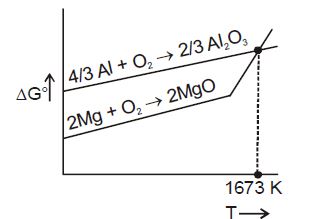
Which of the following statements is/are correct based on the provided Ellingham diagram?
A
$Mg$ will be a good reducing agent below $1673 \ K$.
B
$Al$ will be a good reducing agent below $1673 \ K$.
C
$Al_2O_3$ will be a good reducing agent after $1673 \ K$.
D
Both $(A)$ and $(C)$.
Solution
(A) In an Ellingham diagram,the metal whose oxidation curve lies lower is a better reducing agent for the oxide of the metal whose curve lies higher.
Below $1673 \ K$,the curve for $2Mg + O_2 \rightarrow 2MgO$ lies below the curve for $4/3Al + O_2 \rightarrow 2/3Al_2O_3$,which means $\Delta G^o_{MgO} < \Delta G^o_{Al_2O_3}$. Thus,$Mg$ can reduce $Al_2O_3$ to $Al$ below $1673 \ K$.
Above $1673 \ K$,the curve for $Al$ oxidation lies below the curve for $Mg$ oxidation,meaning $Al$ can reduce $MgO$ to $Mg$. Therefore,$Al_2O_3$ is not a reducing agent,but $Al$ is.
Thus,only statement $(A)$ is correct.
Below $1673 \ K$,the curve for $2Mg + O_2 \rightarrow 2MgO$ lies below the curve for $4/3Al + O_2 \rightarrow 2/3Al_2O_3$,which means $\Delta G^o_{MgO} < \Delta G^o_{Al_2O_3}$. Thus,$Mg$ can reduce $Al_2O_3$ to $Al$ below $1673 \ K$.
Above $1673 \ K$,the curve for $Al$ oxidation lies below the curve for $Mg$ oxidation,meaning $Al$ can reduce $MgO$ to $Mg$. Therefore,$Al_2O_3$ is not a reducing agent,but $Al$ is.
Thus,only statement $(A)$ is correct.
0 likes
View Solution278
MediumMCQ
Identify the correct statements for the following reaction sequence:
$Ag + NaCN (0.5\%) + H_2O + O_2 \to \text{Soluble complex} \xrightarrow{Zn} B (\text{complex}) + Ag$
$Ag + NaCN (0.5\%) + H_2O + O_2 \to \text{Soluble complex} \xrightarrow{Zn} B (\text{complex}) + Ag$
A
$A = Na[Ag(CN)_2]$
B
$B = Na_2[Zn(CN)_4]$
C
Oxidation-reduction process
D
All of these
Solution
(D) The extraction of silver $(Ag)$ from its ore involves the following steps:
$1$. The ore is treated with a dilute solution of $NaCN$ in the presence of air $(O_2)$ to form a soluble complex:
$4Ag + 8NaCN + 2H_2O + O_2 \to 4Na[Ag(CN)_2] + 4NaOH$
Here,$A = Na[Ag(CN)_2]$ (Sodium dicyanoargentate$(I)$).
$2$. The silver is then recovered from the complex by adding zinc $(Zn)$,which acts as a reducing agent:
$2Na[Ag(CN)_2] + Zn \to Na_2[Zn(CN)_4] + 2Ag$
Here,$B = Na_2[Zn(CN)_4]$ (Sodium tetracyanozincate$(II)$).
$3$. This process is a displacement reaction involving oxidation and reduction (redox process),where $Zn$ is oxidized and $Ag^+$ is reduced to $Ag$.
Therefore,all the given options are correct.
$1$. The ore is treated with a dilute solution of $NaCN$ in the presence of air $(O_2)$ to form a soluble complex:
$4Ag + 8NaCN + 2H_2O + O_2 \to 4Na[Ag(CN)_2] + 4NaOH$
Here,$A = Na[Ag(CN)_2]$ (Sodium dicyanoargentate$(I)$).
$2$. The silver is then recovered from the complex by adding zinc $(Zn)$,which acts as a reducing agent:
$2Na[Ag(CN)_2] + Zn \to Na_2[Zn(CN)_4] + 2Ag$
Here,$B = Na_2[Zn(CN)_4]$ (Sodium tetracyanozincate$(II)$).
$3$. This process is a displacement reaction involving oxidation and reduction (redox process),where $Zn$ is oxidized and $Ag^+$ is reduced to $Ag$.
Therefore,all the given options are correct.
0 likes
View Solution279
EasyMCQ
In which of the following metallurgy,self-reduction is not possible?
A
$ZnS \to Zn$
B
$PbS \to Pb$
C
$Cu_2S \to Cu$
D
$HgS \to Hg$
Solution
(A) Self-reduction (or auto-reduction) is a process where the metal sulfide is partially roasted to form oxide,which then reacts with the remaining sulfide to produce the metal.
$1. PbS$ (Galena) undergoes self-reduction: $2PbS + 3O_2 \to 2PbO + 2SO_2$ followed by $PbS + 2PbO \to 3Pb + SO_2$.
$2. Cu_2S$ (Copper glance) undergoes self-reduction: $2Cu_2S + 3O_2 \to 2Cu_2O + 2SO_2$ followed by $2Cu_2O + Cu_2S \to 6Cu + SO_2$.
$3. HgS$ (Cinnabar) undergoes self-reduction: $2HgS + 3O_2 \to 2HgO + 2SO_2$ followed by $2HgO + HgS \to 3Hg + SO_2$.
$4. ZnS$ (Zinc blende) cannot be reduced by self-reduction because zinc oxide $(ZnO)$ is not easily reduced by $ZnS$. Instead,$ZnO$ is reduced by carbon $(C)$ in a blast furnace.
Therefore,self-reduction is not possible for $ZnS \to Zn$.
$1. PbS$ (Galena) undergoes self-reduction: $2PbS + 3O_2 \to 2PbO + 2SO_2$ followed by $PbS + 2PbO \to 3Pb + SO_2$.
$2. Cu_2S$ (Copper glance) undergoes self-reduction: $2Cu_2S + 3O_2 \to 2Cu_2O + 2SO_2$ followed by $2Cu_2O + Cu_2S \to 6Cu + SO_2$.
$3. HgS$ (Cinnabar) undergoes self-reduction: $2HgS + 3O_2 \to 2HgO + 2SO_2$ followed by $2HgO + HgS \to 3Hg + SO_2$.
$4. ZnS$ (Zinc blende) cannot be reduced by self-reduction because zinc oxide $(ZnO)$ is not easily reduced by $ZnS$. Instead,$ZnO$ is reduced by carbon $(C)$ in a blast furnace.
Therefore,self-reduction is not possible for $ZnS \to Zn$.
0 likes
View Solution280
MediumMCQ
The purpose of the stream of air in the leaching process of $Ag_2S$ is to:
A
Oxidise $Na_2S$ formed into $Na_2S_2O_3$
B
Oxidise $Na_2S$ formed into $Na_2SO_4$
C
Oxidise $Na_2S$ formed into $Na_2O$
D
Act as a catalyst
Solution
(B) In the leaching of $Ag_2S$ (silver sulphide) with aqueous $NaCN$,the reaction is reversible:
$Ag_2S + 4 NaCN \rightleftharpoons 2 Na[Ag(CN)_2] + Na_2S$
To drive the reaction forward,the product $Na_2S$ must be removed.
$A$ stream of air (oxygen) is passed through the solution to oxidise $Na_2S$ into $Na_2SO_4$ (sodium sulphate) and sulphur,preventing the reverse reaction.
The overall reaction is: $2 Na_2S + 2 O_2 + H_2O \rightarrow Na_2SO_4 + 2 NaOH + S$ (or similar oxidation products like $Na_2SO_4$).
$Ag_2S + 4 NaCN \rightleftharpoons 2 Na[Ag(CN)_2] + Na_2S$
To drive the reaction forward,the product $Na_2S$ must be removed.
$A$ stream of air (oxygen) is passed through the solution to oxidise $Na_2S$ into $Na_2SO_4$ (sodium sulphate) and sulphur,preventing the reverse reaction.
The overall reaction is: $2 Na_2S + 2 O_2 + H_2O \rightarrow Na_2SO_4 + 2 NaOH + S$ (or similar oxidation products like $Na_2SO_4$).
0 likes
View Solution281
EasyMCQ
During the extraction of $Fe$,which reaction is performed in the combustion zone?
A
$CaO + SiO_2 \to CaSiO_3$
B
$FeO + SiO_2 \to FeSiO_3$
C
$Fe_2O_3 + CO \to Fe + CO_2$
D
None of these
Solution
(D) In the blast furnace,the combustion zone is the region at the bottom where coke burns in the presence of a hot air blast to produce $CO_2$ and heat.
The primary reaction occurring in this zone is $C + O_2 \to CO_2$ $(\Delta H < 0)$.
Since this reaction is not among the given options,the correct answer is $D$.
The primary reaction occurring in this zone is $C + O_2 \to CO_2$ $(\Delta H < 0)$.
Since this reaction is not among the given options,the correct answer is $D$.
0 likes
View Solution282
MediumMCQ
Aluminium is extracted from alumina $Al_2O_3$ by electrolysis of a molten mixture of
A
$Al_2O_3 + Na_3AlF_6 + CaF_2$
B
$Al_2O_3 + KF + Na_3AlF_6$
C
$Al_2O_3 + HF + NaAlF_4$
D
$Al_2O_3 + CaF_2 + NaAlF_4$
Solution
(A) The electrolysis of pure alumina faces some difficulties. Pure alumina is a bad conductor of electricity.
The fusion temperature of pure alumina is about $2000^{\circ} C$ and at this temperature,the metal formed vaporizes,as the boiling point of aluminum is $1800^{\circ} C$.
These difficulties are overcome by using a mixture containing alumina $(Al_2O_3)$,cryolite $(Na_3AlF_6)$,and fluorspar $(CaF_2)$,which lowers the melting point to about $900^{\circ} C$ and increases electrical conductivity.
The fusion temperature of pure alumina is about $2000^{\circ} C$ and at this temperature,the metal formed vaporizes,as the boiling point of aluminum is $1800^{\circ} C$.
These difficulties are overcome by using a mixture containing alumina $(Al_2O_3)$,cryolite $(Na_3AlF_6)$,and fluorspar $(CaF_2)$,which lowers the melting point to about $900^{\circ} C$ and increases electrical conductivity.
0 likes
View Solution283
EasyMCQ
In the equation,$4M + 8CN^{-} + 2H_2O + O_2 \to 4[M(CN)_2]^- + 4OH^{-}$,the metal $M$ is
A
copper
B
iron
C
gold
D
zinc
Solution
(C) The given equation represents the leaching process of noble metals like $Au$ (gold) or $Ag$ (silver) using a dilute solution of sodium cyanide $(NaCN)$ in the presence of air $(O_2)$ as an oxidizing agent.
This is a key step in the MacArthur-Forrest cyanide process for the extraction of gold and silver from their ores.
Therefore,the metal $M$ is $Au$ (gold) or $Ag$ (silver).
This is a key step in the MacArthur-Forrest cyanide process for the extraction of gold and silver from their ores.
Therefore,the metal $M$ is $Au$ (gold) or $Ag$ (silver).
0 likes
View Solution284
MediumMCQ
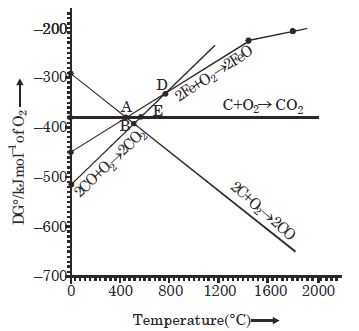
The temperature at which carbon reduces $FeO$ into iron and produces $CO$ is:
A
Below the temperature at point $A$
B
Approximately the same temperature at point $A$
C
Above point $A$, but below point $D$
D
Above point $A$
Solution
(D) In the Ellingham diagram, the reduction of $FeO$ by carbon to produce $CO$ is represented by the reaction: $2FeO + 2C \rightarrow 2Fe + 2CO$.
This reaction is spontaneous when the Gibbs free energy change $(\Delta G^\circ)$ for the coupled reaction is negative.
Looking at the diagram, the line for the oxidation of carbon to $CO$ $(2C + O_2 \rightarrow 2CO)$ intersects the line for the oxidation of iron to $FeO$ $(2Fe + O_2 \rightarrow 2FeO)$ at point $A$.
At temperatures above point $A$, the line for $2C + O_2 \rightarrow 2CO$ lies below the line for $2Fe + O_2 \rightarrow 2FeO$, meaning the reduction of $FeO$ by $C$ becomes thermodynamically favorable $(\Delta G^\circ < 0)$.
Therefore, the reduction occurs at temperatures above point $A$.
This reaction is spontaneous when the Gibbs free energy change $(\Delta G^\circ)$ for the coupled reaction is negative.
Looking at the diagram, the line for the oxidation of carbon to $CO$ $(2C + O_2 \rightarrow 2CO)$ intersects the line for the oxidation of iron to $FeO$ $(2Fe + O_2 \rightarrow 2FeO)$ at point $A$.
At temperatures above point $A$, the line for $2C + O_2 \rightarrow 2CO$ lies below the line for $2Fe + O_2 \rightarrow 2FeO$, meaning the reduction of $FeO$ by $C$ becomes thermodynamically favorable $(\Delta G^\circ < 0)$.
Therefore, the reduction occurs at temperatures above point $A$.
0 likes
View Solution285
EasyMCQ
In the cyanide process involving extraction of silver,zinc is used industrially as an
A
Oxidising agent
B
Reducing agent
C
Solvent
D
Solvating agent
Solution
(B) In the cyanide process for the extraction of silver,the ore is treated with a dilute solution of $NaCN$ in the presence of air to form a soluble complex: $4Ag + 8CN^- + 2H_2O + O_2 \rightarrow 4[Ag(CN)_2]^- + 4OH^-$.
Zinc is then added to this solution to displace silver from the complex: $2[Ag(CN)_2]^- + Zn \rightarrow [Zn(CN)_4]^{2-} + 2Ag$.
In this reaction,$Zn$ is oxidized to $Zn^{2+}$ and $Ag^+$ is reduced to $Ag$. Therefore,zinc acts as a reducing agent.
Zinc is then added to this solution to displace silver from the complex: $2[Ag(CN)_2]^- + Zn \rightarrow [Zn(CN)_4]^{2-} + 2Ag$.
In this reaction,$Zn$ is oxidized to $Zn^{2+}$ and $Ag^+$ is reduced to $Ag$. Therefore,zinc acts as a reducing agent.
0 likes
View Solution286
EasyMCQ
Copper matte contains
A
$98 \%$ pure $Cu$
B
Major amount of $Cu_2S$
C
Minor amount of $Cu_2S$
D
$FeSiO_3$
Solution
(B) Copper matte is obtained during the extraction of copper from copper pyrites $(CuFeS_2)$.
It is a molten mixture consisting mainly of cuprous sulphide $(Cu_2S)$ and a small amount of ferrous sulphide $(FeS)$.
Therefore,it contains a major amount of $Cu_2S$.
It is a molten mixture consisting mainly of cuprous sulphide $(Cu_2S)$ and a small amount of ferrous sulphide $(FeS)$.
Therefore,it contains a major amount of $Cu_2S$.
0 likes
View Solution287
EasyMCQ
When copper ore is mixed with silica in a reverberatory furnace,copper matte is produced. The copper matte contains . . . . . .
A
Sulphides of copper $(II)$ and iron $(II)$
B
Sulphides of copper $(II)$ and iron $(III)$
C
Sulphides of copper $(I)$ and iron $(II)$
D
Sulphides of copper $(I)$ and iron $(III)$
Solution
(C) In the extraction of copper,the roasted ore is mixed with silica $(SiO_2)$ and heated in a reverberatory furnace.
Iron oxide $(FeO)$ reacts with silica to form iron silicate slag $(FeSiO_3)$,which is removed.
The remaining mixture,known as copper matte,primarily consists of cuprous sulphide $(Cu_2S)$ and ferrous sulphide $(FeS)$.
Thus,copper matte contains sulphides of copper $(I)$ and iron $(II)$.
Iron oxide $(FeO)$ reacts with silica to form iron silicate slag $(FeSiO_3)$,which is removed.
The remaining mixture,known as copper matte,primarily consists of cuprous sulphide $(Cu_2S)$ and ferrous sulphide $(FeS)$.
Thus,copper matte contains sulphides of copper $(I)$ and iron $(II)$.
0 likes
View Solution288
EasyMCQ
Carbon reduction is not used to obtain $Cr$ and $Mn$ because
A
Process is not thermodynamically feasible
B
Process is not economically feasible
C
Interstitial compounds are formed by $Cr$ and $Mn$ with carbon at high temperature
D
$Cr$ and $Mn$ are high melting metals
Solution
(C) Carbon reduction is generally used for the extraction of metals like $Fe$,$Zn$,etc.
However,for metals like $Cr$ and $Mn$,carbon reduction is not preferred because these metals have a high affinity for carbon at high temperatures.
At the high temperatures required for the reduction process,$Cr$ and $Mn$ react with carbon to form stable interstitial carbides (e.g.,$Cr_3C_2$,$Mn_7C_3$).
These carbides contaminate the metal and make the extraction process inefficient and the product impure.
However,for metals like $Cr$ and $Mn$,carbon reduction is not preferred because these metals have a high affinity for carbon at high temperatures.
At the high temperatures required for the reduction process,$Cr$ and $Mn$ react with carbon to form stable interstitial carbides (e.g.,$Cr_3C_2$,$Mn_7C_3$).
These carbides contaminate the metal and make the extraction process inefficient and the product impure.
0 likes
View Solution289
EasyMCQ
Which one of the following electrolytes is used in Down's process for the extraction of sodium metal?
A
$NaCl + CaCl_2$
B
$NaCl$
C
$NaOH + CaCl_2$
D
$CaCl_2$ only
Solution
(A) In the Down's process,sodium is obtained by the electrolysis of a fused mixture of sodium chloride $(NaCl)$ and calcium chloride $(CaCl_2)$.
The mixture typically consists of $40\, \% \ NaCl$ and $60\, \% \ CaCl_2$.
The primary function of adding $CaCl_2$ is to lower the melting point of the electrolyte mixture from $801\, ^{\circ}C$ to approximately $600\, ^{\circ}C$,which reduces the operating temperature and prevents the volatilization of sodium metal.
At the cathode: $Na^{+} + e^{-} \longrightarrow Na$
At the anode: $2Cl^{-} \longrightarrow Cl_2 + 2e^{-}$
The mixture typically consists of $40\, \% \ NaCl$ and $60\, \% \ CaCl_2$.
The primary function of adding $CaCl_2$ is to lower the melting point of the electrolyte mixture from $801\, ^{\circ}C$ to approximately $600\, ^{\circ}C$,which reduces the operating temperature and prevents the volatilization of sodium metal.
At the cathode: $Na^{+} + e^{-} \longrightarrow Na$
At the anode: $2Cl^{-} \longrightarrow Cl_2 + 2e^{-}$
0 likes
View Solution290
DifficultMCQ
$Ag_2S + NaCN \to (A)$,$(A) + Zn \to (B)$
$(B)$ is a metal. Hence,$(A)$ and $(B)$ are:
$(B)$ is a metal. Hence,$(A)$ and $(B)$ are:
A
$Na_2[Zn(CN)_4], Zn$
B
$Na[Ag(CN)_2], Ag$
C
$Na_2[Ag(CN)_4], Ag$
D
$Na_3[Ag(CN)_4], Ag$
Solution
(B) The extraction of silver from its ore $Ag_2S$ (argentite) involves the following steps:
$1$. Leaching: $Ag_2S + 4NaCN \to 2Na[Ag(CN)_2] + Na_2S$. Here,$(A)$ is $Na[Ag(CN)_2]$.
$2$. Displacement: $2Na[Ag(CN)_2] + Zn \to Na_2[Zn(CN)_4] + 2Ag$. Here,$(B)$ is $Ag$ (silver metal).
Therefore,$(A)$ is $Na[Ag(CN)_2]$ and $(B)$ is $Ag$.
$1$. Leaching: $Ag_2S + 4NaCN \to 2Na[Ag(CN)_2] + Na_2S$. Here,$(A)$ is $Na[Ag(CN)_2]$.
$2$. Displacement: $2Na[Ag(CN)_2] + Zn \to Na_2[Zn(CN)_4] + 2Ag$. Here,$(B)$ is $Ag$ (silver metal).
Therefore,$(A)$ is $Na[Ag(CN)_2]$ and $(B)$ is $Ag$.
0 likes
View Solution291
MediumMCQ
Carbon reduction process is not commercially applicable for which of the following set of oxides to extract the respective metal?
$(I)$ $ZnO$,$(II)$ $Fe_2O_3$,$(III)$ $Al_2O_3$,$(IV)$ $SnO_2$,$(V)$ $MgO$
$(I)$ $ZnO$,$(II)$ $Fe_2O_3$,$(III)$ $Al_2O_3$,$(IV)$ $SnO_2$,$(V)$ $MgO$
A
$ZnO, Fe_2O_3, SnO_2$
B
$ZnO, SnO_2, MgO$
C
$MgO, Al_2O_3$
D
$MgO, SnO_2, Al_2O_3$
Solution
(C) The carbon reduction process is generally used for metals with moderate electropositivity,such as $Zn, Fe,$ and $Sn$.
Metals like $Al$ and $Mg$ are highly electropositive and have a very high affinity for oxygen.
Their oxides ($Al_2O_3$ and $MgO$) are extremely stable and cannot be reduced by carbon at standard commercial temperatures.
While $MgO$ can be reduced by carbon at extremely high temperatures (around $2000^{\circ} C$),it is not considered a commercially viable process due to the high energy requirements and technical difficulties.
Therefore,carbon reduction is not commercially applicable for $Al_2O_3$ and $MgO$.
Metals like $Al$ and $Mg$ are highly electropositive and have a very high affinity for oxygen.
Their oxides ($Al_2O_3$ and $MgO$) are extremely stable and cannot be reduced by carbon at standard commercial temperatures.
While $MgO$ can be reduced by carbon at extremely high temperatures (around $2000^{\circ} C$),it is not considered a commercially viable process due to the high energy requirements and technical difficulties.
Therefore,carbon reduction is not commercially applicable for $Al_2O_3$ and $MgO$.
0 likes
View Solution292
MediumMCQ
In the extraction of copper from its sulphide ore,metal is finally obtained by the oxidation of cuprous sulphide with
A
$SO_2$
B
$Fe_2O_3$
C
$Cu_2O$
D
$CO$
Solution
(C) In the extraction of copper from copper glance $(Cu_2S)$,the ore is partially roasted to form cuprous oxide $(Cu_2O)$.
The remaining $Cu_2S$ then reacts with the formed $Cu_2O$ in a process known as auto-reduction or self-reduction.
The chemical equation is: $Cu_2S + 2Cu_2O \to 6Cu + SO_2$.
Thus,$Cu_2S$ is oxidized by $Cu_2O$ to produce copper metal.
The remaining $Cu_2S$ then reacts with the formed $Cu_2O$ in a process known as auto-reduction or self-reduction.
The chemical equation is: $Cu_2S + 2Cu_2O \to 6Cu + SO_2$.
Thus,$Cu_2S$ is oxidized by $Cu_2O$ to produce copper metal.
0 likes
View Solution293
DifficultMCQ
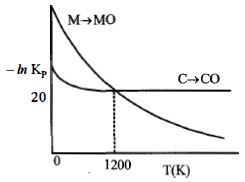
The plot shows the variation of $- \ln K_p$ versus temperature for the two reactions:
$M_{(s)} + \frac{1}{2} O_{2(g)} \to MO_{(s)}$ and $C_{(s)} + \frac{1}{2} O_{2(g)} \to CO_{(g)}$
Identify the correct statement.
$M_{(s)} + \frac{1}{2} O_{2(g)} \to MO_{(s)}$ and $C_{(s)} + \frac{1}{2} O_{2(g)} \to CO_{(g)}$
Identify the correct statement.
A
At $T < 1200 \ K$,oxidation of carbon is unfavourable.
B
Oxidation of carbon is favourable at all temperatures.
C
At $T < 1200 \ K$,the reaction $MO_{(s)} + C_{(s)} \to M_{(s)} + CO_{(g)}$ is spontaneous.
D
At $T > 1200 \ K$,carbon will reduce $MO_{(s)}$ to $M_{(s)}$.
Solution
(D) The relationship between Gibbs free energy change and equilibrium constant is $\Delta G^\circ = -RT \ln K_p$,which can be rewritten as $-\ln K_p = \frac{\Delta G^\circ}{RT}$.
For a reaction to be spontaneous,$\Delta G^\circ < 0$,which implies $-\ln K_p < 0$.
From the Ellingham diagram,at $T > 1200 \ K$,the value of $-\ln K_p$ for the reaction $C_{(s)} + \frac{1}{2} O_{2(g)} \to CO_{(g)}$ is lower than that for $M_{(s)} + \frac{1}{2} O_{2(g)} \to MO_{(s)}$.
This indicates that the formation of $CO$ is more thermodynamically stable than $MO$ at $T > 1200 \ K$.
Therefore,carbon can reduce $MO_{(s)}$ to $M_{(s)}$ at temperatures above $1200 \ K$ according to the reaction $MO_{(s)} + C_{(s)} \to M_{(s)} + CO_{(g)}$.
For a reaction to be spontaneous,$\Delta G^\circ < 0$,which implies $-\ln K_p < 0$.
From the Ellingham diagram,at $T > 1200 \ K$,the value of $-\ln K_p$ for the reaction $C_{(s)} + \frac{1}{2} O_{2(g)} \to CO_{(g)}$ is lower than that for $M_{(s)} + \frac{1}{2} O_{2(g)} \to MO_{(s)}$.
This indicates that the formation of $CO$ is more thermodynamically stable than $MO$ at $T > 1200 \ K$.
Therefore,carbon can reduce $MO_{(s)}$ to $M_{(s)}$ at temperatures above $1200 \ K$ according to the reaction $MO_{(s)} + C_{(s)} \to M_{(s)} + CO_{(g)}$.
0 likes
View Solution294
MediumMCQ
Extraction of copper by smelting uses silica as an additive to remove
A
$Cu_2O$
B
$FeS$
C
$FeO$
D
$Cu_2S$
Solution
(C) In the extraction of copper,$FeO$ is present as a basic gangue impurity.
$SiO_2$ is added as an acidic flux to remove this impurity.
They react to form a fusible slag,$FeSiO_3$.
The reaction is: $\mathop {FeO}\limits_{\text{Basic impurity}} + \mathop {SiO_2}\limits_{\text{Acidic flux}}$ $\longrightarrow \mathop {FeSiO_3}\limits_{\text{Slag}}$
$SiO_2$ is added as an acidic flux to remove this impurity.
They react to form a fusible slag,$FeSiO_3$.
The reaction is: $\mathop {FeO}\limits_{\text{Basic impurity}} + \mathop {SiO_2}\limits_{\text{Acidic flux}}$ $\longrightarrow \mathop {FeSiO_3}\limits_{\text{Slag}}$
0 likes
View Solution295
EasyMCQ
The form of iron obtained from blast furnace is
A
Steel
B
Cast Iron
C
Pig Iron
D
Wrought Iron
Solution
(C) The iron obtained from the blast furnace is known as $Pig \ Iron$. It contains about $4 \%$ carbon and many impurities like $S, P, Si, Mn$ in smaller amounts.
0 likes
View Solution296
MediumMCQ
In the Goldschmidt aluminothermic process,which of the following reducing agents is used?
A
calcium
B
coke
C
$Al$ powder
D
sodium
Solution
(C) The reduction of metal oxides using powdered aluminium is known as the Goldschmidt aluminothermic process.
This process is specifically employed for the extraction of metals that have very high melting points $(m.p.)$ and are obtained from their respective oxides.
This process is specifically employed for the extraction of metals that have very high melting points $(m.p.)$ and are obtained from their respective oxides.
0 likes
View Solution297
DifficultMCQ
Which of the oxide groups among the following cannot be reduced by carbon?
A
$Cu_2O, SnO_2$
B
$CaO, K_2O$
C
$PbO, Fe_3O_4$
D
$Fe_2O_3, ZnO$
Solution
(B) Carbon is used as a reducing agent in metallurgy to reduce metal oxides to their respective metals.
However,carbon cannot reduce oxides of highly reactive metals like $Ca$,$K$,$Na$,and $Mg$ because these metals have a much higher affinity for oxygen than carbon does.
In the given options,$CaO$ and $K_2O$ are oxides of highly reactive alkaline earth and alkali metals,respectively.
Therefore,they cannot be reduced by carbon.
However,carbon cannot reduce oxides of highly reactive metals like $Ca$,$K$,$Na$,and $Mg$ because these metals have a much higher affinity for oxygen than carbon does.
In the given options,$CaO$ and $K_2O$ are oxides of highly reactive alkaline earth and alkali metals,respectively.
Therefore,they cannot be reduced by carbon.
0 likes
View Solution298
MediumMCQ
In the electrolysis of alumina to obtain aluminium metal,cryolite is added mainly to
A
lower the melting point of alumina
B
dissolve alumina in molten cryolite
C
remove the impurities of alumina
D
increase the electrical conductivity
Solution
(A) Fused alumina $(Al_2O_3)$ is a bad conductor of electricity and has a very high melting point. Cryolite $(Na_3AlF_6)$ is added to purified alumina to lower its melting point to about $1140 \ K$ and to increase its electrical conductivity.
0 likes
View Solution299
MediumMCQ
Extraction of zinc from zinc blende is achieved by
A
roasting followed by self-reduction
B
electrolytic reduction
C
roasting followed by reduction with carbon
D
roasting followed by reduction with another metal
Solution
(C) Extraction of $Zn$ from zinc blende $(ZnS)$ is achieved by roasting followed by reduction with carbon (coke).
Step $1$: Roasting of zinc blende in the presence of excess air:
$2ZnS + 3O_2 \xrightarrow{\Delta} 2ZnO + 2SO_2$
Step $2$: Reduction of zinc oxide with carbon (coke) at high temperature:
$ZnO + C \xrightarrow{\Delta} Zn + CO$
Step $1$: Roasting of zinc blende in the presence of excess air:
$2ZnS + 3O_2 \xrightarrow{\Delta} 2ZnO + 2SO_2$
Step $2$: Reduction of zinc oxide with carbon (coke) at high temperature:
$ZnO + C \xrightarrow{\Delta} Zn + CO$
0 likes
View Solution300
DifficultMCQ
The correct statement regarding the given Ellingham diagram is
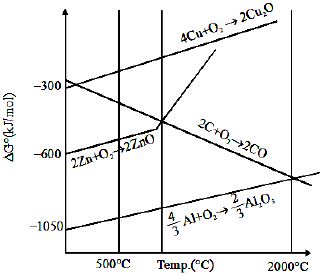
A
At $1400\,^\circ C,$ $Al$ can be used for the extraction of $Zn$ from $ZnO$.
B
At $500\,^\circ C,$ coke can be used for the extraction of $Zn$ from $ZnO$.
C
Coke cannot be used for the extraction of $Cu$ from $Cu_2O$.
D
At $800\,^\circ C,$ $Cu$ can be used for the extraction of $Zn$ from $ZnO$.
Solution
(A) In an Ellingham diagram,a metal can reduce the oxide of another metal if the line for the formation of its own oxide lies below the line for the formation of the other metal's oxide.
$1$. At $1400\,^\circ C,$ the line for the formation of $Al_2O_3$ is below the line for the formation of $ZnO.$ Therefore,$Al$ can reduce $ZnO$ to $Zn$.
$2$. At $500\,^\circ C,$ the line for the formation of $ZnO$ is below the line for the formation of $CO,$ so coke cannot reduce $ZnO$.
$3$. The line for the formation of $CO$ is below the line for the formation of $Cu_2O$ at all temperatures,so coke can reduce $Cu_2O$.
$4$. At $800\,^\circ C,$ the line for the formation of $ZnO$ is below the line for the formation of $Cu_2O,$ so $Cu$ cannot reduce $ZnO$.
Thus,option $A$ is correct.
$1$. At $1400\,^\circ C,$ the line for the formation of $Al_2O_3$ is below the line for the formation of $ZnO.$ Therefore,$Al$ can reduce $ZnO$ to $Zn$.
$2$. At $500\,^\circ C,$ the line for the formation of $ZnO$ is below the line for the formation of $CO,$ so coke cannot reduce $ZnO$.
$3$. The line for the formation of $CO$ is below the line for the formation of $Cu_2O$ at all temperatures,so coke can reduce $Cu_2O$.
$4$. At $800\,^\circ C,$ the line for the formation of $ZnO$ is below the line for the formation of $Cu_2O,$ so $Cu$ cannot reduce $ZnO$.
Thus,option $A$ is correct.
0 likes
View SolutionGeneral Principles and Processes of Isolation of Elements — Reduction to free Metal · Frequently Asked Questions
1Are these General Principles and Processes of Isolation of Elements questions useful for JEE and NEET?
Yes. All questions in this section are mapped to JEE Main and NEET exam patterns. Previous year questions from JEE Main, NEET, GUJCET and state-level exams are included with full solutions.
2Can I switch to Hindi or Gujarati for these questions?
Yes. Use the language tabs in the hero section or the sidebar to view the same questions and solutions in English, Hindi or Gujarati.
3How do I generate a question paper from this subtopic?
Use the Vedclass Exam Paper Generator — select the chapter and subtopic, set difficulty, and generate Sets A, B, C, D automatically. First 3 chapters of every subject are free.
Vedclass Products
For Students
Vedclass Test Series
Mock tests in real JEE/NEET style with performance analysis. 5-day free trial.
Start Free TrialFor Teachers
Exam Paper Generator
Generate Set A/B/C/D papers from this chapter in 2 minutes. 3 chapters free.
Try FreeFor Institutes
Online Exam Module
Live online exams with unlimited students, 360° analytics & white-label branding.
See DemoFor Teachers & Institutes
Generate a General Principles and Processes of Isolation of Elements Exam Paper in 2 Minutes
Select subtopic & difficulty — Sets A, B, C, D auto-generated with No Repeat logic.
First 3 chapters of every subject are free — no payment required.