
A English
Isomerism and Magnetic properties Questions in English
Class 12 Chemistry · Coordination Compounds · Isomerism and Magnetic properties
800+
Questions
English
Language
100%
With Solutions
Showing 50 of 800 questions in English
101
MediumMCQ
Which of the following complex ions is diamagnetic in nature?
A
$[NiCl_4]^{2-}$
B
$[Ni(CN)_4]^{2-}$
C
$[CuCl_4]^{2-}$
D
$[CoF_6]^{3-}$
Solution
(B) In $[Ni(CN)_4]^{2-}$,the central metal ion is $Ni^{2+}$ ($3d^8$ configuration).
$CN^-$ is a strong field ligand,which causes pairing of electrons in the $3d$ orbitals.
This results in $dsp^2$ hybridization,leaving no unpaired electrons,making the complex diamagnetic.
$CN^-$ is a strong field ligand,which causes pairing of electrons in the $3d$ orbitals.
This results in $dsp^2$ hybridization,leaving no unpaired electrons,making the complex diamagnetic.
0 likes
View Solution102
MediumMCQ
Among $Ni(CO)_4$,$[Ni(CN)_4]^{2-}$,and $[NiCl_4]^{2-}$,which of the following statements is correct regarding their magnetic properties?
A
$Ni(CO)_4$ and $[NiCl_4]^{2-}$ are diamagnetic and $[Ni(CN)_4]^{2-}$ is paramagnetic.
B
$[NiCl_4]^{2-}$ and $[Ni(CN)_4]^{2-}$ are diamagnetic and $[Ni(CO)_4]$ is paramagnetic.
C
$Ni(CO)_4$ and $[Ni(CN)_4]^{2-}$ are diamagnetic and $[NiCl_4]^{2-}$ is paramagnetic.
D
$Ni(CO)_4$ is diamagnetic and $[NiCl_4]^{2-}$ and $[Ni(CN)_4]^{2-}$ are paramagnetic.
Solution
(C) $1$. In $Ni(CO)_4$,$Ni$ is in $0$ oxidation state $(3d^8 4s^2)$. $CO$ is a strong field ligand,causing pairing of electrons. It is diamagnetic.
$2$. In $[Ni(CN)_4]^{2-}$,$Ni$ is in $+2$ oxidation state $(3d^8)$. $CN^-$ is a strong field ligand,causing pairing of electrons. It is diamagnetic.
$3$. In $[NiCl_4]^{2-}$,$Ni$ is in $+2$ oxidation state $(3d^8)$. $Cl^-$ is a weak field ligand,so no pairing occurs. It has two unpaired electrons and is paramagnetic.
$2$. In $[Ni(CN)_4]^{2-}$,$Ni$ is in $+2$ oxidation state $(3d^8)$. $CN^-$ is a strong field ligand,causing pairing of electrons. It is diamagnetic.
$3$. In $[NiCl_4]^{2-}$,$Ni$ is in $+2$ oxidation state $(3d^8)$. $Cl^-$ is a weak field ligand,so no pairing occurs. It has two unpaired electrons and is paramagnetic.
0 likes
View Solution103
MediumMCQ
Which of the following complex ions will exhibit paramagnetic behavior?
A
$[Ni(CO)_4]$
B
$[Ni(H_2O)_6]^{2+}$
C
$[Co(NH_3)_6]^{3+}$
D
$[Zn(H_2O)_4]^{2+}$
Solution
(B) To determine paramagnetism,we check for unpaired electrons:
$1$. In $[Ni(CO)_4]$,$Ni$ is in $0$ oxidation state $(3d^8 4s^2)$. $CO$ is a strong field ligand,causing pairing of electrons,resulting in $0$ unpaired electrons (diamagnetic).
$2$. In $[Ni(H_2O)_6]^{2+}$,$Ni^{2+}$ is $3d^8$. $H_2O$ is a weak field ligand,so electrons remain unpaired in $t_{2g}$ and $e_g$ orbitals,resulting in $2$ unpaired electrons (paramagnetic).
$3$. In $[Co(NH_3)_6]^{3+}$,$Co^{3+}$ is $3d^6$. $NH_3$ is a strong field ligand,causing pairing,resulting in $0$ unpaired electrons (diamagnetic).
$4$. In $[Zn(H_2O)_4]^{2+}$,$Zn^{2+}$ is $3d^{10}$,resulting in $0$ unpaired electrons (diamagnetic).
Therefore,$[Ni(H_2O)_6]^{2+}$ is paramagnetic.
$1$. In $[Ni(CO)_4]$,$Ni$ is in $0$ oxidation state $(3d^8 4s^2)$. $CO$ is a strong field ligand,causing pairing of electrons,resulting in $0$ unpaired electrons (diamagnetic).
$2$. In $[Ni(H_2O)_6]^{2+}$,$Ni^{2+}$ is $3d^8$. $H_2O$ is a weak field ligand,so electrons remain unpaired in $t_{2g}$ and $e_g$ orbitals,resulting in $2$ unpaired electrons (paramagnetic).
$3$. In $[Co(NH_3)_6]^{3+}$,$Co^{3+}$ is $3d^6$. $NH_3$ is a strong field ligand,causing pairing,resulting in $0$ unpaired electrons (diamagnetic).
$4$. In $[Zn(H_2O)_4]^{2+}$,$Zn^{2+}$ is $3d^{10}$,resulting in $0$ unpaired electrons (diamagnetic).
Therefore,$[Ni(H_2O)_6]^{2+}$ is paramagnetic.
0 likes
View Solution104
MediumMCQ
Which of the following exhibits optical isomerism? $(en = \text{ethylenediamine})$
A
$\text{trans}-[Co(en)_2Cl_2]^+$
B
$\text{cis}-[Pt(NH_3)_2Cl_2]$
C
$\text{cis}-[Co(en)_2Cl_2]^+$
D
$\text{trans}-[Pt(NH_3)_2Cl_2]$
Solution
(C) Optical isomerism is exhibited by coordination complexes that lack a plane of symmetry or a center of inversion.
In the case of $\text{cis}-[Co(en)_2Cl_2]^+$,the complex lacks a plane of symmetry,making it chiral and optically active.
The $\text{trans}$ isomer,however,possesses a plane of symmetry and is optically inactive.
Square planar complexes like $[Pt(NH_3)_2Cl_2]$ generally do not exhibit optical isomerism due to the presence of a molecular plane of symmetry.
In the case of $\text{cis}-[Co(en)_2Cl_2]^+$,the complex lacks a plane of symmetry,making it chiral and optically active.
The $\text{trans}$ isomer,however,possesses a plane of symmetry and is optically inactive.
Square planar complexes like $[Pt(NH_3)_2Cl_2]$ generally do not exhibit optical isomerism due to the presence of a molecular plane of symmetry.
0 likes
View Solution105
MediumMCQ
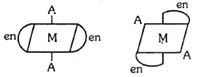
The given complexes are .......
A
Geometrical isomers
B
Linkage isomers
C
Optical isomers
D
Identical
Solution
(A) The given structures represent the $cis$ and $trans$ forms of a coordination complex with the general formula $[M(en)_2A_2]$.
In the first structure,the two $A$ ligands are on the same side (cis-position),while in the second structure,the two $A$ ligands are on opposite sides (trans-position).
Since these structures differ in the spatial arrangement of ligands around the central metal atom,they are known as geometrical isomers.
In the first structure,the two $A$ ligands are on the same side (cis-position),while in the second structure,the two $A$ ligands are on opposite sides (trans-position).
Since these structures differ in the spatial arrangement of ligands around the central metal atom,they are known as geometrical isomers.
0 likes
View Solution106
MediumMCQ
Which type of isomerism is exhibited by $[Cr(C_2O_4)_3]^{3-}$?
A
Ligand
B
Optical
C
Geometrical
D
Ionization
Solution
(B) The complex $[Cr(C_2O_4)_3]^{3-}$ contains three bidentate oxalate ligands $(C_2O_4^{2-})$.
This complex forms a chiral octahedral structure.
Because it lacks a plane of symmetry and a center of inversion,it exists as two non-superimposable mirror images (enantiomers).
Therefore,it exhibits optical isomerism.
This complex forms a chiral octahedral structure.
Because it lacks a plane of symmetry and a center of inversion,it exists as two non-superimposable mirror images (enantiomers).
Therefore,it exhibits optical isomerism.
0 likes
View Solution107
DifficultMCQ
Which of the following complexes can exhibit facial $(fac)$ and meridional $(mer)$ isomerism?
A
$[Co(NH_3)_3Cl_3]$
B
$[Co(NH_3)_4Cl_2]Cl$
C
$[Co(en)_3]Cl_3$
D
$[Co(NH_3)_5Cl]Cl_2$
Solution
(A) Facial $(fac)$ and meridional $(mer)$ isomerism is a type of geometric isomerism observed in octahedral complexes of the type $[MA_3B_3]$.
In $[Co(NH_3)_3Cl_3]$,the central metal $Co$ is bonded to three $NH_3$ ligands and three $Cl$ ligands.
This fits the general formula $[MA_3B_3]$,where $M = Co$,$A = NH_3$,and $B = Cl$.
Therefore,it can exhibit both $fac$ and $mer$ isomers.
In $[Co(NH_3)_3Cl_3]$,the central metal $Co$ is bonded to three $NH_3$ ligands and three $Cl$ ligands.
This fits the general formula $[MA_3B_3]$,where $M = Co$,$A = NH_3$,and $B = Cl$.
Therefore,it can exhibit both $fac$ and $mer$ isomers.
0 likes
View Solution108
DifficultMCQ
Identify the pair of complexes that have the same magnetic moment (spin-only value).
A
$[Cr(H_2O)_6]^{2+}, [CoCl_4]^{2-}$
B
$[Cr(H_2O)_6]^{2+}, [Fe(H_2O)_6]^{2+}$
C
$[Mn(H_2O)_6]^{2+}, [Cr(H_2O)_6]^{2+}$
D
$[CoCl_4]^{2-}, [Fe(H_2O)_6]^{2+}$
Solution
(B) The magnetic moment (spin-only) is given by $\mu = \sqrt{n(n+2)} \ BM$,where $n$ is the number of unpaired electrons. Two complexes have the same magnetic moment if they have the same number of unpaired electrons $(n)$.
$1$. $[Cr(H_2O)_6]^{2+}$: $Cr^{2+}$ is $3d^4$. $H_2O$ is a weak field ligand,so $n = 4$.
$2$. $[CoCl_4]^{2-}$: $Co^{2+}$ is $3d^7$. $Cl^-$ is a weak field ligand,so $n = 3$.
$3$. $[Fe(H_2O)_6]^{2+}$: $Fe^{2+}$ is $3d^6$. $H_2O$ is a weak field ligand,so $n = 4$.
$4$. $[Mn(H_2O)_6]^{2+}$: $Mn^{2+}$ is $3d^5$. $H_2O$ is a weak field ligand,so $n = 5$.
Comparing the values of $n$:
$[Cr(H_2O)_6]^{2+}$ has $n = 4$ and $[Fe(H_2O)_6]^{2+}$ has $n = 4$.
Therefore,they have the same magnetic moment.
$1$. $[Cr(H_2O)_6]^{2+}$: $Cr^{2+}$ is $3d^4$. $H_2O$ is a weak field ligand,so $n = 4$.
$2$. $[CoCl_4]^{2-}$: $Co^{2+}$ is $3d^7$. $Cl^-$ is a weak field ligand,so $n = 3$.
$3$. $[Fe(H_2O)_6]^{2+}$: $Fe^{2+}$ is $3d^6$. $H_2O$ is a weak field ligand,so $n = 4$.
$4$. $[Mn(H_2O)_6]^{2+}$: $Mn^{2+}$ is $3d^5$. $H_2O$ is a weak field ligand,so $n = 5$.
Comparing the values of $n$:
$[Cr(H_2O)_6]^{2+}$ has $n = 4$ and $[Fe(H_2O)_6]^{2+}$ has $n = 4$.
Therefore,they have the same magnetic moment.
0 likes
View Solution109
MediumMCQ
What is the ionization isomer of $[Cr(H_2O)_4Cl(NO_2)]Cl$?
A
$[Cr(H_2O)_4(NO_2)]Cl_2$
B
$[Cr(H_2O)_4Cl_2]NO_2$
C
$[Cr(H_2O)_4Cl(ONO)]Cl$
D
$[Cr(H_2O)_3Cl(NO_2)]H_2O$
Solution
(B) Ionization isomers are formed when a counter ion in the coordination sphere exchanges its position with a ligand present inside the coordination sphere.
In the complex $[Cr(H_2O)_4Cl(NO_2)]Cl$,the $Cl^-$ ion is outside the coordination sphere.
By exchanging the $Cl^-$ ion outside with the $NO_2^-$ ligand inside,we get the isomer $[Cr(H_2O)_4Cl_2]NO_2$.
In the complex $[Cr(H_2O)_4Cl(NO_2)]Cl$,the $Cl^-$ ion is outside the coordination sphere.
By exchanging the $Cl^-$ ion outside with the $NO_2^-$ ligand inside,we get the isomer $[Cr(H_2O)_4Cl_2]NO_2$.
0 likes
View Solution110
MediumMCQ
Which of the following complexes is colored?
A
$Ti(NO_3)_4$
B
$[Cu(NCCH_3)_4]^{+} BF^{-}_4$
C
$Li[AlH_4]$
D
$K_3[VF_6]$
Solution
(D) complex is colored if it contains a metal ion with an incomplete $d$-subshell,allowing for $d-d$ transitions.
In $K_3[VF_6]$,the vanadium is in the $V^{3+}$ oxidation state.
The electronic configuration of $V^{3+}$ is $[Ar] 3d^2$.
Since it has unpaired electrons in the $d$-orbital,it undergoes $d-d$ transitions and exhibits color.
In contrast,$Ti(NO_3)_4$ has $Ti^{4+}$ $(3d^0)$,$[Cu(NCCH_3)_4]^{+}$ has $Cu^{+}$ $(3d^{10})$,and $Li[AlH_4]$ contains $Al^{3+}$ $(2p^6)$,all of which lack unpaired $d$-electrons.
In $K_3[VF_6]$,the vanadium is in the $V^{3+}$ oxidation state.
The electronic configuration of $V^{3+}$ is $[Ar] 3d^2$.
Since it has unpaired electrons in the $d$-orbital,it undergoes $d-d$ transitions and exhibits color.
In contrast,$Ti(NO_3)_4$ has $Ti^{4+}$ $(3d^0)$,$[Cu(NCCH_3)_4]^{+}$ has $Cu^{+}$ $(3d^{10})$,and $Li[AlH_4]$ contains $Al^{3+}$ $(2p^6)$,all of which lack unpaired $d$-electrons.
0 likes
View Solution111
MediumMCQ
What is the magnetic moment value of $Ni^{2+}$ in an aqueous solution in Bohr Magnetons? (Atomic number: $Ni = 28$)
A
$2.83$
B
$4.9$
C
$0$
D
$1.73$
Solution
(A) The electronic configuration of $Ni$ $(Z=28)$ is $[Ar] 3d^8 4s^2$.
For $Ni^{2+}$,the configuration is $[Ar] 3d^8$.
In an aqueous solution,$Ni^{2+}$ forms the complex $[Ni(H_2O)_6]^{2+}$.
In the $3d^8$ configuration,there are $2$ unpaired electrons $(n=2)$.
The magnetic moment $(\mu)$ is calculated using the formula $\mu = \sqrt{n(n+2)} \, B.M.$
$\mu = \sqrt{2(2+2)} = \sqrt{8} \approx 2.83 \, B.M.$
For $Ni^{2+}$,the configuration is $[Ar] 3d^8$.
In an aqueous solution,$Ni^{2+}$ forms the complex $[Ni(H_2O)_6]^{2+}$.
In the $3d^8$ configuration,there are $2$ unpaired electrons $(n=2)$.
The magnetic moment $(\mu)$ is calculated using the formula $\mu = \sqrt{n(n+2)} \, B.M.$
$\mu = \sqrt{2(2+2)} = \sqrt{8} \approx 2.83 \, B.M.$
0 likes
View Solution112
MediumMCQ
Which of the following complexes is capable of showing optical isomerism?
A
$cis-[Pt(NH_3)_2Cl_2]$
B
$trans-[Pt(NH_3)_2Cl_2]$
C
$cis-[Co(en)_2Cl_2]^+$
D
$trans-[Co(en)_2Cl_2]^+$
Solution
(C) Optical isomerism is shown by complexes that lack a plane of symmetry or center of inversion.
$cis-[Co(en)_2Cl_2]^+$ has a $cis$ configuration where the two $Cl$ ligands are adjacent,which results in the absence of a plane of symmetry,making it chiral.
$trans-[Co(en)_2Cl_2]^+$ possesses a plane of symmetry and is therefore achiral.
Square planar complexes like $[Pt(NH_3)_2Cl_2]$ are generally achiral because they possess a plane of symmetry (the molecular plane).
$cis-[Co(en)_2Cl_2]^+$ has a $cis$ configuration where the two $Cl$ ligands are adjacent,which results in the absence of a plane of symmetry,making it chiral.
$trans-[Co(en)_2Cl_2]^+$ possesses a plane of symmetry and is therefore achiral.
Square planar complexes like $[Pt(NH_3)_2Cl_2]$ are generally achiral because they possess a plane of symmetry (the molecular plane).
0 likes
View Solution113
MediumMCQ
Which of the following complexes will exhibit the highest number of isomers?
A
$[Co(NH_3)_4Cl_2]^+$
B
$[Ni(en)(NH_3)_4]^{2+}$
C
$[Ni(C_2O_4)_2(en)]^{2-}$
D
$[Cr(SCN)_2(NH_3)_4]^+$
Solution
(D) $1$. $[Co(NH_3)_4Cl_2]^+$ exhibits $2$ geometric isomers (cis and trans).
$2$. $[Ni(en)(NH_3)_4]^{2+}$ exhibits no geometric or optical isomers.
$3$. $[Ni(C_2O_4)_2(en)]^{2-}$ exhibits $2$ optical isomers.
$4$. $[Cr(SCN)_2(NH_3)_4]^+$ exhibits $2$ geometric isomers (cis and trans),and the cis-isomer is optically active,resulting in $2$ enantiomers. Thus,it shows a total of $3$ isomers (cis-d,cis-l,and trans).
$2$. $[Ni(en)(NH_3)_4]^{2+}$ exhibits no geometric or optical isomers.
$3$. $[Ni(C_2O_4)_2(en)]^{2-}$ exhibits $2$ optical isomers.
$4$. $[Cr(SCN)_2(NH_3)_4]^+$ exhibits $2$ geometric isomers (cis and trans),and the cis-isomer is optically active,resulting in $2$ enantiomers. Thus,it shows a total of $3$ isomers (cis-d,cis-l,and trans).
0 likes
View Solution114
MediumMCQ
$[Pt(NH_3)_4Cl_2]Br_2$ and $[Pt(NH_3)_4Br_2]Cl_2$ are examples of which type of isomerism?
A
Optical isomers
B
Coordination isomers
C
Ionization isomers
D
Linkage isomers
Solution
(C) Ionization isomerism occurs when the counter ion in a coordination compound is itself a potential ligand and can displace a ligand that can then become the counter ion.
In the given compounds,the $Br^-$ ions are outside the coordination sphere in the first complex,while $Cl^-$ ions are outside in the second.
When dissolved in water,they produce different ions: $[Pt(NH_3)_4Cl_2]Br_2 \rightarrow [Pt(NH_3)_4Cl_2]^{2+} + 2Br^-$ and $[Pt(NH_3)_4Br_2]Cl_2 \rightarrow [Pt(NH_3)_4Br_2]^{2+} + 2Cl^-$.
Therefore,they are ionization isomers.
In the given compounds,the $Br^-$ ions are outside the coordination sphere in the first complex,while $Cl^-$ ions are outside in the second.
When dissolved in water,they produce different ions: $[Pt(NH_3)_4Cl_2]Br_2 \rightarrow [Pt(NH_3)_4Cl_2]^{2+} + 2Br^-$ and $[Pt(NH_3)_4Br_2]Cl_2 \rightarrow [Pt(NH_3)_4Br_2]^{2+} + 2Cl^-$.
Therefore,they are ionization isomers.
0 likes
View Solution115
MediumMCQ
Which of the following complex ions exhibits geometrical isomerism?
A
$[Co(en)_3]^{3+}$
B
$[Ni(NH_3)_5Br]^{+}$
C
$[Co(NH_3)_2(en)_2]^{3+}$
D
$[Cr(NH_3)_4(en)]^{3+}$
Solution
(C) Geometrical isomerism in coordination compounds is observed when ligands can be arranged in different spatial configurations around the central metal ion.
For octahedral complexes of the type $[M(AA)_2a_2]^{n+}$,geometrical isomerism exists in the form of $cis$ and $trans$ isomers.
In the complex $[Co(NH_3)_2(en)_2]^{3+}$,the two $NH_3$ ligands can be adjacent $(cis)$ or opposite $(trans)$ to each other,thus exhibiting geometrical isomerism.
$[Co(en)_3]^{3+}$ is a tris-chelate complex which shows optical isomerism but not geometrical isomerism.
$[Ni(NH_3)_5Br]^{+}$ is a pentammine complex which does not show geometrical isomerism.
$[Cr(NH_3)_4(en)]^{3+}$ is of the type $[M(AA)a_4]^{n+}$,which does not exhibit geometrical isomerism.
For octahedral complexes of the type $[M(AA)_2a_2]^{n+}$,geometrical isomerism exists in the form of $cis$ and $trans$ isomers.
In the complex $[Co(NH_3)_2(en)_2]^{3+}$,the two $NH_3$ ligands can be adjacent $(cis)$ or opposite $(trans)$ to each other,thus exhibiting geometrical isomerism.
$[Co(en)_3]^{3+}$ is a tris-chelate complex which shows optical isomerism but not geometrical isomerism.
$[Ni(NH_3)_5Br]^{+}$ is a pentammine complex which does not show geometrical isomerism.
$[Cr(NH_3)_4(en)]^{3+}$ is of the type $[M(AA)a_4]^{n+}$,which does not exhibit geometrical isomerism.
0 likes
View Solution116
MediumMCQ
The electronic configurations of $Cr^{2+}, Mn^{2+}, Fe^{2+}$ and $Ni^{2+}$ ions are $3d^4, 3d^5, 3d^6$ and $3d^8$ respectively. Which of the following aqua complexes exhibits the minimum paramagnetic behavior?
A
$[Mn(H_2O)_6]^{2+}$
B
$[Fe(H_2O)_6]^{2+}$
C
$[Ni(H_2O)_6]^{2+}$
D
$[Cr(H_2O)_6]^{2+}$
Solution
(C) The magnetic moment is directly proportional to the number of unpaired electrons $(n)$.
For $[Cr(H_2O)_6]^{2+}$,the configuration is $3d^4$,so $n = 4$.
For $[Mn(H_2O)_6]^{2+}$,the configuration is $3d^5$,so $n = 5$.
For $[Fe(H_2O)_6]^{2+}$,the configuration is $3d^6$,so $n = 4$.
For $[Ni(H_2O)_6]^{2+}$,the configuration is $3d^8$,so $n = 2$.
Since $[Ni(H_2O)_6]^{2+}$ has the minimum number of unpaired electrons $(n = 2)$,it exhibits the minimum paramagnetic behavior.
For $[Cr(H_2O)_6]^{2+}$,the configuration is $3d^4$,so $n = 4$.
For $[Mn(H_2O)_6]^{2+}$,the configuration is $3d^5$,so $n = 5$.
For $[Fe(H_2O)_6]^{2+}$,the configuration is $3d^6$,so $n = 4$.
For $[Ni(H_2O)_6]^{2+}$,the configuration is $3d^8$,so $n = 2$.
Since $[Ni(H_2O)_6]^{2+}$ has the minimum number of unpaired electrons $(n = 2)$,it exhibits the minimum paramagnetic behavior.
0 likes
View Solution117
AdvancedMCQ
How many geometrical isomers are possible for the square planar complex $[Pt(NO_2)(Py)(NH_3)(NO_2)]$?
A
$4$
B
$5$
C
$8$
D
$3$
0 likes
View Solution118
MediumMCQ
Which of the following compounds exhibits linkage isomerism?
A
$[Co(en)_3]Cl_3$
B
$[Co(NH_3)_6][Cr(CN)_6]$
C
$[Co(en)_2(NO_2)Cl]Br$
D
$[Co(NH_3)_5Cl]Br_2$
Solution
(C) Linkage isomerism occurs in coordination compounds containing ambidentate ligands,which can coordinate through two different donor atoms.
In the complex $[Co(en)_2(NO_2)Cl]Br$,the ligand $NO_2^-$ is an ambidentate ligand.
It can coordinate through the nitrogen atom (nitro,$-NO_2$) or through the oxygen atom (nitrito,$-ONO$).
Therefore,this complex exhibits linkage isomerism.
In the complex $[Co(en)_2(NO_2)Cl]Br$,the ligand $NO_2^-$ is an ambidentate ligand.
It can coordinate through the nitrogen atom (nitro,$-NO_2$) or through the oxygen atom (nitrito,$-ONO$).
Therefore,this complex exhibits linkage isomerism.
0 likes
View Solution119
MediumMCQ
Which of the following compounds does not exhibit optical isomerism?
A
$[Co(NH_3)_3Cl_3]$
B
$[Co(en)_3]Cl_3$
C
$[Co(en)_2Cl_2]Cl$
D
$[Co(en)(NH_3)_2Cl_2]Cl$
Solution
(A) The compound $[Co(NH_3)_3Cl_3]$ has the general formula $MA_3B_3$.
It exists in facial $(fac)$ and meridional $(mer)$ geometric isomers,but both forms possess a plane of symmetry.
Therefore,it does not exhibit optical isomerism.
It exists in facial $(fac)$ and meridional $(mer)$ geometric isomers,but both forms possess a plane of symmetry.
Therefore,it does not exhibit optical isomerism.
0 likes
View Solution120
MediumMCQ
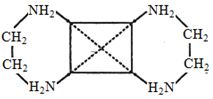
Which type of isomerism is exhibited by the square planar complex shown in the image?
A
Geometrical isomerism
B
Optical isomerism
C
Linkage isomerism
D
None of these
Solution
(A) The square planar complex shown is $[M(en)_2]^{n+}$,where $en$ is ethylenediamine.
Square planar complexes of the type $[MA_2B_2]$ or $[M(AB)_2]$ exhibit geometrical isomerism (cis and trans forms).
However,for square planar complexes,optical isomerism is generally not observed because they possess a plane of symmetry (the molecular plane itself).
Linkage isomerism is shown by ambidentate ligands,which are not present here.
Therefore,the complex exhibits geometrical isomerism.
Square planar complexes of the type $[MA_2B_2]$ or $[M(AB)_2]$ exhibit geometrical isomerism (cis and trans forms).
However,for square planar complexes,optical isomerism is generally not observed because they possess a plane of symmetry (the molecular plane itself).
Linkage isomerism is shown by ambidentate ligands,which are not present here.
Therefore,the complex exhibits geometrical isomerism.
0 likes
View Solution121
MediumMCQ
The complexes $[CO(NO_2)(NH_3)_5]Cl_2$ and $[CO(ONO)(NH_3)_5]Cl_2$ are examples of .....
A
Coordination isomerism
B
Ionization isomerism
C
Geometrical isomerism
D
Linkage isomerism
Solution
(D) The given complexes contain the ambidentate ligand $NO_2^-$.
An ambidentate ligand is a ligand that can coordinate to the central metal atom through two different atoms.
In $[CO(NO_2)(NH_3)_5]Cl_2$,the $NO_2$ group is bonded through the nitrogen atom (nitro).
In $[CO(ONO)(NH_3)_5]Cl_2$,the $NO_2$ group is bonded through the oxygen atom (nitrito).
This type of isomerism,where the ligand coordinates through different donor atoms,is known as linkage isomerism.
An ambidentate ligand is a ligand that can coordinate to the central metal atom through two different atoms.
In $[CO(NO_2)(NH_3)_5]Cl_2$,the $NO_2$ group is bonded through the nitrogen atom (nitro).
In $[CO(ONO)(NH_3)_5]Cl_2$,the $NO_2$ group is bonded through the oxygen atom (nitrito).
This type of isomerism,where the ligand coordinates through different donor atoms,is known as linkage isomerism.
0 likes
View Solution122
MediumMCQ
What is the correct order of magnetic moment (spin-only value in $B.M.$)? (Atomic numbers: $Mn = 25, Fe = 26, Co = 27$)
A
$[Fe(CN)_6]^{4-} < [CoCl_4]^{2-} < [MnCl_4]^{2-}$
B
$[MnCl_4]^{2-} > [Fe(CN)_6]^{4-} > [CoCl_4]^{2-}$
C
$[MnCl_4]^{2-} > [CoCl_4]^{2-} > [Fe(CN)_6]^{4-}$
D
$[Fe(CN)_6]^{4-} > [CoCl_4]^{2-} > [MnCl_4]^{2-}$
Solution
(C) $1$. Calculate the number of unpaired electrons $(n)$ for each complex:
- $[MnCl_4]^{2-}$: $Mn^{2+}$ is $3d^5$. $Cl^-$ is a weak field ligand,so $n = 5$. Magnetic moment $\mu = \sqrt{5(5+2)} = \sqrt{35} \approx 5.92 \ B.M.$
- $[CoCl_4]^{2-}$: $Co^{2+}$ is $3d^7$. $Cl^-$ is a weak field ligand,so $n = 3$. Magnetic moment $\mu = \sqrt{3(3+2)} = \sqrt{15} \approx 3.87 \ B.M.$
- $[Fe(CN)_6]^{4-}$: $Fe^{2+}$ is $3d^6$. $CN^-$ is a strong field ligand,so $n = 0$ (all electrons paired). Magnetic moment $\mu = 0 \ B.M.$
$2$. Comparing the values: $5.92 > 3.87 > 0$.
$3$. Therefore,the order is $[MnCl_4]^{2-} > [CoCl_4]^{2-} > [Fe(CN)_6]^{4-}$.
- $[MnCl_4]^{2-}$: $Mn^{2+}$ is $3d^5$. $Cl^-$ is a weak field ligand,so $n = 5$. Magnetic moment $\mu = \sqrt{5(5+2)} = \sqrt{35} \approx 5.92 \ B.M.$
- $[CoCl_4]^{2-}$: $Co^{2+}$ is $3d^7$. $Cl^-$ is a weak field ligand,so $n = 3$. Magnetic moment $\mu = \sqrt{3(3+2)} = \sqrt{15} \approx 3.87 \ B.M.$
- $[Fe(CN)_6]^{4-}$: $Fe^{2+}$ is $3d^6$. $CN^-$ is a strong field ligand,so $n = 0$ (all electrons paired). Magnetic moment $\mu = 0 \ B.M.$
$2$. Comparing the values: $5.92 > 3.87 > 0$.
$3$. Therefore,the order is $[MnCl_4]^{2-} > [CoCl_4]^{2-} > [Fe(CN)_6]^{4-}$.
0 likes
View Solution123
MediumMCQ
Coordination isomerism is formed by the interchange of ligands between which of the following?
A
Complex cation and complex anion
B
Inner sphere and outer sphere
C
Lower oxidation and higher oxidation state
D
Cis and trans structure
Solution
(A) Coordination isomerism occurs in compounds containing both complex cationic and anionic parts.
It arises from the interchange of ligands between the cationic and anionic entities of different metal ions.
For example,$[Co(NH_3)_6][Cr(CN)_6]$ and $[Cr(NH_3)_6][Co(CN)_6]$ are coordination isomers.
It arises from the interchange of ligands between the cationic and anionic entities of different metal ions.
For example,$[Co(NH_3)_6][Cr(CN)_6]$ and $[Cr(NH_3)_6][Co(CN)_6]$ are coordination isomers.
0 likes
View Solution124
MediumMCQ
Which of the following is true for $[Fe(CN)_6]^{3-}$ and $[FeF_6]^{3-}$?
A
Both are paramagnetic.
B
Only $[Fe(CN)_6]^{3-}$ is paramagnetic.
C
Only $[FeF_6]^{3-}$ is paramagnetic.
D
Both are diamagnetic.
Solution
(A) In both complexes,the oxidation state of $Fe$ is $+3$,which corresponds to a $3d^5$ electronic configuration.
For $[Fe(CN)_6]^{3-}$,$CN^-$ is a strong field ligand,causing pairing of electrons,resulting in $1$ unpaired electron.
For $[FeF_6]^{3-}$,$F^-$ is a weak field ligand,resulting in $5$ unpaired electrons.
Since both complexes contain unpaired electrons,both are paramagnetic.
For $[Fe(CN)_6]^{3-}$,$CN^-$ is a strong field ligand,causing pairing of electrons,resulting in $1$ unpaired electron.
For $[FeF_6]^{3-}$,$F^-$ is a weak field ligand,resulting in $5$ unpaired electrons.
Since both complexes contain unpaired electrons,both are paramagnetic.
0 likes
View Solution125
MediumMCQ
Which of the following compounds is diamagnetic?
A
$[NiCl_4]^{2-}$
B
$[Ni(CN)_4]^{2-}$
C
$[CuCl_4]^{2-}$
D
$[CoF_6]^{3-}$
Solution
(B) In $[Ni(CN)_4]^{2-}$,the central metal ion is $Ni^{2+}$.
$Ni^{2+}$ has an electronic configuration of $[Ar] \, 3d^8$.
$CN^-$ is a strong field ligand,which causes pairing of the $d$-electrons.
As a result,all electrons in the $3d$ orbitals are paired,leading to $n = 0$ unpaired electrons.
Therefore,$[Ni(CN)_4]^{2-}$ is diamagnetic.
$Ni^{2+}$ has an electronic configuration of $[Ar] \, 3d^8$.
$CN^-$ is a strong field ligand,which causes pairing of the $d$-electrons.
As a result,all electrons in the $3d$ orbitals are paired,leading to $n = 0$ unpaired electrons.
Therefore,$[Ni(CN)_4]^{2-}$ is diamagnetic.
0 likes
View Solution126
MediumMCQ
Which of the following has the maximum paramagnetism?
A
$[Cr(H_2O)_6]^{3+}$
B
$[Fe(H_2O)_6]^{2+}$
C
$[Cu(H_2O)_6]^{2+}$
D
$[Zn(H_2O)_6]^{2+}$
Solution
(B) To determine paramagnetism,we calculate the number of unpaired electrons $(n)$ in each complex:
$1$. In $[Cr(H_2O)_6]^{3+}$,$Cr^{3+}$ is $3d^3$,so $n = 3$.
$2$. In $[Fe(H_2O)_6]^{2+}$,$Fe^{2+}$ is $3d^6$. Since $H_2O$ is a weak field ligand,the configuration is $t_{2g}^4 e_g^2$,so $n = 4$.
$3$. In $[Cu(H_2O)_6]^{2+}$,$Cu^{2+}$ is $3d^9$,so $n = 1$.
$4$. In $[Zn(H_2O)_6]^{2+}$,$Zn^{2+}$ is $3d^{10}$,so $n = 0$.
Since $[Fe(H_2O)_6]^{2+}$ has the highest number of unpaired electrons $(n = 4)$,it exhibits the maximum paramagnetism.
$1$. In $[Cr(H_2O)_6]^{3+}$,$Cr^{3+}$ is $3d^3$,so $n = 3$.
$2$. In $[Fe(H_2O)_6]^{2+}$,$Fe^{2+}$ is $3d^6$. Since $H_2O$ is a weak field ligand,the configuration is $t_{2g}^4 e_g^2$,so $n = 4$.
$3$. In $[Cu(H_2O)_6]^{2+}$,$Cu^{2+}$ is $3d^9$,so $n = 1$.
$4$. In $[Zn(H_2O)_6]^{2+}$,$Zn^{2+}$ is $3d^{10}$,so $n = 0$.
Since $[Fe(H_2O)_6]^{2+}$ has the highest number of unpaired electrons $(n = 4)$,it exhibits the maximum paramagnetism.
0 likes
View Solution127
MediumMCQ
The complex $[Ti(H_2O)_6]^{3+}$ is paramagnetic in nature because...
A
It contains one unpaired electron.
B
It contains two paired electrons.
C
It contains three unpaired electrons.
D
It contains no unpaired electrons.
Solution
(A) $1$. The central metal ion is $Ti^{3+}$.
$2$. The atomic number of $Ti$ is $22$. The electronic configuration of $Ti$ is $[Ar] 3d^2 4s^2$.
$3$. In $Ti^{3+}$,the configuration becomes $[Ar] 3d^1$.
$4$. Since there is $1$ unpaired electron in the $3d$ orbital,the complex $[Ti(H_2O)_6]^{3+}$ is paramagnetic.
$2$. The atomic number of $Ti$ is $22$. The electronic configuration of $Ti$ is $[Ar] 3d^2 4s^2$.
$3$. In $Ti^{3+}$,the configuration becomes $[Ar] 3d^1$.
$4$. Since there is $1$ unpaired electron in the $3d$ orbital,the complex $[Ti(H_2O)_6]^{3+}$ is paramagnetic.
0 likes
View Solution128
DifficultMCQ
The pair of complexes $[(C_6H_5)_2Pd(SCN)_2]$ and $[(C_6H_5)_2Pd(NCS)_2]$ represents which type of isomerism?
A
Linkage isomerism
B
Coordination isomerism
C
Ionization isomerism
D
Geometrical isomerism
Solution
(A) The complexes $[(C_6H_5)_2Pd(SCN)_2]$ and $[(C_6H_5)_2Pd(NCS)_2]$ differ in the mode of attachment of the ambidentate ligand $SCN^-$.
In the first complex,the ligand is bonded through the sulfur atom $(S-bonded)$,while in the second complex,it is bonded through the nitrogen atom $(N-bonded)$.
This type of isomerism,where an ambidentate ligand coordinates through different donor atoms,is known as linkage isomerism.
In the first complex,the ligand is bonded through the sulfur atom $(S-bonded)$,while in the second complex,it is bonded through the nitrogen atom $(N-bonded)$.
This type of isomerism,where an ambidentate ligand coordinates through different donor atoms,is known as linkage isomerism.
0 likes
View Solution129
DifficultMCQ
Which of the following sets represents an example of coordination isomerism in complexes?
A
$[Co(NH_3)_6] [Cr(CN)_6]$ and $[Co(CN)_6] [Cr(NH_3)_6]$
B
$[Cr(H_2O)_5Cl]Cl_2 \cdot H_2O$ and $[Cr(H_2O)_4Cl_2]Cl \cdot 2H_2O$
C
$[Co(NH_3)_5Br]SO_4$ and $[Co(NH_3)_5SO_4]Br$
D
$[Pt(NH_3)_2Cl_2]$ and $[Pt(NH_3)_4] [PtCl_4]$
Solution
(A) Coordination isomerism occurs in complexes containing both cationic and anionic coordination entities,where ligands are exchanged between the two metal centers.
In the pair $[Co(NH_3)_6] [Cr(CN)_6]$ and $[Co(CN)_6] [Cr(NH_3)_6]$,the ligands $NH_3$ and $CN^-$ are exchanged between the $Co$ and $Cr$ metal centers,which is the definition of coordination isomerism.
In the pair $[Co(NH_3)_6] [Cr(CN)_6]$ and $[Co(CN)_6] [Cr(NH_3)_6]$,the ligands $NH_3$ and $CN^-$ are exchanged between the $Co$ and $Cr$ metal centers,which is the definition of coordination isomerism.
0 likes
View Solution130
MediumMCQ
The number of possible optical isomers for $[Co(en)_2 Cl_2]^+$ is ....
A
$2$
B
$3$
C
$4$
D
$0$
Solution
(A) The complex $[Co(en)_2 Cl_2]^+$ exists in two geometric forms: $cis$ and $trans$.
The $trans$-isomer is achiral (optically inactive) due to the presence of a plane of symmetry.
The $cis$-isomer is chiral and exists as a pair of enantiomers (dextro and laevo forms).
Therefore,there are $2$ possible optical isomers for this complex.
The $trans$-isomer is achiral (optically inactive) due to the presence of a plane of symmetry.
The $cis$-isomer is chiral and exists as a pair of enantiomers (dextro and laevo forms).
Therefore,there are $2$ possible optical isomers for this complex.
0 likes
View Solution131
DifficultMCQ
In an octahedral complex of the type $Ma_3b_3$,where $M$ is a metal ion and $a$ and $b$ are two different types of ligands,what are the two possible geometric isomers?
A
Cis and Trans
B
Levo and Dextro
C
Facial and Meridional
D
None of these
Solution
(C) For an octahedral complex of the type $Ma_3b_3$,the ligands can be arranged in two ways.
If the three identical ligands occupy the corners of one triangular face of the octahedron,it is called the facial $(fac)$ isomer.
If the three identical ligands are arranged around the meridian of the octahedron,it is called the meridional $(mer)$ isomer.
Therefore,the two geometric isomers are facial and meridional.
If the three identical ligands occupy the corners of one triangular face of the octahedron,it is called the facial $(fac)$ isomer.
If the three identical ligands are arranged around the meridian of the octahedron,it is called the meridional $(mer)$ isomer.
Therefore,the two geometric isomers are facial and meridional.
0 likes
View Solution132
MediumMCQ
The theoretical value of the magnetic moment of the complex ion $[Ni(Cl)_4]^{2-}$ is .......... $B.M.$
A
$3.82$
B
$2.83$
C
$4.9$
D
$1.73$
Solution
(B) In $[Ni(Cl)_4]^{2-}$,the oxidation state of $Ni$ is $+2$.
The electronic configuration of $Ni^{2+}$ is $[Ar] 3d^8$.
According to crystal field theory,$Cl^-$ is a weak field ligand,so no pairing of electrons occurs in the $3d$ orbitals.
There are $2$ unpaired electrons in the $3d$ orbitals.
The magnetic moment $\mu$ is calculated using the formula $\mu = \sqrt{n(n+2)} \ B.M.$,where $n$ is the number of unpaired electrons.
$\mu = \sqrt{2(2+2)} = \sqrt{8} \approx 2.83 \ B.M.$
The electronic configuration of $Ni^{2+}$ is $[Ar] 3d^8$.
According to crystal field theory,$Cl^-$ is a weak field ligand,so no pairing of electrons occurs in the $3d$ orbitals.
There are $2$ unpaired electrons in the $3d$ orbitals.
The magnetic moment $\mu$ is calculated using the formula $\mu = \sqrt{n(n+2)} \ B.M.$,where $n$ is the number of unpaired electrons.
$\mu = \sqrt{2(2+2)} = \sqrt{8} \approx 2.83 \ B.M.$
0 likes
View Solution133
MediumMCQ
The magnetic moment of the complex $[Co(NH_3)_6]^{3+}$ is .....
A
$0$
B
$+3$
C
$2$
D
$1$
Solution
(A) In the complex $[Co(NH_3)_6]^{3+}$,the oxidation state of $Co$ is $+3$.
The electronic configuration of $Co^{3+}$ is $[Ar] 3d^6$.
Since $NH_3$ is a strong field ligand,it causes pairing of electrons in the $3d$ orbitals.
All $6$ electrons are paired in the $t_{2g}$ orbitals,resulting in $n = 0$ unpaired electrons.
The magnetic moment $\mu = \sqrt{n(n+2)} \ BM = \sqrt{0(0+2)} = 0 \ BM$.
The electronic configuration of $Co^{3+}$ is $[Ar] 3d^6$.
Since $NH_3$ is a strong field ligand,it causes pairing of electrons in the $3d$ orbitals.
All $6$ electrons are paired in the $t_{2g}$ orbitals,resulting in $n = 0$ unpaired electrons.
The magnetic moment $\mu = \sqrt{n(n+2)} \ BM = \sqrt{0(0+2)} = 0 \ BM$.
0 likes
View Solution134
MediumMCQ
The spin-only magnetic moment of $Ni^{2+}$ in an aqueous solution in Bohr magneton $(\mu_B)$ is .......
A
$0$
B
$1.73$
C
$2.84$
D
$4.90$
Solution
(C) The atomic number of Nickel $(Ni)$ is $28$.
The electronic configuration of $Ni$ is $[Ar] 3d^8 4s^2$.
In an aqueous solution,$Ni^{2+}$ ion is formed by losing two electrons from the $4s$ orbital.
The electronic configuration of $Ni^{2+}$ is $[Ar] 3d^8$.
In the $3d$ subshell,there are $8$ electrons. According to Hund's rule,these are filled as: $5$ electrons singly and $3$ electrons paired,resulting in $n = 2$ unpaired electrons.
The spin-only magnetic moment $(\mu)$ is calculated using the formula $\mu = \sqrt{n(n+2)} \ \mu_B$.
Substituting $n = 2$: $\mu = \sqrt{2(2+2)} = \sqrt{8} \approx 2.84 \ \mu_B$.
The electronic configuration of $Ni$ is $[Ar] 3d^8 4s^2$.
In an aqueous solution,$Ni^{2+}$ ion is formed by losing two electrons from the $4s$ orbital.
The electronic configuration of $Ni^{2+}$ is $[Ar] 3d^8$.
In the $3d$ subshell,there are $8$ electrons. According to Hund's rule,these are filled as: $5$ electrons singly and $3$ electrons paired,resulting in $n = 2$ unpaired electrons.
The spin-only magnetic moment $(\mu)$ is calculated using the formula $\mu = \sqrt{n(n+2)} \ \mu_B$.
Substituting $n = 2$: $\mu = \sqrt{2(2+2)} = \sqrt{8} \approx 2.84 \ \mu_B$.
0 likes
View Solution135
AdvancedMCQ
Which of the following complexes can exhibit both geometrical and optical isomerism?
A
$[CoCl_2(en)_2]^+$
B
$[Co(NH_3)_5Cl]^{2+}$
C
$[Co(NH_3)_3Cl_3]$
D
$[Co(NH_3)_4Cl_2]^+$
Solution
(A) The complex $[CoCl_2(en)_2]^+$ has the general formula $[M(AA)_2a_2]$.
Geometrical isomerism: It exists in $cis$ and $trans$ forms.
The $cis$-isomer is optically active because it lacks a plane of symmetry.
The $trans$-isomer is optically inactive due to the presence of a plane of symmetry.
Therefore,the $cis$-isomer exhibits both geometrical and optical isomerism.
Geometrical isomerism: It exists in $cis$ and $trans$ forms.
The $cis$-isomer is optically active because it lacks a plane of symmetry.
The $trans$-isomer is optically inactive due to the presence of a plane of symmetry.
Therefore,the $cis$-isomer exhibits both geometrical and optical isomerism.
0 likes
View Solution136
MediumMCQ
The magnetic moment of $[NiCl_4]^{2-}$ is .... $B.M.$ (spin-only).
A
$1.82$
B
$5.46$
C
$2.82$
D
$5.41$
Solution
(C) In $[NiCl_4]^{2-}$,the oxidation state of $Ni$ is $+2$.
The atomic number of $Ni$ is $28$,so the electronic configuration of $Ni^{2+}$ is $[Ar] 3d^8$.
$Cl^-$ is a weak field ligand,so it does not cause pairing of electrons in the $3d$ orbitals.
Thus,there are $2$ unpaired electrons in the $3d$ orbitals.
The spin-only magnetic moment is calculated using the formula $\mu = \sqrt{n(n+2)} \ B.M.$,where $n$ is the number of unpaired electrons.
Substituting $n = 2$,we get $\mu = \sqrt{2(2+2)} = \sqrt{8} \approx 2.82 \ B.M.$
The atomic number of $Ni$ is $28$,so the electronic configuration of $Ni^{2+}$ is $[Ar] 3d^8$.
$Cl^-$ is a weak field ligand,so it does not cause pairing of electrons in the $3d$ orbitals.
Thus,there are $2$ unpaired electrons in the $3d$ orbitals.
The spin-only magnetic moment is calculated using the formula $\mu = \sqrt{n(n+2)} \ B.M.$,where $n$ is the number of unpaired electrons.
Substituting $n = 2$,we get $\mu = \sqrt{2(2+2)} = \sqrt{8} \approx 2.82 \ B.M.$
0 likes
View Solution137
DifficultMCQ
The electronic configurations of $Cr^{2+}$,$Mn^{2+}$,$Fe^{2+}$,and $Co^{2+}$ ions are $d^4$,$d^5$,$d^6$,and $d^7$ respectively. Which of the following complexes has the minimum paramagnetic character?
A
$[Cr(H_2O)_6]^{2+}$
B
$[Mn(H_2O)_6]^{2+}$
C
$[Fe(H_2O)_6]^{2+}$
D
$[Co(H_2O)_6]^{2+}$
Solution
(D) The paramagnetic character depends on the number of unpaired electrons $(n)$.
For $H_2O$ as a weak field ligand,the number of unpaired electrons in these high-spin octahedral complexes are:
$Cr^{2+} (d^4): t_{2g}^3 e_g^1, n = 4$
$Mn^{2+} (d^5): t_{2g}^3 e_g^2, n = 5$
$Fe^{2+} (d^6): t_{2g}^4 e_g^2, n = 4$
$Co^{2+} (d^7): t_{2g}^5 e_g^2, n = 3$
Since $[Co(H_2O)_6]^{2+}$ has the minimum number of unpaired electrons $(n = 3)$,it exhibits the minimum paramagnetic character.
For $H_2O$ as a weak field ligand,the number of unpaired electrons in these high-spin octahedral complexes are:
$Cr^{2+} (d^4): t_{2g}^3 e_g^1, n = 4$
$Mn^{2+} (d^5): t_{2g}^3 e_g^2, n = 5$
$Fe^{2+} (d^6): t_{2g}^4 e_g^2, n = 4$
$Co^{2+} (d^7): t_{2g}^5 e_g^2, n = 3$
Since $[Co(H_2O)_6]^{2+}$ has the minimum number of unpaired electrons $(n = 3)$,it exhibits the minimum paramagnetic character.
0 likes
View Solution138
DifficultMCQ
Identify the ionization isomer of $[Cr(H_2O)_4Cl(NO_2)]Cl$.
A
$[Cr(H_2O)_4(NO_2)]Cl_2$
B
$[Cr(H_2O)_4Cl_2]NO_2$
C
$[Cr(H_2O)_4Cl(ONO)]Cl$
D
$[Cr(H_2O)_3Cl_2(NO_2)]H_2O$
0 likes
View Solution139
DifficultMCQ
Which of the following complex ions does not absorb visible light?
A
$[Ni(H_2O)_6]^{2+}$
B
$[Ni(CN)_4]^{2+}$
C
$[Cr(NH_3)_6]^{3+}$
D
$[Fe(H_2O)_6]^{2+}$
Solution
(B) In the complex ion $[Ni(CN)_4]^{2-}$,the oxidation state of $Ni$ is $+2$ ($3d^8$ configuration).
$CN^-$ is a strong field ligand,which causes pairing of electrons.
As a result,there are $0$ unpaired electrons in the $3d$ orbitals.
Since there are no unpaired electrons,$d-d$ transitions are not possible,and therefore,it does not absorb visible light.
$CN^-$ is a strong field ligand,which causes pairing of electrons.
As a result,there are $0$ unpaired electrons in the $3d$ orbitals.
Since there are no unpaired electrons,$d-d$ transitions are not possible,and therefore,it does not absorb visible light.
0 likes
View Solution140
MediumMCQ
Which cyano complex exhibits the minimum magnetic moment?
A
$[Co(CN)_6]^{3-}$
B
$[Fe(CN)_6]^{3-}$
C
$[Mn(CN)_6]^{3-}$
D
$[Cr(CN)_6]^{3-}$
Solution
(A) To determine the magnetic moment,we calculate the number of unpaired electrons $(n)$ in each complex. $CN^-$ is a strong field ligand,causing pairing of electrons.
(Atomic numbers: $Cr=24, Mn=25, Fe=26, Co=27$)
Since $[Co(CN)_6]^{3-}$ has $0$ unpaired electrons,it has the minimum magnetic moment of $0 \ BM$.
(Atomic numbers: $Cr=24, Mn=25, Fe=26, Co=27$)
| Complex | Electronic Configuration of Metal Ion | Unpaired Electrons $(n)$ | Magnetic Moment $(\mu = \sqrt{n(n+2)} \ BM)$ |
| $[Co(CN)_6]^{3-}$ | $Co^{3+} (3d^6)$ | $0$ | $0 \ BM$ |
| $[Fe(CN)_6]^{3-}$ | $Fe^{3+} (3d^5)$ | $1$ | $\sqrt{3} \ BM \approx 1.73 \ BM$ |
| $[Mn(CN)_6]^{3-}$ | $Mn^{3+} (3d^4)$ | $2$ | $\sqrt{8} \ BM \approx 2.83 \ BM$ |
| $[Cr(CN)_6]^{3-}$ | $Cr^{3+} (3d^3)$ | $3$ | $\sqrt{15} \ BM \approx 3.87 \ BM$ |
Since $[Co(CN)_6]^{3-}$ has $0$ unpaired electrons,it has the minimum magnetic moment of $0 \ BM$.
0 likes
View Solution141
DifficultMCQ
The magnetic moment of $K_3[FeF_6]$ is ..... $B.M.$
A
$3.87$
B
$4.98$
C
$5.91$
D
$6.92$
Solution
(C) In $K_3[FeF_6]$, the oxidation state of $Fe$ is $+3$.
The electronic configuration of $Fe^{3+}$ $(Z=26)$ is $[Ar] 3d^5$.
Since $F^-$ is a weak field ligand, it does not cause pairing of electrons.
Thus, the number of unpaired electrons $(n)$ is $5$.
The magnetic moment $(\mu)$ is calculated using the formula $\mu = \sqrt{n(n+2)} \ B.M.$.
$\mu = \sqrt{5(5+2)} = \sqrt{35} \approx 5.91 \ B.M.$.
The electronic configuration of $Fe^{3+}$ $(Z=26)$ is $[Ar] 3d^5$.
Since $F^-$ is a weak field ligand, it does not cause pairing of electrons.
Thus, the number of unpaired electrons $(n)$ is $5$.
The magnetic moment $(\mu)$ is calculated using the formula $\mu = \sqrt{n(n+2)} \ B.M.$.
$\mu = \sqrt{5(5+2)} = \sqrt{35} \approx 5.91 \ B.M.$.
0 likes
View Solution142
MediumMCQ
Which of the following complexes will not show optical isomerism?
A
$[Co(NH_3)_3Cl_3]$
B
$[Co(en)Cl_2(NH_3)_2]^+$
C
$[Co(en)_3]^{3+}$
D
$[Co(en)_2Cl_2]^+$
Solution
(A) Optical isomerism is shown by complexes that do not have a plane of symmetry or center of inversion.
Complexes of the type $[MA_3B_3]$ (facial or meridional isomers) possess a plane of symmetry and therefore do not exhibit optical isomerism.
In the given options,$[Co(NH_3)_3Cl_3]$ is of the type $[MA_3B_3]$,which is optically inactive.
Complexes of the type $[MA_3B_3]$ (facial or meridional isomers) possess a plane of symmetry and therefore do not exhibit optical isomerism.
In the given options,$[Co(NH_3)_3Cl_3]$ is of the type $[MA_3B_3]$,which is optically inactive.
0 likes
View Solution143
MediumMCQ
Identify the diamagnetic complexes among the following complexes $K$ to $P$:
$(K)\ K_3[Fe(CN)_6]$
$(L)\ [Co(NH_3)_6]Cl_3$
$(M)\ Na_3[Co(ox)_3]$
$(N)\ [Ni(H_2O)_6]Cl_2$
$(O)\ K_2[Pt(CN)_4]$
$(P)\ [Zn(H_2O)_6](NO_3)_2$
$(K)\ K_3[Fe(CN)_6]$
$(L)\ [Co(NH_3)_6]Cl_3$
$(M)\ Na_3[Co(ox)_3]$
$(N)\ [Ni(H_2O)_6]Cl_2$
$(O)\ K_2[Pt(CN)_4]$
$(P)\ [Zn(H_2O)_6](NO_3)_2$
A
$K, L, M, N$
B
$K, M, O, P$
C
$L, M, O, P$
D
$L, M, N, O$
Solution
(C) To identify diamagnetic complexes,we check for the presence of unpaired electrons in the central metal ion:
$(K)\ K_3[Fe(CN)_6]: Fe^{3+}$ is $d^5$. $CN^-$ is a strong field ligand,causing pairing. It has $1$ unpaired electron. (Paramagnetic)
$(L)\ [Co(NH_3)_6]Cl_3: Co^{3+}$ is $d^6$. $NH_3$ is a strong field ligand,causing pairing. All electrons are paired. (Diamagnetic)
$(M)\ Na_3[Co(ox)_3]: Co^{3+}$ is $d^6$. $ox^{2-}$ is a strong field ligand,causing pairing. All electrons are paired. (Diamagnetic)
$(N)\ [Ni(H_2O)_6]Cl_2: Ni^{2+}$ is $d^8$. $H_2O$ is a weak field ligand. It has $2$ unpaired electrons. (Paramagnetic)
$(O)\ K_2[Pt(CN)_4]: Pt^{2+}$ is $5d^8$. Strong field ligand $CN^-$ causes pairing in the $5d$ orbital. All electrons are paired. (Diamagnetic)
$(P)\ [Zn(H_2O)_6](NO_3)_2: Zn^{2+}$ is $d^{10}$. All electrons are paired. (Diamagnetic)
Thus,the diamagnetic complexes are $L, M, O,$ and $P$.
$(K)\ K_3[Fe(CN)_6]: Fe^{3+}$ is $d^5$. $CN^-$ is a strong field ligand,causing pairing. It has $1$ unpaired electron. (Paramagnetic)
$(L)\ [Co(NH_3)_6]Cl_3: Co^{3+}$ is $d^6$. $NH_3$ is a strong field ligand,causing pairing. All electrons are paired. (Diamagnetic)
$(M)\ Na_3[Co(ox)_3]: Co^{3+}$ is $d^6$. $ox^{2-}$ is a strong field ligand,causing pairing. All electrons are paired. (Diamagnetic)
$(N)\ [Ni(H_2O)_6]Cl_2: Ni^{2+}$ is $d^8$. $H_2O$ is a weak field ligand. It has $2$ unpaired electrons. (Paramagnetic)
$(O)\ K_2[Pt(CN)_4]: Pt^{2+}$ is $5d^8$. Strong field ligand $CN^-$ causes pairing in the $5d$ orbital. All electrons are paired. (Diamagnetic)
$(P)\ [Zn(H_2O)_6](NO_3)_2: Zn^{2+}$ is $d^{10}$. All electrons are paired. (Diamagnetic)
Thus,the diamagnetic complexes are $L, M, O,$ and $P$.
0 likes
View Solution144
DifficultMCQ
In coordination compounds,hydrate isomers differ in:
A
The number of water molecules of hydration
B
The number of water molecules present as ligands
C
Both $(A)$ and $(B)$
D
The coordination number of the metal atom
Solution
(C) Hydrate isomerism occurs when water molecules can be either directly coordinated to the metal ion or present as free water of crystallization.
Example: $CoCl_3 \cdot 6H_2O$ can exist as:
$(1)$ $[Co(H_2O)_6]Cl_3$
$(2)$ $[Co(H_2O)_5Cl]Cl_2 \cdot H_2O$
$(3)$ $[Co(H_2O)_4Cl_2]Cl \cdot 2H_2O$
In these isomers,the number of water molecules acting as ligands and the number of water molecules of hydration both change.
Example: $CoCl_3 \cdot 6H_2O$ can exist as:
$(1)$ $[Co(H_2O)_6]Cl_3$
$(2)$ $[Co(H_2O)_5Cl]Cl_2 \cdot H_2O$
$(3)$ $[Co(H_2O)_4Cl_2]Cl \cdot 2H_2O$
In these isomers,the number of water molecules acting as ligands and the number of water molecules of hydration both change.
0 likes
View Solution145
MediumMCQ
For a $t_{2g}^6 e_g^2$ system,the value of the magnetic moment $(\mu)$ is equal to ..... $B.M.$
A
$2.83$
B
$1.73$
C
$3.87$
D
$4.92$
Solution
(A) The magnetic moment is calculated using the formula $\mu = \sqrt{n(n + 2)}$,where $n$ is the number of unpaired electrons.
In the $t_{2g}^6 e_g^2$ configuration,the $t_{2g}$ orbitals are fully filled ($6$ electrons),and the $e_g$ orbitals contain $2$ electrons.
According to Hund's rule,the $2$ electrons in the $e_g$ orbitals will remain unpaired.
Therefore,the number of unpaired electrons $n = 2$.
Substituting the value of $n$ into the formula: $\mu = \sqrt{2(2 + 2)} = \sqrt{8} \approx 2.83 \ B.M.$
In the $t_{2g}^6 e_g^2$ configuration,the $t_{2g}$ orbitals are fully filled ($6$ electrons),and the $e_g$ orbitals contain $2$ electrons.
According to Hund's rule,the $2$ electrons in the $e_g$ orbitals will remain unpaired.
Therefore,the number of unpaired electrons $n = 2$.
Substituting the value of $n$ into the formula: $\mu = \sqrt{2(2 + 2)} = \sqrt{8} \approx 2.83 \ B.M.$
0 likes
View Solution146
MediumMCQ
Which complex ion has the ability to absorb visible light?
A
$[Cr(NH_3)_6]^{3+}$
B
$[Zn(NH_3)_6]^{2+}$
C
$[Sc(H_2O)_3(NH_3)_3]^{3+}$
D
$[Ti(en)_2(NH_3)_2]^{4+}$
Solution
(A) For a complex ion to absorb visible light,it must possess at least one unpaired electron to undergo $d-d$ transition.
In $[Cr(NH_3)_6]^{3+}$,the oxidation state of $Cr$ is $+3$.
The electronic configuration of $Cr^{3+}$ is $[Ar] \ 3d^3$.
Since it has $3$ unpaired electrons,it can undergo $d-d$ transition and absorb visible light.
In contrast,$Zn^{2+}$ $(3d^{10})$,$Sc^{3+}$ $(3d^0)$,and $Ti^{4+}$ $(3d^0)$ do not have unpaired electrons.
In $[Cr(NH_3)_6]^{3+}$,the oxidation state of $Cr$ is $+3$.
The electronic configuration of $Cr^{3+}$ is $[Ar] \ 3d^3$.
Since it has $3$ unpaired electrons,it can undergo $d-d$ transition and absorb visible light.
In contrast,$Zn^{2+}$ $(3d^{10})$,$Sc^{3+}$ $(3d^0)$,and $Ti^{4+}$ $(3d^0)$ do not have unpaired electrons.
0 likes
View Solution147
DifficultMCQ
Which of the following compounds does not exhibit paramagnetism?
A
$[Cu(NH_3)_4]Cl_2$
B
$[Ag(NH_3)_2]Cl$
C
$NO$
D
$NO_2$
Solution
(B) In $[Ag(NH_3)_2]Cl$,the oxidation state of $Ag$ is $+1$. The electronic configuration of $Ag^{+}$ is $[Kr] 4d^{10}$,which means it has no unpaired electrons and is diamagnetic.
In contrast,$[Cu(NH_3)_4]Cl_2$ contains $Cu^{2+}$ $(d^9)$,$NO$ has an odd number of electrons,and $NO_2$ has an odd number of electrons,making them all paramagnetic.
In contrast,$[Cu(NH_3)_4]Cl_2$ contains $Cu^{2+}$ $(d^9)$,$NO$ has an odd number of electrons,and $NO_2$ has an odd number of electrons,making them all paramagnetic.
0 likes
View Solution148
MediumMCQ
The theoretical value of the magnetic moment for the complex ion $[Co(NH_3)_6]^{2+}$ is ...... $B.M.$
A
$3.87$
B
$1.73$
C
$2.87$
D
$5.92$
Solution
(B) In $[Co(NH_3)_6]^{2+}$,the oxidation state of $Co$ is $+2$.
The electronic configuration of $Co^{2+}$ is $[Ar] 3d^7$.
In the presence of the strong field ligand $NH_3$,the electrons in the $3d$ orbitals rearrange to form a low-spin complex.
Specifically,the $3d$ electrons pair up such that there is $1$ unpaired electron remaining.
The magnetic moment $\mu$ is calculated using the formula $\mu = \sqrt{n(n+2)} \ B.M.$,where $n$ is the number of unpaired electrons.
For $n = 1$,$\mu = \sqrt{1(1+2)} = \sqrt{3} \approx 1.73 \ B.M.$
The electronic configuration of $Co^{2+}$ is $[Ar] 3d^7$.
In the presence of the strong field ligand $NH_3$,the electrons in the $3d$ orbitals rearrange to form a low-spin complex.
Specifically,the $3d$ electrons pair up such that there is $1$ unpaired electron remaining.
The magnetic moment $\mu$ is calculated using the formula $\mu = \sqrt{n(n+2)} \ B.M.$,where $n$ is the number of unpaired electrons.
For $n = 1$,$\mu = \sqrt{1(1+2)} = \sqrt{3} \approx 1.73 \ B.M.$
0 likes
View Solution149
MediumMCQ
Which of the following complexes exhibits optical isomerism?
A
$[Zn(en)_2]^{2+}$
B
$[Zn(en)(NH_3)_2]^{2+}$
C
$[CO(en)_3]^{3+}$
D
$[CO(H_2O)_4(en)]^{3+}$
Solution
(C) Optical isomerism is exhibited by complexes that lack a plane of symmetry and a center of inversion (i.e.,they are chiral).
For octahedral complexes of the type $[M(AA)_3]^{n+}$,where $AA$ is a bidentate ligand like ethylenediamine $(en)$,the complex exists as a pair of enantiomers (non-superimposable mirror images).
In the given options,$[CO(en)_3]^{3+}$ is an octahedral complex with three bidentate ligands,which lacks a plane of symmetry and is optically active.
$[Zn(en)_2]^{2+}$ is a tetrahedral complex,which generally does not show optical isomerism unless all four ligands are different.
$[CO(H_2O)_4(en)]^{3+}$ is of the type $[M(AA)a_4]$,which possesses a plane of symmetry and is therefore optically inactive.
For octahedral complexes of the type $[M(AA)_3]^{n+}$,where $AA$ is a bidentate ligand like ethylenediamine $(en)$,the complex exists as a pair of enantiomers (non-superimposable mirror images).
In the given options,$[CO(en)_3]^{3+}$ is an octahedral complex with three bidentate ligands,which lacks a plane of symmetry and is optically active.
$[Zn(en)_2]^{2+}$ is a tetrahedral complex,which generally does not show optical isomerism unless all four ligands are different.
$[CO(H_2O)_4(en)]^{3+}$ is of the type $[M(AA)a_4]$,which possesses a plane of symmetry and is therefore optically inactive.
0 likes
View Solution150
DifficultMCQ
Which of the following is expected to be a paramagnetic complex?
A
$[Ni(H_2O)_6]^{2+}$
B
$[Ni(CO)_4]$
C
$[Zn(NH_3)_4]^{2+}$
D
$[Co(NH_3)_6]^{3+}$
Solution
(A) To determine paramagnetism,we check for unpaired electrons in the central metal ion:
$1$. In $[Ni(H_2O)_6]^{2+}$,$Ni$ is in the $+2$ oxidation state $(3d^8)$. $H_2O$ is a weak field ligand,so the configuration is $t_{2g}^6 e_g^2$,which has $2$ unpaired electrons. Thus,it is paramagnetic.
$2$. In $[Ni(CO)_4]$,$Ni$ is in the $0$ oxidation state $(3d^8 4s^2)$. $CO$ is a strong field ligand,causing pairing to form $3d^{10}$,which is diamagnetic.
$3$. In $[Zn(NH_3)_4]^{2+}$,$Zn$ is in the $+2$ oxidation state $(3d^{10})$,which is diamagnetic.
$4$. In $[Co(NH_3)_6]^{3+}$,$Co$ is in the $+3$ oxidation state $(3d^6)$. $NH_3$ is a strong field ligand,causing pairing to form $t_{2g}^6 e_g^0$,which is diamagnetic.
$1$. In $[Ni(H_2O)_6]^{2+}$,$Ni$ is in the $+2$ oxidation state $(3d^8)$. $H_2O$ is a weak field ligand,so the configuration is $t_{2g}^6 e_g^2$,which has $2$ unpaired electrons. Thus,it is paramagnetic.
$2$. In $[Ni(CO)_4]$,$Ni$ is in the $0$ oxidation state $(3d^8 4s^2)$. $CO$ is a strong field ligand,causing pairing to form $3d^{10}$,which is diamagnetic.
$3$. In $[Zn(NH_3)_4]^{2+}$,$Zn$ is in the $+2$ oxidation state $(3d^{10})$,which is diamagnetic.
$4$. In $[Co(NH_3)_6]^{3+}$,$Co$ is in the $+3$ oxidation state $(3d^6)$. $NH_3$ is a strong field ligand,causing pairing to form $t_{2g}^6 e_g^0$,which is diamagnetic.
0 likes
View SolutionCoordination Compounds — Isomerism and Magnetic properties · Frequently Asked Questions
1Are these Coordination Compounds questions useful for JEE and NEET?
Yes. All questions in this section are mapped to JEE Main and NEET exam patterns. Previous year questions from JEE Main, NEET, GUJCET and state-level exams are included with full solutions.
2Can I switch to Hindi or Gujarati for these questions?
Yes. Use the language tabs in the hero section or the sidebar to view the same questions and solutions in English, Hindi or Gujarati.
3How do I generate a question paper from this subtopic?
Use the Vedclass Exam Paper Generator — select the chapter and subtopic, set difficulty, and generate Sets A, B, C, D automatically. First 3 chapters of every subject are free.
Vedclass Products
For Students
Vedclass Test Series
Mock tests in real JEE/NEET style with performance analysis. 5-day free trial.
Start Free TrialFor Teachers
Exam Paper Generator
Generate Set A/B/C/D papers from this chapter in 2 minutes. 3 chapters free.
Try FreeFor Institutes
Online Exam Module
Live online exams with unlimited students, 360° analytics & white-label branding.
See DemoFor Teachers & Institutes
Generate a Coordination Compounds Exam Paper in 2 Minutes
Select subtopic & difficulty — Sets A, B, C, D auto-generated with No Repeat logic.
First 3 chapters of every subject are free — no payment required.