
A English
Mix Examples-Biomolecules Questions in English
Class 12 Chemistry · Biomolecules · Mix Examples-Biomolecules
63+
Questions
English
Language
100%
With Solutions
Showing 50 of 63 questions in English
1
MediumMCQ
The ultimate products of oxidation of most of hydrogen and carbon in food stuffs are
A
$H_2O$ alone
B
$CO_2$ alone
C
$H_2O$ and $CO_2$
D
None of these
Solution
(C) During the process of cellular respiration,food stuffs containing carbon and hydrogen undergo oxidation in the presence of oxygen $(O_2)$.
The carbon atoms are oxidized to carbon dioxide $(CO_2)$,and the hydrogen atoms are oxidized to water $(H_2O)$.
The overall reaction can be represented as: $\text{Food stuffs} + O_2 \rightarrow CO_2 + H_2O$.
The carbon atoms are oxidized to carbon dioxide $(CO_2)$,and the hydrogen atoms are oxidized to water $(H_2O)$.
The overall reaction can be represented as: $\text{Food stuffs} + O_2 \rightarrow CO_2 + H_2O$.
0 likes
View Solution2
DifficultMCQ
Which of the following shows the maximum hydrophobic behaviour?
A
Glycerine
B
Stearic acid
C
Glucose
D
Adenine
Solution
(D) Hydrophobic behavior refers to the tendency of a substance to repel water molecules.
$Glycerine$,$Glucose$,and $Stearic \ acid$ (which has a long hydrocarbon chain but also a polar $COOH$ group) exhibit varying degrees of interaction with water.
$Adenine$ is a nitrogenous base with a heterocyclic structure that has the least tendency to form hydrogen bonds with water compared to the others,making it exhibit the maximum hydrophobic character in this specific context.
$Glycerine$,$Glucose$,and $Stearic \ acid$ (which has a long hydrocarbon chain but also a polar $COOH$ group) exhibit varying degrees of interaction with water.
$Adenine$ is a nitrogenous base with a heterocyclic structure that has the least tendency to form hydrogen bonds with water compared to the others,making it exhibit the maximum hydrophobic character in this specific context.
0 likes
View Solution3
MediumMCQ
Which gas is eliminated in fermentation?
A
$O_2$
B
$CO_2$
C
$N_2$
D
$H_2$
Solution
(B) $C_6H_{12}O_6 \xrightarrow{\text{Zymase}} 2C_2H_5OH + 2CO_2$
During the process of fermentation,$CO_2$ gas is released as a byproduct.
During the process of fermentation,$CO_2$ gas is released as a byproduct.
0 likes
View Solution4
EasyMCQ
Chemically,'digestion' is:
A
Hydrolysis
B
Change in bacteria
C
Hydrogenation
D
Dehydrogenation
Solution
(A) Chemically,digestion is the process of breaking down complex food molecules into simpler monomer units through hydrolysis reactions.
This process occurs in the mouth,stomach,and small intestine,where enzymes catalyze the addition of water to break chemical bonds in macromolecules like proteins,carbohydrates,and fats.
This process occurs in the mouth,stomach,and small intestine,where enzymes catalyze the addition of water to break chemical bonds in macromolecules like proteins,carbohydrates,and fats.
0 likes
View Solution5
EasyMCQ
Optical activity is shown by
A
Glucose
B
Fructose
C
Sucrose
D
All of these
Solution
(D) Optical activity is a property of molecules that can rotate the plane of plane-polarized light.
$Glucose$ is dextrorotatory $(+52.7^{\circ})$,$Fructose$ is leavorotatory $(-92.4^{\circ})$,and $Sucrose$ is also dextrorotatory $(+66.5^{\circ})$.
Since all three compounds exhibit optical activity,the correct option is $D$.
$Glucose$ is dextrorotatory $(+52.7^{\circ})$,$Fructose$ is leavorotatory $(-92.4^{\circ})$,and $Sucrose$ is also dextrorotatory $(+66.5^{\circ})$.
Since all three compounds exhibit optical activity,the correct option is $D$.
0 likes
View Solution6
EasyMCQ
The ultimate products of the oxidation of most of the hydrogen and carbon in foodstuffs are:
A
$H_2O$ alone
B
$CO_2$ alone
C
$H_2O$ and $CO_2$
D
None of these
Solution
(C) The oxidation of organic compounds (foodstuffs) containing carbon and hydrogen in the body results in the release of energy.
The general chemical equation for the aerobic respiration of these organic molecules is:
$\text{Food} (C, H) + O_2 \to CO_2 + H_2O + \text{Energy}$.
Thus,the ultimate products are $CO_2$ and $H_2O$.
The general chemical equation for the aerobic respiration of these organic molecules is:
$\text{Food} (C, H) + O_2 \to CO_2 + H_2O + \text{Energy}$.
Thus,the ultimate products are $CO_2$ and $H_2O$.
0 likes
View Solution7
MediumMCQ
Which of the following statements is correct?
A
Cellulose is a linear polymer of $\beta-D-glucose$ molecules with $\beta-1,4-glycosidic$ linkages.
B
Starch is a polymer of $\alpha-D-glucose$ molecules with $\alpha-1,4-linkages$ and some $\alpha-1,6-cross-linkages$.
C
Proteins are polyamides of $\alpha-amino$ acids.
D
All of the above statements are correct.
Solution
(D) $1$. Cellulose is a linear homopolysaccharide of $\beta-D-glucose$ units linked by $\beta-1,4-glycosidic$ bonds. Thus,statement $A$ is correct.
$2$. Starch consists of amylose (linear,$\alpha-1,4$ linkages) and amylopectin (branched,$\alpha-1,4$ and $\alpha-1,6$ linkages). Thus,statement $B$ is correct.
$3$. Proteins are polymers of $\alpha-amino$ acids linked by peptide bonds,which are amide linkages. Thus,statement $C$ is correct.
$4$. Nucleic acids ($DNA$ and $RNA$) store and transmit genetic information for biosynthesis. Thus,statement $D$ is correct.
$2$. Starch consists of amylose (linear,$\alpha-1,4$ linkages) and amylopectin (branched,$\alpha-1,4$ and $\alpha-1,6$ linkages). Thus,statement $B$ is correct.
$3$. Proteins are polymers of $\alpha-amino$ acids linked by peptide bonds,which are amide linkages. Thus,statement $C$ is correct.
$4$. Nucleic acids ($DNA$ and $RNA$) store and transmit genetic information for biosynthesis. Thus,statement $D$ is correct.
0 likes
View Solution8
MediumMCQ
Yeast cells derive their energy from glucose by
A
Glycolysis
B
Respiration
C
Fermentation
D
None of these
Solution
(C) Yeast cells derive their energy from glucose primarily through the process of fermentation.
In the absence of oxygen,yeast performs alcoholic fermentation,converting glucose into ethanol and $CO_2$,while generating $ATP$.
Even in the presence of oxygen,yeast often prefers fermentation (the Crabtree effect).
Therefore,the most appropriate answer among the given choices is fermentation.
In the absence of oxygen,yeast performs alcoholic fermentation,converting glucose into ethanol and $CO_2$,while generating $ATP$.
Even in the presence of oxygen,yeast often prefers fermentation (the Crabtree effect).
Therefore,the most appropriate answer among the given choices is fermentation.
0 likes
View Solution9
EasyMCQ
Oxidation of glucose is one of the most important reactions in a living cell. What is the number of $ATP$ molecules generated in cells from one molecule of glucose?
A
$38$
B
$12$
C
$18$
D
$28$
Solution
(A) The complete oxidation of one molecule of glucose $(C_6H_{12}O_6)$ in a living cell follows the overall reaction:
$C_6H_{12}O_6 + 6O_2 \to 6CO_2 + 6H_2O + 38 \, ATP$.
Thus,the total number of $ATP$ molecules generated is $38$.
$C_6H_{12}O_6 + 6O_2 \to 6CO_2 + 6H_2O + 38 \, ATP$.
Thus,the total number of $ATP$ molecules generated is $38$.
0 likes
View Solution10
MediumMCQ
Pick out the wrong combination.
A
$Fe^{2+} \to \text{Haemoglobin}$
B
$Mg^{2+} \to \text{Photosynthesis}$
C
$Se^{2+} \to \text{Kreb Cycle}$
D
$Co^{2+} \to \text{Vitamin } B_{12}$
Solution
(C) The iron atom in the haemoglobin of blood is in the $+2$ oxidation state,i.e.,iron is present as $Fe^{2+}$.
$Mg^{2+}$ is the central atom of the chlorophyll molecule,which is essential for photosynthesis.
Cobalt is an essential trace element for humans and is found at the centre of vitamin $B_{12}$ and a range of other co-enzymes called cobalamins.
There is no involvement of $Se^{2+}$ in the Kreb cycle.
Thus,the wrong combination is $C$.
$Mg^{2+}$ is the central atom of the chlorophyll molecule,which is essential for photosynthesis.
Cobalt is an essential trace element for humans and is found at the centre of vitamin $B_{12}$ and a range of other co-enzymes called cobalamins.
There is no involvement of $Se^{2+}$ in the Kreb cycle.
Thus,the wrong combination is $C$.
0 likes
View Solution11
MediumMCQ
Acquired immune deficiency syndrome $(AIDS)$ is characterized by:
A
Killer $T$-cells
B
Reduction in number of helper $T$-cells
C
An autoimmune disease
D
Inability of body to produce interferons
Solution
(B) $AIDS$ is caused by $HIV$ infection and is characterized by a severe reduction in $CD^{4+} T$-cells (helper $T$-cells).
This reduction leads to a weakened immune system,making the infected person vulnerable to opportunistic infections,such as $Pneumocystis \ carinii$ pneumonia.
This reduction leads to a weakened immune system,making the infected person vulnerable to opportunistic infections,such as $Pneumocystis \ carinii$ pneumonia.
0 likes
View Solution12
EasyMCQ
The first viral disease detected in human being was
A
Cold
B
Influenza
C
Small pox
D
Yellow fever
Solution
(D) Yellow fever was the first viral disease detected in human beings.
0 likes
View Solution13
EasyMCQ
Measles is a disease which belongs to the category of
A
Bacterial disease
B
Viral disease
C
Venereal disease
D
Protozoan disease
Solution
(B) Measles is caused by the $Rubeola$ virus,which belongs to the $Paramyxovirus$ family.
It is an acute systemic viral infection characterized by fever,respiratory symptoms,and a rash.
Therefore,it is classified as a viral disease.
It is an acute systemic viral infection characterized by fever,respiratory symptoms,and a rash.
Therefore,it is classified as a viral disease.
0 likes
View Solution14
MediumMCQ
Which is correct about saccharin?
A
It is the first popular artificial sweetening agent
B
It is $600$ times sweeter than sugar
C
It is used as a sweetening agent
D
All of these
Solution
(D) ,$B$,and $C$ are all correct characteristics of saccharin.
Saccharin is the first popular artificial sweetening agent.
It is about $550-600$ times sweeter than cane sugar.
It is widely used as a sweetening agent in food and beverages,especially for diabetic patients.
Saccharin is the first popular artificial sweetening agent.
It is about $550-600$ times sweeter than cane sugar.
It is widely used as a sweetening agent in food and beverages,especially for diabetic patients.
0 likes
View Solution15
MediumMCQ
Which of the following is not a macromolecule?
A
$DNA$
B
Starch
C
Palmitate
D
Insulin
Solution
(C) macromolecule is a very large molecule,such as a protein,nucleic acid,or synthetic polymer,composed of many repeating subunits.
$DNA$ is a nucleic acid (macromolecule).
Starch is a polysaccharide (macromolecule).
Insulin is a protein (macromolecule).
Palmitate is a salt or ester of palmitic acid,which is a fatty acid with a relatively low molecular weight compared to polymers. Therefore,it is not considered a macromolecule.
$DNA$ is a nucleic acid (macromolecule).
Starch is a polysaccharide (macromolecule).
Insulin is a protein (macromolecule).
Palmitate is a salt or ester of palmitic acid,which is a fatty acid with a relatively low molecular weight compared to polymers. Therefore,it is not considered a macromolecule.
0 likes
View Solution16
MediumMCQ
The tripeptide is written as Glycyl-Alanyl-Glycine. What is its correct structure?
A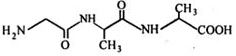
B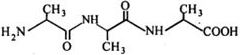
C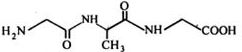
D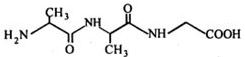
Solution
(C) The tripeptide is Glycyl-Alanyl-Glycine (Gly-Ala-Gly).
$1$. Glycine $(Gly)$ has the side chain $R = H$. Its structure is $H_2N-CH_2-COOH$.
$2$. Alanine $(Ala)$ has the side chain $R = CH_3$. Its structure is $H_2N-CH(CH_3)-COOH$.
$3$. In a peptide bond,the carboxyl group $(-COOH)$ of one amino acid reacts with the amino group $(-NH_2)$ of the next amino acid.
$4$. For Gly-Ala-Gly:
- The first amino acid is Glycine: $H_2N-CH_2-CO-$
- The second is Alanine: $-NH-CH(CH_3)-CO-$
- The third is Glycine: $-NH-CH_2-COOH$
$5$. Combining these,the structure is $H_2N-CH_2-CO-NH-CH(CH_3)-CO-NH-CH_2-COOH$.
$6$. Comparing this with the given options,option $C$ represents this sequence correctly.
$1$. Glycine $(Gly)$ has the side chain $R = H$. Its structure is $H_2N-CH_2-COOH$.
$2$. Alanine $(Ala)$ has the side chain $R = CH_3$. Its structure is $H_2N-CH(CH_3)-COOH$.
$3$. In a peptide bond,the carboxyl group $(-COOH)$ of one amino acid reacts with the amino group $(-NH_2)$ of the next amino acid.
$4$. For Gly-Ala-Gly:
- The first amino acid is Glycine: $H_2N-CH_2-CO-$
- The second is Alanine: $-NH-CH(CH_3)-CO-$
- The third is Glycine: $-NH-CH_2-COOH$
$5$. Combining these,the structure is $H_2N-CH_2-CO-NH-CH(CH_3)-CO-NH-CH_2-COOH$.
$6$. Comparing this with the given options,option $C$ represents this sequence correctly.
0 likes
View Solution17
EasyMCQ
Which of the following bacteria are responsible for intestinal inflammation and urinary tract infections?
A
$E. coli$
B
$S. faecalis$
C
Both $A$ and $B$
D
$S. aureus$
Solution
(C) Both $E. coli$ (Escherichia coli) and $S. faecalis$ (Streptococcus faecalis) are common bacteria found in the human intestine. $E. coli$ is a major cause of urinary tract infections,while $S. faecalis$ is associated with intestinal inflammation and other infections. Therefore,both are responsible for these conditions.
0 likes
View Solution18
MediumMCQ
Which of the following biomolecules contains a non-transition metal ion?
A
Vitamin $B_{12}$
B
Chlorophyll
C
Haemoglobin
D
Insulin
Solution
(B) The metal ions present in the given biomolecules are as follows:
$1$. Vitamin $B_{12}$: Contains $Co^{2+}$ $(Cobalt)$, which is a transition metal.
$2$. Chlorophyll: Contains $Mg^{2+}$ $(Magnesium)$, which is an alkaline earth metal and a non-transition metal ion.
$3$. Haemoglobin: Contains $Fe^{2+}$ $(Iron)$, which is a transition metal.
$4$. Insulin: Contains sulfur $(S)$, which is a non-metal, not a metal ion.
Therefore, the correct option is $B$.
$1$. Vitamin $B_{12}$: Contains $Co^{2+}$ $(Cobalt)$, which is a transition metal.
$2$. Chlorophyll: Contains $Mg^{2+}$ $(Magnesium)$, which is an alkaline earth metal and a non-transition metal ion.
$3$. Haemoglobin: Contains $Fe^{2+}$ $(Iron)$, which is a transition metal.
$4$. Insulin: Contains sulfur $(S)$, which is a non-metal, not a metal ion.
Therefore, the correct option is $B$.
0 likes
View Solution19
EasyMCQ
During the process of aerobic respiration,acetyl co-enzyme $A$ is formed from which of the following?
A
Pyruvate with a loss of a carbonyl group
B
Citric acid cycle
C
Directly from glucose
D
None of these
Solution
(A) During the link reaction (which connects glycolysis to the citric acid cycle),pyruvate undergoes oxidative decarboxylation to form acetyl co-enzyme $A$. This process involves the loss of a carbonyl group (as $CO_2$) and the reduction of $NAD^+$ to $NADH$.
0 likes
View Solution20
MediumMCQ
Which of the following does not reduce Fehling's solution?
A
Glucose
B
Benzaldehyde
C
Sucrose
D
Both $(B)$ and $(C)$
Solution
(D) Fehling's solution is an oxidizing agent used to detect the presence of reducing sugars and aliphatic aldehydes.
$1$. Glucose is a reducing sugar containing a free hemiacetal group,so it reduces Fehling's solution.
$2$. Benzaldehyde is an aromatic aldehyde. Aromatic aldehydes do not reduce Fehling's solution.
$3$. Sucrose is a non-reducing disaccharide because its glycosidic linkage involves the anomeric carbons of both glucose and fructose,preventing the formation of a free aldehyde or ketone group. Therefore,it does not reduce Fehling's solution.
Since both Benzaldehyde and Sucrose do not reduce Fehling's solution,the correct option is $(D)$.
$1$. Glucose is a reducing sugar containing a free hemiacetal group,so it reduces Fehling's solution.
$2$. Benzaldehyde is an aromatic aldehyde. Aromatic aldehydes do not reduce Fehling's solution.
$3$. Sucrose is a non-reducing disaccharide because its glycosidic linkage involves the anomeric carbons of both glucose and fructose,preventing the formation of a free aldehyde or ketone group. Therefore,it does not reduce Fehling's solution.
Since both Benzaldehyde and Sucrose do not reduce Fehling's solution,the correct option is $(D)$.
0 likes
View Solution21
AdvancedMCQ
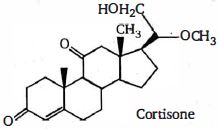
The functional groups present in the given structure of Cortisone are:
A
ether,alkene,alcohol
B
alcohol,ketone,alkene,ether
C
alcohol,ketone,amine
D
ether,amine,ketone
Solution
(B) By observing the structure of the provided molecule:
$1$. The structure contains a primary alcohol group $(-CH_2OH)$.
$2$. It contains two ketone groups $(C=O)$.
$3$. It contains an alkene group $(C=C)$.
$4$. It contains an ether group $(-OCH_3)$.
Therefore,the functional groups present are alcohol,ketone,alkene,and ether.
Thus,the correct option is $(B)$.
$1$. The structure contains a primary alcohol group $(-CH_2OH)$.
$2$. It contains two ketone groups $(C=O)$.
$3$. It contains an alkene group $(C=C)$.
$4$. It contains an ether group $(-OCH_3)$.
Therefore,the functional groups present are alcohol,ketone,alkene,and ether.
Thus,the correct option is $(B)$.
0 likes
View Solution22
MediumMCQ
Which of the following is the Fischer projection of $L$-threonine (also known as $(2S, 3R)-2$-amino-$3$-hydroxybutanoic acid)?
A
B
C
D
Solution
(A) The structure of $L$-threonine is $(2S, 3R)-2$-amino-$3$-hydroxybutanoic acid.
In a Fischer projection,the carbon chain is vertical with the most oxidized carbon $(COOH)$ at the top.
For $L$-amino acids,the $-NH_2$ group is on the left side at the $\alpha$-carbon $(C-2)$.
For the $(2S, 3R)$ configuration,the $-OH$ group at $C-3$ must be on the right side.
Thus,the correct Fischer projection has $-NH_2$ on the left at $C-2$ and $-OH$ on the right at $C-3$.
In a Fischer projection,the carbon chain is vertical with the most oxidized carbon $(COOH)$ at the top.
For $L$-amino acids,the $-NH_2$ group is on the left side at the $\alpha$-carbon $(C-2)$.
For the $(2S, 3R)$ configuration,the $-OH$ group at $C-3$ must be on the right side.
Thus,the correct Fischer projection has $-NH_2$ on the left at $C-2$ and $-OH$ on the right at $C-3$.
0 likes
View Solution23
MediumMCQ
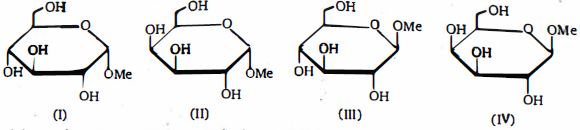
Identify the correct set of stereochemical relationships amongst the following monosaccharides $(I)-(IV)$:
A
$I$ and $II$ are anomers; $III$ and $IV$ are epimers
B
$I$ and $III$ are epimers; $II$ and $IV$ are anomers
C
$I$ and $II$ are epimers; $III$ and $IV$ are anomers
D
$I$ and $III$ are anomers; $I$ and $II$ are epimers
Solution
(D) Anomers are stereoisomers that differ in configuration only at the anomeric carbon (the carbon derived from the carbonyl carbon in the open-chain form). Epimers are stereoisomers that differ in configuration at only one stereocenter other than the anomeric carbon.
$1$. Comparing $I$ and $III$: Both have the same configuration at all carbons except the anomeric carbon $(C1)$. Thus,$I$ and $III$ are anomers.
$2$. Comparing $I$ and $II$: Both have the same configuration at all carbons except $C4$. Thus,$I$ and $II$ are epimers.
$3$. Comparing $III$ and $IV$: Both have the same configuration at all carbons except $C4$. Thus,$III$ and $IV$ are epimers.
$4$. Comparing $II$ and $IV$: Both have the same configuration at all carbons except the anomeric carbon $(C1)$. Thus,$II$ and $IV$ are anomers.
Therefore,the correct statement is that $I$ and $III$ are anomers,and $I$ and $II$ are epimers. The correct option is $(d)$.
$1$. Comparing $I$ and $III$: Both have the same configuration at all carbons except the anomeric carbon $(C1)$. Thus,$I$ and $III$ are anomers.
$2$. Comparing $I$ and $II$: Both have the same configuration at all carbons except $C4$. Thus,$I$ and $II$ are epimers.
$3$. Comparing $III$ and $IV$: Both have the same configuration at all carbons except $C4$. Thus,$III$ and $IV$ are epimers.
$4$. Comparing $II$ and $IV$: Both have the same configuration at all carbons except the anomeric carbon $(C1)$. Thus,$II$ and $IV$ are anomers.
Therefore,the correct statement is that $I$ and $III$ are anomers,and $I$ and $II$ are epimers. The correct option is $(d)$.
0 likes
View Solution24
MediumMCQ
The correct match between item $I$ and item $II$ is
| Item $I$ (compound) | Item $II$ (reagent) |
| $(a)$ Lysine | $(p)$ $1$-naphthol |
| $(b)$ Furfural | $(q)$ Ninhydrin |
| $(c)$ Benzyl alcohol | $(r)$ $KMnO_4$ |
| $(d)$ Styrene | $(s)$ Ceric ammonium nitrate |
A
$(a) \to (q); (b) \to (p); (c) \to (s); (d) \to (r)$
B
$(a) \to (q); (b) \to (p); (c) \to (r); (d) \to (s)$
C
$(a) \to (r); (b) \to (p); (c) \to (q); (d) \to (s)$
D
$(a) \to (q); (b) \to (r); (c) \to (s); (d) \to (p)$
Solution
(A) Lysine is an amino acid,which gives a positive test with Ninhydrin.
$(b)$ Furfural is an aldehyde that reacts with $1$-naphthol (Molisch test reagent) to give a violet color.
$(c)$ Benzyl alcohol is an alcohol,which reacts with Ceric ammonium nitrate to give a red color.
$(d)$ Styrene contains a carbon-carbon double bond,which reacts with $KMnO_4$ (Baeyer's reagent) and discharges its purple color.
Therefore,the correct match is $(a) \to (q), (b) \to (p), (c) \to (s), (d) \to (r)$.
$(b)$ Furfural is an aldehyde that reacts with $1$-naphthol (Molisch test reagent) to give a violet color.
$(c)$ Benzyl alcohol is an alcohol,which reacts with Ceric ammonium nitrate to give a red color.
$(d)$ Styrene contains a carbon-carbon double bond,which reacts with $KMnO_4$ (Baeyer's reagent) and discharges its purple color.
Therefore,the correct match is $(a) \to (q), (b) \to (p), (c) \to (s), (d) \to (r)$.
0 likes
View Solution25
EasyMCQ
Which of the following is water soluble?
A
Insulin
B
Albumins
C
Pyridoxine
D
All of the above
Solution
(D) Insulin is a protein hormone that is soluble in water.
Albumins are a family of globular proteins,the most common of which are the serum albumins,which are water-soluble.
Pyridoxine is one of the forms of Vitamin $B_6$ and is also water-soluble.
Therefore,all of the given substances are water-soluble.
Albumins are a family of globular proteins,the most common of which are the serum albumins,which are water-soluble.
Pyridoxine is one of the forms of Vitamin $B_6$ and is also water-soluble.
Therefore,all of the given substances are water-soluble.
0 likes
View Solution26
DifficultMCQ
Which biological molecule in living organisms contains $Mg$ as an essential component?
A
Hemoglobin
B
Chlorophyll
C
Florigen
D
$ATP$
Solution
(B) Chlorophyll is a green pigment found in plants,algae,and cyanobacteria. It is a coordination complex where the central metal ion is $Mg^{2+}$,which is coordinated to a porphyrin ring system. This $Mg$ ion is essential for the process of photosynthesis.
0 likes
View Solution27
EasyMCQ
Which of the following is the correct order for the calorific value of nutrients?
A
Fats $ > $ Carbohydrates $ > $ Proteins
B
Carbohydrates $ > $ Fats $ > $ Proteins
C
Proteins $ > $ Carbohydrates $ > $ Fats
D
Fats $ > $ Proteins $ > $ Carbohydrates
Solution
(D) The calorific values of the three major nutrients are as follows:
$1$. Fats: $9.45 \ kcal/g$
$2$. Proteins: $5.65 \ kcal/g$
$3$. Carbohydrates: $4.1 \ kcal/g$
Comparing these values,the order is: Fats $ > $ Proteins $ > $ Carbohydrates.
$1$. Fats: $9.45 \ kcal/g$
$2$. Proteins: $5.65 \ kcal/g$
$3$. Carbohydrates: $4.1 \ kcal/g$
Comparing these values,the order is: Fats $ > $ Proteins $ > $ Carbohydrates.
0 likes
View Solution28
MediumMCQ
Match Column-$I$ with Column-$II$ and select the correct option.
| Column-$I$ | Column-$II$ |
| $(i)$ Antiberiberi factor | $(A)$ Vitamin $C$ |
| $(ii)$ Pancreas | $(B)$ Glycerides |
| $(iii)$ Palm oil | $(C)$ Vitamin $B_1$ |
| $(iv)$ $L(+)$-Ascorbic acid | $(D)$ Insulin |
A
$i-C, ii-D, iii-B, iv-A$
B
$i-C, ii-D, iii-A, iv-B$
C
$i-A, ii-B, iii-D, iv-C$
D
$i-C, ii-B, iii-A, iv-D$
Solution
(A) $(i)$ Antiberiberi factor is Vitamin $B_1$ (Thiamine).
$(ii)$ Pancreas secretes the hormone Insulin.
$(iii)$ Palm oil is a rich source of Glycerides (fats).
$(iv)$ $L(+)$-Ascorbic acid is the chemical name for Vitamin $C$.
Therefore,the correct matching is $i-C, ii-D, iii-B, iv-A$.
$(ii)$ Pancreas secretes the hormone Insulin.
$(iii)$ Palm oil is a rich source of Glycerides (fats).
$(iv)$ $L(+)$-Ascorbic acid is the chemical name for Vitamin $C$.
Therefore,the correct matching is $i-C, ii-D, iii-B, iv-A$.
0 likes
View Solution29
EasyMCQ
Which of the following is the most important biological molecule containing $Mg$ found in living organisms?
A
Hemoglobin
B
Chlorophyll
C
Florigen
D
$ATP$
Solution
(B) In living organisms,$Mg^{2+}$ ions are essential for various biological processes. The most significant biological molecule containing magnesium is $Chlorophyll$,which is the green pigment found in plants. $Chlorophyll$ contains a magnesium ion at the center of its porphyrin ring,which is crucial for photosynthesis.
0 likes
View Solution30
DifficultMCQ
Assertion : $Mg$ is not present in the enamel of human teeth.
Reason : $Mg$ is an essential element for the biological functions of humans.
Reason : $Mg$ is an essential element for the biological functions of humans.
A
If both Assertion and Reason are correct and the Reason is a correct explanation of the Assertion.
B
If both Assertion and Reason are correct but Reason is not a correct explanation of the Assertion.
C
If the Assertion is correct but Reason is incorrect.
D
If the Assertion is incorrect but the Reason is correct.
Solution
(D) The enamel of human teeth is primarily composed of hydroxyapatite,$Ca_{10}(PO_4)_6(OH)_2$,which contains calcium. Magnesium $(Mg)$ is not a primary component of enamel.
Magnesium is indeed an essential element for various biological functions in the human body,such as acting as a cofactor for many enzymes and maintaining nerve and muscle function.
Since the Assertion is incorrect (as $Mg$ is present in trace amounts in teeth) and the Reason is correct,the correct option is $D$.
Magnesium is indeed an essential element for various biological functions in the human body,such as acting as a cofactor for many enzymes and maintaining nerve and muscle function.
Since the Assertion is incorrect (as $Mg$ is present in trace amounts in teeth) and the Reason is correct,the correct option is $D$.
0 likes
View Solution31
MediumMCQ
Assertion : $DNA$ as well as $RNA$ molecules are found in the nucleus of a cell.
Reason : On heating,the enzymes do not lose their specific activity.
Reason : On heating,the enzymes do not lose their specific activity.
A
If both Assertion and Reason are correct and the Reason is a correct explanation of the Assertion.
B
If both Assertion and Reason are correct but Reason is not a correct explanation of the Assertion.
C
If the Assertion is correct but Reason is incorrect.
D
If both the Assertion and Reason are incorrect.
Solution
(D) $DNA$ is found mainly in the nucleus of the cell,while $RNA$ is found mainly in the cytoplasm of the cell. Therefore,the assertion is incorrect.
Enzymes are biological catalysts that function within a specific temperature range. Upon heating,they undergo denaturation,which causes them to lose their specific biological activity. Therefore,the reason is also incorrect.
Enzymes are biological catalysts that function within a specific temperature range. Upon heating,they undergo denaturation,which causes them to lose their specific biological activity. Therefore,the reason is also incorrect.
0 likes
View Solution32
AdvancedMCQ
The number of chiral carbons in chloramphenicol is
A
$2$
B
$3$
C
$4$
D
$5$
Solution
(A) chiral carbon is a carbon atom that is bonded to four different groups.
Looking at the structure of chloramphenicol,we can identify the chiral centers marked with an asterisk $(*)$.
The structure contains two chiral carbon atoms:
$1$. The carbon atom attached to the hydroxyl $(-OH)$ group and the benzene ring.
$2$. The carbon atom attached to the amino $(-NH-)$ group and the hydroxymethyl $(-CH_2OH)$ group.
Therefore,the total number of chiral carbons in chloramphenicol is $2$.
Looking at the structure of chloramphenicol,we can identify the chiral centers marked with an asterisk $(*)$.
The structure contains two chiral carbon atoms:
$1$. The carbon atom attached to the hydroxyl $(-OH)$ group and the benzene ring.
$2$. The carbon atom attached to the amino $(-NH-)$ group and the hydroxymethyl $(-CH_2OH)$ group.
Therefore,the total number of chiral carbons in chloramphenicol is $2$.
0 likes
View Solution33
MediumMCQ
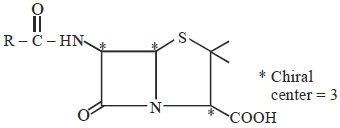
The number of chiral centres in penicillin is
A
$1$
B
$2$
C
$3$
D
$4$
Solution
(C) Penicillin has a core structure consisting of a $\beta$-lactam ring fused to a thiazolidine ring. By examining the structure,we can identify the chiral centers (carbon atoms bonded to four different groups). As shown in the structure,there are $3$ chiral centers marked with an asterisk $(*)$. Therefore,the total number of chiral centers in penicillin is $3$.
0 likes
View Solution34
DifficultMCQ
$A, B$ and $C$ are three biomolecules. The results of the tests performed on them are given below:
$A, B$ and $C$ are respectively:
| $\text{Molisch's Test}$ | $\text{Barfoed Test}$ | $\text{Biuret Test}$ | |
| $A$ | $\text{Positive}$ | $\text{Negative}$ | $\text{Negative}$ |
| $B$ | $\text{Positive}$ | $\text{Positive}$ | $\text{Negative}$ |
| $C$ | $\text{Negative}$ | $\text{Negative}$ | $\text{Positive}$ |
$A, B$ and $C$ are respectively:
A
$A = \text{Glucose}, B = \text{Fructose}, C = \text{Albumin}$
B
$A = \text{Lactose}, B = \text{Fructose}, C = \text{Alanine}$
C
$A = \text{Lactose}, B = \text{Glucose}, C = \text{Alanine}$
D
$A = \text{Lactose}, B = \text{Glucose}, C = \text{Albumin}$
Solution
(D) $\text{Molisch's test}$ is a general test for carbohydrates. $A$ and $B$ are carbohydrates as they give a positive $\text{Molisch's test}$.
$\text{Barfoed test}$ is used to distinguish monosaccharides from disaccharides; monosaccharides give a positive test.
Since $A$ gives a negative $\text{Barfoed test}$,it is a disaccharide (e.g.,$\text{Lactose}$),and since $B$ gives a positive test,it is a monosaccharide (e.g.,$\text{Glucose}$).
$\text{Biuret test}$ is positive for proteins. Since $C$ gives a positive $\text{Biuret test}$,it is a protein (e.g.,$\text{Albumin}$).
Therefore,$A = \text{Lactose}, B = \text{Glucose}, C = \text{Albumin}$.
$\text{Barfoed test}$ is used to distinguish monosaccharides from disaccharides; monosaccharides give a positive test.
Since $A$ gives a negative $\text{Barfoed test}$,it is a disaccharide (e.g.,$\text{Lactose}$),and since $B$ gives a positive test,it is a monosaccharide (e.g.,$\text{Glucose}$).
$\text{Biuret test}$ is positive for proteins. Since $C$ gives a positive $\text{Biuret test}$,it is a protein (e.g.,$\text{Albumin}$).
Therefore,$A = \text{Lactose}, B = \text{Glucose}, C = \text{Albumin}$.
0 likes
View Solution35
MediumMCQ
Aspartame is unstable at cooking temperature. Where would you suggest aspartame to be used for sweetening?
A
In hot beverages
B
In baked goods
C
In cold foods and soft drinks
D
In frying applications
Solution
(C) Aspartame is an artificial sweetener that is unstable at cooking temperatures because it decomposes into its constituent amino acids. Therefore,it is recommended for use only in cold foods and soft drinks.
0 likes
View Solution36
EasyMCQ
Seliwanoff test and Xanthoproteic test are used for the identification of $....$ and $....$ respectively.
A
Aldoses,ketoses
B
Proteins,ketoses
C
Ketoses,proteins
D
Ketoses,aldoses
Solution
(C) The Seliwanoff test is a chemical test which distinguishes between aldose and ketose sugars. It specifically identifies ketoses by producing a red color.
The Xanthoproteic test is used to detect the presence of proteins,specifically those containing amino acids with aromatic rings (like tyrosine,tryptophan,and phenylalanine),which produce a yellow color upon treatment with concentrated nitric acid.
The Xanthoproteic test is used to detect the presence of proteins,specifically those containing amino acids with aromatic rings (like tyrosine,tryptophan,and phenylalanine),which produce a yellow color upon treatment with concentrated nitric acid.
0 likes
View Solution37
MediumMCQ
Which one of the following tests used for the identification of functional groups in organic compounds does not use copper reagent?
A
Barfoed's test
B
Seliwanoff's test
C
Benedict's test
D
Biuret test for peptide bond
Solution
(B) Seliwanoff's test uses resorcinol in concentrated $HCl$ to detect ketoses. It does not contain copper.
Barfoed's test uses copper$(II)$ acetate in acetic acid.
Benedict's test uses a solution of copper$(II)$ sulfate,sodium citrate,and sodium carbonate.
Biuret test uses copper$(II)$ sulfate in an alkaline solution to detect peptide bonds.
Barfoed's test uses copper$(II)$ acetate in acetic acid.
Benedict's test uses a solution of copper$(II)$ sulfate,sodium citrate,and sodium carbonate.
Biuret test uses copper$(II)$ sulfate in an alkaline solution to detect peptide bonds.
0 likes
View Solution38
MediumMCQ
Match List-$I$ and List-$II$
Choose the correct answer from the options given below:
| List-$I$ | List-$II$ |
| $A$. Molisch's Test | $I$. Peptide |
| $B$. Biuret Test | $II$. Carbohydrate |
| $C$. Carbylamine Test | $III$. Primary amine |
| $D$. Schiff's Test | $IV$. Aldehyde |
A
$A-I, B-II, C-III, D-IV$
B
$A-III, B-IV, C-I, D-II$
C
$A-II, B-I, C-III, D-IV$
D
$A-III, B-IV, C-II, D-I$
Solution
(C) . Molisch's Test is a general test for carbohydrates $(II)$.
$B$. Biuret Test is used to detect the presence of peptide bonds in proteins $(I)$.
$C$. Carbylamine Test is a chemical test for the detection of primary amines $(III)$.
$D$. Schiff's Test is used for the detection of aldehydes $(IV)$.
Therefore,the correct matching is $A-II, B-I, C-III, D-IV$.
$B$. Biuret Test is used to detect the presence of peptide bonds in proteins $(I)$.
$C$. Carbylamine Test is a chemical test for the detection of primary amines $(III)$.
$D$. Schiff's Test is used for the detection of aldehydes $(IV)$.
Therefore,the correct matching is $A-II, B-I, C-III, D-IV$.
0 likes
View Solution39
DifficultMCQ
Number of compounds from the following which will not produce orange red precipitate with Benedict's solution is $..............$. Glucose,maltose,sucrose,ribose,$2$-deoxyribose,amylose,lactose.
A
$2$
B
$4$
C
$3$
D
$5$
Solution
(A) Benedict's solution is used to detect reducing sugars. Reducing sugars contain a free aldehyde or ketone group that can reduce $Cu^{2+}$ ions to $Cu^+$ ions,forming a red/orange precipitate of $Cu_2O$.
Among the given compounds:
$1$. Glucose: Reducing sugar (gives test).
$2$. Maltose: Reducing sugar (gives test).
$3$. Sucrose: Non-reducing sugar (does not give test).
$4$. Ribose: Reducing sugar (gives test).
$5$. $2$-deoxyribose: Reducing sugar (gives test).
$6$. Amylose: Non-reducing polysaccharide (does not give test).
$7$. Lactose: Reducing sugar (gives test).
Therefore,only $2$ compounds (Sucrose and Amylose) will not produce an orange-red precipitate with Benedict's solution.
Among the given compounds:
$1$. Glucose: Reducing sugar (gives test).
$2$. Maltose: Reducing sugar (gives test).
$3$. Sucrose: Non-reducing sugar (does not give test).
$4$. Ribose: Reducing sugar (gives test).
$5$. $2$-deoxyribose: Reducing sugar (gives test).
$6$. Amylose: Non-reducing polysaccharide (does not give test).
$7$. Lactose: Reducing sugar (gives test).
Therefore,only $2$ compounds (Sucrose and Amylose) will not produce an orange-red precipitate with Benedict's solution.
0 likes
View Solution40
DifficultMCQ
$A$ decapeptide (Mol. Wt. $796$) on complete hydrolysis gives glycine (Mol. Wt. $75$),alanine,and phenylalanine. Glycine contributes $47.0 \%$ to the total weight of the hydrolysed products. The number of glycine units present in the decapeptide is
A
$4$
B
$5$
C
$6$
D
$7$
Solution
(C) Molecular weight of decapeptide $= 796 \ g/mol$.
$A$ decapeptide contains $10$ amino acid units,so it has $(10-1) = 9$ peptide bonds.
Upon complete hydrolysis,$9$ molecules of water are added.
Total weight of water added $= 9 \times 18 \ g/mol = 162 \ g/mol$.
Total weight of hydrolysis products $= 796 + 162 = 958 \ g$.
Total weight of glycine in the product $= \frac{47.0}{100} \times 958 \ g = 450.26 \ g \approx 450 \ g$.
Molecular weight of glycine $= 75 \ g/mol$.
Number of glycine units $= \frac{450 \ g}{75 \ g/mol} = 6$.
$A$ decapeptide contains $10$ amino acid units,so it has $(10-1) = 9$ peptide bonds.
Upon complete hydrolysis,$9$ molecules of water are added.
Total weight of water added $= 9 \times 18 \ g/mol = 162 \ g/mol$.
Total weight of hydrolysis products $= 796 + 162 = 958 \ g$.
Total weight of glycine in the product $= \frac{47.0}{100} \times 958 \ g = 450.26 \ g \approx 450 \ g$.
Molecular weight of glycine $= 75 \ g/mol$.
Number of glycine units $= \frac{450 \ g}{75 \ g/mol} = 6$.
0 likes
View Solution41
EasyMCQ
Which of the following statement$(s)$ is(are) true?
$(1)$ Oxidation of glucose with bromine water gives gluconic acid.
$(2)$ The two six-membered cyclic hemiacetal forms of $D-(+)-$glucose are called anomers.
$(3)$ Hydrolysis of sucrose gives dextrorotatory glucose and laevorotatory fructose.
$(4)$ Monosaccharides cannot be hydrolysed to give polyhydroxy aldehydes and ketones.
$(1)$ Oxidation of glucose with bromine water gives gluconic acid.
$(2)$ The two six-membered cyclic hemiacetal forms of $D-(+)-$glucose are called anomers.
$(3)$ Hydrolysis of sucrose gives dextrorotatory glucose and laevorotatory fructose.
$(4)$ Monosaccharides cannot be hydrolysed to give polyhydroxy aldehydes and ketones.
A
$1, 2, 3$
B
$2, 3, 4$
C
$2, 3$
D
$1, 2$
Solution
(B) $(1)$ $FALSE$: Oxidation of glucose with bromine water ($Br_2$ water) gives gluconic acid,not glutamic acid.
$(2)$ $TRUE$: The two six-membered cyclic hemiacetal forms of $D-( )-$glucose ($\alpha-D-$glucose and $\beta-D-$glucose) differ in configuration at the $C_1$ carbon and are called anomers.
$(3)$ $TRUE$: Hydrolysis of sucrose yields $D-( )-$glucose (dextrorotatory) and $D-(-)-$fructose (laevorotatory).
$(4)$ $TRUE$: Monosaccharides are the simplest carbohydrates and cannot be further hydrolysed into smaller polyhydroxy aldehyde or ketone units.
$(2)$ $TRUE$: The two six-membered cyclic hemiacetal forms of $D-( )-$glucose ($\alpha-D-$glucose and $\beta-D-$glucose) differ in configuration at the $C_1$ carbon and are called anomers.
$(3)$ $TRUE$: Hydrolysis of sucrose yields $D-( )-$glucose (dextrorotatory) and $D-(-)-$fructose (laevorotatory).
$(4)$ $TRUE$: Monosaccharides are the simplest carbohydrates and cannot be further hydrolysed into smaller polyhydroxy aldehyde or ketone units.
0 likes
View Solution42
DifficultMCQ
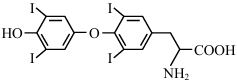
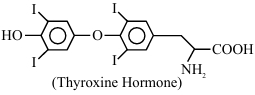
The structure of the hormone thyroxine is given below. The percentage of iodine in thyroxine is $..........\%$. ($nearest$ $integer$)
($Given$ $molar$ $mass$ $in$ $g \ mol^{-1}: C: 12, H: 1, O: 16, N: 14, I: 127$)
($Given$ $molar$ $mass$ $in$ $g \ mol^{-1}: C: 12, H: 1, O: 16, N: 14, I: 127$)
A
$55$
B
$65$
C
$75$
D
$85$
Solution
(B) The molecular formula of thyroxine is $C_{15}H_{11}O_4NI_4$.
Calculate the molecular mass of thyroxine:
$C: 15 \times 12 = 180$
$H: 11 \times 1 = 11$
$O: 16 \times 4 = 64$
$N: 14 \times 1 = 14$
$I: 127 \times 4 = 508$
Total molecular mass $= 180 + 11 + 64 + 14 + 508 = 777 \ g \ mol^{-1}$.
Percentage of iodine $= \frac{\text{Mass of Iodine}}{\text{Total Molecular Mass}} \times 100$
Percentage of iodine $= \frac{508}{777} \times 100 \approx 65.38 \%$.
The nearest integer is $65$.
Calculate the molecular mass of thyroxine:
$C: 15 \times 12 = 180$
$H: 11 \times 1 = 11$
$O: 16 \times 4 = 64$
$N: 14 \times 1 = 14$
$I: 127 \times 4 = 508$
Total molecular mass $= 180 + 11 + 64 + 14 + 508 = 777 \ g \ mol^{-1}$.
Percentage of iodine $= \frac{\text{Mass of Iodine}}{\text{Total Molecular Mass}} \times 100$
Percentage of iodine $= \frac{508}{777} \times 100 \approx 65.38 \%$.
The nearest integer is $65$.
0 likes
View Solution43
EasyMCQ
Which of the following matches is wrong?
A
Vitamin $B_6 - $ Pyridoxine
B
$A$ sequence of Base $- DNA$ fingerprinting
C
Amino acid $-$ Zwitter ion
D
All matches are correct
Solution
(D) $1$. Vitamin $B_6$ is chemically known as Pyridoxine. This is a correct match.
$2$. $DNA$ fingerprinting is based on the principle of identifying the sequence of bases in specific regions of $DNA$. This is a correct match.
$3$. Amino acids exist as zwitter ions in aqueous solutions at their isoelectric point,where the carboxyl group loses a proton and the amino group gains one. This is a correct match.
$4$. Since all the given statements are correct,the option stating that all matches are correct is the right choice.
$2$. $DNA$ fingerprinting is based on the principle of identifying the sequence of bases in specific regions of $DNA$. This is a correct match.
$3$. Amino acids exist as zwitter ions in aqueous solutions at their isoelectric point,where the carboxyl group loses a proton and the amino group gains one. This is a correct match.
$4$. Since all the given statements are correct,the option stating that all matches are correct is the right choice.
0 likes
View Solution44
EasyMCQ
Which element among the following is not present in saccharin?
A
$C$
B
$N$
C
$P$
D
$S$
Solution
(C) Saccharin is an artificial sweetening agent with the chemical formula $C_7H_5NO_3S$.
It contains Carbon $(C)$,Hydrogen $(H)$,Nitrogen $(N)$,Oxygen $(O)$,and Sulfur $(S)$.
Phosphorus $(P)$ is not present in its structure.
The structure is as follows:
(Structure of Saccharin: $A$ benzene ring fused to a five-membered ring containing $CO$,$NH$,and $SO_2$ groups).
It contains Carbon $(C)$,Hydrogen $(H)$,Nitrogen $(N)$,Oxygen $(O)$,and Sulfur $(S)$.
Phosphorus $(P)$ is not present in its structure.
The structure is as follows:
(Structure of Saccharin: $A$ benzene ring fused to a five-membered ring containing $CO$,$NH$,and $SO_2$ groups).
0 likes
View Solution45
EasyMCQ
Identify the source of gallic acid from the following.
A
Clove
B
Wintergreen
C
Citrus fruits
D
Indian gooseberry
Solution
(D) Gallic acid is a naturally occurring phenolic acid found in various plants. Among the given options,$Indian \ gooseberry$ (also known as $Amla$) is a rich source of gallic acid.
0 likes
View Solution46
DifficultMCQ
Identify the source of linen from the following:
A
Flax plant
B
Cotton plant
C
Cane plant
D
Rubber plant
Solution
(A) $(1)$ Flax plant: Linen is a natural fiber derived from the flax plant ($Linum$ $usitatissimum$). The fibers are obtained from the stem of the flax plant and are known for their strength,durability,and breathability. Linen is one of the oldest textile fibers used by humans.
$(2)$ Cotton plant: Cotton fibers come from the cotton plant $(Gossypium)$,not from flax. Cotton is widely used to make fabrics like cotton cloth,but it is a different material from linen.
$(3)$ Cane plant: The cane plant,such as sugarcane or bamboo,is not a source of linen. However,bamboo fibers are used to create textiles in some cases,but this is not the source of linen.
$(4)$ Rubber plant: Rubber comes from the latex of the rubber tree ($Hevea$ $brasiliensis$) and is used for making rubber products,not linen fabric.
$(2)$ Cotton plant: Cotton fibers come from the cotton plant $(Gossypium)$,not from flax. Cotton is widely used to make fabrics like cotton cloth,but it is a different material from linen.
$(3)$ Cane plant: The cane plant,such as sugarcane or bamboo,is not a source of linen. However,bamboo fibers are used to create textiles in some cases,but this is not the source of linen.
$(4)$ Rubber plant: Rubber comes from the latex of the rubber tree ($Hevea$ $brasiliensis$) and is used for making rubber products,not linen fabric.
0 likes
View Solution47
EasyMCQ
Which among the following statements about terpenes is $NOT$ true?
A
Terpenes occur in essential oils
B
Terpenes include vitamin $A$,$E$ and $K$
C
Terpenes consist of isoprene units
D
Terpenes are saturated hydrocarbons
Solution
(D) Terpenes are unsaturated hydrocarbons that are classified by the number of isoprene units $(C_5H_8)$,with the most common being mono-,sesqui-,and di-terpenes ($C_{10}$,$C_{15}$,and $C_{20}$,respectively).
Terpenes are highly aromatic compounds that determine the smell of many plants and herbs,such as rosemary and lavender,as well as some animals.
The side chains of Vitamin $A$,$E$,$K$,and squalene are all constituents of terpenes.
Terpenes are important constituents of essential oils,having a chemical structure consisting of repeated isoprene $(C_5H_8)$ units. Since they contain double bonds,they are unsaturated,not saturated.
Terpenes are highly aromatic compounds that determine the smell of many plants and herbs,such as rosemary and lavender,as well as some animals.
The side chains of Vitamin $A$,$E$,$K$,and squalene are all constituents of terpenes.
Terpenes are important constituents of essential oils,having a chemical structure consisting of repeated isoprene $(C_5H_8)$ units. Since they contain double bonds,they are unsaturated,not saturated.
0 likes
View Solution48
MediumMCQ
Which class of terpenes includes $\beta$-carotene?
A
Tetraterpenes
B
Triterpenes
C
Monoterpenes
D
Sesquiterpenes
Solution
(A) Lycopene,$\beta$-carotene,and lutein are natural carotenoids classified as tetraterpenes.
These compounds are composed of eight isoprene units.
These compounds are composed of eight isoprene units.
0 likes
View Solution49
MediumMCQ
How many isoprene units are present in abscisic acid?
A
Three
B
Two
C
Four
D
Five
Solution
(A) Abscisic acid $(ABA)$ is a sesquiterpenoid plant hormone,which means it is derived from $3$ isoprene units ($C_5H_8$ units).
Therefore,it contains $3$ isoprene units.
Therefore,it contains $3$ isoprene units.
0 likes
View Solution50
EasyMCQ
Assign "$T$" for a true statement and "$F$" for a false statement,then select the correct option.
$(i)$ Most naturally occurring amino acids have $L$-configuration.
$(ii)$ $\beta-D$-ribose sugar is present in $RNA$.
$(iii)$ Amylose is a water-insoluble component made up of $\alpha-D^+$-glucose units.
$(iv)$ All monosaccharides are non-reducing sugars.
$(i)$ Most naturally occurring amino acids have $L$-configuration.
$(ii)$ $\beta-D$-ribose sugar is present in $RNA$.
$(iii)$ Amylose is a water-insoluble component made up of $\alpha-D^+$-glucose units.
$(iv)$ All monosaccharides are non-reducing sugars.
A
$FTTF$
B
$TTFF$
C
$TTFT$
D
$TFTF$
Solution
(B) $(i)$ Most naturally occurring amino acids have $L$-configuration. This is $True$ $(T)$.
$(ii)$ $\beta-D$-ribose sugar is the sugar component present in $RNA$. This is $True$ $(T)$.
$(iii)$ Amylose is a water-insoluble component of starch,composed of long unbranched chains of $\alpha-D^+$-glucose units linked by $\alpha$-glycosidic linkages. This is $True$ $(T)$.
$(iv)$ All monosaccharides,whether aldoses or ketoses,are reducing sugars because they contain a free aldehyde or ketone group. Therefore,the statement that all monosaccharides are non-reducing is $False$ $(F)$.
Thus,the sequence is $T, T, T, F$. However,based on the provided options,the closest match for the logic is $TTFF$ (Option $B$),assuming a potential typo in the source question regarding the solubility or classification of amylose in the provided options.
$(ii)$ $\beta-D$-ribose sugar is the sugar component present in $RNA$. This is $True$ $(T)$.
$(iii)$ Amylose is a water-insoluble component of starch,composed of long unbranched chains of $\alpha-D^+$-glucose units linked by $\alpha$-glycosidic linkages. This is $True$ $(T)$.
$(iv)$ All monosaccharides,whether aldoses or ketoses,are reducing sugars because they contain a free aldehyde or ketone group. Therefore,the statement that all monosaccharides are non-reducing is $False$ $(F)$.
Thus,the sequence is $T, T, T, F$. However,based on the provided options,the closest match for the logic is $TTFF$ (Option $B$),assuming a potential typo in the source question regarding the solubility or classification of amylose in the provided options.
0 likes
View SolutionBiomolecules — Mix Examples-Biomolecules · Frequently Asked Questions
1Are these Biomolecules questions useful for JEE and NEET?
Yes. All questions in this section are mapped to JEE Main and NEET exam patterns. Previous year questions from JEE Main, NEET, GUJCET and state-level exams are included with full solutions.
2Can I switch to Hindi or Gujarati for these questions?
Yes. Use the language tabs in the hero section or the sidebar to view the same questions and solutions in English, Hindi or Gujarati.
3How do I generate a question paper from this subtopic?
Use the Vedclass Exam Paper Generator — select the chapter and subtopic, set difficulty, and generate Sets A, B, C, D automatically. First 3 chapters of every subject are free.
Vedclass Products
For Students
Vedclass Test Series
Mock tests in real JEE/NEET style with performance analysis. 5-day free trial.
Start Free TrialFor Teachers
Exam Paper Generator
Generate Set A/B/C/D papers from this chapter in 2 minutes. 3 chapters free.
Try FreeFor Institutes
Online Exam Module
Live online exams with unlimited students, 360° analytics & white-label branding.
See DemoFor Teachers & Institutes
Generate a Biomolecules Exam Paper in 2 Minutes
Select subtopic & difficulty — Sets A, B, C, D auto-generated with No Repeat logic.
First 3 chapters of every subject are free — no payment required.