
A English
Enzymes and Hormones Questions in English
Class 12 Chemistry · Biomolecules · Enzymes and Hormones
159+
Questions
English
Language
100%
With Solutions
Showing 50 of 159 questions in English
51
EasyMCQ
Which enzyme is responsible for the conversion of maltose into glucose?
A
Zymase
B
Lactase
C
Maltase
D
Diastase
Solution
(C) The hydrolysis of maltose into glucose is catalyzed by the enzyme $Maltase$. The reaction is as follows:
$C_{12}H_{22}O_{11} (maltose) + H_2O \xrightarrow{Maltase} 2C_6H_{12}O_6 (glucose)$.
$C_{12}H_{22}O_{11} (maltose) + H_2O \xrightarrow{Maltase} 2C_6H_{12}O_6 (glucose)$.
0 likes
View Solution52
EasyMCQ
Which of the following statements is incorrect?
A
Enzymes exist in the colloidal state.
B
Enzymes are catalysts.
C
Enzymes are specific to a particular reaction.
D
Urease is an enzyme.
Solution
(C) Enzymes are biological catalysts that are highly specific in nature. They do not catalyze any reaction; rather,each enzyme is specific to a particular substrate or reaction. Therefore,the statement that 'Enzymes are catalyzed in any reaction' is incorrect.
0 likes
View Solution53
EasyMCQ
What is the function of enzymes in biological systems?
A
Transport oxygen
B
Provide immunity
C
Catalyze biochemical reactions
D
Provide energy
Solution
(C) Enzymes are biological catalysts that speed up biochemical reactions in living organisms by lowering the activation energy. Therefore,they catalyze biochemical reactions.
0 likes
View Solution54
EasyMCQ
Enzymes are.......
A
Carbohydrates
B
Nucleic acids
C
Globular proteins
D
Fibrous proteins
Solution
(C) Enzymes are biological catalysts that speed up biochemical reactions in living organisms.
Chemically,almost all enzymes are $Globular \ proteins$ that have a specific three-dimensional structure required for their catalytic activity.
Chemically,almost all enzymes are $Globular \ proteins$ that have a specific three-dimensional structure required for their catalytic activity.
0 likes
View Solution55
EasyMCQ
Which statement is incorrect for enzymes?
A
Enzymes are biological catalysts.
B
Each enzyme is a catalyst for a specific number of reactions.
C
Enzymes are highly specific catalysts.
D
Enzymes are required in very small quantities for their reactions.
0 likes
View Solution56
EasyMCQ
Which of the following statements is incorrect for enzymes?
A
Enzymes are mostly proteinaceous in nature.
B
Enzymes are highly specific in their action.
C
Enzymes are denatured by ultraviolet rays and high temperatures.
D
Enzymes are least active at their optimum temperature.
Solution
(D) Enzymes are highly active at their optimum temperature. Therefore,the statement that they are least active at optimum temperature is incorrect.
0 likes
View Solution57
EasyMCQ
An enzyme is a .......
A
Protein
B
Mineral
C
Oil
D
Fatty acid
Solution
(A) Enzymes are biological catalysts that are almost exclusively composed of proteins. They speed up biochemical reactions in living organisms by lowering the activation energy.
0 likes
View Solution58
EasyMCQ
The hormone that helps in the conversion of glucose to glycogen is.......
A
Adrenaline
B
Insulin
C
Conductance
D
Bile acid
Solution
(B) Insulin is a hormone secreted by the pancreas. It promotes the conversion of glucose into glycogen in the liver,a process known as glycogenesis,which helps in lowering blood glucose levels.
0 likes
View Solution59
MediumMCQ
Select the correct statement regarding enzymes.
A
Enzymes are specific biological catalysts that are non-toxic.
B
Enzymes are generally heterogeneous catalysts and are non-specific for reactions.
C
Enzymes are specific biological catalysts that work at very high temperatures $(T \approx 1000 \ K)$.
D
Enzymes are specific biological catalysts that make reactions favorable.
Solution
(D) Enzymes are highly specific biological catalysts that lower the activation energy of biochemical reactions,making them proceed efficiently at physiological temperatures.
0 likes
View Solution60
EasyMCQ
The production and function of '$Insulin$' in the body are responsible for the regulation of blood sugar levels. To which of the following classes can this compound be assigned?
A
Enzyme
B
Hormone
C
Co-enzyme
D
Antibiotic
0 likes
View Solution61
EasyMCQ
Which of the following is an example of a protein that acts as a hormone?
A
Casein
B
Oxytocin
C
Trypsin
D
Keratin
Solution
(B) Oxytocin is a peptide hormone consisting of $9$ amino acids. It is produced in the hypothalamus and stored in the posterior pituitary gland. It plays a crucial role in childbirth and lactation.
0 likes
View Solution62
MediumMCQ
Which of the following statements is $NOT$ true?
A
Antihistamines help in relieving allergies.
B
Hormones are produced continuously and are not stored in the body.
C
The function of white blood cells is to protect the body against infections.
D
Catabolism involves the degradation of molecules.
Solution
(B) Hormones are not produced continuously; they are synthesized by the body according to its requirements.
0 likes
View Solution63
EasyMCQ
Insulin production and its action in the human body are responsible for regulating blood sugar levels. To which of the following categories does this compound belong?
A
Co-enzyme
B
Hormone
C
Enzyme
D
Antibiotic
Solution
(B) Insulin is a peptide hormone produced by the beta cells of the pancreatic islets. It plays a crucial role in regulating the metabolism of carbohydrates,fats,and proteins by promoting the absorption of glucose from the blood into liver,fat,and skeletal muscle cells. Therefore,it is classified as a hormone.
0 likes
View Solution64
MediumMCQ
Which enzyme is responsible for the conversion of glucose into ethanol?
A
Zymase
B
Invertase
C
Maltase
D
Diastase
Solution
(A) The conversion of glucose into ethanol is a fermentation process catalyzed by the enzyme $Zymase$.
The chemical reaction is:
$C_6H_{12}O_6 \xrightarrow{Zymase} 2C_2H_5OH + 2CO_2$
Therefore,the correct option is $A$.
The chemical reaction is:
$C_6H_{12}O_6 \xrightarrow{Zymase} 2C_2H_5OH + 2CO_2$
Therefore,the correct option is $A$.
0 likes
View Solution65
MediumMCQ
Who conducted the first scientific study of fermentation?
A
Buchner
B
Liebig
C
Bayer
D
Pasteur
Solution
(D) Louis Pasteur was the first to conduct a scientific study of fermentation.
0 likes
View Solution66
MediumMCQ
Organic catalysts differ from inorganic catalysts in which of the following ways?
A
By acting at very high temperature
B
By acting at low temperature
C
Being used up
D
Being proteinous in nature
Solution
(D) Organic catalysts,also known as enzymes,are proteinous in nature and are derived from living cells,whereas inorganic catalysts are typically metals or metal oxides.
0 likes
View Solution67
MediumMCQ
Which one of the following statements is incorrect about enzyme catalysis?
A
Enzymes are mostly proteinous in nature.
B
Enzyme action is specific.
C
Enzymes are denatured by ultraviolet rays and at high temperature.
D
Enzymes are least reactive at optimum temperature.
Solution
(D) Most enzymes are proteinous in nature.
They are highly specific in their action.
They get denatured by high temperatures or $UV$ rays.
At the optimum temperature,enzyme activity is at its maximum,not minimum.
They are highly specific in their action.
They get denatured by high temperatures or $UV$ rays.
At the optimum temperature,enzyme activity is at its maximum,not minimum.
0 likes
View Solution68
MediumMCQ
Which of the following hormones is produced under conditions of stress and stimulates glycogenolysis in the liver of human beings?
A
Thyroxin
B
Insulin
C
Adrenaline
D
Estradiol
Solution
(C) Adrenaline is known as the emergency hormone.
It is released during stress conditions.
It stimulates glycogenolysis in the liver,which leads to the release of glucose into the bloodstream to provide energy for the 'fight or flight' response.
It is released during stress conditions.
It stimulates glycogenolysis in the liver,which leads to the release of glucose into the bloodstream to provide energy for the 'fight or flight' response.
0 likes
View Solution69
MediumMCQ
Which of the following hormones contains iodine?
A
Testosterone
B
Adrenaline
C
Thyroxine
D
Insulin
Solution
(C) Thyroxine is $3, 5, 3', 5'$-tetraiodothyronine. It is secreted by the follicular cells of the thyroid gland. The structure is shown below:
$HO-C_6H_2I_2-O-C_6H_2I_2-CH(NH_2)COOH$
Thyroxine stimulates the consumption of oxygen and thus,the metabolism of all cells or tissues in the body.
$HO-C_6H_2I_2-O-C_6H_2I_2-CH(NH_2)COOH$
Thyroxine stimulates the consumption of oxygen and thus,the metabolism of all cells or tissues in the body.
0 likes
View Solution70
MediumMCQ
Which of the following is an amine hormone?
A
Insulin
B
Progesterone
C
Thyroxine
D
Oxypurin
Solution
(C) Amine hormones are derived from amino acids. $Thyroxine$ is an amine hormone,which is an iodinated derivative of the amino acid tyrosine.
It is secreted by the thyroid gland.
Its primary function is to regulate the metabolism of carbohydrates,proteins,and lipids in the body.
It is secreted by the thyroid gland.
Its primary function is to regulate the metabolism of carbohydrates,proteins,and lipids in the body.
0 likes
View Solution71
EasyMCQ
During the process of digestion,the proteins present in food materials are hydrolysed to amino acids. The two enzymes involved in the process
$proteins$ $\xrightarrow{\text{enzyme } (A)} polypeptides$ $\xrightarrow{\text{enzyme } (B)} amino \ acids$,
are respectively
$proteins$ $\xrightarrow{\text{enzyme } (A)} polypeptides$ $\xrightarrow{\text{enzyme } (B)} amino \ acids$,
are respectively
A
invertase and zymase
B
amylase and maltase
C
diastase and lipase
D
pepsin and trypsin
Solution
(D) In the process of digestion,the proteins present in food material are hydrolysed to amino acids.
In this process,two enzymes,$pepsin$ and $trypsin$,are involved as follows:
$Proteins$ $\xrightarrow{Pepsin \ (A)} Polypeptides$ $\xrightarrow{trypsin \ (B)} Amino \ acids$
In this process,two enzymes,$pepsin$ and $trypsin$,are involved as follows:
$Proteins$ $\xrightarrow{Pepsin \ (A)} Polypeptides$ $\xrightarrow{trypsin \ (B)} Amino \ acids$
0 likes
View Solution72
EasyMCQ
Which one of the following is a peptide hormone?
A
Adrenaline
B
Glucagon
C
Testosterone
D
Thyroxine
Solution
(B) Glucagon is a peptide hormone because it consists of a chain of $29$ amino acids linked by peptide bonds.
Adrenaline is an amino acid derivative.
Testosterone is a steroid hormone.
Thyroxine is an iodinated amino acid derivative.
Adrenaline is an amino acid derivative.
Testosterone is a steroid hormone.
Thyroxine is an iodinated amino acid derivative.
0 likes
View Solution73
EasyMCQ
Which of the following is $INCORRECT$ match for the suitable enzyme catalyst of the given reaction?
A
Inversion of cane sugar - Invertase
B
Conversion of glucose into ethyl alcohol - Diastase
C
Conversion of maltose into glucose - Maltase
D
Conversion of milk into curd - Lacto bacilli
Solution
(B) The conversion of glucose into ethyl alcohol is catalyzed by the enzyme $Zymase$,not $Diastase$.
$Diastase$ is used for the conversion of starch into maltose.
Therefore,the match in option $B$ is $INCORRECT$.
$Diastase$ is used for the conversion of starch into maltose.
Therefore,the match in option $B$ is $INCORRECT$.
0 likes
View Solution74
EasyMCQ
Maltose is changed into monosaccharide $(Glucose)$ in the presence of:
A
Maltase
B
Zymase
C
Diastase
D
Sucrase
Solution
(A) Maltase catalyzes the hydrolysis of the disaccharide maltose into the simple sugar glucose.
Maltase is secreted by the intestine,as some portion of starch is transformed into maltose by pancreatic or salivary enzymes called amylase during food digestion.
Maltase is secreted by the intestine,as some portion of starch is transformed into maltose by pancreatic or salivary enzymes called amylase during food digestion.
0 likes
View Solution75
MediumMCQ
Which of the following enzymes converts starch into maltose?
A
Diastase
B
Maltase
C
Zymase
D
Invertase
Solution
(A) Maltose is obtained by the partial hydrolysis of starch using the enzyme $Diastase$,which is present in malt.
The chemical reaction is:
$2(C_6H_{10}O_5)_n + nH_2O \xrightarrow{Diastase} nC_{12}H_{22}O_{11} \text{ (Maltose)}$
The chemical reaction is:
$2(C_6H_{10}O_5)_n + nH_2O \xrightarrow{Diastase} nC_{12}H_{22}O_{11} \text{ (Maltose)}$
0 likes
View Solution76
DifficultMCQ
The correct match between Item $I$ and Item $II$ is
| Item $I$ | Item $II$ |
| $A$. Allosteric effect | $P$. Molecule binding to the active site of enzyme |
| $B$. Competitive inhibitor | $Q$. Molecule crucial for communication in the body |
| $C$. Receptor | $R$. Molecule binding to a site other than the active site of enzyme |
| $D$. Poison | $S$. Molecule binding to the enzyme covalently |
A
$A \to R, B \to P, C \to Q, D \to S$
B
$A \to P, B \to R, C \to Q, D \to S$
C
$A \to R, B \to P, C \to S, D \to Q$
D
$A \to P, B \to R, C \to S, D \to Q$
Solution
(A) . Allosteric effect: $A$ molecule binds to a site other than the active site of the enzyme,changing its shape. Thus,$A \to R$.
$B$. Competitive inhibitor: $A$ molecule competes with the substrate for the active site of the enzyme. Thus,$B \to P$.
$C$. Receptor: These are proteins crucial for chemical communication in the body. Thus,$C \to Q$.
$D$. Poison: These molecules often bind to the enzyme covalently,inhibiting its activity. Thus,$D \to S$.
Therefore,the correct match is $A \to R, B \to P, C \to Q, D \to S$.
$B$. Competitive inhibitor: $A$ molecule competes with the substrate for the active site of the enzyme. Thus,$B \to P$.
$C$. Receptor: These are proteins crucial for chemical communication in the body. Thus,$C \to Q$.
$D$. Poison: These molecules often bind to the enzyme covalently,inhibiting its activity. Thus,$D \to S$.
Therefore,the correct match is $A \to R, B \to P, C \to Q, D \to S$.
0 likes
View Solution77
MediumMCQ
The function of enzymes in the living system is to
A
Transport oxygen
B
Provide immunity
C
Catalyse biochemical reactions
D
Provide energy
Solution
(C) The function of enzymes in the living system is to catalyse biochemical reactions.
Enzymes are highly substrate-specific and catalyze reactions by providing an alternate pathway of lower activation energy.
Enzymes are highly substrate-specific and catalyze reactions by providing an alternate pathway of lower activation energy.
0 likes
View Solution78
EasyMCQ
Which of the following hormones helps in the conversion of glucose into glycogen in the body?
A
Insulin
B
Cortisone
C
Thyroxin
D
Oxytocin
Solution
(A) Insulin is a peptide hormone produced by the $\beta$-cells of the pancreatic islets. It plays a crucial role in regulating blood glucose levels by promoting the uptake of glucose into cells and stimulating glycogenesis,which is the conversion of glucose into glycogen for storage in the liver and muscles.
0 likes
View Solution79
EasyMCQ
Which of the following is a proteolytic enzyme?
A
Insulin
B
Diastase
C
Pepsin
D
Adenine
Solution
(C) Proteolytic enzymes are enzymes that break down proteins into smaller polypeptides or amino acids. $Pepsin$ is a well-known proteolytic enzyme found in the stomach that initiates the digestion of proteins. $Insulin$ is a hormone,$Diastase$ is an amylolytic enzyme (breaks down starch),and $Adenine$ is a nitrogenous base.
0 likes
View Solution80
MediumMCQ
Which of the following statements about enzymes are correct?
$(i)$ They lack nucleophilic groups.
$(ii)$ They are highly specific.
$(iii)$ They catalyze reactions by lowering the activation energy of the reaction.
$(iv)$ Pepsin is a proteolytic enzyme.
$(i)$ They lack nucleophilic groups.
$(ii)$ They are highly specific.
$(iii)$ They catalyze reactions by lowering the activation energy of the reaction.
$(iv)$ Pepsin is a proteolytic enzyme.
A
$i, iv$
B
$ii, iii$
C
$ii, iii, iv$
D
$i$
Solution
(C) Enzymes are biological catalysts that are highly specific in their action $(ii)$.
They function by providing an alternative pathway with lower activation energy for the reaction $(iii)$.
Pepsin is a well-known proteolytic enzyme that breaks down proteins into peptides $(iv)$.
Enzymes possess various functional groups,including nucleophilic groups (like $-OH, -SH, -NH_2$) in their active sites,which participate in the catalytic mechanism. Therefore,statement $(i)$ is incorrect.
They function by providing an alternative pathway with lower activation energy for the reaction $(iii)$.
Pepsin is a well-known proteolytic enzyme that breaks down proteins into peptides $(iv)$.
Enzymes possess various functional groups,including nucleophilic groups (like $-OH, -SH, -NH_2$) in their active sites,which participate in the catalytic mechanism. Therefore,statement $(i)$ is incorrect.
0 likes
View Solution81
EasyMCQ
What is the non-protein part of an enzyme called?
A
Functional group
B
Characteristic group
C
Prosthetic group
D
Anomeric group
Solution
(C) Many enzymes require a non-protein component for their activity,which is known as a cofactor. If this non-protein part is tightly bound to the apoenzyme (the protein part),it is specifically called a $Prosthetic \ group$.
0 likes
View Solution82
EasyMCQ
The enzyme $Pepsin$ hydrolyzes which of the following?
A
Proteins into amino acids
B
Fats into amino acids
C
Glucose into ethyl alcohol
D
Polysaccharides into monosaccharides
Solution
(A) The enzyme $Pepsin$ is a digestive protease found in the stomach.
It catalyzes the hydrolysis of $Proteins$ into smaller peptides and $Amino \ acids$.
It catalyzes the hydrolysis of $Proteins$ into smaller peptides and $Amino \ acids$.
0 likes
View Solution83
MediumMCQ
Enzymes are ...
A
Show maximum activity at body temperature
B
Contain nucleic acids
C
Are carbohydrates
D
All of the above are correct
Solution
(A) Enzymes are biological catalysts that are primarily proteinaceous in nature.
They exhibit maximum activity at the physiological temperature of the body (approximately $37^{\circ}C$).
While some enzymes may contain non-protein components (cofactors),they are not classified as carbohydrates or nucleic acids.
Therefore,the statement that they show maximum activity at body temperature is the correct characteristic.
They exhibit maximum activity at the physiological temperature of the body (approximately $37^{\circ}C$).
While some enzymes may contain non-protein components (cofactors),they are not classified as carbohydrates or nucleic acids.
Therefore,the statement that they show maximum activity at body temperature is the correct characteristic.
0 likes
View Solution84
MediumMCQ
To which class of compounds do enzymes belong?
A
Polysaccharides
B
Polypeptides
C
Hydrocarbons
D
Polynitro heterocyclic compounds
Solution
(B) Enzymes are biological catalysts that are primarily composed of proteins.
Proteins are polymers of amino acids linked by peptide bonds.
Therefore,enzymes are classified as polypeptides or proteins.
Proteins are polymers of amino acids linked by peptide bonds.
Therefore,enzymes are classified as polypeptides or proteins.
0 likes
View Solution85
EasyMCQ
Which of the following is known as the $fight-or-flight$ hormone?
A
Adrenaline
B
Thyroid
C
Pituitary
D
Kidney
Solution
(A) The hormone $Adrenaline$ (also known as $Epinephrine$) is secreted by the adrenal medulla in response to stress,fear,or excitement. It prepares the body for a $fight-or-flight$ response by increasing heart rate,blood pressure,and blood glucose levels. Therefore,it is commonly referred to as the $fight-or-flight$ hormone.
0 likes
View Solution86
EasyMCQ
Which of the following substances is responsible for controlling the sugar level in the blood?
A
Riboflavin
B
Insulin
C
Adrenaline
D
Thyroxine
Solution
(B) $Insulin$ is a peptide hormone produced by the beta cells of the pancreatic islets. It plays a crucial role in regulating blood glucose levels by facilitating the uptake of glucose into cells,thereby lowering blood sugar levels.
0 likes
View Solution87
EasyMCQ
Which hormone regulates the metabolism of fats,proteins,and carbohydrates in the body?
A
Cortisone
B
Adrenaline
C
Thyroxine
D
Insulin
Solution
(C) The hormone $Thyroxine$,secreted by the thyroid gland,plays a crucial role in regulating the basal metabolic rate $(BMR)$ of the body. It controls the metabolism of carbohydrates,proteins,and fats,thereby maintaining energy balance and growth.
0 likes
View Solution88
EasyMCQ
Which of the following is a male sex hormone?
A
Progesterone
B
Estrone
C
Epinephrine
D
Testosterone
Solution
(D) The male sex hormone is $Testosterone$.
$Progesterone$ and $Estrone$ are female sex hormones.
$Epinephrine$ is a hormone secreted by the adrenal medulla involved in the fight-or-flight response.
Therefore,the correct option is $D$.
$Progesterone$ and $Estrone$ are female sex hormones.
$Epinephrine$ is a hormone secreted by the adrenal medulla involved in the fight-or-flight response.
Therefore,the correct option is $D$.
0 likes
View Solution89
MediumMCQ
Which hormone helps in the conversion of glucose into glycogen?
A
Insulin
B
Glucagon
C
Adrenaline
D
Thyroxine
Solution
(A) The hormone $Insulin$ is secreted by the pancreas. It plays a crucial role in regulating blood glucose levels by promoting the uptake of glucose by cells and stimulating the conversion of excess glucose into glycogen in the liver and muscles,a process known as glycogenesis.
0 likes
View Solution90
MediumMCQ
Which enzyme converts starch into maltose?
A
Diastase
B
Zymase
C
Maltase
D
Invertase
Solution
(A) The enzyme $Diastase$ is responsible for the hydrolysis of starch into maltose.
The reaction is: $2(C_6H_{10}O_5)_n + nH_2O \xrightarrow{Diastase} nC_{12}H_{22}O_{11}$ (Maltose).
The reaction is: $2(C_6H_{10}O_5)_n + nH_2O \xrightarrow{Diastase} nC_{12}H_{22}O_{11}$ (Maltose).
0 likes
View Solution91
DifficultMCQ
Assertion : Activity of an enzyme is $pH$ dependent.
Reason : Change in $pH$ affects the solubility of enzyme in water.
Reason : Change in $pH$ affects the solubility of enzyme in water.
A
If both Assertion and Reason are correct and the Reason is a correct explanation of the Assertion.
B
If both Assertion and Reason are correct but Reason is not a correct explanation of the Assertion.
C
If the Assertion is correct but Reason is incorrect.
D
If both the Assertion and Reason are incorrect.
Solution
(B) The activity of an enzyme is highly $pH$ dependent because enzymes are proteins,and their tertiary structure (which determines their active site) is maintained by ionic and hydrogen bonds that are sensitive to $pH$ changes.
When the $pH$ changes,these bonds break,leading to denaturation of the enzyme and loss of catalytic activity.
While it is true that $pH$ can affect the solubility of proteins (as they are least soluble at their isoelectric point),this is not the primary reason why enzyme activity is $pH$ dependent.
Therefore,both statements are correct,but the reason does not explain the assertion.
When the $pH$ changes,these bonds break,leading to denaturation of the enzyme and loss of catalytic activity.
While it is true that $pH$ can affect the solubility of proteins (as they are least soluble at their isoelectric point),this is not the primary reason why enzyme activity is $pH$ dependent.
Therefore,both statements are correct,but the reason does not explain the assertion.
0 likes
View Solution92
Advanced
What are enzymes? Write in brief the mechanism of enzyme catalysis.
Solution
(N/A) Enzymes are complex,nitrogenous organic compounds produced by living plants and animals. They are essentially protein molecules of high molecular mass that form colloidal solutions in water. They are also known as 'biochemical catalysts'.
Mechanism of enzyme catalysis:
$1$. Binding: The surface of an enzyme contains cavities with characteristic shapes,which possess active groups such as $-NH_2$,$-COOH$,etc.
$2$. Complex Formation: Reactant molecules (substrates) with a complementary shape fit into these cavities,similar to how a key fits into a lock,forming an enzyme-substrate $(ES)$ complex.
$3$. Product Formation: The $ES$ complex then decomposes to yield the product and regenerate the enzyme.
This process is represented as:
$E + S \rightleftharpoons ES \rightarrow E + P$
(Where $E$ = Enzyme,$S$ = Substrate,$ES$ = Enzyme-Substrate complex,$P$ = Product)
Mechanism of enzyme catalysis:
$1$. Binding: The surface of an enzyme contains cavities with characteristic shapes,which possess active groups such as $-NH_2$,$-COOH$,etc.
$2$. Complex Formation: Reactant molecules (substrates) with a complementary shape fit into these cavities,similar to how a key fits into a lock,forming an enzyme-substrate $(ES)$ complex.
$3$. Product Formation: The $ES$ complex then decomposes to yield the product and regenerate the enzyme.
This process is represented as:
$E + S \rightleftharpoons ES \rightarrow E + P$
(Where $E$ = Enzyme,$S$ = Substrate,$ES$ = Enzyme-Substrate complex,$P$ = Product)
0 likes
View Solution93
Medium
What are enzymes?
Solution
(N/A) Enzymes are biocatalysts,which are primarily proteins that accelerate biological reactions. They are highly specific in nature and catalyze only a particular reaction for a specific substrate. Enzymes are typically named after the substrate or class of substrate they act upon,and sometimes after the reaction they catalyze.
For example,the enzyme that catalyzes the hydrolysis of maltose into glucose is named maltase.
$\underset{\text{Maltose}}{C_{12}H_{22}O_{11}} + H_2O$ $\xrightarrow{\text{Maltase}} \underset{\text{Glucose}}{2C_6H_{12}O_6}$
Similarly,enzymes that catalyze the oxidation of one substrate coupled with the reduction of another are called oxidoreductases.
The name of an enzyme typically ends with the suffix '$-ase$'.
For example,the enzyme that catalyzes the hydrolysis of maltose into glucose is named maltase.
$\underset{\text{Maltose}}{C_{12}H_{22}O_{11}} + H_2O$ $\xrightarrow{\text{Maltase}} \underset{\text{Glucose}}{2C_6H_{12}O_6}$
Similarly,enzymes that catalyze the oxidation of one substrate coupled with the reduction of another are called oxidoreductases.
The name of an enzyme typically ends with the suffix '$-ase$'.
0 likes
View Solution94
Medium
Write a note on enzymes and their mechanism of action.
Solution
(N/A) Enzymes are globular proteins that act as biocatalysts in living systems. Life is possible due to various chemical reactions in living organisms,such as the digestion of food,absorption of molecules,and energy production. These processes involve sequences of reactions occurring under mild conditions with the help of enzymes.
Enzymes are highly specific for a reaction and a substrate. They are generally named after the compound or class of compounds upon which they work. For example,the enzyme that catalyses the hydrolysis of maltose into glucose is named maltase:
$C_{12}H_{22}O_{11} \xrightarrow{\text{Maltase}} 2C_6H_{12}O_6$
Sometimes,enzymes are named after the reaction they catalyse. For example,enzymes that catalyse the oxidation of one substrate with the simultaneous reduction of another are called oxidoreductases. The name of an enzyme typically ends in $-ase$.
Mechanism: Enzymes are required in small quantities. Similar to chemical catalysts,enzymes reduce the magnitude of activation energy. For example,the activation energy for the acid hydrolysis of sucrose is $6.22 \ kJ \ mol^{-1}$,whereas it is only $2.15 \ kJ \ mol^{-1}$ when catalysed by the enzyme sucrase.
Enzymes are highly specific for a reaction and a substrate. They are generally named after the compound or class of compounds upon which they work. For example,the enzyme that catalyses the hydrolysis of maltose into glucose is named maltase:
$C_{12}H_{22}O_{11} \xrightarrow{\text{Maltase}} 2C_6H_{12}O_6$
Sometimes,enzymes are named after the reaction they catalyse. For example,enzymes that catalyse the oxidation of one substrate with the simultaneous reduction of another are called oxidoreductases. The name of an enzyme typically ends in $-ase$.
Mechanism: Enzymes are required in small quantities. Similar to chemical catalysts,enzymes reduce the magnitude of activation energy. For example,the activation energy for the acid hydrolysis of sucrose is $6.22 \ kJ \ mol^{-1}$,whereas it is only $2.15 \ kJ \ mol^{-1}$ when catalysed by the enzyme sucrase.
0 likes
View Solution95
Advanced
Explain the catalytic action of enzymes.
Solution
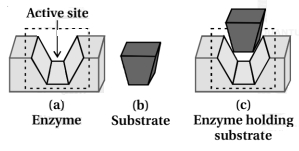
(N/A) For understanding the interaction between a drug and an enzyme,it is important to know how enzymes catalyse the reaction. In their catalytic activity,enzymes perform two major functions:
$(i)$ The first function of an enzyme is to hold the substrate for a chemical reaction. Active sites of enzymes hold the substrate molecule in a suitable position,so that it can be attacked by the reagent effectively. Substrates bind to the active site of the enzyme through a variety of interactions such as ionic bonding,hydrogen bonding,van der Waals interaction,or dipole-dipole interaction.
$(ii)$ The second function of an enzyme is to provide functional groups that will attack the substrate and carry out the chemical reaction.
Macromolecules of biological origin that perform various functions in the body are called enzymes; those which are crucial to the communication system in the body are called receptors.
$(i)$ The first function of an enzyme is to hold the substrate for a chemical reaction. Active sites of enzymes hold the substrate molecule in a suitable position,so that it can be attacked by the reagent effectively. Substrates bind to the active site of the enzyme through a variety of interactions such as ionic bonding,hydrogen bonding,van der Waals interaction,or dipole-dipole interaction.
$(ii)$ The second function of an enzyme is to provide functional groups that will attack the substrate and carry out the chemical reaction.
Macromolecules of biological origin that perform various functions in the body are called enzymes; those which are crucial to the communication system in the body are called receptors.
0 likes
View Solution96
Difficult
Explain enzyme catalysis by giving an example.
Solution
Enzymes are complex nitrogenous organic compounds produced by living plants and animals. They are protein molecules of high molecular mass that form colloidal solutions in water.
They act as highly efficient catalysts for numerous reactions,especially those associated with natural biological processes. Because they catalyze reactions within living organisms,they are termed biochemical catalysts,and the phenomenon is known as biochemical catalysis.
Examples of enzyme-catalyzed reactions:
$(i)$ Inversion of cane sugar: The enzyme invertase converts cane sugar into glucose and fructose.
$C_{12}H_{22}O_{11(aq)} + H_2O_{(l)} \xrightarrow{\text{Invertase}} C_6H_{12}O_{6(aq)} + C_6H_{12}O_{6(aq)}$
$(ii)$ Conversion of glucose into ethyl alcohol: The enzyme zymase converts glucose into ethyl alcohol and carbon dioxide.
$C_6H_{12}O_{6(aq)} \xrightarrow{\text{Zymase}} 2C_2H_5OH_{(aq)} + 2CO_{2(g)}$
$(iii)$ Conversion of starch into maltose: The enzyme diastase converts starch into maltose.
$2(C_6H_{10}O_5)_{n(aq)} + nH_2O_{(l)} \xrightarrow{\text{Diastase}} nC_{12}H_{22}O_{11(aq)}$
$(iv)$ Decomposition of urea: The enzyme urease catalyzes the decomposition of urea into ammonia and carbon dioxide.
$NH_2CONH_{2(aq)} + H_2O_{(l)} \xrightarrow{\text{Urease}} 2NH_{3(g)} + CO_{2(g)}$
They act as highly efficient catalysts for numerous reactions,especially those associated with natural biological processes. Because they catalyze reactions within living organisms,they are termed biochemical catalysts,and the phenomenon is known as biochemical catalysis.
Examples of enzyme-catalyzed reactions:
$(i)$ Inversion of cane sugar: The enzyme invertase converts cane sugar into glucose and fructose.
$C_{12}H_{22}O_{11(aq)} + H_2O_{(l)} \xrightarrow{\text{Invertase}} C_6H_{12}O_{6(aq)} + C_6H_{12}O_{6(aq)}$
$(ii)$ Conversion of glucose into ethyl alcohol: The enzyme zymase converts glucose into ethyl alcohol and carbon dioxide.
$C_6H_{12}O_{6(aq)} \xrightarrow{\text{Zymase}} 2C_2H_5OH_{(aq)} + 2CO_{2(g)}$
$(iii)$ Conversion of starch into maltose: The enzyme diastase converts starch into maltose.
$2(C_6H_{10}O_5)_{n(aq)} + nH_2O_{(l)} \xrightarrow{\text{Diastase}} nC_{12}H_{22}O_{11(aq)}$
$(iv)$ Decomposition of urea: The enzyme urease catalyzes the decomposition of urea into ammonia and carbon dioxide.
$NH_2CONH_{2(aq)} + H_2O_{(l)} \xrightarrow{\text{Urease}} 2NH_{3(g)} + CO_{2(g)}$
0 likes
View Solution97
Difficult
Explain the mechanism of enzyme catalysis.
Solution
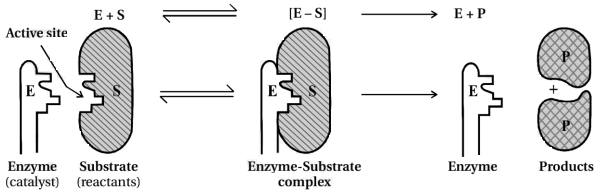
(N/A) There are a number of cavities present on the surface of colloidal particles of enzyme. These cavities are of characteristic shape and possess active groups such as $-NH_2$,$-COOH$,$-SH$,$-OH$,etc. These are actually the active centres on the surface of enzyme particles. The molecules of the reactant which have complementary shape,fit into these cavities like a key fits into a lock. On account of the presence of active groups,an activated complex is formed which then decomposes to yield the products.
Thus,the enzyme catalysed reactions may be considered to proceed in two steps.
Step-$1$: Binding of enzyme to substrate to form an activated complex.
$E + S \rightleftharpoons ES^{*}$
Step-$2$: Decomposition of the activated complex to form product.
$ES^{*} \rightarrow E + P$
Thus,the enzyme catalysed reactions may be considered to proceed in two steps.
Step-$1$: Binding of enzyme to substrate to form an activated complex.
$E + S \rightleftharpoons ES^{*}$
Step-$2$: Decomposition of the activated complex to form product.
$ES^{*} \rightarrow E + P$
0 likes
View Solution98
Medium
Do the vital functions of the body such as digestion get affected during fever? Explain your answer.
Solution
(N/A) Yes,the vital functions of the body such as digestion are affected during fever.
Enzymes are biological catalysts that are most active at an optimum body temperature of approximately $37^{\circ}C$.
During fever,the body temperature rises above this optimum level.
This increase in temperature leads to the denaturation or reduced efficiency of enzymes,which disrupts the normal biochemical reactions,including the digestion process.
Enzymes are biological catalysts that are most active at an optimum body temperature of approximately $37^{\circ}C$.
During fever,the body temperature rises above this optimum level.
This increase in temperature leads to the denaturation or reduced efficiency of enzymes,which disrupts the normal biochemical reactions,including the digestion process.
0 likes
View Solution99
Medium
Name the enzymes and write the reactions involved in the preparation of ethanol from sucrose by fermentation.
Solution
(N/A) The enzymes $Invertase$ and $Zymase$ are used to prepare ethanol from sucrose by fermentation.
Step $1$: Hydrolysis of sucrose into glucose and fructose by $Invertase$.
$C_{12}H_{22}O_{11} + H_{2}O$ $\xrightarrow{\text{Invertase}} C_{6}H_{12}O_{6} (\text{glucose}) + C_{6}H_{12}O_{6} (\text{fructose})$
Step $2$: Conversion of glucose/fructose into ethanol by $Zymase$.
$C_{6}H_{12}O_{6} \xrightarrow{\text{Zymase}} 2C_{2}H_{5}OH + 2CO_{2}$
Step $1$: Hydrolysis of sucrose into glucose and fructose by $Invertase$.
$C_{12}H_{22}O_{11} + H_{2}O$ $\xrightarrow{\text{Invertase}} C_{6}H_{12}O_{6} (\text{glucose}) + C_{6}H_{12}O_{6} (\text{fructose})$
Step $2$: Conversion of glucose/fructose into ethanol by $Zymase$.
$C_{6}H_{12}O_{6} \xrightarrow{\text{Zymase}} 2C_{2}H_{5}OH + 2CO_{2}$
0 likes
View Solution100
Difficult
What are hormones? Give their classification. State the biological importance of hormones.
Solution
(N/A) Hormones are molecules that act as intercellular messengers. They are secreted by endocrine glands in the body,poured directly into the bloodstream,and transported to the site of action.
Classification: Chemically,hormones are classified as steroid hormones,peptide hormones,and amine hormones.
$i$. Peptide hormones: Examples include insulin and endorphins. Insulin maintains blood sugar levels by responding to glucose spikes,while glucagon increases blood glucose levels. Together,they regulate glucose homeostasis.
$ii$. Amine hormones: Examples include epinephrine and norepinephrine,which mediate responses to external stimuli. Thyroxine,an iodinated derivative of the amino acid tyrosine,regulates metabolism. Low levels cause hypothyroidism (lethargy,obesity),while high levels cause hyperthyroidism. Iodine deficiency leads to goiter,which is managed by iodized salt.
$iii$. Steroid hormones: Produced by the adrenal cortex and gonads. Glucocorticoids control carbohydrate metabolism and stress responses. Mineralocorticoids regulate water and salt excretion by the kidneys. Dysfunction of the adrenal cortex can lead to Addison's disease. Gonadal hormones like testosterone (male) and estradiol/progesterone (female) are responsible for secondary sexual characteristics and reproductive functions.
Classification: Chemically,hormones are classified as steroid hormones,peptide hormones,and amine hormones.
$i$. Peptide hormones: Examples include insulin and endorphins. Insulin maintains blood sugar levels by responding to glucose spikes,while glucagon increases blood glucose levels. Together,they regulate glucose homeostasis.
$ii$. Amine hormones: Examples include epinephrine and norepinephrine,which mediate responses to external stimuli. Thyroxine,an iodinated derivative of the amino acid tyrosine,regulates metabolism. Low levels cause hypothyroidism (lethargy,obesity),while high levels cause hyperthyroidism. Iodine deficiency leads to goiter,which is managed by iodized salt.
$iii$. Steroid hormones: Produced by the adrenal cortex and gonads. Glucocorticoids control carbohydrate metabolism and stress responses. Mineralocorticoids regulate water and salt excretion by the kidneys. Dysfunction of the adrenal cortex can lead to Addison's disease. Gonadal hormones like testosterone (male) and estradiol/progesterone (female) are responsible for secondary sexual characteristics and reproductive functions.
0 likes
View SolutionBiomolecules — Enzymes and Hormones · Frequently Asked Questions
1Are these Biomolecules questions useful for JEE and NEET?
Yes. All questions in this section are mapped to JEE Main and NEET exam patterns. Previous year questions from JEE Main, NEET, GUJCET and state-level exams are included with full solutions.
2Can I switch to Hindi or Gujarati for these questions?
Yes. Use the language tabs in the hero section or the sidebar to view the same questions and solutions in English, Hindi or Gujarati.
3How do I generate a question paper from this subtopic?
Use the Vedclass Exam Paper Generator — select the chapter and subtopic, set difficulty, and generate Sets A, B, C, D automatically. First 3 chapters of every subject are free.
Vedclass Products
For Students
Vedclass Test Series
Mock tests in real JEE/NEET style with performance analysis. 5-day free trial.
Start Free TrialFor Teachers
Exam Paper Generator
Generate Set A/B/C/D papers from this chapter in 2 minutes. 3 chapters free.
Try FreeFor Institutes
Online Exam Module
Live online exams with unlimited students, 360° analytics & white-label branding.
See DemoFor Teachers & Institutes
Generate a Biomolecules Exam Paper in 2 Minutes
Select subtopic & difficulty — Sets A, B, C, D auto-generated with No Repeat logic.
First 3 chapters of every subject are free — no payment required.