
A English
General Introduction of Carboxylic Acids and Their Derivatives Questions in English
Class 12 Chemistry · 8-2.Carboxylic acids and Their derivative · General Introduction of Carboxylic Acids and Their Derivatives
75+
Questions
English
Language
100%
With Solutions
Showing 50 of 75 questions in English
1
MediumMCQ
$(RCO)_2NH$ is
A
Primary amine
B
Secondary amine
C
Secondary amide
D
Tertiary amide
Solution
(C) The compound $(RCO)_2NH$ is a derivative of ammonia where two hydrogen atoms are replaced by acyl groups $(RCO-)$.
This structure is known as a secondary amide or an imide.
Thus,$(RCO)_2NH$ is a secondary amide.
This structure is known as a secondary amide or an imide.
Thus,$(RCO)_2NH$ is a secondary amide.
0 likes
View Solution2
MediumMCQ
Which of the following structures of carboxylic acid accounts for its acidic nature?
A
$R-C(=O)OH$
B
$R-C^{+}(OH)_2$
C
$R-C(=O)H$
D
None of these
Solution
(A) The acidic nature of carboxylic acids is primarily due to the resonance stabilization of the carboxylate ion $(R-COO^-)$ formed after the loss of a proton $(H^+)$.
The resonance structures of the carboxylic acid group are:
$R-C(=O)OH \leftrightarrow R-C(O^-)=O^+H$
This resonance allows the negative charge to be delocalized over two oxygen atoms in the carboxylate ion,making the release of the proton favorable.
Option $(A)$ represents the structure of the carboxylic acid group itself,which undergoes this resonance stabilization.
The resonance structures of the carboxylic acid group are:
$R-C(=O)OH \leftrightarrow R-C(O^-)=O^+H$
This resonance allows the negative charge to be delocalized over two oxygen atoms in the carboxylate ion,making the release of the proton favorable.
Option $(A)$ represents the structure of the carboxylic acid group itself,which undergoes this resonance stabilization.
0 likes
View Solution3
MediumMCQ
The general formula $(RCO)_2O$ represents
A
An ester
B
$A$ ketone
C
An ether
D
An acid anhydride
Solution
(D) The general formula $(RCO)_2O$ represents an acid anhydride.
It is formed by the dehydration of two molecules of carboxylic acid:
$2RCOOH \xrightarrow{-H_2O} (RCO)_2O$ (Acid anhydride)
It is formed by the dehydration of two molecules of carboxylic acid:
$2RCOOH \xrightarrow{-H_2O} (RCO)_2O$ (Acid anhydride)
0 likes
View Solution4
MediumMCQ
Number of oxygen atoms in an acetamide molecule is
A
$1$
B
$2$
C
$3$
D
$4$
Solution
(A) The chemical formula of acetamide is $CH_3CONH_2$.
By observing the molecular formula,we can see that it contains only one oxygen atom.
By observing the molecular formula,we can see that it contains only one oxygen atom.
0 likes
View Solution5
MediumMCQ
The general formula $C_nH_{2n}O_2$ could be for open chain:
A
Diketones
B
Carboxylic acids
C
Diols
D
Dialdehydes
Solution
(B) The general formula $C_nH_{2n}O_2$ represents compounds with a degree of unsaturation (double bond equivalent) of $1$.
For carboxylic acids $(R-COOH)$,the general formula is $C_nH_{2n}O_2$.
For example,acetic acid $(CH_3COOH)$ has $n=2$,giving $C_2H_4O_2$.
Diketones,diols,and dialdehydes generally have different general formulas or require different degrees of unsaturation.
Thus,the correct option is $B$.
For carboxylic acids $(R-COOH)$,the general formula is $C_nH_{2n}O_2$.
For example,acetic acid $(CH_3COOH)$ has $n=2$,giving $C_2H_4O_2$.
Diketones,diols,and dialdehydes generally have different general formulas or require different degrees of unsaturation.
Thus,the correct option is $B$.
0 likes
View Solution6
MediumMCQ
$HCOCl$ is called
A
Acetyl chloride
B
Formyl chloride
C
Chloretone
D
Oxochloromethane
Solution
(B) The given structure is $HCOCl$. It is the acid chloride of formic acid $(HCOOH)$,hence it is called formyl chloride.
0 likes
View Solution7
MediumMCQ
Urea
A
Is an amide of carbonic acid
B
It is a diamide of carbonic acid
C
Gives carbonic acid on hydrolysis
D
Resembles carbonic acid
Solution
(B) . Urea is the diamide of carbonic acid.
$\mathop {HO - \mathop {\mathop C\limits^{||} }\limits^O - OH}\limits_{\text{carbonic acid}} + 2NH_3$ $\xrightarrow{- 2H_2O} \mathop {H_2N - \mathop {\mathop C\limits^{||} }\limits^O - NH_2}\limits_{\text{Urea}}$
Since two moles of $NH_3$ are required to replace both hydroxyl groups of carbonic acid,it is classified as the diamide of carbonic acid.
$\mathop {HO - \mathop {\mathop C\limits^{||} }\limits^O - OH}\limits_{\text{carbonic acid}} + 2NH_3$ $\xrightarrow{- 2H_2O} \mathop {H_2N - \mathop {\mathop C\limits^{||} }\limits^O - NH_2}\limits_{\text{Urea}}$
Since two moles of $NH_3$ are required to replace both hydroxyl groups of carbonic acid,it is classified as the diamide of carbonic acid.
0 likes
View Solution8
MediumMCQ
Formamide is
A
$HCONH_2$
B
$CH_3CONH_2$
C
$HCOONH_4$
D
$(HCHO + NH_3)$
Solution
(A) Formamide,also known as methanamide,is the simplest amide derived from formic acid. Its chemical formula is $HCONH_2$. The structure is shown below:
$H-CO-NH_2$
$H-CO-NH_2$
0 likes
View Solution9
EasyMCQ
Which one is called ethanoic acid?
A
$HCOOH$
B
$CH_3COOH$
C
$CH_3CH_2COOH$
D
$CH_3CH_2CH_2COOH$
Solution
(B) The $IUPAC$ name for $CH_3COOH$ is ethanoic acid because it contains two carbon atoms in its structure.
$HCOOH$ is methanoic acid.
$CH_3CH_2COOH$ is propanoic acid.
$CH_3CH_2CH_2COOH$ is butanoic acid.
$HCOOH$ is methanoic acid.
$CH_3CH_2COOH$ is propanoic acid.
$CH_3CH_2CH_2COOH$ is butanoic acid.
0 likes
View Solution10
MediumMCQ
Vinegar is:
A
$HCHO$
B
$HCOOH$
C
$CH_3CHO$
D
$CH_3COOH$
Solution
(D) Vinegar is a dilute solution of acetic acid $(CH_3COOH)$.
It is produced by the fermentation of ethyl alcohol in the presence of the enzyme $Acetobacter$.
It is produced by the fermentation of ethyl alcohol in the presence of the enzyme $Acetobacter$.
0 likes
View Solution11
MediumMCQ
Which of these does not contain a $-COOH$ group?
A
Aspirin
B
Benzoic acid
C
Picric acid
D
Salicylic acid
Solution
(C) The structures of the given compounds are as follows:
$1$. Aspirin: $2$-acetoxybenzoic acid,which contains a $-COOH$ group.
$2$. Benzoic acid: $C_6H_5COOH$,which contains a $-COOH$ group.
$3$. Picric acid: $2,4,6$-trinitrophenol,which contains an $-OH$ group and three $-NO_2$ groups,but no $-COOH$ group.
$4$. Salicylic acid: $2$-hydroxybenzoic acid,which contains a $-COOH$ group.
Therefore,the correct option is $(c)$.
$1$. Aspirin: $2$-acetoxybenzoic acid,which contains a $-COOH$ group.
$2$. Benzoic acid: $C_6H_5COOH$,which contains a $-COOH$ group.
$3$. Picric acid: $2,4,6$-trinitrophenol,which contains an $-OH$ group and three $-NO_2$ groups,but no $-COOH$ group.
$4$. Salicylic acid: $2$-hydroxybenzoic acid,which contains a $-COOH$ group.
Therefore,the correct option is $(c)$.
0 likes
View Solution12
MediumMCQ
To which of the following groups does soap belong?
A
Esters
B
Amines
C
Salts of organic higher fatty acids
D
Aldehydes
Solution
(C) Soap is chemically defined as the sodium or potassium salt of long-chain carboxylic acids,also known as higher fatty acids.
These are typically produced by the saponification of fats or oils with an alkali like $NaOH$ or $KOH$.
These are typically produced by the saponification of fats or oils with an alkali like $NaOH$ or $KOH$.
0 likes
View Solution13
MediumMCQ
$CH_3CN$ is known as acetonitrile because
A
It contains an aceto group
B
On hydrolysis it gives acetic acid
C
Both $(a)$ and $(b)$
D
None of these
Solution
(B) The compound $CH_3CN$ is named acetonitrile because it contains a methyl group attached to a cyanide group,which upon complete hydrolysis yields acetic acid $(CH_3COOH)$.
Specifically,$CH_3CN + 2H_2O \xrightarrow{H^+} CH_3COOH + NH_3$.
Specifically,$CH_3CN + 2H_2O \xrightarrow{H^+} CH_3COOH + NH_3$.
0 likes
View Solution14
EasyMCQ
What is the $IUPAC$ name of the compound ${C_6}{H_5}-CO-Cl$?
A
Benzoyl chloride
B
Benzene carbonyl chloride
C
Chlorophenyl ketone
D
Phenyl chloro ketone
Solution
(B) The compound ${C_6}{H_5}COCl$ consists of a benzene ring attached to a carbonyl chloride group.
According to $IUPAC$ nomenclature rules,when the $-COCl$ group is attached directly to a ring,the suffix used is 'carbonyl chloride'.
Therefore,the parent name is benzene and the suffix is carbonyl chloride,resulting in the name 'Benzene carbonyl chloride'.
According to $IUPAC$ nomenclature rules,when the $-COCl$ group is attached directly to a ring,the suffix used is 'carbonyl chloride'.
Therefore,the parent name is benzene and the suffix is carbonyl chloride,resulting in the name 'Benzene carbonyl chloride'.
0 likes
View Solution15
EasyMCQ
The general formula $C_nH_{2n}O_2$ can represent which of the following open-chain compounds?
A
Diketones
B
Carboxylic acids
C
Diols
D
Dialdehydes
Solution
(B) The general formula $C_nH_{2n}O_2$ corresponds to compounds with a degree of unsaturation (double bond equivalent) of $1$.
Carboxylic acids have the general formula $C_nH_{2n}O_2$ (e.g.,acetic acid $CH_3COOH$ is $C_2H_4O_2$,where $n=2$).
Esters also share this general formula.
Diketones,diols,and dialdehydes generally have different hydrogen counts for the same number of carbons or require different degrees of unsaturation.
Carboxylic acids have the general formula $C_nH_{2n}O_2$ (e.g.,acetic acid $CH_3COOH$ is $C_2H_4O_2$,where $n=2$).
Esters also share this general formula.
Diketones,diols,and dialdehydes generally have different hydrogen counts for the same number of carbons or require different degrees of unsaturation.
0 likes
View Solution16
DifficultMCQ
Give the $IUPAC$ name of the compound.

A
Acetic anhydride
B
Formyl ethanoate
C
Butane-$2, 4$-dione
D
Ethanoic methanoic anhydride
Solution
(D) The given structure is $CH_3-CO-O-CHO$.
This is an acid anhydride formed from two different carboxylic acids: ethanoic acid $(CH_3COOH)$ and methanoic acid $(HCOOH)$.
According to $IUPAC$ nomenclature for acid anhydrides,the names of the parent acids are written in alphabetical order followed by the word 'anhydride'.
Thus,the name is ethanoic methanoic anhydride.
This is an acid anhydride formed from two different carboxylic acids: ethanoic acid $(CH_3COOH)$ and methanoic acid $(HCOOH)$.
According to $IUPAC$ nomenclature for acid anhydrides,the names of the parent acids are written in alphabetical order followed by the word 'anhydride'.
Thus,the name is ethanoic methanoic anhydride.
0 likes
View Solution17
MediumMCQ
Which of the following has the general formula $C_nH_{2n}O_2$?
A
Diketone
B
Carboxylic acid
C
Diol
D
Dialdehyde
Solution
(B) The general formula $C_nH_{2n}O_2$ represents compounds that have two oxygen atoms and a degree of unsaturation of $1$.
Carboxylic acids $(R-COOH)$ and esters $(R-COOR')$ both follow the general formula $C_nH_{2n}O_2$.
For example,acetic acid $(CH_3COOH)$ has the formula $C_2H_4O_2$,which fits the $C_nH_{2n}O_2$ pattern where $n=2$.
Carboxylic acids $(R-COOH)$ and esters $(R-COOR')$ both follow the general formula $C_nH_{2n}O_2$.
For example,acetic acid $(CH_3COOH)$ has the formula $C_2H_4O_2$,which fits the $C_nH_{2n}O_2$ pattern where $n=2$.
0 likes
View Solution18
MediumMCQ
What is the common name of $CH_3-CH=CH-COOH$?
A
Crotonic acid
B
Acrylic acid
C
Allylic acid
D
None of these
Solution
(A) The structure $CH_3-CH=CH-COOH$ is a four-carbon unsaturated carboxylic acid.
Its $IUPAC$ name is $But-2-enoic \ acid$.
The common name for this specific compound is $Crotonic \ acid$.
Its $IUPAC$ name is $But-2-enoic \ acid$.
The common name for this specific compound is $Crotonic \ acid$.
0 likes
View Solution19
MediumMCQ
What does the general formula $(RCO)_2O$ represent?
A
Ketone
B
Ester
C
Acid anhydride
D
Carboxylic acid
Solution
(C) The general formula $(RCO)_2O$ can be written as $R-CO-O-CO-R$. This structure represents an acid anhydride,which is formed by the dehydration of two carboxylic acid molecules.
0 likes
View Solution20
EasyMCQ
Which one of the following is an acyl group?
A
$R-O^-$
B
$R-C(=O)-O^-$
C
$R-C(=O)-$
D
$R-C(=O)-NH^-$
Solution
(C) An acyl group is a functional group with the general formula $R-C(=O)-$,which is derived by removing the hydroxyl group $(-OH)$ from a carboxylic acid $(R-COOH)$.
0 likes
View Solution21
MediumMCQ
Which of the following is the first member of the ester homologous series?
A
Ethyl ethanoate
B
Methyl ethanoate
C
Methyl methanoate
D
Ethyl methanoate
Solution
(C) The general formula for an ester is $R-COO-R'$.
For the first member,the smallest alkyl groups must be attached to the functional group.
The simplest carboxylic acid is formic acid $(HCOOH)$ and the simplest alcohol is methanol $(CH_3OH)$.
Combining these,we get $HCOOCH_3$,which is methyl methanoate.
Thus,methyl methanoate is the first member of the ester homologous series.
For the first member,the smallest alkyl groups must be attached to the functional group.
The simplest carboxylic acid is formic acid $(HCOOH)$ and the simplest alcohol is methanol $(CH_3OH)$.
Combining these,we get $HCOOCH_3$,which is methyl methanoate.
Thus,methyl methanoate is the first member of the ester homologous series.
0 likes
View Solution22
DifficultMCQ
Which of the following is crotonic acid?
A
$CH_2=CH-COOH$
B
$C_6H_5-CH=CH-COOH$
C
$CH_3-CH=CH-COOH$
D
$HOOC-CH=CH-COOH$
Solution
(C) Crotonic acid is a short-chain unsaturated carboxylic acid.
Its chemical formula is $CH_3-CH=CH-COOH$ and its $IUPAC$ name is $(E)-\text{but}-2-\text{enoic acid}$.
Its chemical formula is $CH_3-CH=CH-COOH$ and its $IUPAC$ name is $(E)-\text{but}-2-\text{enoic acid}$.
0 likes
View Solution23
MediumMCQ
Structural formula of isopropyl methanoate is:
A
$CH_3-CO-O-CH(CH_3)_2$
B
$H-CO-O-CH_2-CH_3$
C
$CH_3-CO-O-CH_2-CH_2-CH_3$
D
$H-CO-O-CH(CH_3)_2$
Solution
(D) Isopropyl methanoate is an ester formed from methanoic acid $(HCOOH)$ and isopropyl alcohol $((CH_3)_2CHOH)$.
In the esterification reaction,the acyl group from methanoic acid is $H-CO-$ and the alkoxy group from the isopropyl alcohol is $-O-CH(CH_3)_2$.
Combining these,the structural formula is $H-CO-O-CH(CH_3)_2$,which can also be written as $H-CO-O-CH(CH_3)-CH_3$.
In the esterification reaction,the acyl group from methanoic acid is $H-CO-$ and the alkoxy group from the isopropyl alcohol is $-O-CH(CH_3)_2$.
Combining these,the structural formula is $H-CO-O-CH(CH_3)_2$,which can also be written as $H-CO-O-CH(CH_3)-CH_3$.
0 likes
View Solution24
AdvancedMCQ
The $IUPAC$ name of the compound is

A
Cyclobutanedioic anhydride
B
Butanedicarboxylic anhydride
C
Cyclobutanedicarboxylic anhydride
D
Butanedioic anhydride
Solution
(D) The given structure is a cyclic anhydride derived from succinic acid (butanedioic acid).
In $IUPAC$ nomenclature,cyclic anhydrides are named by replacing the word 'acid' with 'anhydride' in the name of the corresponding dicarboxylic acid.
The parent dicarboxylic acid is butanedioic acid.
Therefore,the cyclic anhydride is named butanedioic anhydride.
In $IUPAC$ nomenclature,cyclic anhydrides are named by replacing the word 'acid' with 'anhydride' in the name of the corresponding dicarboxylic acid.
The parent dicarboxylic acid is butanedioic acid.
Therefore,the cyclic anhydride is named butanedioic anhydride.
0 likes
View Solution25
DifficultMCQ
Which of the following compounds is methyl salicylate (oil of wintergreen)?
A
Acetylsalicylic acid
B
Methyl $2-$hydroxybenzoate
C
Methyl $2-$methoxybenzoate
D
Methyl $4-$hydroxybenzoate
Solution
(B) Methyl salicylate,commonly known as oil of wintergreen,has the chemical structure of an ester formed from salicylic acid and methanol. Its $IUPAC$ name is methyl $2-$hydroxybenzoate. The structure consists of a benzene ring with a hydroxyl group $(-OH)$ at the ortho position relative to a methyl ester group $(-COOCH_3)$.
0 likes
View Solution26
DifficultMCQ
The $IUPAC$ name of the given compound is:
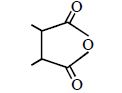
A
$2,3-$Dimethylcyclobutanoic anhydride
B
$2,3-$Dimethyl$-1,4-$epoxybutanedione
C
$2,3-$Dimethylbutanedioic anhydride
D
$2,3-$Dimethylpentanoic anhydride
Solution
(C) The given structure is a cyclic anhydride derived from $2,3-$dimethylbutanedioic acid (also known as dimethylsuccinic acid).
In $IUPAC$ nomenclature,cyclic anhydrides are named by replacing the word 'acid' with 'anhydride' in the name of the corresponding dicarboxylic acid.
The parent dicarboxylic acid is $2,3-$dimethylbutanedioic acid.
Therefore,the cyclic anhydride is named $2,3-$dimethylbutanedioic anhydride.
In $IUPAC$ nomenclature,cyclic anhydrides are named by replacing the word 'acid' with 'anhydride' in the name of the corresponding dicarboxylic acid.
The parent dicarboxylic acid is $2,3-$dimethylbutanedioic acid.
Therefore,the cyclic anhydride is named $2,3-$dimethylbutanedioic anhydride.
0 likes
View Solution27
MediumMCQ
For the dicarboxylic acid represented by the formula $HOOC-(CH_2)_n-COOH$,if $n = 4$,what is the common name of this acid?
A
Malonic acid
B
Succinic acid
C
Adipic acid
D
Oxalic acid
Solution
(C) The general formula for dicarboxylic acids is $HOOC-(CH_2)_n-COOH$.
For $n = 0$,it is Oxalic acid $(HOOC-COOH)$.
For $n = 1$,it is Malonic acid $(HOOC-CH_2-COOH)$.
For $n = 2$,it is Succinic acid $(HOOC-(CH_2)_2-COOH)$.
For $n = 3$,it is Glutaric acid $(HOOC-(CH_2)_3-COOH)$.
For $n = 4$,it is Adipic acid $(HOOC-(CH_2)_4-COOH)$.
Therefore,for $n = 4$,the acid is Adipic acid.
For $n = 0$,it is Oxalic acid $(HOOC-COOH)$.
For $n = 1$,it is Malonic acid $(HOOC-CH_2-COOH)$.
For $n = 2$,it is Succinic acid $(HOOC-(CH_2)_2-COOH)$.
For $n = 3$,it is Glutaric acid $(HOOC-(CH_2)_3-COOH)$.
For $n = 4$,it is Adipic acid $(HOOC-(CH_2)_4-COOH)$.
Therefore,for $n = 4$,the acid is Adipic acid.
0 likes
View Solution28
DifficultMCQ
Among the following organic acids,the acid present in rancid butter is
A
Pyruvic acid
B
Lactic acid
C
Butyric acid
D
Acetic acid
Solution
(C) Butyric acid,also known as butanoic acid $(CH_3CH_2CH_2COOH)$,is found in milk and butter.
It is a product of anaerobic fermentation and is responsible for the characteristic unpleasant smell and acrid taste of rancid butter.
It is a product of anaerobic fermentation and is responsible for the characteristic unpleasant smell and acrid taste of rancid butter.
0 likes
View Solution29
MediumMCQ
Monocarboxylic acids are functional isomers of
A
Ethers
B
Amines
C
Esters
D
Alcohols
Solution
(C) Functional isomers are compounds that have the same molecular formula but different functional groups.
Monocarboxylic acids (general formula $C_nH_{2n}O_2$) are functional isomers of esters (general formula $C_nH_{2n}O_2$).
For example,$CH_3COOH$ (Acetic acid) and $HCOOCH_3$ (Methyl formate) both have the molecular formula $C_2H_4O_2$.
Monocarboxylic acids (general formula $C_nH_{2n}O_2$) are functional isomers of esters (general formula $C_nH_{2n}O_2$).
For example,$CH_3COOH$ (Acetic acid) and $HCOOCH_3$ (Methyl formate) both have the molecular formula $C_2H_4O_2$.
0 likes
View Solution30
Difficult
Name the following compounds according to the $IUPAC$ system of nomenclature:
$(i)$ $CH_3-CH(CH_3)-CH_2-CH_2-CHO$
$(ii)$ $CH_3-CH_2-CO-CH(C_2H_5)-CH_2-CH_2-Cl$
$(iii)$ $CH_3-CH=CH-CHO$
$(iv)$ $CH_3-CO-CH_2-CO-CH_3$
$(v)$ $CH_3-CH(CH_3)-CH_2-C(CH_3)_2-CO-CH_3$
$(vi)$ $(CH_3)_3C-CH_2-COOH$
$(vii)$ $OHC-C_6H_4-CHO-p$
$(i)$ $CH_3-CH(CH_3)-CH_2-CH_2-CHO$
$(ii)$ $CH_3-CH_2-CO-CH(C_2H_5)-CH_2-CH_2-Cl$
$(iii)$ $CH_3-CH=CH-CHO$
$(iv)$ $CH_3-CO-CH_2-CO-CH_3$
$(v)$ $CH_3-CH(CH_3)-CH_2-C(CH_3)_2-CO-CH_3$
$(vi)$ $(CH_3)_3C-CH_2-COOH$
$(vii)$ $OHC-C_6H_4-CHO-p$
Solution
(N/A) $(i)$ $4-$methylpentanal
$(ii)$ $6-$chloro$-4-$ethylhexan$-3-$one
$(iii)$ but$-2-$enal
$(iv)$ pentane$-2,4-$dione
$(v)$ $3,3,5-$trimethylhexan$-2-$one
$(vi)$ $3,3-$dimethylbutanoic acid
$(vii)$ benzene$-1,4-$dicarbaldehyde
$(ii)$ $6-$chloro$-4-$ethylhexan$-3-$one
$(iii)$ but$-2-$enal
$(iv)$ pentane$-2,4-$dione
$(v)$ $3,3,5-$trimethylhexan$-2-$one
$(vi)$ $3,3-$dimethylbutanoic acid
$(vii)$ benzene$-1,4-$dicarbaldehyde
0 likes
View Solution31
Medium
What is a carbonyl group? Provide the different homologous series of carbonyl compounds.
Solution
(N/A) Organic compounds containing a carbon-oxygen double bond $(C=O)$ are called carbonyl compounds. The carbon atom of the carbonyl group is $sp^2$ hybridized and forms three sigma bonds. The homologous series of carbonyl compounds are as follows:
| Name of homologous series | Common formula | Functional group |
|---|---|---|
| $(i)$ Aldehydes | $R-CHO$ | $-CHO$ |
| $(ii)$ Ketones | $R-CO-R'$ | $>C=O$ |
| $(iii)$ Carboxylic acids | $R-COOH$ | $-COOH$ |
| $(iv)$ Esters | $R-COOR'$ | $-COOR'$ |
| $(v)$ Acid halides | $R-COX$ | $-COX$ |
| $(vi)$ Amides | $R-CONH_2$ | $-CONH_2$ |
0 likes
View Solution32
Medium
Explain the following terms:
$(a)$ Carboxylic acid and carboxyl group
$(b)$ Aliphatic and aromatic carboxylic acids
$(c)$ Fatty acids
$(a)$ Carboxylic acid and carboxyl group
$(b)$ Aliphatic and aromatic carboxylic acids
$(c)$ Fatty acids
Solution
(N/A) Carboxylic acid and carboxyl group:
$(i)$ Compounds that contain a carboxyl group $(-COOH)$ as a functional group are known as carboxylic acids.
$(ii)$ In a carboxyl group,a carbonyl group $(C=O)$ is attached to a hydroxyl group $(-OH)$. The name 'carboxyl' is derived from 'carbonyl' and 'hydroxyl'.
$(iii)$ The carboxyl group contains both a carbonyl group and a hydroxyl group.
$(b)$ Aliphatic and aromatic carboxylic acids:
| Aliphatic carboxylic acid | Aromatic carboxylic acid |
| :--- | :--- |
| $R-COOH$ | $Ar-COOH$ |
| The carboxyl carbon is attached to an alkyl group. | The carboxyl carbon is attached to an aryl group. |
| e.g.,$CH_3COOH$ | e.g.,$C_6H_5COOH$ |
$(c)$ Fatty acids: Naturally occurring aliphatic carboxylic acids with long carbon chains (typically $C_{12}$ to $C_{18}$) are known as fatty acids. They are often found as esters of glycerol in natural fats and oils.
$(i)$ Compounds that contain a carboxyl group $(-COOH)$ as a functional group are known as carboxylic acids.
$(ii)$ In a carboxyl group,a carbonyl group $(C=O)$ is attached to a hydroxyl group $(-OH)$. The name 'carboxyl' is derived from 'carbonyl' and 'hydroxyl'.
$(iii)$ The carboxyl group contains both a carbonyl group and a hydroxyl group.
$(b)$ Aliphatic and aromatic carboxylic acids:
| Aliphatic carboxylic acid | Aromatic carboxylic acid |
| :--- | :--- |
| $R-COOH$ | $Ar-COOH$ |
| The carboxyl carbon is attached to an alkyl group. | The carboxyl carbon is attached to an aryl group. |
| e.g.,$CH_3COOH$ | e.g.,$C_6H_5COOH$ |
$(c)$ Fatty acids: Naturally occurring aliphatic carboxylic acids with long carbon chains (typically $C_{12}$ to $C_{18}$) are known as fatty acids. They are often found as esters of glycerol in natural fats and oils.
0 likes
View Solution33
Medium
Explain the nomenclature of carboxylic acids with suitable examples.
Solution
(N/A) Common names:
$(a)$ Carboxylic acid compounds were first obtained from nature,hence most of the acid compounds are known by their common names. In common nomenclature of acids,the suffix 'ic acid' is used,which is based on the natural source of the acid.
$(i)$ Formic acid is first obtained from red ant (formica).
$(ii)$ Acetic acid is obtained from vinegar.
$(iii)$ Butyric acid is obtained from rancid butter.
$(b)$ Often,substituted groups are indicated by $\alpha, \beta, \gamma \ldots$ starting from the carbon atom adjacent to the $-COOH$ group.
e.g.,$^{\beta} CH_{3} - ^{\alpha} CH(OH) - COOH$
$(B)$ $IUPAC$ nomenclature of aliphatic acids:
$(a)$ For naming aliphatic carboxylic acids,the suffix 'oic acid' is added by replacing the 'e' of the corresponding alkane.
$(i)$ $HCOOH$ is named methanoic acid.
$(ii)$ $CH_{3}COOH$ is named ethanoic acid.
$(b)$ In the carbon chain,the carbon atom of the carboxylic acid group is assigned the number $1$.
$(c)$ If more than one $-COOH$ group is present,the prefixes di-,tri-,etc.,are used before 'oic acid',and the 'e' of the alkane is not removed.
$(i)$ $HOOC-COOH$: Ethanedioic acid
$(ii)$ $HOOC-CH_{2}-CH_{2}-COOH$: Butanedioic acid
Examples of $IUPAC$ nomenclature:
| Structure | $IUPAC$ name |
| :--- | :--- |
| $(i) \ CH_{3}-CH(CH_{3})-CH_{2}-COOH$ | $3$-methylbutanoic acid |
| $(ii) \ CH_{3}-CH(Cl)-COOH$ | $2$-chloropropanoic acid |
| $(iii) \ CH_{3}-CH(OH)-COOH$ | $2$-hydroxypropanoic acid |
| $(iv) \ CH_{3}-CO-CH_{2}-CH_{2}-COOH$ | $4$-oxopentanoic acid |
$(a)$ Carboxylic acid compounds were first obtained from nature,hence most of the acid compounds are known by their common names. In common nomenclature of acids,the suffix 'ic acid' is used,which is based on the natural source of the acid.
$(i)$ Formic acid is first obtained from red ant (formica).
$(ii)$ Acetic acid is obtained from vinegar.
$(iii)$ Butyric acid is obtained from rancid butter.
$(b)$ Often,substituted groups are indicated by $\alpha, \beta, \gamma \ldots$ starting from the carbon atom adjacent to the $-COOH$ group.
e.g.,$^{\beta} CH_{3} - ^{\alpha} CH(OH) - COOH$
$(B)$ $IUPAC$ nomenclature of aliphatic acids:
$(a)$ For naming aliphatic carboxylic acids,the suffix 'oic acid' is added by replacing the 'e' of the corresponding alkane.
$(i)$ $HCOOH$ is named methanoic acid.
$(ii)$ $CH_{3}COOH$ is named ethanoic acid.
$(b)$ In the carbon chain,the carbon atom of the carboxylic acid group is assigned the number $1$.
$(c)$ If more than one $-COOH$ group is present,the prefixes di-,tri-,etc.,are used before 'oic acid',and the 'e' of the alkane is not removed.
$(i)$ $HOOC-COOH$: Ethanedioic acid
$(ii)$ $HOOC-CH_{2}-CH_{2}-COOH$: Butanedioic acid
Examples of $IUPAC$ nomenclature:
| Structure | $IUPAC$ name |
| :--- | :--- |
| $(i) \ CH_{3}-CH(CH_{3})-CH_{2}-COOH$ | $3$-methylbutanoic acid |
| $(ii) \ CH_{3}-CH(Cl)-COOH$ | $2$-chloropropanoic acid |
| $(iii) \ CH_{3}-CH(OH)-COOH$ | $2$-hydroxypropanoic acid |
| $(iv) \ CH_{3}-CO-CH_{2}-CH_{2}-COOH$ | $4$-oxopentanoic acid |
0 likes
View Solution34
Medium
Provide the $IUPAC$ and common names for the carboxylic acids listed in the table below:
| Compound | Common Name | $IUPAC$ Name |
|---|---|---|
| $(i) \ HCOOH$ | Formic acid | Methanoic acid |
| $(ii) \ CH_3COOH$ | Acetic acid | Ethanoic acid |
| $(iii) \ CH_3CH_2COOH$ | Propionic acid | Propanoic acid |
| $(iv) \ C_6H_5COOH$ | Benzoic acid | Benzenecarboxylic acid (Benzoic acid) |
| $(v) \ (COOH)_2$ | Oxalic acid | Ethanedioic acid |
| $(vi) \ HOOCCH_2CH_2COOH$ | Succinic acid | Butanedioic acid |
Solution
(N/A) The nomenclature of carboxylic acids involves identifying the longest carbon chain containing the $-COOH$ group.
$(i) \ HCOOH$: Contains $1$ carbon atom. Common name: Formic acid; $IUPAC$ name: Methanoic acid.
$(ii) \ CH_3COOH$: Contains $2$ carbon atoms. Common name: Acetic acid; $IUPAC$ name: Ethanoic acid.
$(iii) \ CH_3CH_2COOH$: Contains $3$ carbon atoms. Common name: Propionic acid; $IUPAC$ name: Propanoic acid.
$(iv) \ C_6H_5COOH$: $A$ benzene ring attached to a $-COOH$ group. Common name: Benzoic acid; $IUPAC$ name: Benzenecarboxylic acid (also accepted as Benzoic acid).
$(v) \ (COOH)_2$: Contains $2$ carbon atoms. Common name: Oxalic acid; $IUPAC$ name: Ethanedioic acid.
$(vi) \ HOOCCH_2CH_2COOH$: Contains $4$ carbon atoms. Common name: Succinic acid; $IUPAC$ name: Butanedioic acid.
$(i) \ HCOOH$: Contains $1$ carbon atom. Common name: Formic acid; $IUPAC$ name: Methanoic acid.
$(ii) \ CH_3COOH$: Contains $2$ carbon atoms. Common name: Acetic acid; $IUPAC$ name: Ethanoic acid.
$(iii) \ CH_3CH_2COOH$: Contains $3$ carbon atoms. Common name: Propionic acid; $IUPAC$ name: Propanoic acid.
$(iv) \ C_6H_5COOH$: $A$ benzene ring attached to a $-COOH$ group. Common name: Benzoic acid; $IUPAC$ name: Benzenecarboxylic acid (also accepted as Benzoic acid).
$(v) \ (COOH)_2$: Contains $2$ carbon atoms. Common name: Oxalic acid; $IUPAC$ name: Ethanedioic acid.
$(vi) \ HOOCCH_2CH_2COOH$: Contains $4$ carbon atoms. Common name: Succinic acid; $IUPAC$ name: Butanedioic acid.
0 likes
View Solution35
Medium
Provide the $IUPAC$ name and structural formula for the carboxylic acids listed in the table below.
Solution
(A) The table provides the common names,structural formulas,and $IUPAC$ names for various carboxylic acids:
| Common Name | Structural Formula | $IUPAC$ Name |
| :--- | :--- | :--- |
| $(i)$ Butyric acid | $CH_3CH_2CH_2COOH$ | Butanoic acid |
| $(ii)$ Isobutyric acid | $(CH_3)_2CHCOOH$ | $2$-methylpropanoic acid |
| $(iii)$ Malonic acid | $HOOC-CH_2-COOH$ | Propanedioic acid |
| $(iv)$ Glutaric acid | $HOOC-(CH_2)_3-COOH$ | Pentanedioic acid |
| $(v)$ Phenyl acetic acid | $C_6H_5CH_2COOH$ | $2$-phenylethanoic acid |
| $(vi)$ Malic acid | $HOOC-CH(OH)-CH_2-COOH$ | $2$-hydroxybutanedioic acid |
| Common Name | Structural Formula | $IUPAC$ Name |
| :--- | :--- | :--- |
| $(i)$ Butyric acid | $CH_3CH_2CH_2COOH$ | Butanoic acid |
| $(ii)$ Isobutyric acid | $(CH_3)_2CHCOOH$ | $2$-methylpropanoic acid |
| $(iii)$ Malonic acid | $HOOC-CH_2-COOH$ | Propanedioic acid |
| $(iv)$ Glutaric acid | $HOOC-(CH_2)_3-COOH$ | Pentanedioic acid |
| $(v)$ Phenyl acetic acid | $C_6H_5CH_2COOH$ | $2$-phenylethanoic acid |
| $(vi)$ Malic acid | $HOOC-CH(OH)-CH_2-COOH$ | $2$-hydroxybutanedioic acid |
0 likes
View Solution36
Easy
Explain the structure of the carboxylic group.
Solution
The carbon atom in the carboxyl group is $sp^{2}$ hybridized.
This results in a planar structure where the three bonds around the carbonyl carbon are at an angle of approximately $120^{\circ}$ to each other.
The carboxylic carbon is less electrophilic than the carbonyl carbon in aldehydes and ketones because of the resonance effect,where the lone pair of electrons on the hydroxyl oxygen atom is delocalized over the carbonyl group,reducing the partial positive charge on the carbon atom.
This results in a planar structure where the three bonds around the carbonyl carbon are at an angle of approximately $120^{\circ}$ to each other.
The carboxylic carbon is less electrophilic than the carbonyl carbon in aldehydes and ketones because of the resonance effect,where the lone pair of electrons on the hydroxyl oxygen atom is delocalized over the carbonyl group,reducing the partial positive charge on the carbon atom.
0 likes
View Solution37
Easy
Write structural formulae for the following compounds:
$(a)$ $1-$bromoheptane
$(b)$ $5-$bromoheptanoic acid
$(a)$ $1-$bromoheptane
$(b)$ $5-$bromoheptanoic acid
Solution
(N/A) $1-$bromoheptane: The parent chain is heptane ($7$ carbons). $A$ bromine atom is attached to the $1^{st}$ carbon.
$CH_2Br-CH_2-CH_2-CH_2-CH_2-CH_2-CH_3$
$(b)$ $5-$bromoheptanoic acid: The parent chain is heptanoic acid ($7$ carbons,including the carboxylic acid carbon). $A$ bromine atom is attached to the $5^{th}$ carbon.
$CH_3-CH_2-CH(Br)-CH_2-CH_2-CH_2-COOH$
$CH_2Br-CH_2-CH_2-CH_2-CH_2-CH_2-CH_3$
$(b)$ $5-$bromoheptanoic acid: The parent chain is heptanoic acid ($7$ carbons,including the carboxylic acid carbon). $A$ bromine atom is attached to the $5^{th}$ carbon.
$CH_3-CH_2-CH(Br)-CH_2-CH_2-CH_2-COOH$
0 likes
View Solution38
MediumMCQ
The number of compounds given below which contain the $-COOH$ group is .... .
$A$. Sulphanilic acid
$B$. Picric acid
$C$. Aspirin
$D$. Ascorbic acid
$A$. Sulphanilic acid
$B$. Picric acid
$C$. Aspirin
$D$. Ascorbic acid
A
$1$
B
$0$
C
$2$
D
$4$
Solution
(A) Let us analyze the structures of the given compounds:
$1$. Sulphanilic acid $(p-NH_2C_6H_4SO_3H)$: Contains a sulphonic acid group $(-SO_3H)$,not a carboxylic acid group $(-COOH)$.
$2$. Picric acid ($2,4,6-$trinitrophenol): Contains a phenolic hydroxyl group $(-OH)$ and nitro groups $(-NO_2)$,not a carboxylic acid group $(-COOH)$.
$3$. Aspirin (Acetylsalicylic acid): Contains a carboxylic acid group $(-COOH)$ and an ester group.
$4$. Ascorbic acid (Vitamin $C$): Contains hydroxyl groups and a cyclic ester (lactone),not a carboxylic acid group $(-COOH)$.
Thus,only Aspirin contains the $-COOH$ group.
The total number of such compounds is $1$.
$1$. Sulphanilic acid $(p-NH_2C_6H_4SO_3H)$: Contains a sulphonic acid group $(-SO_3H)$,not a carboxylic acid group $(-COOH)$.
$2$. Picric acid ($2,4,6-$trinitrophenol): Contains a phenolic hydroxyl group $(-OH)$ and nitro groups $(-NO_2)$,not a carboxylic acid group $(-COOH)$.
$3$. Aspirin (Acetylsalicylic acid): Contains a carboxylic acid group $(-COOH)$ and an ester group.
$4$. Ascorbic acid (Vitamin $C$): Contains hydroxyl groups and a cyclic ester (lactone),not a carboxylic acid group $(-COOH)$.
Thus,only Aspirin contains the $-COOH$ group.
The total number of such compounds is $1$.
0 likes
View Solution39
MediumMCQ
The functional group present in a molecule having the formula $C_{12}O_9$ is
A
carboxylic acid
B
anhydride
C
aldehyde
D
alcohol
Solution
(B) The molecule with the formula $C_{12}O_9$ is known as mellitic anhydride.
Its structure consists of a benzene ring fused with three cyclic anhydride groups.
Therefore,the functional group present in the molecule is an anhydride group.
Its structure consists of a benzene ring fused with three cyclic anhydride groups.
Therefore,the functional group present in the molecule is an anhydride group.
0 likes
View Solution40
DifficultMCQ
Which of the following is an anhydride?
A
Acetic anhydride: $CH_3-CO-O-CO-CH_3$
B
Diethyl ether: $CH_3-CH_2-O-CH_2-CH_3$
C
Ethyl acetate: $CH_3-CO-O-CH_2-CH_3$
D
Methyl acetate: $CH_3-CO-O-CH_3$
Solution
(A) An anhydride is a functional group characterized by two acyl groups $(R-CO-)$ bonded to the same oxygen atom,represented by the general formula $R-CO-O-CO-R$.
In option $(A)$,the structure is $CH_3-CO-O-CO-CH_3$,which is acetic anhydride.
Option $(B)$ is an ether,while options $(C)$ and $(D)$ are esters.
In option $(A)$,the structure is $CH_3-CO-O-CO-CH_3$,which is acetic anhydride.
Option $(B)$ is an ether,while options $(C)$ and $(D)$ are esters.
0 likes
View Solution41
DifficultMCQ
The molecular formula of the second homologue in the homologous series of mono carboxylic acids is . . . . . . .
A
$C_3H_6O_2$
B
$C_2H_4O_2$
C
$CH_2O$
D
$C_2H_2O_2$
Solution
(B) The general formula for mono carboxylic acids is $C_nH_{2n}O_2$ (where $n \geq 1$).
The first member $(n=1)$ is methanoic acid $(HCOOH)$,which is $CH_2O_2$.
The second member $(n=2)$ is ethanoic acid $(CH_3COOH)$,which has the molecular formula $C_2H_4O_2$.
Therefore,the second homologue is $C_2H_4O_2$.
The first member $(n=1)$ is methanoic acid $(HCOOH)$,which is $CH_2O_2$.
The second member $(n=2)$ is ethanoic acid $(CH_3COOH)$,which has the molecular formula $C_2H_4O_2$.
Therefore,the second homologue is $C_2H_4O_2$.
0 likes
View Solution42
DifficultMCQ
The carboxyl functional group $(-COOH)$ is present in
A
picric acid
B
barbituric acid
C
ascorbic acid
D
aspirin
Solution
(D) The carboxyl functional group is represented as $-COOH$.
$1$. Picric acid ($2,4,6$-trinitrophenol) contains a phenolic $-OH$ group and three nitro groups $(-NO_2)$,but no $-COOH$ group.
$2$. Barbituric acid contains amide groups within a heterocyclic ring,but no $-COOH$ group.
$3$. Ascorbic acid (Vitamin $C$) contains hydroxyl groups and a lactone ring,but no $-COOH$ group.
$4$. Aspirin (acetylsalicylic acid) is $2$-acetoxybenzoic acid,which contains a benzene ring substituted with an acetoxy group $(-OCOCH_3)$ and a carboxylic acid group $(-COOH)$.
Therefore,the correct option is $D$.
$1$. Picric acid ($2,4,6$-trinitrophenol) contains a phenolic $-OH$ group and three nitro groups $(-NO_2)$,but no $-COOH$ group.
$2$. Barbituric acid contains amide groups within a heterocyclic ring,but no $-COOH$ group.
$3$. Ascorbic acid (Vitamin $C$) contains hydroxyl groups and a lactone ring,but no $-COOH$ group.
$4$. Aspirin (acetylsalicylic acid) is $2$-acetoxybenzoic acid,which contains a benzene ring substituted with an acetoxy group $(-OCOCH_3)$ and a carboxylic acid group $(-COOH)$.
Therefore,the correct option is $D$.
0 likes
View Solution43
EasyMCQ
The common names of the lower fatty acids are obtained from
A
their parent hydrocarbon
B
their reduction product
C
the sources from which they are obtained
D
$IUPAC$ system
Solution
(C) The common names of lower fatty acids are derived from the natural sources from which they were first isolated.
For example,formic acid $(HCOOH)$ is named after the red ant (Latin: $formica$),from which it was first obtained.
For example,formic acid $(HCOOH)$ is named after the red ant (Latin: $formica$),from which it was first obtained.
0 likes
View Solution44
EasyMCQ
Which among the following is $NOT$ a dicarboxylic acid?
A
Adipic acid
B
Glutaric acid
C
Valeric acid
D
Malonic acid
Solution
(C) dicarboxylic acid contains two carboxylic acid groups $(-COOH)$.
$1$. Adipic acid is $HOOC-(CH_2)_4-COOH$ (hexanedioic acid).
$2$. Glutaric acid is $HOOC-(CH_2)_3-COOH$ (pentanedioic acid).
$3$. Malonic acid is $HOOC-CH_2-COOH$ (propanedioic acid).
$4$. Valeric acid is $CH_3-(CH_2)_3-COOH$ (pentanoic acid),which is a monocarboxylic acid.
Therefore,Valeric acid is not a dicarboxylic acid.
$1$. Adipic acid is $HOOC-(CH_2)_4-COOH$ (hexanedioic acid).
$2$. Glutaric acid is $HOOC-(CH_2)_3-COOH$ (pentanedioic acid).
$3$. Malonic acid is $HOOC-CH_2-COOH$ (propanedioic acid).
$4$. Valeric acid is $CH_3-(CH_2)_3-COOH$ (pentanoic acid),which is a monocarboxylic acid.
Therefore,Valeric acid is not a dicarboxylic acid.
0 likes
View Solution45
EasyMCQ
Which of the following is $NOT$ a dicarboxylic acid?
A
Citric acid
B
Malonic acid
C
Oxalic acid
D
Glutaric acid
Solution
(A) dicarboxylic acid contains two carboxyl $(-COOH)$ groups in its structure.
$1$. Citric acid has the structure $HOOC-CH_2-C(OH)(COOH)-CH_2-COOH$,which contains three carboxyl groups,making it a tricarboxylic acid.
$2$. Malonic acid $(HOOC-CH_2-COOH)$ is a dicarboxylic acid.
$3$. Oxalic acid $(HOOC-COOH)$ is a dicarboxylic acid.
$4$. Glutaric acid $(HOOC-(CH_2)_3-COOH)$ is a dicarboxylic acid.
Therefore,citric acid is not a dicarboxylic acid.
$1$. Citric acid has the structure $HOOC-CH_2-C(OH)(COOH)-CH_2-COOH$,which contains three carboxyl groups,making it a tricarboxylic acid.
$2$. Malonic acid $(HOOC-CH_2-COOH)$ is a dicarboxylic acid.
$3$. Oxalic acid $(HOOC-COOH)$ is a dicarboxylic acid.
$4$. Glutaric acid $(HOOC-(CH_2)_3-COOH)$ is a dicarboxylic acid.
Therefore,citric acid is not a dicarboxylic acid.
0 likes
View Solution46
DifficultMCQ
Which among the following carboxylic acids is found in Lemon?
A
Citric acid
B
Acetic acid
C
Formic acid
D
$L^{-}$-Lactic acid
Solution
(A) Citric acid is a tricarboxylic acid found in citrus fruits like lemon and orange.
0 likes
View Solution47
MediumMCQ
The number of alcoholic $-OH$ and $-COOH$ groups in citric acid respectively are
A
$1$ and $3$
B
$3$ and $1$
C
$2$ and $1$
D
$1$ and $2$
Solution
(A) The chemical structure of citric acid is $HOOC-CH_2-C(OH)(COOH)-CH_2-COOH$.
By observing the structure,we can identify the functional groups present:
$1$. There is one alcoholic $-OH$ group attached to the central carbon atom.
$2$. There are three carboxylic acid $-COOH$ groups present in the molecule.
Therefore,the number of alcoholic $-OH$ and $-COOH$ groups in citric acid are $1$ and $3$ respectively.
By observing the structure,we can identify the functional groups present:
$1$. There is one alcoholic $-OH$ group attached to the central carbon atom.
$2$. There are three carboxylic acid $-COOH$ groups present in the molecule.
Therefore,the number of alcoholic $-OH$ and $-COOH$ groups in citric acid are $1$ and $3$ respectively.
0 likes
View Solution48
EasyMCQ
Which of the following is $NOT$ a dicarboxylic acid?
A
Succinic acid
B
Acrylic acid
C
Malonic acid
D
Phthalic acid
Solution
(B) dicarboxylic acid contains two carboxylic acid $(-COOH)$ groups.
$1$. Succinic acid is $HOOC-CH_2-CH_2-COOH$ (dicarboxylic acid).
$2$. Acrylic acid is $CH_2=CH-COOH$ (monocarboxylic acid).
$3$. Malonic acid is $HOOC-CH_2-COOH$ (dicarboxylic acid).
$4$. Phthalic acid is $C_6H_4(COOH)_2$ (dicarboxylic acid).
Therefore,Acrylic acid is not a dicarboxylic acid.
$1$. Succinic acid is $HOOC-CH_2-CH_2-COOH$ (dicarboxylic acid).
$2$. Acrylic acid is $CH_2=CH-COOH$ (monocarboxylic acid).
$3$. Malonic acid is $HOOC-CH_2-COOH$ (dicarboxylic acid).
$4$. Phthalic acid is $C_6H_4(COOH)_2$ (dicarboxylic acid).
Therefore,Acrylic acid is not a dicarboxylic acid.
0 likes
View Solution49
EasyMCQ
Which of the following is a tricarboxylic acid?
A
Citric acid
B
Malonic acid
C
Succinic acid
D
Malic acid
Solution
(A) Citric acid is a tricarboxylic acid because it contains three carboxylic acid $(-COOH)$ groups in its structure.
Its chemical formula is $C_6H_8O_7$ or $HOOC-CH_2-C(OH)(COOH)-CH_2-COOH$.
Malonic acid is a dicarboxylic acid $(HOOC-CH_2-COOH)$.
Succinic acid is a dicarboxylic acid $(HOOC-CH_2-CH_2-COOH)$.
Malic acid is a dicarboxylic acid $(HOOC-CH_2-CH(OH)-COOH)$.
Its chemical formula is $C_6H_8O_7$ or $HOOC-CH_2-C(OH)(COOH)-CH_2-COOH$.
Malonic acid is a dicarboxylic acid $(HOOC-CH_2-COOH)$.
Succinic acid is a dicarboxylic acid $(HOOC-CH_2-CH_2-COOH)$.
Malic acid is a dicarboxylic acid $(HOOC-CH_2-CH(OH)-COOH)$.
0 likes
View Solution50
MediumMCQ
Which among the following carboxylic acids is a tricarboxylic acid?
A
Oxalic acid
B
Citric acid
C
Succinic acid
D
Adipic acid
Solution
(B) Citric acid,also known as $2$-hydroxypropane-$1,2,3$-tricarboxylic acid,contains three carboxylic acid groups $(-COOH)$.
Therefore,it is a tricarboxylic acid.
Therefore,it is a tricarboxylic acid.
0 likes
View Solution8-2.Carboxylic acids and Their derivative — General Introduction of Carboxylic Acids and Their Derivatives · Frequently Asked Questions
1Are these 8-2.Carboxylic acids and Their derivative questions useful for JEE and NEET?
Yes. All questions in this section are mapped to JEE Main and NEET exam patterns. Previous year questions from JEE Main, NEET, GUJCET and state-level exams are included with full solutions.
2Can I switch to Hindi or Gujarati for these questions?
Yes. Use the language tabs in the hero section or the sidebar to view the same questions and solutions in English, Hindi or Gujarati.
3How do I generate a question paper from this subtopic?
Use the Vedclass Exam Paper Generator — select the chapter and subtopic, set difficulty, and generate Sets A, B, C, D automatically. First 3 chapters of every subject are free.
Vedclass Products
For Students
Vedclass Test Series
Mock tests in real JEE/NEET style with performance analysis. 5-day free trial.
Start Free TrialFor Teachers
Exam Paper Generator
Generate Set A/B/C/D papers from this chapter in 2 minutes. 3 chapters free.
Try FreeFor Institutes
Online Exam Module
Live online exams with unlimited students, 360° analytics & white-label branding.
See DemoFor Teachers & Institutes
Generate a 8-2.Carboxylic acids and Their derivative Exam Paper in 2 Minutes
Select subtopic & difficulty — Sets A, B, C, D auto-generated with No Repeat logic.
First 3 chapters of every subject are free — no payment required.