
A English
Properties Questions in English
Class 12 Chemistry · 8-1.Aldehydes and Ketones · Properties
1739+
Questions
English
Language
100%
With Solutions
Showing 50 of 1739 questions in English
51
MediumMCQ
Reduction of $>C=O$ to $CH_2$ can be carried out with:
A
Catalytic reduction
B
$Na / C_2H_5OH$
C
Wolff-Kishner reduction
D
$LiAlH_4$
Solution
(C) The reduction of a carbonyl group $(>C=O)$ to a methylene group $(CH_2)$ is specifically achieved by Wolff-Kishner reduction (using hydrazine,$NH_2NH_2$,followed by a strong base like $KOH$ in ethylene glycol) or Clemmensen reduction (using $Zn(Hg)$ and $HCl$).
Therefore,the correct option is $(C)$.
Therefore,the correct option is $(C)$.
0 likes
View Solution52
MediumMCQ
For $C_6H_5CHO$,which of the following is incorrect?
A
On oxidation it yields benzoic acid
B
It is used in perfumery
C
It is an aromatic aldehyde
D
On reduction it yields phenol
Solution
(D) The correct option is $(D)$.
Benzaldehyde $(C_6H_5CHO)$ on reduction yields benzyl alcohol $(C_6H_5CH_2OH)$ and not phenol $(C_6H_5OH)$.
The reaction is: $C_6H_5CHO + 2[H] \rightarrow C_6H_5CH_2OH$.
Benzaldehyde $(C_6H_5CHO)$ on reduction yields benzyl alcohol $(C_6H_5CH_2OH)$ and not phenol $(C_6H_5OH)$.
The reaction is: $C_6H_5CHO + 2[H] \rightarrow C_6H_5CH_2OH$.
0 likes
View Solution53
EasyMCQ
What is the product formed when a $Grignard$ reagent $(RMgX)$ reacts with acetone $(CH_3COCH_3)$?
A
Tertiary alcohol
B
Secondary alcohol
C
Acetic acid
D
Acetaldehyde
Solution
(A) The reaction of a $Grignard$ reagent $(RMgX)$ with a ketone like acetone $(CH_3COCH_3)$ proceeds via nucleophilic addition to the carbonyl group.
The nucleophilic alkyl group $(R^-)$ from the $Grignard$ reagent attacks the electrophilic carbonyl carbon of the acetone.
This forms an intermediate magnesium alkoxide: $CH_3-C(R)(OMgX)-CH_3$.
Upon acidic hydrolysis $(H_3O^+)$,this intermediate is converted into a tertiary alcohol with the structure $CH_3-C(R)(OH)-CH_3$.
The nucleophilic alkyl group $(R^-)$ from the $Grignard$ reagent attacks the electrophilic carbonyl carbon of the acetone.
This forms an intermediate magnesium alkoxide: $CH_3-C(R)(OMgX)-CH_3$.
Upon acidic hydrolysis $(H_3O^+)$,this intermediate is converted into a tertiary alcohol with the structure $CH_3-C(R)(OH)-CH_3$.
0 likes
View Solution54
MediumMCQ
Which of the following statements is incorrect?
A
$FeCl_3$ is used in the detection of phenols.
B
Fehling solution is used in the detection of glucose.
C
Tollen’s reagent is used in the detection of unsaturation.
D
$NaHSO_3$ is used in the detection of carbonyl compounds.
Solution
(C) $FeCl_3$ is used to detect phenols by forming a violet-colored complex.
Fehling solution is used to detect reducing sugars like glucose.
$NaHSO_3$ (sodium bisulfite) is used to detect carbonyl compounds (aldehydes and ketones) by forming a crystalline addition product.
Tollen’s reagent is used to detect aldehydes,not unsaturation. Unsaturation is typically detected using bromine water or Baeyer's reagent.
Therefore,the statement that Tollen’s reagent is used in the detection of unsaturation is incorrect.
Fehling solution is used to detect reducing sugars like glucose.
$NaHSO_3$ (sodium bisulfite) is used to detect carbonyl compounds (aldehydes and ketones) by forming a crystalline addition product.
Tollen’s reagent is used to detect aldehydes,not unsaturation. Unsaturation is typically detected using bromine water or Baeyer's reagent.
Therefore,the statement that Tollen’s reagent is used in the detection of unsaturation is incorrect.
0 likes
View Solution55
EasyMCQ
Which one of the following pairs is not correctly matched?
A
$> C = O \xrightarrow{\text{Clemmensen reduction}} > CH_2$
B
$> C = O \xrightarrow{\text{Wolff-Kishner reduction}} > CHOH$
C
$- COCl \xrightarrow{\text{Rosenmund reduction}} - CHO$
D
$- C \equiv N \xrightarrow{\text{Stephen reduction}} - CHO$
Solution
(B) The Wolff-Kishner reduction is a chemical reaction used to convert carbonyl groups $(> C = O)$ into methylene groups $(> CH_2)$ using hydrazine $(NH_2NH_2)$ and a strong base.
It does not convert the carbonyl group into an alcohol $(- CHOH)$.
Therefore,the pair in option $(B)$ is incorrectly matched.
It does not convert the carbonyl group into an alcohol $(- CHOH)$.
Therefore,the pair in option $(B)$ is incorrectly matched.
0 likes
View Solution56
EasyMCQ
Which of the following gives aldol condensation reaction?
A
$C_6H_5OH$
B
$C_6H_5-CO-C_6H_5$
C
$CH_3CH_2-CO-CH_3$
D
$(CH_3)_3C-CO-CH_3$
Solution
(C) The correct answer is $C$.
Aldol condensation occurs in aldehydes and ketones that possess at least one $\alpha$-hydrogen atom.
$C_6H_5OH$ (phenol) is not a carbonyl compound.
$C_6H_5-CO-C_6H_5$ (benzophenone) has no $\alpha$-hydrogen atoms.
$CH_3CH_2-CO-CH_3$ (butan$-2-$one) has $\alpha$-hydrogen atoms and undergoes aldol condensation.
$(CH_3)_3C-CO-CH_3$ ($3$,$3$-dimethylbutan$-2-$one) has $\alpha$-hydrogen atoms,but it does not undergo aldol condensation due to significant steric hindrance.
Aldol condensation occurs in aldehydes and ketones that possess at least one $\alpha$-hydrogen atom.
$C_6H_5OH$ (phenol) is not a carbonyl compound.
$C_6H_5-CO-C_6H_5$ (benzophenone) has no $\alpha$-hydrogen atoms.
$CH_3CH_2-CO-CH_3$ (butan$-2-$one) has $\alpha$-hydrogen atoms and undergoes aldol condensation.
$(CH_3)_3C-CO-CH_3$ ($3$,$3$-dimethylbutan$-2-$one) has $\alpha$-hydrogen atoms,but it does not undergo aldol condensation due to significant steric hindrance.
0 likes
View Solution57
MediumMCQ
Which of the following products is formed when benzaldehyde is treated with $CH_3MgBr$ and the addition product so obtained is subjected to acid hydrolysis?
A
Secondary alcohol
B
$A$ primary alcohol
C
Phenol
D
Tert-Butyl alcohol
Solution
(A) When benzaldehyde $(C_6H_5CHO)$ reacts with a Grignard reagent $(CH_3MgBr)$,a nucleophilic addition occurs to form an intermediate alkoxide.
Upon subsequent acid hydrolysis $(H_3O^+)$,the intermediate is converted into $1$-phenylethanol,which is a secondary $(2^\circ)$ alcohol.
The reaction is: $C_6H_5CHO + CH_3MgBr$ $\rightarrow C_6H_5CH(OMgBr)CH_3$ $\xrightarrow{H_3O^+} C_6H_5CH(OH)CH_3$.
Upon subsequent acid hydrolysis $(H_3O^+)$,the intermediate is converted into $1$-phenylethanol,which is a secondary $(2^\circ)$ alcohol.
The reaction is: $C_6H_5CHO + CH_3MgBr$ $\rightarrow C_6H_5CH(OMgBr)CH_3$ $\xrightarrow{H_3O^+} C_6H_5CH(OH)CH_3$.
0 likes
View Solution58
MediumMCQ
Aldol condensation will not be observed in
A
Chloral
B
Phenyl acetaldehyde
C
Hexanal
D
Ethanal
Solution
(A) Chloral,$CCl_3CHO$,has no $\alpha$-hydrogen atom and hence does not undergo aldol condensation.
0 likes
View Solution59
MediumMCQ
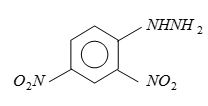
Which of the following compounds containing a carbonyl group will give a coloured crystalline compound with $2, 4-DNP$?
A
$CH_3COCl$
B
$CH_3COCH_3$
C
$CH_3CO(OC_2H_5)$
D
$CH_3CONH_2$
Solution
(B) $2, 4-Dinitrophenylhydrazine$ $(2, 4-DNP)$ is a reagent used to identify aldehydes and ketones through a nucleophilic addition-elimination reaction,forming coloured crystalline $2, 4-dinitrophenylhydrazones$.
Among the given options:
$A$ $(CH_3COCl)$ is an acyl chloride.
$B$ $(CH_3COCH_3)$ is a ketone (acetone).
$C$ $(CH_3CO(OC_2H_5))$ is an ester (ethyl acetate).
$D$ $(CH_3CONH_2)$ is an amide (acetamide).
Only aldehydes and ketones react with $2, 4-DNP$ to form the characteristic coloured crystalline derivatives. Therefore,acetone $(CH_3COCH_3)$ is the correct answer.
Among the given options:
$A$ $(CH_3COCl)$ is an acyl chloride.
$B$ $(CH_3COCH_3)$ is a ketone (acetone).
$C$ $(CH_3CO(OC_2H_5))$ is an ester (ethyl acetate).
$D$ $(CH_3CONH_2)$ is an amide (acetamide).
Only aldehydes and ketones react with $2, 4-DNP$ to form the characteristic coloured crystalline derivatives. Therefore,acetone $(CH_3COCH_3)$ is the correct answer.
0 likes
View Solution60
MediumMCQ
Which of the following organic compounds exhibits positive Fehling test as well as iodoform test?
A
Methanal
B
Ethanol
C
Propanone
D
Ethanal
Solution
(D) Ethanal $(CH_3CHO)$ contains an aldehyde group $(-CHO)$,which gives a positive Fehling test.
It also contains a methyl ketone group ($-COCH_3$ structure is present in the form of $CH_3-CH=O$),which gives a positive iodoform test.
Therefore,Ethanal is the correct answer.
It also contains a methyl ketone group ($-COCH_3$ structure is present in the form of $CH_3-CH=O$),which gives a positive iodoform test.
Therefore,Ethanal is the correct answer.
0 likes
View Solution61
MediumMCQ
Which of the following compounds will undergo self-aldol condensation in the presence of cold dilute alkali?
A
$C_6H_5CHO$
B
$CH_3CH_2CHO$
C
$CH_3CHO$
D
$HCHO$
Solution
(B) Aldol condensation occurs in aldehydes or ketones that possess at least one $\alpha$-hydrogen atom.
$C_6H_5CHO$ (benzaldehyde) and $HCHO$ (formaldehyde) do not have $\alpha$-hydrogen atoms.
$CH_3CH_2CHO$ (propanal) contains two $\alpha$-hydrogen atoms attached to the $\alpha$-carbon.
Therefore,$CH_3CH_2CHO$ undergoes self-aldol condensation in the presence of cold dilute alkali.
$C_6H_5CHO$ (benzaldehyde) and $HCHO$ (formaldehyde) do not have $\alpha$-hydrogen atoms.
$CH_3CH_2CHO$ (propanal) contains two $\alpha$-hydrogen atoms attached to the $\alpha$-carbon.
Therefore,$CH_3CH_2CHO$ undergoes self-aldol condensation in the presence of cold dilute alkali.
0 likes
View Solution62
MediumMCQ
Acetaldehyde when treated with dilute $NaOH$ gives:
A
$CH_3CH_2OH$
B
$CH_3COOH$
C
$CH_3-CH(OH)-CH_2-CHO$
D
$CH_3-CH_3$
Solution
(C) Acetaldehyde $(CH_3CHO)$ contains $\alpha$-hydrogen atoms.
When treated with dilute $NaOH$,it undergoes an aldol condensation reaction.
$2CH_3CHO \xrightarrow{dil. NaOH} CH_3-CH(OH)-CH_2-CHO$ ($3$-hydroxybutanal).
When treated with dilute $NaOH$,it undergoes an aldol condensation reaction.
$2CH_3CHO \xrightarrow{dil. NaOH} CH_3-CH(OH)-CH_2-CHO$ ($3$-hydroxybutanal).
0 likes
View Solution63
MediumMCQ
$C_2H_5CHO$ and $(CH_3)_2CO$ can be distinguished by testing with
A
Phenyl hydrazine
B
Hydroxylamine
C
Fehling solution
D
Sodium bisulphite
Solution
(C) The correct answer is $C$.
$C_2H_5CHO$ is an aldehyde,while $(CH_3)_2CO$ is a ketone.
Aldehydes reduce Fehling solution to give a red precipitate of cuprous oxide $(Cu_2O)$,whereas ketones do not react with Fehling solution.
The reaction for the aldehyde is: $C_2H_5CHO + 2Cu^{+2} + 5OH^{-} \to C_2H_5COO^{-} + Cu_2O (\text{red ppt}) + 3H_2O$.
Ketones like $(CH_3)_2CO$ do not show this reaction.
$C_2H_5CHO$ is an aldehyde,while $(CH_3)_2CO$ is a ketone.
Aldehydes reduce Fehling solution to give a red precipitate of cuprous oxide $(Cu_2O)$,whereas ketones do not react with Fehling solution.
The reaction for the aldehyde is: $C_2H_5CHO + 2Cu^{+2} + 5OH^{-} \to C_2H_5COO^{-} + Cu_2O (\text{red ppt}) + 3H_2O$.
Ketones like $(CH_3)_2CO$ do not show this reaction.
0 likes
View Solution64
MediumMCQ
Which of the following will undergo aldol condensation?
A
Acetaldehyde
B
Propanaldehyde
C
Trideuteroacetaldehyde
D
All of these
Solution
(D) Aldol condensation requires the presence of at least one $\alpha$-hydrogen atom in the carbonyl compound.
$A$ Acetaldehyde $(CH_3CHO)$ has three $\alpha$-hydrogens.
$B$ Propanaldehyde $(CH_3CH_2CHO)$ has two $\alpha$-hydrogens.
$C$ Trideuteroacetaldehyde $(CD_3CDO)$ has three $\alpha$-deuterium atoms. Since deuterium $(D)$ behaves chemically similar to hydrogen $(H)$,it can also undergo aldol condensation.
Therefore,all of these compounds will undergo aldol condensation.
$A$ Acetaldehyde $(CH_3CHO)$ has three $\alpha$-hydrogens.
$B$ Propanaldehyde $(CH_3CH_2CHO)$ has two $\alpha$-hydrogens.
$C$ Trideuteroacetaldehyde $(CD_3CDO)$ has three $\alpha$-deuterium atoms. Since deuterium $(D)$ behaves chemically similar to hydrogen $(H)$,it can also undergo aldol condensation.
Therefore,all of these compounds will undergo aldol condensation.
0 likes
View Solution65
MediumMCQ
Acetaldehyde cannot show:
A
Iodoform test
B
Lucas test
C
Benedict's test
D
Tollen's test
Solution
(B) The $Lucas$ test is used to distinguish between $1^o$,$2^o$,and $3^o$ alcohols based on their reactivity with $Lucas$ reagent $(ZnCl_2 + conc. HCl)$.
$1^o$ Alcohols: No turbidity at room temperature.
$2^o$ Alcohols: Turbidity appears within $5-10$ minutes.
$3^o$ Alcohols: Immediate turbidity.
Acetaldehyde is an aldehyde,not an alcohol; therefore,it does not react with $Lucas$ reagent and cannot show the $Lucas$ test. It gives positive results for $Iodoform$,$Benedict's$,and $Tollen's$ tests.
$1^o$ Alcohols: No turbidity at room temperature.
$2^o$ Alcohols: Turbidity appears within $5-10$ minutes.
$3^o$ Alcohols: Immediate turbidity.
Acetaldehyde is an aldehyde,not an alcohol; therefore,it does not react with $Lucas$ reagent and cannot show the $Lucas$ test. It gives positive results for $Iodoform$,$Benedict's$,and $Tollen's$ tests.
0 likes
View Solution66
MediumMCQ
What is the product of the reaction between $Benzaldehyde$ and concentrated $NaOH$?
A
Benzyl alcohol and Sodium benzoate
B
Benzoic acid
C
Hydrobenzamide
D
Cinnamic acid
Solution
(A) The reaction between $Benzaldehyde$ $(C_6H_5CHO)$ and concentrated $NaOH$ is a classic example of the $Cannizzaro$ reaction.
Since $Benzaldehyde$ lacks $\alpha$-hydrogen atoms,it undergoes self-oxidation and reduction (disproportionation) in the presence of a strong base.
The products formed are $Benzyl \ alcohol$ $(C_6H_5CH_2OH)$ and $Sodium \ benzoate$ $(C_6H_5COONa)$.
Since $Benzaldehyde$ lacks $\alpha$-hydrogen atoms,it undergoes self-oxidation and reduction (disproportionation) in the presence of a strong base.
The products formed are $Benzyl \ alcohol$ $(C_6H_5CH_2OH)$ and $Sodium \ benzoate$ $(C_6H_5COONa)$.
0 likes
View Solution67
MediumMCQ
The following reagent converts $C_6H_5COCHO$ to $C_6H_5CHOHCOONa$.
A
$Aq. NaOH$
B
$Acidic Na_2S_2O_3$
C
$Na_2CrO_4/H_2SO_4$
D
$NaNO_2/HCl$
Solution
(A) The reaction of $C_6H_5COCHO$ (phenylglyoxal) with aqueous $NaOH$ is an example of an intramolecular Cannizzaro reaction.
In this reaction,the aldehyde group $(-CHO)$ is oxidized to a carboxylate group $(-COO^-)$ while the adjacent ketone group $(-CO-)$ is reduced to a hydroxyl group $(-CHOH-)$.
Thus,$C_6H_5COCHO + NaOH \rightarrow C_6H_5CHOHCOONa$.
In this reaction,the aldehyde group $(-CHO)$ is oxidized to a carboxylate group $(-COO^-)$ while the adjacent ketone group $(-CO-)$ is reduced to a hydroxyl group $(-CHOH-)$.
Thus,$C_6H_5COCHO + NaOH \rightarrow C_6H_5CHOHCOONa$.
0 likes
View Solution68
MediumMCQ
Benzyl alcohol and sodium benzoate are obtained by the action of sodium hydroxide on benzaldehyde. This reaction is known as
A
Perkin's reaction
B
Cannizzaro's reaction
C
Sandmeyer's reaction
D
Claisen condensation
Solution
(B) Benzaldehyde,on treatment with $50\%$ aqueous or ethanolic alkali solution,undergoes Cannizzaro's reaction because it lacks an $\alpha$-hydrogen atom.
In this reaction,one molecule of benzaldehyde is oxidized to sodium benzoate and another is reduced to benzyl alcohol.
$2C_6H_5CHO \xrightarrow{NaOH} C_6H_5CH_2OH + C_6H_5COONa$
In this reaction,one molecule of benzaldehyde is oxidized to sodium benzoate and another is reduced to benzyl alcohol.
$2C_6H_5CHO \xrightarrow{NaOH} C_6H_5CH_2OH + C_6H_5COONa$
0 likes
View Solution69
MediumMCQ
To distinguish between formaldehyde and acetaldehyde,we require
A
Tollen's reagent
B
Fehling's solution
C
Schiff's reagent
D
Caustic soda solution
Solution
(D) Formaldehyde $(HCHO)$ and acetaldehyde $(CH_3CHO)$ can be distinguished using caustic soda $(NaOH)$ solution.
Formaldehyde undergoes the Cannizzaro reaction because it lacks $\alpha$-hydrogen atoms:
$2HCHO + NaOH (conc.) \rightarrow CH_3OH + HCOONa$
Acetaldehyde undergoes aldol condensation because it possesses $\alpha$-hydrogen atoms:
$2CH_3CHO \xrightarrow{NaOH (dil.)} CH_3-CH(OH)-CH_2-CHO$
Thus,option $(D)$ is the correct choice.
Formaldehyde undergoes the Cannizzaro reaction because it lacks $\alpha$-hydrogen atoms:
$2HCHO + NaOH (conc.) \rightarrow CH_3OH + HCOONa$
Acetaldehyde undergoes aldol condensation because it possesses $\alpha$-hydrogen atoms:
$2CH_3CHO \xrightarrow{NaOH (dil.)} CH_3-CH(OH)-CH_2-CHO$
Thus,option $(D)$ is the correct choice.
0 likes
View Solution70
MediumMCQ
Which of the following compounds does not give the iodoform test?
A
$CH_3CH_2OH$
B
$CH_3OH$
C
$CH_3CHO$
D
$PhCOCH_3$
Solution
(B) The iodoform test is given by compounds containing the $CH_3CO-$ group or the $CH_3CH(OH)-$ group.
$CH_3CH_2OH$ contains the $CH_3CH(OH)-$ group and gives a positive test.
$CH_3CHO$ contains the $CH_3CO-$ group and gives a positive test.
$PhCOCH_3$ (acetophenone) contains the $CH_3CO-$ group attached to a phenyl ring and gives a positive test.
$CH_3OH$ (methanol) does not contain either of these groups,so it does not give the iodoform test.
$CH_3CH_2OH$ contains the $CH_3CH(OH)-$ group and gives a positive test.
$CH_3CHO$ contains the $CH_3CO-$ group and gives a positive test.
$PhCOCH_3$ (acetophenone) contains the $CH_3CO-$ group attached to a phenyl ring and gives a positive test.
$CH_3OH$ (methanol) does not contain either of these groups,so it does not give the iodoform test.
0 likes
View Solution71
DifficultMCQ
Which of the following will not give the iodoform test?
A
Ethanal
B
Ethanol
C
$2-$propanone
D
$3-$pentanone
Solution
(D) The iodoform test is given by compounds containing the $CH_3-C(=O)-$ group or the $CH_3-CH(OH)-$ group.
$3-$pentanone $(CH_3-CH_2-C(=O)-CH_2-CH_3)$ does not contain the $CH_3-C(=O)-$ group,therefore it does not give the iodoform test.
Thus,the correct option is $(D)$.
$3-$pentanone $(CH_3-CH_2-C(=O)-CH_2-CH_3)$ does not contain the $CH_3-C(=O)-$ group,therefore it does not give the iodoform test.
Thus,the correct option is $(D)$.
0 likes
View Solution72
MediumMCQ
Which of the following will not give the iodoform test?
A
Acetophenone
B
Ethanal
C
Benzophenone
D
Ethanol
Solution
(C) The iodoform test is given by compounds containing the $CH_3CO-$ group or the $CH_3CH(OH)-$ group.
$1$. Acetophenone $(C_6H_5COCH_3)$ contains the $CH_3CO-$ group,so it gives a positive iodoform test.
$2$. Ethanal $(CH_3CHO)$ contains the $CH_3CO-$ group,so it gives a positive iodoform test.
$3$. Benzophenone $(C_6H_5COC_6H_5)$ does not contain either the $CH_3CO-$ group or the $CH_3CH(OH)-$ group,so it does not give the iodoform test.
$4$. Ethanol $(CH_3CH_2OH)$ contains the $CH_3CH(OH)-$ group,so it gives a positive iodoform test.
Therefore,the correct option is $C$.
$1$. Acetophenone $(C_6H_5COCH_3)$ contains the $CH_3CO-$ group,so it gives a positive iodoform test.
$2$. Ethanal $(CH_3CHO)$ contains the $CH_3CO-$ group,so it gives a positive iodoform test.
$3$. Benzophenone $(C_6H_5COC_6H_5)$ does not contain either the $CH_3CO-$ group or the $CH_3CH(OH)-$ group,so it does not give the iodoform test.
$4$. Ethanol $(CH_3CH_2OH)$ contains the $CH_3CH(OH)-$ group,so it gives a positive iodoform test.
Therefore,the correct option is $C$.
0 likes
View Solution73
DifficultMCQ
The haloform test is given by which of the following substances?
A
$HCHO$
B
$CH_3COCH_3$
C
$CH_3OCH_3$
D
$CH_3CH_2Cl$
Solution
(B) The haloform test is given by compounds containing the methyl ketone group $(CH_3CO-)$ or alcohols that can be oxidized to a methyl ketone group (like $CH_3CH(OH)-$).
Acetone $(CH_3COCH_3)$ contains the methyl ketone group and thus gives a positive haloform test.
Acetone $(CH_3COCH_3)$ contains the methyl ketone group and thus gives a positive haloform test.
0 likes
View Solution74
MediumMCQ
Dimethyl ketones are usually characterized through
A
Tollen's reagent
B
Iodoform test
C
Schiff's test
D
Benedict's reagent
Solution
(B) Dimethyl ketone $(CH_3-CO-CH_3)$ is a methyl ketone.
Methyl ketones react with $I_2$ in the presence of $NaOH$ to form a yellow precipitate of iodoform $(CHI_3)$.
This is known as the iodoform test.
Tollen's reagent,Schiff's reagent,and Benedict's reagent are primarily used to identify aldehydes.
Methyl ketones react with $I_2$ in the presence of $NaOH$ to form a yellow precipitate of iodoform $(CHI_3)$.
This is known as the iodoform test.
Tollen's reagent,Schiff's reagent,and Benedict's reagent are primarily used to identify aldehydes.
0 likes
View Solution75
EasyMCQ
The light yellow compound produced when acetone reacts with iodine and alkali is:
A
$CH_3-CO-CH_2I$
B
$CH_3I$
C
$CHI_3$
D
None of these
Solution
(C) Acetone $(CH_3COCH_3)$ undergoes the iodoform reaction when treated with iodine $(I_2)$ and an alkali (like $NaOH$).
This reaction produces iodoform $(CHI_3)$,which is a light yellow crystalline solid.
The chemical equation is: $CH_3COCH_3 + 3I_2 + 4NaOH \rightarrow CHI_3 + CH_3COONa + 3NaI + 3H_2O$.
This reaction produces iodoform $(CHI_3)$,which is a light yellow crystalline solid.
The chemical equation is: $CH_3COCH_3 + 3I_2 + 4NaOH \rightarrow CHI_3 + CH_3COONa + 3NaI + 3H_2O$.
0 likes
View Solution76
MediumMCQ
If formaldehyde and $KOH$ are heated,then we get
A
Acetylene
B
Methane
C
Methyl alcohol
D
Ethyl formate
Solution
(C) The reaction between formaldehyde $(HCHO)$ and concentrated $KOH$ is a Cannizzaro reaction.
In this reaction,formaldehyde undergoes self-oxidation and reduction.
$2HCHO + KOH \xrightarrow{\Delta} HCOOK + CH_3OH$
Thus,the products are potassium formate and methyl alcohol.
In this reaction,formaldehyde undergoes self-oxidation and reduction.
$2HCHO + KOH \xrightarrow{\Delta} HCOOK + CH_3OH$
Thus,the products are potassium formate and methyl alcohol.
0 likes
View Solution77
MediumMCQ
Acetaldehyde reacts with $C_2H_5MgCl$. The final product is
A
An aldehyde
B
$A$ ketone
C
$A$ primary alcohol
D
$A$ secondary alcohol
Solution
(D) Acetaldehyde $(CH_3CHO)$ reacts with the Grignard reagent $C_2H_5MgCl$ to form an addition product.
Upon acidic hydrolysis,this addition product yields a secondary alcohol.
The reaction is:
$CH_3CHO + C_2H_5MgCl \rightarrow CH_3CH(OMgCl)C_2H_5$
$CH_3CH(OMgCl)C_2H_5 + H_2O \rightarrow CH_3CH(OH)C_2H_5 + Mg(OH)Cl$
The product $CH_3CH(OH)C_2H_5$ is $butan-2-ol$,which is a secondary alcohol.
Upon acidic hydrolysis,this addition product yields a secondary alcohol.
The reaction is:
$CH_3CHO + C_2H_5MgCl \rightarrow CH_3CH(OMgCl)C_2H_5$
$CH_3CH(OMgCl)C_2H_5 + H_2O \rightarrow CH_3CH(OH)C_2H_5 + Mg(OH)Cl$
The product $CH_3CH(OH)C_2H_5$ is $butan-2-ol$,which is a secondary alcohol.
0 likes
View Solution78
DifficultMCQ
Treatment of propionaldehyde with dilute $NaOH$ solution gives:
A
$CH_3CH_2COOCH_2CH_2CH_3$
B
$CH_3CH_2CH(OH)CH(CH_3)CHO$
C
$CH_3CH_2CH(OH)CH_2CH_2CHO$
D
$CH_3CH_2COCH_2CH_2CHO$
Solution
(B) Propionaldehyde $(CH_3CH_2CHO)$ contains $\alpha$-hydrogens,so it undergoes an aldol condensation reaction in the presence of a dilute base like $NaOH$.
The reaction proceeds as follows:
$CH_3CH_2CHO + CH_3CH_2CHO \xrightarrow{dil. NaOH} CH_3CH_2CH(OH)CH(CH_3)CHO$
The product formed is $3$-hydroxy-$2$-methylpentanal.
The reaction proceeds as follows:
$CH_3CH_2CHO + CH_3CH_2CHO \xrightarrow{dil. NaOH} CH_3CH_2CH(OH)CH(CH_3)CHO$
The product formed is $3$-hydroxy-$2$-methylpentanal.
0 likes
View Solution79
MediumMCQ
Aldol condensation of acetaldehyde involves the formation of which of the following intermediates?
A
Acetate ion
B
$A$ carbanion
C
$A$ carbonium ion
D
$A$ free radical
Solution
(B) The aldol condensation of an aldehyde involves the formation of a carbanion as the reaction intermediate in the first step.
This occurs by the removal of an $\alpha-H$ atom from the aldehyde by a base (e.g.,$OH^-$).
The resulting enolate ion is resonance-stabilized as shown below:
$OH^- + CH_3CHO \rightleftharpoons H_2O + [CH_2-CHO]^- \leftrightarrow [CH_2=CH-O]^-$
This occurs by the removal of an $\alpha-H$ atom from the aldehyde by a base (e.g.,$OH^-$).
The resulting enolate ion is resonance-stabilized as shown below:
$OH^- + CH_3CHO \rightleftharpoons H_2O + [CH_2-CHO]^- \leftrightarrow [CH_2=CH-O]^-$
0 likes
View Solution80
DifficultMCQ
$3 CH_3COCH_3 \xrightarrow{HCl} (CH_3)_2C = CH - CO - CH = C(CH_3)_2$
This product $B$ is obtained when acetone is saturated with hydrogen chloride gas. $B$ can be:
This product $B$ is obtained when acetone is saturated with hydrogen chloride gas. $B$ can be:
A
Phorone
B
Formose
C
Diacetone alcohol
D
Mesityl oxide
Solution
(A) When acetone $(CH_3COCH_3)$ is saturated with dry hydrogen chloride gas,it undergoes an aldol condensation followed by dehydration to form Phorone.
The reaction is:
$3 CH_3COCH_3 \xrightarrow{HCl} (CH_3)_2C = CH - CO - CH = C(CH_3)_2 + 2 H_2O$
The product formed is Phorone.
The reaction is:
$3 CH_3COCH_3 \xrightarrow{HCl} (CH_3)_2C = CH - CO - CH = C(CH_3)_2 + 2 H_2O$
The product formed is Phorone.
0 likes
View Solution81
EasyMCQ
Aromatic aldehydes undergo disproportionation in the presence of concentrated sodium or potassium hydroxide to give the corresponding alcohol and acid salt. This reaction is known as:
A
Wurtz reaction
B
Cannizzaro reaction
C
Friedel-Crafts reaction
D
Claisen reaction
Solution
(B) The reaction described is the $Cannizzaro$ reaction.
In this reaction,aldehydes that do not contain an $\alpha$-hydrogen atom undergo self-oxidation and reduction (disproportionation) in the presence of a concentrated alkali solution.
For example,two molecules of benzaldehyde react with concentrated $NaOH$ to produce sodium benzoate and benzyl alcohol.
In this reaction,aldehydes that do not contain an $\alpha$-hydrogen atom undergo self-oxidation and reduction (disproportionation) in the presence of a concentrated alkali solution.
For example,two molecules of benzaldehyde react with concentrated $NaOH$ to produce sodium benzoate and benzyl alcohol.
0 likes
View Solution82
MediumMCQ
$m$-chlorobenzaldehyde on reaction with conc. $KOH$ at room temperature gives
A
Potassium $m$-chlorobenzoate and $m$-hydroxybenzaldehyde
B
$m$-hydroxybenzaldehyde and $m$-chlorobenzyl alcohol
C
$m$-chlorobenzyl alcohol and $m$-hydroxybenzyl alcohol
D
Potassium $m$-chlorobenzoate and $m$-chlorobenzyl alcohol
Solution
(D) $m$-chlorobenzaldehyde does not contain an $\alpha$-hydrogen atom. Therefore,it undergoes the Cannizzaro reaction in the presence of concentrated $KOH$.
In the Cannizzaro reaction,one molecule of the aldehyde is oxidized to the corresponding carboxylic acid salt,and another molecule is reduced to the corresponding alcohol.
Thus,$m$-chlorobenzaldehyde undergoes disproportionation to form potassium $m$-chlorobenzoate and $m$-chlorobenzyl alcohol.
In the Cannizzaro reaction,one molecule of the aldehyde is oxidized to the corresponding carboxylic acid salt,and another molecule is reduced to the corresponding alcohol.
Thus,$m$-chlorobenzaldehyde undergoes disproportionation to form potassium $m$-chlorobenzoate and $m$-chlorobenzyl alcohol.
0 likes
View Solution83
MediumMCQ
Which of the following does not give a yellow precipitate with $NaOH + I_2$?
A
Acetone
B
Acetaldehyde
C
Benzaldehyde
D
Acetophenone
Solution
(C) The reaction with $NaOH + I_2$ is the iodoform test,which is given by compounds containing the $CH_3CO-$ group or $CH_3CH(OH)-$ group.
$1$. Acetone $(CH_3COCH_3)$ contains the $CH_3CO-$ group and gives a positive iodoform test.
$2$. Acetaldehyde $(CH_3CHO)$ contains the $CH_3CO-$ group and gives a positive iodoform test.
$3$. Acetophenone $(C_6H_5COCH_3)$ contains the $CH_3CO-$ group attached to a phenyl ring and gives a positive iodoform test.
$4$. Benzaldehyde $(C_6H_5CHO)$ does not contain the $CH_3CO-$ or $CH_3CH(OH)-$ group,so it does not give a yellow precipitate of iodoform $(CHI_3)$.
$1$. Acetone $(CH_3COCH_3)$ contains the $CH_3CO-$ group and gives a positive iodoform test.
$2$. Acetaldehyde $(CH_3CHO)$ contains the $CH_3CO-$ group and gives a positive iodoform test.
$3$. Acetophenone $(C_6H_5COCH_3)$ contains the $CH_3CO-$ group attached to a phenyl ring and gives a positive iodoform test.
$4$. Benzaldehyde $(C_6H_5CHO)$ does not contain the $CH_3CO-$ or $CH_3CH(OH)-$ group,so it does not give a yellow precipitate of iodoform $(CHI_3)$.
0 likes
View Solution84
MediumMCQ
The alkaline $CuSO_4$ solution containing sodium potassium tartrate does not react with:
A
$CH_3CHO$
B
$C_2H_5CHO$
C
$C_6H_5CH_2CHO$
D
$C_6H_5CHO$
Solution
(D) The reagent described is Fehling's solution,which consists of $CuSO_4$ (Fehling's $A$) and sodium potassium tartrate (Rochelle salt) in $NaOH$ (Fehling's $B$).
Fehling's solution is a mild oxidizing agent used to distinguish aliphatic aldehydes from aromatic aldehydes.
Aliphatic aldehydes like $CH_3CHO$,$C_2H_5CHO$,and $C_6H_5CH_2CHO$ (phenylacetaldehyde) are oxidized by Fehling's solution to their corresponding carboxylate ions.
However,aromatic aldehydes like $C_6H_5CHO$ (benzaldehyde) do not react with Fehling's solution because the aldehyde group is directly attached to the benzene ring,making it resistant to oxidation by this mild reagent.
Therefore,the correct option is $D$.
Fehling's solution is a mild oxidizing agent used to distinguish aliphatic aldehydes from aromatic aldehydes.
Aliphatic aldehydes like $CH_3CHO$,$C_2H_5CHO$,and $C_6H_5CH_2CHO$ (phenylacetaldehyde) are oxidized by Fehling's solution to their corresponding carboxylate ions.
However,aromatic aldehydes like $C_6H_5CHO$ (benzaldehyde) do not react with Fehling's solution because the aldehyde group is directly attached to the benzene ring,making it resistant to oxidation by this mild reagent.
Therefore,the correct option is $D$.
0 likes
View Solution85
MediumMCQ
The correct order of reactivity of $CH_3CHO$,$C_2H_5COCH_3$,and $CH_3COCH_3$ towards nucleophilic addition is:
A
$CH_3CHO > CH_3COCH_3 > C_2H_5COCH_3$
B
$C_2H_5COCH_3 > CH_3COCH_3 > CH_3CHO$
C
$CH_3COCH_3 > CH_3CHO > C_2H_5COCH_3$
D
$CH_3COCH_3 > C_2H_5COCH_3 > CH_3CHO$
Solution
(A) The reactivity of carbonyl compounds towards nucleophilic addition depends on two factors: steric hindrance and electronic effects.
$1$. Steric hindrance: As the size of the alkyl groups attached to the carbonyl carbon increases,the approach of the nucleophile becomes more difficult.
$2$. Electronic effect: Alkyl groups are electron-donating ($+I$ effect),which reduces the electrophilicity of the carbonyl carbon.
Comparing the compounds:
- $CH_3CHO$ (Acetaldehyde): One alkyl group $(CH_3)$ and one hydrogen atom.
- $CH_3COCH_3$ (Acetone): Two methyl groups.
- $C_2H_5COCH_3$ (Butan$-2-$one): One methyl group and one ethyl group.
Since $CH_3CHO$ has the least steric hindrance and the least electron-donating effect,it is the most reactive.
$C_2H_5COCH_3$ has more steric hindrance than $CH_3COCH_3$ due to the larger ethyl group.
Therefore,the order of reactivity is $CH_3CHO > CH_3COCH_3 > C_2H_5COCH_3$.
$1$. Steric hindrance: As the size of the alkyl groups attached to the carbonyl carbon increases,the approach of the nucleophile becomes more difficult.
$2$. Electronic effect: Alkyl groups are electron-donating ($+I$ effect),which reduces the electrophilicity of the carbonyl carbon.
Comparing the compounds:
- $CH_3CHO$ (Acetaldehyde): One alkyl group $(CH_3)$ and one hydrogen atom.
- $CH_3COCH_3$ (Acetone): Two methyl groups.
- $C_2H_5COCH_3$ (Butan$-2-$one): One methyl group and one ethyl group.
Since $CH_3CHO$ has the least steric hindrance and the least electron-donating effect,it is the most reactive.
$C_2H_5COCH_3$ has more steric hindrance than $CH_3COCH_3$ due to the larger ethyl group.
Therefore,the order of reactivity is $CH_3CHO > CH_3COCH_3 > C_2H_5COCH_3$.
0 likes
View Solution86
MediumMCQ
One mole of an organic compound requires $0.5$ mole of oxygen to produce an acid. The compound may be
A
Alcohol
B
Ether
C
Ketone
D
Aldehyde
Solution
(D) The oxidation of an aldehyde to a carboxylic acid is represented by the equation:
$RCHO + 0.5 O_2 \to RCOOH$
From the stoichiometry of the reaction,$1$ mole of aldehyde requires $0.5$ mole of oxygen to produce $1$ mole of the corresponding carboxylic acid. Therefore,the compound is an aldehyde.
$RCHO + 0.5 O_2 \to RCOOH$
From the stoichiometry of the reaction,$1$ mole of aldehyde requires $0.5$ mole of oxygen to produce $1$ mole of the corresponding carboxylic acid. Therefore,the compound is an aldehyde.
0 likes
View Solution87
MediumMCQ
Aldehydes can be oxidised by
A
Tollen's reagent
B
Fehling solution
C
Benedict solution
D
All of these
Solution
(D) Aldehydes are easily oxidised to carboxylic acids by mild oxidising agents like Tollen's reagent,Fehling solution,and Benedict solution,whereas ketones are resistant to oxidation by these reagents.
$1.$ Tollen's reagent: $RCHO + 2[Ag(NH_3)_2]^+ + 3OH^- \to RCOO^- + 2Ag + 4NH_3 + 2H_2O$
$2.$ Fehling solution: $RCHO + 2Cu^{2+} + 5OH^- \to RCOO^- + Cu_2O + 3H_2O$
$3.$ Benedict solution: Similar to Fehling solution,it contains $Cu^{2+}$ ions which oxidise aldehydes.
Therefore,the correct option is $D$.
$1.$ Tollen's reagent: $RCHO + 2[Ag(NH_3)_2]^+ + 3OH^- \to RCOO^- + 2Ag + 4NH_3 + 2H_2O$
$2.$ Fehling solution: $RCHO + 2Cu^{2+} + 5OH^- \to RCOO^- + Cu_2O + 3H_2O$
$3.$ Benedict solution: Similar to Fehling solution,it contains $Cu^{2+}$ ions which oxidise aldehydes.
Therefore,the correct option is $D$.
0 likes
View Solution88
EasyMCQ
Silver mirror is a test for
A
Aldehydes
B
Thio alcohols
C
Amines
D
Ethers
Solution
(A) The silver mirror test,also known as the $Tollens'$ test,is a chemical test used to distinguish between aldehydes and ketones.
Aldehydes are oxidized to carboxylic acids by $Tollens'$ reagent,which is an ammoniacal silver nitrate solution,while the silver ions are reduced to metallic silver,forming a silver mirror on the inner surface of the reaction vessel.
Ketones do not give this test.
Aldehydes are oxidized to carboxylic acids by $Tollens'$ reagent,which is an ammoniacal silver nitrate solution,while the silver ions are reduced to metallic silver,forming a silver mirror on the inner surface of the reaction vessel.
Ketones do not give this test.
0 likes
View Solution89
MediumMCQ
$CH_3CH=CHCHO$ is oxidized to $CH_3CH=CHCOOH$ using
A
Alkaline $KMnO_4$
B
Selenium dioxide
C
Ammoniacal $AgNO_3$
D
All of these
Solution
(C) $CH_3CH=CHCHO$ is an $\alpha,\beta$-unsaturated aldehyde.
Ammoniacal $AgNO_3$ (Tollens' reagent) is a mild oxidizing agent that selectively oxidizes the aldehyde group to a carboxylic acid group without affecting the carbon-carbon double bond.
The reaction is: $CH_3CH=CHCHO + 2[Ag(NH_3)_2]^+ + 3OH^- \to CH_3CH=CHCOO^- + 2Ag + 4NH_3 + 2H_2O$.
Alkaline $KMnO_4$ is a strong oxidizing agent and would likely cleave the double bond.
Selenium dioxide is typically used for allylic oxidation.
Therefore,the correct reagent for this specific transformation is Ammoniacal $AgNO_3$.
Ammoniacal $AgNO_3$ (Tollens' reagent) is a mild oxidizing agent that selectively oxidizes the aldehyde group to a carboxylic acid group without affecting the carbon-carbon double bond.
The reaction is: $CH_3CH=CHCHO + 2[Ag(NH_3)_2]^+ + 3OH^- \to CH_3CH=CHCOO^- + 2Ag + 4NH_3 + 2H_2O$.
Alkaline $KMnO_4$ is a strong oxidizing agent and would likely cleave the double bond.
Selenium dioxide is typically used for allylic oxidation.
Therefore,the correct reagent for this specific transformation is Ammoniacal $AgNO_3$.
0 likes
View Solution90
MediumMCQ
Which of the following does not turn Schiff's reagent to pink?
A
Formaldehyde
B
Benzaldehyde
C
Acetone
D
Acetaldehyde
Solution
(C) Schiff's reagent is a specific test used to detect the presence of aldehydes.
Aldehydes react with Schiff's reagent to produce a characteristic pink or magenta color.
Among the given options,$Formaldehyde$ $(HCHO)$,$Benzaldehyde$ $(C_6H_5CHO)$,and $Acetaldehyde$ $(CH_3CHO)$ are all aldehydes and will give a positive test.
$Acetone$ $(CH_3COCH_3)$ is a ketone,which does not react with Schiff's reagent to produce the pink color.
Aldehydes react with Schiff's reagent to produce a characteristic pink or magenta color.
Among the given options,$Formaldehyde$ $(HCHO)$,$Benzaldehyde$ $(C_6H_5CHO)$,and $Acetaldehyde$ $(CH_3CHO)$ are all aldehydes and will give a positive test.
$Acetone$ $(CH_3COCH_3)$ is a ketone,which does not react with Schiff's reagent to produce the pink color.
0 likes
View Solution91
MediumMCQ
Fehling's test is positive for
A
Acetaldehyde
B
Benzaldehyde
C
Ether
D
Alcohol
Solution
(A) Fehling's test is used to distinguish between aliphatic aldehydes and aromatic aldehydes or ketones.
Aliphatic aldehydes,such as $CH_3CHO$ (Acetaldehyde),give a positive Fehling's test by forming a reddish-brown precipitate of $Cu_2O$.
Benzaldehyde is an aromatic aldehyde and does not respond to Fehling's test.
Ethers and alcohols do not contain the carbonyl group required for this oxidation reaction.
Aliphatic aldehydes,such as $CH_3CHO$ (Acetaldehyde),give a positive Fehling's test by forming a reddish-brown precipitate of $Cu_2O$.
Benzaldehyde is an aromatic aldehyde and does not respond to Fehling's test.
Ethers and alcohols do not contain the carbonyl group required for this oxidation reaction.
0 likes
View Solution92
MediumMCQ
Acetaldehyde and acetone differ in their reaction with
A
Sodium bisulphite
B
Ammonia
C
Phosphorus pentachloride
D
Phenyl hydrazine
Solution
(B) Acetaldehyde $(CH_3CHO)$ reacts with ammonia $(NH_3)$ to form an addition product known as acetaldehyde ammonia.
In contrast,acetone $(CH_3COCH_3)$ reacts with ammonia to form complex condensation products such as diacetone amine and triacetone amine.
Both aldehydes and ketones react similarly with sodium bisulphite,$PCl_5$,and phenyl hydrazine to form addition products,gem-dichlorides,and phenylhydrazones,respectively.
In contrast,acetone $(CH_3COCH_3)$ reacts with ammonia to form complex condensation products such as diacetone amine and triacetone amine.
Both aldehydes and ketones react similarly with sodium bisulphite,$PCl_5$,and phenyl hydrazine to form addition products,gem-dichlorides,and phenylhydrazones,respectively.
0 likes
View Solution93
MediumMCQ
The final product formed when acetaldehyde is reduced with sodium and alcohol is
A
Ethylene
B
Ethyl alcohol
C
Ethene
D
All of these
Solution
(B) The reduction of acetaldehyde $(CH_3CHO)$ with sodium and ethanol $(Na/C_2H_5OH)$ is a classic reduction reaction that yields a primary alcohol.
The chemical equation for the reaction is:
$CH_3CHO + 2[H] \xrightarrow{Na/C_2H_5OH} CH_3CH_2OH$
Thus,the final product is ethyl alcohol.
The chemical equation for the reaction is:
$CH_3CHO + 2[H] \xrightarrow{Na/C_2H_5OH} CH_3CH_2OH$
Thus,the final product is ethyl alcohol.
0 likes
View Solution94
MediumMCQ
The compound obtained by the reduction of propionaldehyde by amalgamated zinc and concentrated $HCl$ is
A
Propanol
B
Propane
C
Propene
D
All of these
Solution
(B) The reaction of propionaldehyde with amalgamated zinc and concentrated $HCl$ is known as Clemmensen reduction.
In this reaction,the carbonyl group $(>C=O)$ is reduced to a methylene group $(-CH_2-)$.
$CH_3CH_2CHO + 4[H] \xrightarrow{Zn/Hg, HCl} CH_3CH_2CH_3 + H_2O$
Thus,propionaldehyde is reduced to propane.
In this reaction,the carbonyl group $(>C=O)$ is reduced to a methylene group $(-CH_2-)$.
$CH_3CH_2CHO + 4[H] \xrightarrow{Zn/Hg, HCl} CH_3CH_2CH_3 + H_2O$
Thus,propionaldehyde is reduced to propane.
0 likes
View Solution95
MediumMCQ
Formaldehyde when treated with $KOH$ gives methanol and potassium formate. The reaction is known as
A
Perkin reaction
B
Claisen reaction
C
Cannizzaro reaction
D
Knoevenagel reaction
Solution
(C) . In Cannizzaro reaction,an aldehyde lacking $\alpha$-hydrogen undergoes self-oxidation and reduction (disproportionation) in the presence of a concentrated base.
$2HCHO + KOH \xrightarrow{\text{conc.}} CH_3OH + HCOOK$
Here,one molecule of formaldehyde is reduced to methanol $(CH_3OH)$ and another is oxidized to potassium formate $(HCOOK)$.
$2HCHO + KOH \xrightarrow{\text{conc.}} CH_3OH + HCOOK$
Here,one molecule of formaldehyde is reduced to methanol $(CH_3OH)$ and another is oxidized to potassium formate $(HCOOK)$.
0 likes
View Solution96
MediumMCQ
Aldehydes and ketones give pure addition reaction with:
A
Hydrazine
B
Phenyl hydrazine
C
Semicarbazide
D
Hydrogen cyanide
Solution
(D) Carbonyl compounds $(>C=O)$ react with $HCN$ to form cyanohydrins via a nucleophilic addition reaction,which is a pure addition reaction.
Reaction: $>C=O + HCN \rightarrow >C(OH)(CN)$.
Conversely,reactions with hydrazine $(NH_2NH_2)$,phenyl hydrazine $(NH_2NHC_6H_5)$,and semicarbazide $(NH_2NHCONH_2)$ are addition-elimination reactions (nucleophilic addition followed by the elimination of a water molecule) to form derivatives like hydrazones,phenylhydrazones,and semicarbazones,respectively.
Therefore,$HCN$ is the correct choice for a pure addition reaction.
Reaction: $>C=O + HCN \rightarrow >C(OH)(CN)$.
Conversely,reactions with hydrazine $(NH_2NH_2)$,phenyl hydrazine $(NH_2NHC_6H_5)$,and semicarbazide $(NH_2NHCONH_2)$ are addition-elimination reactions (nucleophilic addition followed by the elimination of a water molecule) to form derivatives like hydrazones,phenylhydrazones,and semicarbazones,respectively.
Therefore,$HCN$ is the correct choice for a pure addition reaction.
0 likes
View Solution97
EasyMCQ
Acetaldehyde $(CH_3CHO)$ reacts with:
A
Electrophiles only
B
Nucleophiles only
C
Free radicals only
D
Both electrophiles and nucleophiles
Solution
(D) Acetaldehyde contains a carbonyl group $(C=O)$.
Due to the difference in electronegativity between carbon and oxygen,the carbonyl carbon is electrophilic,making it susceptible to attack by nucleophiles (nucleophilic addition reactions).
Additionally,the oxygen atom has lone pairs and can act as a weak nucleophile,and the alpha-hydrogens can be involved in reactions with electrophiles (e.g.,in aldol condensation or halogenation).
Therefore,acetaldehyde can react with both electrophiles and nucleophiles.
Due to the difference in electronegativity between carbon and oxygen,the carbonyl carbon is electrophilic,making it susceptible to attack by nucleophiles (nucleophilic addition reactions).
Additionally,the oxygen atom has lone pairs and can act as a weak nucleophile,and the alpha-hydrogens can be involved in reactions with electrophiles (e.g.,in aldol condensation or halogenation).
Therefore,acetaldehyde can react with both electrophiles and nucleophiles.
0 likes
View Solution98
MediumMCQ
The typical reaction of an aldehyde is
A
Electrophilic addition
B
Nucleophilic substitution
C
Nucleophilic addition
D
Nucleophilic elimination
Solution
(C) The typical reaction of an aldehyde is $Nucleophilic \text{ } addition$.
Due to the presence of a polar carbonyl group $(C=O)$,the carbon atom is electrophilic,making it susceptible to attack by nucleophiles.
Examples include the addition of $HCN$,$NaHSO_3$,and Grignard reagents.
Due to the presence of a polar carbonyl group $(C=O)$,the carbon atom is electrophilic,making it susceptible to attack by nucleophiles.
Examples include the addition of $HCN$,$NaHSO_3$,and Grignard reagents.
0 likes
View Solution99
MediumMCQ
The addition of $HCN$ to carbonyl compounds is an example of
A
Nucleophilic substitution
B
Electrophilic addition
C
Nucleophilic addition
D
Electrophilic substitution
Solution
(C) The addition of $HCN$ to carbonyl compounds is a classic example of nucleophilic addition reaction.
In this reaction,the cyanide ion $(CN^-)$ acts as a nucleophile and attacks the electrophilic carbonyl carbon atom.
In this reaction,the cyanide ion $(CN^-)$ acts as a nucleophile and attacks the electrophilic carbonyl carbon atom.
0 likes
View Solution100
MediumMCQ
The product formed by the reaction of chlorine with benzaldehyde in the absence of a catalyst is
A
Chlorobenzene
B
Benzyl chloride
C
Benzoyl chloride
D
$o-$Chlorobenzaldehyde
Solution
(C) The reaction of benzaldehyde $(C_6H_5CHO)$ with chlorine $(Cl_2)$ in the absence of a catalyst proceeds via a free radical mechanism or direct substitution of the aldehydic hydrogen.
The chemical equation is:
$C_6H_5CHO + Cl_2 \to C_6H_5COCl + HCl$
Thus,the product formed is benzoyl chloride.
The chemical equation is:
$C_6H_5CHO + Cl_2 \to C_6H_5COCl + HCl$
Thus,the product formed is benzoyl chloride.
0 likes
View Solution8-1.Aldehydes and Ketones — Properties · Frequently Asked Questions
1Are these 8-1.Aldehydes and Ketones questions useful for JEE and NEET?
Yes. All questions in this section are mapped to JEE Main and NEET exam patterns. Previous year questions from JEE Main, NEET, GUJCET and state-level exams are included with full solutions.
2Can I switch to Hindi or Gujarati for these questions?
Yes. Use the language tabs in the hero section or the sidebar to view the same questions and solutions in English, Hindi or Gujarati.
3How do I generate a question paper from this subtopic?
Use the Vedclass Exam Paper Generator — select the chapter and subtopic, set difficulty, and generate Sets A, B, C, D automatically. First 3 chapters of every subject are free.
Vedclass Products
For Students
Vedclass Test Series
Mock tests in real JEE/NEET style with performance analysis. 5-day free trial.
Start Free TrialFor Teachers
Exam Paper Generator
Generate Set A/B/C/D papers from this chapter in 2 minutes. 3 chapters free.
Try FreeFor Institutes
Online Exam Module
Live online exams with unlimited students, 360° analytics & white-label branding.
See DemoFor Teachers & Institutes
Generate a 8-1.Aldehydes and Ketones Exam Paper in 2 Minutes
Select subtopic & difficulty — Sets A, B, C, D auto-generated with No Repeat logic.
First 3 chapters of every subject are free — no payment required.