
A English
Introduction Questions in English
Class 12 Chemistry · 8-1.Aldehydes and Ketones · Introduction
62+
Questions
English
Language
100%
With Solutions
Showing 50 of 62 questions in English
1
EasyMCQ
Butanal is an example of
A
Primary alcohol
B
Secondary alcohol
C
Aliphatic aldehyde
D
Aliphatic ketone
Solution
(C) $Butanal$ $(CH_3-CH_2-CH_2-CHO)$ is an aliphatic aldehyde because it contains the $-CHO$ functional group attached to an alkyl chain.
0 likes
View Solution2
MediumMCQ
In aldehydes and ketones,the carbon atom of the carbonyl group is
A
$sp^3$ hybridised
B
$sp^2$ hybridised
C
$sp$ hybridised
D
Unhybridised
Solution
(B) In the carbonyl group $(>C=O)$,the carbon atom is bonded to three atoms (one oxygen via a double bond and two other groups/atoms via single bonds) and has no lone pairs.
According to the valence bond theory,the carbon atom undergoes $sp^2$ hybridisation to form three $sp^2$ hybrid orbitals.
Therefore,the carbon atom of the carbonyl group is $sp^2$ hybridised.
According to the valence bond theory,the carbon atom undergoes $sp^2$ hybridisation to form three $sp^2$ hybrid orbitals.
Therefore,the carbon atom of the carbonyl group is $sp^2$ hybridised.
0 likes
View Solution3
EasyMCQ
Glyoxal is
A
$CH_2O-CH_2O$
B
$CH_2OH-CH_2OH$
C
$CHO-CHO$
D
$CH_2OH-CHO$
Solution
(C) Glyoxal is the simplest dialdehyde with the chemical formula $CHO-CHO$. It is also known as ethanedial.
0 likes
View Solution4
EasyMCQ
Aldehydes are isomeric with:
A
Ketones
B
Ethers
C
Alcohols
D
Fatty acids
Solution
(A) Aldehydes are functional isomers of ketones.
Both aldehydes and ketones share the same general molecular formula,$C_nH_{2n}O$,for a given number of carbon atoms.
They exhibit functional isomerism because they contain different functional groups (aldehyde group $-CHO$ vs. ketone group $C=O$) despite having the same molecular formula.
Both aldehydes and ketones share the same general molecular formula,$C_nH_{2n}O$,for a given number of carbon atoms.
They exhibit functional isomerism because they contain different functional groups (aldehyde group $-CHO$ vs. ketone group $C=O$) despite having the same molecular formula.
0 likes
View Solution5
EasyMCQ
Which of the following compounds does not contain an $-OH$ group?
A
Phenol
B
Carboxylic acid
C
Aldehydes
D
Alcohols
Solution
(C) The functional groups of the given compounds are as follows:
$1$. Phenol: $Ar-OH$ (contains $-OH$ group)
$2$. Carboxylic acid: $R-COOH$ (contains $-OH$ group in the carboxyl moiety)
$3$. Aldehydes: $R-CHO$ (contains a carbonyl group,not an $-OH$ group)
$4$. Alcohols: $R-OH$ (contains $-OH$ group)
Therefore,aldehydes do not contain an $-OH$ group.
$1$. Phenol: $Ar-OH$ (contains $-OH$ group)
$2$. Carboxylic acid: $R-COOH$ (contains $-OH$ group in the carboxyl moiety)
$3$. Aldehydes: $R-CHO$ (contains a carbonyl group,not an $-OH$ group)
$4$. Alcohols: $R-OH$ (contains $-OH$ group)
Therefore,aldehydes do not contain an $-OH$ group.
0 likes
View Solution6
EasyMCQ
What is the compound called if the remaining two valencies of a carbonyl group are satisfied by two alkyl groups?
A
Aldehyde
B
Ketone
C
Acid
D
Acid chloride
Solution
(B) carbonyl group $(>C=O)$ has two free valencies. When both of these valencies are satisfied by two alkyl groups $(R)$,the resulting compound is represented as $R-CO-R$. This class of organic compounds is known as a ketone.
0 likes
View Solution7
MediumMCQ
In the group $>C=O$,the carbonyl carbon is joined to other atoms by
A
Two sigma and one pi bonds
B
Three sigma and one pi bonds
C
One sigma and two pi bonds
D
Two sigma and two pi bonds
Solution
(B) In the carbonyl group $(>C=O)$,the carbon atom is $sp^2$ hybridized.
It forms three sigma $(\sigma)$ bonds: two with the adjacent atoms (like $R$ and $R'$ or $H$) and one sigma bond with the oxygen atom.
Additionally,it forms one pi $(\pi)$ bond with the oxygen atom.
Therefore,the carbonyl carbon is joined to other atoms by three sigma and one pi bonds.
It forms three sigma $(\sigma)$ bonds: two with the adjacent atoms (like $R$ and $R'$ or $H$) and one sigma bond with the oxygen atom.
Additionally,it forms one pi $(\pi)$ bond with the oxygen atom.
Therefore,the carbonyl carbon is joined to other atoms by three sigma and one pi bonds.
0 likes
View Solution8
MediumMCQ
Which of the following is a mixed ketone?
A
Pentanone
B
Acetophenone
C
Benzophenone
D
Butanone
Solution
(B) Ketones are classified as simple (symmetrical) or mixed (unsymmetrical) based on the groups attached to the carbonyl carbon $(>C=O)$.
In simple ketones,both alkyl or aryl groups attached to the carbonyl carbon are the same.
In mixed ketones,the two groups attached to the carbonyl carbon are different (e.g.,one alkyl and one aryl group).
Acetophenone $(C_6H_5COCH_3)$ consists of a phenyl group and a methyl group attached to the carbonyl carbon,making it a mixed ketone.
In simple ketones,both alkyl or aryl groups attached to the carbonyl carbon are the same.
In mixed ketones,the two groups attached to the carbonyl carbon are different (e.g.,one alkyl and one aryl group).
Acetophenone $(C_6H_5COCH_3)$ consists of a phenyl group and a methyl group attached to the carbonyl carbon,making it a mixed ketone.
0 likes
View Solution9
MediumMCQ
Chloral is
A
$CCl_3CHO$
B
$CCl_3COCH_3$
C
$CCl_3COCCl_3$
D
$CCl_3CH_2OH$
Solution
(A) Chloral is the common name for $2,2,2-trichloroethanal$.
Its chemical formula is $CCl_3CHO$.
Its chemical formula is $CCl_3CHO$.
0 likes
View Solution10
MediumMCQ
Carbonyl compounds are usually
A
Ethers,aldehydes,ketones and carboxylic acids
B
Aldehydes and ketones
C
Aldehydes,ketones and carboxylic acids
D
Carboxylic acids
Solution
(B) Carbonyl compounds are defined as compounds containing the carbonyl group,which is a carbon atom double-bonded to an oxygen atom $(C=O)$.
While carboxylic acids and their derivatives also contain this group,the term 'carbonyl compounds' in general chemistry is most commonly used to refer specifically to aldehydes and ketones.
While carboxylic acids and their derivatives also contain this group,the term 'carbonyl compounds' in general chemistry is most commonly used to refer specifically to aldehydes and ketones.
0 likes
View Solution11
MediumMCQ
Formalin is an aqueous solution of
A
Formic acid
B
Formaldehyde
C
Fluorescein
D
Furfuraldehyde
Solution
(B) Formalin is an aqueous solution containing approximately $40\% \, HCHO$ (formaldehyde),$8\% \, CH_3OH$ (methanol) as a stabilizer,and $52\%$ water.
It is widely used as a biological preservative for specimens.
It is widely used as a biological preservative for specimens.
0 likes
View Solution12
DifficultMCQ
What is the common name of the compound $(CH_3)_3C-CHO$?
A
Pivaldehyde
B
Trimethylacetaldehyde
C
$\alpha, \alpha, \alpha$-Trimethylacetaldehyde
D
$t$-Butylformaldehyde
Solution
(A) The given compound is $(CH_3)_3C-CHO$.
This compound consists of a $t$-butyl group attached to an aldehyde group $(-CHO)$.
The common name for this specific aldehyde is $Pivaldehyde$.
It is also known as $2,2$-dimethylpropanal in $IUPAC$ nomenclature.
This compound consists of a $t$-butyl group attached to an aldehyde group $(-CHO)$.
The common name for this specific aldehyde is $Pivaldehyde$.
It is also known as $2,2$-dimethylpropanal in $IUPAC$ nomenclature.
0 likes
View Solution13
MediumMCQ
How many total ketones are possible for the molecular formula $C_5H_{10}O$?
A
$2$
B
$3$
C
$4$
D
$5$
Solution
(B) The molecular formula $C_5H_{10}O$ corresponds to a degree of unsaturation of $1$,which can be a ketone or an aldehyde. For ketones,the carbonyl group $(C=O)$ must be placed between two carbon atoms.
The possible ketone isomers are:
$1$. $CH_3-CO-CH_2-CH_2-CH_3$ (Pentan$-2-$one)
$2$. $CH_3-CH_2-CO-CH_2-CH_3$ (Pentan$-3-$one)
$3$. $CH_3-CO-CH(CH_3)_2$ ($3$-Methylbutan$-2-$one)
Thus,there are a total of $3$ ketone isomers.
The possible ketone isomers are:
$1$. $CH_3-CO-CH_2-CH_2-CH_3$ (Pentan$-2-$one)
$2$. $CH_3-CH_2-CO-CH_2-CH_3$ (Pentan$-3-$one)
$3$. $CH_3-CO-CH(CH_3)_2$ ($3$-Methylbutan$-2-$one)
Thus,there are a total of $3$ ketone isomers.
0 likes
View Solution14
MediumMCQ
Find the correct molecular formulas for the following compounds: $(i)$ Propanone,$(ii)$ Propanal,and $(iii)$ $n$-Propanol.
A
$CH_3COCH_3, CH_3CH_2CH_2OH$ and $CH_3CH_2CHO$
B
$CH_3CH_2CH_2OH, CH_3COCH_3$ and $CH_3CH_2CHO$
C
$CH_3CH_2CHO, CH_3COCH_3$ and $CH_3CH_2CH_2OH$
D
$CH_3COCH_3, CH_3CH_2CHO$ and $CH_3CH_2CH_2OH$
Solution
(D) The molecular formulas for the given compounds are as follows:
$(i)$ Propanone is a ketone with three carbon atoms: $CH_3COCH_3$.
$(ii)$ Propanal is an aldehyde with three carbon atoms: $CH_3CH_2CHO$.
$(iii)$ $n$-Propanol is a primary alcohol with three carbon atoms: $CH_3CH_2CH_2OH$.
Therefore,the correct sequence is $(i) = CH_3COCH_3, (ii) = CH_3CH_2CHO, (iii) = CH_3CH_2CH_2OH$.
$(i)$ Propanone is a ketone with three carbon atoms: $CH_3COCH_3$.
$(ii)$ Propanal is an aldehyde with three carbon atoms: $CH_3CH_2CHO$.
$(iii)$ $n$-Propanol is a primary alcohol with three carbon atoms: $CH_3CH_2CH_2OH$.
Therefore,the correct sequence is $(i) = CH_3COCH_3, (ii) = CH_3CH_2CHO, (iii) = CH_3CH_2CH_2OH$.
0 likes
View Solution15
DifficultMCQ
What is the common name of the compound $CH_2=CH-CHO$?
A
Crotonaldehyde
B
Acrolein
C
Propionaldehyde
D
Butyraldehyde
Solution
(B) The given chemical structure is $CH_2=CH-CHO$.
This compound is an unsaturated aldehyde containing three carbon atoms.
The $IUPAC$ name for this compound is $Prop-2-enal$.
The common name for $CH_2=CH-CHO$ is $Acrolein$.
This compound is an unsaturated aldehyde containing three carbon atoms.
The $IUPAC$ name for this compound is $Prop-2-enal$.
The common name for $CH_2=CH-CHO$ is $Acrolein$.
0 likes
View Solution16
MediumMCQ
How many total isomers (aldehydes and ketones) are possible for the molecular formula $C_4H_8O$?
A
$2$
B
$3$
C
$4$
D
$5$
Solution
(B) For the molecular formula $C_4H_8O$,we look for carbonyl isomers (aldehydes and ketones).
$1$. Aldehydes (containing $-CHO$ group):
- Butanal: $CH_3-CH_2-CH_2-CHO$
- $2-$Methylpropanal: $(CH_3)_2CH-CHO$
Total aldehydes = $2$.
$2$. Ketones (containing $C=O$ group):
- Butanone: $CH_3-CO-CH_2-CH_3$
Total ketones = $1$.
Total isomers = $2 \text{ (aldehydes)} + 1 \text{ (ketone)} = 3$.
$1$. Aldehydes (containing $-CHO$ group):
- Butanal: $CH_3-CH_2-CH_2-CHO$
- $2-$Methylpropanal: $(CH_3)_2CH-CHO$
Total aldehydes = $2$.
$2$. Ketones (containing $C=O$ group):
- Butanone: $CH_3-CO-CH_2-CH_3$
Total ketones = $1$.
Total isomers = $2 \text{ (aldehydes)} + 1 \text{ (ketone)} = 3$.
0 likes
View Solution17
MediumMCQ
Which structure represents $3-$methyl$-2-$pentanone?
A
$CH_3 - CO - CH(CH_3) - CH_2 - CH_3$
B
$CH_3 - CH(CH_3) - CH_2 - COOH$
C
$C_2H_5 - CH = C(CH_3) - CH_2 - CH_3$
D
$CH_3 - CH_2 - CH = CH_2$
Solution
(A) The $IUPAC$ name $3-$methyl$-2-$pentanone indicates a ketone functional group $(C=O)$ at the $C-2$ position of a $5-$carbon chain (pentane).
At the $C-3$ position,there is a methyl group $(-CH_3)$.
Writing the structure:
$C^1H_3 - C^2(=O) - C^3H(CH_3) - C^4H_2 - C^5H_3$.
This matches the structure in option $A$.
At the $C-3$ position,there is a methyl group $(-CH_3)$.
Writing the structure:
$C^1H_3 - C^2(=O) - C^3H(CH_3) - C^4H_2 - C^5H_3$.
This matches the structure in option $A$.
0 likes
View Solution18
EasyMCQ
What is the structure of the third member of the homologous series of aliphatic aldehydes?
A
$CH_3CH_2CHO$
B
$CH_3CH_2CH_2CHO$
C
$CH_3COCH_2CH_3$
D
$CH_3COCH_3$
Solution
(A) The general formula for aliphatic aldehydes is $C_nH_{2n}O$ (where $n \geq 1$).
For $n=1$,the first member is $HCHO$ (methanal).
For $n=2$,the second member is $CH_3CHO$ (ethanal).
For $n=3$,the third member is $CH_3CH_2CHO$ (propanal).
Therefore,the correct structure for the third member is $CH_3CH_2CHO$.
For $n=1$,the first member is $HCHO$ (methanal).
For $n=2$,the second member is $CH_3CHO$ (ethanal).
For $n=3$,the third member is $CH_3CH_2CHO$ (propanal).
Therefore,the correct structure for the third member is $CH_3CH_2CHO$.
0 likes
View Solution19
EasyMCQ
Acrolein is a/an......
A
Unsaturated aldehyde
B
Saturated aldehyde
C
Polymer
D
Alkene
Solution
(A) Acrolein is the common name for $CH_2=CH-CHO$.
It contains a carbon-carbon double bond (unsaturation) and an aldehyde functional group $(-CHO)$.
Therefore,it is classified as an unsaturated aldehyde.
It contains a carbon-carbon double bond (unsaturation) and an aldehyde functional group $(-CHO)$.
Therefore,it is classified as an unsaturated aldehyde.
0 likes
View Solution20
MediumMCQ
Formalin is an aqueous solution of which of the following?
A
Furfural
B
Fluorescein
C
Formaldehyde
D
Formic acid
Solution
(C) Formalin is a $40\%$ aqueous solution of formaldehyde $(HCHO)$.
0 likes
View Solution21
MediumMCQ
What is the physical state of formaldehyde at room temperature?
A
Gas
B
Liquid
C
Solid
D
None of these
Solution
(A) As an exception,formaldehyde exists as a gas at room temperature. In contrast,other low molecular weight members of aldehydes and ketones are liquids at room temperature.
0 likes
View Solution22
EasyMCQ
Which of the following pairs is not correctly matched?
A
Benzaldehyde - $C_6H_5CHO$
B
Acetone - $CH_3COCH_3$
C
Acetaldehyde - $CH_3CH_2CHO$
D
Formaldehyde - $HCHO$
Solution
(C) The correct formula for Acetaldehyde is $CH_3CHO$. The option $CH_3CH_2CHO$ represents Propanal. Therefore,the pair Acetaldehyde - $CH_3CH_2CHO$ is incorrectly matched.
0 likes
View Solution23
MediumMCQ
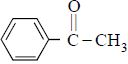
The $IUPAC$ name of the given compound is:
A
$1$-phenylethanone
B
methyl phenyl ketone
C
acetophenone
D
phenyl methyl ketone
Solution
(A) The structure provided is $C_6H_5COCH_3$.
According to $IUPAC$ nomenclature,ketones are named by replacing the suffix $-e$ of the corresponding alkane with $-one$.
For the compound $C_6H_5COCH_3$,the parent chain is an ethane chain (two carbons) attached to a phenyl group.
Thus,the $IUPAC$ name is $1$-phenylethanone (often simply called phenylethanone).
Acetophenone is the common name,and methyl phenyl ketone is another common name.
According to $IUPAC$ nomenclature,ketones are named by replacing the suffix $-e$ of the corresponding alkane with $-one$.
For the compound $C_6H_5COCH_3$,the parent chain is an ethane chain (two carbons) attached to a phenyl group.
Thus,the $IUPAC$ name is $1$-phenylethanone (often simply called phenylethanone).
Acetophenone is the common name,and methyl phenyl ketone is another common name.
0 likes
View Solution24
MediumMCQ
Identify which functional group is not present in the following molecule:-
$CH_3 - C(=O) - O - CH_2 - C(=O) - CH_2 - NH_2$
$CH_3 - C(=O) - O - CH_2 - C(=O) - CH_2 - NH_2$
A
Ester
B
Ketone
C
Amide
D
Amine
Solution
(C) Let us analyze the structure of the given molecule: $CH_3 - C(=O) - O - CH_2 - C(=O) - CH_2 - NH_2$.
$1$. The group $-C(=O)-O-$ is an $Ester$ group.
$2$. The group $-C(=O)-$ (where the carbonyl carbon is bonded to two carbon atoms) is a $Ketone$ group.
$3$. The group $-NH_2$ is a primary $Amine$ group.
$4$. An $Amide$ group requires a nitrogen atom bonded directly to a carbonyl carbon ($-C(=O)-NH_2$ or similar).
In the given structure,there is no nitrogen atom bonded to a carbonyl carbon. Therefore,the $Amide$ functional group is not present.
$1$. The group $-C(=O)-O-$ is an $Ester$ group.
$2$. The group $-C(=O)-$ (where the carbonyl carbon is bonded to two carbon atoms) is a $Ketone$ group.
$3$. The group $-NH_2$ is a primary $Amine$ group.
$4$. An $Amide$ group requires a nitrogen atom bonded directly to a carbonyl carbon ($-C(=O)-NH_2$ or similar).
In the given structure,there is no nitrogen atom bonded to a carbonyl carbon. Therefore,the $Amide$ functional group is not present.
0 likes
View Solution25
DifficultMCQ
Which of the following is correctly matched according to their common names?
A
$CH_3-CN$ Ethyl nitrile
B
$CH_3-CH(CH_3)-CHO$ Isobutyraldehyde
C
$CH_2=CH-CHO$ Allyl aldehyde
D
$CH_3-C(CH_3)(CH_3)-OH$ Neobutyl alcohol
Solution
(B) $CH_3-CH(CH_3)-CHO$ is Isobutyraldehyde.
$CH_3-CN$ is Acetonitrile or Methyl cyanide.
$CH_2=CH-CHO$ is Acrolein or Acrylaldehyde.
$CH_3-C(CH_3)(CH_3)-OH$ is tert-Butyl alcohol.
$CH_3-CN$ is Acetonitrile or Methyl cyanide.
$CH_2=CH-CHO$ is Acrolein or Acrylaldehyde.
$CH_3-C(CH_3)(CH_3)-OH$ is tert-Butyl alcohol.
0 likes
View Solution26
MediumMCQ
Which of the following is an unsymmetrical ketone?
A
$CH_3-CH(CH_3)-O-CH_2-CH_3$
B
$CH_3-CH_2-CO-CH_2-CH_3$
C
$CH_3-CH(CH_3)-CO-CH_2-CH_2-CH_3$
D
$CH_3-CO-CH_3$
Solution
(C) ketone is classified as unsymmetrical (or mixed) if the two alkyl or aryl groups attached to the carbonyl carbon atom are different.
$a.$ $CH_3-CH(CH_3)-O-CH_2-CH_3$ is an ether.
$b.$ $CH_3-CH_2-CO-CH_2-CH_3$ (Pentan-$3$-one) has two ethyl groups (symmetrical).
$c.$ $CH_3-CH(CH_3)-CO-CH_2-CH_2-CH_3$ ($2$-methylhexan-$3$-one) has an isopropyl group and a propyl group (unsymmetrical).
$d.$ $CH_3-CO-CH_3$ (Propanone) has two methyl groups (symmetrical).
$a.$ $CH_3-CH(CH_3)-O-CH_2-CH_3$ is an ether.
$b.$ $CH_3-CH_2-CO-CH_2-CH_3$ (Pentan-$3$-one) has two ethyl groups (symmetrical).
$c.$ $CH_3-CH(CH_3)-CO-CH_2-CH_2-CH_3$ ($2$-methylhexan-$3$-one) has an isopropyl group and a propyl group (unsymmetrical).
$d.$ $CH_3-CO-CH_3$ (Propanone) has two methyl groups (symmetrical).
0 likes
View Solution27
MediumMCQ
The $IUPAC$ name of the given compound is:

A
$1-$Phenylethanone
B
$2-$Phenylethanone
C
$1-$(Oxoethyl)benzene
D
$1-$(Ethyloxo)benzene
Solution
(A) The given compound is $C_6H_5COCH_3$.
In the $IUPAC$ system,ketones are named by replacing the suffix $-e$ of the corresponding alkane with $-one$.
The parent chain is the two-carbon chain (ethane),and the phenyl group is attached to the first carbon.
Therefore,the $IUPAC$ name is $1-$phenylethanone (commonly known as acetophenone).
In the $IUPAC$ system,ketones are named by replacing the suffix $-e$ of the corresponding alkane with $-one$.
The parent chain is the two-carbon chain (ethane),and the phenyl group is attached to the first carbon.
Therefore,the $IUPAC$ name is $1-$phenylethanone (commonly known as acetophenone).
0 likes
View Solution28
MediumMCQ
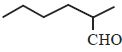
Which of the following is the correct $IUPAC$ name for the given structure?
A
$3-$Methylhexanal
B
$2-$Methylhexanal
C
Hexane$-1-$carbaldehyde
D
Hexane$-2-$carbaldehyde
Solution
(B) The given structure is an aldehyde with a $6-$carbon chain (hexane) and a methyl group attached to the second carbon atom from the aldehyde group.
According to $IUPAC$ nomenclature rules,the carbon atom of the aldehyde group $(-CHO)$ is assigned position $1$.
Counting from the aldehyde carbon,the methyl group is at the $C-2$ position.
Therefore,the correct $IUPAC$ name is $2-$methylhexanal.
According to $IUPAC$ nomenclature rules,the carbon atom of the aldehyde group $(-CHO)$ is assigned position $1$.
Counting from the aldehyde carbon,the methyl group is at the $C-2$ position.
Therefore,the correct $IUPAC$ name is $2-$methylhexanal.
0 likes
View Solution29
Easy
Write the structures of the following compounds:
$(i)$ $\alpha$-Methoxypropionaldehyde
$(ii)$ $3$-Hydroxybutanal
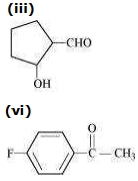
$(iii)$ $2$-Hydroxycyclopentanecarbaldehyde
$(iv)$ $4$-Oxopentanal
$(v)$ Di-sec-butyl ketone
$(vi)$ $4$-Fluoroacetophenone
$(i)$ $\alpha$-Methoxypropionaldehyde
$(ii)$ $3$-Hydroxybutanal
$(iii)$ $2$-Hydroxycyclopentanecarbaldehyde
$(iv)$ $4$-Oxopentanal
$(v)$ Di-sec-butyl ketone
$(vi)$ $4$-Fluoroacetophenone
Solution
(N/A) The structures of the given compounds are as follows:
| $(i)$ $\alpha$-Methoxypropionaldehyde | $CH_3-CH(OCH_3)-CHO$ |
| $(ii)$ $3$-Hydroxybutanal | $CH_3-CH(OH)-CH_2-CHO$ |
| $(iii)$ $2$-Hydroxycyclopentanecarbaldehyde | $C_5H_8(OH)CHO$ |
| $(iv)$ $4$-Oxopentanal | $CH_3-CO-CH_2-CH_2-CHO$ |
| $(v)$ Di-sec-butyl ketone | $CH_3-CH_2-CH(CH_3)-CO-CH(CH_3)-CH_2-CH_3$ |
| $(vi)$ $4$-Fluoroacetophenone | $F-C_6H_4-COCH_3$ |
0 likes
View Solution30
Difficult
Write the $IUPAC$ names of the following ketones and aldehydes. Wherever possible,give also common names.
$(i)$ $CH_{3}CO(CH_{2})_{6}CH_{3}$
$(ii)$ $CH_{3}CH_{2}CHBrCH_{2}CH(CH_{3})CHO$
$(iii)$ $CH_{3}(CH_{2})_{5}CHO$
$(iv)$ $Ph-CH=CH-CHO$
$(v)$ Cyclopentane ring attached to $-CHO$ group
$(vi)$ $PhCOPh$
$(i)$ $CH_{3}CO(CH_{2})_{6}CH_{3}$
$(ii)$ $CH_{3}CH_{2}CHBrCH_{2}CH(CH_{3})CHO$
$(iii)$ $CH_{3}(CH_{2})_{5}CHO$
$(iv)$ $Ph-CH=CH-CHO$
$(v)$ Cyclopentane ring attached to $-CHO$ group
$(vi)$ $PhCOPh$
Solution
(N/A) $(i)$ $CH_{3}CO(CH_{2})_{6}CH_{3}$
$IUPAC$ name: Octan$-2-$one
Common name: Methyl $n-$heptyl ketone
$(ii)$ $CH_{3}CH_{2}CHBrCH_{2}CH(CH_{3})CHO$
$IUPAC$ name: $4-$Bromo$-2-$methylhexanal
$(iii)$ $CH_{3}(CH_{2})_{5}CHO$
$IUPAC$ name: Heptanal
$(iv)$ $Ph-CH=CH-CHO$
$IUPAC$ name: $3-$phenylprop$-2-$enal
Common name: $\beta-$Phenylacrolein
$(v)$ Cyclopentanecarbaldehyde
$(vi)$ $PhCOPh$
$IUPAC$ name: Diphenylmethanone
Common name: Benzophenone
$IUPAC$ name: Octan$-2-$one
Common name: Methyl $n-$heptyl ketone
$(ii)$ $CH_{3}CH_{2}CHBrCH_{2}CH(CH_{3})CHO$
$IUPAC$ name: $4-$Bromo$-2-$methylhexanal
$(iii)$ $CH_{3}(CH_{2})_{5}CHO$
$IUPAC$ name: Heptanal
$(iv)$ $Ph-CH=CH-CHO$
$IUPAC$ name: $3-$phenylprop$-2-$enal
Common name: $\beta-$Phenylacrolein
$(v)$ Cyclopentanecarbaldehyde
$(vi)$ $PhCOPh$
$IUPAC$ name: Diphenylmethanone
Common name: Benzophenone
0 likes
View Solution31
Medium
Explain the common nomenclature of $(a)$ aldehyde compounds and $(b)$ ketone compounds.
Solution
(N/A) Aldehydes and ketones are often referred to by their common names.
$(a)$ Common names of Aldehydes:
$(i)$ The common names of aldehydes are derived from the common names of the corresponding carboxylic acids by replacing the terminal '-ic acid' with '-aldehyde'.
$(ii)$ These names often reflect the Latin or Greek origin of the source of the acid or aldehyde.
$(iii)$ The position of substituents in the carbon chain is indicated by Greek letters $\alpha, \beta, \gamma, \delta$,etc. The $\alpha$-carbon is the one directly linked to the $-CHO$ group,the $\beta$-carbon is the next,and so on.
$(iv)$ The carbon atom next to the $-CHO$ group is designated as $\alpha$: $\stackrel{\delta}{C}-\stackrel{\gamma}{C}-\stackrel{\beta}{C}-\stackrel{\alpha}{C}-CHO$.
Examples include $HCHO$ (Formaldehyde),$CH_3CHO$ (Acetaldehyde),and $\beta$-Bromobutyraldehyde.
$(b)$ Common names of Ketones:
$(i)$ Common names are obtained by naming the two alkyl or aryl groups attached to the carbonyl group $(>C=O)$ as two separate words in alphabetical order,followed by the word 'ketone'.
$(ii)$ For example,$CH_3COCH_3$ is dimethyl ketone (acetone) and $CH_3COC_2H_5$ is ethyl methyl ketone.
$(a)$ Common names of Aldehydes:
$(i)$ The common names of aldehydes are derived from the common names of the corresponding carboxylic acids by replacing the terminal '-ic acid' with '-aldehyde'.
$(ii)$ These names often reflect the Latin or Greek origin of the source of the acid or aldehyde.
$(iii)$ The position of substituents in the carbon chain is indicated by Greek letters $\alpha, \beta, \gamma, \delta$,etc. The $\alpha$-carbon is the one directly linked to the $-CHO$ group,the $\beta$-carbon is the next,and so on.
$(iv)$ The carbon atom next to the $-CHO$ group is designated as $\alpha$: $\stackrel{\delta}{C}-\stackrel{\gamma}{C}-\stackrel{\beta}{C}-\stackrel{\alpha}{C}-CHO$.
Examples include $HCHO$ (Formaldehyde),$CH_3CHO$ (Acetaldehyde),and $\beta$-Bromobutyraldehyde.
$(b)$ Common names of Ketones:
$(i)$ Common names are obtained by naming the two alkyl or aryl groups attached to the carbonyl group $(>C=O)$ as two separate words in alphabetical order,followed by the word 'ketone'.
$(ii)$ For example,$CH_3COCH_3$ is dimethyl ketone (acetone) and $CH_3COC_2H_5$ is ethyl methyl ketone.
0 likes
View Solution32
Medium
Explain the $IUPAC$ nomenclature of aldehydes and ketones.
Solution
(A) $IUPAC$ nomenclature of aldehydes and ketones:
$1$. $IUPAC$ nomenclature of Aldehydes:
- The $IUPAC$ names of open-chain aliphatic aldehydes are derived from the names of the corresponding alkanes by replacing the terminal $'e'$ with the suffix $'al'$.
- In substituted aldehydes,the carbon chain containing the aldehyde group is selected as the parent chain. The numbering starts from the aldehyde carbon,which is always assigned position $1$.
- Example: $CH_3CH_2CHO$ is Propanal.
$2$. $IUPAC$ nomenclature of Ketones:
- The $IUPAC$ names of open-chain aliphatic ketones are derived from the names of the corresponding alkanes by replacing the terminal $'e'$ with the suffix $'one'$.
- The chain is numbered in such a way that the carbonyl carbon gets the lowest possible number.
- Example: $CH_3COCH_2CH_3$ is Butan$-2-$one.
$1$. $IUPAC$ nomenclature of Aldehydes:
- The $IUPAC$ names of open-chain aliphatic aldehydes are derived from the names of the corresponding alkanes by replacing the terminal $'e'$ with the suffix $'al'$.
- In substituted aldehydes,the carbon chain containing the aldehyde group is selected as the parent chain. The numbering starts from the aldehyde carbon,which is always assigned position $1$.
- Example: $CH_3CH_2CHO$ is Propanal.
$2$. $IUPAC$ nomenclature of Ketones:
- The $IUPAC$ names of open-chain aliphatic ketones are derived from the names of the corresponding alkanes by replacing the terminal $'e'$ with the suffix $'one'$.
- The chain is numbered in such a way that the carbonyl carbon gets the lowest possible number.
- Example: $CH_3COCH_2CH_3$ is Butan$-2-$one.
0 likes
View Solution33
Difficult
Give the name and structure of the following compounds:
$(i)$ Methanal $(ii)$ Ethanal $(iii)$ $2$-Methylpropanal $(iv)$ $3$-Methylcyclohexanecarbaldehyde $(v)$ $2$-Methoxypropanal $(vi)$ Pentanal $(vii)$ Prop-$2$-enal $(viii)$ Benzene-$1,2$-dicarbaldehyde $(ix)$ $3$-Bromobenzaldehyde
$(i)$ Methanal $(ii)$ Ethanal $(iii)$ $2$-Methylpropanal $(iv)$ $3$-Methylcyclohexanecarbaldehyde $(v)$ $2$-Methoxypropanal $(vi)$ Pentanal $(vii)$ Prop-$2$-enal $(viii)$ Benzene-$1,2$-dicarbaldehyde $(ix)$ $3$-Bromobenzaldehyde
Solution
(A) The structures for the given $IUPAC$ names are as follows:
$(i)$ Methanal: $HCHO$
$(ii)$ Ethanal: $CH_3CHO$
$(iii)$ $2$-Methylpropanal: $(CH_3)_2CHCHO$
$(iv)$ $3$-Methylcyclohexanecarbaldehyde: $C_6H_{10}(CH_3)CHO$ (with the aldehyde group attached to the ring)
$(v)$ $2$-Methoxypropanal: $CH_3CH(OCH_3)CHO$
$(vi)$ Pentanal: $CH_3CH_2CH_2CH_2CHO$
$(vii)$ Prop-$2$-enal: $CH_2=CHCHO$
$(viii)$ Benzene-$1,2$-dicarbaldehyde: $C_6H_4(CHO)_2$ (ortho-substituted)
$(ix)$ $3$-Bromobenzaldehyde: $C_6H_4(Br)CHO$ (meta-substituted)
$(i)$ Methanal: $HCHO$
$(ii)$ Ethanal: $CH_3CHO$
$(iii)$ $2$-Methylpropanal: $(CH_3)_2CHCHO$
$(iv)$ $3$-Methylcyclohexanecarbaldehyde: $C_6H_{10}(CH_3)CHO$ (with the aldehyde group attached to the ring)
$(v)$ $2$-Methoxypropanal: $CH_3CH(OCH_3)CHO$
$(vi)$ Pentanal: $CH_3CH_2CH_2CH_2CHO$
$(vii)$ Prop-$2$-enal: $CH_2=CHCHO$
$(viii)$ Benzene-$1,2$-dicarbaldehyde: $C_6H_4(CHO)_2$ (ortho-substituted)
$(ix)$ $3$-Bromobenzaldehyde: $C_6H_4(Br)CHO$ (meta-substituted)
0 likes
View Solution34
Difficult
Provide the $IUPAC$ name and structure for the following compounds:
$(i)$ Propanone
$(ii)$ Butanone
$(iii)$ Hexan$-3-$one
$(iv)$ $2,4-$dimethylpentan$-3-$one
$(v)$ Pentan$-3-$one
$(vi)$ $2-$methylcyclohexanone
$(vii)$ $4-$methylpent$-3-$en$-2-$one
$(viii)$ Benzophenone
$(ix)$ Acetophenone
$(x)$ $3-$methylbutan$-2-$one
$(xi)$ $5-$hydroxy$-5-$methylhexan$-3-$one
$(xii)$ $3-$oxobutanoic acid
$(xiii)$ $3,3-$dimethylheptan$-2,6-$dione.
$(i)$ Propanone
$(ii)$ Butanone
$(iii)$ Hexan$-3-$one
$(iv)$ $2,4-$dimethylpentan$-3-$one
$(v)$ Pentan$-3-$one
$(vi)$ $2-$methylcyclohexanone
$(vii)$ $4-$methylpent$-3-$en$-2-$one
$(viii)$ Benzophenone
$(ix)$ Acetophenone
$(x)$ $3-$methylbutan$-2-$one
$(xi)$ $5-$hydroxy$-5-$methylhexan$-3-$one
$(xii)$ $3-$oxobutanoic acid
$(xiii)$ $3,3-$dimethylheptan$-2,6-$dione.
Solution
(A) The structures for the requested compounds are as follows:
$(i)$ Propanone: $CH_3COCH_3$
$(ii)$ Butanone: $CH_3COCH_2CH_3$
$(iii)$ Hexan$-3-$one: $CH_3CH_2COCH_2CH_2CH_3$
$(iv)$ $2,4-$dimethylpentan$-3-$one: $(CH_3)_2CHCOCH(CH_3)_2$
$(v)$ Pentan$-3-$one: $CH_3CH_2COCH_2CH_3$
$(vi)$ $2-$methylcyclohexanone: $\text{A}$ cyclohexanone ring with a methyl group at position $2$.
$(vii)$ $4-$methylpent$-3-$en$-2-$one: $CH_3COCH=C(CH_3)_2$
$(viii)$ Benzophenone: $C_6H_5COC_6H_5$
$(ix)$ Acetophenone: $C_6H_5COCH_3$
$(x)$ $3-$methylbutan$-2-$one: $CH_3COCH(CH_3)_2$
$(xi)$ $5-$hydroxy$-5-$methylhexan$-3-$one: $CH_3CH_2COCH_2C(OH)(CH_3)_2$
$(xii)$ $3-$oxobutanoic acid: $CH_3COCH_2COOH$
$(xiii)$ $3,3-$dimethylheptan$-2,6-$dione: $CH_3COCH_2C(CH_3)_2CH_2CH_2COCH_3$
$(i)$ Propanone: $CH_3COCH_3$
$(ii)$ Butanone: $CH_3COCH_2CH_3$
$(iii)$ Hexan$-3-$one: $CH_3CH_2COCH_2CH_2CH_3$
$(iv)$ $2,4-$dimethylpentan$-3-$one: $(CH_3)_2CHCOCH(CH_3)_2$
$(v)$ Pentan$-3-$one: $CH_3CH_2COCH_2CH_3$
$(vi)$ $2-$methylcyclohexanone: $\text{A}$ cyclohexanone ring with a methyl group at position $2$.
$(vii)$ $4-$methylpent$-3-$en$-2-$one: $CH_3COCH=C(CH_3)_2$
$(viii)$ Benzophenone: $C_6H_5COC_6H_5$
$(ix)$ Acetophenone: $C_6H_5COCH_3$
$(x)$ $3-$methylbutan$-2-$one: $CH_3COCH(CH_3)_2$
$(xi)$ $5-$hydroxy$-5-$methylhexan$-3-$one: $CH_3CH_2COCH_2C(OH)(CH_3)_2$
$(xii)$ $3-$oxobutanoic acid: $CH_3COCH_2COOH$
$(xiii)$ $3,3-$dimethylheptan$-2,6-$dione: $CH_3COCH_2C(CH_3)_2CH_2CH_2COCH_3$
0 likes
View Solution35
Medium
Explain the bond formation and structure of the carbonyl group with a suitable diagram.
Solution
(N/A) Electronic configuration of carbon and oxygen is as follows:
$C^{*} [He] 2s^{1} 2p_{x}^{1} 2p_{y}^{1} 2p_{z}^{1}$
$O [He] 2s^{2} 2p_{x}^{2} 2p_{y}^{1} 2p_{z}^{1}$
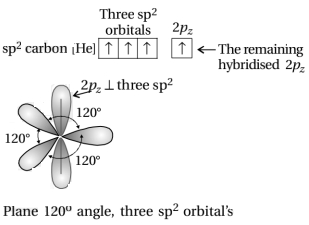
$(b)$ $(i)$ The $C=O$ bond of the carbonyl group in aldehydes and ketones is made up of one $\sigma$-bond and one $\pi$-bond. The carbonyl carbon atom is $sp^{2}$-hybridised and forms three sigma $(\sigma)$ bonds.
$(ii)$ The fourth valence electron of carbon remains in its $p$-orbital and forms a $\pi$-bond with oxygen by overlapping with the $p$-orbital of oxygen.
$(iii)$ In addition,the oxygen atom also has two non-bonding electron pairs. Thus,the carbonyl carbon and the three atoms attached to it lie in the same plane,and the $p$-electron cloud is above and below this plane $\left( C \frac{\pi}{\sigma} \ddot{O} \right)$.
$(iv)$ In carbonyl group compounds,the carbonyl carbon atom is $sp^{2}$ hybridised and forms three $sp^{2}$ hybrid orbitals.
$(v)$ One of the $sp^{2}$ hybridised orbitals of carbon overlaps with the $p$-orbital of the oxygen atom,while the $\pi$ bond is formed by the lateral overlap of the $p$-orbitals of carbon and oxygen.
$(vi)$ The remaining two hybridised $sp^{2}$ orbitals of the carbon atom form two additional $\sigma$-bonds by overlapping with the $1s$-orbital of two hydrogen atoms in formaldehyde.
$(vii)$ For any other aldehyde,two hybridised $sp^{2}$ orbitals of the carbon atom form two $\sigma$-bonds by overlapping with the $1s$-orbital of one hydrogen atom and one $sp^{3}$ hybrid orbital of an alkyl group carbon.
$(viii)$ For any ketone,two hybridised $sp^{2}$ orbitals of the carbon atom form two $\sigma$-bonds by overlapping with two $sp^{3}$ hybrid orbitals of two alkyl group carbons.
$(ix)$ All three $\sigma$-bonds lie in the same plane inclined to one another by $120^{\circ}$ as shown in the figure.
$C^{*} [He] 2s^{1} 2p_{x}^{1} 2p_{y}^{1} 2p_{z}^{1}$
$O [He] 2s^{2} 2p_{x}^{2} 2p_{y}^{1} 2p_{z}^{1}$
$(b)$ $(i)$ The $C=O$ bond of the carbonyl group in aldehydes and ketones is made up of one $\sigma$-bond and one $\pi$-bond. The carbonyl carbon atom is $sp^{2}$-hybridised and forms three sigma $(\sigma)$ bonds.
$(ii)$ The fourth valence electron of carbon remains in its $p$-orbital and forms a $\pi$-bond with oxygen by overlapping with the $p$-orbital of oxygen.
$(iii)$ In addition,the oxygen atom also has two non-bonding electron pairs. Thus,the carbonyl carbon and the three atoms attached to it lie in the same plane,and the $p$-electron cloud is above and below this plane $\left( C \frac{\pi}{\sigma} \ddot{O} \right)$.
$(iv)$ In carbonyl group compounds,the carbonyl carbon atom is $sp^{2}$ hybridised and forms three $sp^{2}$ hybrid orbitals.
$(v)$ One of the $sp^{2}$ hybridised orbitals of carbon overlaps with the $p$-orbital of the oxygen atom,while the $\pi$ bond is formed by the lateral overlap of the $p$-orbitals of carbon and oxygen.
$(vi)$ The remaining two hybridised $sp^{2}$ orbitals of the carbon atom form two additional $\sigma$-bonds by overlapping with the $1s$-orbital of two hydrogen atoms in formaldehyde.
$(vii)$ For any other aldehyde,two hybridised $sp^{2}$ orbitals of the carbon atom form two $\sigma$-bonds by overlapping with the $1s$-orbital of one hydrogen atom and one $sp^{3}$ hybrid orbital of an alkyl group carbon.
$(viii)$ For any ketone,two hybridised $sp^{2}$ orbitals of the carbon atom form two $\sigma$-bonds by overlapping with two $sp^{3}$ hybrid orbitals of two alkyl group carbons.
$(ix)$ All three $\sigma$-bonds lie in the same plane inclined to one another by $120^{\circ}$ as shown in the figure.
0 likes
View Solution36
Medium
Explain $\sigma$ and $\pi$-bond,and planarity and their bond angles in the carbonyl group.
Solution
(N/A) Electronic configuration of carbon and oxygen is as follows:
$C^{*}[He] 2s^{1} 2p_{x}^{1} 2p_{y}^{1} 2p_{z}^{1}$
$O [He] 2s^{2} 2p_{x}^{2} 2p_{y}^{1} 2p_{z}^{1}$
$(b)$ $(i)$ The $C=O$ bond of the carbonyl group in aldehydes and ketones is made up of one $\sigma$-bond and one $\pi$-bond. The carbonyl carbon atom is $sp^{2}$-hybridised and forms three sigma $(\sigma)$ bonds.
$(ii)$ The fourth valence electron of carbon remains in its $p$-orbital and forms a $\pi$-bond with oxygen by overlap with the $p$-orbital of an oxygen atom.
$(iii)$ In addition,the oxygen atom also has two non-bonding electron pairs. Thus,the carbonyl carbon and the three atoms attached to it lie in the same plane,and the $p$-electron cloud is above and below this plane $\left(C \frac{\pi}{\sigma} \ddot{O}\right)$.
$(iv)$ In carbonyl group compounds,the carbonyl carbon atom is $sp^{2}$ hybridised and forms three $sp^{2}$ hybrid orbitals.
$(v)$ One of the $sp^{2}$ hybridised orbitals of carbon overlaps with the $p$-orbital of the oxygen atom forming a $\sigma$ bond,while the $p$-orbital overlap forms the $\pi$ bond.
$(vi)$ The remaining two hybridised $sp^{2}$ orbitals of the carbon atom form two additional $\sigma$-bonds by overlapping with $1s$-orbitals of two hydrogen atoms in formaldehyde.
$(vii)$ For any other aldehyde,two hybridised $sp^{2}$ orbitals of the carbon atom form two $\sigma$-bonds by overlapping with the $1s$-orbital of one hydrogen atom and one $sp^{3}$ hybrid orbital of an alkyl group carbon.
$(viii)$ For any ketone,two hybridised $sp^{2}$ orbitals of the carbon atom form two $\sigma$-bonds by overlapping with two $sp^{3}$ hybrid orbitals of two alkyl group carbons.
$(ix)$ All three $\sigma$-bonds lie in the same plane,inclined to one another by $120^{\circ}$ as shown in the figure.
$C^{*}[He] 2s^{1} 2p_{x}^{1} 2p_{y}^{1} 2p_{z}^{1}$
$O [He] 2s^{2} 2p_{x}^{2} 2p_{y}^{1} 2p_{z}^{1}$
$(b)$ $(i)$ The $C=O$ bond of the carbonyl group in aldehydes and ketones is made up of one $\sigma$-bond and one $\pi$-bond. The carbonyl carbon atom is $sp^{2}$-hybridised and forms three sigma $(\sigma)$ bonds.
$(ii)$ The fourth valence electron of carbon remains in its $p$-orbital and forms a $\pi$-bond with oxygen by overlap with the $p$-orbital of an oxygen atom.
$(iii)$ In addition,the oxygen atom also has two non-bonding electron pairs. Thus,the carbonyl carbon and the three atoms attached to it lie in the same plane,and the $p$-electron cloud is above and below this plane $\left(C \frac{\pi}{\sigma} \ddot{O}\right)$.
$(iv)$ In carbonyl group compounds,the carbonyl carbon atom is $sp^{2}$ hybridised and forms three $sp^{2}$ hybrid orbitals.
$(v)$ One of the $sp^{2}$ hybridised orbitals of carbon overlaps with the $p$-orbital of the oxygen atom forming a $\sigma$ bond,while the $p$-orbital overlap forms the $\pi$ bond.
$(vi)$ The remaining two hybridised $sp^{2}$ orbitals of the carbon atom form two additional $\sigma$-bonds by overlapping with $1s$-orbitals of two hydrogen atoms in formaldehyde.
$(vii)$ For any other aldehyde,two hybridised $sp^{2}$ orbitals of the carbon atom form two $\sigma$-bonds by overlapping with the $1s$-orbital of one hydrogen atom and one $sp^{3}$ hybrid orbital of an alkyl group carbon.
$(viii)$ For any ketone,two hybridised $sp^{2}$ orbitals of the carbon atom form two $\sigma$-bonds by overlapping with two $sp^{3}$ hybrid orbitals of two alkyl group carbons.
$(ix)$ All three $\sigma$-bonds lie in the same plane,inclined to one another by $120^{\circ}$ as shown in the figure.
0 likes
View Solution37
Difficult
Explain: The carbonyl group is polar and possesses electrophilic and nucleophilic centers.
Solution
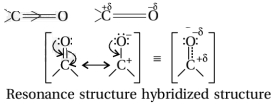
(N/A) Polar bond: In the carbonyl group,the carbon-oxygen double bond is polarized due to the higher electronegativity of oxygen $(3.5)$ compared to that of the carbon $(2.5)$ atom.
As a result,the oxygen atom tends to attract the electron cloud of the $\pi$-bond towards itself,as shown by the polarization: $C=O \leftrightarrow C^{+\delta}=O^{-\delta}$.
Carbonyl compounds have substantial dipole moments and are more polar than ethers.
$(b)$ Resonance structure: The high polarity of the carbonyl group $(C^{+\delta}=O^{-\delta})$ is explained on the basis of resonance involving a neutral structure and a dipolar structure,as shown in the figure.
$(c)$ Electrophilic (Lewis acid) and Nucleophilic (Lewis base) centers: The carbon-oxygen double bond is polarized due to the higher electronegativity of oxygen relative to carbon. Hence,the carbonyl carbon acts as an electrophilic (Lewis acid) center,and the carbonyl oxygen acts as a nucleophilic (Lewis base) center.
As a result,the oxygen atom tends to attract the electron cloud of the $\pi$-bond towards itself,as shown by the polarization: $C=O \leftrightarrow C^{+\delta}=O^{-\delta}$.
Carbonyl compounds have substantial dipole moments and are more polar than ethers.
$(b)$ Resonance structure: The high polarity of the carbonyl group $(C^{+\delta}=O^{-\delta})$ is explained on the basis of resonance involving a neutral structure and a dipolar structure,as shown in the figure.
$(c)$ Electrophilic (Lewis acid) and Nucleophilic (Lewis base) centers: The carbon-oxygen double bond is polarized due to the higher electronegativity of oxygen relative to carbon. Hence,the carbonyl carbon acts as an electrophilic (Lewis acid) center,and the carbonyl oxygen acts as a nucleophilic (Lewis base) center.
0 likes
View Solution38
Medium
Give the structures of the following compounds:
$(i)$ $4-$Nitropropiophenone
$(ii)$ $2-$Hydroxycyclopentanecarbaldehyde
$(iii)$ Phenyl acetaldehyde
$(i)$ $4-$Nitropropiophenone
$(ii)$ $2-$Hydroxycyclopentanecarbaldehyde
$(iii)$ Phenyl acetaldehyde
Solution
(N/A) $(i)$ $4-$Nitropropiophenone: The structure consists of a benzene ring with a nitro group $(-NO_2)$ at the $4-$position and a propiophenone group $(-CO-CH_2-CH_3)$ at the $1-$position.
$(ii)$ $2-$Hydroxycyclopentanecarbaldehyde: The structure consists of a cyclopentane ring with a carbaldehyde group $(-CHO)$ at position $1$ and a hydroxyl group $(-OH)$ at position $2$.
$(iii)$ Phenyl acetaldehyde: The structure consists of a phenyl group $(-C_6H_5)$ attached to an acetaldehyde group $(-CH_2-CHO)$.
$(ii)$ $2-$Hydroxycyclopentanecarbaldehyde: The structure consists of a cyclopentane ring with a carbaldehyde group $(-CHO)$ at position $1$ and a hydroxyl group $(-OH)$ at position $2$.
$(iii)$ Phenyl acetaldehyde: The structure consists of a phenyl group $(-C_6H_5)$ attached to an acetaldehyde group $(-CH_2-CHO)$.
0 likes
View Solution39
Difficult
Match the common names given in Column-$I$ with the $IUPAC$ names given in Column-$II$.
| Column-$I$ (Common names) | Column-$II$ ($IUPAC$ names) |
|---|---|
| $A$. Cinnamaldehyde | $1$. Pentanal |
| $B$. Acetophenone | $2$. Prop-$2$-en-$al$ |
| $C$. Valeraldehyde | $3$. $4$-Methylpent-$3$-en-$2$-one |
| $D$. Acrolein | $4$. $3$-Phenylprop-$2$-en-$al$ |
| $E$. Mesityl oxide | $5$. $1$-Phenylethanone |
Solution
(A-4, B-5, C-1, D-2, E-3) The correct matches are as follows:
$A$. Cinnamaldehyde is $3$-Phenylprop-$2$-en-$al$ $(4)$.
$B$. Acetophenone is $1$-Phenylethanone $(5)$.
$C$. Valeraldehyde is Pentanal $(1)$.
$D$. Acrolein is Prop-$2$-en-$al$ $(2)$.
$E$. Mesityl oxide is $4$-Methylpent-$3$-en-$2$-one $(3)$.
Therefore,the correct sequence is $A-4, B-5, C-1, D-2, E-3$.
$A$. Cinnamaldehyde is $3$-Phenylprop-$2$-en-$al$ $(4)$.
$B$. Acetophenone is $1$-Phenylethanone $(5)$.
$C$. Valeraldehyde is Pentanal $(1)$.
$D$. Acrolein is Prop-$2$-en-$al$ $(2)$.
$E$. Mesityl oxide is $4$-Methylpent-$3$-en-$2$-one $(3)$.
Therefore,the correct sequence is $A-4, B-5, C-1, D-2, E-3$.
0 likes
View Solution40
Easy
Match the formulas in column-$I$ with their corresponding names or functional group classifications in column-$II$.
| column-$I$ | column-$II$ |
|---|---|
| $(i)$ $CH_3COCH_3$ | $(a)$ Aldehyde,$(b)$ Ketone |
| $(ii)$ $CH_3CH_2CHO$ | $(c)$ Propanone,$(d)$ Oxo |
| $(iii)$ $CH_3CH_2COOH$ | $(e)$ One,$(f)$ al |
| $(g)$ Propanoic acid |
Solution
(A) $(i) \rightarrow (b), (c), (d), (e)$
$(ii) \rightarrow (a), (f)$
$(iii) \rightarrow (g)$
$(ii) \rightarrow (a), (f)$
$(iii) \rightarrow (g)$
0 likes
View Solution41
Easy
State True or False for the following statements:
$(i)$ Acetone is a propanone and there is an amide group in it.
$(ii)$ Acetone is dimethyl ketone.
$(iii)$ The formula of acetone is $CH_3COCH_3$.
$(iv)$ Acetone possesses a carbonyl group.
$(i)$ Acetone is a propanone and there is an amide group in it.
$(ii)$ Acetone is dimethyl ketone.
$(iii)$ The formula of acetone is $CH_3COCH_3$.
$(iv)$ Acetone possesses a carbonyl group.
Solution
(A) $(i)$ False: Acetone is propanone,but it contains a ketone group,not an amide group.
$(ii)$ True: Acetone is dimethyl ketone because two methyl groups are attached to the carbonyl carbon.
$(iii)$ True: The chemical formula of acetone is $CH_3COCH_3$.
$(iv)$ True: Acetone contains a carbonyl group $(>C=O)$.
$(ii)$ True: Acetone is dimethyl ketone because two methyl groups are attached to the carbonyl carbon.
$(iii)$ True: The chemical formula of acetone is $CH_3COCH_3$.
$(iv)$ True: Acetone contains a carbonyl group $(>C=O)$.
0 likes
View Solution42
Medium
In column-$I$,diagrams of the carbonyl group are given,and in column-$II$,their descriptions are given. Match column-$I$ with the correct option given in column-$II$.
| Column-$I$ (Drawing diagram) | Column-$II$ (Description) |
| :--- | :--- |
| $(A)$ Resonance structures of carbonyl group | $(i)$ In carbon-oxygen,$\pi$-electron clouds are present on the upper and lower parts of the plane. |
| $(B)$ Geometry of carbonyl group | (ii) Non-bonding $2p$ orbital which is not taking part in hybridization of carbonyl carbon and $2p$ orbital of oxygen containing one electron are parallel to each other and perpendicular to the plane. |
| $(C)$ $\sigma$-bonding in carbonyl group | (iii) Hybridization of carbonyl carbon is $sp^2$ and it has a planar triangular structure and bond angle approximately $120^{\circ}$. |
| $(D)$ $\pi$-bonding in carbonyl group | (iv) Two hybrid structures of the carbonyl group indicate that the carbon-oxygen bond is polar in nature and also the carbon atom is an electrophilic centre and the oxygen atom is a nucleophilic centre. |
| Column-$I$ (Drawing diagram) | Column-$II$ (Description) |
| :--- | :--- |
| $(A)$ Resonance structures of carbonyl group | $(i)$ In carbon-oxygen,$\pi$-electron clouds are present on the upper and lower parts of the plane. |
| $(B)$ Geometry of carbonyl group | (ii) Non-bonding $2p$ orbital which is not taking part in hybridization of carbonyl carbon and $2p$ orbital of oxygen containing one electron are parallel to each other and perpendicular to the plane. |
| $(C)$ $\sigma$-bonding in carbonyl group | (iii) Hybridization of carbonyl carbon is $sp^2$ and it has a planar triangular structure and bond angle approximately $120^{\circ}$. |
| $(D)$ $\pi$-bonding in carbonyl group | (iv) Two hybrid structures of the carbonyl group indicate that the carbon-oxygen bond is polar in nature and also the carbon atom is an electrophilic centre and the oxygen atom is a nucleophilic centre. |
Solution
(A) The correct matching is as follows:
$(A)$ Resonance structures of the carbonyl group represent the polarity of the bond,where carbon acts as an electrophilic centre and oxygen as a nucleophilic centre. Thus,$A \rightarrow iv$.
$(B)$ The geometry shows the $sp^2$ hybridized carbon with a planar triangular structure and bond angles of approximately $120^{\circ}$. Thus,$B \rightarrow iii$.
$(C)$ The $\sigma$-bonding involves the overlap of orbitals forming the skeleton of the carbonyl group. Thus,$C \rightarrow ii$ (referring to the non-bonding $2p$ orbitals perpendicular to the plane).
$(D)$ The $\pi$-bonding involves the overlap of $p$-orbitals above and below the plane. Thus,$D \rightarrow i$.
Therefore,the correct match is $A$ $\rightarrow iv, B$ $\rightarrow iii, C$ $\rightarrow ii, D$ $\rightarrow i$.
$(A)$ Resonance structures of the carbonyl group represent the polarity of the bond,where carbon acts as an electrophilic centre and oxygen as a nucleophilic centre. Thus,$A \rightarrow iv$.
$(B)$ The geometry shows the $sp^2$ hybridized carbon with a planar triangular structure and bond angles of approximately $120^{\circ}$. Thus,$B \rightarrow iii$.
$(C)$ The $\sigma$-bonding involves the overlap of orbitals forming the skeleton of the carbonyl group. Thus,$C \rightarrow ii$ (referring to the non-bonding $2p$ orbitals perpendicular to the plane).
$(D)$ The $\pi$-bonding involves the overlap of $p$-orbitals above and below the plane. Thus,$D \rightarrow i$.
Therefore,the correct match is $A$ $\rightarrow iv, B$ $\rightarrow iii, C$ $\rightarrow ii, D$ $\rightarrow i$.
0 likes
View Solution43
Medium
Match the $IUPAC$ name of the carbonyl compound in Column-$I$ with its structure in Column-$II$ and its common name in Column-$III$.
| Column-$I$ ($IUPAC$ name) | Column-$II$ (Structure) | Column-$III$ (Common name) |
|---|---|---|
| $A. 4$-oxopentanal | $i. CH_3CH_2CH_2CH_2CHO$ | $p. \text{Acetyl acetone}$ |
| $B. \text{Ethane-}1,2\text{-dial}$ | $ii. CH_3COCH_2CH_2CHO$ | $q. \text{Valeraldehyde}$ |
| $C. \text{Pentane-}2,4\text{-dione}$ | $iii. CHOCHO$ | $r. \beta\text{-acetyl propionaldehyde}$ |
| $D. \text{Pentanal}$ | $iv. CH_3COCH_2COCH_3$ | $s. \text{Glyoxal}$ |
Solution
(A) The correct matches are:
$A. 4$-oxopentanal corresponds to structure $ii$ $(CH_3COCH_2CH_2CHO)$ and common name $r$ ($\beta$-acetyl propionaldehyde).
$B. \text{Ethane-}1,2\text{-dial}$ corresponds to structure $iii$ $(CHOCHO)$ and common name $s$ (Glyoxal).
$C. \text{Pentane-}2,4\text{-dione}$ corresponds to structure $iv$ $(CH_3COCH_2COCH_3)$ and common name $p$ (Acetyl acetone).
$D. \text{Pentanal}$ corresponds to structure $i$ $(CH_3CH_2CH_2CH_2CHO)$ and common name $q$ (Valeraldehyde).
Thus,the correct sequence is $A-ii-r, B-iii-s, C-iv-p, D-i-q$.
$A. 4$-oxopentanal corresponds to structure $ii$ $(CH_3COCH_2CH_2CHO)$ and common name $r$ ($\beta$-acetyl propionaldehyde).
$B. \text{Ethane-}1,2\text{-dial}$ corresponds to structure $iii$ $(CHOCHO)$ and common name $s$ (Glyoxal).
$C. \text{Pentane-}2,4\text{-dione}$ corresponds to structure $iv$ $(CH_3COCH_2COCH_3)$ and common name $p$ (Acetyl acetone).
$D. \text{Pentanal}$ corresponds to structure $i$ $(CH_3CH_2CH_2CH_2CHO)$ and common name $q$ (Valeraldehyde).
Thus,the correct sequence is $A-ii-r, B-iii-s, C-iv-p, D-i-q$.
0 likes
View Solution44
MediumMCQ
Mesityl oxide is a common name of
A
$2,4-$Dimethylpentan$-3-$one
B
$3-$Methylcyclohexanecarbaldehyde
C
$2-$Methylcyclohexanone
D
$4-$Methylpent$-3-$en$-2-$one
Solution
(D) Mesityl oxide is an $\alpha, \beta-$unsaturated ketone formed by the aldol condensation of acetone.
Its chemical structure is $(CH_3)_2C=CHCOCH_3$.
According to $IUPAC$ nomenclature,the longest carbon chain containing the ketone group has $5$ carbons.
The double bond is at position $3$ and the ketone group is at position $2$.
There is a methyl group at position $4$.
Therefore,the $IUPAC$ name is $4-$Methylpent$-3-$en$-2-$one.
Its chemical structure is $(CH_3)_2C=CHCOCH_3$.
According to $IUPAC$ nomenclature,the longest carbon chain containing the ketone group has $5$ carbons.
The double bond is at position $3$ and the ketone group is at position $2$.
There is a methyl group at position $4$.
Therefore,the $IUPAC$ name is $4-$Methylpent$-3-$en$-2-$one.
0 likes
View Solution45
MediumMCQ
The molecule having a formyl group is
A
acetone
B
acetaldehyde
C
acetic acid
D
acetic anhydride
Solution
(B)
$A$ formyl group consists of a carbonyl group attached to a hydrogen atom,represented as the $-CHO$ group.
The structures of the given organic compounds are as follows:
$(i)$ Acetone: $CH_3-CO-CH_3$
$(ii)$ Acetaldehyde: $CH_3-CHO$
$(iii)$ Acetic acid: $CH_3-COOH$
$(iv)$ Acetic anhydride: $(CH_3CO)_2O$
Since acetaldehyde contains the $-CHO$ group,it is the correct answer.
Thus,the correct option is $(b)$.
$A$ formyl group consists of a carbonyl group attached to a hydrogen atom,represented as the $-CHO$ group.
The structures of the given organic compounds are as follows:
$(i)$ Acetone: $CH_3-CO-CH_3$
$(ii)$ Acetaldehyde: $CH_3-CHO$
$(iii)$ Acetic acid: $CH_3-COOH$
$(iv)$ Acetic anhydride: $(CH_3CO)_2O$
Since acetaldehyde contains the $-CHO$ group,it is the correct answer.
Thus,the correct option is $(b)$.
0 likes
View Solution46
DifficultMCQ
Which of the following is a simple (symmetrical) ketone?
A
Acetophenone
B
Butanone
C
Benzophenone
D
Pentan-$2$-one
Solution
(C) simple or symmetrical ketone is one in which both alkyl or aryl groups attached to the carbonyl carbon are identical.
Benzophenone,with the structure $(C_6H_5)_2C=O$,has two phenyl groups attached to the carbonyl carbon,making it a symmetrical ketone.
Acetophenone $(C_6H_5COCH_3)$,Butanone $(CH_3COCH_2CH_3)$,and Pentan-$2$-one $(CH_3COCH_2CH_2CH_3)$ are all mixed or unsymmetrical ketones.
Benzophenone,with the structure $(C_6H_5)_2C=O$,has two phenyl groups attached to the carbonyl carbon,making it a symmetrical ketone.
Acetophenone $(C_6H_5COCH_3)$,Butanone $(CH_3COCH_2CH_3)$,and Pentan-$2$-one $(CH_3COCH_2CH_2CH_3)$ are all mixed or unsymmetrical ketones.
0 likes
View Solution47
EasyMCQ
Which of the following aldehydes has a buttery odour?
A
Crotonaldehyde
B
Benzaldehyde
C
Butyraldehyde
D
Cinnamaldehyde
Solution
(C) Butyraldehyde $(CH_3CH_2CH_2CHO)$ is known for its characteristic buttery or rancid butter-like odour.
0 likes
View Solution48
EasyMCQ
What is the $IUPAC$ name of mesityl oxide?
A
$4-$methylpent$-4-$oxo$-3-$en
B
$2-$methylpent$-4-$oxo-ene
C
$2-$methylpent$-2-$en$-4-$one
D
$4-$methylpent$-3-$en$-2-$one
Solution
(D) The structure of mesityl oxide is $(CH_3)_2C=CHCOCH_3$.
To determine the $IUPAC$ name,we identify the longest carbon chain containing the principal functional group (ketone) and the double bond.
The chain has $5$ carbon atoms,so the parent alkane is pentane.
The ketone group is at position $2$,and the double bond starts at position $3$.
There is a methyl substituent at position $4$.
Thus,the $IUPAC$ name is $4-$methylpent$-3-$en$-2-$one.
To determine the $IUPAC$ name,we identify the longest carbon chain containing the principal functional group (ketone) and the double bond.
The chain has $5$ carbon atoms,so the parent alkane is pentane.
The ketone group is at position $2$,and the double bond starts at position $3$.
There is a methyl substituent at position $4$.
Thus,the $IUPAC$ name is $4-$methylpent$-3-$en$-2-$one.
0 likes
View Solution49
MediumMCQ
What is the $IUPAC$ name of mesityl oxide?
A
$4-$Methylbenzaldehyde
B
$2-$Bromohexan$-3-$one
C
$4-$Methylpent$-3-$en$-2-$one
D
$1-$Phenylbutan$-2-$one
Solution
(C) The structure of mesityl oxide is $(CH_3)_2C=CHCOCH_3$.
To name this compound according to $IUPAC$ rules:
$1$. Identify the longest carbon chain containing the functional group (ketone) and the double bond. The chain has $5$ carbon atoms,so the parent alkane is pentane.
$2$. Number the chain starting from the end closer to the ketone group: $C_1$ is the methyl carbon,$C_2$ is the carbonyl carbon,$C_3$ is the $CH$ group,$C_4$ is the $C$ group,and $C_5$ is the methyl group attached to $C_4$.
$3$. The ketone is at position $2$,and the double bond starts at position $3$. There is a methyl group at position $4$.
$4$. Combining these,the name is $4-$methylpent$-3-$en$-2-$one.
To name this compound according to $IUPAC$ rules:
$1$. Identify the longest carbon chain containing the functional group (ketone) and the double bond. The chain has $5$ carbon atoms,so the parent alkane is pentane.
$2$. Number the chain starting from the end closer to the ketone group: $C_1$ is the methyl carbon,$C_2$ is the carbonyl carbon,$C_3$ is the $CH$ group,$C_4$ is the $C$ group,and $C_5$ is the methyl group attached to $C_4$.
$3$. The ketone is at position $2$,and the double bond starts at position $3$. There is a methyl group at position $4$.
$4$. Combining these,the name is $4-$methylpent$-3-$en$-2-$one.
0 likes
View Solution50
EasyMCQ
Number of oxygen atoms present in salicylaldehyde are
A
$3$
B
$1$
C
$2$
D
$4$
Solution
(C) The chemical formula of salicylaldehyde is $C_7H_6O_2$.
It consists of a benzene ring substituted with an aldehyde group $(-CHO)$ and a hydroxyl group $(-OH)$ at the ortho position.
Looking at the structure,there is one oxygen atom in the aldehyde group and one oxygen atom in the hydroxyl group.
Therefore,the total number of oxygen atoms present in salicylaldehyde is $1 + 1 = 2$.
It consists of a benzene ring substituted with an aldehyde group $(-CHO)$ and a hydroxyl group $(-OH)$ at the ortho position.
Looking at the structure,there is one oxygen atom in the aldehyde group and one oxygen atom in the hydroxyl group.
Therefore,the total number of oxygen atoms present in salicylaldehyde is $1 + 1 = 2$.
0 likes
View Solution8-1.Aldehydes and Ketones — Introduction · Frequently Asked Questions
1Are these 8-1.Aldehydes and Ketones questions useful for JEE and NEET?
Yes. All questions in this section are mapped to JEE Main and NEET exam patterns. Previous year questions from JEE Main, NEET, GUJCET and state-level exams are included with full solutions.
2Can I switch to Hindi or Gujarati for these questions?
Yes. Use the language tabs in the hero section or the sidebar to view the same questions and solutions in English, Hindi or Gujarati.
3How do I generate a question paper from this subtopic?
Use the Vedclass Exam Paper Generator — select the chapter and subtopic, set difficulty, and generate Sets A, B, C, D automatically. First 3 chapters of every subject are free.
Vedclass Products
For Students
Vedclass Test Series
Mock tests in real JEE/NEET style with performance analysis. 5-day free trial.
Start Free TrialFor Teachers
Exam Paper Generator
Generate Set A/B/C/D papers from this chapter in 2 minutes. 3 chapters free.
Try FreeFor Institutes
Online Exam Module
Live online exams with unlimited students, 360° analytics & white-label branding.
See DemoFor Teachers & Institutes
Generate a 8-1.Aldehydes and Ketones Exam Paper in 2 Minutes
Select subtopic & difficulty — Sets A, B, C, D auto-generated with No Repeat logic.
First 3 chapters of every subject are free — no payment required.