
A English
Pollen Pistil Interaction Questions in English
Class 12 Biology · Sexual Reproduction in Flowering Plants · Pollen Pistil Interaction
92+
Questions
English
Language
100%
With Solutions
Showing 42 of 92 questions in English
51
MediumMCQ
Name the part of the gynoecium that determines the compatible nature of the pollen grain.
A
Ovary
B
Style
C
Stigma
D
Ovule
Solution
(C) The $Stigma$ is the part of the gynoecium that determines the compatible nature of the pollen grain.
The pistil has the capacity to recognize suitable (right type) or unsuitable (wrong type) pollen grains.
If the pollen grain is of the right type, the pistil accepts it and promotes post-pollination events that lead to fertilization.
If the pollen is of the wrong type, the pistil rejects the pollen.
The ability of the pistil to recognize the pollen, followed by its acceptance or rejection, is the result of a continuous chemical dialogue between the pollen grain and the pistil.
The pistil has the capacity to recognize suitable (right type) or unsuitable (wrong type) pollen grains.
If the pollen grain is of the right type, the pistil accepts it and promotes post-pollination events that lead to fertilization.
If the pollen is of the wrong type, the pistil rejects the pollen.
The ability of the pistil to recognize the pollen, followed by its acceptance or rejection, is the result of a continuous chemical dialogue between the pollen grain and the pistil.
0 likes
View Solution52
Easy
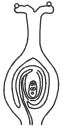
In the diagram given below,show the path of a pollen tube from the pollen on the stigma into the embryo sac. Name the components of the egg apparatus.
Solution
(N/A) After successful pollination,the pollen grain germinates on the stigma. $A$ pollen tube emerges from one of the germ pores. The pollen tube grows through the tissues of the style and reaches the ovary.
Upon reaching the ovule,the pollen tube enters the embryo sac,typically through the micropyle. The filiform apparatus present at the micropylar end of the synergids guides the entry of the pollen tube.
Once inside the synergid,the pollen tube ruptures to release two male gametes. One male gamete fuses with the egg cell (syngamy) to form a zygote,while the other male gamete fuses with the two polar nuclei (triple fusion) to form the primary endosperm nucleus $(PEN)$.
The egg apparatus consists of two synergids and one egg cell.
Upon reaching the ovule,the pollen tube enters the embryo sac,typically through the micropyle. The filiform apparatus present at the micropylar end of the synergids guides the entry of the pollen tube.
Once inside the synergid,the pollen tube ruptures to release two male gametes. One male gamete fuses with the egg cell (syngamy) to form a zygote,while the other male gamete fuses with the two polar nuclei (triple fusion) to form the primary endosperm nucleus $(PEN)$.
The egg apparatus consists of two synergids and one egg cell.
0 likes
View Solution53
EasyMCQ
What does the pollen tube transport?
A
Pollen grains
B
Female gametes
C
Male gametes
D
Stamens
Solution
(C) The pollen tube is a tubular structure produced by the pollen grain when it germinates on the stigma. Its primary function is to transport the male gametes from the pollen grain to the ovule,where fertilization occurs. Therefore,the pollen tube transports the male gametes.
0 likes
View Solution54
MediumMCQ
The period of pollen viability depends on which of the following factors?
A
Size and nucleus of the pollen grain
B
Prevailing temperature and humidity
C
Dehiscence of the anther
D
Both $A$ and $B$
Solution
(B) The viability of pollen grains is the duration for which they remain functional to germinate and produce a pollen tube.
This period is highly variable and depends primarily on the environmental conditions,specifically the prevailing temperature and humidity of the atmosphere.
While some pollen grains (like those of wheat and rice) lose viability within $30$ minutes of their release,others (like those of some members of Rosaceae,Leguminosae,and Solanaceae) can remain viable for months.
Therefore,the correct factor influencing this duration is the prevailing temperature and humidity.
This period is highly variable and depends primarily on the environmental conditions,specifically the prevailing temperature and humidity of the atmosphere.
While some pollen grains (like those of wheat and rice) lose viability within $30$ minutes of their release,others (like those of some members of Rosaceae,Leguminosae,and Solanaceae) can remain viable for months.
Therefore,the correct factor influencing this duration is the prevailing temperature and humidity.
0 likes
View Solution55
MediumMCQ
Which structure guides the entry of the pollen tube into the synergids?
A
Egg cell
B
Antipodal cell
C
Egg apparatus
D
Filiform apparatus
Solution
(D) The $filiform$ $apparatus$ is a specialized cellular thickening located at the micropylar end of the synergids. Its primary function is to secrete chemical substances that guide the entry of the pollen tube into the synergids during the process of fertilization in angiosperms.
0 likes
View Solution56
MediumMCQ
Which part of the flower has the ability to recognize the pollen grain?
A
Stigma
B
Anther
C
Ovule
D
Ovary
Solution
(A) The process of pollen-pistil interaction involves a chemical dialogue between the pollen grain and the pistil.
The $Stigma$ of the flower acts as the landing platform for pollen grains.
It possesses the ability to recognize the pollen grain, specifically whether it is of the right type (compatible) or the wrong type (incompatible).
If the pollen is compatible, the $Stigma$ accepts it and promotes post-pollination events like pollen tube germination.
Therefore, the correct answer is $A$.
The $Stigma$ of the flower acts as the landing platform for pollen grains.
It possesses the ability to recognize the pollen grain, specifically whether it is of the right type (compatible) or the wrong type (incompatible).
If the pollen is compatible, the $Stigma$ accepts it and promotes post-pollination events like pollen tube germination.
Therefore, the correct answer is $A$.
0 likes
View Solution57
MediumMCQ
If the pollen grain is compatible,the pistil accepts it and promotes which of the following events?
A
Pre-pollination event
B
Post-pollination event
C
Inhibition of pollen tube
D
All of the above
Solution
(B) When a pollen grain is compatible,it lands on the stigma and absorbs water and nutrients.
This triggers the germination of the pollen grain,resulting in the formation of a pollen tube.
This process is a crucial part of the post-pollination events that lead to fertilization.
Therefore,the pistil accepts the compatible pollen and promotes post-pollination events.
This triggers the germination of the pollen grain,resulting in the formation of a pollen tube.
This process is a crucial part of the post-pollination events that lead to fertilization.
Therefore,the pistil accepts the compatible pollen and promotes post-pollination events.
0 likes
View Solution58
MediumMCQ
If the pollen grain is incompatible,the pistil...
A
inhibits pollen germination
B
inhibits pollen tube growth
C
causes ovary dehiscence
D
both $A$ and $B$
Solution
(D) The pollen-pistil interaction is a dynamic process involving pollen recognition followed by promotion or inhibition of the pollen.
If the pollen grain is incompatible (i.e.,from a different species or self-incompatible),the pistil rejects the pollen by preventing pollen germination on the stigma or by inhibiting the growth of the pollen tube in the style.
Therefore,both $A$ and $B$ are correct mechanisms of rejection.
If the pollen grain is incompatible (i.e.,from a different species or self-incompatible),the pistil rejects the pollen by preventing pollen germination on the stigma or by inhibiting the growth of the pollen tube in the style.
Therefore,both $A$ and $B$ are correct mechanisms of rejection.
0 likes
View Solution59
MediumMCQ
What acts as a mediator in the pollen-pistil interaction?
A
Physical factors
B
Biological agents
C
Chemical components
D
Abiotic agents
Solution
(C) Pollen-pistil interaction is a dynamic process involving the recognition of compatible pollen by the pistil.
This interaction is mediated by chemical components.
The pistil has the ability to recognize the pollen,whether it is of the right type (compatible) or of the wrong type (incompatible).
If the pollen is compatible,the pistil accepts it and promotes post-pollination events that lead to fertilization.
This recognition is achieved through a continuous dialogue between pollen grains and the pistil,which is mediated by chemical components released by the pollen and the pistil.
This interaction is mediated by chemical components.
The pistil has the ability to recognize the pollen,whether it is of the right type (compatible) or of the wrong type (incompatible).
If the pollen is compatible,the pistil accepts it and promotes post-pollination events that lead to fertilization.
This recognition is achieved through a continuous dialogue between pollen grains and the pistil,which is mediated by chemical components released by the pollen and the pistil.
0 likes
View Solution60
MediumMCQ
In pollen grains released at the $2$-celled stage,where are the male gametes formed?
A
In the anther
B
In the pollen tube
C
In the microsporangium
D
In the megasporangium
Solution
(B) In many angiosperms,pollen grains are shed at the $2$-celled stage. These two cells consist of a vegetative cell and a generative cell.
When these pollen grains land on the stigma,they germinate and produce a pollen tube.
The generative cell divides mitotically within the pollen tube to form two male gametes.
Therefore,the male gametes are formed inside the pollen tube.
When these pollen grains land on the stigma,they germinate and produce a pollen tube.
The generative cell divides mitotically within the pollen tube to form two male gametes.
Therefore,the male gametes are formed inside the pollen tube.
0 likes
View Solution61
MediumMCQ
What is the function of filiform apparatus?
A
Formation of pollen tube
B
Guiding the entry of pollen tube into the synergid
C
Inhibition of pollen tube
D
Formation of gametes
Solution
(B) The filiform apparatus is a specialized cellular thickening present at the micropylar end of the synergid cells in the embryo sac of angiosperms.
Its primary function is to secrete chemical substances that guide the pollen tube into the synergid cell during the process of fertilization.
Therefore,it plays a crucial role in pollen-pistil interaction.
Its primary function is to secrete chemical substances that guide the pollen tube into the synergid cell during the process of fertilization.
Therefore,it plays a crucial role in pollen-pistil interaction.
0 likes
View Solution62
MediumMCQ
What is the collective term for the events starting from the deposition of pollen grains on the stigma to the entry of the pollen tube into the ovule?
A
Pollen-pollen tube interactions
B
Pollen-anther interactions
C
Pollen-ovule interactions
D
Pollen-pistil interactions
Solution
(D) The process starting from the landing of pollen grains on the stigma until the pollen tube enters the ovule is collectively known as $Pollen-Pistil$ interaction.
This is a dynamic process involving pollen recognition followed by promotion or inhibition of the pollen tube growth.
It is a dialogue between the pollen grain and the pistil mediated by chemical components of the pollen interacting with those of the pistil.
This is a dynamic process involving pollen recognition followed by promotion or inhibition of the pollen tube growth.
It is a dialogue between the pollen grain and the pistil mediated by chemical components of the pollen interacting with those of the pistil.
0 likes
View Solution63
MediumMCQ
Which solution can be used to induce the germination of pollen grains and the formation of a pollen tube in plants?
A
$10 \%$ sugar solution
B
$10 \%$ protein solution
C
$10 \%$ lipid solution
D
$10 \%$ alcohol solution
Solution
(A) In laboratory experiments,the germination of pollen grains can be observed by placing them in a nutrient medium. $A$ $10 \%$ sugar (sucrose) solution provides the necessary osmotic pressure and energy source to stimulate the pollen grain to germinate and produce a pollen tube. This process mimics the conditions found on the stigma of a flower.
0 likes
View Solution64
MediumMCQ
In which cell's cytoplasm are both male gametes first released?
A
Antipodal cells
B
Synergid cell
C
Central cell
D
Egg cell
Solution
(B) During the process of double fertilization in angiosperms,the pollen tube enters the ovule through the micropyle.
After entering the ovule,the pollen tube enters one of the two synergids through the filiform apparatus.
Once inside the synergid,the pollen tube ruptures and releases both male gametes into the cytoplasm of the synergid cell.
From there,one male gamete moves towards the egg cell to form the zygote,and the other moves towards the central cell to form the primary endosperm nucleus $(PEN)$.
After entering the ovule,the pollen tube enters one of the two synergids through the filiform apparatus.
Once inside the synergid,the pollen tube ruptures and releases both male gametes into the cytoplasm of the synergid cell.
From there,one male gamete moves towards the egg cell to form the zygote,and the other moves towards the central cell to form the primary endosperm nucleus $(PEN)$.
0 likes
View Solution65
EasyMCQ
Who discovered the pollen tube?
A
Amici
B
Hofmeister
C
Nemec
D
Camerarius
Solution
(A) The pollen tube was first discovered by Giovanni Battista Amici in $1824$ while studying the process of fertilization in the orchid plant. He observed the growth of the pollen tube from the pollen grain towards the ovule.
0 likes
View Solution66
EasyMCQ
Which of the following stimulates the growth of the pollen tube?
A
Magnesium
B
Potassium
C
Starch
D
Boron
Solution
(D) The growth of the pollen tube is significantly stimulated by the presence of $Boron$.
$Boron$ plays a crucial role in the germination of pollen grains and the elongation of the pollen tube by facilitating the uptake of sugar and its translocation.
It also helps in the synthesis of cell wall components required for the rapid growth of the pollen tube towards the ovule.
$Boron$ plays a crucial role in the germination of pollen grains and the elongation of the pollen tube by facilitating the uptake of sugar and its translocation.
It also helps in the synthesis of cell wall components required for the rapid growth of the pollen tube towards the ovule.
0 likes
View Solution67
EasyMCQ
Which part functions as a landing platform for the pollen grains in flowering plants?
A
Style
B
Stigma
C
Ovary
D
Ovules
Solution
(B) In flowering plants,the gynoecium consists of the pistil or carpel. The pistil has three parts: the stigma,the style,and the ovary. The stigma serves as a landing platform for pollen grains during the process of pollination.
0 likes
View Solution68
MediumMCQ
The germination of pollen grain results in the formation of
A
Primary endosperm nucleus
B
Embryo
C
Pollen tube
D
Polar nuclei
Solution
(C) When a pollen grain lands on the stigma,it absorbs moisture and nutrients. This process triggers the germination of the pollen grain,which results in the formation of a pollen tube. The pollen tube grows through the style to reach the ovary,carrying the male gametes to the embryo sac for fertilization.
0 likes
View Solution69
EasyMCQ
The pollen tube enters the embryo sac through:
A
Central cell
B
Synergid cells
C
Antipodal cells
D
Egg cell
Solution
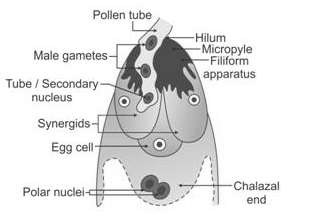
(B) The pollen tube enters the embryo sac through one of the synergid cells.
This entry is guided by the filiform apparatus,which is a specialized cellular thickening present at the micropylar end of the synergid cells.
The synergid cells are located at the micropylar end of the ovule.
This entry is guided by the filiform apparatus,which is a specialized cellular thickening present at the micropylar end of the synergid cells.
The synergid cells are located at the micropylar end of the ovule.
0 likes
View Solution70
EasyMCQ
At which temperature are pollen grains stored (in $^{\circ} C$)?
A
$-196$
B
$196$
C
$10$
D
$0$
Solution
(A) Pollen grains are stored at $-196^{\circ} C$,which is the temperature of liquid nitrogen.
This process is known as cryopreservation.
At this extremely low temperature,the metabolic activities of the pollen grains are suspended,allowing them to remain viable for long periods.
Such stored pollen can be used in pollen banks,similar to seed banks,for crop breeding experiments and conservation purposes.
This process is known as cryopreservation.
At this extremely low temperature,the metabolic activities of the pollen grains are suspended,allowing them to remain viable for long periods.
Such stored pollen can be used in pollen banks,similar to seed banks,for crop breeding experiments and conservation purposes.
0 likes
View Solution71
EasyMCQ
The entry of the pollen tube into the ovule through the micropyle is known as:
A
Mesogamy
B
Porogamy
C
Chalazogamy
D
None of these
Solution
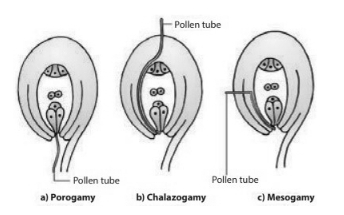
(B) The entry of the pollen tube into the ovule can occur through different routes:
$1$. $Porogamy$: The pollen tube enters through the micropyle. This is the most common method.
$2$. $Chalazogamy$: The pollen tube enters through the chalaza.
$3$. $Mesogamy$: The pollen tube enters through the integuments or the funiculus.
Since the question specifies entry through the micropyle,the correct term is $Porogamy$.
$1$. $Porogamy$: The pollen tube enters through the micropyle. This is the most common method.
$2$. $Chalazogamy$: The pollen tube enters through the chalaza.
$3$. $Mesogamy$: The pollen tube enters through the integuments or the funiculus.
Since the question specifies entry through the micropyle,the correct term is $Porogamy$.
0 likes
View Solution72
MediumMCQ
What is the function and location of the filiform apparatus in synergids?
A
Guide the pollen tube
B
Guide the style for development
C
Present near the micropylar end
D
Both $(a)$ and $(c)$
Solution
(D) The filiform apparatus consists of special cellular thickenings at the micropylar end of the synergids. Its primary function is to secrete chemical substances that guide the entry of the pollen tube into the synergid. Therefore,both statements $(a)$ and $(c)$ are correct.
0 likes
View Solution73
EasyMCQ
The movement of the pollen tube is called:
A
Chemotropism
B
Thermotaxis
C
Thermonastic
D
Hydrotropism
Solution
(A) The movement of the pollen tube towards the embryo sac is known as chemotropism. This occurs because the pollen tube grows in response to chemical gradients,specifically substances like calcium ions,boron,and carbohydrates secreted by the synergids within the ovule.
0 likes
View Solution74
MediumMCQ
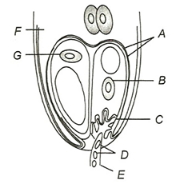
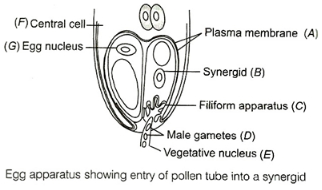
The diagram shows the entry of a pollen tube into the embryo sac. Identify $A$ to $G$ in the diagram.
A
$A-Synergid, B-Filiform apparatus, C-Male gamete, D-Plasma membrane, E-Central cell, F-Egg nucleus, G-Vegetative nucleus$
B
$A-Filiform apparatus, B-Central cell, C-Egg nucleus, D-Vegetative nucleus, E-Male gamete, F-Synergid, G-Plasma membrane$
C
$A-Plasma membrane, B-Synergid, C-Filiform apparatus, D-Male gamete, E-Vegetative nucleus, F-Central cell, G-Egg nucleus$
D
$A-Central cell, B-Egg nucleus, C-Vegetative nucleus, D-Male gamete, E-Synergid, F-Plasma membrane$
Solution
(C) After entering the ovule, the pollen tube is attracted toward the micropylar end. The attractant is secreted by the filiform apparatus. The pollen tube pierces one of the two synergids and releases its gametes. Out of the two male gametes, one fuses with the egg to perform generative fertilization (syngamy), which gives rise to the diploid zygote. The nucleus of the second male gamete fuses with the two haploid polar nuclei to form the triploid endosperm nucleus. This second fertilization is called vegetative fertilization.
0 likes
View Solution75
MediumMCQ
What does the filiform apparatus do at the entrance into the ovule?
A
It helps in the entry of the pollen tube into a synergid
B
It prevents the entry of more than one pollen tube into the embryo sac
C
It brings about the opening of the pollen tube
D
It guides the pollen tube from a synergid to the egg
Solution
(A) Synergid cells are characterized by the presence of finger-like projections called the filiform apparatus,which are attached to their wall at the micropylar end. The primary function of this filiform apparatus is to secrete chemical substances that attract and guide the pollen tube into the synergid.
0 likes
View Solution76
EasyMCQ
The structures which guide the pollen tube into the synergid are:
A
Antipodals
B
Germ pore
C
Aril
D
Filiform apparatus
Solution
(D) The $filiform \text{ apparatus}$ is a specialized cellular thickening located at the micropylar end of the synergid cells in the embryo sac.
Its primary function is to secrete chemical substances that attract and guide the pollen tube into the synergid.
Therefore, the correct answer is $D$.
Its primary function is to secrete chemical substances that attract and guide the pollen tube into the synergid.
Therefore, the correct answer is $D$.
0 likes
View Solution77
MediumMCQ
Pollen-pistil interaction is:
A
Chemically mediated process
B
Dynamic process
C
Genetically controlled process
D
More than one option is correct
Solution
(D) Pollen-pistil interaction is a dynamic process that involves chemical signaling between the pollen grain and the stigma. It is also a genetically controlled process where the pistil recognizes the compatible pollen. Since both chemical mediation and genetic control are involved,the correct answer is that more than one option is correct.
0 likes
View Solution78
MediumMCQ
$A$: Filiform apparatus guides the pollen tube into the synergids.
$R$: It is a special cellular thickening at the micropylar tip to secrete chemotropic stimulus.
$R$: It is a special cellular thickening at the micropylar tip to secrete chemotropic stimulus.
A
Assertion and Reason both are correct and Reason is the correct explanation of Assertion.
B
Assertion and Reason both are correct but Reason is not the correct explanation of Assertion.
C
Assertion is correct,but Reason is incorrect.
D
Both Assertion and Reason are incorrect.
Solution
(A) The filiform apparatus consists of finger-like projections of the synergid cell wall that extend into the cytoplasm of the synergid.
These structures are located at the micropylar end of the synergids.
Their primary function is to guide the entry of the pollen tube into the synergids by secreting chemical substances (chemotropic stimulus).
Therefore,both the Assertion and the Reason are correct,and the Reason provides the correct explanation for the Assertion.
These structures are located at the micropylar end of the synergids.
Their primary function is to guide the entry of the pollen tube into the synergids by secreting chemical substances (chemotropic stimulus).
Therefore,both the Assertion and the Reason are correct,and the Reason provides the correct explanation for the Assertion.
0 likes
View Solution79
MediumMCQ
$A$: Initial growth of the pollen tube takes place at the expense of food present in the stigma and style.
$R$: The pollen tube travels intracellularly and chemotactically.
$R$: The pollen tube travels intracellularly and chemotactically.
A
Assertion and Reason both are correct and Reason is the correct explanation of Assertion.
B
Assertion and Reason both are correct but Reason is not the correct explanation of Assertion.
C
Assertion is correct,but Reason is incorrect.
D
Both Assertion and Reason are incorrect.
Solution
(C) The initial growth of the pollen tube is supported by the food reserves present within the pollen grain itself.
As the pollen tube grows further through the stigma and style,it utilizes the nutrients available in the tissues of the pistil.
Therefore,the Assertion is correct.
The pollen tube grows through the style towards the ovary,guided by chemical signals (chemotaxis) released by the synergids in the ovule.
It typically travels through the intercellular spaces of the style,not intracellularly.
Thus,the Reason is incorrect because the movement is intercellular,not intracellular.
As the pollen tube grows further through the stigma and style,it utilizes the nutrients available in the tissues of the pistil.
Therefore,the Assertion is correct.
The pollen tube grows through the style towards the ovary,guided by chemical signals (chemotaxis) released by the synergids in the ovule.
It typically travels through the intercellular spaces of the style,not intracellularly.
Thus,the Reason is incorrect because the movement is intercellular,not intracellular.
0 likes
View Solution80
MediumMCQ
$A$: Certain proteins of pollen origin identify the compatible stigma.
$R$: Compatibility proteins are located in the ektexine.
$R$: Compatibility proteins are located in the ektexine.
A
Assertion and Reason both are correct and Reason is the correct explanation of Assertion.
B
Assertion and Reason both are correct but Reason is not the correct explanation of Assertion.
C
Assertion is correct,but Reason is incorrect.
D
Both Assertion and Reason are incorrect.
Solution
(A) The pollen-pistil interaction is a dynamic process involving chemical dialogue between the pollen grain and the stigma.
$A$: It is a well-established fact that specific proteins present on the surface of the pollen grain interact with the stigma to determine compatibility.
$R$: These compatibility proteins are indeed located in the outer layer of the pollen wall,known as the ektexine (part of the exine).
Since the interaction between the pollen and the stigma is mediated by these specific proteins located in the ektexine,the Reason correctly explains the Assertion.
$A$: It is a well-established fact that specific proteins present on the surface of the pollen grain interact with the stigma to determine compatibility.
$R$: These compatibility proteins are indeed located in the outer layer of the pollen wall,known as the ektexine (part of the exine).
Since the interaction between the pollen and the stigma is mediated by these specific proteins located in the ektexine,the Reason correctly explains the Assertion.
0 likes
View Solution81
EasyMCQ
Which element is responsible for the germination of pollen grains?
A
Boron
B
Molybdenum
C
Copper
D
Chlorine
Solution
(A) Boron is an essential micronutrient for plants. It plays a crucial role in pollen tube growth and the germination of pollen grains. Deficiency of boron leads to the failure of pollen germination and poor fruit or seed set.
0 likes
View Solution82
MediumMCQ
In wheat and rice,pollen grains lose viability within $30$ minutes of their release. In members of the families Rosaceae,Leguminosae,and Solanaceae,the viability is maintained for $...$.
A
months,$30$ hours
B
$30$ hours,months
C
months,$30$ minutes
D
$30$ minutes,months
Solution
(D) The viability of pollen grains depends on the prevailing temperature and humidity.
In some cereals like wheat and rice,pollen grains lose their viability within $30$ minutes of their release.
In contrast,members of some families like Rosaceae,Leguminosae,and Solanaceae maintain their viability for several months.
Therefore,the correct sequence is $30$ minutes for wheat/rice and months for the mentioned families.
In some cereals like wheat and rice,pollen grains lose their viability within $30$ minutes of their release.
In contrast,members of some families like Rosaceae,Leguminosae,and Solanaceae maintain their viability for several months.
Therefore,the correct sequence is $30$ minutes for wheat/rice and months for the mentioned families.
0 likes
View Solution83
EasyMCQ
Pollen grains can be stored for years in ........
A
Liquid nitrogen $(-196^{\circ} C)$
B
Liquid hydrogen $(-196^{\circ} C)$
C
Liquid nitrogen $(-96^{\circ} C)$
D
Liquid hydrogen $(-96^{\circ} C)$
Solution
(A) Pollen grains are stored in liquid nitrogen at a temperature of $-196^{\circ} C$ for long-term preservation.
This method is known as cryopreservation.
This technique allows pollen to remain viable for years,which is useful in crop breeding programs and gene banks.
This method is known as cryopreservation.
This technique allows pollen to remain viable for years,which is useful in crop breeding programs and gene banks.
0 likes
View Solution84
MediumMCQ
In which cell of the embryo sac are the male gametes released?
A
In both synergids
B
In one synergid
C
In all three antipodal cells
D
In one antipodal cell
Solution
(B) During the process of double fertilization in angiosperms,the pollen tube enters the ovule and reaches the embryo sac.
Upon reaching the embryo sac,the pollen tube enters one of the two synergids through the filiform apparatus.
The two male gametes are then released into the cytoplasm of this specific synergid.
From there,one male gamete moves towards the egg cell to form the zygote,and the other moves towards the central cell to form the primary endosperm nucleus $(PEN)$.
Upon reaching the embryo sac,the pollen tube enters one of the two synergids through the filiform apparatus.
The two male gametes are then released into the cytoplasm of this specific synergid.
From there,one male gamete moves towards the egg cell to form the zygote,and the other moves towards the central cell to form the primary endosperm nucleus $(PEN)$.
0 likes
View Solution85
EasyMCQ
The compatibility and incompatibility of the pollen-pistil interaction is determined by
A
sugars
B
fats
C
nucleotides
D
special proteins
Solution
(D) The pollen-pistil interaction is a dynamic process involving pollen recognition followed by promotion or inhibition of the pollen. This recognition is mediated by chemical components of the pollen interacting with those of the pistil. Specifically,the pistil has the ability to recognize the pollen,whether it is of the right type (compatible) or of the wrong type (incompatible). This recognition is achieved through a continuous chemical dialogue between the pollen grain and the stigma,which involves the interaction of specific proteins present on the surface of the pollen and the stigma.
0 likes
View Solution86
EasyMCQ
In angiosperms,the generative cell inside the pollen grain divides to form . . . . . . .
A
one male gamete
B
two male gametes
C
four male gametes
D
suspensor cell and one male gamete
Solution
(B) In angiosperms,the pollen grain at the time of shedding is usually in a $2$-celled stage,consisting of a vegetative cell and a generative cell.
As the pollen tube grows through the style,the generative cell undergoes mitosis to form $2$ male gametes.
These $2$ male gametes are involved in the process of double fertilization,where one fuses with the egg cell and the other with the central cell.
As the pollen tube grows through the style,the generative cell undergoes mitosis to form $2$ male gametes.
These $2$ male gametes are involved in the process of double fertilization,where one fuses with the egg cell and the other with the central cell.
0 likes
View Solution87
EasyMCQ
Identify the correct sequence of events of pollen-pistil interaction given below.
$(a)$ Pollen tube grows through the stigma,style and reaches the ovule.
$(b)$ Pollen grain lands on the stigma.
$(c)$ Pollen germinates to form pollen tube.
$(d)$ Pollen tube carrying $2$ male gametes enters the ovule.
Choose the correct option.
$(a)$ Pollen tube grows through the stigma,style and reaches the ovule.
$(b)$ Pollen grain lands on the stigma.
$(c)$ Pollen germinates to form pollen tube.
$(d)$ Pollen tube carrying $2$ male gametes enters the ovule.
Choose the correct option.
A
$b \rightarrow c \rightarrow d \rightarrow a$
B
$b \rightarrow c \rightarrow a \rightarrow d$
C
$b \rightarrow a \rightarrow c \rightarrow d$
D
$b \rightarrow d \rightarrow a \rightarrow c$
Solution
(B) The process of pollen-pistil interaction follows a specific sequence:
$1$. First,the pollen grain lands on the stigma of the carpel $(b)$.
$2$. After landing,the pollen grain germinates to form a pollen tube $(c)$.
$3$. The pollen tube then grows through the tissues of the stigma and style to reach the ovule $(a)$.
$4$. Finally,the pollen tube,carrying $2$ male gametes,enters the ovule to facilitate fertilization $(d)$.
Therefore,the correct sequence is $b \rightarrow c \rightarrow a \rightarrow d$.
$1$. First,the pollen grain lands on the stigma of the carpel $(b)$.
$2$. After landing,the pollen grain germinates to form a pollen tube $(c)$.
$3$. The pollen tube then grows through the tissues of the stigma and style to reach the ovule $(a)$.
$4$. Finally,the pollen tube,carrying $2$ male gametes,enters the ovule to facilitate fertilization $(d)$.
Therefore,the correct sequence is $b \rightarrow c \rightarrow a \rightarrow d$.
0 likes
View Solution88
EasyMCQ
How many of the following statements are true about the figure given below?
i. Germination of pollen grain.
ii. Motile male gametes.
iii. Two male gametes and one female gamete.
iv. Pollen grain without exine.
v. Tube nucleus at the tip of pollen tube.
i. Germination of pollen grain.
ii. Motile male gametes.
iii. Two male gametes and one female gamete.
iv. Pollen grain without exine.
v. Tube nucleus at the tip of pollen tube.
A
i and v are true
B
ii and iv are true
C
i and ii are true
D
ii and iii are true
Solution
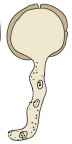
(A) The figure shows the germination of a pollen grain.
Statement $i$ is true: The figure depicts the germination of a pollen grain.
Statement $ii$ is false: Angiosperm male gametes are non-motile.
Statement $iii$ is false: The pollen tube contains two male gametes and one tube nucleus,not a female gamete.
Statement $iv$ is false: The pollen tube is an extension of the intine,but the exine remains on the pollen grain body.
Statement $v$ is true: The tube nucleus is typically located at the tip of the growing pollen tube.
Therefore,statements $i$ and $v$ are true.
Statement $i$ is true: The figure depicts the germination of a pollen grain.
Statement $ii$ is false: Angiosperm male gametes are non-motile.
Statement $iii$ is false: The pollen tube contains two male gametes and one tube nucleus,not a female gamete.
Statement $iv$ is false: The pollen tube is an extension of the intine,but the exine remains on the pollen grain body.
Statement $v$ is true: The tube nucleus is typically located at the tip of the growing pollen tube.
Therefore,statements $i$ and $v$ are true.
0 likes
View Solution89
EasyMCQ
Which one of the following is not associated with pollen-pistil interaction?
A
Pollen deposition on the stigma
B
Pollen germination
C
Pollen tube enters the ovule
D
Embryo development
Solution
(D) Pollen-pistil interaction is a dynamic process involving pollen recognition followed by promotion or inhibition of the pollen.
$1$. Pollen deposition on the stigma is the first step of this interaction.
$2$. Pollen germination and the growth of the pollen tube through the style are key events of this interaction.
$3$. The entry of the pollen tube into the ovule is the final stage of the pollen-pistil interaction.
$4$. Embryo development occurs after fertilization (syngamy and triple fusion) and is not a part of the pollen-pistil interaction.
$1$. Pollen deposition on the stigma is the first step of this interaction.
$2$. Pollen germination and the growth of the pollen tube through the style are key events of this interaction.
$3$. The entry of the pollen tube into the ovule is the final stage of the pollen-pistil interaction.
$4$. Embryo development occurs after fertilization (syngamy and triple fusion) and is not a part of the pollen-pistil interaction.
0 likes
View Solution90
EasyMCQ
In . . . . . . pollen grains cause allergy.
A
Water hyacinth
B
Common pansy
C
Oxalis
D
Parthenium (Carrot grass)
Solution
(D) $Parthenium$,also known as carrot grass,is an invasive weed that was introduced into India as a contaminant with imported wheat. Its pollen grains are a major cause of respiratory allergies and hay fever in humans.
0 likes
View Solution91
EasyMCQ
The role of the filiform apparatus in synergids is to
A
Protect the egg apparatus
B
Endosperm formation
C
Guide the entry of the pollen tube
D
Prevent the entry of gametes
Solution
(C) The correct answer is $C$.
The filiform apparatus consists of specialized cellular thickenings at the micropylar end of the synergids.
Its primary function is to secrete chemical substances that guide the entry of the pollen tube into the synergids during the process of fertilization.
The filiform apparatus consists of specialized cellular thickenings at the micropylar end of the synergids.
Its primary function is to secrete chemical substances that guide the entry of the pollen tube into the synergids during the process of fertilization.
0 likes
View Solution92
EasyMCQ
Identify the correct order of events in pollen-pistil interaction from the options given below.
$I.$ Release of male gametes into the embryo sac
$II.$ Deposition of pollen grains on stigma
$III.$ Entry of pollen tube into embryo sac
$IV.$ Development of pollen tube
$V.$ Entry of pollen tube into the ovule
$I.$ Release of male gametes into the embryo sac
$II.$ Deposition of pollen grains on stigma
$III.$ Entry of pollen tube into embryo sac
$IV.$ Development of pollen tube
$V.$ Entry of pollen tube into the ovule
A
$V \to IV \to III \to II \to I$
B
$IV \to III \to II \to I \to V$
C
$II \to IV \to V \to III \to I$
D
$II \to IV \to III \to V \to I$
Solution
(C) The process of pollen-pistil interaction follows a specific sequence:
$1$. $II.$ Deposition of pollen grains on the stigma.
$2$. $IV.$ Development of the pollen tube through the style.
$3$. $V.$ Entry of the pollen tube into the ovule through the micropyle.
$4$. $III.$ Entry of the pollen tube into the embryo sac (synergids).
$5$. $I.$ Release of male gametes into the embryo sac for fertilization.
Therefore,the correct sequence is $II \to IV \to V \to III \to I$.
$1$. $II.$ Deposition of pollen grains on the stigma.
$2$. $IV.$ Development of the pollen tube through the style.
$3$. $V.$ Entry of the pollen tube into the ovule through the micropyle.
$4$. $III.$ Entry of the pollen tube into the embryo sac (synergids).
$5$. $I.$ Release of male gametes into the embryo sac for fertilization.
Therefore,the correct sequence is $II \to IV \to V \to III \to I$.
0 likes
View SolutionSexual Reproduction in Flowering Plants — Pollen Pistil Interaction · Frequently Asked Questions
1Are these Sexual Reproduction in Flowering Plants questions useful for JEE and NEET?
Yes. All questions in this section are mapped to JEE Main and NEET exam patterns. Previous year questions from JEE Main, NEET, GUJCET and state-level exams are included with full solutions.
2Can I switch to Hindi or Gujarati for these questions?
Yes. Use the language tabs in the hero section or the sidebar to view the same questions and solutions in English, Hindi or Gujarati.
3How do I generate a question paper from this subtopic?
Use the Vedclass Exam Paper Generator — select the chapter and subtopic, set difficulty, and generate Sets A, B, C, D automatically. First 3 chapters of every subject are free.
Vedclass Products
For Students
Vedclass Test Series
Mock tests in real JEE/NEET style with performance analysis. 5-day free trial.
Start Free TrialFor Teachers
Exam Paper Generator
Generate Set A/B/C/D papers from this chapter in 2 minutes. 3 chapters free.
Try FreeFor Institutes
Online Exam Module
Live online exams with unlimited students, 360° analytics & white-label branding.
See DemoFor Teachers & Institutes
Generate a Sexual Reproduction in Flowering Plants Exam Paper in 2 Minutes
Select subtopic & difficulty — Sets A, B, C, D auto-generated with No Repeat logic.
First 3 chapters of every subject are free — no payment required.