
A English
Population Growth Questions in English
Class 12 Biology · Organisms and Populations · Population Growth
195+
Questions
English
Language
100%
With Solutions
Showing 50 of 195 questions in English
101
MediumMCQ
Which of the following is $NOT$ applicable to population growth?
A
Decrease in $MMR$ (Maternal Mortality Rate)
B
Decrease in $IMR$ (Infant Mortality Rate)
C
Decrease in death rate due to better care through $RCH$ (Reproductive and Child Health care)
D
None of the above
Solution
(D) Population growth is primarily driven by a decline in death rates while birth rates remain high or decline more slowly.
$1$. $A$ decrease in $MMR$ (Maternal Mortality Rate) leads to higher survival rates of mothers,contributing to population growth.
$2$. $A$ decrease in $IMR$ (Infant Mortality Rate) means more children survive to reproductive age,which increases the population.
$3$. $RCH$ programs improve healthcare,leading to a decrease in the overall death rate,which is a significant factor in population explosion.
Since all the options $A$,$B$,and $C$ are factors that contribute to population growth,the correct answer is $D$.
$1$. $A$ decrease in $MMR$ (Maternal Mortality Rate) leads to higher survival rates of mothers,contributing to population growth.
$2$. $A$ decrease in $IMR$ (Infant Mortality Rate) means more children survive to reproductive age,which increases the population.
$3$. $RCH$ programs improve healthcare,leading to a decrease in the overall death rate,which is a significant factor in population explosion.
Since all the options $A$,$B$,and $C$ are factors that contribute to population growth,the correct answer is $D$.
0 likes
View Solution102
MediumMCQ
On what did Thomas Malthus work?
A
Individual organisms
B
Bacterial species
C
Populations
D
Viruses
Solution
(C) Thomas Malthus was an English economist and demographer who is best known for his essay on the principle of population. His work focused on the dynamics of human populations and how they grow in relation to the available resources. His ideas regarding population growth and resource limitation significantly influenced Charles Darwin's theory of natural selection,particularly the concept of the 'struggle for existence'.
0 likes
View Solution103
MediumMCQ
If a population adds $20$ new individuals per year and the total population after $2$ years is $75$,what was the initial population size?
A
$65$
B
$55$
C
$40$
D
$35$
Solution
(D) The population growth is given by the formula: $N_t = N_0 + (B \times t)$,where:
$N_t$ is the population after time $t$.
$N_0$ is the initial population.
$B$ is the number of new individuals added per year (birth rate/addition rate).
$t$ is the time in years.
Given:
$N_t = 75$
$B = 20$
$t = 2$
Substituting the values:
$75 = N_0 + (20 \times 2)$
$75 = N_0 + 40$
$N_0 = 75 - 40$
$N_0 = 35$
Therefore,the initial population size was $35$.
$N_t$ is the population after time $t$.
$N_0$ is the initial population.
$B$ is the number of new individuals added per year (birth rate/addition rate).
$t$ is the time in years.
Given:
$N_t = 75$
$B = 20$
$t = 2$
Substituting the values:
$75 = N_0 + (20 \times 2)$
$75 = N_0 + 40$
$N_0 = 75 - 40$
$N_0 = 35$
Therefore,the initial population size was $35$.
0 likes
View Solution104
MediumMCQ
If in a population,the number of organisms added by $B + I$ is less than the number of organisms lost by $D + E$ at time $t$,but the population size $N$ at time $t+1$ is $10$ times greater than the initial population size,which of the following characteristics can be inferred?
A
Increase in population growth rate
B
Decrease in population growth rate
C
Stable population
D
Population extinction
Solution
(A) The population growth equation is given by: $N_{t+1} = N_t + [(B + I) - (D + E)]$.
Here,$B$ is natality (births),$I$ is immigration,$D$ is mortality (deaths),and $E$ is emigration.
If the population size at $t+1$ is $10$ times greater than at time $t$,it indicates a significant increase in the total number of individuals.
Even if $(B + I) < (D + E)$ at a specific instant,the overall result of $N_{t+1} = 10N_t$ implies that the population growth rate has increased significantly over the observed period,leading to a rapid expansion of the population.
Here,$B$ is natality (births),$I$ is immigration,$D$ is mortality (deaths),and $E$ is emigration.
If the population size at $t+1$ is $10$ times greater than at time $t$,it indicates a significant increase in the total number of individuals.
Even if $(B + I) < (D + E)$ at a specific instant,the overall result of $N_{t+1} = 10N_t$ implies that the population growth rate has increased significantly over the observed period,leading to a rapid expansion of the population.
0 likes
View Solution105
MediumMCQ
If the population size at time $N_{t+1}$ is $1000$,and there is no immigration or emigration,and the death rate is $50\%$ less than the birth rate,and the population size $1$ year ago $(N_t)$ was $800$,what is the number of births?
A
$210$
B
$310$
C
$400$
D
$200$
Solution
(C) The formula for population growth is $N_{t+1} = N_t + (B - D)$,where $B$ is the number of births and $D$ is the number of deaths.
Given,$N_{t+1} = 1000$ and $N_t = 800$.
Substituting these values,we get $1000 = 800 + (B - D)$,which simplifies to $B - D = 200$.
According to the problem,the death rate $(D)$ is $50\%$ less than the birth rate $(B)$,which means $D = B - 0.5B = 0.5B$.
Substituting $D = 0.5B$ into the equation $B - D = 200$,we get $B - 0.5B = 200$.
$0.5B = 200$,therefore $B = 400$.
Thus,the number of births is $400$.
Given,$N_{t+1} = 1000$ and $N_t = 800$.
Substituting these values,we get $1000 = 800 + (B - D)$,which simplifies to $B - D = 200$.
According to the problem,the death rate $(D)$ is $50\%$ less than the birth rate $(B)$,which means $D = B - 0.5B = 0.5B$.
Substituting $D = 0.5B$ into the equation $B - D = 200$,we get $B - 0.5B = 200$.
$0.5B = 200$,therefore $B = 400$.
Thus,the number of births is $400$.
0 likes
View Solution106
MediumMCQ
Which of the following formulas can be used to measure exponential growth?
A
$N_{(t)} = N_0e^{rt}$
B
$dN/dt = (b+d) \times N$
C
$dN/dt = (b+d) \times rN$
D
$N/t = b+d$
Solution
(A) Exponential growth occurs when resources are unlimited. The population growth rate is represented by the equation $dN/dt = rN$,where $r$ is the intrinsic rate of natural increase $(r = b - d)$.
Integrating this differential equation gives the integral form of the exponential growth equation: $N_{(t)} = N_0e^{rt}$.
Here,$N_{(t)}$ is the population density at time $t$,$N_0$ is the population density at time zero,$r$ is the intrinsic rate of natural increase,and $e$ is the base of natural logarithms (approximately $2.718$).
Integrating this differential equation gives the integral form of the exponential growth equation: $N_{(t)} = N_0e^{rt}$.
Here,$N_{(t)}$ is the population density at time $t$,$N_0$ is the population density at time zero,$r$ is the intrinsic rate of natural increase,and $e$ is the base of natural logarithms (approximately $2.718$).
0 likes
View Solution107
MediumMCQ
Which of the following equations represents the integral form of exponential growth?
A
$N_t = N_0 e^{rt}$
B
$dN/dt = rN$
C
$dN/dt = (b+d) \times N$
D
All of the above
Solution
(A) In population ecology,exponential growth is described by the differential equation $dN/dt = rN$,where $N$ is the population size,$t$ is time,and $r$ is the intrinsic rate of natural increase.
To find the integral form of this equation,we integrate the differential equation over time.
The resulting integral form is $N_t = N_0 e^{rt}$,where $N_t$ is the population density after time $t$,$N_0$ is the population density at time zero,$r$ is the intrinsic rate of natural increase,and $e$ is the base of natural logarithms $(2.71828)$.
Therefore,option $A$ represents the integral form of exponential growth.
To find the integral form of this equation,we integrate the differential equation over time.
The resulting integral form is $N_t = N_0 e^{rt}$,where $N_t$ is the population density after time $t$,$N_0$ is the population density at time zero,$r$ is the intrinsic rate of natural increase,and $e$ is the base of natural logarithms $(2.71828)$.
Therefore,option $A$ represents the integral form of exponential growth.
0 likes
View Solution108
MediumMCQ
In a hypothetical population of $100$ individuals with an intrinsic rate of increase $(r)$ of $0.5$ per female per year,if the population exhibits exponential growth,what will be the population size after $6$ years? (Given $e = 2.72$)
A
$1000$
B
$2012$
C
$700$
D
$500$
Solution
(B) The formula for exponential population growth is $N_t = N_0 e^{rt}$.
Here,the initial population size $(N_0)$ is $100$.
The intrinsic rate of increase $(r)$ is $0.5$.
The time period $(t)$ is $6$ years.
The value of $e$ is $2.72$.
Substituting these values into the formula:
$N_t = 100 \times (2.72)^{(0.5 \times 6)}$
$N_t = 100 \times (2.72)^3$
$N_t = 100 \times 20.1224$
$N_t = 2012.24$
Rounding to the nearest whole number,the population size after $6$ years will be $2012$.
Here,the initial population size $(N_0)$ is $100$.
The intrinsic rate of increase $(r)$ is $0.5$.
The time period $(t)$ is $6$ years.
The value of $e$ is $2.72$.
Substituting these values into the formula:
$N_t = 100 \times (2.72)^{(0.5 \times 6)}$
$N_t = 100 \times (2.72)^3$
$N_t = 100 \times 20.1224$
$N_t = 2012.24$
Rounding to the nearest whole number,the population size after $6$ years will be $2012$.
0 likes
View Solution109
MediumMCQ
Under which of the following conditions is the logistic population growth curve obtained?
A
In the presence of unlimited resources
B
In the presence of limited resources
C
Not dependent on resources
D
Both $A$ and $B$
Solution
(B) The logistic population growth curve is obtained when resources are limited in the environment.
In nature,a given habitat has enough resources to support a maximum possible number,beyond which no further growth is possible. This limit is called the nature's carrying capacity $(K)$ for that species in that habitat.
When resources are limited,the growth curve takes an $S$-shaped pattern,which is known as the sigmoid or logistic growth curve.
In contrast,unlimited resources lead to exponential growth,which produces a $J$-shaped curve.
In nature,a given habitat has enough resources to support a maximum possible number,beyond which no further growth is possible. This limit is called the nature's carrying capacity $(K)$ for that species in that habitat.
When resources are limited,the growth curve takes an $S$-shaped pattern,which is known as the sigmoid or logistic growth curve.
In contrast,unlimited resources lead to exponential growth,which produces a $J$-shaped curve.
0 likes
View Solution110
MediumMCQ
In a population growth curve,which of the following equations represents the sigmoid growth curve?
A
$\frac{dN}{dt} = rN$
B
$\frac{dN}{dt} = rN \left( \frac{K-N}{K} \right)$
C
$N_{t+1} = N_t + [(B+I) - (D+E)]$
D
None of these
Solution
(B) The sigmoid growth curve represents logistic growth,which occurs when resources are limited.
The equation for logistic growth is $\frac{dN}{dt} = rN \left( \frac{K-N}{K} \right)$,where:
$N$ = Population density at time $t$,
$r$ = Intrinsic rate of natural increase,
$K$ = Carrying capacity.
Option $A$ represents exponential growth ($J$-shaped curve).
Option $C$ represents the basic population density change formula.
The equation for logistic growth is $\frac{dN}{dt} = rN \left( \frac{K-N}{K} \right)$,where:
$N$ = Population density at time $t$,
$r$ = Intrinsic rate of natural increase,
$K$ = Carrying capacity.
Option $A$ represents exponential growth ($J$-shaped curve).
Option $C$ represents the basic population density change formula.
0 likes
View Solution111
MediumMCQ
The measure of the inherent capacity of a population to grow is known as:
A
Intrinsic rate of natural increase
B
Immigration
C
Emigration
D
All of the above
Solution
(A) The intrinsic rate of natural increase (often denoted as $r$) is a critical parameter that represents the inherent capacity of a population to grow under ideal environmental conditions,where resources are unlimited and there is no competition or predation.
It is calculated as the difference between the birth rate $(b)$ and the death rate $(d)$,expressed as $r = b - d$.
This value is a unique characteristic of a species and determines how quickly a population can expand when conditions are optimal.
It is calculated as the difference between the birth rate $(b)$ and the death rate $(d)$,expressed as $r = b - d$.
This value is a unique characteristic of a species and determines how quickly a population can expand when conditions are optimal.
0 likes
View Solution112
MediumMCQ
When resources in the habitat become progressively limited,the growth pattern observed is.......?
A
Exponential
B
Logistic
C
Geometric growth
D
Both $A$ and $B$
Solution
(B) In nature,a given habitat has enough resources to support a maximum possible number,beyond which no further growth is possible. This limit is called nature's carrying capacity $(K)$ for that species in that habitat.
When resources are limited,the population growth initially shows a lag phase,followed by phases of acceleration and deceleration,and finally an asymptote,when the population density reaches the carrying capacity.
This type of population growth is called Verhulst-Pearl Logistic Growth and is described by the equation: $\frac{dN}{dt} = rN \left( \frac{K-N}{K} \right)$.
When resources are limited,the population growth initially shows a lag phase,followed by phases of acceleration and deceleration,and finally an asymptote,when the population density reaches the carrying capacity.
This type of population growth is called Verhulst-Pearl Logistic Growth and is described by the equation: $\frac{dN}{dt} = rN \left( \frac{K-N}{K} \right)$.
0 likes
View Solution113
MediumMCQ
The $J$-shaped curve represents which type of growth?
A
Exponential growth
B
Logistic growth
C
Sigmoid growth
D
Both $A$ and $B$
Solution
(A) In population ecology,when resources are unlimited,the population grows at an exponential rate.
This type of growth is represented by a $J$-shaped curve.
Exponential growth is mathematically expressed as $dN/dt = rN$,where $N$ is the population size,$r$ is the intrinsic rate of natural increase,and $t$ is time.
In contrast,logistic growth (which is resource-limited) follows an $S$-shaped or sigmoid curve.
This type of growth is represented by a $J$-shaped curve.
Exponential growth is mathematically expressed as $dN/dt = rN$,where $N$ is the population size,$r$ is the intrinsic rate of natural increase,and $t$ is time.
In contrast,logistic growth (which is resource-limited) follows an $S$-shaped or sigmoid curve.
0 likes
View Solution114
MediumMCQ
Read the following statements and determine how many of them are correct:
$(1)$ Population is the total number of individuals of a species in a given area at a given time.
$(2)$ Developed countries show a low birth rate.
$(3)$ An equal proportion of reproductive and post-reproductive age individuals indicates a stable population.
$(4)$ In the presence of limited resources,the growth curve is sigmoid ($S$-shaped).
$(1)$ Population is the total number of individuals of a species in a given area at a given time.
$(2)$ Developed countries show a low birth rate.
$(3)$ An equal proportion of reproductive and post-reproductive age individuals indicates a stable population.
$(4)$ In the presence of limited resources,the growth curve is sigmoid ($S$-shaped).
A
$2$
B
$3$
C
$1$
D
All statements are correct.
Solution
(D) Statement $(1)$ is correct: Population is defined as the total number of individuals of a species in a specific geographical area at a specific time.
Statement $(2)$ is correct: Developed countries typically exhibit lower birth rates due to better education,healthcare,and economic stability.
Statement $(3)$ is correct: In a stable population,the number of individuals in the reproductive age group is roughly equal to the number of individuals in the post-reproductive age group.
Statement $(4)$ is correct: When resources are limited,the population growth follows a logistic growth model,which results in a sigmoid or $S$-shaped curve.
Since all four statements are correct,the correct answer is 'All statements are correct'.
Statement $(2)$ is correct: Developed countries typically exhibit lower birth rates due to better education,healthcare,and economic stability.
Statement $(3)$ is correct: In a stable population,the number of individuals in the reproductive age group is roughly equal to the number of individuals in the post-reproductive age group.
Statement $(4)$ is correct: When resources are limited,the population growth follows a logistic growth model,which results in a sigmoid or $S$-shaped curve.
Since all four statements are correct,the correct answer is 'All statements are correct'.
0 likes
View Solution115
MediumMCQ
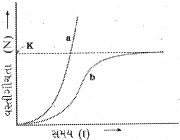
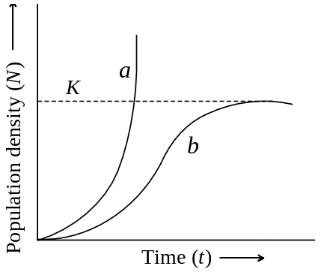
In the given figure,what do $a$ and $b$ represent respectively?
A
$a =$ Logistic growth,$b =$ Exponential growth
B
$a =$ Exponential growth,$b =$ Logistic growth
C
$a =$ Carrying capacity,$b =$ Logistic growth
D
$a =$ Exponential growth,$b =$ Carrying capacity
Solution
(B) In the provided graph,the curve labeled '$a$' shows a continuous increase in population size over time without any limit,which is characteristic of exponential growth.
Curve '$b$' shows an initial slow growth followed by a rapid increase and then leveling off as it approaches the carrying capacity $(K)$,which is characteristic of logistic growth.
Therefore,'$a$' represents exponential growth and '$b$' represents logistic growth.
Curve '$b$' shows an initial slow growth followed by a rapid increase and then leveling off as it approaches the carrying capacity $(K)$,which is characteristic of logistic growth.
Therefore,'$a$' represents exponential growth and '$b$' represents logistic growth.
0 likes
View Solution116
DifficultMCQ
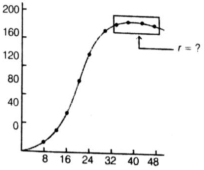
From the given graph of population growth,select the correct option that shows the correct value of '$r$' and the corresponding age pyramid.
A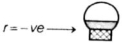
B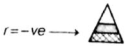
C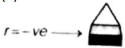
D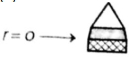
Solution
(D) The provided graph shows a logistic growth curve where the population size stabilizes as it reaches the carrying capacity. At this stage,the intrinsic rate of natural increase $(r)$ becomes zero $(r = 0)$.
When $r = 0$,the population is stable,meaning the number of individuals in the pre-reproductive and reproductive age groups is approximately equal,while the post-reproductive group is the smallest. This age structure is represented by a bell-shaped age pyramid.
When $r = 0$,the population is stable,meaning the number of individuals in the pre-reproductive and reproductive age groups is approximately equal,while the post-reproductive group is the smallest. This age structure is represented by a bell-shaped age pyramid.
0 likes
View Solution117
MediumMCQ
Exponential growth cannot be sustained for a long time due to:
$I.$ Limited space and nutrients
$II.$ Accumulation of toxic agents
$III.$ Unlimited space and nutrients
$IV.$ Accumulation of nutrient agents
Choose the correct combination of options:
$I.$ Limited space and nutrients
$II.$ Accumulation of toxic agents
$III.$ Unlimited space and nutrients
$IV.$ Accumulation of nutrient agents
Choose the correct combination of options:
A
$I$ and $III$
B
$III$ and $IV$
C
$I$ and $II$
D
$IV$ and $II$
Solution
(C) Exponential or log phase cannot be sustained for a long period because the resources such as space and nutrients are limited in nature,leading to intense competition.
Furthermore,as organisms grow,they often produce metabolic waste products. The accumulation of these toxic agents inhibits further growth and eventually leads to a decline in the population growth rate.
Furthermore,as organisms grow,they often produce metabolic waste products. The accumulation of these toxic agents inhibits further growth and eventually leads to a decline in the population growth rate.
0 likes
View Solution118
MediumMCQ
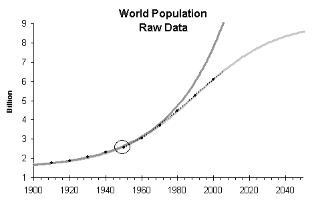
The human population growth graph is:
A
$J-Shape$
B
$S-Shape$
C
$L-Shape$
D
$None of these$
Solution
(A) The human population growth curve,when plotted over time,exhibits an exponential growth phase due to the rapid increase in numbers,which is represented by a $J$-shaped curve.
In ecology,this is characteristic of organisms that grow in an environment with unlimited resources,leading to exponential growth.
Therefore,the correct representation for human population growth is a $J$-shaped curve.
In ecology,this is characteristic of organisms that grow in an environment with unlimited resources,leading to exponential growth.
Therefore,the correct representation for human population growth is a $J$-shaped curve.
0 likes
View Solution119
MediumMCQ
Maximum growth rate occurs in:
A
Lag phase
B
Exponential phase
C
Stationary phase
D
Senescent phase
Solution
(B) The growth curve of a population typically consists of four phases:
$1$. $Lag$ phase: Initial phase where growth is slow as organisms adapt to the environment.
$2$. $Exponential$ (or $Log$) phase: The phase where the population grows at its maximum rate because resources are abundant and environmental resistance is minimal.
$3$. $Stationary$ phase: The phase where growth slows down and levels off as resources become limited and environmental resistance increases.
$4$. $Senescent$ (or $Death$) phase: The phase where the population declines due to resource depletion or environmental stress.
Therefore,the maximum growth rate occurs in the $Exponential$ phase.
$1$. $Lag$ phase: Initial phase where growth is slow as organisms adapt to the environment.
$2$. $Exponential$ (or $Log$) phase: The phase where the population grows at its maximum rate because resources are abundant and environmental resistance is minimal.
$3$. $Stationary$ phase: The phase where growth slows down and levels off as resources become limited and environmental resistance increases.
$4$. $Senescent$ (or $Death$) phase: The phase where the population declines due to resource depletion or environmental stress.
Therefore,the maximum growth rate occurs in the $Exponential$ phase.
0 likes
View Solution120
MediumMCQ
Exponential growth curve is:
A
$J$-shaped
B
$V$-shaped
C
$S$-shaped
D
$C$-shaped
Solution
(A) When resources in the habitat are unlimited,each species has the ability to realize fully its innate potential to grow in number.
In such conditions,the population grows in an exponential or geometric fashion.
When the population size $(N)$ is plotted over time $(t)$,the resulting curve is $J$-shaped.
This is represented by the equation $\frac{dN}{dt} = rN$,where $r$ is the intrinsic rate of natural increase.
In such conditions,the population grows in an exponential or geometric fashion.
When the population size $(N)$ is plotted over time $(t)$,the resulting curve is $J$-shaped.
This is represented by the equation $\frac{dN}{dt} = rN$,where $r$ is the intrinsic rate of natural increase.
0 likes
View Solution121
MediumMCQ
If the rate of addition of new members increases with respect to the individual host of the same population,then the graph obtained has:
A
Declined growth
B
Exponential growth
C
Zero population growth
D
None of these
Solution
(B) In population ecology,when resources are unlimited,the population grows at a rate proportional to the size of the population. This is represented by the equation $\frac{dN}{dt} = rN$.
As the number of individuals $(N)$ increases,the rate of addition of new members also increases,leading to a $J$-shaped curve known as exponential growth.
Therefore,when the rate of addition of new members increases with respect to the individual host of the same population,the graph obtained represents exponential growth.
As the number of individuals $(N)$ increases,the rate of addition of new members also increases,leading to a $J$-shaped curve known as exponential growth.
Therefore,when the rate of addition of new members increases with respect to the individual host of the same population,the graph obtained represents exponential growth.
0 likes
View Solution122
MediumMCQ
Which of the following parameters of the population can be negative?
A
Birth rate
B
Replacement level
C
Growth rate
D
All of these
Solution
(C) The population growth rate is defined as the change in population size over a specific period.
It is calculated by considering the birth rate,death rate,immigration,and emigration.
If the number of deaths and emigrants exceeds the number of births and immigrants,the population growth rate becomes negative.
Birth rate and replacement level are demographic indicators that represent counts or ratios and cannot be negative values.
It is calculated by considering the birth rate,death rate,immigration,and emigration.
If the number of deaths and emigrants exceeds the number of births and immigrants,the population growth rate becomes negative.
Birth rate and replacement level are demographic indicators that represent counts or ratios and cannot be negative values.
0 likes
View Solution123
MediumMCQ
Which of the following can be taken as the most convincing factor for indicating the rapid increase in population growth of a country?
A
Low mortality rate
B
High natality or birth rate
C
Low replacement level
D
High population of young children
Solution
(D) The age structure of a population is a critical indicator of future growth. $A$ high proportion of young individuals (pre-reproductive and early reproductive age) indicates that a large number of individuals will soon enter or are currently in their reproductive phase. Since the number of females in the reproductive age group directly influences the birth rate $(natality)$,a population with a large base of young people is poised for rapid growth.
0 likes
View Solution124
MediumMCQ
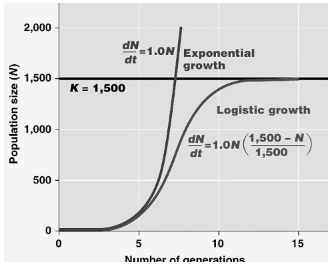
Sigmoid growth curve is represented by
A
$dN/dt = rN$
B
$dN/dt = rN(1 - N/K)$
C
$N_t = N_0 + B + I - D - E$
D
$dN/dt = 1 - N/K$
Solution
(B) The sigmoid growth curve,also known as the logistic growth curve,is represented by the equation $dN/dt = rN(1 - N/K)$.
In this equation,$N$ is the population size,$t$ is time,$r$ is the intrinsic rate of natural increase,and $K$ is the carrying capacity.
Most natural populations do not show exponential growth indefinitely because environmental resources are limited,which prevents such unrestricted increase and leads to a sigmoid ($S$-shaped) growth pattern as the population approaches its carrying capacity.
In this equation,$N$ is the population size,$t$ is time,$r$ is the intrinsic rate of natural increase,and $K$ is the carrying capacity.
Most natural populations do not show exponential growth indefinitely because environmental resources are limited,which prevents such unrestricted increase and leads to a sigmoid ($S$-shaped) growth pattern as the population approaches its carrying capacity.
0 likes
View Solution125
MediumMCQ
In a population,unrestricted reproductive capacity is called
A
Reproductive potential
B
Fertility
C
Carrying capacity
D
Birth rate
Solution
(A) Chapman $(1928)$ proposed the term biotic potential or reproductive potential to designate the maximum reproductive power of a population.
It is defined as the inherent ability of an organism to reproduce and survive under ideal environmental conditions,leading to an increase in population size.
In nature,this potential is rarely achieved due to environmental resistance,which includes factors like limited resources,predation,and disease.
It is defined as the inherent ability of an organism to reproduce and survive under ideal environmental conditions,leading to an increase in population size.
In nature,this potential is rarely achieved due to environmental resistance,which includes factors like limited resources,predation,and disease.
0 likes
View Solution126
MediumMCQ
The formula of growth rate for population in a given time is
A
$dt / dN = rN$
B
$dt / rN = dN$
C
$rN / dN = dt$
D
$dN / dt = rN$
Solution
(D) The population growth rate is defined as the change in population size $(dN)$ over a specific time interval $(dt)$.
According to the exponential growth model,this rate is proportional to the current population size $(N)$ and the intrinsic rate of natural increase $(r)$.
The mathematical expression for this is $\frac{dN}{dt} = rN$.
According to the exponential growth model,this rate is proportional to the current population size $(N)$ and the intrinsic rate of natural increase $(r)$.
The mathematical expression for this is $\frac{dN}{dt} = rN$.
0 likes
View Solution127
MediumMCQ
In a population,the condition at which the rate of addition of new members is more than the rate of individuals lost indicates:
A
Zero population growth
B
Exponential growth
C
Fluctuating growth
D
Declining growth
Solution
(B) In a population,if the rate of addition of new members (natality + immigration) is greater than the rate of individuals lost (mortality + emigration),the population size increases over time. This net increase in population size is characteristic of exponential growth,where resources are typically abundant and the population expands rapidly.
0 likes
View Solution128
MediumMCQ
The asymptote stage of a population is the stage in which the population is:
A
Changing
B
Decreasing
C
Increasing
D
Stabilised
Solution
(D) The asymptote stage of a population refers to the phase where the population growth curve levels off. In this stage,the birth rate is equal to the death rate,meaning the population size remains constant or is stabilised.
0 likes
View Solution129
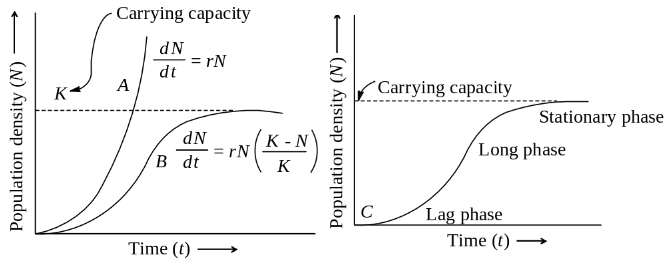
MediumMCQ
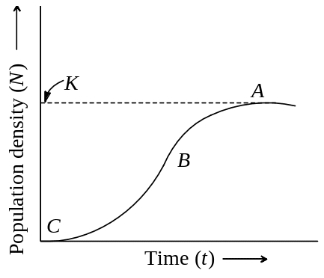
The given population growth curve represents the logistic growth curve. In this curve,identify what $A$,$B$,and $C$ indicate.
A
$A-$Log phase,$B-$Log phase,$C-$Stationary phase
B
$A-$Log phase,$B-$Lag phase,$C-$Stationary phase
C
$A-$Stationary phase,$B-$Log phase,$C-$Lag phase
D
$A-$Stationary phase,$B-$Lag phase,$C-$Log phase
Solution
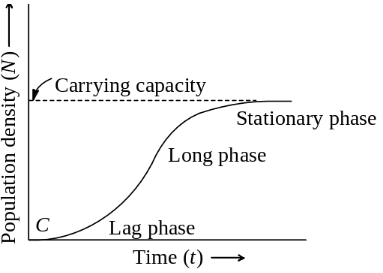
(C) population growing in a habitat with limited resources follows a logistic growth curve,which exhibits three distinct phases:
$(i)$ $C$ represents the Lag phase: This is the initial phase where the population adapts to the environment and begins to increase in number.
$(ii)$ $B$ represents the Log (exponential) phase: This is the second phase where the population utilizes resources maximally,leading to exponential growth. In this phase,the number of births is much greater than the number of deaths.
$(iii)$ $A$ represents the Stationary phase: This is the $3^{\text{rd}}$ phase where the population reaches the carrying capacity $(K)$ of the environment and stabilizes. Here,the number of births equals the number of deaths.
Therefore,$A$ is the Stationary phase,$B$ is the Log phase,and $C$ is the Lag phase.
$(i)$ $C$ represents the Lag phase: This is the initial phase where the population adapts to the environment and begins to increase in number.
$(ii)$ $B$ represents the Log (exponential) phase: This is the second phase where the population utilizes resources maximally,leading to exponential growth. In this phase,the number of births is much greater than the number of deaths.
$(iii)$ $A$ represents the Stationary phase: This is the $3^{\text{rd}}$ phase where the population reaches the carrying capacity $(K)$ of the environment and stabilizes. Here,the number of births equals the number of deaths.
Therefore,$A$ is the Stationary phase,$B$ is the Log phase,and $C$ is the Lag phase.
0 likes
View Solution130
MediumMCQ
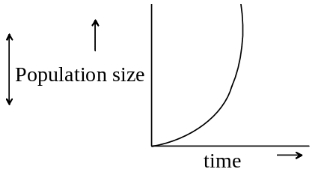
The diagram below indicates:
A
Exponential growth curve
B
Logistic growth pattern
C
$J$-shaped curve
D
Both $(a)$ and $(c)$
Solution
(D) As clearly seen in the given diagram,the population growth is unlimited and increasing rapidly over time.
This is the distinguishing feature of the exponential growth model.
Because the curve has a $J$-shaped appearance,it is also referred to as a $J$-shaped curve.
Therefore,both the terms 'Exponential growth curve' and '$J$-shaped curve' are correct descriptions for this diagram.
This is the distinguishing feature of the exponential growth model.
Because the curve has a $J$-shaped appearance,it is also referred to as a $J$-shaped curve.
Therefore,both the terms 'Exponential growth curve' and '$J$-shaped curve' are correct descriptions for this diagram.
0 likes
View Solution131
MediumMCQ
Which model is considered a more realistic one?
A
Logistic model
B
Exponential model
C
Geometric model
D
$J$-shaped model
Solution
(A) No population has unlimited resources for survival and reproduction. Every population in nature is provided with a certain amount of natural resources that are limited.
Keeping this point of view,the logistic growth model is considered more realistic than the exponential growth curve,as it accounts for environmental resistance and the carrying capacity of the habitat.
Keeping this point of view,the logistic growth model is considered more realistic than the exponential growth curve,as it accounts for environmental resistance and the carrying capacity of the habitat.
0 likes
View Solution132
MediumMCQ
The birth and death rates of four countries are given below. Which one will have the least population growth rate?
| $Country$ | $Birth\, rate$ $/1000$ | $Death\, rate$ $/1000$ |
| $M$ | $15$ | $5$ |
| $N$ | $25$ | $10$ |
| $O$ | $35$ | $18$ |
| $P$ | $48$ | $41$ |
A
$P$
B
$O$
C
$N$
D
$M$
Solution
(A) The population growth rate is calculated as the difference between the birth rate and the death rate.
For country $M$: $15 - 5 = 10$ per $1000$.
For country $N$: $25 - 10 = 15$ per $1000$.
For country $O$: $35 - 18 = 17$ per $1000$.
For country $P$: $48 - 41 = 7$ per $1000$.
Comparing the results,country $P$ has the lowest population growth rate ($7$ per $1000$).
For country $M$: $15 - 5 = 10$ per $1000$.
For country $N$: $25 - 10 = 15$ per $1000$.
For country $O$: $35 - 18 = 17$ per $1000$.
For country $P$: $48 - 41 = 7$ per $1000$.
Comparing the results,country $P$ has the lowest population growth rate ($7$ per $1000$).
0 likes
View Solution133
MediumMCQ
Zero growth of population is indicated by
A
Less number of child birth
B
Less number of reproductive females
C
Reproductive individuals are equal to pre-reproductive individuals
D
Less number of males than females
Solution
(C) Zero population growth is indicated when the age groups are balanced,resulting in a stable population size.
An age pyramid is a graphic representation of different age groups in a population,with the pre-reproductive group at the base,reproductive individuals in the middle,and the post-reproductive group at the top.
Age pyramids are of three types:
$(i)$ Triangular Age Pyramid: The number of pre-reproductive individuals is very large. The number of reproductive individuals is moderate,and post-reproductive individuals are fewer. The population size is growing.
$(ii)$ Bell-shaped Age Pyramid: The number of pre-reproductive and reproductive individuals is almost equal. Post-reproductive individuals are comparatively fewer. The population size is stable (zero growth).
$(iii)$ Urn-shaped Age Pyramid: The proportion of the reproductive age group is higher than the individuals in the pre-reproductive age group. The number of post-reproductive individuals is also sizable. It represents a declining population with negative growth.
An age pyramid is a graphic representation of different age groups in a population,with the pre-reproductive group at the base,reproductive individuals in the middle,and the post-reproductive group at the top.
Age pyramids are of three types:
$(i)$ Triangular Age Pyramid: The number of pre-reproductive individuals is very large. The number of reproductive individuals is moderate,and post-reproductive individuals are fewer. The population size is growing.
$(ii)$ Bell-shaped Age Pyramid: The number of pre-reproductive and reproductive individuals is almost equal. Post-reproductive individuals are comparatively fewer. The population size is stable (zero growth).
$(iii)$ Urn-shaped Age Pyramid: The proportion of the reproductive age group is higher than the individuals in the pre-reproductive age group. The number of post-reproductive individuals is also sizable. It represents a declining population with negative growth.
0 likes
View Solution134
MediumMCQ
Logistic growth is represented by which equation?
A
$\frac{dN}{dt} = rN \left( \frac{K-N}{K} \right)$
B
$\frac{dN}{dt} = rN \left( \frac{K-N}{N} \right)$
C
$\frac{dN}{dt} = rN \left( \frac{K+N}{K} \right)$
D
$\frac{dN}{dt} = rN \left( \frac{K}{K+N} \right)$
Solution
(A) The logistic growth model is represented by the equation: $\frac{dN}{dt} = rN \left( \frac{K-N}{K} \right)$.
In this model,no population can continue to grow exponentially indefinitely because resources become limiting at a certain point in time.
Here,the terms are defined as:
$N$ = Population density at time $t$
$r$ = Intrinsic rate of natural increase
$K$ = Carrying capacity
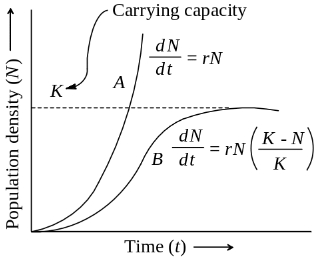
When resources are not limiting,the growth is exponential (curve $A$). When resources are limiting,the growth follows a sigmoid or logistic curve (curve $B$),which is governed by the carrying capacity $K$.
In this model,no population can continue to grow exponentially indefinitely because resources become limiting at a certain point in time.
Here,the terms are defined as:
$N$ = Population density at time $t$
$r$ = Intrinsic rate of natural increase
$K$ = Carrying capacity
When resources are not limiting,the growth is exponential (curve $A$). When resources are limiting,the growth follows a sigmoid or logistic curve (curve $B$),which is governed by the carrying capacity $K$.
0 likes
View Solution135
MediumMCQ
$A$ population growing in a habitat with limited resources shows four phases of growth in the following sequence:
A
$Acceleration - Deceleration - Lag phase - Asymptote$
B
$Asymptote - Acceleration - Deceleration - Lag phase$
C
$Lag phase - Acceleration - Deceleration - Asymptote$
D
$Acceleration - Lag phase - Deceleration - Asymptote$
Solution
(C) When a population grows in a habitat with limited resources,it follows a logistic growth model,which typically exhibits the following phases in sequence:
$(i)$ $Lag phase$: The initial period where the population adjusts to the environment and growth is very slow.
$(ii)$ $Acceleration phase$: The period where the population size increases rapidly as resources are abundant.
$(iii)$ $Deceleration phase$: The period where the growth rate slows down due to environmental resistance and limited resources.
$(iv)$ $Asymptote (Stationary phase)$: The final stage where the population size reaches the carrying capacity $(K)$ and stabilizes,showing no net growth.
$(i)$ $Lag phase$: The initial period where the population adjusts to the environment and growth is very slow.
$(ii)$ $Acceleration phase$: The period where the population size increases rapidly as resources are abundant.
$(iii)$ $Deceleration phase$: The period where the growth rate slows down due to environmental resistance and limited resources.
$(iv)$ $Asymptote (Stationary phase)$: The final stage where the population size reaches the carrying capacity $(K)$ and stabilizes,showing no net growth.
0 likes
View Solution136
MediumMCQ
If non-limiting conditions are provided,then what will happen?
A
Natality increases and mortality decreases
B
Mortality decreases
C
Natality increases
D
Mortality increases
Solution
(A) When non-limiting conditions (unlimited resources) are provided,the environment supports maximum growth.
Under these conditions,the birth rate (natality) increases because resources are abundant for reproduction.
Simultaneously,the death rate (mortality) decreases because there is no competition or scarcity of resources.
This combination leads to an exponential increase in the population size,often resulting in a population explosion.
Under these conditions,the birth rate (natality) increases because resources are abundant for reproduction.
Simultaneously,the death rate (mortality) decreases because there is no competition or scarcity of resources.
This combination leads to an exponential increase in the population size,often resulting in a population explosion.
0 likes
View Solution137
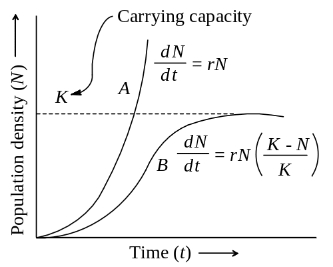
MediumMCQ
Which option is correct for curve $a$ and $b$?
| Curve | Equation | Type of Curve |
| :--- | :--- | :--- |
| $a$ | ? | ? |
| $b$ | ? | ? |
| Curve | Equation | Type of Curve |
| :--- | :--- | :--- |
| $a$ | ? | ? |
| $b$ | ? | ? |
A
$\frac{dN}{dt} = rN$ for $a$,$\frac{dN}{dt} = rN(\frac{N-K}{K})$ for $b$; Exponential curve for $a$,Logistic curve for $b$
B
$\frac{dN}{dt} = rN$ for $a$,$\frac{dN}{dt} = rN(\frac{K-N}{K})$ for $b$; Exponential curve for $a$,Logistic curve for $b$
C
$\frac{dN}{dt} = rN$ for $a$,$\frac{dN}{dt} = rN(\frac{K-N}{K})$ for $b$; $S$-shaped curve for $a$,$J$-shaped curve for $b$
D
Both $(b)$ and $(c)$
Solution
(B) In the given graph,curve $a$ represents exponential growth,which is characterized by unlimited resources and is $J$-shaped. The equation for exponential growth is $\frac{dN}{dt} = rN$.
Curve $b$ represents logistic growth,which occurs when resources are limited,leading to a carrying capacity $(K)$. This curve is $S$-shaped (sigmoid). The equation for logistic growth is $\frac{dN}{dt} = rN(\frac{K-N}{K})$.
Therefore,for curve $a$,the equation is $\frac{dN}{dt} = rN$ and it is an exponential curve. For curve $b$,the equation is $\frac{dN}{dt} = rN(\frac{K-N}{K})$ and it is a logistic curve. Thus,option $(b)$ is correct.
Curve $b$ represents logistic growth,which occurs when resources are limited,leading to a carrying capacity $(K)$. This curve is $S$-shaped (sigmoid). The equation for logistic growth is $\frac{dN}{dt} = rN(\frac{K-N}{K})$.
Therefore,for curve $a$,the equation is $\frac{dN}{dt} = rN$ and it is an exponential curve. For curve $b$,the equation is $\frac{dN}{dt} = rN(\frac{K-N}{K})$ and it is a logistic curve. Thus,option $(b)$ is correct.
0 likes
View Solution138
MediumMCQ
The integral form of the exponential growth equation is $N_{t} = N_{0} e^{rt}$. Identify $A, B, C$,and $D$ from the given equation where:
$A$: Population density after time $t$
$B$: Population density at time zero
$C$: Intrinsic rate of natural increase
$D$: The base of natural logarithms $(2.71828)$
$A$: Population density after time $t$
$B$: Population density at time zero
$C$: Intrinsic rate of natural increase
$D$: The base of natural logarithms $(2.71828)$
A
$A -r, B -e, C - N_{0}, D -N_{t}$
B
$A -N_{t}, B - N_{0}, C -r, D -e$
C
$A - N_{0}, B -N_{t}, C -r, D -e$
D
$A -N_{0}, B -N_{t}, C -e, D -r$
Solution
(B) The integral form of the exponential growth equation is given by the formula $N_{t} = N_{0} e^{rt}$.
In this equation:
$N_{t}$ represents the population density after time $t$.
$N_{0}$ represents the population density at time zero.
$r$ represents the intrinsic rate of natural increase.
$e$ represents the base of natural logarithms (approximately $2.71828$).
Therefore,the correct identification is $A - N_{t}, B - N_{0}, C - r, D - e$.
In this equation:
$N_{t}$ represents the population density after time $t$.
$N_{0}$ represents the population density at time zero.
$r$ represents the intrinsic rate of natural increase.
$e$ represents the base of natural logarithms (approximately $2.71828$).
Therefore,the correct identification is $A - N_{t}, B - N_{0}, C - r, D - e$.
0 likes
View Solution139
MediumMCQ
Which one is correct for the logistic model of population growth?
$I.$ Population growth rate increases as the size of the population approaches the carrying capacity.
$II.$ All individuals have the same effect on population growth.
$III.$ There are unlimited natural resources.
$IV.$ As population increases,the competition goes on increasing.
Select the correct combination.
$I.$ Population growth rate increases as the size of the population approaches the carrying capacity.
$II.$ All individuals have the same effect on population growth.
$III.$ There are unlimited natural resources.
$IV.$ As population increases,the competition goes on increasing.
Select the correct combination.
A
$I$ and $II$
B
Only $IV$
C
$IV$ and $III$
D
$I$ and $III$
Solution
(B) The correct answer is $(b)$.
Logistic growth model describes population growth in a habitat with limited resources. As the population size $(N)$ increases,the available resources per individual decrease,leading to increased competition for survival and reproduction. This is represented by the term $\left(\frac{K-N}{K}\right)$ in the logistic equation: $\frac{dN}{dt} = rN \left(\frac{K-N}{K}\right)$.
Analysis of the statements:
$I.$ Incorrect. As the population approaches the carrying capacity $(K)$,the growth rate decreases because the environment cannot support more individuals.
$II.$ Incorrect. Individuals may have different effects based on age,health,or reproductive status.
$III.$ Incorrect. Logistic growth specifically assumes limited natural resources.
$IV.$ Correct. As population density increases,competition for limited resources increases,which slows down the growth rate.
Therefore,only statement $IV$ is correct.
Logistic growth model describes population growth in a habitat with limited resources. As the population size $(N)$ increases,the available resources per individual decrease,leading to increased competition for survival and reproduction. This is represented by the term $\left(\frac{K-N}{K}\right)$ in the logistic equation: $\frac{dN}{dt} = rN \left(\frac{K-N}{K}\right)$.
Analysis of the statements:
$I.$ Incorrect. As the population approaches the carrying capacity $(K)$,the growth rate decreases because the environment cannot support more individuals.
$II.$ Incorrect. Individuals may have different effects based on age,health,or reproductive status.
$III.$ Incorrect. Logistic growth specifically assumes limited natural resources.
$IV.$ Correct. As population density increases,competition for limited resources increases,which slows down the growth rate.
Therefore,only statement $IV$ is correct.
0 likes
View Solution140
MediumMCQ
Any species growing $A$ under unlimited resource conditions can reach enormous population densities in a short time. Darwin showed how even $B$ growing animal like elephant could reach enormous numbers in absence of check and that characteristics of organism is called $C$. Choose the correct option for $A, B$ or $C$ respectively.
A
$A-$logistically,$B-$fast,$C-$carrying capacity
B
$A-$logistically,$B-$slow,$C-$biotic potential
C
$A-$exponential,$B-$slow,$C-$biotic potential
D
$A-$exponential,$B-$fast,$C-$biotic potential
Solution
(C) Under unlimited resource conditions,species exhibit exponential growth $(A)$. Charles Darwin noted that even slow-breeding animals like elephants could reach massive population sizes if unchecked $(B)$. The inherent ability of a population to increase under ideal environmental conditions is known as biotic potential $(C)$. Therefore,the correct sequence is $A-$exponential,$B-$slow,$C-$biotic potential.
0 likes
View Solution141
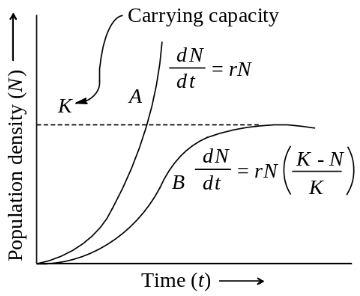
MediumMCQ
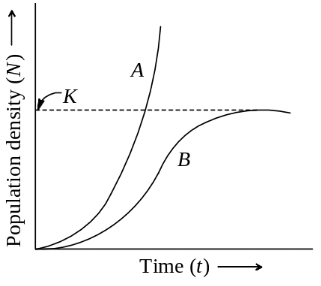
Graph $A$ and $B$ indicate:
A
$A-$Logistic growth; $B-$Exponential growth
B
$A-$Exponential growth; $B-$Logistic growth
C
$A-$Geometric growth; $B-$Logistic growth
D
Either $(b)$ or $(c)$
Solution
(B) In the provided graph,curve $A$ represents exponential growth,which occurs when resources are unlimited. The equation for this is $\frac{dN}{dt} = rN$.
Curve $B$ represents logistic growth,which occurs when resources are limited,leading to a plateau at the carrying capacity $(K)$. The equation for this is $\frac{dN}{dt} = rN \left( \frac{K - N}{K} \right)$.
Therefore,$A$ is exponential growth and $B$ is logistic growth.
Curve $B$ represents logistic growth,which occurs when resources are limited,leading to a plateau at the carrying capacity $(K)$. The equation for this is $\frac{dN}{dt} = rN \left( \frac{K - N}{K} \right)$.
Therefore,$A$ is exponential growth and $B$ is logistic growth.
0 likes
View Solution142
MediumMCQ
$I.$ Populations evolve to maximize their reproductive fitness,also called Darwinian reproductive fitness (higher $r$ value),in the habitat in which they live.
$II.$ The population growth rate $r$ is inversely related to generation time.
$III.$ The housefly,which has a short life span and produces a large number of eggs,could be considered as a '$K$' selected species.
$IV.$ Under a particular set of selection pressures,organisms evolve towards the most efficient reproductive strategies.
$V.$ Life history traits of organisms have evolved in relation to the constraints imposed by biotic and abiotic factors in their habitat.
Select the combination of correct statements.
$II.$ The population growth rate $r$ is inversely related to generation time.
$III.$ The housefly,which has a short life span and produces a large number of eggs,could be considered as a '$K$' selected species.
$IV.$ Under a particular set of selection pressures,organisms evolve towards the most efficient reproductive strategies.
$V.$ Life history traits of organisms have evolved in relation to the constraints imposed by biotic and abiotic factors in their habitat.
Select the combination of correct statements.
A
$I, II$ and $III$
B
$I, III$ and $IV$
C
$I, II, IV$ and $V$
D
All except $III$
Solution
(C) $I.$ Correct: Populations evolve to maximize their Darwinian fitness $(r)$.
$II.$ Correct: $A$ shorter generation time allows for a higher intrinsic rate of natural increase $(r)$.
$III.$ Incorrect: The housefly is an '$r$' selected species because it produces a large number of offspring with little parental care.
$IV.$ Correct: Organisms evolve strategies that optimize their fitness under specific environmental pressures.
$V.$ Correct: Life history traits are shaped by environmental constraints (biotic and abiotic factors).
Therefore,statements $I, II, IV,$ and $V$ are correct.
$II.$ Correct: $A$ shorter generation time allows for a higher intrinsic rate of natural increase $(r)$.
$III.$ Incorrect: The housefly is an '$r$' selected species because it produces a large number of offspring with little parental care.
$IV.$ Correct: Organisms evolve strategies that optimize their fitness under specific environmental pressures.
$V.$ Correct: Life history traits are shaped by environmental constraints (biotic and abiotic factors).
Therefore,statements $I, II, IV,$ and $V$ are correct.
0 likes
View Solution143
MediumMCQ
Which of the following is considered as a more realistic growth model?
A
Exponential growth
B
Arithmetic growth
C
Geometric growth
D
Logistic growth
Solution
(D) In nature,resources are limited,which leads to competition between individuals for survival.
Exponential growth occurs only when resources are unlimited,which is rarely the case in real-world scenarios.
Logistic growth,also known as the $Verhulst-Pearl$ logistic growth,accounts for environmental resistance and the carrying capacity $(K)$ of the habitat.
Therefore,the logistic growth model is considered more realistic as it reflects the constraints of the environment.
Exponential growth occurs only when resources are unlimited,which is rarely the case in real-world scenarios.
Logistic growth,also known as the $Verhulst-Pearl$ logistic growth,accounts for environmental resistance and the carrying capacity $(K)$ of the habitat.
Therefore,the logistic growth model is considered more realistic as it reflects the constraints of the environment.
0 likes
View Solution144
MediumMCQ
In nature, a given habitat has enough resources to support a maximum possible number, beyond which no further growth is possible. This characteristic feature of nature is known as
A
Biotic potential
B
Carrying capacity
C
Natural selection
D
Homeostasis
Solution
(B) In nature, a given habitat has enough resources to support a maximum possible number of individuals, beyond which no further growth is possible. This limit is referred to as the $Carrying \ capacity$ $(K)$. It represents the maximum population size that an environment can sustain indefinitely given the available food, habitat, water, and other necessities.
0 likes
View Solution145
MediumMCQ
$J$-shaped growth curve depicts:
A
Exponential growth when conditions are limited
B
Exponential growth when conditions are unlimited
C
Logistic growth when conditions are limited
D
Logistic growth when conditions are unlimited
Solution
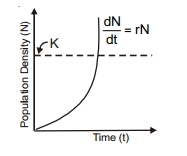
(B) $J$-shaped growth curve represents exponential population growth.
This type of growth occurs when resources are unlimited,allowing the population to grow at its maximum intrinsic rate of increase $(r)$.
The mathematical expression for this growth is $\frac{dN}{dt} = rN$,where $N$ is the population density and $t$ is time.
This type of growth occurs when resources are unlimited,allowing the population to grow at its maximum intrinsic rate of increase $(r)$.
The mathematical expression for this growth is $\frac{dN}{dt} = rN$,where $N$ is the population density and $t$ is time.
0 likes
View Solution146
MediumMCQ
Which is not true for $J$-shaped growth curve?
A
Exponential phase is prolonged
B
Population never grows beyond carrying capacity
C
Population crash occurs
D
Population seldom reaches equilibrium
Solution
(B) The $J$-shaped growth curve represents exponential growth where resources are unlimited. In this model,the population grows rapidly and does not account for carrying capacity $(K)$. Option $B$ is incorrect for a $J$-shaped curve because the population can exceed the carrying capacity,leading to a sudden population crash. The concept of 'carrying capacity' is a defining feature of the $S$-shaped (logistic) growth curve,not the $J$-shaped curve.
0 likes
View Solution147
MediumMCQ
Biotic potential is:
A
Intrinsic rate of natural increase under environmental limited condition
B
Intrinsic rate of natural increase under environmental unlimited condition
C
Extrinsic rate of natural increase under environmental limited conditions
D
Extrinsic rate of natural increase under environmental unlimited conditions
Solution
(B) Biotic potential refers to the maximum reproductive capacity of an organism under optimal environmental conditions. It is defined as the intrinsic rate of natural increase $(r)$ when environmental resources are unlimited and there is no competition or predation.
0 likes
View Solution148
MediumMCQ
The equation for population size change with a prolonged exponential phase can be converted into a logistic growth equation by multiplying it with:
A
$\frac{K}{N}$
B
$\frac{K-N}{K}$
C
$\frac{K}{K-N}$
D
$\frac{1}{N-K}$
Solution
(B) The exponential growth equation is $\frac{dN}{dt} = rN$. To account for environmental resistance and limited resources,we multiply it by the term $\frac{K-N}{K}$,where $K$ is the carrying capacity and $N$ is the population size.
This results in the Verhulst-Pearl logistic growth equation: $\frac{dN}{dt} = rN \left( \frac{K-N}{K} \right)$.
This results in the Verhulst-Pearl logistic growth equation: $\frac{dN}{dt} = rN \left( \frac{K-N}{K} \right)$.
0 likes
View Solution149
MediumMCQ
Populations evolve to maximize their reproductive fitness,also called Darwinian fitness,with:
A
High $r$ value
B
Low $r$ value
C
High $K$ value
D
High $\frac{K-N}{K}$ value
Solution
(A) Populations evolve to maximize their reproductive fitness,which is also known as Darwinian fitness (represented by the value $r$),in the habitats they inhabit.
This $r$ value represents the intrinsic rate of natural increase or biotic potential of a population.
Organisms that produce a large number of offspring with a high $r$ value are better able to survive and reproduce in their respective environments,thereby maximizing their fitness.
This $r$ value represents the intrinsic rate of natural increase or biotic potential of a population.
Organisms that produce a large number of offspring with a high $r$ value are better able to survive and reproduce in their respective environments,thereby maximizing their fitness.
0 likes
View Solution150
MediumMCQ
$A$: Under unlimited resource conditions,a population can show an exponential growth curve.
$R$: $A$ maximum possible number of individuals can always be supported when enough resources are available.
$R$: $A$ maximum possible number of individuals can always be supported when enough resources are available.
A
Assertion and Reason both are correct and Reason is the correct explanation of Assertion.
B
Assertion and Reason both are correct but Reason is not the correct explanation of Assertion.
C
Assertion is correct,but Reason is incorrect.
D
Both Assertion and Reason are incorrect.
Solution
(C) Exponential growth occurs when resources are unlimited,allowing the population to grow at its maximum biotic potential.
However,the Reason statement is incorrect because the maximum number of individuals an environment can support is defined as the carrying capacity $(K)$,which is a concept associated with logistic growth (limited resources),not exponential growth.
However,the Reason statement is incorrect because the maximum number of individuals an environment can support is defined as the carrying capacity $(K)$,which is a concept associated with logistic growth (limited resources),not exponential growth.
0 likes
View SolutionOrganisms and Populations — Population Growth · Frequently Asked Questions
1Are these Organisms and Populations questions useful for JEE and NEET?
Yes. All questions in this section are mapped to JEE Main and NEET exam patterns. Previous year questions from JEE Main, NEET, GUJCET and state-level exams are included with full solutions.
2Can I switch to Hindi or Gujarati for these questions?
Yes. Use the language tabs in the hero section or the sidebar to view the same questions and solutions in English, Hindi or Gujarati.
3How do I generate a question paper from this subtopic?
Use the Vedclass Exam Paper Generator — select the chapter and subtopic, set difficulty, and generate Sets A, B, C, D automatically. First 3 chapters of every subject are free.
Vedclass Products
For Students
Vedclass Test Series
Mock tests in real JEE/NEET style with performance analysis. 5-day free trial.
Start Free TrialFor Teachers
Exam Paper Generator
Generate Set A/B/C/D papers from this chapter in 2 minutes. 3 chapters free.
Try FreeFor Institutes
Online Exam Module
Live online exams with unlimited students, 360° analytics & white-label branding.
See DemoFor Teachers & Institutes
Generate a Organisms and Populations Exam Paper in 2 Minutes
Select subtopic & difficulty — Sets A, B, C, D auto-generated with No Repeat logic.
First 3 chapters of every subject are free — no payment required.