
A English
Mix Examples - Human Health and Disease Questions in English
Class 12 Biology · Human Health and Disease · Mix Examples - Human Health and Disease
150+
Questions
English
Language
100%
With Solutions
Showing 49 of 150 questions in English
51
MediumMCQ
Which of the following options represents the correct matching for the given table?
| Column $A$ | Column $B$ and $C$ |
|---|---|
| $(A)$ Common Cold | $(ii)$ Rhinovirus,$(r)$ Nasal congestion/reduced olfaction |
| $(B)$ Pneumonia | $(i)$ Streptococcus pneumoniae,$(s)$ Fingernails turn gray to bluish |
| $(C)$ $AIDS$ | $(iii)$ Retrovirus,$(q)$ Skin blood vessel cancer (Kaposi's sarcoma) |
| $(D)$ Filariasis | $(iv)$ Filarial worm,$(p)$ Swelling of limbs |
A
$(A-ii-r), (B-i-s), (C-iii-q), (D-iv-p)$
B
$(A-i-p), (B-ii-q), (C-iii-r), (D-iv-s)$
C
$(A-iv-p), (B-iii-q), (C-ii-r), (D-i-s)$
D
$(A-iii-s), (B-iv-r), (C-ii-p), (D-i-q)$
Solution
(A) The correct matches are as follows:
$1$. Common Cold is caused by $(ii)$ Rhinovirus and leads to $(r)$ nasal congestion and discharge.
$2$. Pneumonia is caused by $(i)$ Streptococcus pneumoniae and in severe cases,$(s)$ fingernails and lips may turn gray to bluish.
$3$. $AIDS$ is caused by $(iii)$ Retrovirus and can lead to $(q)$ skin blood vessel cancer (Kaposi's sarcoma).
$4$. Filariasis is caused by $(iv)$ Filarial worm (Wuchereria bancrofti) and leads to $(p)$ chronic inflammation and swelling of limbs.
Therefore,the correct sequence is $(A-ii-r), (B-i-s), (C-iii-q), (D-iv-p)$.
$1$. Common Cold is caused by $(ii)$ Rhinovirus and leads to $(r)$ nasal congestion and discharge.
$2$. Pneumonia is caused by $(i)$ Streptococcus pneumoniae and in severe cases,$(s)$ fingernails and lips may turn gray to bluish.
$3$. $AIDS$ is caused by $(iii)$ Retrovirus and can lead to $(q)$ skin blood vessel cancer (Kaposi's sarcoma).
$4$. Filariasis is caused by $(iv)$ Filarial worm (Wuchereria bancrofti) and leads to $(p)$ chronic inflammation and swelling of limbs.
Therefore,the correct sequence is $(A-ii-r), (B-i-s), (C-iii-q), (D-iv-p)$.
0 likes
View Solution52
MediumMCQ
Match the following columns:
| Column-$I$ | Column-$II$ |
|---|---|
| $(A)$ Typhoid | $(i)$ $HIV$ |
| $(B)$ Malaria | $(ii)$ Rhinovirus |
| $(C)$ Common cold | $(iii)$ Salmonella |
| $(D)$ Pneumonia | $(iv)$ Plasmodium |
| $(E)$ $AIDS$ | $(v)$ Haemophilus |
A
$(A-iii), (B-iv), (C-ii), (D-v), (E-i)$
B
$(A-ii), (B-iii), (C-i), (D-iv), (E-v)$
C
$(A-v), (B-iv), (C-ii), (D-iii), (E-i)$
D
$(A-i), (B-ii), (C-iii), (D-iv), (E-v)$
Solution
(A) The correct matches are as follows:
- $(A)$ Typhoid is caused by the bacterium $Salmonella$ $typhi$.
- $(B)$ Malaria is caused by the protozoan $Plasmodium$.
- $(C)$ Common cold is caused by $Rhinovirus$.
- $(D)$ Pneumonia is caused by $Streptococcus$ $pneumoniae$ or $Haemophilus$ $influenzae$.
- $(E)$ $AIDS$ is caused by the $HIV$ (Human Immunodeficiency Virus).
Thus,the correct sequence is $(A-iii), (B-iv), (C-ii), (D-v), (E-i)$.
- $(A)$ Typhoid is caused by the bacterium $Salmonella$ $typhi$.
- $(B)$ Malaria is caused by the protozoan $Plasmodium$.
- $(C)$ Common cold is caused by $Rhinovirus$.
- $(D)$ Pneumonia is caused by $Streptococcus$ $pneumoniae$ or $Haemophilus$ $influenzae$.
- $(E)$ $AIDS$ is caused by the $HIV$ (Human Immunodeficiency Virus).
Thus,the correct sequence is $(A-iii), (B-iv), (C-ii), (D-v), (E-i)$.
0 likes
View Solution53
EasyMCQ
Which of the following diseases is associated with mosquitoes?
A
Pneumonia
B
Malaria
C
Filariasis
D
Both $(B)$ and $(C)$
Solution
(D) Malaria is caused by the protozoan parasite $Plasmodium$,which is transmitted to humans by the bite of an infected female $Anopheles$ mosquito.
Filariasis (also known as elephantiasis) is caused by the filarial worms $Wuchereria$ $bancrofti$ and $Wuchereria$ $malayi$,which are transmitted to humans through the bite of infected female $Culex$ mosquitoes.
Pneumonia is a bacterial disease caused by $Streptococcus$ $pneumoniae$ and $Haemophilus$ $influenzae$,which spreads through droplets or aerosols released by an infected person.
Therefore,both Malaria and Filariasis are mosquito-borne diseases.
Filariasis (also known as elephantiasis) is caused by the filarial worms $Wuchereria$ $bancrofti$ and $Wuchereria$ $malayi$,which are transmitted to humans through the bite of infected female $Culex$ mosquitoes.
Pneumonia is a bacterial disease caused by $Streptococcus$ $pneumoniae$ and $Haemophilus$ $influenzae$,which spreads through droplets or aerosols released by an infected person.
Therefore,both Malaria and Filariasis are mosquito-borne diseases.
0 likes
View Solution54
MediumMCQ
Which of the following diseases requires avoiding contact with an infected person as a preventive measure?
A
Pneumonia
B
Common cold
C
Typhoid
D
Both $(A)$ and $(B)$
Solution
(D) Pneumonia is caused by bacteria like $Streptococcus$ $\text{ } pneumoniae$ and $Haemophilus$ $\text{ } influenzae$. It spreads through droplets released by an infected person or by sharing glasses and utensils with them.
Common cold is caused by rhinoviruses and is highly infectious, spreading through contaminated objects or inhalation of droplets from an infected person.
Typhoid is primarily spread through the fecal-oral route (contaminated food and water), not through direct contact with an infected person.
Therefore, both Pneumonia and Common cold require avoiding contact with an infected person to prevent transmission.
Common cold is caused by rhinoviruses and is highly infectious, spreading through contaminated objects or inhalation of droplets from an infected person.
Typhoid is primarily spread through the fecal-oral route (contaminated food and water), not through direct contact with an infected person.
Therefore, both Pneumonia and Common cold require avoiding contact with an infected person to prevent transmission.
0 likes
View Solution55
EasyMCQ
What does the part labeled '$A$' in the given figure represent?

A
Hydrogen bond
B
Disulphide bond
C
Light chain
D
Antigen binding site
Solution
(B) The given figure represents the structure of an antibody molecule.
An antibody molecule is composed of four polypeptide chains: two light chains and two heavy chains,represented as $H_2L_2$.
The chains are held together by disulphide bonds.
In the figure,the label '$A$' points to the bond connecting the polypeptide chains,which is a disulphide bond.
An antibody molecule is composed of four polypeptide chains: two light chains and two heavy chains,represented as $H_2L_2$.
The chains are held together by disulphide bonds.
In the figure,the label '$A$' points to the bond connecting the polypeptide chains,which is a disulphide bond.
0 likes
View Solution56
MediumMCQ
In most cities of India,what are the majority of children suffering from?
A
Cancer
B
Allergy
C
Asthma
D
Both $(B)$ and $(C)$
Solution
(D) In urban areas of India,environmental factors such as air pollution,dust,and pollen are significantly higher.
These factors act as triggers for respiratory and immune-related conditions.
Studies have shown that a large number of children in Indian cities suffer from both allergies (due to environmental pollutants) and asthma (a chronic respiratory condition often exacerbated by pollution).
Therefore,both $(B)$ and $(C)$ are correct.
These factors act as triggers for respiratory and immune-related conditions.
Studies have shown that a large number of children in Indian cities suffer from both allergies (due to environmental pollutants) and asthma (a chronic respiratory condition often exacerbated by pollution).
Therefore,both $(B)$ and $(C)$ are correct.
0 likes
View Solution57
MediumMCQ
Which of the following is an autoimmune disease?
A
Rheumatoid arthritis
B
Rheumatism
C
Multiple sclerosis
D
All of the above
Solution
(D) An autoimmune disease occurs when the immune system mistakenly attacks the body's own healthy cells and tissues.
$1$. Rheumatoid arthritis is a chronic inflammatory disorder where the immune system attacks the joints.
$2$. Rheumatism (often used interchangeably with arthritis in general contexts) involves autoimmune responses affecting connective tissues.
$3$. Multiple sclerosis is an autoimmune condition where the immune system attacks the protective sheath (myelin) that covers nerve fibers.
Since all the listed options represent conditions caused by the failure of the immune system to distinguish between 'self' and 'non-self',the correct answer is $D$.
$1$. Rheumatoid arthritis is a chronic inflammatory disorder where the immune system attacks the joints.
$2$. Rheumatism (often used interchangeably with arthritis in general contexts) involves autoimmune responses affecting connective tissues.
$3$. Multiple sclerosis is an autoimmune condition where the immune system attacks the protective sheath (myelin) that covers nerve fibers.
Since all the listed options represent conditions caused by the failure of the immune system to distinguish between 'self' and 'non-self',the correct answer is $D$.
0 likes
View Solution58
EasyMCQ
Which of the following is an important infectious disease in humans?
A
Malaria
B
Common cold
C
Typhoid
D
Cancer
Solution
(A) An infectious disease is one that is caused by pathogenic microorganisms,such as bacteria,viruses,parasites,or fungi,and can be spread,directly or indirectly,from one person to another.
$A$,$B$,and $C$ are all infectious diseases caused by Plasmodium,Rhinoviruses,and Salmonella typhi,respectively.
However,$D$ (Cancer) is a non-infectious disease characterized by the uncontrolled division of cells.
In the context of typical biology curriculum questions,if a single choice is required among these,all $A$,$B$,and $C$ are infectious. Given the options,this question is often presented to identify non-infectious diseases. If the question asks for an infectious disease,$A$,$B$,and $C$ are correct. Assuming the question intended to identify the non-infectious one,$D$ would be the answer. If it asks for an infectious one,any of $A$,$B$,or $C$ is valid. Based on standard examination patterns,$D$ is the odd one out.
$A$,$B$,and $C$ are all infectious diseases caused by Plasmodium,Rhinoviruses,and Salmonella typhi,respectively.
However,$D$ (Cancer) is a non-infectious disease characterized by the uncontrolled division of cells.
In the context of typical biology curriculum questions,if a single choice is required among these,all $A$,$B$,and $C$ are infectious. Given the options,this question is often presented to identify non-infectious diseases. If the question asks for an infectious disease,$A$,$B$,and $C$ are correct. Assuming the question intended to identify the non-infectious one,$D$ would be the answer. If it asks for an infectious one,any of $A$,$B$,or $C$ is valid. Based on standard examination patterns,$D$ is the odd one out.
0 likes
View Solution59
MediumMCQ
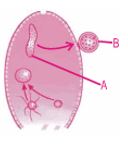
In the given diagram of the life cycle of Anopheles,what do the parts labeled '$A$' and '$B$' represent respectively?
A
Oocyst,Ookinete
B
Zygote,Ookinete
C
Ookinete,Oocyst
D
Gamete,Oocyst
Solution
(C) In the life cycle of Plasmodium within the female Anopheles mosquito,fertilization occurs in the gut to form a zygote.
This zygote transforms into a motile,elongated form called an ookinete (labeled '$A$').
The ookinete then penetrates the gut wall and develops into a spherical,encysted form known as an oocyst (labeled '$B$').
Therefore,'$A$' represents the ookinete and '$B$' represents the oocyst.
This zygote transforms into a motile,elongated form called an ookinete (labeled '$A$').
The ookinete then penetrates the gut wall and develops into a spherical,encysted form known as an oocyst (labeled '$B$').
Therefore,'$A$' represents the ookinete and '$B$' represents the oocyst.
0 likes
View Solution60
MediumMCQ
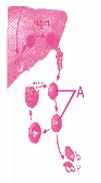
In the given diagram of the life cycle of Plasmodium,what does the part labeled '$A$' represent?
A
Merozoite
B
Red Blood Cell
C
Trophozoite
D
Gametocyte
Solution
(B) The provided diagram illustrates the erythrocytic cycle of the malaria parasite,$Plasmodium$.
In this cycle,the merozoites released from the liver cells infect the red blood cells $(RBCs)$.
Inside the $RBC$,the parasite undergoes development.
The label '$A$' points to the red blood cells that have been infected by the parasite.
Therefore,'$A$' represents the Red Blood Cell $(RBC)$.
In this cycle,the merozoites released from the liver cells infect the red blood cells $(RBCs)$.
Inside the $RBC$,the parasite undergoes development.
The label '$A$' points to the red blood cells that have been infected by the parasite.
Therefore,'$A$' represents the Red Blood Cell $(RBC)$.
0 likes
View Solution61
MediumMCQ
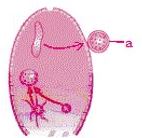
In the given diagram of the life cycle of Plasmodium in the mosquito,what does the part labeled '$a$' represent?
A
Gametes
B
Zygote
C
Oocyst
D
Sporozoite
Solution
(C) The provided diagram illustrates the fertilization and development stages of Plasmodium within the mosquito's gut.
In the mosquito,gametocytes fuse to form a zygote.
The zygote then develops into an elongated form that penetrates the gut wall of the mosquito to form an oocyst.
The label '$a$' points to the oocyst stage,which eventually ruptures to release sporozoites that migrate to the salivary glands.
Therefore,the correct option is '$C$'.
In the mosquito,gametocytes fuse to form a zygote.
The zygote then develops into an elongated form that penetrates the gut wall of the mosquito to form an oocyst.
The label '$a$' points to the oocyst stage,which eventually ruptures to release sporozoites that migrate to the salivary glands.
Therefore,the correct option is '$C$'.
0 likes
View Solution62
MediumMCQ
Identify the odd one out in the context of drugs.
A
Carbamycin
B
Quinine
C
Bacitracin
D
Tetracycline
Solution
(B) The correct answer is $B$ (Quinine).
$1$. Carbamycin,Bacitracin,and Tetracycline are all antibiotics,which are chemical substances produced by microorganisms that inhibit the growth of or kill other microorganisms.
$2$. Quinine is an antimalarial drug derived from the bark of the Cinchona tree,not an antibiotic produced by microorganisms.
$3$. Therefore,Quinine is the odd one out.
$1$. Carbamycin,Bacitracin,and Tetracycline are all antibiotics,which are chemical substances produced by microorganisms that inhibit the growth of or kill other microorganisms.
$2$. Quinine is an antimalarial drug derived from the bark of the Cinchona tree,not an antibiotic produced by microorganisms.
$3$. Therefore,Quinine is the odd one out.
0 likes
View Solution63
MediumMCQ
Which of the following viruses is not transferred through the semen of an infected male?
A
Chikungunya virus
B
Ebola virus
C
Hepatitis $B$ virus
D
Human immunodeficiency virus
Solution
(A) The correct answer is $A$.
Chikungunya virus is an arbovirus primarily transmitted to humans through the bite of infected $Aedes$ $aegypti$ or $Aedes$ $albopictus$ mosquitoes.
It is not sexually transmitted through semen.
In contrast,Ebola virus,Hepatitis $B$ virus,and Human immunodeficiency virus $(HIV)$ have been documented to be present in semen and can be transmitted through sexual contact.
Chikungunya virus is an arbovirus primarily transmitted to humans through the bite of infected $Aedes$ $aegypti$ or $Aedes$ $albopictus$ mosquitoes.
It is not sexually transmitted through semen.
In contrast,Ebola virus,Hepatitis $B$ virus,and Human immunodeficiency virus $(HIV)$ have been documented to be present in semen and can be transmitted through sexual contact.
0 likes
View Solution64
MediumMCQ
Match each disease with its correct type of vaccine.
| Column-$I$ | Column-$II$ |
| $(A)$ Tuberculosis | $(i)$ Harmless virus |
| $(B)$ Whooping cough | $(ii)$ Inactivated toxin |
| $(C)$ Diphtheria | $(iii)$ Killed bacteria |
| $(D)$ Polio | $(iv)$ Harmless bacteria |
A
$A-iv, B-iii, C-ii, D-i$
B
$A-i, B-ii, C-iv, D-iii$
C
$A-ii, B-i, C-iii, D-iv$
D
$A-iii, B-ii, C-iv, D-i$
Solution
(A) The correct matches are as follows:
$(A)$ Tuberculosis: The $BCG$ vaccine uses a live attenuated (harmless) strain of Mycobacterium bovis,which acts as a harmless bacterium $(iv)$.
$(B)$ Whooping cough (Pertussis): The vaccine typically uses killed Bordetella pertussis bacteria $(iii)$.
$(C)$ Diphtheria: The vaccine is a toxoid,which is an inactivated toxin $(ii)$ produced by the bacteria.
$(D)$ Polio: The Salk vaccine uses inactivated (killed) poliovirus,while the Sabin vaccine uses live attenuated (harmless) virus $(i)$.
Therefore,the correct sequence is $A-iv, B-iii, C-ii, D-i$.
$(A)$ Tuberculosis: The $BCG$ vaccine uses a live attenuated (harmless) strain of Mycobacterium bovis,which acts as a harmless bacterium $(iv)$.
$(B)$ Whooping cough (Pertussis): The vaccine typically uses killed Bordetella pertussis bacteria $(iii)$.
$(C)$ Diphtheria: The vaccine is a toxoid,which is an inactivated toxin $(ii)$ produced by the bacteria.
$(D)$ Polio: The Salk vaccine uses inactivated (killed) poliovirus,while the Sabin vaccine uses live attenuated (harmless) virus $(i)$.
Therefore,the correct sequence is $A-iv, B-iii, C-ii, D-i$.
0 likes
View Solution65
MediumMCQ
Which is the particular type of drug that is obtained from the plant whose one flowering branch is shown here?

A
Hallucinogen
B
Depressant
C
Stimulant
D
Pain killer
Solution
(A) : The plant illustrated in the diagram is $Datura$.
$Datura$ is well-known for its hallucinogenic properties.
The seeds and flowers of $Datura$ contain alkaloids like atropine,hyoscyamine,and scopolamine,which act as hallucinogens when consumed.
These substances alter perception,thoughts,and feelings,leading to hallucinations.
$Datura$ is well-known for its hallucinogenic properties.
The seeds and flowers of $Datura$ contain alkaloids like atropine,hyoscyamine,and scopolamine,which act as hallucinogens when consumed.
These substances alter perception,thoughts,and feelings,leading to hallucinations.
0 likes
View Solution66
MediumMCQ
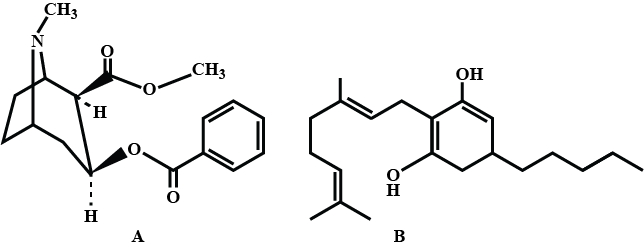
Identify the molecules $(A)$ and $(B)$ shown below and select the right option giving their source and use.
A
$(A)$ Cocaine $\rightarrow$ Erythroxylum coca $\rightarrow$ Accelerates the transport of dopamine
B
$(B)$ Heroin $\rightarrow$ Cannabis sativa $\rightarrow$ Depressant and slows down body functions
C
$(B)$ Cannabinoid $\rightarrow$ Atropa belladonna $\rightarrow$ Produces hallucinations
D
$(A)$ Morphine $\rightarrow$ Papaver somniferum $\rightarrow$ Sedative and pain killer
Solution
(A) The chemical structure $(A)$ represents Cocaine,which is obtained from the plant Erythroxylum coca. It interferes with the transport of the neurotransmitter dopamine,causing euphoria and increased energy.
The chemical structure $(B)$ represents a Cannabinoid,which is obtained from the inflorescence of the plant Cannabis sativa. Cannabinoids are known for their effects on the cardiovascular system and can produce hallucinogenic effects.
Option $(A)$ correctly identifies molecule $(A)$ as Cocaine,its source as Erythroxylum coca,and its effect on dopamine transport.
Therefore,the correct option is $(A)$.
The chemical structure $(B)$ represents a Cannabinoid,which is obtained from the inflorescence of the plant Cannabis sativa. Cannabinoids are known for their effects on the cardiovascular system and can produce hallucinogenic effects.
Option $(A)$ correctly identifies molecule $(A)$ as Cocaine,its source as Erythroxylum coca,and its effect on dopamine transport.
Therefore,the correct option is $(A)$.
0 likes
View Solution67
MediumMCQ
Which one of the following options gives the correct match of a disease with its causative organism and mode of infection?
A
Typhoid $\rightarrow$ Salmonella typhi $\rightarrow$ with inspired air
B
Pneumonia $\rightarrow$ Streptococcus pneumoniae $\rightarrow$ droplet infection
C
Elephantiasis $\rightarrow$ Wuchereria bancrofti $\rightarrow$ with infected water and food
D
Malaria $\rightarrow$ Plasmodium vivax $\rightarrow$ bite of male Anopheles mosquito
Solution
(B) The correct match is $B$.
$1$. Typhoid is caused by $Salmonella$ $typhi$ and is transmitted through contaminated food and water.
$2$. Pneumonia is caused by $Streptococcus$ $pneumoniae$ and is transmitted through droplet infection (inhalation of droplets/aerosols released by an infected person).
$3$. Elephantiasis (Filariasis) is caused by $Wuchereria$ $bancrofti$ and is transmitted through the bite of female $Culex$ mosquitoes.
$4$. Malaria is caused by $Plasmodium$ species and is transmitted through the bite of female $Anopheles$ mosquitoes. Male mosquitoes do not bite humans.
$1$. Typhoid is caused by $Salmonella$ $typhi$ and is transmitted through contaminated food and water.
$2$. Pneumonia is caused by $Streptococcus$ $pneumoniae$ and is transmitted through droplet infection (inhalation of droplets/aerosols released by an infected person).
$3$. Elephantiasis (Filariasis) is caused by $Wuchereria$ $bancrofti$ and is transmitted through the bite of female $Culex$ mosquitoes.
$4$. Malaria is caused by $Plasmodium$ species and is transmitted through the bite of female $Anopheles$ mosquitoes. Male mosquitoes do not bite humans.
0 likes
View Solution68
MediumMCQ
Match the disease in column $I$ with the appropriate items (pathogen/prevention/treatment) in column $II$.
| Column-$I$ | Column-$II$ |
| $(A)$ Amoebiasis | $(i)$ Treponema pallidum |
| $(B)$ Diphtheria | $(ii)$ Use only sterilized food and water |
| $(C)$ Cholera | $(iii)$ $DPT$ Vaccine |
| $(D)$ Syphilis | $(iv)$ Use oral rehydration therapy |
A
$A-(i), B-(ii), C-(iii), D-(iv)$
B
$A-(ii), B-(iii), C-(iv), D-(i)$
C
$A-(i), B-(iii), C-(ii), D-(iv)$
D
$A-(ii), B-(iv), C-(i), D-(iii)$
Solution
(B) The correct matches are as follows:
$1$. $(A)$ Amoebiasis: It is caused by Entamoeba histolytica,which spreads through contaminated food and water. Thus,prevention involves the use of sterilized food and water $(A-ii)$.
$2$. $(B)$ Diphtheria: It is a bacterial infection prevented by the $DPT$ (Diphtheria,Pertussis,and Tetanus) vaccine $(B-iii)$.
$3$. $(C)$ Cholera: It is characterized by severe dehydration,and the primary treatment is oral rehydration therapy $(C-iv)$.
$4$. $(D)$ Syphilis: It is a sexually transmitted disease caused by the bacterium Treponema pallidum $(D-i)$.
Therefore,the correct sequence is $A-(ii), B-(iii), C-(iv), D-(i)$.
$1$. $(A)$ Amoebiasis: It is caused by Entamoeba histolytica,which spreads through contaminated food and water. Thus,prevention involves the use of sterilized food and water $(A-ii)$.
$2$. $(B)$ Diphtheria: It is a bacterial infection prevented by the $DPT$ (Diphtheria,Pertussis,and Tetanus) vaccine $(B-iii)$.
$3$. $(C)$ Cholera: It is characterized by severe dehydration,and the primary treatment is oral rehydration therapy $(C-iv)$.
$4$. $(D)$ Syphilis: It is a sexually transmitted disease caused by the bacterium Treponema pallidum $(D-i)$.
Therefore,the correct sequence is $A-(ii), B-(iii), C-(iv), D-(i)$.
0 likes
View Solution69
MediumMCQ
Match the columns and choose the correct option.
| Column-$I$ | Column-$II$ |
| $(a)$ Allergy | $(1)$ Malaria |
| $(b)$ Widal test | $(2)$ $AIDS$ |
| $(c)$ $ELISA$ test | $(3)$ Typhoid fever |
| $(d)$ Haemozoin | $(4)$ $IgE$ antibodies |
A
$a-1, b-3, c-2, d-4$
B
$a-4, b-2, c-3, d-1$
C
$a-4, b-3, c-2, d-1$
D
$a-3, b-4, c-2, d-1$
Solution
(C) The correct matches are as follows:
$(a)$ Allergy is associated with the production of $IgE$ antibodies in response to allergens. Thus,$a-4$.
$(b)$ Widal test is a diagnostic test used for the detection of Typhoid fever caused by Salmonella typhi. Thus,$b-3$.
$(c)$ $ELISA$ (Enzyme-Linked Immunosorbent Assay) is a diagnostic test used for the detection of $AIDS$ (caused by $HIV$). Thus,$c-2$.
$(d)$ Haemozoin is a toxic substance released by the rupture of red blood cells during the life cycle of the Plasmodium parasite,which causes Malaria. Thus,$d-1$.
Therefore,the correct sequence is $a-4, b-3, c-2, d-1$.
$(a)$ Allergy is associated with the production of $IgE$ antibodies in response to allergens. Thus,$a-4$.
$(b)$ Widal test is a diagnostic test used for the detection of Typhoid fever caused by Salmonella typhi. Thus,$b-3$.
$(c)$ $ELISA$ (Enzyme-Linked Immunosorbent Assay) is a diagnostic test used for the detection of $AIDS$ (caused by $HIV$). Thus,$c-2$.
$(d)$ Haemozoin is a toxic substance released by the rupture of red blood cells during the life cycle of the Plasmodium parasite,which causes Malaria. Thus,$d-1$.
Therefore,the correct sequence is $a-4, b-3, c-2, d-1$.
0 likes
View Solution70
MediumMCQ
Match the following:
| Column-$I$ | Column-$II$ |
|---|---|
| $(A)$ Ringworms | $(P)$ $W. malayi$ |
| $(B)$ Elephantiasis | $(Q)$ Rhino virus |
| $(C)$ Common cold | $(R)$ $HIV$ |
| $(S)$ $Trichophyton$ |
A
$A-S, B-R, C-Q$
B
$A-S, B-Q, C-P$
C
$A-S, B-P, C-Q$
D
$A-Q, B-R, C-P$
Solution
(C) The correct matches are as follows:
$1$. Ringworms are fungal infections caused by fungi belonging to genera like $Trichophyton$,$Microsporum$,and $Epidermophyton$. Thus,$(A)$ matches with $(S)$.
$2$. Elephantiasis (Filariasis) is caused by filarial worms such as $Wuchereria$ $bancrofti$ and $Wuchereria$ $malayi$. Thus,$(B)$ matches with $(P)$.
$3$. Common cold is caused by a group of viruses known as Rhino viruses. Thus,$(C)$ matches with $(Q)$.
Therefore,the correct sequence is $A-S, B-P, C-Q$.
$1$. Ringworms are fungal infections caused by fungi belonging to genera like $Trichophyton$,$Microsporum$,and $Epidermophyton$. Thus,$(A)$ matches with $(S)$.
$2$. Elephantiasis (Filariasis) is caused by filarial worms such as $Wuchereria$ $bancrofti$ and $Wuchereria$ $malayi$. Thus,$(B)$ matches with $(P)$.
$3$. Common cold is caused by a group of viruses known as Rhino viruses. Thus,$(C)$ matches with $(Q)$.
Therefore,the correct sequence is $A-S, B-P, C-Q$.
0 likes
View Solution71
MediumMCQ
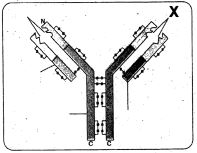
Identify $X$ and $Y$ from the following structure of an antibody molecule.
A
$X$: Antigen binding site,$Y$: Heavy chain
B
$X$: Light chain,$Y$: Heavy chain
C
$X$: Light chain,$Y$: Antibody
D
$X$: Antigen binding site,$Y$: Light chain
Solution
(A) The provided image represents the structure of an antibody molecule (immunoglobulin).
An antibody molecule consists of four polypeptide chains: two small 'light chains' and two larger 'heavy chains',represented as $H_2L_2$.
The variable region at the tips of the $Y$-shaped structure forms the 'antigen binding site' (labeled as $X$ in the diagram).
The longer polypeptide chains forming the stem and part of the arms are the 'heavy chains' (labeled as $Y$ in the diagram).
Therefore,$X$ represents the antigen binding site and $Y$ represents the heavy chain.
An antibody molecule consists of four polypeptide chains: two small 'light chains' and two larger 'heavy chains',represented as $H_2L_2$.
The variable region at the tips of the $Y$-shaped structure forms the 'antigen binding site' (labeled as $X$ in the diagram).
The longer polypeptide chains forming the stem and part of the arms are the 'heavy chains' (labeled as $Y$ in the diagram).
Therefore,$X$ represents the antigen binding site and $Y$ represents the heavy chain.
0 likes
View Solution72
MediumMCQ
Read the following sentences and choose the correct sentences:
$1.$ Dysentery,plague,and diphtheria are caused by bacteria.
$2.$ $Salmonella$ $typhi$ directly affects the respiratory system.
$3.$ Amoebiasis and Ascariasis are caused by contaminated water.
$4.$ Internal bleeding,anemia,and muscular pain are symptoms of elephantiasis.
$1.$ Dysentery,plague,and diphtheria are caused by bacteria.
$2.$ $Salmonella$ $typhi$ directly affects the respiratory system.
$3.$ Amoebiasis and Ascariasis are caused by contaminated water.
$4.$ Internal bleeding,anemia,and muscular pain are symptoms of elephantiasis.
A
$2$ and $4$
B
$1$ and $3$
C
$3$ and $4$
D
$1$ and $2$
Solution
(B) Statement $1$ is correct: Dysentery (Shigellosis) is caused by $Shigella$ species,plague by $Yersinia$ $pestis$,and diphtheria by $Corynebacterium$ $diphtheriae$. All are bacterial diseases.
Statement $2$ is incorrect: $Salmonella$ $typhi$ causes typhoid fever,which affects the small intestine,not the respiratory system.
Statement $3$ is correct: Amoebiasis ($Entamoeba$ $histolytica$) and Ascariasis ($Ascaris$ $lumbricoides$) are transmitted through contaminated food and water.
Statement $4$ is incorrect: Internal bleeding,anemia,and muscular pain are symptoms of Ascariasis,not elephantiasis (filariasis). Elephantiasis is characterized by chronic inflammation of the lymphatic vessels.
Therefore,statements $1$ and $3$ are correct.
Statement $2$ is incorrect: $Salmonella$ $typhi$ causes typhoid fever,which affects the small intestine,not the respiratory system.
Statement $3$ is correct: Amoebiasis ($Entamoeba$ $histolytica$) and Ascariasis ($Ascaris$ $lumbricoides$) are transmitted through contaminated food and water.
Statement $4$ is incorrect: Internal bleeding,anemia,and muscular pain are symptoms of Ascariasis,not elephantiasis (filariasis). Elephantiasis is characterized by chronic inflammation of the lymphatic vessels.
Therefore,statements $1$ and $3$ are correct.
0 likes
View Solution73
MediumMCQ
Choose the correct pair:
A
$T$-Lymphocytes $\to$ Do not secrete antibodies but help $B$-cells to produce them.
B
Interferons $\to$ Proteins which protect non-infected cells from further viral infection.
C
Secondary response $\to$ Highly intense than primary response.
D
All are correct.
Solution
(D) $T$-Lymphocytes are responsible for cell-mediated immunity and they do not secrete antibodies,but they help $B$-cells to produce them.
Interferons are glycoproteins produced by virus-infected cells that protect non-infected cells from further viral infection.
The secondary immune response is characterized by a rapid and highly intense production of antibodies compared to the primary response due to memory cells.
Since all the given statements are scientifically accurate,the correct option is $D$.
Interferons are glycoproteins produced by virus-infected cells that protect non-infected cells from further viral infection.
The secondary immune response is characterized by a rapid and highly intense production of antibodies compared to the primary response due to memory cells.
Since all the given statements are scientifically accurate,the correct option is $D$.
0 likes
View Solution74
MediumMCQ
Match the following:
| Column-$I$ | Column-$II$ |
|---|---|
| $(1)$ $AIDS$ | $(A)$ Rhino Virus |
| $(2)$ Common Cold | $(B)$ Carcinogen |
| $(3)$ Malaria | $(C)$ Salmonella |
| $(4)$ Cancer | $(D)$ Plasmodium |
| $(E)$ Retrovirus |
A
$1-E, 2-A, 3-B, 4-C$
B
$1-E, 2-A, 3-D, 4-C$
C
$1-D, 2-B, 3-C, 4-E$
D
$1-E, 2-A, 3-D, 4-B$
Solution
(D) $(1)$ $AIDS$ is caused by the Human Immunodeficiency Virus $(HIV)$,which is a Retrovirus $(E)$.
$(2)$ Common Cold is caused by Rhino viruses $(A)$.
$(3)$ Malaria is caused by the protozoan parasite Plasmodium $(D)$.
$(4)$ Cancer is caused by physical,chemical,or biological agents known as Carcinogens $(B)$.
Therefore,the correct matching is $1-E, 2-A, 3-D, 4-B$.
$(2)$ Common Cold is caused by Rhino viruses $(A)$.
$(3)$ Malaria is caused by the protozoan parasite Plasmodium $(D)$.
$(4)$ Cancer is caused by physical,chemical,or biological agents known as Carcinogens $(B)$.
Therefore,the correct matching is $1-E, 2-A, 3-D, 4-B$.
0 likes
View Solution75
MediumMCQ
Identify the correct match:
| $(a)$ | $(b)$ | $(c)$ |
|---|---|---|
| $1$. Typhoid | $a$. Virus | $P$. Nose |
| $2$. Malaria | $b$. Bacteria | $Q$. Liver cells |
| $3$. Common cold | $c$. Protozoans | $R$. Small intestine |
A
$(1-b-Q), (2-c-R), (3-a-P)$
B
$(1-b-R), (2-a-P), (3-c-Q)$
C
$(1-c-P), (2-b-R), (3-a-Q)$
D
$(1-b-R), (2-c-Q), (3-a-P)$
Solution
(D) To identify the correct match, we analyze each disease:
$1$. Typhoid is caused by the bacterium $Salmonella \text{ typhi}$, which primarily affects the small intestine $(1-b-R)$.
$2$. Malaria is caused by the protozoan $Plasmodium$, which infects liver cells and red blood cells $(2-c-Q)$.
$3$. Common cold is caused by rhinoviruses, which primarily infect the nose and respiratory passage $(3-a-P)$.
Therefore, the correct sequence is $(1-b-R), (2-c-Q), (3-a-P)$.
$1$. Typhoid is caused by the bacterium $Salmonella \text{ typhi}$, which primarily affects the small intestine $(1-b-R)$.
$2$. Malaria is caused by the protozoan $Plasmodium$, which infects liver cells and red blood cells $(2-c-Q)$.
$3$. Common cold is caused by rhinoviruses, which primarily infect the nose and respiratory passage $(3-a-P)$.
Therefore, the correct sequence is $(1-b-R), (2-c-Q), (3-a-P)$.
0 likes
View Solution76
MediumMCQ
Match the following columns.
| Column-$I$ | Column-$II$ |
|---|---|
| $(1)$ $HIV$ | $(v)$ Oncogenic virus |
| $(2)$ Cancer | $(w)$ Microsporum,Trichophyton |
| $(3)$ Allergens | $(x)$ Retrovirus |
| $(4)$ Ringworm | $(y)$ Colostrum |
| $(z)$ Serotonin |
A
$1-w, 2-y, 3-v, 4-x$
B
$1-y, 2-z, 3-w, 4-v$
C
$1-v, 2-x, 3-y, 4-z$
D
$1-x, 2-v, 3-z, 4-w$
Solution
(D) The correct matches are as follows:
$(1)$ $HIV$ is a $Retrovirus$ (matches with $x$).
$(2)$ Cancer is caused by oncogenic viruses (matches with $v$).
$(3)$ Allergens trigger the release of chemicals like serotonin and histamine during an allergic reaction (matches with $z$).
$(4)$ Ringworm is a fungal infection caused by genera like $Microsporum$ and $Trichophyton$ (matches with $w$).
Therefore,the correct sequence is $1-x, 2-v, 3-z, 4-w$.
$(1)$ $HIV$ is a $Retrovirus$ (matches with $x$).
$(2)$ Cancer is caused by oncogenic viruses (matches with $v$).
$(3)$ Allergens trigger the release of chemicals like serotonin and histamine during an allergic reaction (matches with $z$).
$(4)$ Ringworm is a fungal infection caused by genera like $Microsporum$ and $Trichophyton$ (matches with $w$).
Therefore,the correct sequence is $1-x, 2-v, 3-z, 4-w$.
0 likes
View Solution77
MediumMCQ
$A$ - Smoking increases $O_2$ content in blood.
$R$ - Nicotine stimulates the adrenal gland.
$R$ - Nicotine stimulates the adrenal gland.
A
$A$ and $R$ both are correct.
B
$A$ and $R$ both are incorrect.
C
$A$ is correct,$R$ is incorrect.
D
$A$ is incorrect,$R$ is correct.
Solution
(D) Smoking releases carbon monoxide $(CO)$ into the blood,which binds to hemoglobin with a much higher affinity than $O_2$,forming carboxyhemoglobin. This reduces the oxygen-carrying capacity of the blood,making statement $A$ incorrect.
Nicotine,a chemical found in tobacco,stimulates the adrenal glands to release adrenaline and noradrenaline into the blood,which increases blood pressure and heart rate. Thus,statement $R$ is correct.
Therefore,$A$ is incorrect and $R$ is correct.
Nicotine,a chemical found in tobacco,stimulates the adrenal glands to release adrenaline and noradrenaline into the blood,which increases blood pressure and heart rate. Thus,statement $R$ is correct.
Therefore,$A$ is incorrect and $R$ is correct.
0 likes
View Solution78
MediumMCQ
$A$ person exhibits unpredictable moods, outbursts of emotion, quarrelsome behavior, and conflicts with others. They are suffering from ....... disorder.
A
Schizophrenia
B
Borderline Personality Disorder $(BPD)$
C
Mood disorder
D
Addiction disorder
Solution
(B) The symptoms described, such as unpredictable moods, emotional outbursts, and interpersonal conflicts, are characteristic of $Borderline \text{ } Personality \text{ } Disorder \text{ } (BPD)$.
$BPD$ is a mental health disorder that impacts the way an individual thinks and feels about themselves and others, causing problems functioning in everyday life.
It includes self-image issues, difficulty managing emotions and behavior, and a pattern of unstable relationships.
$BPD$ is a mental health disorder that impacts the way an individual thinks and feels about themselves and others, causing problems functioning in everyday life.
It includes self-image issues, difficulty managing emotions and behavior, and a pattern of unstable relationships.
0 likes
View Solution79
MediumMCQ
Match the diseases given in Column-$I$ with their related aspects (pathogens/preventive measures/treatment) given in Column-$II$.
| Column-$I$ | Column-$II$ |
| $(a)$ Amoebiasis | $(i)$ Treponema pallidum |
| $(b)$ Diphtheria | $(ii)$ Use of hygienic food and water |
| $(c)$ Cholera | $(iii)$ $DPT$ vaccine |
| $(d)$ Syphilis | $(iv)$ Use of oral rehydration therapy |
A
$(a-i), (b-ii), (c-iii), (d-iv)$
B
$(a-ii), (b-iv), (c-i), (d-iii)$
C
$(a-ii), (b-i), (c-iii), (d-iv)$
D
$(a-ii), (b-iii), (c-iv), (d-i)$
Solution
(D) The correct matching is as follows:
$(a)$ Amoebiasis is caused by Entamoeba histolytica and is prevented by the consumption of hygienic food and water. Thus, $(a-ii)$.
$(b)$ Diphtheria is a bacterial infection prevented by the administration of the $DPT$ vaccine. Thus, $(b-iii)$.
$(c)$ Cholera is a water-borne disease treated by oral rehydration therapy to manage dehydration. Thus, $(c-iv)$.
$(d)$ Syphilis is a sexually transmitted disease caused by the bacterium Treponema pallidum. Thus, $(d-i)$.
Therefore, the correct sequence is $(a-ii), (b-iii), (c-iv), (d-i)$.
$(a)$ Amoebiasis is caused by Entamoeba histolytica and is prevented by the consumption of hygienic food and water. Thus, $(a-ii)$.
$(b)$ Diphtheria is a bacterial infection prevented by the administration of the $DPT$ vaccine. Thus, $(b-iii)$.
$(c)$ Cholera is a water-borne disease treated by oral rehydration therapy to manage dehydration. Thus, $(c-iv)$.
$(d)$ Syphilis is a sexually transmitted disease caused by the bacterium Treponema pallidum. Thus, $(d-i)$.
Therefore, the correct sequence is $(a-ii), (b-iii), (c-iv), (d-i)$.
0 likes
View Solution80
MediumMCQ
The common cold differs from pneumonia in that:
A
Pneumonia is a communicable disease whereas the common cold is a nutritional deficiency disease.
B
Pneumonia can be prevented by a live attenuated bacterial vaccine whereas there is no effective vaccine for the common cold.
C
Pneumonia is caused by a virus while the common cold is caused by the bacterium $Haemophilus$ $influenzae$.
D
Pneumonia pathogens infect the alveoli whereas the common cold affects the nose and respiratory passage but not the lungs.
Solution
(D) The common cold is caused by rhinoviruses,which infect the nose and respiratory passage but do not affect the lungs.
In contrast,pneumonia is caused by pathogens like $Streptococcus$ $pneumoniae$ and $Haemophilus$ $influenzae$,which infect the alveoli (air sacs) of the lungs,leading to fluid accumulation.
Therefore,option $D$ correctly highlights the difference in the site of infection.
In contrast,pneumonia is caused by pathogens like $Streptococcus$ $pneumoniae$ and $Haemophilus$ $influenzae$,which infect the alveoli (air sacs) of the lungs,leading to fluid accumulation.
Therefore,option $D$ correctly highlights the difference in the site of infection.
0 likes
View Solution81
MediumMCQ
$A$ person,who shows unpredictable moods,outbursts of emotion,quarrelsome behaviour and conflicts with others,is suffering from
A
Borderline personality disorder $(BPD)$
B
Mood disorder
C
Addictive disorder
D
Schizophrenia
Solution
(A) Borderline personality disorder $(BPD)$ is a mental health condition characterized by a pattern of ongoing instability in moods,behavior,self-image,and functioning.
Individuals with this disorder often exhibit impulsive actions,unpredictable mood swings,intense outbursts of emotion,and difficulty maintaining stable relationships,which frequently leads to quarrelsome behavior and conflicts with others.
Individuals with this disorder often exhibit impulsive actions,unpredictable mood swings,intense outbursts of emotion,and difficulty maintaining stable relationships,which frequently leads to quarrelsome behavior and conflicts with others.
0 likes
View Solution82
MediumMCQ
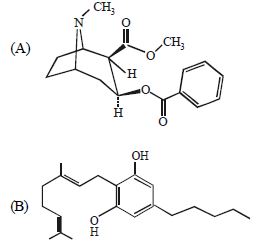
Identify the molecules $(A)$ and $(B)$ shown below and select the right option giving their source and use.
| Molecule | Source | Uses |
| :--- | :--- | :--- |
| Molecule | Source | Uses |
| :--- | :--- | :--- |
A
$(A)$ Cocaine $\to$ Erythroxylum coca $\to$ Accelerates the transport of dopamine
B
$(B)$ Heroin $\to$ Cannabis sativa $\to$ Depressant and slows down body functions
C
$(B)$ Cannabinoid $\to$ Atropa belladona $\to$ Produces hallucinations
D
$(A)$ Morphine $\to$ Papaver somniferum $\to$ Sedative and pain killer
Solution
(A) Molecule $(A)$ is the chemical structure of Cocaine,which is obtained from the plant Erythroxylum coca. It interferes with the transport of the neurotransmitter dopamine.
Molecule $(B)$ is the chemical structure of a Cannabinoid,which is obtained from the inflorescences of the plant Cannabis sativa. Cannabinoids are known for their effects on the cardiovascular system and can produce hallucinations.
Option $(A)$ is incorrect because while the source is correct,the structure shown is Cocaine,not Morphine.
Option $(D)$ is incorrect because the structure shown in $(A)$ is Cocaine,not Morphine.
Therefore,the correct identification and association based on the provided structures is that $(A)$ is Cocaine and $(B)$ is a Cannabinoid. However,looking at the options provided,option $(A)$ correctly identifies the source and action of Cocaine,which matches the structure $(A)$.
Molecule $(B)$ is the chemical structure of a Cannabinoid,which is obtained from the inflorescences of the plant Cannabis sativa. Cannabinoids are known for their effects on the cardiovascular system and can produce hallucinations.
Option $(A)$ is incorrect because while the source is correct,the structure shown is Cocaine,not Morphine.
Option $(D)$ is incorrect because the structure shown in $(A)$ is Cocaine,not Morphine.
Therefore,the correct identification and association based on the provided structures is that $(A)$ is Cocaine and $(B)$ is a Cannabinoid. However,looking at the options provided,option $(A)$ correctly identifies the source and action of Cocaine,which matches the structure $(A)$.
0 likes
View Solution83
MediumMCQ
Assertion: Cocaine has a potent stimulating action on the central nervous system,producing a sense of euphoria and increased energy.
Reason: Injecting the microbes intentionally during immunisation or infectious organisms gaining access into the body during natural infection induces active immunity.
Reason: Injecting the microbes intentionally during immunisation or infectious organisms gaining access into the body during natural infection induces active immunity.
A
If both Assertion and Reason are correct and the Reason is a correct explanation of the Assertion.
B
If both Assertion and Reason are correct but Reason is not a correct explanation of the Assertion.
C
If the Assertion is correct but Reason is incorrect.
D
If both the Assertion and Reason are incorrect.
Solution
(B) The Assertion is correct. Cocaine is an alkaloid obtained from the coca plant, $Erythroxylum \text{ } coca$. It interferes with the transport of the neurotransmitter dopamine,resulting in a potent stimulating action on the central nervous system,which produces a sense of euphoria and increased energy.
The Reason is also a correct statement regarding immunology. Active immunity is indeed developed when a host is exposed to antigens,which can occur either through natural infection or through intentional exposure via immunization (vaccination).
However,the Reason does not explain the mechanism of action of cocaine. Therefore,both statements are correct,but the Reason is not the correct explanation of the Assertion.
The Reason is also a correct statement regarding immunology. Active immunity is indeed developed when a host is exposed to antigens,which can occur either through natural infection or through intentional exposure via immunization (vaccination).
However,the Reason does not explain the mechanism of action of cocaine. Therefore,both statements are correct,but the Reason is not the correct explanation of the Assertion.
0 likes
View Solution84
Medium
State whether true or false :
$(1)$ Gastrointestinal tract,kidney and heart also produce hormones.
$(2)$ Pars distalis produces six trophic hormones.
$(3)$ $B$-lymphocytes provide cell-mediated immunity.
$(4)$ Insulin resistance results in a disease called diabetes mellitus.
$(1)$ Gastrointestinal tract,kidney and heart also produce hormones.
$(2)$ Pars distalis produces six trophic hormones.
$(3)$ $B$-lymphocytes provide cell-mediated immunity.
$(4)$ Insulin resistance results in a disease called diabetes mellitus.
Solution
(A) $(1)$ True. The gastrointestinal tract secretes hormones like gastrin,$CCK$,secretin,and $GIP$. The heart secretes Atrial Natriuretic Factor $(ANF)$,and the kidney secretes erythropoietin.
$(2)$ True. Pars distalis secretes six trophic hormones: $GH$,$PRL$,$TSH$,$ACTH$,$LH$,and $FSH$.
$(3)$ False. $T$-lymphocytes provide cell-mediated immunity,whereas $B$-lymphocytes are responsible for humoral immunity.
$(4)$ True. Insulin resistance or insufficient insulin production leads to diabetes mellitus.
$(2)$ True. Pars distalis secretes six trophic hormones: $GH$,$PRL$,$TSH$,$ACTH$,$LH$,and $FSH$.
$(3)$ False. $T$-lymphocytes provide cell-mediated immunity,whereas $B$-lymphocytes are responsible for humoral immunity.
$(4)$ True. Insulin resistance or insufficient insulin production leads to diabetes mellitus.
0 likes
View Solution85
Medium
What are the various public health measures,which you would suggest as a safeguard against infectious diseases?
Solution
(N/A) Public health measures are preventive actions taken to check the spread of various infectious diseases. These measures aim to reduce contact with infectious agents. Key methods include:
$1$. Maintenance of personal and public hygiene: This is crucial for preventing infectious diseases. It includes maintaining a clean body,consuming healthy and nutritious food,and drinking clean water. Public hygiene involves the proper disposal of waste and excreta,and periodic cleaning and disinfection of water reservoirs.
$2$. Isolation: To prevent the spread of air-borne diseases such as pneumonia,chickenpox,and tuberculosis,it is essential to keep the infected person in isolation to reduce the chances of transmission.
$3$. Vaccination: Vaccination protects the body from communicable diseases by administering agents that mimic microbes. It helps in providing immunity to the body. Vaccines are available for diseases like tetanus,polio,measles,and mumps.
$4$. Vector Eradication: Diseases such as malaria,filariasis,dengue,and chikungunya spread through vectors. These can be prevented by maintaining a clean environment and preventing mosquito breeding. This includes avoiding stagnant water,regular cleaning of coolers,using mosquito nets,and applying insecticides like malathion in drains and ponds. Introducing fish such as $Gambusia$ in ponds also controls mosquito larvae.
$1$. Maintenance of personal and public hygiene: This is crucial for preventing infectious diseases. It includes maintaining a clean body,consuming healthy and nutritious food,and drinking clean water. Public hygiene involves the proper disposal of waste and excreta,and periodic cleaning and disinfection of water reservoirs.
$2$. Isolation: To prevent the spread of air-borne diseases such as pneumonia,chickenpox,and tuberculosis,it is essential to keep the infected person in isolation to reduce the chances of transmission.
$3$. Vaccination: Vaccination protects the body from communicable diseases by administering agents that mimic microbes. It helps in providing immunity to the body. Vaccines are available for diseases like tetanus,polio,measles,and mumps.
$4$. Vector Eradication: Diseases such as malaria,filariasis,dengue,and chikungunya spread through vectors. These can be prevented by maintaining a clean environment and preventing mosquito breeding. This includes avoiding stagnant water,regular cleaning of coolers,using mosquito nets,and applying insecticides like malathion in drains and ponds. Introducing fish such as $Gambusia$ in ponds also controls mosquito larvae.
1 likes
View Solution86
MediumMCQ
In which way has the study of biology helped us to control infectious diseases?
A
By identifying the life cycles of pathogens and vectors.
B
By developing vaccines and antibiotics.
C
By understanding the modes of disease transmission.
D
All of the above.
Solution
(D) The study of biology has significantly contributed to controlling infectious diseases in several ways:
$1$. Identifying life cycles: Understanding the life cycles of pathogens and their vectors allows us to target them at vulnerable stages.
$2$. Developing vaccines and antibiotics: Biotechnology and immunology have enabled the creation of vaccines to prevent diseases and antibiotics to treat bacterial infections.
$3$. Understanding transmission: Knowledge of how diseases spread (modes of transmission) helps in implementing effective public health measures and sanitation practices.
Therefore,all the mentioned options are correct.
$1$. Identifying life cycles: Understanding the life cycles of pathogens and their vectors allows us to target them at vulnerable stages.
$2$. Developing vaccines and antibiotics: Biotechnology and immunology have enabled the creation of vaccines to prevent diseases and antibiotics to treat bacterial infections.
$3$. Understanding transmission: Knowledge of how diseases spread (modes of transmission) helps in implementing effective public health measures and sanitation practices.
Therefore,all the mentioned options are correct.
0 likes
View Solution87
Medium
How does the transmission of each of the following diseases take place?
$(a)$ Amoebiasis
$(b)$ Malaria
$(c)$ Ascariasis
$(d)$ Pneumonia
$(a)$ Amoebiasis
$(b)$ Malaria
$(c)$ Ascariasis
$(d)$ Pneumonia
Solution
(N/A)
| Disease | Mode of Transmission |
|---|---|
| $(a)$ Amoebiasis | Transmitted through contaminated food and water. Houseflies act as mechanical carriers,transferring the parasite from feces to food and water. |
| $(b)$ Malaria | Transmitted by the bite of an infected female $Anopheles$ mosquito,which acts as a vector. |
| $(c)$ Ascariasis | Transmitted through soil,water,and vegetables contaminated with the eggs of the parasite $Ascaris$ $lumbricoides$. |
| $(d)$ Pneumonia | Transmitted by inhaling droplets or aerosols released by an infected person,or by sharing glasses and utensils with an infected person. |
0 likes
View Solution88
EasyMCQ
Given below are the pairs of pathogens and the diseases caused by them. Which out of these is not a matching pair and why?
$(a)$ Virus - Common cold
$(b)$ Salmonella - Typhoid
$(c)$ Microsporum - Filariasis
$(d)$ Plasmodium - Malaria
$(a)$ Virus - Common cold
$(b)$ Salmonella - Typhoid
$(c)$ Microsporum - Filariasis
$(d)$ Plasmodium - Malaria
A
Virus - Common cold
B
Salmonella - Typhoid
C
Microsporum - Filariasis
D
Plasmodium - Malaria
Solution
$(C)$ The pair $(c)$ is mismatched.
$Microsporum$ is a genus of fungi that causes ringworm, a fungal infection of the skin.
Filariasis (also known as elephantiasis) is caused by filarial worms such as $Wuchereria \text{ } bancrofti$ and $Wuchereria \text{ } malayi$, not by $Microsporum$.
$Microsporum$ is a genus of fungi that causes ringworm, a fungal infection of the skin.
Filariasis (also known as elephantiasis) is caused by filarial worms such as $Wuchereria \text{ } bancrofti$ and $Wuchereria \text{ } malayi$, not by $Microsporum$.
0 likes
View Solution89
Medium
"Prevention is better than cure". Comment.
Solution
(N/A) The statement "Prevention is better than cure" is highly significant in medical science for several reasons:
$1$. Some diseases, such as $AIDS$ and Hepatitis-$B$, are chronic and currently have no permanent cure, making prevention the only viable strategy.
$2$. Treatment for many diseases is often expensive, leading to significant financial burden on the family.
$3$. Prevention avoids the physical pain, suffering, and potential long-term complications associated with the disease.
$4$. Preventive measures like vaccination, maintaining hygiene, and healthy lifestyle choices are cost-effective and improve the overall quality of life.
$1$. Some diseases, such as $AIDS$ and Hepatitis-$B$, are chronic and currently have no permanent cure, making prevention the only viable strategy.
$2$. Treatment for many diseases is often expensive, leading to significant financial burden on the family.
$3$. Prevention avoids the physical pain, suffering, and potential long-term complications associated with the disease.
$4$. Preventive measures like vaccination, maintaining hygiene, and healthy lifestyle choices are cost-effective and improve the overall quality of life.
0 likes
View Solution90
Medium
The following table shows certain diseases, their causative organisms, and symptoms. Fill in the gaps $(a)$ to $(f)$.
| Name of the Disease | Causative organism | Symptoms |
| Ascariasis | Ascaris | $(a)$ |
| $(b)$ | Trichophyton | Appearance of dry, scaly lesions on various parts of the body. |
| Typhoid | $(c)$ | High fever, weakness, headache, stomach pain, constipation. |
| Pneumonia | Streptococcus pneumoniae | $(d)$ |
| $(e)$ | Rhino viruses | Nasal congestion and discharge, sore throat, cough, headache. |
| Filariasis | $(f)$ | Inflammation in lower limbs. |
Solution
$(a)$ Internal bleeding, muscular pain, fever, anemia, and blockage of the intestinal passage.
$(b)$ Ringworm
$(c)$ Salmonella typhi
$(d)$ Fever, chills, cough, and headache.
$(e)$ Common cold
$(f)$ Wuchereria bancrofti and Wuchereria malayi
$(b)$ Ringworm
$(c)$ Salmonella typhi
$(d)$ Fever, chills, cough, and headache.
$(e)$ Common cold
$(f)$ Wuchereria bancrofti and Wuchereria malayi
0 likes
View Solution91
Medium
What are lifestyle diseases? How are they caused? Name any two such diseases.
Solution
(N/A) Lifestyle diseases are defined as diseases that are linked with the way people live their lives.
They are primarily caused by improper changes in the living environment and daily habits.
These diseases are commonly caused by factors such as alcohol consumption,drug abuse,smoking,lack of physical activity,and unhealthy dietary habits.
Examples of such diseases include heart disease,stroke,obesity,and cancer.
They are primarily caused by improper changes in the living environment and daily habits.
These diseases are commonly caused by factors such as alcohol consumption,drug abuse,smoking,lack of physical activity,and unhealthy dietary habits.
Examples of such diseases include heart disease,stroke,obesity,and cancer.
0 likes
View Solution92
EasyMCQ
Match the diseases in Column-$I$ with their causative organisms in Column-$II$ and select the correct option:
| Column-$I$ (Disease) | Column-$II$ (Causative Organism) |
|---|---|
| $(a)$ Typhoid | $(i)$ Wuchereria |
| $(b)$ Pneumonia | $(ii)$ Plasmodium |
| $(c)$ Filariasis | $(iii)$ Salmonella |
| $(d)$ Malaria | $(iv)$ Haemophilus |
A
$(i), (iii), (ii), (iv)$
B
$(iii), (iv), (i), (ii)$
C
$(ii), (i), (iii), (iv)$
D
$(iv), (i), (ii), (iii)$
Solution
(B) The correct matches are as follows:
$(a)$ Typhoid is caused by the bacterium $Salmonella$ $typhi$.
$(b)$ Pneumonia is caused by bacteria such as $Streptococcus$ $pneumoniae$ or $Haemophilus$ $influenzae$.
$(c)$ Filariasis (Elephantiasis) is caused by filarial worms like $Wuchereria$ $bancrofti$ or $Wuchereria$ $malayi$.
$(d)$ Malaria is caused by protozoan parasites of the genus $Plasmodium$.
Therefore,the correct matching is: $(a)-(iii), (b)-(iv), (c)-(i), (d)-(ii)$.
The correct option is $B$.
$(a)$ Typhoid is caused by the bacterium $Salmonella$ $typhi$.
$(b)$ Pneumonia is caused by bacteria such as $Streptococcus$ $pneumoniae$ or $Haemophilus$ $influenzae$.
$(c)$ Filariasis (Elephantiasis) is caused by filarial worms like $Wuchereria$ $bancrofti$ or $Wuchereria$ $malayi$.
$(d)$ Malaria is caused by protozoan parasites of the genus $Plasmodium$.
Therefore,the correct matching is: $(a)-(iii), (b)-(iv), (c)-(i), (d)-(ii)$.
The correct option is $B$.
0 likes
View Solution93
Easy
Match the columns:
| Column-$I$ | Column-$II$ |
|---|---|
| $(a)$ $TYPHOID$ | $(1)$ $HIV$ |
| $(b)$ $MALARIA$ | $(2)$ $RHINO$ $VIRUS$ |
| $(c)$ $COMMON$ $COLD$ | $(3)$ $SALMONELLA$ |
| $(d)$ $PNEUMONIA$ | $(4)$ $PLASMODIUM$ |
| $(e)$ $AIDS$ | $(5)$ $HAEMOPHILUS$ $INFLUENZAE$ |
Solution
(A) $(a-3), (b-4), (c-2), (d-5), (e-1)$
Detailed explanation:
- $(a)$ $TYPHOID$ is caused by the bacterium $Salmonella$ $typhi$.
- $(b)$ $MALARIA$ is caused by the protozoan $Plasmodium$.
- $(c)$ $COMMON$ $COLD$ is caused by $Rhino$ $viruses$.
- $(d)$ $PNEUMONIA$ is caused by $Streptococcus$ $pneumoniae$ or $Haemophilus$ $influenzae$.
- $(e)$ $AIDS$ is caused by the $Human$ $Immunodeficiency$ $Virus$ $(HIV)$.
Detailed explanation:
- $(a)$ $TYPHOID$ is caused by the bacterium $Salmonella$ $typhi$.
- $(b)$ $MALARIA$ is caused by the protozoan $Plasmodium$.
- $(c)$ $COMMON$ $COLD$ is caused by $Rhino$ $viruses$.
- $(d)$ $PNEUMONIA$ is caused by $Streptococcus$ $pneumoniae$ or $Haemophilus$ $influenzae$.
- $(e)$ $AIDS$ is caused by the $Human$ $Immunodeficiency$ $Virus$ $(HIV)$.
0 likes
View Solution94
Easy
Match the columns:
| Column-$I$ | Column-$II$ | Column-$III$ |
|---|---|---|
| $(a)$ Common cold | $(1)$ Streptococcus pneumoniae | $(P)$ Inflammation of hands and legs |
| $(b)$ Pneumonia | $(2)$ Rhinovirus | $(Q)$ Cancer of skin and vessels |
| $(c)$ $AIDS$ | $(3)$ Retrovirus | $(R)$ Disease of nasal congestion |
| $(d)$ Elephantiasis | $(4)$ Filarial worms | $(S)$ Finger nails turn blue to gray in color |
Solution
(A) The correct matches are as follows:
$1$. $(a)$ Common cold is caused by $(2)$ Rhinovirus and results in $(R)$ nasal congestion.
$2$. $(b)$ Pneumonia is caused by $(1)$ Streptococcus pneumoniae and results in $(S)$ finger nails turning blue to gray in color.
$3$. $(c)$ $AIDS$ is caused by $(3)$ Retrovirus and can lead to $(Q)$ Kaposi's sarcoma (cancer of skin and vessels).
$4$. $(d)$ Elephantiasis is caused by $(4)$ Filarial worms and results in $(P)$ inflammation of hands and legs.
Therefore,the correct sequence is $(a-2-R), (b-1-S), (c-3-Q), (d-4-P)$.
$1$. $(a)$ Common cold is caused by $(2)$ Rhinovirus and results in $(R)$ nasal congestion.
$2$. $(b)$ Pneumonia is caused by $(1)$ Streptococcus pneumoniae and results in $(S)$ finger nails turning blue to gray in color.
$3$. $(c)$ $AIDS$ is caused by $(3)$ Retrovirus and can lead to $(Q)$ Kaposi's sarcoma (cancer of skin and vessels).
$4$. $(d)$ Elephantiasis is caused by $(4)$ Filarial worms and results in $(P)$ inflammation of hands and legs.
Therefore,the correct sequence is $(a-2-R), (b-1-S), (c-3-Q), (d-4-P)$.
0 likes
View Solution95
MediumMCQ
Identify the disease for which an arthropod vector is not required.
A
Malaria
B
Amoebiasis
C
Filariasis
D
Pneumonia
Solution
(B) $1$. Malaria is transmitted by the female Anopheles mosquito,which is an arthropod.
$2$. Amoebiasis is caused by Entamoeba histolytica and is transmitted through contaminated food and water (fecal-oral route),not by an arthropod vector.
$3$. Filariasis (Elephantiasis) is transmitted by the Culex mosquito,which is an arthropod.
$4$. Pneumonia is caused by Streptococcus pneumoniae and Haemophilus influenzae,which spread through droplets or contact,not by an arthropod vector.
$5$. However,in the context of standard biology questions regarding diseases transmitted by vectors,Amoebiasis is the classic example of a non-vector-borne disease,while Pneumonia is a respiratory infection. Given the options,Amoebiasis is the most distinct answer as it is a water-borne disease.
$2$. Amoebiasis is caused by Entamoeba histolytica and is transmitted through contaminated food and water (fecal-oral route),not by an arthropod vector.
$3$. Filariasis (Elephantiasis) is transmitted by the Culex mosquito,which is an arthropod.
$4$. Pneumonia is caused by Streptococcus pneumoniae and Haemophilus influenzae,which spread through droplets or contact,not by an arthropod vector.
$5$. However,in the context of standard biology questions regarding diseases transmitted by vectors,Amoebiasis is the classic example of a non-vector-borne disease,while Pneumonia is a respiratory infection. Given the options,Amoebiasis is the most distinct answer as it is a water-borne disease.
0 likes
View Solution96
MediumMCQ
Anemia is caused in which of the following diseases?
A
Ascariasis
B
Malaria
C
Elephantiasis
D
Both $A$ and $B$
Solution
(D) Anemia is a condition characterized by a deficiency of red blood cells or hemoglobin in the blood.
In $Ascariasis$ (caused by $Ascaris$ $lumbricoides$),the parasite consumes nutrients from the host,leading to nutritional deficiency and anemia.
In $Malaria$ (caused by $Plasmodium$ species),the parasite infects and destroys red blood cells (RBCs),which leads to hemolytic anemia.
Therefore,both $Ascariasis$ and $Malaria$ can lead to anemia.
In $Ascariasis$ (caused by $Ascaris$ $lumbricoides$),the parasite consumes nutrients from the host,leading to nutritional deficiency and anemia.
In $Malaria$ (caused by $Plasmodium$ species),the parasite infects and destroys red blood cells (RBCs),which leads to hemolytic anemia.
Therefore,both $Ascariasis$ and $Malaria$ can lead to anemia.
0 likes
View Solution97
EasyMCQ
Identify the mosquito that is currently widely found as a disease vector in India.
A
Aedes aegypti
B
Culex fatigans
C
Female Anopheles mosquito
D
All of the above
Solution
(D) In India,various mosquito species act as vectors for different diseases.
$Aedes$ $aegypti$ is the primary vector for Dengue and Chikungunya.
$Culex$ $fatigans$ (also known as $Culex$ $quinquefasciatus$) is a major vector for Filariasis.
Female $Anopheles$ mosquito is the well-known vector for Malaria.
Since all these mosquitoes are widely distributed and act as significant disease vectors in India,the correct answer is $D$.
$Aedes$ $aegypti$ is the primary vector for Dengue and Chikungunya.
$Culex$ $fatigans$ (also known as $Culex$ $quinquefasciatus$) is a major vector for Filariasis.
Female $Anopheles$ mosquito is the well-known vector for Malaria.
Since all these mosquitoes are widely distributed and act as significant disease vectors in India,the correct answer is $D$.
0 likes
View Solution98
MediumMCQ
In which of the following characteristics of the body does the allergic reaction play an important role?
A
Organ transplantation
B
Autoimmunity
C
Cancer development
D
Both $A$ and $B$
Solution
(D) Allergies are an exaggerated immune response to certain antigens present in the environment.
$1$. In organ transplantation,the body's immune system recognizes the transplanted organ as foreign and mounts an immune response,which is a form of hypersensitivity similar to allergic reactions.
$2$. In autoimmunity,the body loses the ability to differentiate between self and non-self cells,leading to an immune attack on its own tissues,which also involves hypersensitivity mechanisms.
Therefore,allergic reactions (hypersensitivity) play a significant role in both organ transplantation rejection and autoimmune diseases.
$1$. In organ transplantation,the body's immune system recognizes the transplanted organ as foreign and mounts an immune response,which is a form of hypersensitivity similar to allergic reactions.
$2$. In autoimmunity,the body loses the ability to differentiate between self and non-self cells,leading to an immune attack on its own tissues,which also involves hypersensitivity mechanisms.
Therefore,allergic reactions (hypersensitivity) play a significant role in both organ transplantation rejection and autoimmune diseases.
0 likes
View Solution99
MediumMCQ
How many of the following diseases can be classified as autoimmune diseases?
Rheumatoid arthritis,Myasthenia gravis,$AIDS$,$SCID$,Vitiligo,Hashimoto's disease,Multiple sclerosis,Cancer,Type-$I$ diabetes.
Rheumatoid arthritis,Myasthenia gravis,$AIDS$,$SCID$,Vitiligo,Hashimoto's disease,Multiple sclerosis,Cancer,Type-$I$ diabetes.
A
$9$
B
$7$
C
$6$
D
$5$
Solution
(C) Autoimmune diseases occur when the immune system mistakenly attacks healthy cells in the body.
$1$. Rheumatoid arthritis: Autoimmune.
$2$. Myasthenia gravis: Autoimmune.
$3$. $AIDS$: Caused by $HIV$ (Immunodeficiency,not autoimmune).
$4$. $SCID$: Severe Combined Immunodeficiency (Genetic,not autoimmune).
$5$. Vitiligo: Autoimmune.
$6$. Hashimoto's disease: Autoimmune.
$7$. Multiple sclerosis: Autoimmune.
$8$. Cancer: Uncontrolled cell division (Not autoimmune).
$9$. Type-$I$ diabetes: Autoimmune.
The autoimmune diseases in the list are: Rheumatoid arthritis,Myasthenia gravis,Vitiligo,Hashimoto's disease,Multiple sclerosis,and Type-$I$ diabetes.
Total count = $6$.
$1$. Rheumatoid arthritis: Autoimmune.
$2$. Myasthenia gravis: Autoimmune.
$3$. $AIDS$: Caused by $HIV$ (Immunodeficiency,not autoimmune).
$4$. $SCID$: Severe Combined Immunodeficiency (Genetic,not autoimmune).
$5$. Vitiligo: Autoimmune.
$6$. Hashimoto's disease: Autoimmune.
$7$. Multiple sclerosis: Autoimmune.
$8$. Cancer: Uncontrolled cell division (Not autoimmune).
$9$. Type-$I$ diabetes: Autoimmune.
The autoimmune diseases in the list are: Rheumatoid arthritis,Myasthenia gravis,Vitiligo,Hashimoto's disease,Multiple sclerosis,and Type-$I$ diabetes.
Total count = $6$.
0 likes
View SolutionHuman Health and Disease — Mix Examples - Human Health and Disease · Frequently Asked Questions
1Are these Human Health and Disease questions useful for JEE and NEET?
Yes. All questions in this section are mapped to JEE Main and NEET exam patterns. Previous year questions from JEE Main, NEET, GUJCET and state-level exams are included with full solutions.
2Can I switch to Hindi or Gujarati for these questions?
Yes. Use the language tabs in the hero section or the sidebar to view the same questions and solutions in English, Hindi or Gujarati.
3How do I generate a question paper from this subtopic?
Use the Vedclass Exam Paper Generator — select the chapter and subtopic, set difficulty, and generate Sets A, B, C, D automatically. First 3 chapters of every subject are free.
Vedclass Products
For Students
Vedclass Test Series
Mock tests in real JEE/NEET style with performance analysis. 5-day free trial.
Start Free TrialFor Teachers
Exam Paper Generator
Generate Set A/B/C/D papers from this chapter in 2 minutes. 3 chapters free.
Try FreeFor Institutes
Online Exam Module
Live online exams with unlimited students, 360° analytics & white-label branding.
See DemoFor Teachers & Institutes
Generate a Human Health and Disease Exam Paper in 2 Minutes
Select subtopic & difficulty — Sets A, B, C, D auto-generated with No Repeat logic.
First 3 chapters of every subject are free — no payment required.