
A English
Immunity Questions in English
Class 12 Biology · Human Health and Disease · Immunity
636+
Questions
English
Language
100%
With Solutions
Showing 50 of 636 questions in English
501
MediumMCQ
Which of the following are phagocytic in nature?
A
Monocytes
B
Macrophages
C
Neutrophils
D
All of these
Solution
(D) Monocytes,macrophages,and neutrophils are phagocytic in nature.
These cells are part of the immune system and function by engulfing and destroying foreign particles,such as bacteria and cellular debris,through the process of phagocytosis.
These cells are part of the immune system and function by engulfing and destroying foreign particles,such as bacteria and cellular debris,through the process of phagocytosis.
0 likes
View Solution502
EasyMCQ
$T-$lymphocytes mature in
A
Bone marrow
B
Lymph nodes
C
Bursa of Fabricius
D
Thymus
Solution
(D) Thymus is the primary lymphoid organ where the maturation of $T-$lymphocytes takes place.
$B-$cell maturation occurs in the bone marrow.
$B-$cell maturation occurs in the bone marrow.
0 likes
View Solution503
MediumMCQ
The immune response of an elderly person becomes weak due to the degeneration of the ...... gland.
A
Thyroid
B
Parathyroid
C
Thymus
D
Hypothalamus
Solution
(C) The thymus gland undergoes gradual atrophy or degeneration as an individual ages,which leads to a decreased production of the hormone thymosin.
Thymosin plays a crucial role in the differentiation of $T$-lymphocytes,which provide cell-mediated immunity.
Consequently,the immune response of elderly individuals becomes significantly weaker.
Thymosin plays a crucial role in the differentiation of $T$-lymphocytes,which provide cell-mediated immunity.
Consequently,the immune response of elderly individuals becomes significantly weaker.
0 likes
View Solution504
EasyMCQ
Resistance against pathogens is due to
A
$Antibodies$
B
$RBCs$
C
$Haemoglobin$
D
$None of these$
Solution
(A) Resistance against pathogens is primarily provided by the immune system through the production of $Antibodies$.
$Antibodies$ are specialized proteins (immunoglobulins) produced by $B$-lymphocytes in response to the presence of specific antigens (pathogens).
They bind to pathogens and neutralize them or mark them for destruction by other immune cells.
$Antibodies$ are specialized proteins (immunoglobulins) produced by $B$-lymphocytes in response to the presence of specific antigens (pathogens).
They bind to pathogens and neutralize them or mark them for destruction by other immune cells.
0 likes
View Solution505
EasyMCQ
$T$-lymphocytes are produced in
A
Bone marrow
B
Spleen
C
Pancreas
D
Thymus
Solution
(A) $T$-lymphocytes are produced in the bone marrow from hematopoietic stem cells. After their initial production,these immature lymphocytes migrate to the thymus gland for maturation and differentiation. Once they mature,they migrate to the secondary lymphoid organs and tissues throughout the body.
0 likes
View Solution506
EasyMCQ
Virus-infected cells secrete proteins called
A
Enzyme
B
Interferon
C
Hormone
D
Antibody
Solution
(B) Virus-infected cells secrete proteins called interferons,which protect non-infected cells from further viral infection. Interferons act as a part of the innate immune system by blocking viral reproduction in healthy cells.
0 likes
View Solution507
MediumMCQ
$A$ condition that occurs when the immune system mistakenly attacks and destroys healthy body tissue is called
A
Auto-immune Disorder
B
Cancer
C
Allergy
D
Immunodeficiency
Solution
(A) An auto-immune disorder is a condition where the immune system fails to distinguish between 'self' and 'non-self' cells.
As a result,the body's immune system mistakenly attacks and destroys its own healthy cells and tissues,leading to various diseases.
As a result,the body's immune system mistakenly attacks and destroys its own healthy cells and tissues,leading to various diseases.
0 likes
View Solution508
EasyMCQ
Which of the following is a characteristic of antibodies?
A
Carbohydrate structure
B
Composed of heavy and light polypeptide chains
C
Three binding sites per antibody monomer
D
All of the above
Solution
(B) Antibodies (also known as immunoglobulins) are proteins produced by $B$-lymphocytes in response to pathogens.
Each antibody molecule has four polypeptide chains: two small light chains and two longer heavy chains,represented as $H_2L_2$.
These chains are held together by disulfide bonds.
Therefore,the correct characteristic is that they are composed of heavy and light polypeptide chains.
Each antibody molecule has four polypeptide chains: two small light chains and two longer heavy chains,represented as $H_2L_2$.
These chains are held together by disulfide bonds.
Therefore,the correct characteristic is that they are composed of heavy and light polypeptide chains.
0 likes
View Solution509
MediumMCQ
Thymus is the site for the development and maturation of
A
$T-lymphocytes$
B
$B-lymphocytes$
C
Both $(a)$ and $(b)$
D
Antibodies
Solution
(A) The thymus is a primary lymphoid organ that provides a specialized microenvironment for the development and maturation of $T-lymphocytes$. After maturation,these cells migrate to secondary lymphoid organs.
0 likes
View Solution510
EasyMCQ
Except for the skin,other physical barriers that also help to prevent the entry of microorganisms are:
$I.$ Mucus coating of the epithelium lining the respiratory tract
$II.$ Gastrointestinal tract
$III.$ Urogenital tract
Choose the correct option.
$I.$ Mucus coating of the epithelium lining the respiratory tract
$II.$ Gastrointestinal tract
$III.$ Urogenital tract
Choose the correct option.
A
$I$ and $II$
B
$I$ and $III$
C
$II$ and $III$
D
$I, II,$ and $III$
Solution
(D) Physical barriers are the first line of defense in the human body.
$1.$ The skin is the primary physical barrier that prevents the entry of microorganisms.
$2.$ Additionally,the mucus coating of the epithelium lining the respiratory,gastrointestinal,and urogenital tracts acts as a physical barrier.
$3.$ This mucus layer traps microorganisms entering the body,thereby preventing them from causing infections.
Therefore,all three mentioned tracts ($I, II,$ and $III$) serve as physical barriers.
$1.$ The skin is the primary physical barrier that prevents the entry of microorganisms.
$2.$ Additionally,the mucus coating of the epithelium lining the respiratory,gastrointestinal,and urogenital tracts acts as a physical barrier.
$3.$ This mucus layer traps microorganisms entering the body,thereby preventing them from causing infections.
Therefore,all three mentioned tracts ($I, II,$ and $III$) serve as physical barriers.
0 likes
View Solution511
EasyMCQ
Which of the following is related to humoral immunity?
A
$T-lymphocyte$
B
$B-lymphocyte$
C
$I-lymphocyte$
D
$P-lymphocyte$
Solution
(B) The term humor refers to plasma and lymph.
$B-lymphocytes$ mature within the bone marrow.
The progeny of $B-cells$ differentiate into memory $B-cells$ and effector $B-cells$ called plasma cells.
$A$ single plasma cell can secrete more than $2000$ molecules of antibody per second.
Secreted antibodies are major effector molecules of humoral immunity.
$B-lymphocytes$ mature within the bone marrow.
The progeny of $B-cells$ differentiate into memory $B-cells$ and effector $B-cells$ called plasma cells.
$A$ single plasma cell can secrete more than $2000$ molecules of antibody per second.
Secreted antibodies are major effector molecules of humoral immunity.
0 likes
View Solution512
MediumMCQ
An autoimmune disease is
A
$AIDS$
B
$Haemophilia$
C
$Allergy$
D
$Myasthenia gravis$
Solution
(D) An autoimmune disease occurs when the immune system mistakenly attacks the body's own healthy cells.
$Myasthenia gravis$ is a classic example of an autoimmune disorder.
It is characterized by chronic muscle weakness and fatigue,particularly in the muscles of the face and throat.
This condition arises due to a defect in the transmission of nerve impulses at the neuromuscular junction,where antibodies block or destroy acetylcholine receptors.
$Myasthenia gravis$ is a classic example of an autoimmune disorder.
It is characterized by chronic muscle weakness and fatigue,particularly in the muscles of the face and throat.
This condition arises due to a defect in the transmission of nerve impulses at the neuromuscular junction,where antibodies block or destroy acetylcholine receptors.
0 likes
View Solution513
MediumMCQ
Antigen binds to antibody. The binding is the result of
A
Electrostatic interactions
B
Covalent bonds
C
Disulphide bridges
D
Amide formation
Solution
(A) The binding between an antigen and an antibody is highly specific and is mediated by non-covalent interactions.
These interactions include electrostatic interactions,hydrogen bonds,hydrophobic interactions,and van der Waals forces.
These forces allow the antigen to fit precisely into the paratope of the antibody without forming permanent covalent bonds,which makes the interaction reversible.
These interactions include electrostatic interactions,hydrogen bonds,hydrophobic interactions,and van der Waals forces.
These forces allow the antigen to fit precisely into the paratope of the antibody without forming permanent covalent bonds,which makes the interaction reversible.
0 likes
View Solution514
EasyMCQ
Which of the following cells are involved in the defence mechanism of the body?
A
Macrophages
B
Neutrophils
C
Lymphocytes
D
All of these
Solution
(D) Certain types of leukocytes $(WBC)$ of our body,such as Polymorpho-Nuclear Leukocytes ($PMNL$-neutrophils),monocytes,and natural killer cells (a type of lymphocytes) in the blood,as well as macrophages in tissues,can phagocytose and destroy microbes.
These cells constitute the cellular barriers of the innate immune system.
These cells constitute the cellular barriers of the innate immune system.
0 likes
View Solution515
MediumMCQ
What is true about $T-lymphocytes$ in mammals?
A
They scavenge damaged cells and cellular debris
B
These are produced in thyroid
C
There are three main types: cytotoxic $T-cells$,helper $T-cells$,and suppressor $T-cells$
D
These originate in lymphoid tissues
Solution
(C) $T-lymphocytes$ are a type of white blood cell that plays a central role in cell-mediated immunity.
They are produced in the bone marrow and mature in the thymus gland,not the thyroid.
They do not scavenge damaged cells; that is the primary function of macrophages.
There are three main functional types of $T-cells$: cytotoxic $T-cells$ (which kill infected cells),helper $T-cells$ (which coordinate the immune response),and suppressor $T-cells$ (which regulate and terminate the immune response).
Therefore,the correct statement is that there are three main types of $T-cells$.
They are produced in the bone marrow and mature in the thymus gland,not the thyroid.
They do not scavenge damaged cells; that is the primary function of macrophages.
There are three main functional types of $T-cells$: cytotoxic $T-cells$ (which kill infected cells),helper $T-cells$ (which coordinate the immune response),and suppressor $T-cells$ (which regulate and terminate the immune response).
Therefore,the correct statement is that there are three main types of $T-cells$.
0 likes
View Solution516
MediumMCQ
Vaccination protects a person from disease because it
A
Helps in $RBC$ production
B
Produces antibodies
C
Helps in digestion
D
Corrects body function
Solution
(B) Vaccines are made from microbes that are dead or inactive so that they are unable to cause the disease.
The antigen in the vaccine is the same as the antigen on the surface of the disease-causing microbe.
The vaccine stimulates the immune system of the body to produce specific antibodies against the pathogen.
These antibodies provide immunity and protect the person from future infections by the same pathogen.
The antigen in the vaccine is the same as the antigen on the surface of the disease-causing microbe.
The vaccine stimulates the immune system of the body to produce specific antibodies against the pathogen.
These antibodies provide immunity and protect the person from future infections by the same pathogen.
0 likes
View Solution517
EasyMCQ
Antibodies in our body are complex
A
Lipoproteins
B
Steroids
C
Prostaglandins
D
Glycoproteins
Solution
(D) Antibodies are proteins known as immunoglobulins.
They are specifically classified as glycoproteins because they consist of a protein chain with attached carbohydrate groups.
These are produced by $B$-lymphocytes in response to the entry of a foreign substance or antigen into the body.
They are specifically classified as glycoproteins because they consist of a protein chain with attached carbohydrate groups.
These are produced by $B$-lymphocytes in response to the entry of a foreign substance or antigen into the body.
0 likes
View Solution518
MediumMCQ
The inability to distinguish between self cells and non-self cells may lead to
A
Hypersensitivity
B
Immunodeficiency
C
Autoimmune disease
D
Allergy
Solution
(C) The inability of the immune system to distinguish between self cells and non-self cells leads to an autoimmune disease.
In an autoimmune disease,the body's immune system mistakenly attacks its own healthy cells and tissues,treating them as foreign invaders (auto-immunity).
In an autoimmune disease,the body's immune system mistakenly attacks its own healthy cells and tissues,treating them as foreign invaders (auto-immunity).
0 likes
View Solution519
EasyMCQ
What is the main lymphoid organ where all blood cells including lymphocytes are produced?
A
Bone marrow
B
Tonsils
C
Liver
D
Spleen
Solution
(A) Blood cells are produced in the bone marrow.
Erythrocytes,or red blood cells,are constantly being produced and released from the marrow tissue.
Leukocytes,or white blood cells,are also produced in the bone marrow.
$B-cells$ are a type of leukocyte that are produced and mature in the bone marrow,whereas $T-cells$ mature in the thymus.
Erythrocytes,or red blood cells,are constantly being produced and released from the marrow tissue.
Leukocytes,or white blood cells,are also produced in the bone marrow.
$B-cells$ are a type of leukocyte that are produced and mature in the bone marrow,whereas $T-cells$ mature in the thymus.
0 likes
View Solution520
EasyMCQ
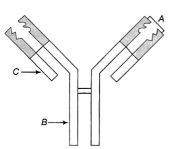
The figure given below shows an antibody molecule. Name the parts $A, B$ and $C$.
A
$A-$Antigen binding site,$B-$Heavy chain,$C-$Light chain
B
$A-$Antibody binding site,$B-$Light chain,$C-$Heavy chain
C
$A-$Antigen binding site,$B-$Short chain,$C-$Long chain
D
$A-$Antibody binding site,$B-$Long chain,$C-$Short chain
Solution
(A) An antibody molecule is $Y$-shaped and consists of four polypeptide chains.
Two of these are long chains called $B-$Heavy chains,and two are shorter chains called $C-$Light chains.
The variable region at the tips of the antibody,labeled as $A$,is the antigen-binding site,which is specific for a particular antigen.
Therefore,the correct identification is $A-$Antigen binding site,$B-$Heavy chain,$C-$Light chain.
Two of these are long chains called $B-$Heavy chains,and two are shorter chains called $C-$Light chains.
The variable region at the tips of the antibody,labeled as $A$,is the antigen-binding site,which is specific for a particular antigen.
Therefore,the correct identification is $A-$Antigen binding site,$B-$Heavy chain,$C-$Light chain.
0 likes
View Solution521
MediumMCQ
Choose the true statements.
$I.$ Innate immunity is accomplished by providing different types of barriers.
$II.$ Acquired immunity is present from birth and is inherited from parents.
$III.$ Sweat,tears,acid in the stomach,and saliva prevent microbial growth.
$I.$ Innate immunity is accomplished by providing different types of barriers.
$II.$ Acquired immunity is present from birth and is inherited from parents.
$III.$ Sweat,tears,acid in the stomach,and saliva prevent microbial growth.
A
$I-$True,$II-$False,$III-$True
B
$I-$True,$II-$True,$III-$False
C
$I-$False,$II-$False,$III-$True
D
$I-$False,$II-$True,$III-$False
Solution
(A) $I.$ Innate immunity is non-specific and is present at the time of birth. It is accomplished by providing different types of barriers to the entry of foreign agents into our body.
$II.$ Acquired immunity is pathogen-specific and is not present from birth. It develops during an individual's lifetime after exposure to a pathogen.
$III.$ Physiological barriers like acid in the stomach,saliva in the mouth,and tears from eyes prevent microbial growth.
Therefore,statements $I$ and $III$ are true,while statement $II$ is false.
$II.$ Acquired immunity is pathogen-specific and is not present from birth. It develops during an individual's lifetime after exposure to a pathogen.
$III.$ Physiological barriers like acid in the stomach,saliva in the mouth,and tears from eyes prevent microbial growth.
Therefore,statements $I$ and $III$ are true,while statement $II$ is false.
0 likes
View Solution522
EasyMCQ
Large groups of lymphoid tissue in the respiratory, digestive, and urogenital tracts are collectively called:
A
$MALT$
B
$Peyer's \; patches$
C
$Mucosa \; lymph \; nodes$
D
$\alpha-globulins$
Solution
(A) There is lymphoid tissue located within the lining of the major tracts (respiratory, digestive, and urogenital tracts) called Mucosa Associated Lymphoid Tissue $(MALT)$.
It constitutes about $50 \; \%$ of the lymphoid tissue in the human body.
It constitutes about $50 \; \%$ of the lymphoid tissue in the human body.
0 likes
View Solution523
MediumMCQ
Immunoglobulins are made up of
A
Two polypeptide chains
B
Four polypeptide chains
C
Three amino acids only
D
Five nucleotides
Solution
(B) Immunoglobulins are proteins present in serum that provide immunity to the body against diseases.
Each immunoglobulin molecule is composed of four polypeptide chains: two heavy $(H)$ chains and two light $(L)$ chains.
These four chains are held together by disulphide bonds to form a $Y$-shaped structure.
Each immunoglobulin molecule is composed of four polypeptide chains: two heavy $(H)$ chains and two light $(L)$ chains.
These four chains are held together by disulphide bonds to form a $Y$-shaped structure.
0 likes
View Solution524
MediumMCQ
Antibodies are produced by
A
Leucocytes
B
Lymphocytes
C
Erythrocytes
D
None of these
Solution
(B) Lymphocytes are a type of white blood cell,which are an important part of the immune system.
Two special types of lymphocytes are present in our blood,$i.e., B-$lymphocytes and $T-$lymphocytes.
The $B-$lymphocytes produce an army of proteins in response to pathogens in our blood to fight against them.
These proteins are called antibodies.
Two special types of lymphocytes are present in our blood,$i.e., B-$lymphocytes and $T-$lymphocytes.
The $B-$lymphocytes produce an army of proteins in response to pathogens in our blood to fight against them.
These proteins are called antibodies.
0 likes
View Solution525
EasyMCQ
Cell-mediated immunity is mainly a function of
A
$B-$cells
B
$T-$cells
C
Macrophages
D
Interferons
Solution
(B) The $T-$lymphocytes (or $T-$cells) are responsible for Cell-Mediated Immunity $(CMI)$.
This immune response is initiated when $T-$cells recognize specific antigens presented by antigen-presenting cells.
This immune response is initiated when $T-$cells recognize specific antigens presented by antigen-presenting cells.
0 likes
View Solution526
EasyMCQ
All of the following are examples of mucosa-associated lymphoid tissue $(MALT)$ except:
A
Appendix
B
Peyer's patches
C
Tonsils
D
Liver
Solution
(D) Mucosa-associated lymphoid tissue $(MALT)$ constitutes about $50\%$ of the lymphoid tissue in the human body.
It is located within the lining of the major tracts in the body,such as the respiratory,digestive,and urogenital tracts.
Examples of $MALT$ include tonsils,Peyer's patches,and the appendix.
The liver is a vital metabolic organ responsible for detoxification,protein synthesis,and the production of bile for digestion,but it is not classified as a lymphoid tissue.
It is located within the lining of the major tracts in the body,such as the respiratory,digestive,and urogenital tracts.
Examples of $MALT$ include tonsils,Peyer's patches,and the appendix.
The liver is a vital metabolic organ responsible for detoxification,protein synthesis,and the production of bile for digestion,but it is not classified as a lymphoid tissue.
0 likes
View Solution527
EasyMCQ
The immunoglobulin abundant in colostrum is
A
$IgG$
B
$IgM$
C
$IgD$
D
$IgA$
Solution
(D) $IgA$ is the immunoglobulin predominantly found in seromucous secretions such as colostrum,saliva,and tears.
Breast milk contains a high concentration of $IgA$,which protects newborn babies against various infections and provides them with a strong defense and passive immunity.
Breast milk contains a high concentration of $IgA$,which protects newborn babies against various infections and provides them with a strong defense and passive immunity.
0 likes
View Solution528
EasyMCQ
Acquired immunity is due to
A
Physiological and inflammatory barriers
B
Lymphocytes
C
Erythrocytes
D
$NK-$cells
Solution
(B) The resistance that an individual acquires during their lifetime is called acquired immunity.
Acquired immunity is pathogen-specific and is characterized by memory.
Two major groups of cells,i.e.,lymphocytes ($B$-lymphocytes and $T$-lymphocytes),are primarily responsible for acquired immunity.
Acquired immunity is pathogen-specific and is characterized by memory.
Two major groups of cells,i.e.,lymphocytes ($B$-lymphocytes and $T$-lymphocytes),are primarily responsible for acquired immunity.
0 likes
View Solution529
MediumMCQ
Immunodeficiency makes a person highly susceptible to infection. It is caused by
A
Lack of $B-$cells
B
Lack of $T-$cells
C
Both $(a)$ and $(b)$
D
None of the above
Solution
(C) Immunodeficiency refers to a state where the immune system's ability to fight infectious diseases is compromised or entirely absent.
Both $B-$cells and $T-$cells are essential components of the adaptive immune system.
$B-$cells are responsible for the production of antibodies (humoral immunity),while $T-$cells (specifically $T-$helper cells) play a crucial role in activating $B-$cells and coordinating the immune response (cell-mediated immunity).
$A$ deficiency in either $B-$cells or $T-$cells,or both,leads to a weakened immune system,making the individual highly susceptible to various infections.
Therefore,immunodeficiency is caused by the lack of both $B-$cells and $T-$cells.
Both $B-$cells and $T-$cells are essential components of the adaptive immune system.
$B-$cells are responsible for the production of antibodies (humoral immunity),while $T-$cells (specifically $T-$helper cells) play a crucial role in activating $B-$cells and coordinating the immune response (cell-mediated immunity).
$A$ deficiency in either $B-$cells or $T-$cells,or both,leads to a weakened immune system,making the individual highly susceptible to various infections.
Therefore,immunodeficiency is caused by the lack of both $B-$cells and $T-$cells.
0 likes
View Solution530
MediumMCQ
$A$ newborn baby who receives $IgA$ from its mother's milk develops:
A
Naturally acquired active immunity
B
Artificially acquired active immunity
C
Naturally acquired passive immunity
D
Artificially acquired passive immunity
Solution
(C) The type of antibody present in colostrum,which is secreted by the mammary glands during the initial days of lactation,is $IgA$.
This process provides the infant with immediate protection without the infant's own immune system being activated to produce antibodies.
Since this transfer occurs naturally from mother to child through breastfeeding,it is classified as naturally acquired passive immunity.
This process provides the infant with immediate protection without the infant's own immune system being activated to produce antibodies.
Since this transfer occurs naturally from mother to child through breastfeeding,it is classified as naturally acquired passive immunity.
0 likes
View Solution531
EasyMCQ
Non-specific host defence that exists prior to the exposure to an antigen is called
A
Acquired immunity
B
Passive immunity
C
Innate immunity
D
Active immunity
Solution
(C) Innate immunity is a type of non-specific defense mechanism that is present from birth.
It is inherited from parents and provides protection against pathogens without prior exposure to an antigen.
Therefore,it is considered the first line of defense in the human body.
It is inherited from parents and provides protection against pathogens without prior exposure to an antigen.
Therefore,it is considered the first line of defense in the human body.
0 likes
View Solution532
MediumMCQ
Active immunity may be acquired by
A
Natural infection
B
Vaccines
C
Toxoids
D
All of these
Solution
(D) Active immunity is developed when a host is exposed to antigens,which may be in the form of living or dead microbes,proteins,or toxins.
Upon exposure,the host's immune system recognizes these antigens and produces specific antibodies within the body.
Natural infection leads to the natural development of active immunity.
Vaccines and toxoids are biological preparations that introduce antigens into the body to stimulate an active immune response without causing the disease.
Therefore,all the mentioned options are methods through which an antigen enters the host body to induce active immunity.
Upon exposure,the host's immune system recognizes these antigens and produces specific antibodies within the body.
Natural infection leads to the natural development of active immunity.
Vaccines and toxoids are biological preparations that introduce antigens into the body to stimulate an active immune response without causing the disease.
Therefore,all the mentioned options are methods through which an antigen enters the host body to induce active immunity.
0 likes
View Solution533
MediumMCQ
The treatment of snake-bite by antivenom is an example of
A
Artificially acquired active immunity
B
Artificially acquired passive immunity
C
Naturally acquired passive immunity
D
Specific natural immunity
Solution
(B) In acquired passive immunity,antibodies are directly introduced into the body to provide immediate protection.
When antivenom is administered to treat a snake-bite,it contains pre-formed antibodies against the snake venom.
Since these antibodies are prepared in another animal (like a horse) and then injected into the human,this process is classified as artificially acquired passive immunity.
When antivenom is administered to treat a snake-bite,it contains pre-formed antibodies against the snake venom.
Since these antibodies are prepared in another animal (like a horse) and then injected into the human,this process is classified as artificially acquired passive immunity.
0 likes
View Solution534
EasyMCQ
Which of the following is a non-specific type of defense that is present at the time of birth?
A
Acquired immunity
B
Humoral immune response
C
Cell mediated immunity
D
Innate immunity
Solution
(D) Innate immunity is a non-specific type of defense that is present at the time of birth. It provides protection against any type of foreign agent.
Acquired immunity is pathogen-specific and is initiated when a host encounters a pathogen during the first attack.
Humoral immunity is a type of acquired immunity mediated by $B$-lymphocytes,in which antibodies are produced.
Cell-mediated immunity is mediated by $T$-lymphocytes.
Acquired immunity is pathogen-specific and is initiated when a host encounters a pathogen during the first attack.
Humoral immunity is a type of acquired immunity mediated by $B$-lymphocytes,in which antibodies are produced.
Cell-mediated immunity is mediated by $T$-lymphocytes.
0 likes
View Solution535
EasyMCQ
Acid in the stomach,saliva in the mouth,and tears from the eyes all prevent microbial growth. These belong to which of the following barriers?
A
Physical barrier
B
Physiological barrier
C
Cellular barrier
D
Cytokine barrier
Solution
(B) Innate immunity consists of four types of barriers:
$1$. Physical barriers: These include the skin and the mucus coating of the epithelium lining the respiratory,gastrointestinal,and urogenital tracts.
$2$. Physiological barriers: These include acid in the stomach,saliva in the mouth,and tears from the eyes,which prevent microbial growth.
$3$. Cellular barriers: These include certain types of leukocytes $(WBC)$ like polymorpho-nuclear leukocytes $(PMNL)$,monocytes,and natural killer $(NK)$ cells in the blood,as well as macrophages in tissues.
$4$. Cytokine barriers: These include virus-infected cells which secrete proteins called interferons that protect non-infected cells from further viral infection.
Therefore,acid in the stomach,saliva in the mouth,and tears from the eyes belong to the physiological barrier.
$1$. Physical barriers: These include the skin and the mucus coating of the epithelium lining the respiratory,gastrointestinal,and urogenital tracts.
$2$. Physiological barriers: These include acid in the stomach,saliva in the mouth,and tears from the eyes,which prevent microbial growth.
$3$. Cellular barriers: These include certain types of leukocytes $(WBC)$ like polymorpho-nuclear leukocytes $(PMNL)$,monocytes,and natural killer $(NK)$ cells in the blood,as well as macrophages in tissues.
$4$. Cytokine barriers: These include virus-infected cells which secrete proteins called interferons that protect non-infected cells from further viral infection.
Therefore,acid in the stomach,saliva in the mouth,and tears from the eyes belong to the physiological barrier.
0 likes
View Solution536
MediumMCQ
The treatment of snake bite by antivenom is an example of
A
Artificially acquired passive immunity
B
Artificially acquired active immunity
C
Naturally acquired active immunity
D
Naturally acquired passive immunity
Solution
(A) The treatment of snake bite using antivenom is an example of artificially acquired passive immunity.
This is because preformed antibodies against the specific snake venom are directly injected into the patient's body to provide immediate protection.
Artificially acquired active immunity involves resistance induced by vaccines,where the body's immune system is stimulated to produce its own antibodies.
Naturally acquired passive immunity occurs when antibodies are transferred from mother to child,such as $IgA$ through breast milk and $IgG$ across the placenta.
Naturally acquired active immunity is developed when the body is exposed to antigens during a natural infection.
This is because preformed antibodies against the specific snake venom are directly injected into the patient's body to provide immediate protection.
Artificially acquired active immunity involves resistance induced by vaccines,where the body's immune system is stimulated to produce its own antibodies.
Naturally acquired passive immunity occurs when antibodies are transferred from mother to child,such as $IgA$ through breast milk and $IgG$ across the placenta.
Naturally acquired active immunity is developed when the body is exposed to antigens during a natural infection.
0 likes
View Solution537
MediumMCQ
Which of the following is an autoimmune disease?
A
Asthma
B
Cirrhosis
C
$AIDS$
D
Rheumatoid arthritis
Solution
(D) An autoimmune disease occurs when the immune system mistakenly attacks the body's own healthy cells.
$A$. Asthma is an allergic reaction,not an autoimmune disease.
$B$. Cirrhosis is a condition involving scarring of the liver,often caused by chronic liver disease or alcohol consumption.
$C$. $AIDS$ is an immunodeficiency syndrome caused by the $HIV$ virus,which destroys the immune system rather than attacking the body's own tissues.
$D$. Rheumatoid arthritis is a classic example of an autoimmune disease where the immune system attacks the joints,causing inflammation and pain.
$A$. Asthma is an allergic reaction,not an autoimmune disease.
$B$. Cirrhosis is a condition involving scarring of the liver,often caused by chronic liver disease or alcohol consumption.
$C$. $AIDS$ is an immunodeficiency syndrome caused by the $HIV$ virus,which destroys the immune system rather than attacking the body's own tissues.
$D$. Rheumatoid arthritis is a classic example of an autoimmune disease where the immune system attacks the joints,causing inflammation and pain.
0 likes
View Solution538
MediumMCQ
The antigen binding site in an antibody is formed by:
A
Two light chains
B
Two heavy chains
C
One heavy and one light chain
D
Either between two light chains or between one heavy and one light chain depending upon the nature of antigen
Solution
(C) An antibody molecule is composed of four polypeptide chains: two identical light $(L)$ chains and two identical heavy $(H)$ chains,represented as $H_2L_2$.
Each arm of the $Y$-shaped antibody molecule contains an antigen-binding site.
This specific site is formed by the variable regions of one heavy chain and one light chain,which come together to create the paratope that recognizes and binds to a specific antigen.
Each arm of the $Y$-shaped antibody molecule contains an antigen-binding site.
This specific site is formed by the variable regions of one heavy chain and one light chain,which come together to create the paratope that recognizes and binds to a specific antigen.
0 likes
View Solution539
MediumMCQ
Mark the correct statement.
A
The anamnestic response against a pathogen is highly intensified.
B
The $T-$lymphocytes produce antibodies.
C
The $B-$lymphocytes produce cell mediated response.
D
An antibody is represented by $H_{2}L_{4}$.
Solution
(A) The anamnestic response (secondary immune response) is highly intensified due to memory cells,making option $A$ correct.
$B-$lymphocytes are responsible for producing antibodies (humoral immune response).
$T-$lymphocytes are responsible for cell-mediated immune response.
An antibody molecule is represented by the formula $H_{2}L_{2}$,where $H$ stands for heavy chains and $L$ stands for light chains.
$B-$lymphocytes are responsible for producing antibodies (humoral immune response).
$T-$lymphocytes are responsible for cell-mediated immune response.
An antibody molecule is represented by the formula $H_{2}L_{2}$,where $H$ stands for heavy chains and $L$ stands for light chains.
0 likes
View Solution540
MediumMCQ
Which of the following will be included under innate immunity?
A
Mucus membranes
B
Interferons
C
Natural killer cells
D
All of these
Solution
(D) Innate immunity is non-specific type of defense that is present at the time of birth.
It consists of four types of barriers:
$1$. Physical barriers: Mucus membranes and skin prevent the entry of microorganisms.
$2$. Physiological barriers: Acid in the stomach,saliva in the mouth,and tears from eyes.
$3$. Cellular barriers: Polymorphonuclear leukocytes ($PMNL$-neutrophils),monocytes,and natural killer cells.
$4$. Cytokine barriers: Virus-infected cells secrete proteins called interferons which protect non-infected cells from further viral infection.
Since all the given options represent these barriers,the correct answer is $D$.
It consists of four types of barriers:
$1$. Physical barriers: Mucus membranes and skin prevent the entry of microorganisms.
$2$. Physiological barriers: Acid in the stomach,saliva in the mouth,and tears from eyes.
$3$. Cellular barriers: Polymorphonuclear leukocytes ($PMNL$-neutrophils),monocytes,and natural killer cells.
$4$. Cytokine barriers: Virus-infected cells secrete proteins called interferons which protect non-infected cells from further viral infection.
Since all the given options represent these barriers,the correct answer is $D$.
0 likes
View Solution541
EasyMCQ
Artificial active immunity can be acquired from
A
Serious illness
B
Vaccination
C
Repeated exposure to some microbes
D
Treatment with penicillin
Solution
(B) Active immunity is the resistance developed by an individual's own immune system after exposure to an antigen.
Natural active immunity is acquired through natural infection or repeated exposure to microbes.
Artificial active immunity is acquired through the introduction of antigens into the body in a controlled manner,which is the principle behind vaccination.
Therefore,vaccination is the correct method for acquiring artificial active immunity.
Natural active immunity is acquired through natural infection or repeated exposure to microbes.
Artificial active immunity is acquired through the introduction of antigens into the body in a controlled manner,which is the principle behind vaccination.
Therefore,vaccination is the correct method for acquiring artificial active immunity.
0 likes
View Solution542
EasyMCQ
The letter $T$ in $T$-lymphocyte refers to:
A
Thymus
B
Thyroid
C
Thalamus
D
Tonsil
Solution
(A) $T$-lymphocytes are a type of white blood cell that plays a central role in cell-mediated immunity.
They are produced in the bone marrow but migrate to the thymus gland for maturation and differentiation.
Therefore,the letter $T$ in $T$-lymphocyte stands for Thymus.
Thyroid is an endocrine gland that produces hormones like $T_3$ and $T_4$.
Thalamus is a part of the brain that acts as a relay station for sensory information.
Tonsils are lymphoid tissues located in the pharynx.
They are produced in the bone marrow but migrate to the thymus gland for maturation and differentiation.
Therefore,the letter $T$ in $T$-lymphocyte stands for Thymus.
Thyroid is an endocrine gland that produces hormones like $T_3$ and $T_4$.
Thalamus is a part of the brain that acts as a relay station for sensory information.
Tonsils are lymphoid tissues located in the pharynx.
0 likes
View Solution543
MediumMCQ
$A$ person who met with a road accident is likely to develop tetanus. He is immunized by administering:
A
Weakened germs
B
Dead germs
C
Preformed antibodies
D
Wide spectrum antibiotics
Solution
(C) In the case of a road accident,there is a high risk of $Clostridium$ $tetani$ infection. Since the pathogen produces a potent neurotoxin called tetanospasmin,a rapid immune response is required to neutralize the toxin.
Active immunization (using vaccines containing weakened or dead germs) takes time to produce antibodies,which is not suitable for an immediate threat.
Therefore,preformed antibodies (passive immunization) are administered to provide immediate protection against the toxin.
Wide spectrum antibiotics are used to treat bacterial infections but are not effective for neutralizing toxins produced by $Clostridium$ $tetani$ in an emergency setting.
Active immunization (using vaccines containing weakened or dead germs) takes time to produce antibodies,which is not suitable for an immediate threat.
Therefore,preformed antibodies (passive immunization) are administered to provide immediate protection against the toxin.
Wide spectrum antibiotics are used to treat bacterial infections but are not effective for neutralizing toxins produced by $Clostridium$ $tetani$ in an emergency setting.
0 likes
View Solution544
MediumMCQ
$A$: Live attenuated vaccine is better in terms of immunity provided to the recipient.
$R$: As secondary lymphoid organs,example $Peyer's$ patches are stimulated to protect the individual.
$R$: As secondary lymphoid organs,example $Peyer's$ patches are stimulated to protect the individual.
A
Assertion and Reason both are correct and Reason is the correct explanation of Assertion.
B
Assertion and Reason both are correct but Reason is not the correct explanation of Assertion.
C
Assertion is correct,but Reason is incorrect.
D
Both Assertion and Reason are incorrect.
Solution
(A) Live attenuated vaccines contain weakened forms of the pathogen. These vaccines are highly effective because they mimic a natural infection,stimulating both humoral and cell-mediated immune responses,which often leads to long-lasting immunity.
$Peyer's$ patches are indeed secondary lymphoid organs located in the small intestine. They play a crucial role in mucosal immunity by sampling antigens from the intestinal lumen and initiating an immune response. Oral vaccines (often live attenuated) stimulate these patches,providing robust local and systemic immunity.
Therefore,both the Assertion and the Reason are correct,and the Reason correctly explains why live attenuated vaccines are effective.
$Peyer's$ patches are indeed secondary lymphoid organs located in the small intestine. They play a crucial role in mucosal immunity by sampling antigens from the intestinal lumen and initiating an immune response. Oral vaccines (often live attenuated) stimulate these patches,providing robust local and systemic immunity.
Therefore,both the Assertion and the Reason are correct,and the Reason correctly explains why live attenuated vaccines are effective.
0 likes
View Solution545
MediumMCQ
$A$: A person who has received a cut accidentally and is bleeding needs to be given anti-tetanus treatment.
$R$: Anti-tetanus injection provides active immunity by providing preformed antibodies for tetanus.
$R$: Anti-tetanus injection provides active immunity by providing preformed antibodies for tetanus.
A
Assertion and Reason both are correct and Reason is the correct explanation of Assertion.
B
Assertion and Reason both are correct but Reason is not the correct explanation of Assertion.
C
Assertion is correct, but Reason is incorrect.
D
Both Assertion and Reason are incorrect.
Solution
(C) The Assertion is correct because a deep cut or wound contaminated with soil or rust can introduce $Clostridium$ $tetani$ spores into the body, necessitating anti-tetanus treatment to prevent the disease.
The Reason is incorrect because anti-tetanus injections (like tetanus antitoxin) provide $passive$ $immunity$ by introducing preformed antibodies directly into the body, not active immunity. Active immunity is developed by the body's own immune system in response to antigens (e.g., through vaccination with toxoids).
The Reason is incorrect because anti-tetanus injections (like tetanus antitoxin) provide $passive$ $immunity$ by introducing preformed antibodies directly into the body, not active immunity. Active immunity is developed by the body's own immune system in response to antigens (e.g., through vaccination with toxoids).
0 likes
View Solution546
MediumMCQ
The $SCID$ patient has a defective gene for the enzyme Adenosine Deaminase $(ADA)$. He/She lacks functional ...... and therefore,fails to fight the infecting pathogens.
A
$B-$lymphocytes
B
Phagocytes
C
$T-$lymphocytes
D
Both $(a)$ and $(b)$
Solution
(C) The $SCID$ patient has a defective gene for the enzyme Adenosine Deaminase $(ADA)$. This enzyme is crucial for the immune system to function properly. Patients with $ADA$ deficiency lack functional $T-$lymphocytes,which are essential for cell-mediated immunity. Consequently,they fail to fight infecting pathogens effectively.
0 likes
View Solution547
Medium
What is Immunity?
Solution
(N/A) The overall ability of the host to fight disease-causing organisms,conferred by the immune system,is called Immunity.
- Immunity is of two types: $(i)$ Innate immunity,$(ii)$ Acquired immunity.
$(i)$ Innate immunity: It is a non-specific type of defense that is present at the time of birth.
This is accomplished by providing different types of barriers to the entry of foreign agents into our body. Innate immunity consists of four types of barriers:
Physical barriers: Skin on our body is the main barrier which prevents the entry of microorganisms. The mucus coating of the epithelium lining the respiratory,gastrointestinal,and urogenital tracts also helps in trapping microbes entering our body.
Physiological barriers: Acid in the stomach,saliva in the mouth,and tears from the eyes all prevent microbial growth.
Cellular barriers: Certain types of leukocytes $(WBC)$ of our body like polymorpho-nuclear leukocytes ($PMNL$-neutrophils),monocytes,and natural killer cells (types of lymphocytes) in the blood,as well as macrophages in tissues,can phagocytose and destroy microbes.
Cytokine barriers: Virus-infected cells secrete proteins called interferons which protect non-infected cells from further viral infection.
$(ii)$ Acquired immunity: Acquired immunity is pathogen-specific. It is characterized by memory.
Our body,when it encounters a pathogen for the first time,produces a response called the primary response.
Primary response is of low intensity.
Subsequent encounters with the same pathogen elicit a highly intensified secondary or anamnestic response.
This is ascribed to the fact that our body appears to have memory of the first encounter.
- Immunity is of two types: $(i)$ Innate immunity,$(ii)$ Acquired immunity.
$(i)$ Innate immunity: It is a non-specific type of defense that is present at the time of birth.
This is accomplished by providing different types of barriers to the entry of foreign agents into our body. Innate immunity consists of four types of barriers:
Physical barriers: Skin on our body is the main barrier which prevents the entry of microorganisms. The mucus coating of the epithelium lining the respiratory,gastrointestinal,and urogenital tracts also helps in trapping microbes entering our body.
Physiological barriers: Acid in the stomach,saliva in the mouth,and tears from the eyes all prevent microbial growth.
Cellular barriers: Certain types of leukocytes $(WBC)$ of our body like polymorpho-nuclear leukocytes ($PMNL$-neutrophils),monocytes,and natural killer cells (types of lymphocytes) in the blood,as well as macrophages in tissues,can phagocytose and destroy microbes.
Cytokine barriers: Virus-infected cells secrete proteins called interferons which protect non-infected cells from further viral infection.
$(ii)$ Acquired immunity: Acquired immunity is pathogen-specific. It is characterized by memory.
Our body,when it encounters a pathogen for the first time,produces a response called the primary response.
Primary response is of low intensity.
Subsequent encounters with the same pathogen elicit a highly intensified secondary or anamnestic response.
This is ascribed to the fact that our body appears to have memory of the first encounter.
0 likes
View Solution548
MediumMCQ
What plays an important role in primary and secondary response?
A
$B$-lymphocytes
B
$T$-lymphocytes
C
Both $B$-lymphocytes and $T$-lymphocytes
D
None of these
Solution
(C) The primary and secondary immune responses are carried out with the help of two special types of lymphocytes present in our body,namely $B$-lymphocytes and $T$-lymphocytes.
$B$-lymphocytes produce an army of proteins in response to pathogens in our blood to fight against them. These proteins are called antibodies.
$T$-lymphocytes themselves do not secrete antibodies,but they help $B$-lymphocytes to produce antibodies. Thus,both types of lymphocytes play a crucial role in the immune response.
$B$-lymphocytes produce an army of proteins in response to pathogens in our blood to fight against them. These proteins are called antibodies.
$T$-lymphocytes themselves do not secrete antibodies,but they help $B$-lymphocytes to produce antibodies. Thus,both types of lymphocytes play a crucial role in the immune response.
0 likes
View Solution549
Medium
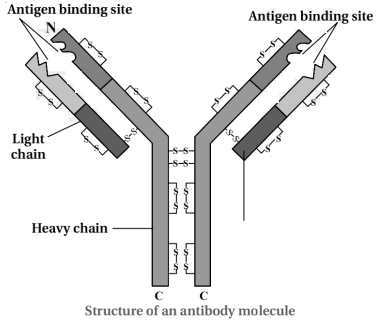
Draw and describe the structure of an antibody.
Solution
(N/A) Each antibody molecule is $Y$-shaped and consists of four peptide chains: two small chains called light chains $(L)$ and two longer chains called heavy chains $(H)$.
$\Rightarrow$ Therefore,an antibody is represented as $H_{2}L_{2}$.
These chains are held together by disulfide bonds $(-S-S-)$.
Different types of antibodies are produced in our body,such as $IgA$,$IgM$,$IgE$,$IgG$,and $IgD$.
Since these antibodies are present in the blood and other body fluids,the immune response mediated by them is called the humoral immune response.
$\Rightarrow$ Therefore,an antibody is represented as $H_{2}L_{2}$.
These chains are held together by disulfide bonds $(-S-S-)$.
Different types of antibodies are produced in our body,such as $IgA$,$IgM$,$IgE$,$IgG$,and $IgD$.
Since these antibodies are present in the blood and other body fluids,the immune response mediated by them is called the humoral immune response.
0 likes
View Solution550
MediumMCQ
The principle of Vaccination and Immunization is based on which property of the immune system?
A
Memory
B
Specificity
C
Diversity
D
Self vs Non-self discrimination
Solution
(A) The principle of Vaccination and Immunization is based on the property of 'memory' of the immune system.
In vaccination,a preparation of antigenic proteins of pathogens or inactivated/weakened pathogens (vaccine) is introduced into the body.
The antibodies produced in the body against these antigens neutralize the pathogenic agents during an actual infection.
The vaccine also generates memory $B$ and $T$ cells that recognize the pathogen quickly upon subsequent exposure and overwhelm the invaders with a massive production of antibodies.
If a person is infected with deadly microbes for which a quick immune response is required,such as in tetanus,we need to inject preformed antibodies or antitoxins.
In the case of a snake bite,the injection given to the patient contains preformed antibodies against the snake venom. This type of immunization is called passive immunization.
In vaccination,a preparation of antigenic proteins of pathogens or inactivated/weakened pathogens (vaccine) is introduced into the body.
The antibodies produced in the body against these antigens neutralize the pathogenic agents during an actual infection.
The vaccine also generates memory $B$ and $T$ cells that recognize the pathogen quickly upon subsequent exposure and overwhelm the invaders with a massive production of antibodies.
If a person is infected with deadly microbes for which a quick immune response is required,such as in tetanus,we need to inject preformed antibodies or antitoxins.
In the case of a snake bite,the injection given to the patient contains preformed antibodies against the snake venom. This type of immunization is called passive immunization.
0 likes
View SolutionHuman Health and Disease — Immunity · Frequently Asked Questions
1Are these Human Health and Disease questions useful for JEE and NEET?
Yes. All questions in this section are mapped to JEE Main and NEET exam patterns. Previous year questions from JEE Main, NEET, GUJCET and state-level exams are included with full solutions.
2Can I switch to Hindi or Gujarati for these questions?
Yes. Use the language tabs in the hero section or the sidebar to view the same questions and solutions in English, Hindi or Gujarati.
3How do I generate a question paper from this subtopic?
Use the Vedclass Exam Paper Generator — select the chapter and subtopic, set difficulty, and generate Sets A, B, C, D automatically. First 3 chapters of every subject are free.
Vedclass Products
For Students
Vedclass Test Series
Mock tests in real JEE/NEET style with performance analysis. 5-day free trial.
Start Free TrialFor Teachers
Exam Paper Generator
Generate Set A/B/C/D papers from this chapter in 2 minutes. 3 chapters free.
Try FreeFor Institutes
Online Exam Module
Live online exams with unlimited students, 360° analytics & white-label branding.
See DemoFor Teachers & Institutes
Generate a Human Health and Disease Exam Paper in 2 Minutes
Select subtopic & difficulty — Sets A, B, C, D auto-generated with No Repeat logic.
First 3 chapters of every subject are free — no payment required.