
A English
Evolution of Man Questions in English
Class 12 Biology · Evolution · Evolution of Man
352+
Questions
English
Language
100%
With Solutions
Showing 50 of 352 questions in English
251
MediumMCQ
Fossils found in which regions indicate that human-like primates were not taller than $4$ feet but walked upright?
A
Tanzania and Kenya
B
Egypt and Tanzania
C
Egypt and Australia
D
Ethiopia and Tanzania
Solution
(D) The fossils of $Australopithecus$ (specifically $Australopithecus afarensis$) provide evidence that these human-like primates were not taller than $4$ feet but walked upright.
These significant fossil discoveries were primarily made in the regions of Ethiopia and Tanzania.
For example,the famous 'Lucy' fossil was discovered in Ethiopia,and footprints indicating upright walking were found in Laetoli,Tanzania.
These significant fossil discoveries were primarily made in the regions of Ethiopia and Tanzania.
For example,the famous 'Lucy' fossil was discovered in Ethiopia,and footprints indicating upright walking were found in Laetoli,Tanzania.
0 likes
View Solution252
MediumMCQ
......... hunted with stone weapons.
A
Chimpanzees
B
Australopithecines
C
Marsupials
D
Dryopithecus
Solution
(B) The $Australopithecines$ were early hominids that lived in East African grasslands.
They were the first to use stone tools for hunting and defense.
$Dryopithecus$ were more ape-like and lived before the $Australopithecines$.
$Chimpanzees$ are modern primates,and $Marsupials$ are a group of mammals that give birth to relatively undeveloped young.
They were the first to use stone tools for hunting and defense.
$Dryopithecus$ were more ape-like and lived before the $Australopithecines$.
$Chimpanzees$ are modern primates,and $Marsupials$ are a group of mammals that give birth to relatively undeveloped young.
0 likes
View Solution253
MediumMCQ
The cranial capacity of the brain is represented by which of the following?
A
cc
B
bb
C
db
D
bc
Solution
(A) The cranial capacity,which refers to the volume of the interior of the cranium,is measured in cubic centimeters.
In scientific literature and biological studies,this unit is abbreviated as $cc$ or $cm^3$.
In scientific literature and biological studies,this unit is abbreviated as $cc$ or $cm^3$.
0 likes
View Solution254
MediumMCQ
Select the option that shows the organisms in ascending order of their cranial capacity.
A
$Homo$ $erectus$ $\rightarrow$ $Homo$ $habilis$ $\rightarrow$ $Neanderthal$ $man$
B
$Neanderthal$ $man$ $\rightarrow$ $Homo$ $habilis$ $\rightarrow$ $Homo$ $erectus$
C
$Homo$ $habilis$ $\rightarrow$ $Homo$ $erectus$ $\rightarrow$ $Neanderthal$ $man$
D
$Homo$ $habilis$ $\rightarrow$ $Neanderthal$ $man$ $\rightarrow$ $Homo$ $erectus$
Solution
(C) The cranial capacities of the given hominids are as follows:
$1$. $Homo$ $habilis$: Approximately $650-800 \text{ cc}$.
$2$. $Homo$ $erectus$: Approximately $900 \text{ cc}$.
$3$. $Neanderthal$ $man$: Approximately $1400 \text{ cc}$.
Therefore,the ascending order of their cranial capacity is $Homo$ $habilis$ $(650-800 \text{ cc})$ < $Homo$ $erectus$ $(900 \text{ cc})$ < $Neanderthal$ $man$ $(1400 \text{ cc})$.
$1$. $Homo$ $habilis$: Approximately $650-800 \text{ cc}$.
$2$. $Homo$ $erectus$: Approximately $900 \text{ cc}$.
$3$. $Neanderthal$ $man$: Approximately $1400 \text{ cc}$.
Therefore,the ascending order of their cranial capacity is $Homo$ $habilis$ $(650-800 \text{ cc})$ < $Homo$ $erectus$ $(900 \text{ cc})$ < $Neanderthal$ $man$ $(1400 \text{ cc})$.
0 likes
View Solution255
MediumMCQ
Approximately how many years ago did $Homo$ $erectus$ exist?
A
$3$ million years
B
$4$ million years
C
$2$ million years
D
$1.5$ million years
Solution
(D) $Homo$ $erectus$ is an extinct species of archaic human that lived throughout most of the Pleistocene geological epoch.
According to evolutionary biology and the fossil record,$Homo$ $erectus$ appeared approximately $1.5$ to $2$ million years ago.
Among the given options,$1.5$ million years is the most accurate representation of the time period associated with the existence of $Homo$ $erectus$ in standard evolutionary timelines.
According to evolutionary biology and the fossil record,$Homo$ $erectus$ appeared approximately $1.5$ to $2$ million years ago.
Among the given options,$1.5$ million years is the most accurate representation of the time period associated with the existence of $Homo$ $erectus$ in standard evolutionary timelines.
0 likes
View Solution256
MediumMCQ
Which primate used hides to protect their body?
A
Australopithecines
B
Homo habilis
C
Homo erectus
D
Neanderthal man
Solution
(D) Neanderthal man ($Homo$ $neanderthalensis$) lived in near-eastern and central Asian regions between $100,000$ and $40,000$ years ago.
They were the first human ancestors to use animal hides (skins) as clothing to protect their bodies from the cold environment.
They also used tools for hunting and buried their dead.
They were the first human ancestors to use animal hides (skins) as clothing to protect their bodies from the cold environment.
They also used tools for hunting and buried their dead.
0 likes
View Solution257
MediumMCQ
What were the brain capacities of $Homo$ $erectus$ and $Neanderthal$ man,respectively?
A
$900$ cc,$800$ cc
B
$900$ cc,$1400$ cc
C
$650$ cc,$800$ cc
D
$1400$ cc,$800$ cc
Solution
(B) The brain capacity of $Homo$ $erectus$ was approximately $900$ cc.
$Neanderthal$ man,who lived near east and central Asia between $1,00,000$ to $40,000$ years back,had a brain capacity of approximately $1400$ cc.
Therefore,the correct sequence is $900$ cc and $1400$ cc.
$Neanderthal$ man,who lived near east and central Asia between $1,00,000$ to $40,000$ years back,had a brain capacity of approximately $1400$ cc.
Therefore,the correct sequence is $900$ cc and $1400$ cc.
0 likes
View Solution258
MediumMCQ
Where did $Homo$ $sapiens$ evolve?
A
Africa
B
Asia
C
Australia
D
America
Solution
(A) According to the scientific consensus based on fossil evidence and genetic studies,$Homo$ $sapiens$ (modern humans) evolved in Africa approximately $200,000$ to $300,000$ years ago.
From Africa,they migrated to other parts of the world,including Asia,Europe,and eventually the Americas and Australia.
From Africa,they migrated to other parts of the world,including Asia,Europe,and eventually the Americas and Australia.
0 likes
View Solution259
MediumMCQ
Which of the following organisms evolved during the Ice Age?
A
Neanderthal man
B
Modern Homo sapiens
C
Homo habilis
D
Dryopithecus
Solution
(A) The Ice Age (Pleistocene epoch) was a period characterized by significant climatic fluctuations.
Neanderthal man ($Homo$ $neanderthalensis$) lived in near-east and central Asia between $100,000$ to $40,000$ years ago,which falls within the late Pleistocene epoch (Ice Age).
They used hides to protect their bodies and buried their dead.
In contrast,$Dryopithecus$ and $Ramapithecus$ existed much earlier (Miocene),and $Homo$ $habilis$ lived during the early Pleistocene but is generally associated with the transition from Pliocene.
Modern $Homo$ $sapiens$ appeared much later,towards the end of the last glacial period.
Neanderthal man ($Homo$ $neanderthalensis$) lived in near-east and central Asia between $100,000$ to $40,000$ years ago,which falls within the late Pleistocene epoch (Ice Age).
They used hides to protect their bodies and buried their dead.
In contrast,$Dryopithecus$ and $Ramapithecus$ existed much earlier (Miocene),and $Homo$ $habilis$ lived during the early Pleistocene but is generally associated with the transition from Pliocene.
Modern $Homo$ $sapiens$ appeared much later,towards the end of the last glacial period.
0 likes
View Solution260
MediumMCQ
Approximately how many years ago did modern $Homo$ $sapiens$ arise?
A
$70,000 - 10,000$ years ago
B
$75,000 - 10,000$ years ago
C
$60,000 - 20,000$ years ago
D
$65,000 - 20,000$ years ago
Solution
(B) According to the evolutionary timeline provided in the $NCERT$ biology textbook,modern $Homo$ $sapiens$ arose during the ice age between $75,000 - 10,000$ years ago.
Therefore,the correct option is $B$.
Therefore,the correct option is $B$.
0 likes
View Solution261
MediumMCQ
Which organisms lived near East and Central Asia between $1,00,000$ and $40,000$ years ago?
A
Modern Homo sapiens
B
Neanderthal man
C
Ramapithecus
D
Homo habilis
Solution
(B) Neanderthal man ($Homo$ $neanderthalensis$) lived in near East and Central Asia between $1,00,000$ and $40,000$ years ago.
They used hides to protect their bodies and buried their dead.
Modern $Homo$ $sapiens$ arose much later,while $Ramapithecus$ and $Homo$ $habilis$ lived much earlier in the evolutionary timeline.
They used hides to protect their bodies and buried their dead.
Modern $Homo$ $sapiens$ arose much later,while $Ramapithecus$ and $Homo$ $habilis$ lived much earlier in the evolutionary timeline.
0 likes
View Solution262
MediumMCQ
What was the cranial capacity of $Homo$ $habilis$?
A
$900$ cc
B
$900-1000$ cc
C
$600-800$ cc
D
$650-800$ cc
Solution
(D) $Homo$ $habilis$ is considered the first human-like hominid.
According to the $NCERT$ textbook,the brain capacity of $Homo$ $habilis$ ranged between $650$ cc and $800$ cc.
They were the first to use tools and did not eat meat.
According to the $NCERT$ textbook,the brain capacity of $Homo$ $habilis$ ranged between $650$ cc and $800$ cc.
They were the first to use tools and did not eat meat.
0 likes
View Solution263
MediumMCQ
Which of the following primates were primarily meat-eaters?
A
Dryopithecus
B
Ramapithecus
C
Homo erectus
D
Homo habilis
Solution
(C) The correct answer is $C$.
$Homo$ $erectus$ lived about $1.5$ million years ago.
They had a large brain around $900$ $cc$.
$Homo$ $erectus$ were likely meat-eaters and used tools made of stone and bone to hunt and process food.
$Homo$ $erectus$ lived about $1.5$ million years ago.
They had a large brain around $900$ $cc$.
$Homo$ $erectus$ were likely meat-eaters and used tools made of stone and bone to hunt and process food.
0 likes
View Solution264
MediumMCQ
Which primates were primarily fruit eaters?
A
Australopithecines
B
Homo erectus
C
Homo sapiens
D
All of the above
Solution
(A) Australopithecines are considered to be the early hominids that lived in East African grasslands. Based on their dental morphology and fossil evidence,they are believed to have been primarily fruit eaters (frugivorous) and plant-based foragers. As evolution progressed,later species like $Homo$ $erectus$ and $Homo$ $sapiens$ developed more omnivorous diets.
0 likes
View Solution265
MediumMCQ
Select the option that shows the correct evolutionary sequence of the following primates:
$(i)$ Australopithecines
$(ii)$ Ramapithecus
$(iii)$ Homo habilis
$(i)$ Australopithecines
$(ii)$ Ramapithecus
$(iii)$ Homo habilis
A
$i - ii - iii$
B
$ii - i - iii$
C
$iii - ii - i$
D
$i - iii - ii$
Solution
(B) The evolutionary sequence of human ancestors is as follows:
$1$. $Ramapithecus$ existed about $15$ million years ago.
$2$. $Australopithecines$ existed about $2$ million years ago.
$3$. $Homo$ $habilis$ existed about $1.5$ to $2$ million years ago.
Therefore,the correct chronological order is $Ramapithecus (ii) \rightarrow Australopithecines (i) \rightarrow Homo$ $habilis (iii)$.
Thus,the correct sequence is $ii - i - iii$.
$1$. $Ramapithecus$ existed about $15$ million years ago.
$2$. $Australopithecines$ existed about $2$ million years ago.
$3$. $Homo$ $habilis$ existed about $1.5$ to $2$ million years ago.
Therefore,the correct chronological order is $Ramapithecus (ii) \rightarrow Australopithecines (i) \rightarrow Homo$ $habilis (iii)$.
Thus,the correct sequence is $ii - i - iii$.
0 likes
View Solution266
MediumMCQ
Match the organism with its appropriate time of existence:
| List-$I$ | List-$II$ |
|---|---|
| $(a)$ $Dryopithecus$ | $(i)$ $100,000 - 40,000$ years ago |
| $(b)$ $Homo$ $erectus$ | $(ii)$ $15$ mya |
| $(c)$ $Neanderthal$ $man$ | $(iii)$ $1.5$ mya |
| $(d)$ $Australopithecines$ | $(iv)$ $2$ mya |
A
$a-ii, b-iii, c-i, d-iv$
B
$a-ii, b-iv, c-i, d-iii$
C
$a-iv, b-ii, c-i, d-iii$
D
$a-i, b-iii, c-ii, d-iv$
Solution
(A) The correct matching based on human evolution is as follows:
$1$. $Dryopithecus$: Existed about $15$ million years ago (mya).
$2$. $Homo$ $erectus$: Existed about $1.5$ mya.
$3$. $Neanderthal$ $man$: Existed about $100,000 - 40,000$ years ago.
$4$. $Australopithecines$: Existed about $2$ mya.
Therefore,the correct sequence is $a-ii, b-iii, c-i, d-iv$.
$1$. $Dryopithecus$: Existed about $15$ million years ago (mya).
$2$. $Homo$ $erectus$: Existed about $1.5$ mya.
$3$. $Neanderthal$ $man$: Existed about $100,000 - 40,000$ years ago.
$4$. $Australopithecines$: Existed about $2$ mya.
Therefore,the correct sequence is $a-ii, b-iii, c-i, d-iv$.
0 likes
View Solution267
EasyMCQ
Match the following columns:
| List-$I$ | List-$II$ |
| $(a)$ $Homo$ $erectus$ | $(i)$ $650-800$ cc |
| $(b)$ $Neanderthal$ man | $(ii)$ $900$ cc |
| $(c)$ $Homo$ $habilis$ | $(iii)$ $1400$ cc |
A
$a-i, b-iii, c-ii$
B
$a-iii, b-i, c-ii$
C
$a-ii, b-iii, c-i$
D
$a-i, b-ii, c-iii$
Solution
(C) The cranial capacities of early human ancestors are as follows:
$1$. $Homo$ $habilis$: Their brain capacity was between $650-800$ cc. Thus, $(c-i)$.
$2$. $Homo$ $erectus$: Their brain capacity was about $900$ cc. Thus, $(a-ii)$.
$3$. $Neanderthal$ man: Their brain capacity was around $1400$ cc. Thus, $(b-iii)$.
Therefore, the correct matching is $(a-ii, b-iii, c-i)$.
$1$. $Homo$ $habilis$: Their brain capacity was between $650-800$ cc. Thus, $(c-i)$.
$2$. $Homo$ $erectus$: Their brain capacity was about $900$ cc. Thus, $(a-ii)$.
$3$. $Neanderthal$ man: Their brain capacity was around $1400$ cc. Thus, $(b-iii)$.
Therefore, the correct matching is $(a-ii, b-iii, c-i)$.
0 likes
View Solution268
MediumMCQ
Which statement is correct regarding $Australopithecus$?
A
They lived in the grasslands of East Africa.
B
They were strictly carnivorous.
C
Their brain capacity was $1400 \ cc$.
D
They were apes.
Solution
(A) $Australopithecus$ lived in the East African grasslands about $2$ million years ago.
They hunted with stone weapons but were essentially fruit eaters.
Their brain capacity was approximately $400-600 \ cc$,not $1400 \ cc$.
They are considered a transitional form between apes and humans,not just apes.
They hunted with stone weapons but were essentially fruit eaters.
Their brain capacity was approximately $400-600 \ cc$,not $1400 \ cc$.
They are considered a transitional form between apes and humans,not just apes.
0 likes
View Solution269
MediumMCQ
Identify the incorrect statement.
A
Invertebrates were formed and active about $500$ million years ago.
B
Seaweeds and some plants probably existed around $320$ million years ago.
C
Jawless fish probably evolved around $300$ million years ago.
D
Ramapithecus were existing about $15$ million years ago.
Solution
(C) According to the geological time scale and evolutionary history provided in $NCERT$:
$1$. Invertebrates were formed and active about $500$ million years ago (Correct).
$2$. Seaweeds and some plants probably existed around $320$ million years ago (Correct).
$3$. Jawless fish probably evolved around $350$ million years ago,not $300$ million years ago (Incorrect).
$4$. Ramapithecus and Dryopithecus were existing about $15$ million years ago (Correct).
Therefore,the statement regarding jawless fish is incorrect.
$1$. Invertebrates were formed and active about $500$ million years ago (Correct).
$2$. Seaweeds and some plants probably existed around $320$ million years ago (Correct).
$3$. Jawless fish probably evolved around $350$ million years ago,not $300$ million years ago (Incorrect).
$4$. Ramapithecus and Dryopithecus were existing about $15$ million years ago (Correct).
Therefore,the statement regarding jawless fish is incorrect.
0 likes
View Solution270
MediumMCQ
Which statement regarding mammals is incorrect?
A
Mammals are viviparous.
B
Mammals were very intelligent in sensing and avoiding danger.
C
Mammals took over the Earth when reptiles declined.
D
South American mammals were overridden by North American fauna after continental drift.
Solution
(D) The incorrect statement is $D$. While South American mammals were indeed affected by continental drift,the historical record shows that when South America joined North America,the North American fauna (which were more competitive) migrated south and largely replaced or 'overrode' the South American fauna. The statement in the option is slightly ambiguous but generally refers to the faunal interchange where South American species were displaced. However,in the context of standard biology questions,$D$ is the intended answer as it misrepresents the direction of the faunal dominance during the Great American Biotic Interchange.
0 likes
View Solution271
MediumMCQ
Select the correct statement regarding $Homo$ $erectus$.
A
They were meat-eaters.
B
Their brain capacity was $1400$ $cc$.
C
They ate only fruits.
D
They existed $15$ million years ago.
Solution
(A) $Homo$ $erectus$ evolved about $1.5$ million years ago.
They had a large brain around $900$ $cc$.
They were likely meat-eaters,as evidenced by the tools found associated with their remains.
$Homo$ $sapiens$ (modern humans) have a brain capacity of about $1400$ $cc$,not $Homo$ $erectus$.
They had a large brain around $900$ $cc$.
They were likely meat-eaters,as evidenced by the tools found associated with their remains.
$Homo$ $sapiens$ (modern humans) have a brain capacity of about $1400$ $cc$,not $Homo$ $erectus$.
0 likes
View Solution272
MediumMCQ
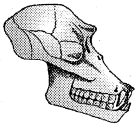
Which organism's skull is shown in the figure?
A
Adult chimpanzee
B
Adult modern human
C
Baby chimpanzee
D
Ramapithecus
Solution
(C) The figure shows the skull of a baby chimpanzee. In $NCERT$ biology textbooks,this specific diagram is used to illustrate the comparison between the skull of a baby chimpanzee and an adult chimpanzee,highlighting how the baby chimpanzee's skull more closely resembles that of an adult human due to its rounded cranium and less prominent jaw compared to an adult chimpanzee.
0 likes
View Solution273
EasyMCQ
In which continent were the most fossils of prehistoric humans discovered?
A
Africa
B
Europe
C
Asia
D
America
Solution
(A) The continent of $Africa$ is widely recognized as the 'cradle of humankind'. Extensive paleoanthropological research has revealed that the earliest ancestors of modern humans,such as $Australopithecus$ and early $Homo$ species,originated and evolved in $Africa$. Consequently,the largest number of prehistoric human fossils has been discovered on the African continent,providing crucial evidence for human evolution.
0 likes
View Solution274
EasyMCQ
Which is the earliest fossil in the evolutionary history of the horse?
A
Eohippus
B
Merychippus
C
Equus
D
Mesohippus
Solution
(A) The evolutionary history of the horse is well-documented in the fossil record.
$Eohippus$ (also known as $Hyracotherium$) is recognized as the earliest known ancestor of the modern horse.
It lived during the Eocene epoch,approximately $50$ million years ago.
It was a small,dog-sized animal with four toes on its front feet and three toes on its hind feet,adapted for running in forests.
$Eohippus$ (also known as $Hyracotherium$) is recognized as the earliest known ancestor of the modern horse.
It lived during the Eocene epoch,approximately $50$ million years ago.
It was a small,dog-sized animal with four toes on its front feet and three toes on its hind feet,adapted for running in forests.
0 likes
View Solution275
EasyMCQ
$A$ Hominid fossil discovered in Java in $1891$, now extinct, having a cranial capacity of about $900 \, cc$ was:
A
Australopithecus
B
Homo erectus
C
Neanderthal man
D
Homo sapiens
Solution
(B) The correct answer is option $B$ because the fossils recovered in Java in $1891$, dating back to about $1.5 \, \text{mya}$, were identified as $Homo \, erectus$ and had a cranial capacity of approximately $900 \, cc$.
Option $A$ is incorrect because $Australopithecus$ lived in East African grasslands about $2 \, \text{mya}$.
Option $C$ is incorrect because the cranial capacity of Neanderthal man was about $1400 \, cc$.
Option $D$ is incorrect because $Homo \, sapiens$ arose during the ice age between $75,000$ to $10,000$ years ago.
Option $A$ is incorrect because $Australopithecus$ lived in East African grasslands about $2 \, \text{mya}$.
Option $C$ is incorrect because the cranial capacity of Neanderthal man was about $1400 \, cc$.
Option $D$ is incorrect because $Homo \, sapiens$ arose during the ice age between $75,000$ to $10,000$ years ago.
0 likes
View Solution276
MediumMCQ
$A$: The brain reaches between $75$ and $80$ percent of its adult size within the first two years,and its full size at the age of $6$ years.
$R$: From an evolutionary point of view,the human gestation period is believed to be shortening.
$R$: From an evolutionary point of view,the human gestation period is believed to be shortening.
A
Assertion and Reason both are correct and Reason is the correct explanation of Assertion.
B
Assertion and Reason both are correct but Reason is not the correct explanation of Assertion.
C
Assertion is correct,but Reason is incorrect.
D
Both Assertion and Reason are incorrect.
Solution
(A) The human brain grows rapidly during early childhood. It reaches $75-80\%$ of its adult size by the age of $2$ years and attains its full adult size by the age of $6$ years.
Regarding the Reason,evolutionary biologists suggest that the human gestation period has been shortening over time to facilitate the birth of infants with larger heads through the birth canal,which is a trade-off known as the 'obstetrical dilemma'.
Therefore,both statements are scientifically accepted facts.
Regarding the Reason,evolutionary biologists suggest that the human gestation period has been shortening over time to facilitate the birth of infants with larger heads through the birth canal,which is a trade-off known as the 'obstetrical dilemma'.
Therefore,both statements are scientifically accepted facts.
0 likes
View Solution277
EasyMCQ
Australopithecus is also called
A
Java ape man
B
First ape man
C
African ape man
D
Both $(b)$ and $(c)$
Solution
(D) Australopithecus is often referred to as the 'First ape man' because it represents an early stage in human evolution showing a transition from ape-like to human-like characteristics.
Australopithecus africanus,which appeared about $5$ million years ago,is specifically known as the 'African ape man'.
Since Australopithecus is considered the first ape-man and the species Australopithecus africanus is known as the African ape-man,both descriptions are applicable in a broader context.
Therefore,the correct option is $(d)$.
Australopithecus africanus,which appeared about $5$ million years ago,is specifically known as the 'African ape man'.
Since Australopithecus is considered the first ape-man and the species Australopithecus africanus is known as the African ape-man,both descriptions are applicable in a broader context.
Therefore,the correct option is $(d)$.
0 likes
View Solution278
MediumMCQ
Homo erectus lived about
A
$2$ million years ago
B
$1.5$ million years ago
C
$1$ million years ago
D
$5$ million years ago
Solution
(B) $Homo$ $erectus$ evolved approximately $2$ million years ago and persisted until about $117,000$ to $108,000$ years ago. Among the given options,$1.5$ million years ago is the most accurate representation of the period when $Homo$ $erectus$ was widely distributed and active.
0 likes
View Solution279
MediumMCQ
The first human-like hominid is known as:
A
Neanderthal man
B
Homo habilis
C
Dryopithecus
D
Homo erectus
Solution
(B) $Homo \text{ } habilis$ is considered the first human-like hominid.
Here, $Homo$ means human and $habilis$ means able.
They lived approximately $2-1.5$ million years ago $(mya)$.
The brain capacity of $Homo \text{ } habilis$ was about half the size of a modern human.
They were more sophisticated and possessed the ability for rudimentary speech.
Here, $Homo$ means human and $habilis$ means able.
They lived approximately $2-1.5$ million years ago $(mya)$.
The brain capacity of $Homo \text{ } habilis$ was about half the size of a modern human.
They were more sophisticated and possessed the ability for rudimentary speech.
0 likes
View Solution280
MediumMCQ
Among the human ancestors,the brain size was more than $1000 \, cc$ in
A
Homo neanderthalensis
B
Homo erectus
C
Ramapithecus
D
Homo habilis
Solution
(A) The cranial capacity of Homo neanderthalensis was about $1450 \, cc$,which is roughly equal to that of modern humans $(Homo \, sapiens)$.
In contrast,Homo habilis had a brain capacity of about $650-800 \, cc$,and Ramapithecus had a much smaller brain size.
Homo erectus had a brain capacity of about $900 \, cc$.
Therefore,among the given options,Homo neanderthalensis is the correct answer as its brain size exceeds $1000 \, cc$.
In contrast,Homo habilis had a brain capacity of about $650-800 \, cc$,and Ramapithecus had a much smaller brain size.
Homo erectus had a brain capacity of about $900 \, cc$.
Therefore,among the given options,Homo neanderthalensis is the correct answer as its brain size exceeds $1000 \, cc$.
0 likes
View Solution281
EasyMCQ
Which of the following fossil man is named as handy man?
A
Ramapithecus
B
Australopithecus
C
Homo erectus
D
Homo habilis
Solution
(D) $Homo \text{ } habilis$ (the able or skillful man, the tool maker, or handy man) was discovered by $LSB$ Leakey and his wife Mary Leakey in $1960$ from the Pleistocene rocks of Olduvai Gorge in East Africa. He lived in Africa about $2$ million years ago.
0 likes
View Solution282
EasyMCQ
The connecting link between ape and man is
A
Cromagnon man
B
Australopithecus
C
Neanderthal man
D
Lemur
Solution
(B) Australopithecus is considered the connecting link between apes and humans. It is regarded as the ancestor of humans who first stood erect. Its cranial capacity was approximately $300-500 \, cc$.
0 likes
View Solution283
EasyMCQ
Which of the following is the most primitive ancestor of man?
A
Homo neanderthalensis
B
Homo habilis
C
Ramapithecus
D
Australopithecus
Solution
(C) Among the given options,$Ramapithecus$ is considered the most primitive ancestor of man.
Edward Lewis $(1932)$ discovered the fossils of $Ramapithecus$ from the Pliocene rocks of the Shivalik hills in India.
$Ramapithecus$ lived approximately $14-15$ million years ago during the late Miocene to Pliocene epoch.
$Ramapithecus$ became extinct about $7-8$ million years ago.
Edward Lewis $(1932)$ discovered the fossils of $Ramapithecus$ from the Pliocene rocks of the Shivalik hills in India.
$Ramapithecus$ lived approximately $14-15$ million years ago during the late Miocene to Pliocene epoch.
$Ramapithecus$ became extinct about $7-8$ million years ago.
0 likes
View Solution284
MediumMCQ
The brain capacity of $Homo \, erectus$ was about (in $, cc$)
A
$650$
B
$900$
C
$1200$
D
$1400$
Solution
(B) $Homo \, erectus$ lived about $1.5$ million years ago.
They had a larger brain compared to their predecessors,with a cranial capacity of approximately $900 \, cc$.
They had a larger brain compared to their predecessors,with a cranial capacity of approximately $900 \, cc$.
0 likes
View Solution285
MediumMCQ
The primates nearest to humans in the evolutionary line are:
A
New world monkeys
B
Apes
C
Lemurs
D
Echidna
Solution
(B) Evolutionary studies and biochemical evidence,such as blood group analysis,indicate that humans share a more recent common ancestor with apes than with monkeys. Blood groups $A$ and $B$ are found in both humans and apes,but not in monkeys. This biochemical similarity,along with anatomical and genetic data,confirms that apes are the closest living relatives to humans in the evolutionary lineage.
0 likes
View Solution286
EasyMCQ
The stage next to $Homo$ $habilis$ was:
A
Homo erectus
B
Homo sapiens
C
Dryopithecus
D
Neanderthal man
Solution
(A) The evolutionary stage following $Homo$ $habilis$ is $Homo$ $erectus$.
Key characteristics of $Homo$ $erectus$ ($1.6$ million to $200,000$ years ago):
$(i)$ They had an upright posture,a protruding jaw,no chin,thick brow ridges,and a long skull.
$(ii)$ Their teeth were smaller than those of $Homo$ $habilis$.
$(iii)$ They possessed a much larger brain capacity than $Homo$ $habilis$ (approximately $1000$ $cc$).
$(iv)$ They may have had advanced speech and controlled fire.
$(v)$ They created more sophisticated tools than their predecessors.
$(vi)$ They migrated out of Africa and spread throughout Asia and Europe.
Key characteristics of $Homo$ $erectus$ ($1.6$ million to $200,000$ years ago):
$(i)$ They had an upright posture,a protruding jaw,no chin,thick brow ridges,and a long skull.
$(ii)$ Their teeth were smaller than those of $Homo$ $habilis$.
$(iii)$ They possessed a much larger brain capacity than $Homo$ $habilis$ (approximately $1000$ $cc$).
$(iv)$ They may have had advanced speech and controlled fire.
$(v)$ They created more sophisticated tools than their predecessors.
$(vi)$ They migrated out of Africa and spread throughout Asia and Europe.
0 likes
View Solution287
EasyMCQ
The fossil man who made cave paintings is:
A
Java man
B
Neanderthal man
C
Cro-magnon man
D
Peking man
Solution
(C) $Cro-magnon$ man is known for being omnivorous,wearing clothes made of animal skin,and creating artistic paintings on cave walls.
0 likes
View Solution288
EasyMCQ
$Homo$ $sapiens$ $neanderthalensis$ and $Homo$ $sapiens$ $sapiens$ ($Cro-magnon$ man) originated from:
A
$Homo$ $erectus$
B
$Homo$ $habilis$
C
$Ramapithecus$
D
$Proconsul$
Solution
(A) $Homo$ $erectus$ (erect man) appeared about $1.7$ million years ago during the middle $Pleistocene$ epoch.
$Homo$ $erectus$ evolved from $Homo$ $habilis$.
$Homo$ $erectus$ was approximately $1.5-1.8$ meters tall.
He is considered the common ancestor or progenitor of the two main sub-species: $Neanderthal$ man and $Cro-magnon$ man.
$Homo$ $erectus$ evolved from $Homo$ $habilis$.
$Homo$ $erectus$ was approximately $1.5-1.8$ meters tall.
He is considered the common ancestor or progenitor of the two main sub-species: $Neanderthal$ man and $Cro-magnon$ man.
0 likes
View Solution289
MediumMCQ
Which of the following statements is correct?
A
$Homo$ $erectus$ is the ancestor of man
B
Cro-magnon man's fossil has been found in Ethiopia
C
$Australopithecus$ is the real ancestor of modern man
D
Cro-magnon man is the most recent ancestor of $Homo$ $sapiens$
Solution
(D) Cro-magnon man was the most recent ancestor of today's man.
It was discovered by MacGregor in $1868$ from Cro-magnon rocks of France.
It was about $180 \, cm$ in height with a large skull,broad face,rounded forehead,narrow nose,and prominent chin.
The cranial capacity was about $1680 \, cc$.
They were omnivorous and expressed themselves through sculpture and painting.
It was discovered by MacGregor in $1868$ from Cro-magnon rocks of France.
It was about $180 \, cm$ in height with a large skull,broad face,rounded forehead,narrow nose,and prominent chin.
The cranial capacity was about $1680 \, cc$.
They were omnivorous and expressed themselves through sculpture and painting.
0 likes
View Solution290
EasyMCQ
The ancestor of man,who first stood erect,was
A
Homo erectus
B
Cromagnon
C
Both $A$ and $B$
D
None
Solution
(A) $Homo$ $erectus$ is considered the first human ancestor to have a fully erect posture. They lived approximately $1.5$ to $1.8$ million years ago and possessed a cranial capacity of about $900$ $cc$. While $Australopithecus$ showed some bipedalism,$Homo$ $erectus$ is scientifically recognized for the first definitive erect stance.
0 likes
View Solution291
EasyMCQ
The modern man differs from the apes in:
A
Protruding eyes
B
Spare body hair
C
Wearing of clothes
D
Arms shorter than legs
Solution
(D) The anatomical structure of modern humans ($Homo$ $sapiens$) shows significant differences from apes. One of the primary morphological differences is that in modern humans,the arms are shorter than the legs,which is an adaptation for bipedal locomotion. In contrast,apes typically have arms that are longer than their legs,which facilitates their arboreal (tree-dwelling) lifestyle and knuckle-walking.
0 likes
View Solution292
EasyMCQ
Maximum cranial capacity is of
A
Neanderthal man
B
Cro-magnon man
C
Modern man
D
Java man
Solution
(B) Cro-magnon man $(Homo \, sapiens \, fossilis)$ had the highest cranial capacity,which was approximately $1680 \, cc$.
In comparison,Neanderthal man had a cranial capacity of about $1400-1500 \, cc$,and Modern man $(Homo \, sapiens \, sapiens)$ has a cranial capacity of about $1400-1450 \, cc$.
In comparison,Neanderthal man had a cranial capacity of about $1400-1500 \, cc$,and Modern man $(Homo \, sapiens \, sapiens)$ has a cranial capacity of about $1400-1450 \, cc$.
0 likes
View Solution293
EasyMCQ
The cranial capacity of modern man is
A
$430-650 \, cc$
B
$600-900 \, cc$
C
$900-1300 \, cc$
D
$1200-1600 \, cc$
Solution
(D) The cranial capacity of various human ancestors and modern humans is as follows:
$1$. $\text{Australopithecus}: 300-500 \, cc$
$2$. $\text{Java ape man (Homo erectus erectus)}: 900 \, cc$
$3$. $\text{Peking man (Homo erectus pekinensis)}: 1075 \, cc$
$4$. $\text{Modern man (Homo sapiens sapiens)}: 1360 \, cc$ (which falls within the range of $1200-1600 \, cc$)
Therefore,the correct option is $D$.
$1$. $\text{Australopithecus}: 300-500 \, cc$
$2$. $\text{Java ape man (Homo erectus erectus)}: 900 \, cc$
$3$. $\text{Peking man (Homo erectus pekinensis)}: 1075 \, cc$
$4$. $\text{Modern man (Homo sapiens sapiens)}: 1360 \, cc$ (which falls within the range of $1200-1600 \, cc$)
Therefore,the correct option is $D$.
0 likes
View Solution294
MediumMCQ
The first mammals were like $A$. Their fossils are small-sized. Mammals were $B$ and protected their unborn young inside the mother's body. Choose the correct option for $A$ and $B$ to complete the given $NCERT$ statement.
A
$A-$shrews,$B-$viviparous
B
$A-$monkeys,$B-$viviparous
C
$A-$monkeys,$B-$oviparous
D
$A-$shrews,$B-$oviparous
Solution
(A) According to the $NCERT$ textbook,the first mammals were like shrews. Their fossils are small-sized. Mammals were viviparous and protected their unborn young inside the mother's body. Viviparous animals are those that give birth to live young rather than laying eggs. Therefore,the correct option is $A-$shrews and $B-$viviparous.
0 likes
View Solution295
EasyMCQ
Ape-like ancestors of humans appeared in which epoch?
A
Pleistocene
B
Pliocene
C
Miocene
D
Oligocene
Solution
(C) The ape-like ancestors of humans,such as Dryopithecus and Ramapithecus,appeared during the $Miocene$ epoch. The $Pliocene$ epoch saw the emergence of early hominids like Australopithecus,while the genus $Homo$ (humans) appeared during the $Pleistocene$ epoch.
0 likes
View Solution296
MediumMCQ
Australopithecines probably lived in the
A
East African grasslands
B
West African grasslands
C
North American grasslands
D
South American grasslands
Solution
(A) Australopithecines are considered the ancestors of the genus $Homo$. Fossil evidence suggests that they lived in the East African grasslands approximately $3-4$ million years ago. They were bipedal and primarily herbivorous,adapted to the savanna environment of East Africa.
0 likes
View Solution297
EasyMCQ
Fossils discovered in Java in $1891$ belonged to
A
Homo habilis
B
Neanderthal man
C
Homo erectus
D
Ramapithecus
Solution
(C) The fossils discovered in Java in $1891$ by Eugene Dubois are known as Java Ape man.
These fossils are classified under the species $Homo \ erectus$.
$Homo \ erectus$ also includes other significant fossils such as Peking man and Heidelberg man.
These fossils are classified under the species $Homo \ erectus$.
$Homo \ erectus$ also includes other significant fossils such as Peking man and Heidelberg man.
0 likes
View Solution298
MediumMCQ
Among the following,which is the most recent?
A
Homo sapiens
B
Australopithecines
C
Homo habilis
D
Dryopithecus
Solution
(A) The evolutionary sequence of human ancestors is as follows: $Dryopithecus \rightarrow Australopithecus \rightarrow Homo \text{ } habilis \rightarrow Homo \text{ } erectus \rightarrow Homo \text{ } sapiens$. Among the given options,$Homo \text{ } sapiens$ is the most recently evolved species.
0 likes
View Solution299
EasyMCQ
The Neanderthal man had a cranial capacity of around
A
$1600\;cc$
B
$650-800\;cc$
C
$900\;cc$
D
$1400\;cc$
Solution
(D) The Neanderthal man $(Homo\;neanderthalensis)$ lived near East and Central Asia between $100,000$ and $40,000$ years ago.
They were characterized by a robust build and a large brain size.
The cranial capacity of the Neanderthal man was approximately $1400\;cc$,which is comparable to that of modern humans.
They were characterized by a robust build and a large brain size.
The cranial capacity of the Neanderthal man was approximately $1400\;cc$,which is comparable to that of modern humans.
0 likes
View Solution300
EasyMCQ
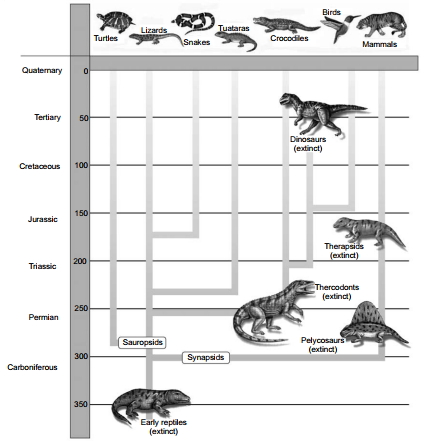
The dinosaurs descended from . . . . . . ancestors.
A
Therapsids
B
Pelycosaurs
C
Synapsids
D
Thecodonts
Solution
(D) Based on the provided evolutionary tree diagram,the lineage leading to dinosaurs branches off from the group known as Thecodonts. Thecodonts were a diverse group of archosaurian reptiles that appeared in the Permian period and were the ancestors of dinosaurs,crocodiles,and pterosaurs. Therefore,the correct option is $D$.
0 likes
View SolutionEvolution — Evolution of Man · Frequently Asked Questions
1Are these Evolution questions useful for JEE and NEET?
Yes. All questions in this section are mapped to JEE Main and NEET exam patterns. Previous year questions from JEE Main, NEET, GUJCET and state-level exams are included with full solutions.
2Can I switch to Hindi or Gujarati for these questions?
Yes. Use the language tabs in the hero section or the sidebar to view the same questions and solutions in English, Hindi or Gujarati.
3How do I generate a question paper from this subtopic?
Use the Vedclass Exam Paper Generator — select the chapter and subtopic, set difficulty, and generate Sets A, B, C, D automatically. First 3 chapters of every subject are free.
Vedclass Products
For Students
Vedclass Test Series
Mock tests in real JEE/NEET style with performance analysis. 5-day free trial.
Start Free TrialFor Teachers
Exam Paper Generator
Generate Set A/B/C/D papers from this chapter in 2 minutes. 3 chapters free.
Try FreeFor Institutes
Online Exam Module
Live online exams with unlimited students, 360° analytics & white-label branding.
See DemoFor Teachers & Institutes
Generate a Evolution Exam Paper in 2 Minutes
Select subtopic & difficulty — Sets A, B, C, D auto-generated with No Repeat logic.
First 3 chapters of every subject are free — no payment required.