
A English
Evolution of Man Questions in English
Class 12 Biology · Evolution · Evolution of Man
352+
Questions
English
Language
100%
With Solutions
Showing 50 of 352 questions in English
301
EasyMCQ
Which of the following had huge fearsome dagger-like teeth?
A
Dryopithecus
B
Tyrannosaurus
C
Ichthyosaur
D
Homo erectus
Solution
(B) Tyrannosaurus rex was the largest dinosaur,reaching a height of about $20 \; ft$. It is well-known for its massive size and huge,fearsome,dagger-like teeth,which it used to hunt and consume prey.
0 likes
View Solution302
MediumMCQ
Which of the following was discovered in Ethiopia and Tanzania?
A
Fossils of dinosaurs
B
Few fossils of man-like bones
C
Alive coelacanth
D
Fossils of Archaeopteryx
Solution
(B) In Ethiopia and Tanzania,researchers discovered several fossils of man-like bones. These fossils,such as those of $Australopithecus$,provide significant evidence for the evolutionary history of humans,showing that early hominids lived in East Africa.
0 likes
View Solution303
MediumMCQ
Which of the following facts is not true for Homo habilis?
A
They had a brain capacity of $1400\;cc$
B
They were the first human-like being
C
They showed the hominid features
D
They probably did not eat meat
Solution
(A) The brain capacity of $Homo\;habilis$ ranged between $650\;cc$ and $800\;cc$. The option stating a brain capacity of $1400\;cc$ is incorrect,as $1400\;cc$ is the brain capacity associated with $Homo\;neanderthalensis$. Therefore,option $A$ is the fact that is not true for $Homo\;habilis$.
0 likes
View Solution304
EasyMCQ
The ancestors of man who used hides to protect their body were
A
Homo erectus
B
Homo habilis
C
Neanderthal man
D
Australopithecus
Solution
(C) The $Neanderthal$ man ($Homo$ $neanderthalensis$) lived in near-eastern and central Asia between $100,000$ to $40,000$ years ago.
They were the first human ancestors to use hides (animal skins) as clothing to protect their bodies from the cold environment.
They also buried their dead and used tools for hunting.
They were the first human ancestors to use hides (animal skins) as clothing to protect their bodies from the cold environment.
They also buried their dead and used tools for hunting.
0 likes
View Solution305
MediumMCQ
$A$ : There is $99\%$ homology in the haemoglobin of man and Gorilla.
$R$ : Modern man is a direct descendant of the Gorilla.
$R$ : Modern man is a direct descendant of the Gorilla.
A
Assertion and Reason both are correct and Reason is the correct explanation of Assertion.
B
Assertion and Reason both are correct but Reason is not the correct explanation of Assertion.
C
Assertion is correct,but Reason is incorrect.
D
Both Assertion and Reason are incorrect.
Solution
(C) The assertion that there is $99\%$ homology in the haemoglobin of man and Gorilla is scientifically accurate,reflecting a close evolutionary relationship.
However,the reason stating that modern man is a direct descendant of the Gorilla is incorrect.
According to evolutionary biology,humans and Gorillas share a common ancestor,but humans did not evolve directly from modern Gorillas.
Both species diverged from a common primate ancestor millions of years ago.
However,the reason stating that modern man is a direct descendant of the Gorilla is incorrect.
According to evolutionary biology,humans and Gorillas share a common ancestor,but humans did not evolve directly from modern Gorillas.
Both species diverged from a common primate ancestor millions of years ago.
0 likes
View Solution306
DifficultMCQ
$A$: Evolution of shelled eggs helped the reptiles to successfully adapt for terrestrial life.
$R$: The origin of shelled eggs occurred earlier than viviparity.
$R$: The origin of shelled eggs occurred earlier than viviparity.
A
Assertion and Reason both are correct and Reason is the correct explanation of Assertion.
B
Assertion and Reason both are correct but Reason is not the correct explanation of Assertion.
C
Assertion is correct,but Reason is incorrect.
D
Both Assertion and Reason are incorrect.
Solution
(C) Assertion is true because reptiles are the first successful land vertebrates,and the formation of a protective shell around the eggs prevented desiccation,helping them adapt to terrestrial life.
Reason is incorrect because viviparity (giving birth to live young) is a reproductive strategy that has appeared independently in various lineages,including some lower animals and sharks,which existed long before the evolution of amniotic shelled eggs in reptiles.
Reason is incorrect because viviparity (giving birth to live young) is a reproductive strategy that has appeared independently in various lineages,including some lower animals and sharks,which existed long before the evolution of amniotic shelled eggs in reptiles.
0 likes
View Solution307
EasyMCQ
The earliest mammals were similar to which of the following animals?
A
Humans
B
Shrews
C
Rabbits
D
Horses
Solution
(B) The earliest mammals appeared during the $Triassic$ period. These early mammals were small,nocturnal,insectivorous creatures that resembled modern-day shrews. They occupied a niche similar to shrews,which allowed them to survive and diversify after the extinction of the dinosaurs.
0 likes
View Solution308
MediumMCQ
The fossils discovered in Java in $1891$ belonged to which of the following?
A
Homo habilis
B
Neanderthal man
C
Homo erectus
D
Ramapithecus
Solution
(C) In $1891$,Eugene Dubois discovered fossils in Java,which were identified as $Homo erectus$ (specifically,Java Man or $Pithecanthropus erectus$).
$Homo erectus$ lived approximately $1.5$ to $2$ million years ago.
They had a cranial capacity of about $900$ cc and were the first to use fire.
Therefore,the correct option is $C$.
$Homo erectus$ lived approximately $1.5$ to $2$ million years ago.
They had a cranial capacity of about $900$ cc and were the first to use fire.
Therefore,the correct option is $C$.
0 likes
View Solution309
MediumMCQ
Which fossil human had a brain capacity similar to that of modern humans?
A
Dryopithecus
B
Homo erectus
C
Australopithecus
D
Neanderthal man
Solution
(D) The Neanderthal man ($Homo$ $neanderthalensis$) lived near the near east and central Asia between $1,00,000$ and $40,000$ years back.
They used hides to protect their body and buried their dead.
Their brain capacity was $1400$ $cc$,which is similar to or even slightly larger than that of modern humans ($Homo$ $sapiens$).
They used hides to protect their body and buried their dead.
Their brain capacity was $1400$ $cc$,which is similar to or even slightly larger than that of modern humans ($Homo$ $sapiens$).
0 likes
View Solution310
MediumMCQ
The cranial capacity of $Homo$ $erectus$ was approximately ........ .
A
$650-800 \,cc$
B
$1400 \,cc$
C
$900 \,cc$
D
$650 \,cc$
Solution
(C) The cranial capacity of various human ancestors is a key indicator of their evolutionary development.
$Homo$ $habilis$ had a cranial capacity of about $650-800 \,cc$.
$Homo$ $erectus$ had a larger brain,with a cranial capacity of approximately $900 \,cc$.
$Homo$ $sapiens$ $neanderthalensis$ had a cranial capacity of about $1400 \,cc$.
Therefore,the correct cranial capacity for $Homo$ $erectus$ is $900 \,cc$.
$Homo$ $habilis$ had a cranial capacity of about $650-800 \,cc$.
$Homo$ $erectus$ had a larger brain,with a cranial capacity of approximately $900 \,cc$.
$Homo$ $sapiens$ $neanderthalensis$ had a cranial capacity of about $1400 \,cc$.
Therefore,the correct cranial capacity for $Homo$ $erectus$ is $900 \,cc$.
0 likes
View Solution311
EasyMCQ
Match the following columns:
| Column-$I$ | Column-$II$ |
| $P$. Homo habilis | $I$. $900 \, cc$ |
| $Q$. Homo erectus | $II$. $1400 \, cc$ |
| $R$. Neanderthal man | $III$. $650-800 \, cc$ |
A
$(P-II), (Q-II), (R-I)$
B
$(P-III), (Q-I), (R-II)$
C
$(P-I), (Q-II), (R-III)$
D
$(P-II), (Q-I), (R-III)$
Solution
(B) The cranial capacities of early human ancestors are as follows:
$1$. $Homo \, habilis$: Their brain capacity was between $650-800 \, cc$. Thus, $P-III$.
$2$. $Homo \, erectus$: Their brain capacity was about $900 \, cc$. Thus, $Q-I$.
$3$. $Neanderthal \, man$: Their brain capacity was around $1400 \, cc$. Thus, $R-II$.
Therefore, the correct matching is $(P-III), (Q-I), (R-II)$.
$1$. $Homo \, habilis$: Their brain capacity was between $650-800 \, cc$. Thus, $P-III$.
$2$. $Homo \, erectus$: Their brain capacity was about $900 \, cc$. Thus, $Q-I$.
$3$. $Neanderthal \, man$: Their brain capacity was around $1400 \, cc$. Thus, $R-II$.
Therefore, the correct matching is $(P-III), (Q-I), (R-II)$.
0 likes
View Solution312
MediumMCQ
About $P$ million years ago,human-like primates walked in eastern Africa. They were probably not taller than $Q$ feet.
$Q$ is:
$Q$ is:
A
$3-4$ million years ago,$4$ feet
B
$3-4$ million years ago,$2$ feet
C
$2$ million years ago,$4$ feet
D
$2$ million years ago,$2$ feet
Solution
(A) According to the $NCERT$ textbook on Evolution,about $15$ million years ago,primates called Dryopithecus and Ramapithecus were existing. They were hairy and walked like gorillas and chimpanzees.
About $3-4$ million years ago,man-like primates walked in eastern Africa. They were probably not taller than $4$ feet but walked up right.
Therefore,$P = 3-4$ million years and $Q = 4$ feet.
About $3-4$ million years ago,man-like primates walked in eastern Africa. They were probably not taller than $4$ feet but walked up right.
Therefore,$P = 3-4$ million years and $Q = 4$ feet.
0 likes
View Solution313
MediumMCQ
Identify $P$ and $Q$ in the given figure.
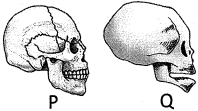
A
Baby chimpanzee skull,Adult modern human skull
B
Baby chimpanzee skull,Adult chimpanzee skull
C
Adult modern human skull,Baby chimpanzee skull
D
Adult chimpanzee skull,Baby chimpanzee skull
Solution
(C) In the study of human evolution,the comparison between the skulls of chimpanzees and humans is a classic example used to illustrate morphological similarities and differences.
$P$ represents the skull of an adult modern human,characterized by a larger cranial capacity,a vertical forehead,and a reduced jaw projection (prognathism).
$Q$ represents the skull of a baby chimpanzee,which shares some structural similarities with the human skull,such as a relatively rounded cranium and less pronounced jaw projection compared to an adult chimpanzee,illustrating the concept of neoteny or paedomorphosis in evolutionary biology.
$P$ represents the skull of an adult modern human,characterized by a larger cranial capacity,a vertical forehead,and a reduced jaw projection (prognathism).
$Q$ represents the skull of a baby chimpanzee,which shares some structural similarities with the human skull,such as a relatively rounded cranium and less pronounced jaw projection compared to an adult chimpanzee,illustrating the concept of neoteny or paedomorphosis in evolutionary biology.
0 likes
View Solution314
MediumMCQ
Modern $Homo$ $sapiens$ appeared during the ice age between ......... years ago.
A
$18,000$
B
$10,000$
C
$1,00,000-40,000$
D
$75,000-10,000$
Solution
(C) According to the evolutionary timeline provided in the $NCERT$ biology textbook,modern $Homo$ $sapiens$ arose during the ice age between $1,00,000$ and $40,000$ years ago. Therefore,option $C$ is the correct answer.
0 likes
View Solution315
EasyMCQ
Where did $Homo$ $sapiens$ originate?
A
Africa
B
America
C
India
D
Australia
Solution
(A) Scientific evidence,including fossil records and genetic studies,indicates that $Homo$ $sapiens$ (modern humans) first evolved in Africa approximately $200,000$ to $300,000$ years ago. From Africa,they migrated to other parts of the world.
0 likes
View Solution316
MediumMCQ
What is the scientific name of Java Man?
A
Homo habilis
B
Homo sapiens sapiens
C
Homo australopithecus
D
Homo erectus
Solution
(D) Java Man was discovered in Java in $1891$ by Eugene Dubois. It is scientifically classified as $Homo \ erectus$ (specifically $Homo \ erectus \ erectus$). It lived approximately $1.5$ to $0.5$ million years ago and is known for having a cranial capacity of about $900 \ cc$.
0 likes
View Solution317
EasyMCQ
Which extinct human ancestor primarily ate fruits and hunted using stone weapons?
A
Dryopithecus
B
Homo erectus
C
Australopithecus
D
Ramapithecus
Solution
(C) Australopithecus is the correct answer.
Australopithecus lived in East African grasslands about $2$ million years ago.
They were known to hunt with stone weapons but essentially ate fruits.
Dryopithecus and Ramapithecus were more ape-like and existed earlier.
Homo erectus had a larger brain capacity and used more sophisticated tools.
Australopithecus lived in East African grasslands about $2$ million years ago.
They were known to hunt with stone weapons but essentially ate fruits.
Dryopithecus and Ramapithecus were more ape-like and existed earlier.
Homo erectus had a larger brain capacity and used more sophisticated tools.
0 likes
View Solution318
EasyMCQ
In which of the following did bipedal locomotion first evolve?
A
Homo erectus
B
Australopithecus
C
Dryopithecus
D
Neanderthal man
Solution
(B) Bipedal locomotion,the ability to walk on two legs,first evolved in the genus $Australopithecus$.
$Australopithecus$ lived in the East African grasslands and exhibited clear skeletal adaptations for walking upright,such as the structure of the pelvis and the position of the foramen magnum.
While $Dryopithecus$ were more ape-like and arboreal,$Homo$ $erectus$ and $Neanderthal$ $man$ evolved later with more advanced brain capacities and tool-making abilities.
$Australopithecus$ lived in the East African grasslands and exhibited clear skeletal adaptations for walking upright,such as the structure of the pelvis and the position of the foramen magnum.
While $Dryopithecus$ were more ape-like and arboreal,$Homo$ $erectus$ and $Neanderthal$ $man$ evolved later with more advanced brain capacities and tool-making abilities.
0 likes
View Solution319
MediumMCQ
The immediate ancestor of modern humans is:
A
Dryopithecus
B
Australopithecus
C
Homo habilis
D
Homo neanderthalensis
Solution
(D) The evolutionary lineage of modern humans ($Homo$ $sapiens$) involves several stages.
$Dryopithecus$ and $Ramapithecus$ were early primates.
$Australopithecus$ lived about $2$ million years ago.
$Homo$ $habilis$ was the first human-like being (the hominid).
$Homo$ $neanderthalensis$ (Neanderthal man) lived near-east and central Asia between $1,00,000-40,000$ years back and is considered the closest ancestor to modern humans in terms of brain capacity and social behavior,though $Homo$ $sapiens$ evolved from earlier $Homo$ species.
$Dryopithecus$ and $Ramapithecus$ were early primates.
$Australopithecus$ lived about $2$ million years ago.
$Homo$ $habilis$ was the first human-like being (the hominid).
$Homo$ $neanderthalensis$ (Neanderthal man) lived near-east and central Asia between $1,00,000-40,000$ years back and is considered the closest ancestor to modern humans in terms of brain capacity and social behavior,though $Homo$ $sapiens$ evolved from earlier $Homo$ species.
0 likes
View Solution320
MediumMCQ
Given below are some stages of human evolution. Arrange them in correct sequence (Past to Recent):
$A$. Homo habilis
$B$. Homo sapiens
$C$. Homo neanderthalensis
$D$. Homo erectus
Choose the correct sequence of human evolution from the options given below:
$A$. Homo habilis
$B$. Homo sapiens
$C$. Homo neanderthalensis
$D$. Homo erectus
Choose the correct sequence of human evolution from the options given below:
A
$B-A-D-C$
B
$C-B-D-A$
C
$A-D-C-B$
D
$D-A-C-B$
Solution
(C) The correct sequence of human evolution from the past to the recent is as follows:
$1$. $Homo$ $\text{habilis}$ (approx. $2.0 - 1.5$ million years ago)
$2$. $Homo$ $\text{erectus}$ (approx. $1.5$ million years ago)
$3$. $Homo$ $\text{neanderthalensis}$ (approx. $100,000 - 40,000$ years ago)
$4$. $Homo$ $\text{sapiens}$ (modern humans)
Therefore, the correct chronological order is $A \rightarrow D \rightarrow C \rightarrow B$. Thus, the correct option is $C$.
$1$. $Homo$ $\text{habilis}$ (approx. $2.0 - 1.5$ million years ago)
$2$. $Homo$ $\text{erectus}$ (approx. $1.5$ million years ago)
$3$. $Homo$ $\text{neanderthalensis}$ (approx. $100,000 - 40,000$ years ago)
$4$. $Homo$ $\text{sapiens}$ (modern humans)
Therefore, the correct chronological order is $A \rightarrow D \rightarrow C \rightarrow B$. Thus, the correct option is $C$.
0 likes
View Solution321
MediumMCQ
Which of the following is the correct sequence of human ancestors?
$(I)$ Homo habilis $(II)$ Ramapithecus $(III)$ Homo erectus $(IV)$ Australopithecus
$(I)$ Homo habilis $(II)$ Ramapithecus $(III)$ Homo erectus $(IV)$ Australopithecus
A
$(I)$,$(III)$,$(II)$,$(IV)$
B
$(I)$,$(II)$,$(III)$,$(IV)$
C
$(II)$,$(IV)$,$(I)$,$(III)$
D
$(IV)$,$(III)$,$(II)$,$(I)$
Solution
(C) The evolutionary sequence of human ancestors from oldest to most recent is as follows:
$1$. Ramapithecus (lived about $12-14$ million years ago).
$2$. Australopithecus (lived about $2-5$ million years ago).
$3$. Homo habilis (lived about $1.5-2$ million years ago).
$4$. Homo erectus (lived about $1.5-1.8$ million years ago).
Therefore,the correct chronological order is $(II), (IV), (I), (III)$.
$1$. Ramapithecus (lived about $12-14$ million years ago).
$2$. Australopithecus (lived about $2-5$ million years ago).
$3$. Homo habilis (lived about $1.5-2$ million years ago).
$4$. Homo erectus (lived about $1.5-1.8$ million years ago).
Therefore,the correct chronological order is $(II), (IV), (I), (III)$.
0 likes
View Solution322
EasyMCQ
Which is not correctly matched among the following options?
A
Homo habilis $-$ Brain capacity $650 - 800 \ \text{cc}$
B
Homo erectus $-$ Fossils discovered in Java
C
Neanderthal man $-$ First human being like creature
D
Homo sapiens $-$ Arose in Africa
Solution
(C) The correct answer is $C$.
$Homo \ habilis$ had a brain capacity between $650-800 \ \text{cc}$ and is considered the first human-like creature (hominid).
$Homo \ erectus$ fossils were indeed discovered in Java (Java man).
Neanderthal man $(Homo \ neanderthalensis)$ lived near east and central Asia and used hides to protect their bodies and buried their dead; they were not the first human-like creature.
$Homo \ sapiens$ arose in Africa and moved across continents and developed into distinct races.
$Homo \ habilis$ had a brain capacity between $650-800 \ \text{cc}$ and is considered the first human-like creature (hominid).
$Homo \ erectus$ fossils were indeed discovered in Java (Java man).
Neanderthal man $(Homo \ neanderthalensis)$ lived near east and central Asia and used hides to protect their bodies and buried their dead; they were not the first human-like creature.
$Homo \ sapiens$ arose in Africa and moved across continents and developed into distinct races.
0 likes
View Solution323
MediumMCQ
Match the hominids with their correct cranial capacity:
Select the correct option:
| $(a)$ Australopithecus | $(i)$ $900 \ CC$ |
| $(b)$ Homo habilis | $(ii)$ $500 \ CC$ |
| $(c)$ Neanderthal man | $(iii)$ $650-800 \ CC$ |
| $(d)$ Homo erectus | $(iv)$ $1400 \ CC$ |
Select the correct option:
A
$(a-ii, b-iii, c-iv, d-i)$
B
$(a-i, b-ii, c-iii, d-iv)$
C
$(a-ii, b-i, c-iv, d-iii)$
D
$(a-ii, b-iii, c-i, d-iv)$
Solution
(A) The cranial capacities of the given hominids are as follows:
$1$. Australopithecus: Their cranial capacity was approximately $500 \ CC$.
$2$. Homo habilis: Their cranial capacity ranged between $650-800 \ CC$.
$3$. Neanderthal man: They had a large brain with a cranial capacity of approximately $1400 \ CC$.
$4$. Homo erectus: Their cranial capacity was approximately $900 \ CC$.
Therefore,the correct matching is $(a-ii, b-iii, c-iv, d-i)$.
$1$. Australopithecus: Their cranial capacity was approximately $500 \ CC$.
$2$. Homo habilis: Their cranial capacity ranged between $650-800 \ CC$.
$3$. Neanderthal man: They had a large brain with a cranial capacity of approximately $1400 \ CC$.
$4$. Homo erectus: Their cranial capacity was approximately $900 \ CC$.
Therefore,the correct matching is $(a-ii, b-iii, c-iv, d-i)$.
0 likes
View Solution324
EasyMCQ
Modern $Homo$ $sapiens$ arose:
A
Between $4,00,000 - 1,00,000$ years back
B
Between $75,000 - 10,000$ years ago
C
$8,000$ years ago
D
$1,000$ years ago
Solution
(B) According to the evolutionary timeline of humans,$Homo$ $sapiens$ (modern humans) evolved during the ice ages between $75,000$ and $10,000$ years ago. Earlier ancestors like $Homo$ $erectus$ existed much earlier,but the specific emergence of modern $Homo$ $sapiens$ is dated to this period.
0 likes
View Solution325
MediumMCQ
Complete the following paragraph by selecting the correct sequence of words from the options given below. The Neanderthal man with a brain size of _$(i)$_ lived near east and central _$(ii)$_ between _$(iii)$_ years back. They used _$(iv)$_ to protect their body and buried their dead.
A
$i \rightarrow 500cc, ii \rightarrow \text{Australia}, iii \rightarrow 2,00,000-1,40,000, iv \rightarrow \text{clothes}$
B
$i \rightarrow 1400cc, ii \rightarrow \text{Africa}, iii \rightarrow 40,000-8,000, iv \rightarrow \text{hides}$
C
$i \rightarrow 1400cc, ii \rightarrow \text{Asia}, iii \rightarrow 1,00,000-40,000, iv \rightarrow \text{hides}$
D
$i \rightarrow 650cc, ii \rightarrow \text{Africa}, iii \rightarrow 75,000-10,000, iv \rightarrow \text{leaves}$
Solution
(C) Neanderthal man $(Homo \ neanderthalensis)$ had a brain capacity of approximately $1400cc$.
They inhabited areas in near east and central Asia.
They lived between $1,00,000$ to $40,000$ years ago.
They used animal hides to protect their bodies from harsh weather and were known to bury their dead,indicating the development of early cultural or ritualistic behavior.
Therefore,the correct sequence is $i \rightarrow 1400cc, ii \rightarrow \text{Asia}, iii \rightarrow 1,00,000-40,000, iv \rightarrow \text{hides}$.
They inhabited areas in near east and central Asia.
They lived between $1,00,000$ to $40,000$ years ago.
They used animal hides to protect their bodies from harsh weather and were known to bury their dead,indicating the development of early cultural or ritualistic behavior.
Therefore,the correct sequence is $i \rightarrow 1400cc, ii \rightarrow \text{Asia}, iii \rightarrow 1,00,000-40,000, iv \rightarrow \text{hides}$.
0 likes
View Solution326
EasyMCQ
Which of the following characteristics was $NOT$ acquired by man in the course of evolution?
A
Increase in cranial capacity
B
Bipedal locomotion
C
Lengthening of forelimbs
D
Broadening of pelvic girdle
Solution
(C) During human evolution,several anatomical changes occurred to support an upright posture and bipedal locomotion.
$1$. The cranial capacity increased significantly to accommodate a larger brain.
$2$. Bipedal locomotion (walking on two legs) became the primary mode of movement.
$3$. The pelvic girdle broadened to support the weight of the upper body in an upright position.
$4$. Conversely,the forelimbs shortened,not lengthened,as they were no longer needed for weight-bearing or locomotion,allowing for greater dexterity and tool use.
Therefore,the lengthening of forelimbs is not a characteristic acquired by humans.
$1$. The cranial capacity increased significantly to accommodate a larger brain.
$2$. Bipedal locomotion (walking on two legs) became the primary mode of movement.
$3$. The pelvic girdle broadened to support the weight of the upper body in an upright position.
$4$. Conversely,the forelimbs shortened,not lengthened,as they were no longer needed for weight-bearing or locomotion,allowing for greater dexterity and tool use.
Therefore,the lengthening of forelimbs is not a characteristic acquired by humans.
0 likes
View Solution327
EasyMCQ
Select the correct set of characteristics acquired by man in the course of evolution.
A
Prognathous face,bony eyebrow ridge,chin present.
B
Stereoscopic vision,opposable thumb,shorter forelimbs.
C
Broad pelvic girdle,long forelimbs,chin present.
D
Short forelimbs,lumbar curvature,prognathous face.
Solution
(B) During human evolution,several key anatomical changes occurred to support bipedalism and increased brain capacity.
$1$. Stereoscopic vision (binocular vision) allows for depth perception,which is essential for primates.
$2$. The opposable thumb allows for the precision grip and manipulation of tools.
$3$. Shorter forelimbs (compared to hindlimbs) are a characteristic adaptation for bipedal locomotion,as humans no longer use their arms for walking.
Option $B$ correctly lists these evolutionary traits.
$1$. Stereoscopic vision (binocular vision) allows for depth perception,which is essential for primates.
$2$. The opposable thumb allows for the precision grip and manipulation of tools.
$3$. Shorter forelimbs (compared to hindlimbs) are a characteristic adaptation for bipedal locomotion,as humans no longer use their arms for walking.
Option $B$ correctly lists these evolutionary traits.
0 likes
View Solution328
EasyMCQ
Which one of the following pairs is mismatched regarding their appearance in human evolution?
A
$Homo erectus$ - ape man
B
$Ramapithecus$ - ape like man
C
$Neanderthal$ man - Advanced prehistoric man
D
$Homo habilis$ - handy man
Solution
(A) The correct answer is $A$.
$Homo erectus$ is known as the 'upright man',not the 'ape man'.
$Dryopithecus$ is considered more ape-like,while $Ramapithecus$ was more man-like.
$Homo habilis$ is correctly referred to as the 'handy man' or 'tool maker' because they were the first to use tools.
$Neanderthal$ man is considered an advanced prehistoric man with a brain capacity of about $1400 \ cc$.
$Homo erectus$ is known as the 'upright man',not the 'ape man'.
$Dryopithecus$ is considered more ape-like,while $Ramapithecus$ was more man-like.
$Homo habilis$ is correctly referred to as the 'handy man' or 'tool maker' because they were the first to use tools.
$Neanderthal$ man is considered an advanced prehistoric man with a brain capacity of about $1400 \ cc$.
0 likes
View Solution329
EasyMCQ
The site of the fossil record of Neanderthal man was . . . . . . .
A
Germany
B
Java
C
Tanzania
D
India
Solution
(A) The fossils of Neanderthal man $(Homo \text{ } neanderthalensis)$ were first discovered in the Neander Valley in Germany. They lived near the end of the Pleistocene epoch, approximately $100,000$ to $40,000$ years ago. Therefore, the correct site is Germany.
0 likes
View Solution330
EasyMCQ
$Homo$ $sapiens$ are most closely related to . . . . . . .
A
Lemurs
B
Tarsiers
C
Baboons
D
Orangutans
Solution
(C) The evolutionary lineage of $Homo$ $sapiens$ places them within the order $Primates$.
Among the options provided,$Baboons$ belong to the family $Cercopithecidae$ (Old World monkeys),which are catarrhine primates.
$Lemurs$ and $Tarsiers$ are prosimians,which are more distantly related to humans compared to the simians (monkeys and apes).
$Orangutans$ are great apes,but in the context of standard evolutionary biology questions comparing these specific groups,$Baboons$ are often cited as being closer in terms of specific primate classification groups relative to the prosimians listed.
Among the options provided,$Baboons$ belong to the family $Cercopithecidae$ (Old World monkeys),which are catarrhine primates.
$Lemurs$ and $Tarsiers$ are prosimians,which are more distantly related to humans compared to the simians (monkeys and apes).
$Orangutans$ are great apes,but in the context of standard evolutionary biology questions comparing these specific groups,$Baboons$ are often cited as being closer in terms of specific primate classification groups relative to the prosimians listed.
0 likes
View Solution331
EasyMCQ
Match the Column-$I$ with Column-$II$ and select the correct option.
| Column-$I$ (Name of fossil) | Column-$II$ (Cranial capacity) |
| $i$. Homo habilis | $A$. $900 \ cc$ |
| $ii$. Neanderthal man | $B$. $650-800 \ cc$ |
| $iii$. Australopithecus | $C$. $1400 \ cc$ |
| $iv$. Homo erectus | $D$. $450-600 \ cc$ |
A
$i-B, ii-C, iii-A, iv-D$
B
$i-C, ii-B, iii-A, iv-D$
C
$i-C, ii-B, iii-D, iv-A$
D
$i-B, ii-C, iii-D, iv-A$
Solution
(D) The correct matching of fossils with their cranial capacities is as follows:
$1$. $Homo \ habilis$: Their cranial capacity was between $650-800 \ cc$. (Matches with $B$)
$2$. $Neanderthal \ man$: They had a large brain with a cranial capacity of approximately $1400 \ cc$. (Matches with $C$)
$3$. $Australopithecus$: They had a smaller brain with a cranial capacity ranging from $450-600 \ cc$. (Matches with $D$)
$4$. $Homo \ erectus$: Their cranial capacity was about $900 \ cc$. (Matches with $A$)
Therefore,the correct sequence is $i-B, ii-C, iii-D, iv-A$.
$1$. $Homo \ habilis$: Their cranial capacity was between $650-800 \ cc$. (Matches with $B$)
$2$. $Neanderthal \ man$: They had a large brain with a cranial capacity of approximately $1400 \ cc$. (Matches with $C$)
$3$. $Australopithecus$: They had a smaller brain with a cranial capacity ranging from $450-600 \ cc$. (Matches with $D$)
$4$. $Homo \ erectus$: Their cranial capacity was about $900 \ cc$. (Matches with $A$)
Therefore,the correct sequence is $i-B, ii-C, iii-D, iv-A$.
0 likes
View Solution332
EasyMCQ
Which one of the following is correct regarding special features of Neanderthal man?
$i$. He used hide to cover his body.
$ii$. Its fossil was first found in Germany.
$iii$. He had semi-erect posture.
$iv$. He existed during Miocene epoch.
$v$. He constructed flint tools.
$i$. He used hide to cover his body.
$ii$. Its fossil was first found in Germany.
$iii$. He had semi-erect posture.
$iv$. He existed during Miocene epoch.
$v$. He constructed flint tools.
A
$i$ and $ii$ only
B
$i, ii, iii$ and $iv$ only
C
$i, ii$ and $v$ only
D
$ii, iii, iv$ and $v$ only
Solution
(C) $i$. Neanderthal man used hides to protect their bodies from cold.
$ii$. The first Neanderthal fossil was discovered in the Neander Valley,Germany.
$iii$. Neanderthal man had an erect posture,not semi-erect.
$iv$. Neanderthal man existed during the late Pleistocene epoch,not the Miocene.
$v$. They were known for constructing sophisticated flint tools.
Therefore,statements $i, ii,$ and $v$ are correct.
$ii$. The first Neanderthal fossil was discovered in the Neander Valley,Germany.
$iii$. Neanderthal man had an erect posture,not semi-erect.
$iv$. Neanderthal man existed during the late Pleistocene epoch,not the Miocene.
$v$. They were known for constructing sophisticated flint tools.
Therefore,statements $i, ii,$ and $v$ are correct.
0 likes
View Solution333
EasyMCQ
Select the correct sequence of fossils in human evolution from ancestors to modern man.
i. $Dryopithecus$ $\quad$ ii. $Homo$ $habilis$
iii. $Ramapithecus$ $\quad$ iv. $Neanderthal$
v. $Homo$ $erectus$
i. $Dryopithecus$ $\quad$ ii. $Homo$ $habilis$
iii. $Ramapithecus$ $\quad$ iv. $Neanderthal$
v. $Homo$ $erectus$
A
$i \rightarrow iii \rightarrow iv \rightarrow v \rightarrow ii$
B
$iii \rightarrow i \rightarrow ii \rightarrow v \rightarrow iv$
C
$i \rightarrow iii \rightarrow ii \rightarrow v \rightarrow iv$
D
$iii \rightarrow i \rightarrow iv \rightarrow v \rightarrow ii$
Solution
(C) The correct evolutionary sequence of human ancestors is as follows:
$1$. $Dryopithecus$: These were more ape-like and lived about $15$ million years ago.
$2$. $Ramapithecus$: These were more man-like and existed around the same time as $Dryopithecus$ but were slightly more advanced.
$3$. $Homo$ $habilis$: These were the first human-like beings (hominids) with a brain capacity of $650-800$ cc.
$4$. $Homo$ $erectus$: These evolved after $Homo$ $habilis$ with a larger brain capacity of about $900$ cc.
$5$. $Neanderthal$ man: These lived near East and Central Asia between $100,000-40,000$ years ago.
Therefore,the sequence is $i \rightarrow iii \rightarrow ii \rightarrow v \rightarrow iv$.
$1$. $Dryopithecus$: These were more ape-like and lived about $15$ million years ago.
$2$. $Ramapithecus$: These were more man-like and existed around the same time as $Dryopithecus$ but were slightly more advanced.
$3$. $Homo$ $habilis$: These were the first human-like beings (hominids) with a brain capacity of $650-800$ cc.
$4$. $Homo$ $erectus$: These evolved after $Homo$ $habilis$ with a larger brain capacity of about $900$ cc.
$5$. $Neanderthal$ man: These lived near East and Central Asia between $100,000-40,000$ years ago.
Therefore,the sequence is $i \rightarrow iii \rightarrow ii \rightarrow v \rightarrow iv$.
0 likes
View Solution334
EasyMCQ
The . . . . . . is also called as Ape man.
A
Homo erectus
B
Homo habilis
C
Homo sapiens
D
Ramapithecus
Solution
(A) The term $Ape$ $man$ is historically associated with $Homo$ $erectus$. Specifically,the fossil $Java$ $Ape$ $man$ ($Pithecanthropus$ $erectus$,now classified as $Homo$ $erectus$ $erectus$) was famously referred to as the $Ape$ $man$ due to its intermediate characteristics between apes and modern humans. Therefore,the correct option is $A$.
0 likes
View Solution335
EasyMCQ
The sub-order $Prosimii$ includes . . . . . . .
A
Lemurs and Tarsiers
B
Squirrel monkeys and spider monkeys
C
Baboons and Macaques
D
Chimpanzee and Orangutan
Solution
(A) The order $Primates$ is traditionally divided into two sub-orders: $Prosimii$ and $Anthropoidea$.
$Prosimii$ (often called prosimians) are considered the more primitive primates.
This group includes lemurs,lorises,and tarsiers.
In contrast,$Anthropoidea$ includes monkeys,apes,and humans.
Therefore,the correct option is $A$.
$Prosimii$ (often called prosimians) are considered the more primitive primates.
This group includes lemurs,lorises,and tarsiers.
In contrast,$Anthropoidea$ includes monkeys,apes,and humans.
Therefore,the correct option is $A$.
0 likes
View Solution336
EasyMCQ
The fossil of which one of the following has been found in Ethiopia as well as Tanzania?
A
Homo erectus
B
Australopithecus
C
Ramapithecus
D
Dryopithecus
Solution
(B) The fossils of $Australopithecus$ have been discovered in both Ethiopia and Tanzania. Specifically,the famous fossil specimen known as 'Lucy' $(Australopithecus afarensis)$ was discovered in the Afar region of Ethiopia,while other significant $Australopithecus$ fossils have been found at sites like Olduvai Gorge in Tanzania. These discoveries have provided crucial evidence for human evolution in East Africa.
0 likes
View Solution337
EasyMCQ
Which one of the following is an arboreal ape?
A
Gorilla
B
Gibbon
C
Orangutan
D
Chimpanzee
Solution
(C) An arboreal animal is one that spends the majority of its life in trees.
Among the given options,the $Orangutan$ $(Pongo)$ is primarily an arboreal ape,spending almost all of its time in the canopy of tropical rainforests.
While other apes like $Chimpanzees$ and $Gorillas$ are primarily terrestrial (ground-dwelling),$Orangutans$ have evolved specialized adaptations for climbing and swinging through trees.
Therefore,the correct answer is $C$.
Among the given options,the $Orangutan$ $(Pongo)$ is primarily an arboreal ape,spending almost all of its time in the canopy of tropical rainforests.
While other apes like $Chimpanzees$ and $Gorillas$ are primarily terrestrial (ground-dwelling),$Orangutans$ have evolved specialized adaptations for climbing and swinging through trees.
Therefore,the correct answer is $C$.
0 likes
View Solution338
EasyMCQ
Heavily built,short prehistoric man having a cranial capacity of about $1450 \text{ cc}$ is:
A
Homo sapiens fossils
B
Homo erectus
C
Homo heidelbergensis
D
Homo neanderthalensis
Solution
(D) The $Homo \text{ neanderthalensis}$ (Neanderthal man) lived in near-east and central Asia between $100,000$ to $40,000$ years ago.
They were heavily built,short in stature,and had a cranial capacity of approximately $1400-1500 \text{ cc}$ (average $1450 \text{ cc}$).
They used hides to protect their bodies and buried their dead.
Therefore,the correct option is $D$.
They were heavily built,short in stature,and had a cranial capacity of approximately $1400-1500 \text{ cc}$ (average $1450 \text{ cc}$).
They used hides to protect their bodies and buried their dead.
Therefore,the correct option is $D$.
0 likes
View Solution339
EasyMCQ
$Homo \text{ } habilis$ is also called . . . . . . .
A
Tool maker man
B
Man with ape brain
C
Java ape man
D
Heidelberg man
Solution
(A) $Homo \text{ } habilis$ is known as the 'handy man' or 'tool maker man' because they were the first hominids to create and use stone tools. Their brain capacity was between $650-800 \text{ } cc$.
0 likes
View Solution340
EasyMCQ
Maximum cranial capacity is found in . . . . . . .
A
Homo habilis
B
Homo erectus
C
Homo neanderthalensis
D
Homo sapiens fossilis
Solution
(D) The cranial capacity of various human ancestors is as follows:
Based on the data,$Homo$ $sapiens$ $fossilis$ (Cro-Magnon man) possesses the largest cranial capacity of approximately $1600$ $cc$.
| Human ancestor | Cranial capacity |
|---|---|
| $i$. $Homo$ $erectus$ | $900$ $cc$ |
| $ii$. $Homo$ $sapiens$ | $1450$ $cc$ |
| $iii$. $Homo$ $neanderthalensis$ | $1400$ $cc$ |
| $iv$. $Homo$ $habilis$ | $650-800$ $cc$ |
| $v$. $Homo$ $sapiens$ $fossilis$ ($Cro$ $Magnon$ $man$) | $\,1600$ $cc$ |
Based on the data,$Homo$ $sapiens$ $fossilis$ (Cro-Magnon man) possesses the largest cranial capacity of approximately $1600$ $cc$.
0 likes
View Solution341
EasyMCQ
The rise of $1^{\text{st}}$ primates occurred in which epoch?
A
Palaeocene
B
Oligocene
C
Miocene
D
Eocene
Solution
(A) The first primates appeared during the $Palaeocene$ epoch of the $Tertiary$ period,approximately $65$ to $55$ million years ago. These early primates were small,arboreal mammals that evolved from insectivore ancestors.
0 likes
View Solution342
EasyMCQ
From $15$ mya to $40,000$ years back,what is the correct chronological sequence in the evolution of man?
A
Australopithecines $\rightarrow$ Homo erectus $\rightarrow$ Ramapithecus $\rightarrow$ Neanderthal
B
Ramapithecus $\rightarrow$ Homo erectus $\rightarrow$ Australopithecines $\rightarrow$ Neanderthal
C
Australopithecines $\rightarrow$ Ramapithecus $\rightarrow$ Homo erectus $\rightarrow$ Neanderthal
D
Ramapithecus $\rightarrow$ Australopithecines $\rightarrow$ Homo erectus $\rightarrow$ Neanderthal
Solution
(D) The correct chronological sequence of human evolution is as follows:
$1$. Ramapithecus: Existed about $15$ mya.
$2$. Australopithecines: Existed about $2$ mya.
$3$. Homo erectus: Existed about $1.5$ mya.
$4$. Neanderthal man: Existed about $100,000$ to $40,000$ years ago.
Therefore,the correct sequence is Ramapithecus $\rightarrow$ Australopithecines $\rightarrow$ Homo erectus $\rightarrow$ Neanderthal.
$1$. Ramapithecus: Existed about $15$ mya.
$2$. Australopithecines: Existed about $2$ mya.
$3$. Homo erectus: Existed about $1.5$ mya.
$4$. Neanderthal man: Existed about $100,000$ to $40,000$ years ago.
Therefore,the correct sequence is Ramapithecus $\rightarrow$ Australopithecines $\rightarrow$ Homo erectus $\rightarrow$ Neanderthal.
0 likes
View Solution343
EasyMCQ
Which of the following had the lowest brain capacity during human evolution?
A
Neanderthal man
B
Homo sapiens
C
Homo habilis
D
Homo erectus
Solution
(C) The brain capacities of the mentioned hominids are as follows:
$1$. $Homo$ $habilis$: $650-800$ $cc$
$2$. $Homo$ $erectus$: $800-1100$ $cc$
$3$. $Neanderthal$ $man$: $1400-1500$ $cc$
$4$. $Homo$ $sapiens$: $1300-1600$ $cc$
Comparing these values, $Homo$ $habilis$ had the lowest brain capacity among the given options. Therefore, the correct option is $C$.
$1$. $Homo$ $habilis$: $650-800$ $cc$
$2$. $Homo$ $erectus$: $800-1100$ $cc$
$3$. $Neanderthal$ $man$: $1400-1500$ $cc$
$4$. $Homo$ $sapiens$: $1300-1600$ $cc$
Comparing these values, $Homo$ $habilis$ had the lowest brain capacity among the given options. Therefore, the correct option is $C$.
0 likes
View Solution344
EasyMCQ
The brain capacity of $Homo \text{ } habilis$ is . . . . . . .
A
$650$ to $800 \text{ } CC$
B
$900$ to $1200 \text{ } CC$
C
$1400$ to $1600 \text{ } CC$
D
$850$ to $950 \text{ } CC$
Solution
(A) $Homo \text{ } habilis$ is considered the first human-like hominid. Their brain capacity ranged between $650 \text{ } CC$ and $800 \text{ } CC$. They did not eat meat. Therefore, the correct option is $A$.
0 likes
View Solution345
EasyMCQ
The brain capacity of Neanderthal man was . . . . . . . (in $cc$)
A
$900$
B
$650$
C
$1400$
D
$800$
Solution
(C) The brain capacity of Neanderthal man was approximately $1400 \text{ cc}$.
Neanderthals lived in near east and central Asia between $100,000$ to $40,000$ years back.
They used hides to protect their body and buried their dead.
Their cranial capacity was significantly larger than that of $Homo \text{ habilis}$ and $Homo \text{ erectus}$.
Neanderthals lived in near east and central Asia between $100,000$ to $40,000$ years back.
They used hides to protect their body and buried their dead.
Their cranial capacity was significantly larger than that of $Homo \text{ habilis}$ and $Homo \text{ erectus}$.
0 likes
View Solution346
EasyMCQ
How many years ago did modern man, $Homo \text{ } sapiens$, arise?
A
$1,00,000 - 90,000$
B
$5,000 - 4,000$
C
$1,50,000 - 1,30,000$
D
$75,000 - 10,000$
Solution
(D) According to evolutionary biology and the fossil record, modern humans, $Homo \text{ } sapiens$, appeared approximately $75,000$ to $10,000$ years ago during the Ice Age.
While earlier forms of $Homo \text{ } sapiens$ existed before this, the emergence of modern human behavior and widespread dispersal is generally categorized within this timeframe in standard textbooks.
Thus, option $D$ is the correct answer.
While earlier forms of $Homo \text{ } sapiens$ existed before this, the emergence of modern human behavior and widespread dispersal is generally categorized within this timeframe in standard textbooks.
Thus, option $D$ is the correct answer.
0 likes
View Solution347
EasyMCQ
Brain capacity of $Homo$ $erectus$ was . . . . . . .
A
$650 - 800$ $C.C.$
B
$900$ $C.C.$
C
$1400$ $C.C.$
D
$950 - 1000$ $C.C.$
Solution
(B) The brain capacity of $Homo$ $erectus$ is estimated to be approximately $900$ $C.C.$ (cubic centimeters).
$Homo$ $habilis$ had a brain capacity between $650 - 800$ $C.C.$,while $Homo$ $sapiens$ $neanderthalensis$ had a brain capacity of about $1400$ $C.C.$
$Homo$ $habilis$ had a brain capacity between $650 - 800$ $C.C.$,while $Homo$ $sapiens$ $neanderthalensis$ had a brain capacity of about $1400$ $C.C.$
0 likes
View Solution348
EasyMCQ
The most ape-like ancestral primate was:
A
Dryopithecus
B
Ramapithecus
C
Australopithecus
D
Neanderthal man
Solution
(A) $Dryopithecus$ was the most ape-like ancestral primate.
It existed about $15$ million years ago.
$Dryopithecus$ was more ape-like,while $Ramapithecus$ was more man-like in its morphological features.
It existed about $15$ million years ago.
$Dryopithecus$ was more ape-like,while $Ramapithecus$ was more man-like in its morphological features.
0 likes
View Solution349
EasyMCQ
The first human-like being is
A
Homo sapiens
B
Homo erectus
C
Homo menthus
D
Homo habilis
Solution
(D) $Homo \text{ } habilis$ is considered the first human-like being.
They lived approximately $2.0$ to $1.5$ million years ago.
They had a brain capacity between $650-800 \text{ } cc$ and were the first to use tools.
They lived approximately $2.0$ to $1.5$ million years ago.
They had a brain capacity between $650-800 \text{ } cc$ and were the first to use tools.
0 likes
View Solution350
EasyMCQ
The brain capacity of $Homo \text{ } habilis$ is
A
$1800 \text{ } cc$
B
Between $650 \text{ } cc$ < $800 \text{ } cc$
C
$900 \text{ } cc$
D
$1400 \text{ } cc$
Solution
(B) $Homo \text{ } habilis$ (skillful humans) were considered the first human-like hominids.
Their brain capacity ranged between $650 \text{ } cc$ and $800 \text{ } cc$.
Their brain capacity ranged between $650 \text{ } cc$ and $800 \text{ } cc$.
0 likes
View SolutionEvolution — Evolution of Man · Frequently Asked Questions
1Are these Evolution questions useful for JEE and NEET?
Yes. All questions in this section are mapped to JEE Main and NEET exam patterns. Previous year questions from JEE Main, NEET, GUJCET and state-level exams are included with full solutions.
2Can I switch to Hindi or Gujarati for these questions?
Yes. Use the language tabs in the hero section or the sidebar to view the same questions and solutions in English, Hindi or Gujarati.
3How do I generate a question paper from this subtopic?
Use the Vedclass Exam Paper Generator — select the chapter and subtopic, set difficulty, and generate Sets A, B, C, D automatically. First 3 chapters of every subject are free.
Vedclass Products
For Students
Vedclass Test Series
Mock tests in real JEE/NEET style with performance analysis. 5-day free trial.
Start Free TrialFor Teachers
Exam Paper Generator
Generate Set A/B/C/D papers from this chapter in 2 minutes. 3 chapters free.
Try FreeFor Institutes
Online Exam Module
Live online exams with unlimited students, 360° analytics & white-label branding.
See DemoFor Teachers & Institutes
Generate a Evolution Exam Paper in 2 Minutes
Select subtopic & difficulty — Sets A, B, C, D auto-generated with No Repeat logic.
First 3 chapters of every subject are free — no payment required.