
A English
Mix Example-Environmental Issues Questions in English
Class 12 Biology · Environmental Issues · Mix Example-Environmental Issues
374+
Questions
English
Language
100%
With Solutions
Showing 50 of 374 questions in English
201
MediumMCQ
In $2002$,the World Summit on Sustainable Development was held in which of the following places?
A
Johannesburg,South Africa
B
Rio de Janeiro,Brazil
C
Kyoto,Japan
D
Montreal,Canada
Solution
(A) The World Summit on Sustainable Development $(WSSD)$ was held in $2002$ in Johannesburg,South Africa.
In this summit,$190$ countries pledged their commitment to achieve by $2010$ a significant reduction in the current rate of biodiversity loss at global,regional,and local levels.
In this summit,$190$ countries pledged their commitment to achieve by $2010$ a significant reduction in the current rate of biodiversity loss at global,regional,and local levels.
0 likes
View Solution202
EasyMCQ
Which act was enacted by the Government of India to protect and improve the quality of our environment and to control environmental pollution?
A
The Air Act
B
Environment (Protection) Act
C
The Water Act
D
Forest Conservation Act
Solution
(B) The Government of India passed the Environment (Protection) Act in $1986$ to protect and improve the quality of our environment (air,water,and soil) and to control environmental pollution.
0 likes
View Solution203
EasyMCQ
Among the $X$ most polluted cities in the world,Delhi ranked at $Y$ position. Identify $X$ and $Y$.
A
$X = 44, Y = 2$
B
$X = 41, Y = 4$
C
$X = 34, Y = 3$
D
$X = 24, Y = 4$
Solution
(B) According to the report by the Central Pollution Control Board $(CPCB)$ and various environmental studies cited in the $NCERT$ textbook regarding environmental issues,Delhi was ranked $4$th among the $41$ most polluted cities in the world.
Therefore,$X = 41$ and $Y = 4$.
Therefore,$X = 41$ and $Y = 4$.
0 likes
View Solution204
MediumMCQ
What is the effect of $Pb$ (lead) on catalysts?
A
$Pb$ deactivates catalysts.
B
$Pb$ activates catalysts.
C
$Pb$ increases the efficiency of catalysts.
D
$Pb$ destroys catalysts.
Solution
(A) $Pb$ (lead) acts as a catalytic poison. In many industrial processes,such as the catalytic converters used in automobiles,the presence of lead $(Pb)$ binds to the active sites of the catalyst (like platinum or palladium). This prevents the reactants from binding to the catalyst,thereby deactivating it and rendering it ineffective. Therefore,$Pb$ deactivates catalysts.
0 likes
View Solution205
EasyMCQ
When was the Bharat Stage $IV$ emission standard implemented for vehicles in the city?
A
March - $2017$
B
April - $2017$
C
March - $2015$
D
April - $2015$
Solution
(B) The Bharat Stage $IV$ $(BS-IV)$ emission norms were implemented for vehicles in $13$ major cities of India from April $2010$. However,the nationwide implementation of $BS-IV$ norms for all vehicles was completed by April $2017$. Therefore,the correct option is $B$.
0 likes
View Solution206
EasyMCQ
Select the appropriate option regarding the natural aging of a lake.
A
Biomagnification
B
Air pollution
C
Eutrophication
D
Mercury
Solution
(C) The natural aging of a lake by nutrient enrichment of its water is known as $Eutrophication$.
As a lake ages,it becomes warmer and shallower,and the accumulation of nutrients like nitrogen and phosphorus encourages the growth of aquatic organisms.
Over centuries,the lake basin fills with silt and organic debris,eventually transforming into land.
This process is a natural phenomenon,but it can be accelerated by human activities,which is then called $Cultural$ or $Accelerated$ $Eutrophication$.
As a lake ages,it becomes warmer and shallower,and the accumulation of nutrients like nitrogen and phosphorus encourages the growth of aquatic organisms.
Over centuries,the lake basin fills with silt and organic debris,eventually transforming into land.
This process is a natural phenomenon,but it can be accelerated by human activities,which is then called $Cultural$ or $Accelerated$ $Eutrophication$.
0 likes
View Solution207
EasyMCQ
Select the appropriate option for $FOAM$.
A
Friends of Arctic Marsh
B
Friends of Antarctic Marsh
C
Friends of American Marsh
D
Friends of Arcata Marsh
Solution
(D) $FOAM$ stands for "Friends of Arcata Marsh".
It is a group of citizens in Arcata, California, who created an integrated waste water treatment process in collaboration with biologists from Humboldt State University.
This process involves a series of marshes where the water is purified through natural processes like seeding, filtering, and absorption by plants, algae, and microorganisms.
It is a group of citizens in Arcata, California, who created an integrated waste water treatment process in collaboration with biologists from Humboldt State University.
This process involves a series of marshes where the water is purified through natural processes like seeding, filtering, and absorption by plants, algae, and microorganisms.
0 likes
View Solution208
EasyMCQ
Where was the attempt to treat wastewater by combining artificial and natural processes carried out?
A
Antarctica
B
Arctic
C
Asia
D
Arcata
Solution
(D) The project to treat wastewater by combining artificial and natural processes was carried out in $Arcata$,California.
This integrated approach involved a two-stage process:
$1$. The conventional sedimentation,filtering,and chlorine treatments were performed first (artificial process).
$2$. To neutralize heavy metals and pollutants,the water was then passed through a series of $60$ hectares of marshland where appropriate plants,algae,fungi,and bacteria were seeded,which neutralized,absorbed,and assimilated the pollutants (natural process).
This integrated approach involved a two-stage process:
$1$. The conventional sedimentation,filtering,and chlorine treatments were performed first (artificial process).
$2$. To neutralize heavy metals and pollutants,the water was then passed through a series of $60$ hectares of marshland where appropriate plants,algae,fungi,and bacteria were seeded,which neutralized,absorbed,and assimilated the pollutants (natural process).
0 likes
View Solution209
EasyMCQ
What is $FOAM$?
A
$A$ company
B
$A$ trust
C
$A$ group of citizens
D
$A$ university
Solution
(C) $FOAM$ stands for Friends of Old Arcata Marsh. It is a group of citizens in Arcata,California,who created an integrated waste water treatment process. This process involves a sequence of six connected marshes where natural processes like seeding,filtering,and chemical uptake by plants,algae,and fungi neutralize,absorb,and assimilate the pollutants in the water.
0 likes
View Solution210
EasyMCQ
Where are Ecosan toilets used?
A
Kerala and Kuala Lumpur
B
Sri Lanka and Tamil Nadu
C
Telangana and Sri Lanka
D
Sri Lanka and Kerala
Solution
(D) Ecosan (Ecological Sanitation) toilets are a practical,hygienic,and cost-effective solution for human waste disposal.
These toilets are used in many areas of Sri Lanka and Kerala to manage human excreta effectively without polluting the environment.
These toilets are used in many areas of Sri Lanka and Kerala to manage human excreta effectively without polluting the environment.
0 likes
View Solution211
EasyMCQ
To which countries do developed countries export e-waste?
A
China
B
India
C
Pakistan
D
All of the above
Solution
(D) Developed countries often export their e-waste to developing nations,including $China$,$India$,and $Pakistan$,where metals like copper,iron,silicon,nickel,and gold are recovered during the recycling process. This practice is common due to lower labor costs and less stringent environmental regulations in these developing countries.
0 likes
View Solution212
EasyMCQ
Who discovered Polyblend?
A
Ahmed Khan
B
Ramesh Chandra Dagar
C
Amrita Devi
D
Indian Research Center
Solution
(A) Polyblend is a fine powder of recycled modified plastic.
It was developed by $Ahmed \ Khan$ from Bangalore.
When mixed with bitumen,it is used to lay roads,which enhances the water-repellent properties and increases the life of the road.
It was developed by $Ahmed \ Khan$ from Bangalore.
When mixed with bitumen,it is used to lay roads,which enhances the water-repellent properties and increases the life of the road.
0 likes
View Solution213
EasyMCQ
Polyblend is mixed with $\underline {i}$ and is used to lay $\underline {ii}$.
A
$i=$ Soil,$ii=$ Plant breeding
B
$i=$ Gravel,$ii=$ Houses
C
$i=$ Bitumen,$ii=$ Roads
D
$i=$ Water,$ii=$ Tyres
Solution
(C) Polyblend is a fine powder of recycled modified plastic.
It is mixed with bitumen (asphalt) to lay roads.
This mixture enhances the water-repellent properties of bitumen and increases the life of the road significantly.
This technique was developed by Ahmad Khan to manage plastic waste.
It is mixed with bitumen (asphalt) to lay roads.
This mixture enhances the water-repellent properties of bitumen and increases the life of the road significantly.
This technique was developed by Ahmad Khan to manage plastic waste.
0 likes
View Solution214
MediumMCQ
In which of the following practices is the waste produced from one process used as a nutrient for another process?
A
Agrochemical-based farming
B
Integrated organic farming
C
Genetically modified crop-based farming
D
All of the above
Solution
(B) Integrated organic farming is a cyclical,zero-waste procedure where waste products from one process are cycled as nutrients for other processes. For example,cattle excreta (dung) is used as manure for crops,and crop waste is used to create compost or feed for livestock. This approach allows for maximum resource utilization and increases the efficiency of agricultural production.
0 likes
View Solution215
EasyMCQ
Choose the correct option regarding integrated organic farming.
A
Ahmed Khan
B
Suresh Chandra Dagar
C
Ramesh Chandra Dagar
D
Hemesh Chandra Dagar
Solution
(C) Integrated organic farming is a cyclical,zero-waste procedure,where waste products from one process are cycled in as nutrients for other processes. This allows the maximum utilization of resources and increases the efficiency of production. Ramesh Chandra Dagar,a farmer in Sonipat,Haryana,includes bee-keeping,dairy management,water harvesting,composting,and agriculture in a chain of processes,which are all supporting each other and allow an extremely economical and sustainable venture. Therefore,the correct option is $C$.
0 likes
View Solution216
MediumMCQ
What percentage of incoming solar radiation is reflected and absorbed by clouds and gases before reaching the Earth's surface (in $\%$)?
A
$25$
B
$50$
C
$75$
D
$100$
Solution
(A) The Earth's atmosphere acts as a filter for incoming solar radiation.
Approximately $1/3$ (about $33\%$) of the incoming solar radiation is reflected back into space by clouds and dust particles.
Additionally,a significant portion is absorbed by atmospheric gases (like ozone and water vapor).
According to standard environmental science data,approximately $25\%$ of the incoming solar radiation is reflected and absorbed by clouds and gases before it reaches the Earth's surface.
Approximately $1/3$ (about $33\%$) of the incoming solar radiation is reflected back into space by clouds and dust particles.
Additionally,a significant portion is absorbed by atmospheric gases (like ozone and water vapor).
According to standard environmental science data,approximately $25\%$ of the incoming solar radiation is reflected and absorbed by clouds and gases before it reaches the Earth's surface.
0 likes
View Solution217
MediumMCQ
Which radiations reaching the Earth's surface are absorbed by the gases present in the Earth's atmosphere?
A
$X$-rays
B
$UV$ rays
C
Infrared rays
D
All of the above
Solution
(D) The Earth's atmosphere acts as a protective shield.
$X$-rays and high-energy $UV$ rays are primarily absorbed by the upper layers of the atmosphere (like the ionosphere and ozone layer).
Infrared rays (heat radiation) are absorbed by greenhouse gases such as $CO_2$,$CH_4$,and water vapor in the lower atmosphere.
Therefore,all these radiations are absorbed by various gases present in the Earth's atmosphere to prevent them from reaching the surface in harmful quantities.
$X$-rays and high-energy $UV$ rays are primarily absorbed by the upper layers of the atmosphere (like the ionosphere and ozone layer).
Infrared rays (heat radiation) are absorbed by greenhouse gases such as $CO_2$,$CH_4$,and water vapor in the lower atmosphere.
Therefore,all these radiations are absorbed by various gases present in the Earth's atmosphere to prevent them from reaching the surface in harmful quantities.
0 likes
View Solution218
EasyMCQ
What percentage of global warming is contributed by $CO_2$ (in $\%$)?
A
$60$
B
$6$
C
$20$
D
$14$
Solution
(A) Global warming is primarily caused by greenhouse gases. Among these,carbon dioxide $(CO_2)$ is the most significant contributor. According to the $NCERT$ textbook,$CO_2$ contributes approximately $60\%$ to the total global warming effect. Other gases like methane $(CH_4)$ contribute $20\%$,chlorofluorocarbons $(CFCs)$ contribute $14\%$,and nitrous oxide $(N_2O)$ contributes $6\%$.
0 likes
View Solution219
MediumMCQ
What is the primary cause of desertification?
A
Overgrazing
B
Urbanization
C
Afforestation
D
All of the above
Solution
(D) Desertification is the process by which fertile land becomes desert,typically as a result of drought,deforestation,or inappropriate agriculture.
$A$. Overgrazing removes the vegetation cover,leading to soil erosion.
$B$. Urbanization leads to the loss of agricultural land and soil degradation.
$C$. Afforestation is the process of planting trees,which actually helps in preventing desertification,not causing it.
Since both overgrazing and urbanization are major contributors to desertification,and the option 'All of the above' is present,it is important to note that while afforestation is a solution,in the context of multiple-choice questions regarding environmental degradation,the most appropriate answer is often the one encompassing the negative human impacts. However,if the question implies causes,$A$ and $B$ are correct. Given the standard format,$D$ is often selected in such contexts,but scientifically,$A$ and $B$ are the primary drivers.
$A$. Overgrazing removes the vegetation cover,leading to soil erosion.
$B$. Urbanization leads to the loss of agricultural land and soil degradation.
$C$. Afforestation is the process of planting trees,which actually helps in preventing desertification,not causing it.
Since both overgrazing and urbanization are major contributors to desertification,and the option 'All of the above' is present,it is important to note that while afforestation is a solution,in the context of multiple-choice questions regarding environmental degradation,the most appropriate answer is often the one encompassing the negative human impacts. However,if the question implies causes,$A$ and $B$ are correct. Given the standard format,$D$ is often selected in such contexts,but scientifically,$A$ and $B$ are the primary drivers.
0 likes
View Solution220
EasyMCQ
Select the appropriate option regarding forest conservation.
A
Ramesh Chandra Dagar
B
Amrita Devi
C
Ahmed Khan
D
Ramdeo Misra
Solution
(B) Amrita Devi Bishnoi is famously associated with forest conservation. In $1731$,she sacrificed her life along with $363$ other Bishnois for the protection of Khejri trees in Khejarli village,Rajasthan. This act of bravery is a landmark event in the history of wildlife and forest conservation in India.
0 likes
View Solution221
EasyMCQ
Where did the Chipko Movement take place?
A
Himalayas
B
Madhya Pradesh
C
Gujarat
D
Bengal
Solution
(A) The Chipko Movement was a non-violent,social,and ecological movement by rural villagers,particularly women,in India.
It originated in the $1970s$ in the Garhwal region of the Himalayas,specifically in the village of Reni in Chamoli district,Uttarakhand.
The movement involved people hugging trees to prevent them from being cut down by commercial loggers,thus the name 'Chipko' (meaning 'to hug' or 'to stick').
Therefore,the correct location is the Himalayas.
It originated in the $1970s$ in the Garhwal region of the Himalayas,specifically in the village of Reni in Chamoli district,Uttarakhand.
The movement involved people hugging trees to prevent them from being cut down by commercial loggers,thus the name 'Chipko' (meaning 'to hug' or 'to stick').
Therefore,the correct location is the Himalayas.
0 likes
View Solution222
EasyMCQ
When did the Government of India introduce the concept of $JFM$?
A
$1980$
B
$1974$
C
$1988$
D
$1882$
Solution
(A) The Government of India introduced the concept of Joint Forest Management $(JFM)$ in the $1980$s.
This initiative was launched to involve local communities in the management and protection of forests.
It recognizes that the participation of local communities is essential for the sustainable management of forest resources.
The National Forest Policy of $1988$ further strengthened this approach.
This initiative was launched to involve local communities in the management and protection of forests.
It recognizes that the participation of local communities is essential for the sustainable management of forest resources.
The National Forest Policy of $1988$ further strengthened this approach.
0 likes
View Solution223
EasyMCQ
Select the correct year associated with the Chipko Movement.
A
$1970$
B
$1980$
C
$1974$
D
$1977$
Solution
(C) The Chipko Movement,a non-violent social and ecological movement,began in the $1970$s. However,the most significant and well-documented protest,which brought the movement to national attention,occurred in $1974$ in the Reni village of the Garhwal Himalayas. Local women,led by Gaura Devi,hugged trees to prevent them from being felled by contractors. Therefore,$1974$ is the most appropriate answer in the context of the movement's historical timeline.
0 likes
View Solution224
EasyMCQ
What is the full form of $JFM$?
A
Journal of Forest March
B
Joint Farming Management
C
Jamaica Farming Machine
D
Joint Forest Management
Solution
(D) The full form of $JFM$ is $Joint Forest Management$.
$JFM$ is a strategy introduced by the Government of India in the $1980s$ to involve local communities in the management and protection of forests.
Under this program,local communities are encouraged to protect and manage forests in exchange for a share of the forest products,thereby ensuring sustainable development and conservation.
$JFM$ is a strategy introduced by the Government of India in the $1980s$ to involve local communities in the management and protection of forests.
Under this program,local communities are encouraged to protect and manage forests in exchange for a share of the forest products,thereby ensuring sustainable development and conservation.
0 likes
View Solution225
EasyMCQ
Match the following columns:
| Column-$I$ | Column-$II$ |
| $(a)$ Environment Act | $(1)$ $1974$ |
| $(b)$ The Air Act | $(2)$ $1987$ |
| $(c)$ The Water Act | $(3)$ $1986$ |
| $(d)$ Amendment in The Air Act | $(4)$ $1981$ |
A
$a-3, b-4, c-1, d-2$
B
$a-3, b-4, c-2, d-1$
C
$a-1, b-3, c-4, d-2$
D
$a-4, b-3, c-1, d-2$
Solution
(A) The correct matches are as follows:
$(a)$ Environment (Protection) Act was enacted in $1986$.
$(b)$ The Air (Prevention and Control of Pollution) Act came into force in $1981$.
$(c)$ The Water (Prevention and Control of Pollution) Act was enacted in $1974$.
$(d)$ The Air (Prevention and Control of Pollution) Act was amended in $1987$ to include noise as an air pollutant.
Therefore, the correct sequence is $a-3, b-4, c-1, d-2$.
$(a)$ Environment (Protection) Act was enacted in $1986$.
$(b)$ The Air (Prevention and Control of Pollution) Act came into force in $1981$.
$(c)$ The Water (Prevention and Control of Pollution) Act was enacted in $1974$.
$(d)$ The Air (Prevention and Control of Pollution) Act was amended in $1987$ to include noise as an air pollutant.
Therefore, the correct sequence is $a-3, b-4, c-1, d-2$.
0 likes
View Solution226
EasyMCQ
Match the following columns:
| Column-$I$ | Column-$II$ |
|---|---|
| $(a)$ Chipko Movement | $(1) \ 1987$ |
| $(b)$ National Forest Policy of India | $(2) \ 1980$ |
| $(c)$ Joint Forest Management | $(3) \ 1988$ |
| $(d)$ Montreal Protocol | $(4) \ 1974$ |
A
$a-3, b-2, c-4, d-1$
B
$a-1, b-3, c-2, d-4$
C
$a-4, b-3, c-2, d-1$
D
$a-4, b-1, c-2, d-3$
Solution
(C) The correct matches are as follows:
$(a)$ Chipko Movement started in $1974$ in Garhwal Himalayas.
$(b)$ The National Forest Policy of India was announced in $1988$.
$(c)$ Joint Forest Management $(JFM)$ was introduced in $1980$.
$(d)$ The Montreal Protocol was signed in $1987$ to control the emission of ozone-depleting substances.
Therefore,the correct sequence is $a-4, b-3, c-2, d-1$.
$(a)$ Chipko Movement started in $1974$ in Garhwal Himalayas.
$(b)$ The National Forest Policy of India was announced in $1988$.
$(c)$ Joint Forest Management $(JFM)$ was introduced in $1980$.
$(d)$ The Montreal Protocol was signed in $1987$ to control the emission of ozone-depleting substances.
Therefore,the correct sequence is $a-4, b-3, c-2, d-1$.
0 likes
View Solution227
MediumMCQ
Match the following columns:
| Column-$I$ | Column-$II$ |
|---|---|
| $(a)$ Electrostatic Precipitator | $(1)$ Platinum,Palladium,Rhodium |
| $(b)$ Scrubber | $(2)$ Collecting plates |
| $(c)$ Catalytic Converters | $(3)$ Recycled modified plastic |
| $(d)$ Polyblend | $(4)$ Water or lime spray |
A
$a-4, b-2, c-3, d-1$
B
$a-4, b-2, c-1, d-3$
C
$a-2, b-1, c-4, d-3$
D
$a-2, b-4, c-1, d-3$
Solution
(D) The correct matches are as follows:
$(a)$ Electrostatic Precipitator: Uses $(2)$ collecting plates to attract charged dust particles.
$(b)$ Scrubber: Uses $(4)$ water or lime spray to remove gases like $SO_2$ from industrial exhaust.
$(c)$ Catalytic Converters: Use $(1)$ expensive metals like platinum,palladium,and rhodium to convert toxic gases into less harmful ones.
$(d)$ Polyblend: Is a $(3)$ fine powder of recycled modified plastic,used for laying roads.
Therefore,the correct sequence is $a-2, b-4, c-1, d-3$.
$(a)$ Electrostatic Precipitator: Uses $(2)$ collecting plates to attract charged dust particles.
$(b)$ Scrubber: Uses $(4)$ water or lime spray to remove gases like $SO_2$ from industrial exhaust.
$(c)$ Catalytic Converters: Use $(1)$ expensive metals like platinum,palladium,and rhodium to convert toxic gases into less harmful ones.
$(d)$ Polyblend: Is a $(3)$ fine powder of recycled modified plastic,used for laying roads.
Therefore,the correct sequence is $a-2, b-4, c-1, d-3$.
0 likes
View Solution228
MediumMCQ
Match the following columns:
| Column-$I$ | Column-$II$ |
|---|---|
| $(a)$ Biomagnification | $(1)$ Nitrates and Phosphates |
| $(b)$ Eutrophication | $(2)$ Chlorine |
| $(c)$ Global warming | $(3)$ $DDT$ |
| $(d)$ Ozone depletion | $(4)$ Greenhouse gases |
A
$a-3, b-2, c-1, d-4$
B
$a-3, b-1, c-4, d-2$
C
$a-3, b-4, c-1, d-2$
D
$a-2, b-4, c-1, d-3$
Solution
(B) The correct matches are as follows:
$(a)$ Biomagnification: It refers to the increase in concentration of non-biodegradable substances (like $DDT$) at successive trophic levels.
$(b)$ Eutrophication: It is the natural aging of a lake by nutrient enrichment of its water,particularly by nitrogen and phosphorus (nitrates and phosphates).
$(c)$ Global warming: It is caused by the increase in the concentration of greenhouse gases (like $CO_2$,$CH_4$) in the atmosphere.
$(d)$ Ozone depletion: It is primarily caused by chlorofluorocarbons $(CFCs)$ and other substances containing chlorine atoms that break down the ozone layer.
Therefore,the correct sequence is $a-3, b-1, c-4, d-2$.
$(a)$ Biomagnification: It refers to the increase in concentration of non-biodegradable substances (like $DDT$) at successive trophic levels.
$(b)$ Eutrophication: It is the natural aging of a lake by nutrient enrichment of its water,particularly by nitrogen and phosphorus (nitrates and phosphates).
$(c)$ Global warming: It is caused by the increase in the concentration of greenhouse gases (like $CO_2$,$CH_4$) in the atmosphere.
$(d)$ Ozone depletion: It is primarily caused by chlorofluorocarbons $(CFCs)$ and other substances containing chlorine atoms that break down the ozone layer.
Therefore,the correct sequence is $a-3, b-1, c-4, d-2$.
0 likes
View Solution229
MediumMCQ
Match the following columns:
| Column-$I$ | Column-$II$ |
| $(a)$ Haryana | $(1)$ Ozone hole |
| $(b)$ Chernobyl | $(2)$ Integrated organic farming |
| $(c)$ Garhwal | $(3)$ Radioactive waste leakage |
| $(d)$ Antarctica region | $(4)$ Chipko movement |
A
$a-4, b-3, c-2, d-1$
B
$a-2, b-3, c-4, d-1$
C
$a-3, b-2, c-4, d-1$
D
$a-4, b-2, c-1, d-3$
Solution
(B) The correct matches are as follows:
$(a)$ Haryana is associated with $(2)$ Integrated organic farming, as practiced by Ramesh Chandra Dagar.
$(b)$ Chernobyl is associated with $(3)$ Radioactive waste leakage, which occurred due to a nuclear accident in $1986$.
$(c)$ Garhwal is associated with $(4)$ Chipko movement, a forest conservation movement in the Himalayas.
$(d)$ Antarctica region is associated with $(1)$ Ozone hole, where depletion of the ozone layer was first observed.
Therefore, the correct sequence is $a-2, b-3, c-4, d-1$.
$(a)$ Haryana is associated with $(2)$ Integrated organic farming, as practiced by Ramesh Chandra Dagar.
$(b)$ Chernobyl is associated with $(3)$ Radioactive waste leakage, which occurred due to a nuclear accident in $1986$.
$(c)$ Garhwal is associated with $(4)$ Chipko movement, a forest conservation movement in the Himalayas.
$(d)$ Antarctica region is associated with $(1)$ Ozone hole, where depletion of the ozone layer was first observed.
Therefore, the correct sequence is $a-2, b-3, c-4, d-1$.
0 likes
View Solution230
MediumMCQ
Identify the correct statement regarding Eutrophication.
A
Eutrophication provides nutrients to all organisms in the food chain.
B
Eutrophication causes thinning of eggshells in birds.
C
Eutrophication inhibits the growth of algae in a lake.
D
Eutrophication is the natural aging of a lake by nutrient enrichment of its water.
Solution
(D) Eutrophication is the natural aging of a lake by biological enrichment of its water.
In a young lake,the water is cold and clear,supporting little life.
With time,streams draining into the lake introduce nutrients such as nitrogen and phosphorus,which encourage the growth of aquatic organisms.
As the lake's fertility increases,plant and animal life burgeons,and organic remains begin to be deposited on the lake bottom.
Over centuries,as silt and organic debris pile up,the lake grows shallower and warmer,with warm-water organisms supplanting those that thrive in a cold environment.
Eventually,the lake becomes essentially a land mass.
In a young lake,the water is cold and clear,supporting little life.
With time,streams draining into the lake introduce nutrients such as nitrogen and phosphorus,which encourage the growth of aquatic organisms.
As the lake's fertility increases,plant and animal life burgeons,and organic remains begin to be deposited on the lake bottom.
Over centuries,as silt and organic debris pile up,the lake grows shallower and warmer,with warm-water organisms supplanting those that thrive in a cold environment.
Eventually,the lake becomes essentially a land mass.
0 likes
View Solution231
MediumMCQ
Identify the correct statements from the following:
$(i)$ $DDT$ is non-biodegradable.
$(ii)$ Heavy metals are responsible for biomagnification.
$(iii)$ High concentration of $DDT$ disturbs calcium metabolism in birds.
$(iv)$ The concentration of $DDT$ in large fish can be up to $2 \, ppm$.
$(i)$ $DDT$ is non-biodegradable.
$(ii)$ Heavy metals are responsible for biomagnification.
$(iii)$ High concentration of $DDT$ disturbs calcium metabolism in birds.
$(iv)$ The concentration of $DDT$ in large fish can be up to $2 \, ppm$.
A
$(i)$ and $(iv)$ are correct.
B
$(i), (ii)$ and $(iv)$ are correct.
C
$(i), (ii)$ and $(iii)$ are correct.
D
$(i)$ and $(ii)$ are correct.
Solution
(C) $(i)$ $DDT$ (Dichlorodiphenyltrichloroethane) is a non-biodegradable pollutant that persists in the environment.
$(ii)$ Heavy metals (like mercury and cadmium) and persistent organic pollutants like $DDT$ are responsible for biomagnification.
$(iii)$ High concentrations of $DDT$ disturb calcium metabolism in birds,which causes thinning of eggshells and their premature breaking,eventually leading to a decline in bird populations.
$(iv)$ The concentration of $DDT$ increases as it moves up the trophic levels. In water,it is $0.003 \, ppb$,in zooplankton it is $0.04 \, ppm$,in small fish it is $0.5 \, ppm$,and in large fish,it can reach up to $2 \, ppm$. Thus,statement $(iv)$ is incorrect because it mentions $ppb$ instead of $ppm$.
Therefore,statements $(i), (ii),$ and $(iii)$ are correct.
$(ii)$ Heavy metals (like mercury and cadmium) and persistent organic pollutants like $DDT$ are responsible for biomagnification.
$(iii)$ High concentrations of $DDT$ disturb calcium metabolism in birds,which causes thinning of eggshells and their premature breaking,eventually leading to a decline in bird populations.
$(iv)$ The concentration of $DDT$ increases as it moves up the trophic levels. In water,it is $0.003 \, ppb$,in zooplankton it is $0.04 \, ppm$,in small fish it is $0.5 \, ppm$,and in large fish,it can reach up to $2 \, ppm$. Thus,statement $(iv)$ is incorrect because it mentions $ppb$ instead of $ppm$.
Therefore,statements $(i), (ii),$ and $(iii)$ are correct.
0 likes
View Solution232
MediumMCQ
Identify the incorrect statement.
A
Biologists at Humboldt State University developed a series of six connected marshes to remove heavy metals from water using plants,algae,fungi,and bacteria.
B
'Ecosan' toilets are used in many parts of Kerala and Sri Lanka.
C
Plastic waste is biodegradable.
D
$E$-waste contains toxic substances.
Solution
(C) The correct answer is $C$. Plastic waste is non-biodegradable,meaning it cannot be broken down by microorganisms into simpler substances. It persists in the environment for hundreds of years,causing pollution. The other statements are correct: $A$ refers to the 'Integrated Waste Water Treatment' method,$B$ refers to ecological sanitation (Ecosan) which is a sustainable system for handling human excreta,and $D$ is correct as e-waste contains heavy metals like lead,mercury,and cadmium.
0 likes
View Solution233
MediumMCQ
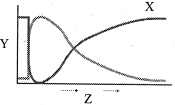
What do '$X$','$Y$',and '$Z$' represent in the given figure respectively?
A
$BOD$,concentration,and direction of flow
B
Concentration,$BOD$,and direction of flow
C
$DO$,concentration,and direction of flow
D
$DO$,amount of pollutant,and direction of flow
Solution
(C) The figure represents the effect of sewage discharge into a river.
$Y$-axis represents the concentration of dissolved oxygen $(DO)$ and biological oxygen demand $(BOD)$.
As sewage enters the river,the $BOD$ increases sharply and $DO$ decreases.
'$X$' represents the dissolved oxygen $(DO)$ curve,which decreases near the point of sewage discharge and recovers downstream.
'$Y$' represents the concentration of $DO$ and $BOD$.
'$Z$' represents the direction of water flow downstream from the point of sewage discharge.
Therefore,'$X$' is $DO$,'$Y$' is concentration,and '$Z$' is the direction of flow.
$Y$-axis represents the concentration of dissolved oxygen $(DO)$ and biological oxygen demand $(BOD)$.
As sewage enters the river,the $BOD$ increases sharply and $DO$ decreases.
'$X$' represents the dissolved oxygen $(DO)$ curve,which decreases near the point of sewage discharge and recovers downstream.
'$Y$' represents the concentration of $DO$ and $BOD$.
'$Z$' represents the direction of water flow downstream from the point of sewage discharge.
Therefore,'$X$' is $DO$,'$Y$' is concentration,and '$Z$' is the direction of flow.
0 likes
View Solution234
EasyMCQ
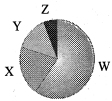
In the given pie chart,what do $W, X, Y$ and $Z$ represent respectively?
A
Carbon dioxide,Methane,$CFCs$ and $N_2O$
B
$CFCs, N_2O$,Methane and Carbon dioxide
C
Carbon dioxide,$CFCs$,Methane,$N_2O$
D
Methane,$N_2O, CFCs$ and Carbon dioxide
Solution
(A) The pie chart represents the relative contribution of various greenhouse gases to global warming.
According to $NCERT$,the relative contributions are:
$W$ (Carbon dioxide) = $60\%$
$X$ (Methane) = $20\%$
$Y$ (Chlorofluorocarbons or $CFCs$) = $14\%$
$Z$ (Nitrous oxide or $N_2O$) = $6\%$
Therefore,$W, X, Y$ and $Z$ represent Carbon dioxide,Methane,$CFCs$ and $N_2O$ respectively.
According to $NCERT$,the relative contributions are:
$W$ (Carbon dioxide) = $60\%$
$X$ (Methane) = $20\%$
$Y$ (Chlorofluorocarbons or $CFCs$) = $14\%$
$Z$ (Nitrous oxide or $N_2O$) = $6\%$
Therefore,$W, X, Y$ and $Z$ represent Carbon dioxide,Methane,$CFCs$ and $N_2O$ respectively.
0 likes
View Solution235
MediumMCQ
Which of the following is incorrect?
A
Mango and coconut are drupe fruits.
B
According to Euro norm $IV$,sulphur content for petrol is $50$ $ppm$.
C
$CO_2$ and other poisonous gases cause pollution.
D
Apple is a true fruit.
Solution
(D) False fruits are fruits that derive from the ovary and other accessory parts,such as the thalamus.
True fruits develop only from the ovary.
Apple is a false fruit because its main edible part is the fleshy receptacle,not the ovary wall.
Therefore,the statement 'Apple is a true fruit' is incorrect.
True fruits develop only from the ovary.
Apple is a false fruit because its main edible part is the fleshy receptacle,not the ovary wall.
Therefore,the statement 'Apple is a true fruit' is incorrect.
0 likes
View Solution236
MediumMCQ
The loss of forests,urbanization,and increasing pollution are primarily due to:
A
Population explosion
B
Global warming
C
Greenhouse effect
D
Ozone depletion
Solution
(A) The primary driver behind the loss of forests,rapid urbanization,and increasing pollution is the rapid increase in human population,known as population explosion.
$(i)$ As the population grows,the demand for land increases,leading to deforestation for agriculture,housing,and infrastructure.
$(ii)$ Urbanization is a direct consequence of the need to accommodate a larger number of people in concentrated areas.
$(iii)$ Increased human activity,industrialization,and consumption patterns associated with a larger population contribute significantly to environmental pollution.
While factors like better medical services have led to a decline in death rates,Maternal Mortality Rate $(MMR)$,and Infant Mortality Rate $(IMR)$,they have simultaneously contributed to the population explosion.
$(i)$ As the population grows,the demand for land increases,leading to deforestation for agriculture,housing,and infrastructure.
$(ii)$ Urbanization is a direct consequence of the need to accommodate a larger number of people in concentrated areas.
$(iii)$ Increased human activity,industrialization,and consumption patterns associated with a larger population contribute significantly to environmental pollution.
While factors like better medical services have led to a decline in death rates,Maternal Mortality Rate $(MMR)$,and Infant Mortality Rate $(IMR)$,they have simultaneously contributed to the population explosion.
0 likes
View Solution237
MediumMCQ
Which of the following statements is/are correct?
$I.$ Chemical fertilizers cause pollution of water bodies as well as groundwater,besides getting stored in crop plants. Therefore,environmental scientists are pressing for a switch over to organic farming.
$II.$ Organic farming is a form of agriculture that relies on techniques such as crop rotation,green manure,compost,and biological pest control.
$I.$ Chemical fertilizers cause pollution of water bodies as well as groundwater,besides getting stored in crop plants. Therefore,environmental scientists are pressing for a switch over to organic farming.
$II.$ Organic farming is a form of agriculture that relies on techniques such as crop rotation,green manure,compost,and biological pest control.
A
Only $I$
B
Only $II$
C
$I$ and $II$
D
None of these
Solution
(C) Statement $I$ is correct because excessive use of chemical fertilizers leads to eutrophication in water bodies and contamination of groundwater,while also accumulating as residues in crops.
Statement $II$ is correct because organic farming utilizes sustainable practices like crop rotation,green manure,composting,and biological pest control to maintain soil health and ecological balance.
Therefore,both statements are correct.
Statement $II$ is correct because organic farming utilizes sustainable practices like crop rotation,green manure,composting,and biological pest control to maintain soil health and ecological balance.
Therefore,both statements are correct.
0 likes
View Solution238
MediumMCQ
The Ganga Action Plan for controlling pollution in the Ganges was started in:
A
$1985$
B
$1981$
C
$1987$
D
$1989$
Solution
(A) The Ganga Action Plan was launched by the Ministry of Environment and Forests in $1985$ with the primary objective of reducing the pollution load in the river Ganges through the interception,diversion,and treatment of domestic sewage.
0 likes
View Solution239
MediumMCQ
All statements regarding $BOD$ (Biochemical Oxygen Demand) are correct,except:
A
It refers to the amount of oxygen that would be consumed if all the organic matter in one liter of water were oxidized by bacteria.
B
$BOD$ test is a measure of the organic matter present in the water.
C
The greater the $BOD$ of wastewater,the lower is its polluting potential.
D
Wastewater is treated until the $BOD$ is reduced significantly.
Solution
(C) $BOD$ (Biochemical Oxygen Demand) refers to the amount of oxygen that would be consumed if all the organic matter in one liter of water were oxidized by bacteria.
$A$ higher $BOD$ indicates that there is a greater amount of organic matter in the water,which leads to higher microbial activity.
Therefore,the greater the $BOD$ of wastewater,the higher is its polluting potential.
Thus,option $C$ is incorrect because it states that a higher $BOD$ means lower polluting potential.
$A$ higher $BOD$ indicates that there is a greater amount of organic matter in the water,which leads to higher microbial activity.
Therefore,the greater the $BOD$ of wastewater,the higher is its polluting potential.
Thus,option $C$ is incorrect because it states that a higher $BOD$ means lower polluting potential.
0 likes
View Solution240
MediumMCQ
The Ministry of Environment and Forest has initiated the Ganga Action Plan and Yamuna Action Plan:
$(i)$ To save these major rivers of our country from pollution.
$(ii)$ It is proposed to build a large number of sewage treatment plants.
$(iii)$ Under these plans,only treated sewage may be discharged into the rivers.
$(i)$ To save these major rivers of our country from pollution.
$(ii)$ It is proposed to build a large number of sewage treatment plants.
$(iii)$ Under these plans,only treated sewage may be discharged into the rivers.
A
$(i)$ and $(ii)$ are correct
B
$(ii)$ and $(iii)$ are correct
C
$(i)$ and $(iii)$ are correct
D
All are correct
Solution
(D) The Ministry of Environment and Forest initiated the Ganga Action Plan and Yamuna Action Plan to protect these major rivers from pollution.
Statement $(i)$ is correct as the primary objective is pollution control.
Statement $(ii)$ is correct because the plan involves constructing numerous sewage treatment plants to process waste before it reaches the rivers.
Statement $(iii)$ is correct because the core mandate of these plans is to ensure that only treated sewage is discharged into the rivers,thereby reducing the biochemical oxygen demand $(BOD)$ and preventing water contamination.
Therefore,all statements are correct.
Statement $(i)$ is correct as the primary objective is pollution control.
Statement $(ii)$ is correct because the plan involves constructing numerous sewage treatment plants to process waste before it reaches the rivers.
Statement $(iii)$ is correct because the core mandate of these plans is to ensure that only treated sewage is discharged into the rivers,thereby reducing the biochemical oxygen demand $(BOD)$ and preventing water contamination.
Therefore,all statements are correct.
0 likes
View Solution241
EasyMCQ
$5^{\text{th}}$ $June$ is celebrated as:
A
Water day
B
World Environment Day
C
Conservation day
D
World Earth Day
Solution
(B) $5^{\text{th}}$ $June$ is celebrated as World Environment Day.
$22^{\text{nd}}$ $April$ is celebrated as World Earth Day.
$22^{\text{nd}}$ $April$ is celebrated as World Earth Day.
0 likes
View Solution242
EasyMCQ
What human activities are responsible for the increase in the amount of $CO_2$ in the atmosphere?
A
Deforestation
B
Massive burning of fossil fuels
C
Use of vehicles for energy
D
All of the above
Solution
(D) Human activities such as deforestation and the massive burning of fossil fuels for energy and transport have significantly increased the rate of release of $CO_2$ into the atmosphere.
0 likes
View Solution243
MediumMCQ
In this soil conservation method,several grasses are left out in the soil after the crop is harvested.
A
Contour farming
B
Terrace farming
C
Tillage
D
Crop rotation
Solution
(C) Tillage is a method of soil conservation. In this method,the underground parts of several grasses are left in the soil after the crop is harvested. These parts remain underground,which improves soil fertility and prevents erosion. This method is also used for some plants such as maize,potato,etc.
0 likes
View Solution244
MediumMCQ
More than $70\; \%$ of the world's freshwater is contained in
A
Antarctica
B
Glaciers and mountains
C
Greenland
D
Polar ice
Solution
(D) The Earth's surface is covered by approximately $71\; \%$ water,with $97.5\; \%$ of this being saline marine water.
Only $2.5\; \%$ of the total water on Earth is freshwater.
Out of this $2.5\; \%$ freshwater,approximately $1.97\; \%$ is stored in the form of frozen polar ice caps and glaciers.
Therefore,more than $70\; \%$ (specifically about $78.8\; \%$) of the world's total freshwater is locked in polar ice caps and glaciers.
Only $2.5\; \%$ of the total water on Earth is freshwater.
Out of this $2.5\; \%$ freshwater,approximately $1.97\; \%$ is stored in the form of frozen polar ice caps and glaciers.
Therefore,more than $70\; \%$ (specifically about $78.8\; \%$) of the world's total freshwater is locked in polar ice caps and glaciers.
0 likes
View Solution245
MediumMCQ
The greatest problem of water conservation is to reduce the amount of
A
Precipitation
B
Run-off water
C
Groundwater
D
Evaporation
Solution
(B) Run-off water refers to the water that flows over the land surface after rainfall (precipitation) and eventually returns to large water bodies like seas or oceans.
Because this water is not captured or stored,a significant amount of potential fresh water is lost.
Therefore,the primary challenge in water conservation is to minimize run-off water by promoting infiltration and storage.
Because this water is not captured or stored,a significant amount of potential fresh water is lost.
Therefore,the primary challenge in water conservation is to minimize run-off water by promoting infiltration and storage.
0 likes
View Solution246
EasyMCQ
Soil erosion is prevented by
A
Deforestation
B
Afforestation
C
Reduction of $CFCs$ production
D
Use of $CNG$ in all transports
Solution
(B) Afforestation or reforestation,i.e.,growing of forest trees,is most effective in controlling soil erosion.
Tree roots bind the soil particles together,preventing them from being washed away by water or blown away by wind.
The Government of India has introduced the festival of '$Van Mahotsav$'.
In this festival,planting of trees is done on open waste land to increase green cover and prevent soil erosion.
Tree roots bind the soil particles together,preventing them from being washed away by water or blown away by wind.
The Government of India has introduced the festival of '$Van Mahotsav$'.
In this festival,planting of trees is done on open waste land to increase green cover and prevent soil erosion.
0 likes
View Solution247
EasyMCQ
Which of the following is an inexhaustible resource?
A
Fossil fuel
B
Solar energy
C
Coal
D
Petroleum
Solution
(B) Inexhaustible resources are available in unlimited quantities on Earth; thus,they cannot be exhausted by human consumption. Examples include solar energy,air,water,and soil.
Fossil fuels,coal,and petroleum are limited and exhaustible or non-renewable resources,which,once depleted,cannot be replenished or reused.
Fossil fuels,coal,and petroleum are limited and exhaustible or non-renewable resources,which,once depleted,cannot be replenished or reused.
0 likes
View Solution248
EasyMCQ
Which one is not a renewable energy source of natural resources?
A
Tidal energy
B
Wind energy
C
Fossil fuel
D
Solar energy
Solution
(C) Fossil fuels,such as coal,petroleum,and natural gas,are classified as non-renewable energy sources.
These resources are available in limited quantities and cannot be replenished or reproduced on a human timescale once consumed.
Since they take millions of years to form,they are considered exhaustible and will eventually run out in the near future.
In contrast,tidal energy,wind energy,and solar energy are renewable resources because they are naturally replenished.
These resources are available in limited quantities and cannot be replenished or reproduced on a human timescale once consumed.
Since they take millions of years to form,they are considered exhaustible and will eventually run out in the near future.
In contrast,tidal energy,wind energy,and solar energy are renewable resources because they are naturally replenished.
0 likes
View Solution249
EasyMCQ
Contour farming is usually employed in
A
Hilly areas
B
Sandy areas
C
Sea beaches
D
All of these
Solution
(A) Contour farming is a sustainable agricultural practice typically employed in hilly regions.
In this method,the land is ploughed along the natural contours of the land,i.e.,across the slope rather than down the slope.
This technique helps in reducing soil erosion by slowing down the flow of water and allowing it to infiltrate into the soil.
In this method,the land is ploughed along the natural contours of the land,i.e.,across the slope rather than down the slope.
This technique helps in reducing soil erosion by slowing down the flow of water and allowing it to infiltrate into the soil.
0 likes
View Solution250
MediumMCQ
The Wildlife Protection Act was introduced in:
A
$1972$
B
$1981$
C
$1986$
D
$1991$
Solution
(A) The Wildlife Protection Act was enacted by the Parliament of India in $1972$ to protect plants and animal species.
It provides for the protection of wild animals,birds,and plants.
This act was subsequently amended in $1991$ to provide more stringent measures for the protection of wildlife.
It provides for the protection of wild animals,birds,and plants.
This act was subsequently amended in $1991$ to provide more stringent measures for the protection of wildlife.
0 likes
View SolutionEnvironmental Issues — Mix Example-Environmental Issues · Frequently Asked Questions
1Are these Environmental Issues questions useful for JEE and NEET?
Yes. All questions in this section are mapped to JEE Main and NEET exam patterns. Previous year questions from JEE Main, NEET, GUJCET and state-level exams are included with full solutions.
2Can I switch to Hindi or Gujarati for these questions?
Yes. Use the language tabs in the hero section or the sidebar to view the same questions and solutions in English, Hindi or Gujarati.
3How do I generate a question paper from this subtopic?
Use the Vedclass Exam Paper Generator — select the chapter and subtopic, set difficulty, and generate Sets A, B, C, D automatically. First 3 chapters of every subject are free.
Vedclass Products
For Students
Vedclass Test Series
Mock tests in real JEE/NEET style with performance analysis. 5-day free trial.
Start Free TrialFor Teachers
Exam Paper Generator
Generate Set A/B/C/D papers from this chapter in 2 minutes. 3 chapters free.
Try FreeFor Institutes
Online Exam Module
Live online exams with unlimited students, 360° analytics & white-label branding.
See DemoFor Teachers & Institutes
Generate a Environmental Issues Exam Paper in 2 Minutes
Select subtopic & difficulty — Sets A, B, C, D auto-generated with No Repeat logic.
First 3 chapters of every subject are free — no payment required.