
A English
Mix Example-Environmental Issues Questions in English
Class 12 Biology · Environmental Issues · Mix Example-Environmental Issues
374+
Questions
English
Language
100%
With Solutions
Showing 47 of 374 questions in English
151
MediumMCQ
Which of the following is an incorrect pair?
A
Combustion of fossil fuels - Release of $CO_2$
B
Nuclear energy - Radioactive waste
C
Solar energy - Greenhouse effect
D
Biomass fuel - Release of $CO_2$
Solution
(C) The correct answer is $C$.
Solar energy is a clean and renewable source of energy that does not contribute to the greenhouse effect.
In contrast,the combustion of fossil fuels and biomass releases $CO_2$,which is a greenhouse gas.
Nuclear energy is associated with the production of hazardous radioactive waste.
Therefore,the pairing of solar energy with the greenhouse effect is incorrect.
Solar energy is a clean and renewable source of energy that does not contribute to the greenhouse effect.
In contrast,the combustion of fossil fuels and biomass releases $CO_2$,which is a greenhouse gas.
Nuclear energy is associated with the production of hazardous radioactive waste.
Therefore,the pairing of solar energy with the greenhouse effect is incorrect.
0 likes
View Solution152
MediumMCQ
Which of the following is $NOT$ present in photochemical smog?
A
Nitrogen oxides
B
Carbon dioxide
C
$PAN$ (Peroxyacetyl nitrate)
D
Ozone
Solution
(B) Photochemical smog is formed by the action of sunlight on nitrogen oxides and hydrocarbons. The primary components of photochemical smog include nitrogen oxides $(NO_x)$,ozone $(O_3)$,and peroxyacetyl nitrate $(PAN)$. Carbon dioxide $(CO_2)$ is a greenhouse gas but is not a component of photochemical smog.
0 likes
View Solution153
MediumMCQ
Arrange the following in increasing order of their $BOD$ values: Sewage $(S)$,Distillery Effluent $(DE)$,Paper Mill Effluent $(PE)$,and Sugar Mill Effluent $(SE)$.
A
$SE < PE < S < DE$
B
$PE < S < SE < DE$
C
$S < DE < PE < SE$
D
$SE < S < PE < DE$
Solution
(D) The $BOD$ (Biochemical Oxygen Demand) is a measure of the organic matter present in water. Higher organic content leads to higher microbial activity and thus higher $BOD$.
$1$. Sewage $(S)$ typically has a moderate $BOD$ compared to industrial effluents.
$2$. Sugar Mill Effluent $(SE)$ is rich in sugars,but often has lower $BOD$ than paper or distillery waste.
$3$. Paper Mill Effluent $(PE)$ contains high amounts of cellulose and organic additives.
$4$. Distillery Effluent $(DE)$ is known for having an extremely high $BOD$ due to the presence of molasses and other organic residues from fermentation.
Based on standard environmental data,the increasing order of $BOD$ is $SE < S < PE < DE$.
$1$. Sewage $(S)$ typically has a moderate $BOD$ compared to industrial effluents.
$2$. Sugar Mill Effluent $(SE)$ is rich in sugars,but often has lower $BOD$ than paper or distillery waste.
$3$. Paper Mill Effluent $(PE)$ contains high amounts of cellulose and organic additives.
$4$. Distillery Effluent $(DE)$ is known for having an extremely high $BOD$ due to the presence of molasses and other organic residues from fermentation.
Based on standard environmental data,the increasing order of $BOD$ is $SE < S < PE < DE$.
0 likes
View Solution154
MediumMCQ
In a pond near a village,a large number of fish suddenly die. Which of the following could be the reason for this?
$(a)$ Large amounts of urea and phosphate are used as fertilizers in nearby fields.
$(b)$ $DDT$ was sprayed in the entire area.
$(c)$ The pond water has become green and dirty.
$(d)$ The population of phytoplankton in the pond has decreased,reducing the photosynthetic capacity.
Which two of the above reasons are responsible?
$(a)$ Large amounts of urea and phosphate are used as fertilizers in nearby fields.
$(b)$ $DDT$ was sprayed in the entire area.
$(c)$ The pond water has become green and dirty.
$(d)$ The population of phytoplankton in the pond has decreased,reducing the photosynthetic capacity.
Which two of the above reasons are responsible?
A
$b$ and $c$
B
$c$ and $d$
C
$a$ and $c$
D
$a$ and $b$
Solution
(C) The death of fish in a pond is often caused by eutrophication.
$1$. When large amounts of fertilizers like urea and phosphate $(a)$ leach into the pond from nearby fields,they promote excessive growth of algae and aquatic plants.
$2$. This leads to the pond water becoming green and dirty $(c)$,a phenomenon known as algal bloom.
$3$. As these algae die and decompose,the decomposers consume a large amount of dissolved oxygen,leading to hypoxia (low oxygen levels),which causes the fish to die.
Therefore,the combination of fertilizer runoff and the resulting algal bloom is the primary cause.
$1$. When large amounts of fertilizers like urea and phosphate $(a)$ leach into the pond from nearby fields,they promote excessive growth of algae and aquatic plants.
$2$. This leads to the pond water becoming green and dirty $(c)$,a phenomenon known as algal bloom.
$3$. As these algae die and decompose,the decomposers consume a large amount of dissolved oxygen,leading to hypoxia (low oxygen levels),which causes the fish to die.
Therefore,the combination of fertilizer runoff and the resulting algal bloom is the primary cause.
0 likes
View Solution155
EasyMCQ
The Chipko movement was started for the conservation of which of the following?
A
Forests
B
Livestock
C
Wetlands
D
Grasslands
Solution
(A) The Chipko movement was a non-violent social and ecological movement by rural villagers,particularly women,in India.
It began in the early $1970$s in the Garhwal Himalayas region of Uttarakhand.
The primary objective of this movement was to protect forests from commercial deforestation by hugging the trees to prevent them from being cut down.
Therefore,the correct option is $A$.
It began in the early $1970$s in the Garhwal Himalayas region of Uttarakhand.
The primary objective of this movement was to protect forests from commercial deforestation by hugging the trees to prevent them from being cut down.
Therefore,the correct option is $A$.
0 likes
View Solution156
EasyMCQ
Which of the following is $NOT$ true regarding the Bhopal Gas Tragedy?
A
$A$ gas named Methyl Isocyanate $(MIC)$ leaked.
B
Thousands of humans died.
C
Radiation engulfed Bhopal.
D
It occurred on the midnight of $2-3$ December,$1984$.
Solution
(C) The Bhopal Gas Tragedy was a major industrial disaster that occurred on the night of $2-3$ December,$1984$.
It was caused by the leakage of a highly toxic gas called Methyl Isocyanate $(MIC)$ from the Union Carbide pesticide plant.
This disaster resulted in the death of thousands of people and caused long-term health issues for many others.
Option $C$ is incorrect because the tragedy was caused by a chemical gas leak,not by radiation. Radiation disasters are associated with nuclear accidents,such as the Chernobyl disaster.
It was caused by the leakage of a highly toxic gas called Methyl Isocyanate $(MIC)$ from the Union Carbide pesticide plant.
This disaster resulted in the death of thousands of people and caused long-term health issues for many others.
Option $C$ is incorrect because the tragedy was caused by a chemical gas leak,not by radiation. Radiation disasters are associated with nuclear accidents,such as the Chernobyl disaster.
0 likes
View Solution157
MediumMCQ
Which of the following statements is incorrect?
A
$A$ large area of forest has been lost in the tropical region.
B
The ozone in the upper part of the atmosphere is harmful to animals.
C
The greenhouse effect is a natural phenomenon.
D
Eutrophication is a natural phenomenon of freshwater bodies.
Solution
(B) The correct answer is $B$.
$1$. The ozone found in the stratosphere (upper atmosphere) is known as 'good' ozone because it absorbs harmful ultraviolet $(UV)$ radiation from the sun,protecting living organisms.
$2$. The ozone found in the troposphere (lower atmosphere) is considered 'bad' or harmful to animals and plants.
$3$. Therefore,the statement that ozone in the upper atmosphere is harmful is incorrect.
$4$. Tropical forests are indeed being lost at a rapid rate.
$5$. The greenhouse effect is a naturally occurring phenomenon that is responsible for heating the Earth's surface and atmosphere.
$6$. Eutrophication is the natural aging of a lake by nutrient enrichment of its water.
$1$. The ozone found in the stratosphere (upper atmosphere) is known as 'good' ozone because it absorbs harmful ultraviolet $(UV)$ radiation from the sun,protecting living organisms.
$2$. The ozone found in the troposphere (lower atmosphere) is considered 'bad' or harmful to animals and plants.
$3$. Therefore,the statement that ozone in the upper atmosphere is harmful is incorrect.
$4$. Tropical forests are indeed being lost at a rapid rate.
$5$. The greenhouse effect is a naturally occurring phenomenon that is responsible for heating the Earth's surface and atmosphere.
$6$. Eutrophication is the natural aging of a lake by nutrient enrichment of its water.
0 likes
View Solution158
EasyMCQ
Where was the Kyoto Protocol adopted?
A
$CoP-4$
B
$CoP-3$
C
$CoP-5$
D
$CoP-6$
Solution
(B) The Kyoto Protocol was adopted in Kyoto,Japan,on $11$ December $1997$ during the third session of the Conference of the Parties $(CoP-3)$ to the United Nations Framework Convention on Climate Change $(UNFCCC)$.
It entered into force on $16$ February $2005$.
It entered into force on $16$ February $2005$.
0 likes
View Solution159
MediumMCQ
How can global warming be controlled?
A
Increasing deforestation,decreasing efficiency of energy usage.
B
Reducing deforestation,reducing the use of fossil fuels.
C
Reducing reforestation,increasing the use of fossil fuels.
D
Increasing deforestation,reducing human population.
Solution
(B) Global warming is primarily caused by the increase in greenhouse gases like $CO_2$ in the atmosphere,which trap heat.
To control global warming,we must reduce the emission of these gases.
$1$. Reducing deforestation helps maintain carbon sinks,as trees absorb $CO_2$.
$2$. Reducing the use of fossil fuels (like coal,oil,and natural gas) directly lowers the amount of $CO_2$ released into the atmosphere.
Therefore,the correct approach is to reduce deforestation and decrease the consumption of fossil fuels.
To control global warming,we must reduce the emission of these gases.
$1$. Reducing deforestation helps maintain carbon sinks,as trees absorb $CO_2$.
$2$. Reducing the use of fossil fuels (like coal,oil,and natural gas) directly lowers the amount of $CO_2$ released into the atmosphere.
Therefore,the correct approach is to reduce deforestation and decrease the consumption of fossil fuels.
0 likes
View Solution160
EasyMCQ
Where was the $UN$ Climate Change Conference held in $2012$?
A
Warsaw
B
Durban
C
Doha
D
Lima
Solution
(C) The $UN$ Climate Change Conference held in $2012$ is known as the $18$th Conference of the Parties $(COP18)$ to the $UN$ Framework Convention on Climate Change $(UNFCCC)$.
This conference took place in Doha,Qatar,from November $26$ to December $8$,$2012$.
This conference took place in Doha,Qatar,from November $26$ to December $8$,$2012$.
0 likes
View Solution161
MediumMCQ
Match the items given in Column $I$ with those in Column $II$ and select the correct option given below:
| Column $I$ | Column $II$ |
| $(a)$ Eutrophication | $(i)$ $UV-B$ radiation |
| $(b)$ Sanitary landfill | $(ii)$ Deforestation |
| $(c)$ Snow blindness | $(iii)$ Nutrient enrichment |
| $(d)$ Jhum cultivation | $(iv)$ Waste disposal |
A
$a-iii, b-iv, c-i, d-ii$
B
$a-ii, b-i, c-iii, d-iv$
C
$a-i, b-ii, c-iv, d-iii$
D
$a-i, b-iii, c-iv, d-ii$
Solution
(A) The correct matches are as follows:
$(a)$ Eutrophication refers to the natural or artificial enrichment of water bodies with nutrients (like nitrogen and phosphorus),which leads to excessive growth of algae. Thus,$(a)-(iii)$.
$(b)$ Sanitary landfills are a method of solid waste disposal where waste is buried in a prepared area. Thus,$(b)-(iv)$.
$(c)$ Snow blindness is caused by the inflammation of the cornea due to high doses of $UV-B$ radiation,which is reflected by snow. Thus,$(c)-(i)$.
$(d)$ Jhum cultivation,also known as slash-and-burn agriculture,is a major cause of deforestation in many regions. Thus,$(d)-(ii)$.
Therefore,the correct sequence is $a-iii, b-iv, c-i, d-ii$.
$(a)$ Eutrophication refers to the natural or artificial enrichment of water bodies with nutrients (like nitrogen and phosphorus),which leads to excessive growth of algae. Thus,$(a)-(iii)$.
$(b)$ Sanitary landfills are a method of solid waste disposal where waste is buried in a prepared area. Thus,$(b)-(iv)$.
$(c)$ Snow blindness is caused by the inflammation of the cornea due to high doses of $UV-B$ radiation,which is reflected by snow. Thus,$(c)-(i)$.
$(d)$ Jhum cultivation,also known as slash-and-burn agriculture,is a major cause of deforestation in many regions. Thus,$(d)-(ii)$.
Therefore,the correct sequence is $a-iii, b-iv, c-i, d-ii$.
0 likes
View Solution162
MediumMCQ
Which one of the following statements pertaining to pollutants is correct?
A
$DDT$ is a non-biodegradable pollutant.
B
Excess fluoride in drinking water causes fluorosis, hardening of bones, and stiff joints.
C
Excess cadmium in drinking water causes Itai-Itai disease.
D
Methylmercury in water may cause Minamata disease.
Solution
(A) Option $A$ is correct because $DDT$ (Dichlorodiphenyltrichloroethane) is a persistent organic pollutant that is non-biodegradable and accumulates in the food chain.
Excess fluoride in drinking water causes fluorosis, which leads to the hardening of bones and stiffness of joints, not osteoporosis.
Black foot disease is caused by chronic exposure to arsenic in drinking water.
"Itai-Itai" disease is caused by cadmium poisoning, not methylmercury.
Excess fluoride in drinking water causes fluorosis, which leads to the hardening of bones and stiffness of joints, not osteoporosis.
Black foot disease is caused by chronic exposure to arsenic in drinking water.
"Itai-Itai" disease is caused by cadmium poisoning, not methylmercury.
0 likes
View Solution163
MediumMCQ
Which one of the following pairs is mismatched?
A
Fossil fuel burning - release of $CO_2$
B
Nuclear power - radioactive wastes
C
Solar energy - green house effect
D
Biomass burning - release of $CO_2$
Solution
(C) Solar energy reaching the Earth is not responsible for the greenhouse effect.
It is the increase in greenhouse gases in the atmosphere,such as $CO_2$,which is released by the complete combustion of fossil fuels or biomass in industries or transportation vehicles,that prevents the reradiation of infrared radiation from the Earth and results in an increase in the Earth's temperature.
It is the increase in greenhouse gases in the atmosphere,such as $CO_2$,which is released by the complete combustion of fossil fuels or biomass in industries or transportation vehicles,that prevents the reradiation of infrared radiation from the Earth and results in an increase in the Earth's temperature.
0 likes
View Solution164
MediumMCQ
$A$ lake near a village suffered heavy mortality of fishes within a few days. Consider the following reasons for this:
$1.$ Lots of urea and phosphate fertilizer were used in the crops in the vicinity.
$2.$ The area was sprayed with $DDT$ by an aircraft.
$3.$ The lake water turned green and stinky.
$4.$ Phytoplankton populations in the lake declined initially,thereby greatly reducing photosynthesis.
Which two of the above were the main causes of fish mortality in the lake?
$1.$ Lots of urea and phosphate fertilizer were used in the crops in the vicinity.
$2.$ The area was sprayed with $DDT$ by an aircraft.
$3.$ The lake water turned green and stinky.
$4.$ Phytoplankton populations in the lake declined initially,thereby greatly reducing photosynthesis.
Which two of the above were the main causes of fish mortality in the lake?
A
$2$ and $3$
B
$3$ and $4$
C
$1$ and $3$
D
$1$ and $2$
Solution
(C) The excessive use of urea and phosphate fertilizers in nearby crops leads to nutrient enrichment in the lake,a process known as eutrophication.
This causes an algal bloom,which makes the lake water turn green and stinky.
The decomposition of these algae by microorganisms consumes dissolved oxygen,leading to a severe depletion of oxygen levels in the water.
This lack of oxygen (hypoxia) is the primary cause of the heavy mortality of fishes in the lake.
Therefore,the main causes are $1$ and $3$.
This causes an algal bloom,which makes the lake water turn green and stinky.
The decomposition of these algae by microorganisms consumes dissolved oxygen,leading to a severe depletion of oxygen levels in the water.
This lack of oxygen (hypoxia) is the primary cause of the heavy mortality of fishes in the lake.
Therefore,the main causes are $1$ and $3$.
0 likes
View Solution165
MediumMCQ
Assertion: Presently,the global atmosphere is warming up.
Reason: The depletion of the stratospheric ozone layer has resulted in an increase in ultraviolet radiations reaching the earth.
Reason: The depletion of the stratospheric ozone layer has resulted in an increase in ultraviolet radiations reaching the earth.
A
If both Assertion and Reason are correct and the Reason is a correct explanation of the Assertion.
B
If both Assertion and Reason are correct but Reason is not a correct explanation of the Assertion.
C
If the Assertion is correct but Reason is incorrect.
D
If both the Assertion and Reason are incorrect.
Solution
(B) The Assertion is correct because global warming is a well-documented phenomenon caused by the increase in the concentration of greenhouse gases like $CO_2$,$CH_4$,and $CFCs$ in the atmosphere.
These greenhouse gases trap heat by preventing the escape of long-wave infrared radiations into space,leading to a rise in global temperatures.
The Reason is also a scientifically correct statement regarding the depletion of the ozone layer,which allows more $UV$ radiation to reach the earth's surface.
However,the depletion of the ozone layer is not the cause of global warming; therefore,the Reason is not the correct explanation for the Assertion.
These greenhouse gases trap heat by preventing the escape of long-wave infrared radiations into space,leading to a rise in global temperatures.
The Reason is also a scientifically correct statement regarding the depletion of the ozone layer,which allows more $UV$ radiation to reach the earth's surface.
However,the depletion of the ozone layer is not the cause of global warming; therefore,the Reason is not the correct explanation for the Assertion.
0 likes
View Solution166
MediumMCQ
Assertion: Deforestation is one main factor contributing to global warming.
Reason: Besides $CO_2$,two other gases,methane $(CH_4)$ and $CFCs$,are also included under greenhouse gases.
Reason: Besides $CO_2$,two other gases,methane $(CH_4)$ and $CFCs$,are also included under greenhouse gases.
A
If both Assertion and Reason are correct and the Reason is a correct explanation of the Assertion.
B
If both Assertion and Reason are correct but Reason is not a correct explanation of the Assertion.
C
If the Assertion is correct but Reason is incorrect.
D
If both the Assertion and Reason are incorrect.
Solution
(B) Deforestation leads to a reduction in the number of trees that absorb $CO_2$ through photosynthesis,thereby increasing the concentration of $CO_2$ in the atmosphere,which contributes to global warming.
Greenhouse gases are gases that trap heat in the atmosphere,leading to the greenhouse effect and global warming.
$CO_2$,methane $(CH_4)$,$CFCs$,and nitrous oxide $(N_2O)$ are the primary greenhouse gases.
While both statements are scientifically true,the Reason does not directly explain why deforestation causes global warming; it merely lists other greenhouse gases. Therefore,the Reason is not the correct explanation for the Assertion.
Greenhouse gases are gases that trap heat in the atmosphere,leading to the greenhouse effect and global warming.
$CO_2$,methane $(CH_4)$,$CFCs$,and nitrous oxide $(N_2O)$ are the primary greenhouse gases.
While both statements are scientifically true,the Reason does not directly explain why deforestation causes global warming; it merely lists other greenhouse gases. Therefore,the Reason is not the correct explanation for the Assertion.
0 likes
View Solution167
MediumMCQ
Assertion : The concentration of methane in the atmosphere has more than doubled in the last $250$ years.
Reason : Wetlands and rice fields are the major sources of methane.
Reason : Wetlands and rice fields are the major sources of methane.
A
If both Assertion and Reason are correct and the Reason is a correct explanation of the Assertion.
B
If both Assertion and Reason are correct but Reason is not a correct explanation of the Assertion.
C
If the Assertion is correct but Reason is incorrect.
D
If both the Assertion and Reason are incorrect.
Solution
(A) The concentration of methane in the atmosphere has significantly increased due to human activities,more than doubling over the last $250$ years.
Wetlands,rice fields,and livestock are indeed the primary natural and anthropogenic sources of methane.
Since the increase in methane concentration is directly linked to the expansion of these sources (like rice cultivation and livestock farming),the Reason correctly explains the Assertion.
Wetlands,rice fields,and livestock are indeed the primary natural and anthropogenic sources of methane.
Since the increase in methane concentration is directly linked to the expansion of these sources (like rice cultivation and livestock farming),the Reason correctly explains the Assertion.
0 likes
View Solution168
MediumMCQ
Assertion : Methane,a component of greenhouse gases,contributes about $20$ percent to global warming.
Reason : The introduction of multi-point fuel injection engines in automobiles has decreased methane content in the exhausts.
Reason : The introduction of multi-point fuel injection engines in automobiles has decreased methane content in the exhausts.
A
If both Assertion and Reason are correct and the Reason is a correct explanation of the Assertion.
B
If both Assertion and Reason are correct but Reason is not a correct explanation of the Assertion.
C
If the Assertion is correct but Reason is incorrect.
D
If both the Assertion and Reason are incorrect.
Solution
(A) Methane is produced by incomplete biomass combustion and anaerobic decomposition by methanogens.
Carbon dioxide contributes about $60\%$ to total global warming,while methane $(CH_4)$ and chlorofluorocarbons $(CFCs)$ contribute $20\%$ and $14\%$ respectively.
Nitrous oxide $(N_2O)$ contributes $6\%$ to total global warming.
Efficient engines,such as multi-point fuel injection engines,improve combustion efficiency,thereby reducing the emission of unburnt hydrocarbons like methane in automobile exhausts.
Therefore,both the Assertion and the Reason are correct,and the Reason explains why methane emissions from vehicles are controlled.
Carbon dioxide contributes about $60\%$ to total global warming,while methane $(CH_4)$ and chlorofluorocarbons $(CFCs)$ contribute $20\%$ and $14\%$ respectively.
Nitrous oxide $(N_2O)$ contributes $6\%$ to total global warming.
Efficient engines,such as multi-point fuel injection engines,improve combustion efficiency,thereby reducing the emission of unburnt hydrocarbons like methane in automobile exhausts.
Therefore,both the Assertion and the Reason are correct,and the Reason explains why methane emissions from vehicles are controlled.
0 likes
View Solution169
MediumMCQ
Assertion: Eutrophication shows an increase in productivity in water.
Reason: With increasing eutrophication,the diversity of the phytoplankton increases.
Reason: With increasing eutrophication,the diversity of the phytoplankton increases.
A
If both Assertion and Reason are correct and the Reason is a correct explanation of the Assertion.
B
If both Assertion and Reason are correct but Reason is not a correct explanation of the Assertion.
C
If the Assertion is correct but Reason is incorrect.
D
If both the Assertion and Reason are incorrect.
Solution
(C) Eutrophication is a natural process that literally means 'well-nourished' or 'enriched'.
It is a natural state in many lakes and ponds that have a rich supply of nutrients.
Eutrophication becomes excessive when abnormally high amounts of nutrients from sewage,fertilizers,animal waste,and detergents enter streams and lakes,causing excessive growth or blooms of microorganisms.
With increasing eutrophication,the diversity of the phytoplankton community of a lake decreases,not increases,because the lake eventually becomes dominated by a few species of blue-green algae,leading to a loss of overall biodiversity.
It is a natural state in many lakes and ponds that have a rich supply of nutrients.
Eutrophication becomes excessive when abnormally high amounts of nutrients from sewage,fertilizers,animal waste,and detergents enter streams and lakes,causing excessive growth or blooms of microorganisms.
With increasing eutrophication,the diversity of the phytoplankton community of a lake decreases,not increases,because the lake eventually becomes dominated by a few species of blue-green algae,leading to a loss of overall biodiversity.
0 likes
View Solution170
MediumMCQ
If an agricultural field is liberally irrigated for a prolonged period of time,it is likely to face the problem of:
A
Metal toxicity
B
Alkalinity
C
Acidity
D
Salinity
Solution
(D) When an agricultural field is irrigated excessively for a prolonged period,the water table rises.
As the water evaporates from the surface,it leaves behind dissolved salts.
Over time,these salts accumulate in the topsoil,leading to a condition known as soil salinity.
This process is often exacerbated by poor drainage,making the land unsuitable for crop cultivation.
As the water evaporates from the surface,it leaves behind dissolved salts.
Over time,these salts accumulate in the topsoil,leading to a condition known as soil salinity.
This process is often exacerbated by poor drainage,making the land unsuitable for crop cultivation.
0 likes
View Solution171
Medium
What measures, as an individual, would you take to reduce environmental pollution?
Solution
(N/A) The following initiatives can be taken to prevent environmental pollution:
Measures for preventing Air pollution:
- Planting more trees.
- Use of clean and renewable energy sources such as $CNG$ and bio-fuels.
- Reducing the use of fossil fuels.
- Use of catalytic converters in automobiles.
Measures for preventing water pollution:
- Optimizing the use of water.
- Using kitchen wastewater in gardening and other household purposes.
Measures for controlling Noise pollution:
- Avoid burning crackers on Diwali.
- Plantation of more trees (as they act as sound absorbers).
Measures for decreasing solid waste generation:
- Segregation of waste.
- Recycling and reuse of plastic and paper.
- Composting of biodegradable kitchen waste.
- Reducing the use of plastics.
Measures for preventing Air pollution:
- Planting more trees.
- Use of clean and renewable energy sources such as $CNG$ and bio-fuels.
- Reducing the use of fossil fuels.
- Use of catalytic converters in automobiles.
Measures for preventing water pollution:
- Optimizing the use of water.
- Using kitchen wastewater in gardening and other household purposes.
Measures for controlling Noise pollution:
- Avoid burning crackers on Diwali.
- Plantation of more trees (as they act as sound absorbers).
Measures for decreasing solid waste generation:
- Segregation of waste.
- Recycling and reuse of plastic and paper.
- Composting of biodegradable kitchen waste.
- Reducing the use of plastics.
0 likes
View Solution172
Medium
List all the wastes that you generate at home,school,or during your trips to other places. Which could you very easily reduce? Which would be difficult or rather impossible to reduce?
Solution
(N/A) Wastes generated at home include plastic bags,paper napkins,toiletries,kitchen wastes (such as peelings of vegetables and fruits,tea leaves),domestic sewage,glass,etc.
Wastes generated at schools include waste paper,plastics,vegetable and fruit peels,food wrappings,sewage,etc.
Wastes generated during trips or picnics include plastic,paper,vegetable and fruit peels,disposable cups,plates,spoons,etc.
Yes,wastes can be easily reduced by the judicious use of the above materials. Wastage of paper can be minimized by writing on both sides of the paper and by using recycled paper. Plastic and glass waste can also be reduced by recycling and reusing. Also,substituting plastic bags with biodegradable jute bags can reduce wastes generated at home,school,or during trips. Domestic sewage can be reduced by optimizing the use of water while bathing,cooking,and other household activities.
Non-biodegradable wastes such as plastic,metal,and broken glass are difficult to decompose because micro-organisms do not have the ability to decompose them.
Wastes generated at schools include waste paper,plastics,vegetable and fruit peels,food wrappings,sewage,etc.
Wastes generated during trips or picnics include plastic,paper,vegetable and fruit peels,disposable cups,plates,spoons,etc.
Yes,wastes can be easily reduced by the judicious use of the above materials. Wastage of paper can be minimized by writing on both sides of the paper and by using recycled paper. Plastic and glass waste can also be reduced by recycling and reusing. Also,substituting plastic bags with biodegradable jute bags can reduce wastes generated at home,school,or during trips. Domestic sewage can be reduced by optimizing the use of water while bathing,cooking,and other household activities.
Non-biodegradable wastes such as plastic,metal,and broken glass are difficult to decompose because micro-organisms do not have the ability to decompose them.
0 likes
View Solution173
MediumMCQ
Match the items given in column $A$ and $B$:
| Column $A$ | Column $B$ |
| $(a)$ Catalytic converter | $(i)$ Particulate matter |
| $(b)$ Electrostatic precipitator | $(ii)$ Carbon monoxide and nitrogen oxides |
| $(c)$ Earmuffs | $(iii)$ High noise level |
| $(d)$ Landfills | $(iv)$ Solid wastes |
A
$(a)-(ii), (b)-(i), (c)-(iii), (d)-(iv)$
B
$(a)-(i), (b)-(ii), (c)-(iii), (d)-(iv)$
C
$(a)-(ii), (b)-(i), (c)-(iv), (d)-(iii)$
D
$(a)-(i), (b)-(ii), (c)-(iv), (d)-(iii)$
Solution
(A) The correct matches are as follows:
$1$. $(a)$ Catalytic converter: These are used in automobiles to reduce the emission of poisonous gases like $(ii)$ Carbon monoxide and nitrogen oxides.
$2$. $(b)$ Electrostatic precipitator: This device is used to remove $(i)$ Particulate matter from industrial exhaust.
$3$. $(c)$ Earmuffs: These are used to protect ears from $(iii)$ High noise level (noise pollution).
$4$. $(d)$ Landfills: These are areas used for the disposal of $(iv)$ Solid wastes.
Therefore, the correct matching is $(a)-(ii), (b)-(i), (c)-(iii), (d)-(iv)$.
$1$. $(a)$ Catalytic converter: These are used in automobiles to reduce the emission of poisonous gases like $(ii)$ Carbon monoxide and nitrogen oxides.
$2$. $(b)$ Electrostatic precipitator: This device is used to remove $(i)$ Particulate matter from industrial exhaust.
$3$. $(c)$ Earmuffs: These are used to protect ears from $(iii)$ High noise level (noise pollution).
$4$. $(d)$ Landfills: These are areas used for the disposal of $(iv)$ Solid wastes.
Therefore, the correct matching is $(a)-(ii), (b)-(i), (c)-(iii), (d)-(iv)$.
0 likes
View Solution174
Medium
Write critical notes on the following:
$(a)$ Eutrophication
$(b)$ Biological magnification
$(c)$ Groundwater depletion and ways for its replenishment
$(a)$ Eutrophication
$(b)$ Biological magnification
$(c)$ Groundwater depletion and ways for its replenishment
Solution
(A) Eutrophication: It is the natural ageing process of a lake caused due to nutrient enrichment. It is accelerated by the runoff of nutrients such as animal wastes,fertilizers,and sewage from land,which leads to an increased fertility of the lake. As a result,it causes a tremendous increase in the primary productivity of the ecosystem. This leads to an increased growth of algae,resulting in algal blooms. Later,the decomposition of these algae depletes the supply of oxygen,leading to the death of other aquatic animal life.
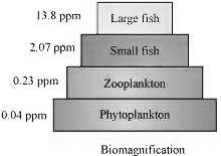
$(b)$ Biological magnification: To protect crops from various diseases and pests,a large number of pesticides are used. These pesticides reach the soil and are absorbed by plants along with water and minerals. Due to rain,these chemicals can also enter water sources and the bodies of aquatic plants and animals. As a result,chemicals enter the food chain. Since these chemicals cannot be decomposed,they keep on accumulating at each trophic level. The maximum concentration is accumulated at the top carnivore's level. This increase in the concentration of pollutants or harmful chemicals with an increase in the trophic level is called biological magnification. For example,as shown in the figure,$DDT$ concentrations increase from $0.04\,ppm$ in phytoplankton to $13.8\,ppm$ in large fish.
$(c)$ Groundwater depletion and ways for its replenishment: The level of groundwater has decreased in recent years. The source of water supply is rapidly diminishing each year because of an increase in population and water pollution. To meet the demand for water,water is withdrawn from water bodies such as ponds,rivers,etc. As a result,the source of groundwater is depleting. This is because the amount of groundwater being drawn for human use is more than the amount replaced by rainfall. Lack of vegetation cover also results in very small amounts of water seeping through the ground. An increase in water pollution is another factor that has reduced the availability of groundwater.
Measures for replenishing groundwater:
$1.$ Preventing over-extraction of groundwater.
$2.$ Optimizing water use and reducing water demand.
$3.$ Rainwater harvesting.
$4.$ Preventing deforestation and planting more trees.
$(b)$ Biological magnification: To protect crops from various diseases and pests,a large number of pesticides are used. These pesticides reach the soil and are absorbed by plants along with water and minerals. Due to rain,these chemicals can also enter water sources and the bodies of aquatic plants and animals. As a result,chemicals enter the food chain. Since these chemicals cannot be decomposed,they keep on accumulating at each trophic level. The maximum concentration is accumulated at the top carnivore's level. This increase in the concentration of pollutants or harmful chemicals with an increase in the trophic level is called biological magnification. For example,as shown in the figure,$DDT$ concentrations increase from $0.04\,ppm$ in phytoplankton to $13.8\,ppm$ in large fish.
$(c)$ Groundwater depletion and ways for its replenishment: The level of groundwater has decreased in recent years. The source of water supply is rapidly diminishing each year because of an increase in population and water pollution. To meet the demand for water,water is withdrawn from water bodies such as ponds,rivers,etc. As a result,the source of groundwater is depleting. This is because the amount of groundwater being drawn for human use is more than the amount replaced by rainfall. Lack of vegetation cover also results in very small amounts of water seeping through the ground. An increase in water pollution is another factor that has reduced the availability of groundwater.
Measures for replenishing groundwater:
$1.$ Preventing over-extraction of groundwater.
$2.$ Optimizing water use and reducing water demand.
$3.$ Rainwater harvesting.
$4.$ Preventing deforestation and planting more trees.
1 likes
View Solution175
Medium
Discuss the role of women and communities in the protection and conservation of forests.
Solution
(N/A) Women and communities have played a major role in environmental conservation movements.
Case study of the Bishnoi community: The Bishnoi community in Rajasthan strictly believes in the concept of living peacefully with nature. In $1731$,the King of Jodhpur ordered his ministers to arrange wood for the construction of his new palace. For this purpose,the minister and the workers went to a Bishnoi village. There,a Bishnoi woman called Amrita Devi,along with her daughter and hundreds of other Bishnois,showed the courage to step forward and stop them from cutting trees. They embraced the trees and lost their lives at the hands of the king's soldiers. This resistance by the people of the village forced the king to give up the idea of cutting trees.
Chipko movement: The Chipko movement was started in $1974$ in the Garhwal region of the Himalayas. In this movement,the women from the village stopped the contractors from cutting forest trees by embracing them.
Case study of the Bishnoi community: The Bishnoi community in Rajasthan strictly believes in the concept of living peacefully with nature. In $1731$,the King of Jodhpur ordered his ministers to arrange wood for the construction of his new palace. For this purpose,the minister and the workers went to a Bishnoi village. There,a Bishnoi woman called Amrita Devi,along with her daughter and hundreds of other Bishnois,showed the courage to step forward and stop them from cutting trees. They embraced the trees and lost their lives at the hands of the king's soldiers. This resistance by the people of the village forced the king to give up the idea of cutting trees.
Chipko movement: The Chipko movement was started in $1974$ in the Garhwal region of the Himalayas. In this movement,the women from the village stopped the contractors from cutting forest trees by embracing them.
0 likes
View Solution176
Difficult
What measures, as an individual, would you take to reduce environmental pollution?
Solution
(N/A) The following initiatives can be taken to prevent environmental pollution:
Measures for preventing Air pollution:
- Planting more trees.
- Use of clean and renewable energy sources such as $CNG$ and bio-fuels.
- Reducing the use of fossil fuels.
- Use of catalytic converters in automobiles.
Measures for preventing water pollution:
- Optimizing the use of water.
- Using kitchen waste water in gardening and other household purposes.
Measures for controlling Noise pollution:
- Avoid burning crackers on Diwali.
- Plantation of more trees to act as sound absorbers.
Measures for decreasing solid waste generation:
- Segregation of waste into biodegradable and non-biodegradable.
- Recycling and reuse of plastic and paper.
- Reducing the use of single-use plastics.
- Composting of biodegradable kitchen waste.
Measures for preventing Air pollution:
- Planting more trees.
- Use of clean and renewable energy sources such as $CNG$ and bio-fuels.
- Reducing the use of fossil fuels.
- Use of catalytic converters in automobiles.
Measures for preventing water pollution:
- Optimizing the use of water.
- Using kitchen waste water in gardening and other household purposes.
Measures for controlling Noise pollution:
- Avoid burning crackers on Diwali.
- Plantation of more trees to act as sound absorbers.
Measures for decreasing solid waste generation:
- Segregation of waste into biodegradable and non-biodegradable.
- Recycling and reuse of plastic and paper.
- Reducing the use of single-use plastics.
- Composting of biodegradable kitchen waste.
0 likes
View Solution177
MediumMCQ
Why is $CNG$ a better option than diesel?
A
$CNG$ is cheaper than diesel.
B
$CNG$ burns more efficiently and leaves no residue.
C
$CNG$ cannot be adulterated like diesel.
D
All of the above.
Solution
(D) $CNG$ (Compressed Natural Gas) is considered a better fuel than diesel for several reasons:
$1$. It is more cost-effective compared to petrol and diesel.
$2$. It burns more efficiently and completely,leaving behind almost no residue or pollutants.
$3$. Unlike diesel,$CNG$ cannot be easily adulterated by unscrupulous dealers.
$4$. It produces fewer greenhouse gas emissions,making it more environmentally friendly.
$1$. It is more cost-effective compared to petrol and diesel.
$2$. It burns more efficiently and completely,leaving behind almost no residue or pollutants.
$3$. Unlike diesel,$CNG$ cannot be easily adulterated by unscrupulous dealers.
$4$. It produces fewer greenhouse gas emissions,making it more environmentally friendly.
0 likes
View Solution178
Medium
Describe the integrated wastewater treatment project in the town of Arcata,California.
Solution
(N/A) The treatment of wastewater,including sewage,can be done in an integrated manner by combining artificial and natural processes.
Such an experiment was carried out in the town of Arcata,situated on the northern coast of California. In collaboration with biologists from Humboldt State University,an integrated wastewater treatment process was developed in two stages:
$(a)$ Conventional sedimentation,filtration,and chlorine treatment are performed. However,many dangerous pollutants,such as dissolved heavy metals,still remain.
$(b)$ To remove these,a series of six connected marshes over $60$ hectares of marshland were developed. Appropriate plants,algae,fungi,and bacteria were grown in these areas,which neutralize,absorb,and assimilate the pollutants,naturally purifying the water as it flows through the marshland.
This marshland also serves as a sanctuary,hosting a high level of biodiversity,including various fish,animals,and birds.
$A$ citizens' group called $FOAM$ ($Friends$ $of$ $the$ $Arcata$ $Marsh$) is responsible for the upkeep and safety of this project.
Such an experiment was carried out in the town of Arcata,situated on the northern coast of California. In collaboration with biologists from Humboldt State University,an integrated wastewater treatment process was developed in two stages:
$(a)$ Conventional sedimentation,filtration,and chlorine treatment are performed. However,many dangerous pollutants,such as dissolved heavy metals,still remain.
$(b)$ To remove these,a series of six connected marshes over $60$ hectares of marshland were developed. Appropriate plants,algae,fungi,and bacteria were grown in these areas,which neutralize,absorb,and assimilate the pollutants,naturally purifying the water as it flows through the marshland.
This marshland also serves as a sanctuary,hosting a high level of biodiversity,including various fish,animals,and birds.
$A$ citizens' group called $FOAM$ ($Friends$ $of$ $the$ $Arcata$ $Marsh$) is responsible for the upkeep and safety of this project.
0 likes
View Solution179
Medium
Provide information about Ecosan toilets.
Solution
(N/A) There is a common assumption that water is required to dispose of human waste. However,if human excreta (feces and urine) are disposed of without using water,it leads to significant water conservation.
An Ecosan (Ecological Sanitation) toilet is a sustainable system for handling human excreta. It is a practical,hygienic,efficient,and cost-effective method for solid waste disposal.
In this composting method,human excreta are recycled and converted into natural fertilizer,which reduces the need for chemical fertilizers.
Ecosan toilets are currently in use in many parts of Kerala and Sri Lanka.
An Ecosan (Ecological Sanitation) toilet is a sustainable system for handling human excreta. It is a practical,hygienic,efficient,and cost-effective method for solid waste disposal.
In this composting method,human excreta are recycled and converted into natural fertilizer,which reduces the need for chemical fertilizers.
Ecosan toilets are currently in use in many parts of Kerala and Sri Lanka.
0 likes
View Solution180
Medium
Explain the importance of the participation of local communities in forest conservation.
Solution
(N/A) $(i)$ In $1731$,the King of Jodhpur sent his men to cut trees in a forest near a village inhabited by the Bishnoi community to obtain wood for building his palace. $A$ woman named Amrita Devi hugged a tree and refused to let it be cut. The King's men killed Amrita Devi,her three daughters,and many others. This is a remarkable example in history where people sacrificed their lives to protect the environment. The Government of India has instituted the 'Amrita Devi Bishnoi Wildlife Protection Award'.
$(ii)$ In $1974$,the 'Chipko Movement' was started by local women in the Garhwal Himalayas. These women bravely protected trees from being cut down by contractors.
Recognizing the importance of local community participation,the Government of India introduced the concept of 'Joint Forest Management' $(JFM)$ in $1980$. This initiative facilitates the protection and management of forests in collaboration with local communities.
$(ii)$ In $1974$,the 'Chipko Movement' was started by local women in the Garhwal Himalayas. These women bravely protected trees from being cut down by contractors.
Recognizing the importance of local community participation,the Government of India introduced the concept of 'Joint Forest Management' $(JFM)$ in $1980$. This initiative facilitates the protection and management of forests in collaboration with local communities.
0 likes
View Solution181
MediumMCQ
What damage does vegetation cause?
A
It increases the rate of photosynthesis.
B
It causes soil erosion.
C
It prevents soil erosion.
D
It reduces the concentration of $CO_2$ in the atmosphere.
Solution
(C) Vegetation acts as a protective cover for the soil surface. By binding the soil particles together with their root systems,plants significantly reduce the impact of wind and water,thereby preventing soil erosion. Therefore,vegetation is beneficial for soil conservation rather than causing damage. Among the given options,the statement that vegetation prevents soil erosion is correct,while the other options describe either beneficial effects or unrelated processes.
0 likes
View Solution182
Medium
Human activities interfere with the carbon cycle. List any two such activities.
Solution
(N/A) The two human activities that interfere with the carbon cycle are as follows:
$(i)$ Rapid deforestation,which reduces the number of plants available to absorb $CO_2$ through photosynthesis.
$(ii)$ The burning of fossil fuels in large amounts for energy production and transportation,which releases significant quantities of stored carbon into the atmosphere as $CO_2$.
$(i)$ Rapid deforestation,which reduces the number of plants available to absorb $CO_2$ through photosynthesis.
$(ii)$ The burning of fossil fuels in large amounts for energy production and transportation,which releases significant quantities of stored carbon into the atmosphere as $CO_2$.
0 likes
View Solution183
EasyMCQ
Who was the Bishnoi woman known for her contribution to forest conservation?
A
Amrita Devi
B
Medha Patkar
C
Vandana Shiva
D
Sunderlal Bahuguna
Solution
(A) Amrita Devi Bishnoi is remembered for her supreme sacrifice in $1731$ to protect Khejri trees in Khejarli village,near Jodhpur,Rajasthan. She,along with $363$ other Bishnois,sacrificed their lives to prevent the cutting of trees by the King's men.
0 likes
View Solution184
EasyMCQ
Contribution of individuals: Women of Garhwal/Himachal.
A
Chipko Movement
B
Appiko Movement
C
Narmada Bachao Andolan
D
Silent Valley Movement
Solution
(A) In $1974$,local women of Garhwal/Himachal protested against contractors cutting down trees. They hugged the trees to protect them from the axe blows. This movement is known as the $Chipko$ $Movement$.
0 likes
View Solution185
EasyMCQ
Contribution of individuals: Sunderlal Bahuguna.
A
Chipko Movement
B
Green Revolution
C
White Revolution
D
Narmada Bachao Andolan
Solution
(A) Sunderlal Bahuguna was a prominent Indian environmentalist and a follower of Gandhian principles. He is best known for his leadership in the $Chipko$ movement,which aimed to protect the Himalayan forests from deforestation. His efforts were instrumental in raising awareness about ecological conservation in India.
0 likes
View Solution186
EasyMCQ
Match the following important dates/events related to environmental legislation in India:
$(i)$ Air (Prevention and Control of Pollution) Act
$(ii)$ Environment (Protection) Act
$(iii)$ Water (Prevention and Control of Pollution) Act $(1974)$
$(i)$ Air (Prevention and Control of Pollution) Act
$(ii)$ Environment (Protection) Act
$(iii)$ Water (Prevention and Control of Pollution) Act $(1974)$
A
$(i)-1981, (ii)-1986, (iii)-1974$
B
$(i)-1974, (ii)-1986, (iii)-1981$
C
$(i)-1986, (ii)-1981, (iii)-1974$
D
$(i)-1981, (ii)-1974, (iii)-1986$
Solution
(A) $(i)$ The Air (Prevention and Control of Pollution) Act came into force in $1981$ and was amended in $1987$ to include noise as an air pollutant.
$(ii)$ The Environment (Protection) Act was enacted in $1986$ to protect and improve the quality of our environment.
$(iii)$ The Water (Prevention and Control of Pollution) Act was enacted in $1974$ to safeguard our water resources.
Therefore,the correct matching is $(i)-1981, (ii)-1986, (iii)-1974$.
$(ii)$ The Environment (Protection) Act was enacted in $1986$ to protect and improve the quality of our environment.
$(iii)$ The Water (Prevention and Control of Pollution) Act was enacted in $1974$ to safeguard our water resources.
Therefore,the correct matching is $(i)-1981, (ii)-1986, (iii)-1974$.
0 likes
View Solution187
Easy
Provide the full names for the following abbreviations:
$(i)$ $HFC$
$(ii)$ $CFC$
$(i)$ $HFC$
$(ii)$ $CFC$
Solution
(N/A) $(i)$ $HFC$ stands for Hydrofluorocarbons.
$(ii)$ $CFC$ stands for Chlorofluorocarbons.
These are synthetic compounds used in refrigeration and air conditioning,which are known to impact the environment.
$(ii)$ $CFC$ stands for Chlorofluorocarbons.
These are synthetic compounds used in refrigeration and air conditioning,which are known to impact the environment.
0 likes
View Solution188
Easy
Provide the full names for the following abbreviations:
$(i)$ $JFM$
$(ii)$ $CPCB$
$(i)$ $JFM$
$(ii)$ $CPCB$
Solution
(N/A) $(i)$ $JFM$ stands for Joint Forest Management.
$(ii)$ $CPCB$ stands for Central Pollution Control Board.
$(ii)$ $CPCB$ stands for Central Pollution Control Board.
0 likes
View Solution189
Medium
Match the items in Column $A$ with those in Column $B$:
\tau\tau\tau
| Column $A$ | \tau\tau\tauColumn $B$ | \tau\tau
| $(A)$ Catalytic converter | \tau\tau\tau$(i)$ Particulate matter | \tau\tau
| $(B)$ Electrostatic precipitator | \tau\tau\tau$(ii)$ Carbon monoxide and nitrogen oxides | \tau\tau
| $(C)$ Earmuffs | \tau\tau\tau$(iii)$ High noise level | \tau\tau
| $(D)$ Landfills | \tau\tau\tau$(iv)$ Solid waste | \tau\tau
Solution
$(A-II, B-I, C-III, D-IV)$ The correct matches are as follows:
$(A)$ Catalytic converter is used to reduce emissions of $(ii)$ Carbon monoxide and nitrogen oxides.
$(B)$ Electrostatic precipitator is used to remove $(i)$ Particulate matter from industrial exhaust.
$(C)$ Earmuffs are used to protect against $(iii)$ High noise level.
$(D)$ Landfills are used for the disposal of $(iv)$ Solid waste.
Therefore, the correct sequence is $(A-ii, B-i, C-iii, D-iv)$.
$(A)$ Catalytic converter is used to reduce emissions of $(ii)$ Carbon monoxide and nitrogen oxides.
$(B)$ Electrostatic precipitator is used to remove $(i)$ Particulate matter from industrial exhaust.
$(C)$ Earmuffs are used to protect against $(iii)$ High noise level.
$(D)$ Landfills are used for the disposal of $(iv)$ Solid waste.
Therefore, the correct sequence is $(A-ii, B-i, C-iii, D-iv)$.
0 likes
View Solution190
Medium
Write critical notes on the following:
$(a)$ Eutrophication
$(b)$ Biomagnification
$(c)$ Groundwater depletion and ways for its replenishment
$(a)$ Eutrophication
$(b)$ Biomagnification
$(c)$ Groundwater depletion and ways for its replenishment
Solution
(A-D) Eutrophication: It is the natural aging of a lake by nutrient enrichment of its water. In a young lake, the water is cold and clear, supporting little life. With time, streams draining into the lake introduce nutrients such as nitrogen and phosphorus, which encourage the growth of aquatic organisms. As the lake's fertility increases, plant and animal life burgeons, and organic remains are deposited on the lake bottom. Over centuries, as silt and organic debris pile up, the lake grows shallower and warmer. Warm-water organisms supplant those that thrive in a cold environment. Marsh plants take root in the shallows and begin to fill in the original lake basin. Eventually, the lake gives way to large masses of floating plants, finally converting into land. Human activities like effluents from industries and homes can radically accelerate this aging process, known as cultural or accelerated eutrophication. Pollutants like nitrates and phosphates act as plant nutrients, overstimulating algal growth, causing unsightly scum and unpleasant odors, and depleting dissolved oxygen, which leads to the death of fish and other aquatic life.
$(b)$ Biomagnification: This refers to the increase in concentration of toxic substances at successive trophic levels. This happens because a toxic substance accumulated by an organism cannot be metabolized or excreted and is thus passed on to the next higher trophic level. This phenomenon is well-known for mercury and $DDT$. In an aquatic food chain, $DDT$ concentration can increase from $0.003 \, ppb$ in water to $25 \, ppm$ in fish-eating birds. High concentrations of $DDT$ disturb calcium metabolism in birds, causing thinning of eggshells and their premature breaking, eventually leading to a decline in bird populations.
$(c)$ Groundwater depletion and ways for its replenishment: Groundwater levels are declining due to increasing demands for irrigation, drinking, and industrial use. About $85\%$ of rural water and $50\%$ of urban and industrial supplies are extracted from the ground. Replenishment methods include rainwater harvesting, constructing check dams, reforestation to increase soil infiltration, and reducing excessive pumping for agriculture.
$(b)$ Biomagnification: This refers to the increase in concentration of toxic substances at successive trophic levels. This happens because a toxic substance accumulated by an organism cannot be metabolized or excreted and is thus passed on to the next higher trophic level. This phenomenon is well-known for mercury and $DDT$. In an aquatic food chain, $DDT$ concentration can increase from $0.003 \, ppb$ in water to $25 \, ppm$ in fish-eating birds. High concentrations of $DDT$ disturb calcium metabolism in birds, causing thinning of eggshells and their premature breaking, eventually leading to a decline in bird populations.
$(c)$ Groundwater depletion and ways for its replenishment: Groundwater levels are declining due to increasing demands for irrigation, drinking, and industrial use. About $85\%$ of rural water and $50\%$ of urban and industrial supplies are extracted from the ground. Replenishment methods include rainwater harvesting, constructing check dams, reforestation to increase soil infiltration, and reducing excessive pumping for agriculture.
0 likes
View Solution191
Medium
Discuss the role of women and communities in the conservation and protection of forests.
Solution
(N/A) $(i)$ In $1731$,the King of Jodhpur ordered his men to cut down trees in a forest near a village inhabited by the $Bishnoi$ community to obtain wood for building his palace. $A$ woman named $Amrita$ $Devi$ stood up to protect the trees by hugging them. The King's men killed $Amrita$ $Devi$,her three daughters,and many others. This is a historic example of sacrifice for environmental protection. The Government of India has instituted the $Amrita$ $Devi$ $Bishnoi$ $Wildlife$ $Protection$ $Award$ in her honor.
$(ii)$ In $1974$,the $Chipko$ $Movement$ was initiated by local women in the $Garhwal$ region of the Himalayas. These women bravely protected trees from being felled by contractors.
Recognizing the importance of local community participation,the Government of India introduced the concept of $Joint$ $Forest$ $Management$ $(JFM)$ in $1980$. This initiative facilitates the protection and management of forests through the active involvement of local communities.
$(ii)$ In $1974$,the $Chipko$ $Movement$ was initiated by local women in the $Garhwal$ region of the Himalayas. These women bravely protected trees from being felled by contractors.
Recognizing the importance of local community participation,the Government of India introduced the concept of $Joint$ $Forest$ $Management$ $(JFM)$ in $1980$. This initiative facilitates the protection and management of forests through the active involvement of local communities.
0 likes
View Solution192
MediumMCQ
As an individual,what measures would you take to reduce environmental pollution?
A
Use non-biodegradable materials
B
Promote deforestation
C
Use biodegradable and recyclable materials
D
Increase the use of fossil fuels
Solution
(C) To reduce environmental pollution as an individual,the following measures can be taken:
$1$. Use biodegradable and recyclable materials to minimize waste generation.
$2$. Participate in tree plantation drives in schools and local communities to increase green cover.
$3$. Reduce the consumption of fossil fuels by opting for public transport,cycling,or walking to decrease carbon emissions.
$1$. Use biodegradable and recyclable materials to minimize waste generation.
$2$. Participate in tree plantation drives in schools and local communities to increase green cover.
$3$. Reduce the consumption of fossil fuels by opting for public transport,cycling,or walking to decrease carbon emissions.
0 likes
View Solution193
EasyMCQ
What is the raw material for polyblend?
A
Recycled modified plastic
B
Natural rubber
C
Synthetic fibers
D
Crude oil
Solution
(A) $\Rightarrow$ Polyblend is a fine powder of recycled modified plastic developed by Ahmed Khan.
$\Rightarrow$ When this material is mixed with bitumen,it is used to lay roads,which enhances their water-repellent properties and increases their lifespan.
$\Rightarrow$ When this material is mixed with bitumen,it is used to lay roads,which enhances their water-repellent properties and increases their lifespan.
0 likes
View Solution194
MediumMCQ
Blends of polyblend and bitumen,when used,help to increase road life by a factor of three. What is the reason?
A
It increases the melting point of bitumen.
B
It enhances the water-repellent properties of bitumen.
C
It makes the road surface smoother.
D
It reduces the cost of road construction.
Solution
(B) Polyblend is a fine powder of recycled modified plastic. When mixed with bitumen,it significantly enhances the water-repellent properties of the bitumen. This prevents water from seeping into the road surface,which is the primary cause of road degradation. Consequently,the use of polyblend and bitumen mixtures helps to increase the road life by a factor of three.
0 likes
View Solution195
Medium
What is the main idea behind the "Joint Forest Management Concept" introduced by the Government of India?
Solution
(A) Realizing the significance of participation by local communities, the Government of India in the $1980s$ introduced the concept of Joint Forest Management $(JFM)$ to work closely with local communities for protecting and managing forests.
In return for their services in protecting the forest, the communities receive the benefit of various forest products (e.g., fruits, gum, rubber, medicine, etc.).
With this idea, the forest can be conserved in a sustainable manner.
In return for their services in protecting the forest, the communities receive the benefit of various forest products (e.g., fruits, gum, rubber, medicine, etc.).
With this idea, the forest can be conserved in a sustainable manner.
0 likes
View Solution196
EasyMCQ
Snow-blindness in the Antarctic region is due to
A
Damage to retina caused by infra-red rays
B
Freezing of fluids in the eye by low temperature
C
Inflammation of cornea due to high dose of $UV-B$ radiation
D
High reflection of light from snow
Solution
(C) Snow-blindness is a condition caused by the inflammation of the cornea due to a high dose of $UV-B$ radiation. In the Antarctic region,the high reflection of $UV$ rays from the snow leads to an increased exposure of the eyes to these radiations,which causes the cornea to absorb high levels of $UV-B$,resulting in inflammation and temporary blindness.
0 likes
View Solution197
MediumMCQ
What has the Ministry of Environment and Forests initiated to save the major rivers of our country from pollution?
A
Ganga Action Plan
B
Narmada Action Plan
C
Yamuna Action Plan
D
Both $A$ and $C$
Solution
(D) The Ministry of Environment and Forests has initiated the Ganga Action Plan and the Yamuna Action Plan to save these major rivers from severe pollution.
These plans aim to reduce the pollution load in the rivers by setting up sewage treatment plants to prevent the discharge of untreated sewage into the water bodies.
These plans aim to reduce the pollution load in the rivers by setting up sewage treatment plants to prevent the discharge of untreated sewage into the water bodies.
0 likes
View SolutionEnvironmental Issues — Mix Example-Environmental Issues · Frequently Asked Questions
1Are these Environmental Issues questions useful for JEE and NEET?
Yes. All questions in this section are mapped to JEE Main and NEET exam patterns. Previous year questions from JEE Main, NEET, GUJCET and state-level exams are included with full solutions.
2Can I switch to Hindi or Gujarati for these questions?
Yes. Use the language tabs in the hero section or the sidebar to view the same questions and solutions in English, Hindi or Gujarati.
3How do I generate a question paper from this subtopic?
Use the Vedclass Exam Paper Generator — select the chapter and subtopic, set difficulty, and generate Sets A, B, C, D automatically. First 3 chapters of every subject are free.
Vedclass Products
For Students
Vedclass Test Series
Mock tests in real JEE/NEET style with performance analysis. 5-day free trial.
Start Free TrialFor Teachers
Exam Paper Generator
Generate Set A/B/C/D papers from this chapter in 2 minutes. 3 chapters free.
Try FreeFor Institutes
Online Exam Module
Live online exams with unlimited students, 360° analytics & white-label branding.
See DemoFor Teachers & Institutes
Generate a Environmental Issues Exam Paper in 2 Minutes
Select subtopic & difficulty — Sets A, B, C, D auto-generated with No Repeat logic.
First 3 chapters of every subject are free — no payment required.