
A English
Air Pollution and Its Control Questions in English
Class 12 Biology · Environmental Issues · Air Pollution and Its Control
79+
Questions
English
Language
100%
With Solutions
Showing 49 of 79 questions in English
1
EasyMCQ
The major cause $(80\%)$ of air pollution in big cities is due to
A
Transportation by automobiles
B
Industrial activities
C
Use of insecticides
D
Radioactive fallouts
Solution
(A) Automobiles are the primary source of air pollution in urban areas.
They are responsible for approximately $80\%$ of the air pollution in big cities due to the emission of harmful gases like carbon monoxide,nitrogen oxides,and hydrocarbons from vehicle exhausts.
They are responsible for approximately $80\%$ of the air pollution in big cities due to the emission of harmful gases like carbon monoxide,nitrogen oxides,and hydrocarbons from vehicle exhausts.
0 likes
View Solution2
MediumMCQ
In metropolitan cities like Mumbai and Calcutta,the major atmospheric pollutants are
A
Carbon monoxide and oxides of sulphur
B
Hydrocarbons and hot air
C
Pollens and marsh gas
D
Ozone
Solution
(A) In large metropolitan cities like Mumbai and Kolkata,the primary sources of air pollution are vehicular emissions and industrial activities.
Vehicular exhaust is a major source of $CO$ (Carbon monoxide) and $NO_x$ (Oxides of nitrogen),while industrial processes and the burning of fossil fuels contribute significantly to $SO_x$ (Oxides of sulphur).
Therefore,$CO$ and oxides of sulphur are considered the major atmospheric pollutants in these urban environments.
Vehicular exhaust is a major source of $CO$ (Carbon monoxide) and $NO_x$ (Oxides of nitrogen),while industrial processes and the burning of fossil fuels contribute significantly to $SO_x$ (Oxides of sulphur).
Therefore,$CO$ and oxides of sulphur are considered the major atmospheric pollutants in these urban environments.
0 likes
View Solution3
EasyMCQ
Which city is the most $SO_2$ polluted?
A
Madras
B
Calcutta
C
Delhi
D
Bombay
Solution
(C) Based on historical environmental data regarding industrial emissions and air quality in India, $Delhi$ has frequently been identified as having high levels of $SO_2$ and other particulate pollutants due to vehicular emissions, industrial activity, and seasonal crop burning.
0 likes
View Solution4
MediumMCQ
It is said that the Taj Mahal may be destroyed due to:
A
Flood in the Yamuna river
B
Decomposition of marble as a result of high temperature
C
Air pollutants released from the oil refinery of Mathura
D
All of the above
Solution
(C) The yellowing and blackening of the Taj Mahal in Agra is primarily caused by air pollutants,specifically sulfur dioxide $(SO_2)$ and other emissions released by the Mathura oil refinery. These pollutants react with moisture in the atmosphere to form acid rain,which corrodes the marble (calcium carbonate),a process often referred to as 'marble cancer'.
0 likes
View Solution5
EasyMCQ
Generally speaking,the atmosphere in big cities is polluted most by
A
Radioactive fall out
B
Household waste
C
Automobile exhaust
D
Pesticide residues
Solution
(C) The correct answer is $C$.
In large cities,the primary source of atmospheric pollution is the exhaust from automobiles.
Vehicles emit a significant amount of harmful pollutants into the air,including carbon monoxide $(CO)$,sulfur dioxide $(SO_2)$,nitrogen oxides $(NO_x)$,and particulate matter,along with lead compounds.
Due to the high density of traffic in urban areas,these emissions accumulate,leading to severe air quality degradation.
In large cities,the primary source of atmospheric pollution is the exhaust from automobiles.
Vehicles emit a significant amount of harmful pollutants into the air,including carbon monoxide $(CO)$,sulfur dioxide $(SO_2)$,nitrogen oxides $(NO_x)$,and particulate matter,along with lead compounds.
Due to the high density of traffic in urban areas,these emissions accumulate,leading to severe air quality degradation.
0 likes
View Solution6
EasyMCQ
Photochemical smog is related to the pollution of
A
Soil
B
Water
C
Noise
D
Air
Solution
(D) Photochemical smog is a type of air pollution that occurs in warm,dry,and sunny climates.
It is formed by the chemical reaction of sunlight with pollutants such as nitrogen oxides $(NO_x)$ and volatile organic compounds $(VOCs)$ in the atmosphere.
Therefore,it is directly related to the pollution of air.
It is formed by the chemical reaction of sunlight with pollutants such as nitrogen oxides $(NO_x)$ and volatile organic compounds $(VOCs)$ in the atmosphere.
Therefore,it is directly related to the pollution of air.
0 likes
View Solution7
MediumMCQ
Which of the following is considered the most harmful air pollutant among the given options?
A
$CO_2$
B
$SO_3$
C
$NO_2$
D
$SO_2$
Solution
(D) $SO_2$ (Sulfur dioxide) is considered the most harmful pollutant among the given options because it is a primary precursor to acid rain and causes significant respiratory issues in humans. It reacts with water vapor in the atmosphere to form sulfuric acid,which damages buildings,aquatic life,and vegetation. While $CO_2$ is a greenhouse gas,$SO_2$ has more immediate toxic effects on living organisms and the environment.
0 likes
View Solution8
MediumMCQ
In big cities,air pollution is primarily caused by:
A
Burning of fossil fuels
B
Thermal power plants
C
Sewage
D
$H_2S$
Solution
(A) In big cities,the primary source of air pollution is the combustion of fossil fuels in automobiles and industries.
Burning of fossil fuels releases pollutants like $CO_2$,$CO$,$SO_2$,$NO_x$,and particulate matter into the atmosphere.
While thermal power plants also contribute,the widespread use of vehicles makes the burning of fossil fuels the most significant factor in urban air pollution.
Sewage is primarily a source of water pollution,and $H_2S$ is a specific chemical compound rather than a general cause of city-wide air pollution.
Burning of fossil fuels releases pollutants like $CO_2$,$CO$,$SO_2$,$NO_x$,and particulate matter into the atmosphere.
While thermal power plants also contribute,the widespread use of vehicles makes the burning of fossil fuels the most significant factor in urban air pollution.
Sewage is primarily a source of water pollution,and $H_2S$ is a specific chemical compound rather than a general cause of city-wide air pollution.
0 likes
View Solution9
EasyMCQ
Carbon monoxide is a major pollutant of
A
Water
B
Air
C
Noise
D
Soil
Solution
(B) $CO$ (Carbon monoxide) is a major air pollutant. It is primarily released into the atmosphere through the incomplete combustion of fossil fuels in automobiles and industrial processes.
0 likes
View Solution10
MediumMCQ
Air pollution effects are usually found on
A
Leaves
B
Flowers
C
Stems
D
Roots
Solution
(A) Air pollutants,such as sulfur dioxide $(SO_2)$,ozone $(O_3)$,and nitrogen oxides $(NO_x)$,primarily enter plants through the stomata located on the leaves.
These pollutants interfere with the process of photosynthesis and cause damage to the leaf tissues,leading to chlorosis,necrosis,and premature leaf fall.
Therefore,the primary and most visible effects of air pollution are observed on the leaves.
These pollutants interfere with the process of photosynthesis and cause damage to the leaf tissues,leading to chlorosis,necrosis,and premature leaf fall.
Therefore,the primary and most visible effects of air pollution are observed on the leaves.
0 likes
View Solution11
EasyMCQ
Oxides of sulphur and nitrogen are important pollutants of
A
Air and water
B
Air
C
Water
D
Soil
Solution
(B) Oxides of sulphur $(SO_x)$ and nitrogen $(NO_x)$ are primarily released into the atmosphere through the combustion of fossil fuels,industrial processes,and vehicular emissions.
These gases react with water vapor in the atmosphere to form sulphuric acid and nitric acid,which contribute to acid rain.
Because these pollutants are primarily dispersed and transported through the atmosphere,they are considered major air pollutants.
These gases react with water vapor in the atmosphere to form sulphuric acid and nitric acid,which contribute to acid rain.
Because these pollutants are primarily dispersed and transported through the atmosphere,they are considered major air pollutants.
0 likes
View Solution12
MediumMCQ
Acid rain is the secondary effect of
A
Water pollution
B
Soil pollution
C
Air pollution
D
Sound pollution
Solution
(C) Acid rain is the secondary effect of air pollution.
When the concentration of gases like $SO_2$ and $NO_2$ increases in the atmosphere,they react with water vapor present in clouds.
This reaction leads to the formation of sulfuric acid $(H_2SO_4)$ and nitric acid $(HNO_3)$.
These acids fall to the earth as acid rain,causing significant damage to living organisms,including plants and animals,as well as infrastructure.
When the concentration of gases like $SO_2$ and $NO_2$ increases in the atmosphere,they react with water vapor present in clouds.
This reaction leads to the formation of sulfuric acid $(H_2SO_4)$ and nitric acid $(HNO_3)$.
These acids fall to the earth as acid rain,causing significant damage to living organisms,including plants and animals,as well as infrastructure.
0 likes
View Solution13
MediumMCQ
$SO_2$ pollution affects which part of the plant?
A
Chloroplast
B
Mitochondria
C
Endoplasmic Reticulum $(ER)$
D
Lysosome
Solution
(A) $SO_2$ (Sulfur dioxide) is a major air pollutant that enters plants through the stomata.
Once inside,it dissolves in the moist cell walls to form sulfite and bisulfite ions.
These ions are highly toxic and primarily target the chloroplasts.
They cause the degradation of chlorophyll,leading to chlorosis (yellowing of leaves) and a reduction in the rate of photosynthesis.
Once inside,it dissolves in the moist cell walls to form sulfite and bisulfite ions.
These ions are highly toxic and primarily target the chloroplasts.
They cause the degradation of chlorophyll,leading to chlorosis (yellowing of leaves) and a reduction in the rate of photosynthesis.
0 likes
View Solution14
MediumMCQ
In almost all Indian metropolitan cities like Delhi,the major atmospheric pollutant$(s)$ is/are
A
Suspended particulate matter $(SPM)$
B
Oxides of sulphur
C
Carbon dioxide and carbon monoxide
D
Oxides of nitrogen
Solution
(A) In Indian metropolitan cities like Delhi,the primary source of air pollution is the combustion of fossil fuels in vehicles and industries.
This process releases a high concentration of $SPM$ (Suspended Particulate Matter),which consists of fine dust,smoke,and soot particles.
According to the Central Pollution Control Board $(CPCB)$,$SPM$ of size $2.5$ micrometers or less in diameter $(PM_{2.5})$ is responsible for causing the greatest harm to human health.
Therefore,$SPM$ is considered the major atmospheric pollutant in these cities.
This process releases a high concentration of $SPM$ (Suspended Particulate Matter),which consists of fine dust,smoke,and soot particles.
According to the Central Pollution Control Board $(CPCB)$,$SPM$ of size $2.5$ micrometers or less in diameter $(PM_{2.5})$ is responsible for causing the greatest harm to human health.
Therefore,$SPM$ is considered the major atmospheric pollutant in these cities.
0 likes
View Solution15
MediumMCQ
The component of a living cell affected by the pollutant $SO_2$ is
A
Nucleus
B
All cell membrane system
C
Cell wall
D
Plasmodesmata
Solution
(B) Sulfur dioxide $(SO_2)$ is a major air pollutant that causes significant damage to plant cells.
It primarily affects the cell membrane system by causing lipid peroxidation and disrupting the integrity of the membrane.
This leads to the leakage of cellular contents and inhibits various metabolic processes,including photosynthesis and respiration.
Therefore,the entire cell membrane system is the primary target of $SO_2$ toxicity.
It primarily affects the cell membrane system by causing lipid peroxidation and disrupting the integrity of the membrane.
This leads to the leakage of cellular contents and inhibits various metabolic processes,including photosynthesis and respiration.
Therefore,the entire cell membrane system is the primary target of $SO_2$ toxicity.
0 likes
View Solution16
MediumMCQ
Air pollution causing the production of photochemical oxidants includes:
A
Carbon monoxide,sulphur dioxide
B
Nitrous oxide,nitric acid fumes,nitric oxide
C
Ozone,peroxyacetyl nitrate,aldehydes
D
Oxygen,chlorine,fuming nitric acid
Solution
(C) Photochemical smog is formed by the reaction of nitrogen oxides $(NO_x)$ and volatile organic compounds $(VOCs)$ in the presence of sunlight.
These reactions lead to the formation of secondary pollutants known as photochemical oxidants.
Common examples of these oxidants include ozone $(O_3)$,peroxyacetyl nitrate $(PAN)$,and various aldehydes.
Therefore,option $C$ is the correct answer.
These reactions lead to the formation of secondary pollutants known as photochemical oxidants.
Common examples of these oxidants include ozone $(O_3)$,peroxyacetyl nitrate $(PAN)$,and various aldehydes.
Therefore,option $C$ is the correct answer.
0 likes
View Solution17
MediumMCQ
Which of the following measures has been taken by the Government of India to control air pollution?
A
All buses and trucks are mandated to use Compressed Natural Gas $(CNG)$ as fuel.
B
Mandatory blending of $20\%$ ethyl alcohol with diesel.
C
Requirement of $PUC$ (Pollution Under Control) certification for petrol-driven vehicles to check carbon monoxide and hydrocarbons.
D
Permitting the use of only diesel with a maximum of $500 \ ppm$ sulfur as fuel for vehicles.
Solution
(C) The Government of India has implemented several measures to control air pollution. One of the key initiatives is the mandatory $PUC$ (Pollution Under Control) certification for petrol-driven vehicles. This certification checks the emission levels of carbon monoxide $(CO)$ and hydrocarbons $(HC)$ to ensure they remain within permissible limits. While $CNG$ is used in public transport in cities like Delhi,it is not mandated for all buses and trucks nationwide. Blending of ethanol with petrol is a policy,but the specific options provided highlight the $PUC$ certification as a standard regulatory requirement.
0 likes
View Solution18
EasyMCQ
Which of the following is the largest source of air pollution these days?
A
Factories
B
Motor vehicles
C
Household waste
D
Animals
Solution
(B) The largest source of air pollution in modern times is the combustion of fossil fuels in motor vehicles.
Motor vehicles release significant amounts of pollutants such as $CO$,$NO_x$,$SO_2$,and particulate matter into the atmosphere.
While factories also contribute significantly,the sheer volume and widespread use of automobiles make them the primary contributor to urban air pollution.
Motor vehicles release significant amounts of pollutants such as $CO$,$NO_x$,$SO_2$,and particulate matter into the atmosphere.
While factories also contribute significantly,the sheer volume and widespread use of automobiles make them the primary contributor to urban air pollution.
0 likes
View Solution19
MediumMCQ
Which of the following is not produced by motor vehicles as an air pollutant in Delhi?
A
$SO_2$
B
Hydrocarbon gases
C
Fly ash
D
$CO$
Solution
(C) Motor vehicles primarily emit pollutants such as carbon monoxide $(CO)$,nitrogen oxides $(NO_x)$,and hydrocarbons due to the incomplete combustion of fossil fuels. Sulfur dioxide $(SO_2)$ is also emitted depending on the sulfur content in the fuel. Fly ash,however,is a particulate matter primarily produced by thermal power plants that burn coal. It is not a direct emission from the combustion process of motor vehicles.
0 likes
View Solution20
MediumMCQ
It is said that the Taj Mahal is being damaged due to ...........
A
Floods in the Yamuna river
B
Air pollutants released from the Mathura oil refinery
C
Decomposition of marble due to high temperature
D
All of the above
Solution
(B) The Taj Mahal is primarily being damaged due to acid rain caused by air pollutants,specifically sulfur dioxide $(SO_2)$,released from the Mathura oil refinery. These pollutants react with moisture in the atmosphere to form sulfuric acid,which reacts with the calcium carbonate $(CaCO_3)$ in the marble,leading to its corrosion and yellowing. This process is often referred to as 'marble cancer'.
0 likes
View Solution21
EasyMCQ
In cities like Mumbai and Kolkata,the major air pollutants are .....
A
Ozone
B
Carbon monoxide and oxides of sulfur
C
Hydrocarbons and air
D
Algal spores and marsh gas
Solution
(B) In large metropolitan cities like Mumbai and Kolkata,the primary sources of air pollution are vehicular emissions and industrial activities. These sources release significant amounts of $CO$ (Carbon monoxide) and $SO_x$ (oxides of sulfur) into the atmosphere. Therefore,$CO$ and oxides of sulfur are considered the major air pollutants in these cities.
0 likes
View Solution22
MediumMCQ
Which of the following is generally not considered an air pollutant?
A
$CO$
B
$SO_2$
C
Hydrocarbons
D
$CO_2$
Solution
(D) Carbon dioxide $(CO_2)$ is a natural component of the atmosphere and is essential for photosynthesis in plants. While it is a greenhouse gas contributing to global warming,it is not classified as a primary air pollutant in the same sense as $CO$,$SO_2$,or hydrocarbons,which are toxic or harmful to human health and the environment at lower concentrations. Therefore,$CO_2$ is generally not considered an air pollutant under standard definitions.
0 likes
View Solution23
EasyMCQ
Which of the following is a major air pollutant?
A
$CO$
B
$CO_2$
C
$N_2$
D
Sulfur
Solution
(A) Carbon monoxide $(CO)$ is a major air pollutant produced by the incomplete combustion of fossil fuels. It is highly toxic as it binds to hemoglobin in the blood with a much higher affinity than oxygen,forming carboxyhemoglobin,which reduces the oxygen-carrying capacity of the blood. While $CO_2$ is a greenhouse gas,$CO$ is considered a primary toxic air pollutant.
0 likes
View Solution24
EasyMCQ
The most harmful air pollutant produced by automobiles is .....
A
$HNO_2$
B
$NO$
C
$SO_2$
D
$CO$
Solution
(D) Automobiles are a major source of air pollution in urban areas.
Among the pollutants released,$CO$ (Carbon monoxide) is considered the most harmful.
$CO$ is a colorless,odorless gas produced by the incomplete combustion of fossil fuels in vehicle engines.
It binds to hemoglobin in the blood with an affinity much higher than that of oxygen,forming carboxyhemoglobin,which reduces the oxygen-carrying capacity of the blood and can lead to asphyxiation or death at high concentrations.
Among the pollutants released,$CO$ (Carbon monoxide) is considered the most harmful.
$CO$ is a colorless,odorless gas produced by the incomplete combustion of fossil fuels in vehicle engines.
It binds to hemoglobin in the blood with an affinity much higher than that of oxygen,forming carboxyhemoglobin,which reduces the oxygen-carrying capacity of the blood and can lead to asphyxiation or death at high concentrations.
0 likes
View Solution25
EasyMCQ
The Air (Prevention and Control of Pollution) Act came into force in:
A
$1985$
B
$1990$
C
$1975$
D
$1981$
Solution
(D) The Air (Prevention and Control of Pollution) Act was enacted in $1981$ to provide for the prevention,control,and abatement of air pollution in India. It was later amended in $1987$ to include noise as an air pollutant.
0 likes
View Solution26
MediumMCQ
Steps taken by the Government of India to control air pollution include:
A
Compulsory $PUC$ (Pollution Under Control) certification of petrol-driven vehicles which tests for carbon monoxide and hydrocarbons.
B
Permission to use only pure diesel with a maximum of $500 \ ppm$ sulphur as fuel for vehicles.
C
Use of non-polluting Compressed Natural Gas $(CNG)$ only as fuel by all buses and trucks.
D
Compulsory mixing of $20\%$ ethyl alcohol with petrol and $20\%$ biodiesel with diesel.
Solution
(A) The correct answer is $A$. The Government of India has implemented several measures to control air pollution,particularly in urban areas. One of the primary steps is the mandatory $PUC$ (Pollution Under Control) certification for all petrol-driven vehicles. This test specifically checks the emission levels of carbon monoxide $(CO)$ and hydrocarbons $(HC)$ to ensure they remain within permissible limits. While $CNG$ is used in public transport,it is not mandated for all trucks,and the other options contain inaccuracies regarding fuel standards and blending mandates.
0 likes
View Solution27
EasyMCQ
According to the Central Pollution Control Board $(CPCB)$,which particulate size in diameter (in micrometers) of air pollutants is responsible for the greatest harm to human health?
A
$1.0$ or less
B
$5.2-2.5$
C
$2.5$ or less
D
$1.5$ or less
Solution
(C) The correct answer is $C$.
According to the Central Pollution Control Board $(CPCB)$,particulate matter of size $2.5 \ \mu m$ or less in diameter (referred to as $PM \ 2.5$) is considered the most harmful to human health.
These fine particles can penetrate deep into the respiratory system,reaching the lungs.
Exposure to these particles causes breathing and respiratory problems,irritation,inflammation,and damage to the lungs,which can lead to premature death.
While they do not enter the circulatory system directly,they cause significant systemic damage through the respiratory tract.
According to the Central Pollution Control Board $(CPCB)$,particulate matter of size $2.5 \ \mu m$ or less in diameter (referred to as $PM \ 2.5$) is considered the most harmful to human health.
These fine particles can penetrate deep into the respiratory system,reaching the lungs.
Exposure to these particles causes breathing and respiratory problems,irritation,inflammation,and damage to the lungs,which can lead to premature death.
While they do not enter the circulatory system directly,they cause significant systemic damage through the respiratory tract.
0 likes
View Solution28
EasyMCQ
Which air pollutants are removed by the scrubber technique?
A
Carbon dioxide
B
Sulphur dioxide
C
Carbon monoxide
D
Sulphur oxide
Solution
(B) scrubber is an air pollution control device that uses a liquid spray to remove particulate matter or gases from an industrial exhaust stream.
In industrial processes,scrubbers are primarily used to remove harmful gases like $SO_2$ (Sulphur dioxide) from the exhaust gases before they are released into the atmosphere.
The exhaust is passed through a spray of water or lime,which reacts with $SO_2$ to form calcium sulphite or sulphate,thereby preventing it from polluting the air.
In industrial processes,scrubbers are primarily used to remove harmful gases like $SO_2$ (Sulphur dioxide) from the exhaust gases before they are released into the atmosphere.
The exhaust is passed through a spray of water or lime,which reacts with $SO_2$ to form calcium sulphite or sulphate,thereby preventing it from polluting the air.
0 likes
View Solution29
EasyMCQ
According to the Central Pollution Control Board $(CPCB)$,particles that are responsible for causing great harm to human health are of diameter:
A
$2.5$ micrometres or less
B
$5.00$ micrometres or greater
C
$10.00$ micrometres
D
$7.5$ micrometres
Solution
(A) According to the Central Pollution Control Board $(CPCB)$,particulate matter of size $2.5$ micrometres or less in diameter (known as $PM_{2.5}$) are responsible for causing the greatest harm to human health.
These fine particles can be inhaled deep into the lungs and can cause breathing and respiratory symptoms,irritation,inflammations,and damage to the lungs and premature deaths.
These fine particles can be inhaled deep into the lungs and can cause breathing and respiratory symptoms,irritation,inflammations,and damage to the lungs and premature deaths.
0 likes
View Solution30
EasyMCQ
The Air (Prevention and Control of Pollution) Act came into force in ........
A
$1975$
B
$1971$
C
$1987$
D
$1981$
Solution
(D) The Air (Prevention and Control of Pollution) Act was enacted in $1981$ to provide for the prevention,control,and abatement of air pollution in India.
It was later amended in $1987$ to include noise as an air pollutant.
Therefore,the correct year the Act came into force is $1981$.
It was later amended in $1987$ to include noise as an air pollutant.
Therefore,the correct year the Act came into force is $1981$.
0 likes
View Solution31
MediumMCQ
The harmful effect of air pollution on organisms depends on:
A
Concentration of pollutants
B
Types of organisms
C
Both $A$ and $B$ are correct
D
Both $A$ and $B$ are incorrect
Solution
(C) The impact of air pollution on living organisms is not uniform.
It primarily depends on two major factors:
$1$. The concentration of pollutants: Higher concentrations of toxic substances generally lead to more severe physiological damage.
$2$. The type of organism: Different species have varying levels of sensitivity to specific pollutants. For example,some plants are highly sensitive to $SO_2$,while others may be more resistant.
Therefore,both the concentration of the pollutant and the biological characteristics of the organism determine the extent of the harmful effect.
It primarily depends on two major factors:
$1$. The concentration of pollutants: Higher concentrations of toxic substances generally lead to more severe physiological damage.
$2$. The type of organism: Different species have varying levels of sensitivity to specific pollutants. For example,some plants are highly sensitive to $SO_2$,while others may be more resistant.
Therefore,both the concentration of the pollutant and the biological characteristics of the organism determine the extent of the harmful effect.
0 likes
View Solution32
EasyMCQ
Air pollution is controlled by:
A
Electrostatic precipitator
B
Scrubbers
C
Reducing the use of vehicles
D
All of the above
Solution
(D) Air pollution can be controlled through various methods:
$1$. Electrostatic precipitators are used to remove particulate matter from industrial exhaust.
$2$. Scrubbers are used to remove harmful gases like $SO_2$ from industrial emissions.
$3$. Reducing the use of vehicles helps in decreasing the emission of pollutants like $CO$,$NO_x$,and hydrocarbons.
Therefore,all the given options are effective methods for controlling air pollution.
$1$. Electrostatic precipitators are used to remove particulate matter from industrial exhaust.
$2$. Scrubbers are used to remove harmful gases like $SO_2$ from industrial emissions.
$3$. Reducing the use of vehicles helps in decreasing the emission of pollutants like $CO$,$NO_x$,and hydrocarbons.
Therefore,all the given options are effective methods for controlling air pollution.
0 likes
View Solution33
EasyMCQ
In India,the Air (Prevention and Control of Pollution) Act came into force in $1981$,but was amended in $1987$ to include noise as an air pollutant.
A
$1981, 1986$
B
$1986, 1987$
C
$1981, 1987$
D
$1974, 1986$
Solution
(C) The Air (Prevention and Control of Pollution) Act was enacted in India in $1981$ to combat air pollution.
Later,in $1987$,this Act was amended to include noise as an air pollutant,recognizing its detrimental effects on human health and the environment.
Later,in $1987$,this Act was amended to include noise as an air pollutant,recognizing its detrimental effects on human health and the environment.
0 likes
View Solution34
EasyMCQ
Which pollution deleteriously and directly affects the respiratory system?
A
Noise pollution
B
Water pollution
C
Air pollution
D
Soil pollution
Solution
(C) Air pollution involves the presence of harmful substances like particulate matter $(PM_{2.5})$,sulfur dioxide $(SO_2)$,nitrogen oxides $(NO_x)$,and carbon monoxide $(CO)$ in the atmosphere.
These pollutants are inhaled directly into the lungs,where they cause inflammation,reduce lung capacity,and exacerbate respiratory conditions such as asthma,bronchitis,and chronic obstructive pulmonary disease $(COPD)$.
While other forms of pollution (noise,water,soil) have indirect or different health impacts,air pollution has the most immediate and deleterious effect on the human respiratory system.
These pollutants are inhaled directly into the lungs,where they cause inflammation,reduce lung capacity,and exacerbate respiratory conditions such as asthma,bronchitis,and chronic obstructive pulmonary disease $(COPD)$.
While other forms of pollution (noise,water,soil) have indirect or different health impacts,air pollution has the most immediate and deleterious effect on the human respiratory system.
0 likes
View Solution35
MediumMCQ
$A$ - Motor vehicles equipped with catalytic converters should use unleaded petrol.
$R$ - Lead in the petrol inactivates the catalyst.
$R$ - Lead in the petrol inactivates the catalyst.
A
$A$ and $R$ both are correct.
B
$A$ and $R$ both are incorrect.
C
$A$ is correct,$R$ is incorrect.
D
$A$ is incorrect,$R$ is correct.
Solution
(A) Catalytic converters are used in motor vehicles to reduce the emission of poisonous gases like carbon monoxide and nitrogen oxides.
These converters contain expensive metals like platinum,palladium,and rhodium as catalysts.
Lead present in petrol acts as a poison for these catalysts and inactivates them,thereby reducing the efficiency of the catalytic converter.
Therefore,vehicles equipped with catalytic converters must use unleaded petrol to ensure the catalyst remains active.
Thus,both assertion $A$ and reason $R$ are correct,and $R$ is the correct explanation of $A$.
These converters contain expensive metals like platinum,palladium,and rhodium as catalysts.
Lead present in petrol acts as a poison for these catalysts and inactivates them,thereby reducing the efficiency of the catalytic converter.
Therefore,vehicles equipped with catalytic converters must use unleaded petrol to ensure the catalyst remains active.
Thus,both assertion $A$ and reason $R$ are correct,and $R$ is the correct explanation of $A$.
0 likes
View Solution36
EasyMCQ
Electrostatic precipitator : remove particulate matter :: scrubbers : ..........
A
Remove liquid waste
B
Separate solid waste
C
Remove gaseous pollutants
D
Remove solid and liquid pollutants
Solution
(C) An electrostatic precipitator is a device used to remove particulate matter from industrial exhaust gases by charging the particles electrically.
Similarly,a scrubber is a device used to remove harmful gaseous pollutants,such as sulfur dioxide $(SO_2)$,from industrial exhaust gases by spraying them with water or lime.
Therefore,the correct analogy is that scrubbers are used to remove gaseous pollutants.
Similarly,a scrubber is a device used to remove harmful gaseous pollutants,such as sulfur dioxide $(SO_2)$,from industrial exhaust gases by spraying them with water or lime.
Therefore,the correct analogy is that scrubbers are used to remove gaseous pollutants.
0 likes
View Solution37
EasyMCQ
The atmosphere of large/metropolitan cities is primarily polluted by which of the following?
A
Automobile exhaust
B
Pesticide residues
C
Household waste
D
Radioactive fallout
Solution
(A) In large and metropolitan cities,the primary source of air pollution is the combustion of fossil fuels in vehicles.
Automobile exhaust releases harmful gases such as $CO$,$NO_x$,$SO_2$,and particulate matter into the atmosphere.
These pollutants significantly degrade air quality in urban areas,making automobile exhaust the major contributor to metropolitan air pollution.
Automobile exhaust releases harmful gases such as $CO$,$NO_x$,$SO_2$,and particulate matter into the atmosphere.
These pollutants significantly degrade air quality in urban areas,making automobile exhaust the major contributor to metropolitan air pollution.
0 likes
View Solution38
EasyMCQ
According to the $CPCB$,particulate size (in micrometers) that is most harmful to human health is:
A
$2.5$ or less
B
$1.5$ or less
C
$1.0$ or less
D
$5.2 - 2.5$
Solution
(A) According to the Central Pollution Control Board $(CPCB)$,particulate matter of size $2.5$ micrometers or less in diameter (known as $PM_{2.5}$) is responsible for causing the greatest harm to human health.
These fine particles can be inhaled deep into the lungs and can cause respiratory problems,inflammation,and damage to the lungs and cardiovascular system.
These fine particles can be inhaled deep into the lungs and can cause respiratory problems,inflammation,and damage to the lungs and cardiovascular system.
0 likes
View Solution39
MediumMCQ
Which of the following measures have been taken by the Government of India to control air pollution?
A
Mandatory $PUC$ (Pollution Under Control) certificate for checking carbon monoxide and hydrocarbons in petrol-driven vehicles.
B
Approval for the use of fuel with $500 \ ppm$ sulfur added to diesel.
C
Use of pollution-free $CNG$ as fuel in buses and trucks.
D
Mandatory addition of $20\%$ alcohol in petrol and $20\%$ biodiesel in diesel.
Solution
(A, C) The Government of India has implemented several measures to control air pollution,particularly in urban areas.
$1$. The use of $CNG$ (Compressed Natural Gas) as a fuel in public transport vehicles like buses and trucks is a major step to reduce particulate matter and carbon emissions.
$2$. Mandatory $PUC$ (Pollution Under Control) certification for all vehicles ensures that emissions of carbon monoxide and hydrocarbons remain within permissible limits.
$3$. The government has also mandated the phasing out of older vehicles and the implementation of stricter emission norms (like Bharat Stage norms).
$4$. Option $B$ is incorrect because the government aims to reduce sulfur content in diesel,not increase it to $500 \ ppm$.
$5$. Option $D$ is not a currently mandated nationwide rule for all fuel types in the context of the $NCERT$ curriculum.
Therefore,the most accurate measures listed are the use of $CNG$ and $PUC$ certification.
$1$. The use of $CNG$ (Compressed Natural Gas) as a fuel in public transport vehicles like buses and trucks is a major step to reduce particulate matter and carbon emissions.
$2$. Mandatory $PUC$ (Pollution Under Control) certification for all vehicles ensures that emissions of carbon monoxide and hydrocarbons remain within permissible limits.
$3$. The government has also mandated the phasing out of older vehicles and the implementation of stricter emission norms (like Bharat Stage norms).
$4$. Option $B$ is incorrect because the government aims to reduce sulfur content in diesel,not increase it to $500 \ ppm$.
$5$. Option $D$ is not a currently mandated nationwide rule for all fuel types in the context of the $NCERT$ curriculum.
Therefore,the most accurate measures listed are the use of $CNG$ and $PUC$ certification.
0 likes
View Solution40
EasyMCQ
When did the Air (Prevention and Control of Pollution) Act come into force?
A
$1990$
B
$1975$
C
$1981$
D
$1985$
Solution
(C) The Air (Prevention and Control of Pollution) Act was enacted in the year $1981$ to combat air pollution in India.
This legislation was later amended in $1987$ to include noise as an air pollutant.
Therefore,the correct year of implementation is $1981$.
This legislation was later amended in $1987$ to include noise as an air pollutant.
Therefore,the correct year of implementation is $1981$.
0 likes
View Solution41
Medium
What initiatives were taken for reducing vehicular air pollution in Delhi? Has air quality improved in Delhi?
Solution
(N/A) Delhi was categorized as the fourth most polluted city in the world. The burning of fossil fuels significantly contributed to air pollution in Delhi.
Various steps were taken to improve the air quality in Delhi:
$1$. Introduction of $CNG$ (Compressed Natural Gas): By the order of the Supreme Court of India,$CNG$-powered vehicles were introduced by the end of $2006$ to reduce pollution levels. $CNG$ is a cleaner fuel that produces very few unburnt particles.
$2$. Phasing out of old vehicles.
$3$. Use of unleaded petrol.
$4$. Use of low-sulphur petrol and diesel.
$5$. Use of catalytic converters in vehicles.
$6$. Application of stringent pollution-level norms for vehicles.
$7$. Implementation of Bharat Stage $II$ (equivalent to Euro $II$ norms) in major Indian cities.
Yes,the introduction of $CNG$-powered vehicles has improved Delhi's air quality,leading to a substantial fall in the levels of $CO_2$ and $SO_2$. However,the problem of suspended particulate matter $(SPM)$ and respiratory suspended particulate matter $(RSPM)$ still persists.
Various steps were taken to improve the air quality in Delhi:
$1$. Introduction of $CNG$ (Compressed Natural Gas): By the order of the Supreme Court of India,$CNG$-powered vehicles were introduced by the end of $2006$ to reduce pollution levels. $CNG$ is a cleaner fuel that produces very few unburnt particles.
$2$. Phasing out of old vehicles.
$3$. Use of unleaded petrol.
$4$. Use of low-sulphur petrol and diesel.
$5$. Use of catalytic converters in vehicles.
$6$. Application of stringent pollution-level norms for vehicles.
$7$. Implementation of Bharat Stage $II$ (equivalent to Euro $II$ norms) in major Indian cities.
Yes,the introduction of $CNG$-powered vehicles has improved Delhi's air quality,leading to a substantial fall in the levels of $CO_2$ and $SO_2$. However,the problem of suspended particulate matter $(SPM)$ and respiratory suspended particulate matter $(RSPM)$ still persists.
0 likes
View Solution42
Medium
Describe the sources of air pollution and its effects on organisms.
Solution
(N/A) Air pollution is the presence of harmful substances in the atmosphere that negatively impact living organisms and the environment.
$1$. Sources of Air Pollution:
- Natural sources: Volcanic eruptions,forest fires,and dust storms.
- Anthropogenic sources: Burning of fossil fuels in industries and automobiles,thermal power plants,smelting operations,and agricultural burning.
$2$. Effects on Organisms:
- Human Health: Particulate matter $(PM_{2.5})$ can penetrate deep into the lungs,causing respiratory issues,inflammation,and damage to the cardiovascular system.
- Plant Health: Air pollutants like sulfur dioxide $(SO_2)$ and ozone $(O_3)$ can cause chlorosis,necrosis,and reduced growth rates in plants.
- Ecosystems: Acid rain,caused by $SO_2$ and $NO_x$,alters soil pH and harms aquatic life in lakes and streams.
$1$. Sources of Air Pollution:
- Natural sources: Volcanic eruptions,forest fires,and dust storms.
- Anthropogenic sources: Burning of fossil fuels in industries and automobiles,thermal power plants,smelting operations,and agricultural burning.
$2$. Effects on Organisms:
- Human Health: Particulate matter $(PM_{2.5})$ can penetrate deep into the lungs,causing respiratory issues,inflammation,and damage to the cardiovascular system.
- Plant Health: Air pollutants like sulfur dioxide $(SO_2)$ and ozone $(O_3)$ can cause chlorosis,necrosis,and reduced growth rates in plants.
- Ecosystems: Acid rain,caused by $SO_2$ and $NO_x$,alters soil pH and harms aquatic life in lakes and streams.
0 likes
View Solution43
Medium
Explain the preventive measures to control pollution in Delhi.
Solution
(N/A) Delhi ranked fourth among the $41$ most polluted cities in the world.
Delhi leads the country in its levels of air pollution.
Air pollution problems in Delhi became so serious that a public interest litigation $(PIL)$ was filed in the Supreme Court of India.
Supreme Court has directed the government to take,within a specified time period,appropriate measures including switching over the entire fleet of public transport,i.e.,buses,from diesel to compressed natural gas $(CNG)$.
All the buses of Delhi were converted to run on $CNG$ by the end of $2002$.
$CNG$ burns most efficiently,unlike petrol or diesel.
Very little of it is left unburnt.
$CNG$ is cheaper than petrol or diesel.
$CNG$ cannot be siphoned off by thieves and adulterated like petrol or diesel.
Other measures include:
Phasing out of old vehicles.
Use of unleaded petrol.
Use of low-sulphur petrol and diesel.
Use of catalytic converters in vehicles.
Delhi leads the country in its levels of air pollution.
Air pollution problems in Delhi became so serious that a public interest litigation $(PIL)$ was filed in the Supreme Court of India.
Supreme Court has directed the government to take,within a specified time period,appropriate measures including switching over the entire fleet of public transport,i.e.,buses,from diesel to compressed natural gas $(CNG)$.
All the buses of Delhi were converted to run on $CNG$ by the end of $2002$.
$CNG$ burns most efficiently,unlike petrol or diesel.
Very little of it is left unburnt.
$CNG$ is cheaper than petrol or diesel.
$CNG$ cannot be siphoned off by thieves and adulterated like petrol or diesel.
Other measures include:
Phasing out of old vehicles.
Use of unleaded petrol.
Use of low-sulphur petrol and diesel.
Use of catalytic converters in vehicles.
0 likes
View Solution44
Medium
What efforts were made to reduce air pollution caused by vehicles in Delhi? Has the air quality in Delhi improved?
Solution
(N/A) There are two main sources of air pollution. According to $1990$ data,Delhi ranked $4$th among the most polluted cities in the world. Due to the high volume of vehicular traffic,the level of air pollution in Delhi was the highest in the country. Considering the severity of pollution in Delhi,a Public Interest Litigation $(PIL)$ was filed in the court. Subsequently,the Government of India was ordered to take appropriate measures,including replacing the entire fleet of public transport.
Key measures taken include:
$(i)$ Use of $CNG$ instead of diesel in public transport buses; all buses were converted to $CNG$ by $2002$.
$(ii)$ Phasing out of old vehicles.
$(iii)$ Use of unleaded petrol.
$(iv)$ Use of low-sulfur diesel/petrol.
$(v)$ Installation of catalytic converters in vehicles.
$(vi)$ Mandatory $PUC$ (Pollution Under Control) certification for vehicles.
By following these regulations,it is estimated that the levels of carbon dioxide and sulfur dioxide in Delhi decreased significantly between $1997$ and $2005$.
Key measures taken include:
$(i)$ Use of $CNG$ instead of diesel in public transport buses; all buses were converted to $CNG$ by $2002$.
$(ii)$ Phasing out of old vehicles.
$(iii)$ Use of unleaded petrol.
$(iv)$ Use of low-sulfur diesel/petrol.
$(v)$ Installation of catalytic converters in vehicles.
$(vi)$ Mandatory $PUC$ (Pollution Under Control) certification for vehicles.
By following these regulations,it is estimated that the levels of carbon dioxide and sulfur dioxide in Delhi decreased significantly between $1997$ and $2005$.
0 likes
View Solution45
EasyMCQ
In which year was the Air (Prevention and Control of Pollution) Act amended to include noise as air pollution?
A
$1981$
B
$1987$
C
$1986$
D
$1990$
Solution
(B) The Air (Prevention and Control of Pollution) Act was enacted in $1981$.
It was amended in $1987$ to include noise as an air pollutant.
It was amended in $1987$ to include noise as an air pollutant.
0 likes
View Solution46
EasyMCQ
Name the city in our country where the entire public road transport runs on $CNG$.
A
Mumbai
B
Delhi
C
Bangalore
D
Kolkata
Solution
(B) In $Delhi$, the entire public road transport system, including buses and auto-rickshaws, has been switched to $CNG$ $(Compressed Natural Gas)$ to reduce air pollution.
0 likes
View Solution47
MediumMCQ
How does an electrostatic precipitator work?
A
It uses filters to trap dust particles.
B
It uses high-voltage electrodes to charge and collect dust particles.
C
It uses water sprays to wash away pollutants.
D
It uses chemical reactions to neutralize gases.
Solution
(B) An electrostatic precipitator consists of electrode wires that are maintained at several thousand volts,which produce a corona that releases electrons.
These electrons attach to dust particles,giving them a net negative charge.
The collecting plates are grounded and attract the negatively charged dust particles.
The velocity of air between the plates must be low enough to allow the dust to settle and be collected.
These electrons attach to dust particles,giving them a net negative charge.
The collecting plates are grounded and attract the negatively charged dust particles.
The velocity of air between the plates must be low enough to allow the dust to settle and be collected.
0 likes
View Solution48
Difficult
Describe air pollution. How can it be controlled?
Solution
(N/A) Air is essential for the respiration of all living organisms. Air pollution is the presence of harmful substances in the atmosphere that cause damage to the environment and human health.
Pollutants reduce the growth and production of crops and can lead to the premature death of plants.
The harmful effect of pollution on all living organisms depends upon: $(a)$ Concentration of pollutants,$(b)$ Duration of exposure,and $(c)$ The specific organisms involved.
Thermal power plants,smelters,and other industries release particulate and gaseous air pollutants along with harmless gases such as nitrogen and oxygen.
These pollutants must be filtered out before releasing the gases into the atmosphere.
There are many methods for removing particulate matter; the most widely used is the electrostatic precipitator and the scrubber.
$1$. Electrostatic Precipitator: It can remove over $99 \%$ of particulate matter present in the exhaust from a thermal power plant. It has electrode wires that are maintained at several thousand volts to produce a corona that releases electrons. These electrons attach to dust particles,giving them a net negative charge. The collecting plates are grounded and attract the charged dust particles,allowing clean air to pass through.
$2$. Scrubber: $A$ scrubber can remove gases like sulfur dioxide $(SO_2)$. In a scrubber,the exhaust is passed through a spray of water or lime. The lime reacts with sulfur dioxide to form a precipitate,which is then removed.
Pollutants reduce the growth and production of crops and can lead to the premature death of plants.
The harmful effect of pollution on all living organisms depends upon: $(a)$ Concentration of pollutants,$(b)$ Duration of exposure,and $(c)$ The specific organisms involved.
Thermal power plants,smelters,and other industries release particulate and gaseous air pollutants along with harmless gases such as nitrogen and oxygen.
These pollutants must be filtered out before releasing the gases into the atmosphere.
There are many methods for removing particulate matter; the most widely used is the electrostatic precipitator and the scrubber.
$1$. Electrostatic Precipitator: It can remove over $99 \%$ of particulate matter present in the exhaust from a thermal power plant. It has electrode wires that are maintained at several thousand volts to produce a corona that releases electrons. These electrons attach to dust particles,giving them a net negative charge. The collecting plates are grounded and attract the charged dust particles,allowing clean air to pass through.
$2$. Scrubber: $A$ scrubber can remove gases like sulfur dioxide $(SO_2)$. In a scrubber,the exhaust is passed through a spray of water or lime. The lime reacts with sulfur dioxide to form a precipitate,which is then removed.
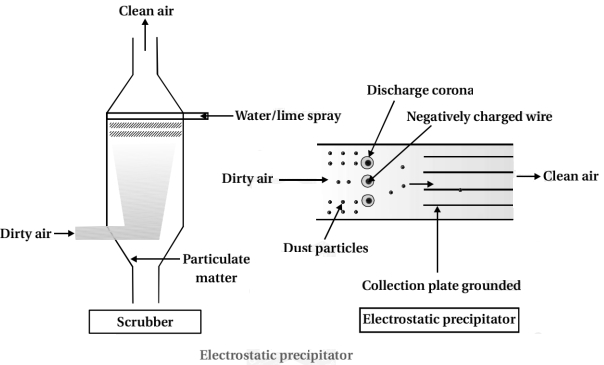
0 likes
View Solution49
EasyMCQ
......... is responsible for the premature death of plants.
A
Air pollutants
B
Soil pollutants
C
Noise
D
Water pollutants
Solution
(A) Air pollutants,such as sulfur dioxide $(SO_2)$,nitrogen oxides $(NO_x)$,and ozone $(O_3)$,are known to cause significant damage to plant tissues. These pollutants enter through the stomata,interfere with photosynthesis,cause chlorosis (yellowing of leaves),and lead to necrosis (tissue death),ultimately resulting in the premature death of plants.
0 likes
View SolutionEnvironmental Issues — Air Pollution and Its Control · Frequently Asked Questions
1Are these Environmental Issues questions useful for JEE and NEET?
Yes. All questions in this section are mapped to JEE Main and NEET exam patterns. Previous year questions from JEE Main, NEET, GUJCET and state-level exams are included with full solutions.
2Can I switch to Hindi or Gujarati for these questions?
Yes. Use the language tabs in the hero section or the sidebar to view the same questions and solutions in English, Hindi or Gujarati.
3How do I generate a question paper from this subtopic?
Use the Vedclass Exam Paper Generator — select the chapter and subtopic, set difficulty, and generate Sets A, B, C, D automatically. First 3 chapters of every subject are free.
Vedclass Products
For Students
Vedclass Test Series
Mock tests in real JEE/NEET style with performance analysis. 5-day free trial.
Start Free TrialFor Teachers
Exam Paper Generator
Generate Set A/B/C/D papers from this chapter in 2 minutes. 3 chapters free.
Try FreeFor Institutes
Online Exam Module
Live online exams with unlimited students, 360° analytics & white-label branding.
See DemoFor Teachers & Institutes
Generate a Environmental Issues Exam Paper in 2 Minutes
Select subtopic & difficulty — Sets A, B, C, D auto-generated with No Repeat logic.
First 3 chapters of every subject are free — no payment required.