
A English
Energy Flow Questions in English
Class 12 Biology · Ecosystem · Energy Flow
132+
Questions
English
Language
100%
With Solutions
Showing 47 of 132 questions in English
51
MediumMCQ
The amount of stored energy is highest in .........
A
First trophic level
B
Second trophic level
C
Third trophic level
D
Fourth trophic level
Solution
(A) In an ecosystem, energy flow follows the $10\%$ law, where only $10\%$ of the energy is transferred from one trophic level to the next.
Producers, which constitute the first trophic level, capture solar energy and convert it into chemical energy through photosynthesis.
Since energy is lost as heat at each successive trophic level due to metabolic activities, the total amount of stored energy is highest at the base of the food chain.
Therefore, the first trophic level (producers) contains the maximum amount of stored energy.
Producers, which constitute the first trophic level, capture solar energy and convert it into chemical energy through photosynthesis.
Since energy is lost as heat at each successive trophic level due to metabolic activities, the total amount of stored energy is highest at the base of the food chain.
Therefore, the first trophic level (producers) contains the maximum amount of stored energy.
0 likes
View Solution52
MediumMCQ
Choose the correct Grazing Food Chain $(GFC)$.
A
Cow $\rightarrow$ Grass $\rightarrow$ Wolf $\rightarrow$ Lion
B
Grass $\rightarrow$ Cow $\rightarrow$ Wolf $\rightarrow$ Lion
C
Grass $\rightarrow$ Wolf $\rightarrow$ Cow $\rightarrow$ Lion
D
Trees $\rightarrow$ Wolf $\rightarrow$ Cow $\rightarrow$ Lion
Solution
(B) Grazing Food Chain $(GFC)$ typically starts with producers (plants/grass) that capture solar energy.
In this chain,the primary consumer (herbivore) feeds on the producer,and the secondary/tertiary consumers (carnivores) feed on the preceding organisms.
$1$. Grass (Producer) is eaten by the Cow (Primary Consumer).
$2$. The Cow is eaten by the Wolf (Secondary Consumer).
$3$. The Wolf is eaten by the Lion (Tertiary Consumer).
Therefore,the correct sequence is: Grass $\rightarrow$ Cow $\rightarrow$ Wolf $\rightarrow$ Lion.
In this chain,the primary consumer (herbivore) feeds on the producer,and the secondary/tertiary consumers (carnivores) feed on the preceding organisms.
$1$. Grass (Producer) is eaten by the Cow (Primary Consumer).
$2$. The Cow is eaten by the Wolf (Secondary Consumer).
$3$. The Wolf is eaten by the Lion (Tertiary Consumer).
Therefore,the correct sequence is: Grass $\rightarrow$ Cow $\rightarrow$ Wolf $\rightarrow$ Lion.
0 likes
View Solution53
MediumMCQ
Energy flow in an ecosystem is.......
A
Bidirectional
B
Unidirectional
C
Cyclic
D
Multidirectional
Solution
(B) In an ecosystem, energy enters from the sun and is captured by producers (plants) through photosynthesis.
As energy moves from one trophic level to the next (e.g., from producers to primary consumers, then to secondary consumers), a significant portion of energy is lost as heat at each transfer, according to the $10\%$ law of energy transfer.
Because energy cannot be recycled back to the sun or reused by the previous trophic level, the flow of energy is always unidirectional (one-way).
Therefore, the correct option is $B$.
As energy moves from one trophic level to the next (e.g., from producers to primary consumers, then to secondary consumers), a significant portion of energy is lost as heat at each transfer, according to the $10\%$ law of energy transfer.
Because energy cannot be recycled back to the sun or reused by the previous trophic level, the flow of energy is always unidirectional (one-way).
Therefore, the correct option is $B$.
0 likes
View Solution54
EasyMCQ
The flow of energy is .................... from the sun to producers and then to consumers.
A
Cyclic
B
Bidirectional
C
Unidirectional
D
$A$ and $B$ both
Solution
(C) In an ecosystem,energy enters from the sun and is captured by producers (plants) through photosynthesis.
This energy is then transferred to consumers (herbivores,carnivores,etc.) through the food chain.
According to the $1^{st}$ and $2^{nd}$ laws of thermodynamics,energy is lost as heat at each trophic level and cannot be reused or returned to the sun.
Therefore,the flow of energy in an ecosystem is always $Unidirectional$ (one-way).
This energy is then transferred to consumers (herbivores,carnivores,etc.) through the food chain.
According to the $1^{st}$ and $2^{nd}$ laws of thermodynamics,energy is lost as heat at each trophic level and cannot be reused or returned to the sun.
Therefore,the flow of energy in an ecosystem is always $Unidirectional$ (one-way).
0 likes
View Solution55
MediumMCQ
Which of the following is unidirectional in an ecosystem?
A
Free energy
B
Carbon
C
Nitrogen
D
Potassium
Solution
(A) In an ecosystem, energy flow is strictly unidirectional.
Solar energy enters the ecosystem, is captured by producers (plants) through photosynthesis, and is then transferred to consumers (herbivores, carnivores, etc.) at different trophic levels.
At each transfer, a significant portion of energy is lost as heat (following the $10\%$ law), and it cannot be recycled back to the producers.
In contrast, nutrients like $Carbon$, $Nitrogen$, and $Potassium$ undergo biogeochemical cycles and are recycled within the ecosystem.
Solar energy enters the ecosystem, is captured by producers (plants) through photosynthesis, and is then transferred to consumers (herbivores, carnivores, etc.) at different trophic levels.
At each transfer, a significant portion of energy is lost as heat (following the $10\%$ law), and it cannot be recycled back to the producers.
In contrast, nutrients like $Carbon$, $Nitrogen$, and $Potassium$ undergo biogeochemical cycles and are recycled within the ecosystem.
0 likes
View Solution56
MediumMCQ
Identify the correct food chain.
A
Grass $\to$ Chameleon $\to$ Insect $\to$ Bird
B
Grass $\to$ Fox $\to$ Rabbit $\to$ Bird
C
Phytoplankton $\to$ Zooplankton $\to$ Fish
D
Fallen leaves $\to$ Bacteria $\to$ Insect larvae
Solution
(C) food chain represents the sequence of transfer of energy from one trophic level to another.
In option $A$,the sequence is incorrect because a chameleon (carnivore) cannot be eaten by an insect.
In option $B$,the sequence is incorrect because a fox (carnivore) does not eat grass.
In option $C$,the sequence is $Phytoplankton$ (producer) $\to$ $Zooplankton$ (primary consumer) $\to$ $Fish$ (secondary consumer). This represents a correct aquatic food chain.
In option $D$,the sequence is incorrect as it describes a detritus food chain,but the flow from bacteria to insect larvae is not the standard representation of energy transfer in this context.
In option $A$,the sequence is incorrect because a chameleon (carnivore) cannot be eaten by an insect.
In option $B$,the sequence is incorrect because a fox (carnivore) does not eat grass.
In option $C$,the sequence is $Phytoplankton$ (producer) $\to$ $Zooplankton$ (primary consumer) $\to$ $Fish$ (secondary consumer). This represents a correct aquatic food chain.
In option $D$,the sequence is incorrect as it describes a detritus food chain,but the flow from bacteria to insect larvae is not the standard representation of energy transfer in this context.
0 likes
View Solution57
MediumMCQ
In a terrestrial ecosystem like a forest,which trophic level contains the maximum amount of energy?
A
$T_1$
B
$T_2$
C
$T_3$
D
$T_4$
Solution
(A) In any ecosystem,energy flows from producers to consumers.
According to the $10\%$ law of energy transfer,only $10\%$ of the energy is transferred from one trophic level to the next,while the rest is lost as heat.
$T_1$ represents the producers (plants),which capture solar energy and convert it into chemical energy.
Since $T_1$ is the first level and receives the maximum energy from the sun,it contains the highest amount of energy compared to subsequent levels $(T_2, T_3, T_4)$.
Therefore,the correct option is $T_1$.
According to the $10\%$ law of energy transfer,only $10\%$ of the energy is transferred from one trophic level to the next,while the rest is lost as heat.
$T_1$ represents the producers (plants),which capture solar energy and convert it into chemical energy.
Since $T_1$ is the first level and receives the maximum energy from the sun,it contains the highest amount of energy compared to subsequent levels $(T_2, T_3, T_4)$.
Therefore,the correct option is $T_1$.
0 likes
View Solution58
MediumMCQ
The transfer of energy from one trophic level to another occurs according to the second law of thermodynamics. What is the average efficiency of energy transfer from herbivores to carnivores (in $\%$)?
A
$5$
B
$10$
C
$25$
D
$50$
Solution
(B) According to the $10\%$ law of energy transfer in an ecosystem,proposed by $Lindeman$ $(1942)$,only about $10\%$ of the energy available at one trophic level is transferred to the next trophic level.
This occurs because a large portion of the energy is lost as heat during metabolic activities,as dictated by the second law of thermodynamics.
Therefore,when energy is transferred from herbivores (primary consumers) to carnivores (secondary consumers),the average efficiency of energy transfer is $10\%$.
This occurs because a large portion of the energy is lost as heat during metabolic activities,as dictated by the second law of thermodynamics.
Therefore,when energy is transferred from herbivores (primary consumers) to carnivores (secondary consumers),the average efficiency of energy transfer is $10\%$.
0 likes
View Solution59
MediumMCQ
Identify the missing link in the following food chain:
Plants $\to$ Insect $\to$ Frog $\to$ $A$ $\to$ Hawk.
Plants $\to$ Insect $\to$ Frog $\to$ $A$ $\to$ Hawk.
A
Rabbit
B
Wolf
C
Cobra
D
Parrot
Solution
(C) In the given food chain, the energy flows from producers (Plants) to primary consumers (Insect), then to secondary consumers (Frog). The organism $A$ must be a tertiary consumer that feeds on the frog and is preyed upon by the hawk (an apex predator). A cobra (snake) is a common predator of frogs and serves as a food source for hawks in many ecosystems. Therefore, the correct link is $A = \text{Cobra}$.
0 likes
View Solution60
MediumMCQ
If $20 \, J$ of energy is trapped at the producer level,then how much energy will be available to the peacock in the following food chain (in $, J$)?
Plant $\to$ Rat $\to$ Snake $\to$ Peacock
Plant $\to$ Rat $\to$ Snake $\to$ Peacock
A
$0.02$
B
$0.002$
C
$0.2$
D
$0.0002$
Solution
(A) According to the $10\%$ law of energy transfer in an ecosystem,only $10\%$ of the energy available at one trophic level is transferred to the next trophic level.
$1$. Producer (Plant): $20 \, J$
$2$. Primary Consumer (Rat): $10\%$ of $20 \, J = 2 \, J$
$3$. Secondary Consumer (Snake): $10\%$ of $2 \, J = 0.2 \, J$
$4$. Tertiary Consumer (Peacock): $10\%$ of $0.2 \, J = 0.02 \, J$
Therefore,the energy available to the peacock is $0.02 \, J$.
$1$. Producer (Plant): $20 \, J$
$2$. Primary Consumer (Rat): $10\%$ of $20 \, J = 2 \, J$
$3$. Secondary Consumer (Snake): $10\%$ of $2 \, J = 0.2 \, J$
$4$. Tertiary Consumer (Peacock): $10\%$ of $0.2 \, J = 0.02 \, J$
Therefore,the energy available to the peacock is $0.02 \, J$.
0 likes
View Solution61
MediumMCQ
Assertion : $A$ network of food chains existing together in an ecosystem is known as food web.
Reason : An animal like kite cannot be a part of a food web.
Reason : An animal like kite cannot be a part of a food web.
A
If both Assertion and Reason are correct and the Reason is a correct explanation of the Assertion.
B
If both Assertion and Reason are correct but Reason is not a correct explanation of the Assertion.
C
If the Assertion is correct but Reason is incorrect.
D
If both the Assertion and Reason are incorrect.
Solution
(C) food web is a complex network of interconnected food chains within an ecosystem,representing the various pathways through which energy and nutrients flow.
In a food web,organisms occupy different trophic levels,such as producers,primary consumers,secondary consumers,and tertiary consumers.
Since a kite is a bird of prey (a secondary or tertiary consumer),it feeds on various organisms like small mammals,reptiles,or insects,making it an integral part of multiple food chains within a food web.
Therefore,the Assertion is correct,but the Reason is incorrect.
In a food web,organisms occupy different trophic levels,such as producers,primary consumers,secondary consumers,and tertiary consumers.
Since a kite is a bird of prey (a secondary or tertiary consumer),it feeds on various organisms like small mammals,reptiles,or insects,making it an integral part of multiple food chains within a food web.
Therefore,the Assertion is correct,but the Reason is incorrect.
0 likes
View Solution62
MediumMCQ
Which one of the following organisms is likely to show the highest concentration of $DDT$,once it has been introduced into the ecosystem?
A
Grasshopper
B
Toad
C
Snake
D
Cattle
Solution
(C) Biomagnification is the phenomenon of increasing concentration of a non-biodegradable compound in the tissues of organisms at successive trophic levels in a food chain,usually as a result of food intake.
In this process,the concentration of the pollutant increases as we move up the trophic levels.
The sequence of energy flow is: Producers $\to$ Primary consumers $\to$ Secondary consumers $\to$ Tertiary consumers $\to$ Top carnivores.
In the given options,the grasshopper is a primary consumer,the toad is a secondary consumer,the cattle is a primary consumer,and the snake acts as a tertiary consumer.
Since the snake occupies the highest trophic level among the given organisms,it will accumulate the highest concentration of $DDT$ due to biomagnification.
In this process,the concentration of the pollutant increases as we move up the trophic levels.
The sequence of energy flow is: Producers $\to$ Primary consumers $\to$ Secondary consumers $\to$ Tertiary consumers $\to$ Top carnivores.
In the given options,the grasshopper is a primary consumer,the toad is a secondary consumer,the cattle is a primary consumer,and the snake acts as a tertiary consumer.
Since the snake occupies the highest trophic level among the given organisms,it will accumulate the highest concentration of $DDT$ due to biomagnification.
0 likes
View Solution63
Easy
Give an account of energy flow in an ecosystem.
Solution
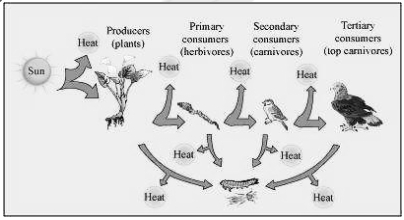
(N/A) Energy enters an ecosystem from the Sun. Solar radiations pass through the atmosphere and are absorbed by the Earth's surface. These radiations help plants in carrying out the process of photosynthesis.
Also,they help maintain the Earth's temperature for the survival of living organisms.
Some solar radiations are reflected by the Earth's surface. Only $2-10 \%$ of solar energy is captured by green plants (producers) during photosynthesis to be converted into food.
The rate at which the biomass is produced by plants during photosynthesis is termed as 'gross primary productivity'.
When these green plants are consumed by herbivores,only $10 \%$ of the stored energy from producers is transferred to herbivores. The remaining $90 \%$ of this energy is used by plants for various processes such as respiration,growth,and reproduction.
Similarly,only $10 \%$ of the energy of herbivores is transferred to carnivores. This is known as the ten percent law of energy flow.
Also,they help maintain the Earth's temperature for the survival of living organisms.
Some solar radiations are reflected by the Earth's surface. Only $2-10 \%$ of solar energy is captured by green plants (producers) during photosynthesis to be converted into food.
The rate at which the biomass is produced by plants during photosynthesis is termed as 'gross primary productivity'.
When these green plants are consumed by herbivores,only $10 \%$ of the stored energy from producers is transferred to herbivores. The remaining $90 \%$ of this energy is used by plants for various processes such as respiration,growth,and reproduction.
Similarly,only $10 \%$ of the energy of herbivores is transferred to carnivores. This is known as the ten percent law of energy flow.
0 likes
View Solution64
Easy
Explain energy flow in ecosystem.
Solution
(N/A) Except for the deep sea hydro-thermal ecosystem,the sun is the only source of energy for all ecosystems on Earth.
Of the incident solar radiation,less than $50$ per cent is photosynthetically active radiation $(PAR)$. Plants,photosynthetic bacteria,and chemosynthetic bacteria (autotrophs) fix the sun's radiant energy to produce food from simple inorganic materials.
Plants capture only $2-10$ per cent of the $PAR$,and this small amount of energy sustains the entire living world.
All organisms are dependent on producers for their food,either directly or indirectly. Thus,the energy flow is from the sun to producers and then unidirectional to consumers.
Furthermore,ecosystems are not exempt from the second law of thermodynamics. They require a constant supply of energy to synthesize the molecules they need and to counteract the universal tendency toward increasing disorderliness.
In ecosystem terminology,green plants are called producers.
In a terrestrial ecosystem,major producers are herbaceous and woody plants. Similarly,primary producers in an aquatic ecosystem include various species like phytoplankton,algae,and higher plants.
Food chains and food webs exist in nature. Starting from the plants (or producers),food chains or webs are formed such that an animal feeds on a plant or another animal and,in turn,becomes food for another.
This interdependency forms the chain or web.
- No energy trapped in an organism remains in it forever. The energy trapped by the producer is either passed on to a consumer or the organism dies.
$\Rightarrow$ The death of an organism marks the beginning of the detritus food chain/web.
- All animals depend on plants (directly or indirectly) for their food needs. They are hence called consumers or heterotrophs.
- If they feed on producers (plants),they are called primary consumers. If they eat other animals that feed on plants,they are called secondary consumers. Similarly,tertiary consumers exist.
Primary consumers are herbivores. Common examples include insects,birds,and mammals in terrestrial ecosystems,and molluscs in aquatic ecosystems.
Consumers that feed on these herbivores are carnivores (specifically,primary carnivores).
- Animals that depend on primary carnivores for food are labeled as secondary carnivores.
Of the incident solar radiation,less than $50$ per cent is photosynthetically active radiation $(PAR)$. Plants,photosynthetic bacteria,and chemosynthetic bacteria (autotrophs) fix the sun's radiant energy to produce food from simple inorganic materials.
Plants capture only $2-10$ per cent of the $PAR$,and this small amount of energy sustains the entire living world.
All organisms are dependent on producers for their food,either directly or indirectly. Thus,the energy flow is from the sun to producers and then unidirectional to consumers.
Furthermore,ecosystems are not exempt from the second law of thermodynamics. They require a constant supply of energy to synthesize the molecules they need and to counteract the universal tendency toward increasing disorderliness.
In ecosystem terminology,green plants are called producers.
In a terrestrial ecosystem,major producers are herbaceous and woody plants. Similarly,primary producers in an aquatic ecosystem include various species like phytoplankton,algae,and higher plants.
Food chains and food webs exist in nature. Starting from the plants (or producers),food chains or webs are formed such that an animal feeds on a plant or another animal and,in turn,becomes food for another.
This interdependency forms the chain or web.
- No energy trapped in an organism remains in it forever. The energy trapped by the producer is either passed on to a consumer or the organism dies.
$\Rightarrow$ The death of an organism marks the beginning of the detritus food chain/web.
- All animals depend on plants (directly or indirectly) for their food needs. They are hence called consumers or heterotrophs.
- If they feed on producers (plants),they are called primary consumers. If they eat other animals that feed on plants,they are called secondary consumers. Similarly,tertiary consumers exist.
Primary consumers are herbivores. Common examples include insects,birds,and mammals in terrestrial ecosystems,and molluscs in aquatic ecosystems.
Consumers that feed on these herbivores are carnivores (specifically,primary carnivores).
- Animals that depend on primary carnivores for food are labeled as secondary carnivores.
0 likes
View Solution65
Easy
Give differences: Food chain and food web.
Solution
(N/A)
| Food chain | Food web |
|---|---|
| $(1)$ It is a linear sequence of organisms. | $(1)$ It is an interconnection of many food chains. |
| $(2)$ Organisms at a higher trophic level depend on only one type of organism for food. | $(2)$ There are many alternative food sources available for an organism. |
| $(3)$ Energy flow can be calculated easily. | $(3)$ The calculation of energy flow is complex and difficult. |
0 likes
View Solution66
EasyMCQ
What is the ultimate source of energy for the ecosystems?
A
Sunlight
B
$ATP$
C
Glucose
D
Wind
Solution
(A) The ultimate source of energy for almost all ecosystems on Earth is sunlight.
Solar energy is captured by producers (plants,algae,and cyanobacteria) through the process of photosynthesis and converted into chemical energy.
While deep-sea hydrothermal vent ecosystems derive energy from chemical reactions (chemosynthesis) rather than sunlight,for the vast majority of ecosystems,the Sun remains the primary and ultimate energy source.
Solar energy is captured by producers (plants,algae,and cyanobacteria) through the process of photosynthesis and converted into chemical energy.
While deep-sea hydrothermal vent ecosystems derive energy from chemical reactions (chemosynthesis) rather than sunlight,for the vast majority of ecosystems,the Sun remains the primary and ultimate energy source.
0 likes
View Solution67
Medium
Organisms at a higher trophic level have less energy available. Comment.
Solution
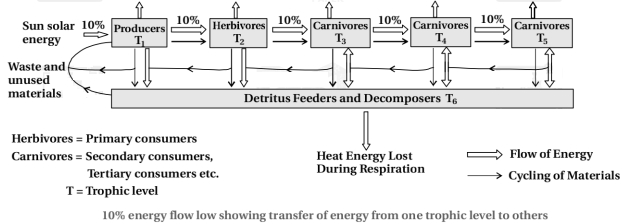
According to Lindeman's $10\%$ Law,only $10\%$ of the energy is transferred from one trophic level to the next higher trophic level in an ecosystem.
- The remaining $90\%$ of the energy is either used by the organisms at the current trophic level for their metabolic activities (like respiration,growth,and reproduction) or lost as heat to the environment.
- As we move to higher trophic levels,the amount of available energy decreases significantly.
- Consequently,organisms at the highest trophic levels (top carnivores) receive the least amount of energy,which limits the number of trophic levels in a food chain.
- The remaining $90\%$ of the energy is either used by the organisms at the current trophic level for their metabolic activities (like respiration,growth,and reproduction) or lost as heat to the environment.
- As we move to higher trophic levels,the amount of available energy decreases significantly.
- Consequently,organisms at the highest trophic levels (top carnivores) receive the least amount of energy,which limits the number of trophic levels in a food chain.
0 likes
View Solution68
Easy
The number of trophic levels in an ecosystem is limited. Comment.
Solution
(N/A) The number of trophic levels in an ecosystem is limited and generally does not exceed $4$ or $5$. This is primarily because energy flow decreases significantly at each successive trophic level.
According to the $10 \%$ law of energy transfer,only about $10 \%$ of the energy available at one trophic level is transferred to the next level. The remaining energy is utilized by organisms for biotic processes,such as respiration,growth,and reproduction,or is lost as heat.
If the number of trophic levels were higher,the amount of energy remaining at the higher levels would be insufficient to support the metabolic requirements of the organisms. Therefore,food chains are naturally restricted to $4$ to $5$ trophic levels.
Example:
$\text{Sunlight } (30,000 \text{ J}) \xrightarrow{1\% \text{ absorbed}} \text{Plants } (300 \text{ J}) \xrightarrow{10\% \text{ transferred}} \text{Deer } (30 \text{ J}) \xrightarrow{10\% \text{ transferred}} \text{Tiger } (3 \text{ J})$.
According to the $10 \%$ law of energy transfer,only about $10 \%$ of the energy available at one trophic level is transferred to the next level. The remaining energy is utilized by organisms for biotic processes,such as respiration,growth,and reproduction,or is lost as heat.
If the number of trophic levels were higher,the amount of energy remaining at the higher levels would be insufficient to support the metabolic requirements of the organisms. Therefore,food chains are naturally restricted to $4$ to $5$ trophic levels.
Example:
$\text{Sunlight } (30,000 \text{ J}) \xrightarrow{1\% \text{ absorbed}} \text{Plants } (300 \text{ J}) \xrightarrow{10\% \text{ transferred}} \text{Deer } (30 \text{ J}) \xrightarrow{10\% \text{ transferred}} \text{Tiger } (3 \text{ J})$.
0 likes
View Solution69
Easy
Flow of energy through various trophic levels in an ecosystem is unidirectional and non-cyclic. Explain.
Solution
(N/A) In an ecosystem, the flow of energy is always unidirectional, meaning it moves in only one direction and is not cyclic.
The energy flow follows the path: $\text{Producers} \rightarrow \text{Herbivores} \rightarrow \text{Carnivores} \rightarrow \text{Top Carnivores}$.
According to the $10\%$ law of energy transfer, only about $10\%$ of the energy is transferred from one trophic level to the next, while the rest is lost as heat to the environment.
Because energy is lost at each step, it cannot be recycled back to the previous trophic level. Thus, the energy flow is non-cyclic and unidirectional.
The energy flow follows the path: $\text{Producers} \rightarrow \text{Herbivores} \rightarrow \text{Carnivores} \rightarrow \text{Top Carnivores}$.
According to the $10\%$ law of energy transfer, only about $10\%$ of the energy is transferred from one trophic level to the next, while the rest is lost as heat to the environment.
Because energy is lost at each step, it cannot be recycled back to the previous trophic level. Thus, the energy flow is non-cyclic and unidirectional.
0 likes
View Solution70
Easy
In relation to energy transfer in an ecosystem, explain the statement: "$10 \; kg$ of deer's meat is equivalent to $1 \; kg$ of lion's flesh".
Solution
(N/A) The flow of energy in an ecosystem is unidirectional and follows the $10 \%$ Law of energy transfer.
According to this law, only about $10 \%$ of the energy available at one trophic level is transferred to the next higher trophic level, while the remaining $90 \%$ is lost as heat during respiration and other metabolic processes.
In this scenario, the deer acts as a primary consumer (herbivore) and the lion acts as a secondary consumer (carnivore).
When a lion consumes $10 \; kg$ of deer biomass, only $10 \%$ of that energy is converted into the lion's body mass.
Therefore, $10 \; kg$ of deer meat provides enough energy to produce approximately $1 \; kg$ of lion flesh, illustrating the significant loss of energy across trophic levels.
According to this law, only about $10 \%$ of the energy available at one trophic level is transferred to the next higher trophic level, while the remaining $90 \%$ is lost as heat during respiration and other metabolic processes.
In this scenario, the deer acts as a primary consumer (herbivore) and the lion acts as a secondary consumer (carnivore).
When a lion consumes $10 \; kg$ of deer biomass, only $10 \%$ of that energy is converted into the lion's body mass.
Therefore, $10 \; kg$ of deer meat provides enough energy to produce approximately $1 \; kg$ of lion flesh, illustrating the significant loss of energy across trophic levels.
0 likes
View Solution71
Medium
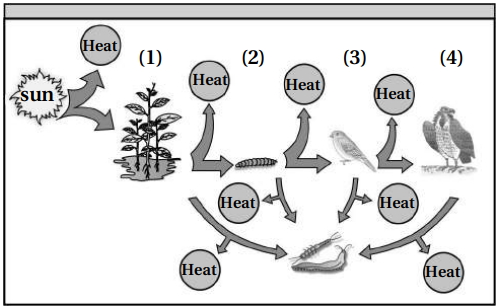
Identify the trophic levels $(1, 2, 3$ and $4)$ in the provided figure.
Solution
(N/A) In an ecosystem,energy flows from the sun to producers and then through various consumer levels.
$(1)$ represents the Producers (e.g.,plants),which occupy the first trophic level.
$(2)$ represents the Primary Consumers (e.g.,herbivores like insects),which occupy the second trophic level.
$(3)$ represents the Secondary Consumers (e.g.,small birds),which occupy the third trophic level.
$(4)$ represents the Tertiary Consumers (e.g.,top predators like vultures),which occupy the fourth trophic level.
Thus,the sequence is: $(1)$ Producers,$(2)$ Primary Consumers,$(3)$ Secondary Consumers,$(4)$ Tertiary Consumers.
$(1)$ represents the Producers (e.g.,plants),which occupy the first trophic level.
$(2)$ represents the Primary Consumers (e.g.,herbivores like insects),which occupy the second trophic level.
$(3)$ represents the Secondary Consumers (e.g.,small birds),which occupy the third trophic level.
$(4)$ represents the Tertiary Consumers (e.g.,top predators like vultures),which occupy the fourth trophic level.
Thus,the sequence is: $(1)$ Producers,$(2)$ Primary Consumers,$(3)$ Secondary Consumers,$(4)$ Tertiary Consumers.
0 likes
View Solution72
Medium
“The energy flow in the ecosystem follows the second law of thermodynamics.” Explain.
Solution
(N/A) The second law of thermodynamics states that no energy transfer is $100 \%$ efficient,and some energy is always lost as heat during the process.
In an ecosystem,energy enters as sunlight and is converted into chemical energy by producers. As this energy moves through different trophic levels,a significant portion is dissipated as heat due to metabolic activities (respiration,movement,etc.).
This aligns with Lindeman's $10 \%$ law,which states that only about $10 \%$ of the energy stored as biomass at one trophic level is transferred to the next trophic level,while the rest is lost as heat,thus adhering to the entropy principle of the second law of thermodynamics.
In an ecosystem,energy enters as sunlight and is converted into chemical energy by producers. As this energy moves through different trophic levels,a significant portion is dissipated as heat due to metabolic activities (respiration,movement,etc.).
This aligns with Lindeman's $10 \%$ law,which states that only about $10 \%$ of the energy stored as biomass at one trophic level is transferred to the next trophic level,while the rest is lost as heat,thus adhering to the entropy principle of the second law of thermodynamics.
0 likes
View Solution73
MediumMCQ
The main source of energy in an ecosystem is .........
A
Sun
B
Earth's crust
C
Plants
D
All of the above
Solution
(A) The $Sun$ is the ultimate and primary source of energy for all ecosystems on Earth.
Plants (producers) capture solar energy through the process of photosynthesis and convert it into chemical energy (food).
This energy then flows through various trophic levels in the food chain.
Therefore, the $Sun$ is the fundamental source of energy for the entire biosphere.
Plants (producers) capture solar energy through the process of photosynthesis and convert it into chemical energy (food).
This energy then flows through various trophic levels in the food chain.
Therefore, the $Sun$ is the fundamental source of energy for the entire biosphere.
0 likes
View Solution74
EasyMCQ
What percentage of $PAR$ (Photosynthetically Active Radiation) is captured by plants?
A
$2-10 \%$
B
$45-50 \%$
C
$20-40 \%$
D
$10-20 \%$
Solution
(A) Photosynthetically Active Radiation $(PAR)$ constitutes about $50 \%$ of the total incident solar radiation.
Plants are capable of capturing only a small fraction of this $PAR$ to perform photosynthesis.
Scientific studies and ecological data indicate that plants capture approximately $2-10 \%$ of the $PAR$ for the synthesis of organic matter.
Plants are capable of capturing only a small fraction of this $PAR$ to perform photosynthesis.
Scientific studies and ecological data indicate that plants capture approximately $2-10 \%$ of the $PAR$ for the synthesis of organic matter.
0 likes
View Solution75
MediumMCQ
All organisms are directly or indirectly dependent on ......... for their food requirements.
A
Primary consumers
B
Consumers
C
Producers
D
All of the above
Solution
(C) In an ecosystem,the flow of energy is unidirectional.
Producers (green plants and certain bacteria) are the only organisms capable of synthesizing their own food using solar energy through the process of photosynthesis.
All other organisms,including primary,secondary,and tertiary consumers,depend on these producers for their energy and food requirements,either directly (herbivores) or indirectly (carnivores).
Therefore,producers form the foundation of the food chain.
Producers (green plants and certain bacteria) are the only organisms capable of synthesizing their own food using solar energy through the process of photosynthesis.
All other organisms,including primary,secondary,and tertiary consumers,depend on these producers for their energy and food requirements,either directly (herbivores) or indirectly (carnivores).
Therefore,producers form the foundation of the food chain.
0 likes
View Solution76
MediumMCQ
How many trophic levels can a $Grazing$ $Food$ $Chain$ $(GFC)$ be divided into?
A
Three
B
Four
C
Two
D
Five
Solution
(D) $Grazing$ $Food$ $Chain$ $(GFC)$ typically consists of $4$ to $5$ trophic levels.
$1$. $T_1$: Producers (Plants).
$2$. $T_2$: Primary Consumers (Herbivores).
$3$. $T_3$: Secondary Consumers (Primary Carnivores).
$4$. $T_4$: Tertiary Consumers (Secondary Carnivores).
$5$. $T_5$: Quaternary Consumers (Top Carnivores).
Due to the $10\%$ law of energy transfer, energy availability decreases significantly at each successive trophic level, which limits the length of the food chain to usually $4$ or $5$ levels.
$1$. $T_1$: Producers (Plants).
$2$. $T_2$: Primary Consumers (Herbivores).
$3$. $T_3$: Secondary Consumers (Primary Carnivores).
$4$. $T_4$: Tertiary Consumers (Secondary Carnivores).
$5$. $T_5$: Quaternary Consumers (Top Carnivores).
Due to the $10\%$ law of energy transfer, energy availability decreases significantly at each successive trophic level, which limits the length of the food chain to usually $4$ or $5$ levels.
0 likes
View Solution77
MediumMCQ
In a terrestrial ecosystem, which type of food chain is the major conduit for energy flow?
A
Detritus food chain
B
Grazing food chain
C
Both detritus and grazing food chains
D
None of these
Solution
(B) In a terrestrial ecosystem, the $Grazing \text{ } Food \text{ } Chain \text{ } (GFC)$ is the major conduit for energy flow.
In an aquatic ecosystem, the $Detritus \text{ } Food \text{ } Chain \text{ } (DFC)$ is the major conduit for energy flow.
Therefore, for a terrestrial ecosystem, the correct answer is the grazing food chain.
In an aquatic ecosystem, the $Detritus \text{ } Food \text{ } Chain \text{ } (DFC)$ is the major conduit for energy flow.
Therefore, for a terrestrial ecosystem, the correct answer is the grazing food chain.
0 likes
View Solution78
MediumMCQ
Which characteristic occurs during the transfer of energy from one trophic level to another?
A
$90 \%$ of energy is transferred
B
$10 \%$ of energy is lost
C
$90 \%$ of energy is lost
D
The flow of energy is bidirectional
Solution
(C) According to the $10 \%$ Law proposed by Lindeman,only about $10 \%$ of the energy available at one trophic level is transferred to the next trophic level.
Consequently,$90 \%$ of the energy is lost as heat to the environment or used for metabolic activities at each trophic level.
Therefore,the correct characteristic is that $90 \%$ of the energy is lost during the transfer.
Consequently,$90 \%$ of the energy is lost as heat to the environment or used for metabolic activities at each trophic level.
Therefore,the correct characteristic is that $90 \%$ of the energy is lost during the transfer.
0 likes
View Solution79
MediumMCQ
What is the rate of energy loss at different trophic levels in an energy pyramid (in $\%$)?
A
$10$
B
$90$
C
$50$
D
$1$
Solution
(B) According to the $10 \%$ law of energy transfer proposed by Lindeman,only about $10 \%$ of the energy available at one trophic level is transferred to the next trophic level.
Consequently,$90 \%$ of the energy is lost as heat during metabolic processes or remains unavailable to the next level.
Therefore,the rate of energy loss at each trophic level is $90 \%$.
Consequently,$90 \%$ of the energy is lost as heat during metabolic processes or remains unavailable to the next level.
Therefore,the rate of energy loss at each trophic level is $90 \%$.
0 likes
View Solution80
MediumMCQ
$10,000 \, J \rightarrow 1000 \, J \rightarrow 100 \, J \rightarrow 10 \, J$
Which of the following characteristics can be justified by linking the given information with various trophic levels?
Which of the following characteristics can be justified by linking the given information with various trophic levels?
A
It shows the unidirectional flow of energy across different trophic levels of an ecosystem.
B
From the given information,it can be said that $10 \%$ of energy is lost during the transfer of energy at various trophic levels.
C
The given information cannot be applied to a grazing food chain.
D
All of the above.
Solution
(D) The given sequence $10,000 \, J \rightarrow 1000 \, J \rightarrow 100 \, J \rightarrow 10 \, J$ represents the $10 \%$ law of energy transfer in an ecosystem.
$1$. Unidirectional flow: Energy in an ecosystem flows in one direction,from producers to consumers,and is never recycled back to the source,which is consistent with the given data.
$2$. $10 \%$ Law: According to Lindeman's $10 \%$ law,only $10 \%$ of the energy available at one trophic level is transferred to the next,while $90 \%$ is lost as heat or used for metabolic activities. In this sequence,each subsequent level retains exactly $10 \%$ of the previous level's energy.
$3$. Applicability: This principle is a fundamental characteristic of all food chains,including grazing food chains.
Therefore,option $A$ is correct regarding the flow,and option $B$ is correct regarding the energy transfer efficiency. Since both are true,the correct answer is $A$ and $B$ (though the provided option $D$ is the intended choice in this context).
$1$. Unidirectional flow: Energy in an ecosystem flows in one direction,from producers to consumers,and is never recycled back to the source,which is consistent with the given data.
$2$. $10 \%$ Law: According to Lindeman's $10 \%$ law,only $10 \%$ of the energy available at one trophic level is transferred to the next,while $90 \%$ is lost as heat or used for metabolic activities. In this sequence,each subsequent level retains exactly $10 \%$ of the previous level's energy.
$3$. Applicability: This principle is a fundamental characteristic of all food chains,including grazing food chains.
Therefore,option $A$ is correct regarding the flow,and option $B$ is correct regarding the energy transfer efficiency. Since both are true,the correct answer is $A$ and $B$ (though the provided option $D$ is the intended choice in this context).
0 likes
View Solution81
MediumMCQ
Identify the organism from the following that receives the least amount of energy and is considered ecologically weak?
A
Producer
B
Deer
C
Lion
D
Grasshopper
Solution
(C) According to the $10\%$ law of energy transfer in an ecosystem, only $10\%$ of the energy available at one trophic level is transferred to the next higher trophic level.
Producers (plants) occupy the first trophic level and possess the maximum energy.
Primary consumers like the grasshopper and deer occupy the second trophic level.
Secondary or tertiary consumers like the lion occupy the highest trophic level in a food chain.
Since energy decreases as we move up the trophic levels, the organism at the highest trophic level (the apex predator) receives the least amount of energy.
Therefore, the lion, being an apex predator, receives the least energy and is considered ecologically weak in terms of energy availability.
Producers (plants) occupy the first trophic level and possess the maximum energy.
Primary consumers like the grasshopper and deer occupy the second trophic level.
Secondary or tertiary consumers like the lion occupy the highest trophic level in a food chain.
Since energy decreases as we move up the trophic levels, the organism at the highest trophic level (the apex predator) receives the least amount of energy.
Therefore, the lion, being an apex predator, receives the least energy and is considered ecologically weak in terms of energy availability.
0 likes
View Solution82
MediumMCQ
If the biomass of a lion in a food chain is $10 \ kg$,then the biomass of the producers is approximately ...... $kg$.
A
$100$
B
$1000$
C
$10000$
D
$100000$
Solution
(C) According to the $10\%$ law of energy transfer in an ecosystem,only about $10\%$ of the energy (or biomass) is transferred from one trophic level to the next higher trophic level.
In a typical food chain: Producers $\rightarrow$ Primary Consumers $\rightarrow$ Secondary Consumers $\rightarrow$ Tertiary Consumers (Lion).
If the biomass of the tertiary consumer (Lion) is $10 \ kg$,we can work backwards:
$1$. Secondary consumer biomass $\approx 10 \times 10 = 100 \ kg$.
$2$. Primary consumer biomass $\approx 100 \times 10 = 1000 \ kg$.
$3$. Producer biomass $\approx 1000 \times 10 = 10000 \ kg$.
Therefore,the biomass of the producers is approximately $10000 \ kg$.
In a typical food chain: Producers $\rightarrow$ Primary Consumers $\rightarrow$ Secondary Consumers $\rightarrow$ Tertiary Consumers (Lion).
If the biomass of the tertiary consumer (Lion) is $10 \ kg$,we can work backwards:
$1$. Secondary consumer biomass $\approx 10 \times 10 = 100 \ kg$.
$2$. Primary consumer biomass $\approx 100 \times 10 = 1000 \ kg$.
$3$. Producer biomass $\approx 1000 \times 10 = 10000 \ kg$.
Therefore,the biomass of the producers is approximately $10000 \ kg$.
0 likes
View Solution83
MediumMCQ
In any ecosystem,at which trophic level is the least amount of energy stored?
A
Primary trophic level
B
Secondary trophic level
C
Tertiary trophic level
D
Producer level
Solution
(C) According to the $10\%$ law of energy transfer in an ecosystem,only about $10\%$ of the energy available at one trophic level is transferred to the next higher trophic level.
As energy moves from producers to primary consumers,secondary consumers,and finally to tertiary consumers,a significant amount of energy is lost as heat during metabolic processes.
Therefore,the energy available decreases as we move up the food chain.
The tertiary trophic level (top carnivores) receives the least amount of energy compared to the producers and lower consumer levels.
As energy moves from producers to primary consumers,secondary consumers,and finally to tertiary consumers,a significant amount of energy is lost as heat during metabolic processes.
Therefore,the energy available decreases as we move up the food chain.
The tertiary trophic level (top carnivores) receives the least amount of energy compared to the producers and lower consumer levels.
0 likes
View Solution84
MediumMCQ
In which of the following trophic levels is the rate of energy flow very low, even though the total amount of energy is very high?
A
Decomposers
B
Herbivores
C
Carnivores
D
Producers
Solution
(D) In an ecosystem, the $Producers$ (first trophic level) capture solar energy and convert it into chemical energy through photosynthesis.
Although the rate of energy flow (productivity) from the producers to the next trophic level is limited by various factors, the total standing crop or biomass (and thus the total energy content) at the producer level is the highest in the ecosystem.
As energy moves to higher trophic levels ($Herbivores$, $Carnivores$, $Decomposers$), a significant portion is lost as heat due to metabolic activities, following the $10\%$ law of energy transfer.
Therefore, the producers possess the highest total energy content.
Although the rate of energy flow (productivity) from the producers to the next trophic level is limited by various factors, the total standing crop or biomass (and thus the total energy content) at the producer level is the highest in the ecosystem.
As energy moves to higher trophic levels ($Herbivores$, $Carnivores$, $Decomposers$), a significant portion is lost as heat due to metabolic activities, following the $10\%$ law of energy transfer.
Therefore, the producers possess the highest total energy content.
0 likes
View Solution85
MediumMCQ
Which of the following does not show recycling in an ecosystem?
A
Energy
B
Water
C
$N_2$
D
All of the above
Solution
(A) In an ecosystem,nutrients like water,carbon,nitrogen,and phosphorus undergo biogeochemical cycles,meaning they are recycled continuously. However,energy flow in an ecosystem is unidirectional. Energy enters the ecosystem from the sun,is converted into chemical energy by producers,and then flows through various trophic levels. At each transfer,a significant portion of energy is lost as heat,and it cannot be recycled back to the producers. Therefore,energy does not show recycling.
0 likes
View Solution86
EasyMCQ
$10 \%$ law of energy transfer was given by
A
Lindermann
B
Tansley
C
Stanley
D
Darwin
Solution
(A) The $10 \%$ law of energy transfer (also known as the $10 \%$ law of energy flow in an ecosystem) was proposed by Raymond Lindemann in $1942$.
This law states that during the transfer of energy from one trophic level to the next,only about $10 \%$ of the energy is stored as biomass and available to the next level,while the remaining $90 \%$ is lost as heat or used for metabolic activities.
This law states that during the transfer of energy from one trophic level to the next,only about $10 \%$ of the energy is stored as biomass and available to the next level,while the remaining $90 \%$ is lost as heat or used for metabolic activities.
0 likes
View Solution87
MediumMCQ
The ultimate source of energy in the biosphere is
A
Sunlight
B
Protein
C
Fats
D
Enzymes
Solution
(A) Sunlight is the ultimate source of energy on Earth.
Green plants convert solar energy into chemical energy in the form of glucose or sucrose through the process of photosynthesis.
Animals obtain their food directly or indirectly from plants and derive energy through the oxidation of glucose during cellular respiration.
Green plants convert solar energy into chemical energy in the form of glucose or sucrose through the process of photosynthesis.
Animals obtain their food directly or indirectly from plants and derive energy through the oxidation of glucose during cellular respiration.
0 likes
View Solution88
MediumMCQ
The average trophic efficiency of transfer of energy from one trophic level to the higher trophic level is called
A
Assimilation efficiency
B
Exploitation efficiency
C
Lindemann's trophic efficiency rule
D
Gross primary production
Solution
(C) The percentage of energy transferred from one trophic level to the next higher trophic level is known as ecological efficiency or Lindemann's trophic efficiency rule.
According to Lindemann's $10\%$ law,only about $10\%$ of the energy is transferred to the next trophic level,while the rest is lost as heat during respiration and metabolic activities.
$EE = \frac{\text{Energy converted into biomass at higher trophic level}}{\text{Energy present in biomass at lower trophic level}} \times 100$
According to Lindemann's $10\%$ law,only about $10\%$ of the energy is transferred to the next trophic level,while the rest is lost as heat during respiration and metabolic activities.
$EE = \frac{\text{Energy converted into biomass at higher trophic level}}{\text{Energy present in biomass at lower trophic level}} \times 100$
0 likes
View Solution89
MediumMCQ
Energy flow in an ecosystem is:
A
Bidirectional
B
Unidirectional
C
All around
D
None of these
Solution
(B) An ecosystem consists of the entire biotic community in a given area along with its abiotic environment.
The flow of energy in an ecosystem is always unidirectional, meaning it moves from producers to consumers and then to decomposers.
Energy is never recycled back from consumers to producers; instead, it is lost as heat at each trophic level according to the $10\%$ law of energy transfer.
The flow of energy in an ecosystem is always unidirectional, meaning it moves from producers to consumers and then to decomposers.
Energy is never recycled back from consumers to producers; instead, it is lost as heat at each trophic level according to the $10\%$ law of energy transfer.
0 likes
View Solution90
MediumMCQ
Select the formula for ecological efficiency.
A
$\frac{\text{Gross primary productivity}}{\text{Incident total solar radiation}} \times 100$
B
$\frac{\text{Food energy assimilated}}{\text{Food energy ingested}} \times 100$
C
$\frac{\text{Net primary productivity}}{\text{Gross primary productivity}} \times 100$
D
$\frac{\text{Energy in biomass production at trophic level } n}{\text{Energy in biomass production at previous trophic level } n-1} \times 100$
Solution
(D) Ecological efficiency,also known as trophic level efficiency,is defined as the percentage of energy transferred from one trophic level to the next.
It represents the efficiency with which energy is converted into biomass by organisms at a higher trophic level relative to the energy available at the lower trophic level.
The formula is:
$\text{Ecological efficiency} = \frac{\text{Energy in biomass production at trophic level } n}{\text{Energy in biomass production at previous trophic level } n-1} \times 100$
It represents the efficiency with which energy is converted into biomass by organisms at a higher trophic level relative to the energy available at the lower trophic level.
The formula is:
$\text{Ecological efficiency} = \frac{\text{Energy in biomass production at trophic level } n}{\text{Energy in biomass production at previous trophic level } n-1} \times 100$
0 likes
View Solution91
MediumMCQ
In what order do a hawk, grass, and rabbit form a food chain in a meadow?
A
Hawk $\rightarrow$ grass $\rightarrow$ rabbit
B
Grass $\rightarrow$ hawk $\rightarrow$ rabbit
C
Rabbit $\rightarrow$ grass $\rightarrow$ hawk
D
Grass $\rightarrow$ rabbit $\rightarrow$ hawk
Solution
(D) food chain represents the sequence of energy transfer between organisms.
$1$. $Grass$ acts as the producer (autotroph) that captures solar energy.
$2$. $Rabbit$ is the primary consumer (herbivore) that feeds on the grass.
$3$. $Hawk$ is the secondary consumer (carnivore) that feeds on the rabbit.
Therefore, the correct order is: $Grass \rightarrow Rabbit \rightarrow Hawk$.
$1$. $Grass$ acts as the producer (autotroph) that captures solar energy.
$2$. $Rabbit$ is the primary consumer (herbivore) that feeds on the grass.
$3$. $Hawk$ is the secondary consumer (carnivore) that feeds on the rabbit.
Therefore, the correct order is: $Grass \rightarrow Rabbit \rightarrow Hawk$.
0 likes
View Solution92
MediumMCQ
$A$ food chain is a series of populations that starts with producers. It is concerned with:
A
Biotic components only
B
Energy flow and transfer of nutrients
C
Both $(a)$ and $(b)$
D
Abiotic components and decomposers
Solution
(C) food chain represents the transfer of food energy from producers through a series of organisms via repeated eating and being eaten.
Producers capture solar energy and transform it into chemical energy $(ATP)$ during the process of photosynthesis.
Since a food chain involves the interaction of living organisms (biotic components) and the movement of energy and nutrients through trophic levels,it encompasses both biotic components and the processes of energy and nutrient transfer.
Producers capture solar energy and transform it into chemical energy $(ATP)$ during the process of photosynthesis.
Since a food chain involves the interaction of living organisms (biotic components) and the movement of energy and nutrients through trophic levels,it encompasses both biotic components and the processes of energy and nutrient transfer.
0 likes
View Solution93
EasyMCQ
Percentage of Photosynthetically Active Radiation $(PAR)$ that is captured by plants in the synthesis of organic matter is
A
$50-80\; \%$
B
$40-60\; \%$
C
$70-100\; \%$
D
$2-10\; \%$
Solution
(D) The correct answer is $2-10\; \%$.
Out of the total incident solar radiation,only $50\; \%$ is Photosynthetically Active Radiation $(PAR)$.
Plants capture only $2-10\; \%$ of the $PAR$ to synthesize organic matter.
This small amount of energy is sufficient to sustain the entire living world.
Out of the total incident solar radiation,only $50\; \%$ is Photosynthetically Active Radiation $(PAR)$.
Plants capture only $2-10\; \%$ of the $PAR$ to synthesize organic matter.
This small amount of energy is sufficient to sustain the entire living world.
0 likes
View Solution94
EasyMCQ
The trophic level of a food chain having the greatest amount of energy is
A
Carnivores
B
Herbivores
C
Autotrophs
D
Omnivores
Solution
(C) Biotic factors of an ecosystem are linked together for food,forming a sequence called a food chain.
The various steps in a food chain are called trophic levels.
According to the pyramid of energy,energy flows from one trophic level to the next in only one direction.
According to the laws of thermodynamics,when energy is transferred from one step to the next,a significant portion of energy is lost as heat.
Since autotrophs (green plants) form the base of the food chain,they capture the maximum solar energy and thus possess the highest amount of energy compared to other trophic levels.
The various steps in a food chain are called trophic levels.
According to the pyramid of energy,energy flows from one trophic level to the next in only one direction.
According to the laws of thermodynamics,when energy is transferred from one step to the next,a significant portion of energy is lost as heat.
Since autotrophs (green plants) form the base of the food chain,they capture the maximum solar energy and thus possess the highest amount of energy compared to other trophic levels.
0 likes
View Solution95
MediumMCQ
What do ecologists call the transfer of energy that begins with the sun and passes from one organism to the next in a food chain?
A
$A$ food web
B
$A$ top consumer
C
Energy flow
D
$A$ pyramid of number
Solution
(C) In an ecosystem,the sun is the primary source of energy for all organisms.
This energy is captured by producers (plants) through photosynthesis and is subsequently transferred to consumers (herbivores,carnivores,etc.) through feeding relationships.
This unidirectional movement of energy through various trophic levels in a food chain is known as $Energy \ flow$.
Therefore,the correct option is $C$.
This energy is captured by producers (plants) through photosynthesis and is subsequently transferred to consumers (herbivores,carnivores,etc.) through feeding relationships.
This unidirectional movement of energy through various trophic levels in a food chain is known as $Energy \ flow$.
Therefore,the correct option is $C$.
0 likes
View Solution96
EasyMCQ
The ultimate energy source of the ecosystem is
A
Solar energy
B
Biomass
C
Producer
D
Carbohydrates
Solution
(A) Solar energy is the ultimate source of energy for all ecosystems on Earth.
Plants and other photosynthetic organisms capture this energy and convert it into chemical energy through the process of photosynthesis.
This energy then flows through the various trophic levels of the food chain.
The pyramid of energy is always upright because energy is lost as heat at each trophic level.
Plants and other photosynthetic organisms capture this energy and convert it into chemical energy through the process of photosynthesis.
This energy then flows through the various trophic levels of the food chain.
The pyramid of energy is always upright because energy is lost as heat at each trophic level.
0 likes
View Solution97
MediumMCQ
The $10\; \%$ law is related to
A
Mendelian genetics
B
Respiratory $ETC$
C
Ecological energy transfer
D
Photophosphorylation
Solution
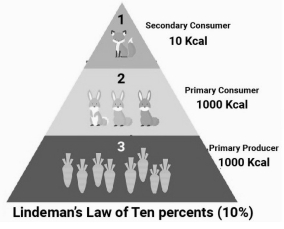
(C) The $10\; \%$ law,proposed by Raymond Lindeman,states that only $10\; \%$ of the energy available at one trophic level is transferred to the next higher trophic level.
This occurs because a large portion of energy is lost as heat during metabolic processes at each level.
Consequently,the number of trophic levels in a food chain is limited,as energy availability decreases significantly at each successive step.
This occurs because a large portion of energy is lost as heat during metabolic processes at each level.
Consequently,the number of trophic levels in a food chain is limited,as energy availability decreases significantly at each successive step.
0 likes
View SolutionEcosystem — Energy Flow · Frequently Asked Questions
1Are these Ecosystem questions useful for JEE and NEET?
Yes. All questions in this section are mapped to JEE Main and NEET exam patterns. Previous year questions from JEE Main, NEET, GUJCET and state-level exams are included with full solutions.
2Can I switch to Hindi or Gujarati for these questions?
Yes. Use the language tabs in the hero section or the sidebar to view the same questions and solutions in English, Hindi or Gujarati.
3How do I generate a question paper from this subtopic?
Use the Vedclass Exam Paper Generator — select the chapter and subtopic, set difficulty, and generate Sets A, B, C, D automatically. First 3 chapters of every subject are free.
Vedclass Products
For Students
Vedclass Test Series
Mock tests in real JEE/NEET style with performance analysis. 5-day free trial.
Start Free TrialFor Teachers
Exam Paper Generator
Generate Set A/B/C/D papers from this chapter in 2 minutes. 3 chapters free.
Try FreeFor Institutes
Online Exam Module
Live online exams with unlimited students, 360° analytics & white-label branding.
See DemoFor Teachers & Institutes
Generate a Ecosystem Exam Paper in 2 Minutes
Select subtopic & difficulty — Sets A, B, C, D auto-generated with No Repeat logic.
First 3 chapters of every subject are free — no payment required.