
A English
Energy Flow Questions in English
Class 12 Biology · Ecosystem · Energy Flow
132+
Questions
English
Language
100%
With Solutions
Showing 32 of 132 questions in English
101
EasyMCQ
Energy for the detritus food chain comes from
A
Organic remains
B
Air
C
Radiation
D
Water
Solution
(A) The energy for the detritus food chain is derived from organic remains,also known as detritus. In terrestrial ecosystems,a much larger fraction of energy flows through the detritus food chain compared to the grazing food chain. Detritus consists of dead plant parts and animal remains,which serve as the primary energy source for decomposers and detritivores.
0 likes
View Solution102
MediumMCQ
The driving force of any ecosystem is
A
Organic fuels and carbohydrates
B
Biomass
C
Solar energy
D
Decomposers
Solution
(C) The ultimate source of energy for all living organisms in an ecosystem is sunlight.
Solar energy is captured by producers (plants) through photosynthesis and converted into chemical energy.
This energy then flows through various trophic levels in the ecosystem.
Therefore,solar energy acts as the primary driving force for the functioning of any ecosystem.
Solar energy is captured by producers (plants) through photosynthesis and converted into chemical energy.
This energy then flows through various trophic levels in the ecosystem.
Therefore,solar energy acts as the primary driving force for the functioning of any ecosystem.
0 likes
View Solution103
MediumMCQ
The statement, "Tiger is in the apex of food chain", indicates
A
Tiger has many enemies
B
Tiger has maximum biomass
C
Tiger is omnivorous
D
Tiger is dependent upon a large number of herbivores and an even larger number of trees in the forest
Solution
(D) Tiger is the top consumer in a food chain.
It can feed upon lower carnivores as well as herbivores.
Herbivores are dependent upon producers ($i.e.$, green plants) for their food.
Thus, indirectly, the tiger is also linked with trees ($i.e.$, primary producers) because the energy flow originates from the producers and passes through the herbivores to the top carnivore.
It can feed upon lower carnivores as well as herbivores.
Herbivores are dependent upon producers ($i.e.$, green plants) for their food.
Thus, indirectly, the tiger is also linked with trees ($i.e.$, primary producers) because the energy flow originates from the producers and passes through the herbivores to the top carnivore.
0 likes
View Solution104
MediumMCQ
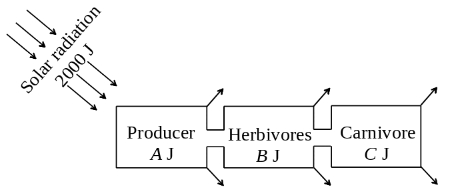
Suppose $2000 \; J$ of solar energy is incident on green vegetation. On the basis of the $10 \; \%$ law of Lindeman,identify $A, B$ and $C$ as shown in the figure.
A
$A-20 \; J, B-2 \; J, C-0.2 \; J$
B
$A-200 \; J, B-20 \; J, C-2 \; J$
C
$A-400 \; J, B-40 \; J, C-4 \; J$
D
$A-40 \; J, B-4 \; J, C-0.4 \; J$
Solution
(A) According to the ecological efficiency,green plants (producers) trap only about $1 \; \%$ of the solar energy incident on them.
Given solar energy = $2000 \; J$.
Energy trapped by producers $(A)$ = $1 \; \%$ of $2000 \; J = (1/100) \times 2000 = 20 \; J$.
According to Lindeman's $10 \; \%$ law,only $10 \; \%$ of the energy is transferred to the next trophic level.
Energy transferred to herbivores $(B)$ = $10 \; \%$ of $A = 10 \; \%$ of $20 \; J = 2 \; J$.
Energy transferred to carnivores $(C)$ = $10 \; \%$ of $B = 10 \; \%$ of $2 \; J = 0.2 \; J$.
Thus,$A = 20 \; J, B = 2 \; J, C = 0.2 \; J$.
Given solar energy = $2000 \; J$.
Energy trapped by producers $(A)$ = $1 \; \%$ of $2000 \; J = (1/100) \times 2000 = 20 \; J$.
According to Lindeman's $10 \; \%$ law,only $10 \; \%$ of the energy is transferred to the next trophic level.
Energy transferred to herbivores $(B)$ = $10 \; \%$ of $A = 10 \; \%$ of $20 \; J = 2 \; J$.
Energy transferred to carnivores $(C)$ = $10 \; \%$ of $B = 10 \; \%$ of $2 \; J = 0.2 \; J$.
Thus,$A = 20 \; J, B = 2 \; J, C = 0.2 \; J$.
0 likes
View Solution105
MediumMCQ
Only a small amount of the energy stored in food is available to the next organism in a food chain because
A
There are more producers than consumers in a food chain
B
There are fewer top consumers than producers in a food chain
C
Primary and secondary consumers compete for food
D
Most of the energy is used for life processes
Solution
(D) According to the $10 \%$ law of energy transfer,only about $10 \%$ of the energy available at one trophic level is transferred to the next trophic level. The majority of the energy (about $90 \%$) is consumed by the organism for its own metabolic activities such as respiration,movement,growth,and maintenance of body heat,and is lost as heat to the environment.
0 likes
View Solution106
MediumMCQ
If $10,000 \; J$ of energy falls on a piece of land,what is the energy available at the $T_2$ trophic level (in $; J$)?
A
$1000$
B
$10$
C
$100$
D
$1$
Solution
(B) According to the $10\%$ law of energy transfer,only $10\%$ of the energy is transferred from one trophic level to the next.
First,the producers $(T_1)$ capture about $1\%$ of the total solar energy falling on the land. Thus,energy at $T_1 = 1\% \text{ of } 10,000 \; J = 100 \; J$.
Next,the energy transferred to the primary consumers $(T_2)$ is $10\%$ of the energy at $T_1$.
Therefore,energy at $T_2 = 10\% \text{ of } 100 \; J = 10 \; J$.
First,the producers $(T_1)$ capture about $1\%$ of the total solar energy falling on the land. Thus,energy at $T_1 = 1\% \text{ of } 10,000 \; J = 100 \; J$.
Next,the energy transferred to the primary consumers $(T_2)$ is $10\%$ of the energy at $T_1$.
Therefore,energy at $T_2 = 10\% \text{ of } 100 \; J = 10 \; J$.
0 likes
View Solution107
MediumMCQ
Major conduit of energy in land and aquatic ecosystem is transferred through . . . . . . and . . . . . . respectively.
A
$GFC, DFC$
B
$PFC, GFC$
C
$DFC, GFC$
D
$GFC, GFC$
Solution
(C) In terrestrial ecosystems,the major conduit for energy flow is the $DFC$ $(Detritus Food Chain)$,where a much larger fraction of energy flows through the detritus pathway compared to the grazing pathway.
In aquatic ecosystems,the major conduit for energy flow is the $GFC$ $(Grazing Food Chain)$,as the primary producers are mostly phytoplankton which are consumed by zooplankton and higher trophic levels.
In aquatic ecosystems,the major conduit for energy flow is the $GFC$ $(Grazing Food Chain)$,as the primary producers are mostly phytoplankton which are consumed by zooplankton and higher trophic levels.
0 likes
View Solution108
MediumMCQ
In tropical rain forests,most of the energy in the ecosystem flows through:
A
Grazing food chain
B
Detritus food chain
C
Parasitic food chain
D
Both $(a)$ and $(c)$
Solution
(B) In a tropical rain forest ecosystem,the majority of the energy flow occurs through the detritus food chain. This is because a large amount of organic matter (litter) is produced,which is decomposed by microorganisms and detritivores,forming the basis of the energy pathway.
0 likes
View Solution109
MediumMCQ
Energy requirement for maintenance of body . . . . . . with successively higher trophic level.
A
Decreases
B
Increases
C
Remain same
D
Always $10\%$
Solution
(B) Energy requirement for the maintenance of the body increases with successively higher trophic levels. As we move up the food chain,organisms at higher trophic levels require more energy to maintain their metabolic processes and body functions relative to the energy available to them.
0 likes
View Solution110
MediumMCQ
What is the primary function of a grazing food chain?
A
Provides inorganic matter to detritus food chain
B
Binds the inorganic nutrients into organic matter
C
Is based on energy present in detritus
D
Does not add energy into ecosystem
Solution
(B) The grazing food chain $(GFC)$ begins with producers (green plants) that capture solar energy. Through the process of photosynthesis,these producers convert inorganic nutrients (like $CO_2$,$H_2O$,and minerals) into organic matter (biomass). This organic matter then serves as the energy source for consumers in the food chain.
0 likes
View Solution111
MediumMCQ
Which of the following statements is not correct about energy flow in an ecosystem?
A
Pyramid of energy is always upright.
B
Energy flow is unidirectional.
C
Energy flow is cyclic.
D
Ecological efficiency is generally $10\%$.
Solution
(C) In an ecosystem,energy flow is unidirectional,meaning it moves from producers to consumers and cannot be recycled back to the producers. Therefore,the statement that energy flow is cyclic is incorrect. The pyramid of energy is always upright because energy is lost as heat at each trophic level. Ecological efficiency,which refers to the percentage of energy transferred from one trophic level to the next,is generally considered to be $10\%$ (Lindeman's $10\%$ Law).
0 likes
View Solution112
MediumMCQ
Energy is transferred from one trophic level to another through which interaction?
A
Antibiosis
B
Mutualism
C
Commensalism
D
Predation
Solution
(D) Energy transfer in an ecosystem occurs through the food chain,where organisms at one trophic level consume organisms from the lower trophic level.
This interaction,where one organism (the predator) kills and eats another organism (the prey) to obtain energy,is known as $Predation$.
$Predation$ acts as a conduit for energy transfer across trophic levels.
This interaction,where one organism (the predator) kills and eats another organism (the prey) to obtain energy,is known as $Predation$.
$Predation$ acts as a conduit for energy transfer across trophic levels.
0 likes
View Solution113
MediumMCQ
How does energy flow in an ecosystem?
A
Bidirectional
B
Unidirectional
C
Both
D
None of these
Solution
(B) In an ecosystem, energy flow is always $Unidirectional$.
$1$. Energy enters the ecosystem from the sun in the form of solar radiation.
$2$. Producers (plants) convert this solar energy into chemical energy through photosynthesis.
$3$. This energy is then transferred to consumers (herbivores, carnivores, etc.) through food chains.
$4$. At each trophic level, a significant portion of energy is lost as heat, according to the $10\%$ law of energy transfer.
$5$. Because energy cannot be recycled back to the sun or to previous trophic levels, the flow is strictly one-way or unidirectional.
$1$. Energy enters the ecosystem from the sun in the form of solar radiation.
$2$. Producers (plants) convert this solar energy into chemical energy through photosynthesis.
$3$. This energy is then transferred to consumers (herbivores, carnivores, etc.) through food chains.
$4$. At each trophic level, a significant portion of energy is lost as heat, according to the $10\%$ law of energy transfer.
$5$. Because energy cannot be recycled back to the sun or to previous trophic levels, the flow is strictly one-way or unidirectional.
0 likes
View Solution114
EasyMCQ
Plants capture $............ \%$ of photosynthetically active radiation $(PAR)$.
A
$2-10 \%$
B
$50 \%$
C
$100 \%$
D
$1-2 \%$
Solution
(A) Photosynthetically active radiation $(PAR)$ is the portion of the light spectrum that plants can use for photosynthesis.
Plants are not able to capture all the available solar energy.
It is a well-established ecological fact that plants capture only about $2-10 \%$ of the $PAR$ to perform photosynthesis and produce organic matter.
Therefore,the correct option is $A$.
Plants are not able to capture all the available solar energy.
It is a well-established ecological fact that plants capture only about $2-10 \%$ of the $PAR$ to perform photosynthesis and produce organic matter.
Therefore,the correct option is $A$.
0 likes
View Solution115
MediumMCQ
"During the transfer of energy from one trophic level to another, some energy is lost as heat." Which law of thermodynamics does this statement represent?
A
First
B
Second
C
Third
D
All of the above
Solution
(B) The statement refers to the $2^{nd}$ law of thermodynamics.
According to the $2^{nd}$ law of thermodynamics, energy transfer is never $100\%$ efficient, and some energy is always dissipated as heat, leading to an increase in the entropy of the system.
In ecological systems, this is reflected in the $10\%$ law of energy transfer, where only about $10\%$ of the energy is transferred to the next trophic level, while the rest is lost as heat during metabolic processes.
According to the $2^{nd}$ law of thermodynamics, energy transfer is never $100\%$ efficient, and some energy is always dissipated as heat, leading to an increase in the entropy of the system.
In ecological systems, this is reflected in the $10\%$ law of energy transfer, where only about $10\%$ of the energy is transferred to the next trophic level, while the rest is lost as heat during metabolic processes.
0 likes
View Solution116
MediumMCQ
If plants have $1000\,J$ of energy,how much energy will reach the trophic level of a lion (in $,J$)?
A
$100$
B
$10$
C
$1$
D
$0.1$
Solution
(B) According to the $10\%$ Law of Lindeman,only $10\%$ of the energy available at one trophic level is transferred to the next higher trophic level.
$1$. Producers (Plants): $1000\,J$.
$2$. Primary Consumers (Herbivores): $10\%$ of $1000\,J = 100\,J$.
$3$. Secondary Consumers (Carnivores,e.g.,a lion eating a herbivore): $10\%$ of $100\,J = 10\,J$.
Therefore,the energy reaching the lion's trophic level is $10\,J$.
$1$. Producers (Plants): $1000\,J$.
$2$. Primary Consumers (Herbivores): $10\%$ of $1000\,J = 100\,J$.
$3$. Secondary Consumers (Carnivores,e.g.,a lion eating a herbivore): $10\%$ of $100\,J = 10\,J$.
Therefore,the energy reaching the lion's trophic level is $10\,J$.
0 likes
View Solution117
MediumMCQ
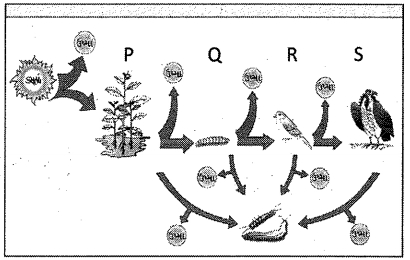
At which of the following levels is the energy the lowest?
A
$P$
B
$Q$
C
$R$
D
$S$
Solution
(D) According to the $10\%$ law of energy transfer in an ecosystem,only about $10\%$ of the energy available at one trophic level is transferred to the next higher trophic level.
As energy moves from producers $(P)$ to primary consumers $(Q)$,secondary consumers $(R)$,and finally to tertiary consumers $(S)$,a significant amount of energy is lost as heat at each step.
Therefore,the energy available decreases as we move up the food chain.
In the given food chain,$S$ represents the highest trophic level (tertiary consumer),and thus it will have the lowest amount of energy available.
As energy moves from producers $(P)$ to primary consumers $(Q)$,secondary consumers $(R)$,and finally to tertiary consumers $(S)$,a significant amount of energy is lost as heat at each step.
Therefore,the energy available decreases as we move up the food chain.
In the given food chain,$S$ represents the highest trophic level (tertiary consumer),and thus it will have the lowest amount of energy available.
0 likes
View Solution118
MediumMCQ
In an ecosystem,if the Net Primary Productivity $(NPP)$ of the first trophic level is $100x \text{ kcal } m^{-2} yr^{-1}$,what would be the Gross Primary Productivity $(GPP)$ of the third trophic level of the same ecosystem?
A
$x \text{ kcal } m^{-2} yr^{-1}$
B
$10x \text{ kcal } m^{-2} yr^{-1}$
C
$\frac{100x}{3} \text{ kcal } m^{-2} yr^{-1}$
D
$\frac{x}{10} \text{ kcal } m^{-2} yr^{-1}$
Solution
(B) According to Lindeman's $10 \%$ law,only $10 \%$ of the energy is transferred from one trophic level to the next.
The $NPP$ of the first trophic level acts as the $GPP$ for the second trophic level.
Therefore,the $GPP$ of the second trophic level is $100x \text{ kcal } m^{-2} yr^{-1}$.
Assuming the energy transfer efficiency is $10 \%$,the $NPP$ of the second trophic level is $100x \times 10 \% = 10x \text{ kcal } m^{-2} yr^{-1}$.
This $NPP$ of the second trophic level acts as the $GPP$ for the third trophic level.
Thus,the $GPP$ of the third trophic level is $10x \text{ kcal } m^{-2} yr^{-1}$.
The $NPP$ of the first trophic level acts as the $GPP$ for the second trophic level.
Therefore,the $GPP$ of the second trophic level is $100x \text{ kcal } m^{-2} yr^{-1}$.
Assuming the energy transfer efficiency is $10 \%$,the $NPP$ of the second trophic level is $100x \times 10 \% = 10x \text{ kcal } m^{-2} yr^{-1}$.
This $NPP$ of the second trophic level acts as the $GPP$ for the third trophic level.
Thus,the $GPP$ of the third trophic level is $10x \text{ kcal } m^{-2} yr^{-1}$.
0 likes
View Solution119
MediumMCQ
Which of the following has maximum energy at trophic level in this food chain $Grass \rightarrow Rabbit \rightarrow Wolf \rightarrow Lion$?
A
Grass
B
Rabbit
C
Wolf
D
Lion
Solution
(A) According to the $10\%$ law of energy transfer in an ecosystem,energy decreases as it moves from one trophic level to the next higher trophic level.
Producers (Grass) occupy the first trophic level and possess the maximum amount of energy.
As energy flows from producers to primary consumers (Rabbit),then to secondary consumers (Wolf),and finally to tertiary consumers (Lion),a significant portion of energy is lost as heat at each step.
Therefore,the organism at the base of the food chain,which is the Grass,contains the maximum energy.
Producers (Grass) occupy the first trophic level and possess the maximum amount of energy.
As energy flows from producers to primary consumers (Rabbit),then to secondary consumers (Wolf),and finally to tertiary consumers (Lion),a significant portion of energy is lost as heat at each step.
Therefore,the organism at the base of the food chain,which is the Grass,contains the maximum energy.
0 likes
View Solution120
MediumMCQ
In an aquatic ecosystem, which type of food chain is the major conduit for energy flow?
A
Grazing food chain
B
Parasitic food chain
C
Detritus food chain
D
Saprophytic food chain
Solution
(A) In an aquatic ecosystem, the $Grazing$ $food$ $chain$ $(GFC)$ is the major conduit for energy flow.
This is because the primary producers in aquatic ecosystems are $phytoplankton$, which are consumed by $zooplankton$ and small fish.
In contrast, in a terrestrial ecosystem, the $Detritus$ $food$ $chain$ $(DFC)$ is the major conduit for energy flow because a much larger fraction of energy flows through the $detritus$ pathway compared to the $GFC$.
This is because the primary producers in aquatic ecosystems are $phytoplankton$, which are consumed by $zooplankton$ and small fish.
In contrast, in a terrestrial ecosystem, the $Detritus$ $food$ $chain$ $(DFC)$ is the major conduit for energy flow because a much larger fraction of energy flows through the $detritus$ pathway compared to the $GFC$.
0 likes
View Solution121
EasyMCQ
Which one is the correct food chain?
A
Eagle $\longrightarrow$ Snake $\longrightarrow$ Grasshopper $\longrightarrow$ Grass $\longrightarrow$ Frog
B
Frog $\longrightarrow$ Snake $\longrightarrow$ Eagle $\longrightarrow$ Grasshopper $\longrightarrow$ Grass
C
Grasshopper $\longrightarrow$ Grass $\longrightarrow$ Snake $\longrightarrow$ Frog $\longrightarrow$ Eagle
D
Grass $\longrightarrow$ Grasshopper $\longrightarrow$ Frog $\longrightarrow$ Snake $\longrightarrow$ Eagle
Solution
(D) food chain represents the sequence of transfer of energy from producers to consumers.
$1$. The producer is the organism that synthesizes its own food,which in this case is Grass.
$2$. The primary consumer feeds on the producer,which is the Grasshopper.
$3$. The secondary consumer feeds on the primary consumer,which is the Frog.
$4$. The tertiary consumer feeds on the secondary consumer,which is the Snake.
$5$. The apex predator or quaternary consumer is the Eagle.
Therefore,the correct sequence is: Grass $\longrightarrow$ Grasshopper $\longrightarrow$ Frog $\longrightarrow$ Snake $\longrightarrow$ Eagle.
$1$. The producer is the organism that synthesizes its own food,which in this case is Grass.
$2$. The primary consumer feeds on the producer,which is the Grasshopper.
$3$. The secondary consumer feeds on the primary consumer,which is the Frog.
$4$. The tertiary consumer feeds on the secondary consumer,which is the Snake.
$5$. The apex predator or quaternary consumer is the Eagle.
Therefore,the correct sequence is: Grass $\longrightarrow$ Grasshopper $\longrightarrow$ Frog $\longrightarrow$ Snake $\longrightarrow$ Eagle.
0 likes
View Solution122
MediumMCQ
Assertion: Ecosystems are not exempt from the second law of thermodynamics.
Reason: In a food chain,energy flow is bidirectional.
Reason: In a food chain,energy flow is bidirectional.
A
Assertion and Reason both are true and Reason is a correct explanation of the assertion.
B
Assertion and Reason both are true but Reason is not a correct explanation of the assertion.
C
Assertion is true but the Reason is false.
D
Both Assertion and Reason are false.
Solution
(C) The second law of thermodynamics states that energy transfer is never $100\%$ efficient,as some energy is always lost as heat. Ecosystems follow this law because energy is lost at each trophic level during transfer.
Therefore,the Assertion is true.
In a food chain,energy flow is always unidirectional (from producers to consumers). It never flows in the reverse direction.
Therefore,the Reason is false.
Therefore,the Assertion is true.
In a food chain,energy flow is always unidirectional (from producers to consumers). It never flows in the reverse direction.
Therefore,the Reason is false.
0 likes
View Solution123
MediumMCQ
Which of the following is the primary source of energy for all ecosystems except deep-sea hydrothermal ecosystems?
A
Geothermal energy
B
Earth's geothermal energy
C
Sunlight
D
Chemical energy from rocks
Solution
(C) The Sun is the ultimate and primary source of energy for almost all ecosystems on Earth.
Photosynthesis,performed by producers (plants,algae,and cyanobacteria),converts solar energy into chemical energy,which then flows through the food chain.
Deep-sea hydrothermal ecosystems are the exception,as they rely on chemosynthesis,where organisms derive energy from chemical reactions involving inorganic substances like hydrogen sulfide,rather than sunlight.
Photosynthesis,performed by producers (plants,algae,and cyanobacteria),converts solar energy into chemical energy,which then flows through the food chain.
Deep-sea hydrothermal ecosystems are the exception,as they rely on chemosynthesis,where organisms derive energy from chemical reactions involving inorganic substances like hydrogen sulfide,rather than sunlight.
0 likes
View Solution124
MediumMCQ
Which of the following is $\text{NOT}$ recycled in an ecosystem?
A
Water
B
Carbon
C
Energy
D
Nitrogen
Solution
(C) In an ecosystem,nutrients like water,carbon,and nitrogen undergo biogeochemical cycles,meaning they are continuously recycled between the biotic and abiotic components.
However,energy flow in an ecosystem is unidirectional (non-cyclic).
Energy enters the ecosystem from the sun,is converted into chemical energy by producers,and then flows through various trophic levels.
At each transfer,a significant portion of energy is lost as heat,which cannot be reused by organisms. Therefore,energy is not recycled.
However,energy flow in an ecosystem is unidirectional (non-cyclic).
Energy enters the ecosystem from the sun,is converted into chemical energy by producers,and then flows through various trophic levels.
At each transfer,a significant portion of energy is lost as heat,which cannot be reused by organisms. Therefore,energy is not recycled.
0 likes
View Solution125
MediumMCQ
$A$ plant receives $10000 \ J$ of energy from the sun. The amount of energy that will be present at the third trophic level is $:-$ (in $J$)
A
$1$
B
$10$
C
$100$
D
$0.1$
Solution
(C) According to the $10\%$ law of energy transfer in an ecosystem,only $10\%$ of the energy available at one trophic level is transferred to the next trophic level.
$1$. The first trophic level (producers/plants) receives $10000 \ J$ of energy.
$2$. The second trophic level (primary consumers) receives $10\%$ of $10000 \ J$,which is $1000 \ J$.
$3$. The third trophic level (secondary consumers) receives $10\%$ of $1000 \ J$,which is $100 \ J$.
Therefore,the energy available at the third trophic level is $100 \ J$.
$1$. The first trophic level (producers/plants) receives $10000 \ J$ of energy.
$2$. The second trophic level (primary consumers) receives $10\%$ of $10000 \ J$,which is $1000 \ J$.
$3$. The third trophic level (secondary consumers) receives $10\%$ of $1000 \ J$,which is $100 \ J$.
Therefore,the energy available at the third trophic level is $100 \ J$.
0 likes
View Solution126
EasyMCQ
Given below are two statements.
Statement $I$ - The amount of energy available in an ecosystem increases at each successive trophic level.
Statement $II$ - Transfer of energy from one trophic level to the other follows $10\%$ law.
In the light of above statements, select the correct option given below:
Statement $I$ - The amount of energy available in an ecosystem increases at each successive trophic level.
Statement $II$ - Transfer of energy from one trophic level to the other follows $10\%$ law.
In the light of above statements, select the correct option given below:
A
Both statement $I$ and statement $II$ are correct.
B
Both statement $I$ and statement $II$ are incorrect.
C
Statement $I$ is correct but statement $II$ is incorrect.
D
Statement $I$ is incorrect but statement $II$ is correct.
Solution
$(D)$ Statement $I$ is incorrect because the amount of energy available decreases at each successive trophic level due to energy loss as heat during metabolic processes and respiration.
Statement $II$ is correct because according to the $10\%$ law (Lindeman's law), only about $10\%$ of the energy is transferred from one trophic level to the next, while the rest is lost.
Therefore, Statement $I$ is incorrect and Statement $II$ is correct.
Statement $II$ is correct because according to the $10\%$ law (Lindeman's law), only about $10\%$ of the energy is transferred from one trophic level to the next, while the rest is lost.
Therefore, Statement $I$ is incorrect and Statement $II$ is correct.
0 likes
View Solution127
EasyMCQ
The number of trophic levels in the grazing food chain is restricted as the transfer of energy follows . . . . . . %. (in $%$)
A
$16$
B
$10$
C
$9$
D
$12$
Solution
(B) According to the $10\%$ law of energy transfer proposed by Lindeman, only about $10\%$ of the energy available at one trophic level is transferred to the next trophic level. The remaining $90\%$ of the energy is lost as heat during metabolic processes or remains in the form of chemical energy in the biomass that is not consumed. Due to this significant loss of energy at each step, the number of trophic levels in a grazing food chain is typically limited to $4$ or $5$.
0 likes
View Solution128
EasyMCQ
If the primary producers have $100 \ J$ of energy,how much energy does the secondary consumer receive (in $J$)?
A
$10$
B
$100$
C
$1$
D
$0.1$
Solution
(C) According to the $10\%$ Law of energy transfer in an ecosystem,only about $10\%$ of the energy available at one trophic level is transferred to the next trophic level.
$1$. Primary Producers: $100 \ J$
$2$. Primary Consumers (First trophic level to second): $10\%$ of $100 \ J = 10 \ J$
$3$. Secondary Consumers (Second trophic level to third): $10\%$ of $10 \ J = 1 \ J$
Therefore,the secondary consumer receives $1 \ J$ of energy.
$1$. Primary Producers: $100 \ J$
$2$. Primary Consumers (First trophic level to second): $10\%$ of $100 \ J = 10 \ J$
$3$. Secondary Consumers (Second trophic level to third): $10\%$ of $10 \ J = 1 \ J$
Therefore,the secondary consumer receives $1 \ J$ of energy.
0 likes
View Solution129
EasyMCQ
Identify the incorrect statement regarding the flow of energy between various components of the food chain.
A
Each trophic level loses some energy as heat to the environment.
B
The amount of energy available at each trophic level is $10$% of previous trophic level.
C
Energy flow is unidirectional.
D
Green plants capture about $10$% of the solar energy that falls on leaves.
Solution
(D) The incorrect statement is $D$.
Green plants capture only about $1\%$ of the solar energy that falls on their leaves.
This energy is used in the process of photosynthesis to convert light energy into chemical energy,which is then stored as food.
The other statements $(A, B, C)$ are correct: energy is lost as heat at each trophic level,energy transfer follows the $10\%$ law,and energy flow in an ecosystem is always unidirectional.
Green plants capture only about $1\%$ of the solar energy that falls on their leaves.
This energy is used in the process of photosynthesis to convert light energy into chemical energy,which is then stored as food.
The other statements $(A, B, C)$ are correct: energy is lost as heat at each trophic level,energy transfer follows the $10\%$ law,and energy flow in an ecosystem is always unidirectional.
0 likes
View Solution130
EasyMCQ
Of the total incident solar radiation,the percentage of photosynthetically active radiation $(PAR)$ captured by the plants is
A
$10-20\%$ of $PAR$ only
B
$2-10\%$ of $PAR$ only
C
$0-10\%$ of $PAR$ only
D
$30-40\%$ of $PAR$ only
Solution
(B) The correct answer is $B$.
Photosynthetically active radiation $(PAR)$ consists of light with wavelengths between $400 \ nm$ and $700 \ nm$,which is the specific portion of the light spectrum utilized by plants for photosynthesis.
Out of the total incident solar radiation reaching the Earth,less than $50\%$ constitutes $PAR$.
Plants are only able to capture and utilize approximately $2-10\%$ of this $PAR$ for the process of photosynthesis.
Photosynthetically active radiation $(PAR)$ consists of light with wavelengths between $400 \ nm$ and $700 \ nm$,which is the specific portion of the light spectrum utilized by plants for photosynthesis.
Out of the total incident solar radiation reaching the Earth,less than $50\%$ constitutes $PAR$.
Plants are only able to capture and utilize approximately $2-10\%$ of this $PAR$ for the process of photosynthesis.
0 likes
View Solution131
EasyMCQ
If $30 \ J$ energy is trapped at the producer level,how much energy will be available to the peacock as food in the following food chain (in $J$)?
Plant $\rightarrow$ Mice $\rightarrow$ Snake $\rightarrow$ Peacock
Plant $\rightarrow$ Mice $\rightarrow$ Snake $\rightarrow$ Peacock
A
$0.3$
B
$0.03$
C
$0.0003$
D
$0.003$
Solution
(B) The correct answer is $(B)$ $0.03 \ J$.
According to the $10 \%$ law proposed by Lindeman $(1942)$,only $10 \%$ of the energy available at one trophic level is transferred to the next trophic level.
In the given food chain: Plant $\rightarrow$ Mice $\rightarrow$ Snake $\rightarrow$ Peacock.
$1$. Energy at producer level (Plant) = $30 \ J$.
$2$. Energy available to primary consumer (Mice) = $10 \%$ of $30 \ J = 3 \ J$.
$3$. Energy available to secondary consumer (Snake) = $10 \%$ of $3 \ J = 0.3 \ J$.
$4$. Energy available to tertiary consumer (Peacock) = $10 \%$ of $0.3 \ J = 0.03 \ J$.
Therefore,the peacock receives $0.03 \ J$ of energy.
According to the $10 \%$ law proposed by Lindeman $(1942)$,only $10 \%$ of the energy available at one trophic level is transferred to the next trophic level.
In the given food chain: Plant $\rightarrow$ Mice $\rightarrow$ Snake $\rightarrow$ Peacock.
$1$. Energy at producer level (Plant) = $30 \ J$.
$2$. Energy available to primary consumer (Mice) = $10 \%$ of $30 \ J = 3 \ J$.
$3$. Energy available to secondary consumer (Snake) = $10 \%$ of $3 \ J = 0.3 \ J$.
$4$. Energy available to tertiary consumer (Peacock) = $10 \%$ of $0.3 \ J = 0.03 \ J$.
Therefore,the peacock receives $0.03 \ J$ of energy.
0 likes
View Solution132
MediumMCQ
In an ecosystem,$1000 \ J$ of energy is stored at the producer level. How much energy will be available at the secondary consumer level (in $J$)?
A
$10$
B
$0.1$
C
$100$
D
$1$
Solution
(A) According to the $10\%$ law of energy transfer in ecosystems,only about $10\%$ of the energy is transferred from one trophic level to the next.
Step $1$: Energy at the producer level = $1000 \ J$.
Step $2$: Energy at the primary consumer level = $10\%$ of $1000 \ J = 100 \ J$.
Step $3$: Energy at the secondary consumer level = $10\%$ of $100 \ J = 10 \ J$.
Therefore,the energy available at the secondary consumer level is $10 \ J$.
Step $1$: Energy at the producer level = $1000 \ J$.
Step $2$: Energy at the primary consumer level = $10\%$ of $1000 \ J = 100 \ J$.
Step $3$: Energy at the secondary consumer level = $10\%$ of $100 \ J = 10 \ J$.
Therefore,the energy available at the secondary consumer level is $10 \ J$.
0 likes
View SolutionEcosystem — Energy Flow · Frequently Asked Questions
1Are these Ecosystem questions useful for JEE and NEET?
Yes. All questions in this section are mapped to JEE Main and NEET exam patterns. Previous year questions from JEE Main, NEET, GUJCET and state-level exams are included with full solutions.
2Can I switch to Hindi or Gujarati for these questions?
Yes. Use the language tabs in the hero section or the sidebar to view the same questions and solutions in English, Hindi or Gujarati.
3How do I generate a question paper from this subtopic?
Use the Vedclass Exam Paper Generator — select the chapter and subtopic, set difficulty, and generate Sets A, B, C, D automatically. First 3 chapters of every subject are free.
Vedclass Products
For Students
Vedclass Test Series
Mock tests in real JEE/NEET style with performance analysis. 5-day free trial.
Start Free TrialFor Teachers
Exam Paper Generator
Generate Set A/B/C/D papers from this chapter in 2 minutes. 3 chapters free.
Try FreeFor Institutes
Online Exam Module
Live online exams with unlimited students, 360° analytics & white-label branding.
See DemoFor Teachers & Institutes
Generate a Ecosystem Exam Paper in 2 Minutes
Select subtopic & difficulty — Sets A, B, C, D auto-generated with No Repeat logic.
First 3 chapters of every subject are free — no payment required.