
A English
Causes of Biodiversity Losses Questions in English
Class 12 Biology · Biodiversity and Conservation · Causes of Biodiversity Losses
158+
Questions
English
Language
100%
With Solutions
Showing 48 of 158 questions in English
51
EasyMCQ
Which of the following is the most important cause for animals and plants being driven to extinction?
A
Habitat loss and fragmentation
B
Drought and floods
C
Economic exploitation
D
Alien species invasion
Solution
(A) The most significant cause of biodiversity loss and the extinction of species is $Habitat \text{ } loss \text{ } and \text{ } fragmentation$.
As human populations increase, the demand for land grows, leading to the destruction of natural habitats such as tropical rainforests.
When large habitats are broken into smaller fragments, species that require large territories or those that are migratory are severely affected, leading to population decline and eventual extinction.
As human populations increase, the demand for land grows, leading to the destruction of natural habitats such as tropical rainforests.
When large habitats are broken into smaller fragments, species that require large territories or those that are migratory are severely affected, leading to population decline and eventual extinction.
0 likes
View Solution52
EasyMCQ
Biodiversity loss occurs due to the reasons given below:
$(i)$ Habitat loss and fragmentation
$(ii)$ Co-extinction
$(iii)$ Over-exploitation
$(iv)$ Alien species invasion
Identify the correct reasons.
$(i)$ Habitat loss and fragmentation
$(ii)$ Co-extinction
$(iii)$ Over-exploitation
$(iv)$ Alien species invasion
Identify the correct reasons.
A
$(i)$ and $(ii)$
B
$(i), (ii)$ and $(iii)$
C
$(ii), (iii)$ and $(iv)$
D
$(i), (ii), (iii)$ and $(iv)$
Solution
(D) Biodiversity loss is primarily driven by human activities that negatively impact ecosystems. The four major causes,often referred to as the 'Evil Quartet',are:
$1$. Habitat loss and fragmentation: This is the most significant cause,where natural habitats are destroyed or broken into smaller pieces.
$2$. Over-exploitation: Humans over-harvest species for food,medicine,or trade,leading to population decline.
$3$. Alien species invasion: The introduction of non-native species can outcompete or prey upon native species,causing their extinction.
$4$. Co-extinction: When a species becomes extinct,the plant and animal species associated with it in an obligatory way also become extinct.
Since all four factors listed $(i, ii, iii, iv)$ are recognized as primary causes of biodiversity loss,the correct option is $(D)$.
$1$. Habitat loss and fragmentation: This is the most significant cause,where natural habitats are destroyed or broken into smaller pieces.
$2$. Over-exploitation: Humans over-harvest species for food,medicine,or trade,leading to population decline.
$3$. Alien species invasion: The introduction of non-native species can outcompete or prey upon native species,causing their extinction.
$4$. Co-extinction: When a species becomes extinct,the plant and animal species associated with it in an obligatory way also become extinct.
Since all four factors listed $(i, ii, iii, iv)$ are recognized as primary causes of biodiversity loss,the correct option is $(D)$.
0 likes
View Solution53
MediumMCQ
$A$ tree species in Mauritius failed to reproduce because of the extinction of a fruit-eating bird. Which one of the following was that bird?
A
Dove
B
Dodo
C
Condor
D
Skua
Solution
(B) The tree species in question is the Calvaria major (tambalacoque) tree.
It was found that the tree species failed to reproduce because of the extinction of the Dodo bird,which was native to Mauritius.
The Dodo bird played a crucial role in the germination of the seeds of this tree by passing them through its digestive tract,which helped in breaking the hard seed coat.
Following the extinction of the Dodo in the $17^{th}$ century due to over-exploitation by humans,the tree species also faced the threat of extinction.
It was found that the tree species failed to reproduce because of the extinction of the Dodo bird,which was native to Mauritius.
The Dodo bird played a crucial role in the germination of the seeds of this tree by passing them through its digestive tract,which helped in breaking the hard seed coat.
Following the extinction of the Dodo in the $17^{th}$ century due to over-exploitation by humans,the tree species also faced the threat of extinction.
0 likes
View Solution54
MediumMCQ
Assertion: Tropical rain forests are disappearing fast from developing countries such as India.
Reason: No value is attached to these forests because these are poor in biodiversity.
Reason: No value is attached to these forests because these are poor in biodiversity.
A
If both Assertion and Reason are correct and the Reason is a correct explanation of the Assertion.
B
If both Assertion and Reason are correct but Reason is not a correct explanation of the Assertion.
C
If the Assertion is correct but Reason is incorrect.
D
If both the Assertion and Reason are incorrect.
Solution
(C) Tropical rain forests are located in the equatorial regions where the annual rainfall exceeds $140\, cm$.
They are also called jungles and cover one-twelfth of the Earth's surface but contain more than half of the Earth's flora and fauna,meaning they are extremely rich in biodiversity.
Therefore,the Reason provided is factually incorrect because these forests are actually very rich in biodiversity,not poor.
Nowadays,these forests are disappearing rapidly due to excessive deforestation for domestic purposes like fuel,furniture,accommodation,clothing,resin,gum,etc.
They are also called jungles and cover one-twelfth of the Earth's surface but contain more than half of the Earth's flora and fauna,meaning they are extremely rich in biodiversity.
Therefore,the Reason provided is factually incorrect because these forests are actually very rich in biodiversity,not poor.
Nowadays,these forests are disappearing rapidly due to excessive deforestation for domestic purposes like fuel,furniture,accommodation,clothing,resin,gum,etc.
0 likes
View Solution55
MediumMCQ
The decline in the population of Indian native fishes due to the introduction of $Clarias$ $gariepinus$ in the river Yamuna can be categorized as:
A
Co-extinction
B
Habitat fragmentation
C
Over-exploitation
D
Alien species invasion
Solution
(D) The introduction of non-native or exotic species into a new ecosystem often leads to the decline or extinction of indigenous species. This phenomenon is known as $Alien$ $species$ $invasion$. $Clarias$ $gariepinus$ (African catfish) is an invasive species that was illegally introduced into Indian water bodies,including the river Yamuna,where it competes with and preys upon native fish species,leading to a significant decline in their population.
0 likes
View Solution56
Medium
What are the major causes of species losses in a geographical region?
Solution
(N/A) Biodiversity is the variety of living forms present in various ecosystems. It includes variability among life forms from all sources including land,air,and water. Biodiversity around the world is declining at a very fast pace. The following are the major causes for the loss of biodiversity around the world:
$1$. Habitat loss and fragmentation: Habitats of various organisms are altered or destroyed by uncontrolled and unsustainable human activities such as deforestation,slash-and-burn agriculture,mining,and urbanization. This results in the breaking up of the habitat into small pieces,which affects the movement of migratory animals and decreases the genetic exchange between populations,leading to a decline in species.
$2$. Over-exploitation: Due to over-hunting and over-exploitation of various plants and animals by humans,many species have become endangered or extinct (such as the tiger and the passenger pigeon).
$3$. Alien species invasions: Accidental or intentional introduction of non-native species into a habitat has also led to the decline or extinction of indigenous species. For example,the Nile perch introduced in Lake Victoria in Kenya led to the extinction of more than $200$ species of native fish in the lake.
$4$. Co-extinction: In a native habitat,one species is connected to the other in an intricate network. The extinction of one species causes the extinction of other species,which is associated with it in an obligatory way. For example,the extinction of the host will cause the extinction of its parasites.
$1$. Habitat loss and fragmentation: Habitats of various organisms are altered or destroyed by uncontrolled and unsustainable human activities such as deforestation,slash-and-burn agriculture,mining,and urbanization. This results in the breaking up of the habitat into small pieces,which affects the movement of migratory animals and decreases the genetic exchange between populations,leading to a decline in species.
$2$. Over-exploitation: Due to over-hunting and over-exploitation of various plants and animals by humans,many species have become endangered or extinct (such as the tiger and the passenger pigeon).
$3$. Alien species invasions: Accidental or intentional introduction of non-native species into a habitat has also led to the decline or extinction of indigenous species. For example,the Nile perch introduced in Lake Victoria in Kenya led to the extinction of more than $200$ species of native fish in the lake.
$4$. Co-extinction: In a native habitat,one species is connected to the other in an intricate network. The extinction of one species causes the extinction of other species,which is associated with it in an obligatory way. For example,the extinction of the host will cause the extinction of its parasites.
0 likes
View Solution57
EasyMCQ
Provide information regarding extinct, endangered, or vulnerable species on Earth.
A
Extinct species
B
Endangered species
C
Vulnerable species
D
All of the above
Solution
(D) The Earth's biological wealth is declining rapidly due to various human activities.
$(i)$ The colonization of tropical Pacific islands by humans has led to the extinction of more than $200$ species of native birds.
(ii) According to the $IUCN$ Red List $(2004)$ documents, $784$ species have become extinct in the last $500$ years, including $338$ vertebrates, $359$ invertebrates, and $87$ plant species.
(iii) Recent examples of extinct species include the Dodo (Mauritius), Quagga (Africa), Thylacine (Australia), Steller's Sea Cow (Russia), and three subspecies of tiger (Bali, Javan, and Caspian). The last twenty years have witnessed the disappearance of $27$ species.
(iv) Currently, more than $15,500$ species worldwide are facing the threat of extinction. Approximately $12\%$ of all bird species, $23\%$ of all mammal species, $32\%$ of all amphibian species, and $31\%$ of all gymnosperm species in the world face the threat of extinction.
$(i)$ The colonization of tropical Pacific islands by humans has led to the extinction of more than $200$ species of native birds.
(ii) According to the $IUCN$ Red List $(2004)$ documents, $784$ species have become extinct in the last $500$ years, including $338$ vertebrates, $359$ invertebrates, and $87$ plant species.
(iii) Recent examples of extinct species include the Dodo (Mauritius), Quagga (Africa), Thylacine (Australia), Steller's Sea Cow (Russia), and three subspecies of tiger (Bali, Javan, and Caspian). The last twenty years have witnessed the disappearance of $27$ species.
(iv) Currently, more than $15,500$ species worldwide are facing the threat of extinction. Approximately $12\%$ of all bird species, $23\%$ of all mammal species, $32\%$ of all amphibian species, and $31\%$ of all gymnosperm species in the world face the threat of extinction.
0 likes
View Solution58
Medium
Discuss the causes of biodiversity loss.
Solution
(N/A) The world is currently facing accelerated species extinction,primarily due to four major causes,collectively known as 'The Evil Quartet':
$(a)$ Habitat loss and fragmentation: $(i)$ Tropical rainforests,which once covered more than $14\%$ of the Earth's land surface,now cover no more than $6\%$. $(ii)$ The Amazon rainforest,often called the 'lungs of the planet',is being cut and cleared for cultivating soya beans or for conversion to grasslands for raising beef cattle. $(iii)$ Pollution and degradation of habitats also threaten the survival of many species. $(iv)$ When large habitats are broken into small fragments due to human activities,mammals and birds requiring large territories are badly affected,leading to population declines.
$(b)$ Over-exploitation: Humans have always depended on nature for food and shelter,but when 'need' turns to 'greed',it leads to over-exploitation. $(i)$ Many species extinctions in the last $500$ years (e.g.,Steller's sea cow,passenger pigeon) were due to over-exploitation by humans. $(ii)$ Currently,many marine fish populations around the world are being over-harvested,endangering the continued existence of some commercially important species.
$(c)$ Alien species invasions: When alien species are introduced unintentionally or deliberately for whatever purpose,some of them turn invasive and cause decline or extinction of indigenous species. $(i)$ The Nile perch introduced into Lake Victoria in east Africa led to the extinction of an ecologically unique assemblage of more than $200$ species of cichlid fish. $(ii)$ Invasive weed species like carrot grass $(Parthenium)$,$Lantana$,and water hyacinth $(Eichhornia)$ cause environmental damage and pose a threat to our native species. $(iii)$ The illegal introduction of the African catfish $Clarias$ $gariepinus$ for aquaculture is posing a threat to the indigenous catfishes in our rivers.
$(d)$ Co-extinctions: When a species becomes extinct,the plant and animal species associated with it in an obligatory way also become extinct. For example,when a host fish species becomes extinct,its unique assemblage of parasites also meets the same fate. Another example is the case of a co-evolved plant-pollinator mutualism where extinction of one invariably leads to the extinction of the other.
$(a)$ Habitat loss and fragmentation: $(i)$ Tropical rainforests,which once covered more than $14\%$ of the Earth's land surface,now cover no more than $6\%$. $(ii)$ The Amazon rainforest,often called the 'lungs of the planet',is being cut and cleared for cultivating soya beans or for conversion to grasslands for raising beef cattle. $(iii)$ Pollution and degradation of habitats also threaten the survival of many species. $(iv)$ When large habitats are broken into small fragments due to human activities,mammals and birds requiring large territories are badly affected,leading to population declines.
$(b)$ Over-exploitation: Humans have always depended on nature for food and shelter,but when 'need' turns to 'greed',it leads to over-exploitation. $(i)$ Many species extinctions in the last $500$ years (e.g.,Steller's sea cow,passenger pigeon) were due to over-exploitation by humans. $(ii)$ Currently,many marine fish populations around the world are being over-harvested,endangering the continued existence of some commercially important species.
$(c)$ Alien species invasions: When alien species are introduced unintentionally or deliberately for whatever purpose,some of them turn invasive and cause decline or extinction of indigenous species. $(i)$ The Nile perch introduced into Lake Victoria in east Africa led to the extinction of an ecologically unique assemblage of more than $200$ species of cichlid fish. $(ii)$ Invasive weed species like carrot grass $(Parthenium)$,$Lantana$,and water hyacinth $(Eichhornia)$ cause environmental damage and pose a threat to our native species. $(iii)$ The illegal introduction of the African catfish $Clarias$ $gariepinus$ for aquaculture is posing a threat to the indigenous catfishes in our rivers.
$(d)$ Co-extinctions: When a species becomes extinct,the plant and animal species associated with it in an obligatory way also become extinct. For example,when a host fish species becomes extinct,its unique assemblage of parasites also meets the same fate. Another example is the case of a co-evolved plant-pollinator mutualism where extinction of one invariably leads to the extinction of the other.
0 likes
View Solution59
Medium
Give scientific reasons: Habitat loss is the most important cause of the extinction of our wildlife.
Solution
(N/A) Habitat is the natural environment where an organism lives,providing essential resources for food,reproduction,and survival. Habitat loss occurs due to deforestation,agricultural expansion,urbanization,and environmental pollution. When a habitat is destroyed,organisms lose their shelter and food sources,which increases predation risks and reduces reproductive success. This cumulative stress leads to a decline in population size,eventually driving species toward extinction.
0 likes
View Solution60
MediumMCQ
What could have triggered mass extinctions of species in the past?
A
Volcanic eruptions
B
Climate change and temperature extremes
C
Continental drift and glaciations
D
All of the above
Solution
(D) Mass extinctions in the past were caused by various natural geological and climatic events. These include:
$(i)$ Volcanic eruptions,which release massive amounts of gases and ash,altering the atmosphere.
$(ii)$ Earthquakes and tectonic shifts.
$(iii)$ Extremes of temperatures,leading to rapid climate change.
$(iv)$ Glaciations,which drastically reduce habitable areas.
$(v)$ Continental drift,which alters ocean currents and global climate patterns.
Therefore,all these factors have contributed to mass extinctions throughout Earth's history.
$(i)$ Volcanic eruptions,which release massive amounts of gases and ash,altering the atmosphere.
$(ii)$ Earthquakes and tectonic shifts.
$(iii)$ Extremes of temperatures,leading to rapid climate change.
$(iv)$ Glaciations,which drastically reduce habitable areas.
$(v)$ Continental drift,which alters ocean currents and global climate patterns.
Therefore,all these factors have contributed to mass extinctions throughout Earth's history.
0 likes
View Solution61
MediumMCQ
Poaching of tiger is a burning issue in today's world. What implication would this activity have on the functioning of the ecosystem of which the tigers are an integral part?
A
It will increase the population of primary consumers.
B
It will lead to the collapse of the food web.
C
It will cause an imbalance in the ecosystem.
D
All of the above.
Solution
(D) Tigers play a crucial role as apex predators in the food chain,which helps in maintaining the stability of the ecosystem.
As carnivores,they keep a check on the uncontrolled growth of herbivore populations.
They remove sick and old animals from the population,ensuring the health of the prey species.
Tigers serve as an indicator species for the health of the jungle ecosystem.
Protecting tigers essentially means protecting the entire forest habitat,as they require large areas to hunt and maintain the balance of the food chain.
As carnivores,they keep a check on the uncontrolled growth of herbivore populations.
They remove sick and old animals from the population,ensuring the health of the prey species.
Tigers serve as an indicator species for the health of the jungle ecosystem.
Protecting tigers essentially means protecting the entire forest habitat,as they require large areas to hunt and maintain the balance of the food chain.
0 likes
View Solution62
MediumMCQ
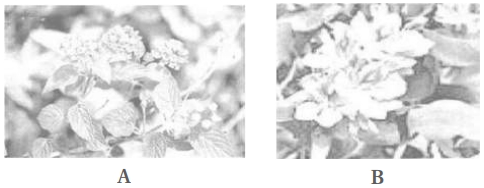
What is common to the species shown in figures $A$ and $B$?
A
Both are endemic species.
B
Both are invasive weed species.
C
Both are critically endangered species.
D
Both are used for medicinal purposes.
Solution
(B) The figures $A$ and $B$ represent $Lantana$ $camara$ and $Eichhornia$ $crassipes$ (water hyacinth),respectively. Both of these are well-known examples of invasive alien species that have caused significant environmental damage and pose a threat to our native biodiversity.
0 likes
View Solution63
EasyMCQ
How is the presently occurring species extinction different from the earlier mass extinctions?
A
Present extinction is natural,while earlier ones were anthropogenic.
B
Present extinction is occurring at a much faster rate due to human activities,whereas earlier extinctions were due to natural causes.
C
There is no difference between the two.
D
Earlier extinctions were caused by pollution,while present ones are caused by climate change.
Solution
(B) The species extinction occurring at present is primarily driven by anthropogenic (human-induced) activities such as habitat destruction,overexploitation,and pollution.
In contrast,the earlier mass extinctions that occurred in Earth's history were caused by natural phenomena such as volcanic eruptions,asteroid impacts,or major climatic shifts.
Furthermore,the current rate of extinction is estimated to be $100$ to $1000$ times faster than the natural background rate of extinction.
In contrast,the earlier mass extinctions that occurred in Earth's history were caused by natural phenomena such as volcanic eruptions,asteroid impacts,or major climatic shifts.
Furthermore,the current rate of extinction is estimated to be $100$ to $1000$ times faster than the natural background rate of extinction.
0 likes
View Solution64
Medium
Of the four major causes for the loss of biodiversity (Alien species invasion,habitat loss and fragmentation,over-exploitation,and co-extinctions),which according to you is the major cause for the loss of biodiversity? Give reasons in support.
Solution
(B) Habitat loss and fragmentation is the most important cause driving animals and plants to extinction.
The most dramatic examples of habitat loss come from tropical rain forests.
Once covering more than $14$ percent of the earth's land surface,these rain forests now cover no more than $6$ percent.
They are being destroyed fast.
By the time you finish reading this chapter,$1000$ more hectares of rain forest would have been lost.
The Amazon rain forest (it is so huge that it is called the 'lungs of the planet') harbouring probably millions of species is being cut and cleared for cultivating soybeans or for conversion to grasslands for raising beef cattle.
The most dramatic examples of habitat loss come from tropical rain forests.
Once covering more than $14$ percent of the earth's land surface,these rain forests now cover no more than $6$ percent.
They are being destroyed fast.
By the time you finish reading this chapter,$1000$ more hectares of rain forest would have been lost.
The Amazon rain forest (it is so huge that it is called the 'lungs of the planet') harbouring probably millions of species is being cut and cleared for cultivating soybeans or for conversion to grasslands for raising beef cattle.
0 likes
View Solution65
Medium
Discuss one example,based on your day-to-day observations,showing how the loss of one species may lead to the extinction of another.
Solution
(N/A) When a species becomes extinct,the plant and animal species associated with it in an obligatory way also become extinct.
For example:
$(i)$ When a fish species that serves as a host for a specific parasite becomes extinct,the parasite species that are uniquely dependent on that host fish will also face extinction.
$(ii)$ Insects can be polyphagous (feeding on more than one plant species) or monophagous (feeding on only one particular plant species).
The monophagous insect species are highly vulnerable and may become extinct if the specific plant species upon which they feed becomes extinct.
For example:
$(i)$ When a fish species that serves as a host for a specific parasite becomes extinct,the parasite species that are uniquely dependent on that host fish will also face extinction.
$(ii)$ Insects can be polyphagous (feeding on more than one plant species) or monophagous (feeding on only one particular plant species).
The monophagous insect species are highly vulnerable and may become extinct if the specific plant species upon which they feed becomes extinct.
0 likes
View Solution66
EasyMCQ
What criteria should one use in categorizing a species as threatened?
A
High population growth rate
B
Rapid decline in population size
C
Wide geographical distribution
D
High genetic diversity
Solution
(B) species is categorized as threatened based on several criteria,primarily focusing on the risk of extinction:
$(i)$ Population decline: The number of individuals of the species is decreasing at an alarming rate.
$(ii)$ Habitat loss and fragmentation: The natural environment required for survival is being destroyed or broken into smaller,isolated patches.
$(iii)$ Predation and competition pressure: Increased pressure from predators or invasive species.
$(iv)$ Introduction of alien species: Non-native species outcompeting or preying on the native species.
$(i)$ Population decline: The number of individuals of the species is decreasing at an alarming rate.
$(ii)$ Habitat loss and fragmentation: The natural environment required for survival is being destroyed or broken into smaller,isolated patches.
$(iii)$ Predation and competition pressure: Increased pressure from predators or invasive species.
$(iv)$ Introduction of alien species: Non-native species outcompeting or preying on the native species.
0 likes
View Solution67
MediumMCQ
What could be the possible explanation for the greater vulnerability of amphibians to extinction compared to other animal groups?
A
They have a complex life cycle involving metamorphosis.
B
They are ectothermic and sensitive to temperature changes.
C
They depend on both terrestrial and aquatic habitats for their survival and reproduction.
D
They have permeable skin that makes them susceptible to pollutants.
Solution
(C) $\Rightarrow$ Amphibians are uniquely vulnerable because they occupy a dual life strategy.
$\Rightarrow$ While they live in terrestrial habitats,they are strictly dependent on aquatic habitats for their sexual reproduction and larval development.
$\Rightarrow$ Consequently,habitat loss or degradation in either the terrestrial or aquatic environment directly threatens their survival and reproductive success,making them more susceptible to extinction than groups that rely on a single type of habitat.
$\Rightarrow$ While they live in terrestrial habitats,they are strictly dependent on aquatic habitats for their sexual reproduction and larval development.
$\Rightarrow$ Consequently,habitat loss or degradation in either the terrestrial or aquatic environment directly threatens their survival and reproductive success,making them more susceptible to extinction than groups that rely on a single type of habitat.
0 likes
View Solution68
Medium
List any two major causes other than anthropogenic causes of the loss of biodiversity.
Solution
(N/A) Apart from anthropogenic (human-induced) activities,the loss of biodiversity is primarily driven by natural causes. Two major natural causes are:
$1$. Natural Calamities: Events such as volcanic eruptions,earthquakes,floods,and forest fires can cause sudden and massive destruction of habitats,leading to the loss of species.
$2$. Climate Change: Long-term shifts in temperature and weather patterns,such as ice ages or prolonged droughts,can alter ecosystems significantly,making it difficult for certain species to survive and adapt,eventually leading to their extinction.
$1$. Natural Calamities: Events such as volcanic eruptions,earthquakes,floods,and forest fires can cause sudden and massive destruction of habitats,leading to the loss of species.
$2$. Climate Change: Long-term shifts in temperature and weather patterns,such as ice ages or prolonged droughts,can alter ecosystems significantly,making it difficult for certain species to survive and adapt,eventually leading to their extinction.
0 likes
View Solution69
Medium
What is an endangered species? Give an example of an endangered plant and animal species each.
Solution
(N/A) An endangered species is a species that is facing a very high risk of extinction in the wild in the near future if conservation measures are not promptly taken.
Example of an endangered animal species: Red panda $(Ailurus \text{ } fulgens)$.
Example of an endangered plant species: $Drosera \text{ } indica$ (Sundew).
Example of an endangered animal species: Red panda $(Ailurus \text{ } fulgens)$.
Example of an endangered plant species: $Drosera \text{ } indica$ (Sundew).
0 likes
View Solution70
Easy
What is co-extinction? Explain with a suitable example.
Solution
(N/A) Co-extinction refers to the process where the extinction of one species leads to the inevitable extinction of another species that is obligatorily associated with it.
$1$. Parasite-Host Example: When a host fish species becomes extinct,its unique assemblage of parasites also meets the same fate because they cannot survive without their specific host.
$2$. Plant-Pollinator Example: In cases of coevolved plant-pollinator mutualism,the extinction of the plant species leads to the extinction of the pollinator,and vice versa,as they depend entirely on each other for survival and reproduction.
$1$. Parasite-Host Example: When a host fish species becomes extinct,its unique assemblage of parasites also meets the same fate because they cannot survive without their specific host.
$2$. Plant-Pollinator Example: In cases of coevolved plant-pollinator mutualism,the extinction of the plant species leads to the extinction of the pollinator,and vice versa,as they depend entirely on each other for survival and reproduction.
0 likes
View Solution71
Easy
Elaborate how invasion by an alien species reduces the species diversity of an area.
Solution
(N/A) Alien species invasion is one of the major causes of biodiversity loss. When alien species are introduced intentionally or unintentionally into a new habitat,they often become invasive due to the absence of their natural predators or competitors in the new environment.
$1$. Competition for Resources: Invasive species often outcompete native species for limited resources such as food,water,space,and sunlight.
$2$. Predation: Alien species may act as predators to native species that have not evolved defense mechanisms against them,leading to a rapid decline in native populations.
$3$. Disruption of Ecosystem Processes: They can alter the physical environment,nutrient cycling,or fire regimes,making the habitat unsuitable for native species.
$4$. Example: The introduction of the Nile Perch into Lake Victoria in East Africa led to the extinction of more than $200$ species of native cichlid fish.
$1$. Competition for Resources: Invasive species often outcompete native species for limited resources such as food,water,space,and sunlight.
$2$. Predation: Alien species may act as predators to native species that have not evolved defense mechanisms against them,leading to a rapid decline in native populations.
$3$. Disruption of Ecosystem Processes: They can alter the physical environment,nutrient cycling,or fire regimes,making the habitat unsuitable for native species.
$4$. Example: The introduction of the Nile Perch into Lake Victoria in East Africa led to the extinction of more than $200$ species of native cichlid fish.
0 likes
View Solution72
Advanced
Though the conflict between humans and wildlife started with the evolution of man,the intensity of conflict has increased due to the activities of modern man. Justify your answer with suitable examples.
Solution
(N/A) The history of life on Earth,as revealed by fossil records,shows that large-scale loss of species has occurred previously,even before the appearance of humans.
During the long period of over $3$ billion years since the origin and diversification of life,there have been five episodes of mass extinction.
The 'Sixth Extinction' currently in progress is distinct from previous episodes.
- The primary difference lies in the rate of extinction; current rates are estimated to be $100$ to $1,000$ times faster than in pre-human times,and human activities are directly responsible for this acceleration.
Ecologists warn that if current trends persist,nearly half of all species on Earth could be wiped out within the next $100$ years.
Historical evidence,such as the colonization of tropical Pacific Islands by humans,led to the extinction of more than $2,000$ species of native birds.
The $IUCN$ Red List $(2004)$ documents the extinction of $784$ species,with $27$ species disappearing in the last twenty years alone.
During the long period of over $3$ billion years since the origin and diversification of life,there have been five episodes of mass extinction.
The 'Sixth Extinction' currently in progress is distinct from previous episodes.
- The primary difference lies in the rate of extinction; current rates are estimated to be $100$ to $1,000$ times faster than in pre-human times,and human activities are directly responsible for this acceleration.
Ecologists warn that if current trends persist,nearly half of all species on Earth could be wiped out within the next $100$ years.
Historical evidence,such as the colonization of tropical Pacific Islands by humans,led to the extinction of more than $2,000$ species of native birds.
The $IUCN$ Red List $(2004)$ documents the extinction of $784$ species,with $27$ species disappearing in the last twenty years alone.
0 likes
View Solution73
Medium
Describe various causes of biodiversity losses in detail.
Solution
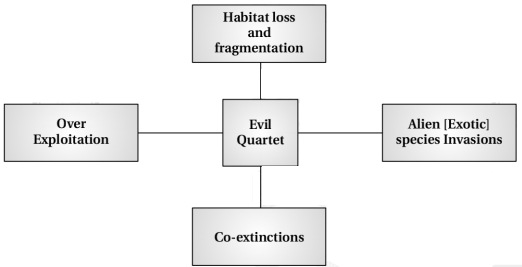
(N/A) Human activities have accelerated the rate of species extinction from the Earth. The four main causes,collectively known as the 'Evil Quartet',are responsible for the loss of biodiversity:
$(A)$ Habitat loss and fragmentation: This is the most significant cause driving the extinction of both plant and animal species. For example,due to habitat loss,the Earth's land surface covered by tropical rainforests has shrunk from $14 \%$ to only $6 \%$ in recent years. The Amazon rainforest,often called the 'lungs of the planet',is being cleared for soybean cultivation or converted into grasslands for cattle ranching. Additionally,habitat degradation due to pollution threatens many species. When large habitats are fragmented into smaller pieces by human activities,mammals and birds requiring large territories,as well as migratory animals,are severely affected,leading to population declines.
$(B)$ Over-exploitation: Humans have always depended on nature for food and shelter. However,when human needs turn into greed,it leads to the over-exploitation of natural resources. Many species have become extinct in the last $500$ years due to over-exploitation,such as the Steller's sea cow and the passenger pigeon. Currently,many marine fish populations are being over-harvested,threatening the survival of commercially important species.
$(C)$ Alien species invasions: When alien species are introduced unintentionally or deliberately for whatever purpose,some of them turn invasive and cause the decline or extinction of indigenous species. For example,the Nile perch introduced into Lake Victoria in East Africa led to the extinction of an ecologically unique assemblage of more than $200$ species of cichlid fish in the lake.
$(D)$ Co-extinctions: When a species becomes extinct,the plant and animal species associated with it in an obligatory way also become extinct. For example,when a host fish species becomes extinct,its unique assemblage of parasites also meets the same fate.
$(A)$ Habitat loss and fragmentation: This is the most significant cause driving the extinction of both plant and animal species. For example,due to habitat loss,the Earth's land surface covered by tropical rainforests has shrunk from $14 \%$ to only $6 \%$ in recent years. The Amazon rainforest,often called the 'lungs of the planet',is being cleared for soybean cultivation or converted into grasslands for cattle ranching. Additionally,habitat degradation due to pollution threatens many species. When large habitats are fragmented into smaller pieces by human activities,mammals and birds requiring large territories,as well as migratory animals,are severely affected,leading to population declines.
$(B)$ Over-exploitation: Humans have always depended on nature for food and shelter. However,when human needs turn into greed,it leads to the over-exploitation of natural resources. Many species have become extinct in the last $500$ years due to over-exploitation,such as the Steller's sea cow and the passenger pigeon. Currently,many marine fish populations are being over-harvested,threatening the survival of commercially important species.
$(C)$ Alien species invasions: When alien species are introduced unintentionally or deliberately for whatever purpose,some of them turn invasive and cause the decline or extinction of indigenous species. For example,the Nile perch introduced into Lake Victoria in East Africa led to the extinction of an ecologically unique assemblage of more than $200$ species of cichlid fish in the lake.
$(D)$ Co-extinctions: When a species becomes extinct,the plant and animal species associated with it in an obligatory way also become extinct. For example,when a host fish species becomes extinct,its unique assemblage of parasites also meets the same fate.
0 likes
View Solution74
EasyMCQ
Due to which characteristics was the water hyacinth $(Eichhornia \text{ } crassipes)$ introduced in India?
A
Beautiful pollen and leaf shape
B
Ability of vegetative propagation and beautiful flowers
C
Beautiful flowers and pollen shape
D
Beautiful flowers and leaf shape
Solution
(D) Water hyacinth $(Eichhornia \text{ } crassipes)$ was introduced in India primarily because of its beautiful flowers and unique shape of leaves.
However, it later became a problematic invasive weed because it propagates vegetatively at a phenomenal rate and spreads all over the water body in a short period of time, making it difficult to eliminate.
However, it later became a problematic invasive weed because it propagates vegetatively at a phenomenal rate and spreads all over the water body in a short period of time, making it difficult to eliminate.
0 likes
View Solution75
MediumMCQ
Which plant entered India as a contaminant with imported wheat?
A
Parthenium (carrot grass)
B
Silver grass
C
Pampas grass
D
Sorghum grass
Solution
(A) Parthenium hysterophorus,commonly known as carrot grass or congress grass,was introduced into India accidentally as a contaminant in imported wheat shipments. It has since become a widespread invasive weed across the country.
0 likes
View Solution76
MediumMCQ
Why do alien species often become invasive when introduced into a new habitat?
A
They have no natural competitors.
B
The soil fertility is more favorable.
C
The absence of their natural predators.
D
All of the above.
Solution
(D) When an alien species is introduced into a new habitat,it often becomes invasive because it lacks its natural predators and competitors that would normally keep its population in check in its native environment. This release from natural enemies allows the species to proliferate rapidly and outcompete native species for resources. Additionally,favorable environmental conditions,such as soil fertility or climate,can further facilitate this rapid expansion. Therefore,all the given factors contribute to the invasive nature of alien species.
0 likes
View Solution77
MediumMCQ
In the current era,$\underline{X \%}$ of all bird species and $\underline{Y \%}$ of all amphibian species in the world are facing the threat of extinction.
A
$X = 12 \%, Y = 32 \%$
B
$X = 23 \%, Y = 35 \%$
C
$X = 32 \%, Y = 10 \%$
D
$X = 10 \%, Y = 12 \%$
Solution
(A) According to the $IUCN$ Red List $(2004)$ documents,the recent extinction of species is a major concern for global biodiversity.
Specifically,the data indicates that $12 \%$ of all bird species and $32 \%$ of all amphibian species currently face the threat of extinction.
Therefore,$X = 12 \%$ and $Y = 32 \%$.
Specifically,the data indicates that $12 \%$ of all bird species and $32 \%$ of all amphibian species currently face the threat of extinction.
Therefore,$X = 12 \%$ and $Y = 32 \%$.
0 likes
View Solution78
MediumMCQ
How many times have mass extinctions of species occurred since $3$ billion years ago to the present?
A
Five times
B
Four times
C
Three times
D
Two times
Solution
(A) According to the fossil record and evolutionary history,there have been $5$ major mass extinction events in the history of life on Earth since the origin of life approximately $3.5$ to $3.8$ billion years ago. These events are known as the 'Big Five' mass extinctions. Therefore,the correct answer is $5$ times.
0 likes
View Solution79
MediumMCQ
How many major causes are there for the loss of biodiversity?
A
One
B
Two
C
Three
D
Four
Solution
(D) The loss of biodiversity is primarily attributed to four major causes,which are collectively known as the '$Evil Quartet$'.
$1$. $Habitat$ loss and fragmentation: This is the most important cause driving animals and plants to extinction.
$2$. Over-exploitation: Humans have always depended on nature for food and shelter,but when '$need$' turns to '$greed$',it leads to over-exploitation.
$3$. Alien species invasions: When alien species are introduced unintentionally or deliberately,some of them turn invasive and cause the decline or extinction of indigenous species.
$4$. Co-extinctions: When a species becomes extinct,the plant and animal species associated with it in an obligatory way also become extinct.
$1$. $Habitat$ loss and fragmentation: This is the most important cause driving animals and plants to extinction.
$2$. Over-exploitation: Humans have always depended on nature for food and shelter,but when '$need$' turns to '$greed$',it leads to over-exploitation.
$3$. Alien species invasions: When alien species are introduced unintentionally or deliberately,some of them turn invasive and cause the decline or extinction of indigenous species.
$4$. Co-extinctions: When a species becomes extinct,the plant and animal species associated with it in an obligatory way also become extinct.
0 likes
View Solution80
MediumMCQ
The Caspian is a subspecies of which animal?
A
Tiger
B
Sea cow
C
Horse
D
Koala
Solution
(A) The Caspian tiger $(Panthera \text{ tigris virgata})$ is an extinct subspecies of tiger that was once found in the region around the Caspian Sea. It is a classic example of a species that has gone extinct due to human activities and habitat loss.
0 likes
View Solution81
MediumMCQ
Select the appropriate option regarding the term 'The Evil Quartet'.
A
Increase in species diversity
B
Deforestation
C
Causes of biodiversity loss
D
Desertification
Solution
(C) The term 'The Evil Quartet' is used to describe the four major causes of biodiversity loss.
These four causes are:
$1$. Habitat loss and fragmentation.
$2$. Over-exploitation.
$3$. Alien species invasions.
$4$. Co-extinctions.
Therefore,option $C$ is the correct answer.
These four causes are:
$1$. Habitat loss and fragmentation.
$2$. Over-exploitation.
$3$. Alien species invasions.
$4$. Co-extinctions.
Therefore,option $C$ is the correct answer.
0 likes
View Solution82
MediumMCQ
Which species has become extinct due to overexploitation by humans?
A
Thylacine
B
Tiger
C
Passenger Pigeon
D
Nile Perch
Solution
(C) Overexploitation refers to the excessive harvesting of a species for human needs,which leads to its extinction. The $Steller's$ sea cow and the Passenger Pigeon are classic examples of species that went extinct due to overexploitation by humans. The Thylacine (Tasmanian wolf) also went extinct due to human hunting. However,in the context of $NCERT$,the Passenger Pigeon is a primary example cited for extinction due to overexploitation.
0 likes
View Solution83
MediumMCQ
Which phenomenon was observed in Lake Victoria of East Africa?
A
Habitat loss and fragmentation
B
Alien species invasion
C
Co-extinction
D
Over-exploitation
Solution
(B) The introduction of the Nile perch,an alien predator fish,into Lake Victoria in East Africa led to the extinction of more than $200$ species of cichlid fish in the lake. This is a classic example of biodiversity loss due to the invasion of alien species.
0 likes
View Solution84
MediumMCQ
Which of the following is an endemic fish species of Lake Victoria?
A
Cichlid
B
Nile Perch
C
Clarias gariepinus
D
African Lamprey
Solution
(A) Lake Victoria in East Africa is famous for its high biodiversity of $Cichlid$ fish.
When the $Nile \text{ } Perch$ (an alien predator fish) was introduced into Lake Victoria, it led to the extinction of more than $200$ species of $Cichlid$ fish, which were endemic to the lake.
Therefore, $Cichlid$ is the correct answer as it represents the group of endemic fish species that were native to Lake Victoria.
When the $Nile \text{ } Perch$ (an alien predator fish) was introduced into Lake Victoria, it led to the extinction of more than $200$ species of $Cichlid$ fish, which were endemic to the lake.
Therefore, $Cichlid$ is the correct answer as it represents the group of endemic fish species that were native to Lake Victoria.
0 likes
View Solution85
MediumMCQ
When a species becomes extinct,the plant and animal species associated with it in an obligatory way also become extinct. This phenomenon is known as:
A
Invasion
B
Co-extinction
C
Over-exploitation
D
Fragmentation
Solution
(B) Co-extinction is a phenomenon where the extinction of one species leads to the extinction of another species that is obligatorily associated with it.
For example,when a host fish species becomes extinct,its unique assemblage of parasites also meets the same fate.
Another example is the co-evolved plant-pollinator mutualism,where the extinction of one inevitably leads to the extinction of the other.
For example,when a host fish species becomes extinct,its unique assemblage of parasites also meets the same fate.
Another example is the co-evolved plant-pollinator mutualism,where the extinction of one inevitably leads to the extinction of the other.
0 likes
View Solution86
MediumMCQ
In Lake Victoria of East Africa, more than $Y$ species of $X$ fish became extinct together. Identify $X$ and $Y$.
A
$X = \text{Nile Perch}, Y = 100$
B
$X = \text{Cichlid}, Y = 200$
C
$X = \text{Clarias gariepinus}, Y = 100$
D
$X = \text{Lamprey}, Y = 2000$
Solution
(B) The introduction of the Nile Perch, an alien predator fish, into Lake Victoria in East Africa led to the extinction of an ecologically unique assemblage of more than $200$ species of Cichlid fish in the lake.
Therefore, $X = \text{Cichlid}$ and $Y = 200$.
Therefore, $X = \text{Cichlid}$ and $Y = 200$.
0 likes
View Solution87
MediumMCQ
Which of the following is an aquatic weed?
A
Parthenium (Carrot grass)
B
Lantana
C
Eichhornia (Water hyacinth)
D
All of the above
Solution
(C) Eichhornia crassipes,commonly known as water hyacinth,is an invasive aquatic weed.
It was introduced in India for its beautiful flowers but became a major environmental problem as it grows rapidly in water bodies,causing an imbalance in the aquatic ecosystem.
Parthenium and Lantana are also invasive weeds,but they are terrestrial,not aquatic.
It was introduced in India for its beautiful flowers but became a major environmental problem as it grows rapidly in water bodies,causing an imbalance in the aquatic ecosystem.
Parthenium and Lantana are also invasive weeds,but they are terrestrial,not aquatic.
0 likes
View Solution88
MediumMCQ
Which alien species was introduced into Lake Victoria?
A
Nile Perch
B
Cichlid
C
Atlantic Salmon
D
Stonefish
Solution
(A) The introduction of the Nile Perch $(Lates \text{ niloticus})$ into Lake Victoria in East Africa caused the extinction of an ecologically unique assemblage of more than $200$ species of Cichlid fish in the lake. This is a classic example of biodiversity loss due to the introduction of alien species.
0 likes
View Solution89
MediumMCQ
Match the following columns:
| List-$I$ | List-$II$ |
| $(a)$ Dodo | $(1)$ Africa |
| $(b)$ Quagga | $(2)$ Russia |
| $(c)$ Thylacine | $(3)$ Mauritius |
| $(d)$ Steller's sea cow | $(4)$ Australia |
A
$a-2, b-3, c-4, d-1$
B
$a-1, b-4, c-3, d-2$
C
$a-3, b-1, c-4, d-2$
D
$a-1, b-2, c-4, d-3$
Solution
(C) The correct matches for the extinct species and their regions are as follows:
$(a)$ Dodo was native to Mauritius.
$(b)$ Quagga was native to Africa.
$(c)$ Thylacine was native to Australia.
$(d)$ Steller's sea cow was native to Russia.
Therefore, the correct matching is $a-3, b-1, c-4, d-2$.
$(a)$ Dodo was native to Mauritius.
$(b)$ Quagga was native to Africa.
$(c)$ Thylacine was native to Australia.
$(d)$ Steller's sea cow was native to Russia.
Therefore, the correct matching is $a-3, b-1, c-4, d-2$.
0 likes
View Solution90
EasyMCQ
Which of the following is known as the 'Terror of Bengal'?
A
Hydrilla
B
Eichhornia crassipes (Water Hyacinth)
C
Algal bloom
D
Cuscuta
Solution
(B) $Eichhornia crassipes$,commonly known as Water Hyacinth,is an invasive aquatic weed.
It was introduced in India for its beautiful flowers but became a major problem because it grows at an alarming rate in water bodies.
It drains oxygen from the water,which leads to the death of fishes and other aquatic organisms.
Due to its rapid spread and the destruction it causes to aquatic ecosystems in West Bengal,it is famously referred to as the 'Terror of Bengal'.
It was introduced in India for its beautiful flowers but became a major problem because it grows at an alarming rate in water bodies.
It drains oxygen from the water,which leads to the death of fishes and other aquatic organisms.
Due to its rapid spread and the destruction it causes to aquatic ecosystems in West Bengal,it is famously referred to as the 'Terror of Bengal'.
0 likes
View Solution91
EasyMCQ
$A$ species which was introduced for ornamentation but has become a troublesome weed in India is:
A
Trapa spinosa
B
Parthenium hysterophorus
C
Eichhornia crassipes
D
Prosopis juliflora
Solution
(C) $Eichhornia$ $crassipes$ (Water Hyacinth) was introduced in India for its beautiful flowers and leaves for ornamentation. However, it grew uncontrollably in water bodies, causing an imbalance in the ecosystem and becoming a troublesome weed, often referred to as the 'Terror of Bengal'.
0 likes
View Solution92
MediumMCQ
Genetic diversity in agricultural crops is threatened by:
A
Introduction of high yielding varieties
B
Intensive use of fertilizers
C
Extensive intercropping
D
Intensive use of biopesticides
Solution
(A) The introduction of high-yielding varieties (HYVs) has led to a significant reduction in genetic diversity. Farmers often replace traditional,locally adapted landraces with a few genetically uniform high-yielding varieties to maximize production. This practice creates a monoculture,making crops more susceptible to diseases and pests,and results in the loss of valuable genetic traits present in traditional varieties.
0 likes
View Solution93
EasyMCQ
Exotic species are also called
$I.$ introduced species
$II.$ alien species
$III.$ non-indigenous species
$IV.$ non-native species
Choose the correct combination
$I.$ introduced species
$II.$ alien species
$III.$ non-indigenous species
$IV.$ non-native species
Choose the correct combination
A
$I, II$ and $III$
B
$II, III$ and $IV$
C
$I, III$ and $IV$
D
$I, II, III$ and $IV$
Solution
(D) An introduced,alien,exotic,non-indigenous,or non-native species is a species living outside its native distributional range,which has arrived there by human activity,either deliberate or accidental.
These terms are synonyms used to describe organisms that have been transported by humans to a new geographic region where they do not naturally occur.
Therefore,all four terms ($I, II, III,$ and $IV$) are correct synonyms for exotic species.
These terms are synonyms used to describe organisms that have been transported by humans to a new geographic region where they do not naturally occur.
Therefore,all four terms ($I, II, III,$ and $IV$) are correct synonyms for exotic species.
0 likes
View Solution94
MediumMCQ
Why do exotic species sometimes become invasive and start spreading rapidly?
A
Natural predators
B
Abundant natural competitors
C
The invaded land lacks their natural predators
D
Mutation in their genome
Solution
(C) Exotic species become invasive when they are introduced into a new environment where they lack their natural predators. In their native habitat,natural predators keep their population in check. In the absence of these predators in the new environment,the species faces no biological control,allowing its population to grow exponentially and spread rapidly.
0 likes
View Solution95
MediumMCQ
Which of the following is an exotic species?
A
Parthenium
B
Lantana
C
Eichhornia
D
All of these
Solution
(D) Exotic species are those that are introduced into a new environment from their native range. $Parthenium$ (carrot grass),$Lantana$ $camara$,and $Eichhornia$ $crassipes$ (water hyacinth) are all well-known examples of invasive exotic species in India that have caused significant damage to native biodiversity. Therefore,all the given options are correct.
0 likes
View Solution96
EasyMCQ
The species,which is going to become extinct due to lack of proper care,would be called:
A
Rare
B
Endangered
C
Vulnerable
D
Extinct
Solution
(B) Taxa whose numbers have been reduced to a critical level or whose habitats have been so drastically reduced that they are deemed to be in immediate danger of extinction are called endangered species.
These species require immediate conservation efforts and proper care to prevent them from becoming extinct.
Examples include the lion-tailed macaque,crocodile,musk deer,and rhinoceros.
These species require immediate conservation efforts and proper care to prevent them from becoming extinct.
Examples include the lion-tailed macaque,crocodile,musk deer,and rhinoceros.
0 likes
View Solution97
MediumMCQ
Habitat loss and fragmentation,over-exploitation,alien species invasion,and co-extinction are causes for:
A
Population explosion
B
Migration
C
Biodiversity loss
D
Pollution
Solution
(C) The four major causes of biodiversity loss,often referred to as the 'Evil Quartet',are habitat loss and fragmentation,over-exploitation,alien species invasion,and co-extinction. These factors significantly contribute to the decline of species worldwide.
0 likes
View Solution98
MediumMCQ
$A$ species which is in danger of extinction is known as:
A
Endangered
B
Vulnerable
C
Rare
D
Critically endangered
Solution
(D) species that is facing an extremely high risk of extinction in the wild in the immediate future is classified as $Critically \text{ } Endangered$.
0 likes
View SolutionBiodiversity and Conservation — Causes of Biodiversity Losses · Frequently Asked Questions
1Are these Biodiversity and Conservation questions useful for JEE and NEET?
Yes. All questions in this section are mapped to JEE Main and NEET exam patterns. Previous year questions from JEE Main, NEET, GUJCET and state-level exams are included with full solutions.
2Can I switch to Hindi or Gujarati for these questions?
Yes. Use the language tabs in the hero section or the sidebar to view the same questions and solutions in English, Hindi or Gujarati.
3How do I generate a question paper from this subtopic?
Use the Vedclass Exam Paper Generator — select the chapter and subtopic, set difficulty, and generate Sets A, B, C, D automatically. First 3 chapters of every subject are free.
Vedclass Products
For Students
Vedclass Test Series
Mock tests in real JEE/NEET style with performance analysis. 5-day free trial.
Start Free TrialFor Teachers
Exam Paper Generator
Generate Set A/B/C/D papers from this chapter in 2 minutes. 3 chapters free.
Try FreeFor Institutes
Online Exam Module
Live online exams with unlimited students, 360° analytics & white-label branding.
See DemoFor Teachers & Institutes
Generate a Biodiversity and Conservation Exam Paper in 2 Minutes
Select subtopic & difficulty — Sets A, B, C, D auto-generated with No Repeat logic.
First 3 chapters of every subject are free — no payment required.