
A English
Biodiversity Conservation Questions in English
Class 12 Biology · Biodiversity and Conservation · Biodiversity Conservation
264+
Questions
English
Language
100%
With Solutions
Showing 48 of 264 questions in English
101
EasyMCQ
$A$ biosphere reserve is legally protected,and no human activity is allowed in its core area. What is this area called?
A
Core zone
B
Buffer zone
C
Transition zone
D
Restoration zone
Solution
(A) biosphere reserve is typically divided into three zones:
$1$. $Core \ zone$: This is the innermost,legally protected area where no human activity is allowed.
$2$. $Buffer \ zone$: This area surrounds the core zone and allows limited human activities like research and education.
$3$. $Transition \ zone$: This is the outermost part where human settlements,cropping,and other activities are permitted.
Therefore,the area where no human activity is allowed is the $Core \ zone$.
$1$. $Core \ zone$: This is the innermost,legally protected area where no human activity is allowed.
$2$. $Buffer \ zone$: This area surrounds the core zone and allows limited human activities like research and education.
$3$. $Transition \ zone$: This is the outermost part where human settlements,cropping,and other activities are permitted.
Therefore,the area where no human activity is allowed is the $Core \ zone$.
0 likes
View Solution102
MediumMCQ
Which of the following is an example of $In-situ$ conservation for threatened plants and animals?
A
Wildlife Safari Park
B
Biodiversity Hotspot
C
Amazon Rainforest
D
Himalayan Region
Solution
(B) $In-situ$ conservation refers to the protection of plants and animals in their natural habitats.
$Biodiversity$ $Hotspots$ are regions with high levels of species richness and endemism that are under threat,and they are protected as $In-situ$ conservation sites.
Wildlife Safari Parks are examples of $Ex-situ$ conservation,where animals are kept in human-managed environments.
Amazon Rainforests and Himalayan regions are geographical areas,but $Biodiversity$ $Hotspots$ is the specific ecological term used for areas prioritized for $In-situ$ conservation.
$Biodiversity$ $Hotspots$ are regions with high levels of species richness and endemism that are under threat,and they are protected as $In-situ$ conservation sites.
Wildlife Safari Parks are examples of $Ex-situ$ conservation,where animals are kept in human-managed environments.
Amazon Rainforests and Himalayan regions are geographical areas,but $Biodiversity$ $Hotspots$ is the specific ecological term used for areas prioritized for $In-situ$ conservation.
0 likes
View Solution103
EasyMCQ
All of the following are included in 'Ex-situ conservation' except:
A
Sacred groves
B
Wildlife safari parks
C
Botanical gardens
D
Seed banks
Solution
(A) Ex-situ conservation involves the conservation of organisms outside their natural habitats.
$1$. 'Ex-situ' methods include botanical gardens,zoological parks,wildlife safari parks,seed banks,and cryopreservation.
$2$. 'In-situ' conservation involves protecting the entire ecosystem and its biodiversity within its natural habitat.
$3$. Sacred groves are a form of 'In-situ' conservation where specific patches of forest are protected by local communities due to religious or cultural beliefs.
Therefore,sacred groves are not included in 'Ex-situ' conservation.
$1$. 'Ex-situ' methods include botanical gardens,zoological parks,wildlife safari parks,seed banks,and cryopreservation.
$2$. 'In-situ' conservation involves protecting the entire ecosystem and its biodiversity within its natural habitat.
$3$. Sacred groves are a form of 'In-situ' conservation where specific patches of forest are protected by local communities due to religious or cultural beliefs.
Therefore,sacred groves are not included in 'Ex-situ' conservation.
0 likes
View Solution104
MediumMCQ
Which one of the following is not a method of $in$ $situ$ conservation of biodiversity?
A
Biosphere Reserve
B
Wildlife Sanctuary
C
Botanical Garden
D
Sacred Grove
Solution
(C) $In$ $situ$ conservation refers to the protection of species in their natural habitat.
Biosphere Reserves,Wildlife Sanctuaries,and Sacred Groves are all examples of $in$ $situ$ conservation as they protect organisms within their natural environment.
Botanical Gardens are examples of $ex$ $situ$ conservation,where plants are maintained outside their natural habitats for research,education,and conservation purposes.
Biosphere Reserves,Wildlife Sanctuaries,and Sacred Groves are all examples of $in$ $situ$ conservation as they protect organisms within their natural environment.
Botanical Gardens are examples of $ex$ $situ$ conservation,where plants are maintained outside their natural habitats for research,education,and conservation purposes.
0 likes
View Solution105
MediumMCQ
The Earth Summit held in Rio de Janeiro in $1992$ was called:
A
to reduce $CO_2$ emissions and global warming.
B
for conservation of biodiversity and sustainable utilization of its benefits.
C
to assess threat posed to native species by invasive weed species.
D
for immediate steps to discontinue use of $CFCs$ that were damaging the ozone layer.
Solution
(B) The Earth Summit,also known as the United Nations Conference on Environment and Development $(UNCED)$,was held in Rio de Janeiro in $1992$.
This historic summit was called for the conservation of biodiversity and the sustainable utilization of its benefits.
It aimed to address the urgent need for global cooperation in protecting the environment and ensuring sustainable development for future generations.
This historic summit was called for the conservation of biodiversity and the sustainable utilization of its benefits.
It aimed to address the urgent need for global cooperation in protecting the environment and ensuring sustainable development for future generations.
0 likes
View Solution106
MediumMCQ
Keystone species deserve protection because these
A
are capable of surviving in harsh environmental conditions
B
indicate presence of certain minerals in the soil
C
have become rare due to overexploitation
D
play an important role in supporting other species
Solution
(D) Keystone species have a disproportionate effect on their environment relative to their biomass.
These species play a critical role in maintaining the structure of an ecological community.
They help to determine the types and numbers of various other species within the community,making their conservation essential for ecosystem stability.
These species play a critical role in maintaining the structure of an ecological community.
They help to determine the types and numbers of various other species within the community,making their conservation essential for ecosystem stability.
0 likes
View Solution107
MediumMCQ
Biosphere reserves differ from National parks and Wildlife sanctuaries because in the former
A
human beings are not allowed to enter
B
people are an integral part of the system
C
plants are paid greater attention than the animals
D
living organisms are brought from all over the world and preserved for posterity
Solution
(B) Biosphere reserves are a special category of protected areas of land or coastal environments where people are an integral component of the system. Unlike National parks and Wildlife sanctuaries,which are strictly protected areas where human interference is minimal or prohibited,Biosphere reserves are designed to include human settlements and their sustainable use of resources as part of the ecosystem management.
0 likes
View Solution108
MediumMCQ
If the Bengal tiger becomes extinct,
A
Hyenas and wolves will become scarce
B
The wild area will be safe for man and domestic animals
C
Its gene pool will be lost forever
D
The population of beautiful animals like deer will be stabilized
Solution
(C) If the Bengal tiger becomes extinct,its unique genetic information,known as the gene pool,will be lost forever. Biodiversity conservation is essential because species represent a unique evolutionary history. Methods for conservation include in-situ conservation (e.g.,National Parks,Wildlife Sanctuaries) and ex-situ conservation (e.g.,zoological parks,gene banks,and cryopreservation).
0 likes
View Solution109
EasyMCQ
The largest Tiger reserve in India is
A
Nagarhole
B
Valmiki
C
Nagarjunsagar-Srisailam
D
Periyar
Solution
(C) Nagarjunsagar-Srisailam Tiger Reserve is the largest Tiger reserve in India.
It is located in the state of Andhra Pradesh and Telangana.
It covers a vast area,making it the largest protected area for tigers in the country.
It is located in the state of Andhra Pradesh and Telangana.
It covers a vast area,making it the largest protected area for tigers in the country.
0 likes
View Solution110
MediumMCQ
Assertion : $A$ sanctuary is formed for the conservation of animals only.
Reason : Restricted human activities are allowed in sanctuaries.
Reason : Restricted human activities are allowed in sanctuaries.
A
If both Assertion and Reason are correct and the Reason is a correct explanation of the Assertion.
B
If both Assertion and Reason are correct but Reason is not a correct explanation of the Assertion.
C
If the Assertion is correct but Reason is incorrect.
D
If both the Assertion and Reason are incorrect.
Solution
(B) The Assertion is correct because a wildlife sanctuary is a protected area specifically designated for the conservation of wild animals.
The Reason is also correct because,unlike national parks,sanctuaries allow certain human activities such as the harvesting of timber,collection of minor forest products,and private ownership rights,provided these activities do not adversely affect the wildlife.
However,the Reason does not explain why a sanctuary is formed for animals only; it merely describes the management policy of the sanctuary. Therefore,the Reason is not the correct explanation of the Assertion.
The Reason is also correct because,unlike national parks,sanctuaries allow certain human activities such as the harvesting of timber,collection of minor forest products,and private ownership rights,provided these activities do not adversely affect the wildlife.
However,the Reason does not explain why a sanctuary is formed for animals only; it merely describes the management policy of the sanctuary. Therefore,the Reason is not the correct explanation of the Assertion.
0 likes
View Solution111
Medium
What are sacred groves? What is their role in conservation?
Solution
(N/A) Sacred groves are tracts of forest which are regenerated around places of worship.
Sacred groves are found in regions like Rajasthan,the Western Ghats of Karnataka and Maharashtra,Meghalaya,and Madhya Pradesh.
Their role in conservation is significant as they help in the protection of many rare,threatened,and endemic species of plants and animals found in a specific area.
The process of deforestation is strictly prohibited in these regions by local tribal communities.
Consequently,sacred groves serve as vital reservoirs of biodiversity and are considered rich areas for conservation.
Sacred groves are found in regions like Rajasthan,the Western Ghats of Karnataka and Maharashtra,Meghalaya,and Madhya Pradesh.
Their role in conservation is significant as they help in the protection of many rare,threatened,and endemic species of plants and animals found in a specific area.
The process of deforestation is strictly prohibited in these regions by local tribal communities.
Consequently,sacred groves serve as vital reservoirs of biodiversity and are considered rich areas for conservation.
0 likes
View Solution112
Advanced
Can you think of a situation where we deliberately want to make a species extinct? How would you justify it?
Solution
(N/A) Yes,there are various kinds of parasites and disease-causing microbes that we deliberately want to eradicate from the Earth. Since these microorganisms are harmful to human beings,scientists are working hard to fight against them. Scientists have been able to eliminate the smallpox virus from the world through the use of vaccinations. This shows that humans deliberately want to make these species extinct. Several other eradication programs,such as polio and Hepatitis $B$ vaccinations,are aimed at eliminating these disease-causing microbes.
0 likes
View Solution113
Medium
State the reasons for the conservation of biodiversity.
Solution
(A) The reasons for conserving biodiversity can be grouped into three categories:
$(a)$ Narrowly utilitarian,$(b)$ Broadly utilitarian,and $(c)$ Ethical.
$(a)$ Narrowly utilitarian: These reasons are obvious as humans derive countless direct economic benefits from nature. $(i)$ Food (cereals,pulses,fruits),firewood,fiber,construction material,industrial products (tannins,lubricants,dyes,resins,perfumes),and products of medicinal importance. $(ii)$ More than $25,000$ species of plants contribute to the traditional medicines used by native peoples around the world. At least $25$ percent of all drugs are currently sold across the market worldwide are derived from plants.
$(b)$ Broadly utilitarian: $(i)$ Biodiversity plays a major role in many ecosystem services that nature provides. $(ii)$ The Amazon forest is estimated to produce through photosynthesis $20$ percent of the total oxygen in the earth's atmosphere. $(iii)$ Pollination,without which plants cannot give us fruits or seeds,is another service that ecosystems provide through pollinators like bees,bumblebees,birds,and bats. $(iv)$ There are other intangible benefits that we derive from nature,such as aesthetic pleasures of walking through thick woods,watching spring flowers in full bloom,or waking up to a bulbul's song in the morning.
$(c)$ Ethical: $(i)$ We share this planet with millions of plant,animal,and microbe species. $(ii)$ Philosophically or spiritually,we need to realize that every species has an intrinsic value,even if it may not be of current or any economic value to us. $(iii)$ We have a moral duty to care for their well-being and pass on our biological legacy in good order to future generations.
$(a)$ Narrowly utilitarian,$(b)$ Broadly utilitarian,and $(c)$ Ethical.
$(a)$ Narrowly utilitarian: These reasons are obvious as humans derive countless direct economic benefits from nature. $(i)$ Food (cereals,pulses,fruits),firewood,fiber,construction material,industrial products (tannins,lubricants,dyes,resins,perfumes),and products of medicinal importance. $(ii)$ More than $25,000$ species of plants contribute to the traditional medicines used by native peoples around the world. At least $25$ percent of all drugs are currently sold across the market worldwide are derived from plants.
$(b)$ Broadly utilitarian: $(i)$ Biodiversity plays a major role in many ecosystem services that nature provides. $(ii)$ The Amazon forest is estimated to produce through photosynthesis $20$ percent of the total oxygen in the earth's atmosphere. $(iii)$ Pollination,without which plants cannot give us fruits or seeds,is another service that ecosystems provide through pollinators like bees,bumblebees,birds,and bats. $(iv)$ There are other intangible benefits that we derive from nature,such as aesthetic pleasures of walking through thick woods,watching spring flowers in full bloom,or waking up to a bulbul's song in the morning.
$(c)$ Ethical: $(i)$ We share this planet with millions of plant,animal,and microbe species. $(ii)$ Philosophically or spiritually,we need to realize that every species has an intrinsic value,even if it may not be of current or any economic value to us. $(iii)$ We have a moral duty to care for their well-being and pass on our biological legacy in good order to future generations.
0 likes
View Solution114
Easy
State the approaches for the conservation of biodiversity.
Solution
(N/A) There are two main approaches for the conservation of biodiversity:
$(a)$ $In-situ$ conservation
$(b)$ $Ex-situ$ conservation
When we conserve and protect the whole ecosystem,its biodiversity at all levels is protected. For example,to save the tiger,we must save the entire forest; this is called $In-situ$ conservation.
In situations where an animal or plant is endangered and needs urgent measures to save it from extinction,$Ex-situ$ conservation is the appropriate approach.
$(a)$ $In-situ$ conservation
$(b)$ $Ex-situ$ conservation
When we conserve and protect the whole ecosystem,its biodiversity at all levels is protected. For example,to save the tiger,we must save the entire forest; this is called $In-situ$ conservation.
In situations where an animal or plant is endangered and needs urgent measures to save it from extinction,$Ex-situ$ conservation is the appropriate approach.
0 likes
View Solution115
Easy
Describe various methods used in 'In situ conservation'.
Solution
(N/A) In situ conservation,also known as 'on-site conservation',involves protecting species within their natural habitats. The primary methods include:
$1$. National Parks: These are strictly protected areas where human activities like grazing,cultivation,and forestry are prohibited to preserve the ecosystem.
$2$. Wildlife Sanctuaries: These areas allow limited human activities such as harvesting of timber or collection of minor forest products,provided they do not interfere with the conservation of wildlife.
$3$. Biosphere Reserves: These are large,multi-purpose protected areas designed to conserve biodiversity while promoting sustainable development. They are divided into three zones: the core zone (no human activity),the buffer zone (limited research and education),and the transition zone (human settlements and sustainable resource use).
$4$. Sacred Groves: These are forest patches protected by local communities based on cultural or religious beliefs,serving as a refuge for rare and threatened plant and animal species.
$1$. National Parks: These are strictly protected areas where human activities like grazing,cultivation,and forestry are prohibited to preserve the ecosystem.
$2$. Wildlife Sanctuaries: These areas allow limited human activities such as harvesting of timber or collection of minor forest products,provided they do not interfere with the conservation of wildlife.
$3$. Biosphere Reserves: These are large,multi-purpose protected areas designed to conserve biodiversity while promoting sustainable development. They are divided into three zones: the core zone (no human activity),the buffer zone (limited research and education),and the transition zone (human settlements and sustainable resource use).
$4$. Sacred Groves: These are forest patches protected by local communities based on cultural or religious beliefs,serving as a refuge for rare and threatened plant and animal species.
0 likes
View Solution116
Medium
Describe National Park and Sanctuary.
Solution
(N/A) $National Park$ is a protected area established by the government to conserve wildlife and its environment. It is strictly protected, and human activities like grazing, cultivation, and private ownership are prohibited. It focuses on the conservation of the entire ecosystem.
$Sanctuary$ is a protected area where animals are protected from hunting and poaching. Limited human activities such as the collection of timber, medicinal plants, and firewood are permitted, provided they do not harm the wildlife. It is often established for the protection of specific species.
$Sanctuary$ is a protected area where animals are protected from hunting and poaching. Limited human activities such as the collection of timber, medicinal plants, and firewood are permitted, provided they do not harm the wildlife. It is often established for the protection of specific species.
0 likes
View Solution117
Medium
Write an explanatory note on Ex situ conservation.
Solution
(N/A) Ex situ (off-site) conservation involves placing threatened animals and plants in special care units for their protection.
Ex situ conservation includes off-site collections and gene banks.
Off-site Collections: These are live collections of wild and domestic species in botanical gardens,zoological parks,wildlife safari parks,etc.
India has $355$ parks where animals that have become extinct in the wild are maintained,and $35$ botanical gardens where plant species are protected.
Gene Banks: These are places where gametes are protected and maintained by stocking viable seeds (seed banks),tissue culture,and frozen germplasm with a full range of genetic variability. These include:
$(a)$ Seed Bank: Storing different genetic strains of commercially important plants as seeds is one of the most widespread and valuable ex situ conservation strategies.
$(b)$ Tissue Culture: Plant tissue culture is widely used to produce clones of a plant through a method known as micropropagation. This method is useful for maintaining a large number of genotypes in a small area,rapid multiplication of endangered species,and hybrid rescue (e.g.,banana and potato).
$(c)$ Cryopreservation: This is a method of in vitro conservation in liquid $N_2$ at a temperature of $-196^{\circ}C$ in a controlled-rate freezer for vegetatively propagated crops and storing other biological material.
Ex situ conservation includes off-site collections and gene banks.
Off-site Collections: These are live collections of wild and domestic species in botanical gardens,zoological parks,wildlife safari parks,etc.
India has $355$ parks where animals that have become extinct in the wild are maintained,and $35$ botanical gardens where plant species are protected.
Gene Banks: These are places where gametes are protected and maintained by stocking viable seeds (seed banks),tissue culture,and frozen germplasm with a full range of genetic variability. These include:
$(a)$ Seed Bank: Storing different genetic strains of commercially important plants as seeds is one of the most widespread and valuable ex situ conservation strategies.
$(b)$ Tissue Culture: Plant tissue culture is widely used to produce clones of a plant through a method known as micropropagation. This method is useful for maintaining a large number of genotypes in a small area,rapid multiplication of endangered species,and hybrid rescue (e.g.,banana and potato).
$(c)$ Cryopreservation: This is a method of in vitro conservation in liquid $N_2$ at a temperature of $-196^{\circ}C$ in a controlled-rate freezer for vegetatively propagated crops and storing other biological material.
0 likes
View Solution118
Easy
Describe the international initiatives for the conservation of biodiversity.
Solution
(N/A) $\rightarrow$ Biodiversity conservation is a collective responsibility of all nations.
$1$. The Convention on Biological Diversity (The Earth Summit) held in Rio de Janeiro in $1992$ called upon all nations to take initiatives for biodiversity conservation.
$2$. $A$ follow-up World Summit on Sustainable Development was held in $2002$ in Johannesburg,South Africa.
$3$. In this summit,$190$ countries made commitments to significantly reduce the current rate of biodiversity loss at global,regional,and local levels by $2010$.
$4$. In $2012$,the United Nations Conference on Sustainable Development was held again in Rio,which is referred to as Rio $+ 20$ or the Rio Earth Summit $2012$.
$1$. The Convention on Biological Diversity (The Earth Summit) held in Rio de Janeiro in $1992$ called upon all nations to take initiatives for biodiversity conservation.
$2$. $A$ follow-up World Summit on Sustainable Development was held in $2002$ in Johannesburg,South Africa.
$3$. In this summit,$190$ countries made commitments to significantly reduce the current rate of biodiversity loss at global,regional,and local levels by $2010$.
$4$. In $2012$,the United Nations Conference on Sustainable Development was held again in Rio,which is referred to as Rio $+ 20$ or the Rio Earth Summit $2012$.
0 likes
View Solution119
Medium
Give differences between a National Park and a Sanctuary.
Solution
(N/A)
| National Park | Sanctuary |
| $(1)$ National parks are established by central or state legislation. | $(1)$ Sanctuaries are established by the order of state or central government. |
| $(2)$ The protection status of a National Park is higher. | $(2)$ The protection status of a sanctuary is relatively lower. |
| $(3)$ No human habitation or private ownership is permitted. | $(3)$ Private ownership and limited human activities may be allowed. |
| $(4)$ Harvesting of timber,grazing,and collection of forest products are strictly prohibited. Example: $Corbett$ National Park. | $(4)$ These activities are allowed with specific permission. Example: $Chilka-Nalaban$ sanctuary for migratory birds. |
0 likes
View Solution120
Medium
Distinguish between: In-situ conservation and Ex-situ conservation.
Solution
(N/A)
| In-situ Conservation | Ex-situ Conservation |
|---|---|
| It is the conservation of genetic resources within their natural habitats. | It is the conservation of genetic resources outside their natural habitats. |
| It provides protection to the entire ecosystem. | It focuses on specific species of plants,animals,and microbes. |
| It includes protected areas like National Parks,Wildlife Sanctuaries,and Biosphere Reserves. | It includes Botanical Gardens,Zoological Parks,Gene Banks,and Seed Banks. |
| It is a proactive approach to maintain biodiversity in its natural environment. | It is a strategy used when species are threatened with extinction in their natural habitat. |
0 likes
View Solution121
Easy
Give scientific reasons: Wildlife acts as our gene bank.
Solution
(N/A) Wildlife species,including wild plants,animals,and microorganisms,serve as a vast reservoir of genetic diversity. These wild relatives contain valuable genes that can be transferred to our domesticated crops and livestock through modern biotechnological techniques. This process helps in developing high-yielding,disease-resistant,and climate-resilient varieties. Thus,wildlife acts as a gene bank,providing the raw material for genetic improvement and the evolution of new,beneficial traits.
0 likes
View Solution122
Medium
Give scientific reasons: Under the wildlife conservation program,endangered species should be given the highest priority.
Solution
(N/A) Endangered species are those whose population has declined to a critical level and whose natural habitats have been severely affected. Therefore,it is essential to prioritize endangered species,including rare and vulnerable species,to prevent their extinction and maintain ecological balance.
0 likes
View Solution123
Easy
Provide the definitions/explanations for the following:
$(i)$ Gene Bank
$(ii)$ Ex-situ Conservation
$(i)$ Gene Bank
$(ii)$ Ex-situ Conservation
Solution
(N/A) $(i)$ Gene Bank: These are facilities established for the preservation of rare or valuable genetic material. They are particularly important for the conservation of crop varieties and wild genetic resources.
$(ii)$ Ex-situ Conservation: The conservation of genetic resources outside their natural habitats is known as ex-situ conservation. Examples include botanical gardens,zoological parks,and seed banks.
$(ii)$ Ex-situ Conservation: The conservation of genetic resources outside their natural habitats is known as ex-situ conservation. Examples include botanical gardens,zoological parks,and seed banks.
0 likes
View Solution124
Medium
Define the following terms:
$(i)$ Ecosystem diversity
$(ii)$ National parks
$(i)$ Ecosystem diversity
$(ii)$ National parks
Solution
(N/A) $(i)$ Ecosystem diversity: It refers to the variety of habitats,biological communities,and ecological processes in the biosphere. It includes the diversity of ecosystems within a geographical area,such as deserts,rainforests,mangroves,coral reefs,wetlands,estuaries,and alpine meadows.
$(ii)$ National parks: These are strictly protected areas established by the government for the conservation of wildlife,biodiversity,and natural habitats. In these areas,human activities such as grazing,cultivation,and private ownership are strictly prohibited to maintain the ecological integrity of the region.
$(ii)$ National parks: These are strictly protected areas established by the government for the conservation of wildlife,biodiversity,and natural habitats. In these areas,human activities such as grazing,cultivation,and private ownership are strictly prohibited to maintain the ecological integrity of the region.
0 likes
View Solution125
EasyMCQ
Define/Explain: Sanctuary.
A
An area where human activities like harvesting timber,collection of minor forest products,and private ownership rights are allowed.
B
$A$ protected area where only scientific research is permitted.
C
$A$ region where the entire ecosystem is protected from all human interference.
D
An area where only endangered species are kept in captivity.
Solution
(A) sanctuary is a protected area,such as a national park or a wildlife refuge,where human activities are limited to ensure the conservation of wildlife and their habitats.
In a sanctuary,certain human activities like harvesting timber,collection of minor forest products,and private ownership rights are allowed,provided they do not interfere with the well-being of the animals.
It serves as a safe haven for wild animals to live,breed,and thrive without the threat of hunting or poaching.
In a sanctuary,certain human activities like harvesting timber,collection of minor forest products,and private ownership rights are allowed,provided they do not interfere with the well-being of the animals.
It serves as a safe haven for wild animals to live,breed,and thrive without the threat of hunting or poaching.
0 likes
View Solution126
Easy
Explain how the protection of biodiversity hotspots alone can reduce up to $30 \%$ of the current rate of species extinction.
Solution
(N/A) Biodiversity hotspots are regions with very high levels of species richness and high degree of endemism.
Although all the biodiversity hotspots put together cover less than $2 \%$ of the Earth's land area,the number of species they collectively harbor is extremely high.
By strictly protecting these hotspots,we can prevent the loss of a vast number of endemic species.
Therefore,strict protection of these hotspots could reduce the ongoing mass extinctions by almost $30 \%$.
Although all the biodiversity hotspots put together cover less than $2 \%$ of the Earth's land area,the number of species they collectively harbor is extremely high.
By strictly protecting these hotspots,we can prevent the loss of a vast number of endemic species.
Therefore,strict protection of these hotspots could reduce the ongoing mass extinctions by almost $30 \%$.
0 likes
View Solution127
EasyMCQ
What is the Red Data Book?
A
$A$ record of extinct species only.
B
$A$ list of all plant species.
C
$A$ compilation of data on species threatened with extinction.
D
$A$ book containing information about endangered habitats.
Solution
(C) The Red Data Book is a public document created for recording endangered and rare species of animals,plants,and fungi as well as some local subspecies that are present within a particular region or country.
It is maintained by the $IUCN$ (International Union for Conservation of Nature).
The primary purpose of this book is to provide complete information for research,studies,and for monitoring the programs on rare and endangered species and their habitats.
It is maintained by the $IUCN$ (International Union for Conservation of Nature).
The primary purpose of this book is to provide complete information for research,studies,and for monitoring the programs on rare and endangered species and their habitats.
1 likes
View Solution128
MediumMCQ
What is the expanded form of $IUCN$?
A
International Union for Conservation of Nature
B
International Union for Conservation of Nature and Natural Resources
C
International Union of Conservation Network
D
International Union for Climate and Nature
Solution
(B) The expanded form of $IUCN$ is International Union for Conservation of Nature and Natural Resources.
It is an international organization working in the field of nature conservation and sustainable use of natural resources.
It is an international organization working in the field of nature conservation and sustainable use of natural resources.
0 likes
View Solution129
EasyMCQ
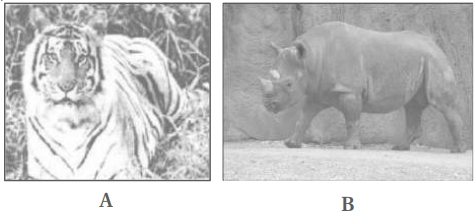
What is common to the species shown in figures $A$ and $B$?
A
Both are critically endangered species.
B
Both are conserved in their natural habitats (in-situ conservation).
C
Both are extinct in the wild.
D
Both are exotic species.
Solution
(B) Figure $A$ shows a tiger and Figure $B$ shows a rhinoceros. Both of these are threatened species that are protected through in-situ conservation strategies,meaning they are conserved within their natural habitats,such as national parks and wildlife sanctuaries.
0 likes
View Solution130
Medium
What are sacred groves and their role in biodiversity conservation?
Solution
(N/A) Sacred groves are tracts of forest land that are dedicated to local deities or ancestral spirits and are protected by local communities through religious and cultural beliefs.
These areas are found in many parts of India,such as the Khasi and Jaintia Hills in Meghalaya,the Aravalli Hills of Rajasthan,the Western Ghat regions of Karnataka and Maharashtra,and the Sarguja,Chanda,and Bastar areas of Madhya Pradesh.
Their role in biodiversity conservation is significant because:
$1$. They act as a refuge for many rare,endangered,and endemic species of plants and animals that might have otherwise gone extinct in the surrounding degraded landscapes.
$2$. They help in the preservation of local biodiversity by preventing deforestation and habitat destruction within the grove boundaries.
$3$. They serve as important gene banks for wild relatives of cultivated crops and medicinal plants.
$4$. They maintain ecological balance by protecting watersheds and preventing soil erosion.
These areas are found in many parts of India,such as the Khasi and Jaintia Hills in Meghalaya,the Aravalli Hills of Rajasthan,the Western Ghat regions of Karnataka and Maharashtra,and the Sarguja,Chanda,and Bastar areas of Madhya Pradesh.
Their role in biodiversity conservation is significant because:
$1$. They act as a refuge for many rare,endangered,and endemic species of plants and animals that might have otherwise gone extinct in the surrounding degraded landscapes.
$2$. They help in the preservation of local biodiversity by preventing deforestation and habitat destruction within the grove boundaries.
$3$. They serve as important gene banks for wild relatives of cultivated crops and medicinal plants.
$4$. They maintain ecological balance by protecting watersheds and preventing soil erosion.
0 likes
View Solution131
EasyMCQ
Suggest a place where one can go to study coral reefs,mangrove vegetation,and estuaries.
A
Andaman and Nicobar Islands
B
Rajasthan
C
Punjab
D
Haryana
Solution
(A) To study coral reefs,one can visit the Andaman and Nicobar Islands,which are famous for their rich marine biodiversity.
- Mangrove vegetation is extensively found in the Sundarbans region of West Bengal.
- Estuaries are commonly found in coastal states like Kerala,Karnataka,and Tamil Nadu.
- Mangrove vegetation is extensively found in the Sundarbans region of West Bengal.
- Estuaries are commonly found in coastal states like Kerala,Karnataka,and Tamil Nadu.
0 likes
View Solution132
Medium
How can you,as an individual,prevent the loss of biodiversity?
Solution
(N/A) The loss of biodiversity can be prevented by:
$(i)$ Practising the recycling of waste paper and other materials.
$(ii)$ Judicious exploitation of medicinal and commercial plants and animals.
$(iii)$ Generating awareness among the public regarding the importance of biodiversity conservation through skits,film screenings,lectures,etc.
$(iv)$ Educating people on how to reduce greenhouse gas emissions by adopting alternative eco-friendly green technologies,such as the use of solar energy,wind energy,biogas,vermicompost,and organic farming.
$(i)$ Practising the recycling of waste paper and other materials.
$(ii)$ Judicious exploitation of medicinal and commercial plants and animals.
$(iii)$ Generating awareness among the public regarding the importance of biodiversity conservation through skits,film screenings,lectures,etc.
$(iv)$ Educating people on how to reduce greenhouse gas emissions by adopting alternative eco-friendly green technologies,such as the use of solar energy,wind energy,biogas,vermicompost,and organic farming.
0 likes
View Solution133
Medium
Explain how biodiversity is important for humans and explain what is conservation?
Solution
(N/A) Conservation of biodiversity is the protection,upliftment,and scientific management of biodiversity to maintain it at an optimum level and derive sustainable benefits for present as well as future generations.
Reasons for Conserving Biodiversity:
There are three main categories of reasons for the conservation of biodiversity:
$1$. Narrowly utilitarian: Humans derive countless direct economic benefits from nature,such as food (cereals,pulses,and fruits),firewood,fiber,construction material,industrial products (tannins,lubricants,dyes,resins,and perfumes),and products of medicinal importance. More than $25\%$ of the drugs currently sold in the market worldwide are derived from plants,and $25,000$ plant species are used in traditional medicines.
$2$. Broadly utilitarian: Biodiversity plays a major role in ecosystem services provided by nature,such as:
$(i)$ Production of oxygen (e.g.,Amazon forest produces $20\%$ of the total oxygen in the earth's atmosphere).
$(ii)$ Pollination of flowers by bees,bumblebees,birds,and bats,which is essential for fruit and seed production.
$(iii)$ Control of floods and soil erosion.
$(iv)$ Aesthetic pleasures,such as watching flowers in bloom or walking through a forest.
$3$. Ethical Argument: Every species has an intrinsic value,even if it has no direct economic value to us. It is our moral duty to care for their well-being and pass on our biological legacy to future generations.
Reasons for Conserving Biodiversity:
There are three main categories of reasons for the conservation of biodiversity:
$1$. Narrowly utilitarian: Humans derive countless direct economic benefits from nature,such as food (cereals,pulses,and fruits),firewood,fiber,construction material,industrial products (tannins,lubricants,dyes,resins,and perfumes),and products of medicinal importance. More than $25\%$ of the drugs currently sold in the market worldwide are derived from plants,and $25,000$ plant species are used in traditional medicines.
$2$. Broadly utilitarian: Biodiversity plays a major role in ecosystem services provided by nature,such as:
$(i)$ Production of oxygen (e.g.,Amazon forest produces $20\%$ of the total oxygen in the earth's atmosphere).
$(ii)$ Pollination of flowers by bees,bumblebees,birds,and bats,which is essential for fruit and seed production.
$(iii)$ Control of floods and soil erosion.
$(iv)$ Aesthetic pleasures,such as watching flowers in bloom or walking through a forest.
$3$. Ethical Argument: Every species has an intrinsic value,even if it has no direct economic value to us. It is our moral duty to care for their well-being and pass on our biological legacy to future generations.
0 likes
View Solution134
Medium
Write an explanatory note on In situ conservation.
Solution
(N/A) In situ (on-site) conservation is the conservation and protection of the whole ecosystem and its biodiversity at all levels to protect threatened species.
However,it is not economically feasible to conserve all biological wealth in all existing ecosystems.
- Methods used in in situ conservation are:
- Biodiversity hotspots: Biodiversity hotspots are an approach for in situ conservation.
Eminent conservationists have identified certain regions for maximum protection; these regions are called biodiversity hotspots.
These are regions with very high levels of species richness,a high degree of endemism (species confined to a region and not found anywhere else),and accelerated habitat loss.
Initially,$25$ biodiversity hotspots were identified.
- Now,there are $34$ hotspots all over the world.
- Three hotspots are in India,i.e.,Western Ghats and Sri Lanka,Indo-Burma,and Eastern Himalaya.
- If all biodiversity hotspots are put together,they cover less than $2 \%$ of the earth's land area but harbour extremely high diversity.
- Ongoing mass extinction could be reduced by $30 \%$ through strict protection of these hotspots.
- Protected Areas: Protected areas are dedicated areas for the protection and maintenance of ecologically unique and biodiversity-rich regions. Protected areas are classified as:
$(a)$ National Parks: These are government-maintained areas reserved for the betterment of wildlife,where activities such as cultivation,grazing,forestry,and habitat manipulation are not allowed.
- The first National Park established in India in $1936$ was Hailey's National Park (now Jim Corbett National Park).
$(b)$ Sanctuaries: These are tracts of land with or without lakes where wild animals/fauna can take refuge without being hunted.
- Other activities like the collection of forest products,harvesting of timber,private ownership of land,etc.,are allowed here.
$(c)$ Biosphere Reserves: These are large tracts of protected land with multiple uses,preserving the genetic diversity of the ecosystem by protecting wildlife,the traditional lifestyles of tribals,and varied plant and animal genetic resources.
- They have been set up under the $MAB$ (Man and the Biosphere) programme of $UNESCO$.
However,it is not economically feasible to conserve all biological wealth in all existing ecosystems.
- Methods used in in situ conservation are:
- Biodiversity hotspots: Biodiversity hotspots are an approach for in situ conservation.
Eminent conservationists have identified certain regions for maximum protection; these regions are called biodiversity hotspots.
These are regions with very high levels of species richness,a high degree of endemism (species confined to a region and not found anywhere else),and accelerated habitat loss.
Initially,$25$ biodiversity hotspots were identified.
- Now,there are $34$ hotspots all over the world.
- Three hotspots are in India,i.e.,Western Ghats and Sri Lanka,Indo-Burma,and Eastern Himalaya.
- If all biodiversity hotspots are put together,they cover less than $2 \%$ of the earth's land area but harbour extremely high diversity.
- Ongoing mass extinction could be reduced by $30 \%$ through strict protection of these hotspots.
- Protected Areas: Protected areas are dedicated areas for the protection and maintenance of ecologically unique and biodiversity-rich regions. Protected areas are classified as:
$(a)$ National Parks: These are government-maintained areas reserved for the betterment of wildlife,where activities such as cultivation,grazing,forestry,and habitat manipulation are not allowed.
- The first National Park established in India in $1936$ was Hailey's National Park (now Jim Corbett National Park).
$(b)$ Sanctuaries: These are tracts of land with or without lakes where wild animals/fauna can take refuge without being hunted.
- Other activities like the collection of forest products,harvesting of timber,private ownership of land,etc.,are allowed here.
$(c)$ Biosphere Reserves: These are large tracts of protected land with multiple uses,preserving the genetic diversity of the ecosystem by protecting wildlife,the traditional lifestyles of tribals,and varied plant and animal genetic resources.
- They have been set up under the $MAB$ (Man and the Biosphere) programme of $UNESCO$.
0 likes
View Solution135
Medium
Describe various methods used in 'In situ conservation'.
Solution
(A) In situ (on-site) conservation involves the protection and conservation of entire ecosystems and their biodiversity at all levels to safeguard threatened species.
Since it is not economically feasible to conserve all biological wealth in every existing ecosystem,specific strategies are employed:
$1$. Biodiversity Hotspots: These are regions identified for maximum protection due to very high levels of species richness,a high degree of endemism (species confined to a specific region),and accelerated habitat loss.
- Currently,there are $34$ hotspots globally.
- India hosts three hotspots: Western Ghats and Sri Lanka,Indo-Burma,and the Eastern Himalayas.
- Collectively,these hotspots cover less than $2 \%$ of the Earth's land area but harbor extremely high diversity. Strict protection of these areas could reduce ongoing mass extinction by nearly $30 \%$.
$2$. Protected Areas: These are dedicated regions for the maintenance of ecologically unique and biodiversity-rich areas.
- $(a)$ National Parks: Government-maintained areas reserved for wildlife protection where activities like cultivation,grazing,and forestry are prohibited. The first national park in India was Hailey National Park (established in $1936$).
- $(b)$ Wildlife Sanctuaries: Tracts of land where wild animals can take refuge without the threat of hunting. Activities like the collection of forest products and timber harvesting are permitted here.
- $(c)$ Biosphere Reserves: Large,multi-purpose protected areas designed to preserve genetic diversity,protect wildlife,and maintain the traditional lifestyles of tribal communities.
Since it is not economically feasible to conserve all biological wealth in every existing ecosystem,specific strategies are employed:
$1$. Biodiversity Hotspots: These are regions identified for maximum protection due to very high levels of species richness,a high degree of endemism (species confined to a specific region),and accelerated habitat loss.
- Currently,there are $34$ hotspots globally.
- India hosts three hotspots: Western Ghats and Sri Lanka,Indo-Burma,and the Eastern Himalayas.
- Collectively,these hotspots cover less than $2 \%$ of the Earth's land area but harbor extremely high diversity. Strict protection of these areas could reduce ongoing mass extinction by nearly $30 \%$.
$2$. Protected Areas: These are dedicated regions for the maintenance of ecologically unique and biodiversity-rich areas.
- $(a)$ National Parks: Government-maintained areas reserved for wildlife protection where activities like cultivation,grazing,and forestry are prohibited. The first national park in India was Hailey National Park (established in $1936$).
- $(b)$ Wildlife Sanctuaries: Tracts of land where wild animals can take refuge without the threat of hunting. Activities like the collection of forest products and timber harvesting are permitted here.
- $(c)$ Biosphere Reserves: Large,multi-purpose protected areas designed to preserve genetic diversity,protect wildlife,and maintain the traditional lifestyles of tribal communities.
0 likes
View Solution136
MediumMCQ
Keoladeo National Park,Bharatpur,which acts as a host for migratory birds from Siberia and other regions,is located in which state?
A
Haryana
B
Gujarat
C
Rajasthan
D
Madhya Pradesh
Solution
(C) Keoladeo National Park,formerly known as the Bharatpur Bird Sanctuary,is a famous avifauna sanctuary located in Bharatpur,Rajasthan,India.
It is a $UNESCO$ World Heritage Site and serves as a crucial wintering ground for thousands of migratory birds,including the rare Siberian Crane,which migrates from Siberia to India to escape the harsh winter conditions.
It is a $UNESCO$ World Heritage Site and serves as a crucial wintering ground for thousands of migratory birds,including the rare Siberian Crane,which migrates from Siberia to India to escape the harsh winter conditions.
0 likes
View Solution137
MediumMCQ
The full form of $IUCN$ is ..........
A
Indian Union for Combination of Nature and National Resources
B
Indonesian Union Combination of Nature and National Resources
C
Indian Union Company for Conservation of Nature and Resources
D
International Union for Conservation of Nature and Natural Resources
Solution
(D) The $IUCN$ stands for the $International$ $Union$ $for$ $Conservation$ $of$ $Nature$ $and$ $Natural$ $Resources$.
It is an international organization working in the field of nature conservation and sustainable use of natural resources.
It is best known for publishing the $Red$ $Data$ $Book$,which lists species that are threatened with extinction.
It is an international organization working in the field of nature conservation and sustainable use of natural resources.
It is best known for publishing the $Red$ $Data$ $Book$,which lists species that are threatened with extinction.
0 likes
View Solution138
MediumMCQ
Which of the following is $NOT$ a biodiversity hotspot?
A
Western Ghats and Sri Lanka
B
Indo-Burma
C
Mount Everest
D
Himalaya
Solution
(C) Biodiversity hotspots are regions with high levels of species richness and significant threats to their habitats. According to the criteria established by Conservation International,there are $36$ recognized biodiversity hotspots globally. In the Indian context,the three major hotspots are the Western Ghats and Sri Lanka,the Indo-Burma region,and the Himalayas. Mount Everest is a mountain peak and is not classified as a biodiversity hotspot.
0 likes
View Solution139
MediumMCQ
What are the numbers of National Parks and Wildlife Sanctuaries in India,respectively?
A
$14$ and $90$
B
$90$ and $448$
C
$448$ and $14$
D
$14$ and $410$
Solution
(B) In India,the network of protected areas is established to conserve biodiversity.
As per the standard data often cited in educational contexts for this topic,there are $90$ National Parks and $448$ Wildlife Sanctuaries.
Therefore,the correct option is $B$.
As per the standard data often cited in educational contexts for this topic,there are $90$ National Parks and $448$ Wildlife Sanctuaries.
Therefore,the correct option is $B$.
0 likes
View Solution140
MediumMCQ
Which of the following is not an in-situ conservation strategy?
A
National Park
B
Zoological Park
C
Wildlife Sanctuary
D
Biosphere Reserve
Solution
(B) In-situ conservation involves protecting species in their natural habitats.
National Parks,Wildlife Sanctuaries,and Biosphere Reserves are examples of in-situ conservation.
Zoological Parks (zoos) are examples of ex-situ conservation,where animals are kept in human-controlled environments outside their natural habitats.
National Parks,Wildlife Sanctuaries,and Biosphere Reserves are examples of in-situ conservation.
Zoological Parks (zoos) are examples of ex-situ conservation,where animals are kept in human-controlled environments outside their natural habitats.
0 likes
View Solution141
MediumMCQ
Which method is used for the preservation of gametes of threatened species?
A
Deep freeze
B
Cryopreservation
C
Plant tissue culture
D
Lyophilization
Solution
(B) Cryopreservation is a technique used to preserve gametes,seeds,embryos,and tissues of threatened species at very low temperatures.
In this method,biological materials are stored in liquid nitrogen at $-196^{\circ}C$.
This process halts metabolic activities,allowing the samples to be stored for long periods without degradation.
Therefore,the correct option is $B$.
In this method,biological materials are stored in liquid nitrogen at $-196^{\circ}C$.
This process halts metabolic activities,allowing the samples to be stored for long periods without degradation.
Therefore,the correct option is $B$.
0 likes
View Solution142
MediumMCQ
Which of the following is not an example of $in-situ$ conservation?
A
Wildlife sanctuaries
B
Wildlife safari parks
C
Zoological parks
D
Botanical gardens
Solution
(C) Conservation strategies are broadly classified into two types: $in-situ$ (on-site) and $ex-situ$ (off-site) conservation.
$In-situ$ conservation involves protecting the whole ecosystem and its biodiversity in its natural habitat, such as National Parks, Wildlife Sanctuaries, and Biosphere Reserves.
$Ex-situ$ conservation involves placing threatened animals and plants in special settings where they can be protected and cared for, outside their natural habitats.
Zoological parks, botanical gardens, and wildlife safari parks are examples of $ex-situ$ conservation.
Therefore, wildlife sanctuaries are the only option listed that represents $in-situ$ conservation, making the question ask for the exception among the choices provided. However, since the question asks which is $NOT$ $in-situ$, and $C$ and $D$ are definitely $ex-situ$, usually, in such multiple-choice questions, $ex-situ$ sites are the answer. Given the standard classification, Zoological parks $(C)$ and Botanical gardens $(D)$ are classic $ex-situ$ examples. Wildlife safari parks are also $ex-situ$.
$In-situ$ conservation involves protecting the whole ecosystem and its biodiversity in its natural habitat, such as National Parks, Wildlife Sanctuaries, and Biosphere Reserves.
$Ex-situ$ conservation involves placing threatened animals and plants in special settings where they can be protected and cared for, outside their natural habitats.
Zoological parks, botanical gardens, and wildlife safari parks are examples of $ex-situ$ conservation.
Therefore, wildlife sanctuaries are the only option listed that represents $in-situ$ conservation, making the question ask for the exception among the choices provided. However, since the question asks which is $NOT$ $in-situ$, and $C$ and $D$ are definitely $ex-situ$, usually, in such multiple-choice questions, $ex-situ$ sites are the answer. Given the standard classification, Zoological parks $(C)$ and Botanical gardens $(D)$ are classic $ex-situ$ examples. Wildlife safari parks are also $ex-situ$.
0 likes
View Solution143
MediumMCQ
Where was the historic convention on biological diversity held?
A
London
B
Rio de Janeiro
C
Montreal
D
France
Solution
(B) The historic convention on biological diversity,known as the Earth Summit,was held in Rio de Janeiro in $1992$. This summit focused on the conservation of biodiversity,sustainable use of its components,and the fair and equitable sharing of benefits arising from the utilization of genetic resources.
0 likes
View Solution144
EasyMCQ
In the following,each set provides a conservation approach and an example of a method of conservation:
$(a)$ In situ conservation - Biosphere Reserve
$(b)$ Ex situ conservation - Sacred groves
$(c)$ In situ conservation - Seed bank
$(d)$ Ex situ conservation - Cryopreservation
Select the option with the correct match of approach and method.
$(a)$ In situ conservation - Biosphere Reserve
$(b)$ Ex situ conservation - Sacred groves
$(c)$ In situ conservation - Seed bank
$(d)$ Ex situ conservation - Cryopreservation
Select the option with the correct match of approach and method.
A
$(a)$ and $(b)$
B
$(a)$ and $(c)$
C
$(a)$ and $(d)$
D
$(b)$ and $(d)$
Solution
(C) In situ conservation involves protecting species in their natural habitat. Examples include National Parks,Wildlife Sanctuaries,and Biosphere Reserves.
Ex situ conservation involves protecting species outside their natural habitat. Examples include Botanical Gardens,Zoological Parks,Seed Banks,and Cryopreservation.
Analyzing the given sets:
$(a)$ In situ conservation - Biosphere Reserve: Correct.
$(b)$ Ex situ conservation - Sacred groves: Incorrect (Sacred groves are a form of In situ conservation).
$(c)$ In situ conservation - Seed bank: Incorrect (Seed banks are a form of Ex situ conservation).
$(d)$ Ex situ conservation - Cryopreservation: Correct.
Therefore,the correct matches are $(a)$ and $(d)$.
Ex situ conservation involves protecting species outside their natural habitat. Examples include Botanical Gardens,Zoological Parks,Seed Banks,and Cryopreservation.
Analyzing the given sets:
$(a)$ In situ conservation - Biosphere Reserve: Correct.
$(b)$ Ex situ conservation - Sacred groves: Incorrect (Sacred groves are a form of In situ conservation).
$(c)$ In situ conservation - Seed bank: Incorrect (Seed banks are a form of Ex situ conservation).
$(d)$ Ex situ conservation - Cryopreservation: Correct.
Therefore,the correct matches are $(a)$ and $(d)$.
0 likes
View Solution145
EasyMCQ
Match the following:
| Column-$I$ | Column-$II$ |
|---|---|
| $(a)$ Ranthambore National Park | $(i)$ Assam |
| $(b)$ Kaziranga National Park | $(ii)$ Rajasthan |
| $(c)$ Jim Corbett National Park | $(iii)$ Odisha |
| $(d)$ Nandankanan Zoological Park | $(iv)$ Uttarakhand |
A
$a-i, b-ii, c-iii, d-iv$
B
$a-ii, b-iii, c-iv, d-i$
C
$a-ii, b-i, c-iv, d-iii$
D
$a-iii, b-ii, c-i, d-iv$
Solution
(C) The correct matching is as follows:
$(a)$ Ranthambore National Park is located in Rajasthan $(ii)$.
$(b)$ Kaziranga National Park is located in Assam $(i)$.
$(c)$ Jim Corbett National Park is located in Uttarakhand $(iv)$.
$(d)$ Nandankanan Zoological Park is located in Odisha $(iii)$.
Therefore,the correct sequence is $a-ii, b-i, c-iv, d-iii$,which corresponds to option $(C)$.
$(a)$ Ranthambore National Park is located in Rajasthan $(ii)$.
$(b)$ Kaziranga National Park is located in Assam $(i)$.
$(c)$ Jim Corbett National Park is located in Uttarakhand $(iv)$.
$(d)$ Nandankanan Zoological Park is located in Odisha $(iii)$.
Therefore,the correct sequence is $a-ii, b-i, c-iv, d-iii$,which corresponds to option $(C)$.
0 likes
View Solution146
MediumMCQ
Keoladeo National Park is situated at . . . . . . and is famous for . . . . . . .
A
Gir (Gujarat),Lion
B
Ranthambhore (Rajasthan),Tiger
C
Bharatpur (Rajasthan),Siberian cranes
D
Hazaribag (Jharkhand),Tiger
Solution
(C) Keoladeo National Park is located in Bharatpur,Rajasthan. It is a world-renowned wetland and a $UNESCO$ World Heritage site,famous for being a wintering ground for migratory birds,particularly the Siberian Cranes.
0 likes
View Solution147
EasyMCQ
The $Hangul$ Project was started by the government to save the $Hangul$ ($Cervus$ $hanglu$ $hanglu$) in $1970$. The sanctuary where it was started is:
A
National Chambal Sanctuary
B
Dachigam Sanctuary
C
Corbett National Park
D
Bandipur National Park
Solution
(B) The Kashmir stag ($Cervus$ $hanglu$ $hanglu$),also known as $Hangul$,is a subspecies of Red Deer native to northern India.
It is primarily found in the riverine forests,high valleys,and mountains of the Kashmir valley.
In $1970$,the $Hangul$ Project was launched by the government to protect this critically endangered species.
The primary habitat and the sanctuary where this conservation project was initiated is the Dachigam National Park in Jammu and Kashmir.
It is primarily found in the riverine forests,high valleys,and mountains of the Kashmir valley.
In $1970$,the $Hangul$ Project was launched by the government to protect this critically endangered species.
The primary habitat and the sanctuary where this conservation project was initiated is the Dachigam National Park in Jammu and Kashmir.
0 likes
View Solution148
MediumMCQ
Which of the following is now called World Conservation Union $(WCU)$?
A
$IUCN$
B
$IPCC$
C
$EPA$
D
$UNEP$
Solution
(A) $IUCN$ (International Union for Conservation of Nature) was previously known as the International Union for Conservation of Nature and Natural Resources and is now commonly referred to as the World Conservation Union $(WCU)$. Its headquarters are located in Gland,Switzerland.
0 likes
View SolutionBiodiversity and Conservation — Biodiversity Conservation · Frequently Asked Questions
1Are these Biodiversity and Conservation questions useful for JEE and NEET?
Yes. All questions in this section are mapped to JEE Main and NEET exam patterns. Previous year questions from JEE Main, NEET, GUJCET and state-level exams are included with full solutions.
2Can I switch to Hindi or Gujarati for these questions?
Yes. Use the language tabs in the hero section or the sidebar to view the same questions and solutions in English, Hindi or Gujarati.
3How do I generate a question paper from this subtopic?
Use the Vedclass Exam Paper Generator — select the chapter and subtopic, set difficulty, and generate Sets A, B, C, D automatically. First 3 chapters of every subject are free.
Vedclass Products
For Students
Vedclass Test Series
Mock tests in real JEE/NEET style with performance analysis. 5-day free trial.
Start Free TrialFor Teachers
Exam Paper Generator
Generate Set A/B/C/D papers from this chapter in 2 minutes. 3 chapters free.
Try FreeFor Institutes
Online Exam Module
Live online exams with unlimited students, 360° analytics & white-label branding.
See DemoFor Teachers & Institutes
Generate a Biodiversity and Conservation Exam Paper in 2 Minutes
Select subtopic & difficulty — Sets A, B, C, D auto-generated with No Repeat logic.
First 3 chapters of every subject are free — no payment required.