
A English
Biodiversity Conservation Questions in English
Class 12 Biology · Biodiversity and Conservation · Biodiversity Conservation
264+
Questions
English
Language
100%
With Solutions
Showing 50 of 264 questions in English
151
EasyMCQ
One of these is not concerned with wild life conservation.
A
$IVF$
B
$IUCN$
C
$WWF$
D
$IBWL$
Solution
(A) In vitro fertilization $(IVF)$ is a medical procedure used for assisted reproduction,often referred to as the test-tube baby technique.
It involves the fertilization of an egg by sperm outside the female's body in a laboratory setting.
$IUCN$ (International Union for Conservation of Nature),$WWF$ (World Wide Fund for Nature),and $IBWL$ (Indian Board for Wildlife) are all organizations or bodies directly involved in the conservation of biodiversity and wildlife.
Therefore,$IVF$ is not concerned with wildlife conservation.
It involves the fertilization of an egg by sperm outside the female's body in a laboratory setting.
$IUCN$ (International Union for Conservation of Nature),$WWF$ (World Wide Fund for Nature),and $IBWL$ (Indian Board for Wildlife) are all organizations or bodies directly involved in the conservation of biodiversity and wildlife.
Therefore,$IVF$ is not concerned with wildlife conservation.
0 likes
View Solution152
EasyMCQ
The largest tiger population is found in:
A
Sunderban National Park
B
Corbett National Park
C
Ranthambhor National Park
D
Kanha National Park
Solution
(A) Compared to other reserves in India,$Sunderban$ National Park has the largest tiger population.
It also serves as a habitat for salt-water crocodiles,Gangetic dolphins,chitals,wild boars,and rhesus macaques.
It also serves as a habitat for salt-water crocodiles,Gangetic dolphins,chitals,wild boars,and rhesus macaques.
0 likes
View Solution153
MediumMCQ
Which of the following expanded forms of the acronyms is correct?
A
$UNEP$ - United Nations Environmental Policy
B
$EPA$ - Environmental Pollution Agency
C
$IUCN$ - International Union for Conservation of Nature and Natural Resources
D
$IPCC$ - International Panel for Climate Change
Solution
(C) $IUCN$ stands for International Union for Conservation of Nature and Natural Resources.
It is now known as the World Conservation Union $(WCU)$.
Its headquarters are located in Gland,Switzerland.
It assesses the conservation status of species globally by gathering information on their geographical distribution,population size,and trends.
It publishes the Red Data Book,which lists threatened species.
It is now known as the World Conservation Union $(WCU)$.
Its headquarters are located in Gland,Switzerland.
It assesses the conservation status of species globally by gathering information on their geographical distribution,population size,and trends.
It publishes the Red Data Book,which lists threatened species.
0 likes
View Solution154
MediumMCQ
The World Summit on Sustainable Development was held in:
A
$USA$
B
$South \; Africa$
C
$South \; Korea$
D
$UK$
Solution
(B) The World Summit on Sustainable Development was held in Johannesburg,South Africa in $2002$.
In this summit,$190$ countries pledged to significantly reduce the current rate of biodiversity loss at global,regional,and local levels by $2010$.
In alignment with this global commitment,the Biological Diversity Act was passed in India in the year $2002$.
In this summit,$190$ countries pledged to significantly reduce the current rate of biodiversity loss at global,regional,and local levels by $2010$.
In alignment with this global commitment,the Biological Diversity Act was passed in India in the year $2002$.
0 likes
View Solution155
MediumMCQ
Which one of the following is an example of ex situ conservation?
A
Wildlife safari park
B
Biosphere reserve
C
Sacred groves
D
National park
Solution
(A) Ex situ conservation refers to the conservation of organisms outside their natural habitats.
This involves maintaining sample populations in genetic resource centers or as gene pools.
Examples of ex situ conservation include $zoos$,botanical gardens,wildlife safari parks,seed banks,pollen storage,tissue culture,and genetic engineering.
In contrast,biosphere reserves,sacred groves,and national parks are examples of in situ conservation,where organisms are protected within their natural habitats.
This involves maintaining sample populations in genetic resource centers or as gene pools.
Examples of ex situ conservation include $zoos$,botanical gardens,wildlife safari parks,seed banks,pollen storage,tissue culture,and genetic engineering.
In contrast,biosphere reserves,sacred groves,and national parks are examples of in situ conservation,where organisms are protected within their natural habitats.
0 likes
View Solution156
MediumMCQ
Sacred groves in India are related with
A
Cultural tradition
B
It is the place where threatened species are protected
C
It is the place where only artificial animal breeding is allowed
D
Forest patches around the places of worship
Solution
(D) Sacred groves are forest patches around places of worship that are held in high esteem by tribal communities.
These areas are protected by local people due to religious beliefs,which helps in the conservation of biodiversity.
They are found in several parts of India,$e.g$.,Karnataka,Maharashtra,Rajasthan (Aravalli),Madhya Pradesh (Sarguja,Chanda,and Bastar),Kerala,and Meghalaya.
In Meghalaya,sacred groves are found in the Jaintia and Khasi hills.
These areas are protected by local people due to religious beliefs,which helps in the conservation of biodiversity.
They are found in several parts of India,$e.g$.,Karnataka,Maharashtra,Rajasthan (Aravalli),Madhya Pradesh (Sarguja,Chanda,and Bastar),Kerala,and Meghalaya.
In Meghalaya,sacred groves are found in the Jaintia and Khasi hills.
0 likes
View Solution157
EasyMCQ
Plants like $Aegle \text{ } marmelos$, $Ocimum \text{ } sanctum$ and $Ficus \text{ } religiosa$ are a group of plants designated as
A
Medicinal plant species
B
Lesser known food plants
C
Traditional food crops
D
Sacred species of plants
Solution
(D) $Aegle \text{ } marmelos$ (Bel), $Ocimum \text{ } sanctum$ (Tulsi), and $Ficus \text{ } religiosa$ (Peepal) are widely recognized in Indian culture as sacred plants.
These species are often protected and conserved due to their religious significance, which is a form of in-situ conservation known as sacred groves or sacred plants.
These species are often protected and conserved due to their religious significance, which is a form of in-situ conservation known as sacred groves or sacred plants.
0 likes
View Solution158
MediumMCQ
Modern ex situ conservation includes
A
In vitro fertilization
B
Cryopreservation techniques
C
Plants can be propagated using tissue culture methods
D
All of the above
Solution
(D) In recent years, $ex \, situ$ conservation has advanced beyond keeping threatened species in enclosures.
Now, gametes of the threatened species can be preserved in viable and fertile condition for long periods using cryopreservation techniques.
Eggs can be fertilized $in \, vitro$ and plants can be propagated using tissue culture methods.
Therefore, all the mentioned techniques are part of modern $ex \, situ$ conservation.
Now, gametes of the threatened species can be preserved in viable and fertile condition for long periods using cryopreservation techniques.
Eggs can be fertilized $in \, vitro$ and plants can be propagated using tissue culture methods.
Therefore, all the mentioned techniques are part of modern $ex \, situ$ conservation.
0 likes
View Solution159
MediumMCQ
In your opinion, which is the most effective way to conserve the plant diversity of an area?
A
By tissue culture method
B
By creating biosphere reserve
C
By creating botanical garden
D
By developing seed bank
Solution
(B) Biosphere reserve is an $in \, situ$ conservation method.
It is the most effective way among the given options for preserving genetic diversity because it protects the entire ecosystem, including wild populations, traditional lifestyles, and domesticated plant genetic resources in their natural habitat.
It is the most effective way among the given options for preserving genetic diversity because it protects the entire ecosystem, including wild populations, traditional lifestyles, and domesticated plant genetic resources in their natural habitat.
0 likes
View Solution160
EasyMCQ
Sanjay Gandhi Biological Park is situated in
A
Patna
B
Kanpur
C
Delhi
D
Bangaluru
Solution
(A) Sanjay Gandhi Biological Park,also known as Patna Zoo,is located in Patna,the capital city of Bihar,India.
0 likes
View Solution161
EasyMCQ
According to the $IUCN$ Red List, what is the conservation status of the Red Panda $(Ailurus \text{ } fulgens)$?
A
Vulnerable species
B
Critically endangered species
C
Extinct species
D
Endangered species
Solution
(D) The Red Panda $(Ailurus \text{ } fulgens)$ is classified as an Endangered species by the $IUCN$ Red List of Threatened Species. This classification indicates that the species faces a very high risk of extinction in the wild in the near future due to habitat loss and fragmentation.
0 likes
View Solution162
MediumMCQ
Siberian cranes are regular visitors of
A
Bharatpur sanctuary,Rajasthan
B
Lalbagh,Bengaluru
C
Vedanthangal sanctuary,Tamil Nadu
D
Jim Corbett National Park,Uttarakhand
Solution
(A) Siberian cranes $(Grus \ leucogeranus)$ are migratory birds that travel long distances to escape harsh winters. They are well-known regular winter visitors to the Keoladeo National Park,formerly known as the Bharatpur Bird Sanctuary,located in Rajasthan,India.
0 likes
View Solution163
MediumMCQ
The Biosphere Reserve programme started in India in:
A
$1986$
B
$1984$
C
$1982$
D
$1988$
Solution
(A) The Biosphere Reserve Programme was launched by $UNESCO$ in $1971$ under its "Man and Biosphere Programme" $(MAB)$.
In India, the government implemented this programme in $1986$ to protect larger areas of natural habitat along with their flora and fauna.
In India, the government implemented this programme in $1986$ to protect larger areas of natural habitat along with their flora and fauna.
0 likes
View Solution164
EasyMCQ
Core zone,buffer zone and manipulation zone are found in
A
National park
B
Sanctuary
C
Tiger reserve
D
Biosphere reserve
Solution
(D) Biosphere reserves are a special category of protected areas of land and/or coastal environments wherein people are an integral component of the ecosystem.
It represents a specified area zonated for particular activity and consists of a core zone without any human activity,a buffer zone with limited human activities,and a manipulation zone with several manipulating human activities.
It represents a specified area zonated for particular activity and consists of a core zone without any human activity,a buffer zone with limited human activities,and a manipulation zone with several manipulating human activities.
0 likes
View Solution165
EasyMCQ
Tiger is not resident in which one of the following national parks?
A
Ranthambore
B
Sunderbans
C
Gir
D
Jim Corbett
Solution
(C) Gir National Park (Gujarat) is famous for the Asiatic lion and is not a habitat for tigers.
The animals found in Gir National Park include the Asiatic lion,panther,striped hyena,sambar,nilgai,chital,four-horned antelope,and chinkara.
Ranthambore National Park,Sunderbans,and Jim Corbett National Park are well-known tiger reserves.
The animals found in Gir National Park include the Asiatic lion,panther,striped hyena,sambar,nilgai,chital,four-horned antelope,and chinkara.
Ranthambore National Park,Sunderbans,and Jim Corbett National Park are well-known tiger reserves.
0 likes
View Solution166
EasyMCQ
Manas sanctuary is located at
A
Rajasthan
B
Asom
C
Bihar
D
Gujarat
Solution
(B) Manas Wildlife Sanctuary is located in the state of Asom.
It covers an area of $80 \; \text{sq km}$.
Its key vertebrate species include the tiger, wild boar, sambar, golden langur, one-horned rhinoceros, swamp deer, wild dog, and wild buffalo.
It covers an area of $80 \; \text{sq km}$.
Its key vertebrate species include the tiger, wild boar, sambar, golden langur, one-horned rhinoceros, swamp deer, wild dog, and wild buffalo.
0 likes
View Solution167
EasyMCQ
Ranthambore National Park is situated in:
A
Assam
B
Jharkhand
C
Uttarakhand
D
Rajasthan
Solution
(D) Ranthambore National Park is a famous wildlife sanctuary and national park located in the Sawai Madhopur district of Rajasthan,India. It is well-known for its population of Bengal tigers.
0 likes
View Solution168
MediumMCQ
One of the $ex \, situ$ conservation methods for endangered species is:
A
Wildlife sanctuaries
B
Biosphere reserves
C
Cryopreservation
D
National parks
Solution
(C) $Ex \, situ$ conservation is the preservation of components of biological diversity outside their natural habitats.
It includes techniques such as cryopreservation, botanical gardens, zoological parks, gene banks, and tissue culture.
In contrast, $in \, situ$ conservation is the preservation of biological diversity within their natural wild conditions, which includes biosphere reserves, national parks, and wildlife sanctuaries.
It includes techniques such as cryopreservation, botanical gardens, zoological parks, gene banks, and tissue culture.
In contrast, $in \, situ$ conservation is the preservation of biological diversity within their natural wild conditions, which includes biosphere reserves, national parks, and wildlife sanctuaries.
0 likes
View Solution169
EasyMCQ
Simlipal is:
A
Sanctuary
B
Biosphere reserve
C
National park
D
Zoo
Solution
(B) Simlipal is a $Biosphere Reserve$ located in the state of Odisha, India. It is part of the $UNESCO$ World Network of Biosphere Reserves and is known for its rich biodiversity, including tigers and elephants.
0 likes
View Solution170
EasyMCQ
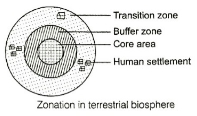
In which part of the biosphere reserves,human settlement is permissible?
A
Transition zone
B
Buffer zone
C
Core zone
D
Settlement not allowed
Solution
(A) Each biosphere reserve has three main zones:
$(i)$ Core or Natural Zone: No human activity is allowed. The area is an undisturbed and legally protected ecosystem.
$(ii)$ Buffer Zone: It surrounds the core area. Limited human activity is allowed,such as resource use strategies,research,and education.
$(iii)$ Transition Zone (Manipulation Zone): It is the outermost or peripheral part of the biosphere reserve where active cooperation exists between reserve management and local people for activities like settlements,cropping,recreation,forestry,and other economic uses without disturbing the ecology.
Therefore,human settlement is permissible in the transition zone.
$(i)$ Core or Natural Zone: No human activity is allowed. The area is an undisturbed and legally protected ecosystem.
$(ii)$ Buffer Zone: It surrounds the core area. Limited human activity is allowed,such as resource use strategies,research,and education.
$(iii)$ Transition Zone (Manipulation Zone): It is the outermost or peripheral part of the biosphere reserve where active cooperation exists between reserve management and local people for activities like settlements,cropping,recreation,forestry,and other economic uses without disturbing the ecology.
Therefore,human settlement is permissible in the transition zone.
0 likes
View Solution171
EasyMCQ
Silent Valley is a tropical evergreen forest located in:
A
Kerala
B
Karnataka
C
Maharashtra
D
Orissa
Solution
(A) Silent Valley is a national park located in the Nilgiri hills of Kerala,South India. It is a well-known tropical evergreen forest. The area was historically explored in $1847$ by the botanist Robert Wight.
0 likes
View Solution172
EasyMCQ
Kaziranga is famous for:
A
Wild ass
B
Elephant
C
Buffalo
D
Rhinoceros
Solution
(D) Kaziranga National Park is world-famous for being the habitat of the one-horned rhinoceros. The Little Rann of Kutch is famous for the Indian wild ass.
0 likes
View Solution173
MediumMCQ
The species listed in the Red Data Book are
A
Threatened
B
Endangered
C
Rare
D
All of these
Solution
(D) The Red Data Book is a public document created by the $IUCN$ (International Union for Conservation of Nature) for recording endangered and rare species of animals, plants, and fungi.
It serves as a comprehensive inventory of the conservation status of biological species.
Species listed in the Red Data Book include those that are threatened, which encompasses categories such as vulnerable, endangered, and critically endangered species.
Therefore, since threatened, endangered, and rare species are all tracked within this system, the correct answer is $All \text{ of these}$.
It serves as a comprehensive inventory of the conservation status of biological species.
Species listed in the Red Data Book include those that are threatened, which encompasses categories such as vulnerable, endangered, and critically endangered species.
Therefore, since threatened, endangered, and rare species are all tracked within this system, the correct answer is $All \text{ of these}$.
0 likes
View Solution174
MediumMCQ
In which year was the Earth Summit held?
A
$1993$
B
$1992$
C
$1994$
D
$1995$
Solution
(B) The Earth Summit was held in Rio de Janeiro,Brazil,in $1992$.
It promoted the Convention on Biological Diversity $(CBD)$,which was signed by $152$ nations to ensure the conservation and sustainable use of biodiversity.
It promoted the Convention on Biological Diversity $(CBD)$,which was signed by $152$ nations to ensure the conservation and sustainable use of biodiversity.
0 likes
View Solution175
MediumMCQ
Which of these is an in situ method of conservation?
A
National park
B
Botanical garden
C
Tissue culture
D
Genetic engineering
Solution
(A) In situ (on-site) conservation refers to the protection and maintenance of biological diversity through a network of protected areas.
In this method,the selected flora and fauna are conserved in their natural habitats.
Examples of in situ conservation include national parks,wildlife sanctuaries,and biosphere reserves.
Conversely,botanical gardens,tissue culture,and genetic engineering are examples of ex situ (off-site) conservation.
In this method,the selected flora and fauna are conserved in their natural habitats.
Examples of in situ conservation include national parks,wildlife sanctuaries,and biosphere reserves.
Conversely,botanical gardens,tissue culture,and genetic engineering are examples of ex situ (off-site) conservation.
0 likes
View Solution176
MediumMCQ
The Biodiversity Act of India was passed by the Parliament in the year:
A
$1996$
B
$1992$
C
$2002$
D
$2006$
Solution
(C) The Biological Diversity Act of India was enacted by the Parliament of India in the year $2002$.
This act was established to provide for the conservation of biological diversity,sustainable use of its components,and fair and equitable sharing of the benefits arising out of the use of biological resources and knowledge.
This act was established to provide for the conservation of biological diversity,sustainable use of its components,and fair and equitable sharing of the benefits arising out of the use of biological resources and knowledge.
0 likes
View Solution177
EasyMCQ
Which one of the following is the first national park in India?
A
Kanha National Park
B
Periyar National Park
C
Corbett National Park
D
Bandipur National Park
Solution
(C) India's first national park ($IUCN$ category-$II$ protected area) was Hailey National Park,which is now known as Jim Corbett National Park.
It was established in $1935$.
By $1970$,India had only $5$ national parks,whereas today the number has increased significantly.
It was established in $1935$.
By $1970$,India had only $5$ national parks,whereas today the number has increased significantly.
0 likes
View Solution178
MediumMCQ
$IUCN$ maintains
A
Habitat loss
B
Competition from introduced species
C
$A$ red data book
D
Over-exploitation
Solution
(C) $IUCN$ (International Union for Conservation of Nature) maintains a Red Data Book or Red List,which is a comprehensive catalogue of taxa (species) that are facing a high risk of extinction globally.
0 likes
View Solution179
EasyMCQ
Identify the correct matched pair:
A
Gir forest - Rhino
B
Kaziranga - Elephant
C
Corbett park - Aves
D
Rann of Kutch - Wild ass
Solution
(D) The correct matched pair is $Rann$ of $Kutch - Wild$ $ass$.
$1$. $Gir$ forest is famous for the $Asiatic$ $lion$.
$2$. $Kaziranga$ $National$ $Park$ is famous for the $One-horned$ $rhinoceros$.
$3$. $Corbett$ $National$ $Park$ is famous for $Tigers$, $Elephants$, and various other mammals.
$4$. $Rann$ of $Kutch$ (Little $Rann$ of $Kutch$) is the natural habitat of the $Indian$ $wild$ $ass$ ($Equus$ $hemionus$ $khur$).
$1$. $Gir$ forest is famous for the $Asiatic$ $lion$.
$2$. $Kaziranga$ $National$ $Park$ is famous for the $One-horned$ $rhinoceros$.
$3$. $Corbett$ $National$ $Park$ is famous for $Tigers$, $Elephants$, and various other mammals.
$4$. $Rann$ of $Kutch$ (Little $Rann$ of $Kutch$) is the natural habitat of the $Indian$ $wild$ $ass$ ($Equus$ $hemionus$ $khur$).
0 likes
View Solution180
EasyMCQ
The Hoolock gibbon (India's only ape) is found in:
A
Kaziranga National Park
B
Hazaribagh National Park
C
Corbett National Park
D
Gir National Park
Solution
(A) The Hoolock gibbon $(Hoolock \text{ hoolock})$ is the only ape found in India. It is primarily distributed in the northeastern states of India. Among the given options, the Kaziranga National Park, located in the state of Assam, is known for protecting various species, including the Hoolock gibbon, the one-horned rhinoceros, and pythons.
0 likes
View Solution181
MediumMCQ
The Red List in India is compiled by:
A
Botanical Survey of India
B
Zoological Survey of India
C
Geological Survey of India
D
None of the above
Solution
(A) The $IUCN$ (International Union for Conservation of Nature) maintains the global Red List. In the context of India,the documentation and compilation of threatened species for the Red List are carried out by the Botanical Survey of India $(BSI)$ for plant species and the Zoological Survey of India $(ZSI)$ for animal species. However,in the context of standard textbook questions regarding the primary agency often cited for the Red Data Book in India,the Botanical Survey of India $(BSI)$ is the correct answer.
0 likes
View Solution182
MediumMCQ
$A$ taxon,which is likely to move into the endangered category in the near future if current conditions prevail,is known as:
A
Vulnerable
B
Endangered
C
Rare
D
Extinct
Solution
(A) taxon is classified as $Vulnerable$ $(VU)$ when it is not critically endangered or endangered but is facing a high risk of extinction in the wild in the medium-term future.
These species are likely to move into the endangered category if the prevailing negative conditions continue.
Examples include the Madagascar frog,$Dyscophus$ $antongilii$,etc.
These species are likely to move into the endangered category if the prevailing negative conditions continue.
Examples include the Madagascar frog,$Dyscophus$ $antongilii$,etc.
0 likes
View Solution183
EasyMCQ
The first biosphere reserve established in India for conserving the gene pool of flora and fauna and the lifestyle of tribals is
A
Nilgiri biosphere reserve
B
Nanda Devi biosphere reserve
C
Uttarakhand biosphere reserve
D
Great Nicobar biosphere reserve
Solution
(A) The first biosphere reserve established in India is the Nilgiri Biosphere Reserve $(NBR)$.
It was established in $1986$ and covers parts of Tamil Nadu,Kerala,and Karnataka.
It is known for conserving the gene pool of diverse flora and fauna,as well as protecting the traditional lifestyle of indigenous tribal communities residing in the region.
It includes protected areas such as Bandipur National Park and Nagarhole National Park.
It was established in $1986$ and covers parts of Tamil Nadu,Kerala,and Karnataka.
It is known for conserving the gene pool of diverse flora and fauna,as well as protecting the traditional lifestyle of indigenous tribal communities residing in the region.
It includes protected areas such as Bandipur National Park and Nagarhole National Park.
0 likes
View Solution184
MediumMCQ
Wildlife conservation aims at:
$I$. Maintaining the ecological process.
$II$. To enrich the wildlife diversity with exotic species.
$III$. Preventing migration of species.
$IV$. Maintaining the diversity of life.
The correct statements are:
$I$. Maintaining the ecological process.
$II$. To enrich the wildlife diversity with exotic species.
$III$. Preventing migration of species.
$IV$. Maintaining the diversity of life.
The correct statements are:
A
$I, II$
B
$II, III$
C
$III, IV$
D
$I, IV$
Solution
(D) Wildlife conservation is primarily focused on protecting natural ecosystems and the variety of life forms within them.
Statement $I$ is correct because maintaining ecological processes (like nutrient cycling and energy flow) is essential for the survival of species.
Statement $IV$ is correct because the core objective of conservation is to preserve the Earth's genetic,species,and ecosystem diversity.
Statement $II$ is incorrect because introducing exotic (alien) species often disrupts native ecosystems and threatens local biodiversity.
Statement $III$ is incorrect because migration is a natural biological process essential for the survival and reproduction of many species.
Therefore,the correct statements are $I$ and $IV$.
Statement $I$ is correct because maintaining ecological processes (like nutrient cycling and energy flow) is essential for the survival of species.
Statement $IV$ is correct because the core objective of conservation is to preserve the Earth's genetic,species,and ecosystem diversity.
Statement $II$ is incorrect because introducing exotic (alien) species often disrupts native ecosystems and threatens local biodiversity.
Statement $III$ is incorrect because migration is a natural biological process essential for the survival and reproduction of many species.
Therefore,the correct statements are $I$ and $IV$.
0 likes
View Solution185
MediumMCQ
Conservation of hot spots are best described as
A
Islands that are experiencing high rates of extinction
B
Areas where native species are being replaced with introduced species
C
Areas where the people are active supporters of the biological diversity
D
Areas with the large members of endemic species that are disappearing rapidly
Solution
(D) Eminent conservationists identified areas (regions) with very high level of species richness and high degree of endemism (i.e. species confined to that region and not found anywhere else) for maximum protection.
Initially,the number of biodiversity hot spots were $25$,but now it has increased to $34$.
Initially,the number of biodiversity hot spots were $25$,but now it has increased to $34$.
0 likes
View Solution186
MediumMCQ
The Indian wild ass is in the category of ..... by the Wildlife Protection Act of the government of India.
A
Rare species
B
Endangered species
C
Endemic species
D
Vulnerable species
Solution
(B) Endangered species are those species which are on the verge of extinction due to a critically reduced number of individuals caused by indiscriminate killing and a drastic reduction in their habitats.
According to the Wildlife Protection Act of India,the Indian wild ass ($Equus$ $hemionus$ $khur$) is classified as an endangered species.
Other examples of endangered species in India include the Indian one-horned rhinoceros and the Bengal tiger.
According to the Wildlife Protection Act of India,the Indian wild ass ($Equus$ $hemionus$ $khur$) is classified as an endangered species.
Other examples of endangered species in India include the Indian one-horned rhinoceros and the Bengal tiger.
0 likes
View Solution187
MediumMCQ
What is the sustainable use of resources?
A
Protected strips of land that allow organisms to migrate from one wilderness area to another.
B
$A$ law that makes it illegal to do harm to species that are listed as endangered or threatened.
C
The ability to use natural resources in a way that helps people to protect the ecosystem.
D
The study of methods to help protect biodiversity.
Solution
(C) Sustainable use of resources refers to the practice of utilizing natural resources in a manner that meets the needs of the present generation without compromising the ability of future generations to meet their own needs.
It involves managing resources in a way that maintains the ecological balance and protects the ecosystem while providing benefits to humanity.
Therefore,option $C$ correctly defines sustainable use as the ability to use natural resources in a way that helps people while protecting the ecosystem.
It involves managing resources in a way that maintains the ecological balance and protects the ecosystem while providing benefits to humanity.
Therefore,option $C$ correctly defines sustainable use as the ability to use natural resources in a way that helps people while protecting the ecosystem.
0 likes
View Solution188
MediumMCQ
Which of the following is not an objective of the Convention on Biological Diversity $(CBD)$?
A
Sustainable use of biodiversity
B
Conservation of biodiversity
C
Selective hunting of dangerous and threatening species
D
Fair and equitable sharing of profits arising out of the genetic resources
Solution
(C) The Earth Summit promoted the Convention on Biological Diversity $(CBD)$. The three main objectives of the Convention on Biological Diversity are:
$(i)$ The conservation of biological diversity.
$(ii)$ The sustainable use of the components of biological diversity.
$(iii)$ The fair and equitable sharing of the benefits arising out of the utilization of genetic resources.
Option $(C)$ is not an objective of the $CBD$. In fact,the convention aims to protect species,not promote selective hunting.
$(i)$ The conservation of biological diversity.
$(ii)$ The sustainable use of the components of biological diversity.
$(iii)$ The fair and equitable sharing of the benefits arising out of the utilization of genetic resources.
Option $(C)$ is not an objective of the $CBD$. In fact,the convention aims to protect species,not promote selective hunting.
0 likes
View Solution189
EasyMCQ
The name of $Smt. Thimmakka$ is associated with the
A
Planting and conservation of avenue trees
B
Agitations against hydroelectric projects
C
'Appiko' movement
D
Conservation of fauna and flora of the western ghats
Solution
(A) The name of $Smt. Thimmakka$ is famously associated with the planting and conservation of avenue trees. She is known as 'Aala Marada Thimmakka' and has planted and nurtured hundreds of banyan trees along a $4 \text{ km}$ stretch of highway in Karnataka, India.
0 likes
View Solution190
MediumMCQ
Biosphere reserves are different from national parks because:
A
Plants and animals are protected in biosphere reserves
B
Humans are an integral part of biosphere reserves
C
Humans are not involved in biosphere reserves
D
None of the above
Solution
(B) Biosphere reserves are multi-purpose protected areas designed to preserve genetic diversity in representative ecosystems of various natural biomes and unique biological communities.
They achieve this by protecting wild populations,the traditional lifestyles of tribal communities,and domesticated plant and animal genetic resources.
Humans are an integral part of biosphere reserves,whereas they are generally excluded from the core zones of National Parks.
They achieve this by protecting wild populations,the traditional lifestyles of tribal communities,and domesticated plant and animal genetic resources.
Humans are an integral part of biosphere reserves,whereas they are generally excluded from the core zones of National Parks.
0 likes
View Solution191
MediumMCQ
Ex situ strategies include:
$I$. Zoos
$II$. Seed/pollen banks
$III$. Gene bank and tissue cultures
$IV$. Botanical garden
Choose the correct option.
$I$. Zoos
$II$. Seed/pollen banks
$III$. Gene bank and tissue cultures
$IV$. Botanical garden
Choose the correct option.
A
$II, III$ and $IV$
B
$I, II$ and $III$
C
$I, II$ and $IV$
D
$I, II, III$ and $IV$
Solution
(D) Ex situ conservation is the strategy of conserving threatened plant and animal species outside their natural habitats.
In this method,the population is maintained under controlled conditions that simulate their natural environment.
Examples of ex situ conservation include:
$1$. Zoological parks (Zoos) - $I$
$2$. Seed/pollen banks - $II$
$3$. Gene banks and tissue culture collections - $III$
$4$. Botanical gardens - $IV$
Since all the listed options represent methods of ex situ conservation,the correct answer is $I, II, III$ and $IV$.
In this method,the population is maintained under controlled conditions that simulate their natural environment.
Examples of ex situ conservation include:
$1$. Zoological parks (Zoos) - $I$
$2$. Seed/pollen banks - $II$
$3$. Gene banks and tissue culture collections - $III$
$4$. Botanical gardens - $IV$
Since all the listed options represent methods of ex situ conservation,the correct answer is $I, II, III$ and $IV$.
0 likes
View Solution192
MediumMCQ
In situ strategies include:
$I$. National parks
$II$. Wildlife sanctuaries
$III$. Biosphere reserves
$IV$. Sacred forests/Lakes
Choose the correct option.
$I$. National parks
$II$. Wildlife sanctuaries
$III$. Biosphere reserves
$IV$. Sacred forests/Lakes
Choose the correct option.
A
$I$ and $II$
B
$II$,$III$ and $IV$
C
$I$,$II$ and $III$
D
$I$,$II$,$III$ and $IV$
Solution
(D) In situ conservation refers to the protection and conservation of biodiversity within its natural habitat.
This approach allows species to continue evolving in their natural environment.
Examples of in situ conservation strategies include:
$1$. National parks: Areas reserved for the protection of wildlife and their natural environment.
$2$. Wildlife sanctuaries: Areas where human activity is limited to protect specific species.
$3$. Biosphere reserves: Large areas of land or coastal environments designed to promote conservation and sustainable development.
$4$. Sacred forests/groves and lakes: Areas protected by local communities due to cultural or religious significance.
Therefore,all the listed options $(I, II, III, IV)$ are examples of in situ conservation strategies.
This approach allows species to continue evolving in their natural environment.
Examples of in situ conservation strategies include:
$1$. National parks: Areas reserved for the protection of wildlife and their natural environment.
$2$. Wildlife sanctuaries: Areas where human activity is limited to protect specific species.
$3$. Biosphere reserves: Large areas of land or coastal environments designed to promote conservation and sustainable development.
$4$. Sacred forests/groves and lakes: Areas protected by local communities due to cultural or religious significance.
Therefore,all the listed options $(I, II, III, IV)$ are examples of in situ conservation strategies.
0 likes
View Solution193
EasyMCQ
Which of the following is a pair of endangered species?
A
Garden lizard and Mexican poppy
B
Rhesus monkey and sal tree
C
Indian peacock and carrot grass
D
Hornbill and Indian aconite
Solution
(D) In India, nearly $450$ plant species and many animal species have been identified as endangered, threatened, or rare. The Hornbill (a bird) and Indian aconite ($Aconitum$ $\text{deinorrhizum}$, a medicinal plant) are both included in the list of endangered species in India.
0 likes
View Solution194
MediumMCQ
Strict protection of biodiversity hotspots could reduce ongoing mass extinctions by almost (in $;\%$)
A
$30$
B
$15$
C
$10$
D
$5$
Solution
(A) Strict protection of biodiversity hotspots is a key strategy in conservation biology.
It is estimated that by strictly protecting these hotspots,we could reduce the ongoing rate of mass extinctions by almost $30\;\%.$
It is estimated that by strictly protecting these hotspots,we could reduce the ongoing rate of mass extinctions by almost $30\;\%.$
0 likes
View Solution195
MediumMCQ
"When we conserve and protect the whole ecosystem, its biodiversity at all levels is protected." This approach includes all of the following, except:
A
Biosphere reserves
B
Seed bank
C
National parks
D
Sanctuaries
Solution
(B) The approach described in the question refers to $In-situ$ (on-site) conservation, where the entire ecosystem is protected to conserve biodiversity at all levels.
$Biosphere$ $reserves$, $National$ $parks$, and $Sanctuaries$ are all examples of $In-situ$ conservation strategies.
$Seed$ $bank$ is an example of $Ex-situ$ (off-site) conservation, where genetic resources are stored outside their natural habitat.
Therefore, $Seed$ $bank$ is the correct exception.
$Biosphere$ $reserves$, $National$ $parks$, and $Sanctuaries$ are all examples of $In-situ$ conservation strategies.
$Seed$ $bank$ is an example of $Ex-situ$ (off-site) conservation, where genetic resources are stored outside their natural habitat.
Therefore, $Seed$ $bank$ is the correct exception.
0 likes
View Solution196
MediumMCQ
Mark the correct match.
A
Wildlife sanctuaries in India - $90$
B
Sacred groves - On-site conservation
C
Western Ghat - Rajasthan and $M.P.$
D
National park in India - $448$
Solution
(B) Sacred groves are a form of on-site (in-situ) conservation where patches of forest are protected by local communities due to religious beliefs.
As of recent data,there are $90$ National Parks in India.
Western Ghats are spread across states like Maharashtra,Kerala,Karnataka,and Tamil Nadu,not Rajasthan and $M.P.$
As of recent data,there are $90$ National Parks in India.
Western Ghats are spread across states like Maharashtra,Kerala,Karnataka,and Tamil Nadu,not Rajasthan and $M.P.$
0 likes
View Solution197
MediumMCQ
In which of the following methods are threatened animals taken out from their natural habitat and placed in a special setting?
A
Zoological park
B
Botanical garden
C
Biosphere reserves
D
Both $(A)$ and $(B)$
Solution
(A) Ex-situ conservation is the conservation of components of biological diversity outside their natural habitats.
In this method,threatened animals and plants are taken out from their natural habitat and placed in special settings where they can be protected and given special care.
Zoological parks are examples of ex-situ conservation for animals.
Botanical gardens are examples of ex-situ conservation for plants.
Biosphere reserves are examples of in-situ conservation,where the entire ecosystem is protected in its natural habitat.
In this method,threatened animals and plants are taken out from their natural habitat and placed in special settings where they can be protected and given special care.
Zoological parks are examples of ex-situ conservation for animals.
Botanical gardens are examples of ex-situ conservation for plants.
Biosphere reserves are examples of in-situ conservation,where the entire ecosystem is protected in its natural habitat.
0 likes
View Solution198
MediumMCQ
Gametes of threatened species can be preserved in viable and fertile condition for long periods using
A
Wildlife safari parks
B
On-site conservation
C
Cryopreservation
D
Botanical gardens
Solution
(C) Cryopreservation is a technique used to store gametes, seeds, embryos, and tissues of threatened species in a viable and fertile state for long periods.
This process involves storing the biological material in liquid nitrogen at a temperature of $-196^{\circ}C$.
This method allows for the conservation of genetic diversity outside of the natural habitat, which is a form of ex-situ conservation.
This process involves storing the biological material in liquid nitrogen at a temperature of $-196^{\circ}C$.
This method allows for the conservation of genetic diversity outside of the natural habitat, which is a form of ex-situ conservation.
0 likes
View Solution199
MediumMCQ
Select the incorrect match.
A
Aravalli hills - Gujarat
B
Khasi and Jaintia hills - Meghalaya
C
Sarguja - Madhya Pradesh
D
Western Ghats - Karnataka,Maharashtra
Solution
(A) The correct answer is $A$.
$Aravalli$ hills are primarily located in the state of $Rajasthan$,not $Gujarat$.
$Khasi$ and $Jaintia$ hills are correctly located in $Meghalaya$.
$Sarguja$ is a region in $Madhya$ $Pradesh$.
$Western$ $Ghats$ span across several states including $Karnataka$ and $Maharashtra$.
$Aravalli$ hills are primarily located in the state of $Rajasthan$,not $Gujarat$.
$Khasi$ and $Jaintia$ hills are correctly located in $Meghalaya$.
$Sarguja$ is a region in $Madhya$ $Pradesh$.
$Western$ $Ghats$ span across several states including $Karnataka$ and $Maharashtra$.
0 likes
View Solution200
EasyMCQ
The Silent Valley of Kerala is being preserved because it has:
A
Rare plants and animals
B
The only natural forest of India
C
Costly timber plants
D
Recreational value
Solution
(A) The Silent Valley National Park in Kerala is a unique tropical evergreen rainforest. It is being preserved primarily because it is an abode for many rare,endemic,and endangered species of plants and animals,making it a critical biodiversity hotspot.
0 likes
View SolutionBiodiversity and Conservation — Biodiversity Conservation · Frequently Asked Questions
1Are these Biodiversity and Conservation questions useful for JEE and NEET?
Yes. All questions in this section are mapped to JEE Main and NEET exam patterns. Previous year questions from JEE Main, NEET, GUJCET and state-level exams are included with full solutions.
2Can I switch to Hindi or Gujarati for these questions?
Yes. Use the language tabs in the hero section or the sidebar to view the same questions and solutions in English, Hindi or Gujarati.
3How do I generate a question paper from this subtopic?
Use the Vedclass Exam Paper Generator — select the chapter and subtopic, set difficulty, and generate Sets A, B, C, D automatically. First 3 chapters of every subject are free.
Vedclass Products
For Students
Vedclass Test Series
Mock tests in real JEE/NEET style with performance analysis. 5-day free trial.
Start Free TrialFor Teachers
Exam Paper Generator
Generate Set A/B/C/D papers from this chapter in 2 minutes. 3 chapters free.
Try FreeFor Institutes
Online Exam Module
Live online exams with unlimited students, 360° analytics & white-label branding.
See DemoFor Teachers & Institutes
Generate a Biodiversity and Conservation Exam Paper in 2 Minutes
Select subtopic & difficulty — Sets A, B, C, D auto-generated with No Repeat logic.
First 3 chapters of every subject are free — no payment required.