
A English
Kinematics Circular Motion (Uniform Angular Accelaration) Questions in English
Class 11 Physics · 3-2.Motion in Plane · Kinematics Circular Motion (Uniform Angular Accelaration)
119+
Questions
English
Language
100%
With Solutions
Showing 48 of 119 questions in English
51
MediumMCQ
$A$ flywheel rotates with a uniform angular acceleration. Its angular velocity increases from $20\pi \, rad/s$ to $40\pi \, rad/s$ in $10 \, s$. How many rotations did it make in this period?
A
$50$
B
$150$
C
$100$
D
$250$
Solution
(B) Given: Initial angular velocity $\omega_{0} = 20\pi \, rad/s$,final angular velocity $\omega = 40\pi \, rad/s$,and time $t = 10 \, s$.
Using the equation of motion $\omega = \omega_{0} + \alpha t$,we find the angular acceleration $\alpha$:
$40\pi = 20\pi + \alpha(10) \Rightarrow 20\pi = 10\alpha \Rightarrow \alpha = 2\pi \, rad/s^{2}$.
Now,calculate the total angular displacement $\theta$ using $\theta = \omega_{0}t + \frac{1}{2}\alpha t^{2}$:
$\theta = (20\pi)(10) + \frac{1}{2}(2\pi)(10)^{2} = 200\pi + 100\pi = 300\pi \, rad$.
Since one rotation is equal to $2\pi \, rad$,the number of rotations $n$ is given by $n = \frac{\theta}{2\pi}$:
$n = \frac{300\pi}{2\pi} = 150$ rotations.
Using the equation of motion $\omega = \omega_{0} + \alpha t$,we find the angular acceleration $\alpha$:
$40\pi = 20\pi + \alpha(10) \Rightarrow 20\pi = 10\alpha \Rightarrow \alpha = 2\pi \, rad/s^{2}$.
Now,calculate the total angular displacement $\theta$ using $\theta = \omega_{0}t + \frac{1}{2}\alpha t^{2}$:
$\theta = (20\pi)(10) + \frac{1}{2}(2\pi)(10)^{2} = 200\pi + 100\pi = 300\pi \, rad$.
Since one rotation is equal to $2\pi \, rad$,the number of rotations $n$ is given by $n = \frac{\theta}{2\pi}$:
$n = \frac{300\pi}{2\pi} = 150$ rotations.
0 likes
View Solution52
MediumMCQ
If the speed of a particle moving in a circle of radius $2 \ m$ is given as $v = 2t + 2$,then its centripetal acceleration after $1 \ s$ will be ......... $m/s^2$.
A
$8$
B
$4$
C
$2$
D
$\sqrt{68}$
Solution
(A) The speed of the particle is given by the equation $v = 2t + 2$.
At time $t = 1 \ s$,the speed $v$ is $v = 2(1) + 2 = 4 \ m/s$.
The centripetal acceleration $a_{cp}$ is given by the formula $a_{cp} = \frac{v^2}{r}$.
Given the radius $r = 2 \ m$,we substitute the values: $a_{cp} = \frac{4^2}{2} = \frac{16}{2} = 8 \ m/s^2$.
At time $t = 1 \ s$,the speed $v$ is $v = 2(1) + 2 = 4 \ m/s$.
The centripetal acceleration $a_{cp}$ is given by the formula $a_{cp} = \frac{v^2}{r}$.
Given the radius $r = 2 \ m$,we substitute the values: $a_{cp} = \frac{4^2}{2} = \frac{16}{2} = 8 \ m/s^2$.
0 likes
View Solution53
DifficultMCQ
When a ceiling fan is switched on,it makes $10$ rotations in the first $3\,s$. How many rotations will it make in the next $3\,s$? (Assume uniform angular acceleration)
A
$10$
B
$20$
C
$30$
D
$40$
Solution
(C) For an object starting from rest with uniform angular acceleration $\alpha$,the angular displacement $\theta$ in time $t$ is given by $\theta = \frac{1}{2}\alpha t^2$.
Since the number of rotations $n$ is proportional to the angular displacement,$n \propto t^2$.
Let $n_1$ be the rotations in the first interval $t_1 = 3\,s$,and $n_2$ be the rotations in the next interval $t_2 = 3\,s$.
The total rotations in time $2t$ is $n_{total} = n_1 + n_2$.
Using the property of uniform acceleration starting from rest,the ratio of rotations in successive equal time intervals is $1 : 3 : 5 : \dots$.
Therefore,$n_1 : n_2 = 1 : 3$.
Given $n_1 = 10$,we have $10 : n_2 = 1 : 3$.
Thus,$n_2 = 10 \times 3 = 30$ rotations.
Since the number of rotations $n$ is proportional to the angular displacement,$n \propto t^2$.
Let $n_1$ be the rotations in the first interval $t_1 = 3\,s$,and $n_2$ be the rotations in the next interval $t_2 = 3\,s$.
The total rotations in time $2t$ is $n_{total} = n_1 + n_2$.
Using the property of uniform acceleration starting from rest,the ratio of rotations in successive equal time intervals is $1 : 3 : 5 : \dots$.
Therefore,$n_1 : n_2 = 1 : 3$.
Given $n_1 = 10$,we have $10 : n_2 = 1 : 3$.
Thus,$n_2 = 10 \times 3 = 30$ rotations.
0 likes
View Solution54
MediumMCQ
An athlete throws a discus from rest to a final angular velocity of $15 \, rad \, s^{-1}$ in $0.270 \, s$ before releasing it. During acceleration,the discus moves along a circular arc of radius $0.810 \, m$. The acceleration of the discus before it is released is ....... $m \, s^{-2}$.
A
$45$
B
$182$
C
$187$
D
$192$
Solution
(A) Given: Initial angular velocity $\omega_{0} = 0 \, rad \, s^{-1}$,final angular velocity $\omega = 15 \, rad \, s^{-1}$,time $t = 0.270 \, s$,and radius $r = 0.810 \, m$.
First,we calculate the angular acceleration $\alpha$ using the formula $\omega = \omega_{0} + \alpha t$.
Since $\omega_{0} = 0$,we have $\alpha = \frac{\omega}{t} = \frac{15}{0.270} \, rad \, s^{-2}$.
The tangential acceleration $a_{t}$ is given by $a_{t} = r \alpha$.
Substituting the values: $a_{t} = 0.810 \times \frac{15}{0.270} = 0.810 \times 55.55 = 45 \, m \, s^{-2}$.
Thus,the acceleration of the discus is $45 \, m \, s^{-2}$.
First,we calculate the angular acceleration $\alpha$ using the formula $\omega = \omega_{0} + \alpha t$.
Since $\omega_{0} = 0$,we have $\alpha = \frac{\omega}{t} = \frac{15}{0.270} \, rad \, s^{-2}$.
The tangential acceleration $a_{t}$ is given by $a_{t} = r \alpha$.
Substituting the values: $a_{t} = 0.810 \times \frac{15}{0.270} = 0.810 \times 55.55 = 45 \, m \, s^{-2}$.
Thus,the acceleration of the discus is $45 \, m \, s^{-2}$.
0 likes
View Solution55
MediumMCQ
The linear speed of the tip of the seconds hand of a wall clock is $1.05 \, cm \, s^{-1}$. The length of the seconds hand is nearly ........ $cm$.
A
$1$
B
$5$
C
$10$
D
$60$
Solution
(C) The seconds hand of a clock completes one full rotation in $T = 60 \, s$. The distance traveled by the tip in one rotation is the circumference of the circle,$2 \pi \ell$,where $\ell$ is the length of the seconds hand.
Linear speed $v$ is given by $v = \frac{2 \pi \ell}{T}$.
Given $v = 1.05 \, cm \, s^{-1}$ and $T = 60 \, s$,we have:
$1.05 = \frac{2 \times 3.14159 \times \ell}{60}$.
Rearranging for $\ell$:
$\ell = \frac{1.05 \times 60}{2 \times 3.14159} \approx \frac{63}{6.283} \approx 10.027 \, cm$.
Thus,the length of the seconds hand is nearly $10 \, cm$.
Linear speed $v$ is given by $v = \frac{2 \pi \ell}{T}$.
Given $v = 1.05 \, cm \, s^{-1}$ and $T = 60 \, s$,we have:
$1.05 = \frac{2 \times 3.14159 \times \ell}{60}$.
Rearranging for $\ell$:
$\ell = \frac{1.05 \times 60}{2 \times 3.14159} \approx \frac{63}{6.283} \approx 10.027 \, cm$.
Thus,the length of the seconds hand is nearly $10 \, cm$.
0 likes
View Solution56
EasyMCQ
$A$ grinding wheel attains a velocity of $20 \ rad/s$ in $5 \ s$ starting from rest. Find the number of revolutions made by the wheel.
A
$\frac{\pi}{25} \text{ revolutions}$
B
$\frac{1}{\pi} \text{ revolutions}$
C
$\frac{25}{\pi} \text{ revolutions}$
D
$\text{None of these}$
Solution
(C) Given: Initial angular velocity $\omega_i = 0 \ rad/s$,Final angular velocity $\omega_f = 20 \ rad/s$,Time $t = 5 \ s$.
The angular displacement $\theta$ is given by the formula: $\theta = \left( \frac{\omega_i + \omega_f}{2} \right) \times t$.
Substituting the values: $\theta = \left( \frac{0 + 20}{2} \right) \times 5 = 10 \times 5 = 50 \ rad$.
The number of revolutions $n$ is given by $n = \frac{\theta}{2\pi}$.
Therefore,$n = \frac{50}{2\pi} = \frac{25}{\pi} \text{ revolutions}$.
The angular displacement $\theta$ is given by the formula: $\theta = \left( \frac{\omega_i + \omega_f}{2} \right) \times t$.
Substituting the values: $\theta = \left( \frac{0 + 20}{2} \right) \times 5 = 10 \times 5 = 50 \ rad$.
The number of revolutions $n$ is given by $n = \frac{\theta}{2\pi}$.
Therefore,$n = \frac{50}{2\pi} = \frac{25}{\pi} \text{ revolutions}$.
0 likes
View Solution57
MediumMCQ
If the equation for the angular displacement of a particle moving on a circular path is given by:
$\theta = 2t^3 + 0.5$
Where $\theta$ is in radians and $t$ is in seconds,then the angular velocity of the particle at $t = 2 \, s$ is:
$\theta = 2t^3 + 0.5$
Where $\theta$ is in radians and $t$ is in seconds,then the angular velocity of the particle at $t = 2 \, s$ is:
A
$8 \, rad/s$
B
$12 \, rad/s$
C
$24 \, rad/s$
D
$36 \, rad/s$
Solution
(C) The angular displacement is given by $\theta = 2t^3 + 0.5$.
The angular velocity $\omega$ is defined as the rate of change of angular displacement with respect to time:
$\omega = \frac{d\theta}{dt} = \frac{d}{dt}(2t^3 + 0.5)$.
Applying the power rule for differentiation:
$\omega = 6t^2$.
To find the angular velocity at $t = 2 \, s$,substitute the value of $t$ into the expression:
$\omega = 6(2)^2 = 6 \times 4 = 24 \, rad/s$.
The angular velocity $\omega$ is defined as the rate of change of angular displacement with respect to time:
$\omega = \frac{d\theta}{dt} = \frac{d}{dt}(2t^3 + 0.5)$.
Applying the power rule for differentiation:
$\omega = 6t^2$.
To find the angular velocity at $t = 2 \, s$,substitute the value of $t$ into the expression:
$\omega = 6(2)^2 = 6 \times 4 = 24 \, rad/s$.
0 likes
View Solution58
MediumMCQ
$A$ particle revolves with constant angular acceleration $\pi \, rad/s^2$. If the particle starts from rest,how many revolutions will it make in the first $10 \, s$?
A
$16$
B
$10$
C
$20$
D
$25$
Solution
(D) Given: Angular acceleration $\alpha = \pi \, rad/s^2$,initial angular velocity $\omega_0 = 0$,and time $t = 10 \, s$.
Using the kinematic equation for angular displacement: $\theta = \omega_0 t + \frac{1}{2} \alpha t^2$.
Substituting the values: $\theta = 0 \cdot (10) + \frac{1}{2} \cdot \pi \cdot (10)^2$.
$\theta = \frac{1}{2} \cdot \pi \cdot 100 = 50\pi \, rad$.
Since one revolution corresponds to $2\pi \, rad$,the number of revolutions $n$ is given by $n = \frac{\theta}{2\pi}$.
$n = \frac{50\pi}{2\pi} = 25$.
Therefore,the particle makes $25$ revolutions.
Using the kinematic equation for angular displacement: $\theta = \omega_0 t + \frac{1}{2} \alpha t^2$.
Substituting the values: $\theta = 0 \cdot (10) + \frac{1}{2} \cdot \pi \cdot (10)^2$.
$\theta = \frac{1}{2} \cdot \pi \cdot 100 = 50\pi \, rad$.
Since one revolution corresponds to $2\pi \, rad$,the number of revolutions $n$ is given by $n = \frac{\theta}{2\pi}$.
$n = \frac{50\pi}{2\pi} = 25$.
Therefore,the particle makes $25$ revolutions.
0 likes
View Solution59
DifficultMCQ
$A$ disc,initially at rest,is rotated about its axis with a uniform angular acceleration. In the first $2 \ s$,it rotates through an angle $\theta$. In the next $2 \ s$,the disc will rotate through an angle:
A
$\theta$
B
$2 \ \theta$
C
$3 \ \theta$
D
$4 \ \theta$
Solution
(C) The angular displacement $\theta$ for a body starting from rest with uniform angular acceleration $\alpha$ is given by $\theta = \frac{1}{2} \alpha t^2$.
For the first $t_1 = 2 \ s$,the angle rotated is $\theta = \frac{1}{2} \alpha (2)^2 = 2 \alpha$.
This implies $\alpha = \frac{\theta}{2}$.
For the total time $t_2 = 2 \ s + 2 \ s = 4 \ s$,the total angle rotated is $\theta_{total} = \frac{1}{2} \alpha (4)^2 = 8 \alpha$.
The angle rotated in the next $2 \ s$ is $\Delta \theta = \theta_{total} - \theta = 8 \alpha - 2 \alpha = 6 \alpha$.
Substituting $\alpha = \frac{\theta}{2}$ into the expression,we get $\Delta \theta = 6 \left( \frac{\theta}{2} \right) = 3 \theta$.
For the first $t_1 = 2 \ s$,the angle rotated is $\theta = \frac{1}{2} \alpha (2)^2 = 2 \alpha$.
This implies $\alpha = \frac{\theta}{2}$.
For the total time $t_2 = 2 \ s + 2 \ s = 4 \ s$,the total angle rotated is $\theta_{total} = \frac{1}{2} \alpha (4)^2 = 8 \alpha$.
The angle rotated in the next $2 \ s$ is $\Delta \theta = \theta_{total} - \theta = 8 \alpha - 2 \alpha = 6 \alpha$.
Substituting $\alpha = \frac{\theta}{2}$ into the expression,we get $\Delta \theta = 6 \left( \frac{\theta}{2} \right) = 3 \theta$.
0 likes
View Solution60
MediumMCQ
$A$ car changes speed from $18\,km/h$ to $36\,km/h$ in $5\,s$. The diameter of its wheel is $0.8\,m$. The angular acceleration of the wheel is ........ $rad/s^2$.
A
$1$
B
$0.8$
C
$2.5$
D
$1.8$
Solution
(C) First,convert the initial and final velocities from $km/h$ to $m/s$:
$u = 18 \times \frac{5}{18} = 5\,m/s$
$v = 36 \times \frac{5}{18} = 10\,m/s$
Calculate the linear acceleration $a$ using the formula $a = \frac{v-u}{t}$:
$a = \frac{10 - 5}{5} = \frac{5}{5} = 1\,m/s^2$
The radius $r$ of the wheel is half the diameter:
$r = \frac{0.8}{2} = 0.4\,m$
The angular acceleration $\alpha$ is related to linear acceleration $a$ by the formula $\alpha = \frac{a}{r}$:
$\alpha = \frac{1}{0.4} = 2.5\,rad/s^2$
$u = 18 \times \frac{5}{18} = 5\,m/s$
$v = 36 \times \frac{5}{18} = 10\,m/s$
Calculate the linear acceleration $a$ using the formula $a = \frac{v-u}{t}$:
$a = \frac{10 - 5}{5} = \frac{5}{5} = 1\,m/s^2$
The radius $r$ of the wheel is half the diameter:
$r = \frac{0.8}{2} = 0.4\,m$
The angular acceleration $\alpha$ is related to linear acceleration $a$ by the formula $\alpha = \frac{a}{r}$:
$\alpha = \frac{1}{0.4} = 2.5\,rad/s^2$
0 likes
View Solution61
DifficultMCQ
$A$ particle of mass $m$ is moving in a circular path of constant radius $r$ such that its centripetal acceleration $a_c$ is varying with time $t$ as $a_c = k^2rt^2$,where $k$ is a constant. What is the power delivered to the particle by the force acting on it?
A
$2\pi mk^2r^2$
B
$mk^2r^2t$
C
$\frac{mk^4r^2t^5}{3}$
D
Zero
Solution
(B) The centripetal acceleration is given by $a_c = k^2rt^2$.
Since $a_c = \frac{v^2}{r}$,we have $\frac{v^2}{r} = k^2rt^2$.
Solving for $v$,we get $v^2 = k^2r^2t^2$,which implies $v = krt$.
The tangential acceleration $a_t$ is the rate of change of speed: $a_t = \frac{dv}{dt} = \frac{d}{dt}(krt) = kr$.
The tangential force $F_t$ responsible for the change in speed is $F_t = m a_t = mkr$.
The power $P$ delivered to the particle is given by $P = F_t \cdot v$.
Substituting the values,$P = (mkr) \cdot (krt) = mk^2r^2t$.
Since $a_c = \frac{v^2}{r}$,we have $\frac{v^2}{r} = k^2rt^2$.
Solving for $v$,we get $v^2 = k^2r^2t^2$,which implies $v = krt$.
The tangential acceleration $a_t$ is the rate of change of speed: $a_t = \frac{dv}{dt} = \frac{d}{dt}(krt) = kr$.
The tangential force $F_t$ responsible for the change in speed is $F_t = m a_t = mkr$.
The power $P$ delivered to the particle is given by $P = F_t \cdot v$.
Substituting the values,$P = (mkr) \cdot (krt) = mk^2r^2t$.
0 likes
View Solution62
DifficultMCQ
Three particles $A, B$ and $C$ move in a circle of radius $r = \frac{1}{\pi} \, m$ in the anticlockwise direction with speeds $1 \, m/s$,$2.5 \, m/s$ and $2 \, m/s$ respectively. The initial positions of $A, B$ and $C$ are as shown in the figure. The ratio of the distance travelled by $B$ and $C$ by the instant $A, B$ and $C$ meet for the first time is
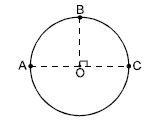
A
$3 : 2$
B
$5 : 4$
C
$3 : 5$
D
$3 : 7$
Solution
(B) Let the angular positions of $A, B$ and $C$ at $t=0$ be $\theta_A(0) = 0$,$\theta_B(0) = \pi/2$,and $\theta_C(0) = \pi$ respectively.
The angular velocities are $\omega_A = v_A/r = \pi \, rad/s$,$\omega_B = v_B/r = 2.5\pi \, rad/s$,and $\omega_C = v_C/r = 2\pi \, rad/s$.
At time $t$,the angular positions are $\theta_A(t) = \pi t$,$\theta_B(t) = \pi/2 + 2.5\pi t$,and $\theta_C(t) = \pi + 2\pi t$.
For the particles to meet,their angular positions must be equal modulo $2\pi$. Let $\theta_A(t) = \theta_B(t) + 2n\pi$ and $\theta_B(t) = \theta_C(t) + 2m\pi$.
$\pi t = \pi/2 + 2.5\pi t + 2n\pi \implies -1.5t = 0.5 + 2n \implies t = -(2n + 0.5)/1.5$.
$\pi/2 + 2.5\pi t = \pi + 2\pi t + 2m\pi \implies 0.5t = 0.5 + 2m \implies t = 1 + 4m$.
Equating $t$: $1 + 4m = -(2n + 0.5)/1.5 \implies 1.5 + 6m = -2n - 0.5 \implies 2n + 6m = -2 \implies n + 3m = -1$.
For the first meeting,let $m = -1$,then $n = 2$. Thus $t = 1 + 4(-1) = -3$ (taking magnitude $t=3s$).
Distance $s_B = v_B t = 2.5 \times 3 = 7.5 \, m$.
Distance $s_C = v_C t = 2 \times 3 = 6 \, m$.
Ratio $s_B : s_C = 7.5 : 6 = 5 : 4$.
The angular velocities are $\omega_A = v_A/r = \pi \, rad/s$,$\omega_B = v_B/r = 2.5\pi \, rad/s$,and $\omega_C = v_C/r = 2\pi \, rad/s$.
At time $t$,the angular positions are $\theta_A(t) = \pi t$,$\theta_B(t) = \pi/2 + 2.5\pi t$,and $\theta_C(t) = \pi + 2\pi t$.
For the particles to meet,their angular positions must be equal modulo $2\pi$. Let $\theta_A(t) = \theta_B(t) + 2n\pi$ and $\theta_B(t) = \theta_C(t) + 2m\pi$.
$\pi t = \pi/2 + 2.5\pi t + 2n\pi \implies -1.5t = 0.5 + 2n \implies t = -(2n + 0.5)/1.5$.
$\pi/2 + 2.5\pi t = \pi + 2\pi t + 2m\pi \implies 0.5t = 0.5 + 2m \implies t = 1 + 4m$.
Equating $t$: $1 + 4m = -(2n + 0.5)/1.5 \implies 1.5 + 6m = -2n - 0.5 \implies 2n + 6m = -2 \implies n + 3m = -1$.
For the first meeting,let $m = -1$,then $n = 2$. Thus $t = 1 + 4(-1) = -3$ (taking magnitude $t=3s$).
Distance $s_B = v_B t = 2.5 \times 3 = 7.5 \, m$.
Distance $s_C = v_C t = 2 \times 3 = 6 \, m$.
Ratio $s_B : s_C = 7.5 : 6 = 5 : 4$.
0 likes
View Solution63
MediumMCQ
$A$ particle moves along a circle of radius $\left( \frac{20}{\pi} \right) \, m$ with constant tangential acceleration. If the velocity of the particle is $80 \, m/s$ at the end of the second revolution after motion has begun,the tangential acceleration is
A
$40 \, m/s^2$
B
$640 \, m/s^2$
C
$160 \pi \, m/s^2$
D
$40 \pi \, m/s^2$
Solution
(A) Given: Radius $r = \frac{20}{\pi} \, m$,initial angular velocity $\omega_i = 0$,and total angular displacement $\theta = 2 \times (2 \pi) = 4 \pi \, rad$ (since it completes two revolutions).
Final linear velocity $v = 80 \, m/s$.
The final angular velocity is $\omega_f = \frac{v}{r} = \frac{80}{20/\pi} = 4 \pi \, rad/s$.
Using the rotational kinematic equation $\omega_f^2 = \omega_i^2 + 2 \alpha \theta$,we get:
$(4 \pi)^2 = 0^2 + 2 \alpha (4 \pi)$
$16 \pi^2 = 8 \pi \alpha$
$\alpha = 2 \pi \, rad/s^2$.
The tangential acceleration is $a_t = r \alpha = \left( \frac{20}{\pi} \right) \times (2 \pi) = 40 \, m/s^2$.
Final linear velocity $v = 80 \, m/s$.
The final angular velocity is $\omega_f = \frac{v}{r} = \frac{80}{20/\pi} = 4 \pi \, rad/s$.
Using the rotational kinematic equation $\omega_f^2 = \omega_i^2 + 2 \alpha \theta$,we get:
$(4 \pi)^2 = 0^2 + 2 \alpha (4 \pi)$
$16 \pi^2 = 8 \pi \alpha$
$\alpha = 2 \pi \, rad/s^2$.
The tangential acceleration is $a_t = r \alpha = \left( \frac{20}{\pi} \right) \times (2 \pi) = 40 \, m/s^2$.
0 likes
View Solution64
MediumMCQ
If the equation for the displacement of a particle moving on a circular path is given as $\theta = 2t^3 + 0.5$,where $\theta$ is in radians and $t$ is in seconds,then the angular velocity of the particle after $2$ seconds will be ....... $rad/sec$.
A
$36$
B
$8$
C
$48$
D
$24$
Solution
(D) The angular displacement is given by $\theta = 2t^3 + 0.5$.
Angular velocity $\omega$ is defined as the rate of change of angular displacement with respect to time: $\omega = \frac{d\theta}{dt}$.
Differentiating $\theta$ with respect to $t$: $\omega = \frac{d}{dt}(2t^3 + 0.5) = 6t^2$.
To find the angular velocity after $t = 2$ seconds,substitute $t = 2$ into the expression for $\omega$:
$\omega = 6(2)^2 = 6 \times 4 = 24 \ rad/sec$.
Angular velocity $\omega$ is defined as the rate of change of angular displacement with respect to time: $\omega = \frac{d\theta}{dt}$.
Differentiating $\theta$ with respect to $t$: $\omega = \frac{d}{dt}(2t^3 + 0.5) = 6t^2$.
To find the angular velocity after $t = 2$ seconds,substitute $t = 2$ into the expression for $\omega$:
$\omega = 6(2)^2 = 6 \times 4 = 24 \ rad/sec$.
0 likes
View Solution65
EasyMCQ
$A$ wheel has an angular acceleration of $3.0\, rad/s^2$ and an initial angular speed of $2.00\, rad/s$. In a time of $2\, s$,it has rotated through an angle (in radians) of:
A
$6$
B
$10$
C
$12$
D
$4$
Solution
(B) Given:
Initial angular speed,$\omega_0 = 2.00\, rad/s$
Angular acceleration,$\alpha = 3.0\, rad/s^2$
Time,$t = 2\, s$
Using the kinematic equation for angular displacement:
$\theta = \omega_0 t + \frac{1}{2} \alpha t^2$
Substituting the given values:
$\theta = (2.00)(2) + \frac{1}{2}(3.0)(2)^2$
$\theta = 4 + \frac{1}{2}(3.0)(4)$
$\theta = 4 + 6 = 10\, radians$
Thus,the wheel has rotated through an angle of $10\, radians$.
Initial angular speed,$\omega_0 = 2.00\, rad/s$
Angular acceleration,$\alpha = 3.0\, rad/s^2$
Time,$t = 2\, s$
Using the kinematic equation for angular displacement:
$\theta = \omega_0 t + \frac{1}{2} \alpha t^2$
Substituting the given values:
$\theta = (2.00)(2) + \frac{1}{2}(3.0)(2)^2$
$\theta = 4 + \frac{1}{2}(3.0)(4)$
$\theta = 4 + 6 = 10\, radians$
Thus,the wheel has rotated through an angle of $10\, radians$.
0 likes
View Solution66
MediumMCQ
$A$ particle starting from rest moves in a circle of radius $r$. It attains a velocity of $V_{0} \; m/s$ in the $n^{\text{th}}$ round. Its angular acceleration will be
A
$\frac{V_{0}}{n} \; rad/s^{2}$
B
$\frac{V_{0}^{2}}{2 \pi n r^{2}} \; rad/s^{2}$
C
$\frac{V_{0}^{2}}{4 \pi n r^{2}} \; rad/s^{2}$
D
$\frac{V_{0}^{2}}{4 \pi n r} \; rad/s^{2}$
Solution
(C) The particle starts from rest,so initial angular velocity $\omega_{0} = 0$.
After $n$ rounds,the total angular displacement is $\theta = 2 \pi n$.
The final linear velocity is $V_{0}$,so the final angular velocity is $\omega = \frac{V_{0}}{r}$.
Using the kinematic equation $\omega^{2} = \omega_{0}^{2} + 2 \alpha \theta$,we get:
$\alpha = \frac{\omega^{2} - \omega_{0}^{2}}{2 \theta} = \frac{(V_{0}/r)^{2} - 0}{2(2 \pi n)} = \frac{V_{0}^{2}/r^{2}}{4 \pi n} = \frac{V_{0}^{2}}{4 \pi n r^{2}} \; rad/s^{2}$.
After $n$ rounds,the total angular displacement is $\theta = 2 \pi n$.
The final linear velocity is $V_{0}$,so the final angular velocity is $\omega = \frac{V_{0}}{r}$.
Using the kinematic equation $\omega^{2} = \omega_{0}^{2} + 2 \alpha \theta$,we get:
$\alpha = \frac{\omega^{2} - \omega_{0}^{2}}{2 \theta} = \frac{(V_{0}/r)^{2} - 0}{2(2 \pi n)} = \frac{V_{0}^{2}/r^{2}}{4 \pi n} = \frac{V_{0}^{2}}{4 \pi n r^{2}} \; rad/s^{2}$.
0 likes
View Solution67
Medium
Obtain the equation $\omega = \omega_{0} + \alpha t$ from first principles.
Solution
(N/A) The angular acceleration $\alpha$ is uniform,hence the rate of change of angular velocity $\omega$ with respect to time $t$ is constant:
$\frac{d\omega}{dt} = \alpha$
Rearranging the terms for integration:
$d\omega = \alpha dt$
Integrating both sides:
$\int d\omega = \int \alpha dt$
$\omega = \alpha t + c$,where $c$ is the constant of integration.
Applying the initial condition: at $t = 0$,$\omega = \omega_{0}$.
Substituting these values into the equation:
$\omega_{0} = \alpha(0) + c \implies c = \omega_{0}$
Substituting the value of $c$ back into the integrated equation:
$\omega = \omega_{0} + \alpha t$.
$\frac{d\omega}{dt} = \alpha$
Rearranging the terms for integration:
$d\omega = \alpha dt$
Integrating both sides:
$\int d\omega = \int \alpha dt$
$\omega = \alpha t + c$,where $c$ is the constant of integration.
Applying the initial condition: at $t = 0$,$\omega = \omega_{0}$.
Substituting these values into the equation:
$\omega_{0} = \alpha(0) + c \implies c = \omega_{0}$
Substituting the value of $c$ back into the integrated equation:
$\omega = \omega_{0} + \alpha t$.
0 likes
View Solution68
Medium
The angular speed of a motor wheel is increased from $1200 \; rpm$ to $3120 \; rpm$ in $16 \; s$.
$(i)$ What is its angular acceleration,assuming the acceleration to be uniform?
$(ii)$ How many revolutions does the engine make during this time?
$(i)$ What is its angular acceleration,assuming the acceleration to be uniform?
$(ii)$ How many revolutions does the engine make during this time?
Solution
(N/A) $(i)$ We use the equation $\omega = \omega_{0} + \alpha t$.
Initial angular speed $\omega_{0} = \frac{2 \pi \times 1200}{60} \; rad/s = 40 \pi \; rad/s$.
Final angular speed $\omega = \frac{2 \pi \times 3120}{60} \; rad/s = 104 \pi \; rad/s$.
Angular acceleration $\alpha = \frac{\omega - \omega_{0}}{t} = \frac{104 \pi - 40 \pi}{16} = \frac{64 \pi}{16} = 4 \pi \; rad/s^{2}$.
$(ii)$ The angular displacement $\theta$ is given by $\theta = \omega_{0} t + \frac{1}{2} \alpha t^{2}$.
$\theta = (40 \pi \times 16) + \frac{1}{2} \times (4 \pi) \times (16)^{2} = 640 \pi + 512 \pi = 1152 \pi \; rad$.
Number of revolutions $n = \frac{\theta}{2 \pi} = \frac{1152 \pi}{2 \pi} = 576$.
Initial angular speed $\omega_{0} = \frac{2 \pi \times 1200}{60} \; rad/s = 40 \pi \; rad/s$.
Final angular speed $\omega = \frac{2 \pi \times 3120}{60} \; rad/s = 104 \pi \; rad/s$.
Angular acceleration $\alpha = \frac{\omega - \omega_{0}}{t} = \frac{104 \pi - 40 \pi}{16} = \frac{64 \pi}{16} = 4 \pi \; rad/s^{2}$.
$(ii)$ The angular displacement $\theta$ is given by $\theta = \omega_{0} t + \frac{1}{2} \alpha t^{2}$.
$\theta = (40 \pi \times 16) + \frac{1}{2} \times (4 \pi) \times (16)^{2} = 640 \pi + 512 \pi = 1152 \pi \; rad$.
Number of revolutions $n = \frac{\theta}{2 \pi} = \frac{1152 \pi}{2 \pi} = 576$.
0 likes
View Solution69
EasyMCQ
What is the value of the tangential component of the linear acceleration of a particle of a rigid body rotating with a constant angular velocity?
A
Zero
B
Non-zero
C
Infinite
D
Depends on the radius
Solution
(A) The tangential component of the linear acceleration of a particle in rotational motion is given by $a_{T} = r\alpha$,where $r$ is the radius and $\alpha$ is the angular acceleration.
Since the rigid body is rotating with a constant angular velocity,the angular acceleration $\alpha = \frac{d\omega}{dt} = 0$.
Therefore,the tangential component of the linear acceleration $a_{T} = r \times 0 = 0$.
Since the rigid body is rotating with a constant angular velocity,the angular acceleration $\alpha = \frac{d\omega}{dt} = 0$.
Therefore,the tangential component of the linear acceleration $a_{T} = r \times 0 = 0$.
0 likes
View Solution70
MediumMCQ
Is the tangential acceleration of a particle moving in a circular path always zero? Under what condition is it zero?
A
Yes,it is always zero.
B
No,it is zero only when the angular speed is constant.
C
No,it is zero only when the radius is constant.
D
No,it is zero only when the centripetal acceleration is zero.
Solution
(B) The tangential acceleration $a_t$ is defined as the rate of change of the magnitude of velocity,given by $a_t = \frac{dv}{dt} = r \alpha$,where $r$ is the radius and $\alpha$ is the angular acceleration.
If the angular speed $\omega$ is constant,then the angular acceleration $\alpha = \frac{d\omega}{dt} = 0$.
Therefore,the tangential acceleration $a_t$ is zero only when the particle undergoes uniform circular motion,meaning the angular speed remains constant.
If the angular speed $\omega$ is constant,then the angular acceleration $\alpha = \frac{d\omega}{dt} = 0$.
Therefore,the tangential acceleration $a_t$ is zero only when the particle undergoes uniform circular motion,meaning the angular speed remains constant.
0 likes
View Solution71
MediumMCQ
$A$ clock has a continuously moving second's hand of $0.1\, m$ length. The average acceleration of the tip of the hand (in units of $m\, s^{-2}$) is of the order of
A
$10^{-3}$
B
$10^{-2}$
C
$10^{-4}$
D
$10^{-1}$
Solution
(A) The length of the second's hand is the radius of the circular path,$R = 0.1\, m$.
The time period for the second's hand is $T = 60\, s$.
The angular velocity $\omega$ is given by $\omega = \frac{2\pi}{T} = \frac{2\pi}{60} \approx 0.105\, rad/s$.
The centripetal acceleration $a$ of the tip of the hand is given by $a = \omega^2 R$.
Substituting the values: $a = (0.105)^2 \times 0.1$.
$a \approx 0.011025 \times 0.1 = 0.0011025\, m/s^2$.
This can be written as $1.1 \times 10^{-3}\, m/s^2$.
Therefore,the average acceleration is of the order of $10^{-3}$.
The time period for the second's hand is $T = 60\, s$.
The angular velocity $\omega$ is given by $\omega = \frac{2\pi}{T} = \frac{2\pi}{60} \approx 0.105\, rad/s$.
The centripetal acceleration $a$ of the tip of the hand is given by $a = \omega^2 R$.
Substituting the values: $a = (0.105)^2 \times 0.1$.
$a \approx 0.011025 \times 0.1 = 0.0011025\, m/s^2$.
This can be written as $1.1 \times 10^{-3}\, m/s^2$.
Therefore,the average acceleration is of the order of $10^{-3}$.
0 likes
View Solution72
MediumMCQ
The angular speed of the wheel of a vehicle is increased from $360 \; rpm$ to $1200 \; rpm$ in $14 \; s$. Its angular acceleration is,
A
$1 \; rad/s^2$
B
$2 \pi \; rad/s^2$
C
$28 \pi \; rad/s^2$
D
$120 \pi \; rad/s^2$
Solution
(B) Initial angular speed $\omega_0 = 360 \; rpm = 360 \times \frac{2\pi}{60} \; rad/s = 12\pi \; rad/s$.
Final angular speed $\omega = 1200 \; rpm = 1200 \times \frac{2\pi}{60} \; rad/s = 40\pi \; rad/s$.
Time taken $t = 14 \; s$.
Using the equation of rotational motion $\omega = \omega_0 + \alpha t$,where $\alpha$ is the angular acceleration:
$40\pi = 12\pi + \alpha(14)$.
$28\pi = 14\alpha$.
$\alpha = \frac{28\pi}{14} = 2\pi \; rad/s^2$.
Final angular speed $\omega = 1200 \; rpm = 1200 \times \frac{2\pi}{60} \; rad/s = 40\pi \; rad/s$.
Time taken $t = 14 \; s$.
Using the equation of rotational motion $\omega = \omega_0 + \alpha t$,where $\alpha$ is the angular acceleration:
$40\pi = 12\pi + \alpha(14)$.
$28\pi = 14\alpha$.
$\alpha = \frac{28\pi}{14} = 2\pi \; rad/s^2$.
0 likes
View Solution73
MediumMCQ
The angular speed of a truck wheel is increased from $900 \, rpm$ to $2460 \, rpm$ in $26 \, s$. The number of revolutions made by the truck engine during this time is (assuming the acceleration to be uniform).
A
$1456$
B
$728$
C
$810$
D
$368$
Solution
(B) Given:
Initial angular speed,$\omega_1 = 900 \, rpm = \frac{900}{60} \, rev/s = 15 \, rev/s$.
Final angular speed,$\omega_2 = 2460 \, rpm = \frac{2460}{60} \, rev/s = 41 \, rev/s$.
Time interval,$t = 26 \, s$.
Since the angular acceleration is uniform,the average angular speed is $\omega_{avg} = \frac{\omega_1 + \omega_2}{2}$.
$\omega_{avg} = \frac{15 + 41}{2} = \frac{56}{2} = 28 \, rev/s$.
The total number of revolutions $N$ is given by the product of average angular speed and time:
$N = \omega_{avg} \times t = 28 \, rev/s \times 26 \, s = 728 \, revolutions$.
Initial angular speed,$\omega_1 = 900 \, rpm = \frac{900}{60} \, rev/s = 15 \, rev/s$.
Final angular speed,$\omega_2 = 2460 \, rpm = \frac{2460}{60} \, rev/s = 41 \, rev/s$.
Time interval,$t = 26 \, s$.
Since the angular acceleration is uniform,the average angular speed is $\omega_{avg} = \frac{\omega_1 + \omega_2}{2}$.
$\omega_{avg} = \frac{15 + 41}{2} = \frac{56}{2} = 28 \, rev/s$.
The total number of revolutions $N$ is given by the product of average angular speed and time:
$N = \omega_{avg} \times t = 28 \, rev/s \times 26 \, s = 728 \, revolutions$.
0 likes
View Solution74
MediumMCQ
$A$ body rotating with an angular speed of $600 \, rpm$ is uniformly accelerated to $1800 \, rpm$ in $10 \, s$. The number of rotations made in the process is ..... .
A
$100$
B
$500$
C
$300$
D
$200$
Solution
(D) Initial angular speed,$\omega_0 = 600 \, rpm = 10 \, rev/s$.
Final angular speed,$\omega_f = 1800 \, rpm = 30 \, rev/s$.
Time taken,$t = 10 \, s$.
Since the acceleration is uniform,the average angular speed is $\omega_{avg} = \frac{\omega_0 + \omega_f}{2} = \frac{10 + 30}{2} = 20 \, rev/s$.
The total number of rotations (revolutions) made is $\theta = \omega_{avg} \times t$.
$\theta = 20 \, rev/s \times 10 \, s = 200 \, rev$.
Final angular speed,$\omega_f = 1800 \, rpm = 30 \, rev/s$.
Time taken,$t = 10 \, s$.
Since the acceleration is uniform,the average angular speed is $\omega_{avg} = \frac{\omega_0 + \omega_f}{2} = \frac{10 + 30}{2} = 20 \, rev/s$.
The total number of rotations (revolutions) made is $\theta = \omega_{avg} \times t$.
$\theta = 20 \, rev/s \times 10 \, s = 200 \, rev$.
0 likes
View Solution75
EasyMCQ
The angular speed of a flywheel moving with uniform angular acceleration changes from $1200\,rpm$ to $3120\,rpm$ in $16\,s$. The angular acceleration in $rad/s^{2}$ is: (in $\pi$)
A
$4$
B
$12$
C
$104$
D
$2$
Solution
(A) The formula for angular velocity under uniform angular acceleration is $\omega = \omega_{0} + \alpha t$.
Here, the initial angular speed $\omega_{0} = 1200\,rpm$ and the final angular speed $\omega = 3120\,rpm$.
The time interval is $t = 16\,s$.
First, convert the angular speeds from $rpm$ to $rad/s$ using the relation $1\,rpm = \frac{2\pi}{60}\,rad/s$.
The change in angular speed is $\Delta\omega = 3120 - 1200 = 1920\,rpm$.
Converting this to $rad/s$: $\Delta\omega = 1920 \times \frac{2\pi}{60} = 32 \times 2\pi = 64\pi\,rad/s$.
The angular acceleration $\alpha$ is given by $\alpha = \frac{\Delta\omega}{t} = \frac{64\pi}{16} = 4\pi\,rad/s^{2}$.
Here, the initial angular speed $\omega_{0} = 1200\,rpm$ and the final angular speed $\omega = 3120\,rpm$.
The time interval is $t = 16\,s$.
First, convert the angular speeds from $rpm$ to $rad/s$ using the relation $1\,rpm = \frac{2\pi}{60}\,rad/s$.
The change in angular speed is $\Delta\omega = 3120 - 1200 = 1920\,rpm$.
Converting this to $rad/s$: $\Delta\omega = 1920 \times \frac{2\pi}{60} = 32 \times 2\pi = 64\pi\,rad/s$.
The angular acceleration $\alpha$ is given by $\alpha = \frac{\Delta\omega}{t} = \frac{64\pi}{16} = 4\pi\,rad/s^{2}$.
0 likes
View Solution76
MediumMCQ
$A$ ball is spun with angular acceleration $\alpha = 6t^2 - 2t$,where $t$ is in seconds and $\alpha$ is in $rad/s^2$. At $t = 0$,the ball has an angular velocity of $10 \ rad/s$ and an angular position of $4 \ rad$. The most appropriate expression for the angular position of the ball is:
A
$\frac{3}{2}t^4 - t^2 + 10t$
B
$\frac{t^4}{2} - \frac{t^3}{3} + 10t + 4$
C
$\frac{2t^4}{3} - \frac{t^3}{6} + 10t + 12$
D
$2t^4 - \frac{t^3}{2} + 5t + 4$
Solution
(B) Given angular acceleration $\alpha = \frac{d\omega}{dt} = 6t^2 - 2t$.
Integrating with respect to $t$ to find angular velocity $\omega$:
$\int_{10}^{\omega} d\omega = \int_{0}^{t} (6t^2 - 2t) dt$
$\omega - 10 = [2t^3 - t^2]_0^t$
$\omega = 2t^3 - t^2 + 10$.
Now,$\omega = \frac{d\theta}{dt} = 2t^3 - t^2 + 10$.
Integrating with respect to $t$ to find angular position $\theta$:
$\int_{4}^{\theta} d\theta = \int_{0}^{t} (2t^3 - t^2 + 10) dt$
$\theta - 4 = [\frac{2t^4}{4} - \frac{t^3}{3} + 10t]_0^t$
$\theta - 4 = \frac{t^4}{2} - \frac{t^3}{3} + 10t$
$\theta = \frac{t^4}{2} - \frac{t^3}{3} + 10t + 4$.
Integrating with respect to $t$ to find angular velocity $\omega$:
$\int_{10}^{\omega} d\omega = \int_{0}^{t} (6t^2 - 2t) dt$
$\omega - 10 = [2t^3 - t^2]_0^t$
$\omega = 2t^3 - t^2 + 10$.
Now,$\omega = \frac{d\theta}{dt} = 2t^3 - t^2 + 10$.
Integrating with respect to $t$ to find angular position $\theta$:
$\int_{4}^{\theta} d\theta = \int_{0}^{t} (2t^3 - t^2 + 10) dt$
$\theta - 4 = [\frac{2t^4}{4} - \frac{t^3}{3} + 10t]_0^t$
$\theta - 4 = \frac{t^4}{2} - \frac{t^3}{3} + 10t$
$\theta = \frac{t^4}{2} - \frac{t^3}{3} + 10t + 4$.
0 likes
View Solution77
EasyMCQ
If the frequency of an object in uniform circular motion is doubled,its acceleration becomes
A
Two times
B
Four times
C
Half
D
One fourth
Solution
(B) In uniform circular motion,the centripetal acceleration $a_c$ is given by the formula $a_c = \omega^2 r$,where $\omega$ is the angular velocity and $r$ is the radius of the circular path.
Since angular velocity $\omega = 2 \pi f$,where $f$ is the frequency,we can substitute this into the acceleration formula:
$a_c = (2 \pi f)^2 r = 4 \pi^2 f^2 r$.
From this expression,we can see that the acceleration is directly proportional to the square of the frequency: $a_c \propto f^2$.
If the frequency $f$ is doubled $(f' = 2f)$,the new acceleration $a_c'$ becomes:
$a_c' \propto (2f)^2 = 4f^2$.
Therefore,the acceleration becomes $4$ times the original value.
Since angular velocity $\omega = 2 \pi f$,where $f$ is the frequency,we can substitute this into the acceleration formula:
$a_c = (2 \pi f)^2 r = 4 \pi^2 f^2 r$.
From this expression,we can see that the acceleration is directly proportional to the square of the frequency: $a_c \propto f^2$.
If the frequency $f$ is doubled $(f' = 2f)$,the new acceleration $a_c'$ becomes:
$a_c' \propto (2f)^2 = 4f^2$.
Therefore,the acceleration becomes $4$ times the original value.
1 likes
View Solution78
EasyMCQ
$A$ particle is revolving in a circular path of radius $25 \, m$ with a constant angular speed of $12 \, rev/min$. The angular acceleration of the particle is .......... $rad/s^2$.
A
$2 \pi^2$
B
$4 \pi^2$
C
$\pi^2$
D
$0$
Solution
(D) Angular acceleration $(\alpha)$ is defined as the rate of change of angular velocity $(\omega)$ with respect to time,given by $\alpha = \frac{d\omega}{dt}$.
Since the particle is revolving with a constant angular speed,the angular velocity $\omega$ does not change over time.
Therefore,the rate of change of angular velocity is zero,which implies $\alpha = 0 \, rad/s^2$.
Since the particle is revolving with a constant angular speed,the angular velocity $\omega$ does not change over time.
Therefore,the rate of change of angular velocity is zero,which implies $\alpha = 0 \, rad/s^2$.
0 likes
View Solution79
MediumMCQ
$A$ body rotating with uniform angular acceleration covers $100 \pi \text{ rad}$ in the first $5 \text{ s}$ after the start. Its angular speed at the end of $5 \text{ s}$ (in $\text{rad/s}$) is .........$\pi$.
A
$40$
B
$30$
C
$20$
D
$10$
Solution
(A) Given: Initial angular velocity $\omega_0 = 0 \text{ rad/s}$ (since it starts from rest).
Angular displacement $\theta = 100 \pi \text{ rad}$.
Time $t = 5 \text{ s}$.
Using the second equation of rotational motion: $\theta = \omega_0 t + \frac{1}{2} \alpha t^2$.
Substituting the values: $100 \pi = 0 + \frac{1}{2} \alpha (5)^2$.
$100 \pi = \frac{25}{2} \alpha$.
$\alpha = \frac{200 \pi}{25} = 8 \pi \text{ rad/s}^2$.
Now,using the first equation of rotational motion: $\omega = \omega_0 + \alpha t$.
$\omega = 0 + (8 \pi) \times 5 = 40 \pi \text{ rad/s}$.
Thus,the angular speed at the end of $5 \text{ s}$ is $40 \pi \text{ rad/s}$.
Angular displacement $\theta = 100 \pi \text{ rad}$.
Time $t = 5 \text{ s}$.
Using the second equation of rotational motion: $\theta = \omega_0 t + \frac{1}{2} \alpha t^2$.
Substituting the values: $100 \pi = 0 + \frac{1}{2} \alpha (5)^2$.
$100 \pi = \frac{25}{2} \alpha$.
$\alpha = \frac{200 \pi}{25} = 8 \pi \text{ rad/s}^2$.
Now,using the first equation of rotational motion: $\omega = \omega_0 + \alpha t$.
$\omega = 0 + (8 \pi) \times 5 = 40 \pi \text{ rad/s}$.
Thus,the angular speed at the end of $5 \text{ s}$ is $40 \pi \text{ rad/s}$.
0 likes
View Solution80
EasyMCQ
The angular acceleration of a body, moving along the circumference of a circle, is :
A
along the axis of rotation
B
along the tangent to its position
C
along the radius towards the centre
D
along the radius, away from centre
Solution
(A) Angular acceleration $(\vec{\alpha})$ is defined as the rate of change of angular velocity $(\vec{\omega})$ with respect to time, given by $\vec{\alpha} = \frac{d\vec{\omega}}{dt}$.
Since the angular velocity vector $(\vec{\omega})$ for a body moving in a circular path is directed along the axis of rotation, the rate of change of this vector, which is the angular acceleration $(\vec{\alpha})$, also acts along the same axis of rotation.
Since the angular velocity vector $(\vec{\omega})$ for a body moving in a circular path is directed along the axis of rotation, the rate of change of this vector, which is the angular acceleration $(\vec{\alpha})$, also acts along the same axis of rotation.

0 likes
View Solution81
DifficultMCQ
$A$ clock has $75 \ cm$ and $60 \ cm$ long second hand and minute hand respectively. In $30$ minutes duration,the tip of the second hand will travel $x$ distance more than the tip of the minute hand. The value of $x$ in meters is nearly (Take $\pi = 3.14$):
A
$220.0$
B
$140.5$
C
$139.4$
D
$118.9$
Solution
(C) The length of the second hand is $r_s = 75 \ cm = 0.75 \ m$. The length of the minute hand is $r_m = 60 \ cm = 0.60 \ m$.
In $30$ minutes,the second hand completes $30$ full revolutions. The distance traveled by the tip of the second hand is $d_s = 30 \times (2 \pi r_s) = 30 \times 2 \times 3.14 \times 0.75 = 141.3 \ m$.
In $30$ minutes,the minute hand completes $0.5$ revolutions (half a circle). The distance traveled by the tip of the minute hand is $d_m = 0.5 \times (2 \pi r_m) = \pi r_m = 3.14 \times 0.60 = 1.884 \ m$.
The difference in distance is $x = d_s - d_m = 141.3 - 1.884 = 139.416 \ m$.
Rounding to one decimal place,$x \approx 139.4 \ m$.
In $30$ minutes,the second hand completes $30$ full revolutions. The distance traveled by the tip of the second hand is $d_s = 30 \times (2 \pi r_s) = 30 \times 2 \times 3.14 \times 0.75 = 141.3 \ m$.
In $30$ minutes,the minute hand completes $0.5$ revolutions (half a circle). The distance traveled by the tip of the minute hand is $d_m = 0.5 \times (2 \pi r_m) = \pi r_m = 3.14 \times 0.60 = 1.884 \ m$.
The difference in distance is $x = d_s - d_m = 141.3 - 1.884 = 139.416 \ m$.
Rounding to one decimal place,$x \approx 139.4 \ m$.
0 likes
View Solution82
DifficultMCQ
$A$ particle moves along a circle of radius $r$ with constant tangential acceleration. If the velocity of the particle is $v$ at the end of the second revolution after the motion has started,then the tangential acceleration is
A
$\frac{v^2}{8 \pi r}$
B
$\frac{v^2}{6 \pi r}$
C
$\frac{v^2}{4 \pi r}$
D
$\frac{v^2}{10 \pi r}$
Solution
(A) The particle starts from rest,so the initial velocity $u = 0$.
The distance covered in one revolution is the circumference of the circle,which is $2 \pi r$.
The distance covered in two revolutions is $s = 2 \times 2 \pi r = 4 \pi r$.
Using the equation of motion $v^2 - u^2 = 2as$,where $a$ is the tangential acceleration:
$v^2 - 0^2 = 2 \times a \times (4 \pi r)$
$v^2 = 8 \pi r a$
Therefore,the tangential acceleration is $a = \frac{v^2}{8 \pi r}$.
The distance covered in one revolution is the circumference of the circle,which is $2 \pi r$.
The distance covered in two revolutions is $s = 2 \times 2 \pi r = 4 \pi r$.
Using the equation of motion $v^2 - u^2 = 2as$,where $a$ is the tangential acceleration:
$v^2 - 0^2 = 2 \times a \times (4 \pi r)$
$v^2 = 8 \pi r a$
Therefore,the tangential acceleration is $a = \frac{v^2}{8 \pi r}$.
0 likes
View Solution83
EasyMCQ
$A$ particle starting from rest moves along the circumference of a circle of radius $r$ with angular acceleration $\alpha$. The magnitude of the average velocity in the time it completes the small angular displacement $\theta$ is
A
$\frac{r^2}{2 \alpha \theta}$
B
$\frac{r}{2 \alpha \theta}$
C
$\frac{r \alpha \theta}{2}$
D
$\frac{r}{\sqrt{2}} \sqrt{\alpha \theta}$
Solution
(D) Using the rotational kinematic equation for angular displacement:
$\theta = \omega_0 t + \frac{1}{2} \alpha t^2$
Since the particle starts from rest,$\omega_0 = 0$,so:
$\theta = \frac{1}{2} \alpha t^2$
Solving for time $t$:
$t = \sqrt{\frac{2 \theta}{\alpha}} \quad ...(i)$
The linear distance (arc length) covered by the particle for an angular displacement $\theta$ is:
$s = r \theta \quad ...(ii)$
The average velocity is defined as the total displacement divided by the total time. For a small displacement $\theta$,the magnitude of displacement is approximately the arc length $s$:
$V_{\text{average}} = \frac{s}{t} = \frac{r \theta}{\sqrt{\frac{2 \theta}{\alpha}}}$
$V_{\text{average}} = r \theta \cdot \sqrt{\frac{\alpha}{2 \theta}} = r \sqrt{\frac{\alpha \theta^2}{2 \theta}} = \frac{r}{\sqrt{2}} \sqrt{\alpha \theta}$
$\theta = \omega_0 t + \frac{1}{2} \alpha t^2$
Since the particle starts from rest,$\omega_0 = 0$,so:
$\theta = \frac{1}{2} \alpha t^2$
Solving for time $t$:
$t = \sqrt{\frac{2 \theta}{\alpha}} \quad ...(i)$
The linear distance (arc length) covered by the particle for an angular displacement $\theta$ is:
$s = r \theta \quad ...(ii)$
The average velocity is defined as the total displacement divided by the total time. For a small displacement $\theta$,the magnitude of displacement is approximately the arc length $s$:
$V_{\text{average}} = \frac{s}{t} = \frac{r \theta}{\sqrt{\frac{2 \theta}{\alpha}}}$
$V_{\text{average}} = r \theta \cdot \sqrt{\frac{\alpha}{2 \theta}} = r \sqrt{\frac{\alpha \theta^2}{2 \theta}} = \frac{r}{\sqrt{2}} \sqrt{\alpha \theta}$
0 likes
View Solution84
MediumMCQ
$A$ particle of mass $m$ moves along a circle of radius $r$ with constant tangential acceleration. If the kinetic energy $(K.E.)$ of the particle is $E$ by the end of the third revolution after the beginning of the motion,then the magnitude of the tangential acceleration is:
A
$\frac{E}{2 \pi rm}$
B
$\frac{E}{6 \pi rm}$
C
$\frac{E}{8 \pi rm}$
D
$\frac{E}{4 \pi rm}$
Solution
(B) Using the $3^{rd}$ equation of motion: $v^2 = u^2 + 2as$.
Since the motion starts from rest,$u = 0$,so $v^2 = 2 a_t s$.
Therefore,$a_t = \frac{v^2}{2s}$.
By the end of the $3^{rd}$ revolution,the total distance covered is $s = 3 \times (2 \pi r) = 6 \pi r$.
Substituting $s$ into the acceleration formula: $a_t = \frac{v^2}{2 \times 6 \pi r} = \frac{v^2}{12 \pi r}$.
Given the kinetic energy $E = \frac{1}{2} m v^2$,we have $v^2 = \frac{2E}{m}$.
Substituting $v^2$ into the expression for $a_t$: $a_t = \frac{2E}{m \times 12 \pi r} = \frac{E}{6 \pi rm}$.
Since the motion starts from rest,$u = 0$,so $v^2 = 2 a_t s$.
Therefore,$a_t = \frac{v^2}{2s}$.
By the end of the $3^{rd}$ revolution,the total distance covered is $s = 3 \times (2 \pi r) = 6 \pi r$.
Substituting $s$ into the acceleration formula: $a_t = \frac{v^2}{2 \times 6 \pi r} = \frac{v^2}{12 \pi r}$.
Given the kinetic energy $E = \frac{1}{2} m v^2$,we have $v^2 = \frac{2E}{m}$.
Substituting $v^2$ into the expression for $a_t$: $a_t = \frac{2E}{m \times 12 \pi r} = \frac{E}{6 \pi rm}$.
0 likes
View Solution85
MediumMCQ
$A$ particle performing uniform circular motion of radius $\frac{\pi}{2} \ m$ makes $x$ revolutions in time $t$. Its tangential velocity is
A
$\frac{\pi x}{t}$
B
$\frac{\pi x^2}{t}$
C
$\frac{\pi^2 x^2}{t}$
D
$\frac{\pi^2 x}{t}$
Solution
(D) The radius of the circular path is $r = \frac{\pi}{2} \ m$.
In $x$ revolutions,the total distance traveled by the particle is $d = x \times (2\pi r)$.
Substituting the value of $r$: $d = x \times (2\pi \times \frac{\pi}{2}) = x \times \pi^2 = \pi^2 x \ m$.
Tangential velocity $v$ is defined as the total distance traveled divided by the time taken: $v = \frac{d}{t}$.
Therefore,$v = \frac{\pi^2 x}{t} \ m/s$.
In $x$ revolutions,the total distance traveled by the particle is $d = x \times (2\pi r)$.
Substituting the value of $r$: $d = x \times (2\pi \times \frac{\pi}{2}) = x \times \pi^2 = \pi^2 x \ m$.
Tangential velocity $v$ is defined as the total distance traveled divided by the time taken: $v = \frac{d}{t}$.
Therefore,$v = \frac{\pi^2 x}{t} \ m/s$.
0 likes
View Solution86
EasyMCQ
$A$ particle of mass $10 \text{ g}$ moves along a circle of radius $6.4 \text{ cm}$ with a constant tangential acceleration. If the kinetic energy of the particle becomes $8 \times 10^{-4} \text{ J}$ by the end of the second revolution after the beginning of the motion, the magnitude of the tangential acceleration is (in $\text{ m/s}^2$)
A
$0.6$
B
$0.4$
C
$0.1$
D
$0.3$
Solution
(C) Given: Mass $m = 10 \text{ g} = 10^{-2} \text{ kg}$, Radius $r = 6.4 \text{ cm} = 6.4 \times 10^{-2} \text{ m}$, Kinetic Energy $K = 8 \times 10^{-4} \text{ J}$.
Since the particle starts from rest, its initial velocity $u = 0$.
The distance covered in two revolutions is $s = 2 \times (2 \pi r) = 4 \pi r$.
Using the work-energy theorem, the work done by the tangential force $F_t$ equals the change in kinetic energy:
$W = F_t \cdot s = \Delta K$
Since $F_t = m a_t$, we have:
$m a_t \cdot (4 \pi r) = K - 0$
$a_t = \frac{K}{m \cdot 4 \pi r}$
Substituting the values:
$a_t = \frac{8 \times 10^{-4} \text{ J}}{10^{-2} \text{ kg} \times 4 \times 3.14 \times 6.4 \times 10^{-2} \text{ m}}$
$a_t = \frac{8 \times 10^{-4}}{25.6 \pi \times 10^{-4}} = \frac{8}{25.6 \times 3.14} \approx 0.1 \text{ m/s}^2$.
Since the particle starts from rest, its initial velocity $u = 0$.
The distance covered in two revolutions is $s = 2 \times (2 \pi r) = 4 \pi r$.
Using the work-energy theorem, the work done by the tangential force $F_t$ equals the change in kinetic energy:
$W = F_t \cdot s = \Delta K$
Since $F_t = m a_t$, we have:
$m a_t \cdot (4 \pi r) = K - 0$
$a_t = \frac{K}{m \cdot 4 \pi r}$
Substituting the values:
$a_t = \frac{8 \times 10^{-4} \text{ J}}{10^{-2} \text{ kg} \times 4 \times 3.14 \times 6.4 \times 10^{-2} \text{ m}}$
$a_t = \frac{8 \times 10^{-4}}{25.6 \pi \times 10^{-4}} = \frac{8}{25.6 \times 3.14} \approx 0.1 \text{ m/s}^2$.
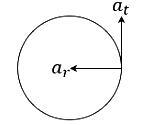
0 likes
View Solution87
EasyMCQ
$A$ particle performing $U.C.M.$ of radius $\frac{\pi}{2} \ m$ makes $x$ revolutions in time $t$. Its tangential velocity is
A
$\frac{\pi x}{t}$
B
$\frac{\pi^2 x}{t}$
C
$\frac{\pi^2 x^2}{t}$
D
$\frac{2 \pi x}{t}$
Solution
(B) The particle is performing uniform circular motion $(U.C.M.)$.
The total angle covered in $x$ revolutions is $\theta = 2 \pi x$ radians.
The angular velocity $\omega$ is given by $\omega = \frac{\theta}{t} = \frac{2 \pi x}{t}$.
The tangential velocity $v$ is related to angular velocity by $v = \omega R$.
Given the radius $R = \frac{\pi}{2} \ m$.
Substituting the values,$v = \left( \frac{2 \pi x}{t} \right) \times \left( \frac{\pi}{2} \right) = \frac{\pi^2 x}{t} \ m/s$.
The total angle covered in $x$ revolutions is $\theta = 2 \pi x$ radians.
The angular velocity $\omega$ is given by $\omega = \frac{\theta}{t} = \frac{2 \pi x}{t}$.
The tangential velocity $v$ is related to angular velocity by $v = \omega R$.
Given the radius $R = \frac{\pi}{2} \ m$.
Substituting the values,$v = \left( \frac{2 \pi x}{t} \right) \times \left( \frac{\pi}{2} \right) = \frac{\pi^2 x}{t} \ m/s$.
0 likes
View Solution88
EasyMCQ
The angular displacement of a body performing circular motion is given by $\theta = 5 \sin \frac{\pi t}{6}$. The angular velocity of the body at $t = 3 \ s$ will be $\left[\sin \frac{\pi}{2} = 1, \cos \frac{\pi}{2} = 0\right]$.
A
$5 \ rad/s$
B
$1 \ rad/s$
C
$2.5 \ rad/s$
D
zero
Solution
(D) The angular displacement is given by $\theta = 5 \sin \frac{\pi t}{6}$.
Angular velocity $\omega$ is the rate of change of angular displacement,defined as $\omega = \frac{d\theta}{dt}$.
Differentiating $\theta$ with respect to $t$:
$\omega = \frac{d}{dt} \left( 5 \sin \frac{\pi t}{6} \right) = 5 \cdot \cos \left( \frac{\pi t}{6} \right) \cdot \frac{\pi}{6} = \frac{5\pi}{6} \cos \left( \frac{\pi t}{6} \right)$.
At $t = 3 \ s$:
$\omega = \frac{5\pi}{6} \cos \left( \frac{\pi \times 3}{6} \right) = \frac{5\pi}{6} \cos \left( \frac{\pi}{2} \right)$.
Since $\cos \frac{\pi}{2} = 0$,we get $\omega = \frac{5\pi}{6} \times 0 = 0 \ rad/s$.
Angular velocity $\omega$ is the rate of change of angular displacement,defined as $\omega = \frac{d\theta}{dt}$.
Differentiating $\theta$ with respect to $t$:
$\omega = \frac{d}{dt} \left( 5 \sin \frac{\pi t}{6} \right) = 5 \cdot \cos \left( \frac{\pi t}{6} \right) \cdot \frac{\pi}{6} = \frac{5\pi}{6} \cos \left( \frac{\pi t}{6} \right)$.
At $t = 3 \ s$:
$\omega = \frac{5\pi}{6} \cos \left( \frac{\pi \times 3}{6} \right) = \frac{5\pi}{6} \cos \left( \frac{\pi}{2} \right)$.
Since $\cos \frac{\pi}{2} = 0$,we get $\omega = \frac{5\pi}{6} \times 0 = 0 \ rad/s$.
0 likes
View Solution89
DifficultMCQ
$A$ particle performing $U.C.M.$ of radius $\frac{\pi}{2} \ m$ makes $x$ revolutions in time $t$. Its tangential velocity is
A
$\frac{\pi t}{x^{2}}$
B
$\frac{\pi x^{2}}{t}$
C
$\frac{\pi x}{t^{2}}$
D
$\frac{\pi^{2} x}{t}$
Solution
(D) The frequency of revolution is given by $f = \frac{x}{t}$.
Angular velocity $\omega$ is related to frequency by $\omega = 2 \pi f = \frac{2 \pi x}{t}$.
Tangential velocity $V$ is related to angular velocity by $V = \omega r$.
Given radius $r = \frac{\pi}{2} \ m$.
Substituting the values: $V = \left( \frac{2 \pi x}{t} \right) \cdot \left( \frac{\pi}{2} \right) = \frac{\pi^{2} x}{t}$.
Angular velocity $\omega$ is related to frequency by $\omega = 2 \pi f = \frac{2 \pi x}{t}$.
Tangential velocity $V$ is related to angular velocity by $V = \omega r$.
Given radius $r = \frac{\pi}{2} \ m$.
Substituting the values: $V = \left( \frac{2 \pi x}{t} \right) \cdot \left( \frac{\pi}{2} \right) = \frac{\pi^{2} x}{t}$.
0 likes
View Solution90
EasyMCQ
$A$ particle starting from rest moves along the circumference of a circle of radius $r$ with constant angular acceleration $\alpha$. The magnitude of the average velocity,in the time it completes a small angular displacement $\theta$,is:
A
$r \sqrt{\frac{\alpha \theta}{2}}$
B
$r \left(\frac{\alpha \theta}{2}\right)$
C
$r \left(\frac{\alpha \theta}{2}\right)^{2}$
D
$r \left(\frac{\alpha \theta}{2}\right)^{\frac{1}{2}}$
Solution
(A) The particle starts from rest,so initial angular velocity $\omega_0 = 0$.
Using the equation of rotational motion: $\theta = \omega_0 t + \frac{1}{2} \alpha t^2$.
Since $\omega_0 = 0$,we have $\theta = \frac{1}{2} \alpha t^2$,which gives $t = \sqrt{\frac{2 \theta}{\alpha}}$.
The displacement of the particle for an angular displacement $\theta$ is the chord length $d = 2r \sin(\theta/2)$. For small $\theta$,$\sin(\theta/2) \approx \theta/2$,so $d \approx r \theta$.
The average velocity is defined as $v_{avg} = \frac{\text{displacement}}{\text{time}} = \frac{r \theta}{t}$.
Substituting $t$: $v_{avg} = \frac{r \theta}{\sqrt{2 \theta / \alpha}} = r \theta \sqrt{\frac{\alpha}{2 \theta}} = r \sqrt{\frac{\alpha \theta^2}{2 \theta}} = r \sqrt{\frac{\alpha \theta}{2}}$.
Thus,the correct option is $r \sqrt{\frac{\alpha \theta}{2}}$,which matches option $A$ if written as $r \left(\frac{\alpha \theta}{2}\right)^{1/2}$.
Using the equation of rotational motion: $\theta = \omega_0 t + \frac{1}{2} \alpha t^2$.
Since $\omega_0 = 0$,we have $\theta = \frac{1}{2} \alpha t^2$,which gives $t = \sqrt{\frac{2 \theta}{\alpha}}$.
The displacement of the particle for an angular displacement $\theta$ is the chord length $d = 2r \sin(\theta/2)$. For small $\theta$,$\sin(\theta/2) \approx \theta/2$,so $d \approx r \theta$.
The average velocity is defined as $v_{avg} = \frac{\text{displacement}}{\text{time}} = \frac{r \theta}{t}$.
Substituting $t$: $v_{avg} = \frac{r \theta}{\sqrt{2 \theta / \alpha}} = r \theta \sqrt{\frac{\alpha}{2 \theta}} = r \sqrt{\frac{\alpha \theta^2}{2 \theta}} = r \sqrt{\frac{\alpha \theta}{2}}$.
Thus,the correct option is $r \sqrt{\frac{\alpha \theta}{2}}$,which matches option $A$ if written as $r \left(\frac{\alpha \theta}{2}\right)^{1/2}$.
0 likes
View Solution91
EasyMCQ
$A$ particle of mass $m$ moves along a circle of radius $r$ with constant tangential acceleration. If the kinetic energy $E$ of the particle becomes three times by the end of the third revolution after the beginning of the motion,then the magnitude of the tangential acceleration is:
A
$\frac{E}{12 \pi rm}$
B
$\frac{E}{3 \pi rm}$
C
$\frac{E}{6 \pi rm}$
D
$\frac{E}{24 \pi rm}$
Solution
(B) Let the initial kinetic energy be $E_1 = E$ and the final kinetic energy be $E_2 = 3E$.
Since $E = \frac{1}{2}mv^2 = \frac{1}{2}mr^2\omega^2$,we have $E \propto \omega^2$.
Thus,$\frac{E_2}{E_1} = \frac{\omega_2^2}{\omega_1^2} = 3$,which implies $\omega_2^2 = 3\omega_1^2$.
Assuming the particle starts from rest,$\omega_1 = 0$. However,the problem implies motion starts from an initial state. Let initial angular velocity be $\omega_0$. Then $\omega_f^2 = 3\omega_0^2$.
Using the rotational kinematic equation $\omega_f^2 = \omega_0^2 + 2\alpha\theta$,where $\theta = 3 \times 2\pi = 6\pi$ radians.
$3\omega_0^2 = \omega_0^2 + 2\alpha(6\pi) \implies 2\omega_0^2 = 12\alpha\pi \implies \alpha = \frac{\omega_0^2}{6\pi}$.
Given $E = \frac{1}{2}mr^2\omega_0^2$,we have $\omega_0^2 = \frac{2E}{mr^2}$.
Substituting $\omega_0^2$ into the expression for $\alpha$: $\alpha = \frac{2E}{mr^2} \cdot \frac{1}{6\pi} = \frac{E}{3\pi mr^2}$.
The tangential acceleration is $a_t = r\alpha = r \cdot \frac{E}{3\pi mr^2} = \frac{E}{3\pi mr}$.
Since $E = \frac{1}{2}mv^2 = \frac{1}{2}mr^2\omega^2$,we have $E \propto \omega^2$.
Thus,$\frac{E_2}{E_1} = \frac{\omega_2^2}{\omega_1^2} = 3$,which implies $\omega_2^2 = 3\omega_1^2$.
Assuming the particle starts from rest,$\omega_1 = 0$. However,the problem implies motion starts from an initial state. Let initial angular velocity be $\omega_0$. Then $\omega_f^2 = 3\omega_0^2$.
Using the rotational kinematic equation $\omega_f^2 = \omega_0^2 + 2\alpha\theta$,where $\theta = 3 \times 2\pi = 6\pi$ radians.
$3\omega_0^2 = \omega_0^2 + 2\alpha(6\pi) \implies 2\omega_0^2 = 12\alpha\pi \implies \alpha = \frac{\omega_0^2}{6\pi}$.
Given $E = \frac{1}{2}mr^2\omega_0^2$,we have $\omega_0^2 = \frac{2E}{mr^2}$.
Substituting $\omega_0^2$ into the expression for $\alpha$: $\alpha = \frac{2E}{mr^2} \cdot \frac{1}{6\pi} = \frac{E}{3\pi mr^2}$.
The tangential acceleration is $a_t = r\alpha = r \cdot \frac{E}{3\pi mr^2} = \frac{E}{3\pi mr}$.
0 likes
View Solution92
EasyMCQ
$A$ wheel has a speed of $1200$ revolutions per minute and is made to slow down at a rate of $4 \ rad/s^{2}$. The number of revolutions it makes before coming to rest is
A
$143$
B
$272$
C
$314$
D
$722$
Solution
(C) Initial angular velocity $\omega_{0} = 1200 \text{ rpm} = \frac{1200 \times 2\pi}{60} \text{ rad/s} = 40\pi \text{ rad/s}$.
Final angular velocity $\omega = 0 \text{ rad/s}$.
Angular deceleration $\alpha = 4 \text{ rad/s}^{2}$.
Using the kinematic equation $\omega^{2} = \omega_{0}^{2} - 2\alpha\theta$:
$0 = (40\pi)^{2} - 2(4)\theta$
$8\theta = 1600\pi^{2}$
$\theta = 200\pi^{2} \text{ rad}$.
Since the total angle $\theta = 2\pi n$,where $n$ is the number of revolutions:
$2\pi n = 200\pi^{2}$
$n = 100\pi = 100 \times 3.14159 \approx 314 \text{ revolutions}$.
Final angular velocity $\omega = 0 \text{ rad/s}$.
Angular deceleration $\alpha = 4 \text{ rad/s}^{2}$.
Using the kinematic equation $\omega^{2} = \omega_{0}^{2} - 2\alpha\theta$:
$0 = (40\pi)^{2} - 2(4)\theta$
$8\theta = 1600\pi^{2}$
$\theta = 200\pi^{2} \text{ rad}$.
Since the total angle $\theta = 2\pi n$,where $n$ is the number of revolutions:
$2\pi n = 200\pi^{2}$
$n = 100\pi = 100 \times 3.14159 \approx 314 \text{ revolutions}$.
0 likes
View Solution93
EasyMCQ
The ratio of angular speeds of the minute hand and the hour hand of a watch is:
A
$1: 12$
B
$6: 1$
C
$12: 1$
D
$1: 6$
Solution
(C) The angular speed $\omega$ is defined as $\omega = \frac{2\pi}{T}$,where $T$ is the time period.
For the minute hand,the time period $T_{\min} = 60 \text{ minutes}$. Thus,$\omega_{\min} = \frac{2\pi}{60} \text{ rad/min}$.
For the hour hand,the time period $T_{hr} = 12 \text{ hours} = 12 \times 60 \text{ minutes}$. Thus,$\omega_{hr} = \frac{2\pi}{12 \times 60} \text{ rad/min}$.
The ratio of angular speeds is $\frac{\omega_{\min}}{\omega_{hr}} = \frac{2\pi / 60}{2\pi / (12 \times 60)} = \frac{12 \times 60}{60} = 12$.
Therefore,the ratio is $12: 1$.
For the minute hand,the time period $T_{\min} = 60 \text{ minutes}$. Thus,$\omega_{\min} = \frac{2\pi}{60} \text{ rad/min}$.
For the hour hand,the time period $T_{hr} = 12 \text{ hours} = 12 \times 60 \text{ minutes}$. Thus,$\omega_{hr} = \frac{2\pi}{12 \times 60} \text{ rad/min}$.
The ratio of angular speeds is $\frac{\omega_{\min}}{\omega_{hr}} = \frac{2\pi / 60}{2\pi / (12 \times 60)} = \frac{12 \times 60}{60} = 12$.
Therefore,the ratio is $12: 1$.
0 likes
View Solution94
MediumMCQ
$A$ wheel initially at rest,begins to rotate about its axis with constant angular acceleration. If it rotates through an angle $\theta_1$ in first $2 \ s$ and a further angle $\theta_2$ in the next $2 \ s$,the ratio $\theta_1 : \theta_2$ is
A
$1: 6$
B
$6: 1$
C
$3: 1$
D
$1: 3$
Solution
(D) The angular displacement $\theta$ for an object starting from rest with constant angular acceleration $\alpha$ is given by $\theta = \frac{1}{2} \alpha t^2$.
For the first $2 \ s$ $(t_1 = 2 \ s)$: $\theta_1 = \frac{1}{2} \alpha (2)^2 = 2\alpha$.
For the total time of $4 \ s$ $(t_2 = 2 + 2 = 4 \ s)$: $\theta_{total} = \frac{1}{2} \alpha (4)^2 = 8\alpha$.
The angle rotated in the next $2 \ s$ is $\theta_2 = \theta_{total} - \theta_1 = 8\alpha - 2\alpha = 6\alpha$.
Therefore,the ratio $\theta_1 : \theta_2 = 2\alpha : 6\alpha = 1 : 3$.
For the first $2 \ s$ $(t_1 = 2 \ s)$: $\theta_1 = \frac{1}{2} \alpha (2)^2 = 2\alpha$.
For the total time of $4 \ s$ $(t_2 = 2 + 2 = 4 \ s)$: $\theta_{total} = \frac{1}{2} \alpha (4)^2 = 8\alpha$.
The angle rotated in the next $2 \ s$ is $\theta_2 = \theta_{total} - \theta_1 = 8\alpha - 2\alpha = 6\alpha$.
Therefore,the ratio $\theta_1 : \theta_2 = 2\alpha : 6\alpha = 1 : 3$.
0 likes
View Solution95
DifficultMCQ
In the $P^{\text{th}}$ second,a particle describes an angular displacement of $\beta \text{ rad}$. If it starts from rest,the angular acceleration is:
A
$\frac{\beta}{P}$
B
$\frac{\beta}{(P-1)}$
C
$\frac{2 \beta}{(2 P-1)}$
D
$\frac{(2 \beta+1)}{(2 P-1)}$
Solution
(C) The angular displacement $\theta_n$ covered in the $n^{\text{th}}$ second for rotational motion is given by the formula: $\theta_n = \omega_0 + \frac{\alpha}{2}(2n - 1)$.
Given that the particle starts from rest,the initial angular velocity $\omega_0 = 0$.
The angular displacement in the $P^{\text{th}}$ second is given as $\beta$.
Substituting these values into the formula: $\beta = 0 + \frac{\alpha}{2}(2P - 1)$.
Rearranging the equation to solve for the angular acceleration $\alpha$: $\alpha = \frac{2 \beta}{(2P - 1)}$.
Given that the particle starts from rest,the initial angular velocity $\omega_0 = 0$.
The angular displacement in the $P^{\text{th}}$ second is given as $\beta$.
Substituting these values into the formula: $\beta = 0 + \frac{\alpha}{2}(2P - 1)$.
Rearranging the equation to solve for the angular acceleration $\alpha$: $\alpha = \frac{2 \beta}{(2P - 1)}$.
0 likes
View Solution96
MediumMCQ
The relative angular speed of the hour hand and the second hand of a clock is (in $rad/s$):
A
$\frac{311 \pi}{578}$
B
$\frac{421 \pi}{11600}$
C
$\frac{719 \pi}{21600}$
D
$\frac{919 \pi}{15600}$
Solution
(C) The correct option is $C$.
Concept: The angular speed is given by $\omega = \frac{\Delta \theta}{\Delta t}$.
Relative angular speed is given by $\omega_{rel} = \omega_{s} - \omega_{h}$.
The angular speed of the second hand is $\omega_{s} = \frac{2 \pi}{60} = \frac{\pi}{30} \ rad/s$.
The angular speed of the hour hand is $\omega_{h} = \frac{2 \pi}{12 \times 3600} = \frac{2 \pi}{43200} = \frac{\pi}{21600} \ rad/s$.
Therefore,the relative angular speed is $\omega_{rel} = \omega_{s} - \omega_{h} = \frac{\pi}{30} - \frac{\pi}{21600}$.
Taking the common denominator $21600$: $\omega_{rel} = \frac{720 \pi - \pi}{21600} = \frac{719 \pi}{21600} \ rad/s$.
Concept: The angular speed is given by $\omega = \frac{\Delta \theta}{\Delta t}$.
Relative angular speed is given by $\omega_{rel} = \omega_{s} - \omega_{h}$.
The angular speed of the second hand is $\omega_{s} = \frac{2 \pi}{60} = \frac{\pi}{30} \ rad/s$.
The angular speed of the hour hand is $\omega_{h} = \frac{2 \pi}{12 \times 3600} = \frac{2 \pi}{43200} = \frac{\pi}{21600} \ rad/s$.
Therefore,the relative angular speed is $\omega_{rel} = \omega_{s} - \omega_{h} = \frac{\pi}{30} - \frac{\pi}{21600}$.
Taking the common denominator $21600$: $\omega_{rel} = \frac{720 \pi - \pi}{21600} = \frac{719 \pi}{21600} \ rad/s$.
0 likes
View Solution97
MediumMCQ
The relative angular speed of the hour hand and minute hand of a clock is (in $rad/s$):
A
$\frac{9 \pi}{1860}$
B
$\frac{11 \pi}{21600}$
C
$\frac{4 \pi}{243}$
D
$\frac{7 \pi}{1480}$
Solution
(B) The angular speed of the hour hand $(\omega_h)$ is given by the angle covered in one full rotation ($2 \pi$ radians) divided by the time taken $(12 \text{ hours} = 12 \times 3600 \text{ seconds})$: $\omega_h = \frac{2 \pi}{12 \times 3600} \text{ rad/s}$.
The angular speed of the minute hand $(\omega_m)$ is given by the angle covered in one full rotation ($2 \pi$ radians) divided by the time taken $(1 \text{ hour} = 3600 \text{ seconds})$: $\omega_m = \frac{2 \pi}{3600} \text{ rad/s}$.
The relative angular speed is the difference between the angular speeds of the two hands: $\Delta \omega = \omega_m - \omega_h$.
Substituting the values: $\Delta \omega = \frac{2 \pi}{3600} - \frac{2 \pi}{12 \times 3600} = \frac{2 \pi}{3600} \left(1 - \frac{1}{12}\right) = \frac{2 \pi}{3600} \left(\frac{11}{12}\right) = \frac{22 \pi}{43200} = \frac{11 \pi}{21600} \text{ rad/s}$.
The angular speed of the minute hand $(\omega_m)$ is given by the angle covered in one full rotation ($2 \pi$ radians) divided by the time taken $(1 \text{ hour} = 3600 \text{ seconds})$: $\omega_m = \frac{2 \pi}{3600} \text{ rad/s}$.
The relative angular speed is the difference between the angular speeds of the two hands: $\Delta \omega = \omega_m - \omega_h$.
Substituting the values: $\Delta \omega = \frac{2 \pi}{3600} - \frac{2 \pi}{12 \times 3600} = \frac{2 \pi}{3600} \left(1 - \frac{1}{12}\right) = \frac{2 \pi}{3600} \left(\frac{11}{12}\right) = \frac{22 \pi}{43200} = \frac{11 \pi}{21600} \text{ rad/s}$.
0 likes
View Solution98
MediumMCQ
$A$ particle at rest starts moving with a constant angular acceleration of $4 \ rad/s^2$ in a circular path. At what time will the magnitude of its centripetal acceleration and tangential acceleration be equal?
A
$1/4 \ s$
B
$2/3 \ s$
C
$1/2 \ s$
D
$1/3 \ s$
Solution
(C) Given: Angular acceleration $\alpha = 4 \ rad/s^2$,initial angular velocity $\omega_0 = 0$.
Centripetal acceleration is given by $a_c = r\omega^2$.
Tangential acceleration is given by $a_t = r\alpha$.
We are given that $a_c = a_t$,so $r\omega^2 = r\alpha$.
This simplifies to $\omega^2 = \alpha$,which means $\omega = \sqrt{\alpha} = \sqrt{4} = 2 \ rad/s$.
Using the kinematic equation for rotational motion,$\omega = \omega_0 + \alpha t$.
Substituting the known values: $2 = 0 + 4t$.
Solving for $t$: $t = 2/4 = 1/2 \ s$.
Centripetal acceleration is given by $a_c = r\omega^2$.
Tangential acceleration is given by $a_t = r\alpha$.
We are given that $a_c = a_t$,so $r\omega^2 = r\alpha$.
This simplifies to $\omega^2 = \alpha$,which means $\omega = \sqrt{\alpha} = \sqrt{4} = 2 \ rad/s$.
Using the kinematic equation for rotational motion,$\omega = \omega_0 + \alpha t$.
Substituting the known values: $2 = 0 + 4t$.
Solving for $t$: $t = 2/4 = 1/2 \ s$.
0 likes
View Solution3-2.Motion in Plane — Kinematics Circular Motion (Uniform Angular Accelaration) · Frequently Asked Questions
1Are these 3-2.Motion in Plane questions useful for JEE and NEET?
Yes. All questions in this section are mapped to JEE Main and NEET exam patterns. Previous year questions from JEE Main, NEET, GUJCET and state-level exams are included with full solutions.
2Can I switch to Hindi or Gujarati for these questions?
Yes. Use the language tabs in the hero section or the sidebar to view the same questions and solutions in English, Hindi or Gujarati.
3How do I generate a question paper from this subtopic?
Use the Vedclass Exam Paper Generator — select the chapter and subtopic, set difficulty, and generate Sets A, B, C, D automatically. First 3 chapters of every subject are free.
Vedclass Products
For Students
Vedclass Test Series
Mock tests in real JEE/NEET style with performance analysis. 5-day free trial.
Start Free TrialFor Teachers
Exam Paper Generator
Generate Set A/B/C/D papers from this chapter in 2 minutes. 3 chapters free.
Try FreeFor Institutes
Online Exam Module
Live online exams with unlimited students, 360° analytics & white-label branding.
See DemoFor Teachers & Institutes
Generate a 3-2.Motion in Plane Exam Paper in 2 Minutes
Select subtopic & difficulty — Sets A, B, C, D auto-generated with No Repeat logic.
First 3 chapters of every subject are free — no payment required.