
A English
Height and Distance Questions in English
Class 11 Mathematics · Trigonometrical Equations · Height and Distance
159+
Questions
English
Language
100%
With Solutions
Showing 5 of 159 questions in English
151
MediumMCQ
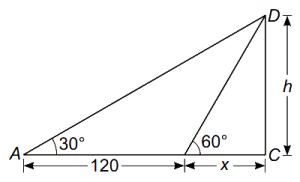
The angle of elevation of an object on a hill is observed from a certain point in the horizontal plane through its base to be $30^{\circ}$. After walking $120 \ m$ towards it on level ground,the angle of elevation is found to be $60^{\circ}$. Then the height of the object (in metres) is:
A
$120$
B
$60 \sqrt{3}$
C
$120 \sqrt{3}$
D
$60$
Solution
(B) Let $h$ be the height of the object and $x$ be the distance from the base of the hill to the second observation point.
In $\triangle BCD$,$\tan 60^{\circ} = \frac{h}{x}$ $\Rightarrow \sqrt{3} = \frac{h}{x}$ $\Rightarrow x = \frac{h}{\sqrt{3}}$.
In $\triangle ACD$,$\tan 30^{\circ} = \frac{h}{120 + x}$ $\Rightarrow \frac{1}{\sqrt{3}} = \frac{h}{120 + x}$ $\Rightarrow 120 + x = h\sqrt{3}$.
Substituting $x = \frac{h}{\sqrt{3}}$ into the equation:
$120 + \frac{h}{\sqrt{3}} = h\sqrt{3}$
$120 = h\sqrt{3} - \frac{h}{\sqrt{3}} = h \left( \frac{3 - 1}{\sqrt{3}} \right) = \frac{2h}{\sqrt{3}}$
$h = \frac{120 \times \sqrt{3}}{2} = 60\sqrt{3} \ m$.
In $\triangle BCD$,$\tan 60^{\circ} = \frac{h}{x}$ $\Rightarrow \sqrt{3} = \frac{h}{x}$ $\Rightarrow x = \frac{h}{\sqrt{3}}$.
In $\triangle ACD$,$\tan 30^{\circ} = \frac{h}{120 + x}$ $\Rightarrow \frac{1}{\sqrt{3}} = \frac{h}{120 + x}$ $\Rightarrow 120 + x = h\sqrt{3}$.
Substituting $x = \frac{h}{\sqrt{3}}$ into the equation:
$120 + \frac{h}{\sqrt{3}} = h\sqrt{3}$
$120 = h\sqrt{3} - \frac{h}{\sqrt{3}} = h \left( \frac{3 - 1}{\sqrt{3}} \right) = \frac{2h}{\sqrt{3}}$
$h = \frac{120 \times \sqrt{3}}{2} = 60\sqrt{3} \ m$.
0 likes
View Solution152
DifficultMCQ
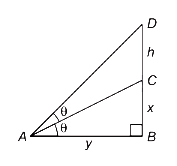
$A$ tower,of $x$ metres high,has a flagstaff at its top. The tower and the flagstaff subtend equal angles at a point distant $y$ metres from the foot of the tower. Then,the length of the flagstaff (in metres) is:
A
$\frac{y\left(x^2-y^2\right)}{\left(x^2+y^2\right)}$
B
$\frac{x\left(y^2+x^2\right)}{\left(y^2-x^2\right)}$
C
$\frac{x\left(x^2+y^2\right)}{\left(x^2-y^2\right)}$
D
$\frac{x\left(x^2-y^2\right)}{\left(x^2+y^2\right)}$
Solution
(B) Let $BC$ be the height of the tower and $CD$ be the height of the flagstaff,where $BC = x$ and $CD = h$.
Let the point be $A$ at a distance $AB = y$ from the foot of the tower $B$.
Given that the tower and the flagstaff subtend equal angles $\theta$ at point $A$.
In $\triangle ABC$,$\tan \theta = \frac{BC}{AB} = \frac{x}{y}$.
In $\triangle ABD$,the total angle is $2\theta$ and the total height is $BD = BC + CD = x + h$.
Thus,$\tan 2\theta = \frac{BD}{AB} = \frac{x+h}{y}$.
Using the formula $\tan 2\theta = \frac{2\tan \theta}{1-\tan^2 \theta}$,we have:
$\frac{2(x/y)}{1-(x/y)^2} = \frac{x+h}{y}$
$\frac{2x/y}{(y^2-x^2)/y^2} = \frac{x+h}{y}$
$\frac{2xy}{y^2-x^2} = \frac{x+h}{y}$
$2xy^2 = (x+h)(y^2-x^2)$
$\frac{2xy^2}{y^2-x^2} = x+h$
$h = \frac{2xy^2}{y^2-x^2} - x$
$h = \frac{2xy^2 - x(y^2-x^2)}{y^2-x^2}$
$h = \frac{2xy^2 - xy^2 + x^3}{y^2-x^2}$
$h = \frac{xy^2 + x^3}{y^2-x^2} = \frac{x(x^2+y^2)}{y^2-x^2}$.
Let the point be $A$ at a distance $AB = y$ from the foot of the tower $B$.
Given that the tower and the flagstaff subtend equal angles $\theta$ at point $A$.
In $\triangle ABC$,$\tan \theta = \frac{BC}{AB} = \frac{x}{y}$.
In $\triangle ABD$,the total angle is $2\theta$ and the total height is $BD = BC + CD = x + h$.
Thus,$\tan 2\theta = \frac{BD}{AB} = \frac{x+h}{y}$.
Using the formula $\tan 2\theta = \frac{2\tan \theta}{1-\tan^2 \theta}$,we have:
$\frac{2(x/y)}{1-(x/y)^2} = \frac{x+h}{y}$
$\frac{2x/y}{(y^2-x^2)/y^2} = \frac{x+h}{y}$
$\frac{2xy}{y^2-x^2} = \frac{x+h}{y}$
$2xy^2 = (x+h)(y^2-x^2)$
$\frac{2xy^2}{y^2-x^2} = x+h$
$h = \frac{2xy^2}{y^2-x^2} - x$
$h = \frac{2xy^2 - x(y^2-x^2)}{y^2-x^2}$
$h = \frac{2xy^2 - xy^2 + x^3}{y^2-x^2}$
$h = \frac{xy^2 + x^3}{y^2-x^2} = \frac{x(x^2+y^2)}{y^2-x^2}$.
0 likes
View Solution153
MediumMCQ
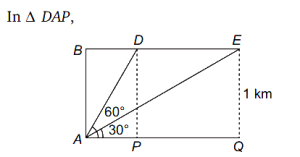
An aeroplane flying with uniform speed horizontally $1 \ km$ above the ground is observed at an elevation of $60^{\circ}$. After $10 \ s$,if the elevation is observed to be $30^{\circ}$,then the speed of the plane (in $km/h$) is
A
$\frac{240}{\sqrt{3}}$
B
$200 \sqrt{3}$
C
$240 \sqrt{3}$
D
$\frac{120}{\sqrt{3}}$
Solution
(C) Let the position of the observer be $A$. The aeroplane is at height $h = 1 \ km$. Let the initial position be $D$ and the final position be $E$.
In $\Delta DAP$,$\tan 60^{\circ} = \frac{DP}{AP}$ $\Rightarrow \sqrt{3} = \frac{1}{AP}$ $\Rightarrow AP = \frac{1}{\sqrt{3}} \ km$.
In $\Delta EAQ$,$\tan 30^{\circ} = \frac{EQ}{AQ} = \frac{1}{AP + PQ} \Rightarrow \frac{1}{\sqrt{3}} = \frac{1}{\frac{1}{\sqrt{3}} + PQ}$.
Solving for $PQ$: $\frac{1}{\sqrt{3}} + PQ = \sqrt{3}$ $\Rightarrow PQ = \sqrt{3} - \frac{1}{\sqrt{3}} = \frac{3-1}{\sqrt{3}} = \frac{2}{\sqrt{3}} \ km$.
The distance covered by the plane is $PQ = \frac{2}{\sqrt{3}} \ km$ in $10 \ s$.
Speed $= \frac{\text{Distance}}{\text{Time}} = \frac{2/\sqrt{3} \ km}{10 \ s} = \frac{2}{\sqrt{3}} \times \frac{1}{10} \ km/s$.
Converting to $km/h$: $\text{Speed} = \frac{2}{10\sqrt{3}} \times 3600 \ km/h = \frac{7200}{10\sqrt{3}} = \frac{720}{\sqrt{3}} = 240\sqrt{3} \ km/h$.
In $\Delta DAP$,$\tan 60^{\circ} = \frac{DP}{AP}$ $\Rightarrow \sqrt{3} = \frac{1}{AP}$ $\Rightarrow AP = \frac{1}{\sqrt{3}} \ km$.
In $\Delta EAQ$,$\tan 30^{\circ} = \frac{EQ}{AQ} = \frac{1}{AP + PQ} \Rightarrow \frac{1}{\sqrt{3}} = \frac{1}{\frac{1}{\sqrt{3}} + PQ}$.
Solving for $PQ$: $\frac{1}{\sqrt{3}} + PQ = \sqrt{3}$ $\Rightarrow PQ = \sqrt{3} - \frac{1}{\sqrt{3}} = \frac{3-1}{\sqrt{3}} = \frac{2}{\sqrt{3}} \ km$.
The distance covered by the plane is $PQ = \frac{2}{\sqrt{3}} \ km$ in $10 \ s$.
Speed $= \frac{\text{Distance}}{\text{Time}} = \frac{2/\sqrt{3} \ km}{10 \ s} = \frac{2}{\sqrt{3}} \times \frac{1}{10} \ km/s$.
Converting to $km/h$: $\text{Speed} = \frac{2}{10\sqrt{3}} \times 3600 \ km/h = \frac{7200}{10\sqrt{3}} = \frac{720}{\sqrt{3}} = 240\sqrt{3} \ km/h$.
0 likes
View Solution154
DifficultMCQ
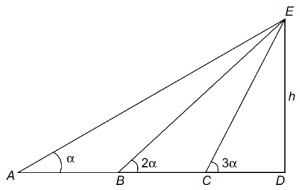
$A$ tower subtends angles $\alpha, 2 \alpha$ and $3 \alpha$ respectively at points $A, B$ and $C$,all lying on a horizontal line through the foot of the tower. Then $\frac{A B}{B C}$ is equal to:
A
$\frac{\sin 3 \alpha}{\sin 2 \alpha}$
B
$1+2 \cos 2 \alpha$
C
$2 \cos 2 \alpha$
D
$\frac{\sin 2 \alpha}{\sin \alpha}$
Solution
(B) In $\triangle ECD$,$\tan 3 \alpha = \frac{h}{CD} \Rightarrow CD = h \cot 3 \alpha \quad \dots(i)$
In $\triangle EBD$,$\tan 2 \alpha = \frac{h}{BD} \Rightarrow BD = h \cot 2 \alpha \quad \dots(ii)$
In $\triangle EAD$,$\tan \alpha = \frac{h}{AD} \Rightarrow AD = h \cot \alpha \quad \dots(iii)$
From Eqs. $(ii)$ and $(iii)$,$AB = AD - BD = h(\cot \alpha - \cot 2 \alpha) \quad \dots(iv)$
From Eqs. $(i)$ and $(ii)$,$BC = BD - CD = h(\cot 2 \alpha - \cot 3 \alpha) \quad \dots(v)$
Dividing $(iv)$ by $(v)$:
$\frac{AB}{BC} = \frac{\cot \alpha - \cot 2 \alpha}{\cot 2 \alpha - \cot 3 \alpha} = \frac{\frac{\cos \alpha}{\sin \alpha} - \frac{\cos 2 \alpha}{\sin 2 \alpha}}{\frac{\cos 2 \alpha}{\sin 2 \alpha} - \frac{\cos 3 \alpha}{\sin 3 \alpha}}$
$= \frac{\frac{\sin(2 \alpha - \alpha)}{\sin \alpha \sin 2 \alpha}}{\frac{\sin(3 \alpha - 2 \alpha)}{\sin 2 \alpha \sin 3 \alpha}} = \frac{\sin \alpha}{\sin \alpha \sin 2 \alpha} \times \frac{\sin 2 \alpha \sin 3 \alpha}{\sin \alpha} = \frac{\sin 3 \alpha}{\sin \alpha}$
$= \frac{3 \sin \alpha - 4 \sin^3 \alpha}{\sin \alpha} = 3 - 4 \sin^2 \alpha = 3 - 2(1 - \cos 2 \alpha) = 1 + 2 \cos 2 \alpha$.
In $\triangle EBD$,$\tan 2 \alpha = \frac{h}{BD} \Rightarrow BD = h \cot 2 \alpha \quad \dots(ii)$
In $\triangle EAD$,$\tan \alpha = \frac{h}{AD} \Rightarrow AD = h \cot \alpha \quad \dots(iii)$
From Eqs. $(ii)$ and $(iii)$,$AB = AD - BD = h(\cot \alpha - \cot 2 \alpha) \quad \dots(iv)$
From Eqs. $(i)$ and $(ii)$,$BC = BD - CD = h(\cot 2 \alpha - \cot 3 \alpha) \quad \dots(v)$
Dividing $(iv)$ by $(v)$:
$\frac{AB}{BC} = \frac{\cot \alpha - \cot 2 \alpha}{\cot 2 \alpha - \cot 3 \alpha} = \frac{\frac{\cos \alpha}{\sin \alpha} - \frac{\cos 2 \alpha}{\sin 2 \alpha}}{\frac{\cos 2 \alpha}{\sin 2 \alpha} - \frac{\cos 3 \alpha}{\sin 3 \alpha}}$
$= \frac{\frac{\sin(2 \alpha - \alpha)}{\sin \alpha \sin 2 \alpha}}{\frac{\sin(3 \alpha - 2 \alpha)}{\sin 2 \alpha \sin 3 \alpha}} = \frac{\sin \alpha}{\sin \alpha \sin 2 \alpha} \times \frac{\sin 2 \alpha \sin 3 \alpha}{\sin \alpha} = \frac{\sin 3 \alpha}{\sin \alpha}$
$= \frac{3 \sin \alpha - 4 \sin^3 \alpha}{\sin \alpha} = 3 - 4 \sin^2 \alpha = 3 - 2(1 - \cos 2 \alpha) = 1 + 2 \cos 2 \alpha$.
0 likes
View Solution155
MediumMCQ
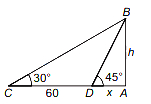
From a point on the level ground,the angle of elevation of the top of a pole is $30^{\circ}$. On moving $20 \ m$ nearer to the pole,the angle of elevation becomes $45^{\circ}$. The height of the pole (in metres) is:
A
$10(\sqrt{3}-1)$
B
$10(\sqrt{3}+1)$
C
$15$
D
$20$
Solution
(B) Let the height of the pole be $h$ and the distance from the second point to the base of the pole be $x$.
In $\triangle BDA$,$\tan 45^{\circ} = \frac{h}{x}$ $\Rightarrow 1 = \frac{h}{x}$ $\Rightarrow h = x$.
In $\triangle BCA$,$\tan 30^{\circ} = \frac{h}{20+x}$.
Substituting $x = h$ into the equation:
$\frac{1}{\sqrt{3}} = \frac{h}{20+h}$
$20+h = \sqrt{3}h$
$20 = h(\sqrt{3}-1)$
$h = \frac{20}{\sqrt{3}-1} \times \frac{\sqrt{3}+1}{\sqrt{3}+1}$
$h = \frac{20(\sqrt{3}+1)}{3-1} = \frac{20(\sqrt{3}+1)}{2} = 10(\sqrt{3}+1) \ m$.
In $\triangle BDA$,$\tan 45^{\circ} = \frac{h}{x}$ $\Rightarrow 1 = \frac{h}{x}$ $\Rightarrow h = x$.
In $\triangle BCA$,$\tan 30^{\circ} = \frac{h}{20+x}$.
Substituting $x = h$ into the equation:
$\frac{1}{\sqrt{3}} = \frac{h}{20+h}$
$20+h = \sqrt{3}h$
$20 = h(\sqrt{3}-1)$
$h = \frac{20}{\sqrt{3}-1} \times \frac{\sqrt{3}+1}{\sqrt{3}+1}$
$h = \frac{20(\sqrt{3}+1)}{3-1} = \frac{20(\sqrt{3}+1)}{2} = 10(\sqrt{3}+1) \ m$.
0 likes
View SolutionTrigonometrical Equations — Height and Distance · Frequently Asked Questions
1Are these Trigonometrical Equations questions useful for JEE and NEET?
Yes. All questions in this section are mapped to JEE Main and NEET exam patterns. Previous year questions from JEE Main, NEET, GUJCET and state-level exams are included with full solutions.
2Can I switch to Hindi or Gujarati for these questions?
Yes. Use the language tabs in the hero section or the sidebar to view the same questions and solutions in English, Hindi or Gujarati.
3How do I generate a question paper from this subtopic?
Use the Vedclass Exam Paper Generator — select the chapter and subtopic, set difficulty, and generate Sets A, B, C, D automatically. First 3 chapters of every subject are free.
Vedclass Products
For Students
Vedclass Test Series
Mock tests in real JEE/NEET style with performance analysis. 5-day free trial.
Start Free TrialFor Teachers
Exam Paper Generator
Generate Set A/B/C/D papers from this chapter in 2 minutes. 3 chapters free.
Try FreeFor Institutes
Online Exam Module
Live online exams with unlimited students, 360° analytics & white-label branding.
See DemoFor Teachers & Institutes
Generate a Trigonometrical Equations Exam Paper in 2 Minutes
Select subtopic & difficulty — Sets A, B, C, D auto-generated with No Repeat logic.
First 3 chapters of every subject are free — no payment required.