
A English
Height and Distance Questions in English
Class 11 Mathematics · Trigonometrical Equations · Height and Distance
159+
Questions
English
Language
100%
With Solutions
Showing 49 of 159 questions in English
1
MediumMCQ
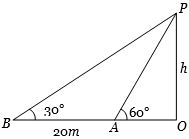
The angle of elevation of the top of a tower at a point on the ground is $30^\circ$. If on walking $20 \, m$ toward the tower,the angle of elevation becomes $60^\circ$,then the height of the tower is:
A
$10 \, m$
B
$\frac{10}{\sqrt{3}} \, m$
C
$10\sqrt{3} \, m$
D
None of these
Solution
(C) Let the height of the tower be $h$ and the distance from the tower to the first point be $x$.
From the right-angled triangle,we have:
$\tan(60^\circ) = \frac{h}{OA}$ $\Rightarrow \sqrt{3} = \frac{h}{OA}$ $\Rightarrow OA = \frac{h}{\sqrt{3}}$.
$\tan(30^\circ) = \frac{h}{OB}$ $\Rightarrow \frac{1}{\sqrt{3}} = \frac{h}{20 + OA}$ $\Rightarrow 20 + OA = h\sqrt{3}$.
Substituting $OA = \frac{h}{\sqrt{3}}$ into the equation:
$20 + \frac{h}{\sqrt{3}} = h\sqrt{3}$
$20 = h\sqrt{3} - \frac{h}{\sqrt{3}}$
$20 = h \left( \frac{3 - 1}{\sqrt{3}} \right) = h \left( \frac{2}{\sqrt{3}} \right)$
$h = \frac{20 \times \sqrt{3}}{2} = 10\sqrt{3} \, m$.
From the right-angled triangle,we have:
$\tan(60^\circ) = \frac{h}{OA}$ $\Rightarrow \sqrt{3} = \frac{h}{OA}$ $\Rightarrow OA = \frac{h}{\sqrt{3}}$.
$\tan(30^\circ) = \frac{h}{OB}$ $\Rightarrow \frac{1}{\sqrt{3}} = \frac{h}{20 + OA}$ $\Rightarrow 20 + OA = h\sqrt{3}$.
Substituting $OA = \frac{h}{\sqrt{3}}$ into the equation:
$20 + \frac{h}{\sqrt{3}} = h\sqrt{3}$
$20 = h\sqrt{3} - \frac{h}{\sqrt{3}}$
$20 = h \left( \frac{3 - 1}{\sqrt{3}} \right) = h \left( \frac{2}{\sqrt{3}} \right)$
$h = \frac{20 \times \sqrt{3}}{2} = 10\sqrt{3} \, m$.
0 likes
View Solution2
EasyMCQ
The angle of elevation of a tower at a point distant $d$ meters from its base is $30^\circ$. If the tower is $20$ meters high,then the value of $d$ is
A
$10\sqrt{3} \, m$
B
$\frac{20}{\sqrt{3}} \, m$
C
$20\sqrt{3} \, m$
D
$10 \, m$
Solution
(C) Let the height of the tower be $h = 20 \, m$ and the distance from the base be $d$.
In the right-angled triangle formed by the tower and the ground,we have:
$\tan(30^\circ) = \frac{\text{height}}{\text{base}} = \frac{20}{d}$
Since $\tan(30^\circ) = \frac{1}{\sqrt{3}}$,we get:
$\frac{1}{\sqrt{3}} = \frac{20}{d}$
$d = 20\sqrt{3} \, m$
Thus,the correct option is $C$.
In the right-angled triangle formed by the tower and the ground,we have:
$\tan(30^\circ) = \frac{\text{height}}{\text{base}} = \frac{20}{d}$
Since $\tan(30^\circ) = \frac{1}{\sqrt{3}}$,we get:
$\frac{1}{\sqrt{3}} = \frac{20}{d}$
$d = 20\sqrt{3} \, m$
Thus,the correct option is $C$.
0 likes
View Solution3
MediumMCQ
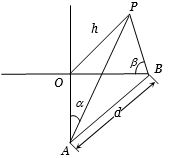
The angle of elevation of the top of a tower from a point $A$ due south of the tower is $\alpha$ and from a point $B$ due east of the tower is $\beta$. If $AB = d$,then the height of the tower is
A
$\frac{d}{\sqrt{\tan^2 \alpha - \tan^2 \beta}}$
B
$\frac{d}{\sqrt{\tan^2 \alpha + \tan^2 \beta}}$
C
$\frac{d}{\sqrt{\cot^2 \alpha + \cot^2 \beta}}$
D
$\frac{d}{\sqrt{\cot^2 \alpha - \cot^2 \beta}}$
Solution
(C) Let $h$ be the height of the tower $OP$,where $O$ is the base of the tower.
In $\triangle OAP$,$\tan \alpha = \frac{h}{OA} \Rightarrow OA = h \cot \alpha$.
In $\triangle OBP$,$\tan \beta = \frac{h}{OB} \Rightarrow OB = h \cot \beta$.
Since $OA$ is south and $OB$ is east,$\triangle OAB$ is a right-angled triangle at $O$.
By Pythagoras theorem in $\triangle OAB$,$OA^2 + OB^2 = AB^2$.
$(h \cot \alpha)^2 + (h \cot \beta)^2 = d^2$.
$h^2 (\cot^2 \alpha + \cot^2 \beta) = d^2$.
$h^2 = \frac{d^2}{\cot^2 \alpha + \cot^2 \beta}$.
$h = \frac{d}{\sqrt{\cot^2 \alpha + \cot^2 \beta}}$.
In $\triangle OAP$,$\tan \alpha = \frac{h}{OA} \Rightarrow OA = h \cot \alpha$.
In $\triangle OBP$,$\tan \beta = \frac{h}{OB} \Rightarrow OB = h \cot \beta$.
Since $OA$ is south and $OB$ is east,$\triangle OAB$ is a right-angled triangle at $O$.
By Pythagoras theorem in $\triangle OAB$,$OA^2 + OB^2 = AB^2$.
$(h \cot \alpha)^2 + (h \cot \beta)^2 = d^2$.
$h^2 (\cot^2 \alpha + \cot^2 \beta) = d^2$.
$h^2 = \frac{d^2}{\cot^2 \alpha + \cot^2 \beta}$.
$h = \frac{d}{\sqrt{\cot^2 \alpha + \cot^2 \beta}}$.
0 likes
View Solution4
MediumMCQ
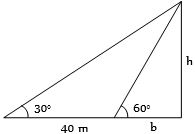
$A$ person standing on the bank of a river observes that the angle subtended by a tree on the opposite bank is $60^\circ$. When he moves $40 \ m$ away from the bank,he finds the angle to be $30^\circ$. The breadth of the river is.....$m$
A
$20$
B
$40$
C
$30$
D
$60$
Solution
(A) Let the height of the tree be $h$ and the breadth of the river be $b$.
From the given information:
In the first triangle,$\tan 60^\circ = \frac{h}{b} \Rightarrow h = b \tan 60^\circ = b\sqrt{3}$.
In the second triangle,$\tan 30^\circ = \frac{h}{b + 40} \Rightarrow h = (b + 40) \tan 30^\circ = \frac{b + 40}{\sqrt{3}}$.
Equating the two expressions for $h$:
$b\sqrt{3} = \frac{b + 40}{\sqrt{3}}$
$3b = b + 40$
$2b = 40$
$b = 20 \ m$.
From the given information:
In the first triangle,$\tan 60^\circ = \frac{h}{b} \Rightarrow h = b \tan 60^\circ = b\sqrt{3}$.
In the second triangle,$\tan 30^\circ = \frac{h}{b + 40} \Rightarrow h = (b + 40) \tan 30^\circ = \frac{b + 40}{\sqrt{3}}$.
Equating the two expressions for $h$:
$b\sqrt{3} = \frac{b + 40}{\sqrt{3}}$
$3b = b + 40$
$2b = 40$
$b = 20 \ m$.
0 likes
View Solution5
MediumMCQ
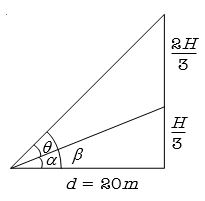
$A$ vertical pole consists of two parts,the lower part being one third of the whole. At a point in the horizontal plane through the base of the pole and at a distance of $20 \, m$ from it,the upper part of the pole subtends an angle whose tangent is $\frac{1}{2}$. The possible heights of the pole are
A
$20 \, m$ and $20\sqrt{3} \, m$
B
$20 \, m$ and $60 \, m$
C
$16 \, m$ and $48 \, m$
D
None of these
Solution
(B) Let the total height of the pole be $H$. The lower part is $\frac{H}{3}$ and the upper part is $\frac{2H}{3}$. Let the point be at a distance $d = 20 \, m$ from the base. Let $\alpha$ be the angle subtended by the lower part and $\beta$ be the angle subtended by the whole pole at the point. The angle subtended by the upper part is $\theta = \beta - \alpha$,where $\tan \theta = \frac{1}{2}$.
We have $\tan \alpha = \frac{H/3}{d} = \frac{H}{3d}$ and $\tan \beta = \frac{H}{d}$.
Using the formula $\tan(\beta - \alpha) = \frac{\tan \beta - \tan \alpha}{1 + \tan \beta \tan \alpha}$,we get:
$\frac{1}{2} = \frac{\frac{H}{d} - \frac{H}{3d}}{1 + (\frac{H}{d})(\frac{H}{3d})} = \frac{\frac{2H}{3d}}{1 + \frac{H^2}{3d^2}} = \frac{2Hd}{3d^2 + H^2}$.
Thus,$3d^2 + H^2 = 4Hd$,which simplifies to $H^2 - 4dH + 3d^2 = 0$.
Substituting $d = 20$,we get $H^2 - 4(20)H + 3(20^2) = 0$,so $H^2 - 80H + 1200 = 0$.
Factoring the quadratic equation: $(H - 20)(H - 60) = 0$.
Therefore,the possible heights of the pole are $H = 20 \, m$ and $H = 60 \, m$.
We have $\tan \alpha = \frac{H/3}{d} = \frac{H}{3d}$ and $\tan \beta = \frac{H}{d}$.
Using the formula $\tan(\beta - \alpha) = \frac{\tan \beta - \tan \alpha}{1 + \tan \beta \tan \alpha}$,we get:
$\frac{1}{2} = \frac{\frac{H}{d} - \frac{H}{3d}}{1 + (\frac{H}{d})(\frac{H}{3d})} = \frac{\frac{2H}{3d}}{1 + \frac{H^2}{3d^2}} = \frac{2Hd}{3d^2 + H^2}$.
Thus,$3d^2 + H^2 = 4Hd$,which simplifies to $H^2 - 4dH + 3d^2 = 0$.
Substituting $d = 20$,we get $H^2 - 4(20)H + 3(20^2) = 0$,so $H^2 - 80H + 1200 = 0$.
Factoring the quadratic equation: $(H - 20)(H - 60) = 0$.
Therefore,the possible heights of the pole are $H = 20 \, m$ and $H = 60 \, m$.
0 likes
View Solution6
MediumMCQ
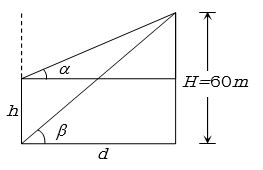
From a $60 \ m$ high tower,the angles of depression of the top and bottom of a house are $\alpha$ and $\beta$ respectively. If the height of the house is $\frac{60 \sin(\beta - \alpha)}{x}$,then $x =$
A
$\sin \alpha \sin \beta$
B
$\cos \alpha \cos \beta$
C
$\sin \alpha \cos \beta$
D
$\cos \alpha \sin \beta$
Solution
(D) Let $H = 60 \ m$ be the height of the tower and $h$ be the height of the house. Let $d$ be the distance between the tower and the house.
From the geometry of the problem:
$\tan \alpha = \frac{H - h}{d} \Rightarrow d = \frac{60 - h}{\tan \alpha}$
$\tan \beta = \frac{H}{d} \Rightarrow d = \frac{60}{\tan \beta}$
Equating the two expressions for $d$:
$\frac{60 - h}{\tan \alpha} = \frac{60}{\tan \beta}$
$(60 - h) \tan \beta = 60 \tan \alpha$
$60 \tan \beta - h \tan \beta = 60 \tan \alpha$
$h \tan \beta = 60(\tan \beta - \tan \alpha)$
$h = 60 \left( \frac{\sin \beta}{\cos \beta} - \frac{\sin \alpha}{\cos \alpha} \right) \cdot \frac{\cos \beta}{\sin \beta}$
$h = 60 \left( \frac{\sin \beta \cos \alpha - \cos \beta \sin \alpha}{\cos \beta \cos \alpha} \right) \cdot \frac{\cos \beta}{\sin \beta}$
$h = \frac{60 \sin(\beta - \alpha)}{\cos \alpha \sin \beta}$
Comparing this with the given expression $\frac{60 \sin(\beta - \alpha)}{x}$,we get $x = \cos \alpha \sin \beta$.
From the geometry of the problem:
$\tan \alpha = \frac{H - h}{d} \Rightarrow d = \frac{60 - h}{\tan \alpha}$
$\tan \beta = \frac{H}{d} \Rightarrow d = \frac{60}{\tan \beta}$
Equating the two expressions for $d$:
$\frac{60 - h}{\tan \alpha} = \frac{60}{\tan \beta}$
$(60 - h) \tan \beta = 60 \tan \alpha$
$60 \tan \beta - h \tan \beta = 60 \tan \alpha$
$h \tan \beta = 60(\tan \beta - \tan \alpha)$
$h = 60 \left( \frac{\sin \beta}{\cos \beta} - \frac{\sin \alpha}{\cos \alpha} \right) \cdot \frac{\cos \beta}{\sin \beta}$
$h = 60 \left( \frac{\sin \beta \cos \alpha - \cos \beta \sin \alpha}{\cos \beta \cos \alpha} \right) \cdot \frac{\cos \beta}{\sin \beta}$
$h = \frac{60 \sin(\beta - \alpha)}{\cos \alpha \sin \beta}$
Comparing this with the given expression $\frac{60 \sin(\beta - \alpha)}{x}$,we get $x = \cos \alpha \sin \beta$.
0 likes
View Solution7
MediumMCQ
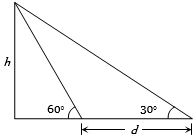
An observer on the top of a tree finds the angle of depression of a car moving towards the tree to be $30^\circ$. After $3 \text{ minutes}$,this angle becomes $60^\circ$. After how much more time will the car reach the tree? (in minutes)
A
$4$
B
$4.5$
C
$1.5$
D
$2$
Solution
(C) Let $h$ be the height of the tree. Let the car be at point $A$ initially and at point $B$ after $3 \text{ minutes}$.
In the right-angled triangle formed with the $30^\circ$ angle,the distance from the tree base is $x_1 = h \cot(30^\circ) = h\sqrt{3}$.
In the right-angled triangle formed with the $60^\circ$ angle,the distance from the tree base is $x_2 = h \cot(60^\circ) = \frac{h}{\sqrt{3}}$.
The distance traveled in $3 \text{ minutes}$ is $d = x_1 - x_2 = h\sqrt{3} - \frac{h}{\sqrt{3}} = h\left(\frac{3-1}{\sqrt{3}}\right) = \frac{2h}{\sqrt{3}}$.
Since the car travels distance $\frac{2h}{\sqrt{3}}$ in $3 \text{ minutes}$,the speed $v = \frac{2h}{3\sqrt{3}} \text{ per minute}$.
The remaining distance to the tree is $x_2 = \frac{h}{\sqrt{3}}$.
Time taken to cover the remaining distance $t = \frac{\text{distance}}{\text{speed}} = \frac{h/\sqrt{3}}{2h/(3\sqrt{3})} = \frac{h}{\sqrt{3}} \times \frac{3\sqrt{3}}{2h} = \frac{3}{2} = 1.5 \text{ minutes}$.
In the right-angled triangle formed with the $30^\circ$ angle,the distance from the tree base is $x_1 = h \cot(30^\circ) = h\sqrt{3}$.
In the right-angled triangle formed with the $60^\circ$ angle,the distance from the tree base is $x_2 = h \cot(60^\circ) = \frac{h}{\sqrt{3}}$.
The distance traveled in $3 \text{ minutes}$ is $d = x_1 - x_2 = h\sqrt{3} - \frac{h}{\sqrt{3}} = h\left(\frac{3-1}{\sqrt{3}}\right) = \frac{2h}{\sqrt{3}}$.
Since the car travels distance $\frac{2h}{\sqrt{3}}$ in $3 \text{ minutes}$,the speed $v = \frac{2h}{3\sqrt{3}} \text{ per minute}$.
The remaining distance to the tree is $x_2 = \frac{h}{\sqrt{3}}$.
Time taken to cover the remaining distance $t = \frac{\text{distance}}{\text{speed}} = \frac{h/\sqrt{3}}{2h/(3\sqrt{3})} = \frac{h}{\sqrt{3}} \times \frac{3\sqrt{3}}{2h} = \frac{3}{2} = 1.5 \text{ minutes}$.
0 likes
View Solution8
MediumMCQ
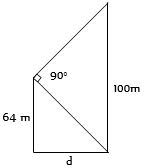
$A$ house of height $100 \ m$ subtends a right angle at the window of an opposite house. If the height of the window is $64 \ m$,then the distance between the two houses is......$m$.
A
$48$
B
$36$
C
$54$
D
$72$
Solution
(A) Let the distance between the two houses be $d$. The window is at a height of $64 \ m$. The house of height $100 \ m$ is divided into two parts by the horizontal line from the window: one part of height $64 \ m$ (below the window) and another part of height $(100 - 64) = 36 \ m$ (above the window).
Let $\theta$ be the angle that the lower part makes with the horizontal line of distance $d$. Then $\tan \theta = \frac{64}{d}$.
The upper part makes an angle $(90^\circ - \theta)$ with the horizontal line. Then $\tan(90^\circ - \theta) = \frac{36}{d}$,which implies $\cot \theta = \frac{36}{d}$.
Multiplying the two equations: $\tan \theta \times \cot \theta = \frac{64}{d} \times \frac{36}{d}$.
$1 = \frac{64 \times 36}{d^2}$.
$d^2 = 64 \times 36$.
$d = \sqrt{64 \times 36} = 8 \times 6 = 48 \ m$.
Let $\theta$ be the angle that the lower part makes with the horizontal line of distance $d$. Then $\tan \theta = \frac{64}{d}$.
The upper part makes an angle $(90^\circ - \theta)$ with the horizontal line. Then $\tan(90^\circ - \theta) = \frac{36}{d}$,which implies $\cot \theta = \frac{36}{d}$.
Multiplying the two equations: $\tan \theta \times \cot \theta = \frac{64}{d} \times \frac{36}{d}$.
$1 = \frac{64 \times 36}{d^2}$.
$d^2 = 64 \times 36$.
$d = \sqrt{64 \times 36} = 8 \times 6 = 48 \ m$.
0 likes
View Solution9
DifficultMCQ
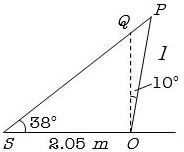
The length of the shadow of a pole inclined at $10^\circ$ to the vertical towards the sun is $2.05 \text{ m}$,when the elevation of the sun is $38^\circ$. The length of the pole is
A
$\frac{2.05 \sin 38^\circ}{\sin 42^\circ}$
B
$\frac{2.05 \sin 42^\circ}{\sin 38^\circ}$
C
$\frac{2.05 \cos 38^\circ}{\cos 42^\circ}$
D
None of these
Solution
(A) Let $OP = l$ be the length of the pole,inclined at $10^\circ$ to the vertical. Let $O$ be the base of the pole and $S$ be the tip of the shadow. The shadow length $OS = 2.05 \text{ m}$.
In $\triangle SPO$,the angle of elevation of the sun is $\angle OSP = 38^\circ$.
The angle between the pole and the vertical is $10^\circ$. The angle between the vertical and the ground is $90^\circ$.
Thus,the angle between the pole and the ground is $\angle SOP = 90^\circ + 10^\circ = 100^\circ$.
The sum of angles in $\triangle SPO$ is $180^\circ$,so $\angle SPO = 180^\circ - (38^\circ + 100^\circ) = 180^\circ - 138^\circ = 42^\circ$.
Using the Sine Rule in $\triangle SPO$:
$\frac{OP}{\sin \angle OSP} = \frac{OS}{\sin \angle SPO}$
$\frac{l}{\sin 38^\circ} = \frac{2.05}{\sin 42^\circ}$
$l = \frac{2.05 \sin 38^\circ}{\sin 42^\circ}$
In $\triangle SPO$,the angle of elevation of the sun is $\angle OSP = 38^\circ$.
The angle between the pole and the vertical is $10^\circ$. The angle between the vertical and the ground is $90^\circ$.
Thus,the angle between the pole and the ground is $\angle SOP = 90^\circ + 10^\circ = 100^\circ$.
The sum of angles in $\triangle SPO$ is $180^\circ$,so $\angle SPO = 180^\circ - (38^\circ + 100^\circ) = 180^\circ - 138^\circ = 42^\circ$.
Using the Sine Rule in $\triangle SPO$:
$\frac{OP}{\sin \angle OSP} = \frac{OS}{\sin \angle SPO}$
$\frac{l}{\sin 38^\circ} = \frac{2.05}{\sin 42^\circ}$
$l = \frac{2.05 \sin 38^\circ}{\sin 42^\circ}$
0 likes
View Solution10
EasyMCQ
The angle of elevation of the top of a tower from a point $20 \ m$ away from its base is $45^\circ$. The height of the tower is ....... $m$.
A
$10$
B
$20$
C
$40$
D
$20\sqrt{3}$
Solution
(B) Let the height of the tower be $h \ m$.
Given that the distance from the base is $20 \ m$ and the angle of elevation is $45^\circ$.
Using the trigonometric ratio $\tan \theta = \frac{\text{opposite}}{\text{adjacent}}$:
$\tan(45^\circ) = \frac{h}{20}$
Since $\tan(45^\circ) = 1$,we have:
$1 = \frac{h}{20}$
$h = 20 \ m$.
Therefore,the height of the tower is $20 \ m$.
Given that the distance from the base is $20 \ m$ and the angle of elevation is $45^\circ$.
Using the trigonometric ratio $\tan \theta = \frac{\text{opposite}}{\text{adjacent}}$:
$\tan(45^\circ) = \frac{h}{20}$
Since $\tan(45^\circ) = 1$,we have:
$1 = \frac{h}{20}$
$h = 20 \ m$.
Therefore,the height of the tower is $20 \ m$.
0 likes
View Solution11
MediumMCQ
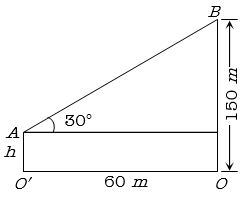
The horizontal distance between two towers is $60 \ m$. The angle of depression of the top of the first tower as seen from the top of the second tower is $30^\circ$. If the height of the second tower is $150 \ m$,then the height of the first tower is:
A
$150 - 60\sqrt{3} \ m$
B
$90 \ m$
C
$150 - 20\sqrt{3} \ m$
D
None of these
Solution
(C) Let the height of the first tower be $h \ m$ and the height of the second tower be $H = 150 \ m$.
The horizontal distance between them is $d = 60 \ m$.
From the top of the second tower,the angle of depression to the top of the first tower is $30^\circ$. This implies the angle of elevation from the top of the first tower to the top of the second tower is also $30^\circ$.
Considering the right-angled triangle formed by the difference in heights and the horizontal distance:
$\tan(30^\circ) = \frac{H - h}{d}$
$\frac{1}{\sqrt{3}} = \frac{150 - h}{60}$
$150 - h = \frac{60}{\sqrt{3}}$
$150 - h = 20\sqrt{3}$
$h = 150 - 20\sqrt{3} \ m$.
Thus,the height of the first tower is $(150 - 20\sqrt{3}) \ m$.
The horizontal distance between them is $d = 60 \ m$.
From the top of the second tower,the angle of depression to the top of the first tower is $30^\circ$. This implies the angle of elevation from the top of the first tower to the top of the second tower is also $30^\circ$.
Considering the right-angled triangle formed by the difference in heights and the horizontal distance:
$\tan(30^\circ) = \frac{H - h}{d}$
$\frac{1}{\sqrt{3}} = \frac{150 - h}{60}$
$150 - h = \frac{60}{\sqrt{3}}$
$150 - h = 20\sqrt{3}$
$h = 150 - 20\sqrt{3} \ m$.
Thus,the height of the first tower is $(150 - 20\sqrt{3}) \ m$.
0 likes
View Solution12
EasyMCQ
From the top of a lighthouse $60 \ m$ high with its base at the sea level,the angle of depression of a boat is $15^\circ$. The distance of the boat from the foot of the lighthouse is:
A
$60 \left( \frac{\sqrt{3} - 1}{\sqrt{3} + 1} \right) \ m$
B
$60 \left( \frac{\sqrt{3} + 1}{\sqrt{3} - 1} \right) \ m$
C
$60 \left( \sqrt{3} + 1 \right) \ m$
D
None of these
Solution
(B) Let the height of the lighthouse be $h = 60 \ m$ and the distance of the boat from the foot of the lighthouse be $x \ m$.
In the right-angled triangle formed by the lighthouse and the sea level,the angle of elevation of the top from the boat is equal to the angle of depression,which is $15^\circ$.
Thus,$\tan(15^\circ) = \frac{\text{height}}{\text{distance}} = \frac{60}{x}$.
Therefore,$x = \frac{60}{\tan(15^\circ)} = 60 \cot(15^\circ)$.
Using the value $\cot(15^\circ) = \frac{\cos(15^\circ)}{\sin(15^\circ)} = \frac{\sqrt{3} + 1}{\sqrt{3} - 1}$.
So,$x = 60 \left( \frac{\sqrt{3} + 1}{\sqrt{3} - 1} \right) \ m$.
Thus,the correct option is $B$.
In the right-angled triangle formed by the lighthouse and the sea level,the angle of elevation of the top from the boat is equal to the angle of depression,which is $15^\circ$.
Thus,$\tan(15^\circ) = \frac{\text{height}}{\text{distance}} = \frac{60}{x}$.
Therefore,$x = \frac{60}{\tan(15^\circ)} = 60 \cot(15^\circ)$.
Using the value $\cot(15^\circ) = \frac{\cos(15^\circ)}{\sin(15^\circ)} = \frac{\sqrt{3} + 1}{\sqrt{3} - 1}$.
So,$x = 60 \left( \frac{\sqrt{3} + 1}{\sqrt{3} - 1} \right) \ m$.
Thus,the correct option is $B$.
0 likes
View Solution13
MediumMCQ
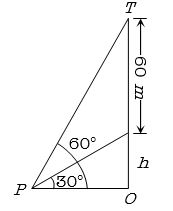
An observer in a boat finds that the angle of elevation of the top of a tower standing on the top of a cliff is $60^\circ$ and that of the top of the cliff is $30^\circ$. If the height of the tower is $60 \ m$,then the height of the cliff is ... $m$.
A
$30$
B
$60\sqrt{3}$
C
$20\sqrt{3}$
D
None of these
Solution
(A) Let the height of the cliff be $h \ m$ and the distance of the observer from the base of the cliff be $x \ m$.
From the given information,the height of the tower is $60 \ m$.
In the right-angled triangle formed by the cliff and the observer,we have:
$\tan(30^\circ) = \frac{h}{x} \Rightarrow x = h \cot(30^\circ) = h\sqrt{3}$.
In the right-angled triangle formed by the tower and the cliff together,the total height is $(h + 60) \ m$:
$\tan(60^\circ) = \frac{h + 60}{x} \Rightarrow x = \frac{h + 60}{\tan(60^\circ)} = \frac{h + 60}{\sqrt{3}}$.
Equating the two expressions for $x$:
$h\sqrt{3} = \frac{h + 60}{\sqrt{3}}$
$3h = h + 60$
$2h = 60$
$h = 30 \ m$.
From the given information,the height of the tower is $60 \ m$.
In the right-angled triangle formed by the cliff and the observer,we have:
$\tan(30^\circ) = \frac{h}{x} \Rightarrow x = h \cot(30^\circ) = h\sqrt{3}$.
In the right-angled triangle formed by the tower and the cliff together,the total height is $(h + 60) \ m$:
$\tan(60^\circ) = \frac{h + 60}{x} \Rightarrow x = \frac{h + 60}{\tan(60^\circ)} = \frac{h + 60}{\sqrt{3}}$.
Equating the two expressions for $x$:
$h\sqrt{3} = \frac{h + 60}{\sqrt{3}}$
$3h = h + 60$
$2h = 60$
$h = 30 \ m$.
0 likes
View Solution14
MediumMCQ
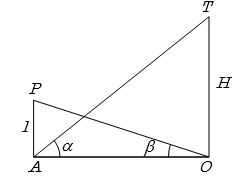
$A$ tower subtends an angle $\alpha$ at a point $A$ in the plane of its base,and the angle of depression of the foot of the tower from a point $P$ at a height $l$ meters vertically above $A$ is $\beta$. The height of the tower is
A
$l \tan \beta \cot \alpha$
B
$l \tan \alpha \cot \beta$
C
$l \tan \alpha \tan \beta$
D
$l \cot \alpha \cot \beta$
Solution
(B) Let the tower be $OT$ with height $H$,where $O$ is the foot of the tower. Let $A$ be a point on the ground such that $\angle OAT = \alpha$. Thus,in $\triangle AOT$,$\tan \alpha = \frac{H}{AO}$,which implies $AO = H \cot \alpha$.
Let $P$ be a point at height $l$ vertically above $A$,so $PA = l$. The angle of depression of the foot $O$ from $P$ is $\beta$,so $\angle APO = 90^\circ - \beta$ or $\angle POA = \beta$. In $\triangle PAO$,$\tan \beta = \frac{PA}{AO} = \frac{l}{AO}$,which implies $AO = l \cot \beta$.
Equating the two expressions for $AO$: $H \cot \alpha = l \cot \beta$.
Therefore,$H = l \frac{\cot \beta}{\cot \alpha} = l \tan \alpha \cot \beta$.
Let $P$ be a point at height $l$ vertically above $A$,so $PA = l$. The angle of depression of the foot $O$ from $P$ is $\beta$,so $\angle APO = 90^\circ - \beta$ or $\angle POA = \beta$. In $\triangle PAO$,$\tan \beta = \frac{PA}{AO} = \frac{l}{AO}$,which implies $AO = l \cot \beta$.
Equating the two expressions for $AO$: $H \cot \alpha = l \cot \beta$.
Therefore,$H = l \frac{\cot \beta}{\cot \alpha} = l \tan \alpha \cot \beta$.
0 likes
View Solution15
DifficultMCQ
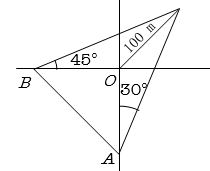
The angle of elevation of a tower from a point $A$ due south of it is $30^\circ$ and from a point $B$ due west of it is $45^\circ$. If the height of the tower is $100 \ m$,then $AB = \dots \ m$.
A
$150$
B
$200$
C
$173.2$
D
$141.4$
Solution
(B) Let $O$ be the base of the tower and $H = 100 \ m$ be its height.
In $\triangle AOT$,where $T$ is the top of the tower,$\tan 30^\circ = \frac{H}{OA} \implies OA = \frac{100}{\tan 30^\circ} = 100\sqrt{3} \ m$.
In $\triangle BOT$,$\tan 45^\circ = \frac{H}{OB} \implies OB = \frac{100}{\tan 45^\circ} = 100 \ m$.
Since $OA$ is due south and $OB$ is due west,$\angle AOB = 90^\circ$.
In right-angled $\triangle AOB$,$AB = \sqrt{OA^2 + OB^2} = \sqrt{(100\sqrt{3})^2 + 100^2} = \sqrt{30000 + 10000} = \sqrt{40000} = 200 \ m$.
In $\triangle AOT$,where $T$ is the top of the tower,$\tan 30^\circ = \frac{H}{OA} \implies OA = \frac{100}{\tan 30^\circ} = 100\sqrt{3} \ m$.
In $\triangle BOT$,$\tan 45^\circ = \frac{H}{OB} \implies OB = \frac{100}{\tan 45^\circ} = 100 \ m$.
Since $OA$ is due south and $OB$ is due west,$\angle AOB = 90^\circ$.
In right-angled $\triangle AOB$,$AB = \sqrt{OA^2 + OB^2} = \sqrt{(100\sqrt{3})^2 + 100^2} = \sqrt{30000 + 10000} = \sqrt{40000} = 200 \ m$.
0 likes
View Solution16
MediumMCQ
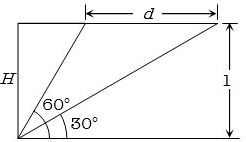
An aeroplane flying horizontally $1 \ km$ above the ground is observed at an elevation of $60^\circ$ and after $10$ seconds the elevation is observed to be $30^\circ$. The uniform speed of the aeroplane in $km/h$ is
A
$240$
B
$240\sqrt{3}$
C
$60\sqrt{3}$
D
None of these
Solution
$(B)$ Let the height of the aeroplane be $H = 1 \ km$. Let the distance covered by the aeroplane in $10$ seconds be $d$.
From the geometry of the problem,we have:
$d = H \cot(30^\circ) - H \cot(60^\circ)$
$d = 1 \times \sqrt{3} - 1 \times \frac{1}{\sqrt{3}} = \sqrt{3} - \frac{1}{\sqrt{3}} = \frac{3-1}{\sqrt{3}} = \frac{2}{\sqrt{3}} \ km$.
Time taken $t = 10 \ seconds = \frac{10}{3600} \ hours = \frac{1}{360} \ hours$.
Speed $= \frac{\text{Distance}}{\text{Time}} = \frac{2/\sqrt{3}}{1/360} = \frac{2}{\sqrt{3}} \times 360 = \frac{720}{\sqrt{3}} = 240\sqrt{3} \ km/h$.
From the geometry of the problem,we have:
$d = H \cot(30^\circ) - H \cot(60^\circ)$
$d = 1 \times \sqrt{3} - 1 \times \frac{1}{\sqrt{3}} = \sqrt{3} - \frac{1}{\sqrt{3}} = \frac{3-1}{\sqrt{3}} = \frac{2}{\sqrt{3}} \ km$.
Time taken $t = 10 \ seconds = \frac{10}{3600} \ hours = \frac{1}{360} \ hours$.
Speed $= \frac{\text{Distance}}{\text{Time}} = \frac{2/\sqrt{3}}{1/360} = \frac{2}{\sqrt{3}} \times 360 = \frac{720}{\sqrt{3}} = 240\sqrt{3} \ km/h$.
0 likes
View Solution17
DifficultMCQ
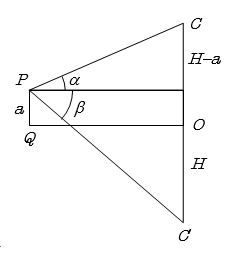
From a point $a$ metre above a lake,the angle of elevation of a cloud is $\alpha$ and the angle of depression of its reflection is $\beta$. The height of the cloud is
A
$\frac{a \sin(\alpha + \beta)}{\sin(\alpha - \beta)} \text{ metre}$
B
$\frac{a \sin(\alpha + \beta)}{\sin(\beta - \alpha)} \text{ metre}$
C
$\frac{a \sin(\beta - \alpha)}{\sin(\alpha + \beta)} \text{ metre}$
D
None of these
Solution
(B) Let the point of observation be $P$ at a height $a$ above the lake surface. Let the cloud be at $C$ at a height $H$ above the lake surface. The reflection of the cloud is at $C'$ at a depth $H$ below the lake surface.
In the right-angled triangle formed by the cloud,the point $P$,and the horizontal line,we have $\tan \alpha = \frac{H - a}{x}$,where $x$ is the horizontal distance.
So,$x = (H - a) \cot \alpha$.
In the right-angled triangle formed by the reflection $C'$,the point $P$,and the horizontal line,we have $\tan \beta = \frac{H + a}{x}$.
So,$x = (H + a) \cot \beta$.
Equating the two expressions for $x$: $(H - a) \cot \alpha = (H + a) \cot \beta$.
$H \cot \alpha - a \cot \alpha = H \cot \beta + a \cot \beta$.
$H(\cot \alpha - \cot \beta) = a(\cot \alpha + \cot \beta)$.
$H \left( \frac{\cos \alpha}{\sin \alpha} - \frac{\cos \beta}{\sin \beta} \right) = a \left( \frac{\cos \alpha}{\sin \alpha} + \frac{\cos \beta}{\sin \beta} \right)$.
$H \left( \frac{\sin \beta \cos \alpha - \cos \beta \sin \alpha}{\sin \alpha \sin \beta} \right) = a \left( \frac{\sin \beta \cos \alpha + \cos \beta \sin \alpha}{\sin \alpha \sin \beta} \right)$.
$H \sin(\beta - \alpha) = a \sin(\alpha + \beta)$.
$H = \frac{a \sin(\alpha + \beta)}{\sin(\beta - \alpha)}$.
In the right-angled triangle formed by the cloud,the point $P$,and the horizontal line,we have $\tan \alpha = \frac{H - a}{x}$,where $x$ is the horizontal distance.
So,$x = (H - a) \cot \alpha$.
In the right-angled triangle formed by the reflection $C'$,the point $P$,and the horizontal line,we have $\tan \beta = \frac{H + a}{x}$.
So,$x = (H + a) \cot \beta$.
Equating the two expressions for $x$: $(H - a) \cot \alpha = (H + a) \cot \beta$.
$H \cot \alpha - a \cot \alpha = H \cot \beta + a \cot \beta$.
$H(\cot \alpha - \cot \beta) = a(\cot \alpha + \cot \beta)$.
$H \left( \frac{\cos \alpha}{\sin \alpha} - \frac{\cos \beta}{\sin \beta} \right) = a \left( \frac{\cos \alpha}{\sin \alpha} + \frac{\cos \beta}{\sin \beta} \right)$.
$H \left( \frac{\sin \beta \cos \alpha - \cos \beta \sin \alpha}{\sin \alpha \sin \beta} \right) = a \left( \frac{\sin \beta \cos \alpha + \cos \beta \sin \alpha}{\sin \alpha \sin \beta} \right)$.
$H \sin(\beta - \alpha) = a \sin(\alpha + \beta)$.
$H = \frac{a \sin(\alpha + \beta)}{\sin(\beta - \alpha)}$.
0 likes
View Solution18
EasyMCQ
If the angle of depression of a point $A$ on the ground from the top of a tower is $30^\circ$,then the angle of elevation of the top of the tower from the point $A$ will be .............. $^\circ $.
A
$60$
B
$45$
C
$30$
D
None of these
Solution
(C) The angle of depression from the top of a tower to a point $A$ on the ground is the angle between the horizontal line of sight from the top and the line of sight to point $A$.
By the property of alternate interior angles,when two parallel lines (the horizontal line at the top and the ground) are intersected by a transversal (the line of sight),the angle of depression is equal to the angle of elevation.
Therefore,if the angle of depression is $30^\circ$,the angle of elevation of the top of the tower from point $A$ is also $30^\circ$.
By the property of alternate interior angles,when two parallel lines (the horizontal line at the top and the ground) are intersected by a transversal (the line of sight),the angle of depression is equal to the angle of elevation.
Therefore,if the angle of depression is $30^\circ$,the angle of elevation of the top of the tower from point $A$ is also $30^\circ$.
0 likes
View Solution19
MediumMCQ
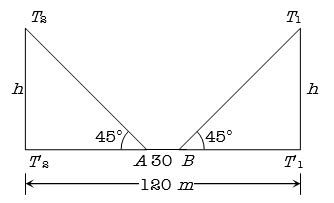
Two vertical poles of equal heights are $120 \, m$ apart. On the line joining their bottoms,$A$ and $B$ are two points. The angle of elevation of the top of one pole from $A$ is $45^\circ$ and that of the other pole from $B$ is also $45^\circ$. If $AB = 30 \, m$,then the height of each pole is.....$m$.
A
$40$
B
$45$
C
$50$
D
$42$
Solution
(B) Let the height of each pole be $h \, m$. Let the positions of the two poles be $P_1$ and $P_2$. The distance between the poles is $120 \, m$.
Let $A$ and $B$ be points on the line joining the bottoms of the poles such that $AB = 30 \, m$.
From the geometry of the problem,the distance from the base of the first pole to $A$ is $h$ (since $\tan 45^\circ = \frac{h}{dist} = 1$).
Similarly,the distance from the base of the second pole to $B$ is $h$.
The total distance between the poles is the sum of the distance from the first pole to $A$,the distance $AB$,and the distance from $B$ to the second pole.
Therefore,$h + 30 + h = 120$.
$2h = 120 - 30 = 90$.
$h = 45 \, m$.
Let $A$ and $B$ be points on the line joining the bottoms of the poles such that $AB = 30 \, m$.
From the geometry of the problem,the distance from the base of the first pole to $A$ is $h$ (since $\tan 45^\circ = \frac{h}{dist} = 1$).
Similarly,the distance from the base of the second pole to $B$ is $h$.
The total distance between the poles is the sum of the distance from the first pole to $A$,the distance $AB$,and the distance from $B$ to the second pole.
Therefore,$h + 30 + h = 120$.
$2h = 120 - 30 = 90$.
$h = 45 \, m$.
0 likes
View Solution20
MediumMCQ
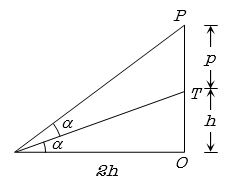
At a distance $2h$ from the foot of a tower of height $h$,the tower and a pole at the top of the tower subtend equal angles. The height of the pole is:
A
$\frac{5h}{3}$
B
$\frac{4h}{3}$
C
$\frac{7h}{5}$
D
$\frac{3h}{2}$
Solution
(A) Let the height of the pole be $p$. The tower has height $h$ and is at a distance $2h$ from the observer.
Let the angle subtended by the tower be $\alpha$. Then,$\tan \alpha = \frac{h}{2h} = \frac{1}{2}$.
Let the pole be on top of the tower. The angle subtended by the pole is also $\alpha$.
The total angle subtended by the tower and the pole together is $\alpha + \alpha = 2\alpha$.
The total height is $h + p$.
Thus,$\tan(2\alpha) = \frac{h + p}{2h}$.
Using the formula $\tan(2\alpha) = \frac{2\tan \alpha}{1 - \tan^2 \alpha}$,we get:
$\frac{h + p}{2h} = \frac{2(1/2)}{1 - (1/2)^2} = \frac{1}{1 - 1/4} = \frac{1}{3/4} = \frac{4}{3}$.
Therefore,$\frac{h + p}{2h} = \frac{4}{3}$ $\Rightarrow h + p = \frac{8h}{3}$ $\Rightarrow p = \frac{8h}{3} - h = \frac{5h}{3}$.
Let the angle subtended by the tower be $\alpha$. Then,$\tan \alpha = \frac{h}{2h} = \frac{1}{2}$.
Let the pole be on top of the tower. The angle subtended by the pole is also $\alpha$.
The total angle subtended by the tower and the pole together is $\alpha + \alpha = 2\alpha$.
The total height is $h + p$.
Thus,$\tan(2\alpha) = \frac{h + p}{2h}$.
Using the formula $\tan(2\alpha) = \frac{2\tan \alpha}{1 - \tan^2 \alpha}$,we get:
$\frac{h + p}{2h} = \frac{2(1/2)}{1 - (1/2)^2} = \frac{1}{1 - 1/4} = \frac{1}{3/4} = \frac{4}{3}$.
Therefore,$\frac{h + p}{2h} = \frac{4}{3}$ $\Rightarrow h + p = \frac{8h}{3}$ $\Rightarrow p = \frac{8h}{3} - h = \frac{5h}{3}$.
0 likes
View Solution21
MediumMCQ
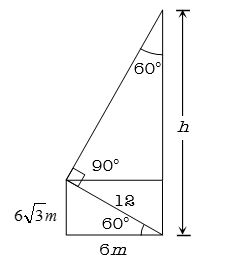
$A$ house subtends a right angle at the window of an opposite house and the angle of elevation of the window from the bottom of the first house is $60^\circ$. If the distance between the two houses is $6 \ m$,then the height of the first house is:
A
$6\sqrt{3} \ m$
B
$8\sqrt{3} \ m$
C
$4\sqrt{3} \ m$
D
None of these
Solution
(B) Let the height of the first house be $H$. Let the window be at height $y$ from the ground. The distance between the houses is $d = 6 \ m$.
From the triangle formed by the bottom of the first house,the base of the second house,and the window,we have $\tan(60^\circ) = \frac{y}{6}$.
Thus,$y = 6 \tan(60^\circ) = 6\sqrt{3} \ m$.
Let the window divide the house of height $H$ into two parts $h_1$ and $h_2$ such that $H = h_1 + h_2$. The window is at height $y$ from the ground,so $h_2 = y = 6\sqrt{3} \ m$.
The angle subtended by the house at the window is $90^\circ$. Let the angle of elevation of the top of the house from the window be $\alpha$. Then the angle of depression of the bottom of the house from the window is $90^\circ - \alpha$.
In the upper triangle,$\tan(\alpha) = \frac{h_1}{6}$. In the lower triangle,$\tan(90^\circ - \alpha) = \cot(\alpha) = \frac{y}{6} = \frac{6\sqrt{3}}{6} = \sqrt{3}$.
Since $\cot(\alpha) = \sqrt{3}$,we have $\tan(\alpha) = \frac{1}{\sqrt{3}}$.
Therefore,$h_1 = 6 \tan(\alpha) = 6 \times \frac{1}{\sqrt{3}} = 2\sqrt{3} \ m$.
The total height $H = h_1 + h_2 = 2\sqrt{3} + 6\sqrt{3} = 8\sqrt{3} \ m$.
From the triangle formed by the bottom of the first house,the base of the second house,and the window,we have $\tan(60^\circ) = \frac{y}{6}$.
Thus,$y = 6 \tan(60^\circ) = 6\sqrt{3} \ m$.
Let the window divide the house of height $H$ into two parts $h_1$ and $h_2$ such that $H = h_1 + h_2$. The window is at height $y$ from the ground,so $h_2 = y = 6\sqrt{3} \ m$.
The angle subtended by the house at the window is $90^\circ$. Let the angle of elevation of the top of the house from the window be $\alpha$. Then the angle of depression of the bottom of the house from the window is $90^\circ - \alpha$.
In the upper triangle,$\tan(\alpha) = \frac{h_1}{6}$. In the lower triangle,$\tan(90^\circ - \alpha) = \cot(\alpha) = \frac{y}{6} = \frac{6\sqrt{3}}{6} = \sqrt{3}$.
Since $\cot(\alpha) = \sqrt{3}$,we have $\tan(\alpha) = \frac{1}{\sqrt{3}}$.
Therefore,$h_1 = 6 \tan(\alpha) = 6 \times \frac{1}{\sqrt{3}} = 2\sqrt{3} \ m$.
The total height $H = h_1 + h_2 = 2\sqrt{3} + 6\sqrt{3} = 8\sqrt{3} \ m$.
0 likes
View Solution22
EasyMCQ
The angle of elevation of the sun,when the shadow of the pole is $\sqrt{3}$ times the height of the pole,is ....$^o$
A
$60$
B
$30$
C
$45$
D
$15$
Solution
(B) Let the height of the pole be $h$ and the length of the shadow be $s$.
Given that $s = \sqrt{3}h$.
Let $\alpha$ be the angle of elevation of the sun.
In the right-angled triangle formed by the pole and its shadow,we have:
$\tan \alpha = \frac{\text{height}}{\text{shadow}} = \frac{h}{\sqrt{3}h} = \frac{1}{\sqrt{3}}$.
Since $\tan 30^o = \frac{1}{\sqrt{3}}$,we get $\alpha = 30^o$.
Given that $s = \sqrt{3}h$.
Let $\alpha$ be the angle of elevation of the sun.
In the right-angled triangle formed by the pole and its shadow,we have:
$\tan \alpha = \frac{\text{height}}{\text{shadow}} = \frac{h}{\sqrt{3}h} = \frac{1}{\sqrt{3}}$.
Since $\tan 30^o = \frac{1}{\sqrt{3}}$,we get $\alpha = 30^o$.
0 likes
View Solution23
EasyMCQ
$A$ ladder rests against a wall so that its top touches the roof of the house. If the ladder makes an angle of $60^{\circ}$ with the horizontal and the height of the house is $6\sqrt{3} \text{ m}$,then the length of the ladder is ..... $m$.
A
$12\sqrt{3}$
B
$12$
C
$12/\sqrt{3}$
D
None of these
Solution
(B) Let the length of the ladder be $L$ and the height of the wall be $h = 6\sqrt{3} \text{ m}$.
Given that the ladder makes an angle of $\theta = 60^{\circ}$ with the horizontal.
In the right-angled triangle formed by the ladder,the wall,and the ground,we have:
$\sin(\theta) = \frac{\text{Height of the wall}}{\text{Length of the ladder}}$
$\sin(60^{\circ}) = \frac{6\sqrt{3}}{L}$
$\frac{\sqrt{3}}{2} = \frac{6\sqrt{3}}{L}$
$L = \frac{6\sqrt{3} \times 2}{\sqrt{3}}$
$L = 12 \text{ m}$.
Thus,the length of the ladder is $12 \text{ m}$.
Given that the ladder makes an angle of $\theta = 60^{\circ}$ with the horizontal.
In the right-angled triangle formed by the ladder,the wall,and the ground,we have:
$\sin(\theta) = \frac{\text{Height of the wall}}{\text{Length of the ladder}}$
$\sin(60^{\circ}) = \frac{6\sqrt{3}}{L}$
$\frac{\sqrt{3}}{2} = \frac{6\sqrt{3}}{L}$
$L = \frac{6\sqrt{3} \times 2}{\sqrt{3}}$
$L = 12 \text{ m}$.
Thus,the length of the ladder is $12 \text{ m}$.
0 likes
View Solution24
EasyMCQ
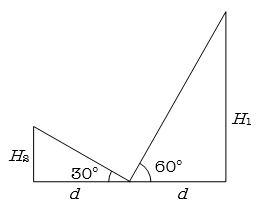
If the angles of elevation of two towers from the middle point of the line joining their feet are $60^\circ$ and $30^\circ$ respectively,then the ratio of their heights is
A
$2 : 1$
B
$1 : \sqrt{2}$
C
$3 : 1$
D
$1 : \sqrt{3}$
Solution
(C) Let the heights of the two towers be $H_1$ and $H_2$,and the distance from the middle point to the foot of each tower be $d$.
From the given information:
$H_1 = d \tan 60^\circ = d \sqrt{3}$
$H_2 = d \tan 30^\circ = d \frac{1}{\sqrt{3}}$
Therefore,the ratio of their heights is:
$\frac{H_1}{H_2} = \frac{d \sqrt{3}}{d / \sqrt{3}} = \sqrt{3} \times \sqrt{3} = \frac{3}{1}$
Thus,the ratio is $3 : 1$.
From the given information:
$H_1 = d \tan 60^\circ = d \sqrt{3}$
$H_2 = d \tan 30^\circ = d \frac{1}{\sqrt{3}}$
Therefore,the ratio of their heights is:
$\frac{H_1}{H_2} = \frac{d \sqrt{3}}{d / \sqrt{3}} = \sqrt{3} \times \sqrt{3} = \frac{3}{1}$
Thus,the ratio is $3 : 1$.
0 likes
View Solution25
MediumMCQ
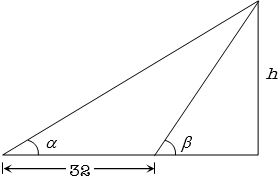
At a point on the ground,the angle of elevation of a tower is such that its cotangent is $3/5$. On walking $32 \, m$ towards the tower,the cotangent of the angle of elevation becomes $2/5$. The height of the tower is .... $m$
A
$160$
B
$120$
C
$64$
D
None of these
Solution
(A) Let the height of the tower be $h$ and the angles of elevation be $\alpha$ and $\beta$ respectively.
Given: $\cot \alpha = 3/5$ and $\cot \beta = 2/5$.
Let the distance from the first point to the base of the tower be $x_1 = h \cot \alpha = 3h/5$.
Let the distance from the second point to the base of the tower be $x_2 = h \cot \beta = 2h/5$.
The distance walked towards the tower is $x_1 - x_2 = 32 \, m$.
Substituting the values: $3h/5 - 2h/5 = 32$.
$h/5 = 32$.
$h = 32 \times 5 = 160 \, m$.
Given: $\cot \alpha = 3/5$ and $\cot \beta = 2/5$.
Let the distance from the first point to the base of the tower be $x_1 = h \cot \alpha = 3h/5$.
Let the distance from the second point to the base of the tower be $x_2 = h \cot \beta = 2h/5$.
The distance walked towards the tower is $x_1 - x_2 = 32 \, m$.
Substituting the values: $3h/5 - 2h/5 = 32$.
$h/5 = 32$.
$h = 32 \times 5 = 160 \, m$.
0 likes
View Solution26
MediumMCQ
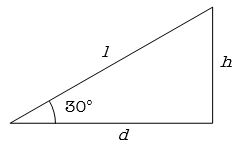
$A$ $20 \ m$ long tree is broken by the wind such that its top touches the ground at an angle of $30^\circ$. The height from the ground at which the tree is broken is:
A
$10 \ m$
B
$20(\sqrt{3} - 1) \ m$
C
$\frac{20}{1 + \sqrt{3}} \ m$
D
$20(2 - \sqrt{3}) \ m$
Solution
(C) Let the total height of the tree be $H = 20 \ m$. Let the tree break at a height $h$ from the ground. The broken part forms the hypotenuse $l$ of a right-angled triangle,where $l = 20 - h$.
In the right-angled triangle,$\sin 30^\circ = \frac{h}{l}$.
Since $\sin 30^\circ = \frac{1}{2}$,we have $\frac{1}{2} = \frac{h}{20 - h}$.
$20 - h = 2h \implies 3h = 20 \implies h = \frac{20}{3} \ m$.
In the right-angled triangle,$\sin 30^\circ = \frac{h}{l}$.
Since $\sin 30^\circ = \frac{1}{2}$,we have $\frac{1}{2} = \frac{h}{20 - h}$.
$20 - h = 2h \implies 3h = 20 \implies h = \frac{20}{3} \ m$.
0 likes
View Solution27
MediumMCQ
The base of a cliff is circular. From the extremities of a diameter of the base,the angles of elevation of the top of the cliff are $30^\circ$ and $60^\circ$. If the height of the cliff is $500 \ m$,then the diameter of the base of the cliff is:
A
$1000 \sqrt{3} \ m$
B
$2000 / \sqrt{3} \ m$
C
$1000 / \sqrt{3} \ m$
D
$2000 \sqrt{2} \ m$
Solution
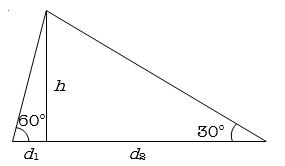
(B) Let the height of the cliff be $h = 500 \ m$.
Let the diameter of the base be $D = d_1 + d_2$.
From the right-angled triangles formed:
$d_1 = h \cot(60^\circ) = 500 \times \frac{1}{\sqrt{3}} = \frac{500}{\sqrt{3}} \ m$.
$d_2 = h \cot(30^\circ) = 500 \times \sqrt{3} = 500\sqrt{3} \ m$.
The diameter $D = d_1 + d_2 = \frac{500}{\sqrt{3}} + 500\sqrt{3}$.
$D = \frac{500 + 500(3)}{\sqrt{3}} = \frac{500 + 1500}{\sqrt{3}} = \frac{2000}{\sqrt{3}} \ m$.
Let the diameter of the base be $D = d_1 + d_2$.
From the right-angled triangles formed:
$d_1 = h \cot(60^\circ) = 500 \times \frac{1}{\sqrt{3}} = \frac{500}{\sqrt{3}} \ m$.
$d_2 = h \cot(30^\circ) = 500 \times \sqrt{3} = 500\sqrt{3} \ m$.
The diameter $D = d_1 + d_2 = \frac{500}{\sqrt{3}} + 500\sqrt{3}$.
$D = \frac{500 + 500(3)}{\sqrt{3}} = \frac{500 + 1500}{\sqrt{3}} = \frac{2000}{\sqrt{3}} \ m$.
0 likes
View Solution28
MediumMCQ
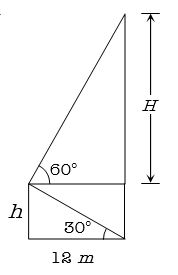
The angle of elevation of the top of a tower from the top of a house is $60^\circ$ and the angle of depression of its base is $30^\circ$. If the horizontal distance between the house and the tower is $12 \ m$,then the height of the tower is
A
$48 \ \sqrt{3} \ m$
B
$16 \ \sqrt{3} \ m$
C
$24 \ \sqrt{3} \ m$
D
$16 / \sqrt{3} \ m$
Solution
(B) Let $h$ be the height of the house and $H$ be the height of the tower above the top of the house.
From the triangle formed by the angle of depression,we have $\tan(30^\circ) = \frac{h}{12}$.
Thus,$h = 12 \tan(30^\circ) = 12 \times \frac{1}{\sqrt{3}} = 4\sqrt{3} \ m$.
From the triangle formed by the angle of elevation,we have $\tan(60^\circ) = \frac{H}{12}$.
Thus,$H = 12 \tan(60^\circ) = 12 \sqrt{3} \ m$.
The total height of the tower is $h + H = 4\sqrt{3} + 12\sqrt{3} = 16\sqrt{3} \ m$.
From the triangle formed by the angle of depression,we have $\tan(30^\circ) = \frac{h}{12}$.
Thus,$h = 12 \tan(30^\circ) = 12 \times \frac{1}{\sqrt{3}} = 4\sqrt{3} \ m$.
From the triangle formed by the angle of elevation,we have $\tan(60^\circ) = \frac{H}{12}$.
Thus,$H = 12 \tan(60^\circ) = 12 \sqrt{3} \ m$.
The total height of the tower is $h + H = 4\sqrt{3} + 12\sqrt{3} = 16\sqrt{3} \ m$.
0 likes
View Solution29
EasyMCQ
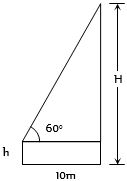
$A$ man whose eye level is $1.5 \ m$ above the ground observes the angle of elevation of a tower to be $60^\circ$. If the distance of the man from the tower is $10 \ m$,the height of the tower is:
A
$(1.5 + 10\sqrt{3}) \ m$
B
$10\sqrt{3} \ m$
C
$(1.5 + \frac{10}{\sqrt{3}}) \ m$
D
None of these
Solution
(A) Let the height of the tower be $H$. The eye level of the man is $h = 1.5 \ m$ above the ground.
The distance of the man from the tower is $d = 10 \ m$.
The angle of elevation is $\theta = 60^\circ$.
Considering the right-angled triangle formed by the line of sight,the horizontal distance,and the height of the tower above the eye level,we have:
$\tan(60^\circ) = \frac{\text{Height above eye level}}{d}$
$\sqrt{3} = \frac{H - 1.5}{10}$
$H - 1.5 = 10\sqrt{3}$
$H = (10\sqrt{3} + 1.5) \ m$.
The distance of the man from the tower is $d = 10 \ m$.
The angle of elevation is $\theta = 60^\circ$.
Considering the right-angled triangle formed by the line of sight,the horizontal distance,and the height of the tower above the eye level,we have:
$\tan(60^\circ) = \frac{\text{Height above eye level}}{d}$
$\sqrt{3} = \frac{H - 1.5}{10}$
$H - 1.5 = 10\sqrt{3}$
$H = (10\sqrt{3} + 1.5) \ m$.
0 likes
View Solution30
EasyMCQ
$A$ tower subtends an angle of $30^\circ$ at a point distant $d$ from the foot of the tower and on the same level as the foot of the tower. At a second point $h$ vertically above the first,the angle of depression of the foot of the tower is $60^\circ$. The height of the tower is:
A
$h/3$
B
$h/3d$
C
$3h$
D
$3h/d$
Solution
(A) Let the height of the tower be $H$ and the distance from the foot be $d$.
From the first point,we have $\tan(30^\circ) = H/d$,so $H = d \tan(30^\circ) = d/\sqrt{3}$.
From the second point at height $h$ above the first,the angle of depression to the foot of the tower is $60^\circ$.
This implies $\tan(60^\circ) = h/d$,so $d = h/\tan(60^\circ) = h/\sqrt{3}$.
Substituting $d$ into the expression for $H$:
$H = (h/\sqrt{3}) / \sqrt{3} = h/3$.
Thus,the height of the tower is $h/3$.
From the first point,we have $\tan(30^\circ) = H/d$,so $H = d \tan(30^\circ) = d/\sqrt{3}$.
From the second point at height $h$ above the first,the angle of depression to the foot of the tower is $60^\circ$.
This implies $\tan(60^\circ) = h/d$,so $d = h/\tan(60^\circ) = h/\sqrt{3}$.
Substituting $d$ into the expression for $H$:
$H = (h/\sqrt{3}) / \sqrt{3} = h/3$.
Thus,the height of the tower is $h/3$.
0 likes
View Solution31
DifficultMCQ
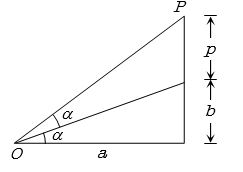
$A$ tower of height $b$ subtends an angle $\alpha$ at a point $O$ on the level of the foot of the tower and at a distance $a$ from the foot of the tower. If a pole of height $p$ mounted on the tower also subtends an equal angle $\alpha$ at $O$,the height of the pole $p$ is:
A
$b \left( \frac{a^2 - b^2}{a^2 + b^2} \right)$
B
$b \left( \frac{a^2 + b^2}{a^2 - b^2} \right)$
C
$a \left( \frac{a^2 - b^2}{a^2 + b^2} \right)$
D
$a \left( \frac{a^2 + b^2}{a^2 - b^2} \right)$
Solution
(B) Let the tower be $AB$ with height $b$ and the pole be $BP$ with height $p$. The point $O$ is at distance $a$ from $A$.
Given $\angle AOB = \alpha$ and $\angle POB = \alpha$.
In $\triangle OAB$,$\tan \alpha = \frac{AB}{OA} = \frac{b}{a}$.
In $\triangle OAP$,$\angle POA = 2\alpha$.
So,$\tan 2\alpha = \frac{AP}{OA} = \frac{p + b}{a}$.
Using the formula $\tan 2\alpha = \frac{2 \tan \alpha}{1 - \tan^2 \alpha}$,we get:
$\frac{2(b/a)}{1 - (b/a)^2} = \frac{p + b}{a}$
$\frac{2b/a}{(a^2 - b^2)/a^2} = \frac{p + b}{a}$
$\frac{2ba}{a^2 - b^2} = \frac{p + b}{a}$
$p + b = \frac{2ba^2}{a^2 - b^2}$
$p = \frac{2ba^2}{a^2 - b^2} - b$
$p = \frac{2ba^2 - b(a^2 - b^2)}{a^2 - b^2}$
$p = \frac{2ba^2 - ba^2 + b^3}{a^2 - b^2}$
$p = \frac{ba^2 + b^3}{a^2 - b^2} = \frac{b(a^2 + b^2)}{a^2 - b^2}$.
Given $\angle AOB = \alpha$ and $\angle POB = \alpha$.
In $\triangle OAB$,$\tan \alpha = \frac{AB}{OA} = \frac{b}{a}$.
In $\triangle OAP$,$\angle POA = 2\alpha$.
So,$\tan 2\alpha = \frac{AP}{OA} = \frac{p + b}{a}$.
Using the formula $\tan 2\alpha = \frac{2 \tan \alpha}{1 - \tan^2 \alpha}$,we get:
$\frac{2(b/a)}{1 - (b/a)^2} = \frac{p + b}{a}$
$\frac{2b/a}{(a^2 - b^2)/a^2} = \frac{p + b}{a}$
$\frac{2ba}{a^2 - b^2} = \frac{p + b}{a}$
$p + b = \frac{2ba^2}{a^2 - b^2}$
$p = \frac{2ba^2}{a^2 - b^2} - b$
$p = \frac{2ba^2 - b(a^2 - b^2)}{a^2 - b^2}$
$p = \frac{2ba^2 - ba^2 + b^3}{a^2 - b^2}$
$p = \frac{ba^2 + b^3}{a^2 - b^2} = \frac{b(a^2 + b^2)}{a^2 - b^2}$.
0 likes
View Solution32
MediumMCQ
$A$ tree is broken by wind,its upper part touches the ground at a point $10 \ m$ from the foot of the tree and makes an angle of $45^\circ$ with the ground. The total length of the tree is:
A
$15 \ m$
B
$20 \ m$
C
$10(1 + \sqrt{2}) \ m$
D
$10(1 + \frac{\sqrt{3}}{2}) \ m$
Solution
(C) Let the height of the tree be $H$. Let the broken part be $x$ and the remaining part be $h$.
The distance from the foot of the tree to the point where the top touches the ground is $d = 10 \ m$.
In the right-angled triangle formed,$\tan(45^\circ) = \frac{h}{10} \implies 1 = \frac{h}{10} \implies h = 10 \ m$.
Also,$\cos(45^\circ) = \frac{10}{x} \implies \frac{1}{\sqrt{2}} = \frac{10}{x} \implies x = 10\sqrt{2} \ m$.
The total length of the tree is $H = h + x = 10 + 10\sqrt{2} = 10(1 + \sqrt{2}) \ m$.
The distance from the foot of the tree to the point where the top touches the ground is $d = 10 \ m$.
In the right-angled triangle formed,$\tan(45^\circ) = \frac{h}{10} \implies 1 = \frac{h}{10} \implies h = 10 \ m$.
Also,$\cos(45^\circ) = \frac{10}{x} \implies \frac{1}{\sqrt{2}} = \frac{10}{x} \implies x = 10\sqrt{2} \ m$.
The total length of the tree is $H = h + x = 10 + 10\sqrt{2} = 10(1 + \sqrt{2}) \ m$.
0 likes
View Solution33
EasyMCQ
The angle of depression of a ship from the top of a tower $30 \, m$ high is $60^\circ$. Find the distance of the ship from the base of the tower.
A
$30 \, m$
B
$30 \sqrt{3} \, m$
C
$10 \sqrt{3} \, m$
D
$10 \, m$
Solution
(C) Let $h = 30 \, m$ be the height of the tower and $x$ be the distance of the ship from the base of the tower.
Since the angle of depression is $60^\circ$,the angle of elevation from the ship to the top of the tower is also $60^\circ$.
In the right-angled triangle formed by the tower and the distance on the ground,we have:
$\tan 60^\circ = \frac{\text{Height}}{\text{Distance}} = \frac{30}{x}$
Since $\tan 60^\circ = \sqrt{3}$,we get:
$\sqrt{3} = \frac{30}{x}$
$x = \frac{30}{\sqrt{3}} = \frac{30 \times \sqrt{3}}{\sqrt{3} \times \sqrt{3}} = \frac{30 \sqrt{3}}{3} = 10 \sqrt{3} \, m$.
Thus,the distance of the ship from the base of the tower is $10 \sqrt{3} \, m$.
Since the angle of depression is $60^\circ$,the angle of elevation from the ship to the top of the tower is also $60^\circ$.
In the right-angled triangle formed by the tower and the distance on the ground,we have:
$\tan 60^\circ = \frac{\text{Height}}{\text{Distance}} = \frac{30}{x}$
Since $\tan 60^\circ = \sqrt{3}$,we get:
$\sqrt{3} = \frac{30}{x}$
$x = \frac{30}{\sqrt{3}} = \frac{30 \times \sqrt{3}}{\sqrt{3} \times \sqrt{3}} = \frac{30 \sqrt{3}}{3} = 10 \sqrt{3} \, m$.
Thus,the distance of the ship from the base of the tower is $10 \sqrt{3} \, m$.
0 likes
View Solution34
DifficultMCQ
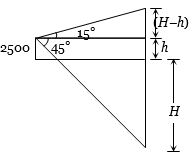
The angle of elevation of a stationary cloud from a point $2500 \, m$ above a lake is $15^\circ$ and the angle of depression of its reflection in the lake is $45^\circ$. The height of the cloud above the lake level is
A
$2500 \sqrt{3} \, m$
B
$2500 \, m$
C
$500 \sqrt{3} \, m$
D
None of these
Solution
(A) Let $H$ be the height of the cloud above the lake level and $h = 2500 \, m$ be the height of the observation point above the lake.
Let $x$ be the horizontal distance from the observation point to the cloud.
From the angle of elevation,we have $\tan(15^\circ) = \frac{H - h}{x}$,so $x = \frac{H - h}{\tan(15^\circ)} = (H - h) \cot(15^\circ)$.
From the angle of depression of the reflection,the depth of the reflection below the lake is $H$. The total vertical distance from the observation point to the reflection is $H + h$.
Thus,$\tan(45^\circ) = \frac{H + h}{x}$,so $x = \frac{H + h}{\tan(45^\circ)} = (H + h) \cot(45^\circ)$.
Equating the two expressions for $x$: $(H - h) \cot(15^\circ) = (H + h) \cot(45^\circ)$.
Since $\cot(45^\circ) = 1$ and $\cot(15^\circ) = 2 + \sqrt{3}$,we have $(H - 2500)(2 + \sqrt{3}) = H + 2500$.
$H(2 + \sqrt{3}) - 2500(2 + \sqrt{3}) = H + 2500$.
$H(1 + \sqrt{3}) = 2500(3 + \sqrt{3}) = 2500 \sqrt{3}(\sqrt{3} + 1)$.
$H = 2500 \sqrt{3} \, m$.
Let $x$ be the horizontal distance from the observation point to the cloud.
From the angle of elevation,we have $\tan(15^\circ) = \frac{H - h}{x}$,so $x = \frac{H - h}{\tan(15^\circ)} = (H - h) \cot(15^\circ)$.
From the angle of depression of the reflection,the depth of the reflection below the lake is $H$. The total vertical distance from the observation point to the reflection is $H + h$.
Thus,$\tan(45^\circ) = \frac{H + h}{x}$,so $x = \frac{H + h}{\tan(45^\circ)} = (H + h) \cot(45^\circ)$.
Equating the two expressions for $x$: $(H - h) \cot(15^\circ) = (H + h) \cot(45^\circ)$.
Since $\cot(45^\circ) = 1$ and $\cot(15^\circ) = 2 + \sqrt{3}$,we have $(H - 2500)(2 + \sqrt{3}) = H + 2500$.
$H(2 + \sqrt{3}) - 2500(2 + \sqrt{3}) = H + 2500$.
$H(1 + \sqrt{3}) = 2500(3 + \sqrt{3}) = 2500 \sqrt{3}(\sqrt{3} + 1)$.
$H = 2500 \sqrt{3} \, m$.
0 likes
View Solution35
MediumMCQ
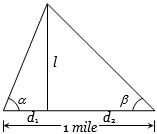
From an aeroplane vertically over a straight horizontal road,the angles of depression of two consecutive milestones on opposite sides of the aeroplane are observed to be $\alpha$ and $\beta$. Then,the height in miles of the aeroplane above the road is:
A
$\frac{\tan \alpha \cdot \tan \beta}{\cot \alpha + \cot \beta}$
B
$\frac{\tan \alpha + \tan \beta}{\tan \alpha \cdot \tan \beta}$
C
$\frac{\cot \alpha + \cot \beta}{\tan \alpha \cdot \tan \beta}$
D
$\frac{\tan \alpha \cdot \tan \beta}{\tan \alpha + \tan \beta}$
Solution
(D) Let $h$ be the height of the aeroplane above the road.
Let the two milestones be at points $A$ and $B$,and the point on the road directly below the aeroplane be $P$.
Given that the distance between the two consecutive milestones is $1 \text{ mile}$,so $AP + PB = 1$.
In the right-angled triangles formed,we have $AP = h \cot \alpha$ and $PB = h \cot \beta$.
Thus,$h \cot \alpha + h \cot \beta = 1$.
$h(\cot \alpha + \cot \beta) = 1$.
$h = \frac{1}{\cot \alpha + \cot \beta}$.
Since $\cot \theta = \frac{1}{\tan \theta}$,we have $h = \frac{1}{\frac{1}{\tan \alpha} + \frac{1}{\tan \beta}} = \frac{1}{\frac{\tan \beta + \tan \alpha}{\tan \alpha \cdot \tan \beta}} = \frac{\tan \alpha \cdot \tan \beta}{\tan \alpha + \tan \beta}$.
Let the two milestones be at points $A$ and $B$,and the point on the road directly below the aeroplane be $P$.
Given that the distance between the two consecutive milestones is $1 \text{ mile}$,so $AP + PB = 1$.
In the right-angled triangles formed,we have $AP = h \cot \alpha$ and $PB = h \cot \beta$.
Thus,$h \cot \alpha + h \cot \beta = 1$.
$h(\cot \alpha + \cot \beta) = 1$.
$h = \frac{1}{\cot \alpha + \cot \beta}$.
Since $\cot \theta = \frac{1}{\tan \theta}$,we have $h = \frac{1}{\frac{1}{\tan \alpha} + \frac{1}{\tan \beta}} = \frac{1}{\frac{\tan \beta + \tan \alpha}{\tan \alpha \cdot \tan \beta}} = \frac{\tan \alpha \cdot \tan \beta}{\tan \alpha + \tan \beta}$.
0 likes
View Solution36
DifficultMCQ
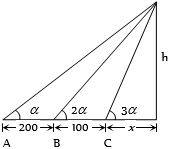
$A$ balloon is observed simultaneously from three points $A, B$ and $C$ on a straight road directly under it. The angular elevation at $B$ is twice and at $C$ is thrice that of $A$. If the distance between $A$ and $B$ is $200$ metres and the distance between $B$ and $C$ is $100$ metres,then the height of the balloon is:
A
$50$ metres
B
$50\sqrt{3}$ metres
C
$50\sqrt{2}$ metres
D
$100\sqrt{3}$ metres
Solution
(D) Let the height of the balloon be $h$ and the distance from the point directly under the balloon to $C$ be $x$. From the geometry of the problem:
$x = h \cot(3\alpha) \dots (i)$
$x + 100 = h \cot(2\alpha) \dots (ii)$
$x + 300 = h \cot(\alpha) \dots (iii)$
Subtracting $(i)$ from $(ii)$:
$100 = h(\cot(2\alpha) - \cot(3\alpha)) = h \left( \frac{\sin(3\alpha - 2\alpha)}{\sin(2\alpha)\sin(3\alpha)} \right) = h \frac{\sin(\alpha)}{\sin(2\alpha)\sin(3\alpha)} \dots (iv)$
Subtracting $(ii)$ from $(iii)$:
$200 = h(\cot(\alpha) - \cot(2\alpha)) = h \left( \frac{\sin(2\alpha - \alpha)}{\sin(\alpha)\sin(2\alpha)} \right) = h \frac{1}{\sin(2\alpha)} \dots (v)$
Dividing $(iv)$ by $(v)$:
$\frac{100}{200} = \frac{\sin(\alpha)}{\sin(3\alpha)} \Rightarrow \frac{\sin(3\alpha)}{\sin(\alpha)} = 2$
Using $\sin(3\alpha) = 3\sin(\alpha) - 4\sin^3(\alpha)$:
$3 - 4\sin^2(\alpha) = 2$ $\Rightarrow 4\sin^2(\alpha) = 1$ $\Rightarrow \sin(\alpha) = \frac{1}{2}$ $\Rightarrow \alpha = 30^\circ$
Substituting $\alpha = 30^\circ$ in $(v)$:
$200 = h \frac{1}{\sin(60^\circ)} = h \frac{1}{\sqrt{3}/2} = \frac{2h}{\sqrt{3}}$
$h = 100\sqrt{3}$ metres.
$x = h \cot(3\alpha) \dots (i)$
$x + 100 = h \cot(2\alpha) \dots (ii)$
$x + 300 = h \cot(\alpha) \dots (iii)$
Subtracting $(i)$ from $(ii)$:
$100 = h(\cot(2\alpha) - \cot(3\alpha)) = h \left( \frac{\sin(3\alpha - 2\alpha)}{\sin(2\alpha)\sin(3\alpha)} \right) = h \frac{\sin(\alpha)}{\sin(2\alpha)\sin(3\alpha)} \dots (iv)$
Subtracting $(ii)$ from $(iii)$:
$200 = h(\cot(\alpha) - \cot(2\alpha)) = h \left( \frac{\sin(2\alpha - \alpha)}{\sin(\alpha)\sin(2\alpha)} \right) = h \frac{1}{\sin(2\alpha)} \dots (v)$
Dividing $(iv)$ by $(v)$:
$\frac{100}{200} = \frac{\sin(\alpha)}{\sin(3\alpha)} \Rightarrow \frac{\sin(3\alpha)}{\sin(\alpha)} = 2$
Using $\sin(3\alpha) = 3\sin(\alpha) - 4\sin^3(\alpha)$:
$3 - 4\sin^2(\alpha) = 2$ $\Rightarrow 4\sin^2(\alpha) = 1$ $\Rightarrow \sin(\alpha) = \frac{1}{2}$ $\Rightarrow \alpha = 30^\circ$
Substituting $\alpha = 30^\circ$ in $(v)$:
$200 = h \frac{1}{\sin(60^\circ)} = h \frac{1}{\sqrt{3}/2} = \frac{2h}{\sqrt{3}}$
$h = 100\sqrt{3}$ metres.
0 likes
View Solution37
DifficultMCQ
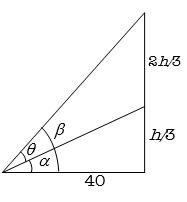
$A$ vertical pole (more than $100 \, ft$ high) consists of two portions,the lower being one-third of the whole. If the upper portion subtends an angle $\tan^{-1}(\frac{1}{2})$ at a point in a horizontal plane through the foot of the pole and at a distance of $40 \, ft$ from it,then the height of the pole is......$ft$.
A
$100$
B
$120$
C
$150$
D
None of these
Solution
(B) Let the total height of the pole be $h \, ft$. The lower portion is $\frac{h}{3}$ and the upper portion is $\frac{2h}{3}$.
Let the point be $P$ at a distance of $40 \, ft$ from the foot of the pole.
Let $\alpha$ be the angle subtended by the lower portion at $P$,and $\beta$ be the angle subtended by the whole pole at $P$.
Then $\tan \alpha = \frac{h/3}{40} = \frac{h}{120}$ and $\tan \beta = \frac{h}{40} = \frac{3h}{120}$.
The upper portion subtends an angle $\theta = \tan^{-1}(\frac{1}{2})$ at $P$,so $\tan \theta = \frac{1}{2}$.
Since $\theta = \beta - \alpha$,we have $\tan \theta = \tan(\beta - \alpha) = \frac{\tan \beta - \tan \alpha}{1 + \tan \beta \tan \alpha}$.
Substituting the values: $\frac{1}{2} = \frac{\frac{3h}{120} - \frac{h}{120}}{1 + (\frac{3h}{120})(\frac{h}{120})} = \frac{\frac{2h}{120}}{1 + \frac{3h^2}{14400}} = \frac{h/60}{1 + \frac{h^2}{4800}}$.
$\frac{1}{2} = \frac{h}{60} \times \frac{4800}{4800 + h^2} = \frac{80h}{4800 + h^2}$.
$4800 + h^2 = 160h \Rightarrow h^2 - 160h + 4800 = 0$.
$(h - 120)(h - 40) = 0$.
So $h = 120$ or $h = 40$.
Since the pole is more than $100 \, ft$ high,$h = 120 \, ft$.
Let the point be $P$ at a distance of $40 \, ft$ from the foot of the pole.
Let $\alpha$ be the angle subtended by the lower portion at $P$,and $\beta$ be the angle subtended by the whole pole at $P$.
Then $\tan \alpha = \frac{h/3}{40} = \frac{h}{120}$ and $\tan \beta = \frac{h}{40} = \frac{3h}{120}$.
The upper portion subtends an angle $\theta = \tan^{-1}(\frac{1}{2})$ at $P$,so $\tan \theta = \frac{1}{2}$.
Since $\theta = \beta - \alpha$,we have $\tan \theta = \tan(\beta - \alpha) = \frac{\tan \beta - \tan \alpha}{1 + \tan \beta \tan \alpha}$.
Substituting the values: $\frac{1}{2} = \frac{\frac{3h}{120} - \frac{h}{120}}{1 + (\frac{3h}{120})(\frac{h}{120})} = \frac{\frac{2h}{120}}{1 + \frac{3h^2}{14400}} = \frac{h/60}{1 + \frac{h^2}{4800}}$.
$\frac{1}{2} = \frac{h}{60} \times \frac{4800}{4800 + h^2} = \frac{80h}{4800 + h^2}$.
$4800 + h^2 = 160h \Rightarrow h^2 - 160h + 4800 = 0$.
$(h - 120)(h - 40) = 0$.
So $h = 120$ or $h = 40$.
Since the pole is more than $100 \, ft$ high,$h = 120 \, ft$.
0 likes
View Solution38
DifficultMCQ
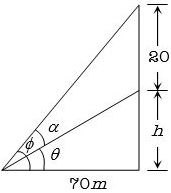
$A$ flag-post $20 \ m$ high standing on the top of a house subtends an angle whose tangent is $\frac{1}{6}$ at a distance $70 \ m$ from the foot of the house. The height of the house is......$m$
A
$30$
B
$60$
C
$50$
D
None of these
Solution
(C) Let the height of the house be $h \ m$. The distance from the foot of the house is $d = 70 \ m$. The height of the flag-post is $20 \ m$.
Let $\theta$ be the angle subtended by the house at the point,and $\phi$ be the angle subtended by the house plus the flag-post.
Then $\tan \theta = \frac{h}{70}$ and $\tan \phi = \frac{h + 20}{70}$.
The angle subtended by the flag-post is $\alpha = \phi - \theta$,where $\tan \alpha = \frac{1}{6}$.
Using the formula $\tan \alpha = \frac{\tan \phi - \tan \theta}{1 + \tan \phi \tan \theta}$:
$\frac{1}{6} = \frac{\frac{h + 20}{70} - \frac{h}{70}}{1 + (\frac{h + 20}{70})(\frac{h}{70})}$
$\frac{1}{6} = \frac{\frac{20}{70}}{1 + \frac{h(h + 20)}{4900}}$
$1 + \frac{h^2 + 20h}{4900} = 6 \times \frac{20}{70} = \frac{120}{70} = \frac{12}{7}$
$\frac{h^2 + 20h}{4900} = \frac{12}{7} - 1 = \frac{5}{7}$
$h^2 + 20h = \frac{5}{7} \times 4900 = 5 \times 700 = 3500$
$h^2 + 20h - 3500 = 0$
$(h + 70)(h - 50) = 0$
Since $h > 0$,we have $h = 50 \ m$.
Let $\theta$ be the angle subtended by the house at the point,and $\phi$ be the angle subtended by the house plus the flag-post.
Then $\tan \theta = \frac{h}{70}$ and $\tan \phi = \frac{h + 20}{70}$.
The angle subtended by the flag-post is $\alpha = \phi - \theta$,where $\tan \alpha = \frac{1}{6}$.
Using the formula $\tan \alpha = \frac{\tan \phi - \tan \theta}{1 + \tan \phi \tan \theta}$:
$\frac{1}{6} = \frac{\frac{h + 20}{70} - \frac{h}{70}}{1 + (\frac{h + 20}{70})(\frac{h}{70})}$
$\frac{1}{6} = \frac{\frac{20}{70}}{1 + \frac{h(h + 20)}{4900}}$
$1 + \frac{h^2 + 20h}{4900} = 6 \times \frac{20}{70} = \frac{120}{70} = \frac{12}{7}$
$\frac{h^2 + 20h}{4900} = \frac{12}{7} - 1 = \frac{5}{7}$
$h^2 + 20h = \frac{5}{7} \times 4900 = 5 \times 700 = 3500$
$h^2 + 20h - 3500 = 0$
$(h + 70)(h - 50) = 0$
Since $h > 0$,we have $h = 50 \ m$.
0 likes
View Solution39
MediumMCQ
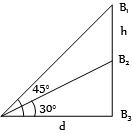
$A$ balloon is descending at a rate of $4 \, m/min$. Its angle of elevation from a point on the ground is $45^\circ$,which reduces to $30^\circ$ after $10 \, minutes$. At what distance from the observer will the balloon touch the ground?
A
$20 \sqrt{3} \, m$
B
$20(3 + \sqrt{3}) \, m$
C
$10(3 + \sqrt{3}) \, m$
D
None of these
Solution
(B) Let the distance of the balloon from the observer be $d$. Let the initial height be $h_1$ and the final height be $h_2$.
From the geometry,$h_1 = d \tan 45^\circ = d$ and $h_2 = d \tan 30^\circ = \frac{d}{\sqrt{3}}$.
The distance descended in $10 \, minutes$ is $h_1 - h_2 = d - \frac{d}{\sqrt{3}} = d \left( \frac{\sqrt{3} - 1}{\sqrt{3}} \right)$.
Given the rate of descent is $4 \, m/min$,the distance descended in $10 \, minutes$ is $4 \times 10 = 40 \, m$.
Equating the two: $d \left( \frac{\sqrt{3} - 1}{\sqrt{3}} \right) = 40$.
$d = \frac{40 \sqrt{3}}{\sqrt{3} - 1} = \frac{40 \sqrt{3}(\sqrt{3} + 1)}{3 - 1} = \frac{40(3 + \sqrt{3})}{2} = 20(3 + \sqrt{3}) \, m$.
From the geometry,$h_1 = d \tan 45^\circ = d$ and $h_2 = d \tan 30^\circ = \frac{d}{\sqrt{3}}$.
The distance descended in $10 \, minutes$ is $h_1 - h_2 = d - \frac{d}{\sqrt{3}} = d \left( \frac{\sqrt{3} - 1}{\sqrt{3}} \right)$.
Given the rate of descent is $4 \, m/min$,the distance descended in $10 \, minutes$ is $4 \times 10 = 40 \, m$.
Equating the two: $d \left( \frac{\sqrt{3} - 1}{\sqrt{3}} \right) = 40$.
$d = \frac{40 \sqrt{3}}{\sqrt{3} - 1} = \frac{40 \sqrt{3}(\sqrt{3} + 1)}{3 - 1} = \frac{40(3 + \sqrt{3})}{2} = 20(3 + \sqrt{3}) \, m$.
0 likes
View Solution40
MediumMCQ
$A$ person standing on the bank of a river finds that the angle of elevation of the top of a tower on the opposite bank is $45^\circ$. Which of the following statements is correct?
A
Breadth of the river is twice the height of the tower
B
Breadth of the river and the height of the tower are the same
C
Breadth of the river is half of the height of the tower
D
None of the above
Solution
(B) Let the height of the tower be $h$ and the breadth of the river be $x$.
According to the problem,the angle of elevation is $45^\circ$.
Using the trigonometric ratio,$\tan(45^\circ) = \frac{\text{height of tower}}{\text{breadth of river}} = \frac{h}{x}$.
Since $\tan(45^\circ) = 1$,we have $1 = \frac{h}{x}$,which implies $x = h$.
Therefore,the breadth of the river and the height of the tower are the same.
According to the problem,the angle of elevation is $45^\circ$.
Using the trigonometric ratio,$\tan(45^\circ) = \frac{\text{height of tower}}{\text{breadth of river}} = \frac{h}{x}$.
Since $\tan(45^\circ) = 1$,we have $1 = \frac{h}{x}$,which implies $x = h$.
Therefore,the breadth of the river and the height of the tower are the same.
0 likes
View Solution41
MediumMCQ
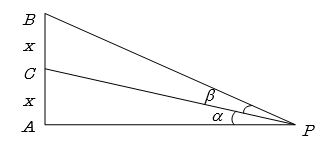
$AB$ is a vertical pole resting at the end $A$ on the level ground. $P$ is a point on the level ground such that $AP = 3 \, AB$. If $C$ is the mid-point of $AB$ and $CB$ subtends an angle $\beta$ at $P$,the value of $\tan \beta$ is
A
$\frac{18}{19}$
B
$\frac{3}{19}$
C
$\frac{1}{6}$
D
None of these
Solution
(B) Let $AC = x = CB$. Then $AB = AC + CB = 2x$.
Given $AP = 3 \, AB = 3(2x) = 6x$.
Let $\angle APC = \alpha$. In $\Delta ACP$,$\tan \alpha = \frac{AC}{AP} = \frac{x}{6x} = \frac{1}{6}$.
In $\Delta ABP$,$\angle APB = \alpha + \beta$. Thus,$\tan(\alpha + \beta) = \frac{AB}{AP} = \frac{2x}{6x} = \frac{1}{3}$.
Using the formula $\tan \beta = \tan((\alpha + \beta) - \alpha) = \frac{\tan(\alpha + \beta) - \tan \alpha}{1 + \tan(\alpha + \beta)\tan \alpha}$.
Substituting the values: $\tan \beta = \frac{\frac{1}{3} - \frac{1}{6}}{1 + (\frac{1}{3})(\frac{1}{6})} = \frac{\frac{2-1}{6}}{1 + \frac{1}{18}} = \frac{\frac{1}{6}}{\frac{19}{18}} = \frac{1}{6} \times \frac{18}{19} = \frac{3}{19}$.
Given $AP = 3 \, AB = 3(2x) = 6x$.
Let $\angle APC = \alpha$. In $\Delta ACP$,$\tan \alpha = \frac{AC}{AP} = \frac{x}{6x} = \frac{1}{6}$.
In $\Delta ABP$,$\angle APB = \alpha + \beta$. Thus,$\tan(\alpha + \beta) = \frac{AB}{AP} = \frac{2x}{6x} = \frac{1}{3}$.
Using the formula $\tan \beta = \tan((\alpha + \beta) - \alpha) = \frac{\tan(\alpha + \beta) - \tan \alpha}{1 + \tan(\alpha + \beta)\tan \alpha}$.
Substituting the values: $\tan \beta = \frac{\frac{1}{3} - \frac{1}{6}}{1 + (\frac{1}{3})(\frac{1}{6})} = \frac{\frac{2-1}{6}}{1 + \frac{1}{18}} = \frac{\frac{1}{6}}{\frac{19}{18}} = \frac{1}{6} \times \frac{18}{19} = \frac{3}{19}$.
0 likes
View Solution42
MediumMCQ
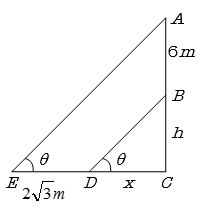
If a flagstaff of $6 \ m$ high placed on the top of a tower throws a shadow of $2\sqrt{3} \ m$ along the ground,then the angle (in degrees) that the sun makes with the ground is.......$^o$
A
$60$
B
$80$
C
$75$
D
None of these
Solution
(A) Let $h$ be the height of the tower and $x$ be the length of its shadow. The flagstaff of height $6 \ m$ is placed on top of the tower.
From the geometry of the problem,we have two similar triangles $AEC$ and $BDC$ as shown in the figure.
For the tower of height $h$ and shadow $x$,we have $\tan \theta = \frac{h}{x}$.
For the combined height $(h + 6)$ and total shadow $(x + 2\sqrt{3})$,we have $\tan \theta = \frac{h + 6}{x + 2\sqrt{3}}$.
Equating the two expressions for $\tan \theta$:
$\frac{h}{x} = \frac{h + 6}{x + 2\sqrt{3}}$
$h(x + 2\sqrt{3}) = x(h + 6)$
$hx + 2\sqrt{3}h = xh + 6x$
$2\sqrt{3}h = 6x$
$\frac{h}{x} = \frac{6}{2\sqrt{3}} = \frac{3}{\sqrt{3}} = \sqrt{3}$
Since $\tan \theta = \frac{h}{x} = \sqrt{3}$,we have $\theta = 60^o$.
From the geometry of the problem,we have two similar triangles $AEC$ and $BDC$ as shown in the figure.
For the tower of height $h$ and shadow $x$,we have $\tan \theta = \frac{h}{x}$.
For the combined height $(h + 6)$ and total shadow $(x + 2\sqrt{3})$,we have $\tan \theta = \frac{h + 6}{x + 2\sqrt{3}}$.
Equating the two expressions for $\tan \theta$:
$\frac{h}{x} = \frac{h + 6}{x + 2\sqrt{3}}$
$h(x + 2\sqrt{3}) = x(h + 6)$
$hx + 2\sqrt{3}h = xh + 6x$
$2\sqrt{3}h = 6x$
$\frac{h}{x} = \frac{6}{2\sqrt{3}} = \frac{3}{\sqrt{3}} = \sqrt{3}$
Since $\tan \theta = \frac{h}{x} = \sqrt{3}$,we have $\theta = 60^o$.
0 likes
View Solution43
DifficultMCQ
The angle of elevation of a cliff at a point $A$ on the ground and a point $B$,$100 \ m$ vertically above $A$,are $\alpha$ and $\beta$ respectively. The height of the cliff is
A
$\frac{100 \cot \alpha}{\cot \alpha - \cot \beta}$
B
$\frac{100 \cot \beta}{\cot \alpha - \cot \beta}$
C
$\frac{100 \cot \beta}{\cot \beta - \cot \alpha}$
D
$\frac{100 \cot \beta}{\cot \beta + \cot \alpha}$
Solution
(C) Let the height of the cliff be $OP = h$. Let $O$ be the base of the cliff on the ground.
From the given information,$AB = 100 \ m$ and $AB$ is vertical,so $OC = 100 \ m$.
Then $CP = OP - OC = h - 100$.
In $\triangle AOP$,$\tan \alpha = \frac{OP}{OA} = \frac{h}{OA} \implies OA = h \cot \alpha$.
In $\triangle BCP$,$\tan \beta = \frac{CP}{BC} = \frac{h - 100}{BC}$. Since $BC = OA$,we have $BC = h \cot \alpha$.
Substituting $BC$ in the second equation: $\tan \beta = \frac{h - 100}{h \cot \alpha}$.
$h \cot \alpha \tan \beta = h - 100$.
$100 = h - h \cot \alpha \tan \beta = h(1 - \cot \alpha \tan \beta)$.
$100 = h \left(1 - \frac{\cot \alpha}{\cot \beta}\right) = h \left(\frac{\cot \beta - \cot \alpha}{\cot \beta}\right)$.
Therefore,$h = \frac{100 \cot \beta}{\cot \beta - \cot \alpha}$.
From the given information,$AB = 100 \ m$ and $AB$ is vertical,so $OC = 100 \ m$.
Then $CP = OP - OC = h - 100$.
In $\triangle AOP$,$\tan \alpha = \frac{OP}{OA} = \frac{h}{OA} \implies OA = h \cot \alpha$.
In $\triangle BCP$,$\tan \beta = \frac{CP}{BC} = \frac{h - 100}{BC}$. Since $BC = OA$,we have $BC = h \cot \alpha$.
Substituting $BC$ in the second equation: $\tan \beta = \frac{h - 100}{h \cot \alpha}$.
$h \cot \alpha \tan \beta = h - 100$.
$100 = h - h \cot \alpha \tan \beta = h(1 - \cot \alpha \tan \beta)$.
$100 = h \left(1 - \frac{\cot \alpha}{\cot \beta}\right) = h \left(\frac{\cot \beta - \cot \alpha}{\cot \beta}\right)$.
Therefore,$h = \frac{100 \cot \beta}{\cot \beta - \cot \alpha}$.
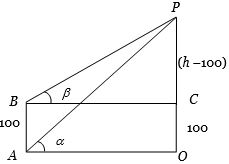
0 likes
View Solution44
MediumMCQ
$A$ flag-staff of $5 \, m$ high stands on a building of $25 \, m$ high. An observer is at a height of $30 \, m$. The flag-staff and the building subtend equal angles at the observer. The distance of the observer from the top of the flag-staff is
A
$\frac{5\sqrt{3}}{2}$
B
$5\sqrt{\frac{3}{2}}$
C
$5\sqrt{\frac{2}{3}}$
D
None of these
Solution
(B) Let the observer be at point $O$ at a height of $30 \, m$ from the ground. The building height is $25 \, m$ and the flag-staff is $5 \, m$ on top of it,so the total height is $30 \, m$.
Let the horizontal distance between the observer and the building be $x$.
The observer is at the same level as the top of the flag-staff.
Let the angle subtended by the flag-staff at the observer be $\alpha$.
Let the angle subtended by the building at the observer be $\alpha$.
From the geometry,$\tan \alpha = \frac{5}{x}$ and $\tan 2\alpha = \frac{30}{x}$.
Using the identity $\tan 2\alpha = \frac{2\tan \alpha}{1 - \tan^2 \alpha}$,we have:
$\frac{30}{x} = \frac{2(5/x)}{1 - (5/x)^2} = \frac{10/x}{(x^2 - 25)/x^2} = \frac{10x}{x^2 - 25}$.
$30(x^2 - 25) = 10x^2$ $\Rightarrow 3x^2 - 75 = x^2$ $\Rightarrow 2x^2 = 75$ $\Rightarrow x^2 = \frac{75}{2}$ $\Rightarrow x = \sqrt{\frac{75}{2}} = 5\sqrt{\frac{3}{2}}$.
The distance of the observer from the top of the flag-staff is the horizontal distance $x$ because the observer and the top of the flag-staff are at the same height $(30 \, m)$.
Thus,the distance is $5\sqrt{\frac{3}{2}} \, m$.
Let the horizontal distance between the observer and the building be $x$.
The observer is at the same level as the top of the flag-staff.
Let the angle subtended by the flag-staff at the observer be $\alpha$.
Let the angle subtended by the building at the observer be $\alpha$.
From the geometry,$\tan \alpha = \frac{5}{x}$ and $\tan 2\alpha = \frac{30}{x}$.
Using the identity $\tan 2\alpha = \frac{2\tan \alpha}{1 - \tan^2 \alpha}$,we have:
$\frac{30}{x} = \frac{2(5/x)}{1 - (5/x)^2} = \frac{10/x}{(x^2 - 25)/x^2} = \frac{10x}{x^2 - 25}$.
$30(x^2 - 25) = 10x^2$ $\Rightarrow 3x^2 - 75 = x^2$ $\Rightarrow 2x^2 = 75$ $\Rightarrow x^2 = \frac{75}{2}$ $\Rightarrow x = \sqrt{\frac{75}{2}} = 5\sqrt{\frac{3}{2}}$.
The distance of the observer from the top of the flag-staff is the horizontal distance $x$ because the observer and the top of the flag-staff are at the same height $(30 \, m)$.
Thus,the distance is $5\sqrt{\frac{3}{2}} \, m$.
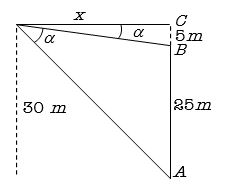
0 likes
View Solution45
MediumMCQ
The upper part of a tree broken by the wind makes an angle of $30^\circ$ with the ground. The distance from the root to the point where the top of the tree touches the ground is $10 \, m$. What was the original height of the tree in meters?
A
$8.66$
B
$15$
C
$17.32$
D
$25.98$
Solution
(C) Let the tree be $AC$ before breaking,where $C$ is the root and $A$ is the top. Let it break at point $D$ such that the top $A$ touches the ground at point $B$.
In $\triangle BCD$,$\angle DBC = 30^\circ$ and $BC = 10 \, m$.
Using trigonometry:
$\tan(30^\circ) = \frac{CD}{BC} \implies \frac{1}{\sqrt{3}} = \frac{CD}{10} \implies CD = \frac{10}{\sqrt{3}} \, m$.
$\cos(30^\circ) = \frac{BC}{BD} \implies \frac{\sqrt{3}}{2} = \frac{10}{BD} \implies BD = \frac{20}{\sqrt{3}} \, m$.
The original height of the tree is $CD + AD = CD + BD$ (since $AD = BD$).
Height $= \frac{10}{\sqrt{3}} + \frac{20}{\sqrt{3}} = \frac{30}{\sqrt{3}} = 10\sqrt{3} \, m$.
Using $\sqrt{3} \approx 1.732$,the height is $10 \times 1.732 = 17.32 \, m$.
In $\triangle BCD$,$\angle DBC = 30^\circ$ and $BC = 10 \, m$.
Using trigonometry:
$\tan(30^\circ) = \frac{CD}{BC} \implies \frac{1}{\sqrt{3}} = \frac{CD}{10} \implies CD = \frac{10}{\sqrt{3}} \, m$.
$\cos(30^\circ) = \frac{BC}{BD} \implies \frac{\sqrt{3}}{2} = \frac{10}{BD} \implies BD = \frac{20}{\sqrt{3}} \, m$.
The original height of the tree is $CD + AD = CD + BD$ (since $AD = BD$).
Height $= \frac{10}{\sqrt{3}} + \frac{20}{\sqrt{3}} = \frac{30}{\sqrt{3}} = 10\sqrt{3} \, m$.
Using $\sqrt{3} \approx 1.732$,the height is $10 \times 1.732 = 17.32 \, m$.
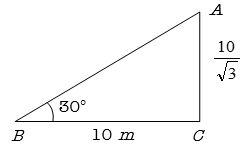
0 likes
View Solution46
EasyMCQ
The angle of elevation of a point situated at a distance of $70 \ m$ from the base of a tower is $45^\circ$. The height of the tower is ..... $m$.
A
$70$
B
$70\sqrt{2}$
C
$\frac{70}{\sqrt{2}}$
D
$35$
Solution
(A) Let the height of the tower be $h \ m$.
Given that the distance from the base of the tower is $70 \ m$.
In the right-angled triangle,we have:
$\tan(45^\circ) = \frac{\text{Height}}{\text{Base}} = \frac{h}{70}$
Since $\tan(45^\circ) = 1$,we get:
$1 = \frac{h}{70}$
$h = 70 \ m$.
Thus,the height of the tower is $70 \ m$.
Given that the distance from the base of the tower is $70 \ m$.
In the right-angled triangle,we have:
$\tan(45^\circ) = \frac{\text{Height}}{\text{Base}} = \frac{h}{70}$
Since $\tan(45^\circ) = 1$,we get:
$1 = \frac{h}{70}$
$h = 70 \ m$.
Thus,the height of the tower is $70 \ m$.
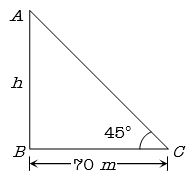
0 likes
View Solution47
DifficultMCQ
The angular elevation of a tower $CD$ at a point $A$ due south of it is $60^\circ$ and at a point $B$ due west of $A$,the elevation is $30^\circ$. If $AB = 3 \, km$,the height of the tower is
A
$2\sqrt{3} \, km$
B
$2\sqrt{6} \, km$
C
$\frac{3\sqrt{3}}{2} \, km$
D
$\frac{3\sqrt{6}}{4} \, km$
Solution
(D) Let the height of the tower $CD$ be $h$.
From $\Delta CDA$,we have $x = h \cot 60^\circ = \frac{h}{\sqrt{3}}$.
From $\Delta CDB$,we have $y = h \cot 30^\circ = \sqrt{3}h$.
In $\Delta ABC$,since $A$ is south of $C$ and $B$ is west of $A$,$\angle CAB = 90^\circ$.
By Pythagoras theorem,$AB^2 + AC^2 = BC^2$,which is $3^2 + x^2 = y^2$.
Substituting the values,$9 + \frac{h^2}{3} = 3h^2$.
$9 = 3h^2 - \frac{h^2}{3} = \frac{8h^2}{3}$.
$h^2 = \frac{27}{8} = \frac{54}{16}$.
$h = \sqrt{\frac{54}{16}} = \frac{3\sqrt{6}}{4} \, km$.
From $\Delta CDA$,we have $x = h \cot 60^\circ = \frac{h}{\sqrt{3}}$.
From $\Delta CDB$,we have $y = h \cot 30^\circ = \sqrt{3}h$.
In $\Delta ABC$,since $A$ is south of $C$ and $B$ is west of $A$,$\angle CAB = 90^\circ$.
By Pythagoras theorem,$AB^2 + AC^2 = BC^2$,which is $3^2 + x^2 = y^2$.
Substituting the values,$9 + \frac{h^2}{3} = 3h^2$.
$9 = 3h^2 - \frac{h^2}{3} = \frac{8h^2}{3}$.
$h^2 = \frac{27}{8} = \frac{54}{16}$.
$h = \sqrt{\frac{54}{16}} = \frac{3\sqrt{6}}{4} \, km$.
0 likes
View Solution48
MediumMCQ
$A$ person is standing on a tower of height $15(\sqrt{3} + 1) \ m$ and observing a car coming towards the tower. He observes that the angle of depression changes from $30^\circ$ to $45^\circ$ in $3 \ s$. What is the speed of the car in $km/hr$?
A
$36$
B
$72$
C
$18$
D
$30$
Solution
(A) Let the height of the tower $AB = h = 15(\sqrt{3} + 1) \ m$.
Let the car be at point $C$ initially and move to point $D$ in $3 \ s$.
In $\triangle ABD$,$\tan(45^\circ) = \frac{AB}{BD} \implies 1 = \frac{h}{BD} \implies BD = h$.
In $\triangle ABC$,$\tan(30^\circ) = \frac{AB}{BC} \implies \frac{1}{\sqrt{3}} = \frac{h}{BC} \implies BC = h\sqrt{3}$.
The distance covered by the car is $CD = BC - BD = h\sqrt{3} - h = h(\sqrt{3} - 1)$.
Substituting $h = 15(\sqrt{3} + 1)$:
$CD = 15(\sqrt{3} + 1)(\sqrt{3} - 1) = 15(3 - 1) = 15 \times 2 = 30 \ m$.
The time taken is $t = 3 \ s$.
Speed $v = \frac{\text{Distance}}{\text{Time}} = \frac{30 \ m}{3 \ s} = 10 \ m/s$.
To convert $m/s$ to $km/hr$,multiply by $\frac{18}{5}$:
$v = 10 \times \frac{18}{5} = 36 \ km/hr$.
Let the car be at point $C$ initially and move to point $D$ in $3 \ s$.
In $\triangle ABD$,$\tan(45^\circ) = \frac{AB}{BD} \implies 1 = \frac{h}{BD} \implies BD = h$.
In $\triangle ABC$,$\tan(30^\circ) = \frac{AB}{BC} \implies \frac{1}{\sqrt{3}} = \frac{h}{BC} \implies BC = h\sqrt{3}$.
The distance covered by the car is $CD = BC - BD = h\sqrt{3} - h = h(\sqrt{3} - 1)$.
Substituting $h = 15(\sqrt{3} + 1)$:
$CD = 15(\sqrt{3} + 1)(\sqrt{3} - 1) = 15(3 - 1) = 15 \times 2 = 30 \ m$.
The time taken is $t = 3 \ s$.
Speed $v = \frac{\text{Distance}}{\text{Time}} = \frac{30 \ m}{3 \ s} = 10 \ m/s$.
To convert $m/s$ to $km/hr$,multiply by $\frac{18}{5}$:
$v = 10 \times \frac{18}{5} = 36 \ km/hr$.
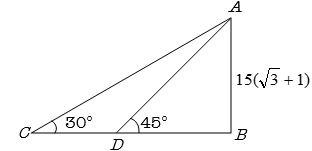
0 likes
View Solution49
MediumMCQ
Two men are on the opposite sides of a tower. They measure the angles of elevation of the top of the tower as $45^{\circ}$ and $30^{\circ}$ respectively. If the height of the tower is $40 \, m,$ find the distance between the men.
A
$40 \, m$
B
$40\sqrt{3} \, m$
C
$68.28 \, m$
D
$109.28 \, m$
Solution
(D) Let the tower be $AB$ with height $40 \, m$. Let the two men be at points $O_1$ and $O_2$ on opposite sides of the tower.
In $\Delta O_1BA$,$\tan(45^{\circ}) = \frac{AB}{O_1B}$ $\Rightarrow 1 = \frac{40}{x}$ $\Rightarrow x = 40 \, m$.
In $\Delta O_2BA$,$\tan(30^{\circ}) = \frac{AB}{O_2B}$ $\Rightarrow \frac{1}{\sqrt{3}} = \frac{40}{y}$ $\Rightarrow y = 40\sqrt{3} \, m$.
Using $\sqrt{3} \approx 1.732$,$y = 40 \times 1.732 = 69.28 \, m$.
The distance between the men is $x + y = 40 + 69.28 = 109.28 \, m$.
In $\Delta O_1BA$,$\tan(45^{\circ}) = \frac{AB}{O_1B}$ $\Rightarrow 1 = \frac{40}{x}$ $\Rightarrow x = 40 \, m$.
In $\Delta O_2BA$,$\tan(30^{\circ}) = \frac{AB}{O_2B}$ $\Rightarrow \frac{1}{\sqrt{3}} = \frac{40}{y}$ $\Rightarrow y = 40\sqrt{3} \, m$.
Using $\sqrt{3} \approx 1.732$,$y = 40 \times 1.732 = 69.28 \, m$.
The distance between the men is $x + y = 40 + 69.28 = 109.28 \, m$.
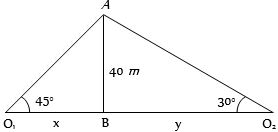
0 likes
View SolutionTrigonometrical Equations — Height and Distance · Frequently Asked Questions
1Are these Trigonometrical Equations questions useful for JEE and NEET?
Yes. All questions in this section are mapped to JEE Main and NEET exam patterns. Previous year questions from JEE Main, NEET, GUJCET and state-level exams are included with full solutions.
2Can I switch to Hindi or Gujarati for these questions?
Yes. Use the language tabs in the hero section or the sidebar to view the same questions and solutions in English, Hindi or Gujarati.
3How do I generate a question paper from this subtopic?
Use the Vedclass Exam Paper Generator — select the chapter and subtopic, set difficulty, and generate Sets A, B, C, D automatically. First 3 chapters of every subject are free.
Vedclass Products
For Students
Vedclass Test Series
Mock tests in real JEE/NEET style with performance analysis. 5-day free trial.
Start Free TrialFor Teachers
Exam Paper Generator
Generate Set A/B/C/D papers from this chapter in 2 minutes. 3 chapters free.
Try FreeFor Institutes
Online Exam Module
Live online exams with unlimited students, 360° analytics & white-label branding.
See DemoFor Teachers & Institutes
Generate a Trigonometrical Equations Exam Paper in 2 Minutes
Select subtopic & difficulty — Sets A, B, C, D auto-generated with No Repeat logic.
First 3 chapters of every subject are free — no payment required.