
A English
Set Based probability Questions in English
Class 11 Mathematics · Probability · Set Based probability
510+
Questions
English
Language
100%
With Solutions
Showing 35 of 510 questions in English
451
EasyMCQ
When two dice are thrown,the probability of getting a prime number on one die and a composite number on the other is
A
$\frac{1}{3}$
B
$\frac{1}{4}$
C
$\frac{1}{2}$
D
$\frac{1}{6}$
Solution
(A) When two dice are thrown,the total number of possible outcomes is $6 \times 6 = 36$.
On a single die,the prime numbers are $\{2, 3, 5\}$ and the composite numbers are $\{4, 6\}$. Note that $1$ is neither prime nor composite.
We need the probability of getting a prime number on one die and a composite number on the other.
The possible outcomes are:
$(2, 4), (2, 6), (3, 4), (3, 6), (5, 4), (5, 6)$ (prime on first,composite on second)
$(4, 2), (6, 2), (4, 3), (6, 3), (4, 5), (6, 5)$ (composite on first,prime on second)
Total favorable outcomes = $6 + 6 = 12$.
Probability = $\frac{\text{Favorable outcomes}}{\text{Total outcomes}} = \frac{12}{36} = \frac{1}{3}$.
On a single die,the prime numbers are $\{2, 3, 5\}$ and the composite numbers are $\{4, 6\}$. Note that $1$ is neither prime nor composite.
We need the probability of getting a prime number on one die and a composite number on the other.
The possible outcomes are:
$(2, 4), (2, 6), (3, 4), (3, 6), (5, 4), (5, 6)$ (prime on first,composite on second)
$(4, 2), (6, 2), (4, 3), (6, 3), (4, 5), (6, 5)$ (composite on first,prime on second)
Total favorable outcomes = $6 + 6 = 12$.
Probability = $\frac{\text{Favorable outcomes}}{\text{Total outcomes}} = \frac{12}{36} = \frac{1}{3}$.
0 likes
View Solution452
EasyMCQ
$A$ problem in Algebra is given to two students $A$ and $B$ whose chances of solving it are $\frac{2}{5}$ and $\frac{3}{4}$ respectively. The probability that the problem is solved,if both of them try independently,is
A
$\frac{17}{20}$
B
$\frac{1}{2}$
C
$\frac{3}{20}$
D
$\frac{13}{20}$
Solution
(A) Let $P(A)$ be the probability that student $A$ solves the problem and $P(B)$ be the probability that student $B$ solves the problem.
Given $P(A) = \frac{2}{5}$ and $P(B) = \frac{3}{4}$.
The problem is solved if at least one of them solves it.
$P(\text{problem is solved}) = 1 - P(\text{problem is not solved})$.
Since $A$ and $B$ try independently,the probability that neither solves it is $P(\bar{A}) \times P(\bar{B})$.
$P(\bar{A}) = 1 - P(A) = 1 - \frac{2}{5} = \frac{3}{5}$.
$P(\bar{B}) = 1 - P(B) = 1 - \frac{3}{4} = \frac{1}{4}$.
$P(\text{problem is solved}) = 1 - (\frac{3}{5} \times \frac{1}{4}) = 1 - \frac{3}{20} = \frac{17}{20}$.
Given $P(A) = \frac{2}{5}$ and $P(B) = \frac{3}{4}$.
The problem is solved if at least one of them solves it.
$P(\text{problem is solved}) = 1 - P(\text{problem is not solved})$.
Since $A$ and $B$ try independently,the probability that neither solves it is $P(\bar{A}) \times P(\bar{B})$.
$P(\bar{A}) = 1 - P(A) = 1 - \frac{2}{5} = \frac{3}{5}$.
$P(\bar{B}) = 1 - P(B) = 1 - \frac{3}{4} = \frac{1}{4}$.
$P(\text{problem is solved}) = 1 - (\frac{3}{5} \times \frac{1}{4}) = 1 - \frac{3}{20} = \frac{17}{20}$.
0 likes
View Solution453
EasyMCQ
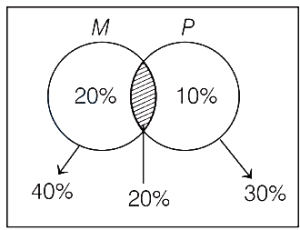
In a college,$40 \%$ of students attend the Mathematics class,$30 \%$ of students attend the Physics class,and $20 \%$ of students attend both classes. If a student is chosen at random from the college,what is the probability that the chosen student attends only one class?
A
$\frac{3}{10}$
B
$\frac{1}{3}$
C
$\frac{2}{3}$
D
$\frac{1}{4}$
Solution
(A) Let $M$ be the set of students attending the Mathematics class and $P$ be the set of students attending the Physics class. Given: $P(M) = 40 \%$,$P(P) = 30 \%$,and $P(M \cap P) = 20 \%$.
The probability of students attending only the Mathematics class is $P(M) - P(M \cap P) = 40 \% - 20 \% = 20 \%$.
The probability of students attending only the Physics class is $P(P) - P(M \cap P) = 30 \% - 20 \% = 10 \%$.
The probability that the student attends only one class is the sum of the probabilities of attending only Mathematics and only Physics: $20 \% + 10 \% = 30 \%$.
Converting to a fraction,$30 \% = \frac{30}{100} = \frac{3}{10}$.
The probability of students attending only the Mathematics class is $P(M) - P(M \cap P) = 40 \% - 20 \% = 20 \%$.
The probability of students attending only the Physics class is $P(P) - P(M \cap P) = 30 \% - 20 \% = 10 \%$.
The probability that the student attends only one class is the sum of the probabilities of attending only Mathematics and only Physics: $20 \% + 10 \% = 30 \%$.
Converting to a fraction,$30 \% = \frac{30}{100} = \frac{3}{10}$.
0 likes
View Solution454
EasyMCQ
If the roots of each of the equations $2x^2+x-1=0$,$3x^2-10x+3=0$,and $6x^2+11x-2=0$ correspond to probabilities of three events of a random experiment,then those events are
A
equally likely
B
exhaustive
C
mutually exclusive
D
mutually independent
Solution
(B) For the equation $2x^2+x-1=0$,we have $2x^2+2x-x-1=0 \Rightarrow 2x(x+1)-1(x+1)=0$,so $x = \frac{1}{2}, -1$. Since probability $P \in [0, 1]$,we take $P_1 = \frac{1}{2}$.
For the equation $3x^2-10x+3=0$,we have $3x^2-9x-x+3=0 \Rightarrow 3x(x-3)-1(x-3)=0$,so $x = \frac{1}{3}, 3$. Since probability $P \in [0, 1]$,we take $P_2 = \frac{1}{3}$.
For the equation $6x^2+11x-2=0$,we have $6x^2+12x-x-2=0 \Rightarrow 6x(x+2)-1(x+2)=0$,so $x = \frac{1}{6}, -2$. Since probability $P \in [0, 1]$,we take $P_3 = \frac{1}{6}$.
Sum of probabilities $P_1 + P_2 + P_3 = \frac{1}{2} + \frac{1}{3} + \frac{1}{6} = \frac{3+2+1}{6} = 1$.
Since the sum of the probabilities of the events is $1$,the events are exhaustive.
For the equation $3x^2-10x+3=0$,we have $3x^2-9x-x+3=0 \Rightarrow 3x(x-3)-1(x-3)=0$,so $x = \frac{1}{3}, 3$. Since probability $P \in [0, 1]$,we take $P_2 = \frac{1}{3}$.
For the equation $6x^2+11x-2=0$,we have $6x^2+12x-x-2=0 \Rightarrow 6x(x+2)-1(x+2)=0$,so $x = \frac{1}{6}, -2$. Since probability $P \in [0, 1]$,we take $P_3 = \frac{1}{6}$.
Sum of probabilities $P_1 + P_2 + P_3 = \frac{1}{2} + \frac{1}{3} + \frac{1}{6} = \frac{3+2+1}{6} = 1$.
Since the sum of the probabilities of the events is $1$,the events are exhaustive.
0 likes
View Solution455
EasyMCQ
$4$-digit numbers are formed using the digits $4, 5, 6, 7, 8, 9$ allowing repetition of the given digits. If a number is chosen at random from those numbers thus formed,then the probability that it is exactly divisible by $3$ is
A
$\frac{7}{36}$
B
$\frac{5}{18}$
C
$\frac{5}{6}$
D
$\frac{1}{3}$
Solution
(D) The total number of $4$-digit numbers that can be formed using the digits ${4, 5, 6, 7, 8, 9}$ with repetition is $6^4 = 1296$.
Let the number be $N = d_1 d_2 d_3 d_4$. The sum of digits is $S = d_1 + d_2 + d_3 + d_4$.
$A$ number is divisible by $3$ if and only if the sum of its digits is divisible by $3$.
Consider the digits modulo $3$:
$4 \equiv 1 \pmod{3}$,$5 \equiv 2 \pmod{3}$,$6 \equiv 0 \pmod{3}$,$7 \equiv 1 \pmod{3}$,$8 \equiv 2 \pmod{3}$,$9 \equiv 0 \pmod{3}$.
There are two digits for each remainder $0, 1, 2$ modulo $3$.
Let $S_n$ be the sum of the first $n$ digits. For any choice of $d_1, d_2, d_3$,the sum $S_3 = d_1 + d_2 + d_3$ will have some remainder $r \in \{0, 1, 2\}$ modulo $3$.
To make $S_4 = S_3 + d_4$ divisible by $3$,we need $d_4 \equiv -S_3 \pmod{3}$.
Since there are exactly two choices for $d_4$ for each remainder,and there are $6$ total choices for $d_4$,the probability that $d_4$ satisfies the condition is $\frac{2}{6} = \frac{1}{3}$.
Thus,the probability is $\frac{1}{3}$.
Let the number be $N = d_1 d_2 d_3 d_4$. The sum of digits is $S = d_1 + d_2 + d_3 + d_4$.
$A$ number is divisible by $3$ if and only if the sum of its digits is divisible by $3$.
Consider the digits modulo $3$:
$4 \equiv 1 \pmod{3}$,$5 \equiv 2 \pmod{3}$,$6 \equiv 0 \pmod{3}$,$7 \equiv 1 \pmod{3}$,$8 \equiv 2 \pmod{3}$,$9 \equiv 0 \pmod{3}$.
There are two digits for each remainder $0, 1, 2$ modulo $3$.
Let $S_n$ be the sum of the first $n$ digits. For any choice of $d_1, d_2, d_3$,the sum $S_3 = d_1 + d_2 + d_3$ will have some remainder $r \in \{0, 1, 2\}$ modulo $3$.
To make $S_4 = S_3 + d_4$ divisible by $3$,we need $d_4 \equiv -S_3 \pmod{3}$.
Since there are exactly two choices for $d_4$ for each remainder,and there are $6$ total choices for $d_4$,the probability that $d_4$ satisfies the condition is $\frac{2}{6} = \frac{1}{3}$.
Thus,the probability is $\frac{1}{3}$.
0 likes
View Solution456
EasyMCQ
$A$ number $n$ is chosen at random from the natural numbers $2$ to $1001$. The probability that $n$ is a number that leaves remainder $1$ when divided by $7$ is:
A
$\frac{73}{500}$
B
$\frac{71}{1000}$
C
$\frac{143}{1000}$
D
$\frac{71}{500}$
Solution
(D) The total number of natural numbers from $2$ to $1001$ is $1001 - 2 + 1 = 1000$.
We are looking for numbers $n$ such that $n \equiv 1 \pmod{7}$.
The sequence of such numbers starting from $2$ is $8, 15, 22, \dots, 995$.
This is an arithmetic progression where the first term $a = 8$,the common difference $d = 7$,and the last term $l = 995$.
Using the formula $l = a + (m - 1)d$,we have:
$995 = 8 + (m - 1)7$
$987 = (m - 1)7$
$m - 1 = 141$
$m = 142$.
The required probability is $\frac{m}{\text{Total numbers}} = \frac{142}{1000} = \frac{71}{500}$.
We are looking for numbers $n$ such that $n \equiv 1 \pmod{7}$.
The sequence of such numbers starting from $2$ is $8, 15, 22, \dots, 995$.
This is an arithmetic progression where the first term $a = 8$,the common difference $d = 7$,and the last term $l = 995$.
Using the formula $l = a + (m - 1)d$,we have:
$995 = 8 + (m - 1)7$
$987 = (m - 1)7$
$m - 1 = 141$
$m = 142$.
The required probability is $\frac{m}{\text{Total numbers}} = \frac{142}{1000} = \frac{71}{500}$.
0 likes
View Solution457
EasyMCQ
If $A$ and $B$ are events having probabilities $P(A)=0.6$,$P(B)=0.4$,and $P(A \cap B)=0$,then the probability that neither $A$ nor $B$ occurs is
A
$0.2$
B
$1$
C
$0.5$
D
$0$
Solution
(D) Given,$P(A)=0.6$,$P(B)=0.4$,and $P(A \cap B)=0$.
We need to find the probability that neither $A$ nor $B$ occurs,which is $P(\bar{A} \cap \bar{B})$.
By De Morgan's Law,$P(\bar{A} \cap \bar{B}) = P(\overline{A \cup B})$.
We know that $P(\overline{A \cup B}) = 1 - P(A \cup B)$.
Using the addition rule of probability,$P(A \cup B) = P(A) + P(B) - P(A \cap B)$.
Substituting the given values: $P(A \cup B) = 0.6 + 0.4 - 0 = 1.0$.
Therefore,$P(\overline{A \cup B}) = 1 - 1.0 = 0$.
We need to find the probability that neither $A$ nor $B$ occurs,which is $P(\bar{A} \cap \bar{B})$.
By De Morgan's Law,$P(\bar{A} \cap \bar{B}) = P(\overline{A \cup B})$.
We know that $P(\overline{A \cup B}) = 1 - P(A \cup B)$.
Using the addition rule of probability,$P(A \cup B) = P(A) + P(B) - P(A \cap B)$.
Substituting the given values: $P(A \cup B) = 0.6 + 0.4 - 0 = 1.0$.
Therefore,$P(\overline{A \cup B}) = 1 - 1.0 = 0$.
0 likes
View Solution458
EasyMCQ
When a pair of six-faced fair dice are thrown,the probability that the sum of the numbers on the two dice is greater than $7$ is:
A
$\frac{1}{3}$
B
$\frac{5}{12}$
C
$\frac{1}{2}$
D
$\frac{1}{4}$
Solution
(B) The total number of outcomes when two dice are thrown is $6 \times 6 = 36$.
The favorable outcomes where the sum is greater than $7$ are:
Sum $= 8$: $(2,6), (3,5), (4,4), (5,3), (6,2)$ ($5$ outcomes)
Sum $= 9$: $(3,6), (4,5), (5,4), (6,3)$ ($4$ outcomes)
Sum $= 10$: $(4,6), (5,5), (6,4)$ ($3$ outcomes)
Sum $= 11$: $(5,6), (6,5)$ ($2$ outcomes)
Sum $= 12$: $(6,6)$ ($1$ outcome)
Total favorable outcomes $= 5 + 4 + 3 + 2 + 1 = 15$.
The required probability is $\frac{15}{36} = \frac{5}{12}$.
The favorable outcomes where the sum is greater than $7$ are:
Sum $= 8$: $(2,6), (3,5), (4,4), (5,3), (6,2)$ ($5$ outcomes)
Sum $= 9$: $(3,6), (4,5), (5,4), (6,3)$ ($4$ outcomes)
Sum $= 10$: $(4,6), (5,5), (6,4)$ ($3$ outcomes)
Sum $= 11$: $(5,6), (6,5)$ ($2$ outcomes)
Sum $= 12$: $(6,6)$ ($1$ outcome)
Total favorable outcomes $= 5 + 4 + 3 + 2 + 1 = 15$.
The required probability is $\frac{15}{36} = \frac{5}{12}$.
0 likes
View Solution459
DifficultMCQ
$A$ six-faced unbiased die is thrown twice and the sum of the numbers appearing on the upper face is observed to be $7$. The probability that the number $3$ has appeared at least once is:
A
$1/6$
B
$1/3$
C
$2/3$
D
$5/6$
Solution
(B) Let $S$ be the sample space of outcomes where the sum of the two dice is $7$. The possible outcomes are:
$S = \{(1, 6), (6, 1), (2, 5), (5, 2), (3, 4), (4, 3)\}$
Total number of outcomes $n(S) = 6$.
Let $E$ be the event that the number $3$ appears at least once.
The favorable outcomes are:
$E = \{(3, 4), (4, 3)\}$
Number of favorable outcomes $n(E) = 2$.
The required probability is $P(E) = \frac{n(E)}{n(S)} = \frac{2}{6} = \frac{1}{3}$.
$S = \{(1, 6), (6, 1), (2, 5), (5, 2), (3, 4), (4, 3)\}$
Total number of outcomes $n(S) = 6$.
Let $E$ be the event that the number $3$ appears at least once.
The favorable outcomes are:
$E = \{(3, 4), (4, 3)\}$
Number of favorable outcomes $n(E) = 2$.
The required probability is $P(E) = \frac{n(E)}{n(S)} = \frac{2}{6} = \frac{1}{3}$.
0 likes
View Solution460
MediumMCQ
Two fair dice are rolled. The probability of the sum of digits on their faces being greater than or equal to $10$ is
A
$\frac{1}{5}$
B
$\frac{1}{4}$
C
$\frac{1}{8}$
D
$\frac{1}{6}$
Solution
(D) Total sample points,$n(S) = 6 \times 6 = 36$.
Favourable outcomes for the sum to be $\ge 10$ are:
$E = \{(4, 6), (5, 5), (5, 6), (6, 4), (6, 5), (6, 6)\}$.
Total number of favourable outcomes,$n(E) = 6$.
Required probability $P(E) = \frac{n(E)}{n(S)} = \frac{6}{36} = \frac{1}{6}$.
Favourable outcomes for the sum to be $\ge 10$ are:
$E = \{(4, 6), (5, 5), (5, 6), (6, 4), (6, 5), (6, 6)\}$.
Total number of favourable outcomes,$n(E) = 6$.
Required probability $P(E) = \frac{n(E)}{n(S)} = \frac{6}{36} = \frac{1}{6}$.
0 likes
View Solution461
DifficultMCQ
Let $A$ and $B$ be events in a sample space $S$ such that $P(A)=0.5$,$P(B)=0.4$ and $P(A \cup B)=0.6$. Observe the following lists. Match List-$I$ with List-$II$ and select the correct option.
| List-$I$ | List-$II$ |
| $(i) \ P(A \cap B)$ | $(1) \ 0.4$ |
| $(ii) \ P(A \cap \bar{B})$ | $(2) \ 0.2$ |
| $(iii) \ P(\bar{A} \cap B)$ | $(3) \ 0.3$ |
| $(iv) \ P(\bar{A} \cap \bar{B})$ | $(4) \ 0.1$ |
A
$(i)-3, (ii)-2, (iii)-4, (iv)-1$
B
$(i)-3, (ii)-2, (iii)-1, (iv)-4$
C
$(i)-1, (ii)-2, (iii)-3, (iv)-4$
D
$(i)-3, (ii)-4, (iii)-2, (iv)-1$
Solution
(A) Given,$P(A)=0.5, P(B)=0.4$ and $P(A \cup B)=0.6$.
$(i) \ P(A \cap B) = P(A) + P(B) - P(A \cup B) = 0.5 + 0.4 - 0.6 = 0.3$. Thus,$(i) \rightarrow (3)$.
$(ii) \ P(A \cap \bar{B}) = P(A) - P(A \cap B) = 0.5 - 0.3 = 0.2$. Thus,$(ii) \rightarrow (2)$.
$(iii) \ P(\bar{A} \cap B) = P(B) - P(A \cap B) = 0.4 - 0.3 = 0.1$. Thus,$(iii) \rightarrow (4)$.
$(iv) \ P(\bar{A} \cap \bar{B}) = P((A \cup B)^c) = 1 - P(A \cup B) = 1 - 0.6 = 0.4$. Thus,$(iv) \rightarrow (1)$.
Therefore,the correct match is $(i)-3, (ii)-2, (iii)-4, (iv)-1$.
$(i) \ P(A \cap B) = P(A) + P(B) - P(A \cup B) = 0.5 + 0.4 - 0.6 = 0.3$. Thus,$(i) \rightarrow (3)$.
$(ii) \ P(A \cap \bar{B}) = P(A) - P(A \cap B) = 0.5 - 0.3 = 0.2$. Thus,$(ii) \rightarrow (2)$.
$(iii) \ P(\bar{A} \cap B) = P(B) - P(A \cap B) = 0.4 - 0.3 = 0.1$. Thus,$(iii) \rightarrow (4)$.
$(iv) \ P(\bar{A} \cap \bar{B}) = P((A \cup B)^c) = 1 - P(A \cup B) = 1 - 0.6 = 0.4$. Thus,$(iv) \rightarrow (1)$.
Therefore,the correct match is $(i)-3, (ii)-2, (iii)-4, (iv)-1$.
0 likes
View Solution462
DifficultMCQ
If $A$ and $B$ are events of a random experiment such that $P(A \cup B) = \frac{4}{5}$,$P(\bar{A} \cup \bar{B}) = \frac{7}{10}$,and $P(B) = \frac{2}{5}$,then $P(A)$ equals
A
$\frac{9}{10}$
B
$\frac{8}{10}$
C
$\frac{7}{10}$
D
$\frac{3}{5}$
Solution
(C) Given,$P(\bar{A} \cup \bar{B}) = P(\overline{A \cap B}) = \frac{7}{10}$.
Since $P(A \cap B) + P(\overline{A \cap B}) = 1$,we have:
$P(A \cap B) = 1 - \frac{7}{10} = \frac{3}{10}$.
Also,the formula for the union of two events is:
$P(A \cup B) = P(A) + P(B) - P(A \cap B)$.
Substituting the given values:
$\frac{4}{5} = P(A) + \frac{2}{5} - \frac{3}{10}$.
$P(A) = \frac{4}{5} - \frac{2}{5} + \frac{3}{10}$.
$P(A) = \frac{2}{5} + \frac{3}{10} = \frac{4+3}{10} = \frac{7}{10}$.
Since $P(A \cap B) + P(\overline{A \cap B}) = 1$,we have:
$P(A \cap B) = 1 - \frac{7}{10} = \frac{3}{10}$.
Also,the formula for the union of two events is:
$P(A \cup B) = P(A) + P(B) - P(A \cap B)$.
Substituting the given values:
$\frac{4}{5} = P(A) + \frac{2}{5} - \frac{3}{10}$.
$P(A) = \frac{4}{5} - \frac{2}{5} + \frac{3}{10}$.
$P(A) = \frac{2}{5} + \frac{3}{10} = \frac{4+3}{10} = \frac{7}{10}$.
0 likes
View Solution463
MediumMCQ
Six faces of an unbiased die are numbered with $2, 3, 5, 7, 11$ and $13$. If two such dice are thrown,then the probability that the sum on the uppermost faces of the dice is an odd number is
A
$\frac{5}{18}$
B
$\frac{5}{36}$
C
$\frac{13}{18}$
D
$\frac{25}{36}$
Solution
(A) The faces of the die are $\{2, 3, 5, 7, 11, 13\}$.
There is $1$ even number $(2)$ and $5$ odd numbers $(3, 5, 7, 11, 13)$.
The sum of two numbers is odd if one number is even and the other is odd.
Let $E$ be the event of getting an even number and $O$ be the event of getting an odd number.
$P(E) = \frac{1}{6}$ and $P(O) = \frac{5}{6}$.
The sum is odd in two cases: (First die is even,Second die is odd) or (First die is odd,Second die is even).
Required Probability $= P(E) \times P(O) + P(O) \times P(E)$
$= \left(\frac{1}{6} \times \frac{5}{6}\right) + \left(\frac{5}{6} \times \frac{1}{6}\right)$
$= \frac{5}{36} + \frac{5}{36} = \frac{10}{36} = \frac{5}{18}$.
There is $1$ even number $(2)$ and $5$ odd numbers $(3, 5, 7, 11, 13)$.
The sum of two numbers is odd if one number is even and the other is odd.
Let $E$ be the event of getting an even number and $O$ be the event of getting an odd number.
$P(E) = \frac{1}{6}$ and $P(O) = \frac{5}{6}$.
The sum is odd in two cases: (First die is even,Second die is odd) or (First die is odd,Second die is even).
Required Probability $= P(E) \times P(O) + P(O) \times P(E)$
$= \left(\frac{1}{6} \times \frac{5}{6}\right) + \left(\frac{5}{6} \times \frac{1}{6}\right)$
$= \frac{5}{36} + \frac{5}{36} = \frac{10}{36} = \frac{5}{18}$.
0 likes
View Solution464
MediumMCQ
$A$ bag contains $5$ black balls,$4$ white balls and $3$ red balls. If a ball is selected at random,the probability that it is a black or a red ball,is
A
$\frac{1}{3}$
B
$\frac{1}{4}$
C
$\frac{5}{12}$
D
$\frac{2}{3}$
Solution
(D) Total number of balls = $5 + 4 + 3 = 12$.
Number of black balls = $5$.
Number of red balls = $3$.
Number of favorable outcomes (black or red) = $5 + 3 = 8$.
Required probability = $\frac{\text{Number of favorable outcomes}}{\text{Total number of outcomes}} = \frac{8}{12} = \frac{2}{3}$.
Number of black balls = $5$.
Number of red balls = $3$.
Number of favorable outcomes (black or red) = $5 + 3 = 8$.
Required probability = $\frac{\text{Number of favorable outcomes}}{\text{Total number of outcomes}} = \frac{8}{12} = \frac{2}{3}$.
0 likes
View Solution465
MediumMCQ
Let $A$ and $B$ be two events in a random experiment. If $P(A \cap \overline{B}) = 0.1$,$P(\overline{A} \cap B) = 0.2$ and $P(B) = 0.5$,then $P(\overline{A} \cap \overline{B}) = $
A
$0.6$
B
$0.5$
C
$0.4$
D
$0.3$
Solution
(C) We are given $P(A \cap \overline{B}) = 0.1$,$P(\overline{A} \cap B) = 0.2$,and $P(B) = 0.5$.
Since $B = (A \cap B) \cup (\overline{A} \cap B)$,and these are disjoint events,we have $P(B) = P(A \cap B) + P(\overline{A} \cap B)$.
Substituting the values,$0.5 = P(A \cap B) + 0.2$,which gives $P(A \cap B) = 0.3$.
Now,$P(A) = P(A \cap B) + P(A \cap \overline{B}) = 0.3 + 0.1 = 0.4$.
We want to find $P(\overline{A} \cap \overline{B})$. By De Morgan's Law,$P(\overline{A} \cap \overline{B}) = P(\overline{A \cup B}) = 1 - P(A \cup B)$.
Using the formula $P(A \cup B) = P(A) + P(B) - P(A \cap B)$,we get $P(A \cup B) = 0.4 + 0.5 - 0.3 = 0.6$.
Therefore,$P(\overline{A} \cap \overline{B}) = 1 - 0.6 = 0.4$.
Since $B = (A \cap B) \cup (\overline{A} \cap B)$,and these are disjoint events,we have $P(B) = P(A \cap B) + P(\overline{A} \cap B)$.
Substituting the values,$0.5 = P(A \cap B) + 0.2$,which gives $P(A \cap B) = 0.3$.
Now,$P(A) = P(A \cap B) + P(A \cap \overline{B}) = 0.3 + 0.1 = 0.4$.
We want to find $P(\overline{A} \cap \overline{B})$. By De Morgan's Law,$P(\overline{A} \cap \overline{B}) = P(\overline{A \cup B}) = 1 - P(A \cup B)$.
Using the formula $P(A \cup B) = P(A) + P(B) - P(A \cap B)$,we get $P(A \cup B) = 0.4 + 0.5 - 0.3 = 0.6$.
Therefore,$P(\overline{A} \cap \overline{B}) = 1 - 0.6 = 0.4$.
0 likes
View Solution466
MediumMCQ
In a non-leap year,the probability of getting $53$ Sundays or $53$ Tuesdays or $53$ Thursdays is:
A
$\frac{1}{7}$
B
$\frac{2}{7}$
C
$\frac{3}{7}$
D
$\frac{4}{7}$
Solution
(C) non-leap year has $365$ days,which is equal to $52$ complete weeks and $1$ extra day.
This extra day can be any of the $7$ days of the week (Sunday,Monday,Tuesday,Wednesday,Thursday,Friday,Saturday).
Let $E_1$ be the event of getting $53$ Sundays,$E_2$ be the event of getting $53$ Tuesdays,and $E_3$ be the event of getting $53$ Thursdays.
Since these events are mutually exclusive,the probability of getting $53$ Sundays $OR$ $53$ Tuesdays $OR$ $53$ Thursdays is $P(E_1 \cup E_2 \cup E_3) = P(E_1) + P(E_2) + P(E_3)$.
$P(E_1) = \frac{1}{7}$,$P(E_2) = \frac{1}{7}$,and $P(E_3) = \frac{1}{7}$.
Therefore,the required probability is $\frac{1}{7} + \frac{1}{7} + \frac{1}{7} = \frac{3}{7}$.
This extra day can be any of the $7$ days of the week (Sunday,Monday,Tuesday,Wednesday,Thursday,Friday,Saturday).
Let $E_1$ be the event of getting $53$ Sundays,$E_2$ be the event of getting $53$ Tuesdays,and $E_3$ be the event of getting $53$ Thursdays.
Since these events are mutually exclusive,the probability of getting $53$ Sundays $OR$ $53$ Tuesdays $OR$ $53$ Thursdays is $P(E_1 \cup E_2 \cup E_3) = P(E_1) + P(E_2) + P(E_3)$.
$P(E_1) = \frac{1}{7}$,$P(E_2) = \frac{1}{7}$,and $P(E_3) = \frac{1}{7}$.
Therefore,the required probability is $\frac{1}{7} + \frac{1}{7} + \frac{1}{7} = \frac{3}{7}$.
0 likes
View Solution467
EasyMCQ
If $A$ and $B$ are two events of a random experiment such that $P(A \cup B) = P(A \cap B)$,then which one amongst the following four options is not true?
A
$A$ and $B$ are equally likely
B
$P(A \cap B') = 0$
C
$P(A' \cap B) = 0$
D
$P(A) + P(B) = 1$
Solution
(D) We are given that $P(A \cup B) = P(A \cap B)$.
Since $P(A \cup B) = P(A) + P(B) - P(A \cap B)$,we substitute the given condition:
$P(A \cap B) = P(A) + P(B) - P(A \cap B)$
$2P(A \cap B) = P(A) + P(B)$.
Also,since $A \cap B \subseteq A \subseteq A \cup B$ and $A \cap B \subseteq B \subseteq A \cup B$,the condition $P(A \cup B) = P(A \cap B)$ implies $P(A) = P(B) = P(A \cap B)$.
This means $P(A \cap B') = P(A) - P(A \cap B) = 0$ and $P(A' \cap B) = P(B) - P(A \cap B) = 0$.
Thus,options $A$,$B$,and $C$ are true.
However,$P(A) + P(B) = 2P(A \cap B)$,which is not necessarily equal to $1$. Therefore,option $D$ is not true.
Since $P(A \cup B) = P(A) + P(B) - P(A \cap B)$,we substitute the given condition:
$P(A \cap B) = P(A) + P(B) - P(A \cap B)$
$2P(A \cap B) = P(A) + P(B)$.
Also,since $A \cap B \subseteq A \subseteq A \cup B$ and $A \cap B \subseteq B \subseteq A \cup B$,the condition $P(A \cup B) = P(A \cap B)$ implies $P(A) = P(B) = P(A \cap B)$.
This means $P(A \cap B') = P(A) - P(A \cap B) = 0$ and $P(A' \cap B) = P(B) - P(A \cap B) = 0$.
Thus,options $A$,$B$,and $C$ are true.
However,$P(A) + P(B) = 2P(A \cap B)$,which is not necessarily equal to $1$. Therefore,option $D$ is not true.
0 likes
View Solution468
EasyMCQ
$A$ non-zero integer $x$ is selected randomly from the set of integers $\{x \in Z \mid -25 \leq x \leq 25, x \neq 0\}$. The probability that $x + 6 \leq \frac{135}{x}$ is
A
$\frac{12}{25}$
B
$\frac{2}{5}$
C
$\frac{3}{5}$
D
$\frac{14}{25}$
Solution
(B) The set of integers is $S = \{x \in Z \mid -25 \leq x \leq 25, x \neq 0\}$. The total number of elements is $50$.
We need to solve the inequality $x + 6 \leq \frac{135}{x}$.
Rearranging the inequality,we get $\frac{x^2 + 6x - 135}{x} \leq 0$.
Factoring the numerator,we have $\frac{(x + 15)(x - 9)}{x} \leq 0$.
Using the sign scheme method,the solution set for the inequality is $x \in (-\infty, -15] \cup (0, 9]$.
Intersecting this with the given set $S$,we get $x \in [-25, -15] \cup \{1, 2, 3, 4, 5, 6, 7, 8, 9\}$.
The number of integers in $[-25, -15]$ is $11$,and the number of integers in ${1, 2, 3, 4, 5, 6, 7, 8, 9}$ is $9$.
Total favorable outcomes $= 11 + 9 = 20$.
Probability $= \frac{\text{Favorable outcomes}}{\text{Total outcomes}} = \frac{20}{50} = \frac{2}{5}$.
We need to solve the inequality $x + 6 \leq \frac{135}{x}$.
Rearranging the inequality,we get $\frac{x^2 + 6x - 135}{x} \leq 0$.
Factoring the numerator,we have $\frac{(x + 15)(x - 9)}{x} \leq 0$.
Using the sign scheme method,the solution set for the inequality is $x \in (-\infty, -15] \cup (0, 9]$.
Intersecting this with the given set $S$,we get $x \in [-25, -15] \cup \{1, 2, 3, 4, 5, 6, 7, 8, 9\}$.
The number of integers in $[-25, -15]$ is $11$,and the number of integers in ${1, 2, 3, 4, 5, 6, 7, 8, 9}$ is $9$.
Total favorable outcomes $= 11 + 9 = 20$.
Probability $= \frac{\text{Favorable outcomes}}{\text{Total outcomes}} = \frac{20}{50} = \frac{2}{5}$.
0 likes
View Solution469
EasyMCQ
If $P(A \cup B)=0.8$ and $P(A \cap B)=0.3$,then $P(A^C)+P(B^C)$ is equal to
A
$0.3$
B
$0.5$
C
$0.7$
D
$0.9$
Solution
(D) Given,$P(A \cup B)=0.8$ and $P(A \cap B)=0.3$.
We know that $P(A \cup B) = P(A) + P(B) - P(A \cap B)$.
Therefore,$P(A) + P(B) = P(A \cup B) + P(A \cap B) = 0.8 + 0.3 = 1.1$.
We need to find $P(A^C) + P(B^C)$.
Using the property $P(E^C) = 1 - P(E)$,we have:
$P(A^C) + P(B^C) = (1 - P(A)) + (1 - P(B)) = 2 - (P(A) + P(B))$.
Substituting the value of $P(A) + P(B)$:
$P(A^C) + P(B^C) = 2 - 1.1 = 0.9$.
We know that $P(A \cup B) = P(A) + P(B) - P(A \cap B)$.
Therefore,$P(A) + P(B) = P(A \cup B) + P(A \cap B) = 0.8 + 0.3 = 1.1$.
We need to find $P(A^C) + P(B^C)$.
Using the property $P(E^C) = 1 - P(E)$,we have:
$P(A^C) + P(B^C) = (1 - P(A)) + (1 - P(B)) = 2 - (P(A) + P(B))$.
Substituting the value of $P(A) + P(B)$:
$P(A^C) + P(B^C) = 2 - 1.1 = 0.9$.
0 likes
View Solution470
DifficultMCQ
If $A, B$ and $C$ are mutually exclusive and exhaustive events of a random experiment such that $P(B) = \frac{3}{2} P(A)$ and $P(C) = \frac{1}{2} P(B)$,then $P(A \cup C)$ equals to
A
$\frac{10}{13}$
B
$\frac{3}{13}$
C
$\frac{6}{13}$
D
$\frac{7}{13}$
Solution
(D) Given,$P(B) = \frac{3}{2} P(A)$ and $P(C) = \frac{1}{2} P(B)$.
Since $A, B$ and $C$ are mutually exclusive and exhaustive events,their sum of probabilities is $1$:
$P(A) + P(B) + P(C) = 1$
Substituting the given relations in terms of $P(A)$:
$P(A) + \frac{3}{2} P(A) + \frac{1}{2} \left( \frac{3}{2} P(A) \right) = 1$
$P(A) \left( 1 + \frac{3}{2} + \frac{3}{4} \right) = 1$
$P(A) \left( \frac{4 + 6 + 3}{4} \right) = 1$
$\frac{13}{4} P(A) = 1 \implies P(A) = \frac{4}{13}$
Now,calculate $P(C)$:
$P(C) = \frac{3}{4} P(A) = \frac{3}{4} \times \frac{4}{13} = \frac{3}{13}$
Since $A$ and $C$ are mutually exclusive,$P(A \cup C) = P(A) + P(C)$:
$P(A \cup C) = \frac{4}{13} + \frac{3}{13} = \frac{7}{13}$
Since $A, B$ and $C$ are mutually exclusive and exhaustive events,their sum of probabilities is $1$:
$P(A) + P(B) + P(C) = 1$
Substituting the given relations in terms of $P(A)$:
$P(A) + \frac{3}{2} P(A) + \frac{1}{2} \left( \frac{3}{2} P(A) \right) = 1$
$P(A) \left( 1 + \frac{3}{2} + \frac{3}{4} \right) = 1$
$P(A) \left( \frac{4 + 6 + 3}{4} \right) = 1$
$\frac{13}{4} P(A) = 1 \implies P(A) = \frac{4}{13}$
Now,calculate $P(C)$:
$P(C) = \frac{3}{4} P(A) = \frac{3}{4} \times \frac{4}{13} = \frac{3}{13}$
Since $A$ and $C$ are mutually exclusive,$P(A \cup C) = P(A) + P(C)$:
$P(A \cup C) = \frac{4}{13} + \frac{3}{13} = \frac{7}{13}$
0 likes
View Solution471
EasyMCQ
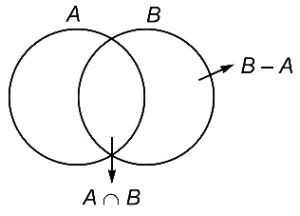
Suppose $A$ and $B$ are two events such that $P(A \cap B) = \frac{3}{25}$ and $P(B - A) = \frac{8}{25}$. Then,$P(B)$ is equal to
A
$\frac{11}{25}$
B
$\frac{3}{11}$
C
$\frac{1}{11}$
D
$\frac{9}{11}$
Solution
(A) Given that $P(A \cap B) = \frac{3}{25}$ and $P(B - A) = \frac{8}{25}$.
From the properties of sets and probability,the event $B$ can be expressed as the union of two disjoint sets: $(B - A)$ and $(A \cap B)$.
Therefore,$P(B) = P(B - A) + P(A \cap B)$.
Substituting the given values:
$P(B) = \frac{8}{25} + \frac{3}{25} = \frac{11}{25}$.
From the properties of sets and probability,the event $B$ can be expressed as the union of two disjoint sets: $(B - A)$ and $(A \cap B)$.
Therefore,$P(B) = P(B - A) + P(A \cap B)$.
Substituting the given values:
$P(B) = \frac{8}{25} + \frac{3}{25} = \frac{11}{25}$.
0 likes
View Solution472
DifficultMCQ
The probability of choosing randomly a number $c$ from the set $\{1, 2, 3, \ldots, 9\}$ such that the quadratic equation $x^2 + 4x + c = 0$ has real roots is
A
$\frac{1}{9}$
B
$\frac{2}{9}$
C
$\frac{3}{9}$
D
$\frac{4}{9}$
Solution
(D) The given quadratic equation is $x^2 + 4x + c = 0$.
For the roots to be real,the discriminant $D$ must be greater than or equal to $0$.
$D = b^2 - 4ac \geq 0$
Substituting the values $a = 1, b = 4$,we get:
$4^2 - 4(1)(c) \geq 0$
$16 - 4c \geq 0$
$16 \geq 4c$
$c \leq 4$.
Since $c$ is chosen from the set $\{1, 2, 3, 4, 5, 6, 7, 8, 9\}$,the possible values for $c$ are $\{1, 2, 3, 4\}$.
There are $4$ favorable outcomes out of $9$ total possible outcomes.
Therefore,the required probability is $\frac{4}{9}$.
For the roots to be real,the discriminant $D$ must be greater than or equal to $0$.
$D = b^2 - 4ac \geq 0$
Substituting the values $a = 1, b = 4$,we get:
$4^2 - 4(1)(c) \geq 0$
$16 - 4c \geq 0$
$16 \geq 4c$
$c \leq 4$.
Since $c$ is chosen from the set $\{1, 2, 3, 4, 5, 6, 7, 8, 9\}$,the possible values for $c$ are $\{1, 2, 3, 4\}$.
There are $4$ favorable outcomes out of $9$ total possible outcomes.
Therefore,the required probability is $\frac{4}{9}$.
0 likes
View Solution473
MediumMCQ
If $P(A \cup B)=0.8$ and $P(A \cap B)=0.3$,then $P(\bar{A})+P(\bar{B})$ is equal to:
A
$0.3$
B
$0.5$
C
$0.8$
D
$0.9$
Solution
(D) We know that for any two events $A$ and $B$,$P(A \cup B) = P(A) + P(B) - P(A \cap B)$.
Therefore,$P(A) + P(B) = P(A \cup B) + P(A \cap B)$.
Substituting the given values,$P(A) + P(B) = 0.8 + 0.3 = 1.1$.
We know that $P(\bar{A}) = 1 - P(A)$ and $P(\bar{B}) = 1 - P(B)$.
Thus,$P(\bar{A}) + P(\bar{B}) = (1 - P(A)) + (1 - P(B)) = 2 - (P(A) + P(B))$.
Substituting $P(A) + P(B) = 1.1$,we get $P(\bar{A}) + P(\bar{B}) = 2 - 1.1 = 0.9$.
Therefore,$P(A) + P(B) = P(A \cup B) + P(A \cap B)$.
Substituting the given values,$P(A) + P(B) = 0.8 + 0.3 = 1.1$.
We know that $P(\bar{A}) = 1 - P(A)$ and $P(\bar{B}) = 1 - P(B)$.
Thus,$P(\bar{A}) + P(\bar{B}) = (1 - P(A)) + (1 - P(B)) = 2 - (P(A) + P(B))$.
Substituting $P(A) + P(B) = 1.1$,we get $P(\bar{A}) + P(\bar{B}) = 2 - 1.1 = 0.9$.
0 likes
View Solution474
MediumMCQ
The events $A$ and $B$ have probabilities $0.25$ and $0.50$,respectively. The probability that both $A$ and $B$ occur simultaneously is $0.14$. Then,the probability that neither $A$ nor $B$ occurs is:
A
$0.39$
B
$0.29$
C
$0.11$
D
$0.25$
Solution
(A) Given that,$P(A) = 0.25$ and $P(B) = 0.50$.
The probability of both events occurring is $P(A \cap B) = 0.14$.
Using the addition rule for probability,the probability that at least one of the events occurs is:
$P(A \cup B) = P(A) + P(B) - P(A \cap B)$
$P(A \cup B) = 0.25 + 0.50 - 0.14 = 0.61$.
The probability that neither $A$ nor $B$ occurs is given by $P(\bar{A} \cap \bar{B})$,which is equal to $P(\overline{A \cup B})$.
$P(\overline{A \cup B}) = 1 - P(A \cup B) = 1 - 0.61 = 0.39$.
The probability of both events occurring is $P(A \cap B) = 0.14$.
Using the addition rule for probability,the probability that at least one of the events occurs is:
$P(A \cup B) = P(A) + P(B) - P(A \cap B)$
$P(A \cup B) = 0.25 + 0.50 - 0.14 = 0.61$.
The probability that neither $A$ nor $B$ occurs is given by $P(\bar{A} \cap \bar{B})$,which is equal to $P(\overline{A \cup B})$.
$P(\overline{A \cup B}) = 1 - P(A \cup B) = 1 - 0.61 = 0.39$.
0 likes
View Solution475
EasyMCQ
$A, B, C$ are aiming to shoot a balloon. $A$ will succeed $4$ times out of $6$ attempts. The chance of $B$ to shoot the balloon is $3$ out of $5$ and that of $C$ is $2$ out of $3$. If the three aim to shoot the balloon simultaneously,then the probability that at least two of them hit the balloon is
A
$\frac{5}{9}$
B
$\frac{9}{25}$
C
$\frac{32}{45}$
D
$\frac{4}{9}$
Solution
(C) Let $P(A), P(B), P(C)$ be the probabilities of $A, B, C$ hitting the balloon respectively.
$P(A) = \frac{4}{6} = \frac{2}{3}$,so $P(\bar{A}) = 1 - \frac{2}{3} = \frac{1}{3}$.
$P(B) = \frac{3}{5}$,so $P(\bar{B}) = 1 - \frac{3}{5} = \frac{2}{5}$.
$P(C) = \frac{2}{3}$,so $P(\bar{C}) = 1 - \frac{2}{3} = \frac{1}{3}$.
At least two hit the balloon means exactly two hit $OR$ all three hit.
Probability (exactly two hit) = $P(A)P(B)P(\bar{C}) + P(A)P(\bar{B})P(C) + P(\bar{A})P(B)P(C)$
$= (\frac{2}{3} \times \frac{3}{5} \times \frac{1}{3}) + (\frac{2}{3} \times \frac{2}{5} \times \frac{2}{3}) + (\frac{1}{3} \times \frac{3}{5} \times \frac{2}{3})$
$= \frac{6}{45} + \frac{8}{45} + \frac{6}{45} = \frac{20}{45} = \frac{4}{9}$.
Probability (all three hit) = $P(A)P(B)P(C) = \frac{2}{3} \times \frac{3}{5} \times \frac{2}{3} = \frac{12}{45} = \frac{4}{15}$.
Total probability = $\frac{20}{45} + \frac{12}{45} = \frac{32}{45}$.
$P(A) = \frac{4}{6} = \frac{2}{3}$,so $P(\bar{A}) = 1 - \frac{2}{3} = \frac{1}{3}$.
$P(B) = \frac{3}{5}$,so $P(\bar{B}) = 1 - \frac{3}{5} = \frac{2}{5}$.
$P(C) = \frac{2}{3}$,so $P(\bar{C}) = 1 - \frac{2}{3} = \frac{1}{3}$.
At least two hit the balloon means exactly two hit $OR$ all three hit.
Probability (exactly two hit) = $P(A)P(B)P(\bar{C}) + P(A)P(\bar{B})P(C) + P(\bar{A})P(B)P(C)$
$= (\frac{2}{3} \times \frac{3}{5} \times \frac{1}{3}) + (\frac{2}{3} \times \frac{2}{5} \times \frac{2}{3}) + (\frac{1}{3} \times \frac{3}{5} \times \frac{2}{3})$
$= \frac{6}{45} + \frac{8}{45} + \frac{6}{45} = \frac{20}{45} = \frac{4}{9}$.
Probability (all three hit) = $P(A)P(B)P(C) = \frac{2}{3} \times \frac{3}{5} \times \frac{2}{3} = \frac{12}{45} = \frac{4}{15}$.
Total probability = $\frac{20}{45} + \frac{12}{45} = \frac{32}{45}$.
0 likes
View Solution476
MediumMCQ
Three groups of children $A$,$B$,and $C$ contain boys and girls as given below. Group $A$ contains $3$ girls and $1$ boy,group $B$ contains $2$ girls and $2$ boys,and group $C$ contains $3$ boys and $1$ girl. If $1$ child is selected at random from each group,what is the probability that the three children selected consist of $1$ girl and $2$ boys?
A
$\frac{9}{32}$
B
$\frac{3}{32}$
C
$\frac{13}{32}$
D
$\frac{19}{32}$
Solution
(C) Let $G$ denote a girl and $B$ denote a boy. The probabilities for each group are as follows:
Group $A$: $P(G_A) = \frac{3}{4}$,$P(B_A) = \frac{1}{4}$
Group $B$: $P(G_B) = \frac{2}{4}$,$P(B_B) = \frac{2}{4}$
Group $C$: $P(G_C) = \frac{1}{4}$,$P(B_C) = \frac{3}{4}$
We need to select $1$ girl and $2$ boys. The possible cases are:
Total probability $= \frac{18}{64} + \frac{6}{64} + \frac{2}{64} = \frac{26}{64} = \frac{13}{32}$.
Group $A$: $P(G_A) = \frac{3}{4}$,$P(B_A) = \frac{1}{4}$
Group $B$: $P(G_B) = \frac{2}{4}$,$P(B_B) = \frac{2}{4}$
Group $C$: $P(G_C) = \frac{1}{4}$,$P(B_C) = \frac{3}{4}$
We need to select $1$ girl and $2$ boys. The possible cases are:
| Case | Selection from $A, B, C$ | Probability |
| $1$ | $G, B, B$ | $\frac{3}{4} \times \frac{2}{4} \times \frac{3}{4} = \frac{18}{64}$ |
| $2$ | $B, G, B$ | $\frac{1}{4} \times \frac{2}{4} \times \frac{3}{4} = \frac{6}{64}$ |
| $3$ | $B, B, G$ | $\frac{1}{4} \times \frac{2}{4} \times \frac{1}{4} = \frac{2}{64}$ |
Total probability $= \frac{18}{64} + \frac{6}{64} + \frac{2}{64} = \frac{26}{64} = \frac{13}{32}$.
0 likes
View Solution477
DifficultMCQ
$A$ number $n$ is chosen at random from $\{1, 2, 3, 4, \ldots, 1000\}$. The probability that $n$ is a number that leaves remainder $1$ when divided by $7$ is:
A
$\frac{71}{500}$
B
$\frac{143}{1000}$
C
$\frac{72}{500}$
D
$\frac{71}{1000}$
Solution
(B) The set of numbers is $S = \{1, 2, 3, \ldots, 1000\}$,so the total number of outcomes $n(S) = 1000$.
We are looking for numbers $n$ such that $n \equiv 1 \pmod{7}$.
These numbers are of the form $n = 7k + 1$,where $k$ is an integer.
For $1 \le n \le 1000$,we have $1 \le 7k + 1 \le 1000$.
Subtracting $1$ from all parts: $0 \le 7k \le 999$.
Dividing by $7$: $0 \le k \le \frac{999}{7} \approx 142.71$.
Since $k$ must be an integer,$k$ can take values from $0, 1, 2, \ldots, 142$.
The number of such values is $142 - 0 + 1 = 143$.
Thus,the number of favorable outcomes $n(E) = 143$.
The probability $P(E) = \frac{n(E)}{n(S)} = \frac{143}{1000}$.
We are looking for numbers $n$ such that $n \equiv 1 \pmod{7}$.
These numbers are of the form $n = 7k + 1$,where $k$ is an integer.
For $1 \le n \le 1000$,we have $1 \le 7k + 1 \le 1000$.
Subtracting $1$ from all parts: $0 \le 7k \le 999$.
Dividing by $7$: $0 \le k \le \frac{999}{7} \approx 142.71$.
Since $k$ must be an integer,$k$ can take values from $0, 1, 2, \ldots, 142$.
The number of such values is $142 - 0 + 1 = 143$.
Thus,the number of favorable outcomes $n(E) = 143$.
The probability $P(E) = \frac{n(E)}{n(S)} = \frac{143}{1000}$.
0 likes
View Solution478
MediumMCQ
When two dice are thrown,the probability of getting an ordered pair $(x, y)$ such that $x^2+y^2 \leq 25$,where $x$ and $y$ are the numbers that show up on the two dice,is:
A
$\frac{4}{9}$
B
$\frac{25}{36}$
C
$\frac{7}{12}$
D
$\frac{5}{12}$
Solution
(D) When two dice are thrown,the total number of outcomes is $6 \times 6 = 36$.
We need to find the number of pairs $(x, y)$ such that $x^2 + y^2 \leq 25$,where $x, y \in \{1, 2, 3, 4, 5, 6\}$.
Let us list the favorable outcomes for each value of $x$:
If $x = 1$,then $1^2 + y^2 \leq 25 \implies y^2 \leq 24$. Possible $y$ values are $\{1, 2, 3, 4\}$ ($4$ outcomes).
If $x = 2$,then $2^2 + y^2 \leq 25 \implies y^2 \leq 21$. Possible $y$ values are $\{1, 2, 3, 4\}$ ($4$ outcomes).
If $x = 3$,then $3^2 + y^2 \leq 25 \implies y^2 \leq 16$. Possible $y$ values are $\{1, 2, 3, 4\}$ ($4$ outcomes).
If $x = 4$,then $4^2 + y^2 \leq 25 \implies y^2 \leq 9$. Possible $y$ values are $\{1, 2, 3\}$ ($3$ outcomes).
If $x = 5$,then $5^2 + y^2 \leq 25 \implies y^2 \leq 0$. No possible $y$ values since $y \geq 1$.
If $x = 6$,then $6^2 + y^2 \leq 25$. No possible $y$ values.
Total favorable outcomes $= 4 + 4 + 4 + 3 = 15$.
The probability is $\frac{15}{36} = \frac{5}{12}$.
Thus,option $(d)$ is correct.
We need to find the number of pairs $(x, y)$ such that $x^2 + y^2 \leq 25$,where $x, y \in \{1, 2, 3, 4, 5, 6\}$.
Let us list the favorable outcomes for each value of $x$:
If $x = 1$,then $1^2 + y^2 \leq 25 \implies y^2 \leq 24$. Possible $y$ values are $\{1, 2, 3, 4\}$ ($4$ outcomes).
If $x = 2$,then $2^2 + y^2 \leq 25 \implies y^2 \leq 21$. Possible $y$ values are $\{1, 2, 3, 4\}$ ($4$ outcomes).
If $x = 3$,then $3^2 + y^2 \leq 25 \implies y^2 \leq 16$. Possible $y$ values are $\{1, 2, 3, 4\}$ ($4$ outcomes).
If $x = 4$,then $4^2 + y^2 \leq 25 \implies y^2 \leq 9$. Possible $y$ values are $\{1, 2, 3\}$ ($3$ outcomes).
If $x = 5$,then $5^2 + y^2 \leq 25 \implies y^2 \leq 0$. No possible $y$ values since $y \geq 1$.
If $x = 6$,then $6^2 + y^2 \leq 25$. No possible $y$ values.
Total favorable outcomes $= 4 + 4 + 4 + 3 = 15$.
The probability is $\frac{15}{36} = \frac{5}{12}$.
Thus,option $(d)$ is correct.
0 likes
View Solution479
EasyMCQ
The probabilities of two persons to hit a target are $\frac{1}{4}$ and $\frac{1}{5}$ respectively. The probability that the target is being hit when both of them attempt independently is
A
$\frac{1}{2}$
B
$\frac{3}{5}$
C
$\frac{2}{5}$
D
$\frac{7}{10}$
Solution
(C) Let $P(A)$ be the probability that the first person hits the target and $P(B)$ be the probability that the second person hits the target.
Given $P(A) = \frac{1}{4}$ and $P(B) = \frac{1}{5}$.
The target is hit if at least one of them hits the target.
It is easier to calculate the probability that the target is not hit at all.
The probability that the first person misses is $P(A') = 1 - P(A) = 1 - \frac{1}{4} = \frac{3}{4}$.
The probability that the second person misses is $P(B') = 1 - P(B) = 1 - \frac{1}{5} = \frac{4}{5}$.
Since they attempt independently,the probability that both miss is $P(A' \cap B') = P(A') \times P(B') = \frac{3}{4} \times \frac{4}{5} = \frac{3}{5}$.
The probability that the target is hit is $1 - P(A' \cap B') = 1 - \frac{3}{5} = \frac{2}{5}$.
Thus,the correct option is $C$.
Given $P(A) = \frac{1}{4}$ and $P(B) = \frac{1}{5}$.
The target is hit if at least one of them hits the target.
It is easier to calculate the probability that the target is not hit at all.
The probability that the first person misses is $P(A') = 1 - P(A) = 1 - \frac{1}{4} = \frac{3}{4}$.
The probability that the second person misses is $P(B') = 1 - P(B) = 1 - \frac{1}{5} = \frac{4}{5}$.
Since they attempt independently,the probability that both miss is $P(A' \cap B') = P(A') \times P(B') = \frac{3}{4} \times \frac{4}{5} = \frac{3}{5}$.
The probability that the target is hit is $1 - P(A' \cap B') = 1 - \frac{3}{5} = \frac{2}{5}$.
Thus,the correct option is $C$.
0 likes
View Solution480
EasyMCQ
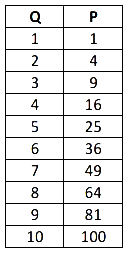
Each of the two boxes $P$ and $Q$ contain $100$ chits numbered from $1$ to $100$. If one chit is drawn at random from each box,then the probability that the number on the chit drawn from $P$ is the square of the number on the chit drawn from $Q$,is (in $\%$)
A
$0.1$
B
$10$
C
$1$
D
$0.01$
Solution
(A) Let $x$ be the number on the chit drawn from box $Q$ and $y$ be the number on the chit drawn from box $P$. Both $x$ and $y$ are integers such that $1 \leq x, y \leq 100$.
We are given the condition that $y = x^2$.
Since $y \leq 100$,we must have $x^2 \leq 100$,which implies $x \leq 10$.
Thus,the possible pairs $(x, y)$ are $(1, 1), (2, 4), (3, 9), (4, 16), (5, 25), (6, 36), (7, 49), (8, 64), (9, 81), (10, 100)$.
There are $10$ such favorable outcomes.
The total number of possible outcomes when drawing one chit from each box is $100 \times 100 = 10000$.
The probability is given by $\frac{\text{Number of favorable outcomes}}{\text{Total number of outcomes}} = \frac{10}{10000} = \frac{1}{1000}$.
Converting this to a percentage: $\frac{1}{1000} \times 100\% = 0.1\%$.
We are given the condition that $y = x^2$.
Since $y \leq 100$,we must have $x^2 \leq 100$,which implies $x \leq 10$.
Thus,the possible pairs $(x, y)$ are $(1, 1), (2, 4), (3, 9), (4, 16), (5, 25), (6, 36), (7, 49), (8, 64), (9, 81), (10, 100)$.
There are $10$ such favorable outcomes.
The total number of possible outcomes when drawing one chit from each box is $100 \times 100 = 10000$.
The probability is given by $\frac{\text{Number of favorable outcomes}}{\text{Total number of outcomes}} = \frac{10}{10000} = \frac{1}{1000}$.
Converting this to a percentage: $\frac{1}{1000} \times 100\% = 0.1\%$.
0 likes
View Solution481
MediumMCQ
The probability of a student qualifying for $IITJEE$ and $EAMCET$ are $\frac{1}{5}$ and $\frac{3}{5}$ respectively. The probability that the student qualifies for at least one of these tests is:
A
$\frac{3}{25}$
B
$\frac{8}{25}$
C
$\frac{17}{25}$
D
$\frac{22}{25}$
Solution
(C) Let $A$ be the event of qualifying for $IITJEE$ and $B$ be the event of qualifying for $EAMCET$.
Given: $P(A) = \frac{1}{5}$ and $P(B) = \frac{3}{5}$.
Assuming the events are independent,the probability of qualifying for at least one test is given by $P(A \cup B) = P(A) + P(B) - P(A \cap B)$.
Since the events are independent,$P(A \cap B) = P(A) \times P(B) = \frac{1}{5} \times \frac{3}{5} = \frac{3}{25}$.
Therefore,$P(A \cup B) = \frac{1}{5} + \frac{3}{5} - \frac{3}{25}$.
$P(A \cup B) = \frac{5}{25} + \frac{15}{25} - \frac{3}{25} = \frac{17}{25}$.
Given: $P(A) = \frac{1}{5}$ and $P(B) = \frac{3}{5}$.
Assuming the events are independent,the probability of qualifying for at least one test is given by $P(A \cup B) = P(A) + P(B) - P(A \cap B)$.
Since the events are independent,$P(A \cap B) = P(A) \times P(B) = \frac{1}{5} \times \frac{3}{5} = \frac{3}{25}$.
Therefore,$P(A \cup B) = \frac{1}{5} + \frac{3}{5} - \frac{3}{25}$.
$P(A \cup B) = \frac{5}{25} + \frac{15}{25} - \frac{3}{25} = \frac{17}{25}$.
0 likes
View Solution482
MediumMCQ
If $A, B, C$ are three events of a sample space such that $P(B)=\frac{3}{2} P(A)$ and $P(C)=\frac{1}{2} P(B)$,then which of the following is correct?
A
$P(A \cup C)=\frac{7}{13}$ when $A, B, C$ are exhaustive and mutually exclusive events
B
$\frac{10}{13} \leq P(B \cup C) \leq 1$ when $A, B, C$ are exclusive events
C
$P(C)=\frac{7}{13}$ when $A, B, C$ are exhaustive events
D
$P(A \cup B \cup C)=P(A) P(B) P(C)$
Solution
(A) Let $P(B)=x$. Then,$P(A)=\frac{2}{3} x$ and $P(C)=\frac{1}{2} x$.
If $A, B, C$ are exhaustive and mutually exclusive,then $P(A \cup B \cup C)=1$.
Since they are mutually exclusive,$P(A \cup B \cup C) = P(A) + P(B) + P(C) = 1$.
Substituting the values: $\frac{2}{3} x + x + \frac{1}{2} x = 1$.
$\frac{4x + 6x + 3x}{6} = 1 \Rightarrow \frac{13x}{6} = 1 \Rightarrow x = \frac{6}{13}$.
Thus,$P(A) = \frac{2}{3} \times \frac{6}{13} = \frac{4}{13}$,$P(B) = \frac{6}{13}$,and $P(C) = \frac{1}{2} \times \frac{6}{13} = \frac{3}{13}$.
Now,$P(A \cup C) = P(A) + P(C) = \frac{4}{13} + \frac{3}{13} = \frac{7}{13}$.
Therefore,option $A$ is correct.
If $A, B, C$ are exhaustive and mutually exclusive,then $P(A \cup B \cup C)=1$.
Since they are mutually exclusive,$P(A \cup B \cup C) = P(A) + P(B) + P(C) = 1$.
Substituting the values: $\frac{2}{3} x + x + \frac{1}{2} x = 1$.
$\frac{4x + 6x + 3x}{6} = 1 \Rightarrow \frac{13x}{6} = 1 \Rightarrow x = \frac{6}{13}$.
Thus,$P(A) = \frac{2}{3} \times \frac{6}{13} = \frac{4}{13}$,$P(B) = \frac{6}{13}$,and $P(C) = \frac{1}{2} \times \frac{6}{13} = \frac{3}{13}$.
Now,$P(A \cup C) = P(A) + P(C) = \frac{4}{13} + \frac{3}{13} = \frac{7}{13}$.
Therefore,option $A$ is correct.
0 likes
View Solution483
DifficultMCQ
In the random experiment of tossing two unbiased dice,let $E$ be the event of getting the sum $8$ and $F$ be the event of getting even numbers on both the dice. Then:
$I. P(E) = \frac{7}{36}$
$II. P(F) = \frac{1}{3}$
Which of the following is a correct statement?
$I. P(E) = \frac{7}{36}$
$II. P(F) = \frac{1}{3}$
Which of the following is a correct statement?
A
Both $I$ and $II$ are true
B
Neither $I$ nor $II$ is true
C
$I$ is true,$II$ is false
D
$I$ is false,$II$ is true
Solution
(B) The total number of outcomes when tossing two dice is $n(S) = 6 \times 6 = 36$.
$E$ is the event of getting a sum of $8$. The outcomes are $\{(2,6), (3,5), (4,4), (5,3), (6,2)\}$.
Thus,$n(E) = 5$,and $P(E) = \frac{n(E)}{n(S)} = \frac{5}{36}$. So,statement $I$ is false.
$F$ is the event of getting even numbers on both dice. The outcomes are $\{(2,2), (2,4), (2,6), (4,2), (4,4), (4,6), (6,2), (6,4), (6,6)\}$.
Thus,$n(F) = 9$,and $P(F) = \frac{n(F)}{n(S)} = \frac{9}{36} = \frac{1}{4}$. So,statement $II$ is false.
Therefore,neither $I$ nor $II$ is true.
$E$ is the event of getting a sum of $8$. The outcomes are $\{(2,6), (3,5), (4,4), (5,3), (6,2)\}$.
Thus,$n(E) = 5$,and $P(E) = \frac{n(E)}{n(S)} = \frac{5}{36}$. So,statement $I$ is false.
$F$ is the event of getting even numbers on both dice. The outcomes are $\{(2,2), (2,4), (2,6), (4,2), (4,4), (4,6), (6,2), (6,4), (6,6)\}$.
Thus,$n(F) = 9$,and $P(F) = \frac{n(F)}{n(S)} = \frac{9}{36} = \frac{1}{4}$. So,statement $II$ is false.
Therefore,neither $I$ nor $II$ is true.
0 likes
View Solution484
EasyMCQ
One die and a coin (both unbiased) are tossed simultaneously. The probability of getting $5$ on the top of the die and tail on the coin is
A
$\frac{1}{2}$
B
$\frac{1}{12}$
C
$\frac{1}{6}$
D
$\frac{1}{8}$
Solution
(B) The probability of getting $5$ on a die is $P(A) = \frac{1}{6}$.
The probability of getting a tail on a coin is $P(B) = \frac{1}{2}$.
Since the events are independent,the required probability is $P(A \cap B) = P(A) \times P(B) = \frac{1}{6} \times \frac{1}{2} = \frac{1}{12}$.
The probability of getting a tail on a coin is $P(B) = \frac{1}{2}$.
Since the events are independent,the required probability is $P(A \cap B) = P(A) \times P(B) = \frac{1}{6} \times \frac{1}{2} = \frac{1}{12}$.
0 likes
View Solution485
EasyMCQ
The probability that a non-leap year selected at random will have $53$ Sundays or $53$ Saturdays is
A
$\frac{1}{7}$
B
$\frac{2}{7}$
C
$1$
D
$\frac{2}{365}$
Solution
(B) non-leap year has $365$ days,which is equal to $52$ weeks and $1$ extra day.
The sample space for this extra day is $S = \{ \text{Sunday, Monday, Tuesday, Wednesday, Thursday, Friday, Saturday} \}$.
There are $7$ possible outcomes for this extra day.
Let $A$ be the event of having $53$ Sundays and $B$ be the event of having $53$ Saturdays.
The year will have $53$ Sundays if the extra day is a Sunday,so $P(A) = \frac{1}{7}$.
The year will have $53$ Saturdays if the extra day is a Saturday,so $P(B) = \frac{1}{7}$.
Since these events are mutually exclusive,the probability of having $53$ Sundays or $53$ Saturdays is $P(A \cup B) = P(A) + P(B) = \frac{1}{7} + \frac{1}{7} = \frac{2}{7}$.
The sample space for this extra day is $S = \{ \text{Sunday, Monday, Tuesday, Wednesday, Thursday, Friday, Saturday} \}$.
There are $7$ possible outcomes for this extra day.
Let $A$ be the event of having $53$ Sundays and $B$ be the event of having $53$ Saturdays.
The year will have $53$ Sundays if the extra day is a Sunday,so $P(A) = \frac{1}{7}$.
The year will have $53$ Saturdays if the extra day is a Saturday,so $P(B) = \frac{1}{7}$.
Since these events are mutually exclusive,the probability of having $53$ Sundays or $53$ Saturdays is $P(A \cup B) = P(A) + P(B) = \frac{1}{7} + \frac{1}{7} = \frac{2}{7}$.
0 likes
View SolutionProbability — Set Based probability · Frequently Asked Questions
1Are these Probability questions useful for JEE and NEET?
Yes. All questions in this section are mapped to JEE Main and NEET exam patterns. Previous year questions from JEE Main, NEET, GUJCET and state-level exams are included with full solutions.
2Can I switch to Hindi or Gujarati for these questions?
Yes. Use the language tabs in the hero section or the sidebar to view the same questions and solutions in English, Hindi or Gujarati.
3How do I generate a question paper from this subtopic?
Use the Vedclass Exam Paper Generator — select the chapter and subtopic, set difficulty, and generate Sets A, B, C, D automatically. First 3 chapters of every subject are free.
Vedclass Products
For Students
Vedclass Test Series
Mock tests in real JEE/NEET style with performance analysis. 5-day free trial.
Start Free TrialFor Teachers
Exam Paper Generator
Generate Set A/B/C/D papers from this chapter in 2 minutes. 3 chapters free.
Try FreeFor Institutes
Online Exam Module
Live online exams with unlimited students, 360° analytics & white-label branding.
See DemoFor Teachers & Institutes
Generate a Probability Exam Paper in 2 Minutes
Select subtopic & difficulty — Sets A, B, C, D auto-generated with No Repeat logic.
First 3 chapters of every subject are free — no payment required.