
A English
Definition of permutation, Number of permutations with or without repetition, Conditional permutations Questions in English
Class 11 Mathematics · Permutation and Combination · Definition of permutation, Number of permutations with or without repetition, Conditional permutations
454+
Questions
English
Language
100%
With Solutions
Showing 50 of 454 questions in English
201
AdvancedMCQ
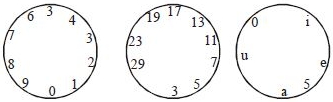
$A$ number lock consists of three rings. If the $1^{st}$ ring is marked with digits $0$ to $9$,the $2^{nd}$ ring is marked with prime numbers greater than $2$ but less than $30$,and the $3^{rd}$ ring is marked with all vowels,find the total number of unsuccessful attempts.
A
$405$
B
$449$
C
$499$
D
$501$
Solution
(B) The $1^{st}$ ring has $10$ digits $(0, 1, 2, 3, 4, 5, 6, 7, 8, 9)$.
The $2^{nd}$ ring has prime numbers greater than $2$ and less than $30$: ${3, 5, 7, 11, 13, 17, 19, 23, 29}$. There are $9$ such numbers.
The $3^{rd}$ ring has all vowels: ${a, e, i, o, u}$. There are $5$ such vowels.
Total number of ways to set the lock $= 10 \times 9 \times 5 = 450$.
Since there is only $1$ correct combination to open the lock,the total number of unsuccessful attempts $= 450 - 1 = 449$.
The $2^{nd}$ ring has prime numbers greater than $2$ and less than $30$: ${3, 5, 7, 11, 13, 17, 19, 23, 29}$. There are $9$ such numbers.
The $3^{rd}$ ring has all vowels: ${a, e, i, o, u}$. There are $5$ such vowels.
Total number of ways to set the lock $= 10 \times 9 \times 5 = 450$.
Since there is only $1$ correct combination to open the lock,the total number of unsuccessful attempts $= 450 - 1 = 449$.
0 likes
View Solution202
AdvancedMCQ
The total number of $4$-digit numbers which can be formed using the digits $1, 2, 3, 4$ without repetition such that the digit $n+1$ never immediately follows the digit $n$ is:
A
$10$
B
$11$
C
$13$
D
$14$
Solution
(B) The total number of permutations of digits $1, 2, 3, 4$ is $4! = 24$.
We want to exclude cases where $n+1$ immediately follows $n$. These are the patterns $12, 23, 34$.
Let $S$ be the set of all permutations. Let $A$ be the set of permutations containing $12$,$B$ containing $23$,and $C$ containing $34$.
We want to find $24 - |A \cup B \cup C|$.
Using the Principle of Inclusion-Exclusion:
$|A| = |B| = |C| = 3! = 6$.
$|A \cap B|$ (contains $123$) = $2! = 2$.
$|B \cap C|$ (contains $234$) = $2! = 2$.
$|A \cap C|$ (contains $12$ and $34$) = $2! = 2$.
$|A \cap B \cap C|$ (contains $1234$) = $1! = 1$.
$|A \cup B \cup C| = (6+6+6) - (2+2+2) + 1 = 18 - 6 + 1 = 13$.
Total valid numbers = $24 - 13 = 11$.
We want to exclude cases where $n+1$ immediately follows $n$. These are the patterns $12, 23, 34$.
Let $S$ be the set of all permutations. Let $A$ be the set of permutations containing $12$,$B$ containing $23$,and $C$ containing $34$.
We want to find $24 - |A \cup B \cup C|$.
Using the Principle of Inclusion-Exclusion:
$|A| = |B| = |C| = 3! = 6$.
$|A \cap B|$ (contains $123$) = $2! = 2$.
$|B \cap C|$ (contains $234$) = $2! = 2$.
$|A \cap C|$ (contains $12$ and $34$) = $2! = 2$.
$|A \cap B \cap C|$ (contains $1234$) = $1! = 1$.
$|A \cup B \cup C| = (6+6+6) - (2+2+2) + 1 = 18 - 6 + 1 = 13$.
Total valid numbers = $24 - 13 = 11$.
0 likes
View Solution203
MediumMCQ
$n$-digit numbers are formed using only three digits $2, 5,$ and $7$. The smallest value of $n$ for which $900$ such distinct numbers can be formed is:
A
$6$
B
$8$
C
$9$
D
$7$
Solution
(D) Each of the $n$ places in the $n$-digit number can be filled in $3$ ways (using digits $2, 5,$ or $7$).
Therefore,the total number of distinct $n$-digit numbers that can be formed is $3^n$.
We need to find the smallest integer $n$ such that $3^n \geq 900$.
Calculating powers of $3$:
$3^1 = 3$
$3^2 = 9$
$3^3 = 27$
$3^4 = 81$
$3^5 = 243$
$3^6 = 729$
$3^7 = 2187$
Since $3^6 = 729 < 900$ and $3^7 = 2187 \geq 900$,the smallest value of $n$ is $7$.
Therefore,the total number of distinct $n$-digit numbers that can be formed is $3^n$.
We need to find the smallest integer $n$ such that $3^n \geq 900$.
Calculating powers of $3$:
$3^1 = 3$
$3^2 = 9$
$3^3 = 27$
$3^4 = 81$
$3^5 = 243$
$3^6 = 729$
$3^7 = 2187$
Since $3^6 = 729 < 900$ and $3^7 = 2187 \geq 900$,the smallest value of $n$ is $7$.
0 likes
View Solution204
DifficultMCQ
The number of integers between $2,000$ and $5,000$ that can be formed using the digits $0, 1, 2, 3, 4$ (repetition of digits is not allowed) such that the number is a multiple of $3$ is:
A
$30$
B
$48$
C
$24$
D
$36$
Solution
(A) number is divisible by $3$ if the sum of its digits is divisible by $3$.
The thousands place can be filled with $2, 3,$ or $4$ because the number must be between $2,000$ and $5,000$.
Case $1$: Thousands place is $2$.
Possible sets of remaining $3$ digits from ${0, 1, 3, 4}$ such that the sum is divisible by $3$:
- ${0, 1, 3}$ (sum $= 2+0+1+3 = 6$)
- ${0, 3, 4}$ (sum $= 2+0+3+4 = 9$)
Each set can be arranged in $3! = 6$ ways. Total $= 2 \times 6 = 12$.
Case $2$: Thousands place is $3$.
Possible sets of remaining $3$ digits from ${0, 1, 2, 4}$ such that the sum is divisible by $3$:
- ${0, 1, 2}$ (sum $= 3+0+1+2 = 6$)
- ${0, 2, 4}$ (sum $= 3+0+2+4 = 9$)
Each set can be arranged in $3! = 6$ ways. Total $= 2 \times 6 = 12$.
Case $3$: Thousands place is $4$.
Possible sets of remaining $3$ digits from ${0, 1, 2, 3}$ such that the sum is divisible by $3$:
- ${0, 2, 1}$ (sum $= 4+0+2+1 = 7$ - No)
- ${0, 2, 3}$ (sum $= 4+0+2+3 = 9$)
- ${1, 2, 3}$ (sum $= 4+1+2+3 = 10$ - No)
Only ${0, 2, 3}$ works. Total $= 1 \times 6 = 6$.
Total numbers $= 12 + 12 + 6 = 30$.
The thousands place can be filled with $2, 3,$ or $4$ because the number must be between $2,000$ and $5,000$.
Case $1$: Thousands place is $2$.
Possible sets of remaining $3$ digits from ${0, 1, 3, 4}$ such that the sum is divisible by $3$:
- ${0, 1, 3}$ (sum $= 2+0+1+3 = 6$)
- ${0, 3, 4}$ (sum $= 2+0+3+4 = 9$)
Each set can be arranged in $3! = 6$ ways. Total $= 2 \times 6 = 12$.
Case $2$: Thousands place is $3$.
Possible sets of remaining $3$ digits from ${0, 1, 2, 4}$ such that the sum is divisible by $3$:
- ${0, 1, 2}$ (sum $= 3+0+1+2 = 6$)
- ${0, 2, 4}$ (sum $= 3+0+2+4 = 9$)
Each set can be arranged in $3! = 6$ ways. Total $= 2 \times 6 = 12$.
Case $3$: Thousands place is $4$.
Possible sets of remaining $3$ digits from ${0, 1, 2, 3}$ such that the sum is divisible by $3$:
- ${0, 2, 1}$ (sum $= 4+0+2+1 = 7$ - No)
- ${0, 2, 3}$ (sum $= 4+0+2+3 = 9$)
- ${1, 2, 3}$ (sum $= 4+1+2+3 = 10$ - No)
Only ${0, 2, 3}$ works. Total $= 1 \times 6 = 6$.
Total numbers $= 12 + 12 + 6 = 30$.
0 likes
View Solution205
DifficultMCQ
If all the words,with or without meaning,are written using the letters of the word $QUEEN$ and are arranged as in an English dictionary,then the position of the word $QUEEN$ is (in $^{th}$)
A
$44$
B
$45$
C
$46$
D
$47$
Solution
(C) The letters in the word $QUEEN$ are $E, E, N, Q, U$. Arranging them in alphabetical order: $E, E, N, Q, U$.
$(i)$ Words starting with $E$: The remaining letters are $E, N, Q, U$ (all distinct). Number of words $= 4! = 24$.
$(ii)$ Words starting with $N$: The remaining letters are $E, E, Q, U$. Number of words $= \frac{4!}{2!} = 12$.
$(iii)$ Words starting with $QE$: The remaining letters are $E, N, U$. Number of words $= 3! = 6$.
$(iv)$ Words starting with $QN$: The remaining letters are $E, E, U$. Number of words $= \frac{3!}{2!} = 3$.
$(v)$ The next word is $QUEEN$ itself,which is the $1^{st}$ word after the above arrangements.
Therefore,the rank of the word $QUEEN = 24 + 12 + 6 + 3 + 1 = 46^{th}$.
$(i)$ Words starting with $E$: The remaining letters are $E, N, Q, U$ (all distinct). Number of words $= 4! = 24$.
$(ii)$ Words starting with $N$: The remaining letters are $E, E, Q, U$. Number of words $= \frac{4!}{2!} = 12$.
$(iii)$ Words starting with $QE$: The remaining letters are $E, N, U$. Number of words $= 3! = 6$.
$(iv)$ Words starting with $QN$: The remaining letters are $E, E, U$. Number of words $= \frac{3!}{2!} = 3$.
$(v)$ The next word is $QUEEN$ itself,which is the $1^{st}$ word after the above arrangements.
Therefore,the rank of the word $QUEEN = 24 + 12 + 6 + 3 + 1 = 46^{th}$.
0 likes
View Solution206
DifficultMCQ
If four-letter words (need not be meaningful) are to be formed using the letters from the word $MEDITERRANEAN$ such that the first letter is $R$ and the fourth letter is $E$,then the total number of such words is
A
$110$
B
$59$
C
$\frac{11!}{2!^3}$
D
$56$
Solution
(B) The word $MEDITERRANEAN$ contains $13$ letters: $M(1), E(3), D(1), I(1), T(1), R(2), A(2), N(2)$.
We need to form a $4$-letter word of the form $R \_ \_ E$.
The two middle positions can be filled in two ways:
$1$. Both letters are identical: The available pairs are $(E, E), (A, A), (N, N)$. There are $3$ such pairs.
$2$. Both letters are distinct: We choose $2$ distinct letters from the set ${M, E, D, I, T, R, A, N}$. There are $8$ distinct letters available. The number of ways to arrange $2$ distinct letters in the $2$ middle positions is $^8P_2 = 8 \times 7 = 56$.
Total number of words = $3 56 = 59$.
We need to form a $4$-letter word of the form $R \_ \_ E$.
The two middle positions can be filled in two ways:
$1$. Both letters are identical: The available pairs are $(E, E), (A, A), (N, N)$. There are $3$ such pairs.
$2$. Both letters are distinct: We choose $2$ distinct letters from the set ${M, E, D, I, T, R, A, N}$. There are $8$ distinct letters available. The number of ways to arrange $2$ distinct letters in the $2$ middle positions is $^8P_2 = 8 \times 7 = 56$.
Total number of words = $3 56 = 59$.
0 likes
View Solution207
DifficultMCQ
The sum of the digits in the unit's place of all the $4-$ digit numbers formed by using the digits $3, 4, 5,$ and $6$,without repetition,is:
A
$432$
B
$108$
C
$36$
D
$18$
Solution
(B) To form a $4-$ digit number using the digits $3, 4, 5,$ and $6$ without repetition,we have $4! = 24$ total numbers.
If we fix a digit at the unit's place,the remaining $3$ positions can be filled by the remaining $3$ digits in $3! = 6$ ways.
Therefore,each of the digits $3, 4, 5,$ and $6$ appears in the unit's place exactly $6$ times.
The sum of the digits in the unit's place is:
$= (6 \times 3) + (6 \times 4) + (6 \times 5) + (6 \times 6)$
$= 6 \times (3 + 4 + 5 + 6)$
$= 6 \times 18$
$= 108$
If we fix a digit at the unit's place,the remaining $3$ positions can be filled by the remaining $3$ digits in $3! = 6$ ways.
Therefore,each of the digits $3, 4, 5,$ and $6$ appears in the unit's place exactly $6$ times.
The sum of the digits in the unit's place is:
$= (6 \times 3) + (6 \times 4) + (6 \times 5) + (6 \times 6)$
$= 6 \times (3 + 4 + 5 + 6)$
$= 6 \times 18$
$= 108$
0 likes
View Solution208
DifficultMCQ
$8$-digit numbers are formed using the digits $1, 1, 2, 2, 2, 3, 4, 4$. The number of such numbers in which the odd digits do not occupy odd places is:
A
$160$
B
$120$
C
$60$
D
$48$
Solution
(B) The total number of digits is $8$. The odd places are $1, 3, 5, 7$ ($4$ places) and the even places are $2, 4, 6, 8$ ($4$ places).
The given digits are $1, 1, 2, 2, 2, 3, 4, 4$. The odd digits are $1, 1, 3$ (total $3$ digits) and the even digits are $2, 2, 2, 4, 4$ (total $5$ digits).
We are given that odd digits do not occupy odd places. This means the $3$ odd digits must be placed in the $4$ available even places.
The number of ways to arrange the $3$ odd digits $(1, 1, 3)$ in $4$ even places is given by $\frac{4!}{2!} = 12$.
After placing the $3$ odd digits,we have $5$ remaining places (the $1$ remaining even place and the $4$ odd places) to fill with the remaining $5$ even digits $(2, 2, 2, 4, 4)$.
The number of ways to arrange these $5$ digits is $\frac{5!}{3!2!} = \frac{120}{6 \times 2} = 10$.
Therefore,the total number of such $8$-digit numbers is $12 \times 10 = 120$.
The given digits are $1, 1, 2, 2, 2, 3, 4, 4$. The odd digits are $1, 1, 3$ (total $3$ digits) and the even digits are $2, 2, 2, 4, 4$ (total $5$ digits).
We are given that odd digits do not occupy odd places. This means the $3$ odd digits must be placed in the $4$ available even places.
The number of ways to arrange the $3$ odd digits $(1, 1, 3)$ in $4$ even places is given by $\frac{4!}{2!} = 12$.
After placing the $3$ odd digits,we have $5$ remaining places (the $1$ remaining even place and the $4$ odd places) to fill with the remaining $5$ even digits $(2, 2, 2, 4, 4)$.
The number of ways to arrange these $5$ digits is $\frac{5!}{3!2!} = \frac{120}{6 \times 2} = 10$.
Therefore,the total number of such $8$-digit numbers is $12 \times 10 = 120$.
0 likes
View Solution209
DifficultMCQ
$5$-digit numbers are to be formed using $2, 3, 5, 7, 9$ without repeating the digits. If $p$ is the number of such numbers that exceed $20000$ and $q$ is the number of those that lie between $30000$ and $90000$,then $p : q$ is
A
$6:5$
B
$3:2$
C
$4:3$
D
$5:3$
Solution
(D) The set of digits is $\{2, 3, 5, 7, 9\}$. The total number of $5$-digit numbers formed without repetition is $5! = 120$.
For $p$: The numbers must exceed $20000$. Since all given digits are $\ge 2$,any $5$-digit number formed using these digits will be $\ge 23579$,which is $> 20000$. Thus,$p = 5! = 120$.
For $q$: The numbers must lie between $30000$ and $90000$. This means the first digit must be $3, 5,$ or $7$.
There are $3$ choices for the first digit. The remaining $4$ positions can be filled by the remaining $4$ digits in $4!$ ways.
So,$q = 3 \times 4! = 3 \times 24 = 72$.
The ratio $p : q = 120 : 72$.
Dividing both by $24$,we get $120/24 : 72/24 = 5 : 3$.
For $p$: The numbers must exceed $20000$. Since all given digits are $\ge 2$,any $5$-digit number formed using these digits will be $\ge 23579$,which is $> 20000$. Thus,$p = 5! = 120$.
For $q$: The numbers must lie between $30000$ and $90000$. This means the first digit must be $3, 5,$ or $7$.
There are $3$ choices for the first digit. The remaining $4$ positions can be filled by the remaining $4$ digits in $4!$ ways.
So,$q = 3 \times 4! = 3 \times 24 = 72$.
The ratio $p : q = 120 : 72$.
Dividing both by $24$,we get $120/24 : 72/24 = 5 : 3$.
0 likes
View Solution210
DifficultMCQ
The number of arrangements that can be formed from the letters $a, b, c, d, e, f$ taken $3$ at a time without repetition,such that each arrangement contains at least one vowel,is
A
$96$
B
$128$
C
$24$
D
$72$
Solution
(A) The set of letters is $\{a, b, c, d, e, f\}$,which contains $2$ vowels $(\{a, e\})$ and $4$ consonants $(\{b, c, d, f\})$.
We need to form arrangements of $3$ letters containing at least one vowel.
Total arrangements with at least one vowel = (Total arrangements of $3$ letters) - (Arrangements with no vowels).
Total arrangements of $3$ letters from $6$ distinct letters = $^6P_3 = 6 \times 5 \times 4 = 120$.
Arrangements with no vowels (only consonants) = $^4P_3 = 4 \times 3 \times 2 = 24$.
Therefore,the number of arrangements with at least one vowel = $120 - 24 = 96$.
We need to form arrangements of $3$ letters containing at least one vowel.
Total arrangements with at least one vowel = (Total arrangements of $3$ letters) - (Arrangements with no vowels).
Total arrangements of $3$ letters from $6$ distinct letters = $^6P_3 = 6 \times 5 \times 4 = 120$.
Arrangements with no vowels (only consonants) = $^4P_3 = 4 \times 3 \times 2 = 24$.
Therefore,the number of arrangements with at least one vowel = $120 - 24 = 96$.
0 likes
View Solution211
DifficultMCQ
The number of natural numbers less than $7,000$ which can be formed by using the digits $0, 1, 3, 7, 9$ (repetition of digits allowed) is equal to
A
$250$
B
$374$
C
$372$
D
$375$
Solution
(B) We need to find the number of natural numbers less than $7,000$ using the digits ${0, 1, 3, 7, 9}$ with repetition allowed.
Case $1$: $1$-digit,$2$-digit,or $3$-digit numbers.
For a $1$-digit number,there are $4$ choices (excluding $0$): ${1, 3, 7, 9}$.
For a $2$-digit number,the first digit has $4$ choices and the second has $5$ choices: $4 \times 5 = 20$.
For a $3$-digit number,the first digit has $4$ choices and the next two have $5$ choices each: $4 \times 5 \times 5 = 100$.
Total for $1, 2, 3$ digits $= 4 + 20 + 100 = 124$.
Case $2$: $4$-digit numbers less than $7,000$.
The first digit can be $1$ or $3$ ($2$ choices).
The remaining three positions can each be filled by any of the $5$ digits ($5 \times 5 \times 5 = 125$ choices).
Total $4$-digit numbers $= 2 \times 125 = 250$.
Total count $= 124 + 250 = 374$.
Case $1$: $1$-digit,$2$-digit,or $3$-digit numbers.
For a $1$-digit number,there are $4$ choices (excluding $0$): ${1, 3, 7, 9}$.
For a $2$-digit number,the first digit has $4$ choices and the second has $5$ choices: $4 \times 5 = 20$.
For a $3$-digit number,the first digit has $4$ choices and the next two have $5$ choices each: $4 \times 5 \times 5 = 100$.
Total for $1, 2, 3$ digits $= 4 + 20 + 100 = 124$.
Case $2$: $4$-digit numbers less than $7,000$.
The first digit can be $1$ or $3$ ($2$ choices).
The remaining three positions can each be filled by any of the $5$ digits ($5 \times 5 \times 5 = 125$ choices).
Total $4$-digit numbers $= 2 \times 125 = 250$.
Total count $= 124 + 250 = 374$.
0 likes
View Solution212
DifficultMCQ
All possible numbers are formed using the digits $1, 1, 2, 2, 2, 2, 3, 4, 4$ taken all at a time. The number of such numbers in which the odd digits occupy even places is
A
$180$
B
$175$
C
$162$
D
$160$
Solution
(A) The total number of digits is $9$. The digits are $1, 1, 2, 2, 2, 2, 3, 4, 4$.
Odd digits are $1, 1, 3$ (total $3$ odd digits).
Even digits are $2, 2, 2, 2, 4, 4$ (total $6$ even digits).
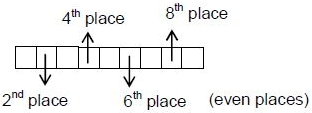
There are $4$ even places $(2^{nd}, 4^{th}, 6^{th}, 8^{th})$ and $5$ odd places $(1^{st}, 3^{rd}, 5^{th}, 7^{th}, 9^{th})$.
We need to place $3$ odd digits in $4$ even places. This is not possible as we have $3$ odd digits and $4$ even places. However,the question implies we must place the $3$ odd digits into the $4$ even places. Since we have $3$ odd digits $(1, 1, 3)$,we choose $3$ places out of $4$ even places in $^4C_3$ ways.
The number of ways to arrange $1, 1, 3$ in these $3$ places is $\frac{3!}{2!} = 3$.
The remaining $6$ digits $(2, 2, 2, 2, 4, 4)$ must be placed in the remaining $6$ places. The number of ways to arrange them is $\frac{6!}{4!2!} = 15$.
Total numbers $= ^4C_3 \times \frac{3!}{2!} \times \frac{6!}{4!2!} = 4 \times 3 \times 15 = 180$.
Odd digits are $1, 1, 3$ (total $3$ odd digits).
Even digits are $2, 2, 2, 2, 4, 4$ (total $6$ even digits).
There are $4$ even places $(2^{nd}, 4^{th}, 6^{th}, 8^{th})$ and $5$ odd places $(1^{st}, 3^{rd}, 5^{th}, 7^{th}, 9^{th})$.
We need to place $3$ odd digits in $4$ even places. This is not possible as we have $3$ odd digits and $4$ even places. However,the question implies we must place the $3$ odd digits into the $4$ even places. Since we have $3$ odd digits $(1, 1, 3)$,we choose $3$ places out of $4$ even places in $^4C_3$ ways.
The number of ways to arrange $1, 1, 3$ in these $3$ places is $\frac{3!}{2!} = 3$.
The remaining $6$ digits $(2, 2, 2, 2, 4, 4)$ must be placed in the remaining $6$ places. The number of ways to arrange them is $\frac{6!}{4!2!} = 15$.
Total numbers $= ^4C_3 \times \frac{3!}{2!} \times \frac{6!}{4!2!} = 4 \times 3 \times 15 = 180$.
0 likes
View Solution213
DifficultMCQ
The number of four-digit numbers strictly greater than $4321$ that can be formed using the digits $0, 1, 2, 3, 4, 5$ (repetition of digits is allowed) is
A
$360$
B
$288$
C
$310$
D
$306$
Solution
(C) We need to find the number of four-digit numbers greater than $4321$ using digits $\{0, 1, 2, 3, 4, 5\}$.
Case $1$: Numbers starting with $5$:
The first digit is $5$. The remaining $3$ positions can be filled by any of the $6$ digits $(0-5)$.
Number of ways $= 1 \times 6 \times 6 \times 6 = 216$.
Case $2$: Numbers starting with $44$ or $45$:
The first digit is $4$. The second digit is $4$ or $5$ ($2$ choices). The remaining $2$ positions can be filled by any of the $6$ digits.
Number of ways $= 1 \times 2 \times 6 \times 6 = 72$.
Case $3$: Numbers starting with $43$:
The first two digits are $43$. The third digit must be greater than $2$,so it can be $3, 4, 5$ ($3$ choices).
The fourth digit can be any of the $6$ digits.
Number of ways $= 1 \times 1 \times 3 \times 6 = 18$.
Case $4$: Numbers starting with $432$:
The first three digits are $432$. The fourth digit must be greater than $1$,so it can be $2, 3, 4, 5$ ($4$ choices).
Number of ways $= 1 \times 1 \times 1 \times 4 = 4$.
Total count $= 216 + 72 + 18 + 4 = 310$.
Case $1$: Numbers starting with $5$:
The first digit is $5$. The remaining $3$ positions can be filled by any of the $6$ digits $(0-5)$.
Number of ways $= 1 \times 6 \times 6 \times 6 = 216$.
Case $2$: Numbers starting with $44$ or $45$:
The first digit is $4$. The second digit is $4$ or $5$ ($2$ choices). The remaining $2$ positions can be filled by any of the $6$ digits.
Number of ways $= 1 \times 2 \times 6 \times 6 = 72$.
Case $3$: Numbers starting with $43$:
The first two digits are $43$. The third digit must be greater than $2$,so it can be $3, 4, 5$ ($3$ choices).
The fourth digit can be any of the $6$ digits.
Number of ways $= 1 \times 1 \times 3 \times 6 = 18$.
Case $4$: Numbers starting with $432$:
The first three digits are $432$. The fourth digit must be greater than $1$,so it can be $2, 3, 4, 5$ ($4$ choices).
Number of ways $= 1 \times 1 \times 1 \times 4 = 4$.
Total count $= 216 + 72 + 18 + 4 = 310$.
0 likes
View Solution214
DifficultMCQ
Total number of $6$-digit numbers in which only and all the five digits $1, 3, 5, 7,$ and $9$ appear,is:
A
$\frac{5}{2}(6!)$
B
$5^6$
C
$\frac{1}{2}(6!)$
D
$6!$
Solution
(A) To form a $6$-digit number using all five digits $\{1, 3, 5, 7, 9\}$,one digit must be repeated exactly twice,and the other four digits must appear exactly once.
Step $1$: Select the digit to be repeated from the $5$ available digits. This can be done in $^5C_1 = 5$ ways.
Step $2$: Arrange these $6$ digits (where one digit is repeated twice) in a sequence. The number of permutations is given by $\frac{6!}{2!}$.
Step $3$: The total number of such $6$-digit numbers is $^5C_1 \times \frac{6!}{2!} = 5 \times \frac{720}{2} = 5 \times 360 = 1800$.
Note: $\frac{5}{2}(6!) = 2.5 \times 720 = 1800$. Thus,the correct option is $A$.
Step $1$: Select the digit to be repeated from the $5$ available digits. This can be done in $^5C_1 = 5$ ways.
Step $2$: Arrange these $6$ digits (where one digit is repeated twice) in a sequence. The number of permutations is given by $\frac{6!}{2!}$.
Step $3$: The total number of such $6$-digit numbers is $^5C_1 \times \frac{6!}{2!} = 5 \times \frac{720}{2} = 5 \times 360 = 1800$.
Note: $\frac{5}{2}(6!) = 2.5 \times 720 = 1800$. Thus,the correct option is $A$.
0 likes
View Solution215
DifficultMCQ
If the number of five-digit numbers with distinct digits and $2$ at the $10^{\text{th}}$ place is $336k$,then $k$ is equal to
A
$8$
B
$6$
C
$4$
D
$2$
Solution
(A) five-digit number is represented as $\_ \;\_\;\_\;\underline{2}\;\_$.
The $10^{\text{th}}$ place is fixed as $2$.
For the $10,000^{\text{th}}$ place,we cannot use $0$ or $2$,so there are $8$ choices $(1, 3, 4, 5, 6, 7, 8, 9)$.
For the $1,000^{\text{th}}$ place,we can use $0$ and any of the remaining $7$ digits,so there are $8$ choices.
For the $100^{\text{th}}$ place,there are $7$ choices remaining.
For the units place,there are $6$ choices remaining.
Total number of such five-digit numbers $= 8 \times 8 \times 7 \times 6 = 2688$.
Given that the number is $336k$,we have $336k = 2688$.
Therefore,$k = \frac{2688}{336} = 8$.
The $10^{\text{th}}$ place is fixed as $2$.
For the $10,000^{\text{th}}$ place,we cannot use $0$ or $2$,so there are $8$ choices $(1, 3, 4, 5, 6, 7, 8, 9)$.
For the $1,000^{\text{th}}$ place,we can use $0$ and any of the remaining $7$ digits,so there are $8$ choices.
For the $100^{\text{th}}$ place,there are $7$ choices remaining.
For the units place,there are $6$ choices remaining.
Total number of such five-digit numbers $= 8 \times 8 \times 7 \times 6 = 2688$.
Given that the number is $336k$,we have $336k = 2688$.
Therefore,$k = \frac{2688}{336} = 8$.
0 likes
View Solution216
EasyMCQ
Find the number of $4$ letter words,with or without meaning,which can be formed out of the letters of the word $ROSE$,where the repetition of the letters is not allowed.
A
$24$
B
$12$
C
$16$
D
$8$
Solution
(A) The word $ROSE$ contains $4$ distinct letters: $R, O, S, E$.
To form a $4$ letter word without repetition,we need to arrange these $4$ letters in $4$ vacant places.
The first place can be filled in $4$ ways.
The second place can be filled in $3$ ways.
The third place can be filled in $2$ ways.
The fourth place can be filled in $1$ way.
By the multiplication principle,the total number of words is $4 \times 3 \times 2 \times 1 = 24$.
To form a $4$ letter word without repetition,we need to arrange these $4$ letters in $4$ vacant places.
The first place can be filled in $4$ ways.
The second place can be filled in $3$ ways.
The third place can be filled in $2$ ways.
The fourth place can be filled in $1$ way.
By the multiplication principle,the total number of words is $4 \times 3 \times 2 \times 1 = 24$.
0 likes
View Solution217
EasyMCQ
Given $4$ flags of different colours,how many different signals can be generated,if a signal requires the use of $2$ flags one below the other?
A
$12$
B
$16$
C
$8$
D
$24$
Solution
(A) There will be as many signals as there are ways of filling in $2$ vacant places in succession by the $4$ flags of different colours.
The upper vacant place can be filled in $4$ different ways by any one of the $4$ flags.
Following which,the lower vacant place can be filled in $3$ different ways by any one of the remaining $3$ different flags.
Hence,by the multiplication principle,the required number of signals $= 4 \times 3 = 12$.
The upper vacant place can be filled in $4$ different ways by any one of the $4$ flags.
Following which,the lower vacant place can be filled in $3$ different ways by any one of the remaining $3$ different flags.
Hence,by the multiplication principle,the required number of signals $= 4 \times 3 = 12$.
0 likes
View Solution218
EasyMCQ
How many $2$ digit even numbers can be formed from the digits $1, 2, 3, 4, 5$ if the digits can be repeated?
A
$10$
B
$12$
C
$15$
D
$20$
Solution
(A) $2$ digit number has a ten's place and a unit's place.
For the number to be even,the unit's place must be filled by an even digit from the set $\{1, 2, 3, 4, 5\}$.
The available even digits are $2$ and $4$. Thus,the unit's place can be filled in $2$ ways.
Since repetition of digits is allowed,the ten's place can be filled by any of the $5$ given digits $(1, 2, 3, 4, 5)$. Thus,the ten's place can be filled in $5$ ways.
By the multiplication principle,the total number of $2$ digit even numbers is $5 \times 2 = 10$.
For the number to be even,the unit's place must be filled by an even digit from the set $\{1, 2, 3, 4, 5\}$.
The available even digits are $2$ and $4$. Thus,the unit's place can be filled in $2$ ways.
Since repetition of digits is allowed,the ten's place can be filled by any of the $5$ given digits $(1, 2, 3, 4, 5)$. Thus,the ten's place can be filled in $5$ ways.
By the multiplication principle,the total number of $2$ digit even numbers is $5 \times 2 = 10$.
0 likes
View Solution219
EasyMCQ
How many $3$-digit numbers can be formed from the digits $1, 2, 3, 4,$ and $5$ assuming that repetition of the digits is allowed?
A
$125$
B
$60$
C
$243$
D
$120$
Solution
(A) There are $3$ vacant places to be filled by the given $5$ digits $(1, 2, 3, 4, 5)$.
Since repetition is allowed,each of the $3$ places can be filled in $5$ different ways.
By the multiplication principle,the total number of $3$-digit numbers is $5 \times 5 \times 5 = 125$.
Since repetition is allowed,each of the $3$ places can be filled in $5$ different ways.
By the multiplication principle,the total number of $3$-digit numbers is $5 \times 5 \times 5 = 125$.
0 likes
View Solution220
EasyMCQ
How many $3$-digit numbers can be formed from the digits $1, 2, 3, 4,$ and $5$ assuming that repetition of the digits is not allowed?
A
$60$
B
$120$
C
$20$
D
$10$
Solution
(A) To form a $3$-digit number using the digits $1, 2, 3, 4,$ and $5$ without repetition,we need to fill $3$ places (hundreds,tens,and units).
The hundreds place can be filled in $5$ ways (using any of the digits $1, 2, 3, 4, 5$).
Since repetition is not allowed,the tens place can be filled in $4$ remaining ways.
The units place can then be filled in $3$ remaining ways.
By the multiplication principle,the total number of $3$-digit numbers is $5 \times 4 \times 3 = 60$.
The hundreds place can be filled in $5$ ways (using any of the digits $1, 2, 3, 4, 5$).
Since repetition is not allowed,the tens place can be filled in $4$ remaining ways.
The units place can then be filled in $3$ remaining ways.
By the multiplication principle,the total number of $3$-digit numbers is $5 \times 4 \times 3 = 60$.
0 likes
View Solution221
EasyMCQ
How many $3$-digit even numbers can be formed from the digits $1, 2, 3, 4, 5, 6$ if the digits can be repeated?
A
$108$
B
$120$
C
$144$
D
$216$
Solution
(A) To form a $3$-digit even number,the units place must be filled by an even digit from the given set $\{1, 2, 3, 4, 5, 6\}$.
The even digits available are $2, 4, 6$. Thus,the units place can be filled in $3$ ways.
Since repetition is allowed,the tens place can be filled by any of the $6$ digits in $6$ ways.
Similarly,the hundreds place can be filled by any of the $6$ digits in $6$ ways.
By the multiplication principle,the total number of $3$-digit even numbers is $6 \times 6 \times 3 = 108$.
The even digits available are $2, 4, 6$. Thus,the units place can be filled in $3$ ways.
Since repetition is allowed,the tens place can be filled by any of the $6$ digits in $6$ ways.
Similarly,the hundreds place can be filled by any of the $6$ digits in $6$ ways.
By the multiplication principle,the total number of $3$-digit even numbers is $6 \times 6 \times 3 = 108$.
0 likes
View Solution222
EasyMCQ
How many $4$-letter codes can be formed using the first $10$ letters of the English alphabet,if no letter can be repeated?
A
$5040$
B
$2520$
C
$1260$
D
$630$
Solution
(A) The number of ways to form a $4$-letter code is equivalent to the number of ways to fill $4$ vacant places in succession using the first $10$ letters of the English alphabet,where repetition is not allowed.
The first place can be filled in $10$ ways.
The second place can be filled in $9$ ways.
The third place can be filled in $8$ ways.
The fourth place can be filled in $7$ ways.
By the multiplication principle,the total number of ways is $10 \times 9 \times 8 \times 7 = 5040$.
Thus,$5040$ four-letter codes can be formed.
The first place can be filled in $10$ ways.
The second place can be filled in $9$ ways.
The third place can be filled in $8$ ways.
The fourth place can be filled in $7$ ways.
By the multiplication principle,the total number of ways is $10 \times 9 \times 8 \times 7 = 5040$.
Thus,$5040$ four-letter codes can be formed.
0 likes
View Solution223
EasyMCQ
How many $5$-digit telephone numbers can be constructed using the digits $0$ to $9$ if each number starts with $67$ and no digit appears more than once?
A
$336$
B
$338$
C
$340$
D
$342$
Solution
(A) $5$-digit telephone number starts with $67$.
This means the first two places are fixed as $6$ and $7$.
Since no digit can be repeated,we have $10 - 2 = 8$ digits remaining to fill the remaining $3$ places.
The third place can be filled in $8$ ways.
The fourth place can be filled in $7$ ways.
The fifth place can be filled in $6$ ways.
By the multiplication principle,the total number of such telephone numbers is $8 \times 7 \times 6 = 336$.
This means the first two places are fixed as $6$ and $7$.
Since no digit can be repeated,we have $10 - 2 = 8$ digits remaining to fill the remaining $3$ places.
The third place can be filled in $8$ ways.
The fourth place can be filled in $7$ ways.
The fifth place can be filled in $6$ ways.
By the multiplication principle,the total number of such telephone numbers is $8 \times 7 \times 6 = 336$.
0 likes
View Solution224
EasyMCQ
$A$ coin is tossed $3$ times and the outcomes are recorded. How many possible outcomes are there?
A
$6$
B
$8$
C
$4$
D
$2$
Solution
(B) When a coin is tossed once,the number of outcomes is $2$ (Head and Tail).
Since the coin is tossed $3$ times,by the multiplication principle,the total number of possible outcomes is $2 \times 2 \times 2 = 8$.
Since the coin is tossed $3$ times,by the multiplication principle,the total number of possible outcomes is $2 \times 2 \times 2 = 8$.
0 likes
View Solution225
EasyMCQ
Given $5$ flags of different colours,how many different signals can be generated if each signal requires the use of $2$ flags,one below the other?
A
$20$
B
$10$
C
$25$
D
$120$
Solution
(A) Each signal requires the use of $2$ flags,one below the other.
The number of signals is equal to the number of ways of filling $2$ vacant places in succession using $5$ flags of different colours.
The upper vacant place can be filled in $5$ different ways by any one of the $5$ flags.
After filling the upper place,the lower vacant place can be filled in $4$ different ways by any one of the remaining $4$ flags.
By the multiplication principle,the total number of different signals that can be generated is $5 \times 4 = 20$.
The number of signals is equal to the number of ways of filling $2$ vacant places in succession using $5$ flags of different colours.
The upper vacant place can be filled in $5$ different ways by any one of the $5$ flags.
After filling the upper place,the lower vacant place can be filled in $4$ different ways by any one of the remaining $4$ flags.
By the multiplication principle,the total number of different signals that can be generated is $5 \times 4 = 20$.
0 likes
View Solution226
EasyMCQ
Evaluate $5!$
A
$120$
B
$100$
C
$60$
D
$24$
Solution
(A) The factorial of a number $n$,denoted by $n!$,is the product of all positive integers from $1$ to $n$.
$5! = 5 \times 4 \times 3 \times 2 \times 1 = 120$.
$5! = 5 \times 4 \times 3 \times 2 \times 1 = 120$.
0 likes
View Solution227
EasyMCQ
Evaluate $7!$
A
$5040$
B
$720$
C
$840$
D
$2520$
Solution
(A) The factorial of a number $n$,denoted by $n!$,is the product of all positive integers from $1$ to $n$.
$7! = 1 \times 2 \times 3 \times 4 \times 5 \times 6 \times 7 = 5040$
$7! = 1 \times 2 \times 3 \times 4 \times 5 \times 6 \times 7 = 5040$
0 likes
View Solution228
EasyMCQ
Evaluate $7! - 5!$
A
$4920$
B
$5040$
C
$4800$
D
$5160$
Solution
(A) We know that $n! = n \times (n-1) \times (n-2) \times \dots \times 1$.
$7! = 7 \times 6 \times 5 \times 4 \times 3 \times 2 \times 1 = 5040$.
$5! = 5 \times 4 \times 3 \times 2 \times 1 = 120$.
Therefore,$7! - 5! = 5040 - 120 = 4920$.
$7! = 7 \times 6 \times 5 \times 4 \times 3 \times 2 \times 1 = 5040$.
$5! = 5 \times 4 \times 3 \times 2 \times 1 = 120$.
Therefore,$7! - 5! = 5040 - 120 = 4920$.
0 likes
View Solution229
EasyMCQ
Compute $\frac{7!}{5!}$
A
$42$
B
$35$
C
$21$
D
$7$
Solution
(A) We have $\frac{7!}{5!} = \frac{7 \times 6 \times 5!}{5!}$.
By canceling $5!$ from the numerator and the denominator,we get $7 \times 6$.
Therefore,$\frac{7!}{5!} = 42$.
By canceling $5!$ from the numerator and the denominator,we get $7 \times 6$.
Therefore,$\frac{7!}{5!} = 42$.
0 likes
View Solution230
EasyMCQ
Evaluate $8!$.
A
$40320$
B
$5040$
C
$720$
D
$80640$
Solution
(A) The factorial of a number $n$ is defined as $n! = 1 \times 2 \times 3 \times \dots \times n$.
For $n = 8$,we have:
$8! = 1 \times 2 \times 3 \times 4 \times 5 \times 6 \times 7 \times 8 = 40320$.
For $n = 8$,we have:
$8! = 1 \times 2 \times 3 \times 4 \times 5 \times 6 \times 7 \times 8 = 40320$.
0 likes
View Solution231
EasyMCQ
Evaluate $4! - 3!$
A
$18$
B
$20$
C
$21$
D
$24$
Solution
(A) We know that the factorial of a number $n$ is defined as $n! = 1 \times 2 \times 3 \times \dots \times n$.
First,calculate $4!$:
$4! = 1 \times 2 \times 3 \times 4 = 24$.
Next,calculate $3!$:
$3! = 1 \times 2 \times 3 = 6$.
Finally,subtract the values:
$4! - 3! = 24 - 6 = 18$.
First,calculate $4!$:
$4! = 1 \times 2 \times 3 \times 4 = 24$.
Next,calculate $3!$:
$3! = 1 \times 2 \times 3 = 6$.
Finally,subtract the values:
$4! - 3! = 24 - 6 = 18$.
0 likes
View Solution232
EasyMCQ
Is $3! + 4! = 7!$?
A
Yes
B
No
C
Cannot be determined
D
None of these
Solution
(B) $3! = 1 \times 2 \times 3 = 6$
$4! = 1 \times 2 \times 3 \times 4 = 24$
$\therefore 3! + 4! = 6 + 24 = 30$
$7! = 1 \times 2 \times 3 \times 4 \times 5 \times 6 \times 7 = 5040$
$\therefore 3! + 4! \neq 7!$
$4! = 1 \times 2 \times 3 \times 4 = 24$
$\therefore 3! + 4! = 6 + 24 = 30$
$7! = 1 \times 2 \times 3 \times 4 \times 5 \times 6 \times 7 = 5040$
$\therefore 3! + 4! \neq 7!$
0 likes
View Solution233
EasyMCQ
Evaluate $\frac{n!}{(n-r)!}$ when $n=6$ and $r=2$.
A
$15$
B
$30$
C
$60$
D
$120$
Solution
(B) Given the expression $\frac{n!}{(n-r)!}$.
Substitute $n=6$ and $r=2$ into the expression:
$\frac{6!}{(6-2)!} = \frac{6!}{4!}$
$= \frac{6 \times 5 \times 4!}{4!}$
$= 6 \times 5 = 30$.
Substitute $n=6$ and $r=2$ into the expression:
$\frac{6!}{(6-2)!} = \frac{6!}{4!}$
$= \frac{6 \times 5 \times 4!}{4!}$
$= 6 \times 5 = 30$.
0 likes
View Solution234
EasyMCQ
Evaluate $\frac{n!}{(n-r)!}$,when $n=9, r=5$.
A
$15120$
B
$30240$
C
$7560$
D
$1260$
Solution
(A) Given $n=9$ and $r=5$.
Substituting these values into the expression $\frac{n!}{(n-r)!}$:
$\frac{9!}{(9-5)!} = \frac{9!}{4!}$
$= \frac{9 \times 8 \times 7 \times 6 \times 5 \times 4!}{4!}$
$= 9 \times 8 \times 7 \times 6 \times 5$
$= 15120$.
Substituting these values into the expression $\frac{n!}{(n-r)!}$:
$\frac{9!}{(9-5)!} = \frac{9!}{4!}$
$= \frac{9 \times 8 \times 7 \times 6 \times 5 \times 4!}{4!}$
$= 9 \times 8 \times 7 \times 6 \times 5$
$= 15120$.
0 likes
View Solution235
EasyMCQ
Find the number of permutations of the letters of the word $ALLAHABAD$.
A
$7560$
B
$3780$
C
$15120$
D
$30240$
Solution
(A) The word $ALLAHABAD$ contains $9$ letters in total.
These letters are: $A, L, L, A, H, A, B, A, D$.
The frequency of each letter is:
$A: 4$
$L: 2$
$H: 1$
$B: 1$
$D: 1$
Using the formula for permutations of a multiset,the number of arrangements is given by $\frac{n!}{n_1! n_2! ... n_k!}$.
Here,$n = 9$,$n_1 = 4$ (for $A$),and $n_2 = 2$ (for $L$).
Number of permutations $= \frac{9!}{4! 2!} = \frac{362880}{24 \times 2} = \frac{362880}{48} = 7560$.
These letters are: $A, L, L, A, H, A, B, A, D$.
The frequency of each letter is:
$A: 4$
$L: 2$
$H: 1$
$B: 1$
$D: 1$
Using the formula for permutations of a multiset,the number of arrangements is given by $\frac{n!}{n_1! n_2! ... n_k!}$.
Here,$n = 9$,$n_1 = 4$ (for $A$),and $n_2 = 2$ (for $L$).
Number of permutations $= \frac{9!}{4! 2!} = \frac{362880}{24 \times 2} = \frac{362880}{48} = 7560$.
0 likes
View Solution236
EasyMCQ
How many $4$-digit numbers can be formed by using the digits $1$ to $9$ if repetition of digits is not allowed?
A
$3024$
B
$3025$
C
$3026$
D
$3027$
Solution
(A) Since the order of digits matters,we are looking for the number of permutations of $9$ distinct digits taken $4$ at a time.
The number of ways to form a $4$-digit number is given by the permutation formula $^nP_r = \frac{n!}{(n-r)!}$.
Here,$n = 9$ and $r = 4$.
Therefore,the number of $4$-digit numbers $= ^9P_4 = \frac{9!}{(9-4)!} = \frac{9!}{5!} = 9 \times 8 \times 7 \times 6 = 3024$.
The number of ways to form a $4$-digit number is given by the permutation formula $^nP_r = \frac{n!}{(n-r)!}$.
Here,$n = 9$ and $r = 4$.
Therefore,the number of $4$-digit numbers $= ^9P_4 = \frac{9!}{(9-4)!} = \frac{9!}{5!} = 9 \times 8 \times 7 \times 6 = 3024$.
0 likes
View Solution237
EasyMCQ
How many numbers lying between $100$ and $1000$ can be formed with the digits $0, 1, 2, 3, 4, 5$,if the repetition of the digits is not allowed?
A
$100$
B
$120$
C
$80$
D
$140$
Solution
(A) Every number between $100$ and $1000$ is a $3$-digit number.
To form a $3$-digit number,the hundreds place cannot be $0$.
The hundreds place can be filled by any of the $5$ digits $(1, 2, 3, 4, 5)$,so there are $5$ choices.
The tens place can be filled by any of the remaining $5$ digits (including $0$),so there are $5$ choices.
The units place can be filled by any of the remaining $4$ digits,so there are $4$ choices.
Therefore,the total number of such $3$-digit numbers is $5 \times 5 \times 4 = 100$.
To form a $3$-digit number,the hundreds place cannot be $0$.
The hundreds place can be filled by any of the $5$ digits $(1, 2, 3, 4, 5)$,so there are $5$ choices.
The tens place can be filled by any of the remaining $5$ digits (including $0$),so there are $5$ choices.
The units place can be filled by any of the remaining $4$ digits,so there are $4$ choices.
Therefore,the total number of such $3$-digit numbers is $5 \times 5 \times 4 = 100$.
0 likes
View Solution238
MediumMCQ
Find the value of $n$ such that $^{n}P_{5} = 42 \, ^{n}P_{3}$,where $n > 4$.
A
$10$
B
$11$
C
$12$
D
$9$
Solution
(A) Given the equation: $^{n}P_{5} = 42 \, ^{n}P_{3}$.
Using the formula $^{n}P_{r} = \frac{n!}{(n-r)!}$,we have:
$n(n-1)(n-2)(n-3)(n-4) = 42 \, n(n-1)(n-2)$.
Since $n > 4$,$n(n-1)(n-2) \neq 0$. Dividing both sides by $n(n-1)(n-2)$,we get:
$(n-3)(n-4) = 42$.
$n^{2} - 7n + 12 = 42$.
$n^{2} - 7n - 30 = 0$.
Factoring the quadratic equation:
$(n-10)(n+3) = 0$.
This gives $n = 10$ or $n = -3$.
Since $n$ must be a positive integer and $n > 4$,we discard $n = -3$.
Therefore,$n = 10$.
Using the formula $^{n}P_{r} = \frac{n!}{(n-r)!}$,we have:
$n(n-1)(n-2)(n-3)(n-4) = 42 \, n(n-1)(n-2)$.
Since $n > 4$,$n(n-1)(n-2) \neq 0$. Dividing both sides by $n(n-1)(n-2)$,we get:
$(n-3)(n-4) = 42$.
$n^{2} - 7n + 12 = 42$.
$n^{2} - 7n - 30 = 0$.
Factoring the quadratic equation:
$(n-10)(n+3) = 0$.
This gives $n = 10$ or $n = -3$.
Since $n$ must be a positive integer and $n > 4$,we discard $n = -3$.
Therefore,$n = 10$.
0 likes
View Solution239
EasyMCQ
Find the value of $n$ such that $\frac{^{n}P_{4}}{^{n-1}P_{4}} = \frac{5}{3}$,where $n > 4$.
A
$10$
B
$12$
C
$8$
D
$15$
Solution
(A) Given the equation $\frac{^{n}P_{4}}{^{n-1}P_{4}} = \frac{5}{3}$.
Using the formula $^{n}P_{r} = \frac{n!}{(n-r)!}$,we have:
$\frac{\frac{n!}{(n-4)!}}{\frac{(n-1)!}{(n-5)!}} = \frac{5}{3}$.
This simplifies to $\frac{n \times (n-1)!}{(n-4) \times (n-5)!} \times \frac{(n-5)!}{(n-1)!} = \frac{5}{3}$.
$\frac{n}{n-4} = \frac{5}{3}$.
Cross-multiplying gives $3n = 5(n-4)$.
$3n = 5n - 20$.
$2n = 20$.
$n = 10$.
Using the formula $^{n}P_{r} = \frac{n!}{(n-r)!}$,we have:
$\frac{\frac{n!}{(n-4)!}}{\frac{(n-1)!}{(n-5)!}} = \frac{5}{3}$.
This simplifies to $\frac{n \times (n-1)!}{(n-4) \times (n-5)!} \times \frac{(n-5)!}{(n-1)!} = \frac{5}{3}$.
$\frac{n}{n-4} = \frac{5}{3}$.
Cross-multiplying gives $3n = 5(n-4)$.
$3n = 5n - 20$.
$2n = 20$.
$n = 10$.
0 likes
View Solution240
MediumMCQ
Find $r,$ if $5 \times ^{4}P_{r} = 6 \times ^{5}P_{r-1}.$
A
$r = 3$
B
$r = 8$
C
$r = 3, 8$
D
$r = 4$
Solution
(A) Given the equation: $5 \times ^{4}P_{r} = 6 \times ^{5}P_{r-1}$
Using the formula $^{n}P_{r} = \frac{n!}{(n-r)!}$,we have:
$5 \times \frac{4!}{(4-r)!} = 6 \times \frac{5!}{(5-(r-1))!} = 6 \times \frac{5!}{(6-r)!}$
Since $5! = 5 \times 4!$,we can write:
$5 \times \frac{4!}{(4-r)!} = 6 \times \frac{5 \times 4!}{(6-r)(5-r)(4-r)!}$
Dividing both sides by $5 \times 4!$:
$\frac{1}{(4-r)!} = \frac{6}{(6-r)(5-r)(4-r)!}$
$1 = \frac{6}{(6-r)(5-r)}$
$(6-r)(5-r) = 6$
$30 - 6r - 5r + r^{2} = 6$
$r^{2} - 11r + 24 = 0$
$(r-8)(r-3) = 0$
Thus,$r = 8$ or $r = 3$.
However,for $^{4}P_{r}$,we must have $r \leq 4$.
Therefore,$r = 8$ is rejected.
Hence,$r = 3$.
Using the formula $^{n}P_{r} = \frac{n!}{(n-r)!}$,we have:
$5 \times \frac{4!}{(4-r)!} = 6 \times \frac{5!}{(5-(r-1))!} = 6 \times \frac{5!}{(6-r)!}$
Since $5! = 5 \times 4!$,we can write:
$5 \times \frac{4!}{(4-r)!} = 6 \times \frac{5 \times 4!}{(6-r)(5-r)(4-r)!}$
Dividing both sides by $5 \times 4!$:
$\frac{1}{(4-r)!} = \frac{6}{(6-r)(5-r)(4-r)!}$
$1 = \frac{6}{(6-r)(5-r)}$
$(6-r)(5-r) = 6$
$30 - 6r - 5r + r^{2} = 6$
$r^{2} - 11r + 24 = 0$
$(r-8)(r-3) = 0$
Thus,$r = 8$ or $r = 3$.
However,for $^{4}P_{r}$,we must have $r \leq 4$.
Therefore,$r = 8$ is rejected.
Hence,$r = 3$.
0 likes
View Solution241
EasyMCQ
Find the number of different $8$-letter arrangements that can be made from the letters of the word $DAUGHTER$ such that all vowels occur together.
A
$4320$
B
$2160$
C
$720$
D
$5040$
Solution
(A) The word $DAUGHTER$ consists of $8$ distinct letters: $D, A, U, G, H, T, E, R$.
There are $3$ vowels: $A, U, E$ and $5$ consonants: $D, G, H, T, R$.
Since the vowels must occur together,we treat them as a single unit or object: $(AUE)$.
Now,we have $5$ consonants plus $1$ unit of vowels,making a total of $6$ objects.
These $6$ objects can be arranged in $6!$ ways.
Within the vowel unit,the $3$ vowels $(A, U, E)$ can be arranged among themselves in $3!$ ways.
By the multiplication principle,the total number of arrangements is $6! \times 3!$.
$6! = 720$ and $3! = 6$.
Total arrangements $= 720 \times 6 = 4320$.
There are $3$ vowels: $A, U, E$ and $5$ consonants: $D, G, H, T, R$.
Since the vowels must occur together,we treat them as a single unit or object: $(AUE)$.
Now,we have $5$ consonants plus $1$ unit of vowels,making a total of $6$ objects.
These $6$ objects can be arranged in $6!$ ways.
Within the vowel unit,the $3$ vowels $(A, U, E)$ can be arranged among themselves in $3!$ ways.
By the multiplication principle,the total number of arrangements is $6! \times 3!$.
$6! = 720$ and $3! = 6$.
Total arrangements $= 720 \times 6 = 4320$.
0 likes
View Solution242
EasyMCQ
Find the number of different $8$-letter arrangements that can be made from the letters of the word $DAUGHTER$ such that all vowels do not occur together.
A
$36000$
B
$40320$
C
$4320$
D
$3600$
Solution
(A) The word $DAUGHTER$ contains $8$ distinct letters: $D, A, U, G, H, T, E, R$. The vowels are $A, U, E$ ($3$ vowels) and the consonants are $D, G, H, T, R$ ($5$ consonants).
Total arrangements of $8$ letters $= 8! = 40320$.
To find the arrangements where all vowels are together,treat $(A, U, E)$ as a single unit. Now we have $5$ consonants $+ 1$ unit $= 6$ items,which can be arranged in $6!$ ways. The $3$ vowels within the unit can be arranged in $3!$ ways.
Number of arrangements where vowels are together $= 6! \times 3! = 720 \times 6 = 4320$.
Number of arrangements where vowels do not occur together $=$ Total arrangements $-$ Arrangements where vowels are together.
$= 40320 - 4320 = 36000$.
Total arrangements of $8$ letters $= 8! = 40320$.
To find the arrangements where all vowels are together,treat $(A, U, E)$ as a single unit. Now we have $5$ consonants $+ 1$ unit $= 6$ items,which can be arranged in $6!$ ways. The $3$ vowels within the unit can be arranged in $3!$ ways.
Number of arrangements where vowels are together $= 6! \times 3! = 720 \times 6 = 4320$.
Number of arrangements where vowels do not occur together $=$ Total arrangements $-$ Arrangements where vowels are together.
$= 40320 - 4320 = 36000$.
0 likes
View Solution243
EasyMCQ
In how many ways can $4$ red,$3$ yellow,and $2$ green discs be arranged in a row if the discs of the same colour are indistinguishable?
A
$1260$
B
$1260$
C
$1260$
D
$1260$
Solution
(A) The total number of discs is $4 + 3 + 2 = 9$.
Since the discs of the same colour are indistinguishable,we use the formula for permutations of a multiset: $\frac{n!}{n_1! n_2! n_3!}$.
Here,$n = 9$,$n_1 = 4$ (red),$n_2 = 3$ (yellow),and $n_3 = 2$ (green).
Therefore,the number of arrangements is $\frac{9!}{4! 3! 2!} = \frac{362880}{24 \times 6 \times 2} = \frac{362880}{288} = 1260$.
Since the discs of the same colour are indistinguishable,we use the formula for permutations of a multiset: $\frac{n!}{n_1! n_2! n_3!}$.
Here,$n = 9$,$n_1 = 4$ (red),$n_2 = 3$ (yellow),and $n_3 = 2$ (green).
Therefore,the number of arrangements is $\frac{9!}{4! 3! 2!} = \frac{362880}{24 \times 6 \times 2} = \frac{362880}{288} = 1260$.
0 likes
View Solution244
MediumMCQ
Find the number of arrangements of the letters of the word $INDEPENDENCE$. In how many of these arrangements do the words start with $P$?
A
$138600$
B
$1663200$
C
$1108800$
D
$69300$
Solution
(A) The word $INDEPENDENCE$ contains $12$ letters: $I(1), N(3), D(2), E(4), P(1), C(1)$.
To find the number of arrangements starting with $P$,we fix $P$ at the first position.
Now,we need to arrange the remaining $11$ letters: $I(1), N(3), D(2), E(4), C(1)$.
The number of arrangements is given by the formula $\frac{n!}{n_1! n_2! n_3! ...}$.
Here,$n = 11$,$n_1 = 3$ (for $N$),$n_2 = 2$ (for $D$),and $n_3 = 4$ (for $E$).
Number of arrangements $= \frac{11!}{3! 2! 4!} = \frac{39916800}{6 \times 2 \times 24} = \frac{39916800}{288} = 138600$.
To find the number of arrangements starting with $P$,we fix $P$ at the first position.
Now,we need to arrange the remaining $11$ letters: $I(1), N(3), D(2), E(4), C(1)$.
The number of arrangements is given by the formula $\frac{n!}{n_1! n_2! n_3! ...}$.
Here,$n = 11$,$n_1 = 3$ (for $N$),$n_2 = 2$ (for $D$),and $n_3 = 4$ (for $E$).
Number of arrangements $= \frac{11!}{3! 2! 4!} = \frac{39916800}{6 \times 2 \times 24} = \frac{39916800}{288} = 138600$.
0 likes
View Solution245
EasyMCQ
Find the number of arrangements of the letters of the word $INDEPENDENCE$. In how many of these arrangements do all the vowels always occur together?
A
$16800$
B
$1680$
C
$33600$
D
$8400$
Solution
(A) The word $INDEPENDENCE$ has $12$ letters: $I(1), N(3), D(2), E(4), P(1), C(1)$.
There are $5$ vowels: $E, E, E, E, I$.
Treating the $5$ vowels as a single object,we have $7$ consonants $(N, N, N, D, D, P, C)$ plus $1$ vowel-block,totaling $8$ objects.
The number of ways to arrange these $8$ objects,where $N$ repeats $3$ times and $D$ repeats $2$ times,is $\frac{8!}{3!2!}$.
The $5$ vowels $(E, E, E, E, I)$ can be arranged among themselves in $\frac{5!}{4!}$ ways.
By the multiplication principle,the total number of arrangements is $\frac{8!}{3!2!} \times \frac{5!}{4!} = \frac{40320}{6 \times 2} \times 5 = 3360 \times 5 = 16800$.
There are $5$ vowels: $E, E, E, E, I$.
Treating the $5$ vowels as a single object,we have $7$ consonants $(N, N, N, D, D, P, C)$ plus $1$ vowel-block,totaling $8$ objects.
The number of ways to arrange these $8$ objects,where $N$ repeats $3$ times and $D$ repeats $2$ times,is $\frac{8!}{3!2!}$.
The $5$ vowels $(E, E, E, E, I)$ can be arranged among themselves in $\frac{5!}{4!}$ ways.
By the multiplication principle,the total number of arrangements is $\frac{8!}{3!2!} \times \frac{5!}{4!} = \frac{40320}{6 \times 2} \times 5 = 3360 \times 5 = 16800$.
0 likes
View Solution246
EasyMCQ
Find the number of arrangements of the letters of the word $INDEPENDENCE$. In how many of these arrangements do the vowels never occur together?
A
$1663200$
B
$1646400$
C
$16800$
D
$3326400$
Solution
(B) The word $INDEPENDENCE$ has $12$ letters: $I(1), N(3), D(2), E(4), P(1), C(1)$.
Total arrangements $= \frac{12!}{3! \times 2! \times 4!} = \frac{479001600}{6 \times 2 \times 24} = 1663200$.
Treating all vowels $(I, E, E, E, E)$ as one unit,we have $8$ consonants $(N, N, N, D, D, P, C)$ and $1$ vowel unit. Total units $= 9$.
Arrangements with vowels together $= \frac{9!}{3! \times 2!} \times \frac{5!}{4!} = \frac{362880}{6 \times 2} \times 5 = 30240 \times 5 = 151200$.
Number of arrangements where vowels never occur together $= 1663200 - 151200 = 1512000$.
Total arrangements $= \frac{12!}{3! \times 2! \times 4!} = \frac{479001600}{6 \times 2 \times 24} = 1663200$.
Treating all vowels $(I, E, E, E, E)$ as one unit,we have $8$ consonants $(N, N, N, D, D, P, C)$ and $1$ vowel unit. Total units $= 9$.
Arrangements with vowels together $= \frac{9!}{3! \times 2!} \times \frac{5!}{4!} = \frac{362880}{6 \times 2} \times 5 = 30240 \times 5 = 151200$.
Number of arrangements where vowels never occur together $= 1663200 - 151200 = 1512000$.
0 likes
View Solution247
EasyMCQ
Find the number of arrangements of the letters of the word $INDEPENDENCE$. In how many of these arrangements do the words begin with $I$ and end in $P$?
A
$12600$
B
$16800$
C
$18600$
D
$15600$
Solution
(A) The word $INDEPENDENCE$ has $12$ letters: $I(2), N(3), D(2), E(4), P(1)$.
To find the number of arrangements starting with $I$ and ending with $P$,we fix $I$ at the first position and $P$ at the last position.
Remaining letters are $10$: $N(3), D(2), E(4), I(1), N(0)$ (Wait,let us re-count: $I$ is used once,$P$ is used once).
Remaining letters: $I(1), N(3), D(2), E(4)$.
Total remaining letters = $1 + 3 + 2 + 4 = 10$.
The number of arrangements is given by the formula $\frac{n!}{n_1! n_2! n_3! n_4!}$.
Number of arrangements $= \frac{10!}{1! 3! 2! 4!} = \frac{3628800}{1 \times 6 \times 2 \times 24} = \frac{3628800}{288} = 12600$.
To find the number of arrangements starting with $I$ and ending with $P$,we fix $I$ at the first position and $P$ at the last position.
Remaining letters are $10$: $N(3), D(2), E(4), I(1), N(0)$ (Wait,let us re-count: $I$ is used once,$P$ is used once).
Remaining letters: $I(1), N(3), D(2), E(4)$.
Total remaining letters = $1 + 3 + 2 + 4 = 10$.
The number of arrangements is given by the formula $\frac{n!}{n_1! n_2! n_3! n_4!}$.
Number of arrangements $= \frac{10!}{1! 3! 2! 4!} = \frac{3628800}{1 \times 6 \times 2 \times 24} = \frac{3628800}{288} = 12600$.
0 likes
View Solution248
EasyMCQ
How many $3$-digit numbers can be formed by using the digits $1$ to $9$ if no digit is repeated?
A
$504$
B
$729$
C
$81$
D
$27$
Solution
(A) To form a $3$-digit number using the digits $1$ to $9$ without repetition,we need to arrange $3$ distinct digits out of $9$.
The order of the digits matters,so we use the permutation formula $^nP_r = \frac{n!}{(n-r)!}$.
Here,$n = 9$ and $r = 3$.
Required number of $3$-digit numbers $= ^9P_3 = \frac{9!}{(9-3)!} = \frac{9!}{6!}$.
$= \frac{9 \times 8 \times 7 \times 6!}{6!} = 9 \times 8 \times 7 = 504$.
The order of the digits matters,so we use the permutation formula $^nP_r = \frac{n!}{(n-r)!}$.
Here,$n = 9$ and $r = 3$.
Required number of $3$-digit numbers $= ^9P_3 = \frac{9!}{(9-3)!} = \frac{9!}{6!}$.
$= \frac{9 \times 8 \times 7 \times 6!}{6!} = 9 \times 8 \times 7 = 504$.
0 likes
View Solution249
EasyMCQ
How many $4$-digit numbers are there with no digit repeated?
A
$4536$
B
$5040$
C
$3024$
D
$4320$
Solution
(A) $4$-digit number consists of four places: thousands,hundreds,tens,and units.
The thousands place can be filled by any digit from ${1, 2, 3, 4, 5, 6, 7, 8, 9}$. Thus,there are $9$ choices for the thousands place.
The hundreds place can be filled by any of the remaining $9$ digits (including $0$,but excluding the digit used in the thousands place). Thus,there are $9$ choices for the hundreds place.
The tens place can be filled by any of the remaining $8$ digits. Thus,there are $8$ choices for the tens place.
The units place can be filled by any of the remaining $7$ digits. Thus,there are $7$ choices for the units place.
By the multiplication principle,the total number of $4$-digit numbers with no digit repeated is $9 \times 9 \times 8 \times 7 = 4536$.
The thousands place can be filled by any digit from ${1, 2, 3, 4, 5, 6, 7, 8, 9}$. Thus,there are $9$ choices for the thousands place.
The hundreds place can be filled by any of the remaining $9$ digits (including $0$,but excluding the digit used in the thousands place). Thus,there are $9$ choices for the hundreds place.
The tens place can be filled by any of the remaining $8$ digits. Thus,there are $8$ choices for the tens place.
The units place can be filled by any of the remaining $7$ digits. Thus,there are $7$ choices for the units place.
By the multiplication principle,the total number of $4$-digit numbers with no digit repeated is $9 \times 9 \times 8 \times 7 = 4536$.
0 likes
View Solution250
MediumMCQ
How many $3$-digit even numbers can be formed using the digits $1, 2, 3, 4, 6, 7$,if no digit is repeated?
A
$40$
B
$50$
C
$60$
D
$70$
Solution
(C) To form a $3$-digit even number,the units place must be filled with an even digit from the set $\{1, 2, 3, 4, 6, 7\}$.
The available even digits are $2, 4,$ and $6$. Thus,the units place can be filled in $3$ ways.
Since digits cannot be repeated,after filling the units place,we have $5$ digits remaining to fill the hundreds and tens places.
The number of ways to fill the hundreds and tens places using the remaining $5$ digits is given by the permutation formula $^5P_2$.
$^5P_2 = \frac{5!}{(5-2)!} = \frac{5 \times 4 \times 3!}{3!} = 5 \times 4 = 20$.
By the multiplication principle,the total number of $3$-digit even numbers is $3 \times 20 = 60$.
The available even digits are $2, 4,$ and $6$. Thus,the units place can be filled in $3$ ways.
Since digits cannot be repeated,after filling the units place,we have $5$ digits remaining to fill the hundreds and tens places.
The number of ways to fill the hundreds and tens places using the remaining $5$ digits is given by the permutation formula $^5P_2$.
$^5P_2 = \frac{5!}{(5-2)!} = \frac{5 \times 4 \times 3!}{3!} = 5 \times 4 = 20$.
By the multiplication principle,the total number of $3$-digit even numbers is $3 \times 20 = 60$.
0 likes
View SolutionPermutation and Combination — Definition of permutation, Number of permutations with or without repetition, Conditional permutations · Frequently Asked Questions
1Are these Permutation and Combination questions useful for JEE and NEET?
Yes. All questions in this section are mapped to JEE Main and NEET exam patterns. Previous year questions from JEE Main, NEET, GUJCET and state-level exams are included with full solutions.
2Can I switch to Hindi or Gujarati for these questions?
Yes. Use the language tabs in the hero section or the sidebar to view the same questions and solutions in English, Hindi or Gujarati.
3How do I generate a question paper from this subtopic?
Use the Vedclass Exam Paper Generator — select the chapter and subtopic, set difficulty, and generate Sets A, B, C, D automatically. First 3 chapters of every subject are free.
Vedclass Products
For Students
Vedclass Test Series
Mock tests in real JEE/NEET style with performance analysis. 5-day free trial.
Start Free TrialFor Teachers
Exam Paper Generator
Generate Set A/B/C/D papers from this chapter in 2 minutes. 3 chapters free.
Try FreeFor Institutes
Online Exam Module
Live online exams with unlimited students, 360° analytics & white-label branding.
See DemoFor Teachers & Institutes
Generate a Permutation and Combination Exam Paper in 2 Minutes
Select subtopic & difficulty — Sets A, B, C, D auto-generated with No Repeat logic.
First 3 chapters of every subject are free — no payment required.