
A English
Circular permutations Questions in English
Class 11 Mathematics · Permutation and Combination · Circular permutations
72+
Questions
English
Language
100%
With Solutions
Showing 17 of 72 questions in English
51
DifficultMCQ
If $3$ sisters and $8$ brothers are together playing a game,then the number of ways in which all the sisters and brothers are to be seated around a circle such that all the $3$ sisters are not seated together is
A
$8! \times 504$
B
$11! \times 8$
C
$7! \times 210$
D
$8! \times 84$
Solution
(D) Total number of people = $3 + 8 = 11$.
Number of ways to arrange $11$ people around a circle = $(11 - 1)! = 10!$.
Now,consider the case where all $3$ sisters sit together. Treat the $3$ sisters as $1$ unit.
Total units to arrange = $8$ brothers + $1$ unit of sisters = $9$ units.
Number of ways to arrange $9$ units around a circle = $(9 - 1)! = 8!$.
The $3$ sisters can be arranged among themselves in $3! = 6$ ways.
So,the number of ways where all $3$ sisters sit together = $8! \times 6$.
The number of ways where all $3$ sisters are not seated together = (Total arrangements) - (Arrangements where all $3$ sisters sit together) = $10! - (8! \times 6)$.
$10! - 6 \times 8! = (10 \times 9 \times 8!) - (6 \times 8!) = (90 - 6) \times 8! = 84 \times 8!$.
Number of ways to arrange $11$ people around a circle = $(11 - 1)! = 10!$.
Now,consider the case where all $3$ sisters sit together. Treat the $3$ sisters as $1$ unit.
Total units to arrange = $8$ brothers + $1$ unit of sisters = $9$ units.
Number of ways to arrange $9$ units around a circle = $(9 - 1)! = 8!$.
The $3$ sisters can be arranged among themselves in $3! = 6$ ways.
So,the number of ways where all $3$ sisters sit together = $8! \times 6$.
The number of ways where all $3$ sisters are not seated together = (Total arrangements) - (Arrangements where all $3$ sisters sit together) = $10! - (8! \times 6)$.
$10! - 6 \times 8! = (10 \times 9 \times 8!) - (6 \times 8!) = (90 - 6) \times 8! = 84 \times 8!$.
0 likes
View Solution52
DifficultMCQ
The number of ways in which $5$ boys and $4$ girls can sit around a circular table such that no two girls sit together is:
A
$5! \times 4!$
B
$5! \times 3!$
C
$4! \times 4!$
D
$5! \times 5!$
Solution
(A) First,arrange the $5$ boys around a circular table. The number of ways to arrange $n$ objects in a circle is $(n-1)!$. So,the number of ways to arrange $5$ boys is $(5-1)! = 4!$.
There are $5$ spaces created between the $5$ boys where the $4$ girls can sit to ensure no two girls sit together.
The number of ways to arrange $4$ girls in these $5$ spaces is given by $P(5, 4) = \frac{5!}{(5-4)!} = \frac{5!}{1!} = 5!$.
Therefore,the total number of ways is $4! \times 5!$.
There are $5$ spaces created between the $5$ boys where the $4$ girls can sit to ensure no two girls sit together.
The number of ways to arrange $4$ girls in these $5$ spaces is given by $P(5, 4) = \frac{5!}{(5-4)!} = \frac{5!}{1!} = 5!$.
Therefore,the total number of ways is $4! \times 5!$.
0 likes
View Solution53
EasyMCQ
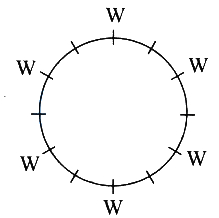
The number of different ways of preparing a garland by using $6$ distinct white roses and $6$ distinct red roses such that no two red roses come together is
A
$43200$
B
$86400$
C
$59200$
D
$76800$
Solution
(A) First,arrange the $6$ distinct white roses in a circle. The number of ways to arrange $n$ distinct items in a circle is $(n-1)!$. So,$6$ white roses can be arranged in $(6-1)! = 5! = 120$ ways.
There are $6$ gaps created between these $6$ white roses. We need to place $6$ distinct red roses in these $6$ gaps so that no two red roses are together. The number of ways to arrange $6$ distinct red roses in $6$ gaps is $6! = 720$ ways.
Since it is a garland,the clockwise and anti-clockwise arrangements are considered the same. Therefore,we divide the total number of linear arrangements by $2$.
The total number of ways $= \frac{5! \times 6!}{2} = \frac{120 \times 720}{2} = \frac{86400}{2} = 43200$.
There are $6$ gaps created between these $6$ white roses. We need to place $6$ distinct red roses in these $6$ gaps so that no two red roses are together. The number of ways to arrange $6$ distinct red roses in $6$ gaps is $6! = 720$ ways.
Since it is a garland,the clockwise and anti-clockwise arrangements are considered the same. Therefore,we divide the total number of linear arrangements by $2$.
The total number of ways $= \frac{5! \times 6!}{2} = \frac{120 \times 720}{2} = \frac{86400}{2} = 43200$.
0 likes
View Solution54
EasyMCQ
The number of ways of arranging $9$ men and $5$ women around a circular table so that no two women come together are
A
$8! \times ^8 P_5$
B
$9! \times ^9 P_5$
C
$8! \times ^9 P_5$
D
$8! \times 5!$
Solution
(C) First,arrange the $9$ men around a circular table,which can be done in $(9-1)! = 8!$ ways.
There are $9$ gaps created between the $9$ men.
To ensure no two women sit together,we must place the $5$ women in these $9$ gaps.
The number of ways to arrange $5$ women in $9$ gaps is given by $^9 P_5$.
Therefore,the total number of ways is $8! \times ^9 P_5$.
There are $9$ gaps created between the $9$ men.
To ensure no two women sit together,we must place the $5$ women in these $9$ gaps.
The number of ways to arrange $5$ women in $9$ gaps is given by $^9 P_5$.
Therefore,the total number of ways is $8! \times ^9 P_5$.
0 likes
View Solution55
EasyMCQ
The number of ways of arranging $2$ red,$3$ white,and $5$ yellow roses of different sizes into a garland such that no two yellow roses come together is
A
$2880$
B
$144$
C
$1440$
D
$288$
Solution
(C) First,arrange the $2$ red and $3$ white roses in a circle. The number of ways to arrange $5$ distinct items in a circle is $(5-1)! = 4! = 24$.
There are $5$ gaps created between these $5$ roses.
We need to place $5$ yellow roses in these $5$ gaps such that no two yellow roses are together.
The number of ways to arrange $5$ distinct yellow roses in $5$ gaps is $5! = 120$.
Since it is a garland,the clockwise and anti-clockwise arrangements are considered the same,so we divide by $2$.
Total number of ways $= \frac{4! \times 5!}{2} = \frac{24 \times 120}{2} = 1440$.
There are $5$ gaps created between these $5$ roses.
We need to place $5$ yellow roses in these $5$ gaps such that no two yellow roses are together.
The number of ways to arrange $5$ distinct yellow roses in $5$ gaps is $5! = 120$.
Since it is a garland,the clockwise and anti-clockwise arrangements are considered the same,so we divide by $2$.
Total number of ways $= \frac{4! \times 5!}{2} = \frac{24 \times 120}{2} = 1440$.
0 likes
View Solution56
EasyMCQ
Six persons $A, B, C, D, E$ and $F$ are to be seated at a circular table facing towards the centre. Find the number of ways this can be done if $A$ must have either $E$ or $F$ on his immediate right and $E$ must have either $F$ or $D$ on his immediate right.
A
$18$
B
$30$
C
$12$
D
$24$
Solution
(A) Fix $A$ at one position. Let the positions be $1, 2, 3, 4, 5, 6$ in clockwise order,with $A$ at position $1$. The immediate right of $A$ is position $6$ (since they face the centre).
Case $1$: $E$ is at position $6$. Then $E$ must have $F$ or $D$ at position $5$.
Subcase $1.1$: $F$ is at position $5$. The remaining $3$ persons $(B, C, D)$ can be arranged in the remaining $3$ positions in $3! = 6$ ways.
Subcase $1.2$: $D$ is at position $5$. The remaining $3$ persons $(B, C, F)$ can be arranged in the remaining $3$ positions in $3! = 6$ ways.
Total for Case $1 = 6 + 6 = 12$ ways.
Case $2$: $F$ is at position $6$. Then $E$ must have $F$ or $D$ on his immediate right. Since $F$ is at position $6$,$E$ cannot be at position $5$ (because $F$ is at $6$,not $5$). Thus,$E$ must be at some other position $k$ such that position $k-1$ (clockwise) is $F$ or $D$.
By checking the remaining positions,we find $6$ valid arrangements for Case $2$.
Total ways $= 12 + 6 = 18$.
Case $1$: $E$ is at position $6$. Then $E$ must have $F$ or $D$ at position $5$.
Subcase $1.1$: $F$ is at position $5$. The remaining $3$ persons $(B, C, D)$ can be arranged in the remaining $3$ positions in $3! = 6$ ways.
Subcase $1.2$: $D$ is at position $5$. The remaining $3$ persons $(B, C, F)$ can be arranged in the remaining $3$ positions in $3! = 6$ ways.
Total for Case $1 = 6 + 6 = 12$ ways.
Case $2$: $F$ is at position $6$. Then $E$ must have $F$ or $D$ on his immediate right. Since $F$ is at position $6$,$E$ cannot be at position $5$ (because $F$ is at $6$,not $5$). Thus,$E$ must be at some other position $k$ such that position $k-1$ (clockwise) is $F$ or $D$.
By checking the remaining positions,we find $6$ valid arrangements for Case $2$.
Total ways $= 12 + 6 = 18$.
0 likes
View Solution57
MediumMCQ
The number of different ways of preparing a garland using $6$ distinct white roses and $5$ distinct red roses such that no two red roses come together is
A
$21600$
B
$43200$
C
$86400$
D
$151200$
Solution
(B) First,arrange the $6$ distinct white roses in a circle. The number of ways to arrange $n$ distinct objects in a circle is $(n-1)!$. So,the number of ways to arrange $6$ white roses is $(6-1)! = 5! = 120$.
There are $6$ gaps created between the $6$ white roses in the circle.
We need to place $5$ distinct red roses in these $6$ gaps such that no two red roses are together. The number of ways to choose $5$ gaps out of $6$ is $^6C_5 = 6$.
The number of ways to arrange $5$ distinct red roses in the chosen $5$ gaps is $5! = 120$.
Since the garland can be flipped (clockwise and anti-clockwise arrangements are considered the same),we divide by $2$.
Total number of ways $= \frac{5! \times ^6C_5 \times 5!}{2} = \frac{120 \times 6 \times 120}{2} = \frac{86400}{2} = 43200$.
There are $6$ gaps created between the $6$ white roses in the circle.
We need to place $5$ distinct red roses in these $6$ gaps such that no two red roses are together. The number of ways to choose $5$ gaps out of $6$ is $^6C_5 = 6$.
The number of ways to arrange $5$ distinct red roses in the chosen $5$ gaps is $5! = 120$.
Since the garland can be flipped (clockwise and anti-clockwise arrangements are considered the same),we divide by $2$.
Total number of ways $= \frac{5! \times ^6C_5 \times 5!}{2} = \frac{120 \times 6 \times 120}{2} = \frac{86400}{2} = 43200$.
0 likes
View Solution58
DifficultMCQ
The number of ways of arranging $8$ men and $4$ women around a circular table such that no two women can sit together is
A
$8!$
B
$4!$
C
$8! 4!$
D
$7! \times {}^{8}P_{4}$
Solution
(D) First,arrange the $8$ men around a circular table. The number of ways to arrange $n$ objects in a circle is $(n-1)!$. So,the number of ways to arrange $8$ men is $(8-1)! = 7!$.
After arranging the men,there are $8$ gaps created between them.
To ensure no two women sit together,we must place the $4$ women in these $8$ gaps.
The number of ways to choose and arrange $4$ women in $8$ gaps is given by the permutation formula ${}^{8}P_{4}$.
Therefore,the total number of ways is $7! \times {}^{8}P_{4}$.
After arranging the men,there are $8$ gaps created between them.
To ensure no two women sit together,we must place the $4$ women in these $8$ gaps.
The number of ways to choose and arrange $4$ women in $8$ gaps is given by the permutation formula ${}^{8}P_{4}$.
Therefore,the total number of ways is $7! \times {}^{8}P_{4}$.
0 likes
View Solution59
MediumMCQ
If $A$ and $B$ are among $20$ persons who sit at random along a round table,then the probability that there are exactly six persons between $A$ and $B$ is
A
$\frac{1}{2}$
B
$\frac{5}{16}$
C
$\frac{2}{19}$
D
$\frac{2}{81}$
Solution
(C) Total number of ways to arrange $20$ persons around a round table is $(20-1)! = 19!$.
Fix person $A$ at one position.
There are $19$ remaining seats for person $B$.
For there to be exactly $6$ persons between $A$ and $B$,$B$ must sit in a specific position relative to $A$.
Counting $6$ seats clockwise from $A$,the $7$th seat is occupied by $B$.
Counting $6$ seats counter-clockwise from $A$,the $7$th seat is also occupied by $B$.
Thus,there are $2$ favorable positions for $B$ out of $19$ possible seats.
Therefore,the probability is $\frac{2}{19}$.
Fix person $A$ at one position.
There are $19$ remaining seats for person $B$.
For there to be exactly $6$ persons between $A$ and $B$,$B$ must sit in a specific position relative to $A$.
Counting $6$ seats clockwise from $A$,the $7$th seat is occupied by $B$.
Counting $6$ seats counter-clockwise from $A$,the $7$th seat is also occupied by $B$.
Thus,there are $2$ favorable positions for $B$ out of $19$ possible seats.
Therefore,the probability is $\frac{2}{19}$.
0 likes
View Solution60
MediumMCQ
If $5$ red roses and $5$ white roses of different sizes are used in preparing a garland,the probability that red and white roses come alternately is
A
$\frac{1}{252}$
B
$\frac{1}{126}$
C
$\frac{1}{63}$
D
$\frac{5}{126}$
Solution
(B) Total number of ways to arrange $5$ red and $5$ white roses in a garland is the number of ways to arrange $10$ distinct items in a circle,which is $(10-1)! = 9!$.
Since the roses are of different sizes,we consider them distinct.
For the roses to be placed alternately,we first fix the $5$ red roses in a circle in $(5-1)! = 4!$ ways.
This creates $5$ gaps between the red roses.
We can place the $5$ white roses in these $5$ gaps in $5!$ ways.
Thus,the number of favorable arrangements is $4! \times 5!$.
The probability is $\frac{4! \times 5!}{9!} = \frac{24 \times 120}{362880} = \frac{2880}{362880} = \frac{1}{126}$.
Since the roses are of different sizes,we consider them distinct.
For the roses to be placed alternately,we first fix the $5$ red roses in a circle in $(5-1)! = 4!$ ways.
This creates $5$ gaps between the red roses.
We can place the $5$ white roses in these $5$ gaps in $5!$ ways.
Thus,the number of favorable arrangements is $4! \times 5!$.
The probability is $\frac{4! \times 5!}{9!} = \frac{24 \times 120}{362880} = \frac{2880}{362880} = \frac{1}{126}$.
0 likes
View Solution61
MediumMCQ
$8$ teachers and $4$ students are sitting around a circular table at random. Then,the probability that no two students sit together is:
A
$\frac{7}{88}$
B
$\frac{14}{33}$
C
$\frac{8}{33}$
D
$\frac{7}{33}$
Solution
(D) Total number of ways to arrange $8$ teachers and $4$ students around a circular table is $(8+4-1)! = 11!$.
To ensure no two students sit together,we first arrange the $8$ teachers in a circle,which can be done in $(8-1)! = 7!$ ways.
This creates $8$ gaps between the teachers. We need to place $4$ students in these $8$ gaps,which can be done in $^8C_4$ ways.
The students can be arranged among themselves in $4!$ ways.
Thus,the number of favorable arrangements is $^8C_4 \times 4! \times 7!$.
The required probability is $\frac{^8C_4 \times 4! \times 7!}{11!} = \frac{\frac{8 \times 7 \times 6 \times 5}{4 \times 3 \times 2 \times 1} \times 4! \times 7!}{11 \times 10 \times 9 \times 8 \times 7!} = \frac{70 \times 24 \times 7!}{11 \times 10 \times 9 \times 8 \times 7!} = \frac{7}{33}$.
To ensure no two students sit together,we first arrange the $8$ teachers in a circle,which can be done in $(8-1)! = 7!$ ways.
This creates $8$ gaps between the teachers. We need to place $4$ students in these $8$ gaps,which can be done in $^8C_4$ ways.
The students can be arranged among themselves in $4!$ ways.
Thus,the number of favorable arrangements is $^8C_4 \times 4! \times 7!$.
The required probability is $\frac{^8C_4 \times 4! \times 7!}{11!} = \frac{\frac{8 \times 7 \times 6 \times 5}{4 \times 3 \times 2 \times 1} \times 4! \times 7!}{11 \times 10 \times 9 \times 8 \times 7!} = \frac{70 \times 24 \times 7!}{11 \times 10 \times 9 \times 8 \times 7!} = \frac{7}{33}$.
0 likes
View Solution62
EasyMCQ
The number of ways of arranging all the letters of the word "$COMBINATIONS$" around a circle so that no two vowels come together is
A
$\frac{7!6!}{(2!)^4}$
B
$\frac{7!6!}{(2!)^3}$
C
$\frac{{ }^{8}P_{5} \times 6!}{(2!)^3}$
D
$\frac{7! \times { }^{8}P_{5}}{(2!)^3}$
Solution
(A) The word "$COMBINATIONS$" has $12$ letters: $C, O, M, B, I, N, A, T, I, O, N, S$.
Consonants: $C, M, B, N, N, T, S$ ($7$ letters,with $N$ repeating twice).
Vowels: $O, I, A, I, O$ ($5$ letters,with $O$ repeating twice and $I$ repeating twice).
First,arrange the $7$ consonants in a circle. The number of ways to arrange $n$ items in a circle is $(n-1)!$. Since $N$ repeats twice,the number of ways is $\frac{(7-1)!}{2!} = \frac{6!}{2!}$.
There are $7$ gaps created between these $7$ consonants. We need to place the $5$ vowels in these $7$ gaps such that no two vowels are together. The number of ways to choose $5$ gaps out of $7$ is ${ }^{7}C_{5}$.
The $5$ vowels can be arranged in these $5$ chosen gaps in $5!$ ways. Since $O$ and $I$ each repeat twice,the number of arrangements is $\frac{5!}{2!2!}$.
Total number of ways $= \frac{6!}{2!} \times { }^{7}C_{5} \times \frac{5!}{2!2!} = \frac{6!}{2!} \times \frac{7!}{5!2!} \times \frac{5!}{2!2!} = \frac{7!6!}{(2!)^4}$.
Consonants: $C, M, B, N, N, T, S$ ($7$ letters,with $N$ repeating twice).
Vowels: $O, I, A, I, O$ ($5$ letters,with $O$ repeating twice and $I$ repeating twice).
First,arrange the $7$ consonants in a circle. The number of ways to arrange $n$ items in a circle is $(n-1)!$. Since $N$ repeats twice,the number of ways is $\frac{(7-1)!}{2!} = \frac{6!}{2!}$.
There are $7$ gaps created between these $7$ consonants. We need to place the $5$ vowels in these $7$ gaps such that no two vowels are together. The number of ways to choose $5$ gaps out of $7$ is ${ }^{7}C_{5}$.
The $5$ vowels can be arranged in these $5$ chosen gaps in $5!$ ways. Since $O$ and $I$ each repeat twice,the number of arrangements is $\frac{5!}{2!2!}$.
Total number of ways $= \frac{6!}{2!} \times { }^{7}C_{5} \times \frac{5!}{2!2!} = \frac{6!}{2!} \times \frac{7!}{5!2!} \times \frac{5!}{2!2!} = \frac{7!6!}{(2!)^4}$.
0 likes
View Solution63
MediumMCQ
The number of ways in which $5$ boys and $4$ girls can sit around a circular table such that no two girls sit together is:
A
$5! \times 4!$
B
$4! \times 5!$
C
$4! \times 5!$
D
$5! \times 3!$
Solution
(B) First,arrange the $5$ boys around a circular table. The number of ways to arrange $n$ objects in a circle is $(n-1)!$. So,the number of ways to arrange $5$ boys is $(5-1)! = 4! = 24$.
There are $5$ spaces created between the $5$ boys where the $4$ girls can sit to ensure no two girls sit together.
The number of ways to arrange $4$ girls in these $5$ spaces is given by $P(5, 4) = \frac{5!}{(5-4)!} = \frac{120}{1} = 120$.
Therefore,the total number of ways is $4! \times 120 = 24 \times 120 = 2880$.
This is equivalent to $4! \times 5!$.
There are $5$ spaces created between the $5$ boys where the $4$ girls can sit to ensure no two girls sit together.
The number of ways to arrange $4$ girls in these $5$ spaces is given by $P(5, 4) = \frac{5!}{(5-4)!} = \frac{120}{1} = 120$.
Therefore,the total number of ways is $4! \times 120 = 24 \times 120 = 2880$.
This is equivalent to $4! \times 5!$.
0 likes
View Solution64
MediumMCQ
Five boys and five girls are to be seated around a circular table. The number of ways in which they can be seated such that no two boys and no two girls are together is:
A
$14400$
B
$2880$
C
$576$
D
$625$
Solution
(B) To seat $5$ boys and $5$ girls around a circular table such that no two boys and no two girls are together,they must sit in an alternating fashion ($B$-$G$-$B$-$G$-$B$-$G$-$B$-$G$-$B$-$G$).
First,fix one boy at a position on the circular table. This can be done in $1$ way.
The remaining $4$ boys can be arranged in the remaining $4$ seats in $(4-1)! = 3! = 6$ ways.
There are $5$ gaps between the boys where the $5$ girls can be seated.
The $5$ girls can be arranged in these $5$ gaps in $5! = 120$ ways.
Therefore,the total number of ways is $1 \times 6 \times 120 = 720$.
Wait,re-evaluating: The number of ways to arrange $n$ boys and $n$ girls in a circle such that they alternate is $(n-1)! \times n!$.
For $n=5$,this is $(5-1)! \times 5! = 4! \times 5! = 24 \times 120 = 2880$.
Thus,the correct option is $B$.
First,fix one boy at a position on the circular table. This can be done in $1$ way.
The remaining $4$ boys can be arranged in the remaining $4$ seats in $(4-1)! = 3! = 6$ ways.
There are $5$ gaps between the boys where the $5$ girls can be seated.
The $5$ girls can be arranged in these $5$ gaps in $5! = 120$ ways.
Therefore,the total number of ways is $1 \times 6 \times 120 = 720$.
Wait,re-evaluating: The number of ways to arrange $n$ boys and $n$ girls in a circle such that they alternate is $(n-1)! \times n!$.
For $n=5$,this is $(5-1)! \times 5! = 4! \times 5! = 24 \times 120 = 2880$.
Thus,the correct option is $B$.
0 likes
View Solution65
MediumMCQ
The number of ways in which $6$ men and $4$ women can be seated around a table so that a particular man and a particular woman never sit adjacent to each other is
A
$9!$
B
$7 \times 8!$
C
$8 \times 8!$
D
$6 \times 7!$
Solution
(B) Total people $= 6 \text{ men} + 4 \text{ women} = 10 \text{ people}$.
First,calculate the total number of ways to seat $10$ people around a circular table,which is $(10-1)! = 9!$.
Next,calculate the number of ways where a particular man and a particular woman sit adjacent to each other.
Treat the particular man and woman as a single unit. Now we have $9$ units to arrange around a circular table,which can be done in $(9-1)! = 8!$ ways.
Within the unit,the man and woman can be arranged in $2! = 2$ ways.
So,the number of ways they sit together is $2 \times 8!$.
The number of ways they never sit adjacent is the total ways minus the ways they sit together:
$9! - (2 \times 8!) = (9 \times 8!) - (2 \times 8!) = (9 - 2) \times 8! = 7 \times 8!$.
First,calculate the total number of ways to seat $10$ people around a circular table,which is $(10-1)! = 9!$.
Next,calculate the number of ways where a particular man and a particular woman sit adjacent to each other.
Treat the particular man and woman as a single unit. Now we have $9$ units to arrange around a circular table,which can be done in $(9-1)! = 8!$ ways.
Within the unit,the man and woman can be arranged in $2! = 2$ ways.
So,the number of ways they sit together is $2 \times 8!$.
The number of ways they never sit adjacent is the total ways minus the ways they sit together:
$9! - (2 \times 8!) = (9 \times 8!) - (2 \times 8!) = (9 - 2) \times 8! = 7 \times 8!$.
0 likes
View Solution66
EasyMCQ
If $3$ sisters and $8$ other girls are together playing a game,then the number of ways in which all the girls are seated around a circle such that the three sisters are not seated together,is
A
$11 ! \times 8$
B
$8 ! \times 504$
C
$7 ! \times 210$
D
$8 ! \times 84$
Solution
(D) Total number of girls $= 3 + 8 = 11$.
Number of ways to arrange $11$ girls around a circle is $(11 - 1)! = 10!$.
To find the number of ways where the $3$ sisters are $NOT$ seated together,we use the complement method: Total arrangements $-$ Arrangements where $3$ sisters are together.
Treating the $3$ sisters as a single unit,we have $8 + 1 = 9$ units to arrange in a circle,which can be done in $(9 - 1)! = 8!$ ways.
The $3$ sisters can be arranged among themselves in $3!$ ways.
So,arrangements where $3$ sisters are together $= 8! \times 3!$.
Required number of ways $= 10! - (8! \times 3!) = 10! - (8! \times 6)$.
$= 8! \times (10 \times 9 - 6) = 8! \times (90 - 6) = 8! \times 84$.
Number of ways to arrange $11$ girls around a circle is $(11 - 1)! = 10!$.
To find the number of ways where the $3$ sisters are $NOT$ seated together,we use the complement method: Total arrangements $-$ Arrangements where $3$ sisters are together.
Treating the $3$ sisters as a single unit,we have $8 + 1 = 9$ units to arrange in a circle,which can be done in $(9 - 1)! = 8!$ ways.
The $3$ sisters can be arranged among themselves in $3!$ ways.
So,arrangements where $3$ sisters are together $= 8! \times 3!$.
Required number of ways $= 10! - (8! \times 3!) = 10! - (8! \times 6)$.
$= 8! \times (10 \times 9 - 6) = 8! \times (90 - 6) = 8! \times 84$.
0 likes
View Solution67
EasyMCQ
The number of ways that $8$ beads of different colours can be strung as a necklace is
A
$2520$
B
$2880$
C
$4320$
D
$5040$
Solution
(A) The number of circular permutations of $n$ distinct objects is $(n-1)!$.
For a necklace,the clockwise and anti-clockwise arrangements are considered identical,so the number of ways is $\frac{(n-1)!}{2}$.
Here,$n = 8$.
Number of ways = $\frac{(8-1)!}{2} = \frac{7!}{2} = \frac{5040}{2} = 2520$.
For a necklace,the clockwise and anti-clockwise arrangements are considered identical,so the number of ways is $\frac{(n-1)!}{2}$.
Here,$n = 8$.
Number of ways = $\frac{(8-1)!}{2} = \frac{7!}{2} = \frac{5040}{2} = 2520$.
0 likes
View SolutionPermutation and Combination — Circular permutations · Frequently Asked Questions
1Are these Permutation and Combination questions useful for JEE and NEET?
Yes. All questions in this section are mapped to JEE Main and NEET exam patterns. Previous year questions from JEE Main, NEET, GUJCET and state-level exams are included with full solutions.
2Can I switch to Hindi or Gujarati for these questions?
Yes. Use the language tabs in the hero section or the sidebar to view the same questions and solutions in English, Hindi or Gujarati.
3How do I generate a question paper from this subtopic?
Use the Vedclass Exam Paper Generator — select the chapter and subtopic, set difficulty, and generate Sets A, B, C, D automatically. First 3 chapters of every subject are free.
Vedclass Products
For Students
Vedclass Test Series
Mock tests in real JEE/NEET style with performance analysis. 5-day free trial.
Start Free TrialFor Teachers
Exam Paper Generator
Generate Set A/B/C/D papers from this chapter in 2 minutes. 3 chapters free.
Try FreeFor Institutes
Online Exam Module
Live online exams with unlimited students, 360° analytics & white-label branding.
See DemoFor Teachers & Institutes
Generate a Permutation and Combination Exam Paper in 2 Minutes
Select subtopic & difficulty — Sets A, B, C, D auto-generated with No Repeat logic.
First 3 chapters of every subject are free — no payment required.