
A English
Equation of pair of straight lines Questions in English
Class 11 Mathematics · Pair of straight lines · Equation of pair of straight lines
299+
Questions
English
Language
100%
With Solutions
Showing 48 of 299 questions in English
151
MediumMCQ
If the lines represented by $ax^2 - bxy - y^2 = 0$ make angles $\alpha$ and $\beta$ with the positive direction of the $X$-axis,then $\tan(\alpha + \beta) = $
A
$\frac{a}{a+b}$
B
$\frac{b}{1+b}$
C
$\frac{b}{1+a}$
D
$\frac{-b}{1+a}$
Solution
(D) The given equation is $ax^2 - bxy - y^2 = 0$. Dividing by $x^2$,we get $-(\frac{y}{x})^2 - b(\frac{y}{x}) + a = 0$,which is $(\frac{y}{x})^2 + b(\frac{y}{x}) - a = 0$.
Let $m_1 = \tan \alpha$ and $m_2 = \tan \beta$ be the slopes of the lines.
These are the roots of the quadratic equation $m^2 + bm - a = 0$.
From the properties of roots,we have $\tan \alpha + \tan \beta = -b$ and $\tan \alpha \tan \beta = -a$.
Using the formula $\tan(\alpha + \beta) = \frac{\tan \alpha + \tan \beta}{1 - \tan \alpha \tan \beta}$,we substitute the values:
$\tan(\alpha + \beta) = \frac{-b}{1 - (-a)} = \frac{-b}{1+a}$.
Let $m_1 = \tan \alpha$ and $m_2 = \tan \beta$ be the slopes of the lines.
These are the roots of the quadratic equation $m^2 + bm - a = 0$.
From the properties of roots,we have $\tan \alpha + \tan \beta = -b$ and $\tan \alpha \tan \beta = -a$.
Using the formula $\tan(\alpha + \beta) = \frac{\tan \alpha + \tan \beta}{1 - \tan \alpha \tan \beta}$,we substitute the values:
$\tan(\alpha + \beta) = \frac{-b}{1 - (-a)} = \frac{-b}{1+a}$.
0 likes
View Solution152
EasyMCQ
If the slopes of the lines given by the equation $ax^{2} + 2hxy + by^{2} = 0$ are in the ratio $5:3$,then the ratio $h^{2}:ab$ is:
A
$5:3$
B
$16:15$
C
$3:5$
D
$15:16$
Solution
(B) Let the slopes of the lines be $m_{1}$ and $m_{2}$.
Given the equation $ax^{2} + 2hxy + by^{2} = 0$,we have $m_{1} + m_{2} = \frac{-2h}{b}$ and $m_{1}m_{2} = \frac{a}{b}$.
Given the ratio of slopes is $m_{1}:m_{2} = 5:3$,let $m_{1} = 5k$ and $m_{2} = 3k$.
Then $m_{1} + m_{2} = 8k = \frac{-2h}{b} \Rightarrow k = \frac{-h}{4b}$.
Also $m_{1}m_{2} = 15k^{2} = \frac{a}{b}$.
Substituting $k$ in the second equation: $15 \left( \frac{-h}{4b} \right)^{2} = \frac{a}{b}$.
$15 \left( \frac{h^{2}}{16b^{2}} \right) = \frac{a}{b}$.
$\frac{15h^{2}}{16b} = a$.
Therefore,$\frac{h^{2}}{ab} = \frac{16}{15}$.
Given the equation $ax^{2} + 2hxy + by^{2} = 0$,we have $m_{1} + m_{2} = \frac{-2h}{b}$ and $m_{1}m_{2} = \frac{a}{b}$.
Given the ratio of slopes is $m_{1}:m_{2} = 5:3$,let $m_{1} = 5k$ and $m_{2} = 3k$.
Then $m_{1} + m_{2} = 8k = \frac{-2h}{b} \Rightarrow k = \frac{-h}{4b}$.
Also $m_{1}m_{2} = 15k^{2} = \frac{a}{b}$.
Substituting $k$ in the second equation: $15 \left( \frac{-h}{4b} \right)^{2} = \frac{a}{b}$.
$15 \left( \frac{h^{2}}{16b^{2}} \right) = \frac{a}{b}$.
$\frac{15h^{2}}{16b} = a$.
Therefore,$\frac{h^{2}}{ab} = \frac{16}{15}$.
0 likes
View Solution153
EasyMCQ
If the slopes of the lines represented by $K x^2 + 5 x y + y^2 = 0$ differ by $1$,then $K =$
A
$2$
B
$3$
C
$6$
D
$8$
Solution
(C) The given equation is $K x^2 + 5 x y + y^2 = 0$.
Comparing this with the general equation $a x^2 + 2 h x y + b y^2 = 0$,we have $a = K$,$2h = 5$,and $b = 1$.
Let the slopes of the lines be $m_1$ and $m_2$.
Then,$m_1 + m_2 = -\frac{2h}{b} = -5$ and $m_1 m_2 = \frac{a}{b} = K$.
It is given that the difference between the slopes is $1$,i.e.,$|m_1 - m_2| = 1$.
Using the identity $(m_1 - m_2)^2 = (m_1 + m_2)^2 - 4 m_1 m_2$,we substitute the values:
$1^2 = (-5)^2 - 4(K)$.
$1 = 25 - 4K$.
$4K = 24$.
$K = 6$.
Comparing this with the general equation $a x^2 + 2 h x y + b y^2 = 0$,we have $a = K$,$2h = 5$,and $b = 1$.
Let the slopes of the lines be $m_1$ and $m_2$.
Then,$m_1 + m_2 = -\frac{2h}{b} = -5$ and $m_1 m_2 = \frac{a}{b} = K$.
It is given that the difference between the slopes is $1$,i.e.,$|m_1 - m_2| = 1$.
Using the identity $(m_1 - m_2)^2 = (m_1 + m_2)^2 - 4 m_1 m_2$,we substitute the values:
$1^2 = (-5)^2 - 4(K)$.
$1 = 25 - 4K$.
$4K = 24$.
$K = 6$.
0 likes
View Solution154
MediumMCQ
If one of the lines given by $k x^2 + x y - y^2 = 0$ bisects the angle between the coordinate axes,then the values of $k$ are
A
$1$ and $2$
B
$0$ and $2$
C
$0$ and $-2$
D
$-1$ and $2$
Solution
(B) The equation of the pair of lines is $k x^2 + x y - y^2 = 0$.
Since the lines bisect the angle between the coordinate axes,their slopes must be $m = \pm 1$.
Substituting $y = mx$ into the equation,we get $k x^2 + x(mx) - (mx)^2 = 0$.
Dividing by $x^2$ (assuming $x \neq 0$),we get $k + m - m^2 = 0$.
For $m = 1$,$k + 1 - 1^2 = 0 \Rightarrow k = 0$.
For $m = -1$,$k - 1 - (-1)^2 = 0$ $\Rightarrow k - 1 - 1 = 0$ $\Rightarrow k = 2$.
Thus,the values of $k$ are $0$ and $2$.
Since the lines bisect the angle between the coordinate axes,their slopes must be $m = \pm 1$.
Substituting $y = mx$ into the equation,we get $k x^2 + x(mx) - (mx)^2 = 0$.
Dividing by $x^2$ (assuming $x \neq 0$),we get $k + m - m^2 = 0$.
For $m = 1$,$k + 1 - 1^2 = 0 \Rightarrow k = 0$.
For $m = -1$,$k - 1 - (-1)^2 = 0$ $\Rightarrow k - 1 - 1 = 0$ $\Rightarrow k = 2$.
Thus,the values of $k$ are $0$ and $2$.
0 likes
View Solution155
MediumMCQ
If the equation $kxy + 10x + 8y + 16 = 0$ represents a pair of lines,then
A
$k = 5$ only
B
$k = 0$ only
C
$k = 0$ or $k = 5$
D
the value of $k$ does not exist
Solution
(C) The general equation of a second-degree curve is $ax^2 + 2hxy + by^2 + 2gx + 2fy + c = 0$.
For this to represent a pair of straight lines,the condition is $abc + 2fgh - af^2 - bg^2 - ch^2 = 0$.
Comparing the given equation $kxy + 10x + 8y + 16 = 0$ with the general form,we have:
$a = 0, b = 0, c = 16, h = k/2, g = 5, f = 4$.
Substituting these values into the condition:
$(0)(0)(16) + 2(4)(5)(k/2) - (0)(4^2) - (0)(5^2) - (16)(k/2)^2 = 0$.
$0 + 20k - 0 - 0 - 16(k^2/4) = 0$.
$20k - 4k^2 = 0$.
$4k(5 - k) = 0$.
Thus,$k = 0$ or $k = 5$.
For this to represent a pair of straight lines,the condition is $abc + 2fgh - af^2 - bg^2 - ch^2 = 0$.
Comparing the given equation $kxy + 10x + 8y + 16 = 0$ with the general form,we have:
$a = 0, b = 0, c = 16, h = k/2, g = 5, f = 4$.
Substituting these values into the condition:
$(0)(0)(16) + 2(4)(5)(k/2) - (0)(4^2) - (0)(5^2) - (16)(k/2)^2 = 0$.
$0 + 20k - 0 - 0 - 16(k^2/4) = 0$.
$20k - 4k^2 = 0$.
$4k(5 - k) = 0$.
Thus,$k = 0$ or $k = 5$.
0 likes
View Solution156
MediumMCQ
If the slope of one of the lines represented by $ax^2 + (2a + 1)xy + 2y^2 = 0$ is the reciprocal of the slope of the other,then the sum of the squares of the slopes is
A
$\frac{17}{4}$
B
$\frac{82}{9}$
C
$\frac{97}{36}$
D
$2$
Solution
(A) The given equation of the pair of lines is $ax^2 + (2a + 1)xy + 2y^2 = 0$.
Comparing this with $Ax^2 + 2Hxy + By^2 = 0$,we have $A = a$,$2H = 2a + 1$,and $B = 2$.
Let the slopes of the lines be $m_1$ and $m_2$.
Given that $m_1 = \frac{1}{m_2}$,which implies $m_1 m_2 = 1$.
For a pair of lines $ax^2 + 2hxy + by^2 = 0$,the product of slopes is $m_1 m_2 = \frac{A}{B} = \frac{a}{2}$.
Equating the two,we get $\frac{a}{2} = 1$,so $a = 2$.
The sum of the slopes is $m_1 + m_2 = -\frac{2H}{B} = -\frac{2a + 1}{2}$.
Substituting $a = 2$,we get $m_1 + m_2 = -\frac{2(2) + 1}{2} = -\frac{5}{2}$.
We need to find $m_1^2 + m_2^2$.
Using the identity $m_1^2 + m_2^2 = (m_1 + m_2)^2 - 2m_1 m_2$,we get:
$m_1^2 + m_2^2 = (-\frac{5}{2})^2 - 2(1) = \frac{25}{4} - 2 = \frac{25 - 8}{4} = \frac{17}{4}$.
Comparing this with $Ax^2 + 2Hxy + By^2 = 0$,we have $A = a$,$2H = 2a + 1$,and $B = 2$.
Let the slopes of the lines be $m_1$ and $m_2$.
Given that $m_1 = \frac{1}{m_2}$,which implies $m_1 m_2 = 1$.
For a pair of lines $ax^2 + 2hxy + by^2 = 0$,the product of slopes is $m_1 m_2 = \frac{A}{B} = \frac{a}{2}$.
Equating the two,we get $\frac{a}{2} = 1$,so $a = 2$.
The sum of the slopes is $m_1 + m_2 = -\frac{2H}{B} = -\frac{2a + 1}{2}$.
Substituting $a = 2$,we get $m_1 + m_2 = -\frac{2(2) + 1}{2} = -\frac{5}{2}$.
We need to find $m_1^2 + m_2^2$.
Using the identity $m_1^2 + m_2^2 = (m_1 + m_2)^2 - 2m_1 m_2$,we get:
$m_1^2 + m_2^2 = (-\frac{5}{2})^2 - 2(1) = \frac{25}{4} - 2 = \frac{25 - 8}{4} = \frac{17}{4}$.
0 likes
View Solution157
MediumMCQ
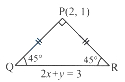
Let $PQR$ be a right-angled isosceles triangle,right-angled at $P(2, 1)$. If the equation of the line $QR$ is $2x + y = 3$,then the equation representing the pair of lines $PQ$ and $PR$ is
A
$3x^2 - 3y^2 + 8xy + 20x + 10y + 25 = 0$
B
$3x^2 - 3y^2 + 8xy - 20x - 10y + 25 = 0$
C
$3x^2 - 3y^2 + 8xy + 10x + 15y + 20 = 0$
D
$3x^2 - 3y^2 - 8xy - 10x - 15y - 20 = 0$
Solution
(B) The slope of line $QR$ is $m = -2$. Let the slopes of lines $PQ$ and $PR$ be $m_1$ and $m_2$ respectively.
Since $\triangle PQR$ is an isosceles right-angled triangle,the angles $\angle PQR = \angle PRQ = 45^{\circ}$.
Using the formula $\tan \theta = \left| \frac{m - m_1}{1 + m \cdot m_1} \right|$,we have $\tan 45^{\circ} = \left| \frac{-2 - m_1}{1 + (-2)m_1} \right| = 1$.
This gives $\left| \frac{2 + m_1}{1 - 2m_1} \right| = 1$,so $2 + m_1 = 1 - 2m_1$ or $2 + m_1 = -(1 - 2m_1)$.
Solving $3m_1 = -1$ gives $m_1 = -1/3$. Solving $-m_1 = -3$ gives $m_2 = 3$.
The lines $PQ$ and $PR$ pass through $P(2, 1)$ with slopes $-1/3$ and $3$.
The equations are $y - 1 = -1/3(x - 2) \Rightarrow x + 3y - 5 = 0$ and $y - 1 = 3(x - 2) \Rightarrow 3x - y - 5 = 0$.
The joint equation is $(x + 3y - 5)(3x - y - 5) = 0$.
Expanding this: $3x^2 - xy - 5x + 9xy - 3y^2 - 15y - 15x + 5y + 25 = 0$.
Simplifying gives $3x^2 - 3y^2 + 8xy - 20x - 10y + 25 = 0$.
Since $\triangle PQR$ is an isosceles right-angled triangle,the angles $\angle PQR = \angle PRQ = 45^{\circ}$.
Using the formula $\tan \theta = \left| \frac{m - m_1}{1 + m \cdot m_1} \right|$,we have $\tan 45^{\circ} = \left| \frac{-2 - m_1}{1 + (-2)m_1} \right| = 1$.
This gives $\left| \frac{2 + m_1}{1 - 2m_1} \right| = 1$,so $2 + m_1 = 1 - 2m_1$ or $2 + m_1 = -(1 - 2m_1)$.
Solving $3m_1 = -1$ gives $m_1 = -1/3$. Solving $-m_1 = -3$ gives $m_2 = 3$.
The lines $PQ$ and $PR$ pass through $P(2, 1)$ with slopes $-1/3$ and $3$.
The equations are $y - 1 = -1/3(x - 2) \Rightarrow x + 3y - 5 = 0$ and $y - 1 = 3(x - 2) \Rightarrow 3x - y - 5 = 0$.
The joint equation is $(x + 3y - 5)(3x - y - 5) = 0$.
Expanding this: $3x^2 - xy - 5x + 9xy - 3y^2 - 15y - 15x + 5y + 25 = 0$.
Simplifying gives $3x^2 - 3y^2 + 8xy - 20x - 10y + 25 = 0$.
0 likes
View Solution158
EasyMCQ
If $4ab = 3h^2$,then the ratio of slopes of the lines represented by $ax^2 + 2hxy + by^2 = 0$ is
A
$1: 2$
B
$2: 1$
C
$1: 3$
D
$3: 1$
Solution
(C) The equation of the pair of lines is $ax^2 + 2hxy + by^2 = 0$. Let $m_1$ and $m_2$ be the slopes of the lines.
We know that $m_1 + m_2 = -\frac{2h}{b}$ and $m_1m_2 = \frac{a}{b}$.
The difference of the slopes is given by $(m_1 - m_2)^2 = (m_1 + m_2)^2 - 4m_1m_2$.
$(m_1 - m_2)^2 = \left(-\frac{2h}{b}\right)^2 - 4\left(\frac{a}{b}\right) = \frac{4h^2}{b^2} - \frac{4a}{b} = \frac{4h^2 - 4ab}{b^2}$.
Given $4ab = 3h^2$,we substitute this into the expression:
$(m_1 - m_2)^2 = \frac{4h^2 - 3h^2}{b^2} = \frac{h^2}{b^2}$.
Thus,$m_1 - m_2 = \pm \frac{h}{b}$.
Taking $m_1 - m_2 = \frac{h}{b}$ and $m_1 + m_2 = -\frac{2h}{b}$,we solve for $m_1$ and $m_2$:
$2m_1 = -\frac{2h}{b} + \frac{h}{b} = -\frac{h}{b} \Rightarrow m_1 = -\frac{h}{2b}$.
$2m_2 = -\frac{2h}{b} - \frac{h}{b} = -\frac{3h}{b} \Rightarrow m_2 = -\frac{3h}{2b}$.
The ratio $m_1 : m_2 = \left(-\frac{h}{2b}\right) : \left(-\frac{3h}{2b}\right) = 1 : 3$.
We know that $m_1 + m_2 = -\frac{2h}{b}$ and $m_1m_2 = \frac{a}{b}$.
The difference of the slopes is given by $(m_1 - m_2)^2 = (m_1 + m_2)^2 - 4m_1m_2$.
$(m_1 - m_2)^2 = \left(-\frac{2h}{b}\right)^2 - 4\left(\frac{a}{b}\right) = \frac{4h^2}{b^2} - \frac{4a}{b} = \frac{4h^2 - 4ab}{b^2}$.
Given $4ab = 3h^2$,we substitute this into the expression:
$(m_1 - m_2)^2 = \frac{4h^2 - 3h^2}{b^2} = \frac{h^2}{b^2}$.
Thus,$m_1 - m_2 = \pm \frac{h}{b}$.
Taking $m_1 - m_2 = \frac{h}{b}$ and $m_1 + m_2 = -\frac{2h}{b}$,we solve for $m_1$ and $m_2$:
$2m_1 = -\frac{2h}{b} + \frac{h}{b} = -\frac{h}{b} \Rightarrow m_1 = -\frac{h}{2b}$.
$2m_2 = -\frac{2h}{b} - \frac{h}{b} = -\frac{3h}{b} \Rightarrow m_2 = -\frac{3h}{2b}$.
The ratio $m_1 : m_2 = \left(-\frac{h}{2b}\right) : \left(-\frac{3h}{2b}\right) = 1 : 3$.
0 likes
View Solution159
EasyMCQ
The joint equation of the pair of lines passing through $(2,3)$ and parallel to the lines represented by $x^{2}-y^{2}=0$ is:
A
$x^{2}-y^{2}-4x+6y-5=0$
B
$x^{2}-y^{2}-4x+6y=0$
C
$x^{2}-y^{2}-4x+6y+17=0$
D
$x^{2}-y^{2}-4x+6y+2=0$
Solution
(A) The given equation is $x^{2}-y^{2}=0$,which can be written as $(x-y)(x+y)=0$.
Thus,the slopes of the given lines are $m_{1}=1$ and $m_{2}=-1$.
The equations of the lines passing through $(2,3)$ and parallel to these lines are:
$(y-3)=1(x-2) \Rightarrow x-y+1=0$
$(y-3)=-1(x-2) \Rightarrow x+y-5=0$
The joint equation is the product of these two lines:
$(x-y+1)(x+y-5)=0$
Expanding this:
$x(x+y-5) - y(x+y-5) + 1(x+y-5) = 0$
$x^{2}+xy-5x-xy-y^{2}+5y+x+y-5=0$
$x^{2}-y^{2}-4x+6y-5=0$
Thus,the slopes of the given lines are $m_{1}=1$ and $m_{2}=-1$.
The equations of the lines passing through $(2,3)$ and parallel to these lines are:
$(y-3)=1(x-2) \Rightarrow x-y+1=0$
$(y-3)=-1(x-2) \Rightarrow x+y-5=0$
The joint equation is the product of these two lines:
$(x-y+1)(x+y-5)=0$
Expanding this:
$x(x+y-5) - y(x+y-5) + 1(x+y-5) = 0$
$x^{2}+xy-5x-xy-y^{2}+5y+x+y-5=0$
$x^{2}-y^{2}-4x+6y-5=0$
0 likes
View Solution160
MediumMCQ
If the equation $kxy + 5x + 3y + 2 = 0$ represents a pair of lines,then $k=$
A
$0$
B
$\frac{15}{2}$
C
$0, \frac{15}{2}$
D
$15$
Solution
(C) The general equation of a second-degree curve is $Ax^{2} + 2Hxy + By^{2} + 2Gx + 2Fy + C = 0$.
For this to represent a pair of lines,the condition is $\Delta = ABC + 2FGH - AF^{2} - BG^{2} - CH^{2} = 0$.
Comparing the given equation $kxy + 5x + 3y + 2 = 0$ with the general form,we have:
$A = 0, B = 0, C = 2, 2H = k$ $\Rightarrow H = \frac{k}{2}, 2G = 5$ $\Rightarrow G = \frac{5}{2}, 2F = 3$ $\Rightarrow F = \frac{3}{2}$.
Substituting these values into the condition $\Delta = 0$:
$0 + 2(\frac{3}{2})(\frac{5}{2})(\frac{k}{2}) - 0 - 0 - 2(\frac{k}{2})^{2} = 0$.
$\frac{15k}{4} - \frac{2k^{2}}{4} = 0$.
$15k - 2k^{2} = 0$.
$k(15 - 2k) = 0$.
Thus,$k = 0$ or $k = \frac{15}{2}$.
For this to represent a pair of lines,the condition is $\Delta = ABC + 2FGH - AF^{2} - BG^{2} - CH^{2} = 0$.
Comparing the given equation $kxy + 5x + 3y + 2 = 0$ with the general form,we have:
$A = 0, B = 0, C = 2, 2H = k$ $\Rightarrow H = \frac{k}{2}, 2G = 5$ $\Rightarrow G = \frac{5}{2}, 2F = 3$ $\Rightarrow F = \frac{3}{2}$.
Substituting these values into the condition $\Delta = 0$:
$0 + 2(\frac{3}{2})(\frac{5}{2})(\frac{k}{2}) - 0 - 0 - 2(\frac{k}{2})^{2} = 0$.
$\frac{15k}{4} - \frac{2k^{2}}{4} = 0$.
$15k - 2k^{2} = 0$.
$k(15 - 2k) = 0$.
Thus,$k = 0$ or $k = \frac{15}{2}$.
0 likes
View Solution161
EasyMCQ
The separate equations of the lines represented by $4x^{2}-y^{2}+2x+y=0$ are
A
$2x-2y+1=0, x+2y=0$
B
$2x-y+1=0, 2x+y=0$
C
$2x-y+1=0, 2x-y=0$
D
$2x-y=0, 2x+y+1=0$
Solution
(D) Given equation: $4x^{2}-y^{2}+2x+y=0$
We can rewrite the expression as: $(2x)^{2} - y^{2} + (2x+y) = 0$
Using the identity $a^{2}-b^{2} = (a-b)(a+b)$,we get: $(2x-y)(2x+y) + (2x+y) = 0$
Factoring out $(2x+y)$: $(2x+y)(2x-y+1) = 0$
Thus,the separate equations are $2x+y=0$ and $2x-y+1=0$.
We can rewrite the expression as: $(2x)^{2} - y^{2} + (2x+y) = 0$
Using the identity $a^{2}-b^{2} = (a-b)(a+b)$,we get: $(2x-y)(2x+y) + (2x+y) = 0$
Factoring out $(2x+y)$: $(2x+y)(2x-y+1) = 0$
Thus,the separate equations are $2x+y=0$ and $2x-y+1=0$.
0 likes
View Solution162
EasyMCQ
If the sum of the slopes of the lines given by $x^2-4pxy+8y^2=0$ is three times their product,then $p=\ldots$
A
$\frac{3}{4}$
B
$\frac{1}{4}$
C
$4$
D
$3$
Solution
(A) The given equation of the pair of lines is $x^2-4pxy+8y^2=0$.
This is in the form $ax^2+2hxy+by^2=0$,where $a=1$,$2h=-4p$,and $b=8$.
Let $m_1$ and $m_2$ be the slopes of the lines.
We know that $m_1+m_2 = -\frac{2h}{b}$ and $m_1m_2 = \frac{a}{b}$.
Substituting the values,$m_1+m_2 = -\frac{-4p}{8} = \frac{4p}{8} = \frac{p}{2}$ and $m_1m_2 = \frac{1}{8}$.
According to the problem,the sum of the slopes is three times their product:
$m_1+m_2 = 3(m_1m_2)$
$\frac{p}{2} = 3 \times \frac{1}{8}$
$\frac{p}{2} = \frac{3}{8}$
$p = \frac{3}{8} \times 2 = \frac{3}{4}$.
This is in the form $ax^2+2hxy+by^2=0$,where $a=1$,$2h=-4p$,and $b=8$.
Let $m_1$ and $m_2$ be the slopes of the lines.
We know that $m_1+m_2 = -\frac{2h}{b}$ and $m_1m_2 = \frac{a}{b}$.
Substituting the values,$m_1+m_2 = -\frac{-4p}{8} = \frac{4p}{8} = \frac{p}{2}$ and $m_1m_2 = \frac{1}{8}$.
According to the problem,the sum of the slopes is three times their product:
$m_1+m_2 = 3(m_1m_2)$
$\frac{p}{2} = 3 \times \frac{1}{8}$
$\frac{p}{2} = \frac{3}{8}$
$p = \frac{3}{8} \times 2 = \frac{3}{4}$.
0 likes
View Solution163
DifficultMCQ
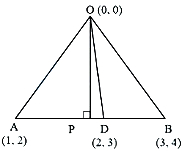
$O(0,0), A(1,2), B(3,4)$ are the vertices of $\triangle OAB$. The joint equation of the altitude and median drawn from $O$ is
A
$x^2+7xy-y^2=0$
B
$x^2+7xy+y^2=0$
C
$3x^2-xy-2y^2=0$
D
$3x^2+xy-2y^2=0$
Solution
(D) Let $O(0,0), A(1,2), B(3,4)$.
$1$. Median from $O$ to $AB$:
The midpoint $D$ of $AB$ is $(\frac{1+3}{2}, \frac{2+4}{2}) = (2,3)$.
The equation of the median $OD$ passing through $(0,0)$ and $(2,3)$ is $y = \frac{3}{2}x$,which simplifies to $3x - 2y = 0$.
$2$. Altitude from $O$ to $AB$:
The slope of $AB$ is $m_{AB} = \frac{4-2}{3-1} = \frac{2}{2} = 1$.
The slope of the altitude $OP$ is $m_{OP} = -\frac{1}{m_{AB}} = -1$.
The equation of the altitude $OP$ passing through $(0,0)$ with slope $-1$ is $y = -x$,which simplifies to $x + y = 0$.
$3$. Joint equation:
The joint equation of the altitude and median is $(3x - 2y)(x + y) = 0$.
Expanding this,we get $3x^2 + 3xy - 2xy - 2y^2 = 0$,which is $3x^2 + xy - 2y^2 = 0$.
$1$. Median from $O$ to $AB$:
The midpoint $D$ of $AB$ is $(\frac{1+3}{2}, \frac{2+4}{2}) = (2,3)$.
The equation of the median $OD$ passing through $(0,0)$ and $(2,3)$ is $y = \frac{3}{2}x$,which simplifies to $3x - 2y = 0$.
$2$. Altitude from $O$ to $AB$:
The slope of $AB$ is $m_{AB} = \frac{4-2}{3-1} = \frac{2}{2} = 1$.
The slope of the altitude $OP$ is $m_{OP} = -\frac{1}{m_{AB}} = -1$.
The equation of the altitude $OP$ passing through $(0,0)$ with slope $-1$ is $y = -x$,which simplifies to $x + y = 0$.
$3$. Joint equation:
The joint equation of the altitude and median is $(3x - 2y)(x + y) = 0$.
Expanding this,we get $3x^2 + 3xy - 2xy - 2y^2 = 0$,which is $3x^2 + xy - 2y^2 = 0$.
0 likes
View Solution164
MediumMCQ
If one of the lines of the pair $ax^{2}+2hxy+by^{2}=0$ bisects the angle between the positive direction of the axes,then $a, b,$ and $h$ satisfy the relation:
A
$a+b=2|h|$
B
$a+b=-2h$
C
$a-b=2|h|$
D
$(a-b)^{2}=4h^{2}$
Solution
(B) The line that bisects the angle between the positive $x$-axis and positive $y$-axis is $y=x$.
Since this line is a part of the pair $ax^{2}+2hxy+by^{2}=0$,it must satisfy the equation.
Substituting $y=x$ into the equation:
$ax^{2}+2hx(x)+b(x)^{2}=0$
$ax^{2}+2hx^{2}+bx^{2}=0$
$(a+2h+b)x^{2}=0$
For this to hold for all $x$,we must have $a+b+2h=0$,which implies $a+b=-2h$.
Since this line is a part of the pair $ax^{2}+2hxy+by^{2}=0$,it must satisfy the equation.
Substituting $y=x$ into the equation:
$ax^{2}+2hx(x)+b(x)^{2}=0$
$ax^{2}+2hx^{2}+bx^{2}=0$
$(a+2h+b)x^{2}=0$
For this to hold for all $x$,we must have $a+b+2h=0$,which implies $a+b=-2h$.
0 likes
View Solution165
EasyMCQ
If the equation given by $hxy + 10x + 6y + 4 = 0$ represents a pair of lines,then $h$ is equal to
A
$15$
B
$30$
C
$5$
D
$10$
Solution
(B) The general equation of a second-degree curve is $ax^2 + 2hxy + by^2 + 2gx + 2fy + c = 0$.
Comparing $hxy + 10x + 6y + 4 = 0$ with the general form,we get $a = 0, b = 0, 2h' = h \Rightarrow h' = h/2, g = 5, f = 3, c = 4$.
For the equation to represent a pair of lines,the determinant must be zero:
$\Delta = \begin{vmatrix} a & h' & g \\ h' & b & f \\ g & f & c \end{vmatrix} = 0$
$\begin{vmatrix} 0 & h/2 & 5 \\ h/2 & 0 & 3 \\ 5 & 3 & 4 \end{vmatrix} = 0$
$0(0 - 9) - \frac{h}{2}(2h/2 - 15) + 5(3h/2 - 0) = 0$
$-\frac{h}{2}(h - 15) + \frac{15h}{2} = 0$
$-\frac{h^2}{2} + \frac{15h}{2} + \frac{15h}{2} = 0$
$-\frac{h^2}{2} + 15h = 0$
$-h^2 + 30h = 0 \Rightarrow h(30 - h) = 0$
Therefore,$h = 0$ or $h = 30$.
Comparing $hxy + 10x + 6y + 4 = 0$ with the general form,we get $a = 0, b = 0, 2h' = h \Rightarrow h' = h/2, g = 5, f = 3, c = 4$.
For the equation to represent a pair of lines,the determinant must be zero:
$\Delta = \begin{vmatrix} a & h' & g \\ h' & b & f \\ g & f & c \end{vmatrix} = 0$
$\begin{vmatrix} 0 & h/2 & 5 \\ h/2 & 0 & 3 \\ 5 & 3 & 4 \end{vmatrix} = 0$
$0(0 - 9) - \frac{h}{2}(2h/2 - 15) + 5(3h/2 - 0) = 0$
$-\frac{h}{2}(h - 15) + \frac{15h}{2} = 0$
$-\frac{h^2}{2} + \frac{15h}{2} + \frac{15h}{2} = 0$
$-\frac{h^2}{2} + 15h = 0$
$-h^2 + 30h = 0 \Rightarrow h(30 - h) = 0$
Therefore,$h = 0$ or $h = 30$.
0 likes
View Solution166
DifficultMCQ
The joint equation of the pair of lines passing through $(3, -2)$ and parallel to the lines represented by $x^{2} - 4xy + 3y^{2} = 0$ is:
A
$x^{2} + 3y^{2} - 4xy - 14x + 24y + 45 = 0$
B
$x^{2} + 3y^{2} + 4xy - 14x + 24y + 45 = 0$
C
$x^{2} + 3y^{2} + 4xy - 14x + 24y - 45 = 0$
D
$x^{2} + 3y^{2} + 4xy - 14x - 24y - 45 = 0$
Solution
(A) The given equation is $x^{2} - 4xy + 3y^{2} = 0$.
Factoring the equation: $x^{2} - 3xy - xy + 3y^{2} = 0$ $\Rightarrow x(x - 3y) - y(x - 3y) = 0$ $\Rightarrow (x - y)(x - 3y) = 0$.
The lines are $x - y = 0$ and $x - 3y = 0$.
Lines parallel to these passing through $(3, -2)$ are of the form $(x - y + k_{1}) = 0$ and $(x - 3y + k_{2}) = 0$.
For $(x - y + k_{1}) = 0$ passing through $(3, -2)$: $3 - (-2) + k_{1} = 0$ $\Rightarrow 5 + k_{1} = 0$ $\Rightarrow k_{1} = -5$.
For $(x - 3y + k_{2}) = 0$ passing through $(3, -2)$: $3 - 3(-2) + k_{2} = 0$ $\Rightarrow 3 + 6 + k_{2} = 0$ $\Rightarrow k_{2} = -9$.
The joint equation is $(x - y - 5)(x - 3y - 9) = 0$.
Expanding: $x(x - 3y - 9) - y(x - 3y - 9) - 5(x - 3y - 9) = 0$.
$x^{2} - 3xy - 9x - xy + 3y^{2} + 9y - 5x + 15y + 45 = 0$.
$x^{2} + 3y^{2} - 4xy - 14x + 24y + 45 = 0$.
Factoring the equation: $x^{2} - 3xy - xy + 3y^{2} = 0$ $\Rightarrow x(x - 3y) - y(x - 3y) = 0$ $\Rightarrow (x - y)(x - 3y) = 0$.
The lines are $x - y = 0$ and $x - 3y = 0$.
Lines parallel to these passing through $(3, -2)$ are of the form $(x - y + k_{1}) = 0$ and $(x - 3y + k_{2}) = 0$.
For $(x - y + k_{1}) = 0$ passing through $(3, -2)$: $3 - (-2) + k_{1} = 0$ $\Rightarrow 5 + k_{1} = 0$ $\Rightarrow k_{1} = -5$.
For $(x - 3y + k_{2}) = 0$ passing through $(3, -2)$: $3 - 3(-2) + k_{2} = 0$ $\Rightarrow 3 + 6 + k_{2} = 0$ $\Rightarrow k_{2} = -9$.
The joint equation is $(x - y - 5)(x - 3y - 9) = 0$.
Expanding: $x(x - 3y - 9) - y(x - 3y - 9) - 5(x - 3y - 9) = 0$.
$x^{2} - 3xy - 9x - xy + 3y^{2} + 9y - 5x + 15y + 45 = 0$.
$x^{2} + 3y^{2} - 4xy - 14x + 24y + 45 = 0$.
0 likes
View Solution167
MediumMCQ
If the equation $7x^2 - 14xy + py^2 - 12x + qy - 4 = 0$ represents a pair of parallel lines,then the value of $\sqrt{p^2 + q^2 - pq}$ is
A
$\sqrt{119}$
B
$\sqrt{107}$
C
$\sqrt{109}$
D
$\sqrt{108}$
Solution
(C) The given equation of the pair of lines is $7x^2 - 14xy + py^2 - 12x + qy - 4 = 0$.
Comparing this with the general equation $ax^2 + 2hxy + by^2 + 2gx + 2fy + c = 0$,we get $a = 7$,$h = -7$,$b = p$,$g = -6$,$f = \frac{q}{2}$,and $c = -4$.
Since the lines are parallel,$h^2 = ab$.
Substituting the values,$(-7)^2 = 7p$ $\Rightarrow 49 = 7p$ $\Rightarrow p = 7$.
For the equation to represent a pair of lines,the condition $abc + 2fgh - af^2 - bg^2 - ch^2 = 0$ must be satisfied.
Substituting $p = 7$,$a = 7$,$h = -7$,$g = -6$,$f = \frac{q}{2}$,and $c = -4$:
$7(7)(-4) + 2(\frac{q}{2})(-6)(-7) - 7(\frac{q}{2})^2 - 7(-6)^2 - (-4)(-7)^2 = 0$.
$-196 + 42q - \frac{7q^2}{4} - 252 + 196 = 0$.
$42q - \frac{7q^2}{4} - 252 = 0$.
Multiplying by $-4/7$,we get $q^2 - 24q + 144 = 0$.
$(q - 12)^2 = 0 \Rightarrow q = 12$.
Finally,$\sqrt{p^2 + q^2 - pq} = \sqrt{7^2 + 12^2 - (7)(12)} = \sqrt{49 + 144 - 84} = \sqrt{109}$.
Comparing this with the general equation $ax^2 + 2hxy + by^2 + 2gx + 2fy + c = 0$,we get $a = 7$,$h = -7$,$b = p$,$g = -6$,$f = \frac{q}{2}$,and $c = -4$.
Since the lines are parallel,$h^2 = ab$.
Substituting the values,$(-7)^2 = 7p$ $\Rightarrow 49 = 7p$ $\Rightarrow p = 7$.
For the equation to represent a pair of lines,the condition $abc + 2fgh - af^2 - bg^2 - ch^2 = 0$ must be satisfied.
Substituting $p = 7$,$a = 7$,$h = -7$,$g = -6$,$f = \frac{q}{2}$,and $c = -4$:
$7(7)(-4) + 2(\frac{q}{2})(-6)(-7) - 7(\frac{q}{2})^2 - 7(-6)^2 - (-4)(-7)^2 = 0$.
$-196 + 42q - \frac{7q^2}{4} - 252 + 196 = 0$.
$42q - \frac{7q^2}{4} - 252 = 0$.
Multiplying by $-4/7$,we get $q^2 - 24q + 144 = 0$.
$(q - 12)^2 = 0 \Rightarrow q = 12$.
Finally,$\sqrt{p^2 + q^2 - pq} = \sqrt{7^2 + 12^2 - (7)(12)} = \sqrt{49 + 144 - 84} = \sqrt{109}$.
0 likes
View Solution168
MediumMCQ
If an equation $hxy + gx + fy + c = 0$ represents a pair of lines,then
A
$fg = ch$
B
$gh = cf$
C
$fh = cg$
D
$hf = -cg$
Solution
(A) The general equation of a second-degree curve is $Ax^2 + 2Hxy + By^2 + 2Gx + 2Fy + C = 0$.
Comparing this with the given equation $hxy + gx + fy + c = 0$,we get:
$A = 0, B = 0, C = c, H = \frac{h}{2}, G = \frac{g}{2}, F = \frac{f}{2}$.
For the equation to represent a pair of lines,the condition is $\Delta = \begin{vmatrix} A & H & G \\ H & B & F \\ G & F & C \end{vmatrix} = 0$.
Substituting the values:
$\begin{vmatrix} 0 & \frac{h}{2} & \frac{g}{2} \\ \frac{h}{2} & 0 & \frac{f}{2} \\ \frac{g}{2} & \frac{f}{2} & c \end{vmatrix} = 0$.
Expanding along the first row:
$0 - \frac{h}{2} \left( \frac{ch}{2} - \frac{gf}{4} \right) + \frac{g}{2} \left( \frac{hf}{4} - 0 \right) = 0$.
$-\frac{ch^2}{4} + \frac{hgf}{8} + \frac{ghf}{8} = 0$.
$-\frac{ch^2}{4} + \frac{hgf}{4} = 0$.
Multiplying by $4$,we get $-ch^2 + hgf = 0$,which implies $hgf = ch^2$.
Dividing by $h$ (assuming $h \neq 0$),we get $gf = ch$.
Comparing this with the given equation $hxy + gx + fy + c = 0$,we get:
$A = 0, B = 0, C = c, H = \frac{h}{2}, G = \frac{g}{2}, F = \frac{f}{2}$.
For the equation to represent a pair of lines,the condition is $\Delta = \begin{vmatrix} A & H & G \\ H & B & F \\ G & F & C \end{vmatrix} = 0$.
Substituting the values:
$\begin{vmatrix} 0 & \frac{h}{2} & \frac{g}{2} \\ \frac{h}{2} & 0 & \frac{f}{2} \\ \frac{g}{2} & \frac{f}{2} & c \end{vmatrix} = 0$.
Expanding along the first row:
$0 - \frac{h}{2} \left( \frac{ch}{2} - \frac{gf}{4} \right) + \frac{g}{2} \left( \frac{hf}{4} - 0 \right) = 0$.
$-\frac{ch^2}{4} + \frac{hgf}{8} + \frac{ghf}{8} = 0$.
$-\frac{ch^2}{4} + \frac{hgf}{4} = 0$.
Multiplying by $4$,we get $-ch^2 + hgf = 0$,which implies $hgf = ch^2$.
Dividing by $h$ (assuming $h \neq 0$),we get $gf = ch$.
0 likes
View Solution169
EasyMCQ
If the sum of slopes of lines represented by $ax^2+8xy+5y^2=0$ is twice their product,then $a=$
A
-$4$
B
$5$
C
-$2$
D
-$8$
Solution
(A) The given equation is $ax^2+8xy+5y^2=0$.
Comparing this with the general equation $Ax^2+2Hxy+By^2=0$,we have $A=a$,$2H=8$ (so $H=4$),and $B=5$.
Let the slopes of the lines be $m_1$ and $m_2$.
The sum of slopes is $m_1+m_2 = -\frac{2H}{B} = -\frac{8}{5}$.
The product of slopes is $m_1m_2 = \frac{A}{B} = \frac{a}{5}$.
According to the given condition,the sum of slopes is twice their product:
$m_1+m_2 = 2(m_1m_2)$
$-\frac{8}{5} = 2\left(\frac{a}{5}\right)$
$-\frac{8}{5} = \frac{2a}{5}$
$2a = -8$
$a = -4$.
Comparing this with the general equation $Ax^2+2Hxy+By^2=0$,we have $A=a$,$2H=8$ (so $H=4$),and $B=5$.
Let the slopes of the lines be $m_1$ and $m_2$.
The sum of slopes is $m_1+m_2 = -\frac{2H}{B} = -\frac{8}{5}$.
The product of slopes is $m_1m_2 = \frac{A}{B} = \frac{a}{5}$.
According to the given condition,the sum of slopes is twice their product:
$m_1+m_2 = 2(m_1m_2)$
$-\frac{8}{5} = 2\left(\frac{a}{5}\right)$
$-\frac{8}{5} = \frac{2a}{5}$
$2a = -8$
$a = -4$.
0 likes
View Solution170
EasyMCQ
If the equation $ax^{2} + by^{2} + cx + cy = 0$,$c \neq 0$ represents a pair of lines,then
A
$a+c=0$
B
$a+b=0$
C
$a-c=0$
D
$a-b=0$
Solution
(B) The general equation of a second-degree curve $ax^{2} + 2hxy + by^{2} + 2gx + 2fy + k = 0$ represents a pair of lines if the determinant of the matrix $\begin{vmatrix} a & h & g \\ h & b & f \\ g & f & k \end{vmatrix} = 0$.
Comparing the given equation $ax^{2} + 0xy + by^{2} + cx + cy + 0 = 0$ with the general form,we have $h = 0$,$g = c/2$,$f = c/2$,and $k = 0$.
Substituting these values into the determinant condition:
$\begin{vmatrix} a & 0 & c/2 \\ 0 & b & c/2 \\ c/2 & c/2 & 0 \end{vmatrix} = 0$.
Expanding along the first row:
$a(0 - c^{2}/4) - 0 + (c/2)(0 - bc/2) = 0$.
$-ac^{2}/4 - bc^{2}/4 = 0$.
Multiplying by $-4$:
$ac^{2} + bc^{2} = 0$.
$c^{2}(a + b) = 0$.
Since $c \neq 0$,we must have $a + b = 0$.
Comparing the given equation $ax^{2} + 0xy + by^{2} + cx + cy + 0 = 0$ with the general form,we have $h = 0$,$g = c/2$,$f = c/2$,and $k = 0$.
Substituting these values into the determinant condition:
$\begin{vmatrix} a & 0 & c/2 \\ 0 & b & c/2 \\ c/2 & c/2 & 0 \end{vmatrix} = 0$.
Expanding along the first row:
$a(0 - c^{2}/4) - 0 + (c/2)(0 - bc/2) = 0$.
$-ac^{2}/4 - bc^{2}/4 = 0$.
Multiplying by $-4$:
$ac^{2} + bc^{2} = 0$.
$c^{2}(a + b) = 0$.
Since $c \neq 0$,we must have $a + b = 0$.
0 likes
View Solution171
EasyMCQ
If the equation $3x^{2}+10xy+3y^{2}+16y+k=0$ represents a pair of lines,then the value of $k$ is
A
$-21$
B
$21$
C
$12$
D
$-12$
Solution
(D) Comparing the given equation with $ax^{2}+2hxy+by^{2}+2gx+2fy+c=0$,we get $a=3, h=5, b=3, g=0, f=8, c=k$.
Since the equation represents a pair of lines,the condition is $abc+2fgh-af^{2}-bg^{2}-ch^{2}=0$.
Substituting the values: $(3)(3)(k)+2(8)(0)(5)-3(8)^{2}-3(0)^{2}-k(5)^{2}=0$.
$9k+0-192-0-25k=0$.
$-16k=192$.
$k = -12$.
Since the equation represents a pair of lines,the condition is $abc+2fgh-af^{2}-bg^{2}-ch^{2}=0$.
Substituting the values: $(3)(3)(k)+2(8)(0)(5)-3(8)^{2}-3(0)^{2}-k(5)^{2}=0$.
$9k+0-192-0-25k=0$.
$-16k=192$.
$k = -12$.
0 likes
View Solution172
EasyMCQ
Which of the following equations does not represent a pair of lines?
A
$x^2 - x = 0$
B
$xy - x = 0$
C
$y^2 - x + 1 = 0$
D
$xy + x + y + 1 = 0$
Solution
(C) general second-degree equation $ax^2 + 2hxy + by^2 + 2gx + 2fy + c = 0$ represents a pair of straight lines if the determinant $\Delta = \begin{vmatrix} a & h & g \\ h & b & f \\ g & f & c \end{vmatrix} = 0$.
For option $A$: $x^2 - x = 0 \implies x(x-1) = 0$,which represents lines $x=0$ and $x=1$.
For option $B$: $xy - x = 0 \implies x(y-1) = 0$,which represents lines $x=0$ and $y=1$.
For option $C$: $y^2 - x + 1 = 0$. This is a parabola,not a pair of lines,as it cannot be factored into two linear factors.
For option $D$: $xy + x + y + 1 = 0 \implies x(y+1) + 1(y+1) = 0 \implies (x+1)(y+1) = 0$,which represents lines $x=-1$ and $y=-1$.
Thus,the equation that does not represent a pair of lines is $y^2 - x + 1 = 0$.
For option $A$: $x^2 - x = 0 \implies x(x-1) = 0$,which represents lines $x=0$ and $x=1$.
For option $B$: $xy - x = 0 \implies x(y-1) = 0$,which represents lines $x=0$ and $y=1$.
For option $C$: $y^2 - x + 1 = 0$. This is a parabola,not a pair of lines,as it cannot be factored into two linear factors.
For option $D$: $xy + x + y + 1 = 0 \implies x(y+1) + 1(y+1) = 0 \implies (x+1)(y+1) = 0$,which represents lines $x=-1$ and $y=-1$.
Thus,the equation that does not represent a pair of lines is $y^2 - x + 1 = 0$.
0 likes
View Solution173
EasyMCQ
If $m_{1}$ and $m_{2}$ are slopes of the lines represented by $(\sec^{2} \theta - \sin^{2} \theta) x^{2} - 2 \tan \theta xy + \sin^{2} \theta y^{2} = 0$,then $|m_{1} - m_{2}| = $
A
$1$
B
$2$
C
$4$
D
$3$
Solution
(B) The given equation is of the form $Ax^{2} + 2Hxy + By^{2} = 0$,where $A = \sec^{2} \theta - \sin^{2} \theta$,$2H = -2 \tan \theta$,and $B = \sin^{2} \theta$.
For a pair of lines $Ax^{2} + 2Hxy + By^{2} = 0$,the sum of slopes is $m_{1} + m_{2} = -\frac{2H}{B}$ and the product of slopes is $m_{1}m_{2} = \frac{A}{B}$.
Here,$m_{1} + m_{2} = \frac{2 \tan \theta}{\sin^{2} \theta}$ and $m_{1}m_{2} = \frac{\sec^{2} \theta - \sin^{2} \theta}{\sin^{2} \theta}$.
We know that $|m_{1} - m_{2}| = \sqrt{(m_{1} + m_{2})^{2} - 4m_{1}m_{2}}$.
Substituting the values:
$|m_{1} - m_{2}| = \sqrt{\left(\frac{2 \tan \theta}{\sin^{2} \theta}\right)^{2} - 4\left(\frac{\sec^{2} \theta - \sin^{2} \theta}{\sin^{2} \theta}\right)}$
$|m_{1} - m_{2}| = \sqrt{\frac{4 \tan^{2} \theta - 4(\sec^{2} \theta - \sin^{2} \theta) \sin^{2} \theta}{\sin^{4} \theta}}$
Using $\tan^{2} \theta = \frac{\sin^{2} \theta}{\cos^{2} \theta}$ and $\sec^{2} \theta = \frac{1}{\cos^{2} \theta}$:
$|m_{1} - m_{2}| = \sqrt{\frac{4 \frac{\sin^{2} \theta}{\cos^{2} \theta} - 4(\frac{1}{\cos^{2} \theta} - \sin^{2} \theta) \sin^{2} \theta}{\sin^{4} \theta}} = \sqrt{\frac{4 \frac{\sin^{2} \theta}{\cos^{2} \theta} - 4 \frac{\sin^{2} \theta}{\cos^{2} \theta} + 4 \sin^{4} \theta}{\sin^{4} \theta}} = \sqrt{\frac{4 \sin^{4} \theta}{\sin^{4} \theta}} = \sqrt{4} = 2$.
For a pair of lines $Ax^{2} + 2Hxy + By^{2} = 0$,the sum of slopes is $m_{1} + m_{2} = -\frac{2H}{B}$ and the product of slopes is $m_{1}m_{2} = \frac{A}{B}$.
Here,$m_{1} + m_{2} = \frac{2 \tan \theta}{\sin^{2} \theta}$ and $m_{1}m_{2} = \frac{\sec^{2} \theta - \sin^{2} \theta}{\sin^{2} \theta}$.
We know that $|m_{1} - m_{2}| = \sqrt{(m_{1} + m_{2})^{2} - 4m_{1}m_{2}}$.
Substituting the values:
$|m_{1} - m_{2}| = \sqrt{\left(\frac{2 \tan \theta}{\sin^{2} \theta}\right)^{2} - 4\left(\frac{\sec^{2} \theta - \sin^{2} \theta}{\sin^{2} \theta}\right)}$
$|m_{1} - m_{2}| = \sqrt{\frac{4 \tan^{2} \theta - 4(\sec^{2} \theta - \sin^{2} \theta) \sin^{2} \theta}{\sin^{4} \theta}}$
Using $\tan^{2} \theta = \frac{\sin^{2} \theta}{\cos^{2} \theta}$ and $\sec^{2} \theta = \frac{1}{\cos^{2} \theta}$:
$|m_{1} - m_{2}| = \sqrt{\frac{4 \frac{\sin^{2} \theta}{\cos^{2} \theta} - 4(\frac{1}{\cos^{2} \theta} - \sin^{2} \theta) \sin^{2} \theta}{\sin^{4} \theta}} = \sqrt{\frac{4 \frac{\sin^{2} \theta}{\cos^{2} \theta} - 4 \frac{\sin^{2} \theta}{\cos^{2} \theta} + 4 \sin^{4} \theta}{\sin^{4} \theta}} = \sqrt{\frac{4 \sin^{4} \theta}{\sin^{4} \theta}} = \sqrt{4} = 2$.
0 likes
View Solution174
DifficultMCQ
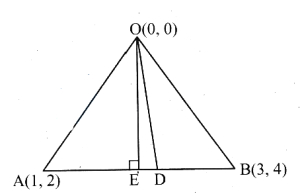
If $O(0,0)$,$A(1,2)$,and $B(3,4)$ are the vertices of triangle $OAB$,then the joint equation of the altitude and median drawn from $O$ is
A
$3x^2-xy-2y^2=0$
B
$3x^2+xy+2y^2=0$
C
$3x^2-xy+2y^2=0$
D
$3x^2+xy-2y^2=0$
Solution
(D) Let $D$ be the midpoint of $AB$. The coordinates of $D$ are $\left(\frac{1+3}{2}, \frac{2+4}{2}\right) = (2,3)$.
The median $OD$ passes through $(0,0)$ and $(2,3)$. Its equation is $y = \frac{3}{2}x$,which simplifies to $3x-2y=0$.
The slope of line $AB$ is $m_{AB} = \frac{4-2}{3-1} = \frac{2}{2} = 1$.
The altitude $OE$ is perpendicular to $AB$,so its slope is $m_{OE} = -\frac{1}{m_{AB}} = -1$.
The equation of the altitude $OE$ is $y = -x$,which simplifies to $x+y=0$.
The joint equation of the median and altitude is $(3x-2y)(x+y) = 0$.
Expanding this,we get $3x^2 + 3xy - 2xy - 2y^2 = 0$,which is $3x^2 + xy - 2y^2 = 0$.
The median $OD$ passes through $(0,0)$ and $(2,3)$. Its equation is $y = \frac{3}{2}x$,which simplifies to $3x-2y=0$.
The slope of line $AB$ is $m_{AB} = \frac{4-2}{3-1} = \frac{2}{2} = 1$.
The altitude $OE$ is perpendicular to $AB$,so its slope is $m_{OE} = -\frac{1}{m_{AB}} = -1$.
The equation of the altitude $OE$ is $y = -x$,which simplifies to $x+y=0$.
The joint equation of the median and altitude is $(3x-2y)(x+y) = 0$.
Expanding this,we get $3x^2 + 3xy - 2xy - 2y^2 = 0$,which is $3x^2 + xy - 2y^2 = 0$.
0 likes
View Solution175
MediumMCQ
The slopes of the lines given by $x^2+2hxy+2y^2=0$ are in the ratio $1:2$,then $h$ is
A
$\frac{3}{2}$
B
$\frac{3}{\sqrt{2}}$
C
$3$
D
$1$
Solution
(A) The given equation is $x^2+2hxy+2y^2=0$.
Comparing with $ax^2+2hxy+by^2=0$,we have $a=1, h=h, b=2$.
Let the slopes of the lines be $m_1$ and $m_2$.
We know that $m_1+m_2 = -\frac{2h}{b} = -\frac{2h}{2} = -h$ and $m_1m_2 = \frac{a}{b} = \frac{1}{2}$.
Given the ratio of slopes is $m_1:m_2 = 1:2$,so $m_2 = 2m_1$.
Substituting $m_2$ in the product equation: $m_1(2m_1) = \frac{1}{2}$ $\Rightarrow 2m_1^2 = \frac{1}{2}$ $\Rightarrow m_1^2 = \frac{1}{4}$ $\Rightarrow m_1 = \pm \frac{1}{2}$.
If $m_1 = \frac{1}{2}$,then $m_2 = 1$.
Then $m_1+m_2 = \frac{1}{2} + 1 = \frac{3}{2}$.
Since $m_1+m_2 = -h$,we get $-h = \frac{3}{2} \Rightarrow h = -\frac{3}{2}$.
If $m_1 = -\frac{1}{2}$,then $m_2 = -1$.
Then $m_1+m_2 = -\frac{1}{2} - 1 = -\frac{3}{2}$.
Since $m_1+m_2 = -h$,we get $-h = -\frac{3}{2} \Rightarrow h = \frac{3}{2}$.
Thus,$h = \pm \frac{3}{2}$. Given the options,the correct value is $\frac{3}{2}$.
Comparing with $ax^2+2hxy+by^2=0$,we have $a=1, h=h, b=2$.
Let the slopes of the lines be $m_1$ and $m_2$.
We know that $m_1+m_2 = -\frac{2h}{b} = -\frac{2h}{2} = -h$ and $m_1m_2 = \frac{a}{b} = \frac{1}{2}$.
Given the ratio of slopes is $m_1:m_2 = 1:2$,so $m_2 = 2m_1$.
Substituting $m_2$ in the product equation: $m_1(2m_1) = \frac{1}{2}$ $\Rightarrow 2m_1^2 = \frac{1}{2}$ $\Rightarrow m_1^2 = \frac{1}{4}$ $\Rightarrow m_1 = \pm \frac{1}{2}$.
If $m_1 = \frac{1}{2}$,then $m_2 = 1$.
Then $m_1+m_2 = \frac{1}{2} + 1 = \frac{3}{2}$.
Since $m_1+m_2 = -h$,we get $-h = \frac{3}{2} \Rightarrow h = -\frac{3}{2}$.
If $m_1 = -\frac{1}{2}$,then $m_2 = -1$.
Then $m_1+m_2 = -\frac{1}{2} - 1 = -\frac{3}{2}$.
Since $m_1+m_2 = -h$,we get $-h = -\frac{3}{2} \Rightarrow h = \frac{3}{2}$.
Thus,$h = \pm \frac{3}{2}$. Given the options,the correct value is $\frac{3}{2}$.
0 likes
View Solution176
EasyMCQ
If $4ab = 3h^2$,then the ratio of the slopes of the lines represented by $ax^2 + 2hxy + by^2 = 0$ is
A
$\sqrt{3} : 1$
B
$1 : \sqrt{3}$
C
$1 : 3$
D
$3 : 1$
Solution
(C) Let the slopes of the lines be $m_1$ and $m_2$. For the equation $ax^2 + 2hxy + by^2 = 0$,we have:
$m_1 + m_2 = \frac{-2h}{b}$ $(i)$
$m_1 m_2 = \frac{a}{b}$ $(ii)$
Given $4ab = 3h^2$,so $ab = \frac{3h^2}{4}$.
Substituting this into $(ii)$,we get $m_1 m_2 = \frac{3h^2}{4b^2}$.
Now,$(m_1 - m_2)^2 = (m_1 + m_2)^2 - 4m_1 m_2 = \frac{4h^2}{b^2} - 4(\frac{3h^2}{4b^2}) = \frac{4h^2 - 3h^2}{b^2} = \frac{h^2}{b^2}$.
Thus,$m_1 - m_2 = \frac{h}{b}$ $(iii)$.
Adding $(i)$ and $(iii)$: $2m_1 = \frac{-2h}{b} + \frac{h}{b} = \frac{-h}{b} \implies m_1 = \frac{-h}{2b}$.
Subtracting $(iii)$ from $(i)$: $2m_2 = \frac{-2h}{b} - \frac{h}{b} = \frac{-3h}{b} \implies m_2 = \frac{-3h}{2b}$.
The ratio $m_1 : m_2 = \frac{-h}{2b} : \frac{-3h}{2b} = 1 : 3$.
$m_1 + m_2 = \frac{-2h}{b}$ $(i)$
$m_1 m_2 = \frac{a}{b}$ $(ii)$
Given $4ab = 3h^2$,so $ab = \frac{3h^2}{4}$.
Substituting this into $(ii)$,we get $m_1 m_2 = \frac{3h^2}{4b^2}$.
Now,$(m_1 - m_2)^2 = (m_1 + m_2)^2 - 4m_1 m_2 = \frac{4h^2}{b^2} - 4(\frac{3h^2}{4b^2}) = \frac{4h^2 - 3h^2}{b^2} = \frac{h^2}{b^2}$.
Thus,$m_1 - m_2 = \frac{h}{b}$ $(iii)$.
Adding $(i)$ and $(iii)$: $2m_1 = \frac{-2h}{b} + \frac{h}{b} = \frac{-h}{b} \implies m_1 = \frac{-h}{2b}$.
Subtracting $(iii)$ from $(i)$: $2m_2 = \frac{-2h}{b} - \frac{h}{b} = \frac{-3h}{b} \implies m_2 = \frac{-3h}{2b}$.
The ratio $m_1 : m_2 = \frac{-h}{2b} : \frac{-3h}{2b} = 1 : 3$.
0 likes
View Solution177
MediumMCQ
If the slope of one of the lines given by $K x^2 + 6 x y + y^2 = 0$ is three times the other,then the value of $K$ is:
A
$\frac{9}{4}$
B
$\frac{4}{9}$
C
$\frac{27}{4}$
D
$\frac{4}{27}$
Solution
(C) The given equation of the pair of lines is $K x^2 + 6 x y + y^2 = 0$.
Comparing this with the general form $A x^2 + 2 H x y + B y^2 = 0$,we get $A = K$,$H = 3$,and $B = 1$.
Let the slopes of the two lines be $m_1$ and $m_2$.
We know that $m_1 + m_2 = \frac{-2 H}{B} = -6$ and $m_1 m_2 = \frac{A}{B} = K$.
Given that one slope is three times the other,let $m_2 = 3 m_1$.
Substituting this into the sum of slopes: $m_1 + 3 m_1 = -6$ $\Rightarrow 4 m_1 = -6$ $\Rightarrow m_1 = -\frac{3}{2}$.
Now,using the product of slopes: $m_1 \times (3 m_1) = K \Rightarrow 3 m_1^2 = K$.
Substituting $m_1 = -\frac{3}{2}$: $K = 3 \times (-\frac{3}{2})^2 = 3 \times \frac{9}{4} = \frac{27}{4}$.
Comparing this with the general form $A x^2 + 2 H x y + B y^2 = 0$,we get $A = K$,$H = 3$,and $B = 1$.
Let the slopes of the two lines be $m_1$ and $m_2$.
We know that $m_1 + m_2 = \frac{-2 H}{B} = -6$ and $m_1 m_2 = \frac{A}{B} = K$.
Given that one slope is three times the other,let $m_2 = 3 m_1$.
Substituting this into the sum of slopes: $m_1 + 3 m_1 = -6$ $\Rightarrow 4 m_1 = -6$ $\Rightarrow m_1 = -\frac{3}{2}$.
Now,using the product of slopes: $m_1 \times (3 m_1) = K \Rightarrow 3 m_1^2 = K$.
Substituting $m_1 = -\frac{3}{2}$: $K = 3 \times (-\frac{3}{2})^2 = 3 \times \frac{9}{4} = \frac{27}{4}$.
0 likes
View Solution178
MediumMCQ
If one of the lines represented by $ax^2+2hxy+by^2=0$ is perpendicular to $mx+ny=18$,then
A
$an^2+2hmn+bm^2=0$
B
$am^2+2hmn+bn^2=0$
C
$am^2-2hmn+bn^2=0$
D
$an^2-2hmn+bm^2=0$
Solution
(B) The given pair of lines is $ax^2+2hxy+by^2=0$. Dividing by $x^2$,we get $a+2h(\frac{y}{x})+b(\frac{y}{x})^2=0$. Let $k = \frac{y}{x}$ be the slope of one of the lines. Then $bk^2+2hk+a=0$.
The slope of the line $mx+ny=18$ is $-\frac{m}{n}$.
Since the line is perpendicular to $mx+ny=18$,its slope $k$ must be the negative reciprocal of $-\frac{m}{n}$,so $k = \frac{n}{m}$.
Substituting $k = \frac{n}{m}$ into the equation $bk^2+2hk+a=0$,we get $b(\frac{n}{m})^2+2h(\frac{n}{m})+a=0$.
Multiplying by $m^2$,we obtain $bn^2+2hmn+am^2=0$.
The slope of the line $mx+ny=18$ is $-\frac{m}{n}$.
Since the line is perpendicular to $mx+ny=18$,its slope $k$ must be the negative reciprocal of $-\frac{m}{n}$,so $k = \frac{n}{m}$.
Substituting $k = \frac{n}{m}$ into the equation $bk^2+2hk+a=0$,we get $b(\frac{n}{m})^2+2h(\frac{n}{m})+a=0$.
Multiplying by $m^2$,we obtain $bn^2+2hmn+am^2=0$.
0 likes
View Solution179
MediumMCQ
If $\frac{x^2}{a} + \frac{2xy}{h} + \frac{y^2}{b} = 0$ represents a pair of straight lines and the slope of one of the lines is twice that of the other,then $ab : h^2$ is:
A
$1 : 2$
B
$9 : 8$
C
$2 : 1$
D
$8 : 9$
Solution
(B) The given equation is $\frac{x^2}{a} + \frac{2xy}{h} + \frac{y^2}{b} = 0$. Multiplying by $abh$,we get $bhx^2 + 2abyx + ahy^2 = 0$.
Comparing this with the standard form $Ax^2 + 2Hxy + By^2 = 0$,we have $A = bh$,$2H = 2ab \Rightarrow H = ab$,and $B = ah$.
Let the slopes be $m_1$ and $m_2$. We are given $m_2 = 2m_1$.
For the equation $Ax^2 + 2Hxy + By^2 = 0$,the sum of slopes $m_1 + m_2 = -\frac{2H}{B}$ and the product of slopes $m_1 m_2 = \frac{A}{B}$.
$m_1 + 2m_1 = 3m_1 = -\frac{2ab}{ah} = -\frac{2b}{h} \Rightarrow m_1 = -\frac{2b}{3h}$.
$m_1(2m_1) = 2m_1^2 = \frac{bh}{ah} = \frac{b}{a} \Rightarrow 2\left(-\frac{2b}{3h}\right)^2 = \frac{b}{a}$.
$2 \times \frac{4b^2}{9h^2} = \frac{b}{a} \Rightarrow \frac{8b^2}{9h^2} = \frac{b}{a}$.
Dividing both sides by $b$ (assuming $b \neq 0$),we get $\frac{8b}{9h^2} = \frac{1}{a} \Rightarrow \frac{ab}{h^2} = \frac{9}{8}$.
Comparing this with the standard form $Ax^2 + 2Hxy + By^2 = 0$,we have $A = bh$,$2H = 2ab \Rightarrow H = ab$,and $B = ah$.
Let the slopes be $m_1$ and $m_2$. We are given $m_2 = 2m_1$.
For the equation $Ax^2 + 2Hxy + By^2 = 0$,the sum of slopes $m_1 + m_2 = -\frac{2H}{B}$ and the product of slopes $m_1 m_2 = \frac{A}{B}$.
$m_1 + 2m_1 = 3m_1 = -\frac{2ab}{ah} = -\frac{2b}{h} \Rightarrow m_1 = -\frac{2b}{3h}$.
$m_1(2m_1) = 2m_1^2 = \frac{bh}{ah} = \frac{b}{a} \Rightarrow 2\left(-\frac{2b}{3h}\right)^2 = \frac{b}{a}$.
$2 \times \frac{4b^2}{9h^2} = \frac{b}{a} \Rightarrow \frac{8b^2}{9h^2} = \frac{b}{a}$.
Dividing both sides by $b$ (assuming $b \neq 0$),we get $\frac{8b}{9h^2} = \frac{1}{a} \Rightarrow \frac{ab}{h^2} = \frac{9}{8}$.
0 likes
View Solution180
MediumMCQ
The joint equation of a pair of lines passing through the origin and making an angle of $\frac{\pi}{4}$ with the line $3x + 2y - 8 = 0$ is
A
$5x^2 + 24xy - 5y^2 = 0$
B
$5x^2 - 24xy + 5y^2 = 0$
C
$5x^2 - 24xy - 5y^2 = 0$
D
$5x^2 + 24xy + 5y^2 = 0$
Solution
(A) The slope of the line $3x + 2y - 8 = 0$ is $m_1 = -\frac{3}{2}$.
Let $m$ be the slope of the lines passing through the origin that make an angle of $\frac{\pi}{4}$ with the given line.
Using the formula $\tan \theta = \left| \frac{m - m_1}{1 + mm_1} \right|$,we have:
$\tan \frac{\pi}{4} = \left| \frac{m - (-3/2)}{1 + m(-3/2)} \right|$
$1 = \left| \frac{2m + 3}{2 - 3m} \right|$
Squaring both sides:
$(2 - 3m)^2 = (2m + 3)^2$
$4 - 12m + 9m^2 = 4m^2 + 12m + 9$
$5m^2 - 24m - 5 = 0$
Since the lines pass through the origin,their equations are $y = mx$,so $m = \frac{y}{x}$.
Substituting $m = \frac{y}{x}$ into the auxiliary equation:
$5(\frac{y}{x})^2 - 24(\frac{y}{x}) - 5 = 0$
Multiplying by $x^2$,we get:
$5y^2 - 24xy - 5x^2 = 0$
Rearranging,we get $5x^2 + 24xy - 5y^2 = 0$.
Let $m$ be the slope of the lines passing through the origin that make an angle of $\frac{\pi}{4}$ with the given line.
Using the formula $\tan \theta = \left| \frac{m - m_1}{1 + mm_1} \right|$,we have:
$\tan \frac{\pi}{4} = \left| \frac{m - (-3/2)}{1 + m(-3/2)} \right|$
$1 = \left| \frac{2m + 3}{2 - 3m} \right|$
Squaring both sides:
$(2 - 3m)^2 = (2m + 3)^2$
$4 - 12m + 9m^2 = 4m^2 + 12m + 9$
$5m^2 - 24m - 5 = 0$
Since the lines pass through the origin,their equations are $y = mx$,so $m = \frac{y}{x}$.
Substituting $m = \frac{y}{x}$ into the auxiliary equation:
$5(\frac{y}{x})^2 - 24(\frac{y}{x}) - 5 = 0$
Multiplying by $x^2$,we get:
$5y^2 - 24xy - 5x^2 = 0$
Rearranging,we get $5x^2 + 24xy - 5y^2 = 0$.
0 likes
View Solution181
DifficultMCQ
If $m$ is the slope of one of the lines represented by $ax^{2}+2hxy+by^{2}=0$,then $(h+bm)^{2}$ is equal to
A
$(a+b)^{2}$
B
$(a-b)^{2}$
C
$h^{2}+ab$
D
$h^{2}-ab$
Solution
(D) Given the homogeneous equation $ax^{2}+2hxy+by^{2}=0 \quad \dots(i)$
This represents a pair of straight lines passing through the origin. Let the slopes of these lines be $m$ and $m_{1}$.
Thus,the lines are $y=mx$ and $y=m_{1}x$.
Their product is $(y-mx)(y-m_{1}x) = 0$,which simplifies to $y^{2}-(m+m_{1})xy+mm_{1}x^{2}=0$.
Dividing the original equation by $b$,we get $y^{2}+\frac{2h}{b}xy+\frac{a}{b}x^{2}=0 \quad \dots(ii)$.
Comparing $(i)$ and $(ii)$,we have:
$m+m_{1} = -\frac{2h}{b}$ and $mm_{1} = \frac{a}{b}$.
Since $m$ is a root of the quadratic equation $bm^{2}+2hm+a=0$ (obtained by substituting $y=mx$ in the original equation):
$bm^{2}+2hm+a=0$
$bm^{2}+hm = -a-hm$
$m(bm+h) = -(a+hm)$
This does not lead directly to the target. Let us use the relation $m_{1} = -\frac{2h}{b}-m$.
Substituting into $mm_{1} = \frac{a}{b}$:
$m(-\frac{2h}{b}-m) = \frac{a}{b}$
$-2hm - bm^{2} = a$
$bm^{2} + 2hm + a = 0$
Adding $h^{2}$ to both sides:
$bm^{2} + 2hm + h^{2} = h^{2} - a$
This is not quite right. Let's re-evaluate: $bm^{2}+2hm+a=0 \implies bm^{2}+hm = -a-hm$. Actually,from $bm^{2}+2hm+a=0$,we have $bm^{2}+hm = -a-hm$.
Wait,the expression is $(h+bm)^{2} = h^{2} + 2hbm + b^{2}m^{2}$.
Since $bm^{2}+2hm+a=0$,then $b^{2}m^{2}+2hbm+ab=0$.
Thus $b^{2}m^{2}+2hbm = -ab$.
Adding $h^{2}$ to both sides: $h^{2}+2hbm+b^{2}m^{2} = h^{2}-ab$.
Therefore,$(h+bm)^{2} = h^{2}-ab$.
This represents a pair of straight lines passing through the origin. Let the slopes of these lines be $m$ and $m_{1}$.
Thus,the lines are $y=mx$ and $y=m_{1}x$.
Their product is $(y-mx)(y-m_{1}x) = 0$,which simplifies to $y^{2}-(m+m_{1})xy+mm_{1}x^{2}=0$.
Dividing the original equation by $b$,we get $y^{2}+\frac{2h}{b}xy+\frac{a}{b}x^{2}=0 \quad \dots(ii)$.
Comparing $(i)$ and $(ii)$,we have:
$m+m_{1} = -\frac{2h}{b}$ and $mm_{1} = \frac{a}{b}$.
Since $m$ is a root of the quadratic equation $bm^{2}+2hm+a=0$ (obtained by substituting $y=mx$ in the original equation):
$bm^{2}+2hm+a=0$
$bm^{2}+hm = -a-hm$
$m(bm+h) = -(a+hm)$
This does not lead directly to the target. Let us use the relation $m_{1} = -\frac{2h}{b}-m$.
Substituting into $mm_{1} = \frac{a}{b}$:
$m(-\frac{2h}{b}-m) = \frac{a}{b}$
$-2hm - bm^{2} = a$
$bm^{2} + 2hm + a = 0$
Adding $h^{2}$ to both sides:
$bm^{2} + 2hm + h^{2} = h^{2} - a$
This is not quite right. Let's re-evaluate: $bm^{2}+2hm+a=0 \implies bm^{2}+hm = -a-hm$. Actually,from $bm^{2}+2hm+a=0$,we have $bm^{2}+hm = -a-hm$.
Wait,the expression is $(h+bm)^{2} = h^{2} + 2hbm + b^{2}m^{2}$.
Since $bm^{2}+2hm+a=0$,then $b^{2}m^{2}+2hbm+ab=0$.
Thus $b^{2}m^{2}+2hbm = -ab$.
Adding $h^{2}$ to both sides: $h^{2}+2hbm+b^{2}m^{2} = h^{2}-ab$.
Therefore,$(h+bm)^{2} = h^{2}-ab$.
0 likes
View Solution182
DifficultMCQ
If $3x^{2} + xy - y^{2} - 3x + 6y + k = 0$ represents a pair of lines,then $k$ is equal to
A
$0$
B
$9$
C
$1$
D
$-9$
Solution
(D) The general equation of a second-degree curve is $ax^{2} + 2hxy + by^{2} + 2gx + 2fy + c = 0$.
Comparing this with the given equation $3x^{2} + xy - y^{2} - 3x + 6y + k = 0$,we get:
$a = 3, b = -1, h = \frac{1}{2}, g = -\frac{3}{2}, f = 3, c = k$.
For the equation to represent a pair of lines,the condition is $abc + 2fgh - af^{2} - bg^{2} - ch^{2} = 0$.
Substituting the values:
$3(-1)(k) + 2(3)(-\frac{3}{2})(\frac{1}{2}) - 3(3)^{2} - (-1)(-\frac{3}{2})^{2} - k(\frac{1}{2})^{2} = 0$.
$-3k - \frac{9}{2} - 27 + \frac{9}{4} - \frac{k}{4} = 0$.
Multiplying by $4$ to clear the denominators:
$-12k - 18 - 108 + 9 - k = 0$.
$-13k - 117 = 0$.
$-13k = 117$.
$k = -9$.
Comparing this with the given equation $3x^{2} + xy - y^{2} - 3x + 6y + k = 0$,we get:
$a = 3, b = -1, h = \frac{1}{2}, g = -\frac{3}{2}, f = 3, c = k$.
For the equation to represent a pair of lines,the condition is $abc + 2fgh - af^{2} - bg^{2} - ch^{2} = 0$.
Substituting the values:
$3(-1)(k) + 2(3)(-\frac{3}{2})(\frac{1}{2}) - 3(3)^{2} - (-1)(-\frac{3}{2})^{2} - k(\frac{1}{2})^{2} = 0$.
$-3k - \frac{9}{2} - 27 + \frac{9}{4} - \frac{k}{4} = 0$.
Multiplying by $4$ to clear the denominators:
$-12k - 18 - 108 + 9 - k = 0$.
$-13k - 117 = 0$.
$-13k = 117$.
$k = -9$.
0 likes
View Solution183
DifficultMCQ
If one of the slopes of the pair of lines $ax^{2}+2hxy+by^{2}=0$ is $n$ times the other,then
A
$4(n+1)^{2}ab=nab$
B
$4h^{2}=(n+1)^{2}ab$
C
$4nh^{2}=(n+1)^{2}ab$
D
$4ab=(n+1)^{2}h$
Solution
(C) Let the slopes of the lines $ax^{2}+2hxy+by^{2}=0$ be $m_{1}$ and $m_{2}$.
According to the problem,$m_{1} = nm_{2}$.
We know that $m_{1}+m_{2} = -\frac{2h}{b}$ and $m_{1}m_{2} = \frac{a}{b}$.
Substituting $m_{1} = nm_{2}$ into the sum and product equations:
$m_{2}(n+1) = -\frac{2h}{b} \implies m_{2} = -\frac{2h}{b(n+1)}$.
$nm_{2}^{2} = \frac{a}{b}$.
Substituting the value of $m_{2}$ into the product equation:
$n \left( -\frac{2h}{b(n+1)} \right)^{2} = \frac{a}{b}$.
$n \left( \frac{4h^{2}}{b^{2}(n+1)^{2}} \right) = \frac{a}{b}$.
$4nh^{2} = ab(n+1)^{2}$.
According to the problem,$m_{1} = nm_{2}$.
We know that $m_{1}+m_{2} = -\frac{2h}{b}$ and $m_{1}m_{2} = \frac{a}{b}$.
Substituting $m_{1} = nm_{2}$ into the sum and product equations:
$m_{2}(n+1) = -\frac{2h}{b} \implies m_{2} = -\frac{2h}{b(n+1)}$.
$nm_{2}^{2} = \frac{a}{b}$.
Substituting the value of $m_{2}$ into the product equation:
$n \left( -\frac{2h}{b(n+1)} \right)^{2} = \frac{a}{b}$.
$n \left( \frac{4h^{2}}{b^{2}(n+1)^{2}} \right) = \frac{a}{b}$.
$4nh^{2} = ab(n+1)^{2}$.
0 likes
View Solution184
EasyMCQ
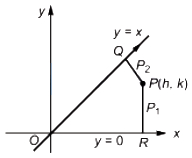
The locus of a point which moves such that its distance from the $x$-axis is twice its distance from the line $x-y=0$ is
A
$x^{2}+4xy-y^{2}=0$
B
$2x^{2}-4xy+y^{2}=0$
C
$x^{2}-4xy+y^{2}=0$
D
$x^{2}-4xy-y^{2}=0$
Solution
(B) Let the point be $P(h, k)$.
$P_{1}$ is the length of the perpendicular from $P$ to the $x$-axis $(y=0)$,so $P_{1} = |k|$.
$P_{2}$ is the length of the perpendicular from $P$ to the line $x-y=0$,so $P_{2} = \frac{|h-k|}{\sqrt{1^{2}+(-1)^{2}}} = \frac{|h-k|}{\sqrt{2}}$.
Given that $P_{1} = 2P_{2}$,we have:
$|k| = 2 \cdot \frac{|h-k|}{\sqrt{2}}$
$|k| = \sqrt{2} |h-k|$
Squaring both sides:
$k^{2} = 2(h-k)^{2}$
$k^{2} = 2(h^{2} + k^{2} - 2hk)$
$k^{2} = 2h^{2} + 2k^{2} - 4hk$
$2h^{2} - 4hk + k^{2} = 0$
Replacing $(h, k)$ with $(x, y)$,the locus is:
$2x^{2} - 4xy + y^{2} = 0$
$P_{1}$ is the length of the perpendicular from $P$ to the $x$-axis $(y=0)$,so $P_{1} = |k|$.
$P_{2}$ is the length of the perpendicular from $P$ to the line $x-y=0$,so $P_{2} = \frac{|h-k|}{\sqrt{1^{2}+(-1)^{2}}} = \frac{|h-k|}{\sqrt{2}}$.
Given that $P_{1} = 2P_{2}$,we have:
$|k| = 2 \cdot \frac{|h-k|}{\sqrt{2}}$
$|k| = \sqrt{2} |h-k|$
Squaring both sides:
$k^{2} = 2(h-k)^{2}$
$k^{2} = 2(h^{2} + k^{2} - 2hk)$
$k^{2} = 2h^{2} + 2k^{2} - 4hk$
$2h^{2} - 4hk + k^{2} = 0$
Replacing $(h, k)$ with $(x, y)$,the locus is:
$2x^{2} - 4xy + y^{2} = 0$
0 likes
View Solution185
MediumMCQ
The area of the triangle formed by the pair of lines $23x^2 - 48xy + 3y^2 = 0$ with the line $2x + 3y + 5 = 0$ is
A
$\frac{1}{13 \sqrt{3}}$
B
$\frac{25}{13 \sqrt{3}}$
C
$\frac{7}{13 \sqrt{5}}$
D
$\frac{9}{25 \sqrt{3}}$
Solution
(B) The given pair of lines is $23x^2 - 48xy + 3y^2 = 0$.
The area of the triangle formed by the pair of lines $ax^2 + 2hxy + by^2 = 0$ and the line $lx + my + n = 0$ is given by the formula:
$\text{Area} = \frac{n^2 \sqrt{h^2 - ab}}{|am^2 - 2hlm + bl^2|}$
Here,$a = 23$,$h = -24$,$b = 3$,$l = 2$,$m = 3$,and $n = 5$.
First,calculate $\sqrt{h^2 - ab} = \sqrt{(-24)^2 - (23)(3)} = \sqrt{576 - 69} = \sqrt{507} = 13 \sqrt{3}$.
Next,calculate the denominator $|am^2 - 2hlm + bl^2| = |23(3)^2 - 2(-24)(2)(3) + 3(2)^2| = |23(9) + 144(2) + 3(4)| = |207 + 288 + 12| = |507| = 507$.
Now,substitute the values into the area formula:
$\text{Area} = \frac{5^2 \times 13 \sqrt{3}}{507} = \frac{25 \times 13 \sqrt{3}}{507} = \frac{25 \times 13 \sqrt{3}}{39 \times 13} = \frac{25}{39} \sqrt{3} = \frac{25}{13 \sqrt{3}} \text{ sq. units}$.
The area of the triangle formed by the pair of lines $ax^2 + 2hxy + by^2 = 0$ and the line $lx + my + n = 0$ is given by the formula:
$\text{Area} = \frac{n^2 \sqrt{h^2 - ab}}{|am^2 - 2hlm + bl^2|}$
Here,$a = 23$,$h = -24$,$b = 3$,$l = 2$,$m = 3$,and $n = 5$.
First,calculate $\sqrt{h^2 - ab} = \sqrt{(-24)^2 - (23)(3)} = \sqrt{576 - 69} = \sqrt{507} = 13 \sqrt{3}$.
Next,calculate the denominator $|am^2 - 2hlm + bl^2| = |23(3)^2 - 2(-24)(2)(3) + 3(2)^2| = |23(9) + 144(2) + 3(4)| = |207 + 288 + 12| = |507| = 507$.
Now,substitute the values into the area formula:
$\text{Area} = \frac{5^2 \times 13 \sqrt{3}}{507} = \frac{25 \times 13 \sqrt{3}}{507} = \frac{25 \times 13 \sqrt{3}}{39 \times 13} = \frac{25}{39} \sqrt{3} = \frac{25}{13 \sqrt{3}} \text{ sq. units}$.
0 likes
View Solution186
MediumMCQ
Assertion $(A)$: The difference of the slopes of the lines represented by $y^2 - 2xy \sec^2 \alpha + (3 + \tan^2 \alpha)(\tan^2 \alpha - 1) x^2 = 0$ is $4$.
Reason $(R)$: The difference of the slopes of the lines represented by $ax^2 + 2hxy + by^2 = 0$ is $\frac{2 \sqrt{h^2 - ab}}{|b|}$.
Reason $(R)$: The difference of the slopes of the lines represented by $ax^2 + 2hxy + by^2 = 0$ is $\frac{2 \sqrt{h^2 - ab}}{|b|}$.
A
Both $A$ and $R$ are true and $R$ is the correct explanation of $A$
B
Both $A$ and $R$ are true but $R$ is not the correct explanation of $A$
C
$A$ is true but $R$ is false
D
$A$ is false but $R$ is true
Solution
(A) The difference of the slopes of the lines represented by $ax^2 + 2hxy + by^2 = 0$ is given by $\frac{2 \sqrt{h^2 - ab}}{|b|}$.
For the given equation $y^2 - 2xy \sec^2 \alpha + (3 + \tan^2 \alpha)(\tan^2 \alpha - 1) x^2 = 0$,we have $a = (3 + \tan^2 \alpha)(\tan^2 \alpha - 1)$,$2h = -2 \sec^2 \alpha$ (so $h = -\sec^2 \alpha$),and $b = 1$.
The difference of slopes is $\frac{2 \sqrt{(-\sec^2 \alpha)^2 - (3 + \tan^2 \alpha)(\tan^2 \alpha - 1)(1)}}{|1|}$.
$= 2 \sqrt{\sec^4 \alpha - (3\tan^2 \alpha - 3 + \tan^4 \alpha - \tan^2 \alpha)}$.
$= 2 \sqrt{\sec^4 \alpha - (\tan^4 \alpha + 2\tan^2 \alpha - 3)}$.
Since $\sec^2 \alpha = 1 + \tan^2 \alpha$,then $\sec^4 \alpha = (1 + \tan^2 \alpha)^2 = 1 + 2\tan^2 \alpha + \tan^4 \alpha$.
Substituting this,the expression becomes $2 \sqrt{1 + 2\tan^2 \alpha + \tan^4 \alpha - \tan^4 \alpha - 2\tan^2 \alpha + 3} = 2 \sqrt{4} = 4$.
Thus,both $A$ and $R$ are true and $R$ is the correct explanation of $A$.
For the given equation $y^2 - 2xy \sec^2 \alpha + (3 + \tan^2 \alpha)(\tan^2 \alpha - 1) x^2 = 0$,we have $a = (3 + \tan^2 \alpha)(\tan^2 \alpha - 1)$,$2h = -2 \sec^2 \alpha$ (so $h = -\sec^2 \alpha$),and $b = 1$.
The difference of slopes is $\frac{2 \sqrt{(-\sec^2 \alpha)^2 - (3 + \tan^2 \alpha)(\tan^2 \alpha - 1)(1)}}{|1|}$.
$= 2 \sqrt{\sec^4 \alpha - (3\tan^2 \alpha - 3 + \tan^4 \alpha - \tan^2 \alpha)}$.
$= 2 \sqrt{\sec^4 \alpha - (\tan^4 \alpha + 2\tan^2 \alpha - 3)}$.
Since $\sec^2 \alpha = 1 + \tan^2 \alpha$,then $\sec^4 \alpha = (1 + \tan^2 \alpha)^2 = 1 + 2\tan^2 \alpha + \tan^4 \alpha$.
Substituting this,the expression becomes $2 \sqrt{1 + 2\tan^2 \alpha + \tan^4 \alpha - \tan^4 \alpha - 2\tan^2 \alpha + 3} = 2 \sqrt{4} = 4$.
Thus,both $A$ and $R$ are true and $R$ is the correct explanation of $A$.
0 likes
View Solution187
MediumMCQ
If the products of the perpendiculars from the origin to the pairs of lines $xy+x+y+1=0$,$x^2-y^2+2x+1=0$,and $2x^2+3xy-2y^2+2x+1=0$ are $p_1, p_2$,and $p_3$ respectively,then:
A
$p_1 < p_2 < p_3$
B
$p_1 < p_3 < p_2$
C
$p_3 < p_2 < p_1$
D
$p_2 < p_1 < p_3$
Solution
(C) The product of the perpendiculars from the origin $(0,0)$ to the pair of lines represented by $ax^2 + 2hxy + by^2 + 2gx + 2fy + c = 0$ is given by $p = \left| \frac{c}{\sqrt{(a-b)^2 + 4h^2}} \right|$.
For $xy+x+y+1=0$:
$a=0, b=0, h=1/2, c=1$.
$p_1 = \left| \frac{1}{\sqrt{(0-0)^2 + 4(1/2)^2}} \right| = \left| \frac{1}{\sqrt{1}} \right| = 1$.
For $x^2-y^2+2x+1=0$:
$a=1, b=-1, h=0, c=1$.
$p_2 = \left| \frac{1}{\sqrt{(1-(-1))^2 + 4(0)^2}} \right| = \left| \frac{1}{\sqrt{4}} \right| = 1/2$.
For $2x^2+3xy-2y^2+2x+1=0$:
$a=2, b=-2, h=3/2, c=1$.
$p_3 = \left| \frac{1}{\sqrt{(2-(-2))^2 + 4(3/2)^2}} \right| = \left| \frac{1}{\sqrt{16 + 9}} \right| = \frac{1}{\sqrt{25}} = 1/5$.
Comparing the values: $1/5 < 1/2 < 1$,which means $p_3 < p_2 < p_1$.
For $xy+x+y+1=0$:
$a=0, b=0, h=1/2, c=1$.
$p_1 = \left| \frac{1}{\sqrt{(0-0)^2 + 4(1/2)^2}} \right| = \left| \frac{1}{\sqrt{1}} \right| = 1$.
For $x^2-y^2+2x+1=0$:
$a=1, b=-1, h=0, c=1$.
$p_2 = \left| \frac{1}{\sqrt{(1-(-1))^2 + 4(0)^2}} \right| = \left| \frac{1}{\sqrt{4}} \right| = 1/2$.
For $2x^2+3xy-2y^2+2x+1=0$:
$a=2, b=-2, h=3/2, c=1$.
$p_3 = \left| \frac{1}{\sqrt{(2-(-2))^2 + 4(3/2)^2}} \right| = \left| \frac{1}{\sqrt{16 + 9}} \right| = \frac{1}{\sqrt{25}} = 1/5$.
Comparing the values: $1/5 < 1/2 < 1$,which means $p_3 < p_2 < p_1$.
0 likes
View Solution188
MediumMCQ
If $p_1$ and $p_2$ denote the lengths of perpendiculars from $(2,3)$ onto the lines given by $15 x^2+31 x y+14 y^2=0$,and if $p_1 > p_2$,then $p_1^2 + \frac{1}{74} - p_2^2 + \frac{1}{13}$ is equal to
A
-$2$
B
$0$
C
$2$
D
$1$
Solution
(C) The given equation of the pair of lines is $15 x^2 + 31 x y + 14 y^2 = 0$.
Factoring the quadratic expression: $15 x^2 + 10 x y + 21 x y + 14 y^2 = 0$ $\Rightarrow 5 x(3 x + 2 y) + 7 y(3 x + 2 y) = 0$ $\Rightarrow (3 x + 2 y)(5 x + 7 y) = 0$.
Thus,the two lines are $L_1: 3 x + 2 y = 0$ and $L_2: 5 x + 7 y = 0$.
The perpendicular distance from $(2,3)$ to $3 x + 2 y = 0$ is $d_1 = \frac{|3(2) + 2(3)|}{\sqrt{3^2 + 2^2}} = \frac{12}{\sqrt{13}}$.
The perpendicular distance from $(2,3)$ to $5 x + 7 y = 0$ is $d_2 = \frac{|5(2) + 7(3)|}{\sqrt{5^2 + 7^2}} = \frac{31}{\sqrt{74}}$.
Since $p_1 > p_2$,we have $p_1 = \frac{31}{\sqrt{74}}$ and $p_2 = \frac{12}{\sqrt{13}}$.
Now,calculating $p_1^2 + \frac{1}{74} - p_2^2 + \frac{1}{13} = \frac{31^2}{74} + \frac{1}{74} - \frac{12^2}{13} + \frac{1}{13} = \frac{961+1}{74} - \frac{144-1}{13} = \frac{962}{74} - \frac{143}{13} = 13 - 11 = 2$.
Factoring the quadratic expression: $15 x^2 + 10 x y + 21 x y + 14 y^2 = 0$ $\Rightarrow 5 x(3 x + 2 y) + 7 y(3 x + 2 y) = 0$ $\Rightarrow (3 x + 2 y)(5 x + 7 y) = 0$.
Thus,the two lines are $L_1: 3 x + 2 y = 0$ and $L_2: 5 x + 7 y = 0$.
The perpendicular distance from $(2,3)$ to $3 x + 2 y = 0$ is $d_1 = \frac{|3(2) + 2(3)|}{\sqrt{3^2 + 2^2}} = \frac{12}{\sqrt{13}}$.
The perpendicular distance from $(2,3)$ to $5 x + 7 y = 0$ is $d_2 = \frac{|5(2) + 7(3)|}{\sqrt{5^2 + 7^2}} = \frac{31}{\sqrt{74}}$.
Since $p_1 > p_2$,we have $p_1 = \frac{31}{\sqrt{74}}$ and $p_2 = \frac{12}{\sqrt{13}}$.
Now,calculating $p_1^2 + \frac{1}{74} - p_2^2 + \frac{1}{13} = \frac{31^2}{74} + \frac{1}{74} - \frac{12^2}{13} + \frac{1}{13} = \frac{961+1}{74} - \frac{144-1}{13} = \frac{962}{74} - \frac{143}{13} = 13 - 11 = 2$.
0 likes
View Solution189
EasyMCQ
If the equation $8x^2+8xy+2y^2+26x+13y+15=0$ represents a pair of parallel straight lines,then the distance between them is.........
A
$\frac{7}{\sqrt{5}}$
B
$\frac{7}{2\sqrt{5}}$
C
$\frac{2}{\sqrt{5}}$
D
$\frac{7}{\sqrt{3}}$
Solution
(B) The given equation is $8x^2+8xy+2y^2+26x+13y+15=0$ ...$(i)$
We can rewrite the equation as $2(4x^2+4xy+y^2)+13(2x+y)+15=0$.
Let $2x+y=t$. Then the equation becomes $2t^2+13t+15=0$.
Factoring the quadratic: $2t^2+10t+3t+15=0 \Rightarrow 2t(t+5)+3(t+5)=0$.
So,$(2t+3)(t+5)=0$.
Substituting $t=2x+y$ back,we get $(2(2x+y)+3)(2x+y+5)=0$.
This simplifies to $(4x+2y+3)(2x+y+5)=0$.
Thus,the two lines are $4x+2y+3=0$ and $2x+y+5=0$.
Dividing the first line by $2$,we get $2x+y+1.5=0$.
The distance $d$ between parallel lines $Ax+By+C_1=0$ and $Ax+By+C_2=0$ is given by $d = \frac{|C_1-C_2|}{\sqrt{A^2+B^2}}$.
Here,$A=2, B=1, C_1=5, C_2=1.5$.
$d = \frac{|5-1.5|}{\sqrt{2^2+1^2}} = \frac{3.5}{\sqrt{5}} = \frac{7}{2\sqrt{5}}$.
We can rewrite the equation as $2(4x^2+4xy+y^2)+13(2x+y)+15=0$.
Let $2x+y=t$. Then the equation becomes $2t^2+13t+15=0$.
Factoring the quadratic: $2t^2+10t+3t+15=0 \Rightarrow 2t(t+5)+3(t+5)=0$.
So,$(2t+3)(t+5)=0$.
Substituting $t=2x+y$ back,we get $(2(2x+y)+3)(2x+y+5)=0$.
This simplifies to $(4x+2y+3)(2x+y+5)=0$.
Thus,the two lines are $4x+2y+3=0$ and $2x+y+5=0$.
Dividing the first line by $2$,we get $2x+y+1.5=0$.
The distance $d$ between parallel lines $Ax+By+C_1=0$ and $Ax+By+C_2=0$ is given by $d = \frac{|C_1-C_2|}{\sqrt{A^2+B^2}}$.
Here,$A=2, B=1, C_1=5, C_2=1.5$.
$d = \frac{|5-1.5|}{\sqrt{2^2+1^2}} = \frac{3.5}{\sqrt{5}} = \frac{7}{2\sqrt{5}}$.
0 likes
View Solution190
DifficultMCQ
The equation of the line common to the pair of lines $(p^2-q^2) x^2+(q^2-r^2) xy+(r^2-p^2) y^2=0$ and $(l-m) x^2+(m-n) xy+(n-l) y^2=0$ is
A
$x+y=0$
B
$x-y=0$
C
$x+y=pqr$
D
$x-y=pqr$
Solution
(B) The given equations are:
$(p^2-q^2) x^2+(q^2-r^2) xy+(r^2-p^2) y^2=0$ ...$(i)$
$(l-m) x^2+(m-n) xy+(n-l) y^2=0$ ...(ii)
For any equation of the form $Ax^2+Bxy+Cy^2=0$,if $A+B+C=0$,then $(x-y)$ is a factor of the equation.
For equation $(i)$: $(p^2-q^2) + (q^2-r^2) + (r^2-p^2) = 0$. Thus,$(x-y)$ is a factor.
For equation (ii): $(l-m) + (m-n) + (n-l) = 0$. Thus,$(x-y)$ is a factor.
Since both equations represent a pair of lines passing through the origin and share the factor $(x-y)$,the common line is $x-y=0$.
$(p^2-q^2) x^2+(q^2-r^2) xy+(r^2-p^2) y^2=0$ ...$(i)$
$(l-m) x^2+(m-n) xy+(n-l) y^2=0$ ...(ii)
For any equation of the form $Ax^2+Bxy+Cy^2=0$,if $A+B+C=0$,then $(x-y)$ is a factor of the equation.
For equation $(i)$: $(p^2-q^2) + (q^2-r^2) + (r^2-p^2) = 0$. Thus,$(x-y)$ is a factor.
For equation (ii): $(l-m) + (m-n) + (n-l) = 0$. Thus,$(x-y)$ is a factor.
Since both equations represent a pair of lines passing through the origin and share the factor $(x-y)$,the common line is $x-y=0$.
0 likes
View Solution191
DifficultMCQ
If the equation $4x^2 + hxy + y^2 = 0$ represents coincident lines,then $h$ is equal to
A
$1$
B
$2$
C
$3$
D
$4$ or $-4$
Solution
(D) The general equation of a pair of lines passing through the origin is $ax^2 + 2hxy + by^2 = 0$.
For the lines to be coincident,the condition is $h^2 - ab = 0$.
Comparing $4x^2 + hxy + y^2 = 0$ with $ax^2 + 2h'xy + by^2 = 0$,we have $a = 4$,$2h' = h$,and $b = 1$.
The condition for coincidence is $(h')^2 - ab = 0$.
Substituting $h' = \frac{h}{2}$,we get $(\frac{h}{2})^2 - (4)(1) = 0$.
$\frac{h^2}{4} = 4$.
$h^2 = 16$.
$h = \pm 4$.
Since the options provided are limited,the correct value is $4$ or $-4$.
For the lines to be coincident,the condition is $h^2 - ab = 0$.
Comparing $4x^2 + hxy + y^2 = 0$ with $ax^2 + 2h'xy + by^2 = 0$,we have $a = 4$,$2h' = h$,and $b = 1$.
The condition for coincidence is $(h')^2 - ab = 0$.
Substituting $h' = \frac{h}{2}$,we get $(\frac{h}{2})^2 - (4)(1) = 0$.
$\frac{h^2}{4} = 4$.
$h^2 = 16$.
$h = \pm 4$.
Since the options provided are limited,the correct value is $4$ or $-4$.
0 likes
View Solution192
MediumMCQ
The combined equation of the lines passing through the point $(3,4)$ and each making an angle $45^{\circ}$ with the line $x+y+1=0$ is
A
$xy-4x-3y+12=0$
B
$(3x-2y-1)(x-2y+2)=0$
C
$(3x+2y-17)(x+2y-11)=0$
D
$xy-4x+3y+12=0$
Solution
(A) The slope of the line $x+y+1=0$ is $m = -1$. Let the slope of the required lines be $m'$.
Since the angle between the lines is $45^{\circ}$,we use the formula $\tan \theta = |\frac{m_1 - m_2}{1 + m_1 m_2}|$.
$\tan 45^{\circ} = |\frac{m' - (-1)}{1 + m'(-1)}| \Rightarrow 1 = |\frac{m'+1}{1-m'}|$.
This gives two cases: $\frac{m'+1}{1-m'} = 1$ or $\frac{m'+1}{1-m'} = -1$.
Case $1$: $m'+1 = 1-m'$ $\Rightarrow 2m' = 0$ $\Rightarrow m' = 0$.
The equation of the line is $y-4 = 0(x-3) \Rightarrow y-4 = 0$.
Case $2$: $m'+1 = -(1-m')$ $\Rightarrow m'+1 = -1+m'$ $\Rightarrow 1 = -1$,which implies the line is vertical $(m' = \infty)$.
The equation of the line is $x-3 = 0$.
The combined equation is $(x-3)(y-4) = 0 \Rightarrow xy-4x-3y+12 = 0$.
Since the angle between the lines is $45^{\circ}$,we use the formula $\tan \theta = |\frac{m_1 - m_2}{1 + m_1 m_2}|$.
$\tan 45^{\circ} = |\frac{m' - (-1)}{1 + m'(-1)}| \Rightarrow 1 = |\frac{m'+1}{1-m'}|$.
This gives two cases: $\frac{m'+1}{1-m'} = 1$ or $\frac{m'+1}{1-m'} = -1$.
Case $1$: $m'+1 = 1-m'$ $\Rightarrow 2m' = 0$ $\Rightarrow m' = 0$.
The equation of the line is $y-4 = 0(x-3) \Rightarrow y-4 = 0$.
Case $2$: $m'+1 = -(1-m')$ $\Rightarrow m'+1 = -1+m'$ $\Rightarrow 1 = -1$,which implies the line is vertical $(m' = \infty)$.
The equation of the line is $x-3 = 0$.
The combined equation is $(x-3)(y-4) = 0 \Rightarrow xy-4x-3y+12 = 0$.
0 likes
View Solution193
EasyMCQ
If the slope of one line of the pair of lines $2x^2 + hxy + 6y^2 = 0$ is thrice the slope of the other line,then $h =$
A
$\pm 16$
B
$\pm 9$
C
$\pm 18$
D
$\pm 8$
Solution
(D) The given equation is $2x^2 + hxy + 6y^2 = 0$.
Comparing this with the general form $ax^2 + 2h'xy + by^2 = 0$,we have $a = 2$,$2h' = h$,and $b = 6$.
Let the slopes of the two lines be $m_1$ and $m_2$.
Given that $m_1 = 3m_2$.
We know that the product of the slopes $m_1 m_2 = \frac{a}{b} = \frac{2}{6} = \frac{1}{3}$.
Substituting $m_1 = 3m_2$ into the product,we get $(3m_2)m_2 = \frac{1}{3}$ $\Rightarrow 3m_2^2 = \frac{1}{3}$ $\Rightarrow m_2^2 = \frac{1}{9}$ $\Rightarrow m_2 = \pm \frac{1}{3}$.
Thus,$m_1 = 3(\pm \frac{1}{3}) = \pm 1$.
The sum of the slopes is $m_1 + m_2 = -\frac{2h'}{b} = -\frac{h}{6}$.
Substituting the values of $m_1$ and $m_2$: $\pm 1 \pm \frac{1}{3} = -\frac{h}{6}$.
For the positive case: $1 + \frac{1}{3} = \frac{4}{3} = -\frac{h}{6} \Rightarrow h = -8$.
For the negative case: $-1 - \frac{1}{3} = -\frac{4}{3} = -\frac{h}{6} \Rightarrow h = 8$.
Therefore,$h = \pm 8$.
Comparing this with the general form $ax^2 + 2h'xy + by^2 = 0$,we have $a = 2$,$2h' = h$,and $b = 6$.
Let the slopes of the two lines be $m_1$ and $m_2$.
Given that $m_1 = 3m_2$.
We know that the product of the slopes $m_1 m_2 = \frac{a}{b} = \frac{2}{6} = \frac{1}{3}$.
Substituting $m_1 = 3m_2$ into the product,we get $(3m_2)m_2 = \frac{1}{3}$ $\Rightarrow 3m_2^2 = \frac{1}{3}$ $\Rightarrow m_2^2 = \frac{1}{9}$ $\Rightarrow m_2 = \pm \frac{1}{3}$.
Thus,$m_1 = 3(\pm \frac{1}{3}) = \pm 1$.
The sum of the slopes is $m_1 + m_2 = -\frac{2h'}{b} = -\frac{h}{6}$.
Substituting the values of $m_1$ and $m_2$: $\pm 1 \pm \frac{1}{3} = -\frac{h}{6}$.
For the positive case: $1 + \frac{1}{3} = \frac{4}{3} = -\frac{h}{6} \Rightarrow h = -8$.
For the negative case: $-1 - \frac{1}{3} = -\frac{4}{3} = -\frac{h}{6} \Rightarrow h = 8$.
Therefore,$h = \pm 8$.
0 likes
View Solution194
EasyMCQ
If the slope of one of the lines in the pair of lines $8x^2 + axy + y^2 = 0$ is thrice the slope of the other line,then $a =$
A
$8 \sqrt{\frac{2}{3}}$
B
$6$
C
$16 \sqrt{2}$
D
$3 \frac{\sqrt{2}}{5}$
Solution
(A) The given equation is $8x^2 + axy + y^2 = 0$.
Let the slopes of the two lines be $m_1$ and $m_2$.
For a homogeneous equation $Ax^2 + Bxy + Cy^2 = 0$,the sum of slopes is $m_1 + m_2 = -B/C$ and the product of slopes is $m_1 m_2 = A/C$.
Here,$A = 8$,$B = a$,and $C = 1$.
So,$m_1 + m_2 = -a$ and $m_1 m_2 = 8$.
Given that one slope is thrice the other,let $m_1 = 3m_2$.
Substituting this into the product equation: $(3m_2) \times m_2 = 8$ $\Rightarrow 3m_2^2 = 8$ $\Rightarrow m_2^2 = 8/3$.
Substituting into the sum equation: $3m_2 + m_2 = -a$ $\Rightarrow 4m_2 = -a$ $\Rightarrow m_2 = -a/4$.
Squaring both sides: $m_2^2 = a^2/16$.
Equating the two values of $m_2^2$: $a^2/16 = 8/3$ $\Rightarrow a^2 = 128/3$ $\Rightarrow a = \pm \sqrt{128/3} = \pm 8 \sqrt{2/3}$.
Since the options provide the positive value,$a = 8 \sqrt{\frac{2}{3}}$.
Let the slopes of the two lines be $m_1$ and $m_2$.
For a homogeneous equation $Ax^2 + Bxy + Cy^2 = 0$,the sum of slopes is $m_1 + m_2 = -B/C$ and the product of slopes is $m_1 m_2 = A/C$.
Here,$A = 8$,$B = a$,and $C = 1$.
So,$m_1 + m_2 = -a$ and $m_1 m_2 = 8$.
Given that one slope is thrice the other,let $m_1 = 3m_2$.
Substituting this into the product equation: $(3m_2) \times m_2 = 8$ $\Rightarrow 3m_2^2 = 8$ $\Rightarrow m_2^2 = 8/3$.
Substituting into the sum equation: $3m_2 + m_2 = -a$ $\Rightarrow 4m_2 = -a$ $\Rightarrow m_2 = -a/4$.
Squaring both sides: $m_2^2 = a^2/16$.
Equating the two values of $m_2^2$: $a^2/16 = 8/3$ $\Rightarrow a^2 = 128/3$ $\Rightarrow a = \pm \sqrt{128/3} = \pm 8 \sqrt{2/3}$.
Since the options provide the positive value,$a = 8 \sqrt{\frac{2}{3}}$.
0 likes
View Solution195
DifficultMCQ
If $ad \neq 0$ and two of the lines represented by $ax^3+3bx^2y+3cxy^2+dy^3=0$ are perpendicular,then
A
$a^2+ac+bd+d^2=0$
B
$a^2+3ac+3bd+d^2=0$
C
$a^2-3ac-3bd+d^2=0$
D
$a^2+3ac-3bd+d^2=0$
Solution
(B) The given equation is $ax^3+3bx^2y+3cxy^2+dy^3=0$.
Dividing by $x^3$ and setting $m = \frac{y}{x}$,we get the cubic equation in $m$: $dm^3+3cm^2+3bm+a=0$.
Let the roots be $m_1, m_2, m_3$.
From the properties of roots,the product of the roots is $m_1m_2m_3 = -\frac{a}{d}$.
Since two lines are perpendicular,let $m_1m_2 = -1$.
Substituting this into the product equation: $(-1)m_3 = -\frac{a}{d} \Rightarrow m_3 = \frac{a}{d}$.
Since $m_3$ is a root of the cubic equation,it must satisfy $d(\frac{a}{d})^3+3c(\frac{a}{d})^2+3b(\frac{a}{d})+a=0$.
Multiplying by $d^2$,we get $a^3+3a^2c+3abd+ad^2=0$.
Dividing by $a$ (since $a \neq 0$),we get $a^2+3ac+3bd+d^2=0$.
Dividing by $x^3$ and setting $m = \frac{y}{x}$,we get the cubic equation in $m$: $dm^3+3cm^2+3bm+a=0$.
Let the roots be $m_1, m_2, m_3$.
From the properties of roots,the product of the roots is $m_1m_2m_3 = -\frac{a}{d}$.
Since two lines are perpendicular,let $m_1m_2 = -1$.
Substituting this into the product equation: $(-1)m_3 = -\frac{a}{d} \Rightarrow m_3 = \frac{a}{d}$.
Since $m_3$ is a root of the cubic equation,it must satisfy $d(\frac{a}{d})^3+3c(\frac{a}{d})^2+3b(\frac{a}{d})+a=0$.
Multiplying by $d^2$,we get $a^3+3a^2c+3abd+ad^2=0$.
Dividing by $a$ (since $a \neq 0$),we get $a^2+3ac+3bd+d^2=0$.
0 likes
View Solution196
MediumMCQ
If $m_1$ and $m_2$ $(m_1 > m_2)$ are the slopes of the lines represented by $5x^2 - 8xy + 3y^2 = 0$,then $m_1 : m_2$ equals
A
$5:1$
B
$2:1$
C
$5:3$
D
$3:2$
Solution
(C) The given equation is $5x^2 - 8xy + 3y^2 = 0$.
Dividing by $x^2$,we get $3(\frac{y}{x})^2 - 8(\frac{y}{x}) + 5 = 0$.
Let $m = \frac{y}{x}$ be the slope of the lines. Then $3m^2 - 8m + 5 = 0$.
Solving the quadratic equation $3m^2 - 8m + 5 = 0$ using the quadratic formula $m = \frac{-b \pm \sqrt{b^2 - 4ac}}{2a}$:
$m = \frac{8 \pm \sqrt{64 - 4(3)(5)}}{2(3)} = \frac{8 \pm \sqrt{64 - 60}}{6} = \frac{8 \pm \sqrt{4}}{6} = \frac{8 \pm 2}{6}$.
The two slopes are $m_1 = \frac{8+2}{6} = \frac{10}{6} = \frac{5}{3}$ and $m_2 = \frac{8-2}{6} = \frac{6}{6} = 1$.
Since $m_1 > m_2$,we have $m_1 = \frac{5}{3}$ and $m_2 = 1$.
Therefore,the ratio $m_1 : m_2 = \frac{5}{3} : 1 = 5 : 3$.
Dividing by $x^2$,we get $3(\frac{y}{x})^2 - 8(\frac{y}{x}) + 5 = 0$.
Let $m = \frac{y}{x}$ be the slope of the lines. Then $3m^2 - 8m + 5 = 0$.
Solving the quadratic equation $3m^2 - 8m + 5 = 0$ using the quadratic formula $m = \frac{-b \pm \sqrt{b^2 - 4ac}}{2a}$:
$m = \frac{8 \pm \sqrt{64 - 4(3)(5)}}{2(3)} = \frac{8 \pm \sqrt{64 - 60}}{6} = \frac{8 \pm \sqrt{4}}{6} = \frac{8 \pm 2}{6}$.
The two slopes are $m_1 = \frac{8+2}{6} = \frac{10}{6} = \frac{5}{3}$ and $m_2 = \frac{8-2}{6} = \frac{6}{6} = 1$.
Since $m_1 > m_2$,we have $m_1 = \frac{5}{3}$ and $m_2 = 1$.
Therefore,the ratio $m_1 : m_2 = \frac{5}{3} : 1 = 5 : 3$.
0 likes
View Solution197
MediumMCQ
If $4x^2-5xy+y^2=0$ represents a pair of lines with slopes $m_1$ and $m_2$,then the value of $|m_1-m_2|$ equals
A
$1$
B
$2$
C
$3$
D
$4$
Solution
(C) The given equation of the pair of lines is $4x^2-5xy+y^2=0$.
Dividing by $x^2$,we get the quadratic equation in terms of $m = \frac{y}{x}$:
$m^2-5m+4=0$.
Here,$m_1$ and $m_2$ are the roots of this equation.
Thus,the sum of slopes is $m_1+m_2 = 5$ and the product of slopes is $m_1m_2 = 4$.
We know that $|m_1-m_2| = \sqrt{(m_1+m_2)^2-4m_1m_2}$.
Substituting the values,we get:
$|m_1-m_2| = \sqrt{5^2-4(4)} = \sqrt{25-16} = \sqrt{9} = 3$.
Dividing by $x^2$,we get the quadratic equation in terms of $m = \frac{y}{x}$:
$m^2-5m+4=0$.
Here,$m_1$ and $m_2$ are the roots of this equation.
Thus,the sum of slopes is $m_1+m_2 = 5$ and the product of slopes is $m_1m_2 = 4$.
We know that $|m_1-m_2| = \sqrt{(m_1+m_2)^2-4m_1m_2}$.
Substituting the values,we get:
$|m_1-m_2| = \sqrt{5^2-4(4)} = \sqrt{25-16} = \sqrt{9} = 3$.
0 likes
View Solution198
MediumMCQ
The slopes of the lines represented by $x^2+2 h x y+2 y^2=0$ are in the ratio $1:2$. Then $h$ is equal to:
A
$\pm \frac{1}{2}$
B
$\pm \frac{3}{2}$
C
$\pm 1$
D
$\pm 3$
Solution
(B) Given the equation of lines: $x^2+2 h x y+2 y^2=0 \dots (i)$
Comparing with $a x^2+2 h x y+b y^2=0$,we get $a=1$ and $b=2$.
Let the slopes of the lines be $m_1$ and $m_2$.
Then,$m_1+m_2 = -\frac{2h}{b} = -\frac{2h}{2} = -h \dots (ii)$
And $m_1 m_2 = \frac{a}{b} = \frac{1}{2} \dots (iii)$
Given the ratio of slopes is $m_1:m_2 = 1:2$,so $m_2 = 2m_1$.
Substituting $m_2 = 2m_1$ into $(iii)$: $m_1(2m_1) = \frac{1}{2}$ $\Rightarrow 2m_1^2 = \frac{1}{2}$ $\Rightarrow m_1^2 = \frac{1}{4}$ $\Rightarrow m_1 = \pm \frac{1}{2}$.
If $m_1 = \frac{1}{2}$,then $m_2 = 1$. From $(ii)$,$m_1+m_2 = -h$ $\Rightarrow \frac{1}{2} + 1 = -h$ $\Rightarrow h = -\frac{3}{2}$.
If $m_1 = -\frac{1}{2}$,then $m_2 = -1$. From $(ii)$,$m_1+m_2 = -h$ $\Rightarrow -\frac{1}{2} - 1 = -h$ $\Rightarrow h = \frac{3}{2}$.
Thus,$h = \pm \frac{3}{2}$.
Comparing with $a x^2+2 h x y+b y^2=0$,we get $a=1$ and $b=2$.
Let the slopes of the lines be $m_1$ and $m_2$.
Then,$m_1+m_2 = -\frac{2h}{b} = -\frac{2h}{2} = -h \dots (ii)$
And $m_1 m_2 = \frac{a}{b} = \frac{1}{2} \dots (iii)$
Given the ratio of slopes is $m_1:m_2 = 1:2$,so $m_2 = 2m_1$.
Substituting $m_2 = 2m_1$ into $(iii)$: $m_1(2m_1) = \frac{1}{2}$ $\Rightarrow 2m_1^2 = \frac{1}{2}$ $\Rightarrow m_1^2 = \frac{1}{4}$ $\Rightarrow m_1 = \pm \frac{1}{2}$.
If $m_1 = \frac{1}{2}$,then $m_2 = 1$. From $(ii)$,$m_1+m_2 = -h$ $\Rightarrow \frac{1}{2} + 1 = -h$ $\Rightarrow h = -\frac{3}{2}$.
If $m_1 = -\frac{1}{2}$,then $m_2 = -1$. From $(ii)$,$m_1+m_2 = -h$ $\Rightarrow -\frac{1}{2} - 1 = -h$ $\Rightarrow h = \frac{3}{2}$.
Thus,$h = \pm \frac{3}{2}$.
0 likes
View SolutionPair of straight lines — Equation of pair of straight lines · Frequently Asked Questions
1Are these Pair of straight lines questions useful for JEE and NEET?
Yes. All questions in this section are mapped to JEE Main and NEET exam patterns. Previous year questions from JEE Main, NEET, GUJCET and state-level exams are included with full solutions.
2Can I switch to Hindi or Gujarati for these questions?
Yes. Use the language tabs in the hero section or the sidebar to view the same questions and solutions in English, Hindi or Gujarati.
3How do I generate a question paper from this subtopic?
Use the Vedclass Exam Paper Generator — select the chapter and subtopic, set difficulty, and generate Sets A, B, C, D automatically. First 3 chapters of every subject are free.
Vedclass Products
For Students
Vedclass Test Series
Mock tests in real JEE/NEET style with performance analysis. 5-day free trial.
Start Free TrialFor Teachers
Exam Paper Generator
Generate Set A/B/C/D papers from this chapter in 2 minutes. 3 chapters free.
Try FreeFor Institutes
Online Exam Module
Live online exams with unlimited students, 360° analytics & white-label branding.
See DemoFor Teachers & Institutes
Generate a Pair of straight lines Exam Paper in 2 Minutes
Select subtopic & difficulty — Sets A, B, C, D auto-generated with No Repeat logic.
First 3 chapters of every subject are free — no payment required.