
A English
Bisectors of the angle between the lines, Point of intersection of the lines Questions in English
Class 11 Mathematics · Pair of straight lines · Bisectors of the angle between the lines, Point of intersection of the lines
85+
Questions
English
Language
100%
With Solutions
Showing 50 of 85 questions in English
1
DifficultMCQ
The condition for the general quadratic equation $f(x, y) = ax^2 + 2hxy + by^2 + 2gx + 2fy + c = 0$ to represent coincident lines is:
A
$\Delta = 0$ and $h^2 = ab$
B
$\Delta = 0$ and $a + b = 0$
C
$\Delta = 0, h^2 = ab, g^2 = ac$ and $f^2 = bc$
D
$h^2 = ab, g^2 = ac$ and $f^2 = bc$
Solution
(C) The general quadratic equation is $ax^2 + 2hxy + by^2 + 2gx + 2fy + c = 0$.
The condition for the equation to represent a pair of straight lines is $\Delta = 0$,where $\Delta = abc + 2fgh - af^2 - bg^2 - ch^2 = 0$.
For the lines to be parallel,the condition is $h^2 = ab$.
For the lines to be coincident,the distance between the parallel lines must be zero.
The distance $d$ between parallel lines is given by $d = 2\sqrt{\frac{g^2 - ac}{a(a+b)}}$ or $d = 2\sqrt{\frac{f^2 - bc}{b(a+b)}}$.
Setting $d = 0$ implies $g^2 = ac$ and $f^2 = bc$.
Thus,the combined condition for coincident lines is $\Delta = 0, h^2 = ab, g^2 = ac$,and $f^2 = bc$.
Therefore,the correct option is $C$.
The condition for the equation to represent a pair of straight lines is $\Delta = 0$,where $\Delta = abc + 2fgh - af^2 - bg^2 - ch^2 = 0$.
For the lines to be parallel,the condition is $h^2 = ab$.
For the lines to be coincident,the distance between the parallel lines must be zero.
The distance $d$ between parallel lines is given by $d = 2\sqrt{\frac{g^2 - ac}{a(a+b)}}$ or $d = 2\sqrt{\frac{f^2 - bc}{b(a+b)}}$.
Setting $d = 0$ implies $g^2 = ac$ and $f^2 = bc$.
Thus,the combined condition for coincident lines is $\Delta = 0, h^2 = ab, g^2 = ac$,and $f^2 = bc$.
Therefore,the correct option is $C$.
0 likes
View Solution2
MediumMCQ
The line $x - 2y = 0$ will be a bisector of the angle between the lines represented by the equation ${x^2} - 2hxy - 2{y^2} = 0$,if $h = $
A
$0.5$
B
$2$
C
$-2$
D
$-0.5$
Solution
(C) The equation of the pair of lines is ${x^2} - 2hxy - 2{y^2} = 0$.
Comparing this with $ax^2 + 2h'xy + by^2 = 0$,we have $a = 1$,$2h' = -2h$,and $b = -2$.
The equation of the bisectors of the angles between the lines is given by $\frac{x^2 - y^2}{a - b} = \frac{xy}{h'}$.
Substituting the values,we get $\frac{x^2 - y^2}{1 - (-2)} = \frac{xy}{-h} \Rightarrow \frac{x^2 - y^2}{3} = \frac{xy}{-h}$.
This simplifies to $-h(x^2 - y^2) = 3xy$,or $hx^2 + 3xy - hy^2 = 0$.
Since $x - 2y = 0$ is a bisector,it must satisfy this equation.
Substituting $x = 2y$,we get $h(2y)^2 + 3(2y)y - hy^2 = 0$.
$4hy^2 + 6y^2 - hy^2 = 0 \Rightarrow 3hy^2 + 6y^2 = 0$.
$3y^2(h + 2) = 0$.
For this to hold for all $y$,$h + 2 = 0$,so $h = -2$.
Comparing this with $ax^2 + 2h'xy + by^2 = 0$,we have $a = 1$,$2h' = -2h$,and $b = -2$.
The equation of the bisectors of the angles between the lines is given by $\frac{x^2 - y^2}{a - b} = \frac{xy}{h'}$.
Substituting the values,we get $\frac{x^2 - y^2}{1 - (-2)} = \frac{xy}{-h} \Rightarrow \frac{x^2 - y^2}{3} = \frac{xy}{-h}$.
This simplifies to $-h(x^2 - y^2) = 3xy$,or $hx^2 + 3xy - hy^2 = 0$.
Since $x - 2y = 0$ is a bisector,it must satisfy this equation.
Substituting $x = 2y$,we get $h(2y)^2 + 3(2y)y - hy^2 = 0$.
$4hy^2 + 6y^2 - hy^2 = 0 \Rightarrow 3hy^2 + 6y^2 = 0$.
$3y^2(h + 2) = 0$.
For this to hold for all $y$,$h + 2 = 0$,so $h = -2$.
0 likes
View Solution3
MediumMCQ
The equation of the bisectors of the angle between the lines represented by the equation $4x^2 - 16xy - 7y^2 = 0$ is
A
$8x^2 + 11xy - 8y^2 = 0$
B
$8x^2 - 11xy - 8y^2 = 0$
C
$16x^2 + 11xy - 16y^2 = 0$
D
$16x^2 + 11xy + 16y^2 = 0$
Solution
(A) The given equation is $4x^2 - 16xy - 7y^2 = 0$.
Comparing this with $ax^2 + 2hxy + by^2 = 0$,we get $a = 4$,$2h = -16$ (so $h = -8$),and $b = -7$.
The equation of the bisectors of the angle between the lines is given by $\frac{x^2 - y^2}{a - b} = \frac{xy}{h}$.
Substituting the values,we get $\frac{x^2 - y^2}{4 - (-7)} = \frac{xy}{-8}$.
This simplifies to $\frac{x^2 - y^2}{11} = \frac{xy}{-8}$.
Cross-multiplying gives $-8(x^2 - y^2) = 11xy$.
Rearranging the terms,we get $8x^2 + 11xy - 8y^2 = 0$.
Comparing this with $ax^2 + 2hxy + by^2 = 0$,we get $a = 4$,$2h = -16$ (so $h = -8$),and $b = -7$.
The equation of the bisectors of the angle between the lines is given by $\frac{x^2 - y^2}{a - b} = \frac{xy}{h}$.
Substituting the values,we get $\frac{x^2 - y^2}{4 - (-7)} = \frac{xy}{-8}$.
This simplifies to $\frac{x^2 - y^2}{11} = \frac{xy}{-8}$.
Cross-multiplying gives $-8(x^2 - y^2) = 11xy$.
Rearranging the terms,we get $8x^2 + 11xy - 8y^2 = 0$.
0 likes
View Solution4
MediumMCQ
The equation of the bisectors of the angle between the lines represented by the equation $(y - mx)^2 = (x + my)^2$ is
A
$mx^2 + (m^2 - 1)xy - my^2 = 0$
B
$mx^2 - (m^2 - 1)xy - my^2 = 0$
C
$mx^2 + (m^2 - 1)xy + my^2 = 0$
D
None of these
Solution
(A) The given equation is $(y - mx)^2 = (x + my)^2$.
Expanding both sides,we get $y^2 + m^2x^2 - 2mxy = x^2 + m^2y^2 + 2mxy$.
Rearranging the terms,we get $(m^2 - 1)x^2 - 4mxy + (1 - m^2)y^2 = 0$.
This is of the form $Ax^2 + 2Hxy + By^2 = 0$,where $A = m^2 - 1$,$H = -2m$,and $B = 1 - m^2$.
The equation of the bisectors of the angles between the lines is given by $\frac{x^2 - y^2}{A - B} = \frac{xy}{H}$.
Substituting the values,we get $\frac{x^2 - y^2}{(m^2 - 1) - (1 - m^2)} = \frac{xy}{-2m}$.
$\frac{x^2 - y^2}{2(m^2 - 1)} = \frac{xy}{-2m}$.
$-m(x^2 - y^2) = (m^2 - 1)xy$.
$-mx^2 + my^2 = (m^2 - 1)xy$.
$mx^2 + (m^2 - 1)xy - my^2 = 0$.
Expanding both sides,we get $y^2 + m^2x^2 - 2mxy = x^2 + m^2y^2 + 2mxy$.
Rearranging the terms,we get $(m^2 - 1)x^2 - 4mxy + (1 - m^2)y^2 = 0$.
This is of the form $Ax^2 + 2Hxy + By^2 = 0$,where $A = m^2 - 1$,$H = -2m$,and $B = 1 - m^2$.
The equation of the bisectors of the angles between the lines is given by $\frac{x^2 - y^2}{A - B} = \frac{xy}{H}$.
Substituting the values,we get $\frac{x^2 - y^2}{(m^2 - 1) - (1 - m^2)} = \frac{xy}{-2m}$.
$\frac{x^2 - y^2}{2(m^2 - 1)} = \frac{xy}{-2m}$.
$-m(x^2 - y^2) = (m^2 - 1)xy$.
$-mx^2 + my^2 = (m^2 - 1)xy$.
$mx^2 + (m^2 - 1)xy - my^2 = 0$.
0 likes
View Solution5
MediumMCQ
The equation of the bisectors of the angle between the lines represented by the equation ${x^2} - {y^2} = 0$ is:
A
$x = 0$
B
$y = 0$
C
$xy = 0$
D
None of these
Solution
(C) The given equation is ${x^2} - {y^2} = 0$.
Comparing this with the general equation of a pair of straight lines ${ax^2} + {2hxy} + {by^2} = 0$,we have $a = 1$,$h = 0$,and $b = -1$.
The equation of the bisectors of the angles between the lines is given by $\frac{{x^2 - y^2}}{{a - b}} = \frac{{xy}}{h}$.
Substituting the values,we get $\frac{{x^2 - y^2}}{{1 - (-1)}} = \frac{{xy}}{0}$.
This implies $xy = 0$.
Comparing this with the general equation of a pair of straight lines ${ax^2} + {2hxy} + {by^2} = 0$,we have $a = 1$,$h = 0$,and $b = -1$.
The equation of the bisectors of the angles between the lines is given by $\frac{{x^2 - y^2}}{{a - b}} = \frac{{xy}}{h}$.
Substituting the values,we get $\frac{{x^2 - y^2}}{{1 - (-1)}} = \frac{{xy}}{0}$.
This implies $xy = 0$.
0 likes
View Solution6
DifficultMCQ
If $y = mx$ is one of the bisectors of the angle between the lines $ax^2 - 2hxy + by^2 = 0$,then
A
$h(1 + m^2) + m(a - b) = 0$
B
$h(1 - m^2) + m(a + b) = 0$
C
$h(1 - m^2) + m(a - b) = 0$
D
$h(1 + m^2) + m(a + b) = 0$
Solution
(C) The equation of the pair of lines is $ax^2 - 2hxy + by^2 = 0$. The equation of the bisectors of the angles between these lines is given by $\frac{x^2 - y^2}{a - b} = \frac{xy}{-h}$.
This can be rewritten as $h(x^2 - y^2) + (a - b)xy = 0$.
Since $y = mx$ is one of the bisectors,it must satisfy the equation of the bisectors.
Substituting $y = mx$ into the equation $h(x^2 - y^2) + (a - b)xy = 0$,we get:
$h(x^2 - (mx)^2) + (a - b)x(mx) = 0$
$h(x^2 - m^2x^2) + (a - b)mx^2 = 0$
Dividing by $x^2$ (assuming $x \neq 0$):
$h(1 - m^2) + m(a - b) = 0$.
This can be rewritten as $h(x^2 - y^2) + (a - b)xy = 0$.
Since $y = mx$ is one of the bisectors,it must satisfy the equation of the bisectors.
Substituting $y = mx$ into the equation $h(x^2 - y^2) + (a - b)xy = 0$,we get:
$h(x^2 - (mx)^2) + (a - b)x(mx) = 0$
$h(x^2 - m^2x^2) + (a - b)mx^2 = 0$
Dividing by $x^2$ (assuming $x \neq 0$):
$h(1 - m^2) + m(a - b) = 0$.
0 likes
View Solution7
MediumMCQ
The combined equation of the bisectors of the angles between the coordinate axes is:
A
$x^2 + y^2 = 0$
B
$x^2 - y^2 = 0$
C
$xy = 0$
D
$x + y = 0$
Solution
(B) The coordinate axes are given by the equations $x = 0$ and $y = 0$.
The bisectors of the angles between the coordinate axes are the lines $y = x$ and $y = -x$.
These can be rewritten as $y - x = 0$ and $y + x = 0$.
The combined equation is obtained by multiplying these two equations:
$(y - x)(y + x) = 0$
$y^2 - x^2 = 0$
Multiplying by $-1$,we get $x^2 - y^2 = 0$.
The bisectors of the angles between the coordinate axes are the lines $y = x$ and $y = -x$.
These can be rewritten as $y - x = 0$ and $y + x = 0$.
The combined equation is obtained by multiplying these two equations:
$(y - x)(y + x) = 0$
$y^2 - x^2 = 0$
Multiplying by $-1$,we get $x^2 - y^2 = 0$.
0 likes
View Solution8
MediumMCQ
If the bisectors of the angles between the pairs of lines given by the equations $ax^2 + 2hxy + by^2 = 0$ and $ax^2 + 2hxy + by^2 + \lambda(x^2 + y^2) = 0$ are coincident,then $\lambda = $
A
$a$
B
$b$
C
$h$
D
Any real number
Solution
(D) The equation of the pair of angle bisectors for $ax^2 + 2hxy + by^2 = 0$ is given by $\frac{x^2 - y^2}{a - b} = \frac{xy}{h}$ ... $(i)$.
The second equation is $(a + \lambda)x^2 + 2hxy + (b + \lambda)y^2 = 0$.
The equation of the pair of angle bisectors for this equation is $\frac{x^2 - y^2}{(a + \lambda) - (b + \lambda)} = \frac{xy}{h}$,which simplifies to $\frac{x^2 - y^2}{a - b} = \frac{xy}{h}$ ... $(ii)$.
Since equation $(i)$ and equation $(ii)$ are identical for any value of $\lambda$,the bisectors are coincident for any real number $\lambda$.
The second equation is $(a + \lambda)x^2 + 2hxy + (b + \lambda)y^2 = 0$.
The equation of the pair of angle bisectors for this equation is $\frac{x^2 - y^2}{(a + \lambda) - (b + \lambda)} = \frac{xy}{h}$,which simplifies to $\frac{x^2 - y^2}{a - b} = \frac{xy}{h}$ ... $(ii)$.
Since equation $(i)$ and equation $(ii)$ are identical for any value of $\lambda$,the bisectors are coincident for any real number $\lambda$.
0 likes
View Solution9
MediumMCQ
The combined equation of the bisectors of the angle between the lines represented by $({x^2} + {y^2})\sqrt{3} = 4xy$ is
A
${x^2} - {y^2} = 0$
B
$xy = 0$
C
${x^2} + {y^2} = 2xy$
D
$\frac{{x^2 - y^2}}{{\sqrt{3}}} = \frac{{xy}}{2}$
Solution
(A) The given equation is $\sqrt{3}x^2 - 4xy + \sqrt{3}y^2 = 0$.
Comparing this with the general form $ax^2 + 2hxy + by^2 = 0$,we have $a = \sqrt{3}$,$h = -2$,and $b = \sqrt{3}$.
The equation of the bisectors of the angles between the lines is given by $\frac{x^2 - y^2}{a - b} = \frac{xy}{h}$.
Substituting the values,we get $\frac{x^2 - y^2}{\sqrt{3} - \sqrt{3}} = \frac{xy}{-2}$.
Since the denominator on the left is $0$,the equation becomes $x^2 - y^2 = 0$.
Comparing this with the general form $ax^2 + 2hxy + by^2 = 0$,we have $a = \sqrt{3}$,$h = -2$,and $b = \sqrt{3}$.
The equation of the bisectors of the angles between the lines is given by $\frac{x^2 - y^2}{a - b} = \frac{xy}{h}$.
Substituting the values,we get $\frac{x^2 - y^2}{\sqrt{3} - \sqrt{3}} = \frac{xy}{-2}$.
Since the denominator on the left is $0$,the equation becomes $x^2 - y^2 = 0$.
0 likes
View Solution10
MediumMCQ
The equation of the bisectors of the angles between the lines represented by ${x^2} + 2xy \cot \theta + {y^2} = 0$ is
A
${x^2} - {y^2} = 0$
B
${x^2} - {y^2} = xy$
C
$({x^2} - {y^2}) \cot \theta = 2xy$
D
None of these
Solution
(A) The general equation of a pair of lines passing through the origin is $ax^2 + 2hxy + by^2 = 0$.
Comparing this with the given equation ${x^2} + 2xy \cot \theta + {y^2} = 0$,we get $a = 1$,$h = \cot \theta$,and $b = 1$.
The equation of the bisectors of the angles between the lines is given by the formula $\frac{x^2 - y^2}{a - b} = \frac{xy}{h}$.
Substituting the values,we get $\frac{x^2 - y^2}{1 - 1} = \frac{xy}{\cot \theta}$.
Since the denominator on the left side is $0$,the equation becomes $x^2 - y^2 = 0$.
Comparing this with the given equation ${x^2} + 2xy \cot \theta + {y^2} = 0$,we get $a = 1$,$h = \cot \theta$,and $b = 1$.
The equation of the bisectors of the angles between the lines is given by the formula $\frac{x^2 - y^2}{a - b} = \frac{xy}{h}$.
Substituting the values,we get $\frac{x^2 - y^2}{1 - 1} = \frac{xy}{\cot \theta}$.
Since the denominator on the left side is $0$,the equation becomes $x^2 - y^2 = 0$.
0 likes
View Solution11
MediumMCQ
If the bisectors of the angles represented by $ax^2 + 2hxy + by^2 = 0$ and $a'x^2 + 2h'xy + b'y^2 = 0$ are the same,then:
A
$(a - b)h' = (a' - b')h$
B
$(a - b)h = (a' - b')h'$
C
$(a + b)h' = (a' - b')h$
D
$(a - b)h' = (a' + b')h$
Solution
(A) The equation of the pair of angle bisectors for the pair of lines $ax^2 + 2hxy + by^2 = 0$ is given by $\frac{x^2 - y^2}{a - b} = \frac{xy}{h}$.
For the first pair,the equation of bisectors is $\frac{x^2 - y^2}{a - b} = \frac{xy}{h}$.
For the second pair,the equation of bisectors is $\frac{x^2 - y^2}{a' - b'} = \frac{xy}{h'}$.
Since the bisectors are the same,the ratios of the coefficients must be equal:
$\frac{a - b}{h} = \frac{a' - b'}{h'}$.
Cross-multiplying gives: $(a - b)h' = (a' - b')h$.
For the first pair,the equation of bisectors is $\frac{x^2 - y^2}{a - b} = \frac{xy}{h}$.
For the second pair,the equation of bisectors is $\frac{x^2 - y^2}{a' - b'} = \frac{xy}{h'}$.
Since the bisectors are the same,the ratios of the coefficients must be equal:
$\frac{a - b}{h} = \frac{a' - b'}{h'}$.
Cross-multiplying gives: $(a - b)h' = (a' - b')h$.
0 likes
View Solution12
MediumMCQ
If $r(1 - m^2) + m(p - q) = 0$,then a bisector of the angle between the lines represented by the equation $px^2 - 2rxy + qy^2 = 0$ is
A
$y = x$
B
$y = -x$
C
$y = mx$
D
$my = x$
Solution
(C) The equation of the bisectors of the angle between the lines represented by $px^2 - 2rxy + qy^2 = 0$ is given by:
$\frac{x^2 - y^2}{p - q} = \frac{xy}{-r}$ .....$(i)$
To check if $y = mx$ is a bisector,we substitute $y = mx$ into equation $(i)$:
$\frac{x^2 - (mx)^2}{p - q} = \frac{x(mx)}{-r}$
$\frac{x^2(1 - m^2)}{p - q} = \frac{mx^2}{-r}$
Dividing by $x^2$ (assuming $x \neq 0$):
$\frac{1 - m^2}{p - q} = \frac{m}{-r}$
$-r(1 - m^2) = m(p - q)$
$r(1 - m^2) + m(p - q) = 0$
Since this matches the given condition,$y = mx$ is a bisector.
$\frac{x^2 - y^2}{p - q} = \frac{xy}{-r}$ .....$(i)$
To check if $y = mx$ is a bisector,we substitute $y = mx$ into equation $(i)$:
$\frac{x^2 - (mx)^2}{p - q} = \frac{x(mx)}{-r}$
$\frac{x^2(1 - m^2)}{p - q} = \frac{mx^2}{-r}$
Dividing by $x^2$ (assuming $x \neq 0$):
$\frac{1 - m^2}{p - q} = \frac{m}{-r}$
$-r(1 - m^2) = m(p - q)$
$r(1 - m^2) + m(p - q) = 0$
Since this matches the given condition,$y = mx$ is a bisector.
0 likes
View Solution13
DifficultMCQ
One bisector of the angle between the lines given by $a(x - 1)^2 + 2h(x - 1)y + by^2 = 0$ is $2x + y - 2 = 0$. The other bisector is
A
$x - 2y + 1 = 0$
B
$2x + y - 1 = 0$
C
$x + 2y - 1 = 0$
D
$x - 2y - 1 = 0$
Solution
(D) The equation $a(x - 1)^2 + 2h(x - 1)y + by^2 = 0$ represents a pair of straight lines intersecting at the point $(1, 0)$.
By shifting the origin to $(1, 0)$,we substitute $x = X + 1$ and $y = Y$,which transforms the equation into $aX^2 + 2hXY + bY^2 = 0$ $(i)$.
The given bisector $2x + y - 2 = 0$ becomes $2(X + 1) + Y - 2 = 0$,which simplifies to $2X + Y = 0$.
Since the angle bisectors of a pair of straight lines are always perpendicular to each other,the slope of the second bisector must be the negative reciprocal of the slope of the first bisector.
The slope of $2X + Y = 0$ is $m_1 = -2$. Thus,the slope of the second bisector $m_2$ is $1/2$.
The equation of the second bisector passing through $(1, 0)$ is $Y - 0 = \frac{1}{2}(X - 0)$,which simplifies to $X - 2Y = 0$.
Substituting back $X = x - 1$ and $Y = y$,we get $(x - 1) - 2y = 0$,or $x - 2y - 1 = 0$.
By shifting the origin to $(1, 0)$,we substitute $x = X + 1$ and $y = Y$,which transforms the equation into $aX^2 + 2hXY + bY^2 = 0$ $(i)$.
The given bisector $2x + y - 2 = 0$ becomes $2(X + 1) + Y - 2 = 0$,which simplifies to $2X + Y = 0$.
Since the angle bisectors of a pair of straight lines are always perpendicular to each other,the slope of the second bisector must be the negative reciprocal of the slope of the first bisector.
The slope of $2X + Y = 0$ is $m_1 = -2$. Thus,the slope of the second bisector $m_2$ is $1/2$.
The equation of the second bisector passing through $(1, 0)$ is $Y - 0 = \frac{1}{2}(X - 0)$,which simplifies to $X - 2Y = 0$.
Substituting back $X = x - 1$ and $Y = y$,we get $(x - 1) - 2y = 0$,or $x - 2y - 1 = 0$.
0 likes
View Solution14
MediumMCQ
The point of intersection of the lines represented by the equation $2x^2 + 7xy + 3y^2 + 8x + 14y + 8 = 0$ is
A
$(0, 2)$
B
$(1, 2)$
C
$(-2, 0)$
D
$(-2, 1)$
Solution
(C) The given equation is $2x^2 + 7xy + 3y^2 + 8x + 14y + 8 = 0$.
Comparing this with the general equation $ax^2 + 2hxy + by^2 + 2gx + 2fy + c = 0$,we get:
$a = 2, b = 3, 2h = 7 \implies h = 3.5, 2g = 8 \implies g = 4, 2f = 14 \implies f = 7, c = 8$.
The point of intersection $(x, y)$ is given by the formulas:
$x = \frac{hf - bg}{ab - h^2} = \frac{(3.5)(7) - (3)(4)}{(2)(3) - (3.5)^2} = \frac{24.5 - 12}{6 - 12.25} = \frac{12.5}{-6.25} = -2$.
$y = \frac{hg - af}{ab - h^2} = \frac{(3.5)(4) - (2)(7)}{(2)(3) - (3.5)^2} = \frac{14 - 14}{6 - 12.25} = 0$.
Thus,the point of intersection is $(-2, 0)$.
Comparing this with the general equation $ax^2 + 2hxy + by^2 + 2gx + 2fy + c = 0$,we get:
$a = 2, b = 3, 2h = 7 \implies h = 3.5, 2g = 8 \implies g = 4, 2f = 14 \implies f = 7, c = 8$.
The point of intersection $(x, y)$ is given by the formulas:
$x = \frac{hf - bg}{ab - h^2} = \frac{(3.5)(7) - (3)(4)}{(2)(3) - (3.5)^2} = \frac{24.5 - 12}{6 - 12.25} = \frac{12.5}{-6.25} = -2$.
$y = \frac{hg - af}{ab - h^2} = \frac{(3.5)(4) - (2)(7)}{(2)(3) - (3.5)^2} = \frac{14 - 14}{6 - 12.25} = 0$.
Thus,the point of intersection is $(-2, 0)$.
0 likes
View Solution15
MediumMCQ
The point of intersection of the lines represented by the equation $2(x + 2)^2 + 3(x + 2)(y - 2) - 2(y - 2)^2 = 0$ is
A
$(2, 2)$
B
$(-2, -2)$
C
$(-2, 2)$
D
$(2, -2)$
Solution
(C) Let $X = x + 2$ and $Y = y - 2$.
The given equation becomes $2X^2 + 3XY - 2Y^2 = 0$.
This is a homogeneous equation of the second degree in $X$ and $Y$,which represents a pair of straight lines passing through the origin $(X, Y) = (0, 0)$.
Substituting back the values of $X$ and $Y$:
$x + 2 = 0 \implies x = -2$
$y - 2 = 0 \implies y = 2$
Thus,the point of intersection is $(-2, 2)$.
The given equation becomes $2X^2 + 3XY - 2Y^2 = 0$.
This is a homogeneous equation of the second degree in $X$ and $Y$,which represents a pair of straight lines passing through the origin $(X, Y) = (0, 0)$.
Substituting back the values of $X$ and $Y$:
$x + 2 = 0 \implies x = -2$
$y - 2 = 0 \implies y = 2$
Thus,the point of intersection is $(-2, 2)$.
0 likes
View Solution16
DifficultMCQ
The square of the distance between the origin and the point of intersection of the lines represented by the equation $ax^2 + 2hxy + by^2 + 2gx + 2fy + c = 0$ is
A
$\frac{c(a + b) - f^2 - g^2}{ab - h^2}$
B
$\frac{c(a - b) + f^2 + g^2}{\sqrt{ab - h^2}}$
C
$\frac{c(a + b) - f^2 - g^2}{ab + h^2}$
D
None of these
Solution
(A) The point of intersection $(x_0, y_0)$ of the lines represented by $ax^2 + 2hxy + by^2 + 2gx + 2fy + c = 0$ is given by the solution of the partial derivatives $\frac{\partial f}{\partial x} = 0$ and $\frac{\partial f}{\partial y} = 0$.
These are $2ax + 2hy + 2g = 0 \implies ax + hy + g = 0$ and $2hx + 2by + 2f = 0 \implies hx + by + f = 0$.
Solving these equations using Cramer's rule,we get $x_0 = \frac{hf - bg}{ab - h^2}$ and $y_0 = \frac{gf - ah}{ab - h^2}$.
The square of the distance from the origin $(0, 0)$ is $x_0^2 + y_0^2 = \frac{(hf - bg)^2 + (gf - ah)^2}{(ab - h^2)^2}$.
Expanding the numerator: $h^2f^2 + b^2g^2 - 2hfbg + g^2f^2 + a^2h^2 - 2gfah = f^2(g^2 + h^2) + h^2(a^2 + b^2) - 2hfg(a + b)$.
Using the condition for the pair of lines $abc + 2fgh - af^2 - bg^2 - ch^2 = 0$,the expression simplifies to $\frac{c(a + b) - f^2 - g^2}{ab - h^2}$.
These are $2ax + 2hy + 2g = 0 \implies ax + hy + g = 0$ and $2hx + 2by + 2f = 0 \implies hx + by + f = 0$.
Solving these equations using Cramer's rule,we get $x_0 = \frac{hf - bg}{ab - h^2}$ and $y_0 = \frac{gf - ah}{ab - h^2}$.
The square of the distance from the origin $(0, 0)$ is $x_0^2 + y_0^2 = \frac{(hf - bg)^2 + (gf - ah)^2}{(ab - h^2)^2}$.
Expanding the numerator: $h^2f^2 + b^2g^2 - 2hfbg + g^2f^2 + a^2h^2 - 2gfah = f^2(g^2 + h^2) + h^2(a^2 + b^2) - 2hfg(a + b)$.
Using the condition for the pair of lines $abc + 2fgh - af^2 - bg^2 - ch^2 = 0$,the expression simplifies to $\frac{c(a + b) - f^2 - g^2}{ab - h^2}$.
0 likes
View Solution17
MediumMCQ
If the bisectors of the lines $x^2 - 2pxy - y^2 = 0$ are $x^2 - 2qxy - y^2 = 0$,then
A
$pq + 1 = 0$
B
$pq - 1 = 0$
C
$p + q = 0$
D
$p - q = 0$
Solution
(A) The equation of the pair of bisectors of the angle between the lines $ax^2 + 2hxy + by^2 = 0$ is given by $\frac{x^2 - y^2}{a - b} = \frac{xy}{h}$.
For the given equation $x^2 - 2pxy - y^2 = 0$,we have $a = 1, h = -p, b = -1$.
Substituting these values,the equation of the bisectors is $\frac{x^2 - y^2}{1 - (-1)} = \frac{xy}{-p}$.
$\frac{x^2 - y^2}{2} = \frac{xy}{-p}$ $\Rightarrow -p(x^2 - y^2) = 2xy$ $\Rightarrow -px^2 + py^2 = 2xy$ $\Rightarrow px^2 + 2xy - py^2 = 0$.
Comparing this with the given bisector equation $x^2 - 2qxy - y^2 = 0$,we have the ratio of coefficients:
$\frac{p}{1} = \frac{2}{-2q} = \frac{-p}{-1}$.
From $\frac{p}{1} = \frac{2}{-2q}$,we get $p = -\frac{1}{q}$,which implies $pq = -1$ or $pq + 1 = 0$.
For the given equation $x^2 - 2pxy - y^2 = 0$,we have $a = 1, h = -p, b = -1$.
Substituting these values,the equation of the bisectors is $\frac{x^2 - y^2}{1 - (-1)} = \frac{xy}{-p}$.
$\frac{x^2 - y^2}{2} = \frac{xy}{-p}$ $\Rightarrow -p(x^2 - y^2) = 2xy$ $\Rightarrow -px^2 + py^2 = 2xy$ $\Rightarrow px^2 + 2xy - py^2 = 0$.
Comparing this with the given bisector equation $x^2 - 2qxy - y^2 = 0$,we have the ratio of coefficients:
$\frac{p}{1} = \frac{2}{-2q} = \frac{-p}{-1}$.
From $\frac{p}{1} = \frac{2}{-2q}$,we get $p = -\frac{1}{q}$,which implies $pq = -1$ or $pq + 1 = 0$.
0 likes
View Solution18
DifficultMCQ
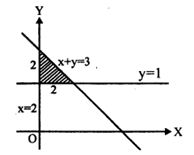
The area of the triangle formed by the line $x + y = 3$ and the angle bisectors of the pair of lines $x^2 - y^2 + 2y = 1$ is:
A
$1$
B
$3$
C
$2$
D
$4$
Solution
(C) The given equation is $x^2 - y^2 + 2y = 1$,which can be written as $x^2 - (y^2 - 2y + 1) = 0$,or $x^2 - (y - 1)^2 = 0$.
This represents the pair of lines $(x - y + 1)(x + y - 1) = 0$.
The angle bisectors of these lines are given by the lines $x = 0$ and $y = 1$.
The triangle is formed by the lines $x = 0$,$y = 1$,and $x + y = 3$.
The vertices of the triangle are the intersection points of these lines:
$1$. Intersection of $x = 0$ and $y = 1$ is $(0, 1)$.
$2$. Intersection of $x = 0$ and $x + y = 3$ is $(0, 3)$.
$3$. Intersection of $y = 1$ and $x + y = 3$ is $(2, 1)$.
The base of the triangle along $y = 1$ is $|2 - 0| = 2$.
The height of the triangle along $x = 0$ is $|3 - 1| = 2$.
Therefore,the area of the triangle is $\frac{1}{2} \times \text{base} \times \text{height} = \frac{1}{2} \times 2 \times 2 = 2$.
This represents the pair of lines $(x - y + 1)(x + y - 1) = 0$.
The angle bisectors of these lines are given by the lines $x = 0$ and $y = 1$.
The triangle is formed by the lines $x = 0$,$y = 1$,and $x + y = 3$.
The vertices of the triangle are the intersection points of these lines:
$1$. Intersection of $x = 0$ and $y = 1$ is $(0, 1)$.
$2$. Intersection of $x = 0$ and $x + y = 3$ is $(0, 3)$.
$3$. Intersection of $y = 1$ and $x + y = 3$ is $(2, 1)$.
The base of the triangle along $y = 1$ is $|2 - 0| = 2$.
The height of the triangle along $x = 0$ is $|3 - 1| = 2$.
Therefore,the area of the triangle is $\frac{1}{2} \times \text{base} \times \text{height} = \frac{1}{2} \times 2 \times 2 = 2$.
0 likes
View Solution19
MediumMCQ
Find the point of intersection of the lines represented by $2x^2 - 7xy - 4y^2 - x + 22y - 10 = 0$.
A
$(2, 3)$
B
$(0, 2)$
C
$(1, 0)$
D
$(2, 1)$
Solution
(D) Let $\varphi(x, y) = 2x^2 - 7xy - 4y^2 - x + 22y - 10 = 0$.
To find the point of intersection,we take the partial derivatives with respect to $x$ and $y$ and set them to zero.
$\frac{\partial \varphi}{\partial x} = 4x - 7y - 1 = 0$ (Equation $1$)
$\frac{\partial \varphi}{\partial y} = -7x - 8y + 22 = 0$ (Equation $2$)
From Equation $1$,$4x = 7y + 1 \implies x = \frac{7y + 1}{4}$.
Substituting this into Equation $2$:
$-7(\frac{7y + 1}{4}) - 8y + 22 = 0$
$-49y - 7 - 32y + 88 = 0$
$-81y + 81 = 0 \implies y = 1$.
Substituting $y = 1$ into $4x - 7(1) - 1 = 0$:
$4x - 8 = 0 \implies x = 2$.
Thus,the point of intersection is $(2, 1)$.
To find the point of intersection,we take the partial derivatives with respect to $x$ and $y$ and set them to zero.
$\frac{\partial \varphi}{\partial x} = 4x - 7y - 1 = 0$ (Equation $1$)
$\frac{\partial \varphi}{\partial y} = -7x - 8y + 22 = 0$ (Equation $2$)
From Equation $1$,$4x = 7y + 1 \implies x = \frac{7y + 1}{4}$.
Substituting this into Equation $2$:
$-7(\frac{7y + 1}{4}) - 8y + 22 = 0$
$-49y - 7 - 32y + 88 = 0$
$-81y + 81 = 0 \implies y = 1$.
Substituting $y = 1$ into $4x - 7(1) - 1 = 0$:
$4x - 8 = 0 \implies x = 2$.
Thus,the point of intersection is $(2, 1)$.
0 likes
View Solution20
DifficultMCQ
If the lines represented by $x^2 - 2pxy - y^2 = 0$ are rotated about the origin by an angle $\theta$ in clockwise and counter-clockwise directions respectively,then the equation of the bisector of the angle between the lines in the new position is:
A
$px^2 + 2xy - py^2 = 0$
B
$px^2 + 2xy + py^2 = 0$
C
$x^2 - 2pxy + y^2 = 0$
D
None of these
Solution
(A) The bisectors of the angles between the lines in the new position are the same as the bisectors of the angles between the lines in the original position.
The equation of the pair of bisectors for $ax^2 + 2hxy + by^2 = 0$ is given by $\frac{x^2 - y^2}{a - b} = \frac{xy}{h}$.
Here,$a = 1$,$h = -p$,and $b = -1$.
Substituting these values,we get:
$\frac{x^2 - y^2}{1 - (-1)} = \frac{xy}{-p}$
$\frac{x^2 - y^2}{2} = \frac{xy}{-p}$
$-p(x^2 - y^2) = 2xy$
$-px^2 + py^2 = 2xy$
$px^2 + 2xy - py^2 = 0$
The equation of the pair of bisectors for $ax^2 + 2hxy + by^2 = 0$ is given by $\frac{x^2 - y^2}{a - b} = \frac{xy}{h}$.
Here,$a = 1$,$h = -p$,and $b = -1$.
Substituting these values,we get:
$\frac{x^2 - y^2}{1 - (-1)} = \frac{xy}{-p}$
$\frac{x^2 - y^2}{2} = \frac{xy}{-p}$
$-p(x^2 - y^2) = 2xy$
$-px^2 + py^2 = 2xy$
$px^2 + 2xy - py^2 = 0$
0 likes
View Solution21
DifficultMCQ
Find the equation of the bisectors of the angles between the lines represented by the equation $2x^{2} - 7xy + 3y^{2} = 0$.
A
$7x^{2} - 2xy - 7y^{2} = 0$
B
$3x^{2} - 5xy + 7y^{2} = 0$
C
$x^{2} + 7xy - 5y^{2} = 0$
D
None of these
Solution
(A) The given equation is $2x^{2} - 7xy + 3y^{2} = 0$.
Comparing this with $ax^{2} + 2hxy + by^{2} = 0$,we have $a = 2$,$2h = -7 \implies h = -7/2$,and $b = 3$.
The equation of the bisectors of the angles between the lines is given by the formula:
$\frac{x^{2} - y^{2}}{a - b} = \frac{xy}{h}$
Substituting the values:
$\frac{x^{2} - y^{2}}{2 - 3} = \frac{xy}{-7/2}$
$\frac{x^{2} - y^{2}}{-1} = \frac{2xy}{-7}$
$7(x^{2} - y^{2}) = 2xy$
$7x^{2} - 7y^{2} = 2xy$
$7x^{2} - 2xy - 7y^{2} = 0$.
Comparing this with $ax^{2} + 2hxy + by^{2} = 0$,we have $a = 2$,$2h = -7 \implies h = -7/2$,and $b = 3$.
The equation of the bisectors of the angles between the lines is given by the formula:
$\frac{x^{2} - y^{2}}{a - b} = \frac{xy}{h}$
Substituting the values:
$\frac{x^{2} - y^{2}}{2 - 3} = \frac{xy}{-7/2}$
$\frac{x^{2} - y^{2}}{-1} = \frac{2xy}{-7}$
$7(x^{2} - y^{2}) = 2xy$
$7x^{2} - 7y^{2} = 2xy$
$7x^{2} - 2xy - 7y^{2} = 0$.
0 likes
View Solution22
MediumMCQ
Find the point of intersection of the lines represented by the curve $2x^2 + 3xy + y^2 - 7x - 5y + 6 = 0$.
A
$(1, -1)$
B
$(2, 1)$
C
$(1, 1)$
D
None of these
Solution
(C) Let the given equation be $f(x, y) = 2x^2 + 3xy + y^2 - 7x - 5y + 6 = 0$.
To find the point of intersection $(h, k)$,we take partial derivatives with respect to $x$ and $y$ and set them to zero.
$\frac{\partial f}{\partial x} = 4x + 3y - 7 = 0$ (Equation $1$)
$\frac{\partial f}{\partial y} = 3x + 2y - 5 = 0$ (Equation $2$)
Multiply Equation $1$ by $2$ and Equation $2$ by $3$:
$8x + 6y - 14 = 0$
$9x + 6y - 15 = 0$
Subtracting the first from the second:
$(9x - 8x) + (6y - 6y) - (15 - 14) = 0 \implies x - 1 = 0 \implies x = 1$.
Substitute $x = 1$ into Equation $1$:
$4(1) + 3y - 7 = 0 \implies 3y - 3 = 0 \implies y = 1$.
Thus,the point of intersection is $(1, 1)$.
To find the point of intersection $(h, k)$,we take partial derivatives with respect to $x$ and $y$ and set them to zero.
$\frac{\partial f}{\partial x} = 4x + 3y - 7 = 0$ (Equation $1$)
$\frac{\partial f}{\partial y} = 3x + 2y - 5 = 0$ (Equation $2$)
Multiply Equation $1$ by $2$ and Equation $2$ by $3$:
$8x + 6y - 14 = 0$
$9x + 6y - 15 = 0$
Subtracting the first from the second:
$(9x - 8x) + (6y - 6y) - (15 - 14) = 0 \implies x - 1 = 0 \implies x = 1$.
Substitute $x = 1$ into Equation $1$:
$4(1) + 3y - 7 = 0 \implies 3y - 3 = 0 \implies y = 1$.
Thus,the point of intersection is $(1, 1)$.
0 likes
View Solution23
DifficultMCQ
If one of the lines $my^2 + (1 - m^2)xy - mx^2 = 0$ is a bisector of the angle between the lines $xy = 0$,then $m$ is
A
$1$
B
$2$
C
$-0.5$
D
$-2$
Solution
(A) The given pair of lines is $my^2 + (1 - m^2)xy - mx^2 = 0$.
This can be rewritten as $-mx^2 + (1 - m^2)xy + my^2 = 0$,or $mx^2 - (1 - m^2)xy - my^2 = 0$.
The lines $xy = 0$ represent the coordinate axes,$x = 0$ and $y = 0$.
The angle bisectors of the lines $x = 0$ and $y = 0$ are given by $x^2 - y^2 = 0$,which implies $x = y$ and $x = -y$.
If one of the lines $my^2 + (1 - m^2)xy - mx^2 = 0$ is a bisector,it must be either $x - y = 0$ or $x + y = 0$.
For $x - y = 0$,the equation is $x^2 - xy - xy + y^2 = 0$ (not matching) or by substituting $y = x$ into the original equation:
$m(x^2) + (1 - m^2)x^2 - mx^2 = 0 \Rightarrow (1 - m^2)x^2 = 0$,which implies $m^2 = 1$,so $m = \pm 1$.
However,if $m = 1$,the equation becomes $y^2 - x^2 = 0$,i.e.,$(y - x)(y + x) = 0$,which are the bisectors of $xy = 0$.
If $m = -1$,the equation becomes $-y^2 + 2xy + x^2 = 0$,which are not the bisectors.
Thus,$m = \pm 1$. Given the options,$m = 1$ is the correct choice.
This can be rewritten as $-mx^2 + (1 - m^2)xy + my^2 = 0$,or $mx^2 - (1 - m^2)xy - my^2 = 0$.
The lines $xy = 0$ represent the coordinate axes,$x = 0$ and $y = 0$.
The angle bisectors of the lines $x = 0$ and $y = 0$ are given by $x^2 - y^2 = 0$,which implies $x = y$ and $x = -y$.
If one of the lines $my^2 + (1 - m^2)xy - mx^2 = 0$ is a bisector,it must be either $x - y = 0$ or $x + y = 0$.
For $x - y = 0$,the equation is $x^2 - xy - xy + y^2 = 0$ (not matching) or by substituting $y = x$ into the original equation:
$m(x^2) + (1 - m^2)x^2 - mx^2 = 0 \Rightarrow (1 - m^2)x^2 = 0$,which implies $m^2 = 1$,so $m = \pm 1$.
However,if $m = 1$,the equation becomes $y^2 - x^2 = 0$,i.e.,$(y - x)(y + x) = 0$,which are the bisectors of $xy = 0$.
If $m = -1$,the equation becomes $-y^2 + 2xy + x^2 = 0$,which are not the bisectors.
Thus,$m = \pm 1$. Given the options,$m = 1$ is the correct choice.
0 likes
View Solution24
DifficultMCQ
If the pair of straight lines $xy - x - y + 1 = 0$ and the line $ax + 2y - 3 = 0$ are concurrent,then $a =$
A
$-1$
B
$0$
C
$3$
D
$1$
Solution
(D) The given equation of the pair of straight lines is $xy - x - y + 1 = 0$.
Factoring the expression,we get $(x - 1)(y - 1) = 0$.
This implies the two lines are $x - 1 = 0$ and $y - 1 = 0$.
The intersection point of these two lines is $(1, 1)$.
Since the three lines are concurrent,the point $(1, 1)$ must satisfy the equation of the third line $ax + 2y - 3 = 0$.
Substituting $x = 1$ and $y = 1$ into the equation: $a(1) + 2(1) - 3 = 0$.
$a + 2 - 3 = 0$.
$a - 1 = 0$,which gives $a = 1$.
Factoring the expression,we get $(x - 1)(y - 1) = 0$.
This implies the two lines are $x - 1 = 0$ and $y - 1 = 0$.
The intersection point of these two lines is $(1, 1)$.
Since the three lines are concurrent,the point $(1, 1)$ must satisfy the equation of the third line $ax + 2y - 3 = 0$.
Substituting $x = 1$ and $y = 1$ into the equation: $a(1) + 2(1) - 3 = 0$.
$a + 2 - 3 = 0$.
$a - 1 = 0$,which gives $a = 1$.
0 likes
View Solution25
DifficultMCQ
The locus of the points equidistant from the lines represented by $x^2 \cos^2 \theta - xy \sin^2 \theta - y^2 \sin^2 \theta = 0$ is
A
$x^2 + y^2 + 2xy \sec^2 \theta = 0$
B
$x^2 + y^2 + 2xy \csc^2 \theta = 0$
C
$x^2 - y^2 + 2xy \sec^2 \theta = 0$
D
$x^2 - y^2 + 2xy \csc^2 \theta = 0$
Solution
(D) The locus of points equidistant from two lines is the pair of angle bisectors of the lines represented by the equation $ax^2 + 2hxy + by^2 = 0$.
Comparing the given equation $x^2 \cos^2 \theta - xy \sin^2 \theta - y^2 \sin^2 \theta = 0$ with $ax^2 + 2hxy + by^2 = 0$,we have $a = \cos^2 \theta$,$2h = -\sin^2 \theta$,and $b = -\sin^2 \theta$.
The equation of the angle bisectors is given by $\frac{x^2 - y^2}{a - b} = \frac{xy}{h}$.
Substituting the values,we get $\frac{x^2 - y^2}{\cos^2 \theta - (-\sin^2 \theta)} = \frac{xy}{-\frac{1}{2} \sin^2 \theta}$.
$\frac{x^2 - y^2}{\cos^2 \theta + \sin^2 \theta} = \frac{2xy}{-\sin^2 \theta}$.
Since $\cos^2 \theta + \sin^2 \theta = 1$,we have $x^2 - y^2 = -\frac{2xy}{\sin^2 \theta}$.
$x^2 - y^2 = -2xy \csc^2 \theta$.
Therefore,$x^2 - y^2 + 2xy \csc^2 \theta = 0$.
Comparing the given equation $x^2 \cos^2 \theta - xy \sin^2 \theta - y^2 \sin^2 \theta = 0$ with $ax^2 + 2hxy + by^2 = 0$,we have $a = \cos^2 \theta$,$2h = -\sin^2 \theta$,and $b = -\sin^2 \theta$.
The equation of the angle bisectors is given by $\frac{x^2 - y^2}{a - b} = \frac{xy}{h}$.
Substituting the values,we get $\frac{x^2 - y^2}{\cos^2 \theta - (-\sin^2 \theta)} = \frac{xy}{-\frac{1}{2} \sin^2 \theta}$.
$\frac{x^2 - y^2}{\cos^2 \theta + \sin^2 \theta} = \frac{2xy}{-\sin^2 \theta}$.
Since $\cos^2 \theta + \sin^2 \theta = 1$,we have $x^2 - y^2 = -\frac{2xy}{\sin^2 \theta}$.
$x^2 - y^2 = -2xy \csc^2 \theta$.
Therefore,$x^2 - y^2 + 2xy \csc^2 \theta = 0$.
0 likes
View Solution26
DifficultMCQ
If the pair of straight lines $x^2 - 2mxy - y^2 = 0$ and $x^2 - 2nxy - y^2 = 0$ are such that each pair bisects the angle between the other pair,then $mn =$
A
$1$
B
$-1$
C
$0$
D
$-1/2$
Solution
(B) The equation of the pair of lines is $ax^2 + 2hxy + by^2 = 0$. The equation of the bisectors of the angles between these lines is given by $\frac{x^2 - y^2}{a - b} = \frac{xy}{h}$.
For the first pair $x^2 - 2mxy - y^2 = 0$,we have $a = 1, h = -m, b = -1$. The bisectors are $\frac{x^2 - y^2}{1 - (-1)} = \frac{xy}{-m}$ $\Rightarrow \frac{x^2 - y^2}{2} = \frac{xy}{-m}$ $\Rightarrow -m(x^2 - y^2) = 2xy$ $\Rightarrow mx^2 + 2xy - my^2 = 0$.
For the second pair $x^2 - 2nxy - y^2 = 0$,we have $a = 1, h = -n, b = -1$. The bisectors are $\frac{x^2 - y^2}{1 - (-1)} = \frac{xy}{-n} \Rightarrow nx^2 + 2xy - ny^2 = 0$.
Since each pair bisects the angle between the other,the bisectors of the first pair must be the second pair,and vice versa. Comparing $mx^2 + 2xy - my^2 = 0$ with $x^2 - 2nxy - y^2 = 0$,we get $\frac{m}{1} = \frac{2}{-2n} = \frac{-m}{-1}$.
From $\frac{m}{1} = \frac{2}{-2n}$,we get $m = -\frac{1}{n}$,which implies $mn = -1$.
For the first pair $x^2 - 2mxy - y^2 = 0$,we have $a = 1, h = -m, b = -1$. The bisectors are $\frac{x^2 - y^2}{1 - (-1)} = \frac{xy}{-m}$ $\Rightarrow \frac{x^2 - y^2}{2} = \frac{xy}{-m}$ $\Rightarrow -m(x^2 - y^2) = 2xy$ $\Rightarrow mx^2 + 2xy - my^2 = 0$.
For the second pair $x^2 - 2nxy - y^2 = 0$,we have $a = 1, h = -n, b = -1$. The bisectors are $\frac{x^2 - y^2}{1 - (-1)} = \frac{xy}{-n} \Rightarrow nx^2 + 2xy - ny^2 = 0$.
Since each pair bisects the angle between the other,the bisectors of the first pair must be the second pair,and vice versa. Comparing $mx^2 + 2xy - my^2 = 0$ with $x^2 - 2nxy - y^2 = 0$,we get $\frac{m}{1} = \frac{2}{-2n} = \frac{-m}{-1}$.
From $\frac{m}{1} = \frac{2}{-2n}$,we get $m = -\frac{1}{n}$,which implies $mn = -1$.
0 likes
View Solution27
MediumMCQ
If the pair of lines $ax^2 + 2hxy + by^2 + 2gx + 2fy + c = 0$ intersect on the $y$-axis,then:
A
$2fgh = bg^2 + ch^2$
B
$bg^2 \neq ch^2$
C
$abc = 2fgh$
D
None of these
Solution
(A) The given equation of the pair of lines is $f(x, y) = ax^2 + 2hxy + by^2 + 2gx + 2fy + c = 0$.
To find the point of intersection,we take partial derivatives with respect to $x$ and $y$:
$\frac{\partial f}{\partial x} = 2ax + 2hy + 2g = 0 \implies ax + hy + g = 0$
$\frac{\partial f}{\partial y} = 2hx + 2by + 2f = 0 \implies hx + by + f = 0$
Since the lines intersect on the $y$-axis,the $x$-coordinate of the point of intersection is $x = 0$.
Substituting $x = 0$ into the first partial derivative equation: $h(y) + g = 0 \implies y = -g/h$.
Now,substitute $(0, -g/h)$ into the original equation $f(x, y) = 0$:
$a(0)^2 + 2h(0)(-g/h) + b(-g/h)^2 + 2g(0) + 2f(-g/h) + c = 0$
$b(g^2/h^2) - 2fg/h + c = 0$
Multiplying by $h^2$,we get $bg^2 - 2fgh + ch^2 = 0$,which simplifies to $bg^2 + ch^2 = 2fgh$.
To find the point of intersection,we take partial derivatives with respect to $x$ and $y$:
$\frac{\partial f}{\partial x} = 2ax + 2hy + 2g = 0 \implies ax + hy + g = 0$
$\frac{\partial f}{\partial y} = 2hx + 2by + 2f = 0 \implies hx + by + f = 0$
Since the lines intersect on the $y$-axis,the $x$-coordinate of the point of intersection is $x = 0$.
Substituting $x = 0$ into the first partial derivative equation: $h(y) + g = 0 \implies y = -g/h$.
Now,substitute $(0, -g/h)$ into the original equation $f(x, y) = 0$:
$a(0)^2 + 2h(0)(-g/h) + b(-g/h)^2 + 2g(0) + 2f(-g/h) + c = 0$
$b(g^2/h^2) - 2fg/h + c = 0$
Multiplying by $h^2$,we get $bg^2 - 2fgh + ch^2 = 0$,which simplifies to $bg^2 + ch^2 = 2fgh$.
0 likes
View Solution28
AdvancedMCQ
If the line $y = mx$ bisects the angle between the lines $ax^2 + 2hxy + by^2 = 0$,then $m$ is a root of the quadratic equation:
A
$hx^2 + (a - b)x - h = 0$
B
$x^2 + h(a - b)x - 1 = 0$
C
$(a - b)x^2 + hx - (a - b) = 0$
D
$(a - b)x^2 - hx - (a - b) = 0$
Solution
(A) The equation of the bisectors of the pair of straight lines $ax^2 + 2hxy + by^2 = 0$ is given by $\frac{x^2 - y^2}{a - b} = \frac{xy}{h}$.
This can be rewritten as $h(x^2 - y^2) - (a - b)xy = 0 \dots (1)$.
Since the line $y = mx$ is a bisector,it must satisfy equation $(1)$.
Substituting $y = mx$ into equation $(1)$,we get:
$h(x^2 - (mx)^2) - (a - b)x(mx) = 0$
$h(x^2 - m^2x^2) - (a - b)mx^2 = 0$
Dividing by $x^2$ (assuming $x \neq 0$):
$h(1 - m^2) - (a - b)m = 0$
$h - hm^2 - (a - b)m = 0$
$hm^2 + (a - b)m - h = 0$.
Thus,$m$ is a root of the quadratic equation $hx^2 + (a - b)x - h = 0$.
This can be rewritten as $h(x^2 - y^2) - (a - b)xy = 0 \dots (1)$.
Since the line $y = mx$ is a bisector,it must satisfy equation $(1)$.
Substituting $y = mx$ into equation $(1)$,we get:
$h(x^2 - (mx)^2) - (a - b)x(mx) = 0$
$h(x^2 - m^2x^2) - (a - b)mx^2 = 0$
Dividing by $x^2$ (assuming $x \neq 0$):
$h(1 - m^2) - (a - b)m = 0$
$h - hm^2 - (a - b)m = 0$
$hm^2 + (a - b)m - h = 0$.
Thus,$m$ is a root of the quadratic equation $hx^2 + (a - b)x - h = 0$.
0 likes
View Solution29
AdvancedMCQ
If the real pair of lines $L_1 : ax^2 + 2hxy + by^2 = 0$ represents the angle bisectors of the real lines given by $L_2 : Ax^2 + Bxy + Cy^2 + Dx + Ey + F = 0$,then which of the following is incorrect?
A
$a + b = 0$
B
$a + b + F = 0$
C
$BDE = AE^2 + CD^2$
D
The pair of lines given by $L_1$ is the angle bisector of lines $lx^2 + 2mxy + ny^2 = 0$ for all $l, m, n \in \mathbb{R}$.
Solution
(D) The equation $ax^2 + 2hxy + by^2 = 0$ represents a pair of angle bisectors,which are always perpendicular to each other.
Therefore,the sum of the coefficients of $x^2$ and $y^2$ must be zero,i.e.,$a + b = 0$.
Since the origin $(0, 0)$ is the point of intersection of the angle bisectors,it must satisfy the equation of the lines $L_2$.
Substituting $(0, 0)$ into $Ax^2 + Bxy + Cy^2 + Dx + Ey + F = 0$,we get $F = 0$.
Thus,$a + b + F = 0 + 0 = 0$.
For the general second-degree equation to represent a pair of lines,the determinant $\Delta$ must be zero:
$ABC + 2hfg - af^2 - bg^2 - ch^2 = 0$.
Applying this condition to $L_2$ leads to the relation $BDE = AE^2 + CD^2$.
Option $D$ is incorrect because the angle bisectors of a pair of lines depend on the specific coefficients of those lines,not just any arbitrary $l, m, n$.
Therefore,the sum of the coefficients of $x^2$ and $y^2$ must be zero,i.e.,$a + b = 0$.
Since the origin $(0, 0)$ is the point of intersection of the angle bisectors,it must satisfy the equation of the lines $L_2$.
Substituting $(0, 0)$ into $Ax^2 + Bxy + Cy^2 + Dx + Ey + F = 0$,we get $F = 0$.
Thus,$a + b + F = 0 + 0 = 0$.
For the general second-degree equation to represent a pair of lines,the determinant $\Delta$ must be zero:
$ABC + 2hfg - af^2 - bg^2 - ch^2 = 0$.
Applying this condition to $L_2$ leads to the relation $BDE = AE^2 + CD^2$.
Option $D$ is incorrect because the angle bisectors of a pair of lines depend on the specific coefficients of those lines,not just any arbitrary $l, m, n$.
0 likes
View Solution30
MediumMCQ
Let the equation of the pair of lines,$y=px$ and $y=qx$,be written as $(y-px)(y-qx)=0$. Then the equation of the pair of angle bisectors of the lines $x^{2}-4xy-5y^{2}=0$ is:
A
$x^{2}-3xy-y^{2}=0$
B
$x^{2}+3xy-y^{2}=0$
C
$x^{2}-3xy+y^{2}=0$
D
$x^{2}+4xy-y^{2}=0$
Solution
(B) The equation of the pair of angle bisectors of the homogeneous equation $ax^{2}+2hxy+by^{2}=0$ is given by the formula $\frac{x^{2}-y^{2}}{a-b} = \frac{xy}{h}$.
For the given equation $x^{2}-4xy-5y^{2}=0$,we have $a=1$,$2h=-4$ (so $h=-2$),and $b=-5$.
Substituting these values into the formula:
$\frac{x^{2}-y^{2}}{1-(-5)} = \frac{xy}{-2}$
$\frac{x^{2}-y^{2}}{6} = \frac{xy}{-2}$
Multiplying both sides by $6$:
$x^{2}-y^{2} = -3xy$
Rearranging the terms,we get:
$x^{2}+3xy-y^{2}=0$.
For the given equation $x^{2}-4xy-5y^{2}=0$,we have $a=1$,$2h=-4$ (so $h=-2$),and $b=-5$.
Substituting these values into the formula:
$\frac{x^{2}-y^{2}}{1-(-5)} = \frac{xy}{-2}$
$\frac{x^{2}-y^{2}}{6} = \frac{xy}{-2}$
Multiplying both sides by $6$:
$x^{2}-y^{2} = -3xy$
Rearranging the terms,we get:
$x^{2}+3xy-y^{2}=0$.
0 likes
View Solution31
DifficultMCQ
The combined equation of the two lines $ax+by+c=0$ and $a'x+b'y+c'=0$ can be written as $(ax+by+c)(a'x+b'y+c')=0$. The equation of the angle bisectors of the lines represented by the equation $2x^2+xy-3y^2=0$ is:
A
$3x^2+5xy+2y^2=0$
B
$x^2-y^2+10xy=0$
C
$3x^2+xy-2y^2=0$
D
$x^2-y^2-10xy=0$
Solution
(D) The equation of the pair of angle bisectors for the homogeneous equation $ax^2+2hxy+by^2=0$ is given by:
$\frac{x^2-y^2}{a-b} = \frac{xy}{h}$
Comparing $2x^2+xy-3y^2=0$ with $ax^2+2hxy+by^2=0$,we get:
$a=2$,$2h=1 \implies h=1/2$,and $b=-3$.
Substituting these values into the formula:
$\frac{x^2-y^2}{2-(-3)} = \frac{xy}{1/2}$
$\frac{x^2-y^2}{5} = 2xy$
$x^2-y^2 = 10xy$
$x^2-y^2-10xy=0$
$\frac{x^2-y^2}{a-b} = \frac{xy}{h}$
Comparing $2x^2+xy-3y^2=0$ with $ax^2+2hxy+by^2=0$,we get:
$a=2$,$2h=1 \implies h=1/2$,and $b=-3$.
Substituting these values into the formula:
$\frac{x^2-y^2}{2-(-3)} = \frac{xy}{1/2}$
$\frac{x^2-y^2}{5} = 2xy$
$x^2-y^2 = 10xy$
$x^2-y^2-10xy=0$
0 likes
View Solution32
MediumMCQ
The joint equation of the pair of lines which bisects the angles between the lines $x^2+3xy+2y^2=0$ is
A
$3x^2-2xy-3y^2=0$
B
$3x^2+2xy-3y^2=0$
C
$2x^2-3xy-2y^2=0$
D
$2x^2+3xy-2y^2=0$
Solution
(B) The equation of the pair of angle bisectors of the homogeneous equation $ax^2+2hxy+by^2=0$ is given by $\frac{x^2-y^2}{a-b} = \frac{xy}{h}$.
Given the equation $x^2+3xy+2y^2=0$,we have $a=1$,$2h=3$ (so $h=\frac{3}{2}$),and $b=2$.
Substituting these values into the formula:
$\frac{x^2-y^2}{1-2} = \frac{xy}{3/2}$
$\frac{x^2-y^2}{-1} = \frac{2xy}{3}$
$3(x^2-y^2) = -2xy$
$3x^2-3y^2 = -2xy$
$3x^2+2xy-3y^2=0$.
Given the equation $x^2+3xy+2y^2=0$,we have $a=1$,$2h=3$ (so $h=\frac{3}{2}$),and $b=2$.
Substituting these values into the formula:
$\frac{x^2-y^2}{1-2} = \frac{xy}{3/2}$
$\frac{x^2-y^2}{-1} = \frac{2xy}{3}$
$3(x^2-y^2) = -2xy$
$3x^2-3y^2 = -2xy$
$3x^2+2xy-3y^2=0$.
0 likes
View Solution33
MediumMCQ
If a pair of lines $x^{2}-2 p x y-y^{2}=0$ and $x^{2}-2 q x y-y^{2}=0$ are such that each pair bisects the angle between the other pair,then
A
$p q=-1$
B
$p q=1$
C
$\frac{1}{p}+\frac{1}{q}=0$
D
$\frac{1}{p}-\frac{1}{q}=0$
Solution
(A) The equation of the pair of angle bisectors of the pair of lines $ax^{2}+2hxy+by^{2}=0$ is given by $\frac{x^{2}-y^{2}}{a-b} = \frac{xy}{h}$.
For the pair $x^{2}-2pxy-y^{2}=0$,we have $a=1, h=-p, b=-1$.
The equation of the angle bisectors is $\frac{x^{2}-y^{2}}{1-(-1)} = \frac{xy}{-p}$,which simplifies to $\frac{x^{2}-y^{2}}{2} = \frac{xy}{-p}$.
This gives $x^{2}-y^{2} = -\frac{2}{p}xy$,or $x^{2} + \frac{2}{p}xy - y^{2} = 0$.
It is given that this pair is the same as $x^{2}-2qxy-y^{2}=0$.
Comparing the coefficients of $xy$,we get $-2q = \frac{2}{p}$.
Therefore,$pq = -1$.
For the pair $x^{2}-2pxy-y^{2}=0$,we have $a=1, h=-p, b=-1$.
The equation of the angle bisectors is $\frac{x^{2}-y^{2}}{1-(-1)} = \frac{xy}{-p}$,which simplifies to $\frac{x^{2}-y^{2}}{2} = \frac{xy}{-p}$.
This gives $x^{2}-y^{2} = -\frac{2}{p}xy$,or $x^{2} + \frac{2}{p}xy - y^{2} = 0$.
It is given that this pair is the same as $x^{2}-2qxy-y^{2}=0$.
Comparing the coefficients of $xy$,we get $-2q = \frac{2}{p}$.
Therefore,$pq = -1$.
0 likes
View Solution34
MediumMCQ
The joint equation of the bisectors of the angles between the lines represented by $2x^2 + 11xy + 3y^2 = 0$ is:
A
$11x^2 + 2xy - 11y^2 = 0$
B
$x^2 + 2xy - y^2 = 0$
C
$3x^2 - 11xy + 2y^2 = 0$
D
$11x^2 - 2xy - 11y^2 = 0$
Solution
(A) The given equation is $ax^2 + 2hxy + by^2 = 0$,where $a = 2$,$2h = 11$,and $b = 3$.
The joint equation of the bisectors of the angles between the lines is given by the formula:
$\frac{x^2 - y^2}{a - b} = \frac{xy}{h}$
Substituting the values:
$\frac{x^2 - y^2}{2 - 3} = \frac{xy}{11/2}$
$\frac{x^2 - y^2}{-1} = \frac{2xy}{11}$
$11(x^2 - y^2) = -2xy$
$11x^2 - 11y^2 + 2xy = 0$
$11x^2 + 2xy - 11y^2 = 0$
Thus,the correct option is $A$.
The joint equation of the bisectors of the angles between the lines is given by the formula:
$\frac{x^2 - y^2}{a - b} = \frac{xy}{h}$
Substituting the values:
$\frac{x^2 - y^2}{2 - 3} = \frac{xy}{11/2}$
$\frac{x^2 - y^2}{-1} = \frac{2xy}{11}$
$11(x^2 - y^2) = -2xy$
$11x^2 - 11y^2 + 2xy = 0$
$11x^2 + 2xy - 11y^2 = 0$
Thus,the correct option is $A$.
0 likes
View Solution35
DifficultMCQ
The equation of a pair of lines $y=px$ and $y=qx$ can be written as $(y-px)(y-qx)=0$. Then the equation of the pair of angle bisectors of the lines $x^2-4xy-5y^2=0$ is
A
$x^2-3xy+y^2=0$
B
$x^2+4xy-y^2=0$
C
$x^2-3xy-y^2=0$
D
$x^2+3xy-y^2=0$
Solution
(D) The equation of the angle bisectors of two lines represented by the general equation $ax^2+2hxy+by^2=0$ is given by $\frac{x^2-y^2}{a-b} = \frac{xy}{h}$.
Comparing the given equation $x^2-4xy-5y^2=0$ with $ax^2+2hxy+by^2=0$,we get $a=1$,$b=-5$,and $2h=-4$,which implies $h=-2$.
Substituting these values into the formula:
$\frac{x^2-y^2}{1-(-5)} = \frac{xy}{-2}$
$\frac{x^2-y^2}{6} = \frac{xy}{-2}$
$x^2-y^2 = -3xy$
$x^2+3xy-y^2=0$.
Comparing the given equation $x^2-4xy-5y^2=0$ with $ax^2+2hxy+by^2=0$,we get $a=1$,$b=-5$,and $2h=-4$,which implies $h=-2$.
Substituting these values into the formula:
$\frac{x^2-y^2}{1-(-5)} = \frac{xy}{-2}$
$\frac{x^2-y^2}{6} = \frac{xy}{-2}$
$x^2-y^2 = -3xy$
$x^2+3xy-y^2=0$.
0 likes
View Solution36
MediumMCQ
If the equation $3 x^2-k x y-3 y^2=0$ represents the bisectors of the angles between the lines $x^2-3 x y-4 y^2=0$,then the value of $k$ is
A
-$6$
B
-$10$
C
$6$
D
$10$
Solution
(B) The equation of the pair of lines is $x^2-3 x y-4 y^2=0$. Comparing this with $Ax^2+2Hxy+By^2=0$,we get $A=1, H=-\frac{3}{2}, B=-4$.
The equation of the angle bisectors is given by $\frac{x^2-y^2}{A-B} = \frac{xy}{H}$.
Substituting the values,we get $\frac{x^2-y^2}{1-(-4)} = \frac{xy}{-3/2}$.
$\frac{x^2-y^2}{5} = -\frac{2xy}{3}$.
$3(x^2-y^2) = -10xy$.
$3x^2+10xy-3y^2=0$.
Comparing this with the given equation $3x^2-kxy-3y^2=0$,we have $-k=10$,which implies $k=-10$.
The equation of the angle bisectors is given by $\frac{x^2-y^2}{A-B} = \frac{xy}{H}$.
Substituting the values,we get $\frac{x^2-y^2}{1-(-4)} = \frac{xy}{-3/2}$.
$\frac{x^2-y^2}{5} = -\frac{2xy}{3}$.
$3(x^2-y^2) = -10xy$.
$3x^2+10xy-3y^2=0$.
Comparing this with the given equation $3x^2-kxy-3y^2=0$,we have $-k=10$,which implies $k=-10$.
0 likes
View Solution37
EasyMCQ
The joint equation of the bisectors of the angle between the lines represented by $3x^{2} + 2xy - y^{2} = 0$ is:
A
$x^{2} - 4xy - y^{2} = 0$
B
$x^{2} + 4xy - y^{2} = 0$
C
$x^{2} - 4xy + y^{2} = 0$
D
$x^{2} + 4xy + y^{2} = 0$
Solution
(A) The given equation is $3x^{2} + 2xy - y^{2} = 0$. Comparing this with the general form $ax^{2} + 2hxy + by^{2} = 0$,we get $a = 3$,$2h = 2 \implies h = 1$,and $b = -1$.
The joint equation of the pair of angle bisectors is given by the formula $\frac{x^{2} - y^{2}}{a - b} = \frac{xy}{h}$.
Substituting the values,we get $\frac{x^{2} - y^{2}}{3 - (-1)} = \frac{xy}{1}$.
$\frac{x^{2} - y^{2}}{4} = xy$.
$x^{2} - y^{2} = 4xy$.
$x^{2} - 4xy - y^{2} = 0$.
The joint equation of the pair of angle bisectors is given by the formula $\frac{x^{2} - y^{2}}{a - b} = \frac{xy}{h}$.
Substituting the values,we get $\frac{x^{2} - y^{2}}{3 - (-1)} = \frac{xy}{1}$.
$\frac{x^{2} - y^{2}}{4} = xy$.
$x^{2} - y^{2} = 4xy$.
$x^{2} - 4xy - y^{2} = 0$.
0 likes
View Solution38
DifficultMCQ
The joint equation of the bisectors of the angles between the lines $x=5$ and $y=3$ is
A
$(x-5)(y-3)=0$
B
$x^2-y^2-10x+6y+16=0$
C
$xy=0$
D
$xy-5x-3y+15=0$
Solution
(B) The lines $x=5$ (a vertical line) and $y=3$ (a horizontal line) intersect at the point $(5, 3)$.
Since these lines are perpendicular,the angle bisectors are lines passing through $(5, 3)$ that make angles of $45^{\circ}$ and $135^{\circ}$ with the $x$-axis.
The slopes of these bisectors are $m = \tan 45^{\circ} = 1$ and $m = \tan 135^{\circ} = -1$.
The equations of the bisectors are:
$y - 3 = 1(x - 5) \Rightarrow y - x + 2 = 0$
$y - 3 = -1(x - 5) \Rightarrow y + x - 8 = 0$
The joint equation is $(y - x + 2)(y + x - 8) = 0$.
Expanding this: $y^2 + xy - 8y - xy - x^2 + 8x + 2y + 2x - 16 = 0$.
Simplifying,we get $-x^2 + y^2 + 10x - 6y - 16 = 0$,or $x^2 - y^2 - 10x + 6y + 16 = 0$.
Since these lines are perpendicular,the angle bisectors are lines passing through $(5, 3)$ that make angles of $45^{\circ}$ and $135^{\circ}$ with the $x$-axis.
The slopes of these bisectors are $m = \tan 45^{\circ} = 1$ and $m = \tan 135^{\circ} = -1$.
The equations of the bisectors are:
$y - 3 = 1(x - 5) \Rightarrow y - x + 2 = 0$
$y - 3 = -1(x - 5) \Rightarrow y + x - 8 = 0$
The joint equation is $(y - x + 2)(y + x - 8) = 0$.
Expanding this: $y^2 + xy - 8y - xy - x^2 + 8x + 2y + 2x - 16 = 0$.
Simplifying,we get $-x^2 + y^2 + 10x - 6y - 16 = 0$,or $x^2 - y^2 - 10x + 6y + 16 = 0$.
0 likes
View Solution39
MediumMCQ
If $x^{2}-2 p x y-y^{2}=0$ and $x^{2}-2 q x y-y^{2}=0$ bisect angles between each other,then
A
$p+q=1$
B
$p q=1$
C
$p q+1=0$
D
$p^{2}+p q+q^{2}=0$
Solution
(C) The equation of the bisectors of the angles between the lines $x^{2}-2 p x y-y^{2}=0$ is given by the formula $\frac{x^{2}-y^{2}}{a-b} = \frac{xy}{h}$.
Here,$a=1, b=-1, h=-p$.
So,$\frac{x^{2}-y^{2}}{1-(-1)} = \frac{xy}{-p}$.
$\Rightarrow \frac{x^{2}-y^{2}}{2} = \frac{-xy}{p}$.
$\Rightarrow px^{2} + 2xy - py^{2} = 0$.
Since this equation represents the same pair of lines as $x^{2}-2qxy-y^{2}=0$,we compare the coefficients:
$\frac{p}{1} = \frac{2}{-2q} = \frac{-p}{-1}$.
From $\frac{p}{1} = \frac{2}{-2q}$,we get $p = -\frac{1}{q}$,which implies $pq = -1$ or $pq+1=0$.
Here,$a=1, b=-1, h=-p$.
So,$\frac{x^{2}-y^{2}}{1-(-1)} = \frac{xy}{-p}$.
$\Rightarrow \frac{x^{2}-y^{2}}{2} = \frac{-xy}{p}$.
$\Rightarrow px^{2} + 2xy - py^{2} = 0$.
Since this equation represents the same pair of lines as $x^{2}-2qxy-y^{2}=0$,we compare the coefficients:
$\frac{p}{1} = \frac{2}{-2q} = \frac{-p}{-1}$.
From $\frac{p}{1} = \frac{2}{-2q}$,we get $p = -\frac{1}{q}$,which implies $pq = -1$ or $pq+1=0$.
0 likes
View Solution40
MediumMCQ
If the pair of straight lines $xy-x+y-1=0$ and the line $x+ky-3=0$ are concurrent,then the value of $k$ is equal to
A
$4$
B
$3$
C
$-1$
D
$2$
Solution
(A) The given equation of the pair of straight lines is $xy-x+y-1=0$.
Factorizing the expression: $x(y-1)+1(y-1)=0$,which gives $(x+1)(y-1)=0$.
This represents two lines: $L_1: x+1=0$ and $L_2: y-1=0$.
The intersection point of these two lines is $(-1, 1)$.
Since the line $x+ky-3=0$ is concurrent with these lines,it must pass through the point $(-1, 1)$.
Substituting $(-1, 1)$ into the line equation: $-1 + k(1) - 3 = 0$.
$k - 4 = 0$,which implies $k = 4$.
Factorizing the expression: $x(y-1)+1(y-1)=0$,which gives $(x+1)(y-1)=0$.
This represents two lines: $L_1: x+1=0$ and $L_2: y-1=0$.
The intersection point of these two lines is $(-1, 1)$.
Since the line $x+ky-3=0$ is concurrent with these lines,it must pass through the point $(-1, 1)$.
Substituting $(-1, 1)$ into the line equation: $-1 + k(1) - 3 = 0$.
$k - 4 = 0$,which implies $k = 4$.
0 likes
View Solution41
MediumMCQ
The joint equation of the pair of lines passing through the point of intersection of the lines represented by $2x^{2}-xy-15y^{2}-7x+32y-9=0$ and parallel to the coordinate axes is:
A
$xy-x-2y+2=0$
B
$xy+x+2y-2=0$
C
$xy+x+2y+2=0$
D
$xy-x-2y-2=0$
Solution
(A) Let $\phi(x, y) = 2x^{2}-xy-15y^{2}-7x+32y-9=0$ ...$(1)$
To find the point of intersection,we take partial derivatives:
$\frac{\partial \phi}{\partial x} = 4x-y-7=0$ ...$(2)$
$\frac{\partial \phi}{\partial y} = -x-30y+32=0$ ...$(3)$
Solving equations $(2)$ and $(3)$:
From $(2)$,$y = 4x-7$.
Substitute into $(3)$: $-x - 30(4x-7) + 32 = 0$ $\Rightarrow -x - 120x + 210 + 32 = 0$ $\Rightarrow -121x + 242 = 0$ $\Rightarrow x = 2$.
Then $y = 4(2)-7 = 1$.
So,the point of intersection is $(2, 1)$.
The lines passing through $(2, 1)$ parallel to the coordinate axes are $x=2$ and $y=1$.
The joint equation is $(x-2)(y-1) = 0$.
Expanding this,we get $xy - x - 2y + 2 = 0$.
To find the point of intersection,we take partial derivatives:
$\frac{\partial \phi}{\partial x} = 4x-y-7=0$ ...$(2)$
$\frac{\partial \phi}{\partial y} = -x-30y+32=0$ ...$(3)$
Solving equations $(2)$ and $(3)$:
From $(2)$,$y = 4x-7$.
Substitute into $(3)$: $-x - 30(4x-7) + 32 = 0$ $\Rightarrow -x - 120x + 210 + 32 = 0$ $\Rightarrow -121x + 242 = 0$ $\Rightarrow x = 2$.
Then $y = 4(2)-7 = 1$.
So,the point of intersection is $(2, 1)$.
The lines passing through $(2, 1)$ parallel to the coordinate axes are $x=2$ and $y=1$.
The joint equation is $(x-2)(y-1) = 0$.
Expanding this,we get $xy - x - 2y + 2 = 0$.
0 likes
View Solution42
MediumMCQ
The point of intersection of the lines represented by the equation $x^2 - y^2 + x + 3y - 2 = 0$ is
A
$(-1, 1)$
B
$(0, 2)$
C
$(-\frac{1}{2}, \frac{3}{2})$
D
$(\frac{1}{2}, \frac{1}{2})$
Solution
(C) The given equation is $x^2 - y^2 + x + 3y - 2 = 0$.
Comparing this with the general second-degree equation $ax^2 + 2hxy + by^2 + 2gx + 2fy + c = 0$,we get $a=1, h=0, b=-1, g=\frac{1}{2}, f=\frac{3}{2}, c=-2$.
The point of intersection $(x, y)$ of the pair of lines is given by the solution of the partial derivatives $\frac{\partial f}{\partial x} = 0$ and $\frac{\partial f}{\partial y} = 0$.
$\frac{\partial}{\partial x}(x^2 - y^2 + x + 3y - 2) = 2x + 1 = 0 \Rightarrow x = -\frac{1}{2}$.
$\frac{\partial}{\partial y}(x^2 - y^2 + x + 3y - 2) = -2y + 3 = 0 \Rightarrow y = \frac{3}{2}$.
Thus,the point of intersection is $(-\frac{1}{2}, \frac{3}{2})$.
Comparing this with the general second-degree equation $ax^2 + 2hxy + by^2 + 2gx + 2fy + c = 0$,we get $a=1, h=0, b=-1, g=\frac{1}{2}, f=\frac{3}{2}, c=-2$.
The point of intersection $(x, y)$ of the pair of lines is given by the solution of the partial derivatives $\frac{\partial f}{\partial x} = 0$ and $\frac{\partial f}{\partial y} = 0$.
$\frac{\partial}{\partial x}(x^2 - y^2 + x + 3y - 2) = 2x + 1 = 0 \Rightarrow x = -\frac{1}{2}$.
$\frac{\partial}{\partial y}(x^2 - y^2 + x + 3y - 2) = -2y + 3 = 0 \Rightarrow y = \frac{3}{2}$.
Thus,the point of intersection is $(-\frac{1}{2}, \frac{3}{2})$.
0 likes
View Solution43
MediumMCQ
The joint equation of the bisectors of the angles between the lines $x=5$ and $y=3$ is
A
$x^2+y^2-10x-6y+16=0$
B
$x^2-y^2-10x+6y+16=0$
C
$x^2+y^2-10x-6y+25=0$
D
$x^2+y^2-5x-3y+16=0$
Solution
(B) The given lines are $x=5$ and $y=3$.
These lines are perpendicular to each other.
The bisectors of the angles between the lines $x=h$ and $y=k$ are given by the lines $x-h = \pm(y-k)$.
Substituting $h=5$ and $k=3$,we get $x-5 = \pm(y-3)$.
This gives two equations: $x-5 = y-3 \implies x-y-2=0$ and $x-5 = -(y-3) \implies x+y-8=0$.
The joint equation is $(x-y-2)(x+y-8) = 0$.
Expanding this: $x(x+y-8) - y(x+y-8) - 2(x+y-8) = 0$.
$x^2 + xy - 8x - xy - y^2 + 8y - 2x - 2y + 16 = 0$.
$x^2 - y^2 - 10x + 6y + 16 = 0$.
These lines are perpendicular to each other.
The bisectors of the angles between the lines $x=h$ and $y=k$ are given by the lines $x-h = \pm(y-k)$.
Substituting $h=5$ and $k=3$,we get $x-5 = \pm(y-3)$.
This gives two equations: $x-5 = y-3 \implies x-y-2=0$ and $x-5 = -(y-3) \implies x+y-8=0$.
The joint equation is $(x-y-2)(x+y-8) = 0$.
Expanding this: $x(x+y-8) - y(x+y-8) - 2(x+y-8) = 0$.
$x^2 + xy - 8x - xy - y^2 + 8y - 2x - 2y + 16 = 0$.
$x^2 - y^2 - 10x + 6y + 16 = 0$.
0 likes
View Solution44
MediumMCQ
Suppose the pairs of straight lines $x^2 - 2axy - y^2 = 0$ and $x^2 - 2bxy - y^2 = 0$ are such that each pair bisects the angles between the other. Then $ab =$
A
$1$
B
$-1$
C
$2$
D
$\frac{1}{2}$
Solution
(B) The equation of a pair of lines is $Ax^2 + 2Hxy + By^2 = 0$. The angle bisectors of this pair are given by $\frac{x^2 - y^2}{A - B} = \frac{xy}{H}$.
For the first pair $x^2 - 2axy - y^2 = 0$,we have $A=1, B=-1, H=-a$. The bisectors are $\frac{x^2 - y^2}{1 - (-1)} = \frac{xy}{-a}$,which simplifies to $\frac{x^2 - y^2}{2} = \frac{xy}{-a}$,or $ax^2 + 2xy - ay^2 = 0$.
Since this must be the second pair $x^2 - 2bxy - y^2 = 0$,we compare the coefficients:
$\frac{a}{1} = \frac{2}{-2b} = \frac{-a}{-1}$.
From $\frac{a}{1} = \frac{-a}{-1}$,we get $a=a$ (always true).
From $\frac{a}{1} = \frac{2}{-2b}$,we get $a = -\frac{1}{b}$,which implies $ab = -1$.
For the first pair $x^2 - 2axy - y^2 = 0$,we have $A=1, B=-1, H=-a$. The bisectors are $\frac{x^2 - y^2}{1 - (-1)} = \frac{xy}{-a}$,which simplifies to $\frac{x^2 - y^2}{2} = \frac{xy}{-a}$,or $ax^2 + 2xy - ay^2 = 0$.
Since this must be the second pair $x^2 - 2bxy - y^2 = 0$,we compare the coefficients:
$\frac{a}{1} = \frac{2}{-2b} = \frac{-a}{-1}$.
From $\frac{a}{1} = \frac{-a}{-1}$,we get $a=a$ (always true).
From $\frac{a}{1} = \frac{2}{-2b}$,we get $a = -\frac{1}{b}$,which implies $ab = -1$.
0 likes
View Solution45
MediumMCQ
The equation of the straight line passing through the point of intersection of the lines represented by $x^2+4xy+3y^2-4x-10y+3=0$ and the point $(2,2)$ is
A
$2x+3y-10=0$
B
$3x+2y-10=0$
C
$2x+y-6=0$
D
$x+2y-6=0$
Solution
(B) The given equation is $x^2+4xy+3y^2-4x-10y+3=0$.
Comparing with $ax^2+2hxy+by^2+2gx+2fy+c=0$,we have $a=1, h=2, b=3, g=-2, f=-5, c=3$.
The point of intersection $(x_1, y_1)$ is given by $\left(\frac{bg-fh}{h^2-ab}, \frac{af-gh}{h^2-ab}\right)$.
Substituting the values: $x_1 = \frac{3(-2)-(-5)(2)}{2^2-1(3)} = \frac{-6+10}{1} = 4$ and $y_1 = \frac{1(-5)-(-2)(2)}{2^2-1(3)} = \frac{-5+4}{1} = -1$.
So,the point of intersection is $(4, -1)$.
The equation of the line passing through $(4, -1)$ and $(2, 2)$ is given by $y - y_1 = \frac{y_2 - y_1}{x_2 - x_1}(x - x_1)$.
$y - (-1) = \frac{2 - (-1)}{2 - 4}(x - 4) \Rightarrow y + 1 = \frac{3}{-2}(x - 4)$.
$-2y - 2 = 3x - 12 \Rightarrow 3x + 2y - 10 = 0$.
Comparing with $ax^2+2hxy+by^2+2gx+2fy+c=0$,we have $a=1, h=2, b=3, g=-2, f=-5, c=3$.
The point of intersection $(x_1, y_1)$ is given by $\left(\frac{bg-fh}{h^2-ab}, \frac{af-gh}{h^2-ab}\right)$.
Substituting the values: $x_1 = \frac{3(-2)-(-5)(2)}{2^2-1(3)} = \frac{-6+10}{1} = 4$ and $y_1 = \frac{1(-5)-(-2)(2)}{2^2-1(3)} = \frac{-5+4}{1} = -1$.
So,the point of intersection is $(4, -1)$.
The equation of the line passing through $(4, -1)$ and $(2, 2)$ is given by $y - y_1 = \frac{y_2 - y_1}{x_2 - x_1}(x - x_1)$.
$y - (-1) = \frac{2 - (-1)}{2 - 4}(x - 4) \Rightarrow y + 1 = \frac{3}{-2}(x - 4)$.
$-2y - 2 = 3x - 12 \Rightarrow 3x + 2y - 10 = 0$.
0 likes
View Solution46
MediumMCQ
The square of the distance from the origin to the point of intersection of the pair of lines $ax^2+2hxy-ay^2+2gx+2fy+c=0$ is
A
$\frac{f^2+g^2}{a^2+h^2}$
B
$\frac{f^2+g^2}{a^2-h^2}$
C
$\frac{f^2+g^2}{h^2-a^2}$
D
$\frac{f^2-g^2}{h^2-a^2}$
Solution
(A) The given equation of the pair of lines is $ax^2+2hxy-ay^2+2gx+2fy+c=0$.
Let the point of intersection be $(x_0, y_0)$.
The coordinates of the point of intersection of the pair of lines $Ax^2+2Hxy+By^2+2Gx+2Fy+C=0$ are given by the formulas:
$x_0 = \frac{HF-BG}{AB-H^2}$ and $y_0 = \frac{GH-AF}{AB-H^2}$.
Here,$A=a$,$H=h$,$B=-a$,$G=g$,$F=f$,$C=c$.
Substituting these values:
$x_0 = \frac{hf-g(-a)}{a(-a)-h^2} = \frac{hf+ag}{-(a^2+h^2)}$
$y_0 = \frac{gh-af}{-(a^2+h^2)} = \frac{af-gh}{a^2+h^2}$.
The square of the distance from the origin $(0,0)$ is $x_0^2 + y_0^2$.
$x_0^2 + y_0^2 = \frac{(hf+ag)^2 + (af-gh)^2}{(a^2+h^2)^2} = \frac{h^2f^2+a^2g^2+2afgh + a^2f^2+g^2h^2-2afgh}{(a^2+h^2)^2}$
$= \frac{f^2(h^2+a^2) + g^2(a^2+h^2)}{(a^2+h^2)^2} = \frac{(f^2+g^2)(a^2+h^2)}{(a^2+h^2)^2} = \frac{f^2+g^2}{a^2+h^2}$.
Let the point of intersection be $(x_0, y_0)$.
The coordinates of the point of intersection of the pair of lines $Ax^2+2Hxy+By^2+2Gx+2Fy+C=0$ are given by the formulas:
$x_0 = \frac{HF-BG}{AB-H^2}$ and $y_0 = \frac{GH-AF}{AB-H^2}$.
Here,$A=a$,$H=h$,$B=-a$,$G=g$,$F=f$,$C=c$.
Substituting these values:
$x_0 = \frac{hf-g(-a)}{a(-a)-h^2} = \frac{hf+ag}{-(a^2+h^2)}$
$y_0 = \frac{gh-af}{-(a^2+h^2)} = \frac{af-gh}{a^2+h^2}$.
The square of the distance from the origin $(0,0)$ is $x_0^2 + y_0^2$.
$x_0^2 + y_0^2 = \frac{(hf+ag)^2 + (af-gh)^2}{(a^2+h^2)^2} = \frac{h^2f^2+a^2g^2+2afgh + a^2f^2+g^2h^2-2afgh}{(a^2+h^2)^2}$
$= \frac{f^2(h^2+a^2) + g^2(a^2+h^2)}{(a^2+h^2)^2} = \frac{(f^2+g^2)(a^2+h^2)}{(a^2+h^2)^2} = \frac{f^2+g^2}{a^2+h^2}$.
0 likes
View Solution47
MediumMCQ
The straight line passing through $(-1, 1)$ and parallel to the common line of the pairs of lines given by $6x^2 - xy - 12y^2 = 0$ and $15x^2 + 14xy - 8y^2 = 0$ is:
A
$5x - 2y + 7 = 0$
B
$3x + 4y - 1 = 0$
C
$3x - 4y + 7 = 0$
D
$2x - 3y + 5 = 0$
Solution
(B) Factorizing the first pair of lines:
$6x^2 - xy - 12y^2 = 6x^2 - 9xy + 8xy - 12y^2 = 3x(2x - 3y) + 4y(2x - 3y) = (3x + 4y)(2x - 3y) = 0$
Factorizing the second pair of lines:
$15x^2 + 14xy - 8y^2 = 15x^2 + 20xy - 6xy - 8y^2 = 5x(3x + 4y) - 2y(3x + 4y) = (5x - 2y)(3x + 4y) = 0$
The common line is $3x + 4y = 0$.
The slope of this line is $m = -\frac{3}{4}$.
The equation of the line passing through $(-1, 1)$ with slope $m = -\frac{3}{4}$ is:
$y - 1 = -\frac{3}{4}(x + 1)$
$4y - 4 = -3x - 3$
$3x + 4y - 1 = 0$
$6x^2 - xy - 12y^2 = 6x^2 - 9xy + 8xy - 12y^2 = 3x(2x - 3y) + 4y(2x - 3y) = (3x + 4y)(2x - 3y) = 0$
Factorizing the second pair of lines:
$15x^2 + 14xy - 8y^2 = 15x^2 + 20xy - 6xy - 8y^2 = 5x(3x + 4y) - 2y(3x + 4y) = (5x - 2y)(3x + 4y) = 0$
The common line is $3x + 4y = 0$.
The slope of this line is $m = -\frac{3}{4}$.
The equation of the line passing through $(-1, 1)$ with slope $m = -\frac{3}{4}$ is:
$y - 1 = -\frac{3}{4}(x + 1)$
$4y - 4 = -3x - 3$
$3x + 4y - 1 = 0$
0 likes
View Solution48
EasyMCQ
The equation of the bisectors of the angle between the lines given by $3x^2+5xy+4y^2=0$ is
A
$x^2-y^2-\frac{2}{5}xy=0$
B
$x^2-y^2+\frac{2}{5}xy=0$
C
$x^2-y^2-\frac{1}{5}xy=0$
D
$x^2-y^2+\frac{1}{5}xy=0$
Solution
(B) The equation of the pair of lines is given by $ax^2+2hxy+by^2=0$,where $a=3$,$2h=5$,and $b=4$.
The equation of the angle bisectors is given by the formula $\frac{x^2-y^2}{a-b} = \frac{xy}{h}$.
Substituting the values,we get $\frac{x^2-y^2}{3-4} = \frac{xy}{5/2}$.
This simplifies to $\frac{x^2-y^2}{-1} = \frac{2xy}{5}$.
Multiplying both sides by $-1$,we get $x^2-y^2 = -\frac{2}{5}xy$.
Rearranging the terms,we get $x^2-y^2+\frac{2}{5}xy=0$.
The equation of the angle bisectors is given by the formula $\frac{x^2-y^2}{a-b} = \frac{xy}{h}$.
Substituting the values,we get $\frac{x^2-y^2}{3-4} = \frac{xy}{5/2}$.
This simplifies to $\frac{x^2-y^2}{-1} = \frac{2xy}{5}$.
Multiplying both sides by $-1$,we get $x^2-y^2 = -\frac{2}{5}xy$.
Rearranging the terms,we get $x^2-y^2+\frac{2}{5}xy=0$.
0 likes
View Solution49
MediumMCQ
The point of intersection of the lines represented by the equation $3x^2 - 11xy + 10y^2 - 7x + 13y + 4 = 0$ is
A
$(3, 1)$
B
$(1, 3)$
C
$(0, 0)$
D
$(-3, -1)$
Solution
(A) Given the equation of the pair of lines: $f(x, y) = 3x^2 - 11xy + 10y^2 - 7x + 13y + 4 = 0$.
To find the point of intersection,we solve the partial derivatives $\frac{\partial f}{\partial x} = 0$ and $\frac{\partial f}{\partial y} = 0$.
$\frac{\partial f}{\partial x} = 6x - 11y - 7 = 0$
$\frac{\partial f}{\partial y} = -11x + 20y + 13 = 0$
Solving these simultaneous equations using the cross-multiplication method:
$\frac{x}{(-11)(13) - (20)(-7)} = \frac{-y}{(6)(13) - (-11)(-7)} = \frac{1}{(6)(20) - (-11)(-11)}$
$\frac{x}{-143 + 140} = \frac{-y}{78 - 77} = \frac{1}{120 - 121}$
$\frac{x}{-3} = \frac{-y}{1} = \frac{1}{-1}$
$x = 3$ and $y = 1$.
Thus,the point of intersection is $(3, 1)$.
To find the point of intersection,we solve the partial derivatives $\frac{\partial f}{\partial x} = 0$ and $\frac{\partial f}{\partial y} = 0$.
$\frac{\partial f}{\partial x} = 6x - 11y - 7 = 0$
$\frac{\partial f}{\partial y} = -11x + 20y + 13 = 0$
Solving these simultaneous equations using the cross-multiplication method:
$\frac{x}{(-11)(13) - (20)(-7)} = \frac{-y}{(6)(13) - (-11)(-7)} = \frac{1}{(6)(20) - (-11)(-11)}$
$\frac{x}{-143 + 140} = \frac{-y}{78 - 77} = \frac{1}{120 - 121}$
$\frac{x}{-3} = \frac{-y}{1} = \frac{1}{-1}$
$x = 3$ and $y = 1$.
Thus,the point of intersection is $(3, 1)$.
0 likes
View Solution50
DifficultMCQ
If $3x^2-11xy+10y^2-7x+13y+k=0$ denotes a pair of straight lines,then the point of intersection of the lines is
A
$(1,3)$
B
$(3,1)$
C
$(-3,1)$
D
$(1,-3)$
Solution
(B) The given equation of the pair of straight lines is $3x^2-11xy+10y^2-7x+13y+k=0$.
Comparing this with the general equation $ax^2+2hxy+by^2+2gx+2fy+c=0$,we get:
$a=3, h=-\frac{11}{2}, b=10, g=-\frac{7}{2}, f=\frac{13}{2}$.
The point of intersection $(x, y)$ of the pair of lines is given by the formula:
$x = \frac{hf-bg}{ab-h^2}$ and $y = \frac{gh-af}{ab-h^2}$.
First,calculate the denominator: $ab-h^2 = (3)(10) - (-\frac{11}{2})^2 = 30 - \frac{121}{4} = \frac{120-121}{4} = -\frac{1}{4}$.
Now,calculate the numerator for $x$: $hf-bg = (-\frac{11}{2})(\frac{13}{2}) - (10)(-\frac{7}{2}) = -\frac{143}{4} + 35 = \frac{-143+140}{4} = -\frac{3}{4}$.
So,$x = \frac{-3/4}{-1/4} = 3$.
Now,calculate the numerator for $y$: $gh-af = (-\frac{7}{2})(-\frac{11}{2}) - (3)(\frac{13}{2}) = \frac{77}{4} - \frac{39}{2} = \frac{77-78}{4} = -\frac{1}{4}$.
So,$y = \frac{-1/4}{-1/4} = 1$.
Therefore,the point of intersection is $(3, 1)$.
Comparing this with the general equation $ax^2+2hxy+by^2+2gx+2fy+c=0$,we get:
$a=3, h=-\frac{11}{2}, b=10, g=-\frac{7}{2}, f=\frac{13}{2}$.
The point of intersection $(x, y)$ of the pair of lines is given by the formula:
$x = \frac{hf-bg}{ab-h^2}$ and $y = \frac{gh-af}{ab-h^2}$.
First,calculate the denominator: $ab-h^2 = (3)(10) - (-\frac{11}{2})^2 = 30 - \frac{121}{4} = \frac{120-121}{4} = -\frac{1}{4}$.
Now,calculate the numerator for $x$: $hf-bg = (-\frac{11}{2})(\frac{13}{2}) - (10)(-\frac{7}{2}) = -\frac{143}{4} + 35 = \frac{-143+140}{4} = -\frac{3}{4}$.
So,$x = \frac{-3/4}{-1/4} = 3$.
Now,calculate the numerator for $y$: $gh-af = (-\frac{7}{2})(-\frac{11}{2}) - (3)(\frac{13}{2}) = \frac{77}{4} - \frac{39}{2} = \frac{77-78}{4} = -\frac{1}{4}$.
So,$y = \frac{-1/4}{-1/4} = 1$.
Therefore,the point of intersection is $(3, 1)$.
0 likes
View SolutionPair of straight lines — Bisectors of the angle between the lines, Point of intersection of the lines · Frequently Asked Questions
1Are these Pair of straight lines questions useful for JEE and NEET?
Yes. All questions in this section are mapped to JEE Main and NEET exam patterns. Previous year questions from JEE Main, NEET, GUJCET and state-level exams are included with full solutions.
2Can I switch to Hindi or Gujarati for these questions?
Yes. Use the language tabs in the hero section or the sidebar to view the same questions and solutions in English, Hindi or Gujarati.
3How do I generate a question paper from this subtopic?
Use the Vedclass Exam Paper Generator — select the chapter and subtopic, set difficulty, and generate Sets A, B, C, D automatically. First 3 chapters of every subject are free.
Vedclass Products
For Students
Vedclass Test Series
Mock tests in real JEE/NEET style with performance analysis. 5-day free trial.
Start Free TrialFor Teachers
Exam Paper Generator
Generate Set A/B/C/D papers from this chapter in 2 minutes. 3 chapters free.
Try FreeFor Institutes
Online Exam Module
Live online exams with unlimited students, 360° analytics & white-label branding.
See DemoFor Teachers & Institutes
Generate a Pair of straight lines Exam Paper in 2 Minutes
Select subtopic & difficulty — Sets A, B, C, D auto-generated with No Repeat logic.
First 3 chapters of every subject are free — no payment required.