
A English
Quadratic expressions and Position of roots Questions in English
Class 11 Mathematics · 4-2.Quadratic Equations and Inequations · Quadratic expressions and Position of roots
73+
Questions
English
Language
100%
With Solutions
Showing 23 of 73 questions in English
51
DifficultMCQ
Let the set of all values of $p \in R$,for which both the roots of the equation $x^2-(p+2)x+(2p+9)=0$ are negative real numbers,be the interval $(\alpha, \beta]$. Then $\beta-2\alpha$ is equal to
A
$0$
B
$9$
C
$5$
D
$20$
Solution
(C) For the roots of the quadratic equation $x^2-(p+2)x+(2p+9)=0$ to be negative real numbers,the following conditions must be satisfied:
$1$. The discriminant $D \geq 0$:
$D = (p+2)^2 - 4(2p+9) \geq 0$
$p^2 + 4p + 4 - 8p - 36 \geq 0$
$p^2 - 4p - 32 \geq 0$
$(p-8)(p+4) \geq 0$
This implies $p \in (-\infty, -4] \cup [8, \infty)$.
$2$. The sum of roots must be negative:
Sum $= -\frac{b}{a} = p+2 < 0 \implies p < -2$.
$3$. The product of roots must be positive:
Product $= \frac{c}{a} = 2p+9 > 0 \implies p > -\frac{9}{2}$.
Combining these conditions: $p \in (-\frac{9}{2}, -4]$.
Thus,$\alpha = -\frac{9}{2}$ and $\beta = -4$.
We need to find $\beta - 2\alpha = -4 - 2(-\frac{9}{2}) = -4 + 9 = 5$.
$1$. The discriminant $D \geq 0$:
$D = (p+2)^2 - 4(2p+9) \geq 0$
$p^2 + 4p + 4 - 8p - 36 \geq 0$
$p^2 - 4p - 32 \geq 0$
$(p-8)(p+4) \geq 0$
This implies $p \in (-\infty, -4] \cup [8, \infty)$.
$2$. The sum of roots must be negative:
Sum $= -\frac{b}{a} = p+2 < 0 \implies p < -2$.
$3$. The product of roots must be positive:
Product $= \frac{c}{a} = 2p+9 > 0 \implies p > -\frac{9}{2}$.
Combining these conditions: $p \in (-\frac{9}{2}, -4]$.
Thus,$\alpha = -\frac{9}{2}$ and $\beta = -4$.
We need to find $\beta - 2\alpha = -4 - 2(-\frac{9}{2}) = -4 + 9 = 5$.
0 likes
View Solution52
DifficultMCQ
The value of $k$ for which the equation $x^2 - 3x + k = 0$ has at least one real root in $[0, 1]$ is
A
$0 \le k \le 2$
B
$k \le 0$ or $k \ge 2$
C
$k \le 0$
D
$k \ge 2$
Solution
(A) Let $f(x) = x^2 - 3x + k$. For the equation $f(x) = 0$ to have at least one root in the interval $[0, 1]$,we consider the following conditions:
$1$. The product of the values at the endpoints must be less than or equal to zero: $f(0) \cdot f(1) \le 0$.
$f(0) = 0^2 - 3(0) + k = k$.
$f(1) = 1^2 - 3(1) + k = k - 2$.
So,$k(k - 2) \le 0$,which implies $0 \le k \le 2$.
$2$. The vertex of the parabola $x = -b/(2a) = 3/2$ does not lie in the interval $[0, 1]$.
$3$. Since the parabola opens upward,if the vertex is outside the interval,the only way to have a root in $[0, 1]$ is if the function changes sign at the endpoints.
Therefore,the required range for $k$ is $0 \le k \le 2$.
$1$. The product of the values at the endpoints must be less than or equal to zero: $f(0) \cdot f(1) \le 0$.
$f(0) = 0^2 - 3(0) + k = k$.
$f(1) = 1^2 - 3(1) + k = k - 2$.
So,$k(k - 2) \le 0$,which implies $0 \le k \le 2$.
$2$. The vertex of the parabola $x = -b/(2a) = 3/2$ does not lie in the interval $[0, 1]$.
$3$. Since the parabola opens upward,if the vertex is outside the interval,the only way to have a root in $[0, 1]$ is if the function changes sign at the endpoints.
Therefore,the required range for $k$ is $0 \le k \le 2$.
0 likes
View Solution53
DifficultMCQ
If $ax^2 + bx + c < 0$ for all $x \in R$ and the expressions $cx^2 + ax + b$ and $ax^2 + bx + c$ have their extreme values at the same point $x$,then for the expression $cx^2 + ax + b$:
A
Minimum value $= \frac{4b}{3}$
B
Maximum value $= \frac{4a}{3}$
C
Minimum value $= \frac{3a}{4}$
D
Maximum value $= \frac{3b}{4}$
Solution
(D) Given $ax^2 + bx + c < 0$ for all $x \in R$. This implies $a < 0$ and $D = b^2 - 4ac < 0$.
The extreme value of $ax^2 + bx + c$ occurs at $x = -\frac{b}{2a}$.
The extreme value of $cx^2 + ax + b$ occurs at $x = -\frac{a}{2c}$.
Since these points are the same,$-\frac{b}{2a} = -\frac{a}{2c}$,which implies $a^2 = bc$.
Since $a < 0$ and $a^2 = bc$,$c$ must also be negative.
The expression $cx^2 + ax + b$ has a maximum value because $c < 0$.
The maximum value is given by $-\frac{D'}{4c} = -\frac{a^2 - 4bc}{4c} = -\frac{bc - 4bc}{4c} = -\frac{-3bc}{4c} = \frac{3b}{4}$.
Thus,the maximum value is $\frac{3b}{4}$.
The extreme value of $ax^2 + bx + c$ occurs at $x = -\frac{b}{2a}$.
The extreme value of $cx^2 + ax + b$ occurs at $x = -\frac{a}{2c}$.
Since these points are the same,$-\frac{b}{2a} = -\frac{a}{2c}$,which implies $a^2 = bc$.
Since $a < 0$ and $a^2 = bc$,$c$ must also be negative.
The expression $cx^2 + ax + b$ has a maximum value because $c < 0$.
The maximum value is given by $-\frac{D'}{4c} = -\frac{a^2 - 4bc}{4c} = -\frac{bc - 4bc}{4c} = -\frac{-3bc}{4c} = \frac{3b}{4}$.
Thus,the maximum value is $\frac{3b}{4}$.
0 likes
View Solution54
MediumMCQ
If $f:[1, 2] \rightarrow R$ defined by $f(x) = x^2 + 2kx + k$ is always negative for all $x \in [1, 2]$,then the interval in which $k$ lies is:
A
$(-\infty, -1)$
B
$(-\infty, -4/5)$
C
$(-4/5, \infty)$
D
$(1, \infty)$
Solution
(B) Given $f(x) = x^2 + 2kx + k < 0$ for all $x \in [1, 2]$.
Since the coefficient of $x^2$ is positive,the parabola opens upward.
For a quadratic $f(x)$ to be negative on $[1, 2]$,the maximum value of $f(x)$ on the interval $[1, 2]$ must be less than $0$.
Since the parabola opens upward,the maximum value on $[1, 2]$ occurs at the endpoints $x=1$ or $x=2$.
$f(1) = 1^2 + 2k(1) + k = 1 + 3k < 0 \implies 3k < -1 \implies k < -1/3$.
$f(2) = 2^2 + 2k(2) + k = 4 + 5k < 0 \implies 5k < -4 \implies k < -4/5$.
For $f(x) < 0$ to hold for all $x \in [1, 2]$,both conditions must be satisfied simultaneously.
Thus,$k < \min(-1/3, -4/5)$,which gives $k < -4/5$.
Therefore,the interval for $k$ is $(-\infty, -4/5)$.
Since the coefficient of $x^2$ is positive,the parabola opens upward.
For a quadratic $f(x)$ to be negative on $[1, 2]$,the maximum value of $f(x)$ on the interval $[1, 2]$ must be less than $0$.
Since the parabola opens upward,the maximum value on $[1, 2]$ occurs at the endpoints $x=1$ or $x=2$.
$f(1) = 1^2 + 2k(1) + k = 1 + 3k < 0 \implies 3k < -1 \implies k < -1/3$.
$f(2) = 2^2 + 2k(2) + k = 4 + 5k < 0 \implies 5k < -4 \implies k < -4/5$.
For $f(x) < 0$ to hold for all $x \in [1, 2]$,both conditions must be satisfied simultaneously.
Thus,$k < \min(-1/3, -4/5)$,which gives $k < -4/5$.
Therefore,the interval for $k$ is $(-\infty, -4/5)$.
0 likes
View Solution55
MediumMCQ
Let $f(x) = x^2 + 2bx + 2c^2$ and $g(x) = -x^2 - 2cx + b^2$,where $x \in R$. If $b$ and $c$ are nonzero real numbers such that $\min f(x) > \max g(x)$,then $\left|\frac{c}{b}\right|$ lies in the interval:
A
$\left(\frac{1}{2}, \frac{1}{\sqrt{2}}\right)$
B
$\left(\frac{1}{\sqrt{2}}, \sqrt{2}\right)$
C
$(\sqrt{2}, \infty)$
D
$(0, 1)$
Solution
(C) The minimum value of $f(x) = x^2 + 2bx + 2c^2$ is found at $x = -b$,which is $f(-b) = (-b)^2 + 2b(-b) + 2c^2 = b^2 - 2b^2 + 2c^2 = 2c^2 - b^2$.
The maximum value of $g(x) = -x^2 - 2cx + b^2$ is found at $x = -c$,which is $g(-c) = -(-c)^2 - 2c(-c) + b^2 = -c^2 + 2c^2 + b^2 = c^2 + b^2$.
Given $\min f(x) > \max g(x)$,we have $2c^2 - b^2 > c^2 + b^2$.
This simplifies to $c^2 > 2b^2$,or $\frac{c^2}{b^2} > 2$.
Taking the square root of both sides,we get $\left|\frac{c}{b}\right| > \sqrt{2}$.
Thus,$\left|\frac{c}{b}\right| \in (\sqrt{2}, \infty)$.
The maximum value of $g(x) = -x^2 - 2cx + b^2$ is found at $x = -c$,which is $g(-c) = -(-c)^2 - 2c(-c) + b^2 = -c^2 + 2c^2 + b^2 = c^2 + b^2$.
Given $\min f(x) > \max g(x)$,we have $2c^2 - b^2 > c^2 + b^2$.
This simplifies to $c^2 > 2b^2$,or $\frac{c^2}{b^2} > 2$.
Taking the square root of both sides,we get $\left|\frac{c}{b}\right| > \sqrt{2}$.
Thus,$\left|\frac{c}{b}\right| \in (\sqrt{2}, \infty)$.
0 likes
View Solution56
DifficultMCQ
Match the following quadratic expressions with their minimum values:
| Quadratic expression | The minimum value |
|---|---|
| i) $x^2 + 4x + 6$ | a) $1$ |
| ii) $x^2 - 2x + 5$ | b) $2$ |
| iii) $x^2 + 6x + 18$ | c) $4$ |
| iv) $x^2 - 4x + 5$ | d) $9$ |
A
$i)$ $\rightarrow c, ii)$ $\rightarrow b, iii)$ $\rightarrow d, iv)$ $\rightarrow a$
B
$i)$ $\rightarrow a, ii)$ $\rightarrow c, iii)$ $\rightarrow d, iv)$ $\rightarrow b$
C
$i)$ $\rightarrow b, ii)$ $\rightarrow d, iii)$ $\rightarrow c, iv)$ $\rightarrow a$
D
$i)$ $\rightarrow b, ii)$ $\rightarrow c, iii)$ $\rightarrow d, iv)$ $\rightarrow a$
Solution
(D) The minimum value of a quadratic expression $ax^2 + bx + c$ (where $a > 0$) is given by the formula $\frac{4ac - b^2}{4a}$.
$i) x^2 + 4x + 6$: Here $a=1, b=4, c=6$. Minimum value = $\frac{4(1)(6) - (4)^2}{4(1)} = \frac{24 - 16}{4} = \frac{8}{4} = 2$. So,$i \rightarrow b$.
$ii) x^2 - 2x + 5$: Here $a=1, b=-2, c=5$. Minimum value = $\frac{4(1)(5) - (-2)^2}{4(1)} = \frac{20 - 4}{4} = \frac{16}{4} = 4$. So,$ii \rightarrow c$.
$iii) x^2 + 6x + 18$: Here $a=1, b=6, c=18$. Minimum value = $\frac{4(1)(18) - (6)^2}{4(1)} = \frac{72 - 36}{4} = \frac{36}{4} = 9$. So,$iii \rightarrow d$.
$iv) x^2 - 4x + 5$: Here $a=1, b=-4, c=5$. Minimum value = $\frac{4(1)(5) - (-4)^2}{4(1)} = \frac{20 - 16}{4} = \frac{4}{4} = 1$. So,$iv \rightarrow a$.
Thus,the correct matching is $i$ $\rightarrow b, ii$ $\rightarrow c, iii$ $\rightarrow d, iv$ $\rightarrow a$.
$i) x^2 + 4x + 6$: Here $a=1, b=4, c=6$. Minimum value = $\frac{4(1)(6) - (4)^2}{4(1)} = \frac{24 - 16}{4} = \frac{8}{4} = 2$. So,$i \rightarrow b$.
$ii) x^2 - 2x + 5$: Here $a=1, b=-2, c=5$. Minimum value = $\frac{4(1)(5) - (-2)^2}{4(1)} = \frac{20 - 4}{4} = \frac{16}{4} = 4$. So,$ii \rightarrow c$.
$iii) x^2 + 6x + 18$: Here $a=1, b=6, c=18$. Minimum value = $\frac{4(1)(18) - (6)^2}{4(1)} = \frac{72 - 36}{4} = \frac{36}{4} = 9$. So,$iii \rightarrow d$.
$iv) x^2 - 4x + 5$: Here $a=1, b=-4, c=5$. Minimum value = $\frac{4(1)(5) - (-4)^2}{4(1)} = \frac{20 - 16}{4} = \frac{4}{4} = 1$. So,$iv \rightarrow a$.
Thus,the correct matching is $i$ $\rightarrow b, ii$ $\rightarrow c, iii$ $\rightarrow d, iv$ $\rightarrow a$.
0 likes
View Solution57
DifficultMCQ
All the values of $k$ such that the quadratic expression $2kx^2 - (4k+1)x + 2$ is negative for exactly three integral values of $x$,lie in the interval
A
$[-\frac{2}{3}, -\frac{1}{2}]$
B
$(\frac{1}{6}, \frac{1}{5})$
C
$[-1, 2)$
D
$[2, 6)$
Solution
(A) The given quadratic expression is $f(x) = 2kx^2 - (4k+1)x + 2$.
We can factorize this as $f(x) = (2x - 1)(kx - 2)$.
The roots of $f(x) = 0$ are $x = \frac{1}{2}$ and $x = \frac{2}{k}$.
For the expression to be negative,$x$ must lie between the roots.
Case $1$: If $k > 0$,then $\frac{1}{2} < x < \frac{2}{k}$. The integers $x$ satisfying this are $1, 2, 3$.
For exactly three integers to exist,we need $3 < \frac{2}{k} \le 4$.
Solving $3 < \frac{2}{k}$ gives $k < \frac{2}{3}$.
Solving $\frac{2}{k} \le 4$ gives $k \ge \frac{1}{2}$.
So,$k \in [\frac{1}{2}, \frac{2}{3})$.
Case $2$: If $k < 0$,then $\frac{2}{k} < x < \frac{1}{2}$. The integers $x$ are $-1, -2, -3$.
For exactly three integers,we need $-4 \le \frac{2}{k} < -3$.
Solving $\frac{2}{k} < -3$ gives $k > -\frac{2}{3}$.
Solving $-4 \le \frac{2}{k}$ gives $k \le -\frac{1}{2}$.
So,$k \in [-\frac{2}{3}, -\frac{1}{2}]$.
Since the provided options do not match these intervals,the question or options may be flawed.
We can factorize this as $f(x) = (2x - 1)(kx - 2)$.
The roots of $f(x) = 0$ are $x = \frac{1}{2}$ and $x = \frac{2}{k}$.
For the expression to be negative,$x$ must lie between the roots.
Case $1$: If $k > 0$,then $\frac{1}{2} < x < \frac{2}{k}$. The integers $x$ satisfying this are $1, 2, 3$.
For exactly three integers to exist,we need $3 < \frac{2}{k} \le 4$.
Solving $3 < \frac{2}{k}$ gives $k < \frac{2}{3}$.
Solving $\frac{2}{k} \le 4$ gives $k \ge \frac{1}{2}$.
So,$k \in [\frac{1}{2}, \frac{2}{3})$.
Case $2$: If $k < 0$,then $\frac{2}{k} < x < \frac{1}{2}$. The integers $x$ are $-1, -2, -3$.
For exactly three integers,we need $-4 \le \frac{2}{k} < -3$.
Solving $\frac{2}{k} < -3$ gives $k > -\frac{2}{3}$.
Solving $-4 \le \frac{2}{k}$ gives $k \le -\frac{1}{2}$.
So,$k \in [-\frac{2}{3}, -\frac{1}{2}]$.
Since the provided options do not match these intervals,the question or options may be flawed.
0 likes
View Solution58
EasyMCQ
If both the roots of the equation $x^2 - 6ax + 2 - 2a + 9a^2 = 0$ exceed $3$,then
A
$a < \frac{3}{2}$
B
$a > \frac{3}{2}$
C
$a < \frac{5}{2}$
D
$a > \frac{11}{9}$
Solution
(D) Given equation: $x^2 - 6ax + (9a^2 - 2a + 2) = 0$.
Let $f(x) = x^2 - 6ax + 9a^2 - 2a + 2$.
For both roots to be greater than $3$,the following conditions must be satisfied:
$1)$ Discriminant $D \ge 0$:
$D = (-6a)^2 - 4(1)(9a^2 - 2a + 2) = 36a^2 - 36a^2 + 8a - 8 = 8a - 8$.
$8a - 8 \ge 0 \Rightarrow a \ge 1$.
$2)$ Vertex location: $-\frac{b}{2a} > 3$:
$-\frac{-6a}{2(1)} > 3$ $\Rightarrow 3a > 3$ $\Rightarrow a > 1$.
$3)$ $f(3) > 0$:
$f(3) = 3^2 - 6a(3) + 9a^2 - 2a + 2 > 0$
$9 - 18a + 9a^2 - 2a + 2 > 0$
$9a^2 - 20a + 11 > 0$
$(9a - 11)(a - 1) > 0$.
Since $a > 1$,the condition $(9a - 11)(a - 1) > 0$ implies $a > \frac{11}{9}$.
Combining all conditions,we get $a > \frac{11}{9}$.
Let $f(x) = x^2 - 6ax + 9a^2 - 2a + 2$.
For both roots to be greater than $3$,the following conditions must be satisfied:
$1)$ Discriminant $D \ge 0$:
$D = (-6a)^2 - 4(1)(9a^2 - 2a + 2) = 36a^2 - 36a^2 + 8a - 8 = 8a - 8$.
$8a - 8 \ge 0 \Rightarrow a \ge 1$.
$2)$ Vertex location: $-\frac{b}{2a} > 3$:
$-\frac{-6a}{2(1)} > 3$ $\Rightarrow 3a > 3$ $\Rightarrow a > 1$.
$3)$ $f(3) > 0$:
$f(3) = 3^2 - 6a(3) + 9a^2 - 2a + 2 > 0$
$9 - 18a + 9a^2 - 2a + 2 > 0$
$9a^2 - 20a + 11 > 0$
$(9a - 11)(a - 1) > 0$.
Since $a > 1$,the condition $(9a - 11)(a - 1) > 0$ implies $a > \frac{11}{9}$.
Combining all conditions,we get $a > \frac{11}{9}$.
0 likes
View Solution59
DifficultMCQ
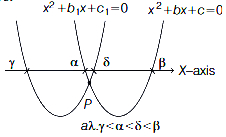
If $\alpha, \beta$ are the roots of $x^2+bx+c=0$,$\gamma, \delta$ are the roots of $x^2+b_1x+c_1=0$ and $\gamma < \alpha < \delta < \beta$,then $(c-c_1)^2 < $
A
$(b_1-b)(bc_1-b_1c)$
B
$1$
C
$(b-b_1)^2$
D
$(c-c_1)(b_1c-b_1c_1)$
Solution
(A) Let $f(x) = x^2+bx+c$ and $g(x) = x^2+b_1x+c_1$. The intersection point $P$ of the two parabolas is found by solving $f(x) = g(x)$.
$x^2+bx+c = x^2+b_1x+c_1$
$(b-b_1)x = c_1-c$
$x = \frac{c_1-c}{b-b_1} = \frac{c-c_1}{b_1-b}$.
Since $\gamma < \alpha < \delta < \beta$,the point of intersection $P$ lies below the $x$-axis,meaning $f(x) < 0$ at this $x$-coordinate.
$f\left(\frac{c-c_1}{b_1-b}\right) < 0$
$\left(\frac{c-c_1}{b_1-b}\right)^2 + b\left(\frac{c-c_1}{b_1-b}\right) + c < 0$
Multiplying by $(b_1-b)^2$ (which is positive):
$(c-c_1)^2 + b(c-c_1)(b_1-b) + c(b_1-b)^2 < 0$
$(c-c_1)^2 < -b(c-c_1)(b_1-b) - c(b_1-b)^2$
$(c-c_1)^2 < (b_1-b)[-b(c-c_1) - c(b_1-b)]$
$(c-c_1)^2 < (b_1-b)[-bc+bc_1-cb_1+cb]$
$(c-c_1)^2 < (b_1-b)(bc_1-b_1c)$.
Thus,option $A$ is correct.
$x^2+bx+c = x^2+b_1x+c_1$
$(b-b_1)x = c_1-c$
$x = \frac{c_1-c}{b-b_1} = \frac{c-c_1}{b_1-b}$.
Since $\gamma < \alpha < \delta < \beta$,the point of intersection $P$ lies below the $x$-axis,meaning $f(x) < 0$ at this $x$-coordinate.
$f\left(\frac{c-c_1}{b_1-b}\right) < 0$
$\left(\frac{c-c_1}{b_1-b}\right)^2 + b\left(\frac{c-c_1}{b_1-b}\right) + c < 0$
Multiplying by $(b_1-b)^2$ (which is positive):
$(c-c_1)^2 + b(c-c_1)(b_1-b) + c(b_1-b)^2 < 0$
$(c-c_1)^2 < -b(c-c_1)(b_1-b) - c(b_1-b)^2$
$(c-c_1)^2 < (b_1-b)[-b(c-c_1) - c(b_1-b)]$
$(c-c_1)^2 < (b_1-b)[-bc+bc_1-cb_1+cb]$
$(c-c_1)^2 < (b_1-b)(bc_1-b_1c)$.
Thus,option $A$ is correct.
0 likes
View Solution60
EasyMCQ
For a real number $x$,if the minimum value of $f(x) = x^2 + 2bx + 2c^2$ is greater than the maximum value of $g(x) = -x^2 - 2cx + b^2$,then:
A
$c^2 > 2b^2$
B
$c^2 < 2b^2$
C
$b^2 = 2c^2$
D
$c^2 = 2b^2$
Solution
(A) The function $f(x) = x^2 + 2bx + 2c^2$ is an upward-opening parabola. Its minimum value occurs at $x = -b$,which is $f(-b) = (-b)^2 + 2b(-b) + 2c^2 = b^2 - 2b^2 + 2c^2 = 2c^2 - b^2$.
The function $g(x) = -x^2 - 2cx + b^2$ is a downward-opening parabola. Its maximum value occurs at $x = -c$,which is $g(-c) = -(-c)^2 - 2c(-c) + b^2 = -c^2 + 2c^2 + b^2 = c^2 + b^2$.
According to the problem,the minimum value of $f(x)$ is greater than the maximum value of $g(x)$:
$2c^2 - b^2 > c^2 + b^2$
$2c^2 - c^2 > b^2 + b^2$
$c^2 > 2b^2$.
The function $g(x) = -x^2 - 2cx + b^2$ is a downward-opening parabola. Its maximum value occurs at $x = -c$,which is $g(-c) = -(-c)^2 - 2c(-c) + b^2 = -c^2 + 2c^2 + b^2 = c^2 + b^2$.
According to the problem,the minimum value of $f(x)$ is greater than the maximum value of $g(x)$:
$2c^2 - b^2 > c^2 + b^2$
$2c^2 - c^2 > b^2 + b^2$
$c^2 > 2b^2$.
0 likes
View Solution61
EasyMCQ
If $a$ and $b$ are the maximum and minimum values of the quadratic expressions $1-2x-5x^2$ and $x^2-2x+5$ respectively,then the set of all values of $x$ for which the expression $5ax^2+bx+7$ is positive,is
A
$(a, b)$
B
$(-\infty, 7)$
C
$(5, \infty)$
D
$(-\infty, \infty)$
Solution
(D) The maximum value of the quadratic expression $1-2x-5x^2$ is found at $x = -\frac{b}{2a} = -\frac{-2}{2(-5)} = -\frac{1}{5}$.
Substituting $x = -\frac{1}{5}$,we get $a = 1 - 2(-\frac{1}{5}) - 5(-\frac{1}{5})^2 = 1 + \frac{2}{5} - \frac{1}{5} = \frac{6}{5}$.
The minimum value of the quadratic expression $x^2-2x+5$ is found at $x = -\frac{b}{2a} = -\frac{-2}{2(1)} = 1$.
Substituting $x = 1$,we get $b = (1)^2 - 2(1) + 5 = 4$.
Now,substitute $a = \frac{6}{5}$ and $b = 4$ into the expression $5ax^2+bx+7$:
$5(\frac{6}{5})x^2 + 4x + 7 = 6x^2 + 4x + 7$.
For the quadratic $6x^2 + 4x + 7 > 0$,we check the discriminant $D = b^2 - 4ac = (4)^2 - 4(6)(7) = 16 - 168 = -152$.
Since $D < 0$ and the leading coefficient $6 > 0$,the expression $6x^2 + 4x + 7$ is always positive for all real values of $x$.
Thus,the set of all values of $x$ is $(-\infty, \infty)$.
Substituting $x = -\frac{1}{5}$,we get $a = 1 - 2(-\frac{1}{5}) - 5(-\frac{1}{5})^2 = 1 + \frac{2}{5} - \frac{1}{5} = \frac{6}{5}$.
The minimum value of the quadratic expression $x^2-2x+5$ is found at $x = -\frac{b}{2a} = -\frac{-2}{2(1)} = 1$.
Substituting $x = 1$,we get $b = (1)^2 - 2(1) + 5 = 4$.
Now,substitute $a = \frac{6}{5}$ and $b = 4$ into the expression $5ax^2+bx+7$:
$5(\frac{6}{5})x^2 + 4x + 7 = 6x^2 + 4x + 7$.
For the quadratic $6x^2 + 4x + 7 > 0$,we check the discriminant $D = b^2 - 4ac = (4)^2 - 4(6)(7) = 16 - 168 = -152$.
Since $D < 0$ and the leading coefficient $6 > 0$,the expression $6x^2 + 4x + 7$ is always positive for all real values of $x$.
Thus,the set of all values of $x$ is $(-\infty, \infty)$.
0 likes
View Solution62
EasyMCQ
If the minimum value of the quadratic expression $x^2+5x-2$ is $M$ and it occurs at $x=a$,then $\frac{M}{a}$ is equal to
A
$3.3$
B
$\frac{33}{5}$
C
$2.5$
D
$-0.25$
Solution
(A) For a quadratic expression $f(x) = ax^2+bx+c$,the minimum value occurs at $x = -\frac{b}{2a}$.
Here,$f(x) = x^2+5x-2$,so $a=1, b=5, c=-2$.
The minimum value occurs at $a = -\frac{5}{2(1)} = -2.5$.
The minimum value $M$ is $f(-2.5) = (-2.5)^2 + 5(-2.5) - 2 = 6.25 - 12.5 - 2 = -8.25$.
Now,$\frac{M}{a} = \frac{-8.25}{-2.5} = 3.3$.
Here,$f(x) = x^2+5x-2$,so $a=1, b=5, c=-2$.
The minimum value occurs at $a = -\frac{5}{2(1)} = -2.5$.
The minimum value $M$ is $f(-2.5) = (-2.5)^2 + 5(-2.5) - 2 = 6.25 - 12.5 - 2 = -8.25$.
Now,$\frac{M}{a} = \frac{-8.25}{-2.5} = 3.3$.
0 likes
View Solution63
MediumMCQ
If $f(x) = x^2 - 2(4K - 1)x + g(K) > 0$ for all $x \in R$ and for $K \in (a, b)$. If $g(K) = 15K^2 - 2K - 7$,then:
A
$g(K)$ attains its maximum at the midpoint of $(a, b)$
B
$g(K)$ attains its minimum at two points in $(a, b)$
C
$g(K)$ attains its both maximum and minimum in $(a, b)$
D
$g(K)$ attains no maximum and no minimum in $(a, b)$
Solution
(D) For $f(x) = x^2 - 2(4K - 1)x + g(K) > 0$ to hold for all $x \in R$,the discriminant $D$ must be less than $0$.
$D = [-2(4K - 1)]^2 - 4(1)(g(K)) < 0$
$4(16K^2 - 8K + 1) - 4(15K^2 - 2K - 7) < 0$
$16K^2 - 8K + 1 - 15K^2 + 2K + 7 < 0$
$K^2 - 6K + 8 < 0$
$(K - 2)(K - 4) < 0$
Thus,$K \in (2, 4)$,so $a = 2$ and $b = 4$.
The function $g(K) = 15K^2 - 2K - 7$ is an upward-opening parabola with its vertex at $K = -(-2) / (2 \times 15) = 1/15$.
Since $1/15 \notin (2, 4)$,the function $g(K)$ is strictly increasing on the interval $(2, 4)$.
Therefore,$g(K)$ does not attain a maximum or a minimum value within the open interval $(2, 4)$.
$D = [-2(4K - 1)]^2 - 4(1)(g(K)) < 0$
$4(16K^2 - 8K + 1) - 4(15K^2 - 2K - 7) < 0$
$16K^2 - 8K + 1 - 15K^2 + 2K + 7 < 0$
$K^2 - 6K + 8 < 0$
$(K - 2)(K - 4) < 0$
Thus,$K \in (2, 4)$,so $a = 2$ and $b = 4$.
The function $g(K) = 15K^2 - 2K - 7$ is an upward-opening parabola with its vertex at $K = -(-2) / (2 \times 15) = 1/15$.
Since $1/15 \notin (2, 4)$,the function $g(K)$ is strictly increasing on the interval $(2, 4)$.
Therefore,$g(K)$ does not attain a maximum or a minimum value within the open interval $(2, 4)$.
0 likes
View Solution64
EasyMCQ
$f(x)=ax^2-bx-a$ is a quadratic expression. If $K$ is the least real number such that $f(x) \leq K, \forall x \in R$,then
A
$K=0$
B
$K < -2$
C
$K > 0$
D
$-1 < K < 0$
Solution
(C) Given $f(x)=ax^2-bx-a$ is a quadratic expression such that $f(x) \leq K, \forall x \in R$.
This implies $ax^2-bx-a-K \leq 0, \forall x \in R$.
For a quadratic expression $Ax^2+Bx+C$ to be less than or equal to $0$ for all $x$,the coefficient of $x^2$ must be negative $(a < 0)$ and the discriminant $D$ must be less than or equal to $0$.
Here,$D = (-b)^2 - 4(a)(-a-K) \leq 0$.
$b^2 + 4a(a+K) \leq 0$.
$b^2 + 4a^2 + 4aK \leq 0$.
Since $b^2 + 4a^2 \geq 0$,for the expression to be $\leq 0$,$4aK$ must be negative.
Given $a < 0$,for $4aK < 0$ to hold,$K$ must be positive.
Thus,$K > 0$.
This implies $ax^2-bx-a-K \leq 0, \forall x \in R$.
For a quadratic expression $Ax^2+Bx+C$ to be less than or equal to $0$ for all $x$,the coefficient of $x^2$ must be negative $(a < 0)$ and the discriminant $D$ must be less than or equal to $0$.
Here,$D = (-b)^2 - 4(a)(-a-K) \leq 0$.
$b^2 + 4a(a+K) \leq 0$.
$b^2 + 4a^2 + 4aK \leq 0$.
Since $b^2 + 4a^2 \geq 0$,for the expression to be $\leq 0$,$4aK$ must be negative.
Given $a < 0$,for $4aK < 0$ to hold,$K$ must be positive.
Thus,$K > 0$.
0 likes
View Solution65
EasyMCQ
If the maximum value of $2x - 7 - ax^2$ cannot exceed $20$,then the minimum value of $a$ is
A
$27$
B
$\frac{1}{13}$
C
$13$
D
$\frac{1}{27}$
Solution
(D) Let $f(x) = -ax^2 + 2x - 7$. For the function to have a maximum value,we must have $a > 0$.
Completing the square:
$f(x) = -a(x^2 - \frac{2}{a}x) - 7$
$f(x) = -a(x^2 - \frac{2}{a}x + \frac{1}{a^2} - \frac{1}{a^2}) - 7$
$f(x) = -a(x - \frac{1}{a})^2 + \frac{1}{a} - 7$
The maximum value of $f(x)$ is $\frac{1}{a} - 7$.
Given that the maximum value cannot exceed $20$,we have:
$\frac{1}{a} - 7 \leq 20$
$\frac{1}{a} \leq 27$
Since $a > 0$,we get $a \geq \frac{1}{27}$.
Thus,the minimum value of $a$ is $\frac{1}{27}$.
Completing the square:
$f(x) = -a(x^2 - \frac{2}{a}x) - 7$
$f(x) = -a(x^2 - \frac{2}{a}x + \frac{1}{a^2} - \frac{1}{a^2}) - 7$
$f(x) = -a(x - \frac{1}{a})^2 + \frac{1}{a} - 7$
The maximum value of $f(x)$ is $\frac{1}{a} - 7$.
Given that the maximum value cannot exceed $20$,we have:
$\frac{1}{a} - 7 \leq 20$
$\frac{1}{a} \leq 27$
Since $a > 0$,we get $a \geq \frac{1}{27}$.
Thus,the minimum value of $a$ is $\frac{1}{27}$.
0 likes
View Solution66
MediumMCQ
If both the roots of the equation $x^2-4ax+1-3a+4a^2=0$ exceed $1$,then $a$ lies in the interval
A
$\left(-\infty, \frac{7-\sqrt{17}}{8}\right)$
B
$\left(\frac{7+\sqrt{17}}{8}, \infty\right)$
C
$\left(\frac{7-\sqrt{17}}{8}, \frac{1}{2}\right)$
D
$\left(\frac{1}{2}, \frac{7+\sqrt{17}}{8}\right)$
Solution
(B) Let $f(x) = x^2 - 4ax + (4a^2 - 3a + 1)$. For both roots to be greater than $1$,the following conditions must be satisfied:
$1$. Discriminant $D \geq 0$:
$D = (-4a)^2 - 4(1)(4a^2 - 3a + 1) = 16a^2 - 16a^2 + 12a - 4 = 12a - 4 \geq 0 \Rightarrow a \geq \frac{1}{3}$.
$2$. Vertex position: $\frac{-b}{2a} > 1$:
$\frac{4a}{2} > 1$ $\Rightarrow 2a > 1$ $\Rightarrow a > \frac{1}{2}$.
$3$. $f(1) > 0$:
$f(1) = 1^2 - 4a(1) + 4a^2 - 3a + 1 = 4a^2 - 7a + 2 > 0$.
Roots of $4a^2 - 7a + 2 = 0$ are $a = \frac{7 \pm \sqrt{49 - 32}}{8} = \frac{7 \pm \sqrt{17}}{8}$.
Since the parabola opens upward,$4a^2 - 7a + 2 > 0$ for $a \in \left(-\infty, \frac{7-\sqrt{17}}{8}\right) \cup \left(\frac{7+\sqrt{17}}{8}, \infty\right)$.
Taking the intersection of $a \geq \frac{1}{3}$,$a > \frac{1}{2}$,and $a \in \left(-\infty, \frac{7-\sqrt{17}}{8}\right) \cup \left(\frac{7+\sqrt{17}}{8}, \infty\right)$:
Since $\frac{7+\sqrt{17}}{8} \approx \frac{7+4.12}{8} \approx 1.39 > \frac{1}{2}$,the intersection is $a \in \left(\frac{7+\sqrt{17}}{8}, \infty\right)$.
$1$. Discriminant $D \geq 0$:
$D = (-4a)^2 - 4(1)(4a^2 - 3a + 1) = 16a^2 - 16a^2 + 12a - 4 = 12a - 4 \geq 0 \Rightarrow a \geq \frac{1}{3}$.
$2$. Vertex position: $\frac{-b}{2a} > 1$:
$\frac{4a}{2} > 1$ $\Rightarrow 2a > 1$ $\Rightarrow a > \frac{1}{2}$.
$3$. $f(1) > 0$:
$f(1) = 1^2 - 4a(1) + 4a^2 - 3a + 1 = 4a^2 - 7a + 2 > 0$.
Roots of $4a^2 - 7a + 2 = 0$ are $a = \frac{7 \pm \sqrt{49 - 32}}{8} = \frac{7 \pm \sqrt{17}}{8}$.
Since the parabola opens upward,$4a^2 - 7a + 2 > 0$ for $a \in \left(-\infty, \frac{7-\sqrt{17}}{8}\right) \cup \left(\frac{7+\sqrt{17}}{8}, \infty\right)$.
Taking the intersection of $a \geq \frac{1}{3}$,$a > \frac{1}{2}$,and $a \in \left(-\infty, \frac{7-\sqrt{17}}{8}\right) \cup \left(\frac{7+\sqrt{17}}{8}, \infty\right)$:
Since $\frac{7+\sqrt{17}}{8} \approx \frac{7+4.12}{8} \approx 1.39 > \frac{1}{2}$,the intersection is $a \in \left(\frac{7+\sqrt{17}}{8}, \infty\right)$.
0 likes
View Solution67
EasyMCQ
If the roots of the equation $x^2+x+a=0$ exceed $a$,then
A
$a > 2$
B
$a < -2$
C
$2 < a < 3$
D
$-2 < a < -1$
Solution
(B) Let $f(x) = x^2+x+a$. For the roots to exceed $a$,the following conditions must be satisfied:
$1$. $D \geq 0$ $\Rightarrow 1-4a \geq 0$ $\Rightarrow a \leq \frac{1}{4}$.
$2$. $f(a) > 0$ $\Rightarrow a^2+a+a > 0$ $\Rightarrow a^2+2a > 0$ $\Rightarrow a(a+2) > 0$ $\Rightarrow a \in (-\infty, -2) \cup (0, \infty)$.
$3$. $-\frac{b}{2a} > a$ $\Rightarrow -\frac{1}{2} > a$ $\Rightarrow a < -\frac{1}{2}$.
Taking the intersection of all three conditions:
$a \in (-\infty, \frac{1}{4}] \cap ((-\infty, -2) \cup (0, \infty)) \cap (-\infty, -\frac{1}{2})$
$= (-\infty, -2)$.
$1$. $D \geq 0$ $\Rightarrow 1-4a \geq 0$ $\Rightarrow a \leq \frac{1}{4}$.
$2$. $f(a) > 0$ $\Rightarrow a^2+a+a > 0$ $\Rightarrow a^2+2a > 0$ $\Rightarrow a(a+2) > 0$ $\Rightarrow a \in (-\infty, -2) \cup (0, \infty)$.
$3$. $-\frac{b}{2a} > a$ $\Rightarrow -\frac{1}{2} > a$ $\Rightarrow a < -\frac{1}{2}$.
Taking the intersection of all three conditions:
$a \in (-\infty, \frac{1}{4}] \cap ((-\infty, -2) \cup (0, \infty)) \cap (-\infty, -\frac{1}{2})$
$= (-\infty, -2)$.
0 likes
View Solution68
EasyMCQ
Let $a, b, c$ be real numbers such that $a+b+c < 0$ and the quadratic equation $a x^{2}+b x+c=0$ has imaginary roots. Then:
A
$a > 0, c > 0$
B
$a > 0, c < 0$
C
$a < 0, c > 0$
D
$a < 0, c < 0$
Solution
(D) Let $f(x) = a x^{2} + b x + c$.
Given that $f(1) = a + b + c < 0$.
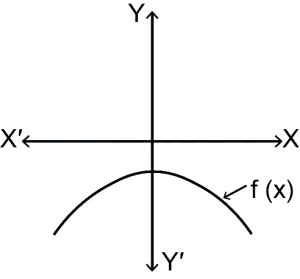
Since the quadratic equation $a x^{2} + b x + c = 0$ has imaginary roots,the graph of $f(x)$ does not intersect the $x$-axis.
This means $f(x)$ is either always positive $(a > 0)$ or always negative $(a < 0)$.
Since $f(1) < 0$,$f(x)$ must be always negative,which implies $a < 0$.
Also,$f(0) = c$. Since $f(x)$ is always negative,$f(0) < 0$,which implies $c < 0$.
Thus,$a < 0$ and $c < 0$.
Given that $f(1) = a + b + c < 0$.
Since the quadratic equation $a x^{2} + b x + c = 0$ has imaginary roots,the graph of $f(x)$ does not intersect the $x$-axis.
This means $f(x)$ is either always positive $(a > 0)$ or always negative $(a < 0)$.
Since $f(1) < 0$,$f(x)$ must be always negative,which implies $a < 0$.
Also,$f(0) = c$. Since $f(x)$ is always negative,$f(0) < 0$,which implies $c < 0$.
Thus,$a < 0$ and $c < 0$.
0 likes
View Solution69
MediumMCQ
The quadratic expression $(2x+1)^{2} - px + q \neq 0$ for any real $x$,if
A
$p^{2} - 16p - 8q < 0$
B
$p^{2} - 8p + 16q < 0$
C
$p^{2} - 8p - 16q < 0$
D
$p^{2} - 16p + 8q < 0$
Solution
(C) Given the quadratic expression is $(2x+1)^{2} - px + q \neq 0$ for all real $x$.
Expanding the expression:
$4x^{2} + 4x + 1 - px + q \neq 0$
$4x^{2} + (4-p)x + (1+q) \neq 0$
For a quadratic expression $ax^{2} + bx + c$ to be non-zero for all real $x$,its discriminant $D$ must be less than $0$.
$D = b^{2} - 4ac < 0$
Substituting the coefficients $a = 4$,$b = (4-p)$,and $c = (1+q)$:
$(4-p)^{2} - 4(4)(1+q) < 0$
$16 - 8p + p^{2} - 16 - 16q < 0$
$p^{2} - 8p - 16q < 0$
Expanding the expression:
$4x^{2} + 4x + 1 - px + q \neq 0$
$4x^{2} + (4-p)x + (1+q) \neq 0$
For a quadratic expression $ax^{2} + bx + c$ to be non-zero for all real $x$,its discriminant $D$ must be less than $0$.
$D = b^{2} - 4ac < 0$
Substituting the coefficients $a = 4$,$b = (4-p)$,and $c = (1+q)$:
$(4-p)^{2} - 4(4)(1+q) < 0$
$16 - 8p + p^{2} - 16 - 16q < 0$
$p^{2} - 8p - 16q < 0$
0 likes
View Solution70
EasyMCQ
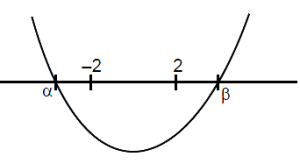
If the quadratic equation $ax^2+bx+c=0$ $(a>0)$ has two roots $\alpha$ and $\beta$ such that $\alpha < -2$ and $\beta > 2$,then which of the following is true?
A
$c < 0$
B
$a+b+c > 0$
C
$a-b+c < 0$
D
$a-b+c > 0$
Solution
(C) Let $f(x) = ax^2+bx+c$. Since $a > 0$,the parabola opens upwards.
Given that the roots $\alpha$ and $\beta$ satisfy $\alpha < -2$ and $\beta > 2$,the value of the function at $x = -1$ must be negative because $-1$ lies between the roots $\alpha$ and $\beta$ (since $\alpha < -2 < -1 < 2 < \beta$).
Thus,$f(-1) < 0$.
Substituting $x = -1$ into the quadratic expression,we get $f(-1) = a(-1)^2 + b(-1) + c = a - b + c$.
Therefore,$a - b + c < 0$.
Given that the roots $\alpha$ and $\beta$ satisfy $\alpha < -2$ and $\beta > 2$,the value of the function at $x = -1$ must be negative because $-1$ lies between the roots $\alpha$ and $\beta$ (since $\alpha < -2 < -1 < 2 < \beta$).
Thus,$f(-1) < 0$.
Substituting $x = -1$ into the quadratic expression,we get $f(-1) = a(-1)^2 + b(-1) + c = a - b + c$.
Therefore,$a - b + c < 0$.
0 likes
View Solution71
EasyMCQ
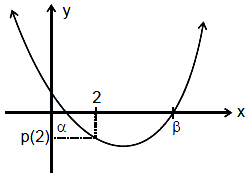
If one root of $x^2+px-q^2=0$,where $p$ and $q$ are real,is less than $2$ and the other is greater than $2$,then:
A
$4+2p+q^2 > 0$
B
$4+2p+q^2 < 0$
C
$4+2p-q^2 > 0$
D
$4+2p-q^2 < 0$
Solution
(D) Let $f(x) = x^2+px-q^2$.
Since the coefficient of $x^2$ is $1 > 0$,the parabola opens upwards.
Given that one root $\alpha < 2$ and the other root $\beta > 2$,the value of the function at $x=2$ must be negative,i.e.,$f(2) < 0$.
Substituting $x=2$ into the quadratic expression:
$f(2) = (2)^2 + p(2) - q^2 < 0$
$4 + 2p - q^2 < 0$
Thus,the correct option is $D$.
Since the coefficient of $x^2$ is $1 > 0$,the parabola opens upwards.
Given that one root $\alpha < 2$ and the other root $\beta > 2$,the value of the function at $x=2$ must be negative,i.e.,$f(2) < 0$.
Substituting $x=2$ into the quadratic expression:
$f(2) = (2)^2 + p(2) - q^2 < 0$
$4 + 2p - q^2 < 0$
Thus,the correct option is $D$.
0 likes
View Solution72
MediumMCQ
The number of values of $k,$ for which the equation $x^{2}-3x+k=0$ has two distinct roots lying in the interval $(0,1),$ is
A
three
B
two
C
infinitely many
D
no value of $k$ satisfies the requirement
Solution
(D) Let $f(x) = x^{2}-3x+k$.
For the roots to lie in the interval $(0,1)$,the vertex of the parabola must lie within $(0,1)$.
The $x$-coordinate of the vertex is given by $x = -\frac{b}{2a} = -\frac{-3}{2(1)} = \frac{3}{2} = 1.5$.
Since $1.5 \notin (0,1)$,it is impossible for both roots to lie in the interval $(0,1)$ simultaneously.
Therefore,there is no value of $k$ that satisfies the given condition.
For the roots to lie in the interval $(0,1)$,the vertex of the parabola must lie within $(0,1)$.
The $x$-coordinate of the vertex is given by $x = -\frac{b}{2a} = -\frac{-3}{2(1)} = \frac{3}{2} = 1.5$.
Since $1.5 \notin (0,1)$,it is impossible for both roots to lie in the interval $(0,1)$ simultaneously.
Therefore,there is no value of $k$ that satisfies the given condition.
0 likes
View Solution73
DifficultMCQ
Let $\alpha$ and $\beta$ be the roots of the equation $x^{2}+2ax+(3a+10) = 0$ such that $\alpha < 1 < \beta$. Then the set of all possible values of $a$ is:
A
$(-\infty, -11/5) \cup (5, \infty)$
B
$(-\infty, -2) \cup (5, \infty)$
C
$(-\infty, -3)$
D
$(-\infty, -11/5)$
Solution
(D) Given the quadratic equation $f(x) = x^{2}+2ax+(3a+10) = 0$.
Since the roots $\alpha$ and $\beta$ satisfy $\alpha < 1 < \beta$,the value of the function at $x=1$ must be negative,i.e.,$f(1) < 0$.
Substituting $x=1$ into the equation:
$f(1) = (1)^{2} + 2a(1) + (3a+10) < 0$
$1 + 2a + 3a + 10 < 0$
$5a + 11 < 0$
$5a < -11$
$a < -11/5$
Therefore,the set of all possible values of $a$ is $(-\infty, -11/5)$.
Since the roots $\alpha$ and $\beta$ satisfy $\alpha < 1 < \beta$,the value of the function at $x=1$ must be negative,i.e.,$f(1) < 0$.
Substituting $x=1$ into the equation:
$f(1) = (1)^{2} + 2a(1) + (3a+10) < 0$
$1 + 2a + 3a + 10 < 0$
$5a + 11 < 0$
$5a < -11$
$a < -11/5$
Therefore,the set of all possible values of $a$ is $(-\infty, -11/5)$.
0 likes
View Solution4-2.Quadratic Equations and Inequations — Quadratic expressions and Position of roots · Frequently Asked Questions
1Are these 4-2.Quadratic Equations and Inequations questions useful for JEE and NEET?
Yes. All questions in this section are mapped to JEE Main and NEET exam patterns. Previous year questions from JEE Main, NEET, GUJCET and state-level exams are included with full solutions.
2Can I switch to Hindi or Gujarati for these questions?
Yes. Use the language tabs in the hero section or the sidebar to view the same questions and solutions in English, Hindi or Gujarati.
3How do I generate a question paper from this subtopic?
Use the Vedclass Exam Paper Generator — select the chapter and subtopic, set difficulty, and generate Sets A, B, C, D automatically. First 3 chapters of every subject are free.
Vedclass Products
For Students
Vedclass Test Series
Mock tests in real JEE/NEET style with performance analysis. 5-day free trial.
Start Free TrialFor Teachers
Exam Paper Generator
Generate Set A/B/C/D papers from this chapter in 2 minutes. 3 chapters free.
Try FreeFor Institutes
Online Exam Module
Live online exams with unlimited students, 360° analytics & white-label branding.
See DemoFor Teachers & Institutes
Generate a 4-2.Quadratic Equations and Inequations Exam Paper in 2 Minutes
Select subtopic & difficulty — Sets A, B, C, D auto-generated with No Repeat logic.
First 3 chapters of every subject are free — no payment required.