
A English
System of circles Questions in English
Class 11 Mathematics · 10-1.Circle and System of Circles · System of circles
373+
Questions
English
Language
100%
With Solutions
Showing 21 of 373 questions in English
351
DifficultMCQ
The condition for the coaxial system $x^2+y^2+2 \lambda x+c=0$,where $\lambda$ is a parameter and $c$ is a constant,to have distinct limiting points,is
A
$c=0$
B
$c < 0$
C
$c=-1$
D
$c>0$
Solution
(D) The given equation of the coaxial system is $x^2+y^2+2 \lambda x+c=0$.
Limiting points are the centers of the point circles in the system.
$A$ point circle is obtained when the radius $r=0$.
The radius $r$ of the circle $x^2+y^2+2gx+2fy+c=0$ is given by $\sqrt{g^2+f^2-c}$.
Here,$g=\lambda$,$f=0$,and the constant term is $c$.
Thus,$r = \sqrt{\lambda^2-c}$.
For the limiting points to be distinct,the radius must be imaginary,which implies $\lambda^2-c < 0$,or $c > \lambda^2$.
However,for the system to have limiting points that are real and distinct,the condition is $c > 0$.
Limiting points are the centers of the point circles in the system.
$A$ point circle is obtained when the radius $r=0$.
The radius $r$ of the circle $x^2+y^2+2gx+2fy+c=0$ is given by $\sqrt{g^2+f^2-c}$.
Here,$g=\lambda$,$f=0$,and the constant term is $c$.
Thus,$r = \sqrt{\lambda^2-c}$.
For the limiting points to be distinct,the radius must be imaginary,which implies $\lambda^2-c < 0$,or $c > \lambda^2$.
However,for the system to have limiting points that are real and distinct,the condition is $c > 0$.
0 likes
View Solution352
MediumMCQ
The limiting points of the co-axial system containing the two circles $x^2+y^2+2x-2y+2=0$ and $25(x^2+y^2)-10x-80y+65=0$ are
A
$(1,-1), (-3,-40)$
B
$(1,-1), \left(-\frac{1}{5}, \frac{8}{5}\right)$
C
$(-1,1), \left(\frac{1}{5}, \frac{8}{5}\right)$
D
$\left(-\frac{1}{5}, -\frac{8}{5}\right)$
Solution
(C) The equations of the circles are $S_1: x^2+y^2+2x-2y+2=0$ and $S_2: x^2+y^2-\frac{2}{5}x-\frac{16}{5}y+\frac{13}{5}=0$.
The family of circles is given by $S_1 + \lambda(S_1 - S_2) = 0$ or $S_1 + k S_2 = 0$.
The limiting points are the centers of the point circles in the co-axial system.
$A$ circle $x^2+y^2+2gx+2fy+c=0$ is a point circle if $g^2+f^2-c=0$.
The radical axis is $S_1 - S_2 = 0$ $\Rightarrow (2 + \frac{2}{5})x + (-2 + \frac{16}{5})y + (2 - \frac{13}{5}) = 0$ $\Rightarrow \frac{12}{5}x + \frac{6}{5}y - \frac{3}{5} = 0$ $\Rightarrow 4x + 2y - 1 = 0$.
Any circle in the system is $S_1 + \lambda(4x+2y-1) = 0 \Rightarrow x^2+y^2+(2+4\lambda)x + (-2+2\lambda)y + (2-\lambda) = 0$.
For a point circle,$g^2+f^2-c=0 \Rightarrow (1+2\lambda)^2 + (-1+\lambda)^2 - (2-\lambda) = 0$.
$1+4\lambda+4\lambda^2 + 1-2\lambda+\lambda^2 - 2+\lambda = 0 \Rightarrow 5\lambda^2+3\lambda = 0$.
Thus,$\lambda = 0$ or $\lambda = -\frac{3}{5}$.
For $\lambda = 0$,the center is $(-g, -f) = (-1, 1)$.
For $\lambda = -\frac{3}{5}$,the center is $(-(1+2(-\frac{3}{5})), -(-1+(-\frac{3}{5}))) = (- (1-\frac{6}{5}), -(-\frac{8}{5})) = (\frac{1}{5}, \frac{8}{5})$.
The limiting points are $(-1, 1)$ and $(\frac{1}{5}, \frac{8}{5})$.
The family of circles is given by $S_1 + \lambda(S_1 - S_2) = 0$ or $S_1 + k S_2 = 0$.
The limiting points are the centers of the point circles in the co-axial system.
$A$ circle $x^2+y^2+2gx+2fy+c=0$ is a point circle if $g^2+f^2-c=0$.
The radical axis is $S_1 - S_2 = 0$ $\Rightarrow (2 + \frac{2}{5})x + (-2 + \frac{16}{5})y + (2 - \frac{13}{5}) = 0$ $\Rightarrow \frac{12}{5}x + \frac{6}{5}y - \frac{3}{5} = 0$ $\Rightarrow 4x + 2y - 1 = 0$.
Any circle in the system is $S_1 + \lambda(4x+2y-1) = 0 \Rightarrow x^2+y^2+(2+4\lambda)x + (-2+2\lambda)y + (2-\lambda) = 0$.
For a point circle,$g^2+f^2-c=0 \Rightarrow (1+2\lambda)^2 + (-1+\lambda)^2 - (2-\lambda) = 0$.
$1+4\lambda+4\lambda^2 + 1-2\lambda+\lambda^2 - 2+\lambda = 0 \Rightarrow 5\lambda^2+3\lambda = 0$.
Thus,$\lambda = 0$ or $\lambda = -\frac{3}{5}$.
For $\lambda = 0$,the center is $(-g, -f) = (-1, 1)$.
For $\lambda = -\frac{3}{5}$,the center is $(-(1+2(-\frac{3}{5})), -(-1+(-\frac{3}{5}))) = (- (1-\frac{6}{5}), -(-\frac{8}{5})) = (\frac{1}{5}, \frac{8}{5})$.
The limiting points are $(-1, 1)$ and $(\frac{1}{5}, \frac{8}{5})$.
0 likes
View Solution353
DifficultMCQ
If $(h, k)$ is the centre of the circle which passes through the origin and cuts the circles $x^2+y^2+4x+6y+12=0$ and $x^2+y^2+4x-6y+9=0$ orthogonally,then $k-2h=$
A
$0$
B
$1$
C
-$1$
D
$5$
Solution
(C) The equation of a circle passing through the origin $(0,0)$ and cutting the circles $x^2+y^2+2g_1x+2f_1y+c_1=0$ and $x^2+y^2+2g_2x+2f_2y+c_2=0$ orthogonally is given by the determinant equation:
$\left|\begin{array}{ccc} x^2+y^2 & x & y \\ c_1 & g_1 & f_1 \\ c_2 & g_2 & f_2 \end{array}\right| = 0$
Here,$c_1=12, g_1=2, f_1=3$ and $c_2=9, g_2=2, f_2=-3$.
Substituting these values:
$\left|\begin{array}{ccc} x^2+y^2 & x & y \\ 12 & 2 & 3 \\ 9 & 2 & -3 \end{array}\right| = 0$
Expanding the determinant:
$(x^2+y^2)(-6-6) - x(-36-27) + y(24-18) = 0$
$-12(x^2+y^2) + 63x + 6y = 0$
$x^2+y^2 - \frac{63}{12}x - \frac{6}{12}y = 0$
$x^2+y^2 - \frac{21}{4}x - \frac{1}{2}y = 0$
The centre $(h, k)$ is $(\frac{21}{8}, \frac{1}{4})$.
Thus,$k-2h = \frac{1}{4} - 2(\frac{21}{8}) = \frac{1}{4} - \frac{21}{4} = -\frac{20}{4} = -5$.
$\left|\begin{array}{ccc} x^2+y^2 & x & y \\ c_1 & g_1 & f_1 \\ c_2 & g_2 & f_2 \end{array}\right| = 0$
Here,$c_1=12, g_1=2, f_1=3$ and $c_2=9, g_2=2, f_2=-3$.
Substituting these values:
$\left|\begin{array}{ccc} x^2+y^2 & x & y \\ 12 & 2 & 3 \\ 9 & 2 & -3 \end{array}\right| = 0$
Expanding the determinant:
$(x^2+y^2)(-6-6) - x(-36-27) + y(24-18) = 0$
$-12(x^2+y^2) + 63x + 6y = 0$
$x^2+y^2 - \frac{63}{12}x - \frac{6}{12}y = 0$
$x^2+y^2 - \frac{21}{4}x - \frac{1}{2}y = 0$
The centre $(h, k)$ is $(\frac{21}{8}, \frac{1}{4})$.
Thus,$k-2h = \frac{1}{4} - 2(\frac{21}{8}) = \frac{1}{4} - \frac{21}{4} = -\frac{20}{4} = -5$.
0 likes
View Solution354
DifficultMCQ
The circle $S=0$ cuts the circles $C_1=x^2+y^2-8x-2y+16=0$ and $C_2=x^2+y^2-4x-4y-1=0$ orthogonally. If the common chord of $S=0$ and $C_1=0$ is $2x+13y-15=0$,then the centre of $S=0$ is
A
$\left(\frac{-11}{3}, \frac{7}{6}\right)$
B
$\left(\frac{11}{3}, \frac{-7}{6}\right)$
C
$\left(\frac{2}{13}, \frac{11}{15}\right)$
D
$\left(\frac{11}{15}, \frac{-2}{13}\right)$
Solution
(B) Let the equation of circle $S$ be $x^2+y^2+2gx+2fy+c=0$.
Since $S$ cuts $C_1$ and $C_2$ orthogonally,we have:
$2g(-4) + 2f(-1) = c + 16 \implies -8g - 2f = c + 16 \quad (i)$
$2g(-2) + 2f(-2) = c - 1 \implies -4g - 4f = c - 1 \quad (ii)$
Subtracting $(ii)$ from $(i)$: $-4g + 2f = 17 \implies 2f = 4g + 17 \implies f = 2g + 8.5$.
The common chord of $S=0$ and $C_1=0$ is $S - C_1 = 0$:
$(2g+8)x + (2f+2)y + (c-16) = 0$.
Comparing this with the given chord $2x + 13y - 15 = 0$:
$\frac{2g+8}{2} = \frac{2f+2}{13} = \frac{c-16}{-15} = k$.
$2g+8 = 2k \implies g = k-4$.
$2f+2 = 13k \implies f = \frac{13k-2}{2}$.
Substitute into $2f = 4g + 17$: $13k-2 = 4(k-4) + 17 \implies 13k-2 = 4k-16+17 \implies 9k = 3 \implies k = \frac{1}{3}$.
Then $g = \frac{1}{3} - 4 = \frac{-11}{3}$ and $f = \frac{13(1/3)-2}{2} = \frac{7/3}{2} = \frac{7}{6}$.
The centre of $S$ is $(-g, -f) = \left(\frac{11}{3}, \frac{-7}{6}\right)$.
Since $S$ cuts $C_1$ and $C_2$ orthogonally,we have:
$2g(-4) + 2f(-1) = c + 16 \implies -8g - 2f = c + 16 \quad (i)$
$2g(-2) + 2f(-2) = c - 1 \implies -4g - 4f = c - 1 \quad (ii)$
Subtracting $(ii)$ from $(i)$: $-4g + 2f = 17 \implies 2f = 4g + 17 \implies f = 2g + 8.5$.
The common chord of $S=0$ and $C_1=0$ is $S - C_1 = 0$:
$(2g+8)x + (2f+2)y + (c-16) = 0$.
Comparing this with the given chord $2x + 13y - 15 = 0$:
$\frac{2g+8}{2} = \frac{2f+2}{13} = \frac{c-16}{-15} = k$.
$2g+8 = 2k \implies g = k-4$.
$2f+2 = 13k \implies f = \frac{13k-2}{2}$.
Substitute into $2f = 4g + 17$: $13k-2 = 4(k-4) + 17 \implies 13k-2 = 4k-16+17 \implies 9k = 3 \implies k = \frac{1}{3}$.
Then $g = \frac{1}{3} - 4 = \frac{-11}{3}$ and $f = \frac{13(1/3)-2}{2} = \frac{7/3}{2} = \frac{7}{6}$.
The centre of $S$ is $(-g, -f) = \left(\frac{11}{3}, \frac{-7}{6}\right)$.
0 likes
View Solution355
MediumMCQ
The equation of the circle whose radius is $3$ and which touches the circle $x^2+y^2-4x-6y-12=0$ internally at $(-1,-1)$ is
A
$5x^2+5y^2-8x-14y-32=0$
B
$x^2+y^2-12x-14y-28=0$
C
$3x^2+3y^2-8x-14y-31=0$
D
$x^2+y^2-5x-7y-14=0$
Solution
(A) The given circle is $S: x^2+y^2-4x-6y-12=0$. The center $C_1$ is $(2, 3)$ and radius $r_1 = \sqrt{2^2+3^2-(-12)} = \sqrt{4+9+12} = 5$.
Let the required circle have center $C_2(h, k)$ and radius $r_2 = 3$.
Since the circles touch internally at $P(-1, -1)$,the point $P$ divides the line segment $C_1C_2$ externally in the ratio $r_1 : r_2 = 5 : 3$.
Using the section formula for external division:
$-1 = \frac{5h - 3(2)}{5-3} \implies -2 = 5h - 6 \implies 5h = 4 \implies h = \frac{4}{5}$.
$-1 = \frac{5k - 3(3)}{5-3} \implies -2 = 5k - 9 \implies 5k = 7 \implies k = \frac{7}{5}$.
The equation of the circle is $(x - \frac{4}{5})^2 + (y - \frac{7}{5})^2 = 3^2$.
$x^2 - \frac{8}{5}x + \frac{16}{25} + y^2 - \frac{14}{5}y + \frac{49}{25} = 9$.
$x^2 + y^2 - \frac{8}{5}x - \frac{14}{5}y + \frac{65}{25} - 9 = 0$.
$x^2 + y^2 - \frac{8}{5}x - \frac{14}{5}y + \frac{13}{5} - 9 = 0$.
$x^2 + y^2 - \frac{8}{5}x - \frac{14}{5}y - \frac{32}{5} = 0$.
Multiplying by $5$,we get $5x^2 + 5y^2 - 8x - 14y - 32 = 0$.
Let the required circle have center $C_2(h, k)$ and radius $r_2 = 3$.
Since the circles touch internally at $P(-1, -1)$,the point $P$ divides the line segment $C_1C_2$ externally in the ratio $r_1 : r_2 = 5 : 3$.
Using the section formula for external division:
$-1 = \frac{5h - 3(2)}{5-3} \implies -2 = 5h - 6 \implies 5h = 4 \implies h = \frac{4}{5}$.
$-1 = \frac{5k - 3(3)}{5-3} \implies -2 = 5k - 9 \implies 5k = 7 \implies k = \frac{7}{5}$.
The equation of the circle is $(x - \frac{4}{5})^2 + (y - \frac{7}{5})^2 = 3^2$.
$x^2 - \frac{8}{5}x + \frac{16}{25} + y^2 - \frac{14}{5}y + \frac{49}{25} = 9$.
$x^2 + y^2 - \frac{8}{5}x - \frac{14}{5}y + \frac{65}{25} - 9 = 0$.
$x^2 + y^2 - \frac{8}{5}x - \frac{14}{5}y + \frac{13}{5} - 9 = 0$.
$x^2 + y^2 - \frac{8}{5}x - \frac{14}{5}y - \frac{32}{5} = 0$.
Multiplying by $5$,we get $5x^2 + 5y^2 - 8x - 14y - 32 = 0$.
0 likes
View Solution356
MediumMCQ
$A$ circle $S$ given by $x^2+y^2-14x+6y+33=0$ cuts the $X$-axis at $A$ and $B$ $(OB > OA)$. $C$ is the midpoint of $AB$. $L$ is a line through $C$ with slope $-1$. If $L$ is the diameter of a circle $S^{\prime}$ and also the radical axis of the circles $S$ and $S^{\prime}$,then the equation of the circle $S^{\prime}$ is
A
$x^2+y^2-17x+3y+54=0$
B
$x^2+y^2+17x-3y-54=0$
C
$x^2+y^2-17x+3y+51=0$
D
$x^2+y^2-3x+17y-51=0$
Solution
(A) The circle $S$ is $x^2+y^2-14x+6y+33=0$.
To find the intersection with the $X$-axis,set $y=0$: $x^2-14x+33=0 \implies (x-3)(x-11)=0$.
Thus,the points are $A(3, 0)$ and $B(11, 0)$ since $OB > OA$.
The midpoint $C$ of $AB$ is $(\frac{3+11}{2}, 0) = (7, 0)$.
The line $L$ passes through $(7, 0)$ with slope $-1$: $y-0 = -1(x-7) \implies x+y-7=0$.
Since $L$ is the radical axis of $S$ and $S^{\prime}$,the equation of $S^{\prime}$ is $S + kL = 0$:
$x^2+y^2-14x+6y+33 + k(x+y-7) = 0$.
$x^2+y^2+(k-14)x+(k+6)y+(33-7k) = 0$.
The center of $S^{\prime}$ is $(-\frac{k-14}{2}, -\frac{k+6}{2})$.
Since $L$ is the diameter of $S^{\prime}$,the center must lie on $L$:
$-\frac{k-14}{2} - \frac{k+6}{2} - 7 = 0 \implies -k+14-k-6-14 = 0 \implies -2k-6=0 \implies k=-3$.
Substituting $k=-3$ into the equation:
$x^2+y^2+(-3-14)x+(-3+6)y+(33-7(-3)) = 0$.
$x^2+y^2-17x+3y+54=0$.
To find the intersection with the $X$-axis,set $y=0$: $x^2-14x+33=0 \implies (x-3)(x-11)=0$.
Thus,the points are $A(3, 0)$ and $B(11, 0)$ since $OB > OA$.
The midpoint $C$ of $AB$ is $(\frac{3+11}{2}, 0) = (7, 0)$.
The line $L$ passes through $(7, 0)$ with slope $-1$: $y-0 = -1(x-7) \implies x+y-7=0$.
Since $L$ is the radical axis of $S$ and $S^{\prime}$,the equation of $S^{\prime}$ is $S + kL = 0$:
$x^2+y^2-14x+6y+33 + k(x+y-7) = 0$.
$x^2+y^2+(k-14)x+(k+6)y+(33-7k) = 0$.
The center of $S^{\prime}$ is $(-\frac{k-14}{2}, -\frac{k+6}{2})$.
Since $L$ is the diameter of $S^{\prime}$,the center must lie on $L$:
$-\frac{k-14}{2} - \frac{k+6}{2} - 7 = 0 \implies -k+14-k-6-14 = 0 \implies -2k-6=0 \implies k=-3$.
Substituting $k=-3$ into the equation:
$x^2+y^2+(-3-14)x+(-3+6)y+(33-7(-3)) = 0$.
$x^2+y^2-17x+3y+54=0$.
0 likes
View Solution357
MediumMCQ
If the centre $(\alpha, \beta)$ of a circle cutting the circles $x^2+y^2-2y-3=0$ and $x^2+y^2+4x+3=0$ orthogonally lies on the line $2x-3y+4=0$,then $2\alpha+\beta=$
A
$3$
B
$-3$
C
$0$
D
$1$
Solution
(B) Let the equation of the circle be $x^2+y^2+2gx+2fy+c=0$. The centre is $(-\alpha, -\beta)$ which is given as $(\alpha, \beta)$,so $g=-\alpha$ and $f=-\beta$. The circle $x^2+y^2+2gx+2fy+c=0$ cuts $x^2+y^2-2y-3=0$ orthogonally. The condition for orthogonality is $2g_1g_2 + 2f_1f_2 = c_1+c_2$. Here $g_1=g, f_1=f, c_1=c$ and $g_2=0, f_2=-1, c_2=-3$. So,$2g(0) + 2f(-1) = c-3 \implies -2f = c-3 \implies c = 3-2f = 3+2\beta$.
Next,it cuts $x^2+y^2+4x+3=0$ orthogonally. Here $g_3=2, f_3=0, c_3=3$. So,$2g(2) + 2f(0) = c+3 \implies 4g = c+3 \implies 4(-\alpha) = c+3 \implies c = -4\alpha-3$.
Equating the two expressions for $c$: $3+2\beta = -4\alpha-3 \implies 4\alpha+2\beta = -6 \implies 2\alpha+\beta = -3$.
Since the centre $(\alpha, \beta)$ lies on $2x-3y+4=0$,we have $2\alpha-3\beta+4=0$.
From $2\alpha+\beta = -3$,we get $2\alpha = -3-\beta$. Substituting this into the line equation: $(-3-\beta)-3\beta+4=0 \implies -4\beta+1=0 \implies \beta=1/4$.
Then $2\alpha = -3-1/4 = -13/4 \implies \alpha = -13/8$.
The value $2\alpha+\beta = -3$.
Next,it cuts $x^2+y^2+4x+3=0$ orthogonally. Here $g_3=2, f_3=0, c_3=3$. So,$2g(2) + 2f(0) = c+3 \implies 4g = c+3 \implies 4(-\alpha) = c+3 \implies c = -4\alpha-3$.
Equating the two expressions for $c$: $3+2\beta = -4\alpha-3 \implies 4\alpha+2\beta = -6 \implies 2\alpha+\beta = -3$.
Since the centre $(\alpha, \beta)$ lies on $2x-3y+4=0$,we have $2\alpha-3\beta+4=0$.
From $2\alpha+\beta = -3$,we get $2\alpha = -3-\beta$. Substituting this into the line equation: $(-3-\beta)-3\beta+4=0 \implies -4\beta+1=0 \implies \beta=1/4$.
Then $2\alpha = -3-1/4 = -13/4 \implies \alpha = -13/8$.
The value $2\alpha+\beta = -3$.
0 likes
View Solution358
MediumMCQ
If $(\alpha, \beta)$ is the centre of the circle which passes through the point $(1, -1)$ and cuts the circles $x^2+y^2+2x-3y-5=0$ and $x^2+y^2-3x+2y+1=0$ orthogonally,then $\alpha-5\beta=$
A
-$10$
B
$5$
C
-$11$
D
$10$
Solution
(D) Let the equation of the circle be $x^2+y^2+2gx+2fy+c=0$. The centre is $(-\alpha, -\beta)$ where $\alpha = -g$ and $\beta = -f$.
Since the circle cuts $x^2+y^2+2x-3y-5=0$ orthogonally,$2g(1) + 2f(-3/2) = c-5 \implies 2g-3f = c-5$.
Since the circle cuts $x^2+y^2-3x+2y+1=0$ orthogonally,$2g(-3/2) + 2f(1) = c+1 \implies -3g+2f = c+1$.
Subtracting the two equations: $(2g-3f) - (-3g+2f) = (c-5) - (c+1) \implies 5g-5f = -6 \implies g-f = -6/5$.
Since the circle passes through $(1, -1)$,$1+1+2g-2f+c=0 \implies 2g-2f+c = -2$.
From $2g-3f = c-5$,we have $c = 2g-3f+5$. Substituting into the circle equation: $2g-2f+(2g-3f+5) = -2 \implies 4g-5f = -7$.
We have the system: $g-f = -1.2$ and $4g-5f = -7$. Multiplying the first by $4$: $4g-4f = -4.8$.
Subtracting: $(4g-5f) - (4g-4f) = -7 - (-4.8) \implies -f = -2.2 \implies f = 2.2$.
Then $g = 2.2 - 1.2 = 1$.
Thus,$\alpha = -g = -1$ and $\beta = -f = -2.2$.
Therefore,$\alpha-5\beta = -1 - 5(-2.2) = -1 + 11 = 10$.
Since the circle cuts $x^2+y^2+2x-3y-5=0$ orthogonally,$2g(1) + 2f(-3/2) = c-5 \implies 2g-3f = c-5$.
Since the circle cuts $x^2+y^2-3x+2y+1=0$ orthogonally,$2g(-3/2) + 2f(1) = c+1 \implies -3g+2f = c+1$.
Subtracting the two equations: $(2g-3f) - (-3g+2f) = (c-5) - (c+1) \implies 5g-5f = -6 \implies g-f = -6/5$.
Since the circle passes through $(1, -1)$,$1+1+2g-2f+c=0 \implies 2g-2f+c = -2$.
From $2g-3f = c-5$,we have $c = 2g-3f+5$. Substituting into the circle equation: $2g-2f+(2g-3f+5) = -2 \implies 4g-5f = -7$.
We have the system: $g-f = -1.2$ and $4g-5f = -7$. Multiplying the first by $4$: $4g-4f = -4.8$.
Subtracting: $(4g-5f) - (4g-4f) = -7 - (-4.8) \implies -f = -2.2 \implies f = 2.2$.
Then $g = 2.2 - 1.2 = 1$.
Thus,$\alpha = -g = -1$ and $\beta = -f = -2.2$.
Therefore,$\alpha-5\beta = -1 - 5(-2.2) = -1 + 11 = 10$.
0 likes
View Solution359
DifficultMCQ
If the line $x+y=2$ cuts the circle $x^2+y^2+2x-4y+4=0$ at two points $A$ and $B$,then the radius of the circle passing through $A$ and $B$ and orthogonal to $x^2+y^2-2x-4y-4=0$ is
A
$3$
B
$4$
C
$5$
D
$6$
Solution
(C) The equation of the family of circles passing through the intersection of the circle $S_1: x^2+y^2+2x-4y+4=0$ and the line $L: x+y-2=0$ is given by $S_1 + \lambda L = 0$.
$x^2+y^2+2x-4y+4 + \lambda(x+y-2) = 0$
$x^2+y^2+(2+\lambda)x + (\lambda-4)y + (4-2\lambda) = 0$.
This circle is orthogonal to $S_2: x^2+y^2-2x-4y-4=0$.
The condition for orthogonality is $2g_1g_2 + 2f_1f_2 = c_1 + c_2$.
Here,$g_1 = \frac{2+\lambda}{2}$,$f_1 = \frac{\lambda-4}{2}$,$c_1 = 4-2\lambda$ and $g_2 = -1$,$f_2 = -2$,$c_2 = -4$.
Substituting these values: $2(\frac{2+\lambda}{2})(-1) + 2(\frac{\lambda-4}{2})(-2) = 4-2\lambda - 4$.
$-(2+\lambda) - 2(\lambda-4) = -2\lambda$.
$-2-\lambda - 2\lambda + 8 = -2\lambda$.
$6 - 3\lambda = -2\lambda \implies \lambda = 6$.
Substituting $\lambda = 6$ into the circle equation: $x^2+y^2+8x+2y-8=0$.
The radius $r = \sqrt{g^2+f^2-c} = \sqrt{4^2+1^2-(-8)} = \sqrt{16+1+8} = \sqrt{25} = 5$.
$x^2+y^2+2x-4y+4 + \lambda(x+y-2) = 0$
$x^2+y^2+(2+\lambda)x + (\lambda-4)y + (4-2\lambda) = 0$.
This circle is orthogonal to $S_2: x^2+y^2-2x-4y-4=0$.
The condition for orthogonality is $2g_1g_2 + 2f_1f_2 = c_1 + c_2$.
Here,$g_1 = \frac{2+\lambda}{2}$,$f_1 = \frac{\lambda-4}{2}$,$c_1 = 4-2\lambda$ and $g_2 = -1$,$f_2 = -2$,$c_2 = -4$.
Substituting these values: $2(\frac{2+\lambda}{2})(-1) + 2(\frac{\lambda-4}{2})(-2) = 4-2\lambda - 4$.
$-(2+\lambda) - 2(\lambda-4) = -2\lambda$.
$-2-\lambda - 2\lambda + 8 = -2\lambda$.
$6 - 3\lambda = -2\lambda \implies \lambda = 6$.
Substituting $\lambda = 6$ into the circle equation: $x^2+y^2+8x+2y-8=0$.
The radius $r = \sqrt{g^2+f^2-c} = \sqrt{4^2+1^2-(-8)} = \sqrt{16+1+8} = \sqrt{25} = 5$.
0 likes
View Solution360
EasyMCQ
If the circle $x^2+y^2-6x-12y+1=0$ cuts another circle $C$ orthogonally and the centre of the circle $C$ is $(-4, 2)$,then its radius is
A
$\sqrt{21}$
B
$5$
C
$\frac{3}{4}$
D
$\sqrt{15}$
Solution
(A) The given circle is $x^2+y^2-6x-12y+1=0$. Comparing this with $x^2+y^2+2g_1x+2f_1y+c_1=0$,we get $g_1=-3, f_1=-6, c_1=1$.
Let the circle $C$ be $x^2+y^2+2g_2x+2f_2y+c_2=0$. Given the centre is $(-4, 2)$,so $-g_2=-4 \Rightarrow g_2=4$ and $-f_2=2 \Rightarrow f_2=-2$.
Two circles cut orthogonally if $2g_1g_2+2f_1f_2=c_1+c_2$.
Substituting the values: $2(-3)(4) + 2(-6)(-2) = 1 + c_2$.
$-24 + 24 = 1 + c_2 \Rightarrow c_2 = -1$.
The radius $r$ of circle $C$ is given by $\sqrt{g_2^2+f_2^2-c_2}$.
$r = \sqrt{4^2+(-2)^2-(-1)} = \sqrt{16+4+1} = \sqrt{21}$.
Let the circle $C$ be $x^2+y^2+2g_2x+2f_2y+c_2=0$. Given the centre is $(-4, 2)$,so $-g_2=-4 \Rightarrow g_2=4$ and $-f_2=2 \Rightarrow f_2=-2$.
Two circles cut orthogonally if $2g_1g_2+2f_1f_2=c_1+c_2$.
Substituting the values: $2(-3)(4) + 2(-6)(-2) = 1 + c_2$.
$-24 + 24 = 1 + c_2 \Rightarrow c_2 = -1$.
The radius $r$ of circle $C$ is given by $\sqrt{g_2^2+f_2^2-c_2}$.
$r = \sqrt{4^2+(-2)^2-(-1)} = \sqrt{16+4+1} = \sqrt{21}$.
0 likes
View Solution361
EasyMCQ
The radius of the circle which cuts all the three circles $x^2+y^2-4x-4y+3=0$,$x^2+y^2+4x-4y+3=0$,and $x^2+y^2+4x+4y+3=0$ orthogonally is
A
$1$
B
$\sqrt{3}$
C
$\sqrt{5}$
D
$\sqrt{7}$
Solution
(B) Let the required circle be $x^2+y^2+2gx+2fy+c=0$.
Since it cuts the given circles orthogonally,the condition $2g_1g_2 + 2f_1f_2 = c_1 + c_2$ must be satisfied for each.
For $x^2+y^2-4x-4y+3=0$: $2g(-2) + 2f(-2) = c + 3 \implies -4g - 4f = c + 3$.
For $x^2+y^2+4x-4y+3=0$: $2g(2) + 2f(-2) = c + 3 \implies 4g - 4f = c + 3$.
For $x^2+y^2+4x+4y+3=0$: $2g(2) + 2f(2) = c + 3 \implies 4g + 4f = c + 3$.
Subtracting the first two equations: $8g = 0 \implies g = 0$.
Subtracting the last two equations: $8f = 0 \implies f = 0$.
Substituting $g=0$ and $f=0$ into any equation: $0 = c + 3 \implies c = -3$.
The equation of the circle is $x^2+y^2-3=0$,which is $x^2+y^2=3$.
The radius is $\sqrt{r^2} = \sqrt{3}$.
Since it cuts the given circles orthogonally,the condition $2g_1g_2 + 2f_1f_2 = c_1 + c_2$ must be satisfied for each.
For $x^2+y^2-4x-4y+3=0$: $2g(-2) + 2f(-2) = c + 3 \implies -4g - 4f = c + 3$.
For $x^2+y^2+4x-4y+3=0$: $2g(2) + 2f(-2) = c + 3 \implies 4g - 4f = c + 3$.
For $x^2+y^2+4x+4y+3=0$: $2g(2) + 2f(2) = c + 3 \implies 4g + 4f = c + 3$.
Subtracting the first two equations: $8g = 0 \implies g = 0$.
Subtracting the last two equations: $8f = 0 \implies f = 0$.
Substituting $g=0$ and $f=0$ into any equation: $0 = c + 3 \implies c = -3$.
The equation of the circle is $x^2+y^2-3=0$,which is $x^2+y^2=3$.
The radius is $\sqrt{r^2} = \sqrt{3}$.
0 likes
View Solution362
DifficultMCQ
If the circle $x^{2}+y^{2}+2gx+2fy+c=0$ cuts the three circles $x^{2}+y^{2}-5=0$,$x^{2}+y^{2}-8x-6y+10=0$,and $x^{2}+y^{2}-4x+2y-2=0$ at the extremities of their diameters,then
A
$c=-5$
B
$fg=147/25$
C
$g+2f=c+2$
D
$4f=3g$
Solution
(D) The condition that a circle $x^{2}+y^{2}+2gx+2fy+c=0$ cuts another circle $x^{2}+y^{2}+2g_{i}x+2f_{i}y+c_{i}=0$ at the extremities of its diameter is equivalent to the condition of orthogonality: $2(gg_{i}+ff_{i})=c+c_{i}$.
For the first circle $x^{2}+y^{2}-5=0$,$g_{1}=0, f_{1}=0, c_{1}=-5$. Applying the condition: $2(g(0)+f(0))=c-5 \Rightarrow c=5$.
For the second circle $x^{2}+y^{2}-8x-6y+10=0$,$g_{2}=-4, f_{2}=-3, c_{2}=10$. Applying the condition: $2(g(-4)+f(-3))=c+10$ $\Rightarrow 2(-4g-3f)=5+10$ $\Rightarrow 4g+3f=-15/2$.
For the third circle $x^{2}+y^{2}-4x+2y-2=0$,$g_{3}=-2, f_{3}=1, c_{3}=-2$. Applying the condition: $2(g(-2)+f(1))=c-2$ $\Rightarrow 2(-2g+f)=5-2$ $\Rightarrow -2g+f=3/2$.
Solving the system of equations $4g+3f=-7.5$ and $-2g+f=1.5$:
From the second equation,$f=2g+1.5$. Substituting into the first: $4g+3(2g+1.5)=-7.5$ $\Rightarrow 10g+4.5=-7.5$ $\Rightarrow 10g=-12$ $\Rightarrow g=-1.2$.
Then $f=2(-1.2)+1.5 = -2.4+1.5 = -0.9$.
Checking option $D$: $4f = 4(-0.9) = -3.6$ and $3g = 3(-1.2) = -3.6$. Thus,$4f=3g$ is correct.
For the first circle $x^{2}+y^{2}-5=0$,$g_{1}=0, f_{1}=0, c_{1}=-5$. Applying the condition: $2(g(0)+f(0))=c-5 \Rightarrow c=5$.
For the second circle $x^{2}+y^{2}-8x-6y+10=0$,$g_{2}=-4, f_{2}=-3, c_{2}=10$. Applying the condition: $2(g(-4)+f(-3))=c+10$ $\Rightarrow 2(-4g-3f)=5+10$ $\Rightarrow 4g+3f=-15/2$.
For the third circle $x^{2}+y^{2}-4x+2y-2=0$,$g_{3}=-2, f_{3}=1, c_{3}=-2$. Applying the condition: $2(g(-2)+f(1))=c-2$ $\Rightarrow 2(-2g+f)=5-2$ $\Rightarrow -2g+f=3/2$.
Solving the system of equations $4g+3f=-7.5$ and $-2g+f=1.5$:
From the second equation,$f=2g+1.5$. Substituting into the first: $4g+3(2g+1.5)=-7.5$ $\Rightarrow 10g+4.5=-7.5$ $\Rightarrow 10g=-12$ $\Rightarrow g=-1.2$.
Then $f=2(-1.2)+1.5 = -2.4+1.5 = -0.9$.
Checking option $D$: $4f = 4(-0.9) = -3.6$ and $3g = 3(-1.2) = -3.6$. Thus,$4f=3g$ is correct.
0 likes
View Solution363
EasyMCQ
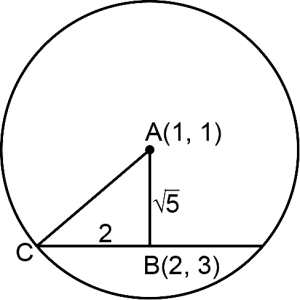
If one of the diameters of the curve $x^{2}+y^{2}-4x-6y+9=0$ is a chord of a circle with centre $(1,1)$,the radius of this circle is
A
$3$
B
$2$
C
$\sqrt{2}$
D
$1$
Solution
(A) Given circle equation: $x^{2}+y^{2}-4x-6y+9=0$.
Comparing with $x^{2}+y^{2}+2gx+2fy+c=0$,we get $g=-2, f=-3, c=9$.
Centre $B = (-g, -f) = (2, 3)$.
Radius $r = \sqrt{g^{2}+f^{2}-c} = \sqrt{(-2)^{2}+(-3)^{2}-9} = \sqrt{4+9-9} = 2$.
Let the centre of the required circle be $A(1, 1)$.
The distance $AB$ between the centres is $AB = \sqrt{(2-1)^{2}+(3-1)^{2}} = \sqrt{1^{2}+2^{2}} = \sqrt{5}$.
Since the diameter of the first circle is a chord of the second circle,the radius $R$ of the second circle is the hypotenuse of the right-angled triangle formed by the distance between centres and the radius of the first circle.
$R = \sqrt{AB^{2}+r^{2}} = \sqrt{(\sqrt{5})^{2}+2^{2}} = \sqrt{5+4} = \sqrt{9} = 3$.
Comparing with $x^{2}+y^{2}+2gx+2fy+c=0$,we get $g=-2, f=-3, c=9$.
Centre $B = (-g, -f) = (2, 3)$.
Radius $r = \sqrt{g^{2}+f^{2}-c} = \sqrt{(-2)^{2}+(-3)^{2}-9} = \sqrt{4+9-9} = 2$.
Let the centre of the required circle be $A(1, 1)$.
The distance $AB$ between the centres is $AB = \sqrt{(2-1)^{2}+(3-1)^{2}} = \sqrt{1^{2}+2^{2}} = \sqrt{5}$.
Since the diameter of the first circle is a chord of the second circle,the radius $R$ of the second circle is the hypotenuse of the right-angled triangle formed by the distance between centres and the radius of the first circle.
$R = \sqrt{AB^{2}+r^{2}} = \sqrt{(\sqrt{5})^{2}+2^{2}} = \sqrt{5+4} = \sqrt{9} = 3$.
0 likes
View Solution364
DifficultMCQ
If two circles which pass through the points $(0, a)$ and $(0, -a)$ and touch the line $y = mx + c$ cut orthogonally,then:
A
$c^2=a^2(1+m^2)$
B
$c^2=a^2(2+m^2)$
C
$c^2=a^2(1+2m^2)$
D
$2c^2=a^2(1+m^2)$
Solution
(B) Let the equation of the circles be $x^2+y^2+2gx+2fy+d=0 \quad \ldots(1)$.
Since these circles pass through $(0, a)$ and $(0, -a)$,we have $a^2+2fa+d=0 \quad \ldots(2)$ and $a^2-2fa+d=0 \quad \ldots(3)$.
Solving $(2)$ and $(3)$,we get $f=0$ and $d=-a^2$.
Substituting these values in $(1)$,we obtain $x^2+y^2+2gx-a^2=0 \quad \ldots(4)$.
Since the line $y=mx+c$ touches this circle,the perpendicular distance from the centre $(-g, 0)$ to the line $mx-y+c=0$ is equal to the radius $\sqrt{g^2+a^2}$.
Thus,$\frac{|-mg+c|}{\sqrt{1+m^2}} = \sqrt{g^2+a^2}$.
Squaring both sides,we get $(c-mg)^2 = (1+m^2)(g^2+a^2)$.
Expanding this,$c^2-2mcg+m^2g^2 = g^2+a^2+m^2g^2+m^2a^2$.
Rearranging,$g^2 + 2mcg + a^2(1+m^2) - c^2 = 0$.
Let $g_1$ and $g_2$ be the roots of this quadratic equation in $g$.
Then the product of the roots is $g_1g_2 = a^2(1+m^2)-c^2 \quad \ldots(5)$.
The two circles are $x^2+y^2+2g_1x-a^2=0$ and $x^2+y^2+2g_2x-a^2=0$.
For these circles to cut orthogonally,$2g_1g_2 + 2f_1f_2 = d_1+d_2$.
Here $f_1=f_2=0$ and $d_1=d_2=-a^2$,so $2g_1g_2 = -2a^2$,which implies $g_1g_2 = -a^2 \quad \ldots(6)$.
Comparing $(5)$ and $(6)$,$-a^2 = a^2(1+m^2) - c^2$.
Therefore,$c^2 = a^2(1+m^2) + a^2 = a^2(2+m^2)$.
Since these circles pass through $(0, a)$ and $(0, -a)$,we have $a^2+2fa+d=0 \quad \ldots(2)$ and $a^2-2fa+d=0 \quad \ldots(3)$.
Solving $(2)$ and $(3)$,we get $f=0$ and $d=-a^2$.
Substituting these values in $(1)$,we obtain $x^2+y^2+2gx-a^2=0 \quad \ldots(4)$.
Since the line $y=mx+c$ touches this circle,the perpendicular distance from the centre $(-g, 0)$ to the line $mx-y+c=0$ is equal to the radius $\sqrt{g^2+a^2}$.
Thus,$\frac{|-mg+c|}{\sqrt{1+m^2}} = \sqrt{g^2+a^2}$.
Squaring both sides,we get $(c-mg)^2 = (1+m^2)(g^2+a^2)$.
Expanding this,$c^2-2mcg+m^2g^2 = g^2+a^2+m^2g^2+m^2a^2$.
Rearranging,$g^2 + 2mcg + a^2(1+m^2) - c^2 = 0$.
Let $g_1$ and $g_2$ be the roots of this quadratic equation in $g$.
Then the product of the roots is $g_1g_2 = a^2(1+m^2)-c^2 \quad \ldots(5)$.
The two circles are $x^2+y^2+2g_1x-a^2=0$ and $x^2+y^2+2g_2x-a^2=0$.
For these circles to cut orthogonally,$2g_1g_2 + 2f_1f_2 = d_1+d_2$.
Here $f_1=f_2=0$ and $d_1=d_2=-a^2$,so $2g_1g_2 = -2a^2$,which implies $g_1g_2 = -a^2 \quad \ldots(6)$.
Comparing $(5)$ and $(6)$,$-a^2 = a^2(1+m^2) - c^2$.
Therefore,$c^2 = a^2(1+m^2) + a^2 = a^2(2+m^2)$.
0 likes
View Solution365
EasyMCQ
If the circles $x^{2}+y^{2}+2x+2ky+6=0$ and $x^{2}+y^{2}+2ky+k=0$ intersect orthogonally,then $k$ is equal to
A
$2$ or $-\frac{3}{2}$
B
$-2$ or $-\frac{3}{2}$
C
$2$ or $\frac{3}{2}$
D
$-2$ or $\frac{3}{2}$
Solution
(A) Two circles $x^{2}+y^{2}+2g_{1}x+2f_{1}y+c_{1}=0$ and $x^{2}+y^{2}+2g_{2}x+2f_{2}y+c_{2}=0$ intersect orthogonally if and only if $2(g_{1}g_{2}+f_{1}f_{2})=c_{1}+c_{2}$.
For the given circles:
Circle $1$: $g_{1}=1, f_{1}=k, c_{1}=6$
Circle $2$: $g_{2}=0, f_{2}=k, c_{2}=k$
Substituting these values into the condition:
$2((1)(0) + (k)(k)) = 6 + k$
$2k^{2} = 6 + k$
$2k^{2} - k - 6 = 0$
Factoring the quadratic equation:
$2k^{2} - 4k + 3k - 6 = 0$
$2k(k-2) + 3(k-2) = 0$
$(k-2)(2k+3) = 0$
Thus,$k = 2$ or $k = -\frac{3}{2}$.
For the given circles:
Circle $1$: $g_{1}=1, f_{1}=k, c_{1}=6$
Circle $2$: $g_{2}=0, f_{2}=k, c_{2}=k$
Substituting these values into the condition:
$2((1)(0) + (k)(k)) = 6 + k$
$2k^{2} = 6 + k$
$2k^{2} - k - 6 = 0$
Factoring the quadratic equation:
$2k^{2} - 4k + 3k - 6 = 0$
$2k(k-2) + 3(k-2) = 0$
$(k-2)(2k+3) = 0$
Thus,$k = 2$ or $k = -\frac{3}{2}$.
0 likes
View Solution366
MediumMCQ
The circles $x^2+y^2-10x+16=0$ and $x^2+y^2=a^2$ intersect at two distinct points if
A
$a < 2$
B
$2 < a < 8$
C
$a > 8$
D
$a = 2$
Solution
(B) For two circles to intersect at two distinct points,the distance between their centers $d$ must satisfy the condition $|r_1 - r_2| < d < r_1 + r_2$.
For the first circle $x^2+y^2-10x+16=0$,the center $C_1$ is $(5, 0)$ and the radius $r_1 = \sqrt{5^2 + 0^2 - 16} = \sqrt{25-16} = 3$.
For the second circle $x^2+y^2=a^2$,the center $C_2$ is $(0, 0)$ and the radius $r_2 = |a|$.
The distance between centers $d = \sqrt{(5-0)^2 + (0-0)^2} = 5$.
Applying the condition $|r_1 - r_2| < d < r_1 + r_2$:
$|3 - |a|| < 5 < 3 + |a|$.
From $5 < 3 + |a|$,we get $|a| > 2$,which implies $a > 2$ or $a < -2$.
From $|3 - |a|| < 5$,we get $-5 < 3 - |a| < 5$,which simplifies to $-8 < -|a| < 2$,or $-2 < |a| < 8$.
Combining these,we get $2 < |a| < 8$. Since $a$ is a radius,$a > 0$,so $2 < a < 8$.
For the first circle $x^2+y^2-10x+16=0$,the center $C_1$ is $(5, 0)$ and the radius $r_1 = \sqrt{5^2 + 0^2 - 16} = \sqrt{25-16} = 3$.
For the second circle $x^2+y^2=a^2$,the center $C_2$ is $(0, 0)$ and the radius $r_2 = |a|$.
The distance between centers $d = \sqrt{(5-0)^2 + (0-0)^2} = 5$.
Applying the condition $|r_1 - r_2| < d < r_1 + r_2$:
$|3 - |a|| < 5 < 3 + |a|$.
From $5 < 3 + |a|$,we get $|a| > 2$,which implies $a > 2$ or $a < -2$.
From $|3 - |a|| < 5$,we get $-5 < 3 - |a| < 5$,which simplifies to $-8 < -|a| < 2$,or $-2 < |a| < 8$.
Combining these,we get $2 < |a| < 8$. Since $a$ is a radius,$a > 0$,so $2 < a < 8$.
0 likes
View Solution367
EasyMCQ
The equation of the circle passing through the point $(1, 1)$ and the points of intersection of $x^{2}+y^{2}-6x-8=0$ and $x^{2}+y^{2}-6=0$ is
A
$x^{2}+y^{2}+3x-5=0$
B
$x^{2}+y^{2}-4x+2=0$
C
$x^{2}+y^{2}+6x-4=0$
D
$x^{2}+y^{2}-4y-2=0$
Solution
(A) Let $S_{1} = x^{2}+y^{2}-6x-8=0$ and $S_{2} = x^{2}+y^{2}-6=0$.
The equation of the family of circles passing through the intersection of $S_{1}$ and $S_{2}$ is given by $S_{1} + \lambda S_{2} = 0$.
$(x^{2}+y^{2}-6x-8) + \lambda(x^{2}+y^{2}-6) = 0 \quad \dots(i)$
Since the circle passes through the point $(1, 1)$,we substitute $x=1$ and $y=1$ into equation $(i)$:
$(1^{2}+1^{2}-6(1)-8) + \lambda(1^{2}+1^{2}-6) = 0$
$(1+1-6-8) + \lambda(1+1-6) = 0$
$-12 + \lambda(-4) = 0$
$-4\lambda = 12 \Rightarrow \lambda = -3$.
Substituting $\lambda = -3$ back into equation $(i)$:
$(x^{2}+y^{2}-6x-8) - 3(x^{2}+y^{2}-6) = 0$
$x^{2}+y^{2}-6x-8 - 3x^{2}-3y^{2}+18 = 0$
$-2x^{2}-2y^{2}-6x+10 = 0$
Dividing by $-2$,we get $x^{2}+y^{2}+3x-5 = 0$.
The equation of the family of circles passing through the intersection of $S_{1}$ and $S_{2}$ is given by $S_{1} + \lambda S_{2} = 0$.
$(x^{2}+y^{2}-6x-8) + \lambda(x^{2}+y^{2}-6) = 0 \quad \dots(i)$
Since the circle passes through the point $(1, 1)$,we substitute $x=1$ and $y=1$ into equation $(i)$:
$(1^{2}+1^{2}-6(1)-8) + \lambda(1^{2}+1^{2}-6) = 0$
$(1+1-6-8) + \lambda(1+1-6) = 0$
$-12 + \lambda(-4) = 0$
$-4\lambda = 12 \Rightarrow \lambda = -3$.
Substituting $\lambda = -3$ back into equation $(i)$:
$(x^{2}+y^{2}-6x-8) - 3(x^{2}+y^{2}-6) = 0$
$x^{2}+y^{2}-6x-8 - 3x^{2}-3y^{2}+18 = 0$
$-2x^{2}-2y^{2}-6x+10 = 0$
Dividing by $-2$,we get $x^{2}+y^{2}+3x-5 = 0$.
0 likes
View Solution368
MediumMCQ
The straight line $x+y-1=0$ meets the circle $x^2+y^2-6x-8y=0$ at $A$ and $B$. Then the equation of the circle of which $AB$ is a diameter is
A
$x^2+y^2-2y-6=0$
B
$x^2+y^2+2y-6=0$
C
$2(x^2+y^2)+2y-6=0$
D
$3(x^2+y^2)+2y-6=0$
Solution
(A) The equation of any circle passing through the intersection of the circle $S: x^2+y^2-6x-8y=0$ and the line $L: x+y-1=0$ is given by $S + \lambda L = 0$.
$x^2+y^2-6x-8y + \lambda(x+y-1) = 0$
$x^2+y^2 + (\lambda-6)x + (\lambda-8)y - \lambda = 0$.
Since $AB$ is a diameter,the center of this circle must lie on the line $x+y-1=0$.
The center of the circle is $(-\frac{\lambda-6}{2}, -\frac{\lambda-8}{2})$.
Substituting the center into the line equation:
$-\frac{\lambda-6}{2} - \frac{\lambda-8}{2} - 1 = 0$
$-(\lambda-6) - (\lambda-8) - 2 = 0$
$-\lambda + 6 - \lambda + 8 - 2 = 0$
$-2\lambda + 12 = 0 \implies \lambda = 6$.
Substituting $\lambda = 6$ into the circle equation:
$x^2+y^2 + (6-6)x + (6-8)y - 6 = 0$
$x^2+y^2-2y-6=0$.
$x^2+y^2-6x-8y + \lambda(x+y-1) = 0$
$x^2+y^2 + (\lambda-6)x + (\lambda-8)y - \lambda = 0$.
Since $AB$ is a diameter,the center of this circle must lie on the line $x+y-1=0$.
The center of the circle is $(-\frac{\lambda-6}{2}, -\frac{\lambda-8}{2})$.
Substituting the center into the line equation:
$-\frac{\lambda-6}{2} - \frac{\lambda-8}{2} - 1 = 0$
$-(\lambda-6) - (\lambda-8) - 2 = 0$
$-\lambda + 6 - \lambda + 8 - 2 = 0$
$-2\lambda + 12 = 0 \implies \lambda = 6$.
Substituting $\lambda = 6$ into the circle equation:
$x^2+y^2 + (6-6)x + (6-8)y - 6 = 0$
$x^2+y^2-2y-6=0$.
0 likes
View Solution369
DifficultMCQ
The points of intersection of two ellipses $x^{2}+2y^{2}-6x-12y+20=0$ and $2x^{2}+y^{2}-10x-6y+15=0$ lie on a circle. The centre of the circle is
A
$(8,3)$
B
$(8,1)$
C
$\left(\frac{8}{3}, 3\right)$
D
$(3,8)$
Solution
(C) The equation of the family of curves passing through the intersection of the two ellipses is given by $S_1 + \lambda S_2 = 0$,where $S_1: x^{2}+2y^{2}-6x-12y+20=0$ and $S_2: 2x^{2}+y^{2}-10x-6y+15=0$.
$(x^{2}+2y^{2}-6x-12y+20) + \lambda(2x^{2}+y^{2}-10x-6y+15) = 0$
$(1+2\lambda)x^{2} + (2+\lambda)y^{2} - (6+10\lambda)x - (12+6\lambda)y + (20+15\lambda) = 0$
For this to represent a circle,the coefficients of $x^{2}$ and $y^{2}$ must be equal:
$1+2\lambda = 2+\lambda \Rightarrow \lambda = 1$
Substituting $\lambda = 1$ into the equation:
$3x^{2} + 3y^{2} - 16x - 18y + 35 = 0$
$x^{2} + y^{2} - \frac{16}{3}x - 6y + \frac{35}{3} = 0$
The centre of the circle is given by $\left(-\frac{g}{2}, -\frac{f}{2}\right)$,where $2g = -\frac{16}{3}$ and $2f = -6$.
Centre $= \left(\frac{16/3}{2}, \frac{6}{2}\right) = \left(\frac{8}{3}, 3\right)$.
$(x^{2}+2y^{2}-6x-12y+20) + \lambda(2x^{2}+y^{2}-10x-6y+15) = 0$
$(1+2\lambda)x^{2} + (2+\lambda)y^{2} - (6+10\lambda)x - (12+6\lambda)y + (20+15\lambda) = 0$
For this to represent a circle,the coefficients of $x^{2}$ and $y^{2}$ must be equal:
$1+2\lambda = 2+\lambda \Rightarrow \lambda = 1$
Substituting $\lambda = 1$ into the equation:
$3x^{2} + 3y^{2} - 16x - 18y + 35 = 0$
$x^{2} + y^{2} - \frac{16}{3}x - 6y + \frac{35}{3} = 0$
The centre of the circle is given by $\left(-\frac{g}{2}, -\frac{f}{2}\right)$,where $2g = -\frac{16}{3}$ and $2f = -6$.
Centre $= \left(\frac{16/3}{2}, \frac{6}{2}\right) = \left(\frac{8}{3}, 3\right)$.
0 likes
View Solution370
DifficultMCQ
If the points of intersection of the ellipses $x^{2}+2y^{2}-6x-12y+23=0$ and $4x^{2}+2y^{2}-20x-12y+35=0$ lie on a circle of radius $r$ and centre $(a, b)$,then the value of $ab+18r^{2}$ is:
A
$53$
B
$51$
C
$52$
D
$55$
Solution
(D) Let the equations of the ellipses be $S_{1} = x^{2}+2y^{2}-6x-12y+23=0$ and $S_{2} = 4x^{2}+2y^{2}-20x-12y+35=0$.
Any curve passing through the intersection of these two ellipses is given by $S_{1} + \lambda S_{2} = 0$.
$(x^{2}+2y^{2}-6x-12y+23) + \lambda(4x^{2}+2y^{2}-20x-12y+35) = 0$.
$(1+4\lambda)x^{2} + (2+2\lambda)y^{2} - (6+20\lambda)x - (12+12\lambda)y + (23+35\lambda) = 0$.
For this to be a circle,the coefficient of $x^{2}$ must equal the coefficient of $y^{2}$:
$1+4\lambda = 2+2\lambda$ $\Rightarrow 2\lambda = 1$ $\Rightarrow \lambda = \frac{1}{2}$.
Substituting $\lambda = \frac{1}{2}$ into the equation:
$(1+2)x^{2} + (2+1)y^{2} - (6+10)x - (12+6)y + (23+17.5) = 0$.
$3x^{2} + 3y^{2} - 16x - 18y + 40.5 = 0$.
Dividing by $3$: $x^{2} + y^{2} - \frac{16}{3}x - 6y + 13.5 = 0$.
The centre $(a, b)$ is $(\frac{8}{3}, 3)$.
The radius $r$ is given by $r^{2} = g^{2} + f^{2} - c = (\frac{8}{3})^{2} + 3^{2} - 13.5 = \frac{64}{9} + 9 - \frac{27}{2} = \frac{128 + 162 - 243}{18} = \frac{47}{18}$.
Thus,$ab + 18r^{2} = (\frac{8}{3} \times 3) + 18(\frac{47}{18}) = 8 + 47 = 55$.
Any curve passing through the intersection of these two ellipses is given by $S_{1} + \lambda S_{2} = 0$.
$(x^{2}+2y^{2}-6x-12y+23) + \lambda(4x^{2}+2y^{2}-20x-12y+35) = 0$.
$(1+4\lambda)x^{2} + (2+2\lambda)y^{2} - (6+20\lambda)x - (12+12\lambda)y + (23+35\lambda) = 0$.
For this to be a circle,the coefficient of $x^{2}$ must equal the coefficient of $y^{2}$:
$1+4\lambda = 2+2\lambda$ $\Rightarrow 2\lambda = 1$ $\Rightarrow \lambda = \frac{1}{2}$.
Substituting $\lambda = \frac{1}{2}$ into the equation:
$(1+2)x^{2} + (2+1)y^{2} - (6+10)x - (12+6)y + (23+17.5) = 0$.
$3x^{2} + 3y^{2} - 16x - 18y + 40.5 = 0$.
Dividing by $3$: $x^{2} + y^{2} - \frac{16}{3}x - 6y + 13.5 = 0$.
The centre $(a, b)$ is $(\frac{8}{3}, 3)$.
The radius $r$ is given by $r^{2} = g^{2} + f^{2} - c = (\frac{8}{3})^{2} + 3^{2} - 13.5 = \frac{64}{9} + 9 - \frac{27}{2} = \frac{128 + 162 - 243}{18} = \frac{47}{18}$.
Thus,$ab + 18r^{2} = (\frac{8}{3} \times 3) + 18(\frac{47}{18}) = 8 + 47 = 55$.
0 likes
View Solution371
DifficultMCQ
Let the set of all values of $r$,for which the circles $(x+1)^{2}+(y+4)^{2}=r^{2}$ and $x^{2}+y^{2}-4x-2y-4=0$ intersect at two distinct points,be the interval $(\alpha, \beta)$. Then $\alpha\beta$ is equal to
A
$25$
B
$20$
C
$21$
D
$24$
Solution
(A) The first circle is $C_1: (x+1)^2+(y+4)^2=r^2$ with center $O_1(-1, -4)$ and radius $r_1 = |r|$.
The second circle is $C_2: x^2+y^2-4x-2y-4=0$. Rewriting in standard form: $(x-2)^2+(y-1)^2 = 4+1+4 = 9$,so center $O_2(2, 1)$ and radius $r_2 = 3$.
For two circles to intersect at two distinct points,the distance between their centers $d = O_1O_2$ must satisfy $|r_1 - r_2| < d < r_1 + r_2$.
Calculate $d = \sqrt{(2 - (-1))^2 + (1 - (-4))^2} = \sqrt{3^2 + 5^2} = \sqrt{9+25} = \sqrt{34}$.
Thus,$|r - 3| < \sqrt{34} < |r| + 3$.
From $|r - 3| < \sqrt{34}$,we have $-\sqrt{34} < r - 3 < \sqrt{34}$,which implies $3 - \sqrt{34} < r < 3 + \sqrt{34}$.
From $\sqrt{34} < |r| + 3$,we have $|r| > \sqrt{34} - 3$. Since $\sqrt{34} \approx 5.83$,$\sqrt{34} - 3 > 0$,so $r > \sqrt{34} - 3$ or $r < -(\sqrt{34} - 3)$.
Since $r$ is a radius,$r > 0$. The intersection of $r \in (3 - \sqrt{34}, 3 + \sqrt{34})$ and $r > \sqrt{34} - 3$ is $r \in (\sqrt{34} - 3, \sqrt{34} + 3)$.
Thus,$\alpha = \sqrt{34} - 3$ and $\beta = \sqrt{34} + 3$.
$\alpha\beta = (\sqrt{34} - 3)(\sqrt{34} + 3) = 34 - 9 = 25$.
The second circle is $C_2: x^2+y^2-4x-2y-4=0$. Rewriting in standard form: $(x-2)^2+(y-1)^2 = 4+1+4 = 9$,so center $O_2(2, 1)$ and radius $r_2 = 3$.
For two circles to intersect at two distinct points,the distance between their centers $d = O_1O_2$ must satisfy $|r_1 - r_2| < d < r_1 + r_2$.
Calculate $d = \sqrt{(2 - (-1))^2 + (1 - (-4))^2} = \sqrt{3^2 + 5^2} = \sqrt{9+25} = \sqrt{34}$.
Thus,$|r - 3| < \sqrt{34} < |r| + 3$.
From $|r - 3| < \sqrt{34}$,we have $-\sqrt{34} < r - 3 < \sqrt{34}$,which implies $3 - \sqrt{34} < r < 3 + \sqrt{34}$.
From $\sqrt{34} < |r| + 3$,we have $|r| > \sqrt{34} - 3$. Since $\sqrt{34} \approx 5.83$,$\sqrt{34} - 3 > 0$,so $r > \sqrt{34} - 3$ or $r < -(\sqrt{34} - 3)$.
Since $r$ is a radius,$r > 0$. The intersection of $r \in (3 - \sqrt{34}, 3 + \sqrt{34})$ and $r > \sqrt{34} - 3$ is $r \in (\sqrt{34} - 3, \sqrt{34} + 3)$.
Thus,$\alpha = \sqrt{34} - 3$ and $\beta = \sqrt{34} + 3$.
$\alpha\beta = (\sqrt{34} - 3)(\sqrt{34} + 3) = 34 - 9 = 25$.
0 likes
View Solution10-1.Circle and System of Circles — System of circles · Frequently Asked Questions
1Are these 10-1.Circle and System of Circles questions useful for JEE and NEET?
Yes. All questions in this section are mapped to JEE Main and NEET exam patterns. Previous year questions from JEE Main, NEET, GUJCET and state-level exams are included with full solutions.
2Can I switch to Hindi or Gujarati for these questions?
Yes. Use the language tabs in the hero section or the sidebar to view the same questions and solutions in English, Hindi or Gujarati.
3How do I generate a question paper from this subtopic?
Use the Vedclass Exam Paper Generator — select the chapter and subtopic, set difficulty, and generate Sets A, B, C, D automatically. First 3 chapters of every subject are free.
Vedclass Products
For Students
Vedclass Test Series
Mock tests in real JEE/NEET style with performance analysis. 5-day free trial.
Start Free TrialFor Teachers
Exam Paper Generator
Generate Set A/B/C/D papers from this chapter in 2 minutes. 3 chapters free.
Try FreeFor Institutes
Online Exam Module
Live online exams with unlimited students, 360° analytics & white-label branding.
See DemoFor Teachers & Institutes
Generate a 10-1.Circle and System of Circles Exam Paper in 2 Minutes
Select subtopic & difficulty — Sets A, B, C, D auto-generated with No Repeat logic.
First 3 chapters of every subject are free — no payment required.