
A English
Heat of reaction, Bond energy and Hess law Questions in English
Class 11 Chemistry · Thermodynamics · Heat of reaction, Bond energy and Hess law
682+
Questions
English
Language
100%
With Solutions
Showing 47 of 682 questions in English
601
EasyMCQ
When $6.0 \ g$ of graphite reacts with dihydrogen to give methane gas,$37.4 \ kJ$ of heat is liberated. What is the standard enthalpy of formation of $CH_{4(g)}$?
A
$112.2 \ kJ \ mol^{-1}$
B
$-74.8 \ kJ \ mol^{-1}$
C
$-37.4 \ kJ \ mol^{-1}$
D
$-112.2 \ kJ \ mol^{-1}$
Solution
(B) The chemical equation for the formation of methane is: $C_{(s)} + 2H_{2(g)} \longrightarrow CH_{4(g)}$
The molar mass of graphite $(C)$ is $12.0 \ g \ mol^{-1}$.
Given that $6.0 \ g$ of graphite releases $37.4 \ kJ$ of heat,the enthalpy change $(\Delta H)$ for this amount is $-37.4 \ kJ$.
To find the standard enthalpy of formation $(\Delta H_f^{\circ})$,we calculate the heat released for $1 \ mol$ $(12.0 \ g)$ of graphite:
$\Delta H_f^{\circ} = \frac{-37.4 \ kJ}{6.0 \ g} \times 12.0 \ g \ mol^{-1} = -74.8 \ kJ \ mol^{-1}$.
The molar mass of graphite $(C)$ is $12.0 \ g \ mol^{-1}$.
Given that $6.0 \ g$ of graphite releases $37.4 \ kJ$ of heat,the enthalpy change $(\Delta H)$ for this amount is $-37.4 \ kJ$.
To find the standard enthalpy of formation $(\Delta H_f^{\circ})$,we calculate the heat released for $1 \ mol$ $(12.0 \ g)$ of graphite:
$\Delta H_f^{\circ} = \frac{-37.4 \ kJ}{6.0 \ g} \times 12.0 \ g \ mol^{-1} = -74.8 \ kJ \ mol^{-1}$.
0 likes
View Solution602
DifficultMCQ
The heat of combustion of acetaldehyde to carbon dioxide and water is $-1172 \ kJ \ mol^{-1}$. Calculate the amount of heat liberated when $66 \ g$ of acetaldehyde is completely oxidised. (Atomic mass: $C=12, H=1, O=16$) (in $kJ$)
A
$1758$
B
$2344$
C
$6600$
D
$1172$
Solution
(A) The chemical formula of acetaldehyde is $CH_3CHO$. The molar mass of $CH_3CHO = (2 \times 12) + (4 \times 1) + 16 = 44 \ g \ mol^{-1}$.
Given that the heat of combustion for $1 \ mol$ $(44 \ g)$ of $CH_3CHO$ is $-1172 \ kJ \ mol^{-1}$.
For $66 \ g$ of $CH_3CHO$,the number of moles $n = \frac{66 \ g}{44 \ g \ mol^{-1}} = 1.5 \ mol$.
The heat liberated = $n \times \Delta H = 1.5 \ mol \times 1172 \ kJ \ mol^{-1} = 1758 \ kJ$.
Therefore,the amount of heat liberated is $1758 \ kJ$.
Given that the heat of combustion for $1 \ mol$ $(44 \ g)$ of $CH_3CHO$ is $-1172 \ kJ \ mol^{-1}$.
For $66 \ g$ of $CH_3CHO$,the number of moles $n = \frac{66 \ g}{44 \ g \ mol^{-1}} = 1.5 \ mol$.
The heat liberated = $n \times \Delta H = 1.5 \ mol \times 1172 \ kJ \ mol^{-1} = 1758 \ kJ$.
Therefore,the amount of heat liberated is $1758 \ kJ$.
0 likes
View Solution603
MediumMCQ
If $C_{(s)} + O_{2(g)} \rightarrow CO_{2(g)}$,$\Delta H = -X$,and $CO_{(g)} + \frac{1}{2} O_{2(g)} \rightarrow CO_{2(g)}$,$\Delta H = -Y$,calculate $\Delta_f H$ for $CO_{(g)}$ formation.
A
$-Y - X$
B
$Y - X$
C
$X + Y$
D
$Y + X$
Solution
(B) To find the enthalpy of formation of $CO_{(g)}$,we need the reaction: $C_{(s)} + \frac{1}{2} O_{2(g)} \rightarrow CO_{(g)}$.
Given equations:
Subtracting equation $(ii)$ from equation $(i)$:
$(C_{(s)} + O_{2(g)}) - (CO_{(g)} + \frac{1}{2} O_{2(g)}) \rightarrow CO_{2(g)} - CO_{2(g)}$
$C_{(s)} + \frac{1}{2} O_{2(g)} - CO_{(g)} \rightarrow 0$
$C_{(s)} + \frac{1}{2} O_{2(g)} \rightarrow CO_{(g)}$
The enthalpy change is $\Delta_f H = (-X) - (-Y) = Y - X$.
Given equations:
| $(i) \ C_{(s)} + O_{2(g)} \rightarrow CO_{2(g)}$ | $\Delta H = -X$ |
| $(ii) \ CO_{(g)} + \frac{1}{2} O_{2(g)} \rightarrow CO_{2(g)}$ | $\Delta H = -Y$ |
Subtracting equation $(ii)$ from equation $(i)$:
$(C_{(s)} + O_{2(g)}) - (CO_{(g)} + \frac{1}{2} O_{2(g)}) \rightarrow CO_{2(g)} - CO_{2(g)}$
$C_{(s)} + \frac{1}{2} O_{2(g)} - CO_{(g)} \rightarrow 0$
$C_{(s)} + \frac{1}{2} O_{2(g)} \rightarrow CO_{(g)}$
The enthalpy change is $\Delta_f H = (-X) - (-Y) = Y - X$.
0 likes
View Solution604
DifficultMCQ
The heat of combustion of carbon is $-393.5 \ kJ / mol$. The heat released upon the formation of $35.2 \ g$ of $CO_{2}$ from carbon and oxygen gas is
A
$+315 \ kJ$
B
$-31.5 \ kJ$
C
$-315 \ kJ$
D
$+31.5 \ kJ$
Solution
(C) The combustion reaction is: $C(s) + O_{2}(g) \longrightarrow CO_{2}(g)$
The enthalpy change for the formation of $1 \ mol$ $(44 \ g)$ of $CO_{2}$ is $\Delta H = -393.5 \ kJ / mol$.
Heat released for $44 \ g$ of $CO_{2} = 393.5 \ kJ$.
Heat released for $1 \ g$ of $CO_{2} = \frac{393.5}{44} \ kJ$.
Heat released for $35.2 \ g$ of $CO_{2} = \frac{393.5}{44} \times 35.2 \ kJ = 314.8 \ kJ \approx 315 \ kJ$.
Since heat is released,the value is $-315 \ kJ$.
The enthalpy change for the formation of $1 \ mol$ $(44 \ g)$ of $CO_{2}$ is $\Delta H = -393.5 \ kJ / mol$.
Heat released for $44 \ g$ of $CO_{2} = 393.5 \ kJ$.
Heat released for $1 \ g$ of $CO_{2} = \frac{393.5}{44} \ kJ$.
Heat released for $35.2 \ g$ of $CO_{2} = \frac{393.5}{44} \times 35.2 \ kJ = 314.8 \ kJ \approx 315 \ kJ$.
Since heat is released,the value is $-315 \ kJ$.
0 likes
View Solution605
EasyMCQ
According to Hess's law,the heat of reaction depends upon
A
initial condition of reactants
B
initial and final conditions of reactants
C
intermediate path of the reaction
D
end conditions of reactants
Solution
(B) According to Hess's law,the total enthalpy change of a reaction is the same whether the reaction occurs in one step or in several steps. Therefore,the heat of reaction depends only on the initial and final states of the reactants and products,not on the path taken.
0 likes
View Solution606
MediumMCQ
The heat of neutralisation of a strong acid and a strong alkali is $57.0 \ kJ \ mol^{-1}$. The heat released when $0.5 \ mol$ of $HNO_3$ solution is mixed with $0.2 \ mol$ of $KOH$ is: (in $kJ$)
A
$57.0$
B
$11.4$
C
$28.5$
D
$34.9$
Solution
(B) The reaction between a strong acid $(HNO_3)$ and a strong base $(KOH)$ is represented as: $H^+ + OH^- \rightarrow H_2O$; $\Delta H = -57.0 \ kJ \ mol^{-1}$.
Since $0.2 \ mol$ of $KOH$ is the limiting reagent,it will react with $0.2 \ mol$ of $HNO_3$ to produce $0.2 \ mol$ of $H_2O$.
The heat evolved is calculated as: $\text{Heat} = \Delta H \times \text{moles of water formed} = 57.0 \ kJ \ mol^{-1} \times 0.2 \ mol = 11.4 \ kJ$.
Since $0.2 \ mol$ of $KOH$ is the limiting reagent,it will react with $0.2 \ mol$ of $HNO_3$ to produce $0.2 \ mol$ of $H_2O$.
The heat evolved is calculated as: $\text{Heat} = \Delta H \times \text{moles of water formed} = 57.0 \ kJ \ mol^{-1} \times 0.2 \ mol = 11.4 \ kJ$.
0 likes
View Solution607
DifficultMCQ
The heat of formation of water is $260 \ kJ$. How much $H_2O$ is decomposed by $130 \ kJ$ of heat (in $mol$)?
A
$0.25$
B
$1$
C
$0.5$
D
$2$
Solution
(C) The reaction for the formation of water is as follows:
$H_2(g) + \frac{1}{2} O_2(g) \longrightarrow H_2O(l); \quad \Delta H = -260 \ kJ$
For the decomposition of water,the reaction is reversed:
$H_2O(l) \longrightarrow H_2(g) + \frac{1}{2} O_2(g); \quad \Delta H = +260 \ kJ$
This means that $260 \ kJ$ of heat is required to decompose $1 \ mol$ of $H_2O$.
Therefore,the amount of $H_2O$ decomposed by $130 \ kJ$ of heat is:
$\text{Moles of } H_2O = \frac{1 \ mol}{260 \ kJ} \times 130 \ kJ = 0.5 \ mol$
$H_2(g) + \frac{1}{2} O_2(g) \longrightarrow H_2O(l); \quad \Delta H = -260 \ kJ$
For the decomposition of water,the reaction is reversed:
$H_2O(l) \longrightarrow H_2(g) + \frac{1}{2} O_2(g); \quad \Delta H = +260 \ kJ$
This means that $260 \ kJ$ of heat is required to decompose $1 \ mol$ of $H_2O$.
Therefore,the amount of $H_2O$ decomposed by $130 \ kJ$ of heat is:
$\text{Moles of } H_2O = \frac{1 \ mol}{260 \ kJ} \times 130 \ kJ = 0.5 \ mol$
0 likes
View Solution608
MediumMCQ
If $C_{(s)} + O_{2(g)} \longrightarrow CO_{2(g)}; \Delta H = r$ and $CO_{(g)} + \frac{1}{2} O_{2(g)} \longrightarrow CO_{2(g)}; \Delta H = s$,then the heat of formation of $CO$ is
A
$r+s$
B
$r-s$
C
$s-r$
D
$rs$
Solution
(B) Given equations:
$C_{(s)} + O_{2(g)} \longrightarrow CO_{2(g)}; \Delta H = r$ ...$(I)$
$CO_{(g)} + \frac{1}{2} O_{2(g)} \longrightarrow CO_{2(g)}; \Delta H = s$ ...$(II)$
We need to find the heat of formation of $CO$,which corresponds to the reaction:
$C_{(s)} + \frac{1}{2} O_{2(g)} \longrightarrow CO_{(g)}; \Delta H = ?$
Subtracting equation $(II)$ from equation $(I)$:
$(C_{(s)} + O_{2(g)}) - (CO_{(g)} + \frac{1}{2} O_{2(g)}) \longrightarrow CO_{2(g)} - CO_{2(g)}$
$C_{(s)} + \frac{1}{2} O_{2(g)} - CO_{(g)} \longrightarrow 0$
$C_{(s)} + \frac{1}{2} O_{2(g)} \longrightarrow CO_{(g)}$
The enthalpy change for this reaction is $\Delta H = r - s$.
$C_{(s)} + O_{2(g)} \longrightarrow CO_{2(g)}; \Delta H = r$ ...$(I)$
$CO_{(g)} + \frac{1}{2} O_{2(g)} \longrightarrow CO_{2(g)}; \Delta H = s$ ...$(II)$
We need to find the heat of formation of $CO$,which corresponds to the reaction:
$C_{(s)} + \frac{1}{2} O_{2(g)} \longrightarrow CO_{(g)}; \Delta H = ?$
Subtracting equation $(II)$ from equation $(I)$:
$(C_{(s)} + O_{2(g)}) - (CO_{(g)} + \frac{1}{2} O_{2(g)}) \longrightarrow CO_{2(g)} - CO_{2(g)}$
$C_{(s)} + \frac{1}{2} O_{2(g)} - CO_{(g)} \longrightarrow 0$
$C_{(s)} + \frac{1}{2} O_{2(g)} \longrightarrow CO_{(g)}$
The enthalpy change for this reaction is $\Delta H = r - s$.
0 likes
View Solution609
EasyMCQ
Hess's law is based on
A
law of conservation of mass
B
law of conservation of energy
C
first law of thermodynamics
D
None of the above
Solution
(B) Hess's law states that the total enthalpy change for a reaction is the same,whether it occurs in one step or several steps.
This is a direct consequence of the law of conservation of energy,which is also known as the first law of thermodynamics.
Therefore,both $B$ and $C$ are technically correct,but since the law is fundamentally a statement of the conservation of energy,$B$ is the most appropriate answer.
This is a direct consequence of the law of conservation of energy,which is also known as the first law of thermodynamics.
Therefore,both $B$ and $C$ are technically correct,but since the law is fundamentally a statement of the conservation of energy,$B$ is the most appropriate answer.
0 likes
View Solution610
MediumMCQ
For the reaction,$2 H_{2(g)} + O_{2(g)} \longrightarrow 2 H_{2}O_{(g)}$,$\Delta H^{\circ} = -573.2 \ kJ$. The heat of decomposition of water per mole is
A
$286.6 \ kJ$
B
$573.2 \ kJ$
C
$-28.66 \ kJ$
D
zero
Solution
(A) The given reaction is $2 H_{2(g)} + O_{2(g)} \longrightarrow 2 H_{2}O_{(g)}$ with $\Delta H^{\circ} = -573.2 \ kJ$.
This is the heat of formation for $2 \text{ moles}$ of water.
The decomposition reaction is the reverse of the formation reaction: $H_{2}O_{(g)} \longrightarrow H_{2(g)} + \frac{1}{2} O_{2(g)}$.
For this reaction,the enthalpy change is $\Delta H = -(\frac{-573.2 \ kJ}{2}) = +286.6 \ kJ/mol$.
This is the heat of formation for $2 \text{ moles}$ of water.
The decomposition reaction is the reverse of the formation reaction: $H_{2}O_{(g)} \longrightarrow H_{2(g)} + \frac{1}{2} O_{2(g)}$.
For this reaction,the enthalpy change is $\Delta H = -(\frac{-573.2 \ kJ}{2}) = +286.6 \ kJ/mol$.
0 likes
View Solution611
EasyMCQ
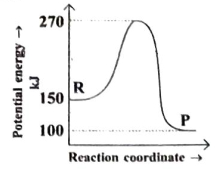
For the reaction $R \rightarrow P$,the following potential energy diagram is given. What will be the enthalpy change $(\Delta H)$ for the given reaction (in $kJ$)?
A
$170$
B
$120$
C
$-50$
D
$50$
Solution
(C) The enthalpy change $(\Delta H)$ of a reaction is defined as the difference between the potential energy of the products $(H_P)$ and the potential energy of the reactants $(H_R)$.
$\Delta H = H_P - H_R$
From the given graph:
Potential energy of reactants $(H_R)$ = $150 \ kJ$
Potential energy of products $(H_P)$ = $100 \ kJ$
Therefore,$\Delta H = 100 \ kJ - 150 \ kJ = -50 \ kJ$.
Thus,the correct option is $C$.
$\Delta H = H_P - H_R$
From the given graph:
Potential energy of reactants $(H_R)$ = $150 \ kJ$
Potential energy of products $(H_P)$ = $100 \ kJ$
Therefore,$\Delta H = 100 \ kJ - 150 \ kJ = -50 \ kJ$.
Thus,the correct option is $C$.
0 likes
View Solution612
MediumMCQ
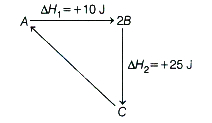
From the given diagram, the enthalpy change $\Delta_r H$ for the reaction $C \rightarrow A$ is:
A
$+35 \ J$
B
$-15 \ J$
C
$-35 \ J$
D
$+15 \ J$
Solution
$\textbf{(C) According to Hess's Law, the enthalpy change for a cyclic process is zero.}$
$\text{For the cycle } A \rightarrow 2B \rightarrow C \rightarrow A, \text{ we have:}$
$\Delta H_{A \to 2B} + \Delta H_{2B \to C} + \Delta H_{C \to A} = 0$
$\text{Given } \Delta H_{A \to 2B} = +10 \text{ J and } \Delta H_{2B \to C} = +25 \text{ J}.$
$\text{Substituting these values:}$
$10 \text{ J} + 25 \text{ J} + \Delta H_{C \to A} = 0$
$35 \text{ J} + \Delta H_{C \to A} = 0$
$\Delta H_{C \to A} = -35 \text{ J}$
$\text{For the cycle } A \rightarrow 2B \rightarrow C \rightarrow A, \text{ we have:}$
$\Delta H_{A \to 2B} + \Delta H_{2B \to C} + \Delta H_{C \to A} = 0$
$\text{Given } \Delta H_{A \to 2B} = +10 \text{ J and } \Delta H_{2B \to C} = +25 \text{ J}.$
$\text{Substituting these values:}$
$10 \text{ J} + 25 \text{ J} + \Delta H_{C \to A} = 0$
$35 \text{ J} + \Delta H_{C \to A} = 0$
$\Delta H_{C \to A} = -35 \text{ J}$
0 likes
View Solution613
DifficultMCQ
If the bond energies of $H-H$,$Br-Br$ and $H-Br$ are $433$,$192$ and $364 \ kJ \ mol^{-1}$ respectively,then $\Delta H^{\circ}$ for the reaction: $H_{2(g)} + Br_{2(g)} \rightarrow 2HBr_{(g)}$ is:
A
$-261 \ kJ$
B
$+103 \ kJ$
C
$+261 \ kJ$
D
$-103 \ kJ$
Solution
(D) For the reaction: $H_{2(g)} + Br_{2(g)} \rightarrow 2HBr_{(g)}$
$\Delta H^{\circ}_{reaction} = \Sigma \Delta H_{\text{bonds broken}} - \Sigma \Delta H_{\text{bonds formed}}$
$\Delta H^{\circ}_{reaction} = [BE(H-H) + BE(Br-Br)] - [2 \times BE(H-Br)]$
$\Delta H^{\circ}_{reaction} = (433 + 192) - (2 \times 364) \ kJ \ mol^{-1}$
$\Delta H^{\circ}_{reaction} = 625 - 728 \ kJ \ mol^{-1}$
$\Delta H^{\circ}_{reaction} = -103 \ kJ \ mol^{-1}$
$\Delta H^{\circ}_{reaction} = \Sigma \Delta H_{\text{bonds broken}} - \Sigma \Delta H_{\text{bonds formed}}$
$\Delta H^{\circ}_{reaction} = [BE(H-H) + BE(Br-Br)] - [2 \times BE(H-Br)]$
$\Delta H^{\circ}_{reaction} = (433 + 192) - (2 \times 364) \ kJ \ mol^{-1}$
$\Delta H^{\circ}_{reaction} = 625 - 728 \ kJ \ mol^{-1}$
$\Delta H^{\circ}_{reaction} = -103 \ kJ \ mol^{-1}$
0 likes
View Solution614
MediumMCQ
In the reaction $S + \frac{3}{2} O_{2} \rightarrow SO_{3} + 2x \ kJ$ and $SO_{2} + \frac{1}{2} O_{2} \rightarrow SO_{3} + y \ kJ$,the heat of formation of $SO_{2}$ is
A
$x + y$
B
$x - y$
C
$2x - y$
D
$2x + y$
Solution
(C) Given equations:
$1) \ S_{(s)} + \frac{3}{2} O_{2(g)} \rightarrow SO_{3(g)}; \Delta H_{1} = 2x \ kJ$
$2) \ SO_{2(g)} + \frac{1}{2} O_{2(g)} \rightarrow SO_{3(g)}; \Delta H_{2} = y \ kJ$
We need to find the heat of formation of $SO_{2}$,which is the enthalpy change for the reaction:
$S_{(s)} + O_{2(g)} \rightarrow SO_{2(g)}; \Delta H_{3} = ?$
Reverse equation $(2)$:
$SO_{3(g)} \rightarrow SO_{2(g)} + \frac{1}{2} O_{2(g)}; \Delta H_{4} = -y \ kJ$ $(3)$
Add equation $(1)$ and equation $(3)$:
$(S_{(s)} + \frac{3}{2} O_{2(g)}) + (SO_{3(g)}) \rightarrow (SO_{3(g)}) + (SO_{2(g)} + \frac{1}{2} O_{2(g)})$
$S_{(s)} + O_{2(g)} \rightarrow SO_{2(g)}$
The enthalpy change is $\Delta H_{3} = \Delta H_{1} + \Delta H_{4} = 2x - y \ kJ$.
$1) \ S_{(s)} + \frac{3}{2} O_{2(g)} \rightarrow SO_{3(g)}; \Delta H_{1} = 2x \ kJ$
$2) \ SO_{2(g)} + \frac{1}{2} O_{2(g)} \rightarrow SO_{3(g)}; \Delta H_{2} = y \ kJ$
We need to find the heat of formation of $SO_{2}$,which is the enthalpy change for the reaction:
$S_{(s)} + O_{2(g)} \rightarrow SO_{2(g)}; \Delta H_{3} = ?$
Reverse equation $(2)$:
$SO_{3(g)} \rightarrow SO_{2(g)} + \frac{1}{2} O_{2(g)}; \Delta H_{4} = -y \ kJ$ $(3)$
Add equation $(1)$ and equation $(3)$:
$(S_{(s)} + \frac{3}{2} O_{2(g)}) + (SO_{3(g)}) \rightarrow (SO_{3(g)}) + (SO_{2(g)} + \frac{1}{2} O_{2(g)})$
$S_{(s)} + O_{2(g)} \rightarrow SO_{2(g)}$
The enthalpy change is $\Delta H_{3} = \Delta H_{1} + \Delta H_{4} = 2x - y \ kJ$.
0 likes
View Solution615
DifficultMCQ
Given the thermochemical equation,$2 H_{2(g)} + O_{2(g)} \rightarrow 2 H_2O_{(l)}$; $\Delta H = -571.6 \ kJ$. The heat of decomposition of water is:
A
$ -571.6 \ kJ $
B
$ +571.6 \ kJ $
C
$ -1143.2 \ kJ $
D
$ +285.8 \ kJ $
Solution
(D) The given thermochemical equation is:
$2 H_{2(g)} + O_{2(g)} \rightarrow 2 H_2O_{(l)}$; $\Delta H = -571.6 \ kJ$
The decomposition of water is represented by the reverse reaction:
$H_2O_{(l)} \rightarrow H_{2(g)} + \frac{1}{2} O_{2(g)}$
To obtain this,we reverse the given equation and divide it by $2$:
$\Delta H_{\text{decomposition}} = -(\frac{\Delta H}{2}) = -(\frac{-571.6 \ kJ}{2}) = +285.8 \ kJ$
Thus,the heat of decomposition of water is $+285.8 \ kJ$.
$2 H_{2(g)} + O_{2(g)} \rightarrow 2 H_2O_{(l)}$; $\Delta H = -571.6 \ kJ$
The decomposition of water is represented by the reverse reaction:
$H_2O_{(l)} \rightarrow H_{2(g)} + \frac{1}{2} O_{2(g)}$
To obtain this,we reverse the given equation and divide it by $2$:
$\Delta H_{\text{decomposition}} = -(\frac{\Delta H}{2}) = -(\frac{-571.6 \ kJ}{2}) = +285.8 \ kJ$
Thus,the heat of decomposition of water is $+285.8 \ kJ$.
0 likes
View Solution616
EasyMCQ
The enthalpy of formation of $NH_3$ is $-46 \ kJ \ mol^{-1}$. The enthalpy change for the reaction $2 NH_{3(g)} \longrightarrow N_{2(g)} + 3 H_{2(g)}$ is
A
$+184 \ kJ$
B
$+23 \ kJ$
C
$+92 \ kJ$
D
$+46 \ kJ$
Solution
(C) The reaction is $2 NH_{3(g)} \longrightarrow N_{2(g)} + 3 H_{2(g)}$.
For any reaction,$\Delta H_r = \sum \Delta H_f^{\circ}(\text{products}) - \sum \Delta H_f^{\circ}(\text{reactants})$.
Since the elements $N_2$ and $H_2$ are in their standard states,their enthalpy of formation is $0$.
$\Delta H_r = [1 \times \Delta H_f^{\circ}(N_2) + 3 \times \Delta H_f^{\circ}(H_2)] - [2 \times \Delta H_f^{\circ}(NH_3)]$.
$\Delta H_r = [0 + 0] - [2 \times (-46 \ kJ \ mol^{-1})]$.
$\Delta H_r = +92 \ kJ$.
For any reaction,$\Delta H_r = \sum \Delta H_f^{\circ}(\text{products}) - \sum \Delta H_f^{\circ}(\text{reactants})$.
Since the elements $N_2$ and $H_2$ are in their standard states,their enthalpy of formation is $0$.
$\Delta H_r = [1 \times \Delta H_f^{\circ}(N_2) + 3 \times \Delta H_f^{\circ}(H_2)] - [2 \times \Delta H_f^{\circ}(NH_3)]$.
$\Delta H_r = [0 + 0] - [2 \times (-46 \ kJ \ mol^{-1})]$.
$\Delta H_r = +92 \ kJ$.
0 likes
View Solution617
MediumMCQ
Bond enthalpies of $A_{2}$,$B_{2}$ and $AB$ are in the ratio $2:1:2$. If the enthalpy of formation of $AB$ is $-100 \ kJ \ mol^{-1}$,the bond enthalpy of $B_{2}$ is:
A
$100 \ kJ \ mol^{-1}$
B
$50 \ kJ \ mol^{-1}$
C
$200 \ kJ \ mol^{-1}$
D
$150 \ kJ \ mol^{-1}$
Solution
(C) Given,$(BE)_{A_{2}} : (BE)_{B_{2}} : (BE)_{AB} = 2 : 1 : 2$,where $BE$ is bond enthalpy.
Let $(BE)_{A_{2}} = 2x$,$(BE)_{B_{2}} = x$,and $(BE)_{AB} = 2x$.
The reaction for the formation of $AB$ is: $\frac{1}{2} A_{2}(g) + \frac{1}{2} B_{2}(g) \rightarrow AB(g)$.
The enthalpy of formation is given by: $\Delta H^{\circ}_{f} = \Sigma (BE)_{\text{reactants}} - \Sigma (BE)_{\text{products}}$.
Substituting the values: $-100 = [\frac{1}{2}(2x) + \frac{1}{2}(x)] - 2x$.
$-100 = [x + 0.5x] - 2x$.
$-100 = 1.5x - 2x$.
$-100 = -0.5x$.
$x = \frac{100}{0.5} = 200 \ kJ \ mol^{-1}$.
Thus,the bond enthalpy of $B_{2}$ is $200 \ kJ \ mol^{-1}$.
Let $(BE)_{A_{2}} = 2x$,$(BE)_{B_{2}} = x$,and $(BE)_{AB} = 2x$.
The reaction for the formation of $AB$ is: $\frac{1}{2} A_{2}(g) + \frac{1}{2} B_{2}(g) \rightarrow AB(g)$.
The enthalpy of formation is given by: $\Delta H^{\circ}_{f} = \Sigma (BE)_{\text{reactants}} - \Sigma (BE)_{\text{products}}$.
Substituting the values: $-100 = [\frac{1}{2}(2x) + \frac{1}{2}(x)] - 2x$.
$-100 = [x + 0.5x] - 2x$.
$-100 = 1.5x - 2x$.
$-100 = -0.5x$.
$x = \frac{100}{0.5} = 200 \ kJ \ mol^{-1}$.
Thus,the bond enthalpy of $B_{2}$ is $200 \ kJ \ mol^{-1}$.
0 likes
View Solution618
EasyMCQ
Given below are two statements:
Assertion $(A)$: The enthalpy of formation of graphite is taken as zero.
Reason $(R)$: Graphite is the thermodynamically most stable allotrope of carbon.
The correct answer is:
Assertion $(A)$: The enthalpy of formation of graphite is taken as zero.
Reason $(R)$: Graphite is the thermodynamically most stable allotrope of carbon.
The correct answer is:
A
Both $(A)$ and $(R)$ are correct and $(R)$ is the correct explanation of $(A)$
B
Both $(A)$ and $(R)$ are correct but $(R)$ is not the correct explanation of $(A)$
C
$(A)$ is correct but $(R)$ is incorrect
D
$(A)$ is incorrect but $(R)$ is correct
Solution
(A) The enthalpy of formation of a substance is defined as the change in enthalpy when $1 \ mol$ of a substance is formed from its constituent elements in their most stable states at standard conditions ($298 \ K$ and $1 \ bar$ pressure).
Since graphite is the most stable allotrope of carbon at standard conditions,its standard enthalpy of formation is defined as zero.
Therefore,the Assertion $(A)$ is correct because it states the standard enthalpy of formation of graphite is zero.
The Reason $(R)$ is also correct because the stability of graphite as the most stable allotrope is the fundamental reason why its enthalpy of formation is taken as zero.
Thus,$(R)$ is the correct explanation of $(A)$.
Since graphite is the most stable allotrope of carbon at standard conditions,its standard enthalpy of formation is defined as zero.
Therefore,the Assertion $(A)$ is correct because it states the standard enthalpy of formation of graphite is zero.
The Reason $(R)$ is also correct because the stability of graphite as the most stable allotrope is the fundamental reason why its enthalpy of formation is taken as zero.
Thus,$(R)$ is the correct explanation of $(A)$.
0 likes
View Solution619
MediumMCQ
One mole of $C_2H_5OH_{(l)}$ was completely burnt in oxygen to form $CO_{2(g)}$ and $H_2O_{(l)}$. The standard enthalpy of formation $\Delta_fH^{\ominus}$ of $C_2H_5OH_{(l)}, CO_{2(g)}$ and $H_2O_{(l)}$ is $x, y, z \ kJ \ mol^{-1}$ respectively. What is $\Delta_rH^{\ominus}$ (in $kJ \ mol^{-1}$) for this reaction?
A
$2y + 3z - x$
B
$2y - 3z + x$
C
$x - 2y - 3z$
D
$2y + 3z + x$
Solution
(A) The balanced chemical equation for the combustion of ethanol is:
$C_2H_5OH_{(l)} + 3O_{2(g)} \rightarrow 2CO_{2(g)} + 3H_2O_{(l)}$
The standard enthalpy of reaction $\Delta_rH^{\ominus}$ is calculated using the formula:
$\Delta_rH^{\ominus} = \sum \Delta_fH^{\ominus}(\text{products}) - \sum \Delta_fH^{\ominus}(\text{reactants})$
Substituting the given values:
$\Delta_rH^{\ominus} = [2 \times \Delta_fH^{\ominus}(CO_{2(g)}) + 3 \times \Delta_fH^{\ominus}(H_2O_{(l)})] - [\Delta_fH^{\ominus}(C_2H_5OH_{(l)}) + 3 \times \Delta_fH^{\ominus}(O_{2(g)})]$
Since $\Delta_fH^{\ominus}$ for an element in its standard state $(O_{2(g)})$ is $0$:
$\Delta_rH^{\ominus} = [2y + 3z] - [x + 3(0)] = 2y + 3z - x \ kJ \ mol^{-1}$
$C_2H_5OH_{(l)} + 3O_{2(g)} \rightarrow 2CO_{2(g)} + 3H_2O_{(l)}$
The standard enthalpy of reaction $\Delta_rH^{\ominus}$ is calculated using the formula:
$\Delta_rH^{\ominus} = \sum \Delta_fH^{\ominus}(\text{products}) - \sum \Delta_fH^{\ominus}(\text{reactants})$
Substituting the given values:
$\Delta_rH^{\ominus} = [2 \times \Delta_fH^{\ominus}(CO_{2(g)}) + 3 \times \Delta_fH^{\ominus}(H_2O_{(l)})] - [\Delta_fH^{\ominus}(C_2H_5OH_{(l)}) + 3 \times \Delta_fH^{\ominus}(O_{2(g)})]$
Since $\Delta_fH^{\ominus}$ for an element in its standard state $(O_{2(g)})$ is $0$:
$\Delta_rH^{\ominus} = [2y + 3z] - [x + 3(0)] = 2y + 3z - x \ kJ \ mol^{-1}$
0 likes
View Solution620
MediumMCQ
One mole of ethanol $(l)$ was completely burnt in oxygen to form $CO_{2(g)}$ and $H_2O_{(l)}$. What is the $\Delta_r H^{\ominus}$ (in $kJ \ mol^{-1}$) for this reaction?
(The standard enthalpy of formation $(\Delta_f H^{\ominus})$ of $C_2H_5OH_{(l)}$,$CO_{2(g)}$ and $H_2O_{(l)}$ is respectively $-277, -393$ and $-286 \ kJ \ mol^{-1}$.)
(The standard enthalpy of formation $(\Delta_f H^{\ominus})$ of $C_2H_5OH_{(l)}$,$CO_{2(g)}$ and $H_2O_{(l)}$ is respectively $-277, -393$ and $-286 \ kJ \ mol^{-1}$.)
A
$+1921$
B
$-1921$
C
$+1367$
D
$-1367$
Solution
(D) The combustion reaction for ethanol is: $C_2H_5OH_{(l)} + 3O_{2(g)} \rightarrow 2CO_{2(g)} + 3H_2O_{(l)}$
The standard enthalpy of reaction is calculated using the formula: $\Delta_r H^{\ominus} = \sum \Delta_f H^{\ominus}(\text{products}) - \sum \Delta_f H^{\ominus}(\text{reactants})$
$\Delta_r H^{\ominus} = [2 \times \Delta_f H^{\ominus}(CO_{2(g)}) + 3 \times \Delta_f H^{\ominus}(H_2O_{(l)})] - [1 \times \Delta_f H^{\ominus}(C_2H_5OH_{(l)}) + 3 \times \Delta_f H^{\ominus}(O_{2(g)})]$
Given $\Delta_f H^{\ominus}(O_{2(g)}) = 0 \ kJ \ mol^{-1}$ (standard state of an element).
Substituting the values: $\Delta_r H^{\ominus} = [2 \times (-393) + 3 \times (-286)] - [-277 + 3 \times 0]$
$\Delta_r H^{\ominus} = [-786 - 858] - [-277]$
$\Delta_r H^{\ominus} = -1644 + 277 = -1367 \ kJ \ mol^{-1}$.
The standard enthalpy of reaction is calculated using the formula: $\Delta_r H^{\ominus} = \sum \Delta_f H^{\ominus}(\text{products}) - \sum \Delta_f H^{\ominus}(\text{reactants})$
$\Delta_r H^{\ominus} = [2 \times \Delta_f H^{\ominus}(CO_{2(g)}) + 3 \times \Delta_f H^{\ominus}(H_2O_{(l)})] - [1 \times \Delta_f H^{\ominus}(C_2H_5OH_{(l)}) + 3 \times \Delta_f H^{\ominus}(O_{2(g)})]$
Given $\Delta_f H^{\ominus}(O_{2(g)}) = 0 \ kJ \ mol^{-1}$ (standard state of an element).
Substituting the values: $\Delta_r H^{\ominus} = [2 \times (-393) + 3 \times (-286)] - [-277 + 3 \times 0]$
$\Delta_r H^{\ominus} = [-786 - 858] - [-277]$
$\Delta_r H^{\ominus} = -1644 + 277 = -1367 \ kJ \ mol^{-1}$.
0 likes
View Solution621
MediumMCQ
Identify the molecule for which the enthalpy of atomization $\left(\Delta_{a} H^{\ominus}\right)$ and bond dissociation enthalpy $\left(\Delta_{BOND} H^{\ominus}\right)$ are not equal.
A
$H_2$
B
$Cl_2$
C
$F_2$
D
$CH_4$
Solution
(D) $1$. For diatomic molecules like $H_2$,$Cl_2$,and $F_2$,the enthalpy of atomization is equal to the bond dissociation enthalpy because breaking the bond results in the formation of two atoms.
$2$. For polyatomic molecules like $CH_4$,the enthalpy of atomization is the energy required to break all $C-H$ bonds to form gaseous atoms $(CH_4(g) \rightarrow C(g) + 4H(g))$.
$3$. The bond dissociation enthalpy for $CH_4$ refers to the energy required to break a single $C-H$ bond,which varies for each step of dissociation.
$4$. Therefore,for $CH_4$,the enthalpy of atomization is the sum of four different $C-H$ bond dissociation enthalpies,making it not equal to the bond dissociation enthalpy of a single bond.
$2$. For polyatomic molecules like $CH_4$,the enthalpy of atomization is the energy required to break all $C-H$ bonds to form gaseous atoms $(CH_4(g) \rightarrow C(g) + 4H(g))$.
$3$. The bond dissociation enthalpy for $CH_4$ refers to the energy required to break a single $C-H$ bond,which varies for each step of dissociation.
$4$. Therefore,for $CH_4$,the enthalpy of atomization is the sum of four different $C-H$ bond dissociation enthalpies,making it not equal to the bond dissociation enthalpy of a single bond.
0 likes
View Solution622
EasyMCQ
Observe the following reaction:
$2 A_{2(g)} + B_{2(g)} \xrightarrow{T(K)} 2 A_2 B_{(g)} + 600 \ kJ$
The standard enthalpy of formation $(\Delta_f H^{\circ})$ of $A_2 B_{(g)}$ is:
$2 A_{2(g)} + B_{2(g)} \xrightarrow{T(K)} 2 A_2 B_{(g)} + 600 \ kJ$
The standard enthalpy of formation $(\Delta_f H^{\circ})$ of $A_2 B_{(g)}$ is:
A
$-300 \ kJ \ mol^{-1}$
B
$300 \ kJ \ mol^{-1}$
C
$600 \ kJ \ mol^{-1}$
D
$-600 \ kJ \ mol^{-1}$
Solution
(A) The given reaction is: $2 A_{2(g)} + B_{2(g)} \rightarrow 2 A_2 B_{(g)} + 600 \ kJ$.
This indicates that the formation of $2 \ mol$ of $A_2 B$ releases $600 \ kJ$ of energy,meaning the enthalpy change for the reaction is $\Delta H = -600 \ kJ$.
By definition,the standard enthalpy of formation $(\Delta_f H^{\circ})$ is the enthalpy change when $1 \ mol$ of a substance is formed from its constituent elements in their standard states.
$\Delta_f H^{\circ}(A_2 B) = \frac{\Delta H}{2} = \frac{-600 \ kJ}{2} = -300 \ kJ \ mol^{-1}$.
This indicates that the formation of $2 \ mol$ of $A_2 B$ releases $600 \ kJ$ of energy,meaning the enthalpy change for the reaction is $\Delta H = -600 \ kJ$.
By definition,the standard enthalpy of formation $(\Delta_f H^{\circ})$ is the enthalpy change when $1 \ mol$ of a substance is formed from its constituent elements in their standard states.
$\Delta_f H^{\circ}(A_2 B) = \frac{\Delta H}{2} = \frac{-600 \ kJ}{2} = -300 \ kJ \ mol^{-1}$.
0 likes
View Solution623
MediumMCQ
$A$,$B$,$C$ and $D$ are some compounds. The enthalpy of formation of $A_{(g)}$,$B_{(g)}$,$C_{(g)}$ and $D_{(g)}$ is $9.7, -110, 81$ and $-393 \ kJ \ mol^{-1}$ respectively. What is $\Delta_r H$ (in $kJ \ mol^{-1}$) for the given reaction?
$A_{(g)} + 3B_{(g)} \longrightarrow C_{(g)} + 3D_{(g)}$
$A_{(g)} + 3B_{(g)} \longrightarrow C_{(g)} + 3D_{(g)}$
A
$-777.7$
B
$777.7$
C
$-1418.3$
D
$1418.3$
Solution
(A) Given:
$\Delta H_f(A) = 9.7 \ kJ \ mol^{-1}$
$\Delta H_f(B) = -110 \ kJ \ mol^{-1}$
$\Delta H_f(C) = 81 \ kJ \ mol^{-1}$
$\Delta H_f(D) = -393 \ kJ \ mol^{-1}$
Reaction: $A_{(g)} + 3B_{(g)} \longrightarrow C_{(g)} + 3D_{(g)}$
$\Delta_r H = \sum \Delta H_f(\text{products}) - \sum \Delta H_f(\text{reactants})$
$\Delta_r H = [\Delta H_f(C) + 3 \times \Delta H_f(D)] - [\Delta H_f(A) + 3 \times \Delta H_f(B)]$
$\Delta_r H = [81 + 3 \times (-393)] - [9.7 + 3 \times (-110)]$
$\Delta_r H = [81 - 1179] - [9.7 - 330]$
$\Delta_r H = -1098 - (-320.3)$
$\Delta_r H = -1098 + 320.3$
$\Delta_r H = -777.7 \ kJ \ mol^{-1}$
$\Delta H_f(A) = 9.7 \ kJ \ mol^{-1}$
$\Delta H_f(B) = -110 \ kJ \ mol^{-1}$
$\Delta H_f(C) = 81 \ kJ \ mol^{-1}$
$\Delta H_f(D) = -393 \ kJ \ mol^{-1}$
Reaction: $A_{(g)} + 3B_{(g)} \longrightarrow C_{(g)} + 3D_{(g)}$
$\Delta_r H = \sum \Delta H_f(\text{products}) - \sum \Delta H_f(\text{reactants})$
$\Delta_r H = [\Delta H_f(C) + 3 \times \Delta H_f(D)] - [\Delta H_f(A) + 3 \times \Delta H_f(B)]$
$\Delta_r H = [81 + 3 \times (-393)] - [9.7 + 3 \times (-110)]$
$\Delta_r H = [81 - 1179] - [9.7 - 330]$
$\Delta_r H = -1098 - (-320.3)$
$\Delta_r H = -1098 + 320.3$
$\Delta_r H = -777.7 \ kJ \ mol^{-1}$
0 likes
View Solution624
MediumMCQ
If the standard enthalpy change $\left(\Delta_{r} H^\theta\right)$ for the reaction $H_{2(g)} + Br_{2(l)} \rightarrow 2 HBr_{(g)}$ is $-72.8 \ kJ$,the standard enthalpy of formation $\left(\Delta_{f} H^\theta\right)$ of $HBr_{(g)}$ (in $kJ \ mol^{-1}$) is
A
$-36.4$
B
$36.4$
C
$-18.2$
D
$18.2$
Solution
(A) The standard enthalpy of formation $\Delta_{f} H^\theta$ is defined as the enthalpy change when $1 \ mol$ of a substance is formed from its constituent elements in their standard states.
For the reaction $H_{2(g)} + Br_{2(l)} \rightarrow 2 HBr_{(g)}$,the enthalpy change $\Delta_{r} H^\theta$ is given as $-72.8 \ kJ$ for the production of $2 \ mol$ of $HBr_{(g)}$.
The relationship between reaction enthalpy and enthalpy of formation is:
$\Delta_{r} H^\theta = \sum \Delta_{f} H^\theta \text{(products)} - \sum \Delta_{f} H^\theta \text{(reactants)}$
Since $\Delta_{f} H^\theta$ for elements in their standard states ($H_{2(g)}$ and $Br_{2(l)}$) is $0$,we have:
$-72.8 \ kJ = 2 \times \Delta_{f} H^\theta (HBr_{(g)}) - (0 + 0)$
$\Delta_{f} H^\theta (HBr_{(g)}) = \frac{-72.8 \ kJ}{2 \ mol} = -36.4 \ kJ \ mol^{-1}$.
For the reaction $H_{2(g)} + Br_{2(l)} \rightarrow 2 HBr_{(g)}$,the enthalpy change $\Delta_{r} H^\theta$ is given as $-72.8 \ kJ$ for the production of $2 \ mol$ of $HBr_{(g)}$.
The relationship between reaction enthalpy and enthalpy of formation is:
$\Delta_{r} H^\theta = \sum \Delta_{f} H^\theta \text{(products)} - \sum \Delta_{f} H^\theta \text{(reactants)}$
Since $\Delta_{f} H^\theta$ for elements in their standard states ($H_{2(g)}$ and $Br_{2(l)}$) is $0$,we have:
$-72.8 \ kJ = 2 \times \Delta_{f} H^\theta (HBr_{(g)}) - (0 + 0)$
$\Delta_{f} H^\theta (HBr_{(g)}) = \frac{-72.8 \ kJ}{2 \ mol} = -36.4 \ kJ \ mol^{-1}$.
0 likes
View Solution625
MediumMCQ
If for the reaction $CCl_{4(g)} \rightarrow C_{(g)} + 4Cl_{(g)}$ the following data is given:
$\Delta_{vap} H^{\theta} (CCl_{4(l)}) = 30 \ kJ \ mol^{-1}$
$\Delta_{f} H^{\theta} (CCl_{4(l)}) = -136.0 \ kJ \ mol^{-1}$
$\Delta_{a} H^{\theta} (C_{(s)}) = 714.0 \ kJ \ mol^{-1}$
$\Delta_{a} H^{\theta} (Cl_{2(g)}) = 242.0 \ kJ \ mol^{-1}$
Calculate the mean bond enthalpy of $C-Cl$ in $CCl_{4(g)}$.
$\Delta_{vap} H^{\theta} (CCl_{4(l)}) = 30 \ kJ \ mol^{-1}$
$\Delta_{f} H^{\theta} (CCl_{4(l)}) = -136.0 \ kJ \ mol^{-1}$
$\Delta_{a} H^{\theta} (C_{(s)}) = 714.0 \ kJ \ mol^{-1}$
$\Delta_{a} H^{\theta} (Cl_{2(g)}) = 242.0 \ kJ \ mol^{-1}$
Calculate the mean bond enthalpy of $C-Cl$ in $CCl_{4(g)}$.
A
$ -319 $
B
$ 326 $
C
$ -326 $
D
$ 292 $
Solution
(B) The reaction is $CCl_{4(g)} \rightarrow C_{(g)} + 4Cl_{(g)}$.
First,we find the enthalpy of formation of $CCl_{4(g)}$ using the enthalpy of vaporization:
$\Delta_{f} H^{\theta} (CCl_{4(g)}) = \Delta_{f} H^{\theta} (CCl_{4(l)}) + \Delta_{vap} H^{\theta} (CCl_{4(l)}) = -136.0 + 30.0 = -106.0 \ kJ \ mol^{-1}$.
The enthalpy change for the reaction is given by:
$\Delta_{r} H^{\theta} = \Delta_{a} H^{\theta} (C) + 4 \times \Delta_{a} H^{\theta} (Cl) - \Delta_{f} H^{\theta} (CCl_{4(g)})$.
Note that $\Delta_{a} H^{\theta} (Cl) = \frac{1}{2} \Delta_{a} H^{\theta} (Cl_2) = \frac{242.0}{2} = 121.0 \ kJ \ mol^{-1}$.
$\Delta_{r} H^{\theta} = 714.0 + 4(121.0) - (-106.0) = 714.0 + 484.0 + 106.0 = 1304.0 \ kJ \ mol^{-1}$.
The mean bond enthalpy of $C-Cl$ is $\frac{\Delta_{r} H^{\theta}}{4} = \frac{1304.0}{4} = 326 \ kJ \ mol^{-1}$.
First,we find the enthalpy of formation of $CCl_{4(g)}$ using the enthalpy of vaporization:
$\Delta_{f} H^{\theta} (CCl_{4(g)}) = \Delta_{f} H^{\theta} (CCl_{4(l)}) + \Delta_{vap} H^{\theta} (CCl_{4(l)}) = -136.0 + 30.0 = -106.0 \ kJ \ mol^{-1}$.
The enthalpy change for the reaction is given by:
$\Delta_{r} H^{\theta} = \Delta_{a} H^{\theta} (C) + 4 \times \Delta_{a} H^{\theta} (Cl) - \Delta_{f} H^{\theta} (CCl_{4(g)})$.
Note that $\Delta_{a} H^{\theta} (Cl) = \frac{1}{2} \Delta_{a} H^{\theta} (Cl_2) = \frac{242.0}{2} = 121.0 \ kJ \ mol^{-1}$.
$\Delta_{r} H^{\theta} = 714.0 + 4(121.0) - (-106.0) = 714.0 + 484.0 + 106.0 = 1304.0 \ kJ \ mol^{-1}$.
The mean bond enthalpy of $C-Cl$ is $\frac{\Delta_{r} H^{\theta}}{4} = \frac{1304.0}{4} = 326 \ kJ \ mol^{-1}$.
0 likes
View Solution626
MediumMCQ
The standard enthalpy of formation of $CO_{2(g)}$,$CaO_{(s)}$ and $CaCO_{3(s)}$ are $-393, -634, -1210 \ kJ \ mol^{-1}$ respectively. If all the substances are in standard state,the standard enthalpy of decomposition of calcium carbonate to $CaO_{(s)}$ and $CO_{2(g)}$ (in $kJ \ mol^{-1}$) is
A
$969$
B
$183$
C
$-969$
D
$-183$
Solution
(B) The decomposition reaction is: $CaCO_{3(s)} \rightarrow CaO_{(s)} + CO_{2(g)}$
$\Delta H_{r}^{\circ} = [\Delta_{f} H^{\circ}(CaO) + \Delta_{f} H^{\circ}(CO_2)] - [\Delta_{f} H^{\circ}(CaCO_3)]$
$\Delta H_{r}^{\circ} = [(-634) + (-393)] - (-1210)$
$\Delta H_{r}^{\circ} = -1027 + 1210 = +183 \ kJ \ mol^{-1}$
$\Delta H_{r}^{\circ} = [\Delta_{f} H^{\circ}(CaO) + \Delta_{f} H^{\circ}(CO_2)] - [\Delta_{f} H^{\circ}(CaCO_3)]$
$\Delta H_{r}^{\circ} = [(-634) + (-393)] - (-1210)$
$\Delta H_{r}^{\circ} = -1027 + 1210 = +183 \ kJ \ mol^{-1}$
0 likes
View Solution627
MediumMCQ
The standard enthalpy of atomization of ethane according to the equation $C_2H_{6(g)} \rightarrow 2C_{(g)} + 6H_{(g)}$ is $622 \ kJ \ mol^{-1}$. If the standard mean $C-H$ bond dissociation enthalpy is $90 \ kJ \ mol^{-1}$,the standard mean dissociation enthalpy of the $C-C$ bond (in $kJ \ mol^{-1}$) is:
A
$540$
B
$90$
C
$85$
D
$82$
Solution
(D) The standard enthalpy of atomization $(\Delta_{a}H^{\circ})$ is the sum of the bond dissociation enthalpies of all bonds in the molecule.
For ethane $(C_2H_6)$,there are $6$ $C-H$ bonds and $1$ $C-C$ bond.
Thus,$\Delta_{a}H^{\circ} = (6 \times \Delta_{C-H}H^{\circ}) \Delta_{C-C}H^{\circ}$.
Given: $\Delta_{a}H^{\circ} = 622 \ kJ \ mol^{-1}$ and $\Delta_{C-H}H^{\circ} = 90 \ kJ \ mol^{-1}$.
Substituting the values: $622 = (6 \times 90) \Delta_{C-C}H^{\circ}$.
$622 = 540 \Delta_{C-C}H^{\circ}$.
$\Delta_{C-C}H^{\circ} = 622 - 540 = 82 \ kJ \ mol^{-1}$.
For ethane $(C_2H_6)$,there are $6$ $C-H$ bonds and $1$ $C-C$ bond.
Thus,$\Delta_{a}H^{\circ} = (6 \times \Delta_{C-H}H^{\circ}) \Delta_{C-C}H^{\circ}$.
Given: $\Delta_{a}H^{\circ} = 622 \ kJ \ mol^{-1}$ and $\Delta_{C-H}H^{\circ} = 90 \ kJ \ mol^{-1}$.
Substituting the values: $622 = (6 \times 90) \Delta_{C-C}H^{\circ}$.
$622 = 540 \Delta_{C-C}H^{\circ}$.
$\Delta_{C-C}H^{\circ} = 622 - 540 = 82 \ kJ \ mol^{-1}$.
0 likes
View Solution628
MediumMCQ
Use the data from the table to estimate the enthalpy of formation of $CH_3CHO$.
| Bond | Bond Enthalpy $(kJ \ mol^{-1})$ | Enthalpy of formation $(kJ \ mol^{-1})$ |
|---|---|---|
| $C-H$ | $400$ | $C(g): 700$ |
| $C-C$ | $350$ | $H(g): 200$ |
| $C=O$ | $700$ | $O(g): 250$ |
A
$-200 \ kJ \ mol^{-1}$
B
$-400 \ kJ \ mol^{-1}$
C
$-350 \ kJ \ mol^{-1}$
D
$-150 \ kJ \ mol^{-1}$
Solution
(A) The formation reaction is: $2C(s) + 2H_2(g) + \frac{1}{2}O_2(g) \longrightarrow CH_3CHO(g)$
The enthalpy of formation $\Delta H_f$ is calculated using the formula: $\Delta H_f = \Sigma \Delta H_{\text{sublimation/atomization}} - \Sigma BE_{\text{products}}$
$\Delta H_f = [2 \times \Delta H_f(C) + 2 \times \Delta H_f(H) + \frac{1}{2} \times \Delta H_f(O_2)] - [3 \times BE(C-H) + 1 \times BE(C-C) + 1 \times BE(C=O)]$
Note: $\Delta H_f(O_2) = 2 \times 250 = 500 \ kJ \ mol^{-1}$
$\Delta H_f = [(2 \times 700) + (2 \times 200) + (\frac{1}{2} \times 500)] - [(3 \times 400) + (1 \times 350) + (1 \times 700)]$
$\Delta H_f = [1400 + 400 + 250] - [1200 + 350 + 700]$
$\Delta H_f = 2050 - 2250 = -200 \ kJ \ mol^{-1}$
The enthalpy of formation $\Delta H_f$ is calculated using the formula: $\Delta H_f = \Sigma \Delta H_{\text{sublimation/atomization}} - \Sigma BE_{\text{products}}$
$\Delta H_f = [2 \times \Delta H_f(C) + 2 \times \Delta H_f(H) + \frac{1}{2} \times \Delta H_f(O_2)] - [3 \times BE(C-H) + 1 \times BE(C-C) + 1 \times BE(C=O)]$
Note: $\Delta H_f(O_2) = 2 \times 250 = 500 \ kJ \ mol^{-1}$
$\Delta H_f = [(2 \times 700) + (2 \times 200) + (\frac{1}{2} \times 500)] - [(3 \times 400) + (1 \times 350) + (1 \times 700)]$
$\Delta H_f = [1400 + 400 + 250] - [1200 + 350 + 700]$
$\Delta H_f = 2050 - 2250 = -200 \ kJ \ mol^{-1}$
0 likes
View Solution629
MediumMCQ
From the following data at $25^{\circ} C$,calculate the $\Delta_{r} H^0$ for the reaction $H_2O_{(g)} \rightarrow 2 H_{(g)} + O_{(g)}$:
| $1/2 H_{2(g)} + 1/2 O_{2(g)} \rightarrow OH_{(g)}$ | $\Delta H = 42.09 \ kJ \ mol^{-1}$ |
| $H_{2(g)} + 1/2 O_{2(g)} \rightarrow H_2O_{(g)}$ | $\Delta H = -242 \ kJ \ mol^{-1}$ |
| $H_{2(g)} \rightarrow 2 H_{(g)}$ | $\Delta H = 436 \ kJ \ mol^{-1}$ |
| $O_{2(g)} \rightarrow 2 O_{(g)}$ | $\Delta H = 496 \ kJ \ mol^{-1}$ |
A
$1174 \ kJ \ mol^{-1}$
B
$742 \ kJ \ mol^{-1}$
C
$926 \ kJ \ mol^{-1}$
D
$690 \ kJ \ mol^{-1}$
Solution
(C) To find $\Delta_{r} H^0$ for $H_2O_{(g)} \rightarrow 2 H_{(g)} + O_{(g)}$,we manipulate the given equations:
$1. H_2O_{(g)} \rightarrow H_{2(g)} + 1/2 O_{2(g)} ; \Delta H = +242 \ kJ \ mol^{-1}$ (Reverse of equation $2$)
$2. H_{2(g)} \rightarrow 2 H_{(g)} ; \Delta H = +436 \ kJ \ mol^{-1}$ (Equation $3$)
$3. 1/2 O_{2(g)} \rightarrow O_{(g)} ; \Delta H = 496 / 2 = +248 \ kJ \ mol^{-1}$ (Half of equation $4$)
Adding these equations:
$H_2O_{(g)} \rightarrow 2 H_{(g)} + O_{(g)}$
$\Delta_{r} H^0 = 242 + 436 + 248 = 926 \ kJ \ mol^{-1}$
$1. H_2O_{(g)} \rightarrow H_{2(g)} + 1/2 O_{2(g)} ; \Delta H = +242 \ kJ \ mol^{-1}$ (Reverse of equation $2$)
$2. H_{2(g)} \rightarrow 2 H_{(g)} ; \Delta H = +436 \ kJ \ mol^{-1}$ (Equation $3$)
$3. 1/2 O_{2(g)} \rightarrow O_{(g)} ; \Delta H = 496 / 2 = +248 \ kJ \ mol^{-1}$ (Half of equation $4$)
Adding these equations:
$H_2O_{(g)} \rightarrow 2 H_{(g)} + O_{(g)}$
$\Delta_{r} H^0 = 242 + 436 + 248 = 926 \ kJ \ mol^{-1}$
0 likes
View Solution630
MediumMCQ
Enthalpy of formation of $CO_{(g)}$,$CO_{2(g)}$,$N_2O_{(g)}$ and $N_2O_{4(g)}$ are $-110$,$-393$,$81$,and $9.7 \ kJ \ mol^{-1}$ respectively. Calculate $\Delta_r H$ for the following reaction: $N_2O_{4(g)} + 3 CO_{(g)} \longrightarrow N_2O_{(g)} + 3 CO_{2(g)}$
A
$-569 \ kJ \ mol^{-1}$
B
$+569 \ kJ \ mol^{-1}$
C
$+778 \ kJ \ mol^{-1}$
D
$-778 \ kJ \ mol^{-1}$
Solution
(D) The enthalpy of reaction $\Delta_r H$ is calculated using the formula: $\Delta_r H = \sum \Delta_f H^{\circ}(\text{products}) - \sum \Delta_f H^{\circ}(\text{reactants})$.
Given values are: $\Delta_f H(CO) = -110 \ kJ \ mol^{-1}$,$\Delta_f H(CO_2) = -393 \ kJ \ mol^{-1}$,$\Delta_f H(N_2O) = 81 \ kJ \ mol^{-1}$,and $\Delta_f H(N_2O_4) = 9.7 \ kJ \ mol^{-1}$.
For the reaction $N_2O_{4(g)} + 3 CO_{(g)} \longrightarrow N_2O_{(g)} + 3 CO_{2(g)}$:
$\Delta_r H = [\Delta_f H(N_2O) + 3 \times \Delta_f H(CO_2)] - [\Delta_f H(N_2O_4) + 3 \times \Delta_f H(CO)]$.
Substituting the values:
$\Delta_r H = [81 + 3(-393)] - [9.7 + 3(-110)]$.
$\Delta_r H = [81 - 1179] - [9.7 - 330]$.
$\Delta_r H = (-1098) - (-320.3)$.
$\Delta_r H = -1098 + 320.3 = -777.7 \ kJ \ mol^{-1}$.
Rounding off,we get $\Delta_r H \approx -778 \ kJ \ mol^{-1}$.
Given values are: $\Delta_f H(CO) = -110 \ kJ \ mol^{-1}$,$\Delta_f H(CO_2) = -393 \ kJ \ mol^{-1}$,$\Delta_f H(N_2O) = 81 \ kJ \ mol^{-1}$,and $\Delta_f H(N_2O_4) = 9.7 \ kJ \ mol^{-1}$.
For the reaction $N_2O_{4(g)} + 3 CO_{(g)} \longrightarrow N_2O_{(g)} + 3 CO_{2(g)}$:
$\Delta_r H = [\Delta_f H(N_2O) + 3 \times \Delta_f H(CO_2)] - [\Delta_f H(N_2O_4) + 3 \times \Delta_f H(CO)]$.
Substituting the values:
$\Delta_r H = [81 + 3(-393)] - [9.7 + 3(-110)]$.
$\Delta_r H = [81 - 1179] - [9.7 - 330]$.
$\Delta_r H = (-1098) - (-320.3)$.
$\Delta_r H = -1098 + 320.3 = -777.7 \ kJ \ mol^{-1}$.
Rounding off,we get $\Delta_r H \approx -778 \ kJ \ mol^{-1}$.
0 likes
View Solution631
MediumMCQ
Calculate $\Delta_r H$ $(kJ \ mol^{-1})$ of the following reaction:
$C_2H_5OH_{(l)} + \frac{7}{2}O_{2(g)} \rightarrow 2CO_{2(g)} + 3H_2O_{(l)}$
$C_2H_5OH_{(l)} + \frac{7}{2}O_{2(g)} \rightarrow 2CO_{2(g)} + 3H_2O_{(l)}$
| Molecule | $\Delta_f H^0 (kJ \ mol^{-1})$ |
| $C_2H_5OH_{(l)}$ | $-280$ |
| $CO_{2(g)}$ | $-400$ |
| $H_2O_{(l)}$ | $-290$ |
A
$-1950$
B
$-1100$
C
$-1390$
D
$-700$
Solution
(C) The enthalpy of reaction $(\Delta_r H^0)$ is calculated using the formula:
$\Delta_r H^0 = \sum \Delta_f H^0 (\text{products}) - \sum \Delta_f H^0 (\text{reactants})$
For the reaction: $C_2H_5OH_{(l)} + \frac{7}{2}O_{2(g)} \rightarrow 2CO_{2(g)} + 3H_2O_{(l)}$
$\Delta_r H^0 = [2 \times \Delta_f H^0 (CO_2) + 3 \times \Delta_f H^0 (H_2O)] - [\Delta_f H^0 (C_2H_5OH) + \frac{7}{2} \Delta_f H^0 (O_2)]$
Given: $\Delta_f H^0 (O_2) = 0 \ kJ \ mol^{-1}$ (standard state element).
$\Delta_r H^0 = [2(-400) + 3(-290)] - [-280 + 0]$
$\Delta_r H^0 = [-800 - 870] + 280$
$\Delta_r H^0 = -1670 + 280 = -1390 \ kJ \ mol^{-1}$
$\Delta_r H^0 = \sum \Delta_f H^0 (\text{products}) - \sum \Delta_f H^0 (\text{reactants})$
For the reaction: $C_2H_5OH_{(l)} + \frac{7}{2}O_{2(g)} \rightarrow 2CO_{2(g)} + 3H_2O_{(l)}$
$\Delta_r H^0 = [2 \times \Delta_f H^0 (CO_2) + 3 \times \Delta_f H^0 (H_2O)] - [\Delta_f H^0 (C_2H_5OH) + \frac{7}{2} \Delta_f H^0 (O_2)]$
Given: $\Delta_f H^0 (O_2) = 0 \ kJ \ mol^{-1}$ (standard state element).
$\Delta_r H^0 = [2(-400) + 3(-290)] - [-280 + 0]$
$\Delta_r H^0 = [-800 - 870] + 280$
$\Delta_r H^0 = -1670 + 280 = -1390 \ kJ \ mol^{-1}$
0 likes
View Solution632
MediumMCQ
The atomisation enthalpy of $CH_4$ is $1660 \ kJ \ mol^{-1}$. The $C-H$ bond enthalpy of each successive step in $CH_4$ $\rightarrow CH_3$ $\rightarrow CH_2$ $\rightarrow CH$ are $+15, +30$ and $+45 \ kJ \ mol^{-1}$ higher than the mean bond enthalpy of $C-H$ bonds,respectively. The bond enthalpy of the last $C-H$ unit is
A
$400 \ kJ \ mol^{-1}$
B
$325 \ kJ \ mol^{-1}$
C
$475 \ kJ \ mol^{-1}$
D
$385 \ kJ \ mol^{-1}$
Solution
(B) The atomisation enthalpy of $CH_4$ is $1660 \ kJ \ mol^{-1}$.
$CH_{4(g)} \longrightarrow C_{(g)} + 4H_{(g)} ; \Delta_a H = 1660 \ kJ \ mol^{-1}$
Mean $C-H$ bond enthalpy $= \frac{1660}{4} = 415 \ kJ \ mol^{-1}$.
Let the bond enthalpies of the four $C-H$ bonds be $E_1, E_2, E_3, E_4$.
Given: $E_1 = 415 + 15 = 430 \ kJ \ mol^{-1}$,$E_2 = 415 + 30 = 445 \ kJ \ mol^{-1}$,$E_3 = 415 + 45 = 460 \ kJ \ mol^{-1}$.
The sum of all bond enthalpies equals the atomisation enthalpy:
$E_1 + E_2 + E_3 + E_4 = 1660$
$430 + 445 + 460 + E_4 = 1660$
$1335 + E_4 = 1660$
$E_4 = 1660 - 1335 = 325 \ kJ \ mol^{-1}$.
$CH_{4(g)} \longrightarrow C_{(g)} + 4H_{(g)} ; \Delta_a H = 1660 \ kJ \ mol^{-1}$
Mean $C-H$ bond enthalpy $= \frac{1660}{4} = 415 \ kJ \ mol^{-1}$.
Let the bond enthalpies of the four $C-H$ bonds be $E_1, E_2, E_3, E_4$.
Given: $E_1 = 415 + 15 = 430 \ kJ \ mol^{-1}$,$E_2 = 415 + 30 = 445 \ kJ \ mol^{-1}$,$E_3 = 415 + 45 = 460 \ kJ \ mol^{-1}$.
The sum of all bond enthalpies equals the atomisation enthalpy:
$E_1 + E_2 + E_3 + E_4 = 1660$
$430 + 445 + 460 + E_4 = 1660$
$1335 + E_4 = 1660$
$E_4 = 1660 - 1335 = 325 \ kJ \ mol^{-1}$.
0 likes
View Solution633
EasyMCQ
For strong acid and strong base neutralisation,the net chemical change is $H^{+} + OH^{-} \longrightarrow H_2O_{(l)}$; $\Delta_r H^{\circ} = -55.84 \ kJ \ mol^{-1}$. If the enthalpy of neutralisation of $CH_3COOH$ by $NaOH$ is $-49.86 \ kJ \ mol^{-1}$,then the enthalpy of ionisation of $CH_3COOH$ is:
A
$5.98 \ kJ \ mol^{-1}$
B
$-5.98 \ kJ \ mol^{-1}$
C
$105.7 \ kJ \ mol^{-1}$
D
$-59.8 \ kJ \ mol^{-1}$
Solution
(A) The enthalpy of neutralisation for a strong acid and strong base is given by: $H^{+} + OH^{-} \longrightarrow H_2O; \Delta_r H^{\circ} = -55.84 \ kJ \ mol^{-1}$.
For the weak acid $CH_3COOH$,the neutralisation reaction is: $CH_3COOH + OH^{-} \longrightarrow CH_3COO^{-} + H_2O; \Delta_r H = -49.86 \ kJ \ mol^{-1}$.
The enthalpy of ionisation $(\Delta H_i)$ is the energy required to dissociate the weak acid: $CH_3COOH \longrightarrow CH_3COO^{-} + H^{+}; \Delta H_i = ?$.
This can be calculated as: $\Delta H_i = \Delta H_{\text{neutralisation(weak)}} - \Delta H_{\text{neutralisation(strong)}}$.
$\Delta H_i = -49.86 - (-55.84) = 5.98 \ kJ \ mol^{-1}$.
For the weak acid $CH_3COOH$,the neutralisation reaction is: $CH_3COOH + OH^{-} \longrightarrow CH_3COO^{-} + H_2O; \Delta_r H = -49.86 \ kJ \ mol^{-1}$.
The enthalpy of ionisation $(\Delta H_i)$ is the energy required to dissociate the weak acid: $CH_3COOH \longrightarrow CH_3COO^{-} + H^{+}; \Delta H_i = ?$.
This can be calculated as: $\Delta H_i = \Delta H_{\text{neutralisation(weak)}} - \Delta H_{\text{neutralisation(strong)}}$.
$\Delta H_i = -49.86 - (-55.84) = 5.98 \ kJ \ mol^{-1}$.
0 likes
View Solution634
MediumMCQ
Which of the following substances has the highest value of standard molar enthalpy of formation at $298 \ K$?
A
$NaF_{(s)}$
B
$NaCl_{(s)}$
C
$NaBr_{(s)}$
D
$NaI_{(s)}$
Solution
(A) The standard molar enthalpy of formation,$\Delta_f H^{\circ}$,is a measure of the stability of a compound relative to its constituent elements in their standard states. $A$ more negative value indicates greater stability.
For the given alkali metal halides,the lattice energy is the primary factor determining the stability.
According to the Born-Landé equation,lattice energy is inversely proportional to the interionic distance $(r_+ + r_-)$.
Since the size of the halide ion increases in the order $F^- < Cl^- < Br^- < I^-$,the interionic distance increases in the order $NaF < NaCl < NaBr < NaI$.
Consequently,the lattice energy decreases in the order $NaF > NaCl > NaBr > NaI$.
Therefore,$NaF_{(s)}$ has the most negative (highest magnitude) standard molar enthalpy of formation.
For the given alkali metal halides,the lattice energy is the primary factor determining the stability.
According to the Born-Landé equation,lattice energy is inversely proportional to the interionic distance $(r_+ + r_-)$.
Since the size of the halide ion increases in the order $F^- < Cl^- < Br^- < I^-$,the interionic distance increases in the order $NaF < NaCl < NaBr < NaI$.
Consequently,the lattice energy decreases in the order $NaF > NaCl > NaBr > NaI$.
Therefore,$NaF_{(s)}$ has the most negative (highest magnitude) standard molar enthalpy of formation.
0 likes
View Solution635
DifficultMCQ
For the reaction,$3 C_2 H_{2(g)} \longrightarrow C_6 H_{6(g)}$,calculate the standard enthalpy change. The values of $\Delta H_f$ for $C_2 H_2$ and $C_6 H_6$ respectively are $250 \ kJ \ mol^{-1}$ and $90 \ kJ \ mol^{-1}$.
A
$+660 \ kJ \ mol^{-1}$
B
$-260 \ kJ \ mol^{-1}$
C
$+260 \ kJ \ mol^{-1}$
D
$-660 \ kJ \ mol^{-1}$
Solution
(D) The standard enthalpy change of a reaction is calculated using the formula: $\Delta H_{rxn}^{\circ} = \sum \Delta H_f^{\circ} (\text{products}) - \sum \Delta H_f^{\circ} (\text{reactants})$.
For the reaction $3 C_2 H_{2(g)} \longrightarrow C_6 H_{6(g)}$,the expression is: $\Delta H_{rxn}^{\circ} = [1 \times \Delta H_f^{\circ}(C_6 H_6)] - [3 \times \Delta H_f^{\circ}(C_2 H_2)]$.
Substituting the given values: $\Delta H_{rxn}^{\circ} = [1 \times 90 \ kJ \ mol^{-1}] - [3 \times 250 \ kJ \ mol^{-1}]$.
$\Delta H_{rxn}^{\circ} = 90 \ kJ \ mol^{-1} - 750 \ kJ \ mol^{-1} = -660 \ kJ \ mol^{-1}$.
For the reaction $3 C_2 H_{2(g)} \longrightarrow C_6 H_{6(g)}$,the expression is: $\Delta H_{rxn}^{\circ} = [1 \times \Delta H_f^{\circ}(C_6 H_6)] - [3 \times \Delta H_f^{\circ}(C_2 H_2)]$.
Substituting the given values: $\Delta H_{rxn}^{\circ} = [1 \times 90 \ kJ \ mol^{-1}] - [3 \times 250 \ kJ \ mol^{-1}]$.
$\Delta H_{rxn}^{\circ} = 90 \ kJ \ mol^{-1} - 750 \ kJ \ mol^{-1} = -660 \ kJ \ mol^{-1}$.
0 likes
View Solution636
MediumMCQ
From the following data:
$CH_3OH_{(l)} + \frac{3}{2}O_{2(g)} \longrightarrow CO_{2(g)} + 2H_2O_{(l)}$; $\Delta_rH^{\circ} = -726 \ kJ \ mol^{-1}$
$H_{2(g)} + \frac{1}{2}O_{2(g)} \longrightarrow H_2O_{(l)}$; $\Delta_rH^{\circ} = -286 \ kJ \ mol^{-1}$
$C_{(graphite)} + O_{2(g)} \longrightarrow CO_{2(g)}$; $\Delta_rH^{\circ} = -393 \ kJ \ mol^{-1}$
The standard enthalpy of formation of $CH_3OH_{(l)}$ in $kJ \ mol^{-1}$ is:
$CH_3OH_{(l)} + \frac{3}{2}O_{2(g)} \longrightarrow CO_{2(g)} + 2H_2O_{(l)}$; $\Delta_rH^{\circ} = -726 \ kJ \ mol^{-1}$
$H_{2(g)} + \frac{1}{2}O_{2(g)} \longrightarrow H_2O_{(l)}$; $\Delta_rH^{\circ} = -286 \ kJ \ mol^{-1}$
$C_{(graphite)} + O_{2(g)} \longrightarrow CO_{2(g)}$; $\Delta_rH^{\circ} = -393 \ kJ \ mol^{-1}$
The standard enthalpy of formation of $CH_3OH_{(l)}$ in $kJ \ mol^{-1}$ is:
A
$-239$
B
$239$
C
$547$
D
$-905$
Solution
(A) The formation reaction for $CH_3OH_{(l)}$ is:
$C_{(graphite)} + 2H_{2(g)} + \frac{1}{2}O_{2(g)} \longrightarrow CH_3OH_{(l)}$
We can obtain this by combining the given equations:
$(iii) + 2 \times (ii) - (i)$
Substituting the values:
$\Delta_fH^{\circ} = (-393) + 2 \times (-286) - (-726)$
$\Delta_fH^{\circ} = -393 - 572 + 726$
$\Delta_fH^{\circ} = -965 + 726 = -239 \ kJ \ mol^{-1}$
$C_{(graphite)} + 2H_{2(g)} + \frac{1}{2}O_{2(g)} \longrightarrow CH_3OH_{(l)}$
We can obtain this by combining the given equations:
$(iii) + 2 \times (ii) - (i)$
Substituting the values:
$\Delta_fH^{\circ} = (-393) + 2 \times (-286) - (-726)$
$\Delta_fH^{\circ} = -393 - 572 + 726$
$\Delta_fH^{\circ} = -965 + 726 = -239 \ kJ \ mol^{-1}$
0 likes
View Solution637
MediumMCQ
If the enthalpy of combustion of carbon to $CO_{2(g)}$ is $-394.0 \ kJ \ mol^{-1}$,the enthalpy change for the formation of $17.6 \ g$ of $CO_2$ from carbon and dioxygen at the same temperature in $kJ$ is:
A
$-157.6$
B
$315.2$
C
$157.6$
D
$-315.2$
Solution
(A) The combustion reaction is: $C_{(s)} + O_{2(g)} \longrightarrow CO_{2(g)}$,$\Delta H = -394.0 \ kJ \ mol^{-1}$.
The molar mass of $CO_2$ is $12 + (2 \times 16) = 44 \ g \ mol^{-1}$.
Since the formation of $44 \ g$ of $CO_2$ releases $394.0 \ kJ$ of heat,the enthalpy change for the formation of $17.6 \ g$ of $CO_2$ is calculated as:
$\Delta H = \frac{-394.0 \ kJ \ mol^{-1} \times 17.6 \ g}{44 \ g \ mol^{-1}} = -157.6 \ kJ$.
The molar mass of $CO_2$ is $12 + (2 \times 16) = 44 \ g \ mol^{-1}$.
Since the formation of $44 \ g$ of $CO_2$ releases $394.0 \ kJ$ of heat,the enthalpy change for the formation of $17.6 \ g$ of $CO_2$ is calculated as:
$\Delta H = \frac{-394.0 \ kJ \ mol^{-1} \times 17.6 \ g}{44 \ g \ mol^{-1}} = -157.6 \ kJ$.
0 likes
View Solution638
MediumMCQ
If standard enthalpy of formation $(\Delta_{f} H^{\circ})$ of $CO_2, H_2 O$ and $CH_4$ are $-393, -286$ and $-74.0 \ kJ \ mol^{-1}$ respectively,the standard enthalpy of combustion of methane in $kJ \ mol^{-1}$ is
A
$-753$
B
$-105$
C
$-605$
D
$-891$
Solution
(D) The combustion reaction of methane is: $CH_4(g) + 2O_2(g) \rightarrow CO_2(g) + 2H_2O(l)$.
The standard enthalpy of combustion $(\Delta_{c} H^{\circ})$ is calculated using the formula: $\Delta_{c} H^{\circ} = [\sum \Delta_{f} H^{\circ}(\text{products}) - \sum \Delta_{f} H^{\circ}(\text{reactants})]$.
Substituting the given values: $\Delta_{c} H^{\circ} = [\Delta_{f} H^{\circ}(CO_2) + 2 \times \Delta_{f} H^{\circ}(H_2O)] - [\Delta_{f} H^{\circ}(CH_4) + 2 \times \Delta_{f} H^{\circ}(O_2)]$.
Since $\Delta_{f} H^{\circ}(O_2) = 0$,we have: $\Delta_{c} H^{\circ} = [-393 + 2 \times (-286)] - [-74.0]$.
$\Delta_{c} H^{\circ} = [-393 - 572] + 74.0$.
$\Delta_{c} H^{\circ} = -965 + 74.0 = -891 \ kJ \ mol^{-1}$.
The standard enthalpy of combustion $(\Delta_{c} H^{\circ})$ is calculated using the formula: $\Delta_{c} H^{\circ} = [\sum \Delta_{f} H^{\circ}(\text{products}) - \sum \Delta_{f} H^{\circ}(\text{reactants})]$.
Substituting the given values: $\Delta_{c} H^{\circ} = [\Delta_{f} H^{\circ}(CO_2) + 2 \times \Delta_{f} H^{\circ}(H_2O)] - [\Delta_{f} H^{\circ}(CH_4) + 2 \times \Delta_{f} H^{\circ}(O_2)]$.
Since $\Delta_{f} H^{\circ}(O_2) = 0$,we have: $\Delta_{c} H^{\circ} = [-393 + 2 \times (-286)] - [-74.0]$.
$\Delta_{c} H^{\circ} = [-393 - 572] + 74.0$.
$\Delta_{c} H^{\circ} = -965 + 74.0 = -891 \ kJ \ mol^{-1}$.
0 likes
View Solution639
MediumMCQ
The enthalpy of formation $(\Delta H_f)$ of methanol,formaldehyde and water are $-239, -116$ and $-286 \ kJ \ mol^{-1}$ respectively. The enthalpy change for the oxidation of methanol to formaldehyde and water in $kJ$ is
A
$-136$
B
$-173$
C
$163$
D
$-163$
Solution
(D) The chemical equation for the oxidation of methanol is: $CH_3OH(l) + \frac{1}{2} O_2(g) \longrightarrow HCHO(g) + H_2O(l)$
The enthalpy change of the reaction $(\Delta_r H)$ is calculated using the formula: $\Delta_r H = \sum \Delta_f H^{\circ}(\text{products}) - \sum \Delta_f H^{\circ}(\text{reactants})$
Given values:
$\Delta_f H^{\circ}(CH_3OH) = -239 \ kJ \ mol^{-1}$
$\Delta_f H^{\circ}(HCHO) = -116 \ kJ \ mol^{-1}$
$\Delta_f H^{\circ}(H_2O) = -286 \ kJ \ mol^{-1}$
$\Delta_f H^{\circ}(O_2) = 0 \ kJ \ mol^{-1}$ (standard state)
Substituting the values:
$\Delta_r H = [(-116) + (-286)] - [-239 + 0]$
$\Delta_r H = -402 - (-239)$
$\Delta_r H = -402 + 239 = -163 \ kJ \ mol^{-1}$
The enthalpy change of the reaction $(\Delta_r H)$ is calculated using the formula: $\Delta_r H = \sum \Delta_f H^{\circ}(\text{products}) - \sum \Delta_f H^{\circ}(\text{reactants})$
Given values:
$\Delta_f H^{\circ}(CH_3OH) = -239 \ kJ \ mol^{-1}$
$\Delta_f H^{\circ}(HCHO) = -116 \ kJ \ mol^{-1}$
$\Delta_f H^{\circ}(H_2O) = -286 \ kJ \ mol^{-1}$
$\Delta_f H^{\circ}(O_2) = 0 \ kJ \ mol^{-1}$ (standard state)
Substituting the values:
$\Delta_r H = [(-116) + (-286)] - [-239 + 0]$
$\Delta_r H = -402 - (-239)$
$\Delta_r H = -402 + 239 = -163 \ kJ \ mol^{-1}$
0 likes
View Solution640
DifficultMCQ
Given that,$C_{(s)} + O_{2(g)} \longrightarrow CO_{2(g)} ; \Delta H^{\circ} = -x \ kJ \ mol^{-1}$ and $2CO_{(g)} + O_{2(g)} \longrightarrow 2CO_{2(g)} ; \Delta H^{\circ} = -y \ kJ \ mol^{-1}$. The enthalpy of formation of $CO$ will be:
A
$\frac{y-2x}{3}$
B
$\frac{y-2x}{2}$
C
$\frac{2x-y}{2}$
D
$\frac{x-y}{2}$
Solution
(B) The enthalpy of formation of $CO$ corresponds to the reaction: $C_{(s)} + \frac{1}{2}O_{2(g)} \longrightarrow CO_{(g)}$.
Given equations:
$(i) \ C_{(s)} + O_{2(g)} \longrightarrow CO_{2(g)} ; \Delta H^{\circ} = -x \ kJ \ mol^{-1}$
$(ii) \ 2CO_{(g)} + O_{2(g)} \longrightarrow 2CO_{2(g)} ; \Delta H^{\circ} = -y \ kJ \ mol^{-1}$
Divide equation $(ii)$ by $2$:
$CO_{(g)} + \frac{1}{2}O_{2(g)} \longrightarrow CO_{2(g)} ; \Delta H^{\circ} = -\frac{y}{2} \ kJ \ mol^{-1} \ (iii)$
Subtract equation $(iii)$ from equation $(i)$:
$(C_{(s)} + O_{2(g)}) - (CO_{(g)} + \frac{1}{2}O_{2(g)}) \longrightarrow CO_{2(g)} - CO_{2(g)}$
$C_{(s)} + \frac{1}{2}O_{2(g)} \longrightarrow CO_{(g)}$
$\Delta H^{\circ}_{f} = -x - (-\frac{y}{2}) = \frac{y}{2} - x = \frac{y-2x}{2} \ kJ \ mol^{-1}$.
Given equations:
$(i) \ C_{(s)} + O_{2(g)} \longrightarrow CO_{2(g)} ; \Delta H^{\circ} = -x \ kJ \ mol^{-1}$
$(ii) \ 2CO_{(g)} + O_{2(g)} \longrightarrow 2CO_{2(g)} ; \Delta H^{\circ} = -y \ kJ \ mol^{-1}$
Divide equation $(ii)$ by $2$:
$CO_{(g)} + \frac{1}{2}O_{2(g)} \longrightarrow CO_{2(g)} ; \Delta H^{\circ} = -\frac{y}{2} \ kJ \ mol^{-1} \ (iii)$
Subtract equation $(iii)$ from equation $(i)$:
$(C_{(s)} + O_{2(g)}) - (CO_{(g)} + \frac{1}{2}O_{2(g)}) \longrightarrow CO_{2(g)} - CO_{2(g)}$
$C_{(s)} + \frac{1}{2}O_{2(g)} \longrightarrow CO_{(g)}$
$\Delta H^{\circ}_{f} = -x - (-\frac{y}{2}) = \frac{y}{2} - x = \frac{y-2x}{2} \ kJ \ mol^{-1}$.
0 likes
View Solution641
EasyMCQ
Calculate $\Delta H^{\circ}$ for the reaction,$Na_2O_{(s)} + SO_{3(g)} \longrightarrow Na_2SO_{4(s)}$ given the following:
$(A) \ Na_{(s)} + H_2O_{(l)} \longrightarrow NaOH_{(s)} + \frac{1}{2} H_{2(g)} \quad \Delta H^{\circ} = -146 \ kJ$
$(B) \ Na_2SO_{4(s)} + H_2O_{(l)} \longrightarrow 2NaOH_{(s)} + SO_{3(g)} \quad \Delta H^{\circ} = +418 \ kJ$
$(C) \ 2Na_2O_{(s)} + 2H_{2(g)} \longrightarrow 4Na_{(s)} + 2H_2O_{(l)} \quad \Delta H^{\circ} = +259 \ kJ$
$(A) \ Na_{(s)} + H_2O_{(l)} \longrightarrow NaOH_{(s)} + \frac{1}{2} H_{2(g)} \quad \Delta H^{\circ} = -146 \ kJ$
$(B) \ Na_2SO_{4(s)} + H_2O_{(l)} \longrightarrow 2NaOH_{(s)} + SO_{3(g)} \quad \Delta H^{\circ} = +418 \ kJ$
$(C) \ 2Na_2O_{(s)} + 2H_{2(g)} \longrightarrow 4Na_{(s)} + 2H_2O_{(l)} \quad \Delta H^{\circ} = +259 \ kJ$
A
$+823 \ kJ$
B
$-581 \ kJ$
C
$-435 \ kJ$
D
$+531 \ kJ$
Solution
(B) We need to find $\Delta H^{\circ}$ for the reaction: $Na_2O_{(s)} + SO_{3(g)} \longrightarrow Na_2SO_{4(s)}$.
Given equations:
$(A) \ Na_{(s)} + H_2O_{(l)} \longrightarrow NaOH_{(s)} + \frac{1}{2} H_{2(g)} \quad \Delta H^{\circ} = -146 \ kJ$
$(B) \ Na_2SO_{4(s)} + H_2O_{(l)} \longrightarrow 2NaOH_{(s)} + SO_{3(g)} \quad \Delta H^{\circ} = +418 \ kJ$
$(C) \ 2Na_2O_{(s)} + 2H_{2(g)} \longrightarrow 4Na_{(s)} + 2H_2O_{(l)} \quad \Delta H^{\circ} = +259 \ kJ$
To get the target reaction,perform the operation: $2 \times (A) + \frac{1}{2} \times (C) - (B)$.
$2 \times [Na_{(s)} + H_2O_{(l)}$ $\longrightarrow NaOH_{(s)} + \frac{1}{2} H_{2(g)}] \implies 2Na_{(s)} + 2H_2O_{(l)}$ $\longrightarrow 2NaOH_{(s)} + H_{2(g)} \quad \Delta H^{\circ} = 2 \times (-146) = -292 \ kJ$
$\frac{1}{2} \times [2Na_2O_{(s)} + 2H_{2(g)}$ $\longrightarrow 4Na_{(s)} + 2H_2O_{(l)}] \implies Na_2O_{(s)} + H_{2(g)}$ $\longrightarrow 2Na_{(s)} + H_2O_{(l)} \quad \Delta H^{\circ} = \frac{259}{2} = 129.5 \ kJ$
$-(B) \implies 2NaOH_{(s)} + SO_{3(g)} \longrightarrow Na_2SO_{4(s)} + H_2O_{(l)} \quad \Delta H^{\circ} = -418 \ kJ$
Adding these: $(2Na_{(s)} + 2H_2O_{(l)} + Na_2O_{(s)} + H_{2(g)} + 2NaOH_{(s)} + SO_{3(g)})$ $\longrightarrow (2NaOH_{(s)} + H_{2(g)} + 2Na_{(s)} + H_2O_{(l)} + Na_2SO_{4(s)} + H_2O_{(l)})$
Simplifying gives: $Na_2O_{(s)} + SO_{3(g)} \longrightarrow Na_2SO_{4(s)}$.
$\Delta H^{\circ} = -292 + 129.5 - 418 = -580.5 \ kJ \approx -581 \ kJ$.
Given equations:
$(A) \ Na_{(s)} + H_2O_{(l)} \longrightarrow NaOH_{(s)} + \frac{1}{2} H_{2(g)} \quad \Delta H^{\circ} = -146 \ kJ$
$(B) \ Na_2SO_{4(s)} + H_2O_{(l)} \longrightarrow 2NaOH_{(s)} + SO_{3(g)} \quad \Delta H^{\circ} = +418 \ kJ$
$(C) \ 2Na_2O_{(s)} + 2H_{2(g)} \longrightarrow 4Na_{(s)} + 2H_2O_{(l)} \quad \Delta H^{\circ} = +259 \ kJ$
To get the target reaction,perform the operation: $2 \times (A) + \frac{1}{2} \times (C) - (B)$.
$2 \times [Na_{(s)} + H_2O_{(l)}$ $\longrightarrow NaOH_{(s)} + \frac{1}{2} H_{2(g)}] \implies 2Na_{(s)} + 2H_2O_{(l)}$ $\longrightarrow 2NaOH_{(s)} + H_{2(g)} \quad \Delta H^{\circ} = 2 \times (-146) = -292 \ kJ$
$\frac{1}{2} \times [2Na_2O_{(s)} + 2H_{2(g)}$ $\longrightarrow 4Na_{(s)} + 2H_2O_{(l)}] \implies Na_2O_{(s)} + H_{2(g)}$ $\longrightarrow 2Na_{(s)} + H_2O_{(l)} \quad \Delta H^{\circ} = \frac{259}{2} = 129.5 \ kJ$
$-(B) \implies 2NaOH_{(s)} + SO_{3(g)} \longrightarrow Na_2SO_{4(s)} + H_2O_{(l)} \quad \Delta H^{\circ} = -418 \ kJ$
Adding these: $(2Na_{(s)} + 2H_2O_{(l)} + Na_2O_{(s)} + H_{2(g)} + 2NaOH_{(s)} + SO_{3(g)})$ $\longrightarrow (2NaOH_{(s)} + H_{2(g)} + 2Na_{(s)} + H_2O_{(l)} + Na_2SO_{4(s)} + H_2O_{(l)})$
Simplifying gives: $Na_2O_{(s)} + SO_{3(g)} \longrightarrow Na_2SO_{4(s)}$.
$\Delta H^{\circ} = -292 + 129.5 - 418 = -580.5 \ kJ \approx -581 \ kJ$.
0 likes
View Solution642
EasyMCQ
Calculate the enthalpy of formation of ethylene $(C_2H_4)$ from the following data:
$I. C_{(graphite)} + O_{2(g)} \rightarrow CO_{2(g)}; \Delta H = -393.5 \ kJ$
$II. H_{2(g)} + \frac{1}{2}O_{2(g)} \rightarrow H_2O_{(l)}; \Delta H = -286.2 \ kJ$
$III. C_2H_{4(g)} + 3O_{2(g)} \rightarrow 2CO_{2(g)} + 2H_2O_{(l)}; \Delta H = -1410.8 \ kJ$ (in $kJ$)
$I. C_{(graphite)} + O_{2(g)} \rightarrow CO_{2(g)}; \Delta H = -393.5 \ kJ$
$II. H_{2(g)} + \frac{1}{2}O_{2(g)} \rightarrow H_2O_{(l)}; \Delta H = -286.2 \ kJ$
$III. C_2H_{4(g)} + 3O_{2(g)} \rightarrow 2CO_{2(g)} + 2H_2O_{(l)}; \Delta H = -1410.8 \ kJ$ (in $kJ$)
A
$54.1$
B
$44.8$
C
$51.4$
D
$48.4$
Solution
(C) The formation reaction of ethylene is: $2C_{(graphite)} + 2H_{2(g)} \rightarrow C_2H_{4(g)}$
Using Hess's Law,the enthalpy of formation is given by: $\Delta H_f = 2 \times \Delta H_I + 2 \times \Delta H_{II} - \Delta H_{III}$
Substituting the given values:
$\Delta H_f = 2(-393.5 \ kJ) + 2(-286.2 \ kJ) - (-1410.8 \ kJ)$
$\Delta H_f = -787.0 \ kJ - 572.4 \ kJ + 1410.8 \ kJ$
$\Delta H_f = 51.4 \ kJ$
Using Hess's Law,the enthalpy of formation is given by: $\Delta H_f = 2 \times \Delta H_I + 2 \times \Delta H_{II} - \Delta H_{III}$
Substituting the given values:
$\Delta H_f = 2(-393.5 \ kJ) + 2(-286.2 \ kJ) - (-1410.8 \ kJ)$
$\Delta H_f = -787.0 \ kJ - 572.4 \ kJ + 1410.8 \ kJ$
$\Delta H_f = 51.4 \ kJ$
0 likes
View Solution643
EasyMCQ
The average $C-H$ bond energy is $416 \ kJ \ mol^{-1}$. Which of the following equations correctly represents the bond dissociation of $CH_4$?
A
$CH_{4(g)} + 416 \ kJ \longrightarrow C_{(g)} + 4H_{(g)}$
B
$CH_{4(g)} \longrightarrow C_{(g)} + 4H_{(g)} + 416 \ kJ$
C
$CH_{4(g)} + 1664 \ kJ \longrightarrow C_{(g)} + 4H_{(g)}$
D
$CH_{4(g)} \longrightarrow C_{(g)} + 4H_{(g)} + 1664 \ kJ$
Solution
(C) The molecule $CH_4$ contains four $C-H$ bonds.
To break one mole of $CH_4$ into gaseous carbon and hydrogen atoms,all four $C-H$ bonds must be broken.
The total energy required is $4 \times 416 \ kJ \ mol^{-1} = 1664 \ kJ \ mol^{-1}$.
Therefore,the correct thermochemical equation is $CH_{4(g)} + 1664 \ kJ \longrightarrow C_{(g)} + 4H_{(g)}$.
To break one mole of $CH_4$ into gaseous carbon and hydrogen atoms,all four $C-H$ bonds must be broken.
The total energy required is $4 \times 416 \ kJ \ mol^{-1} = 1664 \ kJ \ mol^{-1}$.
Therefore,the correct thermochemical equation is $CH_{4(g)} + 1664 \ kJ \longrightarrow C_{(g)} + 4H_{(g)}$.
0 likes
View Solution644
EasyMCQ
The correct order of $\Delta_{f} H^{\circ}$ values of Diamond $(I)$,Graphite $(II)$,and Fullerene $(III)$ is:
A
$I > II > III$
B
$II > I > III$
C
$III > I > II$
D
$III > II > I$
Solution
(C) The standard enthalpy of formation $\Delta_{f} H^{\circ}$ for the most stable allotrope of an element is defined as $0 \ kJ/mol$.
Graphite $(II)$ is the most stable allotrope of carbon,so its $\Delta_{f} H^{\circ} = 0 \ kJ/mol$.
Diamond $(I)$ is less stable than graphite,with $\Delta_{f} H^{\circ} \approx 1.90 \ kJ/mol$.
Fullerene $(III)$ is the least stable among these,with $\Delta_{f} H^{\circ} \approx 38.1 \ kJ/mol$.
Therefore,the correct order of $\Delta_{f} H^{\circ}$ values is $III > I > II$.
Graphite $(II)$ is the most stable allotrope of carbon,so its $\Delta_{f} H^{\circ} = 0 \ kJ/mol$.
Diamond $(I)$ is less stable than graphite,with $\Delta_{f} H^{\circ} \approx 1.90 \ kJ/mol$.
Fullerene $(III)$ is the least stable among these,with $\Delta_{f} H^{\circ} \approx 38.1 \ kJ/mol$.
Therefore,the correct order of $\Delta_{f} H^{\circ}$ values is $III > I > II$.
0 likes
View Solution645
MediumMCQ
At $298 \ K$,the enthalpy change (in $kJ$) for the reaction given below is: $CH_{4(g)} + O_{2(g)} \rightarrow C_{(s)} + 2H_2O_{(l)}$
Given:
$1) \ H_{2(g)} + \frac{1}{2}O_{2(g)} \rightarrow H_2O_{(l)} ; \Delta H^{\ominus} = -286 \ kJ$
$2) \ C_{(s)} + O_{2(g)} \rightarrow CO_{2(g)} ; \Delta H^{\ominus} = -394 \ kJ$
$3) \ CH_{4(g)} + 2O_{2(g)} \rightarrow CO_{2(g)} + 2H_2O_{(l)} ; \Delta H^{\ominus} = -890 \ kJ$
Given:
$1) \ H_{2(g)} + \frac{1}{2}O_{2(g)} \rightarrow H_2O_{(l)} ; \Delta H^{\ominus} = -286 \ kJ$
$2) \ C_{(s)} + O_{2(g)} \rightarrow CO_{2(g)} ; \Delta H^{\ominus} = -394 \ kJ$
$3) \ CH_{4(g)} + 2O_{2(g)} \rightarrow CO_{2(g)} + 2H_2O_{(l)} ; \Delta H^{\ominus} = -890 \ kJ$
A
$+496$
B
$-496$
C
$-1284$
D
$+680$
Solution
(B) To find the enthalpy change for the reaction $CH_{4(g)} + O_{2(g)} \rightarrow C_{(s)} + 2H_2O_{(l)}$,we manipulate the given equations:
Equation $(3): CH_{4(g)} + 2O_{2(g)} \rightarrow CO_{2(g)} + 2H_2O_{(l)} ; \Delta H^{\ominus} = -890 \ kJ$
Reverse Equation $(2): CO_{2(g)} \rightarrow C_{(s)} + O_{2(g)} ; \Delta H^{\ominus} = +394 \ kJ$
Adding these two equations:
$CH_{4(g)} + 2O_{2(g)} + CO_{2(g)} \rightarrow CO_{2(g)} + 2H_2O_{(l)} + C_{(s)} + O_{2(g)}$
Simplifying,we get:
$CH_{4(g)} + O_{2(g)} \rightarrow C_{(s)} + 2H_2O_{(l)}$
The enthalpy change is the sum of the enthalpy changes of the steps:
$\Delta H = -890 \ kJ + 394 \ kJ = -496 \ kJ$.
Equation $(3): CH_{4(g)} + 2O_{2(g)} \rightarrow CO_{2(g)} + 2H_2O_{(l)} ; \Delta H^{\ominus} = -890 \ kJ$
Reverse Equation $(2): CO_{2(g)} \rightarrow C_{(s)} + O_{2(g)} ; \Delta H^{\ominus} = +394 \ kJ$
Adding these two equations:
$CH_{4(g)} + 2O_{2(g)} + CO_{2(g)} \rightarrow CO_{2(g)} + 2H_2O_{(l)} + C_{(s)} + O_{2(g)}$
Simplifying,we get:
$CH_{4(g)} + O_{2(g)} \rightarrow C_{(s)} + 2H_2O_{(l)}$
The enthalpy change is the sum of the enthalpy changes of the steps:
$\Delta H = -890 \ kJ + 394 \ kJ = -496 \ kJ$.
0 likes
View Solution646
EasyMCQ
The standard enthalpy of formation $(\Delta_f H^{\circ})$ of ammonia is $-46.2 \ kJ \ mol^{-1}$. What is the $\Delta_r H^{\circ}$ of the following reaction?
$N_{2(g)} + 3H_{2(g)} \rightarrow 2NH_{3(g)}$
$N_{2(g)} + 3H_{2(g)} \rightarrow 2NH_{3(g)}$
A
$-46.2 \ kJ \ mol^{-1}$
B
$+46.2 \ kJ \ mol^{-1}$
C
$-92.4 \ kJ \ mol^{-1}$
D
$-184.8 \ kJ \ mol^{-1}$
Solution
(C) The standard enthalpy of reaction $(\Delta_r H^{\circ})$ is calculated using the formula: $\Delta_r H^{\circ} = \Sigma \Delta_f H^{\circ} (\text{products}) - \Sigma \Delta_f H^{\circ} (\text{reactants})$.
For the reaction $N_{2(g)} + 3H_{2(g)} \rightarrow 2NH_{3(g)}$,the expression is: $\Delta_r H^{\circ} = [2 \times \Delta_f H^{\circ}(NH_3)] - [\Delta_f H^{\circ}(N_2) + 3 \times \Delta_f H^{\circ}(H_2)]$.
Since $N_2$ and $H_2$ are elements in their standard states,their standard enthalpy of formation is $0 \ kJ \ mol^{-1}$.
Substituting the values: $\Delta_r H^{\circ} = [2 \times (-46.2 \ kJ \ mol^{-1})] - [0 + 3 \times 0] = -92.4 \ kJ \ mol^{-1}$.
For the reaction $N_{2(g)} + 3H_{2(g)} \rightarrow 2NH_{3(g)}$,the expression is: $\Delta_r H^{\circ} = [2 \times \Delta_f H^{\circ}(NH_3)] - [\Delta_f H^{\circ}(N_2) + 3 \times \Delta_f H^{\circ}(H_2)]$.
Since $N_2$ and $H_2$ are elements in their standard states,their standard enthalpy of formation is $0 \ kJ \ mol^{-1}$.
Substituting the values: $\Delta_r H^{\circ} = [2 \times (-46.2 \ kJ \ mol^{-1})] - [0 + 3 \times 0] = -92.4 \ kJ \ mol^{-1}$.
0 likes
View Solution647
DifficultMCQ
The standard enthalpy of combustion of $C$ (graphite),$H_{2(g)}$ and $CH_3OH_{(l)}$ respectively are $-393 \ kJ \ mol^{-1}$,$-286 \ kJ \ mol^{-1}$ and $-726 \ kJ \ mol^{-1}$. What is the standard enthalpy of formation of methanol?
A
$-726 \ kJ \ mol^{-1}$
B
$-239 \ kJ \ mol^{-1}$
C
$-96 \ kJ \ mol^{-1}$
D
$+96 \ kJ \ mol^{-1}$
Solution
(B) The formation reaction for methanol is: $C(graphite) + 2H_{2(g)} + \frac{1}{2}O_{2(g)} \rightarrow CH_3OH_{(l)}$
Given combustion reactions:
$(i)$ $C(graphite) + O_{2(g)} \rightarrow CO_{2(g)}$,$\Delta H_1 = -393 \ kJ \ mol^{-1}$
(ii) $H_{2(g)} + \frac{1}{2}O_{2(g)} \rightarrow H_2O_{(l)}$,$\Delta H_2 = -286 \ kJ \ mol^{-1}$
(iii) $CH_3OH_{(l)} + \frac{3}{2}O_{2(g)} \rightarrow CO_{2(g)} + 2H_2O_{(l)}$,$\Delta H_3 = -726 \ kJ \ mol^{-1}$
To get the formation reaction,we perform: $(i) + 2 \times (ii) - (iii)$
$\Delta H_f = \Delta H_1 + 2(\Delta H_2) - \Delta H_3$
$\Delta H_f = -393 + 2(-286) - (-726)$
$\Delta H_f = -393 - 572 + 726 = -239 \ kJ \ mol^{-1}$
Given combustion reactions:
$(i)$ $C(graphite) + O_{2(g)} \rightarrow CO_{2(g)}$,$\Delta H_1 = -393 \ kJ \ mol^{-1}$
(ii) $H_{2(g)} + \frac{1}{2}O_{2(g)} \rightarrow H_2O_{(l)}$,$\Delta H_2 = -286 \ kJ \ mol^{-1}$
(iii) $CH_3OH_{(l)} + \frac{3}{2}O_{2(g)} \rightarrow CO_{2(g)} + 2H_2O_{(l)}$,$\Delta H_3 = -726 \ kJ \ mol^{-1}$
To get the formation reaction,we perform: $(i) + 2 \times (ii) - (iii)$
$\Delta H_f = \Delta H_1 + 2(\Delta H_2) - \Delta H_3$
$\Delta H_f = -393 + 2(-286) - (-726)$
$\Delta H_f = -393 - 572 + 726 = -239 \ kJ \ mol^{-1}$
0 likes
View SolutionThermodynamics — Heat of reaction, Bond energy and Hess law · Frequently Asked Questions
1Are these Thermodynamics questions useful for JEE and NEET?
Yes. All questions in this section are mapped to JEE Main and NEET exam patterns. Previous year questions from JEE Main, NEET, GUJCET and state-level exams are included with full solutions.
2Can I switch to Hindi or Gujarati for these questions?
Yes. Use the language tabs in the hero section or the sidebar to view the same questions and solutions in English, Hindi or Gujarati.
3How do I generate a question paper from this subtopic?
Use the Vedclass Exam Paper Generator — select the chapter and subtopic, set difficulty, and generate Sets A, B, C, D automatically. First 3 chapters of every subject are free.
Vedclass Products
For Students
Vedclass Test Series
Mock tests in real JEE/NEET style with performance analysis. 5-day free trial.
Start Free TrialFor Teachers
Exam Paper Generator
Generate Set A/B/C/D papers from this chapter in 2 minutes. 3 chapters free.
Try FreeFor Institutes
Online Exam Module
Live online exams with unlimited students, 360° analytics & white-label branding.
See DemoFor Teachers & Institutes
Generate a Thermodynamics Exam Paper in 2 Minutes
Select subtopic & difficulty — Sets A, B, C, D auto-generated with No Repeat logic.
First 3 chapters of every subject are free — no payment required.