
A English
Nature of radiation Questions in English
Class 11 Chemistry · Structure of Atom · Nature of radiation
198+
Questions
English
Language
100%
With Solutions
Showing 50 of 198 questions in English
101
EasyMCQ
Calculate the frequency of visible light whose wavelength is $456 \, nm$.
A
$6.58 \times 10^{14} \, Hz$
B
$5.58 \times 10^{14} \, Hz$
C
$4.58 \times 10^{14} \, Hz$
D
$7.58 \times 10^{14} \, Hz$
Solution
(A) Given,wavelength $\lambda = 456 \, nm = 456 \times 10^{-9} \, m$.
Speed of light $c = 3 \times 10^8 \, m/s$.
The relationship between frequency $\nu$,speed of light $c$,and wavelength $\lambda$ is given by the formula: $c = \nu \lambda$.
Rearranging for frequency: $\nu = \frac{c}{\lambda}$.
Substituting the values: $\nu = \frac{3 \times 10^8 \, m/s}{456 \times 10^{-9} \, m}$.
$\nu = 0.0065789 \times 10^{17} \, s^{-1} = 6.579 \times 10^{14} \, Hz$.
Rounding to two decimal places,we get $\nu \approx 6.58 \times 10^{14} \, Hz$.
Speed of light $c = 3 \times 10^8 \, m/s$.
The relationship between frequency $\nu$,speed of light $c$,and wavelength $\lambda$ is given by the formula: $c = \nu \lambda$.
Rearranging for frequency: $\nu = \frac{c}{\lambda}$.
Substituting the values: $\nu = \frac{3 \times 10^8 \, m/s}{456 \times 10^{-9} \, m}$.
$\nu = 0.0065789 \times 10^{17} \, s^{-1} = 6.579 \times 10^{14} \, Hz$.
Rounding to two decimal places,we get $\nu \approx 6.58 \times 10^{14} \, Hz$.
0 likes
View Solution102
Easy
Calculate the wavelength of yellow light having a frequency of $5.09 \times 10^{14} \ Hz$.
Solution
(A) The relationship between speed of light $(c)$,wavelength $(\lambda)$,and frequency $(\nu)$ is given by: $c = \lambda \nu$
Rearranging the formula to solve for wavelength: $\lambda = \frac{c}{\nu}$
Given: $c = 3 \times 10^8 \ m \ s^{-1}$ and $\nu = 5.09 \times 10^{14} \ s^{-1}$
$\lambda = \frac{3 \times 10^8 \ m \ s^{-1}}{5.09 \times 10^{14} \ s^{-1}}$
$\lambda = 5.894 \times 10^{-7} \ m$
Converting to nanometers: $\lambda = 589.4 \times 10^{-9} \ m = 589.4 \ nm$
Rearranging the formula to solve for wavelength: $\lambda = \frac{c}{\nu}$
Given: $c = 3 \times 10^8 \ m \ s^{-1}$ and $\nu = 5.09 \times 10^{14} \ s^{-1}$
$\lambda = \frac{3 \times 10^8 \ m \ s^{-1}}{5.09 \times 10^{14} \ s^{-1}}$
$\lambda = 5.894 \times 10^{-7} \ m$
Converting to nanometers: $\lambda = 589.4 \times 10^{-9} \ m = 589.4 \ nm$
0 likes
View Solution103
EasyMCQ
Find the wavelength of electromagnetic radiation having frequency $1368 \ kHz$. (in $m$)
A
$219.3$
B
$21.93$
C
$2193$
D
$2.193$
Solution
(A) The relationship between wavelength $(\lambda)$,frequency $(\nu)$,and speed of light $(c)$ is given by $\lambda = \frac{c}{\nu}$.
Given:
Speed of light $(c) = 3 \times 10^8 \ m/s$
Frequency $(\nu) = 1368 \ kHz = 1368 \times 10^3 \ Hz$
Calculation:
$\lambda = \frac{3 \times 10^8 \ m/s}{1368 \times 10^3 \ s^{-1}}$
$\lambda = \frac{300000000}{1368000} \ m$
$\lambda \approx 219.298 \ m$
Rounding to one decimal place,we get $\lambda = 219.3 \ m$.
Given:
Speed of light $(c) = 3 \times 10^8 \ m/s$
Frequency $(\nu) = 1368 \ kHz = 1368 \times 10^3 \ Hz$
Calculation:
$\lambda = \frac{3 \times 10^8 \ m/s}{1368 \times 10^3 \ s^{-1}}$
$\lambda = \frac{300000000}{1368000} \ m$
$\lambda \approx 219.298 \ m$
Rounding to one decimal place,we get $\lambda = 219.3 \ m$.
0 likes
View Solution104
Medium
Chlorophyll in green plants absorbs light of frequency $4.620 \times 10^{14} \ Hz$. Find the wavelength and the region in the electromagnetic spectrum.
Solution
(N/A) The wavelength $\lambda$ is calculated using the formula $\lambda = \frac{c}{\nu}$,where $c = 3.0 \times 10^8 \ m \ s^{-1}$ and $\nu = 4.620 \times 10^{14} \ Hz$.
$\lambda = \frac{3.0 \times 10^8 \ m \ s^{-1}}{4.620 \times 10^{14} \ Hz} = 0.6494 \times 10^{-6} \ m$.
Converting to nanometers: $\lambda = 0.6494 \times 10^{-6} \ m \times 10^9 \ nm/m = 649.4 \ nm$.
The visible spectrum range is approximately $400 \ nm$ to $750 \ nm$. Since $649.4 \ nm$ falls within this range,it belongs to the visible region.
$\lambda = \frac{3.0 \times 10^8 \ m \ s^{-1}}{4.620 \times 10^{14} \ Hz} = 0.6494 \times 10^{-6} \ m$.
Converting to nanometers: $\lambda = 0.6494 \times 10^{-6} \ m \times 10^9 \ nm/m = 649.4 \ nm$.
The visible spectrum range is approximately $400 \ nm$ to $750 \ nm$. Since $649.4 \ nm$ falls within this range,it belongs to the visible region.
0 likes
View Solution105
EasyMCQ
Find the wavelength of radiation having frequency $4 \times 10^{11} \ kHz$.
A
$7.5 \times 10^{-4} \ m$
B
$7.5 \times 10^{-7} \ m$
C
$7.5 \times 10^{-5} \ m$
D
$7.5 \times 10^{-6} \ m$
Solution
(B) Given: Frequency $(\nu) = 4 \times 10^{11} \ kHz = 4 \times 10^{14} \ Hz$ (or $s^{-1}$).
Speed of light $(c) = 3 \times 10^8 \ m \ s^{-1}$.
We know the relation: $\nu = \frac{c}{\lambda}$.
Therefore,wavelength $(\lambda) = \frac{c}{\nu}$.
$\lambda = \frac{3 \times 10^8 \ m \ s^{-1}}{4 \times 10^{14} \ s^{-1}}$.
$\lambda = 0.75 \times 10^{-6} \ m = 7.5 \times 10^{-7} \ m$.
Speed of light $(c) = 3 \times 10^8 \ m \ s^{-1}$.
We know the relation: $\nu = \frac{c}{\lambda}$.
Therefore,wavelength $(\lambda) = \frac{c}{\nu}$.
$\lambda = \frac{3 \times 10^8 \ m \ s^{-1}}{4 \times 10^{14} \ s^{-1}}$.
$\lambda = 0.75 \times 10^{-6} \ m = 7.5 \times 10^{-7} \ m$.
0 likes
View Solution106
EasyMCQ
The wavelength of $X$-ray is $1.5 \times 10^{-10} \ m$. Find the frequency.
A
$2 \times 10^{18} \ Hz$
B
$2 \times 10^{17} \ Hz$
C
$4.5 \times 10^{-2} \ Hz$
D
$0.5 \times 10^{18} \ Hz$
Solution
(A) The relationship between frequency $(f)$,wavelength $(\lambda)$,and speed of light $(c)$ is given by the equation:
$f \times \lambda = c$
Given:
$\lambda = 1.5 \times 10^{-10} \ m$
$c = 3 \times 10^8 \ m \ s^{-1}$
Rearranging the formula to solve for frequency $(f)$:
$f = \frac{c}{\lambda}$
Substituting the values:
$f = \frac{3 \times 10^8 \ m \ s^{-1}}{1.5 \times 10^{-10} \ m} = 2 \times 10^{18} \ s^{-1} = 2 \times 10^{18} \ Hz$
$f \times \lambda = c$
Given:
$\lambda = 1.5 \times 10^{-10} \ m$
$c = 3 \times 10^8 \ m \ s^{-1}$
Rearranging the formula to solve for frequency $(f)$:
$f = \frac{c}{\lambda}$
Substituting the values:
$f = \frac{3 \times 10^8 \ m \ s^{-1}}{1.5 \times 10^{-10} \ m} = 2 \times 10^{18} \ s^{-1} = 2 \times 10^{18} \ Hz$
0 likes
View Solution107
Medium
Explain the dual behavior of electromagnetic radiation.
Solution
(N/A) Electromagnetic radiation exhibits dual behavior,meaning it possesses both wave-like and particle-like properties.
$1$. Wave-like nature: This is supported by phenomena such as interference and diffraction.
$2$. Particle-like nature: This is supported by phenomena such as black body radiation and the photoelectric effect.
Thus,light behaves as a wave in some contexts and as a stream of particles (photons) in others.
$1$. Wave-like nature: This is supported by phenomena such as interference and diffraction.
$2$. Particle-like nature: This is supported by phenomena such as black body radiation and the photoelectric effect.
Thus,light behaves as a wave in some contexts and as a stream of particles (photons) in others.
0 likes
View Solution108
MediumMCQ
Find the ratio of energy for radiations having $6000 \ \mathring{A}$ and $4000 \ \mathring{A}$ wavelength.
$(h = 6.62 \times 10^{-34} \ J \ s, c = 3 \times 10^8 \ m \ s^{-1})$
$(h = 6.62 \times 10^{-34} \ J \ s, c = 3 \times 10^8 \ m \ s^{-1})$
A
$2:3$
B
$3:2$
C
$4:9$
D
$9:4$
Solution
(A) The energy of a photon is given by the formula $E = \frac{hc}{\lambda}$.
Since $h$ and $c$ are constants,the energy is inversely proportional to the wavelength: $E \propto \frac{1}{\lambda}$.
Therefore,the ratio of energies $E_1 : E_2$ for wavelengths $\lambda_1 = 6000 \ \mathring{A}$ and $\lambda_2 = 4000 \ \mathring{A}$ is:
$\frac{E_1}{E_2} = \frac{\lambda_2}{\lambda_1} = \frac{4000}{6000} = \frac{4}{6} = \frac{2}{3}$.
Thus,the ratio is $2:3$.
Since $h$ and $c$ are constants,the energy is inversely proportional to the wavelength: $E \propto \frac{1}{\lambda}$.
Therefore,the ratio of energies $E_1 : E_2$ for wavelengths $\lambda_1 = 6000 \ \mathring{A}$ and $\lambda_2 = 4000 \ \mathring{A}$ is:
$\frac{E_1}{E_2} = \frac{\lambda_2}{\lambda_1} = \frac{4000}{6000} = \frac{4}{6} = \frac{2}{3}$.
Thus,the ratio is $2:3$.
0 likes
View Solution109
Easy
Find the energy of radiation having $7000 \ \mathring{A}$ and $400 \ nm$ wavelength. $\left( h = 6.62 \times 10^{-34} \ J \ s, c = 3 \times 10^8 \ m/s \right)$
Solution
The energy of a photon is given by $E = \frac{hc}{\lambda}$.
For $\lambda_1 = 7000 \ \mathring{A} = 7000 \times 10^{-10} \ m$:
$E_1 = \frac{6.62 \times 10^{-34} \times 3 \times 10^8}{7000 \times 10^{-10}} = 2.837 \times 10^{-19} \ J$.
For $\lambda_2 = 400 \ nm = 400 \times 10^{-9} \ m$:
$E_2 = \frac{6.62 \times 10^{-34} \times 3 \times 10^8}{400 \times 10^{-9}} = 4.965 \times 10^{-19} \ J$.
For $\lambda_1 = 7000 \ \mathring{A} = 7000 \times 10^{-10} \ m$:
$E_1 = \frac{6.62 \times 10^{-34} \times 3 \times 10^8}{7000 \times 10^{-10}} = 2.837 \times 10^{-19} \ J$.
For $\lambda_2 = 400 \ nm = 400 \times 10^{-9} \ m$:
$E_2 = \frac{6.62 \times 10^{-34} \times 3 \times 10^8}{400 \times 10^{-9}} = 4.965 \times 10^{-19} \ J$.
0 likes
View Solution110
MediumMCQ
The periodic time of radiation is $4 \times 10^{-10} \ s$. Find the wavelength,wave number,and frequency.
A
$\nu = 2.5 \times 10^{9} \ Hz, \lambda = 0.12 \ m, \bar{\nu} = 8.33 \ m^{-1}$
B
$\nu = 2.5 \times 10^{8} \ Hz, \lambda = 0.12 \ m, \bar{\nu} = 8.33 \ m^{-1}$
C
$\nu = 2.5 \times 10^{9} \ Hz, \lambda = 0.12 \ m, \bar{\nu} = 8.33 \ cm^{-1}$
D
$\nu = 2.5 \times 10^{10} \ Hz, \lambda = 0.12 \ m, \bar{\nu} = 8.33 \ m^{-1}$
Solution
(A) Given: Periodic time $T = 4 \times 10^{-10} \ s$.
Frequency $\nu = \frac{1}{T} = \frac{1}{4 \times 10^{-10}} = 0.25 \times 10^{10} = 2.5 \times 10^{9} \ Hz$.
Wavelength $\lambda = c \times T = (3 \times 10^{8} \ m/s) \times (4 \times 10^{-10} \ s) = 12 \times 10^{-2} \ m = 0.12 \ m$.
Wave number $\bar{\nu} = \frac{1}{\lambda} = \frac{1}{0.12} = 8.33 \ m^{-1}$.
Frequency $\nu = \frac{1}{T} = \frac{1}{4 \times 10^{-10}} = 0.25 \times 10^{10} = 2.5 \times 10^{9} \ Hz$.
Wavelength $\lambda = c \times T = (3 \times 10^{8} \ m/s) \times (4 \times 10^{-10} \ s) = 12 \times 10^{-2} \ m = 0.12 \ m$.
Wave number $\bar{\nu} = \frac{1}{\lambda} = \frac{1}{0.12} = 8.33 \ m^{-1}$.
0 likes
View Solution111
Difficult
Explain emission and absorption spectra.
Solution
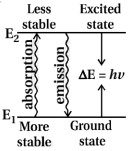
(N/A) Absorption spectra: When electromagnetic radiation interacts with an object,it can be absorbed by atoms,molecules,or ions,causing them to transition from a lower energy state $E_{1}$ to a higher energy state $E_{2}$. The energy absorbed is given by $\Delta E = E_{2} - E_{1} = h\nu$. This process results in an absorption spectrum,which appears as dark lines in a continuous spectrum.
Emission spectra: Atoms or molecules in an excited state $E_{2}$ are unstable and tend to return to a lower energy state $E_{1}$ by releasing energy in the form of electromagnetic radiation. The energy emitted is given by $\Delta E = E_{2} - E_{1} = h\nu$. This process results in an emission spectrum,which appears as bright lines on a dark background.
Spectroscopy: The study of emission or absorption spectra is referred to as spectroscopy. In the gaseous phase,these spectra are not continuous but consist of discrete lines.
Emission spectra: Atoms or molecules in an excited state $E_{2}$ are unstable and tend to return to a lower energy state $E_{1}$ by releasing energy in the form of electromagnetic radiation. The energy emitted is given by $\Delta E = E_{2} - E_{1} = h\nu$. This process results in an emission spectrum,which appears as bright lines on a dark background.
Spectroscopy: The study of emission or absorption spectra is referred to as spectroscopy. In the gaseous phase,these spectra are not continuous but consist of discrete lines.
0 likes
View Solution112
Difficult
Explain line spectra and its uses.
Solution
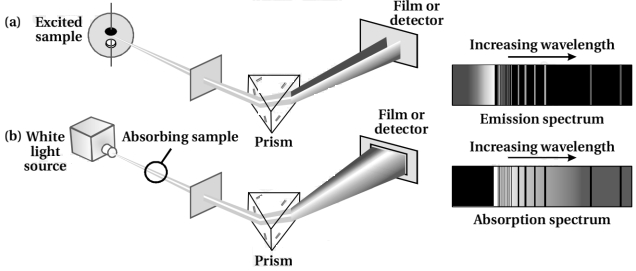
(N/A) Line spectra (atomic spectra): The emission spectra of atoms in the gas phase do not show a continuous spread of wavelength from red to violet. Instead,they emit light only at specific wavelengths with dark spaces between them. Such spectra are called line spectra or atomic spectra because the emitted radiation is identified by the appearance of bright lines in the spectra.
An emission or absorption spectrum is a photographic recording of the separated wavelengths,which is referred to as a line spectrum.
Uses: Line emission spectra are of great interest in the study of electronic structure. The characteristic lines in atomic spectra can be used in chemical analysis to identify unknown atoms. By matching the lines of the emission spectrum of the atoms of a known element with the lines from an unknown sample,one can identify the elements present. Elements like $Rb$,$Cs$,$Tl$,$In$,$Ga$,and $Sc$ were discovered when their minerals were analyzed by spectroscopic methods.
An emission or absorption spectrum is a photographic recording of the separated wavelengths,which is referred to as a line spectrum.
Uses: Line emission spectra are of great interest in the study of electronic structure. The characteristic lines in atomic spectra can be used in chemical analysis to identify unknown atoms. By matching the lines of the emission spectrum of the atoms of a known element with the lines from an unknown sample,one can identify the elements present. Elements like $Rb$,$Cs$,$Tl$,$In$,$Ga$,and $Sc$ were discovered when their minerals were analyzed by spectroscopic methods.
0 likes
View Solution113
Medium
Find the mass of a photon emitted by a sodium lamp (wavelength $\lambda = 5890 \ \mathring{A}$). How many times is this mass compared to the mass of an electron?
Solution
(N/A) The mass of a photon is given by the relation $m = \frac{h}{\lambda c}$.
Given: $h = 6.626 \times 10^{-34} \ J \cdot s$,$\lambda = 5890 \ \mathring{A} = 5890 \times 10^{-10} \ m$,$c = 3 \times 10^8 \ m/s$.
$m = \frac{6.626 \times 10^{-34}}{5890 \times 10^{-10} \times 3 \times 10^8} = 3.75 \times 10^{-36} \ kg$.
The mass of an electron is $m_e = 9.11 \times 10^{-31} \ kg$.
Ratio $= \frac{m}{m_e} = \frac{3.75 \times 10^{-36}}{9.11 \times 10^{-31}} \approx 4.11 \times 10^{-6}$ times.
Given: $h = 6.626 \times 10^{-34} \ J \cdot s$,$\lambda = 5890 \ \mathring{A} = 5890 \times 10^{-10} \ m$,$c = 3 \times 10^8 \ m/s$.
$m = \frac{6.626 \times 10^{-34}}{5890 \times 10^{-10} \times 3 \times 10^8} = 3.75 \times 10^{-36} \ kg$.
The mass of an electron is $m_e = 9.11 \times 10^{-31} \ kg$.
Ratio $= \frac{m}{m_e} = \frac{3.75 \times 10^{-36}}{9.11 \times 10^{-31}} \approx 4.11 \times 10^{-6}$ times.
0 likes
View Solution114
Medium
Wavelengths of different radiations are given below:
$\lambda(A) = 300 \ nm$
$\lambda(B) = 300 \ \mu m$
$\lambda(C) = 3 \ nm$
$\lambda(D) = 30 \ \mathring{A}$
Arrange these radiations in the increasing order of their energies.
$\lambda(A) = 300 \ nm$
$\lambda(B) = 300 \ \mu m$
$\lambda(C) = 3 \ nm$
$\lambda(D) = 30 \ \mathring{A}$
Arrange these radiations in the increasing order of their energies.
Solution
(B < A < C = D) The energy of a radiation is given by $E = \frac{hc}{\lambda}$,which implies $E \propto \frac{1}{\lambda}$.
First,convert all wavelengths to meters:
$\lambda(A) = 300 \ nm = 300 \times 10^{-9} \ m = 3 \times 10^{-7} \ m$
$\lambda(B) = 300 \ \mu m = 300 \times 10^{-6} \ m = 3 \times 10^{-4} \ m$
$\lambda(C) = 3 \ nm = 3 \times 10^{-9} \ m$
$\lambda(D) = 30 \ \mathring{A} = 30 \times 10^{-10} \ m = 3 \times 10^{-9} \ m$
Comparing the wavelengths: $\lambda(B) > \lambda(A) > \lambda(C) = \lambda(D)$.
Since energy is inversely proportional to wavelength,the increasing order of energy is $B < A < C = D$.
First,convert all wavelengths to meters:
$\lambda(A) = 300 \ nm = 300 \times 10^{-9} \ m = 3 \times 10^{-7} \ m$
$\lambda(B) = 300 \ \mu m = 300 \times 10^{-6} \ m = 3 \times 10^{-4} \ m$
$\lambda(C) = 3 \ nm = 3 \times 10^{-9} \ m$
$\lambda(D) = 30 \ \mathring{A} = 30 \times 10^{-10} \ m = 3 \times 10^{-9} \ m$
Comparing the wavelengths: $\lambda(B) > \lambda(A) > \lambda(C) = \lambda(D)$.
Since energy is inversely proportional to wavelength,the increasing order of energy is $B < A < C = D$.
0 likes
View Solution115
Easy
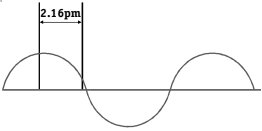
$A$ hypothetical electromagnetic wave is shown in the figure. Find out the wavelength of the radiation.
Solution
(N/A) The wavelength $(\lambda)$ is the distance between two successive peaks or two successive troughs of a wave.
In the given figure, the distance between a peak and the next equilibrium point is $2.16 \text{ pm}$.
Since a full wavelength corresponds to $4$ such segments (peak to equilibrium, equilibrium to trough, trough to equilibrium, equilibrium to peak), the wavelength is:
$\lambda = 4 \times 2.16 \text{ pm} = 8.64 \text{ pm}$
In the given figure, the distance between a peak and the next equilibrium point is $2.16 \text{ pm}$.
Since a full wavelength corresponds to $4$ such segments (peak to equilibrium, equilibrium to trough, trough to equilibrium, equilibrium to peak), the wavelength is:
$\lambda = 4 \times 2.16 \text{ pm} = 8.64 \text{ pm}$
0 likes
View Solution116
Medium
Chlorophyll present in green leaves of plants absorbs light at $4.620 \times 10^{14} \ Hz$. Calculate the wavelength of radiation in nanometer. Which part of the electromagnetic spectrum does it belong to?
Solution
(N/A) The wavelength $\lambda$ is calculated using the formula $\lambda = \frac{c}{\nu}$.
Given: $c = 3.0 \times 10^{8} \ m \ s^{-1}$ and $\nu = 4.620 \times 10^{14} \ Hz$.
$\lambda = \frac{3.0 \times 10^{8} \ m \ s^{-1}}{4.620 \times 10^{14} \ s^{-1}} = 0.6494 \times 10^{-6} \ m$.
Converting to nanometers: $0.6494 \times 10^{-6} \ m \times 10^{9} \ nm/m = 649.4 \ nm$.
Since the wavelength $649.4 \ nm$ falls within the range of $400 \ nm$ to $750 \ nm$,it belongs to the visible light region of the electromagnetic spectrum.
Given: $c = 3.0 \times 10^{8} \ m \ s^{-1}$ and $\nu = 4.620 \times 10^{14} \ Hz$.
$\lambda = \frac{3.0 \times 10^{8} \ m \ s^{-1}}{4.620 \times 10^{14} \ s^{-1}} = 0.6494 \times 10^{-6} \ m$.
Converting to nanometers: $0.6494 \times 10^{-6} \ m \times 10^{9} \ nm/m = 649.4 \ nm$.
Since the wavelength $649.4 \ nm$ falls within the range of $400 \ nm$ to $750 \ nm$,it belongs to the visible light region of the electromagnetic spectrum.
0 likes
View Solution117
Difficult
What is the photoelectric effect? Explain it.
Solution
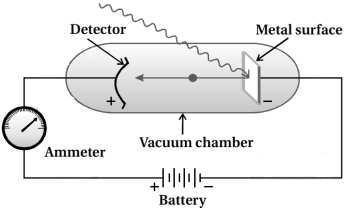
(N/A) Photoelectric effect: When radiation with a certain minimum frequency $v_{0}$ strikes the surface of a metal,electrons are ejected from the metal surface. This phenomenon is called the photoelectric effect. The emitted electrons are called photoelectrons.
Equipment for studying the photoelectric effect: Light of a particular frequency strikes a clean metal surface inside a vacuum chamber. Electrons are ejected from the metal and are counted by a detector that measures their kinetic energy.
The results observed in this experiment were:
$(i)$. The electrons are ejected from the metal surface as soon as the beam of light strikes the surface,i.e.,there is no time lag between the striking of the light beam and the ejection of electrons from the metal surface.
$(ii)$. The number of electrons ejected is proportional to the intensity or brightness of light.
$(iii)$. For each metal,there is a characteristic minimum frequency,$v_{0}$ (also known as threshold frequency),below which the photoelectric effect is not observed. At a frequency $v > v_{0}$,the ejected electrons come out with certain kinetic energy. The kinetic energies of these electrons increase with the increase of the frequency of the light used.
The above observations cannot be explained by the electromagnetic wave theory. According to this theory,since radiations were continuous,it should be possible to accumulate energy on the surface of the metal,irrespective of its frequency,and thus,radiations of all frequencies should be able to eject electrons.
Similarly,according to this theory,the energy of the ejected electrons should depend upon the intensity of the incident radiation.
Equipment for studying the photoelectric effect: Light of a particular frequency strikes a clean metal surface inside a vacuum chamber. Electrons are ejected from the metal and are counted by a detector that measures their kinetic energy.
The results observed in this experiment were:
$(i)$. The electrons are ejected from the metal surface as soon as the beam of light strikes the surface,i.e.,there is no time lag between the striking of the light beam and the ejection of electrons from the metal surface.
$(ii)$. The number of electrons ejected is proportional to the intensity or brightness of light.
$(iii)$. For each metal,there is a characteristic minimum frequency,$v_{0}$ (also known as threshold frequency),below which the photoelectric effect is not observed. At a frequency $v > v_{0}$,the ejected electrons come out with certain kinetic energy. The kinetic energies of these electrons increase with the increase of the frequency of the light used.
The above observations cannot be explained by the electromagnetic wave theory. According to this theory,since radiations were continuous,it should be possible to accumulate energy on the surface of the metal,irrespective of its frequency,and thus,radiations of all frequencies should be able to eject electrons.
Similarly,according to this theory,the energy of the ejected electrons should depend upon the intensity of the incident radiation.
0 likes
View Solution118
MediumMCQ
State the characteristics and uses of $X$-rays.
A
They are charged particles with high energy.
B
They are neutral electromagnetic radiations with very short wavelengths.
C
They are visible light rays with long wavelengths.
D
They are sound waves used for communication.
Solution
(B) $X$-rays are electromagnetic radiations that do not deflect in electric or magnetic fields,indicating they are neutral.
They possess a very short wavelength (approximately $0.1 \ nm$).
Due to their high penetrating power,they are widely used in medical imaging to study the internal structure of objects and the human body.
They possess a very short wavelength (approximately $0.1 \ nm$).
Due to their high penetrating power,they are widely used in medical imaging to study the internal structure of objects and the human body.
0 likes
View Solution119
EasyMCQ
What is scattering? Which property of electromagnetic radiation can explain it? Explain.
A
Reflection,Particle nature
B
Scattering,Wave nature
C
Refraction,Particle nature
D
Diffraction,Wave nature
Solution
(B) Scattering is the phenomenon of the deflection of a wave due to an obstacle. It can be explained by the wave nature of electromagnetic radiation. When electromagnetic radiation interacts with particles of matter,the waves are redirected in various directions,which is known as scattering.
0 likes
View Solution120
EasyMCQ
What is interference in the context of electromagnetic radiation?
A
The process where two waves combine to form a resultant wave of greater,lower,or the same amplitude.
B
The bending of light around the corners of an obstacle.
C
The emission of electrons from a metal surface when light of a suitable frequency strikes it.
D
The change in direction of a wave passing from one medium to another.
Solution
(A) Interference is a phenomenon that occurs when two or more electromagnetic waves overlap in space.
When the crests and troughs of the waves align,they undergo constructive interference,resulting in an increased amplitude.
When the crest of one wave aligns with the trough of another,they undergo destructive interference,resulting in a decreased amplitude.
This behavior is a fundamental property of waves,demonstrating the wave nature of electromagnetic radiation.
When the crests and troughs of the waves align,they undergo constructive interference,resulting in an increased amplitude.
When the crest of one wave aligns with the trough of another,they undergo destructive interference,resulting in a decreased amplitude.
This behavior is a fundamental property of waves,demonstrating the wave nature of electromagnetic radiation.
0 likes
View Solution121
EasyMCQ
Which characteristics of electromagnetic radiation can be explained by its wave nature and particle nature,respectively?
A
Wave: Diffraction and Interference; Particle: Photoelectric effect and Black body radiation
B
Wave: Photoelectric effect and Black body radiation; Particle: Diffraction and Interference
C
Wave: Diffraction and Black body radiation; Particle: Interference and Photoelectric effect
D
Wave: Interference and Photoelectric effect; Particle: Diffraction and Black body radiation
Solution
(A) The wave nature of electromagnetic radiation explains phenomena such as diffraction and interference.
The particle nature of electromagnetic radiation explains phenomena such as the photoelectric effect and black body radiation.
The particle nature of electromagnetic radiation explains phenomena such as the photoelectric effect and black body radiation.
0 likes
View Solution122
MediumMCQ
Which color in the visible spectrum has the maximum energy? Provide its energy,wavelength,and frequency.
A
Red
B
Yellow
C
Green
D
Violet
Solution
(D) In the visible spectrum,the violet color has the maximum energy because it has the shortest wavelength.
For violet light:
Wavelength $(\lambda)$: Approximately $380-450 \, nm$ (or $3800-4500 \, \mathring{A}$).
Frequency $(\nu)$: Approximately $6.7 \times 10^{14} - 7.9 \times 10^{14} \, Hz$.
Energy $(E = h\nu)$: It has the highest energy among visible colors,approximately $2.75 - 3.26 \, eV$ per photon.
For violet light:
Wavelength $(\lambda)$: Approximately $380-450 \, nm$ (or $3800-4500 \, \mathring{A}$).
Frequency $(\nu)$: Approximately $6.7 \times 10^{14} - 7.9 \times 10^{14} \, Hz$.
Energy $(E = h\nu)$: It has the highest energy among visible colors,approximately $2.75 - 3.26 \, eV$ per photon.
0 likes
View Solution123
MediumMCQ
Which color in the visible spectrum has the minimum energy? State its energy,wavelength,and frequency.
A
Red,$E = 2.84 \times 10^{-19} \ J, \lambda = 700 \ nm, \nu = 4.28 \times 10^{14} \ Hz$
B
Violet,$E = 4.97 \times 10^{-19} \ J, \lambda = 400 \ nm, \nu = 7.50 \times 10^{14} \ Hz$
C
Yellow,$E = 3.43 \times 10^{-19} \ J, \lambda = 580 \ nm, \nu = 5.17 \times 10^{14} \ Hz$
D
Blue,$E = 4.41 \times 10^{-19} \ J, \lambda = 450 \ nm, \nu = 6.66 \times 10^{14} \ Hz$
Solution
(A) In the visible spectrum,the energy of light is inversely proportional to its wavelength $(E = \frac{hc}{\lambda})$.
Red color has the longest wavelength (approximately $700 \ nm$),which corresponds to the minimum energy.
Using $E = \frac{hc}{\lambda}$ where $h = 6.626 \times 10^{-34} \ J \cdot s$ and $c = 3 \times 10^8 \ m/s$:
$E = \frac{6.626 \times 10^{-34} \times 3 \times 10^8}{700 \times 10^{-9}} \approx 2.84 \times 10^{-19} \ J$.
The frequency $\nu = \frac{c}{\lambda} = \frac{3 \times 10^8}{700 \times 10^{-9}} \approx 4.28 \times 10^{14} \ Hz$.
Red color has the longest wavelength (approximately $700 \ nm$),which corresponds to the minimum energy.
Using $E = \frac{hc}{\lambda}$ where $h = 6.626 \times 10^{-34} \ J \cdot s$ and $c = 3 \times 10^8 \ m/s$:
$E = \frac{6.626 \times 10^{-34} \times 3 \times 10^8}{700 \times 10^{-9}} \approx 2.84 \times 10^{-19} \ J$.
The frequency $\nu = \frac{c}{\lambda} = \frac{3 \times 10^8}{700 \times 10^{-9}} \approx 4.28 \times 10^{14} \ Hz$.
0 likes
View Solution124
Easy
What is Maxwell's electromagnetic theory?
Solution
(N/A) According to this theory,when a charged particle is accelerated,it emits electromagnetic radiation.
0 likes
View Solution125
Easy
What are the different regions of the electromagnetic spectrum?
Solution
(N/A) The different regions of the electromagnetic spectrum are: Radio waves,Microwave region,Infrared region,Visible region,Ultraviolet region,$X$-rays,and $\gamma$-rays.
0 likes
View Solution126
Easy
Which properties characterize electromagnetic radiation?
Solution
(N/A) Electromagnetic radiation is characterized by the following properties:
$(i)$ Wavelength $(\lambda)$
$(ii)$ Frequency $(\nu)$
$(iii)$ Wavenumber $(\bar{\nu})$
$(i)$ Wavelength $(\lambda)$
$(ii)$ Frequency $(\nu)$
$(iii)$ Wavenumber $(\bar{\nu})$
0 likes
View Solution127
EasyMCQ
What is the speed of all types of electromagnetic radiation in a vacuum? What is it called?
A
$3.0 \times 10^{8} \text{ m s}^{-1}$,Speed of light $(c)$
B
$3.0 \times 10^{10} \text{ m s}^{-1}$,Speed of sound
C
$3.0 \times 10^{6} \text{ m s}^{-1}$,Velocity of particles
D
$3.0 \times 10^{5} \text{ m s}^{-1}$,Wave velocity
Solution
(A) In a vacuum,all types of electromagnetic radiation travel at a constant speed of $3.0 \times 10^{8} \text{ m s}^{-1}$.
This speed is known as the speed of light and is denoted by the symbol $c$.
This speed is known as the speed of light and is denoted by the symbol $c$.
0 likes
View Solution128
Easy
Give the formulas for wave number and time period.
Solution
(N/A) Wave number $= \bar{v} = \frac{1}{\lambda} \text{ m}^{-1}$ (It is the number of wavelengths per unit length.)
Time period $= T = \frac{1}{v} \text{ s}$ (The time taken by a wave to complete one oscillation or cycle is called the time period $(T)$.)
Time period $= T = \frac{1}{v} \text{ s}$ (The time taken by a wave to complete one oscillation or cycle is called the time period $(T)$.)
0 likes
View Solution129
Easy
What changes are observed in the color of iron as it is heated,and how does the frequency of the emitted radiation change?
Solution
(N/A) As iron is heated,its color changes with temperature: $Dull \ Red$ $\rightarrow Bright \ Red$ $\rightarrow White$ $\rightarrow Blue$. As the temperature increases,the wavelength of the emitted radiation decreases,which means the frequency $(v)$ of the emitted radiation increases.
0 likes
View Solution130
EasyMCQ
What is a black body?
A
An ideal body that emits all radiation.
B
An ideal body that absorbs all radiation incident on it.
C
An ideal body that reflects all radiation.
D
An ideal body that transmits all radiation.
Solution
(B) black body is an idealized physical body that absorbs all incident electromagnetic radiation,regardless of frequency or angle of incidence.
It does not reflect or transmit any radiation.
Because it absorbs all radiation,it is also a perfect emitter of radiation when heated,following Planck's law.
It does not reflect or transmit any radiation.
Because it absorbs all radiation,it is also a perfect emitter of radiation when heated,following Planck's law.
0 likes
View Solution131
EasyMCQ
What is the intensity of radiation?
A
The number of photons passing through a unit area per unit time.
B
The energy of a single photon.
C
The frequency of the radiation.
D
The wavelength of the radiation.
Solution
(A) The intensity of radiation is defined as the amount of energy flowing per unit area per unit time. In terms of the particle nature of light,it corresponds to the number of photons passing through a unit area per unit time. Higher intensity means a greater number of photons are present in the beam.
0 likes
View Solution132
Medium
Explain the visible spectrum and the continuous spectrum.
Solution
(N/A) Visible Spectrum: White light contains waves of all wavelengths in the visible region. When a beam of white light is passed through a prism,it splits into a series of colored bands,which is called a 'spectrum'.
Continuous Spectrum: The visible spectrum ranges from violet $(7.50 \times 10^{14} \ Hz)$ to red $(4.00 \times 10^{14} \ Hz)$. This is a continuous spectrum. $A$ 'continuous spectrum' is one in which the adjacent colors (wavelengths) blend into each other without any gaps.
Example: In the visible spectrum,violet blends into blue,blue into green,and so on,with all colors merging into one another.
Continuous Spectrum: The visible spectrum ranges from violet $(7.50 \times 10^{14} \ Hz)$ to red $(4.00 \times 10^{14} \ Hz)$. This is a continuous spectrum. $A$ 'continuous spectrum' is one in which the adjacent colors (wavelengths) blend into each other without any gaps.
Example: In the visible spectrum,violet blends into blue,blue into green,and so on,with all colors merging into one another.
0 likes
View Solution133
EasyMCQ
Write examples of a continuous spectrum.
A
Rainbow
B
Emission spectrum of hydrogen
C
Absorption spectrum of sodium
D
None of the above
Solution
(A) The examples of a continuous spectrum are:
$(i)$ The rainbow.
$(ii)$ The spectrum obtained by passing a beam of white light through a prism.
$(i)$ The rainbow.
$(ii)$ The spectrum obtained by passing a beam of white light through a prism.
0 likes
View Solution134
EasyMCQ
Explain the reason for the formation of a spectrum.
A
Dispersion of light
B
Reflection of light
C
Absorption of light
D
Emission of light
Solution
(A) When a beam of light passes through a medium,it undergoes refraction and deviates from its path.
Different wavelengths of light travel at different speeds in a medium,causing them to bend by different angles.
Shorter wavelengths (higher frequency) bend more than longer wavelengths.
This separation of light into its constituent colors is known as dispersion,which results in the formation of a spectrum.
Different wavelengths of light travel at different speeds in a medium,causing them to bend by different angles.
Shorter wavelengths (higher frequency) bend more than longer wavelengths.
This separation of light into its constituent colors is known as dispersion,which results in the formation of a spectrum.
0 likes
View Solution135
Easy
In the visible spectrum,which color,violet or red,undergoes greater refraction? Why?
Solution
(A) Violet light undergoes greater refraction than red light. This is because violet light has a shorter wavelength and higher frequency compared to red light.
| Color | Wavelength $(\lambda)$ | Frequency $(v)$ | Deviation |
|---|---|---|---|
| Violet | $400 \, nm$ | $7.50 \times 10^{14} \, Hz$ | Greater |
| Red | $750 \, nm$ | $4.00 \times 10^{14} \, Hz$ | Lesser |
0 likes
View Solution136
EasyMCQ
What is an emission spectrum?
A
$A$ spectrum formed by the absorption of light by a substance.
B
$A$ spectrum formed when radiation emitted from a source is passed through a prism or diffraction grating.
C
$A$ spectrum that shows all wavelengths of light continuously.
D
$A$ spectrum that is independent of the source of radiation.
Solution
(B) An emission spectrum is produced when radiation emitted from a source (like an excited atom or molecule) is passed through a prism or diffraction grating.
It consists of specific wavelengths or frequencies of light that are characteristic of the substance being studied.
This spectrum provides information about the energy levels of atoms and molecules.
It consists of specific wavelengths or frequencies of light that are characteristic of the substance being studied.
This spectrum provides information about the energy levels of atoms and molecules.
0 likes
View Solution137
Easy
How is an electron observed? Explain.
Solution
(N/A) To observe an electron,it is illuminated with light or electromagnetic radiation having a wavelength smaller than the dimensions of the electron. This allows the interaction of photons with the electron to be detected.
0 likes
View Solution138
Medium
Fill in the blanks:
$(i)$ If the orbits around the nucleus contract,the electron will spiral into the nucleus in $....$ seconds.
$(ii)$ Waves used in radio broadcasting have a frequency of $....$ $Hz$.
$(iii)$ The $SI$ unit of frequency is $....$.
$(iv)$ The number of waves present in unit length is called $....$.
$(i)$ If the orbits around the nucleus contract,the electron will spiral into the nucleus in $....$ seconds.
$(ii)$ Waves used in radio broadcasting have a frequency of $....$ $Hz$.
$(iii)$ The $SI$ unit of frequency is $....$.
$(iv)$ The number of waves present in unit length is called $....$.
Solution
(N/A) $(i)$ $10^{-8}$
$(ii)$ $10^6$
$(iii)$ Hertz $(Hz)$
$(iv)$ Wave number $(\overline{\nu})$
$(ii)$ $10^6$
$(iii)$ Hertz $(Hz)$
$(iv)$ Wave number $(\overline{\nu})$
0 likes
View Solution139
Easy
Fill in the blank: Wave number is measured in units of .........
Solution
(N/A) The wave number $(\bar{\nu})$ is defined as the number of wavelengths per unit length. Its $SI$ unit is $m^{-1}$,and it is commonly expressed in $cm^{-1}$.
0 likes
View Solution140
Easy
Match the following:
| List-$I$ | List-$II$ |
| $(1)$ $X$-rays | $(A)$ $\nu = 10^0 - 10^4 \ Hz$ |
| $(2)$ Ultraviolet $(UV)$ rays | $(B)$ $\nu = 10^{10} \ Hz$ |
| $(3)$ Long radio waves | $(C)$ $\nu = 10^{16} \ Hz$ |
| $(4)$ Microwave | $(D)$ $\nu = 10^{18} \ Hz$ |
Solution
(D) The frequency ranges for electromagnetic radiation are as follows:
$(1)$ $X$-rays have high frequency,typically around $10^{18} \ Hz$ $(D)$.
$(2)$ Ultraviolet $(UV)$ rays have frequencies around $10^{16} \ Hz$ $(C)$.
$(3)$ Long radio waves have very low frequencies,typically $10^0 - 10^4 \ Hz$ $(A)$.
$(4)$ Microwaves have frequencies around $10^{10} \ Hz$ $(B)$.
Therefore,the correct matching is: $(1-D, 2-C, 3-A, 4-B)$.
$(1)$ $X$-rays have high frequency,typically around $10^{18} \ Hz$ $(D)$.
$(2)$ Ultraviolet $(UV)$ rays have frequencies around $10^{16} \ Hz$ $(C)$.
$(3)$ Long radio waves have very low frequencies,typically $10^0 - 10^4 \ Hz$ $(A)$.
$(4)$ Microwaves have frequencies around $10^{10} \ Hz$ $(B)$.
Therefore,the correct matching is: $(1-D, 2-C, 3-A, 4-B)$.
0 likes
View Solution141
EasyMCQ
The region in the electromagnetic spectrum where the Balmer series lines appear is
A
Visible
B
Microwave
C
Ultraviolet
D
Infrared
Solution
(A) The spectral lines of the Balmer series for the $H$-atom correspond to transitions from higher energy levels to the $n = 2$ energy level. These transitions emit radiation that falls within the visible region of the electromagnetic spectrum.
0 likes
View Solution142
MediumMCQ
Electromagnetic radiation of wavelength $663 \ nm$ is just sufficient to ionise the atom of metal $A.$ The ionization energy of metal $A$ in $kJ \ mol^{-1}$ is ...... .
(Rounded-off to the nearest integer) $\left[ h = 6.63 \times 10^{-34} \ Js, c = 3.00 \times 10^{8} \ ms^{-1}, N_{A} = 6.02 \times 10^{23} \ mol^{-1} \right]$
(Rounded-off to the nearest integer) $\left[ h = 6.63 \times 10^{-34} \ Js, c = 3.00 \times 10^{8} \ ms^{-1}, N_{A} = 6.02 \times 10^{23} \ mol^{-1} \right]$
A
$145$
B
$90$
C
$40$
D
$181$
Solution
(D) The energy $E$ required to ionize one mole of atoms is given by the formula:
$E = \frac{hcN_{A}}{\lambda \times 1000} \text{ (in } kJ \ mol^{-1} \text{)}$
Given:
$h = 6.63 \times 10^{-34} \ J \cdot s$
$c = 3.00 \times 10^{8} \ m \cdot s^{-1}$
$N_{A} = 6.02 \times 10^{23} \ mol^{-1}$
$\lambda = 663 \ nm = 663 \times 10^{-9} \ m$
Substituting the values:
$E = \frac{6.63 \times 10^{-34} \times 3.00 \times 10^{8} \times 6.02 \times 10^{23}}{663 \times 10^{-9} \times 1000}$
$E = \frac{6.63 \times 3.00 \times 6.02 \times 10^{-3}}{663 \times 10^{-6}}$
$E = \frac{119.799 \times 10^{-3}}{663 \times 10^{-6}} = \frac{119.799}{0.663} \approx 180.69 \ kJ \ mol^{-1}$
Rounding off to the nearest integer,we get $181 \ kJ \ mol^{-1}$.
$E = \frac{hcN_{A}}{\lambda \times 1000} \text{ (in } kJ \ mol^{-1} \text{)}$
Given:
$h = 6.63 \times 10^{-34} \ J \cdot s$
$c = 3.00 \times 10^{8} \ m \cdot s^{-1}$
$N_{A} = 6.02 \times 10^{23} \ mol^{-1}$
$\lambda = 663 \ nm = 663 \times 10^{-9} \ m$
Substituting the values:
$E = \frac{6.63 \times 10^{-34} \times 3.00 \times 10^{8} \times 6.02 \times 10^{23}}{663 \times 10^{-9} \times 1000}$
$E = \frac{6.63 \times 3.00 \times 6.02 \times 10^{-3}}{663 \times 10^{-6}}$
$E = \frac{119.799 \times 10^{-3}}{663 \times 10^{-6}} = \frac{119.799}{0.663} \approx 180.69 \ kJ \ mol^{-1}$
Rounding off to the nearest integer,we get $181 \ kJ \ mol^{-1}$.
0 likes
View Solution143
EasyMCQ
$A$ particular station of All India Radio,New Delhi,broadcasts on a frequency of $1,368 \, kHz$. The wavelength of the electromagnetic radiation emitted by the transmitter is : [speed of light $c = 3.0 \times 10^{8} \, m \, s^{-1}$]
A
$219.3 \, m$
B
$219.2 \, m$
C
$2192 \, m$
D
$21.92 \, cm$
Solution
(A) The relationship between frequency $(\nu)$,wavelength $(\lambda)$,and speed of light $(c)$ is given by the formula: $\nu = \frac{c}{\lambda}$.
Rearranging the formula to solve for wavelength: $\lambda = \frac{c}{\nu}$.
Given: $c = 3.0 \times 10^{8} \, m \, s^{-1}$ and $\nu = 1,368 \, kHz = 1,368 \times 10^{3} \, Hz$.
Substituting the values: $\lambda = \frac{3.0 \times 10^{8} \, m \, s^{-1}}{1,368 \times 10^{3} \, s^{-1}}$.
$\lambda = \frac{300,000,000}{1,368,000} \, m \approx 219.29 \, m$.
Rounding to one decimal place,we get $\lambda \approx 219.3 \, m$.
Rearranging the formula to solve for wavelength: $\lambda = \frac{c}{\nu}$.
Given: $c = 3.0 \times 10^{8} \, m \, s^{-1}$ and $\nu = 1,368 \, kHz = 1,368 \times 10^{3} \, Hz$.
Substituting the values: $\lambda = \frac{3.0 \times 10^{8} \, m \, s^{-1}}{1,368 \times 10^{3} \, s^{-1}}$.
$\lambda = \frac{300,000,000}{1,368,000} \, m \approx 219.29 \, m$.
Rounding to one decimal place,we get $\lambda \approx 219.3 \, m$.
0 likes
View Solution144
MediumMCQ
The energy of one mole of photons of radiation of wavelength $300 \ nm$ is ...... $kJ \ mol^{-1}$. (Given: $h = 6.63 \times 10^{-34} \ J \ s, N_A = 6.02 \times 10^{23} \ mol^{-1}, c = 3 \times 10^8 \ m \ s^{-1}$)
A
$235$
B
$325$
C
$399$
D
$435$
Solution
(C) The energy of one mole of photons is given by the formula: $E = \frac{hcN_A}{\lambda}$
Substituting the given values:
$E = \frac{6.63 \times 10^{-34} \ J \ s \times 3 \times 10^8 \ m \ s^{-1} \times 6.02 \times 10^{23} \ mol^{-1}}{300 \times 10^{-9} \ m}$
$E = \frac{11.976 \times 10^{-2} \ J \ mol^{-1}}{3 \times 10^{-7}}$
$E = 3.9913 \times 10^5 \ J \ mol^{-1}$
$E \approx 399 \ kJ \ mol^{-1}$
Substituting the given values:
$E = \frac{6.63 \times 10^{-34} \ J \ s \times 3 \times 10^8 \ m \ s^{-1} \times 6.02 \times 10^{23} \ mol^{-1}}{300 \times 10^{-9} \ m}$
$E = \frac{11.976 \times 10^{-2} \ J \ mol^{-1}}{3 \times 10^{-7}}$
$E = 3.9913 \times 10^5 \ J \ mol^{-1}$
$E \approx 399 \ kJ \ mol^{-1}$
0 likes
View Solution145
MediumMCQ
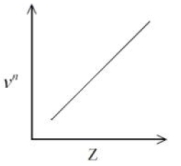
It is observed that characteristic $X$-ray spectra of elements show regularity. When frequency to the power '$n$' i.e.,$v^{n}$ of $X$-rays emitted is plotted against atomic number '$Z$',the following graph is obtained. The value of '$n$' is
A
$1$
B
$2$
C
$0.5$
D
$3$
Solution
(C) According to Henry Moseley's law for characteristic $X$-rays,the frequency $v$ is related to the atomic number $Z$ by the equation: $\sqrt{v} = a(Z - b)$,where $a$ and $b$ are constants.
This can be written as $v^{1/2} = a(Z - b)$.
Comparing this with the given plot of $v^{n}$ versus $Z$,we get $n = 1/2 = 0.5$.
This can be written as $v^{1/2} = a(Z - b)$.
Comparing this with the given plot of $v^{n}$ versus $Z$,we get $n = 1/2 = 0.5$.
0 likes
View Solution146
MediumMCQ
The energy of one mole of photons of radiation of frequency $2 \times 10^{12} \ Hz$ in $J \ mol^{-1}$ is $.....$ (Nearest integer) (Given: $h = 6.626 \times 10^{-34} \ Js$,$N_A = 6.022 \times 10^{23} \ mol^{-1}$)
A
$796$
B
$798$
C
$797$
D
$785$
Solution
(B) The energy of one photon is given by $E = h\nu$.
The energy of one mole of photons is given by $E = N_A \times h \times \nu$.
Substituting the given values:
$E = (6.022 \times 10^{23} \ mol^{-1}) \times (6.626 \times 10^{-34} \ Js) \times (2 \times 10^{12} \ s^{-1})$.
$E = 6.022 \times 6.626 \times 2 \times 10^{23-34+12} \ J \ mol^{-1}$.
$E = 79.795 \times 10^{1} \ J \ mol^{-1} = 797.95 \ J \ mol^{-1}$.
Rounding to the nearest integer,we get $798 \ J \ mol^{-1}$.
The energy of one mole of photons is given by $E = N_A \times h \times \nu$.
Substituting the given values:
$E = (6.022 \times 10^{23} \ mol^{-1}) \times (6.626 \times 10^{-34} \ Js) \times (2 \times 10^{12} \ s^{-1})$.
$E = 6.022 \times 6.626 \times 2 \times 10^{23-34+12} \ J \ mol^{-1}$.
$E = 79.795 \times 10^{1} \ J \ mol^{-1} = 797.95 \ J \ mol^{-1}$.
Rounding to the nearest integer,we get $798 \ J \ mol^{-1}$.
0 likes
View Solution147
MediumMCQ
When electromagnetic radiation of wavelength $300 \, nm$ falls on the surface of a metal,electrons are emitted with the kinetic energy of $1.68 \times 10^5 \, J \, mol^{-1}$. What is the minimum energy needed to remove an electron from the metal? $(h = 6.626 \times 10^{-34} \, J \, s, c = 3 \times 10^8 \, m \, s^{-1}, N_A = 6.022 \times 10^{23} \, mol^{-1})$
A
$2.31 \times 10^6 \, J \, mol^{-1}$
B
$3.84 \times 10^4 \, J \, mol^{-1}$
C
$3.84 \times 10^{-19} \, J \, mol^{-1}$
D
$2.31 \times 10^5 \, J \, mol^{-1}$
Solution
(D) The energy of a single photon is given by $E = \frac{hc}{\lambda}$.
For one mole of photons,the energy is $E_{mol} = \frac{hcN_A}{\lambda}$.
$E_{mol} = \frac{6.626 \times 10^{-34} \, J \, s \times 3 \times 10^8 \, m \, s^{-1} \times 6.022 \times 10^{23} \, mol^{-1}}{300 \times 10^{-9} \, m} = 3.99 \times 10^5 \, J \, mol^{-1}$.
According to the photoelectric effect equation,$E_{photon} = \Phi + KE$,where $\Phi$ is the work function (minimum energy to remove an electron).
$\Phi = E_{mol} - KE = (3.99 \times 10^5 - 1.68 \times 10^5) \, J \, mol^{-1} = 2.31 \times 10^5 \, J \, mol^{-1}$.
For one mole of photons,the energy is $E_{mol} = \frac{hcN_A}{\lambda}$.
$E_{mol} = \frac{6.626 \times 10^{-34} \, J \, s \times 3 \times 10^8 \, m \, s^{-1} \times 6.022 \times 10^{23} \, mol^{-1}}{300 \times 10^{-9} \, m} = 3.99 \times 10^5 \, J \, mol^{-1}$.
According to the photoelectric effect equation,$E_{photon} = \Phi + KE$,where $\Phi$ is the work function (minimum energy to remove an electron).
$\Phi = E_{mol} - KE = (3.99 \times 10^5 - 1.68 \times 10^5) \, J \, mol^{-1} = 2.31 \times 10^5 \, J \, mol^{-1}$.
0 likes
View Solution148
MediumMCQ
The number of the following statements which is/are incorrect is:
$A$. Line emission spectra are used to study the electronic structure.
$B$. The emission spectra of atoms in the gas phase show a continuous spread of wavelength from red to violet.
$C$. An absorption spectrum is like the photographic negative of an emission spectrum.
$D$. The element helium was discovered in the sun by spectroscopic method.
$A$. Line emission spectra are used to study the electronic structure.
$B$. The emission spectra of atoms in the gas phase show a continuous spread of wavelength from red to violet.
$C$. An absorption spectrum is like the photographic negative of an emission spectrum.
$D$. The element helium was discovered in the sun by spectroscopic method.
A
$2$
B
$1$
C
$3$
D
$0$
Solution
(B) Statement $A$ is correct: Line emission spectra provide information about the electronic structure of atoms.
Statement $B$ is incorrect: Atoms in the gas phase emit line spectra (discrete wavelengths),not a continuous spectrum.
Statement $C$ is correct: An absorption spectrum consists of dark lines in a continuous spectrum,which corresponds to the bright lines in an emission spectrum,acting like a photographic negative.
Statement $D$ is correct: Helium was indeed discovered in the sun's spectrum during a solar eclipse.
Therefore,only $1$ statement (Statement $B$) is incorrect.
Statement $B$ is incorrect: Atoms in the gas phase emit line spectra (discrete wavelengths),not a continuous spectrum.
Statement $C$ is correct: An absorption spectrum consists of dark lines in a continuous spectrum,which corresponds to the bright lines in an emission spectrum,acting like a photographic negative.
Statement $D$ is correct: Helium was indeed discovered in the sun's spectrum during a solar eclipse.
Therefore,only $1$ statement (Statement $B$) is incorrect.
0 likes
View Solution149
DifficultMCQ
The number of incorrect statement/s about the black body from the following is $........$.
$(A)$ Emit or absorb energy in the form of electromagnetic radiation
$(B)$ Frequency distribution of the emitted radiation depends on temperature
$(C)$ At a given temperature,intensity vs frequency curve passes through a maximum value
$(D)$ The maximum of the intensity vs frequency curve is at a higher frequency at higher temperature compared to that at lower temperature
$(A)$ Emit or absorb energy in the form of electromagnetic radiation
$(B)$ Frequency distribution of the emitted radiation depends on temperature
$(C)$ At a given temperature,intensity vs frequency curve passes through a maximum value
$(D)$ The maximum of the intensity vs frequency curve is at a higher frequency at higher temperature compared to that at lower temperature
A
$1$
B
$0$
C
$2$
D
$3$
Solution
(B) black body is an ideal body that can emit and absorb all frequencies of electromagnetic radiation. Thus,statement $(A)$ is correct.
The frequency distribution of the emitted radiation from a black body depends solely on its temperature. Thus,statement $(B)$ is correct.
For a black body at a given temperature,the intensity of emitted radiation varies with frequency,showing a characteristic curve that passes through a maximum value. Thus,statement $(C)$ is correct.
According to Wien's displacement law,as the temperature of a black body increases,the peak of the intensity distribution curve shifts towards higher frequencies (or shorter wavelengths). Thus,statement $(D)$ is correct.
Since all statements $(A)$,$(B)$,$(C)$,and $(D)$ are correct,the number of incorrect statements is $0$.
The frequency distribution of the emitted radiation from a black body depends solely on its temperature. Thus,statement $(B)$ is correct.
For a black body at a given temperature,the intensity of emitted radiation varies with frequency,showing a characteristic curve that passes through a maximum value. Thus,statement $(C)$ is correct.
According to Wien's displacement law,as the temperature of a black body increases,the peak of the intensity distribution curve shifts towards higher frequencies (or shorter wavelengths). Thus,statement $(D)$ is correct.
Since all statements $(A)$,$(B)$,$(C)$,and $(D)$ are correct,the number of incorrect statements is $0$.
0 likes
View Solution150
MediumMCQ
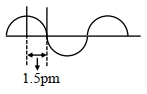
$A$ hypothetical electromagnetic wave is shown below. The frequency of the wave is $x \times 10^{19} \ Hz$. $x =$ . . . . (nearest integer)
A
$5$
B
$7$
C
$9$
D
$10$
Solution
(D) From the given figure, the distance shown corresponds to half of the wavelength (half-cycle), i.e., $\frac{\lambda}{2} = 1.5 \ pm$.
Therefore, the wavelength $\lambda = 2 \times 1.5 \ pm = 3 \ pm = 3 \times 10^{-12} \ m$.
The relationship between frequency $(\nu)$, wavelength $(\lambda)$, and speed of light $(c)$ is $\nu = \frac{c}{\lambda}$.
Given $c = 3 \times 10^8 \ m/s$, we have $\nu = \frac{3 \times 10^8 \ m/s}{3 \times 10^{-12} \ m} = 1 \times 10^{20} \ Hz$.
Expressing this in the form $x \times 10^{19} \ Hz$, we get $10 \times 10^{19} \ Hz$.
Thus, $x = 10$.
Therefore, the wavelength $\lambda = 2 \times 1.5 \ pm = 3 \ pm = 3 \times 10^{-12} \ m$.
The relationship between frequency $(\nu)$, wavelength $(\lambda)$, and speed of light $(c)$ is $\nu = \frac{c}{\lambda}$.
Given $c = 3 \times 10^8 \ m/s$, we have $\nu = \frac{3 \times 10^8 \ m/s}{3 \times 10^{-12} \ m} = 1 \times 10^{20} \ Hz$.
Expressing this in the form $x \times 10^{19} \ Hz$, we get $10 \times 10^{19} \ Hz$.
Thus, $x = 10$.
0 likes
View SolutionStructure of Atom — Nature of radiation · Frequently Asked Questions
1Are these Structure of Atom questions useful for JEE and NEET?
Yes. All questions in this section are mapped to JEE Main and NEET exam patterns. Previous year questions from JEE Main, NEET, GUJCET and state-level exams are included with full solutions.
2Can I switch to Hindi or Gujarati for these questions?
Yes. Use the language tabs in the hero section or the sidebar to view the same questions and solutions in English, Hindi or Gujarati.
3How do I generate a question paper from this subtopic?
Use the Vedclass Exam Paper Generator — select the chapter and subtopic, set difficulty, and generate Sets A, B, C, D automatically. First 3 chapters of every subject are free.
Vedclass Products
For Students
Vedclass Test Series
Mock tests in real JEE/NEET style with performance analysis. 5-day free trial.
Start Free TrialFor Teachers
Exam Paper Generator
Generate Set A/B/C/D papers from this chapter in 2 minutes. 3 chapters free.
Try FreeFor Institutes
Online Exam Module
Live online exams with unlimited students, 360° analytics & white-label branding.
See DemoFor Teachers & Institutes
Generate a Structure of Atom Exam Paper in 2 Minutes
Select subtopic & difficulty — Sets A, B, C, D auto-generated with No Repeat logic.
First 3 chapters of every subject are free — no payment required.