
A English
Nature of radiation Questions in English
Class 11 Chemistry · Structure of Atom · Nature of radiation
198+
Questions
English
Language
100%
With Solutions
Showing 50 of 198 questions in English
51
EasyMCQ
The photoelectric effect shows:
A
Particle-like behavior of light
B
Wave-like behavior of light
C
Both wave-like and particle-like behavior of light
D
Neither wave-like nor particle-like behavior of light
Solution
(A) The photoelectric effect is the emission of photoelectrons from a clean metal surface due to incident light whose frequency is greater than a threshold frequency.
The photoelectric effect supports the particle theory of light because it shows that the energy required to release electrons from a metal is dependent upon the frequency of the light,and not the intensity.
Therefore,light behaves as a stream of particles (photons) in this phenomenon,confirming the particle-like behavior of light.
The photoelectric effect supports the particle theory of light because it shows that the energy required to release electrons from a metal is dependent upon the frequency of the light,and not the intensity.
Therefore,light behaves as a stream of particles (photons) in this phenomenon,confirming the particle-like behavior of light.
0 likes
View Solution52
MediumMCQ
Photoelectric effect is the phenomenon in which
A
Photons come out of a metal when it is hit by a beam of electrons.
B
Photons come out of the nucleus of an atom under the action of an electric field.
C
Electrons come out of a metal with a constant velocity which depends on the frequency and intensity of incident light wave.
D
Electrons come out of a metal with different velocities not greater than a certain value which depends only on the frequency of the incident light wave and not on its intensity.
Solution
(D) The photoelectric effect is the emission of electrons from a metal surface when light of a suitable frequency strikes it.
The energy of the incident photon is given by $E = h\nu$.
According to Einstein's photoelectric equation: $h\nu = \Phi + KE_{max}$,where $\Phi$ is the work function and $KE_{max}$ is the maximum kinetic energy of the emitted electrons.
$KE_{max} = h\nu - \Phi$.
Since $KE_{max} = \frac{1}{2}mv_{max}^2$,the velocity of emitted electrons ranges from $0$ to $v_{max}$.
This $v_{max}$ depends only on the frequency of the incident light $(\nu)$ and the nature of the metal $(\Phi)$,not on the intensity of the light.
Therefore,electrons are emitted with different velocities,none of which exceed the value corresponding to $KE_{max}$.
The energy of the incident photon is given by $E = h\nu$.
According to Einstein's photoelectric equation: $h\nu = \Phi + KE_{max}$,where $\Phi$ is the work function and $KE_{max}$ is the maximum kinetic energy of the emitted electrons.
$KE_{max} = h\nu - \Phi$.
Since $KE_{max} = \frac{1}{2}mv_{max}^2$,the velocity of emitted electrons ranges from $0$ to $v_{max}$.
This $v_{max}$ depends only on the frequency of the incident light $(\nu)$ and the nature of the metal $(\Phi)$,not on the intensity of the light.
Therefore,electrons are emitted with different velocities,none of which exceed the value corresponding to $KE_{max}$.
0 likes
View Solution53
EasyMCQ
In the photoelectric effect,the photocurrent:
A
Increases with increasing frequency of incident photon.
B
Decreases with increasing frequency of incident photon.
C
Does not depend on the frequency of the photon.
D
Depends both on the intensity and frequency of the incident photon.
Solution
(C) In the photoelectric effect,the number of photoelectrons emitted per unit time is directly proportional to the intensity of the incident radiation,provided the frequency is above the threshold frequency.
Since the photocurrent is directly proportional to the number of emitted photoelectrons,it depends on the intensity of the incident light.
The frequency of the incident photon determines the maximum kinetic energy of the emitted photoelectrons,but it does not affect the magnitude of the photocurrent.
Therefore,the photocurrent is independent of the frequency of the incident photon.
Since the photocurrent is directly proportional to the number of emitted photoelectrons,it depends on the intensity of the incident light.
The frequency of the incident photon determines the maximum kinetic energy of the emitted photoelectrons,but it does not affect the magnitude of the photocurrent.
Therefore,the photocurrent is independent of the frequency of the incident photon.
0 likes
View Solution54
EasyMCQ
The photoelectric effect can be caused by which of the following?
A
Visible light but not $X-rays$
B
Gamma rays but not by $X-rays$
C
$U.V.$ light only
D
Visible light,$U.V.$ rays,and Gamma rays
Solution
(D) The photoelectric effect occurs when radiation with sufficient energy (frequency greater than the threshold frequency) strikes a metal surface.
$E = h\nu$
Since $X-rays$,$Gamma$ rays,$U.V.$ light,and even visible light (for certain metals like alkali metals) have frequencies that can exceed the threshold frequency of various materials,all of these can cause the photoelectric effect.
Therefore,the correct option is $D$.
$E = h\nu$
Since $X-rays$,$Gamma$ rays,$U.V.$ light,and even visible light (for certain metals like alkali metals) have frequencies that can exceed the threshold frequency of various materials,all of these can cause the photoelectric effect.
Therefore,the correct option is $D$.
0 likes
View Solution55
EasyMCQ
The photoelectric effect demonstrates:
A
Particle nature of light
B
Wave nature of light
C
Dual nature of light
D
Neither of the natures of light
Solution
(A) Phenomena such as interference,diffraction,and polarization are characteristic of wave motion,which light exhibits. However,the photoelectric effect cannot be explained by wave theory. It can only be explained by considering light as a stream of discrete energy packets called photons. Therefore,the photoelectric effect provides evidence for the particle nature of light.
0 likes
View Solution56
EasyMCQ
Which of the following statements is $NOT$ true?
A
The wavelength associated with an electron is longer than that of a proton if they have the same speed.
B
Violet radiations have a longer wavelength than red radiations.
C
The energy of light with wavelength $600 \ nm$ is lower than that with wavelength $500 \ nm$.
D
The spectrum of an atom is known as a line spectrum.
Solution
(B) $1$. According to the de Broglie relation,$\lambda = \frac{h}{mv}$. Since the mass of an electron is much smaller than that of a proton,for the same speed,the electron will have a longer wavelength. This statement is true.
$2$. Violet light has a shorter wavelength (approx. $380-450 \ nm$) compared to red light (approx. $620-750 \ nm$). Therefore,the statement that violet radiations have a longer wavelength than red radiations is false.
$3$. Energy $E = \frac{hc}{\lambda}$. Since $E \propto \frac{1}{\lambda}$,light with a longer wavelength $(600 \ nm)$ has lower energy than light with a shorter wavelength $(500 \ nm)$. This statement is true.
$4$. Atoms emit radiation at specific discrete frequencies,resulting in a line spectrum. This statement is true.
$2$. Violet light has a shorter wavelength (approx. $380-450 \ nm$) compared to red light (approx. $620-750 \ nm$). Therefore,the statement that violet radiations have a longer wavelength than red radiations is false.
$3$. Energy $E = \frac{hc}{\lambda}$. Since $E \propto \frac{1}{\lambda}$,light with a longer wavelength $(600 \ nm)$ has lower energy than light with a shorter wavelength $(500 \ nm)$. This statement is true.
$4$. Atoms emit radiation at specific discrete frequencies,resulting in a line spectrum. This statement is true.
0 likes
View Solution57
EasyMCQ
Splitting of spectral lines when atoms are subjected to a strong electric field is called:
A
Zeeman effect
B
Stark effect
C
Decay
D
Disintegration
Solution
(B) The splitting of spectral lines in the presence of an external electric field is known as the $Stark \ effect$.
In contrast,the splitting of spectral lines in the presence of an external magnetic field is known as the $Zeeman \ effect$.
Therefore,the correct option is $B$.
In contrast,the splitting of spectral lines in the presence of an external magnetic field is known as the $Zeeman \ effect$.
Therefore,the correct option is $B$.
0 likes
View Solution58
MediumMCQ
Electrons are emitted with zero velocity from a metal surface when it is exposed to radiation of wavelength $8000 \ \mathring{A}$. What should be the maximum velocity of emitted electron when the same metal surface is exposed to radiation of wavelength $5000 \ \mathring{A}$? $\left( h = 6.6 \times 10^{-34} \ J \cdot s, \ m_e = 9.1 \times 10^{-31} \ kg, \ c = 3 \times 10^8 \ m/s \right)$
A
$5.74 \times 10^6 \ ms^{-1}$
B
$5.74 \times 10^5 \ ms^{-1}$
C
$5.74 \times 10^4 \ ms^{-1}$
D
$5.74 \times 10^7 \ ms^{-1}$
Solution
(B) The threshold wavelength $\lambda_0$ is $8000 \ \mathring{A} = 8000 \times 10^{-10} \ m$. The work function $\Phi = \frac{hc}{\lambda_0} = \frac{6.6 \times 10^{-34} \times 3 \times 10^8}{8000 \times 10^{-10}} = 2.475 \times 10^{-19} \ J$.
When exposed to $\lambda = 5000 \ \mathring{A} = 5000 \times 10^{-10} \ m$,the energy of incident radiation is $E = \frac{hc}{\lambda} = \frac{6.6 \times 10^{-34} \times 3 \times 10^8}{5000 \times 10^{-10}} = 3.96 \times 10^{-19} \ J$.
The kinetic energy $K.E. = E - \Phi = 3.96 \times 10^{-19} - 2.475 \times 10^{-19} = 1.485 \times 10^{-19} \ J$.
Using $K.E. = \frac{1}{2} m_e v^2$,we get $v = \sqrt{\frac{2 \times K.E.}{m_e}} = \sqrt{\frac{2 \times 1.485 \times 10^{-19}}{9.1 \times 10^{-31}}} = \sqrt{0.326 \times 10^{12}} \approx 5.71 \times 10^5 \ ms^{-1}$.
Rounding to the nearest option,the answer is $5.74 \times 10^5 \ ms^{-1}$.
When exposed to $\lambda = 5000 \ \mathring{A} = 5000 \times 10^{-10} \ m$,the energy of incident radiation is $E = \frac{hc}{\lambda} = \frac{6.6 \times 10^{-34} \times 3 \times 10^8}{5000 \times 10^{-10}} = 3.96 \times 10^{-19} \ J$.
The kinetic energy $K.E. = E - \Phi = 3.96 \times 10^{-19} - 2.475 \times 10^{-19} = 1.485 \times 10^{-19} \ J$.
Using $K.E. = \frac{1}{2} m_e v^2$,we get $v = \sqrt{\frac{2 \times K.E.}{m_e}} = \sqrt{\frac{2 \times 1.485 \times 10^{-19}}{9.1 \times 10^{-31}}} = \sqrt{0.326 \times 10^{12}} \approx 5.71 \times 10^5 \ ms^{-1}$.
Rounding to the nearest option,the answer is $5.74 \times 10^5 \ ms^{-1}$.
0 likes
View Solution59
EasyMCQ
Which of the following is not an electromagnetic radiation?
A
Infrared rays
B
$X$-rays
C
Cathode rays
D
$\gamma$-rays
Solution
(C) Electromagnetic radiations consist of oscillating electric and magnetic fields and travel as photons.
Cathode rays are a stream of fast-moving electrons,which possess mass and charge.
Therefore,cathode rays are particle radiations,not electromagnetic radiations.
Cathode rays are a stream of fast-moving electrons,which possess mass and charge.
Therefore,cathode rays are particle radiations,not electromagnetic radiations.
0 likes
View Solution60
MediumMCQ
Two radiations having energies $E_1$ and $E_2$ as $15 \ eV$ and $45 \ eV$ respectively,then the relationship between $\lambda_1$ and $\lambda_2$ will be:
A
$\lambda_1 = \lambda_2$
B
$\lambda_1 = 3\lambda_2$
C
$\lambda_1 = \lambda_2/3$
D
$\lambda_1 = 9\lambda_2$
Solution
(B) The energy of a radiation is given by the formula $E = \frac{hc}{\lambda}$.
For the first radiation: $E_1 = \frac{hc}{\lambda_1} = 15 \ eV$ $(I)$
For the second radiation: $E_2 = \frac{hc}{\lambda_2} = 45 \ eV$ $(II)$
Dividing equation $(I)$ by equation $(II)$:
$\frac{E_1}{E_2} = \frac{\lambda_2}{\lambda_1} = \frac{15}{45} = \frac{1}{3}$
Therefore,$\frac{\lambda_2}{\lambda_1} = \frac{1}{3}$,which implies $\lambda_1 = 3\lambda_2$.
For the first radiation: $E_1 = \frac{hc}{\lambda_1} = 15 \ eV$ $(I)$
For the second radiation: $E_2 = \frac{hc}{\lambda_2} = 45 \ eV$ $(II)$
Dividing equation $(I)$ by equation $(II)$:
$\frac{E_1}{E_2} = \frac{\lambda_2}{\lambda_1} = \frac{15}{45} = \frac{1}{3}$
Therefore,$\frac{\lambda_2}{\lambda_1} = \frac{1}{3}$,which implies $\lambda_1 = 3\lambda_2$.
0 likes
View Solution61
MediumMCQ
$A$ photon of $300 \, nm$ is absorbed by a gas and then re-emits two photons. One re-emitted photon has a wavelength of $496 \, nm$. The wavelength of the second re-emitted photon is: (in $, nm$)
A
$759$
B
$857$
C
$957$
D
$657$
Solution
(A) According to the law of conservation of energy,the energy of the absorbed photon is equal to the sum of the energies of the two re-emitted photons.
$E = E_{1} + E_{2}$
Since $E = \frac{hc}{\lambda}$,we have:
$\frac{hc}{\lambda} = \frac{hc}{\lambda_{1}} + \frac{hc}{\lambda_{2}}$
Dividing by $hc$:
$\frac{1}{\lambda} = \frac{1}{\lambda_{1}} + \frac{1}{\lambda_{2}}$
Given $\lambda = 300 \, nm$ and $\lambda_{1} = 496 \, nm$:
$\frac{1}{300} = \frac{1}{496} + \frac{1}{\lambda_{2}}$
$\frac{1}{\lambda_{2}} = \frac{1}{300} - \frac{1}{496} = \frac{496 - 300}{300 \times 496} = \frac{196}{148800}$
$\lambda_{2} = \frac{148800}{196} \approx 759.18 \, nm$
Rounding to the nearest integer,we get $759 \, nm$.
$E = E_{1} + E_{2}$
Since $E = \frac{hc}{\lambda}$,we have:
$\frac{hc}{\lambda} = \frac{hc}{\lambda_{1}} + \frac{hc}{\lambda_{2}}$
Dividing by $hc$:
$\frac{1}{\lambda} = \frac{1}{\lambda_{1}} + \frac{1}{\lambda_{2}}$
Given $\lambda = 300 \, nm$ and $\lambda_{1} = 496 \, nm$:
$\frac{1}{300} = \frac{1}{496} + \frac{1}{\lambda_{2}}$
$\frac{1}{\lambda_{2}} = \frac{1}{300} - \frac{1}{496} = \frac{496 - 300}{300 \times 496} = \frac{196}{148800}$
$\lambda_{2} = \frac{148800}{196} \approx 759.18 \, nm$
Rounding to the nearest integer,we get $759 \, nm$.
0 likes
View Solution62
EasyMCQ
Electromagnetic radiation with maximum wavelength is
A
Ultraviolet
B
Radio wave
C
$X$-ray
D
Infra red
Solution
(B) The electromagnetic spectrum is arranged in order of increasing frequency and decreasing wavelength as follows: $Radio \ waves > Microwaves > Infrared > Visible > Ultraviolet > X-rays > Gamma \ rays$.
Since radio waves have the lowest frequency,they possess the maximum wavelength among the given options.
Since radio waves have the lowest frequency,they possess the maximum wavelength among the given options.
0 likes
View Solution63
MediumMCQ
The momentum (in $kg \cdot m/s$) of a photon having $6 \, MeV$ energy is:
A
$3.2 \times 10^{-21}$
B
$2.0$
C
$1.6 \times 10^{-21}$
D
$3.2 \times 10^{-18}$
Solution
(A) The energy of the photon is given as $E = 6 \, MeV = 6 \times 10^6 \, eV$.
Converting energy to Joules: $E = 6 \times 10^6 \times 1.6 \times 10^{-19} \, J = 9.6 \times 10^{-13} \, J$.
For a photon,the relationship between energy $(E)$ and momentum $(p)$ is $E = pc$,where $c$ is the speed of light $(3 \times 10^8 \, m/s)$.
Therefore,$p = \frac{E}{c} = \frac{9.6 \times 10^{-13}}{3 \times 10^8} \, kg \cdot m/s$.
$p = 3.2 \times 10^{-21} \, kg \cdot m/s$.
Converting energy to Joules: $E = 6 \times 10^6 \times 1.6 \times 10^{-19} \, J = 9.6 \times 10^{-13} \, J$.
For a photon,the relationship between energy $(E)$ and momentum $(p)$ is $E = pc$,where $c$ is the speed of light $(3 \times 10^8 \, m/s)$.
Therefore,$p = \frac{E}{c} = \frac{9.6 \times 10^{-13}}{3 \times 10^8} \, kg \cdot m/s$.
$p = 3.2 \times 10^{-21} \, kg \cdot m/s$.
0 likes
View Solution64
DifficultMCQ
If $p$ is the momentum of the fastest electron ejected from a metal surface after the irradiation of light having wavelength $\lambda$,then for $1.5 \ p$ momentum of the photoelectron,the wavelength of the light should be: (Assume kinetic energy of ejected photoelectron to be very high in comparison to work function)
A
$\frac{3}{4} \lambda$
B
$\frac{1}{2} \lambda$
C
$\frac{4}{9} \lambda$
D
$\frac{2}{3} \lambda$
Solution
(C) The kinetic energy $(K.E.)$ of the photoelectron is given by $K.E. = \frac{p^2}{2m}$.
According to the photoelectric equation,$\frac{hc}{\lambda} = W_o + K.E.$
Given that $K.E. \gg W_o$,we can approximate $\frac{hc}{\lambda} \approx K.E. = \frac{p^2}{2m}$.
For the first case,$\frac{hc}{\lambda} = \frac{p^2}{2m}$.
For the second case,let the new wavelength be $\lambda'$ and momentum be $p' = 1.5 \ p = \frac{3}{2} \ p$.
Then,$\frac{hc}{\lambda'} = \frac{(1.5 \ p)^2}{2m} = \frac{2.25 \ p^2}{2m}$.
Dividing the two equations: $\frac{\lambda}{\lambda'} = \frac{2.25 \ p^2 / 2m}{p^2 / 2m} = 2.25 = \frac{9}{4}$.
Therefore,$\lambda' = \frac{4}{9} \lambda$.
According to the photoelectric equation,$\frac{hc}{\lambda} = W_o + K.E.$
Given that $K.E. \gg W_o$,we can approximate $\frac{hc}{\lambda} \approx K.E. = \frac{p^2}{2m}$.
For the first case,$\frac{hc}{\lambda} = \frac{p^2}{2m}$.
For the second case,let the new wavelength be $\lambda'$ and momentum be $p' = 1.5 \ p = \frac{3}{2} \ p$.
Then,$\frac{hc}{\lambda'} = \frac{(1.5 \ p)^2}{2m} = \frac{2.25 \ p^2}{2m}$.
Dividing the two equations: $\frac{\lambda}{\lambda'} = \frac{2.25 \ p^2 / 2m}{p^2 / 2m} = 2.25 = \frac{9}{4}$.
Therefore,$\lambda' = \frac{4}{9} \lambda$.
0 likes
View Solution65
MediumMCQ
$750$ waves of an electromagnetic radiation pass a point in one minute. What is the wavelength of the radiation?
A
$4 \times 10^5 \, m$
B
$2.4 \times 10^7 \, m$
C
$4.16 \times 10^{-8} \, m$
D
$2.4 \times 10^9 \, m$
Solution
(B) Frequency $(v) = \frac{750 \text{ waves}}{60 \text{ seconds}} = 12.5 \, Hz$.
The speed of light $(c)$ is $3 \times 10^8 \, m/s$.
Using the relation $\lambda = \frac{c}{v}$,we get:
$\lambda = \frac{3 \times 10^8}{12.5} = 2.4 \times 10^7 \, m$.
The speed of light $(c)$ is $3 \times 10^8 \, m/s$.
Using the relation $\lambda = \frac{c}{v}$,we get:
$\lambda = \frac{3 \times 10^8}{12.5} = 2.4 \times 10^7 \, m$.
0 likes
View Solution66
MediumMCQ
Which formula represents the rest mass of an electron?
A
$m_{rest} = m \sqrt{1 - (\frac{v}{c})^2}$
B
$m_{rest} = \frac{m}{\sqrt{1 - (\frac{v}{c})^2}}$
C
$m_{rest} = m \times (1 - (\frac{v}{c})^2)$
D
$m_{rest} = \frac{\sqrt{1 - (\frac{v}{c})^2}}{m}$
Solution
(A) According to the theory of relativity,the mass of a particle moving with velocity $v$ is given by $m = \frac{m_{rest}}{\sqrt{1 - (\frac{v}{c})^2}}$,where $m$ is the relativistic mass and $m_{rest}$ is the rest mass.
Rearranging this formula to solve for the rest mass gives $m_{rest} = m \sqrt{1 - (\frac{v}{c})^2}$.
Rearranging this formula to solve for the rest mass gives $m_{rest} = m \sqrt{1 - (\frac{v}{c})^2}$.
0 likes
View Solution67
EasyMCQ
Which of the following is $NOT$ a property of $X$-rays?
A
They can ionize gases.
B
They produce fluorescence on $ZnS$.
C
They are deflected by electric and magnetic fields.
D
They have shorter wavelengths than ultraviolet rays.
Solution
(C) $X$-rays are electromagnetic radiations with high energy and no charge.
Because they are electrically neutral,they are $NOT$ deflected by electric or magnetic fields.
Therefore,the statement that they are deflected by electric and magnetic fields is incorrect.
Because they are electrically neutral,they are $NOT$ deflected by electric or magnetic fields.
Therefore,the statement that they are deflected by electric and magnetic fields is incorrect.
0 likes
View Solution68
MediumMCQ
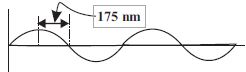
The following sketch represents a specific wave of light. What will be the color of the light represented by this wave?
A
Red
B
Blue
C
Black
D
Yellow
Solution
(A) From the given sketch,the distance shown represents one-fourth of the wavelength $(\lambda)$.
Therefore,the total wavelength is $\lambda = 4 \times 175 \, nm = 700 \, nm$.
The wavelength of $700 \, nm$ corresponds to the red color in the visible spectrum.
Therefore,the total wavelength is $\lambda = 4 \times 175 \, nm = 700 \, nm$.
The wavelength of $700 \, nm$ corresponds to the red color in the visible spectrum.
0 likes
View Solution69
MediumMCQ
Mercury street lights emit light of a pale blue color with a wavelength of $436 \, nm$. Calculate its frequency.
A
$6.88 \times 10^{10} \, Hz$
B
$6.88 \times 10^{14} \, Hz$
C
$9.55 \times 10^{17} \, Hz$
D
$4.65 \times 10^{15} \, Hz$
Solution
(B) Given: Wavelength $\lambda = 436 \, nm = 436 \times 10^{-9} \, m = 4.36 \times 10^{-7} \, m$.
Speed of light $c = 3 \times 10^8 \, m/s$.
The formula for frequency is $\nu = \frac{c}{\lambda}$.
Substituting the values: $\nu = \frac{3 \times 10^8 \, m/s}{4.36 \times 10^{-7} \, m} = 0.688 \times 10^{15} \, Hz = 6.88 \times 10^{14} \, Hz$.
Speed of light $c = 3 \times 10^8 \, m/s$.
The formula for frequency is $\nu = \frac{c}{\lambda}$.
Substituting the values: $\nu = \frac{3 \times 10^8 \, m/s}{4.36 \times 10^{-7} \, m} = 0.688 \times 10^{15} \, Hz = 6.88 \times 10^{14} \, Hz$.
0 likes
View Solution70
EasyMCQ
The kinetic energy of photoelectrons depends on ...............
A
Wavelength of light
B
Frequency of light
C
Intensity of light
D
All of the above
Solution
(B) According to Einstein's photoelectric equation,$h\nu = h\nu_0 + K.E._{max}$,where $K.E._{max} = \frac{1}{2}mv^2$.
Since $h\nu_0$ (work function) is constant for a given metal,the kinetic energy $(K.E._{max})$ depends directly on the frequency $(\nu)$ of the incident light.
As $\nu = \frac{c}{\lambda}$,it also depends on the wavelength $(\lambda)$.
Since $h\nu_0$ (work function) is constant for a given metal,the kinetic energy $(K.E._{max})$ depends directly on the frequency $(\nu)$ of the incident light.
As $\nu = \frac{c}{\lambda}$,it also depends on the wavelength $(\lambda)$.
0 likes
View Solution71
MediumMCQ
The frequency of radiation with a wavelength of $5800 \ \mathring{A}$ is ... $s^{-1}$.
A
$2.68 \times 10^{16}$
B
$3.15 \times 10^{15}$
C
$5.17 \times 10^{14}$
D
$5.17 \times 10^{16}$
Solution
(C) The relationship between frequency $\nu$,speed of light $c$,and wavelength $\lambda$ is given by $\nu = \frac{c}{\lambda}$.
Given $\lambda = 5800 \ \mathring{A} = 5800 \times 10^{-10} \ m = 5.8 \times 10^{-7} \ m$.
The speed of light $c = 3 \times 10^8 \ m/s$.
Substituting the values: $\nu = \frac{3 \times 10^8 \ m/s}{5.8 \times 10^{-7} \ m} \approx 5.17 \times 10^{14} \ s^{-1}$.
Given $\lambda = 5800 \ \mathring{A} = 5800 \times 10^{-10} \ m = 5.8 \times 10^{-7} \ m$.
The speed of light $c = 3 \times 10^8 \ m/s$.
Substituting the values: $\nu = \frac{3 \times 10^8 \ m/s}{5.8 \times 10^{-7} \ m} \approx 5.17 \times 10^{14} \ s^{-1}$.
1 likes
View Solution72
DifficultMCQ
The value of one Einstein for radiation of wavelength $9000 \ \mathring{A}$ is .............
A
$1.439 \times 10^{5}$
B
$2.139 \times 10^{-5}$
C
$1.329 \times 10^{5}$
D
$1.596 \times 10^{-5}$
Solution
(C) The energy of one Einstein is defined as the energy of one mole of photons.
$E = \frac{N_A \times h \times c}{\lambda}$
Given: $\lambda = 9000 \ \mathring{A} = 9000 \times 10^{-10} \ m = 9 \times 10^{-7} \ m$,$N_A = 6.022 \times 10^{23} \ mol^{-1}$,$h = 6.626 \times 10^{-34} \ J \cdot s$,$c = 3 \times 10^8 \ m/s$.
$E = \frac{6.022 \times 10^{23} \times 6.626 \times 10^{-34} \times 3 \times 10^8}{9 \times 10^{-7}}$
$E = \frac{11.97 \times 10^{-3}}{9 \times 10^{-7}} \approx 1.33 \times 10^5 \ J \ mol^{-1}$.
$E = \frac{N_A \times h \times c}{\lambda}$
Given: $\lambda = 9000 \ \mathring{A} = 9000 \times 10^{-10} \ m = 9 \times 10^{-7} \ m$,$N_A = 6.022 \times 10^{23} \ mol^{-1}$,$h = 6.626 \times 10^{-34} \ J \cdot s$,$c = 3 \times 10^8 \ m/s$.
$E = \frac{6.022 \times 10^{23} \times 6.626 \times 10^{-34} \times 3 \times 10^8}{9 \times 10^{-7}}$
$E = \frac{11.97 \times 10^{-3}}{9 \times 10^{-7}} \approx 1.33 \times 10^5 \ J \ mol^{-1}$.
0 likes
View Solution73
EasyMCQ
Which of the following radiations has the highest energy?
A
$\lambda = 300 \, pm$
B
$\lambda = 30 \, nm$
C
$\nu = 3 \times 10^{12} \, s^{-1}$
D
$\nu = 3 \times 10^{10} \, s^{-1}$
Solution
(A) The energy of radiation is given by $E = h\nu = \frac{hc}{\lambda}$.
For option $A$: $\lambda = 300 \, pm = 3 \times 10^{-10} \, m$. Thus,$E_A = \frac{hc}{3 \times 10^{-10}} = h \times (3 \times 10^8) / (3 \times 10^{-10}) = h \times 10^{18} \, J$.
For option $B$: $\lambda = 30 \, nm = 3 \times 10^{-8} \, m$. Thus,$E_B = \frac{hc}{3 \times 10^{-8}} = h \times (3 \times 10^8) / (3 \times 10^{-8}) = h \times 10^{16} \, J$.
For option $C$: $\nu = 3 \times 10^{12} \, s^{-1}$. Thus,$E_C = h \times 3 \times 10^{12} \, J$.
For option $D$: $\nu = 3 \times 10^{10} \, s^{-1}$. Thus,$E_D = h \times 3 \times 10^{10} \, J$.
Comparing the values,$E_A = h \times 10^{18}$ is the highest energy.
For option $A$: $\lambda = 300 \, pm = 3 \times 10^{-10} \, m$. Thus,$E_A = \frac{hc}{3 \times 10^{-10}} = h \times (3 \times 10^8) / (3 \times 10^{-10}) = h \times 10^{18} \, J$.
For option $B$: $\lambda = 30 \, nm = 3 \times 10^{-8} \, m$. Thus,$E_B = \frac{hc}{3 \times 10^{-8}} = h \times (3 \times 10^8) / (3 \times 10^{-8}) = h \times 10^{16} \, J$.
For option $C$: $\nu = 3 \times 10^{12} \, s^{-1}$. Thus,$E_C = h \times 3 \times 10^{12} \, J$.
For option $D$: $\nu = 3 \times 10^{10} \, s^{-1}$. Thus,$E_D = h \times 3 \times 10^{10} \, J$.
Comparing the values,$E_A = h \times 10^{18}$ is the highest energy.
0 likes
View Solution74
EasyMCQ
Linear spectrum (line spectrum) is a characteristic of which of the following?
A
Molecules
B
Atoms
C
Elements
D
None of these
Solution
(B) line spectrum is a spectrum that contains radiation of only specific wavelengths. It is produced by excited atoms in the gaseous state. When atoms are excited,they emit light of specific frequencies,which appear as distinct lines in the spectrum. Therefore,a line spectrum is a characteristic of $Atoms$.
0 likes
View Solution75
EasyMCQ
The ....... series is observed in the visible region of the hydrogen spectrum.
A
Paschen
B
Pfund
C
Balmer
D
Brackett
Solution
(C) The hydrogen spectrum consists of various series of spectral lines.
The Lyman series lies in the ultraviolet region.
The Balmer series lies in the visible region.
The Paschen,Brackett,and Pfund series lie in the infrared region.
Therefore,the correct answer is the Balmer series.
The Lyman series lies in the ultraviolet region.
The Balmer series lies in the visible region.
The Paschen,Brackett,and Pfund series lie in the infrared region.
Therefore,the correct answer is the Balmer series.
0 likes
View Solution76
EasyMCQ
The splitting of spectral lines under the influence of a magnetic field is known as .....
A
Photoelectric effect
B
Zeeman effect
C
Compton effect
D
Stark effect
Solution
(B) The splitting of spectral lines in the presence of an external magnetic field is called the $Zeeman \ effect$.
In contrast,the splitting of spectral lines in the presence of an external electric field is known as the $Stark \ effect$.
In contrast,the splitting of spectral lines in the presence of an external electric field is known as the $Stark \ effect$.
0 likes
View Solution77
MediumMCQ
$750$ waves of an energy radiation pass in one minute from a point. What will be the wavelength of the radiation? (Assume the speed of radiation is $3 \times 10^8 \ m/s$)
A
$4 \times 10^5 \ m$
B
$2.4 \times 10^7 \ m$
C
$4.16 \times 10^{-8} \ m$
D
$2.4 \times 10^9 \ m$
Solution
(B) $1$. Frequency $(\nu)$ is the number of waves passing a point per second.
Given: $750$ waves in $1$ minute ($60$ seconds).
$\nu = \frac{750}{60} = 12.5 \ Hz$.
$2$. The relationship between speed of light $(c)$,frequency $(\nu)$,and wavelength $(\lambda)$ is $c = \nu \times \lambda$.
$3$. Using $c = 3 \times 10^8 \ m/s$:
$\lambda = \frac{c}{\nu} = \frac{3 \times 10^8}{12.5} = 0.24 \times 10^8 \ m = 2.4 \times 10^7 \ m$.
Therefore,the correct option is $B$.
Given: $750$ waves in $1$ minute ($60$ seconds).
$\nu = \frac{750}{60} = 12.5 \ Hz$.
$2$. The relationship between speed of light $(c)$,frequency $(\nu)$,and wavelength $(\lambda)$ is $c = \nu \times \lambda$.
$3$. Using $c = 3 \times 10^8 \ m/s$:
$\lambda = \frac{c}{\nu} = \frac{3 \times 10^8}{12.5} = 0.24 \times 10^8 \ m = 2.4 \times 10^7 \ m$.
Therefore,the correct option is $B$.
0 likes
View Solution78
EasyMCQ
The ratio of the energy of a photon with wavelength $3000 \ \mathring{A}$ to that of a photon with wavelength $6000 \ \mathring{A}$ is:
A
$3 : 1$
B
$2 : 1$
C
$1 : 2$
D
$1 : 3$
Solution
(B) The energy of a photon is given by the formula $E = \frac{hc}{\lambda}$.
Since $h$ and $c$ are constants,the energy $E$ is inversely proportional to the wavelength $\lambda$,i.e.,$E \propto \frac{1}{\lambda}$.
Therefore,the ratio of energies is $\frac{E_1}{E_2} = \frac{\lambda_2}{\lambda_1}$.
Given $\lambda_1 = 3000 \ \mathring{A}$ and $\lambda_2 = 6000 \ \mathring{A}$.
Substituting the values,we get $\frac{E_1}{E_2} = \frac{6000}{3000} = \frac{2}{1}$.
Thus,the ratio is $2 : 1$.
Since $h$ and $c$ are constants,the energy $E$ is inversely proportional to the wavelength $\lambda$,i.e.,$E \propto \frac{1}{\lambda}$.
Therefore,the ratio of energies is $\frac{E_1}{E_2} = \frac{\lambda_2}{\lambda_1}$.
Given $\lambda_1 = 3000 \ \mathring{A}$ and $\lambda_2 = 6000 \ \mathring{A}$.
Substituting the values,we get $\frac{E_1}{E_2} = \frac{6000}{3000} = \frac{2}{1}$.
Thus,the ratio is $2 : 1$.
0 likes
View Solution79
MediumMCQ
Assertion : All photons possess the same amount of energy.
Reason : Energy of photon does not depend upon wavelength of light used.
Reason : Energy of photon does not depend upon wavelength of light used.
A
If both Assertion and Reason are correct and the Reason is a correct explanation of the Assertion.
B
If both Assertion and Reason are correct but Reason is not a correct explanation of the Assertion.
C
If the Assertion is correct but Reason is incorrect.
D
If both the Assertion and Reason are incorrect.
Solution
(D) The energy of a photon is given by the formula $E = h\nu = \frac{hc}{\lambda}$.
From this relation,it is clear that the energy of a photon is inversely proportional to its wavelength $(\lambda)$.
Therefore,photons of different wavelengths possess different amounts of energy.
Since both the Assertion and the Reason are false,the correct option is $D$.
From this relation,it is clear that the energy of a photon is inversely proportional to its wavelength $(\lambda)$.
Therefore,photons of different wavelengths possess different amounts of energy.
Since both the Assertion and the Reason are false,the correct option is $D$.
0 likes
View Solution80
MediumMCQ
Assertion : Absorption spectrum consists of some bright lines separated by dark spaces.
Reason : Emission spectrum consists of dark lines.
Reason : Emission spectrum consists of dark lines.
A
If both Assertion and Reason are correct and the Reason is a correct explanation of the Assertion.
B
If both Assertion and Reason are correct but Reason is not a correct explanation of the Assertion.
C
If the Assertion is correct but Reason is incorrect.
D
If both the Assertion and Reason are incorrect.
Solution
(D) The Assertion is incorrect because an absorption spectrum consists of dark lines separated by bright spaces,which occur when specific wavelengths are absorbed by a substance.
The Reason is also incorrect because an emission spectrum consists of bright lines on a dark background,representing the light emitted by excited atoms or molecules.
Therefore,both the Assertion and the Reason are incorrect.
The Reason is also incorrect because an emission spectrum consists of bright lines on a dark background,representing the light emitted by excited atoms or molecules.
Therefore,both the Assertion and the Reason are incorrect.
0 likes
View Solution81
MediumMCQ
The Vividh Bharati station of All India Radio,Delhi,broadcasts on a frequency of $1368 \, kHz$ (kilo hertz). Calculate the wavelength of the electromagnetic radiation emitted by the transmitter. Which part of the electromagnetic spectrum does it belong to?
A
$219.3 \, m$,Radio waves
B
$219.3 \, m$,Microwaves
C
$2.193 \, m$,Radio waves
D
$219.3 \, km$,Radio waves
Solution
(A) The wavelength,$\lambda$,is calculated using the formula $\lambda = c / \nu$,where $c$ is the speed of light $(3.00 \times 10^{8} \, m \, s^{-1})$ and $\nu$ is the frequency.
Given frequency $\nu = 1368 \, kHz = 1368 \times 10^{3} \, s^{-1}$.
Substituting the values:
$\lambda = \frac{3.00 \times 10^{8} \, m \, s^{-1}}{1368 \times 10^{3} \, s^{-1}}$
$\lambda = 219.3 \, m$
Since the wavelength is in the range of meters,this radiation belongs to the radio wave region of the electromagnetic spectrum.
Given frequency $\nu = 1368 \, kHz = 1368 \times 10^{3} \, s^{-1}$.
Substituting the values:
$\lambda = \frac{3.00 \times 10^{8} \, m \, s^{-1}}{1368 \times 10^{3} \, s^{-1}}$
$\lambda = 219.3 \, m$
Since the wavelength is in the range of meters,this radiation belongs to the radio wave region of the electromagnetic spectrum.
1 likes
View Solution82
Medium
The wavelength range of the visible spectrum extends from violet $(400 \, nm)$ to red $(750 \, nm).$ Express these wavelengths in frequencies $(Hz).$ $(1 \, nm = 10^{-9} \, m)$
Solution
Using the equation $v = \frac{c}{\lambda}$,where $c = 3.00 \times 10^{8} \, m \, s^{-1}$ is the speed of light.
For violet light $(\lambda = 400 \, nm = 400 \times 10^{-9} \, m)$:
$v = \frac{3.00 \times 10^{8} \, m \, s^{-1}}{400 \times 10^{-9} \, m} = 7.50 \times 10^{14} \, Hz$
For red light $(\lambda = 750 \, nm = 750 \times 10^{-9} \, m)$:
$v = \frac{3.00 \times 10^{8} \, m \, s^{-1}}{750 \times 10^{-9} \, m} = 4.00 \times 10^{14} \, Hz$
Thus,the range of the visible spectrum in terms of frequency is from $4.00 \times 10^{14} \, Hz$ to $7.50 \times 10^{14} \, Hz$.
For violet light $(\lambda = 400 \, nm = 400 \times 10^{-9} \, m)$:
$v = \frac{3.00 \times 10^{8} \, m \, s^{-1}}{400 \times 10^{-9} \, m} = 7.50 \times 10^{14} \, Hz$
For red light $(\lambda = 750 \, nm = 750 \times 10^{-9} \, m)$:
$v = \frac{3.00 \times 10^{8} \, m \, s^{-1}}{750 \times 10^{-9} \, m} = 4.00 \times 10^{14} \, Hz$
Thus,the range of the visible spectrum in terms of frequency is from $4.00 \times 10^{14} \, Hz$ to $7.50 \times 10^{14} \, Hz$.
0 likes
View Solution83
Medium
Calculate $(a)$ wavenumber and $(b)$ frequency of yellow radiation having wavelength $5800 \, \mathring{A}$.
Solution
$(a)$ Calculation of wavenumber $(\bar{\nu})$:
$\lambda = 5800 \, \mathring{A} = 5800 \times 10^{-10} \, m = 5.8 \times 10^{-7} \, m$.
$\bar{\nu} = \frac{1}{\lambda} = \frac{1}{5.8 \times 10^{-7} \, m} \approx 1.724 \times 10^{6} \, m^{-1} = 1.724 \times 10^{4} \, cm^{-1}$.
$(b)$ Calculation of frequency $(\nu)$:
$\nu = \frac{c}{\lambda} = \frac{3 \times 10^{8} \, m \, s^{-1}}{5.8 \times 10^{-7} \, m} \approx 5.172 \times 10^{14} \, s^{-1}$.
$\lambda = 5800 \, \mathring{A} = 5800 \times 10^{-10} \, m = 5.8 \times 10^{-7} \, m$.
$\bar{\nu} = \frac{1}{\lambda} = \frac{1}{5.8 \times 10^{-7} \, m} \approx 1.724 \times 10^{6} \, m^{-1} = 1.724 \times 10^{4} \, cm^{-1}$.
$(b)$ Calculation of frequency $(\nu)$:
$\nu = \frac{c}{\lambda} = \frac{3 \times 10^{8} \, m \, s^{-1}}{5.8 \times 10^{-7} \, m} \approx 5.172 \times 10^{14} \, s^{-1}$.
0 likes
View Solution84
Medium
Calculate the energy of one mole of photons of radiation whose frequency is $5 \times 10^{14} \ Hz$.
Solution
The energy $(E)$ of one photon is given by the expression: $E = h \nu$.
Given:
$h = 6.626 \times 10^{-34} \ J \ s$
$\nu = 5 \times 10^{14} \ s^{-1}$
Energy of one photon:
$E = (6.626 \times 10^{-34} \ J \ s) \times (5 \times 10^{14} \ s^{-1}) = 3.313 \times 10^{-19} \ J$.
Energy of one mole of photons:
$E_{mole} = (3.313 \times 10^{-19} \ J) \times (6.022 \times 10^{23} \ mol^{-1}) = 199508.26 \ J \ mol^{-1} \approx 199.51 \ kJ \ mol^{-1}$.
Given:
$h = 6.626 \times 10^{-34} \ J \ s$
$\nu = 5 \times 10^{14} \ s^{-1}$
Energy of one photon:
$E = (6.626 \times 10^{-34} \ J \ s) \times (5 \times 10^{14} \ s^{-1}) = 3.313 \times 10^{-19} \ J$.
Energy of one mole of photons:
$E_{mole} = (3.313 \times 10^{-19} \ J) \times (6.022 \times 10^{23} \ mol^{-1}) = 199508.26 \ J \ mol^{-1} \approx 199.51 \ kJ \ mol^{-1}$.
0 likes
View Solution85
Medium
Yellow light emitted from a sodium lamp has a wavelength $(\lambda)$ of $580 \,nm$. Calculate the frequency $(v)$ and wave number $(\bar{v})$ of the yellow light.
Solution
(N/A) Given:
$\lambda = 580 \,nm = 580 \times 10^{-9} \,m$
$c = 3 \times 10^{8} \,m/s$
$1$. Frequency $(v)$:
Using the relation $v = \frac{c}{\lambda}$,
$v = \frac{3 \times 10^{8} \,m/s}{580 \times 10^{-9} \,m} = 5.17 \times 10^{14} \,s^{-1}$
$2$. Wave number $(\bar{v})$:
Using the relation $\bar{v} = \frac{1}{\lambda}$,
$\bar{v} = \frac{1}{580 \times 10^{-9} \,m} = 1.72 \times 10^{6} \,m^{-1}$
Thus,the frequency is $5.17 \times 10^{14} \,s^{-1}$ and the wave number is $1.72 \times 10^{6} \,m^{-1}$.
$\lambda = 580 \,nm = 580 \times 10^{-9} \,m$
$c = 3 \times 10^{8} \,m/s$
$1$. Frequency $(v)$:
Using the relation $v = \frac{c}{\lambda}$,
$v = \frac{3 \times 10^{8} \,m/s}{580 \times 10^{-9} \,m} = 5.17 \times 10^{14} \,s^{-1}$
$2$. Wave number $(\bar{v})$:
Using the relation $\bar{v} = \frac{1}{\lambda}$,
$\bar{v} = \frac{1}{580 \times 10^{-9} \,m} = 1.72 \times 10^{6} \,m^{-1}$
Thus,the frequency is $5.17 \times 10^{14} \,s^{-1}$ and the wave number is $1.72 \times 10^{6} \,m^{-1}$.
0 likes
View Solution86
Medium
Calculate the wavelength,frequency and wave number of a light wave whose period is $2.0 \times 10^{-10} \,s$.
Solution
Frequency $(\nu)$ of light $= \frac{1}{\text{Period}}$
$= \frac{1}{2.0 \times 10^{-10} \,s} = 5.0 \times 10^{9} \,Hz$
Wavelength $(\lambda)$ of light $= \frac{c}{\nu}$
Where $c$ (velocity of light in vacuum) $= 3 \times 10^{8} \,m/s$
$\lambda = \frac{3 \times 10^{8} \,m/s}{5.0 \times 10^{9} \,s^{-1}} = 0.06 \,m = 6.0 \times 10^{-2} \,m$
Wave number $(\bar{\nu}) = \frac{1}{\lambda} = \frac{1}{6.0 \times 10^{-2} \,m} = 16.66 \,m^{-1}$
$= \frac{1}{2.0 \times 10^{-10} \,s} = 5.0 \times 10^{9} \,Hz$
Wavelength $(\lambda)$ of light $= \frac{c}{\nu}$
Where $c$ (velocity of light in vacuum) $= 3 \times 10^{8} \,m/s$
$\lambda = \frac{3 \times 10^{8} \,m/s}{5.0 \times 10^{9} \,s^{-1}} = 0.06 \,m = 6.0 \times 10^{-2} \,m$
Wave number $(\bar{\nu}) = \frac{1}{\lambda} = \frac{1}{6.0 \times 10^{-2} \,m} = 16.66 \,m^{-1}$
0 likes
View Solution87
Medium
Electromagnetic radiation of wavelength $242 \, nm$ is just sufficient to ionise the sodium atom. Calculate the ionisation energy of sodium in $kJ \, mol^{-1}$.
Solution
(N/A) The energy required to ionise one mole of sodium atoms is given by the formula $E = \frac{N_A h c}{\lambda}$.
Substituting the values:
$N_A = 6.022 \times 10^{23} \, mol^{-1}$
$h = 6.626 \times 10^{-34} \, J \cdot s$
$c = 3 \times 10^8 \, m \cdot s^{-1}$
$\lambda = 242 \times 10^{-9} \, m$
$E = \frac{(6.022 \times 10^{23} \, mol^{-1}) \times (6.626 \times 10^{-34} \, J \cdot s) \times (3 \times 10^8 \, m \cdot s^{-1})}{242 \times 10^{-9} \, m}$
$E \approx 494700 \, J \cdot mol^{-1}$
Converting to $kJ \cdot mol^{-1}$:
$E = 494.7 \, kJ \cdot mol^{-1}$
Substituting the values:
$N_A = 6.022 \times 10^{23} \, mol^{-1}$
$h = 6.626 \times 10^{-34} \, J \cdot s$
$c = 3 \times 10^8 \, m \cdot s^{-1}$
$\lambda = 242 \times 10^{-9} \, m$
$E = \frac{(6.022 \times 10^{23} \, mol^{-1}) \times (6.626 \times 10^{-34} \, J \cdot s) \times (3 \times 10^8 \, m \cdot s^{-1})}{242 \times 10^{-9} \, m}$
$E \approx 494700 \, J \cdot mol^{-1}$
Converting to $kJ \cdot mol^{-1}$:
$E = 494.7 \, kJ \cdot mol^{-1}$
0 likes
View Solution88
Medium
Electrons are emitted with zero velocity from a metal surface when it is exposed to radiation of wavelength $6800 \, \mathring{A}$. Calculate threshold frequency $(v_{0})$ and work function $(W_{0})$ of the metal.
Solution
(N/A) Threshold wavelength of radiation $(\lambda_{0}) = 6800 \, \mathring{A} = 6800 \times 10^{-10} \, m$.
Threshold frequency $(v_{0})$ is given by the formula $v_{0} = \frac{c}{\lambda_{0}}$.
Substituting the values: $v_{0} = \frac{3 \times 10^{8} \, m s^{-1}}{6.8 \times 10^{-7} \, m} = 4.41 \times 10^{14} \, s^{-1}$.
Thus,the threshold frequency $(v_{0})$ of the metal is $4.41 \times 10^{14} \, s^{-1}$.
Work function $(W_{0})$ is given by $W_{0} = h v_{0}$.
Substituting the values: $W_{0} = (6.626 \times 10^{-34} \, J s)(4.41 \times 10^{14} \, s^{-1}) = 2.922 \times 10^{-19} \, J$.
Threshold frequency $(v_{0})$ is given by the formula $v_{0} = \frac{c}{\lambda_{0}}$.
Substituting the values: $v_{0} = \frac{3 \times 10^{8} \, m s^{-1}}{6.8 \times 10^{-7} \, m} = 4.41 \times 10^{14} \, s^{-1}$.
Thus,the threshold frequency $(v_{0})$ of the metal is $4.41 \times 10^{14} \, s^{-1}$.
Work function $(W_{0})$ is given by $W_{0} = h v_{0}$.
Substituting the values: $W_{0} = (6.626 \times 10^{-34} \, J s)(4.41 \times 10^{14} \, s^{-1}) = 2.922 \times 10^{-19} \, J$.
0 likes
View Solution89
MediumMCQ
Arrange the following types of radiations in increasing order of frequency: $(a)$ radiation from microwave oven,$(b)$ amber light from traffic signal,$(c)$ radiation from $FM$ radio,$(d)$ cosmic rays from outer space,and $(e)$ $X$-rays.
A
$(c) < (a) < (b) < (e) < (d)$
B
$(d) < (e) < (b) < (a) < (c)$
C
$(c) < (b) < (a) < (e) < (d)$
D
$(d) < (b) < (a) < (e) < (c)$
Solution
(A) The electromagnetic spectrum follows the order of increasing frequency as: $FM$ radio waves $ < $ microwave radiation $<$ visible light (amber light) $ < $ $X$-rays $ < $ cosmic rays.
Therefore,the increasing order of frequency is: $(c) < (a) < (b) < (e) < (d)$.
Therefore,the increasing order of frequency is: $(c) < (a) < (b) < (e) < (d)$.
0 likes
View Solution90
Medium
Nitrogen laser produces a radiation at a wavelength of $337.1 \ nm$. If the number of photons emitted is $5.6 \times 10^{24}$,calculate the power of this laser.
Solution
The power of the laser is defined as the total energy emitted per unit time. Assuming the emission occurs over $1 \ s$ for the given number of photons:
Power $(P) = \frac{E}{t} = \frac{N h c}{\lambda \times t}$
Where:
$N = 5.6 \times 10^{24}$ (number of photons)
$h = 6.626 \times 10^{-34} \ J \ s$ (Planck's constant)
$c = 3 \times 10^{8} \ m \ s^{-1}$ (speed of light)
$\lambda = 337.1 \times 10^{-9} \ m$ (wavelength)
$t = 1 \ s$
Substituting the values:
$P = \frac{(5.6 \times 10^{24}) \times (6.626 \times 10^{-34}) \times (3 \times 10^{8})}{337.1 \times 10^{-9}}$
$P = \frac{11.13168 \times 10^{-1}}{337.1 \times 10^{-9}}$
$P \approx 3.302 \times 10^{6} \ W$
Power $(P) = \frac{E}{t} = \frac{N h c}{\lambda \times t}$
Where:
$N = 5.6 \times 10^{24}$ (number of photons)
$h = 6.626 \times 10^{-34} \ J \ s$ (Planck's constant)
$c = 3 \times 10^{8} \ m \ s^{-1}$ (speed of light)
$\lambda = 337.1 \times 10^{-9} \ m$ (wavelength)
$t = 1 \ s$
Substituting the values:
$P = \frac{(5.6 \times 10^{24}) \times (6.626 \times 10^{-34}) \times (3 \times 10^{8})}{337.1 \times 10^{-9}}$
$P = \frac{11.13168 \times 10^{-1}}{337.1 \times 10^{-9}}$
$P \approx 3.302 \times 10^{6} \ W$
0 likes
View Solution91
Medium
The ejection of the photoelectron from the silver metal in the photoelectric effect experiment can be stopped by applying a stopping potential of $0.35 \ V$ when radiation of $256.7 \ nm$ is used. Calculate the work function for silver metal.
Solution
(N/A) According to the photoelectric effect equation:
$E = W_{0} + K.E_{max}$
where $E$ is the energy of the incident photon,$W_{0}$ is the work function,and $K.E_{max}$ is the maximum kinetic energy of the emitted photoelectron.
The energy of the incident photon is given by $E = \frac{hc}{\lambda}$.
Using $h = 6.626 \times 10^{-34} \ J \ s$,$c = 3.0 \times 10^{8} \ m \ s^{-1}$,and $\lambda = 256.7 \times 10^{-9} \ m$:
$E = \frac{6.626 \times 10^{-34} \times 3.0 \times 10^{8}}{256.7 \times 10^{-9}} \ J = 7.744 \times 10^{-19} \ J$.
Converting to electron-volts $(eV)$:
$E = \frac{7.744 \times 10^{-19} \ J}{1.602 \times 10^{-19} \ J/eV} \approx 4.83 \ eV$.
The stopping potential is $0.35 \ V$,so the maximum kinetic energy is $K.E_{max} = 0.35 \ eV$.
Substituting these values into the equation:
$W_{0} = E - K.E_{max} = 4.83 \ eV - 0.35 \ eV = 4.48 \ eV$.
The work function for silver metal is $4.48 \ eV$.
$E = W_{0} + K.E_{max}$
where $E$ is the energy of the incident photon,$W_{0}$ is the work function,and $K.E_{max}$ is the maximum kinetic energy of the emitted photoelectron.
The energy of the incident photon is given by $E = \frac{hc}{\lambda}$.
Using $h = 6.626 \times 10^{-34} \ J \ s$,$c = 3.0 \times 10^{8} \ m \ s^{-1}$,and $\lambda = 256.7 \times 10^{-9} \ m$:
$E = \frac{6.626 \times 10^{-34} \times 3.0 \times 10^{8}}{256.7 \times 10^{-9}} \ J = 7.744 \times 10^{-19} \ J$.
Converting to electron-volts $(eV)$:
$E = \frac{7.744 \times 10^{-19} \ J}{1.602 \times 10^{-19} \ J/eV} \approx 4.83 \ eV$.
The stopping potential is $0.35 \ V$,so the maximum kinetic energy is $K.E_{max} = 0.35 \ eV$.
Substituting these values into the equation:
$W_{0} = E - K.E_{max} = 4.83 \ eV - 0.35 \ eV = 4.48 \ eV$.
The work function for silver metal is $4.48 \ eV$.
0 likes
View Solution92
Difficult
Explain the production,characteristics,and uses of $X$-rays.
Solution
(N/A) Wilhelm Roentgen in $1895$ showed that when high-speed electrons strike a dense metal target in a cathode ray tube,they produce rays that cause fluorescence in materials placed outside the tube. He named them $X$-rays.
Production: $X$-rays are produced when fast-moving electrons are suddenly decelerated upon striking a dense metal anode (target).
Characteristics: $(i)$ $X$-rays are not deflected by electric or magnetic fields,indicating they are neutral.
$(ii)$ They possess very high penetrating power through matter.
$(iii)$ They have very short wavelengths,typically in the range of $\sim 0.1 \ nm$.
$(iv)$ They exhibit electromagnetic wave character.
Uses: Due to their high penetrating power,$X$-rays are extensively used in medical imaging to study the interior of the human body and in industrial applications to detect structural defects in objects.
Production: $X$-rays are produced when fast-moving electrons are suddenly decelerated upon striking a dense metal anode (target).
Characteristics: $(i)$ $X$-rays are not deflected by electric or magnetic fields,indicating they are neutral.
$(ii)$ They possess very high penetrating power through matter.
$(iii)$ They have very short wavelengths,typically in the range of $\sim 0.1 \ nm$.
$(iv)$ They exhibit electromagnetic wave character.
Uses: Due to their high penetrating power,$X$-rays are extensively used in medical imaging to study the interior of the human body and in industrial applications to detect structural defects in objects.
0 likes
View Solution93
MediumMCQ
According to the electromagnetic theory of Maxwell,what happens when charged particles are accelerated?
A
They emit energy in the form of electromagnetic radiation.
B
They absorb energy from the surroundings.
C
They remain stationary.
D
They move with constant velocity.
Solution
(A) According to Maxwell's electromagnetic theory,when an electrically charged particle moves under acceleration,it produces alternating electrical and magnetic fields.
These fields are transmitted in the form of waves,which are known as electromagnetic waves or electromagnetic radiation.
These fields are transmitted in the form of waves,which are known as electromagnetic waves or electromagnetic radiation.
0 likes
View Solution94
Medium
What is electromagnetic radiation? How is it produced?
Solution
(N/A) James Maxwell was the first to provide a comprehensive explanation regarding the interaction between charged bodies and the behavior of electrical and magnetic fields.
- When an electrically charged particle moves under acceleration,alternating electrical and magnetic fields are produced and transmitted.
- These fields are transmitted in the form of waves,which are known as electromagnetic waves or electromagnetic radiation.
- When an electrically charged particle moves under acceleration,alternating electrical and magnetic fields are produced and transmitted.
- These fields are transmitted in the form of waves,which are known as electromagnetic waves or electromagnetic radiation.
0 likes
View Solution95
EasyMCQ
What is light?
A
$A$ particle
B
$A$ wave
C
Electromagnetic radiation
D
None of the above
Solution
(C) In earlier days,Newton proposed that light was made of particles.
In the $19^{th}$ century,it was established that light is a form of electromagnetic radiation.
Maxwell was the first to reveal that light waves are associated with oscillating electric and magnetic fields.
In the $19^{th}$ century,it was established that light is a form of electromagnetic radiation.
Maxwell was the first to reveal that light waves are associated with oscillating electric and magnetic fields.
0 likes
View Solution96
Difficult
Explain the properties of electromagnetic waves.
Solution
(N/A) Electromagnetic wave motion is complex in nature. Its key properties are as follows:
$(i)$ The oscillating electric and magnetic fields produced by oscillating charged particles are perpendicular to each other and both are perpendicular to the direction of propagation of the wave.
$(ii)$ Unlike sound waves or water waves,electromagnetic waves do not require a medium and can travel through a vacuum.
$(iii)$ There are many types of electromagnetic radiations,which differ from one another in wavelength $(\lambda)$ or frequency $(\nu)$. These constitute what is called the electromagnetic spectrum:
Radio frequency: $10^{6} \ Hz$ (broadcasting)
Microwave region: $10^{10} \ Hz$ (radar)
Infrared region: $10^{13} \ Hz$ (heating)
Visible light: $10^{15} \ Hz$ (component of sun's radiation)
Ultraviolet region: $10^{16} \ Hz$ (component of sun's radiation)
$(iv)$ These radiations are characterized by properties such as frequency $(\nu)$,wavelength $(\lambda)$,and wavenumber $(\bar{\nu})$.
$(i)$ The oscillating electric and magnetic fields produced by oscillating charged particles are perpendicular to each other and both are perpendicular to the direction of propagation of the wave.
$(ii)$ Unlike sound waves or water waves,electromagnetic waves do not require a medium and can travel through a vacuum.
$(iii)$ There are many types of electromagnetic radiations,which differ from one another in wavelength $(\lambda)$ or frequency $(\nu)$. These constitute what is called the electromagnetic spectrum:
Radio frequency: $10^{6} \ Hz$ (broadcasting)
Microwave region: $10^{10} \ Hz$ (radar)
Infrared region: $10^{13} \ Hz$ (heating)
Visible light: $10^{15} \ Hz$ (component of sun's radiation)
Ultraviolet region: $10^{16} \ Hz$ (component of sun's radiation)
$(iv)$ These radiations are characterized by properties such as frequency $(\nu)$,wavelength $(\lambda)$,and wavenumber $(\bar{\nu})$.
0 likes
View Solution97
Difficult
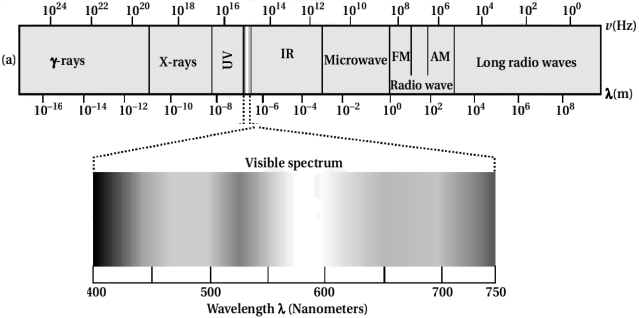
Describe the electromagnetic spectrum.
Solution
There are many types of electromagnetic radiations,which differ from one another in wavelength (or frequency). These constitute what is called the electromagnetic spectrum. The electromagnetic spectrum is shown in the figure below:
0 likes
View Solution98
Difficult
Give the characteristics of electromagnetic radiation. Give the relation between them.
Solution
(N/A) The electromagnetic radiations are characterized by frequency $(\nu)$,wavelength $(\lambda)$,and wave number $(\bar{\nu})$.
$1$. Frequency $(\nu)$: It is defined as the number of waves that pass a given point in one second. The $SI$ unit for frequency is hertz ($Hz$ or $s^{-1}$).
$2$. Wavelength $(\lambda)$: It is the distance between two successive crests or troughs of a wave. Its $SI$ unit is meter $(m)$,though smaller units like $\mathring{A}$,$nm$,or $cm$ are commonly used.
$3$. Wave number $(\bar{\nu})$: It is defined as the number of wavelengths per unit length. Its $SI$ unit is $m^{-1}$,and the commonly used unit is $cm^{-1}$.
In vacuum,all electromagnetic radiations travel at the same speed,known as the speed of light $(c)$,where $c = 3.0 \times 10^{8} \ m \ s^{-1}$.
The relationship between frequency $(\nu)$,wavelength $(\lambda)$,and the speed of light $(c)$ is given by the equation: $c = \nu \lambda$ or $\nu = \frac{c}{\lambda}$.
Additionally,the wave number is related to wavelength as: $\bar{\nu} = \frac{1}{\lambda}$.
$1$. Frequency $(\nu)$: It is defined as the number of waves that pass a given point in one second. The $SI$ unit for frequency is hertz ($Hz$ or $s^{-1}$).
$2$. Wavelength $(\lambda)$: It is the distance between two successive crests or troughs of a wave. Its $SI$ unit is meter $(m)$,though smaller units like $\mathring{A}$,$nm$,or $cm$ are commonly used.
$3$. Wave number $(\bar{\nu})$: It is defined as the number of wavelengths per unit length. Its $SI$ unit is $m^{-1}$,and the commonly used unit is $cm^{-1}$.
In vacuum,all electromagnetic radiations travel at the same speed,known as the speed of light $(c)$,where $c = 3.0 \times 10^{8} \ m \ s^{-1}$.
The relationship between frequency $(\nu)$,wavelength $(\lambda)$,and the speed of light $(c)$ is given by the equation: $c = \nu \lambda$ or $\nu = \frac{c}{\lambda}$.
Additionally,the wave number is related to wavelength as: $\bar{\nu} = \frac{1}{\lambda}$.
0 likes
View Solution99
Medium
Arrange the following types of radiation in increasing order of frequency:
$(a)$ radiation from microwave oven
$(b)$ amber light from traffic signal
$(c)$ radiation from $FM$ radio
$(d)$ cosmic rays from outer space
$(e)$ $X$-rays
$(a)$ radiation from microwave oven
$(b)$ amber light from traffic signal
$(c)$ radiation from $FM$ radio
$(d)$ cosmic rays from outer space
$(e)$ $X$-rays
Solution
(C-A-B-E-D) The electromagnetic spectrum in increasing order of frequency is: $FM$ radio waves < microwave radiation < visible light (amber) < $X$-rays < cosmic rays.
The order is: $(c) < (a) < (b) < (e) < (d)$.
The order is: $(c) < (a) < (b) < (e) < (d)$.
| Radiation Type | Frequency Range $(Hz)$ |
| $(c)$ $FM$ radio | $\sim 10^{6}$ |
| $(a)$ Microwave | $\sim 10^{10}$ |
| $(b)$ Amber light | $\sim 10^{14}$ |
| $(e)$ $X$-rays | $10^{17} - 10^{19}$ |
| $(d)$ Cosmic rays | $> 10^{20}$ |
0 likes
View Solution100
Easy
Calculate the frequency and wave number of a photon with a wavelength of $3.6 \ \mathring{A}$.
Solution
Given: Wavelength $(\lambda)$ = $3.6 \ \mathring{A} = 3.6 \times 10^{-10} \ m$.
Speed of light $(c)$ = $3 \times 10^{8} \ m/s$.
Frequency $(v)$ = $c / \lambda = (3 \times 10^{8} \ m/s) / (3.6 \times 10^{-10} \ m) = 8.333 \times 10^{17} \ s^{-1}$.
Wave number $(\bar{v})$ = $1 / \lambda = 1 / (3.6 \times 10^{-10} \ m) = 2.778 \times 10^{9} \ m^{-1}$.
Speed of light $(c)$ = $3 \times 10^{8} \ m/s$.
Frequency $(v)$ = $c / \lambda = (3 \times 10^{8} \ m/s) / (3.6 \times 10^{-10} \ m) = 8.333 \times 10^{17} \ s^{-1}$.
Wave number $(\bar{v})$ = $1 / \lambda = 1 / (3.6 \times 10^{-10} \ m) = 2.778 \times 10^{9} \ m^{-1}$.
0 likes
View SolutionStructure of Atom — Nature of radiation · Frequently Asked Questions
1Are these Structure of Atom questions useful for JEE and NEET?
Yes. All questions in this section are mapped to JEE Main and NEET exam patterns. Previous year questions from JEE Main, NEET, GUJCET and state-level exams are included with full solutions.
2Can I switch to Hindi or Gujarati for these questions?
Yes. Use the language tabs in the hero section or the sidebar to view the same questions and solutions in English, Hindi or Gujarati.
3How do I generate a question paper from this subtopic?
Use the Vedclass Exam Paper Generator — select the chapter and subtopic, set difficulty, and generate Sets A, B, C, D automatically. First 3 chapters of every subject are free.
Vedclass Products
For Students
Vedclass Test Series
Mock tests in real JEE/NEET style with performance analysis. 5-day free trial.
Start Free TrialFor Teachers
Exam Paper Generator
Generate Set A/B/C/D papers from this chapter in 2 minutes. 3 chapters free.
Try FreeFor Institutes
Online Exam Module
Live online exams with unlimited students, 360° analytics & white-label branding.
See DemoFor Teachers & Institutes
Generate a Structure of Atom Exam Paper in 2 Minutes
Select subtopic & difficulty — Sets A, B, C, D auto-generated with No Repeat logic.
First 3 chapters of every subject are free — no payment required.