
A English
Critical state and Liquefaction of gases Questions in English
Class 11 Chemistry · States of Matter · Critical state and Liquefaction of gases
79+
Questions
English
Language
100%
With Solutions
Showing 29 of 79 questions in English
51
Medium
Why does the boundary between the liquid phase and the gaseous phase disappear upon heating a liquid up to the critical temperature in a closed vessel? In this situation,what will be the state of the substance?
Solution
(N/A) Below the critical temperature in a closed vessel,the surface of separation (meniscus) between the liquid and its vapour is clearly visible.
As the temperature approaches the critical point,the density of the liquid decreases due to expansion,and the density of the vapour increases due to compression.
At the critical temperature,the densities of the liquid and the vapour become equal,and the surface of separation disappears. The liquid and gaseous states are no longer distinguishable.
The fluid,which is now a homogeneous mixture,is called a supercritical fluid. Any fluid above its critical temperature and pressure is referred to as a supercritical fluid.
Supercritical fluids are used for the extraction of organic substances. For example,$CO_{2}$ above $31.1^{\circ}C$ and above $73.8 \ bar$ pressure has a density of about $1 \ g/cm^{3}$. It is used to dissolve caffeine from coffee beans as a safer alternative to chlorofluorocarbons.
As the temperature approaches the critical point,the density of the liquid decreases due to expansion,and the density of the vapour increases due to compression.
At the critical temperature,the densities of the liquid and the vapour become equal,and the surface of separation disappears. The liquid and gaseous states are no longer distinguishable.
The fluid,which is now a homogeneous mixture,is called a supercritical fluid. Any fluid above its critical temperature and pressure is referred to as a supercritical fluid.
Supercritical fluids are used for the extraction of organic substances. For example,$CO_{2}$ above $31.1^{\circ}C$ and above $73.8 \ bar$ pressure has a density of about $1 \ g/cm^{3}$. It is used to dissolve caffeine from coffee beans as a safer alternative to chlorofluorocarbons.
0 likes
View Solution52
Difficult
Isotherms of carbon dioxide gas are shown in the figure. Mark a path for changing gas into liquid such that only one phase (i.e.,either a gas or a liquid) exists at any time during the change. Explain how the temperature,volume,and pressure should be changed to carry out this process.
Solution
(N/A) It is possible to change a gas into a liquid or a liquid into a gas by a process such that there is a single phase present at all times.
For example,in the given figure,we can move from point $A$ vertically upwards by increasing the temperature above the critical temperature $(31.1^{\circ}C)$.
Then,we can compress the gas at this constant temperature along the isotherm. The pressure will increase.
Finally,we can move vertically downwards by lowering the temperature. As we cross the region above the critical point $E$,we obtain the liquid phase.
Thus,at no stage during this process do we pass through the two-phase region. This process is carried out above the critical temperature $T_c$,where the substance always remains in a single phase. This is known as the continuity of state between the gaseous and the liquid state.
For example,in the given figure,we can move from point $A$ vertically upwards by increasing the temperature above the critical temperature $(31.1^{\circ}C)$.
Then,we can compress the gas at this constant temperature along the isotherm. The pressure will increase.
Finally,we can move vertically downwards by lowering the temperature. As we cross the region above the critical point $E$,we obtain the liquid phase.
Thus,at no stage during this process do we pass through the two-phase region. This process is carried out above the critical temperature $T_c$,where the substance always remains in a single phase. This is known as the continuity of state between the gaseous and the liquid state.
0 likes
View Solution53
MediumMCQ
What is the relationship between the liquefaction of gases,compression,and temperature?
A
Liquefaction is independent of temperature.
B
Liquefaction occurs only by increasing pressure.
C
Liquefaction is facilitated by decreasing temperature and increasing pressure.
D
Liquefaction occurs only at high temperatures.
Solution
(C) The liquefaction of gases depends on both pressure and temperature. $1$. Increasing pressure brings gas molecules closer together. $2$. Decreasing temperature reduces the kinetic energy of gas molecules,allowing intermolecular forces to hold them together in the liquid state. Thus,liquefaction is most effective at high pressure and low temperature.
0 likes
View Solution54
EasyMCQ
What is the Andrews isotherm graph used for?
A
To determine the critical temperature of gases
B
To study the liquefaction of gases
C
To represent the pressure-volume relationship at constant temperature
D
All of the above
0 likes
View Solution55
EasyMCQ
What are the critical constants?
A
Critical temperature $(T_C)$
B
Critical pressure $(P_C)$
C
Critical volume $(V_C)$
D
All of the above
Solution
(D) The critical constants are defined as follows:
$(i)$ Critical temperature $(T_C)$
$(ii)$ Critical pressure $(P_C)$
$(iii)$ Critical volume $(V_C)$
Therefore,all the mentioned parameters are critical constants.
$(i)$ Critical temperature $(T_C)$
$(ii)$ Critical pressure $(P_C)$
$(iii)$ Critical volume $(V_C)$
Therefore,all the mentioned parameters are critical constants.
0 likes
View Solution56
Easy
What is the critical temperature $T_C$? What is its value for $CO_2$?
Solution
(N/A) The critical temperature of a gas is the temperature above which it cannot be liquefied,no matter how much pressure is applied.
For $CO_2$,the critical temperature is $30.98^{\circ}C$ (at $73.0 \ atm$ pressure).
For $CO_2$,the critical temperature is $30.98^{\circ}C$ (at $73.0 \ atm$ pressure).
0 likes
View Solution57
EasyMCQ
What happens when the temperature of $CO_2$ at its critical temperature of $30.98 \, ^\circ C$ is increased or decreased?
A
It remains a gas at all temperatures.
B
It liquefies at higher temperatures.
C
It becomes a gas at higher temperatures and a liquid at lower temperatures.
D
It remains a liquid at all temperatures.
Solution
(C) The critical temperature of $CO_2$ is $30.98 \, ^\circ C$.
Above this temperature,$CO_2$ exists only as a gas and cannot be liquefied by pressure alone.
Below this temperature,$CO_2$ can exist as a liquid or a gas-liquid equilibrium mixture depending on the pressure applied.
Above this temperature,$CO_2$ exists only as a gas and cannot be liquefied by pressure alone.
Below this temperature,$CO_2$ can exist as a liquid or a gas-liquid equilibrium mixture depending on the pressure applied.
0 likes
View Solution58
Medium
What will be the phase of $CO_2$ at critical pressure $P_C$ and temperatures of $13.1^{\circ}C$,$31.5^{\circ}C$,$50^{\circ}C$,and $30.98^{\circ}C$?
Solution
(N/A) The critical temperature $(T_C)$ of $CO_2$ is $31.1^{\circ}C$ (standard value).
At $30.98^{\circ}C$ (which is approximately $T_C$),$CO_2$ exists in equilibrium between gas and liquid phases.
At $13.1^{\circ}C$ $(T < T_C)$,$CO_2$ exists as a liquid at high pressure.
At $31.5^{\circ}C$ and $50^{\circ}C$ $(T > T_C)$,$CO_2$ exists as a gas regardless of the pressure applied.
At $30.98^{\circ}C$ (which is approximately $T_C$),$CO_2$ exists in equilibrium between gas and liquid phases.
At $13.1^{\circ}C$ $(T < T_C)$,$CO_2$ exists as a liquid at high pressure.
At $31.5^{\circ}C$ and $50^{\circ}C$ $(T > T_C)$,$CO_2$ exists as a gas regardless of the pressure applied.
0 likes
View Solution59
EasyMCQ
What happens when $CO_2$ is compressed and expanded at a constant temperature of $30.98 \, ^\circ C$?
A
It remains a gas throughout.
B
It liquefies immediately.
C
The (gas + liquid) region widens,and it eventually turns into a liquid upon sufficient compression.
D
It undergoes sublimation.
Solution
(C) The temperature $30.98 \, ^\circ C$ is the critical temperature of $CO_2$.
At this temperature,the (gas + liquid) coexistence region is observed.
As the pressure increases (compression),the gas gradually liquefies.
As the pressure decreases (expansion),the liquid turns back into gas.
Beyond the critical point,it exists as a supercritical fluid.
At this temperature,the (gas + liquid) coexistence region is observed.
As the pressure increases (compression),the gas gradually liquefies.
As the pressure decreases (expansion),the liquid turns back into gas.
Beyond the critical point,it exists as a supercritical fluid.
0 likes
View Solution60
Easy
What is meant by the vapor of a substance like $CO_2$?
Solution
(N/A) substance is called a vapor if it exists in the gaseous state below its critical temperature and can be liquefied by applying pressure. $CO_2$ is referred to as $CO_2$ vapor when it is at a temperature below its critical temperature of $31.1 \ ^\circ C$.
0 likes
View Solution61
EasyMCQ
The critical temperature of $O_2$ is $154.3 \ K$ and the critical temperature of $N_2$ is $126.0 \ K$. Which gas will liquefy first during the liquefaction of air?
A
$O_2$
B
$N_2$
C
Both will liquefy simultaneously
D
Neither will liquefy
Solution
(A) Liquefaction of gases is easier for gases with higher critical temperatures because they can be liquefied at higher temperatures.
Since the critical temperature of $O_2$ $(154.3 \ K)$ is higher than that of $N_2$ $(126.0 \ K)$,$O_2$ will liquefy first during the cooling process of air.
Since the critical temperature of $O_2$ $(154.3 \ K)$ is higher than that of $N_2$ $(126.0 \ K)$,$O_2$ will liquefy first during the cooling process of air.
0 likes
View Solution62
EasyMCQ
Distinguish between vapor and gas.
A
Vapor is a gas below its critical temperature.
B
Gas is a substance above its critical temperature.
C
Vapor can be liquefied by pressure alone.
D
Gas cannot be liquefied by pressure alone.
Solution
(A) substance is called a $vapor$ if its temperature is below its critical temperature $(T_{c})$.
It can be easily liquefied by applying pressure.
$A$ substance is called a $gas$ if its temperature is above its critical temperature $(T_{c})$.
It cannot be liquefied by applying pressure alone,regardless of how much pressure is applied.
It can be easily liquefied by applying pressure.
$A$ substance is called a $gas$ if its temperature is above its critical temperature $(T_{c})$.
It cannot be liquefied by applying pressure alone,regardless of how much pressure is applied.
0 likes
View Solution63
EasyMCQ
What is the surface tension at the critical temperature?
A
Maximum
B
Minimum
C
Zero
D
Infinite
Solution
(C) At the critical temperature $(T_c)$,the distinction between the liquid and gaseous phases disappears. Since surface tension is a property arising from the intermolecular forces at the interface between a liquid and its vapor,it becomes $0$ at the critical temperature.
0 likes
View Solution64
EasyMCQ
What is critical temperature $(T_{C})$?
A
The temperature above which a gas cannot be liquefied by pressure alone.
B
The temperature at which a liquid boils.
C
The temperature at which a solid melts.
D
The temperature at which a substance sublimes.
Solution
(A) Critical temperature $(T_{C})$ is defined as the temperature above which a gas cannot be liquefied,no matter how much pressure is applied.
At this temperature,the density of the liquid and its vapor become identical,and the boundary between the liquid and the gas phase disappears.
At this temperature,the density of the liquid and its vapor become identical,and the boundary between the liquid and the gas phase disappears.
0 likes
View Solution65
DifficultMCQ
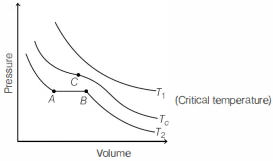
The isotherms of a gas are shown below:
Among the following:
$(i)$ At $T_1$,the gas cannot be liquefied.
$(ii)$ At point $B$,liquid starts to appear at $T_2$.
$(iii)$ $T_c$ is the highest temperature at which the gas can be liquefied.
$(iv)$ At point $A$,a small increase in pressure condenses the whole system to a liquid.
The correct statements are:
Among the following:
$(i)$ At $T_1$,the gas cannot be liquefied.
$(ii)$ At point $B$,liquid starts to appear at $T_2$.
$(iii)$ $T_c$ is the highest temperature at which the gas can be liquefied.
$(iv)$ At point $A$,a small increase in pressure condenses the whole system to a liquid.
The correct statements are:
A
only $(i)$ and $(ii)$
B
only $(i), (iii)$ and $(iv)$
C
only $(ii), (iii)$ and $(iv)$
D
$(i), (ii), (iii)$ and $(iv)$
Solution
(D)
All given statements are correct.
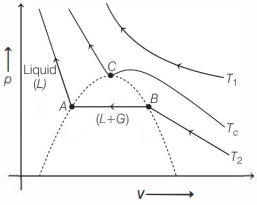
$(i)$ At temperatures above the critical temperature $(T_c)$,such as $T_1$,the gas cannot be liquefied by applying pressure alone.
$(ii)$ At $T_2$,point $B$ represents the onset of condensation where the gas begins to liquefy.
$(iii)$ $T_c$ (critical temperature) is defined as the highest temperature at which a gas can be liquefied by pressure.
$(iv)$ At point $A$,the substance is entirely in the liquid state; further compression leads to a sharp increase in pressure as liquids are nearly incompressible.
All given statements are correct.
$(i)$ At temperatures above the critical temperature $(T_c)$,such as $T_1$,the gas cannot be liquefied by applying pressure alone.
$(ii)$ At $T_2$,point $B$ represents the onset of condensation where the gas begins to liquefy.
$(iii)$ $T_c$ (critical temperature) is defined as the highest temperature at which a gas can be liquefied by pressure.
$(iv)$ At point $A$,the substance is entirely in the liquid state; further compression leads to a sharp increase in pressure as liquids are nearly incompressible.
0 likes
View Solution66
MediumMCQ
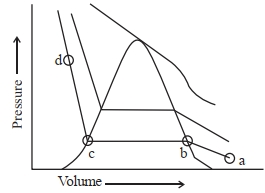
The number of statements,which are correct with respect to the compression of carbon dioxide from point $(a)$ in the Andrews isotherm from the following is $..........$.
$A.$ Carbon dioxide remains as a gas up to point $(b)$
$B.$ Liquid carbon dioxide appears at point $(c)$
$C.$ Liquid and gaseous carbon dioxide coexist between points $(b)$ and $(c)$
$D.$ As the volume decreases from $(b)$ to $(c)$,the amount of liquid decreases
$A.$ Carbon dioxide remains as a gas up to point $(b)$
$B.$ Liquid carbon dioxide appears at point $(c)$
$C.$ Liquid and gaseous carbon dioxide coexist between points $(b)$ and $(c)$
$D.$ As the volume decreases from $(b)$ to $(c)$,the amount of liquid decreases
A
$2$
B
$4$
C
$3$
D
$1$
Solution
(A) At point $(a)$,$CO_2$ exists as a gas.
At point $(b)$,the liquefaction of $CO_2$ starts.
At point $(c)$,the liquefaction ends.
Between points $(b)$ and $(c)$,liquid and gaseous $CO_2$ coexist.
As the volume decreases from $(b)$ to $(c)$,the amount of gas decreases and the amount of liquid increases.
Evaluating the statements:
$A.$ Correct: $CO_2$ remains as a gas up to point $(b)$.
$B.$ Incorrect: Liquid $CO_2$ starts appearing at point $(b)$,not $(c)$.
$C.$ Correct: Liquid and gaseous $CO_2$ coexist between points $(b)$ and $(c)$.
$D.$ Incorrect: As the volume decreases from $(b)$ to $(c)$,the amount of liquid increases,not decreases.
Therefore,there are $2$ correct statements ($A$ and $C$).
At point $(b)$,the liquefaction of $CO_2$ starts.
At point $(c)$,the liquefaction ends.
Between points $(b)$ and $(c)$,liquid and gaseous $CO_2$ coexist.
As the volume decreases from $(b)$ to $(c)$,the amount of gas decreases and the amount of liquid increases.
Evaluating the statements:
$A.$ Correct: $CO_2$ remains as a gas up to point $(b)$.
$B.$ Incorrect: Liquid $CO_2$ starts appearing at point $(b)$,not $(c)$.
$C.$ Correct: Liquid and gaseous $CO_2$ coexist between points $(b)$ and $(c)$.
$D.$ Incorrect: As the volume decreases from $(b)$ to $(c)$,the amount of liquid increases,not decreases.
Therefore,there are $2$ correct statements ($A$ and $C$).
0 likes
View Solution67
MediumMCQ
Four gas cylinders containing $He$,$N_2$,$CO_2$ and $NH_3$ gases separately are gradually cooled from a temperature of $500 \ K$. Which gas will liquefy first?
(Given $T_C$ in $K - He: 5.3, N_2: 126, CO_2: 304.1$ and $NH_3: 405.5$)
(Given $T_C$ in $K - He: 5.3, N_2: 126, CO_2: 304.1$ and $NH_3: 405.5$)
A
$He$
B
$N_2$
C
$CO_2$
D
$NH_3$
Solution
(D) The ease of liquefaction of a gas is directly proportional to its critical temperature $(T_C)$.
As the temperature is lowered from $500 \ K$,the gas with the highest critical temperature will reach its liquefaction point first.
Comparing the given critical temperatures: $NH_3$ $(405.5 \ K)$ > $CO_2$ $(304.1 \ K)$ > $N_2$ $(126 \ K)$ > $He$ $(5.3 \ K)$.
Since $NH_3$ has the highest critical temperature,it will liquefy first.
As the temperature is lowered from $500 \ K$,the gas with the highest critical temperature will reach its liquefaction point first.
Comparing the given critical temperatures: $NH_3$ $(405.5 \ K)$ > $CO_2$ $(304.1 \ K)$ > $N_2$ $(126 \ K)$ > $He$ $(5.3 \ K)$.
Since $NH_3$ has the highest critical temperature,it will liquefy first.
0 likes
View Solution68
EasyMCQ
According to Andrews isothermals,the minimum temperature at which carbon dioxide gas obeys Boyle's law is (in $^{\circ}C$)
A
$32.5$
B
$31.1$
C
$48.1$
D
$35.5$
Solution
(B) According to Andrews' experiments on carbon dioxide,the gas obeys Boyle's law only at temperatures above its critical temperature.
For carbon dioxide,the critical temperature $(T_c)$ is $31.1^{\circ}C$.
At temperatures below $31.1^{\circ}C$,the gas can be liquefied by pressure,and it deviates significantly from ideal gas behavior.
Therefore,the minimum temperature at which $CO_2$ behaves like an ideal gas (obeying Boyle's law) is its critical temperature,which is $31.1^{\circ}C$.
For carbon dioxide,the critical temperature $(T_c)$ is $31.1^{\circ}C$.
At temperatures below $31.1^{\circ}C$,the gas can be liquefied by pressure,and it deviates significantly from ideal gas behavior.
Therefore,the minimum temperature at which $CO_2$ behaves like an ideal gas (obeying Boyle's law) is its critical temperature,which is $31.1^{\circ}C$.
0 likes
View Solution69
EasyMCQ
According to Andrews isothermals,at what temperature does carbon dioxide gas start to condense at $73 \ atm$ (in $^{\circ} C$)?
A
$21.5$
B
$30.98$
C
$13.1$
D
$48.1$
Solution
(B) According to Andrews' experiments on $CO_2$ isotherms,the critical pressure $(P_C)$ of carbon dioxide is $73 \ atm$.
At this critical pressure,the temperature at which the gas starts to condense (or the temperature at which the gas becomes indistinguishable from its liquid phase) is known as the critical temperature $(T_C)$.
For $CO_2$,the critical temperature $(T_C)$ is $30.98^{\circ} C$.
At this critical pressure,the temperature at which the gas starts to condense (or the temperature at which the gas becomes indistinguishable from its liquid phase) is known as the critical temperature $(T_C)$.
For $CO_2$,the critical temperature $(T_C)$ is $30.98^{\circ} C$.
0 likes
View Solution70
MediumMCQ
Which among the following gases is difficult to liquefy?
A
$SO_2$
B
$Cl_2$
C
$NH_3$
D
$O_2$
Solution
(D) The ease of liquefaction of a gas depends on its critical temperature $(T_{c})$.
Gases with higher critical temperatures are easier to liquefy because they can be liquefied at higher temperatures.
The critical temperatures of the given gases are approximately: $SO_2$ $(430 \ K)$,$Cl_2$ $(417 \ K)$,$NH_3$ $(405 \ K)$,and $O_2$ $(154.6 \ K)$.
Since $O_2$ has the lowest critical temperature,it is the most difficult to liquefy among the given options.
Gases with higher critical temperatures are easier to liquefy because they can be liquefied at higher temperatures.
The critical temperatures of the given gases are approximately: $SO_2$ $(430 \ K)$,$Cl_2$ $(417 \ K)$,$NH_3$ $(405 \ K)$,and $O_2$ $(154.6 \ K)$.
Since $O_2$ has the lowest critical temperature,it is the most difficult to liquefy among the given options.
0 likes
View Solution71
MediumMCQ
Which of the following gases is most difficult to liquefy?
A
$O_2$
B
$SO_2$
C
$Cl_2$
D
$NH_3$
Solution
(A) The ease of liquefaction of a gas depends on the magnitude of intermolecular forces of attraction.
$SO_2$,$Cl_2$,and $NH_3$ are polar molecules,which possess stronger dipole-dipole interactions.
$O_2$ is a non-polar molecule,which only possesses weak London dispersion forces.
Therefore,$O_2$ has the lowest critical temperature and is the most difficult to liquefy.
$SO_2$,$Cl_2$,and $NH_3$ are polar molecules,which possess stronger dipole-dipole interactions.
$O_2$ is a non-polar molecule,which only possesses weak London dispersion forces.
Therefore,$O_2$ has the lowest critical temperature and is the most difficult to liquefy.
0 likes
View Solution72
MediumMCQ
What is the value of the critical temperature of water (in $K$)?
A
$647$
B
$312$
C
$346$
D
$493$
Solution
(A) The critical temperature of water is approximately $647 \ K$ $(647.096 \ K)$.
0 likes
View Solution73
MediumMCQ
Which among the following gases liquefy easily?
A
Oxygen
B
Helium
C
Chlorine
D
Nitrogen
Solution
(C) Gases with higher critical temperatures and stronger intermolecular forces of attraction are easier to liquefy.
Among the given options,$Cl_{2}$ (chlorine) has a relatively high critical temperature $(417 \ K)$ and strong van der Waals forces,making it easy to liquefy.
In contrast,gases like $O_{2}$,$N_{2}$,and $He$ have very low critical temperatures and are considered permanent gases,which are difficult to liquefy at room temperature.
Among the given options,$Cl_{2}$ (chlorine) has a relatively high critical temperature $(417 \ K)$ and strong van der Waals forces,making it easy to liquefy.
In contrast,gases like $O_{2}$,$N_{2}$,and $He$ have very low critical temperatures and are considered permanent gases,which are difficult to liquefy at room temperature.
0 likes
View Solution74
DifficultMCQ
The statement that is $NOT$ correct is
A
Van der Waals constant '$a$' measures extent of intermolecular attractive forces for real gases.
B
Boyle point depends on the nature of real gas.
C
Compressibility factor measures the deviation of real gas from ideal behaviour.
D
Critical temperature is the lowest temperature at which liquefaction of a gas first occurs.
Solution
(D) Critical temperature $(T_c)$ is defined as the temperature above which a gas cannot be liquefied,regardless of the pressure applied.
It is not the lowest temperature at which liquefaction occurs; rather,it is the maximum temperature at which a gas can exist as a liquid.
Therefore,statement $(D)$ is incorrect.
It is not the lowest temperature at which liquefaction occurs; rather,it is the maximum temperature at which a gas can exist as a liquid.
Therefore,statement $(D)$ is incorrect.
0 likes
View Solution75
EasyMCQ
$A$ liquid can exist only,
A
Between triple point and critical point.
B
At any temperature above melting point.
C
Between melting point and critical point.
D
Between boiling and melting points.
Solution
(A) Based on the phase diagram,the liquid phase is bounded by the triple point at the lower temperature limit and the critical point at the upper temperature limit. Below the triple point,the substance exists as a solid or vapor. Above the critical temperature $(T_c)$,the substance exists as a supercritical fluid,where the distinction between liquid and gas disappears. Therefore,a liquid can exist only between the triple point and the critical point.
0 likes
View Solution76
EasyMCQ
$A, B, C$ and $D$ are four different gases with critical temperatures $304.1, 154.3, 405.5$ and $126.0 \ K$ respectively. While cooling the gas,which gets liquefied first?
A
$B$
B
$A$
C
$D$
D
$C$
Solution
(D) The ease of liquefaction of a gas is directly proportional to its critical temperature $(T_c)$.
$C$ has the highest critical temperature,which is $405.5 \ K$.
Therefore,gas $C$ will be the easiest to liquefy and will get liquefied first upon cooling.
$C$ has the highest critical temperature,which is $405.5 \ K$.
Therefore,gas $C$ will be the easiest to liquefy and will get liquefied first upon cooling.
0 likes
View Solution77
MediumMCQ
The compressibility factor $(Z)$ of a gas at critical state is $(T_c = \frac{8 a}{27 R b}; p_c = \frac{a}{27 b^2}; V_c = 3 b)$.
A
$8/3$
B
$1$
C
$3/8$
D
$0.5$
Solution
(C) Given,$T_c = \frac{8 a}{27 R b}$,$p_c = \frac{a}{27 b^2}$,$V_c = 3 b$.
The compressibility factor $(Z)$ is defined as $Z = \frac{p V}{R T}$.
At the critical state,$Z = \frac{p_c V_c}{R T_c}$.
Substituting the given values:
$Z = \frac{(\frac{a}{27 b^2}) \times (3 b)}{R \times (\frac{8 a}{27 R b})}$.
$Z = \frac{\frac{3 a}{27 b}}{\frac{8 a}{27 b}} = \frac{3}{8}$.
Thus,the correct option is $(C)$.
The compressibility factor $(Z)$ is defined as $Z = \frac{p V}{R T}$.
At the critical state,$Z = \frac{p_c V_c}{R T_c}$.
Substituting the given values:
$Z = \frac{(\frac{a}{27 b^2}) \times (3 b)}{R \times (\frac{8 a}{27 R b})}$.
$Z = \frac{\frac{3 a}{27 b}}{\frac{8 a}{27 b}} = \frac{3}{8}$.
Thus,the correct option is $(C)$.
0 likes
View Solution78
MediumMCQ
Which statement$(s)$ is/are applicable above critical temperature?
A
$A$. $A$ gas cannot be liquified
B
$B$. Surface tension of a liquid is very high
C
$C$. $A$ liquid phase cannot be distinguished from a gas phase
D
$D$. Density changes continuously with $P$ or $V$
Solution
(A, C, D) Above the critical temperature $(T_c)$,a gas cannot be liquefied by the application of pressure alone.
At this temperature,the distinction between the liquid and gas phases disappears,meaning the liquid phase cannot be distinguished from the gas phase.
Furthermore,the density of the substance changes continuously with changes in pressure $(P)$ or volume $(V)$ as it exists as a supercritical fluid.
Therefore,statements $A$,$C$,and $D$ are applicable.
At this temperature,the distinction between the liquid and gas phases disappears,meaning the liquid phase cannot be distinguished from the gas phase.
Furthermore,the density of the substance changes continuously with changes in pressure $(P)$ or volume $(V)$ as it exists as a supercritical fluid.
Therefore,statements $A$,$C$,and $D$ are applicable.
0 likes
View Solution79
EasyMCQ
$A$ gas can be liquefied at temperature $T$ and pressure $p$ provided:
A
$T = T_{c}$ and $p < p_{c}$
B
$T < T_{c}$ and $p > p_{c}$
C
$T > T_{c}$ and $p > p_{c}$
D
$T > T_{c}$ and $p < p_{c}$
Solution
(B) gas can be liquefied at a temperature $T$ only when it is below its critical temperature,$T_{c}$.
At temperatures below $T_{c}$,the gas can be liquefied by applying sufficient pressure,specifically when the pressure $p$ is greater than the critical pressure,$p_{c}$.
Therefore,the condition for liquefaction is $T < T_{c}$ and $p > p_{c}$.
At temperatures below $T_{c}$,the gas can be liquefied by applying sufficient pressure,specifically when the pressure $p$ is greater than the critical pressure,$p_{c}$.
Therefore,the condition for liquefaction is $T < T_{c}$ and $p > p_{c}$.
0 likes
View SolutionStates of Matter — Critical state and Liquefaction of gases · Frequently Asked Questions
1Are these States of Matter questions useful for JEE and NEET?
Yes. All questions in this section are mapped to JEE Main and NEET exam patterns. Previous year questions from JEE Main, NEET, GUJCET and state-level exams are included with full solutions.
2Can I switch to Hindi or Gujarati for these questions?
Yes. Use the language tabs in the hero section or the sidebar to view the same questions and solutions in English, Hindi or Gujarati.
3How do I generate a question paper from this subtopic?
Use the Vedclass Exam Paper Generator — select the chapter and subtopic, set difficulty, and generate Sets A, B, C, D automatically. First 3 chapters of every subject are free.
Vedclass Products
For Students
Vedclass Test Series
Mock tests in real JEE/NEET style with performance analysis. 5-day free trial.
Start Free TrialFor Teachers
Exam Paper Generator
Generate Set A/B/C/D papers from this chapter in 2 minutes. 3 chapters free.
Try FreeFor Institutes
Online Exam Module
Live online exams with unlimited students, 360° analytics & white-label branding.
See DemoFor Teachers & Institutes
Generate a States of Matter Exam Paper in 2 Minutes
Select subtopic & difficulty — Sets A, B, C, D auto-generated with No Repeat logic.
First 3 chapters of every subject are free — no payment required.