
A English
Chemical stoichiometry Questions in English
Class 11 Chemistry · Some Basic Concepts of Chemistry · Chemical stoichiometry
809+
Questions
English
Language
100%
With Solutions
Showing 50 of 809 questions in English
301
MediumMCQ
Equal masses of $H_2, O_2$ and methane have been taken in a container of volume $V$ at temperature $27 \ ^oC$ in identical conditions. The ratio of the volumes of gases $H_2 : O_2 :$ methane would be
A
$8 : 16 : 1$
B
$16 : 8 : 1$
C
$16 : 1 : 2$
D
$8 : 1 : 2$
Solution
(C) According to Avogadro's hypothesis,the volume of a gas $(V)$ is directly proportional to the number of moles $(n)$ at constant temperature and pressure.
Therefore,the ratio of the volumes of gases is equal to the ratio of their moles.
Let the mass of each gas be $m$.
The molar masses are: $M_{H_2} = 2 \ g/mol$,$M_{O_2} = 32 \ g/mol$,and $M_{CH_4} = 16 \ g/mol$.
The ratio of volumes is:
$V_{H_2} : V_{O_2} : V_{CH_4} = n_{H_2} : n_{O_2} : n_{CH_4} = \frac{m}{2} : \frac{m}{32} : \frac{m}{16}$.
Multiplying by $32/m$,we get:
$16 : 1 : 2$.
Therefore,the ratio of the volumes of gases is equal to the ratio of their moles.
Let the mass of each gas be $m$.
The molar masses are: $M_{H_2} = 2 \ g/mol$,$M_{O_2} = 32 \ g/mol$,and $M_{CH_4} = 16 \ g/mol$.
The ratio of volumes is:
$V_{H_2} : V_{O_2} : V_{CH_4} = n_{H_2} : n_{O_2} : n_{CH_4} = \frac{m}{2} : \frac{m}{32} : \frac{m}{16}$.
Multiplying by $32/m$,we get:
$16 : 1 : 2$.
0 likes
View Solution302
DifficultMCQ
In an experiment,it was shown that $10 \ mL$ of a $0.05 \ M$ solution of a chloride required $10 \ mL$ of a $0.1 \ M$ solution of $AgNO_3$. Which of the following will be the formula of the chloride ($X$ stands for the symbol of the element other than chlorine)?
A
$X_2Cl_2$
B
$XCl_2$
C
$XCl_4$
D
$X_2Cl$
Solution
(B) The reaction between the chloride and $AgNO_3$ is: $Ag^{+} + Cl^{-} \rightarrow AgCl_{(s)}$.
Number of moles of $AgNO_3 = \text{Molarity} \times \text{Volume (in L)} = 0.1 \ M \times 0.01 \ L = 10^{-3} \ mol$.
Number of moles of the chloride solution $= 0.05 \ M \times 0.01 \ L = 0.5 \times 10^{-3} \ mol$.
Let the formula of the chloride be $XCl_n$. The number of moles of $Cl^{-}$ ions provided by the solution is $n \times (0.5 \times 10^{-3}) \ mol$.
According to the stoichiometry of the reaction,moles of $Cl^{-}$ must equal moles of $Ag^{+}$:
$n \times 0.5 \times 10^{-3} = 10^{-3}$.
Solving for $n$: $n = \frac{10^{-3}}{0.5 \times 10^{-3}} = 2$.
Therefore,the formula of the chloride is $XCl_2$.
Number of moles of $AgNO_3 = \text{Molarity} \times \text{Volume (in L)} = 0.1 \ M \times 0.01 \ L = 10^{-3} \ mol$.
Number of moles of the chloride solution $= 0.05 \ M \times 0.01 \ L = 0.5 \times 10^{-3} \ mol$.
Let the formula of the chloride be $XCl_n$. The number of moles of $Cl^{-}$ ions provided by the solution is $n \times (0.5 \times 10^{-3}) \ mol$.
According to the stoichiometry of the reaction,moles of $Cl^{-}$ must equal moles of $Ag^{+}$:
$n \times 0.5 \times 10^{-3} = 10^{-3}$.
Solving for $n$: $n = \frac{10^{-3}}{0.5 \times 10^{-3}} = 2$.
Therefore,the formula of the chloride is $XCl_2$.
0 likes
View Solution303
DifficultMCQ
What volume of oxygen gas $(O_2)$ measured at $0\,^oC$ and $1\ atm$ is needed to burn completely $1\ L$ of propane gas $(C_3H_8)$ measured under the same conditions? $..........\ L$
A
$5$
B
$10$
C
$7$
D
$6$
Solution
(A) The balanced chemical equation for the combustion of propane is:
$C_3H_8(g) + 5O_2(g) \rightarrow 3CO_2(g) + 4H_2O(l)$
According to Avogadro's Law,at constant temperature and pressure,the volume of gases reacting is directly proportional to their stoichiometric coefficients.
From the balanced equation,$1 \text{ volume of } C_3H_8$ requires $5 \text{ volumes of } O_2$.
Therefore,to burn $1 \ L$ of $C_3H_8$,the volume of $O_2$ required is $5 \times 1 \ L = 5 \ L$.
$C_3H_8(g) + 5O_2(g) \rightarrow 3CO_2(g) + 4H_2O(l)$
According to Avogadro's Law,at constant temperature and pressure,the volume of gases reacting is directly proportional to their stoichiometric coefficients.
From the balanced equation,$1 \text{ volume of } C_3H_8$ requires $5 \text{ volumes of } O_2$.
Therefore,to burn $1 \ L$ of $C_3H_8$,the volume of $O_2$ required is $5 \times 1 \ L = 5 \ L$.
0 likes
View Solution304
MediumMCQ
When $5 \ L$ of a gas mixture of methane and propane is perfectly combusted at $0 \ ^\circ C$ and $1 \ atm$,$16 \ L$ of oxygen at the same temperature and pressure is consumed. The amount of heat released from this combustion in $kJ$ ($\Delta H_{comb.} (CH_4) = 890 \ kJ \ mol^{-1},$ $\Delta H_{comb.} (C_3H_8) = 2220 \ kJ \ mol^{-1}$) is
A
$38$
B
$317$
C
$477$
D
$32$
Solution
(B) The combustion reactions are:
$CH_4(g) + 2O_2(g) \rightarrow CO_2(g) + 2H_2O(l)$
$C_3H_8(g) + 5O_2(g) \rightarrow 3CO_2(g) + 4H_2O(l)$
Let the volume of $CH_4$ be $x \ L$ and the volume of $C_3H_8$ be $(5-x) \ L$.
According to the stoichiometry of the reactions,the volume of $O_2$ consumed is $2x + 5(5-x) = 16$.
$2x + 25 - 5x = 16 \implies 3x = 9 \implies x = 3 \ L$.
Thus,volume of $CH_4 = 3 \ L$ and volume of $C_3H_8 = 2 \ L$.
At $STP$ $(0 \ ^\circ C, 1 \ atm)$,$22.4 \ L$ corresponds to $1 \ mol$. Therefore,moles of $CH_4 = 3/22.4$ and moles of $C_3H_8 = 2/22.4$.
Heat released $= (3/22.4) \times 890 + (2/22.4) \times 2220 = (2670 + 4440) / 22.4 = 7110 / 22.4 \approx 317.4 \ kJ$.
$CH_4(g) + 2O_2(g) \rightarrow CO_2(g) + 2H_2O(l)$
$C_3H_8(g) + 5O_2(g) \rightarrow 3CO_2(g) + 4H_2O(l)$
Let the volume of $CH_4$ be $x \ L$ and the volume of $C_3H_8$ be $(5-x) \ L$.
According to the stoichiometry of the reactions,the volume of $O_2$ consumed is $2x + 5(5-x) = 16$.
$2x + 25 - 5x = 16 \implies 3x = 9 \implies x = 3 \ L$.
Thus,volume of $CH_4 = 3 \ L$ and volume of $C_3H_8 = 2 \ L$.
At $STP$ $(0 \ ^\circ C, 1 \ atm)$,$22.4 \ L$ corresponds to $1 \ mol$. Therefore,moles of $CH_4 = 3/22.4$ and moles of $C_3H_8 = 2/22.4$.
Heat released $= (3/22.4) \times 890 + (2/22.4) \times 2220 = (2670 + 4440) / 22.4 = 7110 / 22.4 \approx 317.4 \ kJ$.
0 likes
View Solution305
DifficultMCQ
$20.0 \ g$ of a magnesium carbonate sample decomposes on heating to give carbon dioxide and $8.0 \ g$ magnesium oxide. What will be the percentage purity of magnesium carbonate in the sample? $(At. \ wt. \ of \ Mg = 24)$
A
$96$
B
$60$
C
$84$
D
$75$
Solution
(C) The decomposition reaction is: $MgCO_{3(s)} \longrightarrow MgO_{(s)} + CO_{2(g)}$
Molar mass of $MgCO_3 = 24 + 12 + (3 \times 16) = 84 \ g/mol$.
Molar mass of $MgO = 24 + 16 = 40 \ g/mol$.
According to the stoichiometry,$84 \ g$ of pure $MgCO_3$ produces $40 \ g$ of $MgO$.
Therefore,the mass of pure $MgCO_3$ required to produce $8.0 \ g$ of $MgO$ is: $\frac{84 \ g \ MgCO_3}{40 \ g \ MgO} \times 8.0 \ g \ MgO = 16.8 \ g \ MgCO_3$.
Percentage purity of the sample = $\frac{\text{Mass of pure } MgCO_3}{\text{Total mass of sample}} \times 100 = \frac{16.8}{20.0} \times 100 = 84 \ \%$.
Molar mass of $MgCO_3 = 24 + 12 + (3 \times 16) = 84 \ g/mol$.
Molar mass of $MgO = 24 + 16 = 40 \ g/mol$.
According to the stoichiometry,$84 \ g$ of pure $MgCO_3$ produces $40 \ g$ of $MgO$.
Therefore,the mass of pure $MgCO_3$ required to produce $8.0 \ g$ of $MgO$ is: $\frac{84 \ g \ MgCO_3}{40 \ g \ MgO} \times 8.0 \ g \ MgO = 16.8 \ g \ MgCO_3$.
Percentage purity of the sample = $\frac{\text{Mass of pure } MgCO_3}{\text{Total mass of sample}} \times 100 = \frac{16.8}{20.0} \times 100 = 84 \ \%$.
0 likes
View Solution306
MediumMCQ
How many grams of concentrated nitric acid solution should be used to prepare $250 \ mL$ of $2.0 \ M \ HNO_3$? The concentrated acid is $70\% \ HNO_3$ by mass.
A
$70.0 \ g$ conc. $HNO_3$
B
$54.0 \ g$ conc. $HNO_3$
C
$45.0 \ g$ conc. $HNO_3$
D
$90.0 \ g$ conc. $HNO_3$
Solution
(C) Step $1$: Calculate the number of moles of $HNO_3$ required.
$n = M \times V(L) = 2.0 \ mol/L \times 0.250 \ L = 0.5 \ mol$.
Step $2$: Calculate the mass of pure $HNO_3$ required.
Molar mass of $HNO_3 = 1 + 14 + (3 \times 16) = 63 \ g/mol$.
Mass of $HNO_3 = 0.5 \ mol \times 63 \ g/mol = 31.5 \ g$.
Step $3$: Calculate the mass of the $70\%$ concentrated solution.
Since the solution is $70\%$ $HNO_3$ by mass,$70 \ g$ of $HNO_3$ is present in $100 \ g$ of solution.
Mass of solution $= (100 \ g \text{ solution} / 70 \ g \text{ } HNO_3) \times 31.5 \ g \text{ } HNO_3 = 45 \ g$.
$n = M \times V(L) = 2.0 \ mol/L \times 0.250 \ L = 0.5 \ mol$.
Step $2$: Calculate the mass of pure $HNO_3$ required.
Molar mass of $HNO_3 = 1 + 14 + (3 \times 16) = 63 \ g/mol$.
Mass of $HNO_3 = 0.5 \ mol \times 63 \ g/mol = 31.5 \ g$.
Step $3$: Calculate the mass of the $70\%$ concentrated solution.
Since the solution is $70\%$ $HNO_3$ by mass,$70 \ g$ of $HNO_3$ is present in $100 \ g$ of solution.
Mass of solution $= (100 \ g \text{ solution} / 70 \ g \text{ } HNO_3) \times 31.5 \ g \text{ } HNO_3 = 45 \ g$.
2 likes
View Solution307
MediumMCQ
Concentrated aqueous sulphuric acid is $98\% \ H_2SO_4$ by mass and has a density of $1.80 \ g \ mL^{-1}$. The volume of acid required to make $1 \ L$ of $0.1 \ M \ H_2SO_4$ solution is ........ $mL$.
A
$16.65$
B
$22.20$
C
$5.55$
D
$11.10$
Solution
(C) First,calculate the molarity $(M_1)$ of the concentrated acid:
$M_1 = \frac{\text{density} \times 10 \times \% \text{ by mass}}{\text{molar mass}} = \frac{1.80 \times 10 \times 98}{98} = 18 \ M$.
Now,use the dilution formula $M_1 V_1 = M_2 V_2$:
$18 \times V_1 = 0.1 \times 1000 \ mL$.
$V_1 = \frac{100}{18} \approx 5.55 \ mL$.
$M_1 = \frac{\text{density} \times 10 \times \% \text{ by mass}}{\text{molar mass}} = \frac{1.80 \times 10 \times 98}{98} = 18 \ M$.
Now,use the dilution formula $M_1 V_1 = M_2 V_2$:
$18 \times V_1 = 0.1 \times 1000 \ mL$.
$V_1 = \frac{100}{18} \approx 5.55 \ mL$.
0 likes
View Solution308
DifficultMCQ
The density (in $g \; mL^{-1}$) of a $3.60 \; M$ sulphuric acid solution that is $29 \%$ $H_2SO_4$ (molar mass $= 98 \; g \; mol^{-1}$) by mass will be
A
$1.45$
B
$1.64$
C
$1.88$
D
$1.22$
Solution
(D) The relationship between Molarity $(M)$,percentage by mass $(\% \; w/w)$,and density $(d)$ is given by the formula:
$M = \frac{10 \times \% \; w/w \times d}{M_{solute}}$
Given values are:
$M = 3.60 \; mol \; L^{-1}$
$\% \; w/w = 29 \%$
$M_{solute} = 98 \; g \; mol^{-1}$
Substituting these values into the formula:
$3.60 = \frac{10 \times 29 \times d}{98}$
$d = \frac{3.60 \times 98}{10 \times 29}$
$d = \frac{352.8}{290} \approx 1.2165 \; g \; mL^{-1}$
Rounding to two decimal places,we get $d = 1.22 \; g \; mL^{-1}$.
$M = \frac{10 \times \% \; w/w \times d}{M_{solute}}$
Given values are:
$M = 3.60 \; mol \; L^{-1}$
$\% \; w/w = 29 \%$
$M_{solute} = 98 \; g \; mol^{-1}$
Substituting these values into the formula:
$3.60 = \frac{10 \times 29 \times d}{98}$
$d = \frac{3.60 \times 98}{10 \times 29}$
$d = \frac{352.8}{290} \approx 1.2165 \; g \; mL^{-1}$
Rounding to two decimal places,we get $d = 1.22 \; g \; mL^{-1}$.
0 likes
View Solution309
DifficultMCQ
In the reaction,$2Al_{(s)} + 6HCl_{(aq)} \rightarrow 2Al^{3+}_{(aq)} + 6Cl^{-}_{(aq)} + 3H_{2(g)}$
A
$11.2 \ L$ of $H_{2(g)}$ at $STP$ is produced for every $2 \ moles$ of $HCl_{(aq)}$ consumed
B
$6 \ L$ of $HCl_{(aq)}$ is consumed for every $3 \ L$ of $H_{2(g)}$ produced
C
$33.6 \ L$ of $H_{2(g)}$ is produced at $STP$ for every mole of $Al$ that reacts
D
$11.2 \ L$ of $H_{2(g)}$ at $STP$ is produced for every mole of $HCl_{(aq)}$ consumed
Solution
(D) From the balanced chemical equation: $2Al_{(s)} + 6HCl_{(aq)} \rightarrow 2Al^{3+}_{(aq)} + 6Cl^{-}_{(aq)} + 3H_{2(g)}$
$6 \ moles$ of $HCl_{(aq)}$ produces $3 \ moles$ of $H_{2(g)}$.
Therefore,$1 \ mole$ of $HCl_{(aq)}$ produces $\frac{3}{6} = 0.5 \ moles$ of $H_{2(g)}$.
At $STP$,$1 \ mole$ of any gas occupies $22.4 \ L$.
Thus,$0.5 \ moles$ of $H_{2(g)}$ occupies $0.5 \times 22.4 \ L = 11.2 \ L$ at $STP$.
Hence,option $D$ is correct.
$6 \ moles$ of $HCl_{(aq)}$ produces $3 \ moles$ of $H_{2(g)}$.
Therefore,$1 \ mole$ of $HCl_{(aq)}$ produces $\frac{3}{6} = 0.5 \ moles$ of $H_{2(g)}$.
At $STP$,$1 \ mole$ of any gas occupies $22.4 \ L$.
Thus,$0.5 \ moles$ of $H_{2(g)}$ occupies $0.5 \times 22.4 \ L = 11.2 \ L$ at $STP$.
Hence,option $D$ is correct.
0 likes
View Solution310
DifficultMCQ
The molecular formula of a commercial resin used for exchanging ions in water softening is $C_8H_7SO_3^- Na^+$ $(Mol. \ wt. 206)$. What would be the maximum uptake of $Ca^{2+}$ ions by the resin when expressed in mole per gram resin?
A
$\frac{2}{309}$
B
$\frac{1}{412}$
C
$\frac{1}{103}$
D
$\frac{1}{206}$
Solution
(B) The ion exchange reaction is: $2(C_8H_7SO_3^- Na^+) + Ca^{2+} \rightarrow (C_8H_7SO_3^-)_2 Ca^{2+} + 2Na^+$.
From the stoichiometry,$2 \ mol$ of the resin are required to exchange $1 \ mol$ of $Ca^{2+}$ ions.
Therefore,$1 \ mol$ of the resin can take up $\frac{1}{2} \ mol$ of $Ca^{2+}$ ions.
Given the molar mass of the resin is $206 \ g/mol$,the uptake capacity per gram of resin is $\frac{1 \ mol \ Ca^{2+}}{2 \times 206 \ g \ resin} = \frac{1}{412} \ mol/g$.
From the stoichiometry,$2 \ mol$ of the resin are required to exchange $1 \ mol$ of $Ca^{2+}$ ions.
Therefore,$1 \ mol$ of the resin can take up $\frac{1}{2} \ mol$ of $Ca^{2+}$ ions.
Given the molar mass of the resin is $206 \ g/mol$,the uptake capacity per gram of resin is $\frac{1 \ mol \ Ca^{2+}}{2 \times 206 \ g \ resin} = \frac{1}{412} \ mol/g$.
1 likes
View Solution311
DifficultMCQ
At $300 \ K$ and $1 \ atm$,$15 \ mL$ of a gaseous hydrocarbon requires $375 \ mL$ of air containing $20 \% \ O_2$ by volume for complete combustion. After combustion,the gases occupy $330 \ mL$. Assuming that the water formed is in liquid form and the volumes were measured at the same temperature and pressure,the formula of the hydrocarbon is:
A
$C_4H_8$
B
$C_4H_{10}$
C
$C_3H_6$
D
$C_3H_8$
Solution
(D) The combustion reaction is: $C_xH_y + (x + \frac{y}{4}) O_2 \rightarrow x CO_2 + \frac{y}{2} H_2O_{(l)}$
Volume of $O_2$ used $= 375 \times 0.20 = 75 \ mL$.
From the stoichiometry: $15(x + \frac{y}{4}) = 75$,which simplifies to $x + \frac{y}{4} = 5$,or $4x + y = 20$.
The final volume $330 \ mL$ consists of $CO_2$ produced and the remaining $N_2$ from the air.
Volume of $N_2 = 375 - 75 = 300 \ mL$.
Volume of $CO_2 = 330 - 300 = 30 \ mL$.
Since $15 \ mL$ of hydrocarbon produces $30 \ mL$ of $CO_2$,$x = 2$. Wait,checking stoichiometry: $15x = 30 \implies x = 2$.
Substituting $x=2$ into $4x + y = 20$: $4(2) + y = 20 \implies y = 12$. This suggests $C_2H_{12}$ which is impossible.
Re-evaluating: The total volume $330 \ mL$ includes $CO_2$ and $N_2$. $15x = 30 \implies x = 2$. If $x=3$,$15x = 45 \ mL$ of $CO_2$. Then $N_2 = 300 \ mL$,total $= 345 \ mL$. If $x=3$,$4(3) + y = 20 \implies y = 8$. This gives $C_3H_8$. $15 \ mL$ of $C_3H_8$ produces $45 \ mL$ of $CO_2$. Total volume $= 45 + 300 = 345 \ mL$. Given $330 \ mL$,let's check $C_3H_6$: $x=3, y=6$. $4(3)+6 = 18 \neq 20$. The correct hydrocarbon is $C_3H_8$.
Volume of $O_2$ used $= 375 \times 0.20 = 75 \ mL$.
From the stoichiometry: $15(x + \frac{y}{4}) = 75$,which simplifies to $x + \frac{y}{4} = 5$,or $4x + y = 20$.
The final volume $330 \ mL$ consists of $CO_2$ produced and the remaining $N_2$ from the air.
Volume of $N_2 = 375 - 75 = 300 \ mL$.
Volume of $CO_2 = 330 - 300 = 30 \ mL$.
Since $15 \ mL$ of hydrocarbon produces $30 \ mL$ of $CO_2$,$x = 2$. Wait,checking stoichiometry: $15x = 30 \implies x = 2$.
Substituting $x=2$ into $4x + y = 20$: $4(2) + y = 20 \implies y = 12$. This suggests $C_2H_{12}$ which is impossible.
Re-evaluating: The total volume $330 \ mL$ includes $CO_2$ and $N_2$. $15x = 30 \implies x = 2$. If $x=3$,$15x = 45 \ mL$ of $CO_2$. Then $N_2 = 300 \ mL$,total $= 345 \ mL$. If $x=3$,$4(3) + y = 20 \implies y = 8$. This gives $C_3H_8$. $15 \ mL$ of $C_3H_8$ produces $45 \ mL$ of $CO_2$. Total volume $= 45 + 300 = 345 \ mL$. Given $330 \ mL$,let's check $C_3H_6$: $x=3, y=6$. $4(3)+6 = 18 \neq 20$. The correct hydrocarbon is $C_3H_8$.
0 likes
View Solution312
MediumMCQ
Equal masses of methane and oxygen are mixed in an empty container at $25^\circ C$. The fraction of the total pressure exerted by oxygen is
A
$1/2$
B
$2/3$
C
$\frac{1}{3} \times \frac{273}{298}$
D
$1/3$
Solution
(D) Let the mass of methane $(CH_4)$ and oxygen $(O_2)$ be $m \ g$.
Moles of $CH_4 = \frac{m}{16}$
Moles of $O_2 = \frac{m}{32}$
According to Dalton's Law of Partial Pressures,the partial pressure of a gas is equal to its mole fraction multiplied by the total pressure.
Mole fraction of $O_2 (x_{O_2}) = \frac{\text{Moles of } O_2}{\text{Moles of } O_2 + \text{Moles of } CH_4}$
$x_{O_2} = \frac{m/32}{m/32 + m/16} = \frac{m/32}{m/32 + 2m/32} = \frac{m/32}{3m/32} = 1/3$
Therefore,the fraction of the total pressure exerted by oxygen is $1/3$.
Moles of $CH_4 = \frac{m}{16}$
Moles of $O_2 = \frac{m}{32}$
According to Dalton's Law of Partial Pressures,the partial pressure of a gas is equal to its mole fraction multiplied by the total pressure.
Mole fraction of $O_2 (x_{O_2}) = \frac{\text{Moles of } O_2}{\text{Moles of } O_2 + \text{Moles of } CH_4}$
$x_{O_2} = \frac{m/32}{m/32 + m/16} = \frac{m/32}{m/32 + 2m/32} = \frac{m/32}{3m/32} = 1/3$
Therefore,the fraction of the total pressure exerted by oxygen is $1/3$.
0 likes
View Solution313
MediumMCQ
The most abundant elements by mass in the body of a healthy human adult are: Oxygen $(61.4\%);$ Carbon $(22.9\%),$ Hydrogen $(10.0\%);$ and Nitrogen $(2.6\%).$ The weight which a $75 \ kg$ person would gain if all $^1H$ atoms are replaced by $^2H$ atoms is ....... $kg$.
A
$15$
B
$37.5$
C
$7.5$
D
$10$
Solution
(C) The mass of hydrogen in a $75 \ kg$ human body is calculated as: $\text{Mass of } H = \frac{10}{100} \times 75 \ kg = 7.5 \ kg$.
When all $^1H$ atoms (atomic mass $\approx 1$) are replaced by $^2H$ atoms (atomic mass $\approx 2$),the mass of the hydrogen component doubles.
New mass of hydrogen $= 7.5 \ kg \times 2 = 15 \ kg$.
Therefore,the weight gain is $15 \ kg - 7.5 \ kg = 7.5 \ kg$.
When all $^1H$ atoms (atomic mass $\approx 1$) are replaced by $^2H$ atoms (atomic mass $\approx 2$),the mass of the hydrogen component doubles.
New mass of hydrogen $= 7.5 \ kg \times 2 = 15 \ kg$.
Therefore,the weight gain is $15 \ kg - 7.5 \ kg = 7.5 \ kg$.
0 likes
View Solution314
DifficultMCQ
$1\, g$ of a carbonate $(M_{2}CO_{3})$ on treatment with excess $HCl$ produces $0.01186\, mol$ of $CO_{2}.$ The molar mass of $M_{2}CO_{3}$ in $g\, mol^{-1}$ is:
A
$1186$
B
$84.3$
C
$118.6$
D
$11.86$
Solution
(B) The balanced chemical equation for the reaction is:
$M_{2}CO_{3} + 2HCl \rightarrow 2MCl + H_{2}O + CO_{2}$
According to the stoichiometry of the reaction,$1\, mol$ of $M_{2}CO_{3}$ produces $1\, mol$ of $CO_{2}$.
Therefore,the moles of $M_{2}CO_{3}$ reacted is equal to the moles of $CO_{2}$ produced,which is $0.01186\, mol$.
Using the formula: $\text{Molar mass} = \frac{\text{Mass}}{\text{Moles}}$
$\text{Molar mass} = \frac{1\, g}{0.01186\, mol} \approx 84.3\, g\, mol^{-1}$.
$M_{2}CO_{3} + 2HCl \rightarrow 2MCl + H_{2}O + CO_{2}$
According to the stoichiometry of the reaction,$1\, mol$ of $M_{2}CO_{3}$ produces $1\, mol$ of $CO_{2}$.
Therefore,the moles of $M_{2}CO_{3}$ reacted is equal to the moles of $CO_{2}$ produced,which is $0.01186\, mol$.
Using the formula: $\text{Molar mass} = \frac{\text{Mass}}{\text{Moles}}$
$\text{Molar mass} = \frac{1\, g}{0.01186\, mol} \approx 84.3\, g\, mol^{-1}$.
0 likes
View Solution315
AdvancedMCQ
$20 \ g$ of iron pyrite,$FeS_2$,is roasted completely and the $SO_2$ gas produced is absorbed completely in $400 \ mL$ of $NaOH$ solution. If only $50\%$ of the $NaOH$ is used in the reaction,what was the molarity of the $NaOH$ solution?
A
$\frac{5}{3} \ M$
B
$\frac{10}{3} \ M$
C
$\frac{5}{6} \ M$
D
$\frac{20}{3} \ M$
Solution
(B) Step $1$: Calculate moles of $FeS_2$. Molar mass of $FeS_2 = 56 + 2 \times 32 = 120 \ g/mol$. Moles of $FeS_2 = \frac{20 \ g}{120 \ g/mol} = \frac{1}{6} \ mol$.
Step $2$: Write the roasting reaction: $2FeS_2 + \frac{11}{2}O_2 \to Fe_2O_3 + 4SO_2$.
From stoichiometry,$2 \ mol$ of $FeS_2$ produce $4 \ mol$ of $SO_2$. Thus,$\frac{1}{6} \ mol$ of $FeS_2$ produces $\frac{1}{6} \times 2 = \frac{1}{3} \ mol$ of $SO_2$.
Step $3$: Write the absorption reaction: $SO_2 + 2NaOH \to Na_2SO_3 + H_2O$.
To react with $\frac{1}{3} \ mol$ of $SO_2$,we need $\frac{2}{3} \ mol$ of $NaOH$.
Step $4$: Calculate molarity. Given that $50\%$ of the $NaOH$ solution was used,let $M$ be the molarity. Total moles of $NaOH = \frac{400 \times M}{1000} = 0.4M$.
$0.5 \times 0.4M = \frac{2}{3} \ mol$ $\Rightarrow 0.2M = \frac{2}{3}$ $\Rightarrow M = \frac{2}{0.6} = \frac{10}{3} \ M$.
Step $2$: Write the roasting reaction: $2FeS_2 + \frac{11}{2}O_2 \to Fe_2O_3 + 4SO_2$.
From stoichiometry,$2 \ mol$ of $FeS_2$ produce $4 \ mol$ of $SO_2$. Thus,$\frac{1}{6} \ mol$ of $FeS_2$ produces $\frac{1}{6} \times 2 = \frac{1}{3} \ mol$ of $SO_2$.
Step $3$: Write the absorption reaction: $SO_2 + 2NaOH \to Na_2SO_3 + H_2O$.
To react with $\frac{1}{3} \ mol$ of $SO_2$,we need $\frac{2}{3} \ mol$ of $NaOH$.
Step $4$: Calculate molarity. Given that $50\%$ of the $NaOH$ solution was used,let $M$ be the molarity. Total moles of $NaOH = \frac{400 \times M}{1000} = 0.4M$.
$0.5 \times 0.4M = \frac{2}{3} \ mol$ $\Rightarrow 0.2M = \frac{2}{3}$ $\Rightarrow M = \frac{2}{0.6} = \frac{10}{3} \ M$.
0 likes
View Solution316
DifficultMCQ
$100 \, mL$ of a given $H_2O_2$ sample in water (density $1.08 \, g/mL$) required $5 \, mL$ of $M/25 \, KMnO_4$ in acidic medium for its oxidation. Select the correct statement regarding $H_2O_2$ in the sample:
A
Molarity of $H_2O_2$ in the solution $= 0.5$
B
Moles of $H_2O_2$ in the solution $= 0.5$
C
Molality of $H_2O_2$ in the solution $= 0.5$
D
Moles of $H_2O_2$ in the solution $= 5 \times 10^{-4}$
Solution
(D) The balanced chemical equation for the reaction between $H_2O_2$ and $KMnO_4$ in acidic medium is:
$2MnO_4^- + 5H_2O_2 + 6H^+ \rightarrow 2Mn^{2+} + 5O_2 + 8H_2O$
From the stoichiometry,$2 \, \text{moles of } KMnO_4$ react with $5 \, \text{moles of } H_2O_2$.
Given: Volume of $KMnO_4 = 5 \, mL = 5 \times 10^{-3} \, L$,Molarity of $KMnO_4 = 1/25 \, M = 0.04 \, M$.
Moles of $KMnO_4 = \text{Molarity} \times \text{Volume} = 0.04 \times 5 \times 10^{-3} = 2 \times 10^{-4} \, \text{moles}$.
Using the stoichiometry,moles of $H_2O_2 = \frac{5}{2} \times (\text{moles of } KMnO_4) = 2.5 \times 2 \times 10^{-4} = 5 \times 10^{-4} \, \text{moles}$.
Therefore,the correct statement is that the moles of $H_2O_2$ in the solution $= 5 \times 10^{-4}$.
$2MnO_4^- + 5H_2O_2 + 6H^+ \rightarrow 2Mn^{2+} + 5O_2 + 8H_2O$
From the stoichiometry,$2 \, \text{moles of } KMnO_4$ react with $5 \, \text{moles of } H_2O_2$.
Given: Volume of $KMnO_4 = 5 \, mL = 5 \times 10^{-3} \, L$,Molarity of $KMnO_4 = 1/25 \, M = 0.04 \, M$.
Moles of $KMnO_4 = \text{Molarity} \times \text{Volume} = 0.04 \times 5 \times 10^{-3} = 2 \times 10^{-4} \, \text{moles}$.
Using the stoichiometry,moles of $H_2O_2 = \frac{5}{2} \times (\text{moles of } KMnO_4) = 2.5 \times 2 \times 10^{-4} = 5 \times 10^{-4} \, \text{moles}$.
Therefore,the correct statement is that the moles of $H_2O_2$ in the solution $= 5 \times 10^{-4}$.
0 likes
View Solution317
AdvancedMCQ
Diatoms,microscopic organisms,are an abundant food source in the oceans producing carbohydrates from carbon dioxide and water by photosynthesis.
$6CO_2 + 6H_2O + \text{solar energy} o C_6H_{12}O_6 + 6O_2$
$A$ blue whale gains $75 kg$ of mass per day by feeding on krill. The whale must consume ten times this mass of krill each day. The krill must consume $10.0 kg$ of diatoms to produce $1.0 kg$ of krill. Assuming that the mass gain of a whale's life is due to the consumption of carbohydrates $(C_6H_{12}O_6)$,calculate the moles of $CO_2$ that must be used by the diatoms to produce the carbohydrates consumed by a blue whale in a day.
$6CO_2 + 6H_2O + \text{solar energy} o C_6H_{12}O_6 + 6O_2$
$A$ blue whale gains $75 kg$ of mass per day by feeding on krill. The whale must consume ten times this mass of krill each day. The krill must consume $10.0 kg$ of diatoms to produce $1.0 kg$ of krill. Assuming that the mass gain of a whale's life is due to the consumption of carbohydrates $(C_6H_{12}O_6)$,calculate the moles of $CO_2$ that must be used by the diatoms to produce the carbohydrates consumed by a blue whale in a day.
A
$2.5 \times 10^5 mol$
B
$2.5 \times 10^4 mol$
C
$2.5 \times 10^7 mol$
D
$2.5 \times 10^8 mol$
Solution
(A) $1$. Mass of krill consumed by the whale per day = $75 kg \times 10 = 750 kg = 7.5 \times 10^5 g$.
$2$. Mass of diatoms consumed by krill to produce this mass of krill = $750 kg \times 10 = 7500 kg = 7.5 \times 10^6 g$.
$3$. Assuming the mass of diatoms is equivalent to the mass of carbohydrates $(C_6H_{12}O_6)$ produced,moles of $C_6H_{12}O_6$ = $\frac{7.5 \times 10^6 g}{180 g/mol} = 41666.67 mol$.
$4$. From the balanced equation,$1 mol$ of $C_6H_{12}O_6$ requires $6 mol$ of $CO_2$.
$5$. Moles of $CO_2$ required = $41666.67 mol \times 6 = 250000 mol = 2.5 \times 10^5 mol$.
$2$. Mass of diatoms consumed by krill to produce this mass of krill = $750 kg \times 10 = 7500 kg = 7.5 \times 10^6 g$.
$3$. Assuming the mass of diatoms is equivalent to the mass of carbohydrates $(C_6H_{12}O_6)$ produced,moles of $C_6H_{12}O_6$ = $\frac{7.5 \times 10^6 g}{180 g/mol} = 41666.67 mol$.
$4$. From the balanced equation,$1 mol$ of $C_6H_{12}O_6$ requires $6 mol$ of $CO_2$.
$5$. Moles of $CO_2$ required = $41666.67 mol \times 6 = 250000 mol = 2.5 \times 10^5 mol$.
0 likes
View Solution318
DifficultMCQ
$40 \ mL$ of $0.1 \ N$ $KMnO_4$ is equivalent to $30 \ mL$ of $KHC_2O_4$ solution. How many $mL$ of $0.1 \ N$ $KOH$ are required to titrate $60 \ mL$ of the same $KHC_2O_4$ solution?
A
$80$
B
$30$
C
$28.57$
D
$35.5$
Solution
(NONE) Step $1$: Determine the normality of $KHC_2O_4$ solution.
Using the equivalence principle,$N_1V_1 = N_2V_2$.
$0.1 \ N \times 40 \ mL = N_2 \times 30 \ mL$.
$N_2 = \frac{4}{30} = \frac{2}{15} \ N$.
Step $2$: Titration of $KHC_2O_4$ with $KOH$.
$KHC_2O_4$ acts as an acid,reacting with $KOH$ in a $1:1$ molar ratio (or $1:1$ equivalent ratio).
$N_{acid} \times V_{acid} = N_{base} \times V_{base}$.
$\frac{2}{15} \ N \times 60 \ mL = 0.1 \ N \times V_{base}$.
$V_{base} = \frac{2 \times 60}{15 \times 0.1} = \frac{8}{0.1} = 80 \ mL$.
Using the equivalence principle,$N_1V_1 = N_2V_2$.
$0.1 \ N \times 40 \ mL = N_2 \times 30 \ mL$.
$N_2 = \frac{4}{30} = \frac{2}{15} \ N$.
Step $2$: Titration of $KHC_2O_4$ with $KOH$.
$KHC_2O_4$ acts as an acid,reacting with $KOH$ in a $1:1$ molar ratio (or $1:1$ equivalent ratio).
$N_{acid} \times V_{acid} = N_{base} \times V_{base}$.
$\frac{2}{15} \ N \times 60 \ mL = 0.1 \ N \times V_{base}$.
$V_{base} = \frac{2 \times 60}{15 \times 0.1} = \frac{8}{0.1} = 80 \ mL$.
0 likes
View Solution319
MediumMCQ
An aqueous solution of $18 \ g$ oxalic acid $(H_2C_2O_4 \cdot 2H_2O)$ is made up to $400 \ mL$. Calculate the volume of $0.1 \ M \ NaOH$ required to completely neutralize $50 \ mL$ of the above solution in $mL$.
A
$500$
B
$50$
C
$400$
D
$200$
Solution
(A) The molar mass of oxalic acid dihydrate $(H_2C_2O_4 \cdot 2H_2O)$ is $126 \ g/mol$.
Moles of oxalic acid in $400 \ mL$ = $\frac{18 \ g}{126 \ g/mol} = \frac{1}{7} \ mol$.
Moles of oxalic acid in $50 \ mL$ = $\frac{1}{7} \times \frac{50}{400} = \frac{1}{56} \ mol$.
The neutralization reaction is: $H_2C_2O_4 + 2NaOH \rightarrow Na_2C_2O_4 + 2H_2O$.
According to the stoichiometry,$1 \ mol$ of $H_2C_2O_4$ reacts with $2 \ mol$ of $NaOH$.
Moles of $NaOH$ required = $2 \times \frac{1}{56} = \frac{1}{28} \ mol$.
Volume of $0.1 \ M \ NaOH$ = $\frac{\text{moles}}{\text{molarity}} = \frac{1/28}{0.1} = \frac{10}{28} \approx 0.357 \ L = 357 \ mL$.
Note: If anhydrous oxalic acid ($H_2C_2O_4$,molar mass $90 \ g/mol$) is assumed:
Moles in $400 \ mL$ = $\frac{18}{90} = 0.2 \ mol$.
Moles in $50 \ mL$ = $0.2 \times \frac{50}{400} = 0.025 \ mol$.
Moles of $NaOH$ required = $2 \times 0.025 = 0.05 \ mol$.
Volume of $0.1 \ M \ NaOH$ = $\frac{0.05}{0.1} = 0.5 \ L = 500 \ mL$.
Given the options,the calculation assumes anhydrous oxalic acid.
Moles of oxalic acid in $400 \ mL$ = $\frac{18 \ g}{126 \ g/mol} = \frac{1}{7} \ mol$.
Moles of oxalic acid in $50 \ mL$ = $\frac{1}{7} \times \frac{50}{400} = \frac{1}{56} \ mol$.
The neutralization reaction is: $H_2C_2O_4 + 2NaOH \rightarrow Na_2C_2O_4 + 2H_2O$.
According to the stoichiometry,$1 \ mol$ of $H_2C_2O_4$ reacts with $2 \ mol$ of $NaOH$.
Moles of $NaOH$ required = $2 \times \frac{1}{56} = \frac{1}{28} \ mol$.
Volume of $0.1 \ M \ NaOH$ = $\frac{\text{moles}}{\text{molarity}} = \frac{1/28}{0.1} = \frac{10}{28} \approx 0.357 \ L = 357 \ mL$.
Note: If anhydrous oxalic acid ($H_2C_2O_4$,molar mass $90 \ g/mol$) is assumed:
Moles in $400 \ mL$ = $\frac{18}{90} = 0.2 \ mol$.
Moles in $50 \ mL$ = $0.2 \times \frac{50}{400} = 0.025 \ mol$.
Moles of $NaOH$ required = $2 \times 0.025 = 0.05 \ mol$.
Volume of $0.1 \ M \ NaOH$ = $\frac{0.05}{0.1} = 0.5 \ L = 500 \ mL$.
Given the options,the calculation assumes anhydrous oxalic acid.
0 likes
View Solution320
DifficultMCQ
$3 \ L$ mixture of $C_2H_6$ and $C_3H_8$ produces $8 \ L$ of $CO_2$ upon complete combustion. Find the volume of $C_2H_6$ in the mixture.
A
$2$
B
$1$
C
$1.5$
D
$2.5$
Solution
(B) Let the volume of $C_2H_6$ be $x \ L$ and the volume of $C_3H_8$ be $(3-x) \ L$.
The combustion reactions are:
$C_2H_6 + \frac{7}{2}O_2 \rightarrow 2CO_2 + 3H_2O$
$C_3H_8 + 5O_2 \rightarrow 3CO_2 + 4H_2O$
From the stoichiometry,$1 \ L$ of $C_2H_6$ produces $2 \ L$ of $CO_2$,and $1 \ L$ of $C_3H_8$ produces $3 \ L$ of $CO_2$.
Total volume of $CO_2 = 2(x) + 3(3-x) = 8$.
$2x + 9 - 3x = 8$.
$-x = -1$.
$x = 1 \ L$.
The combustion reactions are:
$C_2H_6 + \frac{7}{2}O_2 \rightarrow 2CO_2 + 3H_2O$
$C_3H_8 + 5O_2 \rightarrow 3CO_2 + 4H_2O$
From the stoichiometry,$1 \ L$ of $C_2H_6$ produces $2 \ L$ of $CO_2$,and $1 \ L$ of $C_3H_8$ produces $3 \ L$ of $CO_2$.
Total volume of $CO_2 = 2(x) + 3(3-x) = 8$.
$2x + 9 - 3x = 8$.
$-x = -1$.
$x = 1 \ L$.
0 likes
View Solution321
DifficultMCQ
For the given series of reactions:
$NH_{3(g)} + O_{2(g)} \rightarrow NO_{(g)} + H_2O_{(l)}$
$NO_{(g)} + O_{2(g)} \rightarrow NO_{2(g)}$
To obtain the maximum mass of $NO_2$ from a given mass of a mixture of $NH_3$ and $O_2$,the ratio of the mass of $NH_3$ to $O_2$ should be:
$NH_{3(g)} + O_{2(g)} \rightarrow NO_{(g)} + H_2O_{(l)}$
$NO_{(g)} + O_{2(g)} \rightarrow NO_{2(g)}$
To obtain the maximum mass of $NO_2$ from a given mass of a mixture of $NH_3$ and $O_2$,the ratio of the mass of $NH_3$ to $O_2$ should be:
A
$4/7$
B
$17/16$
C
$17/40$
D
$17/56$
Solution
(D) The balanced chemical equations are:
$4 NH_{3(g)} + 5 O_{2(g)} \rightarrow 4 NO_{(g)} + 6 H_2O_{(l)}$
$4 NO_{(g)} + 2 O_{2(g)} \rightarrow 4 NO_{2(g)}$
Adding these equations,we get the overall reaction:
$4 NH_{3(g)} + 7 O_{2(g)} \rightarrow 4 NO_{2(g)} + 6 H_2O_{(l)}$
To obtain the maximum mass of $NO_2$,the reactants must be in their stoichiometric ratio to ensure there is no limiting reagent.
The molar ratio is $n_{NH_3} : n_{O_2} = 4 : 7$.
The mass ratio is calculated as:
$\text{Mass ratio} = (4 \times \text{molar mass of } NH_3) : (7 \times \text{molar mass of } O_2)$
$\text{Mass ratio} = (4 \times 17) : (7 \times 32)$
$\text{Mass ratio} = 68 : 224$
Dividing both sides by $4$,we get $17 : 56$.
$4 NH_{3(g)} + 5 O_{2(g)} \rightarrow 4 NO_{(g)} + 6 H_2O_{(l)}$
$4 NO_{(g)} + 2 O_{2(g)} \rightarrow 4 NO_{2(g)}$
Adding these equations,we get the overall reaction:
$4 NH_{3(g)} + 7 O_{2(g)} \rightarrow 4 NO_{2(g)} + 6 H_2O_{(l)}$
To obtain the maximum mass of $NO_2$,the reactants must be in their stoichiometric ratio to ensure there is no limiting reagent.
The molar ratio is $n_{NH_3} : n_{O_2} = 4 : 7$.
The mass ratio is calculated as:
$\text{Mass ratio} = (4 \times \text{molar mass of } NH_3) : (7 \times \text{molar mass of } O_2)$
$\text{Mass ratio} = (4 \times 17) : (7 \times 32)$
$\text{Mass ratio} = 68 : 224$
Dividing both sides by $4$,we get $17 : 56$.
0 likes
View Solution322
DifficultMCQ
$3 \text{ mole}$ of a mixture of $FeSO_4$ and $Fe_2(SO_4)_3$ required $100 \text{ mL}$ of $2 \text{ M}$ $KMnO_4$ solution in acidic medium. Hence,the mole fraction of $FeSO_4$ in the mixture is:
A
$\frac{3}{5}$
B
$\frac{2}{3}$
C
$\frac{2}{5}$
D
$\frac{1}{3}$
Solution
(D) In an acidic medium,$KMnO_4$ acts as an oxidizing agent and reduces to $Mn^{2+}$,involving a change in oxidation state of $+5$ ($n$-factor $= 5$).
$FeSO_4$ contains $Fe^{2+}$,which gets oxidized to $Fe^{3+}$ ($n$-factor $= 1$).
$Fe_2(SO_4)_3$ contains $Fe^{3+}$,which cannot be further oxidized by $KMnO_4$.
Equating the milliequivalents (meq) of the reducing agent $(FeSO_4)$ and the oxidizing agent $(KMnO_4)$:
$\text{meq of } FeSO_4 = \text{meq of } KMnO_4$
$\text{moles of } FeSO_4 \times 1 = \text{Molarity} \times \text{Volume (in mL)} \times n\text{-factor}$
$\text{moles of } FeSO_4 = 2 \times 100 \times 5 / 1000 = 1 \text{ mole}$.
Total moles of mixture $= 3 \text{ moles}$.
$\text{Mole fraction of } FeSO_4 = \frac{\text{moles of } FeSO_4}{\text{Total moles}} = \frac{1}{3}$.
$FeSO_4$ contains $Fe^{2+}$,which gets oxidized to $Fe^{3+}$ ($n$-factor $= 1$).
$Fe_2(SO_4)_3$ contains $Fe^{3+}$,which cannot be further oxidized by $KMnO_4$.
Equating the milliequivalents (meq) of the reducing agent $(FeSO_4)$ and the oxidizing agent $(KMnO_4)$:
$\text{meq of } FeSO_4 = \text{meq of } KMnO_4$
$\text{moles of } FeSO_4 \times 1 = \text{Molarity} \times \text{Volume (in mL)} \times n\text{-factor}$
$\text{moles of } FeSO_4 = 2 \times 100 \times 5 / 1000 = 1 \text{ mole}$.
Total moles of mixture $= 3 \text{ moles}$.
$\text{Mole fraction of } FeSO_4 = \frac{\text{moles of } FeSO_4}{\text{Total moles}} = \frac{1}{3}$.
0 likes
View Solution323
MediumMCQ
$A$ gaseous mixture contains $CH_4$ and $C_2H_6$ in equimolecular proportion. The weight of $2.24 \ L$ of this mixture at $S.T.P.$ is :- .............. $g$
A
$4.6$
B
$1.6$
C
$2.3$
D
$23$
Solution
(C) At $S.T.P.$,$1 \ mol$ of any gas occupies $22.4 \ L$.
Therefore,$2.24 \ L$ of the mixture corresponds to $\frac{2.24}{22.4} = 0.1 \ mol$ of the mixture.
Since the mixture is equimolecular,it contains equal moles of $CH_4$ and $C_2H_6$.
Moles of $CH_4 = 0.05 \ mol$ and moles of $C_2H_6 = 0.05 \ mol$.
Mass of $CH_4 = 0.05 \ mol \times 16 \ g/mol = 0.8 \ g$.
Mass of $C_2H_6 = 0.05 \ mol \times 30 \ g/mol = 1.5 \ g$.
Total mass of the mixture $= 0.8 \ g + 1.5 \ g = 2.3 \ g$.
Therefore,$2.24 \ L$ of the mixture corresponds to $\frac{2.24}{22.4} = 0.1 \ mol$ of the mixture.
Since the mixture is equimolecular,it contains equal moles of $CH_4$ and $C_2H_6$.
Moles of $CH_4 = 0.05 \ mol$ and moles of $C_2H_6 = 0.05 \ mol$.
Mass of $CH_4 = 0.05 \ mol \times 16 \ g/mol = 0.8 \ g$.
Mass of $C_2H_6 = 0.05 \ mol \times 30 \ g/mol = 1.5 \ g$.
Total mass of the mixture $= 0.8 \ g + 1.5 \ g = 2.3 \ g$.
0 likes
View Solution324
DifficultMCQ
In an experiment on the enthalpy of neutralisation of sodium hydroxide with sulphuric acid,$50 \ cm^3$ of $0.4 \ M$ sodium hydroxide were titrated thermometrically with $0.25 \ M$ sulphuric acid. Which of the following plots gives the most probable correct representation of the temperature of the solution (initial temperatures of $NaOH$ and $H_2SO_4$ are the same)?
A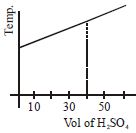
B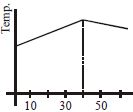
C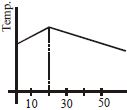
D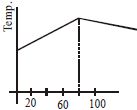
Solution
(B) The reaction is: $2NaOH + H_2SO_4 \rightarrow Na_2SO_4 + 2H_2O$.
Number of millimoles of $NaOH = 50 \ cm^3 \times 0.4 \ M = 20 \ mmol$.
Since $2 \ mol$ of $NaOH$ react with $1 \ mol$ of $H_2SO_4$,the $20 \ mmol$ of $NaOH$ will require $10 \ mmol$ of $H_2SO_4$.
Volume of $H_2SO_4$ required $= \frac{10 \ mmol}{0.25 \ M} = 40 \ cm^3$.
As $H_2SO_4$ is added,the temperature of the solution increases due to the exothermic nature of the neutralisation reaction until the equivalence point is reached at $40 \ cm^3$.
After the equivalence point,the addition of excess $H_2SO_4$ (which is at the same initial temperature) causes the total volume of the solution to increase,leading to a decrease in temperature due to dilution.
Therefore,the temperature plot should show a maximum at $40 \ cm^3$. Plot $B$ shows the maximum temperature at $40 \ cm^3$.
Number of millimoles of $NaOH = 50 \ cm^3 \times 0.4 \ M = 20 \ mmol$.
Since $2 \ mol$ of $NaOH$ react with $1 \ mol$ of $H_2SO_4$,the $20 \ mmol$ of $NaOH$ will require $10 \ mmol$ of $H_2SO_4$.
Volume of $H_2SO_4$ required $= \frac{10 \ mmol}{0.25 \ M} = 40 \ cm^3$.
As $H_2SO_4$ is added,the temperature of the solution increases due to the exothermic nature of the neutralisation reaction until the equivalence point is reached at $40 \ cm^3$.
After the equivalence point,the addition of excess $H_2SO_4$ (which is at the same initial temperature) causes the total volume of the solution to increase,leading to a decrease in temperature due to dilution.
Therefore,the temperature plot should show a maximum at $40 \ cm^3$. Plot $B$ shows the maximum temperature at $40 \ cm^3$.
0 likes
View Solution325
EasyMCQ
In what ratio by mass carbon dioxide $(CO_2)$ and nitrogen $(N_2)$ should be mixed so that the partial pressure exerted by each gas is the same?
A
$1:2$
B
$11:7$
C
$1:1$
D
$22:7$
Solution
(B) According to Dalton's law of partial pressure,$P_i = x_i \times P_{total}$,where $x_i$ is the mole fraction of the gas.
For the partial pressures to be equal $(P_{CO_2} = P_{N_2})$,their mole fractions must be equal $(x_{CO_2} = x_{N_2})$.
Since $x_i = \frac{n_i}{n_{total}}$,equal mole fractions imply that the number of moles must be equal $(n_{CO_2} = n_{N_2})$.
Let the number of moles be $n$.
Mass of $CO_2 = n \times \text{Molar mass of } CO_2 = n \times 44 \ g/mol$.
Mass of $N_2 = n \times \text{Molar mass of } N_2 = n \times 28 \ g/mol$.
The ratio of masses = $\frac{n \times 44}{n \times 28} = \frac{44}{28} = \frac{11}{7}$.
For the partial pressures to be equal $(P_{CO_2} = P_{N_2})$,their mole fractions must be equal $(x_{CO_2} = x_{N_2})$.
Since $x_i = \frac{n_i}{n_{total}}$,equal mole fractions imply that the number of moles must be equal $(n_{CO_2} = n_{N_2})$.
Let the number of moles be $n$.
Mass of $CO_2 = n \times \text{Molar mass of } CO_2 = n \times 44 \ g/mol$.
Mass of $N_2 = n \times \text{Molar mass of } N_2 = n \times 28 \ g/mol$.
The ratio of masses = $\frac{n \times 44}{n \times 28} = \frac{44}{28} = \frac{11}{7}$.
0 likes
View Solution326
DifficultMCQ
$10 \ g$ of a piece of marble $(CaCO_3)$ was put into excess of dilute $HCl$ acid. When the reaction was complete,$1120 \ mL$ of $CO_2$ was obtained at $STP$. The percentage of pure $CaCO_3$ in the marble is $............ \%$.
A
$10$
B
$25$
C
$50$
D
$75$
Solution
(C) The chemical equation for the reaction is: $CaCO_3(s) + 2HCl(aq) \rightarrow CaCl_2(aq) + H_2O(l) + CO_2(g)$.
According to the stoichiometry,$1 \ mol$ of $CaCO_3$ $(100 \ g)$ produces $22400 \ mL$ of $CO_2$ at $STP$.
If the marble were $100 \%$ pure,$10 \ g$ of $CaCO_3$ would produce: $\frac{22400 \ mL}{100 \ g} \times 10 \ g = 2240 \ mL$ of $CO_2$.
However,only $1120 \ mL$ of $CO_2$ was obtained.
The percentage purity of $CaCO_3$ is calculated as: $\frac{\text{Actual volume of } CO_2}{\text{Theoretical volume of } CO_2} \times 100 = \frac{1120 \ mL}{2240 \ mL} \times 100 = 50 \%$.
According to the stoichiometry,$1 \ mol$ of $CaCO_3$ $(100 \ g)$ produces $22400 \ mL$ of $CO_2$ at $STP$.
If the marble were $100 \%$ pure,$10 \ g$ of $CaCO_3$ would produce: $\frac{22400 \ mL}{100 \ g} \times 10 \ g = 2240 \ mL$ of $CO_2$.
However,only $1120 \ mL$ of $CO_2$ was obtained.
The percentage purity of $CaCO_3$ is calculated as: $\frac{\text{Actual volume of } CO_2}{\text{Theoretical volume of } CO_2} \times 100 = \frac{1120 \ mL}{2240 \ mL} \times 100 = 50 \%$.
0 likes
View Solution327
DifficultMCQ
$300 \ mL$ of a gaseous hydrocarbon when burnt in excess of $O_2$ gave $2.4 \ L$ of $CO_2$ and $2.7 \ L$ of water vapour under same conditions. The molecular formula of the hydrocarbon is:
A
$C_4H_8$
B
$C_8H_{18}$
C
$C_6H_{14}$
D
$C_8H_{16}$
Solution
(B) The combustion reaction for a hydrocarbon $C_xH_y$ is given by:
$C_xH_y + (x + y/4)O_2 \to xCO_2 + (y/2)H_2O$
According to Avogadro's Law,at constant temperature and pressure,the volume of gases is directly proportional to the number of moles.
Given:
Volume of $C_xH_y = 300 \ mL$
Volume of $CO_2 = 2.4 \ L = 2400 \ mL$
Volume of $H_2O = 2.7 \ L = 2700 \ mL$
From the stoichiometry:
$x = \text{Volume of } CO_2 / \text{Volume of } C_xH_y = 2400 / 300 = 8$
$y/2 = \text{Volume of } H_2O / \text{Volume of } C_xH_y = 2700 / 300 = 9$
$y = 9 \times 2 = 18$
Therefore,the molecular formula is $C_8H_{18}$.
$C_xH_y + (x + y/4)O_2 \to xCO_2 + (y/2)H_2O$
According to Avogadro's Law,at constant temperature and pressure,the volume of gases is directly proportional to the number of moles.
Given:
Volume of $C_xH_y = 300 \ mL$
Volume of $CO_2 = 2.4 \ L = 2400 \ mL$
Volume of $H_2O = 2.7 \ L = 2700 \ mL$
From the stoichiometry:
$x = \text{Volume of } CO_2 / \text{Volume of } C_xH_y = 2400 / 300 = 8$
$y/2 = \text{Volume of } H_2O / \text{Volume of } C_xH_y = 2700 / 300 = 9$
$y = 9 \times 2 = 18$
Therefore,the molecular formula is $C_8H_{18}$.
0 likes
View Solution328
DifficultMCQ
$0.7 \ g$ of $Na_2CO_3 \cdot xH_2O$ were dissolved in water and the volume was made to $100 \ mL$. $20 \ mL$ of this solution required $19.8 \ mL$ of $N/10 \ HCl$ for complete neutralization. The value of $x$ is:
A
$7$
B
$3$
C
$2$
D
$5$
Solution
(C) The reaction between $Na_2CO_3$ and $HCl$ is: $Na_2CO_3 + 2HCl \rightarrow 2NaCl + H_2O + CO_2$.
The number of equivalents of $Na_2CO_3$ in $20 \ mL$ is equal to the number of equivalents of $HCl$ used.
Equivalents of $HCl = N \times V(L) = \frac{1}{10} \times \frac{19.8}{1000} = 1.98 \times 10^{-3} \ eq$.
Since $20 \ mL$ contains $1.98 \times 10^{-3} \ eq$,the total $100 \ mL$ contains $1.98 \times 10^{-3} \times \frac{100}{20} = 9.9 \times 10^{-3} \ eq$.
The equivalent weight of $Na_2CO_3$ is $\frac{106}{2} = 53 \ g/eq$.
Total mass of $Na_2CO_3$ (anhydrous) = $9.9 \times 10^{-3} \times 53 = 0.5247 \ g$.
The mass of $Na_2CO_3 \cdot xH_2O$ is $0.7 \ g$.
The fraction of $Na_2CO_3$ in the hydrate is $\frac{106}{106 + 18x} = \frac{0.5247}{0.7} \approx 0.7495$.
$106 = 0.7495 \times (106 + 18x) \implies 106 = 79.45 + 13.49x \implies 13.49x = 26.55 \implies x \approx 2$.
The number of equivalents of $Na_2CO_3$ in $20 \ mL$ is equal to the number of equivalents of $HCl$ used.
Equivalents of $HCl = N \times V(L) = \frac{1}{10} \times \frac{19.8}{1000} = 1.98 \times 10^{-3} \ eq$.
Since $20 \ mL$ contains $1.98 \times 10^{-3} \ eq$,the total $100 \ mL$ contains $1.98 \times 10^{-3} \times \frac{100}{20} = 9.9 \times 10^{-3} \ eq$.
The equivalent weight of $Na_2CO_3$ is $\frac{106}{2} = 53 \ g/eq$.
Total mass of $Na_2CO_3$ (anhydrous) = $9.9 \times 10^{-3} \times 53 = 0.5247 \ g$.
The mass of $Na_2CO_3 \cdot xH_2O$ is $0.7 \ g$.
The fraction of $Na_2CO_3$ in the hydrate is $\frac{106}{106 + 18x} = \frac{0.5247}{0.7} \approx 0.7495$.
$106 = 0.7495 \times (106 + 18x) \implies 106 = 79.45 + 13.49x \implies 13.49x = 26.55 \implies x \approx 2$.
0 likes
View Solution329
MediumMCQ
Phosphine $[PH_{3(g)}]$ decomposes to produce vapours of phosphorus $(P_4)$ and $H_2$ gas. What will be the change in volume when $100 \ mL$ of phosphine is decomposed?
A
$+50$
B
$500$
C
$+75$
D
$-500$
Solution
(C) The balanced chemical equation for the decomposition of phosphine is: $4PH_{3(g)} \rightarrow P_{4(g)} + 6H_{2(g)}$.
According to the stoichiometry,$4$ volumes of $PH_3$ produce $1 + 6 = 7$ volumes of gaseous products.
For $100 \ mL$ of $PH_3$:
Volume of $P_4 = \frac{1}{4} \times 100 = 25 \ mL$.
Volume of $H_2 = \frac{6}{4} \times 100 = 150 \ mL$.
Total final volume = $25 + 150 = 175 \ mL$.
Change in volume = $175 \ mL - 100 \ mL = +75 \ mL$.
According to the stoichiometry,$4$ volumes of $PH_3$ produce $1 + 6 = 7$ volumes of gaseous products.
For $100 \ mL$ of $PH_3$:
Volume of $P_4 = \frac{1}{4} \times 100 = 25 \ mL$.
Volume of $H_2 = \frac{6}{4} \times 100 = 150 \ mL$.
Total final volume = $25 + 150 = 175 \ mL$.
Change in volume = $175 \ mL - 100 \ mL = +75 \ mL$.
0 likes
View Solution330
DifficultMCQ
Three substances $A$,$B$ and $C$ react to form $E$ and $D$ as shown: $2A + 3B + C \rightarrow 4D + 2E$. If the molar masses of $A, B, C$ and $D$ are $40, 30, 20$ and $15 \ g/mol$ respectively,and $570 \ g$ of a stoichiometric mixture of $A, B$ and $C$ is reacted,the maximum mass of $E$ obtained will be ............ $g$.
A
$570$
B
$400$
C
$390$
D
$90$
Solution
(C) The balanced chemical equation is $2A + 3B + C \rightarrow 4D + 2E$.
First,calculate the mass of one stoichiometric unit of the reactants: $2(40) + 3(30) + 1(20) = 80 + 90 + 20 = 190 \ g$.
Since $570 \ g$ of the mixture is used,the number of stoichiometric units reacting is $570 / 190 = 3$.
According to the stoichiometry,$1$ unit of reaction produces $2$ moles of $E$. Therefore,$3$ units produce $3 \times 2 = 6 \ moles$ of $E$.
Using the law of conservation of mass: $Mass_{reactants} = Mass_{products}$.
$570 \ g = Mass_{D} + Mass_{E}$.
Mass of $D$ produced $= 3 \times (4 \times 15) = 3 \times 60 = 180 \ g$.
Mass of $E = 570 \ g - 180 \ g = 390 \ g$.
First,calculate the mass of one stoichiometric unit of the reactants: $2(40) + 3(30) + 1(20) = 80 + 90 + 20 = 190 \ g$.
Since $570 \ g$ of the mixture is used,the number of stoichiometric units reacting is $570 / 190 = 3$.
According to the stoichiometry,$1$ unit of reaction produces $2$ moles of $E$. Therefore,$3$ units produce $3 \times 2 = 6 \ moles$ of $E$.
Using the law of conservation of mass: $Mass_{reactants} = Mass_{products}$.
$570 \ g = Mass_{D} + Mass_{E}$.
Mass of $D$ produced $= 3 \times (4 \times 15) = 3 \times 60 = 180 \ g$.
Mass of $E = 570 \ g - 180 \ g = 390 \ g$.
0 likes
View Solution331
DifficultMCQ
To obtain the maximum mass of $NO_2$ from a given mass of a mixture of $NH_3$ and $O_2$,the ratio of the mass of $NH_3$ to $O_2$ should be based on the reaction: $NH_3 + O_2 \longrightarrow NO_2 + H_2O$
A
$\frac{17}{40}$
B
$\frac{17}{64}$
C
$\frac{17}{56}$
D
$\frac{17}{32}$
Solution
(C) The balanced chemical equation for the reaction is:
$4 NH_3 + 7 O_2 \longrightarrow 4 NO_2 + 6 H_2O$
To obtain the maximum product without any limiting reagent,the reactants must be in their stoichiometric ratio.
The molar ratio of $NH_3$ to $O_2$ is $4:7$.
The mass ratio is calculated as:
$\frac{\text{Mass of } NH_3}{\text{Mass of } O_2} = \frac{4 \times \text{Molar mass of } NH_3}{7 \times \text{Molar mass of } O_2}$
$= \frac{4 \times 17}{7 \times 32} = \frac{68}{224} = \frac{17}{56}$
$4 NH_3 + 7 O_2 \longrightarrow 4 NO_2 + 6 H_2O$
To obtain the maximum product without any limiting reagent,the reactants must be in their stoichiometric ratio.
The molar ratio of $NH_3$ to $O_2$ is $4:7$.
The mass ratio is calculated as:
$\frac{\text{Mass of } NH_3}{\text{Mass of } O_2} = \frac{4 \times \text{Molar mass of } NH_3}{7 \times \text{Molar mass of } O_2}$
$= \frac{4 \times 17}{7 \times 32} = \frac{68}{224} = \frac{17}{56}$
0 likes
View Solution332
DifficultMCQ
Find the molecular weight of a solid containing $20\%$ by mole of $S$ atoms,whose $400\ g$ provides just sufficient $S$ atoms to produce enough $H_2SO_4$ to neutralise $100\ g$ $NaOH$.
A
$96$
B
$64$
C
$128$
D
$32$
Solution
(B) Step $1$: Calculate the moles of $NaOH$ to be neutralized.
Moles of $NaOH = \frac{100 \ g}{40 \ g/mol} = 2.5 \ mol$.
Step $2$: Determine the moles of $H_2SO_4$ required.
The neutralization reaction is $H_2SO_4 + 2NaOH \rightarrow Na_2SO_4 + 2H_2O$.
From the stoichiometry,$1 \ mol$ of $H_2SO_4$ reacts with $2 \ mol$ of $NaOH$.
So,moles of $H_2SO_4$ required $= \frac{2.5}{2} = 1.25 \ mol$.
Step $3$: Determine the moles of $S$ atoms required.
Since $1 \ mol$ of $H_2SO_4$ contains $1 \ mol$ of $S$ atoms,$1.25 \ mol$ of $H_2SO_4$ requires $1.25 \ mol$ of $S$ atoms.
Step $4$: Calculate the molecular weight of the solid.
The solid contains $20\%$ by mole of $S$ atoms.
Let the total moles of the solid be $n$.
Moles of $S = 0.20 \times n = 1.25 \ mol$.
Therefore,$n = \frac{1.25}{0.20} = 6.25 \ mol$.
Molecular weight of the solid $= \frac{\text{Total mass}}{\text{Total moles}} = \frac{400 \ g}{6.25 \ mol} = 64 \ g/mol$.
Moles of $NaOH = \frac{100 \ g}{40 \ g/mol} = 2.5 \ mol$.
Step $2$: Determine the moles of $H_2SO_4$ required.
The neutralization reaction is $H_2SO_4 + 2NaOH \rightarrow Na_2SO_4 + 2H_2O$.
From the stoichiometry,$1 \ mol$ of $H_2SO_4$ reacts with $2 \ mol$ of $NaOH$.
So,moles of $H_2SO_4$ required $= \frac{2.5}{2} = 1.25 \ mol$.
Step $3$: Determine the moles of $S$ atoms required.
Since $1 \ mol$ of $H_2SO_4$ contains $1 \ mol$ of $S$ atoms,$1.25 \ mol$ of $H_2SO_4$ requires $1.25 \ mol$ of $S$ atoms.
Step $4$: Calculate the molecular weight of the solid.
The solid contains $20\%$ by mole of $S$ atoms.
Let the total moles of the solid be $n$.
Moles of $S = 0.20 \times n = 1.25 \ mol$.
Therefore,$n = \frac{1.25}{0.20} = 6.25 \ mol$.
Molecular weight of the solid $= \frac{\text{Total mass}}{\text{Total moles}} = \frac{400 \ g}{6.25 \ mol} = 64 \ g/mol$.
0 likes
View Solution333
DifficultMCQ
$417 \ g$ of $PCl_{5(s)}$ is kept in an open container where it reacts with moisture from air to form $POCl_{3(s)}$ and $HCl_{(g)}$. $A$ few hours later,the solid left in the container weighed only $395 \ g$. The percentage of $PCl_5$ converted to $POCl_3$ is: .............. $\%$ $(P = 31, Cl = 35.5, O = 16, H = 1)$
A
$10$
B
$20$
C
$30$
D
$40$
Solution
(B) The balanced chemical equation for the reaction is:
$PCl_{5(s)} + H_2O_{(g)} \rightarrow POCl_{3(s)} + 2HCl_{(g)}$
Molar mass of $PCl_5 = 31 + 5 \times 35.5 = 208.5 \ g/mol$.
Molar mass of $POCl_3 = 31 + 16 + 3 \times 35.5 = 153.5 \ g/mol$.
Let $x$ moles of $PCl_5$ react.
Initial mass of $PCl_5 = 417 \ g$.
Initial moles of $PCl_5 = 417 / 208.5 = 2 \ mol$.
According to the reaction,$x$ moles of $PCl_5$ produce $x$ moles of $POCl_3$ and $2x$ moles of $HCl_{(g)}$.
Since the container is open,$HCl_{(g)}$ escapes.
The solid remaining consists of $(2 - x)$ moles of $PCl_5$ and $x$ moles of $POCl_3$.
Mass of solid remaining $= (2 - x) \times 208.5 + x \times 153.5 = 395$.
$417 - 208.5x + 153.5x = 395$.
$417 - 55x = 395$.
$55x = 22$.
$x = 22 / 55 = 0.4 \ mol$.
Percentage conversion $= (x / 2) \times 100 = (0.4 / 2) \times 100 = 20 \%$.
$PCl_{5(s)} + H_2O_{(g)} \rightarrow POCl_{3(s)} + 2HCl_{(g)}$
Molar mass of $PCl_5 = 31 + 5 \times 35.5 = 208.5 \ g/mol$.
Molar mass of $POCl_3 = 31 + 16 + 3 \times 35.5 = 153.5 \ g/mol$.
Let $x$ moles of $PCl_5$ react.
Initial mass of $PCl_5 = 417 \ g$.
Initial moles of $PCl_5 = 417 / 208.5 = 2 \ mol$.
According to the reaction,$x$ moles of $PCl_5$ produce $x$ moles of $POCl_3$ and $2x$ moles of $HCl_{(g)}$.
Since the container is open,$HCl_{(g)}$ escapes.
The solid remaining consists of $(2 - x)$ moles of $PCl_5$ and $x$ moles of $POCl_3$.
Mass of solid remaining $= (2 - x) \times 208.5 + x \times 153.5 = 395$.
$417 - 208.5x + 153.5x = 395$.
$417 - 55x = 395$.
$55x = 22$.
$x = 22 / 55 = 0.4 \ mol$.
Percentage conversion $= (x / 2) \times 100 = (0.4 / 2) \times 100 = 20 \%$.
0 likes
View Solution334
AdvancedMCQ
$A$ $6 \ L$ sample of hard water has a total hardness of $200 \ ppm$ of $Mg^{2+}$ in the form of bicarbonates and chlorides. This sample is treated with $Na_2CO_3$ to eliminate all temporary hardness,and the new hardness is found to be $\frac{1000}{3} \ ppm$ of $CaCO_3$. Find the mass of $MgCl_2$ in the $6 \ L$ sample in $mg$. $(d_{H_2O} = 1 \ g/mL)$
A
$\frac{400}{3}$
B
$0.8$
C
$1.9$
D
$2.4$
Solution
(C) Total hardness $= 200 \ ppm$ of $Mg^{2+}$.
Temporary hardness is due to $Mg(HCO_3)_2$ and permanent hardness is due to $MgCl_2$.
$Na_2CO_3$ removes temporary hardness by precipitating $Mg^{2+}$ as $MgCO_3$.
Remaining hardness is due to $MgCl_2$,which is $\frac{1000}{3} \ ppm$ of $CaCO_3$ equivalent.
$1 \ ppm = 1 \ mg/L$. So,remaining hardness $= \frac{1000}{3} \ mg/L$ of $CaCO_3$.
In $6 \ L$,total $CaCO_3$ equivalent $= \frac{1000}{3} \times 6 = 2000 \ mg = 2 \ g$ of $CaCO_3$.
Moles of $CaCO_3 = \frac{2 \ g}{100 \ g/mol} = 0.02 \ mol$.
Since $1 \ mol$ of $MgCl_2$ is equivalent to $1 \ mol$ of $CaCO_3$,moles of $MgCl_2 = 0.02 \ mol$.
Mass of $MgCl_2 = 0.02 \ mol \times 95 \ g/mol = 1.9 \ g$.
Temporary hardness is due to $Mg(HCO_3)_2$ and permanent hardness is due to $MgCl_2$.
$Na_2CO_3$ removes temporary hardness by precipitating $Mg^{2+}$ as $MgCO_3$.
Remaining hardness is due to $MgCl_2$,which is $\frac{1000}{3} \ ppm$ of $CaCO_3$ equivalent.
$1 \ ppm = 1 \ mg/L$. So,remaining hardness $= \frac{1000}{3} \ mg/L$ of $CaCO_3$.
In $6 \ L$,total $CaCO_3$ equivalent $= \frac{1000}{3} \times 6 = 2000 \ mg = 2 \ g$ of $CaCO_3$.
Moles of $CaCO_3 = \frac{2 \ g}{100 \ g/mol} = 0.02 \ mol$.
Since $1 \ mol$ of $MgCl_2$ is equivalent to $1 \ mol$ of $CaCO_3$,moles of $MgCl_2 = 0.02 \ mol$.
Mass of $MgCl_2 = 0.02 \ mol \times 95 \ g/mol = 1.9 \ g$.
0 likes
View Solution335
DifficultMCQ
Three solutions of $HCl$ having normalities $12 \ N$,$6 \ N$,and $2 \ N$ are mixed to obtain a solution of $4 \ N$ normality. Which among the following volume ratios is incorrect for the above mixture?
A
$1 : 1 : 5$
B
$1 : 2 : 6$
C
$2 : 1 : 9$
D
$1 : 2 : 4$
Solution
(D) The condition for mixing solutions is given by the equation: $N_{1}V_{1} + N_{2}V_{2} + N_{3}V_{3} = N_{R}(V_{1} + V_{2} + V_{3})$.
Given $N_{1} = 12$,$N_{2} = 6$,$N_{3} = 2$,and the resultant normality $N_{R} = 4$.
Substituting the values: $12V_{1} + 6V_{2} + 2V_{3} = 4(V_{1} + V_{2} + V_{3})$.
Simplifying: $12V_{1} + 6V_{2} + 2V_{3} = 4V_{1} + 4V_{2} + 4V_{3}$.
$8V_{1} + 2V_{2} = 2V_{3}$,which simplifies to $4V_{1} + V_{2} = V_{3}$.
Checking the options:
For $A$ $(1:1:5)$: $4(1) + 1 = 5$. This is correct.
For $B$ $(1:2:6)$: $4(1) + 2 = 6$. This is correct.
For $C$ $(2:1:9)$: $4(2) + 1 = 9$. This is correct.
For $D$ $(1:2:4)$: $4(1) + 2 = 6 \neq 4$. This is incorrect.
Given $N_{1} = 12$,$N_{2} = 6$,$N_{3} = 2$,and the resultant normality $N_{R} = 4$.
Substituting the values: $12V_{1} + 6V_{2} + 2V_{3} = 4(V_{1} + V_{2} + V_{3})$.
Simplifying: $12V_{1} + 6V_{2} + 2V_{3} = 4V_{1} + 4V_{2} + 4V_{3}$.
$8V_{1} + 2V_{2} = 2V_{3}$,which simplifies to $4V_{1} + V_{2} = V_{3}$.
Checking the options:
For $A$ $(1:1:5)$: $4(1) + 1 = 5$. This is correct.
For $B$ $(1:2:6)$: $4(1) + 2 = 6$. This is correct.
For $C$ $(2:1:9)$: $4(2) + 1 = 9$. This is correct.
For $D$ $(1:2:4)$: $4(1) + 2 = 6 \neq 4$. This is incorrect.
0 likes
View Solution336
DifficultMCQ
How many moles of $H_2O$ (per mole of $Cl_2$ evolved) will be formed when $KMnO_4$ is added to $HCl$ solution?
A
$5/4$
B
$4/5$
C
$5/8$
D
$8/5$
Solution
(D) The balanced chemical equation for the reaction between $KMnO_4$ and $HCl$ is:
$2 KMnO_4 + 16 HCl \rightarrow 2 MnCl_2 + 5 Cl_2 + 2 KCl + 8 H_2O$
Dividing the entire equation by $2$ to normalize per mole of $KMnO_4$:
$KMnO_4 + 8 HCl \rightarrow MnCl_2 + \frac{5}{2} Cl_2 + KCl + 4 H_2O$
From the stoichiometry,we see that $\frac{5}{2}$ moles of $Cl_2$ are produced along with $4$ moles of $H_2O$.
To find the moles of $H_2O$ per mole of $Cl_2$,we calculate:
$\text{Ratio} = \frac{4 \text{ moles } H_2O}{5/2 \text{ moles } Cl_2} = 4 \times \frac{2}{5} = \frac{8}{5}$ moles of $H_2O$.
$2 KMnO_4 + 16 HCl \rightarrow 2 MnCl_2 + 5 Cl_2 + 2 KCl + 8 H_2O$
Dividing the entire equation by $2$ to normalize per mole of $KMnO_4$:
$KMnO_4 + 8 HCl \rightarrow MnCl_2 + \frac{5}{2} Cl_2 + KCl + 4 H_2O$
From the stoichiometry,we see that $\frac{5}{2}$ moles of $Cl_2$ are produced along with $4$ moles of $H_2O$.
To find the moles of $H_2O$ per mole of $Cl_2$,we calculate:
$\text{Ratio} = \frac{4 \text{ moles } H_2O}{5/2 \text{ moles } Cl_2} = 4 \times \frac{2}{5} = \frac{8}{5}$ moles of $H_2O$.
0 likes
View Solution337
DifficultMCQ
If $1 \, mole$ of $H_3PO_x$ is completely neutralized by $80 \, g$ of $NaOH$,select the correct statement :-
A
$x = 2$ and acid is monobasic
B
$x = 3$ and acid is dibasic
C
$x = 4$ and acid is tribasic
D
All are correct
Solution
(B) The number of equivalents of acid equals the number of equivalents of base for complete neutralization.
$Eqv. \text{ of } H_3PO_x = Eqv. \text{ of } NaOH$
$1 \, mole \times \text{Basicity} = \frac{\text{mass}}{\text{Equivalent mass of } NaOH} = \frac{80 \, g}{40 \, g/mol} = 2 \, Eqv.$
Thus,the Basicity of the acid is $2$.
For phosphorus oxoacids,$H_3PO_3$ has a basicity of $2$ (where $x = 3$).
Therefore,$x = 3$ and the acid is dibasic.
$Eqv. \text{ of } H_3PO_x = Eqv. \text{ of } NaOH$
$1 \, mole \times \text{Basicity} = \frac{\text{mass}}{\text{Equivalent mass of } NaOH} = \frac{80 \, g}{40 \, g/mol} = 2 \, Eqv.$
Thus,the Basicity of the acid is $2$.
For phosphorus oxoacids,$H_3PO_3$ has a basicity of $2$ (where $x = 3$).
Therefore,$x = 3$ and the acid is dibasic.
0 likes
View Solution338
DifficultMCQ
At $STP$,for complete combustion of $3\, g$ of $C_2H_6$,the required volume of $O_2$ will be - ............. $litre$.
A
$78.4$
B
$7.84$
C
$2.78$
D
$6.23$
Solution
(B) The balanced chemical equation for the combustion of ethane is:
$C_2H_6 + \frac{7}{2} O_2 \rightarrow 2 CO_2 + 3 H_2O$
Calculate the moles of $C_2H_6$:
$mol \text{ of } C_2H_6 = \frac{\text{mass}}{\text{molar mass}} = \frac{3\, g}{30\, g/mol} = 0.1\, mol$
From the stoichiometry,$1\, mol$ of $C_2H_6$ requires $3.5\, mol$ of $O_2$:
$mol \text{ of } O_2 = \frac{7}{2} \times 0.1 = 0.35\, mol$
Calculate the volume of $O_2$ at $STP$ $(1\, mol = 22.4\, L)$:
$Vol. \text{ of } O_2 = 0.35\, mol \times 22.4\, L/mol = 7.84\, L$
$C_2H_6 + \frac{7}{2} O_2 \rightarrow 2 CO_2 + 3 H_2O$
Calculate the moles of $C_2H_6$:
$mol \text{ of } C_2H_6 = \frac{\text{mass}}{\text{molar mass}} = \frac{3\, g}{30\, g/mol} = 0.1\, mol$
From the stoichiometry,$1\, mol$ of $C_2H_6$ requires $3.5\, mol$ of $O_2$:
$mol \text{ of } O_2 = \frac{7}{2} \times 0.1 = 0.35\, mol$
Calculate the volume of $O_2$ at $STP$ $(1\, mol = 22.4\, L)$:
$Vol. \text{ of } O_2 = 0.35\, mol \times 22.4\, L/mol = 7.84\, L$
0 likes
View Solution339
MediumMCQ
$0.01$ mole of iodoform $(CHI_3)$ reacts with $Ag$ to produce a gas whose volume at $NTP$ is ............. $mL$.
$2CHI_3 + 6Ag \to 6AgI_{(s)} + C_2H_{2(g)}$
$2CHI_3 + 6Ag \to 6AgI_{(s)} + C_2H_{2(g)}$
A
$224$
B
$112$
C
$336$
D
None of these
Solution
(B) From the balanced chemical equation: $2CHI_3 + 6Ag \to 6AgI_{(s)} + C_2H_{2(g)}$
$2$ moles of $CHI_3$ produce $1$ mole of $C_2H_2$.
Therefore,$0.01$ moles of $CHI_3$ will produce $\frac{1}{2} \times 0.01 = 0.005$ moles of $C_2H_2$.
At $NTP$,$1$ mole of any gas occupies $22400 \ mL$.
Volume of $C_2H_2 = 0.005 \times 22400 = 112 \ mL$.
$2$ moles of $CHI_3$ produce $1$ mole of $C_2H_2$.
Therefore,$0.01$ moles of $CHI_3$ will produce $\frac{1}{2} \times 0.01 = 0.005$ moles of $C_2H_2$.
At $NTP$,$1$ mole of any gas occupies $22400 \ mL$.
Volume of $C_2H_2 = 0.005 \times 22400 = 112 \ mL$.
0 likes
View Solution340
MediumMCQ
$60 \ mL$ $NaOH$ solution is required for complete neutralization of $0.98 \ g$ orthophosphoric acid. The concentration of $NaOH$ solution is ............. $M$.
A
$0.5$
B
$0.167$
C
$1.5$
D
$0.33$
Solution
(A) The balanced chemical equation for the reaction is:
$H_3PO_4 + 3NaOH \rightarrow Na_3PO_4 + 3H_2O$
$1$. Calculate the molar mass of orthophosphoric acid $(H_3PO_4)$:
$M(H_3PO_4) = (3 \times 1) + 31 + (4 \times 16) = 98 \ g/mol$.
$2$. Calculate the moles of $H_3PO_4$:
$n(H_3PO_4) = \frac{0.98 \ g}{98 \ g/mol} = 0.01 \ mol$.
$3$. From the stoichiometry,$1 \ mol$ of $H_3PO_4$ reacts with $3 \ mol$ of $NaOH$.
Therefore,$0.01 \ mol$ of $H_3PO_4$ reacts with $0.01 \times 3 = 0.03 \ mol$ of $NaOH$.
$4$. Calculate the molarity $(M)$ of $NaOH$ solution:
$M = \frac{n(NaOH)}{V(L)} = \frac{0.03 \ mol}{0.060 \ L} = 0.5 \ M$.
$H_3PO_4 + 3NaOH \rightarrow Na_3PO_4 + 3H_2O$
$1$. Calculate the molar mass of orthophosphoric acid $(H_3PO_4)$:
$M(H_3PO_4) = (3 \times 1) + 31 + (4 \times 16) = 98 \ g/mol$.
$2$. Calculate the moles of $H_3PO_4$:
$n(H_3PO_4) = \frac{0.98 \ g}{98 \ g/mol} = 0.01 \ mol$.
$3$. From the stoichiometry,$1 \ mol$ of $H_3PO_4$ reacts with $3 \ mol$ of $NaOH$.
Therefore,$0.01 \ mol$ of $H_3PO_4$ reacts with $0.01 \times 3 = 0.03 \ mol$ of $NaOH$.
$4$. Calculate the molarity $(M)$ of $NaOH$ solution:
$M = \frac{n(NaOH)}{V(L)} = \frac{0.03 \ mol}{0.060 \ L} = 0.5 \ M$.
0 likes
View Solution341
DifficultMCQ
$A$ given initial mass of $KClO_3$ on $50\%$ decomposition produces $67.2 \ L$ of oxygen gas at $0 \ ^\circ C$ and $1 \ atm$. The other product of decomposition is $KCl$. The initial mass of $KClO_3$ (in $g$) taken is:
A
$245$
B
$122.5$
C
$490$
D
None of these
Solution
(C) The balanced chemical equation for the decomposition of $KClO_3$ is:
$2KClO_3 \rightarrow 2KCl + 3O_2$
From the stoichiometry,$2 \ mol$ of $KClO_3$ produces $3 \ mol$ of $O_2$.
Given volume of $O_2 = 67.2 \ L$ at $STP$ $(0 \ ^\circ C, 1 \ atm)$.
Since $1 \ mol$ of gas occupies $22.4 \ L$ at $STP$,
Moles of $O_2 = \frac{67.2 \ L}{22.4 \ L/mol} = 3 \ mol$.
Using the stoichiometry,$3 \ mol$ of $O_2$ is produced by $2 \ mol$ of $KClO_3$.
So,$2 \ mol$ of $KClO_3$ decomposed.
Given that only $50\%$ of the initial mass of $KClO_3$ decomposed,let the initial mass be $m \ g$.
Moles of $KClO_3$ decomposed = $\frac{0.5 \times m}{122.5 \ g/mol} = 2 \ mol$.
$0.5 \times m = 2 \times 122.5 = 245$.
$m = \frac{245}{0.5} = 490 \ g$.
$2KClO_3 \rightarrow 2KCl + 3O_2$
From the stoichiometry,$2 \ mol$ of $KClO_3$ produces $3 \ mol$ of $O_2$.
Given volume of $O_2 = 67.2 \ L$ at $STP$ $(0 \ ^\circ C, 1 \ atm)$.
Since $1 \ mol$ of gas occupies $22.4 \ L$ at $STP$,
Moles of $O_2 = \frac{67.2 \ L}{22.4 \ L/mol} = 3 \ mol$.
Using the stoichiometry,$3 \ mol$ of $O_2$ is produced by $2 \ mol$ of $KClO_3$.
So,$2 \ mol$ of $KClO_3$ decomposed.
Given that only $50\%$ of the initial mass of $KClO_3$ decomposed,let the initial mass be $m \ g$.
Moles of $KClO_3$ decomposed = $\frac{0.5 \times m}{122.5 \ g/mol} = 2 \ mol$.
$0.5 \times m = 2 \times 122.5 = 245$.
$m = \frac{245}{0.5} = 490 \ g$.
0 likes
View Solution342
MediumMCQ
$20 \ mL$ of $0.2 \ M \ Al_2(SO_4)_3$ is mixed with $20 \ mL$ of $6.6 \ M \ BaCl_2$. The concentration of $Cl^{-}$ ion in the final solution is $......... \ M$.
A
$3.3$
B
$6.6$
C
$0.02$
D
$0.06$
Solution
(B) The reaction between $Al_2(SO_4)_3$ and $BaCl_2$ is: $Al_2(SO_4)_3 + 3BaCl_2 \rightarrow 2AlCl_3 + 3BaSO_4(s)$.
Initial moles of $BaCl_2 = 20 \ mL \times 6.6 \ M = 132 \ mmol$.
Initial moles of $Al_2(SO_4)_3 = 20 \ mL \times 0.2 \ M = 4 \ mmol$.
Since $BaCl_2$ is in excess,all $Al_2(SO_4)_3$ reacts with $12 \ mmol$ of $BaCl_2$ to form $8 \ mmol$ of $AlCl_3$ and $12 \ mmol$ of $BaSO_4$ precipitate.
Remaining moles of $BaCl_2 = 132 \ mmol - 12 \ mmol = 120 \ mmol$.
Total moles of $Cl^{-}$ ions = (moles from remaining $BaCl_2$) + (moles from $AlCl_3$ formed) = $(120 \times 2) + (8 \times 3) = 240 + 24 = 264 \ mmol$.
Total volume of solution = $20 \ mL + 20 \ mL = 40 \ mL$.
Concentration of $Cl^{-} = \frac{264 \ mmol}{40 \ mL} = 6.6 \ M$.
Initial moles of $BaCl_2 = 20 \ mL \times 6.6 \ M = 132 \ mmol$.
Initial moles of $Al_2(SO_4)_3 = 20 \ mL \times 0.2 \ M = 4 \ mmol$.
Since $BaCl_2$ is in excess,all $Al_2(SO_4)_3$ reacts with $12 \ mmol$ of $BaCl_2$ to form $8 \ mmol$ of $AlCl_3$ and $12 \ mmol$ of $BaSO_4$ precipitate.
Remaining moles of $BaCl_2 = 132 \ mmol - 12 \ mmol = 120 \ mmol$.
Total moles of $Cl^{-}$ ions = (moles from remaining $BaCl_2$) + (moles from $AlCl_3$ formed) = $(120 \times 2) + (8 \times 3) = 240 + 24 = 264 \ mmol$.
Total volume of solution = $20 \ mL + 20 \ mL = 40 \ mL$.
Concentration of $Cl^{-} = \frac{264 \ mmol}{40 \ mL} = 6.6 \ M$.
0 likes
View Solution343
DifficultMCQ
How much oxygen is required for complete combustion of $560 \ g$ of ethene? ................. $kg$
A
$6.4$
B
$1.92$
C
$2.8$
D
$9.6$
Solution
(B) The balanced chemical equation for the combustion of ethene $(C_2H_4)$ is:
$C_2H_4 + 3O_2 \to 2CO_2 + 2H_2O$
Calculate the number of moles of ethene:
$n_{C_2H_4} = \frac{\text{mass}}{\text{molar mass}} = \frac{560 \ g}{28 \ g/mol} = 20 \ mol$
From the stoichiometry,$1 \ mol$ of $C_2H_4$ requires $3 \ mol$ of $O_2$.
Therefore,$20 \ mol$ of $C_2H_4$ requires:
$n_{O_2} = 3 \times 20 \ mol = 60 \ mol$
Calculate the mass of oxygen:
$w_{O_2} = n_{O_2} \times \text{molar mass of } O_2 = 60 \ mol \times 32 \ g/mol = 1920 \ g$
Convert to $kg$:
$1920 \ g = 1.92 \ kg$
$C_2H_4 + 3O_2 \to 2CO_2 + 2H_2O$
Calculate the number of moles of ethene:
$n_{C_2H_4} = \frac{\text{mass}}{\text{molar mass}} = \frac{560 \ g}{28 \ g/mol} = 20 \ mol$
From the stoichiometry,$1 \ mol$ of $C_2H_4$ requires $3 \ mol$ of $O_2$.
Therefore,$20 \ mol$ of $C_2H_4$ requires:
$n_{O_2} = 3 \times 20 \ mol = 60 \ mol$
Calculate the mass of oxygen:
$w_{O_2} = n_{O_2} \times \text{molar mass of } O_2 = 60 \ mol \times 32 \ g/mol = 1920 \ g$
Convert to $kg$:
$1920 \ g = 1.92 \ kg$
0 likes
View Solution344
MediumMCQ
The hydrated salt $Na_2SO_4 \cdot nH_2O$ undergoes $55.9 \%$ loss in weight on heating and becomes anhydrous. The value of $n$ will be?
A
$5$
B
$7$
C
$3$
D
$10$
Solution
(D) The molar mass of anhydrous $Na_2SO_4$ is $(2 \times 23) + 32 + (4 \times 16) = 142 \, g/mol$.
The molar mass of water is $18 \, g/mol$.
The loss in weight corresponds to the mass of $n$ water molecules lost,which is $18n$.
The percentage loss in weight is given by: $\frac{\text{Mass of water}}{\text{Total mass of hydrated salt}} \times 100 = 55.9 \%$.
$\frac{18n}{142 + 18n} \times 100 = 55.9$.
$1800n = 55.9(142 + 18n)$.
$1800n = 7937.8 + 1006.2n$.
$793.8n = 7937.8$.
$n = \frac{7937.8}{793.8} \approx 10$.
Therefore,the value of $n$ is $10$.
The molar mass of water is $18 \, g/mol$.
The loss in weight corresponds to the mass of $n$ water molecules lost,which is $18n$.
The percentage loss in weight is given by: $\frac{\text{Mass of water}}{\text{Total mass of hydrated salt}} \times 100 = 55.9 \%$.
$\frac{18n}{142 + 18n} \times 100 = 55.9$.
$1800n = 55.9(142 + 18n)$.
$1800n = 7937.8 + 1006.2n$.
$793.8n = 7937.8$.
$n = \frac{7937.8}{793.8} \approx 10$.
Therefore,the value of $n$ is $10$.
0 likes
View Solution345
DifficultMCQ
$0.5 \ L$ of gaseous hydrocarbon when burnt in excess of $O_2$ gave $3.5 \ L$ of $CO_2$ and $4 \ L$ of water vapours under same conditions. The molecular formula of the hydrocarbon will be:
A
$C_4H_8$
B
$C_4H_{10}$
C
$C_7H_{16}$
D
$C_5H_{12}$
Solution
(C) According to Avogadro's Law,at constant temperature and pressure,the volume of gases is directly proportional to the number of moles $(V \propto n)$.
Let the hydrocarbon be $C_xH_y$.
The combustion reaction is: $C_xH_y + (x + y/4) O_2 \rightarrow x CO_2 + (y/2) H_2O$.
Given volumes:
$V_{hydrocarbon} = 0.5 \ L$
$V_{CO_2} = 3.5 \ L$
$V_{H_2O} = 4 \ L$
From the stoichiometry:
$x = V_{CO_2} / V_{hydrocarbon} = 3.5 / 0.5 = 7$
$y/2 = V_{H_2O} / V_{hydrocarbon} = 4 / 0.5 = 8 \Rightarrow y = 16$
Thus,the molecular formula is $C_7H_{16}$.
Let the hydrocarbon be $C_xH_y$.
The combustion reaction is: $C_xH_y + (x + y/4) O_2 \rightarrow x CO_2 + (y/2) H_2O$.
Given volumes:
$V_{hydrocarbon} = 0.5 \ L$
$V_{CO_2} = 3.5 \ L$
$V_{H_2O} = 4 \ L$
From the stoichiometry:
$x = V_{CO_2} / V_{hydrocarbon} = 3.5 / 0.5 = 7$
$y/2 = V_{H_2O} / V_{hydrocarbon} = 4 / 0.5 = 8 \Rightarrow y = 16$
Thus,the molecular formula is $C_7H_{16}$.
0 likes
View Solution346
MediumMCQ
What volume of dioxygen is required for complete combustion of $2 \, \text{volumes}$ of acetylene gas at $NTP$?
A
$2$
B
$5$
C
$10$
D
$4$
Solution
(B) The balanced chemical equation for the combustion of acetylene $(C_2H_2)$ is:
$2C_2H_2(g) + 5O_2(g) \rightarrow 4CO_2(g) + 2H_2O(l)$
According to the stoichiometry of the reaction,$2 \, \text{volumes}$ of $C_2H_2$ require $5 \, \text{volumes}$ of $O_2$ for complete combustion.
Therefore,for $2 \, \text{volumes}$ of acetylene,$5 \, \text{volumes}$ of dioxygen are required.
$2C_2H_2(g) + 5O_2(g) \rightarrow 4CO_2(g) + 2H_2O(l)$
According to the stoichiometry of the reaction,$2 \, \text{volumes}$ of $C_2H_2$ require $5 \, \text{volumes}$ of $O_2$ for complete combustion.
Therefore,for $2 \, \text{volumes}$ of acetylene,$5 \, \text{volumes}$ of dioxygen are required.
0 likes
View Solution347
MediumMCQ
Volume of air required to completely burn $10 \ L$ of $C_2H_4$ is ................ $L$ (assume all volumes are measured at the same temperature and pressure,and air contains $20\%$ oxygen by volume).
A
$15$
B
$150$
C
$100$
D
$200$
Solution
(B) The combustion reaction for ethene is: $C_2H_4 + 3O_2 \rightarrow 2CO_2 + 2H_2O$
According to the stoichiometry,$1 \ L$ of $C_2H_4$ requires $3 \ L$ of $O_2$.
Therefore,$10 \ L$ of $C_2H_4$ requires $10 \times 3 = 30 \ L$ of $O_2$.
Since air contains $20\%$ oxygen by volume,the volume of air required is:
$V_{air} = \frac{V_{O_2}}{0.20} = \frac{30}{0.20} = 150 \ L$.
According to the stoichiometry,$1 \ L$ of $C_2H_4$ requires $3 \ L$ of $O_2$.
Therefore,$10 \ L$ of $C_2H_4$ requires $10 \times 3 = 30 \ L$ of $O_2$.
Since air contains $20\%$ oxygen by volume,the volume of air required is:
$V_{air} = \frac{V_{O_2}}{0.20} = \frac{30}{0.20} = 150 \ L$.
0 likes
View Solution348
DifficultMCQ
$5 \, L$ of a gaseous mixture of ethane and propane are burnt to produce total $11 \, L$ of $CO_2$. Volume percent of $C_2H_6$ in the initial mixture is
A
$10$
B
$20$
C
$80$
D
$60$
Solution
(C) Let the volume of $C_2H_6$ be $x \, L$ and the volume of $C_3H_8$ be $(5-x) \, L$.
The combustion reactions are:
$C_2H_6 + \frac{7}{2}O_2 \to 2CO_2 + 3H_2O$
$C_3H_8 + 5O_2 \to 3CO_2 + 4H_2O$
From the stoichiometry,$x \, L$ of $C_2H_6$ produces $2x \, L$ of $CO_2$.
$(5-x) \, L$ of $C_3H_8$ produces $3(5-x) \, L$ of $CO_2$.
Total volume of $CO_2$ produced is $11 \, L$:
$2x + 3(5-x) = 11$
$2x + 15 - 3x = 11$
$-x = -4$
$x = 4 \, L$
Volume percentage of $C_2H_6 = \frac{\text{Volume of } C_2H_6}{\text{Total volume}} \times 100 = \frac{4}{5} \times 100 = 80 \%$.
The combustion reactions are:
$C_2H_6 + \frac{7}{2}O_2 \to 2CO_2 + 3H_2O$
$C_3H_8 + 5O_2 \to 3CO_2 + 4H_2O$
From the stoichiometry,$x \, L$ of $C_2H_6$ produces $2x \, L$ of $CO_2$.
$(5-x) \, L$ of $C_3H_8$ produces $3(5-x) \, L$ of $CO_2$.
Total volume of $CO_2$ produced is $11 \, L$:
$2x + 3(5-x) = 11$
$2x + 15 - 3x = 11$
$-x = -4$
$x = 4 \, L$
Volume percentage of $C_2H_6 = \frac{\text{Volume of } C_2H_6}{\text{Total volume}} \times 100 = \frac{4}{5} \times 100 = 80 \%$.
0 likes
View Solution349
DifficultMCQ
What volume of $CO_2$ at $STP$ is obtained by thermal decomposition of $20 \ g$ $KHCO_3$? [Atomic weight of $K = 39$]
$2KHCO_{3(s)} \to K_2CO_{3(s)} + CO_{2(g)} + H_2O_{(g)}$
$2KHCO_{3(s)} \to K_2CO_{3(s)} + CO_{2(g)} + H_2O_{(g)}$
A
$44.8$
B
$4.48$
C
$22.4$
D
None of the above
Solution
(D) The balanced chemical equation for the thermal decomposition of potassium bicarbonate is:
$2KHCO_{3(s)} \to K_2CO_{3(s)} + CO_{2(g)} + H_2O_{(g)}$
Molar mass of $KHCO_3 = 39 + 1 + 12 + (3 \times 16) = 100 \ g/mol$.
Number of moles of $KHCO_3 = \frac{20 \ g}{100 \ g/mol} = 0.2 \ mol$.
From the stoichiometry of the reaction,$2 \ mol$ of $KHCO_3$ produces $1 \ mol$ of $CO_2$.
Therefore,$0.2 \ mol$ of $KHCO_3$ produces $\frac{0.2}{2} = 0.1 \ mol$ of $CO_2$.
At $STP$,$1 \ mol$ of any gas occupies $22.4 \ L$.
Volume of $CO_2 = 0.1 \ mol \times 22.4 \ L/mol = 2.24 \ L$.
$2KHCO_{3(s)} \to K_2CO_{3(s)} + CO_{2(g)} + H_2O_{(g)}$
Molar mass of $KHCO_3 = 39 + 1 + 12 + (3 \times 16) = 100 \ g/mol$.
Number of moles of $KHCO_3 = \frac{20 \ g}{100 \ g/mol} = 0.2 \ mol$.
From the stoichiometry of the reaction,$2 \ mol$ of $KHCO_3$ produces $1 \ mol$ of $CO_2$.
Therefore,$0.2 \ mol$ of $KHCO_3$ produces $\frac{0.2}{2} = 0.1 \ mol$ of $CO_2$.
At $STP$,$1 \ mol$ of any gas occupies $22.4 \ L$.
Volume of $CO_2 = 0.1 \ mol \times 22.4 \ L/mol = 2.24 \ L$.
0 likes
View Solution350
DifficultMCQ
What volume of $O_{2(g)}$ measured at standard condition will be formed by the action of $100 \ mL$ of $0.5 \ N \ KMnO_4$ on hydrogen peroxide in an acidic solution? The skeleton equation for the reaction is:
$KMnO_4 + H_2SO_4 + H_2O_2 \to KHSO_4 + MnSO_4 + O_2 + H_2O$
(Answer in $L$)
$KMnO_4 + H_2SO_4 + H_2O_2 \to KHSO_4 + MnSO_4 + O_2 + H_2O$
(Answer in $L$)
A
$0.12$
B
$0.56$
C
$0.28$
D
$1.12$
Solution
(C) The balanced chemical equation is:
$2KMnO_4 + 3H_2SO_4 + 5H_2O_2 \to K_2SO_4 + 2MnSO_4 + 8H_2O + 5O_2$
According to the law of equivalence,the number of equivalents of $KMnO_4$ reacting is equal to the number of equivalents of $O_2$ produced.
Equivalents of $KMnO_4 = \text{Normality} \times \text{Volume (in } L) = 0.5 \ N \times 0.1 \ L = 0.05 \ eq$.
Since the equivalents of $O_2$ produced must also be $0.05$,and the equivalent weight of $O_2$ in this reaction (where $O^{-2} \to O^0$,$n$-factor $= 4$) is $\frac{32}{4} = 8 \ g/eq$:
Mass of $O_2 = 0.05 \ eq \times 8 \ g/eq = 0.4 \ g$.
At standard conditions $(STP)$,$32 \ g$ of $O_2$ occupies $22.4 \ L$.
Volume of $0.4 \ g$ of $O_2 = \frac{22.4 \ L}{32 \ g} \times 0.4 \ g = 0.28 \ L$.
$2KMnO_4 + 3H_2SO_4 + 5H_2O_2 \to K_2SO_4 + 2MnSO_4 + 8H_2O + 5O_2$
According to the law of equivalence,the number of equivalents of $KMnO_4$ reacting is equal to the number of equivalents of $O_2$ produced.
Equivalents of $KMnO_4 = \text{Normality} \times \text{Volume (in } L) = 0.5 \ N \times 0.1 \ L = 0.05 \ eq$.
Since the equivalents of $O_2$ produced must also be $0.05$,and the equivalent weight of $O_2$ in this reaction (where $O^{-2} \to O^0$,$n$-factor $= 4$) is $\frac{32}{4} = 8 \ g/eq$:
Mass of $O_2 = 0.05 \ eq \times 8 \ g/eq = 0.4 \ g$.
At standard conditions $(STP)$,$32 \ g$ of $O_2$ occupies $22.4 \ L$.
Volume of $0.4 \ g$ of $O_2 = \frac{22.4 \ L}{32 \ g} \times 0.4 \ g = 0.28 \ L$.
0 likes
View SolutionSome Basic Concepts of Chemistry — Chemical stoichiometry · Frequently Asked Questions
1Are these Some Basic Concepts of Chemistry questions useful for JEE and NEET?
Yes. All questions in this section are mapped to JEE Main and NEET exam patterns. Previous year questions from JEE Main, NEET, GUJCET and state-level exams are included with full solutions.
2Can I switch to Hindi or Gujarati for these questions?
Yes. Use the language tabs in the hero section or the sidebar to view the same questions and solutions in English, Hindi or Gujarati.
3How do I generate a question paper from this subtopic?
Use the Vedclass Exam Paper Generator — select the chapter and subtopic, set difficulty, and generate Sets A, B, C, D automatically. First 3 chapters of every subject are free.
Vedclass Products
For Students
Vedclass Test Series
Mock tests in real JEE/NEET style with performance analysis. 5-day free trial.
Start Free TrialFor Teachers
Exam Paper Generator
Generate Set A/B/C/D papers from this chapter in 2 minutes. 3 chapters free.
Try FreeFor Institutes
Online Exam Module
Live online exams with unlimited students, 360° analytics & white-label branding.
See DemoFor Teachers & Institutes
Generate a Some Basic Concepts of Chemistry Exam Paper in 2 Minutes
Select subtopic & difficulty — Sets A, B, C, D auto-generated with No Repeat logic.
First 3 chapters of every subject are free — no payment required.